



Abstract
This article reports on a mentoring case from a transdisciplinary, longitudinal writing-across-the-curriculum (WAC) initiative in which the situated complexities of integrating new writing pedagogies were observed and supported. Considering this case through an agential realist lens, we introduce the concept of “discursive turbulence”: an emergent quality of situated semiotic activity produced from the continual mixing of discourses. Discursive turbulence can emerge in myriad and complex ways, including fits-and-starts of pedagogical development, mismatched discursive alignments, affective signs of struggle and intensity, and nonlinear patterns of change. Through a series of four vignettes, we illustrate discursive turbulence as it emerged while pedagogical changes around writing were being implemented by an environmental sciences professor. We suggest that discursive turbulence is to be expected in heterodisciplinary spaces, and we argue that attention to discursive turbulence will lead to more robust accounts of learning, becoming, and literate activity, as well as new ways of supporting pedagogical becoming.
Keywords
Writing studies practitioners and researchers recognize the importance of supporting college students’ writing development through helping disciplinary instructors develop their own writing pedagogical practices; that work “requires sustained conversations among faculty” (Statement on WAC Principles and Practices, 1). Yet, sustaining interactions remains challenging. This is, in part, due to resource limitations, and thus relatively short-term interventions, such as workshops that target generalized writing pedagogical practices but leave the complexity of learning, re-mediating, and employing new pedagogical practices for participants to manage on their own. Approaches that follow up with participants and trace their development of writing pedagogical practices over several years (such as Anson, 2002; Fishman & McCarthey, 2000; Walvoord et al., 1997) are less documented in the literature. With desired impacts often relying on instructors making pedagogical changes on their own, questions of how pedagogical changes are decided upon and implemented, and how to effectively support that process, which we call “pedagogical becoming” (Prior, 2018; Ware, 2022), deserve greater attention.
Over the last seven years, we have applied a transdisciplinary action research (TDAR) approach to writing training and studying processes of pedagogical changes with faculty in engineering and science departments. Two core principles of TDAR are that (1) complex, real-life problems are best addressed through sustained collaboration among stakeholders and (2) fostering change and advancing understanding are complementary aims (Perrin, 2012; Pohl & Hadron, 2008; Stokols, 2006). These principles are widely supported in the literature, under such diverse names as action research, participatory action research, design-based research, and education design research (Barab & Squire, 2011; Gutiérrez & Jurow, 2016; McKenney & Reeves, 2014; Perrin, 2012; Pohl & Hadron, 2008; Spinuzzi, 2005). TDAR projects are “designed cyclically and planned incrementally to allow for unpredicted developments and foster mutual learning,” they “define and solve . . . complex real-life problem[s] sustainably” and “handle risks related to crossing borders between scientific and other fields” (Perrin, 2012, p. 18). In our case, writing studies and engineering and science faculty, graduate students, and academic professionals have been working together to collaboratively and iteratively research and improve our ability to develop our science, technology, engineering, and mathematics (STEM) students as writers.
The resulting program (Writing Across Engineering and Science or WAES) provides longitudinal support for STEM faculty through a semester-long faculty learning community followed by individualized mentoring (Gallagher et al., 2020; Ware et al., 2019). Through these interventions and via integrated research into their effectiveness, we have been able to observe faculty as they are implementing and adapting new pedagogies and to engage more collaboratively with them. As we worked in mentoring contexts with faculty participants on redesigns that ranged from changing one individual assignment to comprehensive changes in almost every aspect of writing in a course, we were particularly struck by the unsettled and unsettling turbulence around taking up and interacting with new writing pedagogies. In the afterlife of the faculty learning community, during mentoring, is where sites of difficulty (Bergmann, 2000), or of turbulence, became most apparent to us.
We have found theoretical foundations, particularly agential realism, complement our TDAR methodological frame. Barad’s (2007) intra-action (multiple forms of agency emerging through rather than preceding “interactions”) figures strongly in our interpretation of data. We also draw from Olinger’s (2020) practice of analyzing embodied interactions (which we adapt to intra-actions) to trace key embodied activity during mentoring sessions. With these foundations, we focus less than might be expected on the assignment-as-artifact of our extended WAES mentoring and more on the situated talk, embodied action, and turbulence around the production of the assignment. Across our work, “product” approaches (vs. “process”) to thinking about writing emerged continuously as “zombie concepts” (Prior & Olinger, 2019) and circulated discursively in affective, embodied ways.
In this article, we take up questions not only of pedagogical change but also of the complex, emergent, entangled, and embodied character of pedagogical becoming (Prior, 2018; Ware, 2022). We introduce the notion of discursive turbulence, an emergent quality of situated activity stemming from the continual mixing of discourses that can manifest in myriad, complex ways, including fits-and-starts of pedagogical (re)development, mismatched discursive alignments, and affective signs of struggle and intensity (e.g., uncertainty, doubt and unease, elation). 1 We have found discursive turbulence useful in tracing patterns of pedagogical change and becoming. First, we ground discursive turbulence in relevant literature and describe our methods for the current case. Then, we use a series of four vignettes from a WAES mentoring case with Dr. Angela Kent, 2 an environmental sciences professor, to illustrate both how discursive turbulence can appear in situated talk and embodied action, and the fits-and-starts and struggles that occur because of it. We then draw on those vignettes to discuss the contextual elements that we believe contributed to our recognition of discursive turbulence. We conclude by reflecting on the implications of discursive turbulence for pedagogical change and becoming, arguing that our concept may lead to more robust accounts of learning and becoming and productively inform both faculty development around writing and writing pedagogical practices.
Theoretical Foundations
Agential Realism
Barad’s (2007, 2012, 2017) agential realist framework is crucial to our concept of discursive turbulence. We draw on agential realism most pointedly through our use of their concept of intra-action, finding that it complements complex systems theory (Lemke, 1993, 2001). Intra-action, Barad notes, “signifies the mutual constitution of entangled agencies” (p. 34). They note further:
. . .in contrast to the usual “interaction,” which assumes separate individual agencies that precede their interaction, the notion of intra-action recognizes that distinct agencies do not precede, but rather emerge through, their intra-action (p. 34, emphasis added).
Intra-action highlights agential relations as entangled, emergent processes. In our view of pedagogical development, intra-action positions us with our participants in ongoing, emergent becoming, as the people, artifacts, places, and times come to matter together in layered and often turbulent discursive spaces.
Barad’s work draws from several disciplines: queer studies, discourse studies, feminist studies, theories of performativity, new materialism, and, importantly, the quantum mechanics of Neils Bohr. These disciplines influenced Wysocki and Sheridan, who in their book Making Future Matters (2018), note being “moved by Barad’s call to resist easy divisions between discourse and materiality. And [they] were inspired by the complex possibilities of mattering” (n.p). While Barad is not alone in calling for resistance to easy divisions between the material and the discursive (see Micciche, 2014, for a review of new materialism), we see Barad’s emphasis on the entanglement of “material-discursivity” as important. Sheridan (2018) also draws on this element to trace the ways in which students taking part in a 2-week summer camp titled the “Digital Media Academy” are “materially-discursively entangled,” as well as to illustrate intra-action as shaping and being shaped by knowledge creation (n.p). Most important to our theoretical-methodological framing, Prior (2018; same volume) develops the notion of “becoming,” which he aligns also with Barad’s concept of intra-action to emphasize “that everything is always becoming, intra-acting, not already made and just inter-acting” (n.p.).
Defining Discursive Turbulence
Applying Barad’s ideas to “discourse” and “discursive” draws attention to the property of discourse/discursive practices being fundamentally emergent through intra-action. We build on uses that treat discourses as domain-specific, centered in social communities, while also recognizing the limits of sharedness and preferring the descriptor quasi-shared (Prior, 2001). We also draw on a distinctly different sense of discourse, as captured in the Oxford English Dictionary’s (2019) fourth and sixth definitions, which focus on “the action or process of communicating thought by means of the spoken word” and more broadly “interaction, dealings, communication.” As Hengst (2020) notes, most linguistic theories (including sociolinguistics) have continued to define discourse as some thing an individual produces; in contrast, she argues instead for situated discourse as “processes of communication among people in sociomaterial contexts” (p. x). As Prior (1998) argued regarding disciplinarity, discourses are not settled but represent
fuzzy sets of semiotic artifacts and practices that have come to be associated and associable through histories of particular spheres of activity. Discourses . . . are not codified in some abstract structuralist dictionary, but are products of history. (p. 74)
In Barad’s (2007) agential realist framework, discourse processes are always “differentially enacted” (p. 355). They are emergent, open-ended, contested, constantly under negotiation, and re-mediated in concrete, historical reproduction (Prior & Hengst, 2010).
We intend discursive, then, to signal something more like fuzzy ways of doing semiotic activity. These ways of doing, we argue, make particular spheres of activity matter together through varied, more-or-less typified material-discursive practices. These discursive practices (such as practices built in conjunction with the emergence of product-oriented ideological discourses) resonate heterodisciplinarily 3 through the intra-action and entangling of agentive potentials. They also generate possible emerging sets of quasi-shared ideological formations.
Although “turbulence” is a less familiar and less fraught term in literacy and writing studies than discourse and discursive, it was the subject of extensive discussion within our transdisciplinary team. For many engineers and scientists, the messiness and dynamics of turbulence contrasts with the orderliness of laminar flows, i.e. coherent flows in parallel with little mixing. While for some, “turbulence” might call up troubled experiences like bumpiness on planes, general discomfort, or political turmoil, the term is not always negatively cast. The OED highlights some of the more negative senses, but it also importantly captures dynamic movement, as in the adjectival usage “of, pertaining to, or designating flow of a fluid in which the velocity at any point fluctuates irregularly and there is continual mixing rather than a steady flow or pattern.” We use turbulence then to suggest irregular fluctuations and continual mixing, remixing, and re-mediating as fundamental characteristics of material-discursive semiotic practices, and as particularly crucial in moment-to-moment becoming. People intra-acting with material-discursive practices and artifacts associated with disparate histories, with disparate spheres of activity, and with disparate discourses results in turbulence, which might be judged as negative, positive, or neutral.
Discursive turbulence refers then to dynamic phenomena around the emergent, distributed interfaces of discursive activities and around the general flow of discourses in intra-action. We suggest it may be characteristic of heterodisciplinary spaces. However, discursive turbulence, as we define it, need not only surface when individuals and groups from “different” disciplines intra-act, but rather can be an emergent property of seemingly “laminar” spaces as well. The concept of discursive turbulences invites us to attend to processes of fits-and-starts, mismatched alignments, and affective signs of struggle and intensity (e.g., uncertainty, doubt and unease, and elation) that can emerge as disparate material-discursivities intra-act.
Methods
Research Site
This study took place at the University of Illinois Urbana Champaign, a large R1 university in the midwestern United States. The WAES team initially came together in 2016 in response to a call from the Grainger College of Engineering’s Strategic Instructional Innovations Program in which writing was specifically highlighted as a priority area. From the beginning and continuing into the present, our team has included tenured and tenure track faculty, non–tenure track faculty, academic professionals, and graduate students from STEM (including Physics, Civil and Environmental Engineering, and Crop Sciences) and writing studies. This project was reviewed and approved by Institutional Review Board (IRB no. 18471) at the University of Illinois Urbana–Champaign and was conducted in keeping with relevant human subject research requirements.
WAES Context
During the first year of our collaboration, we conducted a local needs analysis (Gallagher et al., 2020; Yoritomo et al., 2018). Together, we then identified a model that appeared viable for our context. The WAES program developed by our transdisciplinary team includes semester-long faculty learning communities and individualized mentoring for STEM faculty (Gallagher et al., 2020; Ware et al., 2019). The faculty learning communities discuss topics and engage in activities around developing writing pedagogical practices. Importantly, the topics are selected based on the needs identified by STEM faculty at our institution, and the sessions are designed and presented jointly by STEM and writing studies professionals from our team. Our individualized mentoring also typically employs a transdisciplinary pair of mentors working with a STEM faculty mentee. The mentee sets the objectives for our work together, and our aim is to support them as they engage with the task of how to square seemingly discrete writing practices with their own content demands. In keeping with our TDAR approach, integrated with these offerings for STEM faculty, our WAES team conducts research into the effectiveness of the interventions, including regular reflection and informed adjustments to our interventions.
Mentoring Case
The mentee in the case described here was Dr. Angela Kent, a professor of Natural Resources and Environmental Sciences. She participated in the WAES faculty learning community during its first offering in the fall 2017 semester, attending 9 of 12 sessions, and chose to continue with mentoring in the spring of 2018. Before participating in WAES, Angela had not engaged in any workshops or consultations related to writing prior to WAES. She had, however, participated in various workshops on teaching and the scholarship of teaching and learning at her former institution, with broad and varied effects on her pedagogical practices.
Angela’s mentoring team was Ryan Ware, then a PhD student in writing studies, and Julie Zilles, then a research assistant professor in Civil and Environmental Engineering. Ryan had joined the WAES team in January 2018 and was mentoring for the first time in this context. Julie is a cofounder and the principal investigator of the WAES project. Angela and Julie had crossed paths in graduate school in the early 1990s and had an extensive history (about 10 years) of close collaboration on microbiology research prior to Angela’s participation in WAES, resulting in shared vocabulary and friendship that helped facilitate our mentoring work.
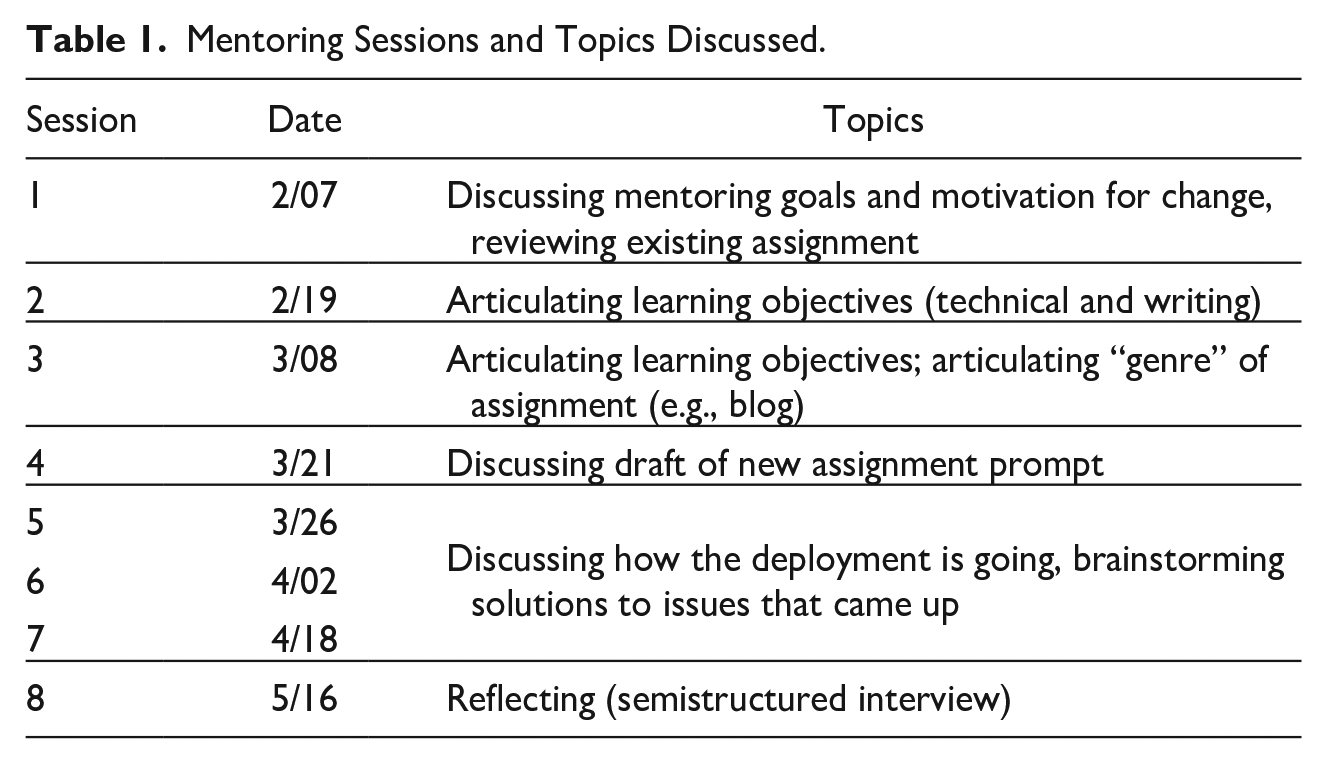
In the mentoring phase, Angela set the objective of revising a particular writing assignment for an upper-level course in environmental microbiology, noting that the assignment was not serving the purposes she wanted. Our main objective as mentors was to assist her in adapting and implementing aspects of writing in her teaching. The three of us met roughly biweekly to work together toward this objective, for a total of eight hour-long mentoring sessions between early February and mid-May of 2018. The general arc of the mentoring work is illustrated by the main topics discussed in the sessions in Table 1. Ryan frequently presented updates on our mentoring work with Angela at our weekly meetings of the full WAES team, and we often gained insight from those discussions on how to approach subsequent mentoring sessions with Angela. 4
Mentoring Sessions and Topics Discussed.
Data Collection
As part of the faculty learning community, Angela had completed a pre-WAES survey, we had collected her assignment prompts and informal writing from the sessions and taken notes during the sessions. These data informed our early approach to situated mentoring as well as our final, more inquiry-driven session. During our mentoring work, we collected the focal writing assignment, the various versions as it developed, and related artifacts including her rubric and course syllabus. We also collected writing assignments from her other courses and drew on one of these during mentoring (as discussed later). We audio- and video-recorded all mentoring sessions, collecting roughly eight hours of intra-actions, with Julie taking detailed case notes. We received some of Angela’s notes from our sessions (embedded as comments in various iterations of the assignment in development) as well as notes she took in preparation to deploy the writing assignment. Our final session was designed as a semistructured interview (Prior, 1998; Roozen & Erickson, 2017). We asked Angela to reflect on the process of participating in WAES, across both the weekly WAES curriculum and the subsequent mentoring, and to talk us through her impressions of the redesigned assignment and assessment, as well as how students seemed to engage with the work. We draw from all these sources directly save for Angela’s pre- and postmentoring rubrics, and her course syllabus.
We would retrospectively describe our TDAR research and data collection with Angela as taking an “inquiry stance” (Stornaiuolo et al., 2017), following “connections that emerge without predetermining the nature of those pathways” (p. 70). In practice, this meant that (apart from the eighth and final session) we did not prepare interview questions before mentoring sessions but let the sessions be emergent (Stornaiuolo et al., 2017) based on/around Angela’s situated needs. We did, however, carefully inspect any artifacts that Angela sent ahead of sessions so that we could arrive with a familiarity of the work she had conducted between meetings.
Data Analysis
Analysis of data was integrative (Prior, 2004; Ware, 2022), drawing together data from multiple sources (e.g., interviews and artifacts) and highlighting patterns and intertextual links across data. An example of integrative analysis across data is showcased in the findings below. There, we highlight that Angela, prior to our mentoring sessions, wrote in a free-write: “Privately, I guess I have it in mind that upper level classes should definitely have writing assignments, that writing is ‘good’ for student.” Below, we trace that moment throughout our interview sessions that occurred months later in varied—and embodied—ways across data types (texts, audio-video records). We see that as an instance of what Stornaiuolo et al. (2017) describe as “resonance,” which “helps researchers address questions about how ideas, practices, symbols, objects, and the like become ‘shared’ and circulate across spaces and times, even when they do not seem to share direct links or traces to follow” (pp. 80–81).
As part of our integrative approach to analysis, we used three key techniques: writing-as-analysis (Ware, 2022), documented narrative (Roozen & Erickson, 2017), and analyzing embodied intra-actions (Olinger, 2020). First, Ryan produced full transcripts of all sessions. We include transcription as an analytical technique, attending to embodied activity by marking not only what was said but also how it was said. For example, gestures were marked with italics and double parentheses. Laughter within and/or across the utterance of a word was marked with an “h” in single parentheses (see Figures 3–5). After producing the transcripts, Ryan used writing-as-analysis to think about and interpret data, to connect data with other intertextually related or resonant instances, and to relate to extant scholarship in the field. These small writing exercises were, at points, brought to the whole WAES group as data exemplars for discussion. Interwoven with these analyses, Ryan produced a documented narrative (Prior, 1994; Roozen & Erickson, 2017; Ware, 2022) that reflected the complexity of our sessions and conveyed a longer-term story of the data. Presentations to and conversations with the full WAES project team throughout the analyses influenced the direction and analysis of this work, as did Ryan’s development of the concept of discursive turbulence, which was simultaneously occurring in a broader context and beginning to show up in Angela’s case.
Articulation of discursive turbulence prompted another examination of the transcripts, this time for affective markers of struggle, specifically seeking out moments where Angela was implicitly or explicitly describing her feelings about her practices related to writing instruction (e.g., see Figure 3 below). In addition to verbal markers of struggle, we went back to the original video recordings here. As Olinger (2020) points out, the analysis of visual embodied actions assists in challenging the “audio default” in ethnographic research by linking up talk with paralanguage, gesture, enactments of knowledge, and stance taking. For this analysis, we followed Olinger’s (2020) definition of and methods for studying visual embodied interactions. In analyzing the video record of moments that Ryan had initially identified in transcripts as displaying linguistically based affective signs of struggle, he tracked shifts in ways of speaking (linguistic and vocal) and marked movement with red arrows (Figure 1) to better understand the discourses Angela was embodying in the sessions. These arrows are imperfect representations, but they indicate how embodied activity is coupled with linguistic utterances in the production of discourse, and in the emergence of discursive turbulence.
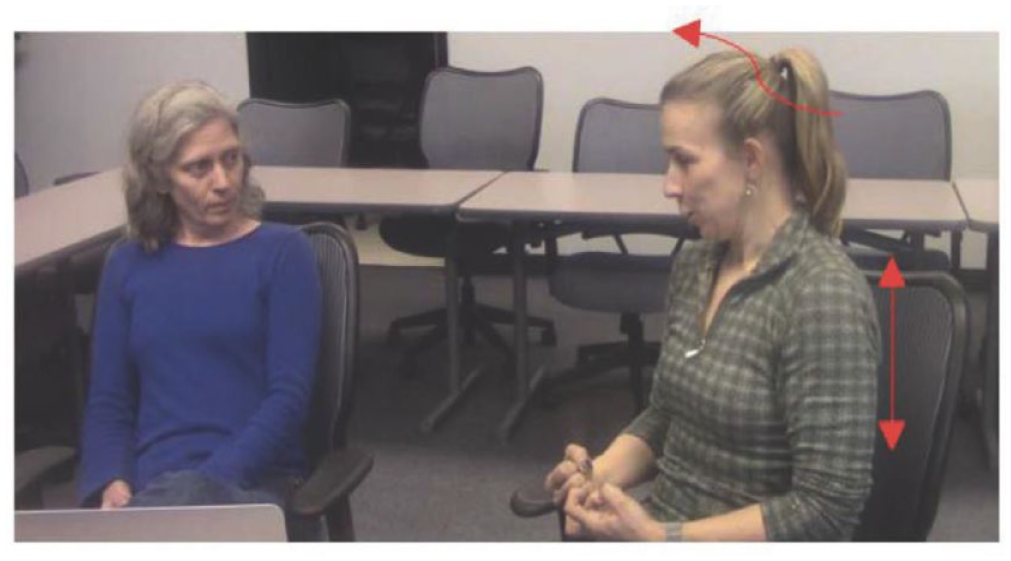
An example of screen capture marking. The arrows signal embodied activity: Angela straightened her posture (with the red, straight arrow at her back) and tilted her head to the side (with the red, curved arrow to approximate her movement) during one of the sessions. Context for this image is provided in Figure 4.
As we focused in on discursive turbulence and pedagogical becoming, that is, moments when Angela was actively negotiating and implementing facets of writing pedagogy or discourses around writing that she had encountered in WAES, two initial arcs emerged that were, in the end, key to this work. One arc traced Angela’s struggles with “genre” as form and content in ways that often indexed “product” models of writing (Crowley, 1998) rather than as dynamic forms of activity (Bazerman, 1994; Prior, 1998). The other key narrative arc emerged around Angela’s difficulty seeing her own efficacy around teaching her students about writing. We came to see these arcs as dynamically entangled. Drawing on Barad’s concept of intra-action and the sustained intervention-research cycle around TDAR helped us productively engage with them. As is usually the case with integrative analyses, these arcs prompted us to draw on additional sources of data, including Angela’s writing from WAES sessions and the evolving course materials. In the next section, we share four vignettes that illustrate these arcs and the discursive turbulence that we observed: around Angela’s remediated writing assignment as artifact, her conceptualization about what writing is, and her own sense of her ability to teach writing. The signs of discursive turbulence that we identified here are representations of the phenomenon; we do not suggest they capture the full breadth of how, when, where, or why discursive turbulence can emerge in intra-action.
Findings: Discursive Turbulence in Four Vignettes
In this series of vignettes, we present scenes from our situated mentoring with Angela. We highlight instances of discursive turbulence, particularly around her motives for assigning writing, her struggles around her conceptualization about what writing is (i.e., as activity and as what counts as writing) and writing-as-product, and her own sense of her ability to teach writing. To these ends, we highlight turbulence around the mixing of “product” conceptualizations of writing (Berlin, 1980; Connors, 1997; Crowley, 1998) with those we shared in WAES and in subsequent mentoring. We note how reflecting on her struggles (i.e., on her forms of discursive turbulence) helped her to revise her practices of assigning writing and how that turbulence played out complexly around her pedagogical becoming.
At the beginning of the WAES faculty learning community, Angela took a survey about writing and how it functioned in her courses and in relation to other courses in her department. In response to the question “In your courses, what are the learning objectives related to writing?” she wrote,
Although I use learning objectives in lectures, I don’t believe that I actually use them explicitly in writing assignments. Privately, I guess I have it in mind that upper level classes should definitely have writing assignments, that writing is “good” for students (at all levels), and I want them to use a writing assignment to more deeply explore a topic.
As shown in the vignettes below, both the surprising (for her) absence of explicit objectives tied to writing and the notion that “writing is good for students” figured importantly across her participation in mentoring. Angela noted also, “I’d like them [her students] to learn to write/communicate more effectively, but I don’t teach them how to write or communicate.” All these tensions were, in varied ways, related to Angela’s emerging discursive turbulence.
Vignette 1: Discursive Turbulence Around “Motives”
Angela’s goal for the mentoring sessions was to redevelop a writing assignment for an upper-level microbiology course in environmental sciences taken by a mix of undergraduate and graduate students. The assignment (Figure 2) was one she had been using for years, with various revisions (described below). It asked students to write a literature review in an area of environmental microbiology and present 1 or more case studies. The assignment included some attention to process, namely, submission of a topic description and some references 2 weeks before the final due date. It was introduced with a mix of form requirements (page length, bibliographic format, page margins, and font size) and content requirements and prohibitions (no plagiarism, no figures or tables from sources, synthesis of multiple articles, attention to future questions, specifics for a “Literature Cited” section). Contextually, it is important to note that Angela was redesigning her assignment during the semester while the date of assignment was fast approaching, as well as making changes to more fixed documents like her syllabus and course calendar.
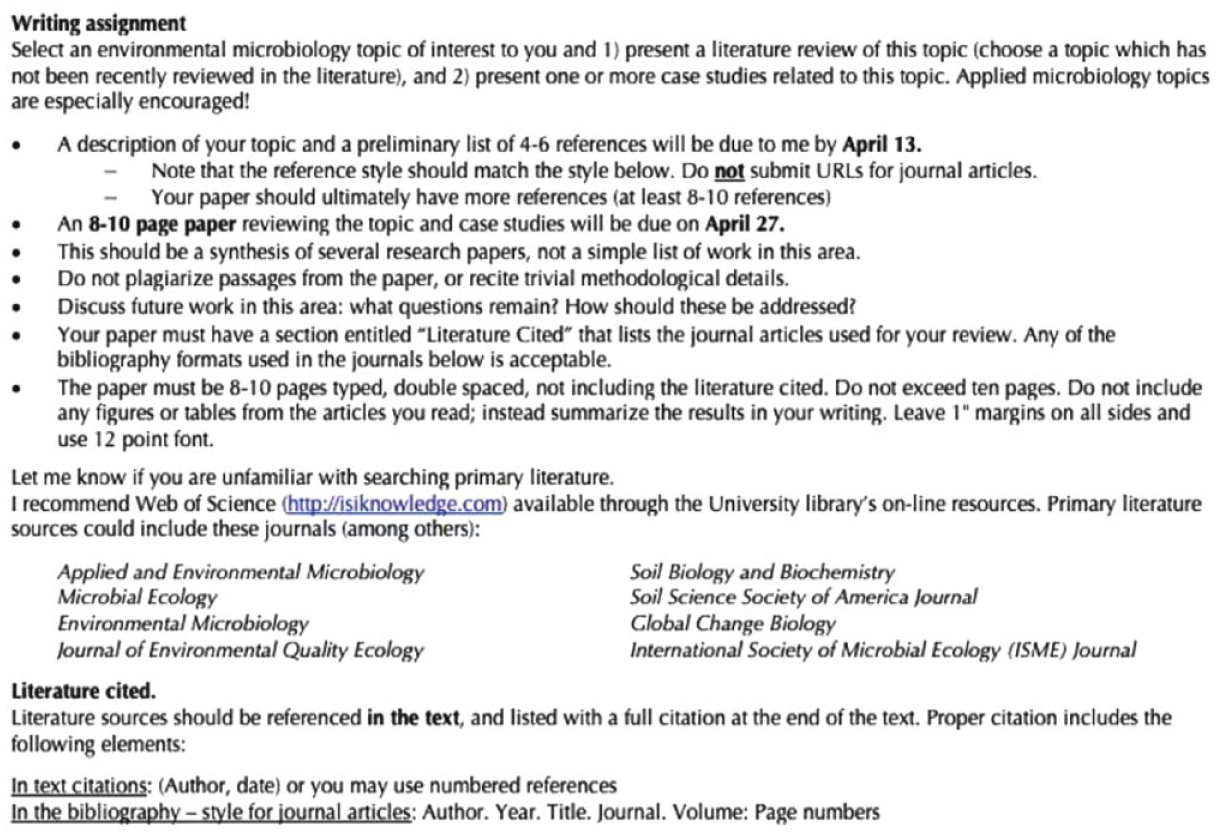
Initial prementoring writing assignment from Angela’s course.
In our first mentoring session, Angela’s first recorded utterance described her early motives for the assignment, noting she had “ideas about sharing information, everybody became an expert, my original version, was everybody became an expert in a topic and then presented it [in class and then turned in the paper].” Over time, she abandoned the in-class presentations because of her frustrations and concerns about the confusion caused when students presented incorrect information, in some cases just before the final examination (which was something she also brought up in our WAES sessions the semester before mentoring). However, Angela kept the paper. She also noted that she did not guide students through the process of preparing their work (“I didn’t have my fingers in it enough”).
Angela’s affective intensity, fluidity, and stance-taking (Olinger, 2020) stood out to us in this mentoring intra-action (Figure 3). In the top two panels, Angela addressed Julie with her palm upturned (referring to a prior intra-action), noting that the WAES sessions the previous semester called on her to examine her motives. She laughed through the word “motives” while tightening and rolling her shoulders forward. In the bottom two panels she shrugged when she said “in part” and then fleetingly enacted a figured other, what we read as a formal, stuffy persona directly voiced as saying “a thing that college classes should do.” She animated that voice: briefly straightening her posture, raising her eyebrows, and shifting her intonation. She openly noted that recognizing this part of her motivation for assigning writing was uncomfortable and laughed through the word “actually.” In the final panel, we can also see that Julie and Ryan were smiling or laughing with Angela. The embodied-semiotic character of her description was at ease and playful (not stressed and distressed) as she reflected on the problem of motives. This embodied activity suggests that what we are describing as discursive turbulence is not a purely cognitive phenomenon, but is embodied through various activity (shrugging, laughing, taking on a figured other persona) and is distributed socially (as Angela intra-acts with us, and we with her through smiling and/or laughing).
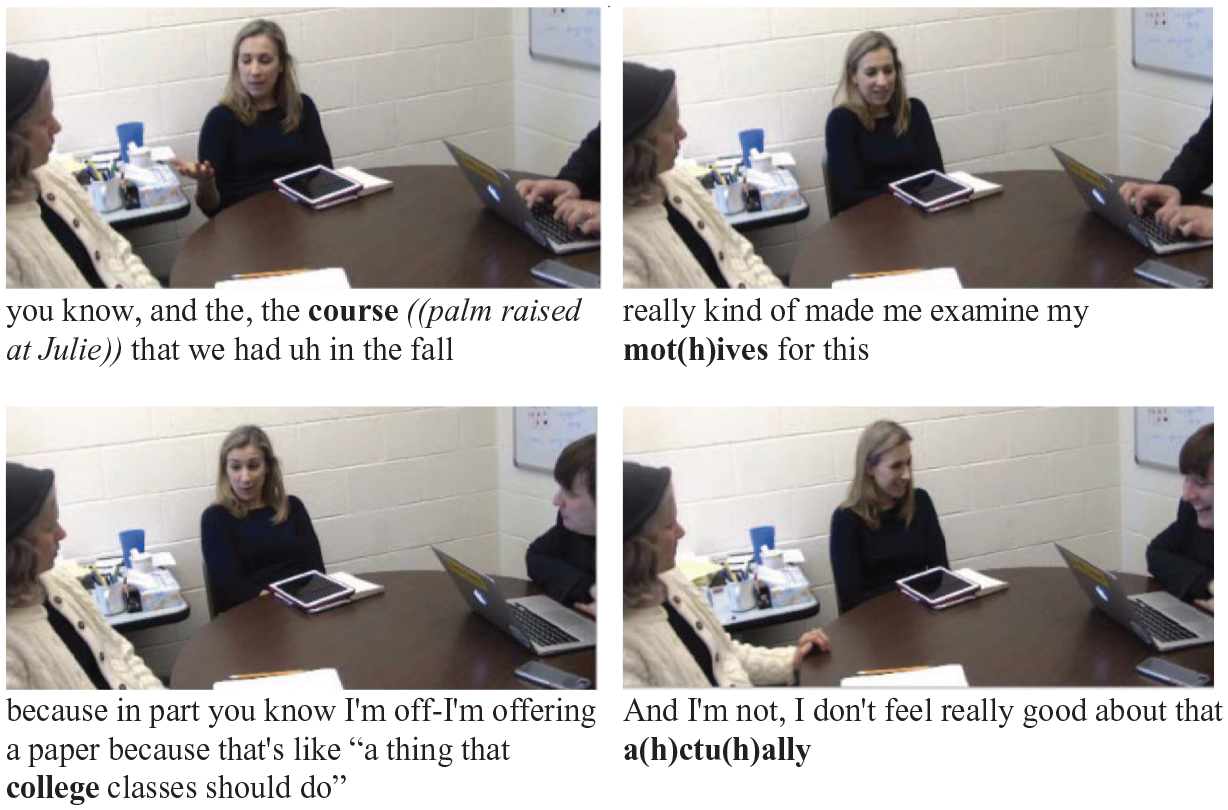
Affective intensity and embodied intra-action marking writing as “A thing college classes do.” Still images and surrounding text were extracted from a video-recording of our first mentoring session. Words marked in bold represent close approximation of word uttered at screen capture. “(h)” mid-word denotes laughter across words and stretches of words. The course referred to here was the WAES faculty learning community. Julie (left), Angela (center), and Ryan (right).
This vignette illustrates some ways that discursive turbulence can show up, including affective intensity, embodied actions and voices, and continual mixing of disparate discourses. Discussing motives for assigning writing and how Angela was feeling about her current assignment felt natural and appropriate as entries to our mentoring work together. What we did not anticipate was the many ways in which these topics would ebb, flow, shift, and resurface throughout our work together.
Vignette 2: Discursive Turbulence Around Self-Efficacy for Writing Instruction
Later in the same session, as we continued discussing what she hoped to accomplish with her assignment, Angela described tensions about whether she was improving students’ writing: “I just feel like I’m kind of beating up on them, and then if it’s dreadful writing it’s just painful to read. Um, yeah, I don’t have any mechanism for them to get better so it’s not actually very nice to them.” She also linked these tensions to difficulties around the clarity and fairness of her expectations and grades, continuing with a hypothetical example around grading one paper:
I read it, I have a sense of maybe what this paper should be graded and then I kind of massage the rubric to end up like that. . .and that’s probably part of it is I’m not giving them the opportunity to meet my expectations because maybe I’m not being clear enough about—I would say that there’s a fairly good chance that I don’t have a clear sense of what my expectations are.
That Angela typically relied on her sense of ‘what a paper should be graded’ projects her students’ writing onto idealized, perhaps fuzzy, forms. While product orientations often lead to the simplification of writing and teaching writing, in this context of mentoring we argue that it generated discursive turbulence. We read her self-evaluations here as a reflection on the discursive turbulence that she felt, particularly around describing feeling like she does not have a mechanism for students to become better writers, her feeling of doing wrong by that, and around her linking not having a mechanism for student improvement to her not knowing what her expectations for student writing are. In this intra-action, product-oriented conceptualizations seem to surface as recurrent frames for thinking about writing and teaching writing. Self-efficacy also begins to emerge as a topic.
These comments also highlight a relatively specific interpretation of what writing is, emphasizing products such as literature reviews and laboratory reports, which seems to be a common perspective for STEM faculty. Angela noted, “I have problem sets too that are not about writing styles, just about figuring out things, answering the questions, those seem very useful to the class.” She did not consider the problem sets as writing, while we would characterize them as rich writing-to-learn activities she had designed for her class.
As we moved into discussing what her writing assignment could become, discussing numerous genres including blogs, as well as shorter writing assignments that could be completed as parts of the process, discursive turbulence was visible as Angela cast our suggestions of process-based “writing” beyond the formal paper as our proposing “not writing”:
I mean, but I’m also open to the, I mean, I’d feel bad for your project if we didn’t wr—some writing thing. But I’m also open to not writing. If that serves the purpose.
In a striking way, for Angela “not writing” meant not producing a typical academic paper. Coming from a broader concept of writing, Julie countered with “you know, I think our project would argue that even if you switched to a presentation, there’s a lot of writing involved in that.” But a more restricted sense of writing-as-a-paper—and discursive turbulence around product ideologies intertwined with it—still needed to be managed over the course of our mentoring. We discuss this in our next vignette.
Vignette 3: Discursive Turbulence Around “Product”
In our second meeting, we were focused on articulating learning objectives for a new writing assignment. Continuing her reflections into motives for assigning writing, Angela noted that she became most excited about student writing when the content was “cool” or “really interesting” (e.g., one student developed a text around terraforming on Mars that Angela subsequently re-mediated as a lecture for the course) or when students took course concepts and merged them, combined them, applied them to some area that wasn’t covered. She concluded: “I think that’s. . .what I want the assignment to be, so I guess, for learning objectives, ‘how do we harness microbial processes in human endeavors?’” She expressed tension around this objective, though, because she felt like it wasn’t tied to “writing.” Here again then, we encountered tensions around what writing is, a discrete skill distinct from content and knowledge expressed in certain essayist genres or literate activity deeply tied to knowledge and only loosely related to specific genres.
At our third meeting, Angela came having reflected on her purposes for the “Writing Assignment” we were reimagining. Angela wanted to recapture the “cool” or “interesting” applications of course material in student writing. Julie, having worked closely with Angela in the past, referenced a particularly nuanced assignment from another of Angela’s classes in which students created “Wiki articles” about microbial habitats (which were published on a Wiki site), and in which they wrote around a highly specified (by Angela) genre (as form). Angela noted,
Reflecting on what my original purpose was for the assignment and because it . . . had gotten to the point where it just had its own purpose. It was “the writing assignment,” it was one hundred points or whatever, I assigned it and my rubric—and I wasn’t really thinking through what it was, what goals it was accomplishing in terms of the class. So, the conversations that we’ve had really helped me kind of think through that it . . . wasn’t tying stuff together as much as I wanted. . . . Luckily Julie reminded me of the [Wiki] assignment that I had . . . where my goal was to explicitly give them some structure . . . where I gave them expectations about what the structure was and laid it out and there was, so I was defining the genre for them I guess. So, I had a specific expectation for what it would look like and also specific expectations about how topics should be incorporated into their product as well.
Not only was Angela coming to a nuanced sense of how she wanted the writing assignment to function for the class, but she also articulated her preference for making sure student writing had clear expectations of form: a well-defined genre leading to a specific product.
Drawing on her Wiki assignment, Angela decided to have the students create blog posts that described how microbial processes are harnessed in human endeavors in ways of interest to them, reclaiming her goal of students exploring a topic, which she had noted as important in her early WAES survey. However, around this decision, we showcase another marked instance of discursive turbulence in Figure 4. This intra-action unfolded toward the end of our third meeting and illustrates Angela’s (and Julie’s) embodied activity (in contiguity with direct linguistic representations) as markers of discursive turbulence.
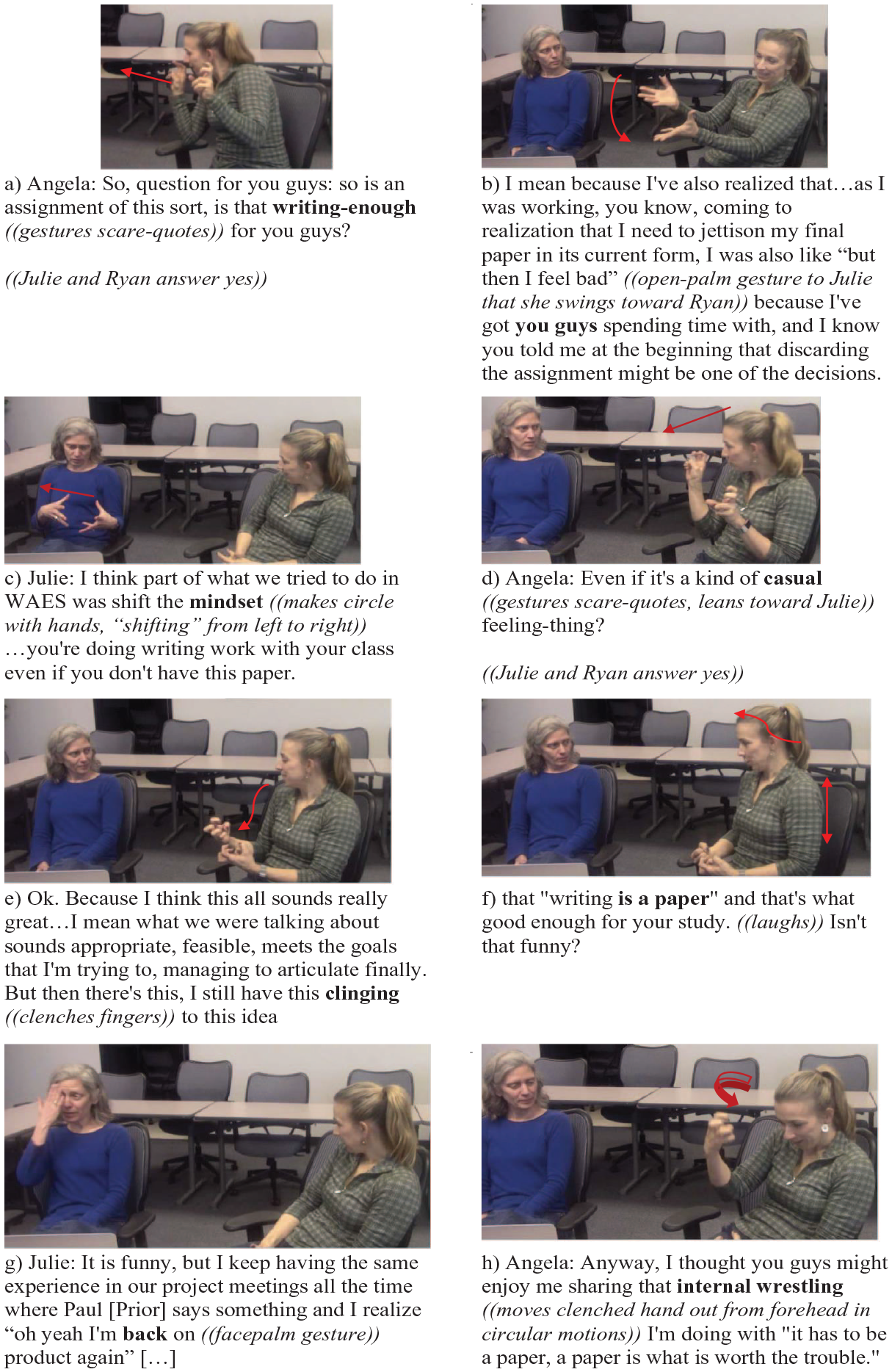
Embodied intra-actions: Wrestling with what counts as writing. Still images and surrounding text were extracted from a video-recording of our third mentoring session. Words marked in bold represent the word uttered at screen capture. Red arrows indicate directional paths of embodied actions.
Figure 4 presents a powerful scene of discursive turbulence: multisemiotic, distributed, quasi-shared, and historically conditioned (product models) and contextually conditioned (by Angela’s pointing to the nature of our WAES program as a site of TDAR “study”). Across the panels, in multisemiotic ways, Angela coupled linguistic description with embodied activity (e.g., leaning toward Julie and engaging scare quotes in panel a, uttering “clinging” while clenching her fingers in panel e, and moving her clenched hand in circular motions in conjunction with her description of internal wrestling in panel h). It highlights a distributed, quasi-shared sense of discursive turbulence in the ways in which Julie likens her struggles with slipping back into product-oriented ways of thinking to Angela’s idea that “writing is a paper.” We note that Julie helped manage the turbulence around Angela’s question about whether an assignment that clearly involved a lot of writing was writing-enough (panel a) by noting that it was one of the mindsets we were trying to shift, and she responded with a gesture that aligned with Angela’s (made in front of her torso, palms wide open, but that reversed the outward motion to make a centered circle, akin to channeling energy) and pulled the circle from left to right (see directional arrow). We argue that this segment of intra-action also highlights the historically conditioned nature of discursive turbulence in panel f. One full month after the mentoring intra-action in Figure 3, while Angela uttered “writing is a paper” she once again enacted the figure of a “formal other”: she straightened her posture (still clenching), tilted her head to the side, raised her eyebrows, and shifted to a (stilted) intonation, and she questioned her stance on product (“Isn’t that funny?”). Although it is more difficult to identify in written form, that formal other might also have been showing up in the writing she did several months prior (“Privately, I guess I have it in mind that upper level classes should definitely have writing assignments, that writing is ‘good’ for students”), with the quotes around the word good. In the mentoring meeting, she also described her struggle with “writing-as-product” and shifting to a broader interpretation of writing (“it has to be a paper”), moving her right hand out, palm up, in circular motions.
In this third vignette we see the same themes reemerging, often with strong affective intensity and embodied intra-actions, as discursive turbulence mixes ideas and as old and new orientations continue to sink and reemerge. We see this as another embodied representation of affective intensity around discursive turbulence. While Angela demonstrated other instances of discursive turbulence while revising her practices, our final example showcases an instance that we interpret as a more marked, fundamental, and longitudinal kind of turbulence.
Vignette 4: Discursive Turbulence Around Teaching Writing
After the semester ended, we conducted an interview with Angela to discuss her overall impressions of her work with WAES. Angela noted multiple times, across the mentoring sessions and then in the interview, that our work as a transdisciplinary mentoring team was beneficial, that she was learning a lot about creating and employing writing assignments. She also noted that the “products” she received from her students were much improved and that their comments about the work were very positive. Julie noted in response to Angela’s comments that it seemed to go “remarkably smoothly,” and Angela agreed:
Yeah, given that we were designing it, many moving parts, my first time doing something like this, and that we were designing it as it was being deployed, and finishing the design as it was being deployed. . . . I was very pleased with it . . . it really accomplished what I wanted it to.
Given her comments about all these successful aspects of the redesigned assignment, we were surprised to hear what Angela had to say moments later (see Figure 5).
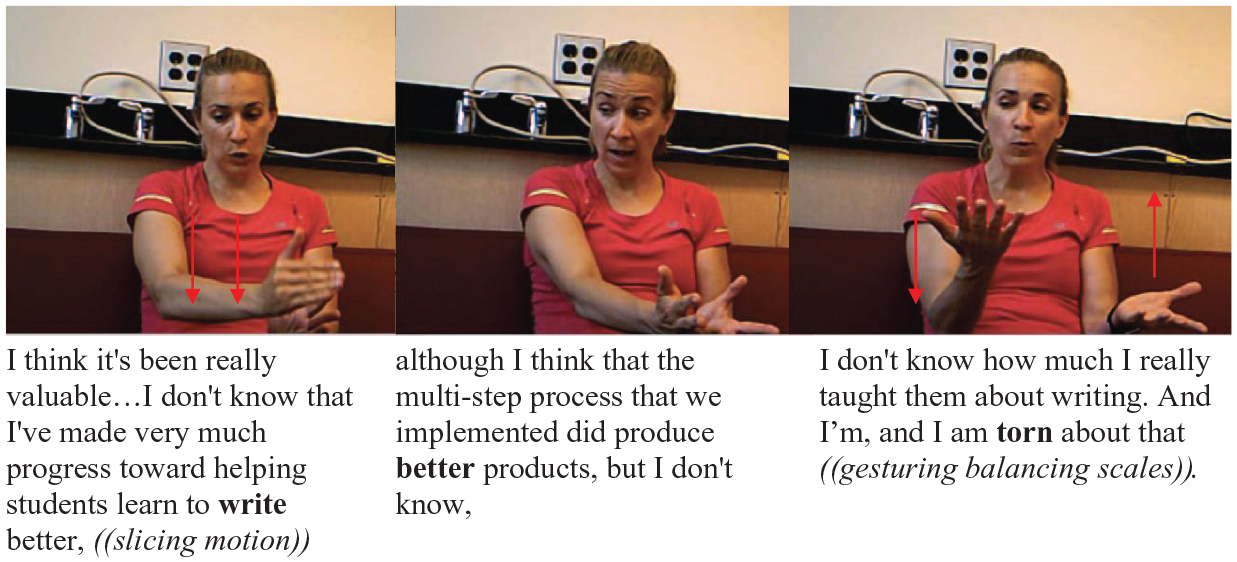
Persistent turbulence. In the final interview, Angela expresses that she is “torn” because she does not see that the redesigned assignment has helped students to “learn to write better.” Still images and surrounding text were extracted from a video recording of our final interview. Words marked in bold represent the word uttered at screen capture, and red arrows indicate directional paths of embodied actions.
As shown in Figure 5, Angela turned to her concerns that she had not “made much progress toward helping students learn to write better,” a comment accompanied by a downward slicing gesture and marked tension in her facial expressions (left panel). As Olinger (2020) has noted, such gestures may embody representations of writing styles (and in this case a related sense of writing instruction). She summed up that the students produced “better products,” making a concessive open palm gesture (middle panel), but then expressed doubt that she had “taught them about writing” and concluded, “I am torn about that,” accompanied by a gesture of balancing scales (right panel). Angela is less playful and more direct about her concern. After Angela finished speaking, Julie presented a contrasting view:
I think you’re selling yourself short there . . . if you’re teaching them that it’s a process and that you’re going to do something and get some feedback and do the next stage and get some feedback, you’re actually teaching them quite a lot about how to write.
We read this as a different, strikingly persistent sort of discursive turbulence from those we had seen during the mentoring sessions, one that was particularly surprising given the success of her new assignment.
Discussion
Discursive Turbulence in Angela’s Vignettes
The vignettes invite us to see intra-active pedagogical change around discursive turbulence as pedagogical becoming (Barad, 2007; Smith & Prior, 2020; Ware, 2022). They illustrate two major patterns of discursive turbulence across Angela’s WAES intra-actions: around her conceptualization about what writing is and around her own sense of her ability to teach writing. Discursive turbulence emerged across Angela’s trajectory of intra-action with WAES—and among and across the three of us—as our varied discourses on writing and different disciplinary histories and identities were enacted and circulated. Two intertwined threads from this mentoring case serve to illustrate what discursive turbulence is and how it can show up. First, it illustrates discursive turbulence around Angela’s conception about what writing is. The notions that writing is “good for students” and “a thing college classes should do” (see Vignettes 1 and 3) reflect product-oriented ideologies of writing (Crowley, 1998), which all of us had encountered in our disparate histories and which recurred here in turbulent patterns as our intra-actions surfaced conflicts between these ideologies and the broader, more process-oriented approaches promoted by WAES. In Vignette 3, Angela directly named aspects of the discursive turbulence she was feeling (e.g., “clinging” to writing needed to be “a paper,” “internal wrestling”). Discursive turbulence seemed marked by affective intensity in her embodied activity (and in Julie’s responsive uptakes) as well as explicitly in her utterances. Angela’s continued engagement with this tension over time and the incorporation of a less traditional genre and more process elements in her revised assignment suggests to us that a productive, dialogic space of pedagogical becoming emerged across our intra-actions.
Second, we noted recurring discursive turbulence around Angela’s perception of her ability to teach writing. Angela had noted that she does not teach students to write in her first survey response in the Fall 2017 WAES program, and across the first seven mentoring meetings, she had at times expressed doubt about her understanding of, and qualifications for, teaching writing. Looking at her actions, it had appeared that Angela had reconciled the discursive turbulence, articulating her goals for writing; designing and deploying a new assignment that incorporated process, writing-to-learn, and genre-aware approaches; and reporting success with the new assignment. And yet, as shown in Vignette 4, even with these successes Angela expressed an unsettled sense of being “torn” about how her work on the redesign, more broadly, impacted her students. When she thought about “teaching writing,” the product-based framework emerged powerfully, making palpable Prior and Olinger’s (2019) description of such ideas as zombie concepts that keep reemerging after having seemingly been dispatched. It was this arc of sharp discursive oscillations that led one of us (Ryan) to first articulate the notion of discursive turbulence.
Contextual Elements That Allowed Us to Observe Discursive Turbulence
One TDAR element that was key to this work is the interweaving of intervention and research that is characteristic of action research approaches. While our main focus during the mentoring was on helping Angela redesign her assignment, we were simultaneously collecting data and studying her pedagogical becoming, and these activities in turn informed our mentoring work. Our interventions were a success, based on the redesigned assignments’ incorporation of core concepts from writing studies and Angela’s account of its successful deployment. However, without the integrated research we would not have observed the material-discursive, turbulent processes in intra-action or developed the concept of discursive turbulence. Having recorded the mentoring meetings allowed us to identify recurring themes and observe signs of affective intensity, providing a rich dataset that helped develop the concept of discursive turbulence. Concluding with a semistructured interview provided important insights into Angela’s continuing discursive turbulence, as illustrated in the fourth vignette. Assistantships associated with the research played a vital role in affording the time for this work. Our understanding of discursive turbulence is now feeding back into our current WAES work, encouraging us to be attentive to moments where turbulence surfaces, to view them as signs of deep engagement and to be thoughtful in how we respond to them in the iterative cycling that is characteristic of action research.
A specific aspect of the WAES program that was crucial to this work is the sustained nature of our interactions with participating faculty. In contrast to still prevalent WAC workshop models, during the WAES faculty learning community, our team interacted with Angela weekly over a semester. As her mentoring team, Ryan and Julie then continued to meet with her regularly for another semester. It was during the implementation that much of the discursive turbulence emerged, much more than during the faculty learning community. In addition to our integrated intervention-research cycle, sustained intra-actions with Angela were necessary for us to observe the serious challenges to pedagogical change that happen in the situated moments, when instructors try to make useful sense of writing pedagogies in the intra-active contexts of their own course materials, their students, and their histories of practice. Developing comfort and managing discomfort with new pedagogical practices take time and work, and those moments are key to what happens after WAC workshops.
A second key TDAR element is having stakeholders engaged throughout the iterative design-intervention-assessment cycles. For us, this has meant having a core team that includes STEM faculty, academic professionals, and graduate students, along with writing studies faculty and graduate students, meeting together weekly since 2016. We codesigned our local needs analysis and codeveloped the WAES program. Other STEM faculty have become members of our broader community of practice through their participation in WAES offerings. This engagement does not just apply to the origins of our project; a deep transdisciplinary approach is also foundational to how our WAES program conducts WAC work. Both our faculty learning community and our mentoring offerings are jointly provided by STEM and writing studies professionals. We believe the transdisciplinary relationships that have developed among our core WAES team and the ways in which we cofacilitate the faculty learning community and provide transdisciplinary mentoring all reduce the potential for us to apply deficit models or make other tacit assumptions (such as assuming resistance) when investigating obstacles to change. Our core team has also been experiencing conceptual shifts themselves over the last several years and sharing those experiences with the team, which informs how we all approach interventions and, in the case of our STEM members, also provides contextually relevant pedagogical examples. The dialogue that naturally results from having a transdisciplinary mentoring team provides a bridge across disciplines first, but then also assists with the work of blurring or fuzzing the discursive formations around writing across STEM and writing studies, as the “trans-” in transdisciplinary affords. The challenges the mentoring made visible could not be addressed by referencing a discipline-specific set of unified norms for writing and expecting Angela to incorporate them smoothly into her teaching, as discourse community theory or transmission models might suggest. Rather, it took time and the circulating discursive turbulence—the dynamic ebbs and flows and continual mixing (rather than a laminar, steady flow or pattern) of disparate discourses and material-discursive practices—for Angela to provisionally reenvision her writing pedagogical practices in directions away from product-based notions. We argue that the sustained, transdisciplinary nature of WAES helps illuminate how emergent and entangled the processes of taking up new pedagogical practices are (and how challenging they can be).
Implications
Appreciating that our context is unusual, it is important to consider what broader implications discursive turbulence might have. In our experience, Angela’s case is not unique. Both our core team and our WAES participants almost always integrate new material-discursive practices in fits-and-starts, with doubt or unease, unevenly and/or uncomfortably, and with affective intensity as we saw across all four of Angela’s vignettes. As in her case, dialogic, and often tacit, sociohistoric forces and/or discourses (e.g., the many ways elements of “product” approaches to writing have become embedded in texts, practices, and people) shape motivations and conceptualizations of what writing is, and those forces make writing work more difficult. In fact, we should expect these sorts of historically entrenched, multiply embedded, and complexly connected ideologies to survive brief interventions that seek to transmit fundamentally different understandings and practices of writing/literate activity. Practitioners integrating writing into their pedagogies are likely to encounter discursive turbulence, which might derail pedagogical changes we hope to facilitate. Moreover, it might facilitate less productive pedagogical becomings, if not brought into productive, intra-active dialogic circulation. Thus, to promote sustained and effective pedagogical change and becoming, instructors need to be supported as they intra-act with multiple streams of material-discursivity and as they progressively reconfigure deeply established ideological histories in light of their historied but shifting heteropraxia.
Attention to the emergence and trajectories of discursive turbulence can also focus our attention on how disparate discursive histories, material-discursive practices, and varied agentive potentials play out in intra-action. For Angela, discursive turbulence emerged intra-actively: not only as she confronted material-discursive practices that were pedagogically different and indexed a different conceptualization of writing, but also as she confronted identity issues around her self-efficacy, around considering herself as qualified to teach writing as a skill in her field or seeing that her exceptionally productive work actually taught students something about writing. This discursive turbulence fundamentally challenges transmission models of writing pedagogy, particularly of writing-across-the-curriculum, illustrating that Angela’s conceptualizations of teaching writing remained in flux, that they had both changed and not changed, and that one effect was to efface what she and her students had accomplished in the revised writing tasks. The entangled tensions around the material-discursive practices in intra-action emerged, we argue, as a broader sort of discursive turbulence that played out in the material-discursive field we created and re-created over a series of sessions and was foregrounded prominently in Angela’s reflection during our final meeting. The story of her pedagogical becoming is not a just-so story, but one that will continue along complex, nonlinear pathways.
We began to observe discursive turbulence as we analyzed sustained intra-actions with people affiliated with various disciplines. However, from a dialogic perspective, all communicative activities and spheres are heterogenous (products of many disparate histories), so all material-discursive intra-actions are likely to exhibit chaotic fluidity and mixing and may not be characterized by the kind of steady flows or patterns transmission models typically imagine (and then only because of the challenging, ongoing work of hardening; see Latour, 1987). If not brought into productive tension, discursive turbulence may encourage reentrenchment of tacit beliefs and practices. To the extent that any evidence-based pedagogical change requires the participant to engage with results and ways of thinking that emerge heterodisciplinarily, discursive turbulence might then be a foundational concept, an intrinsic element of pedagogical becoming. In other words, we suggest that discursive turbulence is a typical—not exceptional—phenomenon and is central to learning and becoming, and particularly, in this case, to pedagogical becoming.
What might continued investigation of discursive turbulence look like, and how might it support learning and becoming? Potential starting points include attention to affective intensity and embodied activity (Olinger, 2020) during intra-actions, as these often drew our attention to points where discursive turbulence emerged during our work with Angela. We are also finding Stornaiuolo et al.’s (2017) “transliteracies framework” to be generative in that it accounts for practices as highly unstable and mobile. Their framework is predicated on a strong conceptualization of materiality and emergence. These features might help us trace the development of discursive turbulence through intra-action, as well as mobility and longevity of features of the turbulence. Finally, we are finding a number of Hengst’s (2020) theoretical-methodological frameworks generative. Tracing individuals’ (or groups’) patterns of participation in sociomaterial spaces, and tracing discourse phenomena that disrupt those patterns, could be fruitful in tracing discursive turbulence, as it has been for our tracing of the situated complexities of our mentoring with Angela.
While it would be too speculative for us to offer particular practices that might help navigate discursive turbulence productively, the concept has already informed how we approach the WAES work we are doing in important ways. For us, expecting turbulence has shifted our mindset, leading us to view signs of contradiction and doubt as key to a process of foundational change: as opportunities rather than setbacks. It has also drawn our attention to the need to surface and engage with existing (and often tacit) ideologies. At a programmatic level, our understanding of discursive turbulence has also strengthened our commitments to (a) providing longitudinal support offerings and (b) assessing our impacts based on pedagogical changes and students’ writing identities and behaviors.
Footnotes
Acknowledgements
We thank Angela Kent for her honest and thoughtful participation and the WAES team (past and present) for insightful suggestions. We also thank Paul Prior, anonymous reviewers, and editors Chad Wickman, Mya Poe, and Dylan Dryer for feedback that improved the manuscript.
Declaration of Conflicting Interests
The authors declared no potential conflicts of interest with respect to the research, authorship, and/or publication of this article.
Funding
The authors disclosed receipt of the following financial support for the research, authorship, and/or publication of this article: This material is based upon work supported by the National Science Foundation (under IUSE grant number 2013443). Additional support was provided by the Grainger College of Engineering’s Strategic Instructional Innovations Program, the Center for Writing Studies, and the Departments of Civil and Environmental Engineering, Crop Sciences, and Physics at the University of Illinois at Urbana-Champaign.
