



Abstract
Writing and genre scholarship has become increasingly attuned to how various nontextual features of written genres contribute to the kinds of social actions that the genres perform and to the activities that they mediate. Even though scholars have proposed different ways to account for nontextual features of genres, such attempts often remain undertheorized. By bringing together Writing, Activity, and Genre Research, and Multimodal Interaction Analysis, the authors propose a conceptual framework for multimodal activity-based analysis of genres, or Multimodal Writing, Activity, and Genre (MWAG) analysis. Furthermore, by drawing on previous studies of the laboratory notebook (lab book) genre, the article discusses the rhetorical action the genre performs and its role in mediating knowledge construction activities in science. The authors provide an illustrative example of the MWAG analysis of an emergent scientist’s lab book and discuss its contributions to his increasing participation in medical physics. The study contributes to the development of a theoretically informed analytical framework for integrative multimodal and rhetorical genre analysis, while illustrating how the proposed framework can lead to the insights into the sociorhetorical roles multimodal genres play in mediating such activities as knowledge construction and disciplinary enculturation.
The “study of writing and rhetoric in science,” as Wickman and Fitzgerald (2019) have observed, is “an area of inquiry that spans decades and continues to provide the field [of writing studies] with new and compelling insights related to writers, texts, and discourse practices” (p. 3). Included in these insights is the view that writing shapes disciplinary knowledge in science (e.g., Bazerman, 1988; Reid, 2019; Wickman, 2013, 2015). Indeed, in academic research contexts, writing is not only something that scientists do often, if not constantly (Emerson, 2016), it is also a practice that serves to enact disciplinary ways of knowing, doing, and arguing (Prior, 2009). How disciplines shape, and are shaped by, writing is largely enabled by typified socially situated discursive practices of a disciplinary community, or genres (e.g., Miller, 1984, 2015; Tardy, 2012; Tardy et al., 2020). Perhaps the most visible, “pre-eminent” (Hyland, 2010, p. 117), or “privileged” (Räisänen, 2015, p. 136) genres in science are “research-paper genres (experimental, theoretical and review articles and conference papers)” (p. 135), which tend to be closely associated with the creation and dissemination of knowledge claims (e.g., Hyland, 2015; Myers, 1985). However, as Thieme (2021) notes, “The majority of the text genres produced in daily academic work . . . are hidden from general view” (p. 1). These less visible, “special” genres “of scientific writing” (Holmes et al., 2003, p. viii) that “support the research publication process but are not, themselves, part of the research record” (Swales, 1996, p. 46) have been viewed as relatively occluded (Swales, 1996). Such occluded genres, as, for example, laboratory notebooks (Holmes et al., 2003; Wickman, 2010) and presentations given in smaller research teams and science laboratories (e.g., Wickman, 2013), have been shown to significantly contribute to the construction of disciplinary knowledge.
By studying rhetorical and linguistic practices of writers in the sciences, scholars have been able to explore questions of how written genres shape shared disciplinary assumptions and practices of scientific communities (e.g., Emerson, 2016) and investigate how students “enculturate into disciplinary-appropriate practices” as they develop disciplinary competencies (Bazerman et al., 2019, p. 277). And yet, writing studies still has much to learn about the production of writing and the use of data in the disciplines (cf. Bazerman et al., 2019). Recent explorations of scientific writing have been influenced by what has come to be known as the “visual turn” (Purdy, 2014, p. 615) in communication research or the multimodal turn in composition research (Allan, 2013; Sheridan, 2010), which has inspired examinations into how visuals are implicated in the everyday writing of scientists (e.g., Rachul & Varpio, 2020; Reid, 2019). More and more attention has been paid to various embodied and interactional aspects of writing (e.g., Fogarty-Bourget et al., 2021; Mondada & Svinhufvud, 2016; O’Halloran, 2015; Weedon & Fountain, 2021). In particular, scientific texts are often characterized by the integration of linguistic expression with “visual, tactile, and other semiotic modes” (Prior & Lunsford, 2007, p. 98) and need to be approached as such (e.g., Lemke, 1998). Indeed, science serves as a “particularly rich . . . site for multimodality” (Jones et al., 2020, p. 154), where multimodality is understood as a “concept” accounting for “the different resources used in communication to express meaning” (Adami, 2017, p. 451).
Studies of writing in science (e.g., Bezemer, 2014; Reid et al., 2016; Wickman, 2015) have demonstrated that focusing exclusively on linguistic aspects of scientific texts may severely limit or distort research findings. Taking into consideration combinations of linguistic text, mathematical notation, and visual elements—which routinely co-occur in scientific writing (e.g., Coopmans et al., 2014)—is key to developing a deep understanding of the nature of disciplinary knowledge construction. Such combinations “are integral to reasoning about scientific phenomena” (Klein & Kirkpatrick, 2010, p. 87); they “have epistemic importance and ought not be ignored or subordinated in exegesis” (Gross & Harmon, 2013, p. 2). In scientific texts, these semiotic and cultural resources, or modes, combine, and enable their users to create meaningful representations (e.g., a sketch constitutes a realization of a visual mode; Jewitt et al., 2016; Kress & van Leeuwen, 2001; Lynch, 1985) through multimodal genres (e.g., Camiciottoli & Fortanet-Gómez, 2015; Jewitt et al., 2016). There have been multiple studies (e.g., Bateman, 2008; Gray, 2021; Miller & Kelly, 2017; van Leeuwen, 2011), “which seek to identify what constitutes ‘multimodality’ and to offer analytical frameworks” (Scott, 2010, p. 241); however, as noted by Hiippala (2014), “the concept of multimodal genre” still “lacks a solid theoretical foundation due to the scarcity of empirical research and analytical scrutiny” (p. 112). Thus, there is a clear need for further investigation and theorization of the combinations of multiple semiotic and “cultural resources for making meaning” (Reid, 2019, p. 70; see also Kress & van Leeuwen, 2001) in scientific multimodal genres.
In response to Hiippala’s (2014) call, we propose one such theoretically grounded analytical approach. Specifically, we draw on a combination of Writing, Activity, and Genre Research (WAGR 1 ; Russell, 1997, 2009) and Multimodal Interaction Analysis (MIA; Norris, 2004, 2019) to develop a framework for the study of multimodal genres and their involvement in knowledge-making activities of science. We then use an illustrative example of the multimodal genre of the laboratory notebook, or lab book (Latour & Woolgar, 1986; Wickman, 2010), to apply this approach to the investigation of the disciplinary enculturation of a doctoral medical physics student—an emerging scientist, to use a term coined by Emerson (2016), and further our understanding of the rhetorical action the genre performs and the role it plays in mediating knowledge construction in a medical physics laboratory.
Multimodal Writing, Activity, and Genre Research
Our exploration of how the lab book works within the context of medical physics is informed by a combination of sociocultural approaches (e.g., Berger & Luckmann, 1967; Engeström, 1987; Leont’ev, 1981b; Vygotsky, 1986) to the study of human activity and interaction.
Writing, Activity, and Genre Research
WAGR (Russell, 2009) draws, in part, on rhetorical genre studies (RGS 2 ; e.g., Bakhtin, 1986; Freedman, 2006; Miller, 1984). RGS views genres as “recurrent rhetorical acts”—wherein “significant rhetorical similarities outweigh the significant rhetorical differences” (Campbell & Jamieson, 1978, pp. 19, 21)—or, as Miller (1984) puts it, as typified and recognizable responses to recurring social situations (p. 159; also cf. Schutz, 1967). From an RGS perspective, genres develop in response to exigence, or objectified social need (Miller, 1984, 2020), for the same type of audience in a recurrent context, and they regularize human activity to enable the creation of situated knowledge (Bitzer, 1968; Miller, 1984; for a detailed discussion, please see Freadman, 2020). Furthermore, genres are not only shaped by but also shape recurring and socially defined situations and the collectives, or communities, with which they are associated (e.g., Bawarshi, 2000; Paré & Smart, 1994). Because of the close connection between genre and context, genres are best understood as dynamic, “stabilized-for-now” (Schryer, 1993, p. 208) symbolic actions that are imbued with and perpetuate a particular community’s assumptions and practices (e.g., Artemeva & Freedman, 2006; Starke-Meyerring et al., 2014). That is, since genres develop within particular communities, they (re)produce 3 the epistemological and ontological assumptions of these communities (Bawarshi & Reiff, 2010). Thus, as individuals engage in the production and use of genres, they are also engaging with the assumptions, beliefs, and values of that community (Dias et al., 1999; Schryer, 1993).
It has been observed that while RGS is useful for analyzing how genres and their configurations get things done (Artemeva & Freedman, 2006; Dias et al., 1999) in institutional and community settings, it is especially powerful when coupled with an understanding of how genre and its instantiations function as a symbolic mediational means (cf. Russell, 2009) within a larger system of human activity (e.g., Russell, 1997; Spinuzzi, 2003). Since the early 1990s, the integration of RGS (at the time referred to as North American genre theory) and activity theory (AT; Bakhurst, 1997; Engeström, 1987; Leont’ev, 1978, 1981b, 1989), known as WAGR, has been productively used in the investigation into the roles of genres in various human activities (cf. Dias, 2000; Russell, 1997). The framework we propose in this study draws on WAGR, as developed by Russell (2009), to explore the role of nonlinguistic features of the lab book in medical physics knowledge making. WAGR brings together, on the one hand, RGS, and, on the other hand, cultural-historical activity theory (CHAT; e.g., Engeström, 1987, 1999; Engeström & Miettinen, 1999). The unit of analysis in CHAT is typically defined as the Activity System (AS; Figure 1) in the analysis of a single activity (Engeström, 1987), or as multiple interacting Activity Systems (Engeström, 1987; Spinuzzi & Guile, 2019) in the analysis of multiple interconnected activities. Russell (1997) has defined the AS as “any ongoing, object-directed, historically conditioned, dialectically structured, tool-mediated human interaction” (p. 510). From this perspective, CHAT provides a way of investigating human activity through the analysis of the relationships among the subjects of the activity, Vygotskian material or symbolic mediational means, and the object of the activity as situated within the social context of the community, its rules, and division of labor in a single AS (Engeström, 1987; see Figure 1). It also provides means of analyzing the relationships among multiple related activity systems. In the literature, AS has often been visualized as an activity triangle 4 (Figure 1) that researchers use as a heuristic to investigate how the components of human activity contribute to the production, consumption, distribution, and outcome of the said activity (Engeström, 1987).
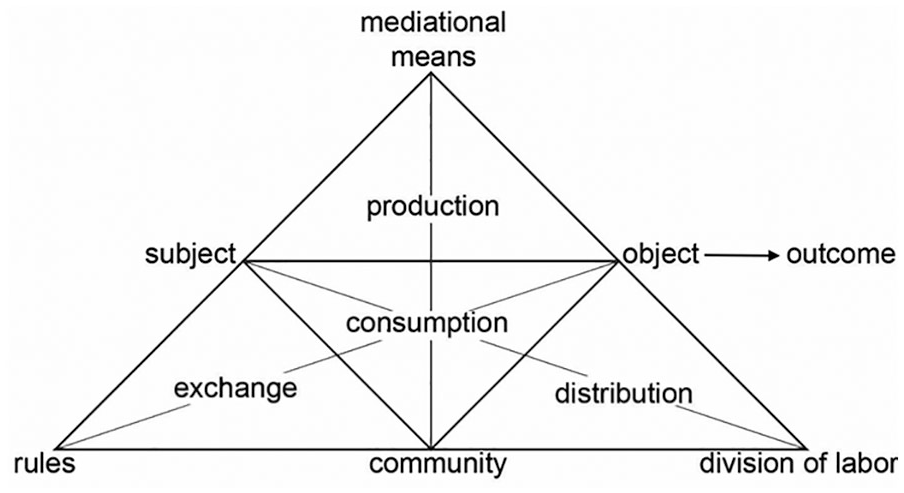
A symbolic representation of an activity system (based on Engeström’s [1987] representation of human activity).
Depending on the nature of the activity, written genres and/or their instantiations (individual texts), including that of the lab book, have been viewed from a WAGR perspective as objects of activity, mediational means, or activity outcomes (cf. Dias, 2000; Russell, 1997; Wickman, 2010, 2013, 2015).
5
Mediational means, objects, and outcomes of human activities are in reality processes and their representations, which can be symbolic, material, or both. As Bakhurst (2009) observed in his discussion of Vygotsky’s view of mediational means: Vygotsky’s interest in mediation quickly led him to become preoccupied with meaning, as he recognized that mediating artifacts do not influence us simply as artificial stimuli, but in virtue of their significance, which cannot be understood causally. (pp. 201-202, emphasis in original)
This view of mediational means as providing symbolic semiotic mediation supports our reliance on a combination of RGS and CHAT as exemplified by WAGR. Here, CHAT enables us to map out the rhetorical action (cf. Bitzer, 1968) performed by the lab book, which mediates diverse yet related activities within the medical physics community. Furthermore, we are concerned with the relationships among subjects (agents of activity), mediational means (symbolic or material means used in activity), objects (symbolic or material items being acted upon), and outcomes of the activity 6 (Engeström, 1999; Räisänen, 2015; Russell, 1997) within the AS of the medical physics lab. By unpacking these relationships, we aim to show how the lab book genre contributes to the development of a novice member of a medical physics laboratory, and how this genre is deployed as mediational means (Vygotsky, 1986) in the knowledge-making activities of that community.
Multimodal Interaction Analysis
Lab books often combine the linguistic mode (e.g., handwritten notes), mathematical notation mode (e.g., equations), visual mode (e.g., sketches), and so on (e.g., Sarini et al., 2004; Wickman, 2010) and can, therefore, be understood as instantiations of a multimodal genre. In order to fully understand the roles that this combination of modes play in human activity it is necessary to complement WAGR with an analytical approach that allows researchers to investigate the complex multimodal nature of the lab book and its contributions to knowledge making. We have adapted MIA (Bernad-Mechó, 2021; Norris, 2004, 2013, 2019) to inform our study, as “this is the only approach that was especially developed because of and for the analysis of multimodal action and interaction” (Pirini et al., 2018, p. 640). The unit of analysis in MIA is mediated action, which includes “a social actor acting with/through mediational means” (pp. 640-641), foregrounding how social actors and any mediational means they draw upon work in tandem, ensuring that neither are positioned as being static or, importantly for us, arhetorical. A key aim of MIA is to interpret and explicate human actions, distinguishing between higher and lower level actions. A lower level action is the “smallest pragmatic meaning of a mode” (Norris, 2019, p. 41), or the smallest perceivable meaningful action, like pointing in a conversation. Higher level actions are produced through “chains of lower-level mediated actions” (p. 43); thus, in MIA, a spoken conversation may be perceived as a higher level action comprised of several lower level actions, including gestures of participants, voice intonation, posture, and gaze (cf. Fogarty-Bourget, 2019). As both approaches focus on human action and mediation, MIA can be naturally paired with WAGR (Russell, 2009). MIA’s focus on mediated action makes adapting it to the exploration of multimodal genres especially generative.
MIA was originally developed to explore embodied human activity (Norris, 2004) and distinguishes between the kinds of actions that can be performed by people (embodied actions) and those that can be performed otherwise. Importantly, MIA views actions performed through semiotic resources that appear on paper as “disembodied” (p. 13) and frozen in time. But what MIA may consider frozen, RGS considers anything but—written genres are not static artifacts; rather, following Miller (1984, 2015), they are forms of social action, 7 which might be interpreted as higher level actions in MIA terminology. Furthermore, Pflaeging and Stöckl (2021) observe that “combining different modes in a variety of . . . genres is invariably guided by rhetorical considerations” (p. 319). We follow this observation in adapting MIA to explore how the lower level actions (i.e., the multimodal entries in lab books) work together to perform higher level rhetorical actions. While the kinds of actions may be different, MIA’s emphasis on understanding actions and interactions evokes the RGS emphasis on understanding social actions performed by genres. Thus, while in its original conceptualization MIA may consider the embodied action of sketching as a mode (cf. Norris, 2004) and the visual realization of the sketch itself as an outcome of an embodied action, we view sketches as realizations of the visual mode. For the purposes of our analytical framework, the sketch activates as it is read, interpreted, or otherwise elicits or enables a rhetorical action. By drawing on MIA in the study of rhetorical action, we explore how the multimodality of the lab book contributes to the rhetorical actions performed by the genre and how it facilitates knowledge construction.
Key MIA Concepts
An important concept in MIA is that of attention; that is, the degree of awareness that participants have of higher and lower level actions during a multimodal interaction (e.g., Norris, 2004, 2019; Pirini et al., 2018). To trace how participants’ attention to higher and lower level actions is mediated through modes, MIA uses an attention foreground/background continuum (Norris, 2019, Pirini, 2014). Participants may, of course, attend to several actions, thus in MIA analysis the attention foreground/background continuum traces how attention might shift between lower level actions, which often occur on the backgrounded end of the continuum (e.g., gaze, posture, gestures, intonation), and higher level actions, which often occur on the foregrounded end of the continuum (e.g., the higher level action of a conversation that is made possible by backgrounded modes; cf. Norris, 2016; Pirini, 2014). To explore how attention is focused on this attention continuum, we turn to three analytical concepts emerging from MIA: modal intensity, modal complexity, and modal density.
An MIA analytical concept we draw on is modal intensity, used to refer to the importance (or weight) a particular mode has in participants’ awareness of a multimodal action (Norris, 2004). When a mode is highly intense, it takes on primacy in an action (e.g., the action of sketching an imaging machine in the lab book is achieved through the use of the visual mode; the sketch would become a realization of an intense mode as it serves as a representation of a machine used during an experiment), and the alteration or removal of a highly intense mode changes an action or makes it impossible (Norris, 2004). The intensity of a mode is further impacted by its relationship with other modes within the interactional context (Fogarty-Bourget, 2019; Fogarty-Bourget et al., 2021). In other words, if we consider the purpose of a lab book entry and the modes enacted to achieve this purpose, one mode (e.g., the visual mode realized as a sketch) may become intensified and carry more importance than another (e.g., a mathematical notation mode realized as an equation) in performing the rhetorical action. Although one mode may have a higher modal intensity than another, the low intensity modes are not unimportant: they are more likely to contribute to actions on a background level—that is, they may be contributing to higher level (in our case, rhetorical) actions that individuals may be less consciously aware of performing (Norris, 2016).
While separate modes can take on prominence within an action, they may also act collaboratively. To understand how different modes might create meaning and enable actions through collaboration, we use the concept of modal complexity (Norris, 2004). As its name suggests, modal complexity is a means of exploring how several different communicative modes, for example, linguistic, visual, and mathematical notation modes, intertwine and contribute to the higher level action being investigated (Norris, 2019, p. 176). Unlike modal intensity, an action that is achieved through modal complexity will not have one mode outshining another. Instead, if a mode is altered in a modally complex action, this action will not be dramatically affected. In our illustrative example below, modal complexity is used as a way of analyzing the modal make-up of lab book entries where no one mode takes on a particularly high intensity and, instead, rhetorical actions are enabled through a combination of modes.
Although modal intensity and complexity may serve as analytical devices on their own, they also combine to contribute to what Norris (2019) calls modal density. The concept of modal density is directly connected with the notion of markedness (cf. Trubetzkoy, 1936). As explained by Fogarty-Bourget et al. (2021), “In common parlance, markedness is generally equated with notability of an object or phenomenon”, where unmarked refers to the ordinary, frequent, and unexceptional, whereas marked refers to the extraordinary, infrequent, exceptional, and salient. . . . In other words, that which is marked becomes the focus of attention by virtue of standing-out (Brekhus, 1998), is attention “catching” (van Leeuwen, 2005, p. 182) or “worthy” (Zerubavel, 1997, p. 51). (p. 7, emphasis in the original)
The higher the frequency or salience of an object (or the more an action stands out; that is, the more marked it is), the more modally dense it is considered. The more awareness an individual has of participating in an activity (e.g., planning experiments), the more the modes used in the interaction (e.g., modally intense visuals, in our case sketches) will indicate where attention is focused (Norris, 2019, p. 248). Modal density provides a lens for understanding how modes are involved in the production of a high-level, in our case, rhetorical, action. Using the concept of an attention foreground/background continuum, modal density is a way of analyzing how modal intensity and complexity produce and focus participants’ attention on high-level actions (Norris, 2019; Pirini, 2014). In MIA analysis, the actions with more modal density are foregrounded and the actions with less density are backgrounded (cf. Norris, 2016; Pirini, 2014). More recently, Norris (2020) has clarified the notion of modal density by referring to it as density of lower level actions within a higher level action. Thus, through the action of recording experiment results in a lab book, researchers might be focusing their attention on a lower level action of record keeping. Simultaneously, they are also engaged in a higher level action of building knowledge and preparing it for dissemination to a disciplinary audience. The researchers’ attention may be focused on a lower level action (e.g., record keeping), nested within a higher level one (e.g., knowledge building). Such an interaction is considered modally dense because of the way the researchers’ attention is drawn to a more mundane activity (e.g., inscribing in a lab book), even while the activity itself serves a higher level background action like knowledge building.
As noted above, the concept of modal density was originally developed to analyze embodied actions (e.g., Norris, 2016). In adapting this concept to the investigation of a written genre, we attend to rhetorical actions the genre performs. Thus, instead of examining the modal density of interactions through gesture, gaze, and posture (cf. Fogarty-Bourget et al., 2021), we use the concept of modal density to analyze how the multimodality of lab book entries, through sketches, mathematical notation, linguistic notes, and so on, mediates high-level rhetorical actions (see Table 1).
Key MIA Concepts Used in MWAG Analysis.
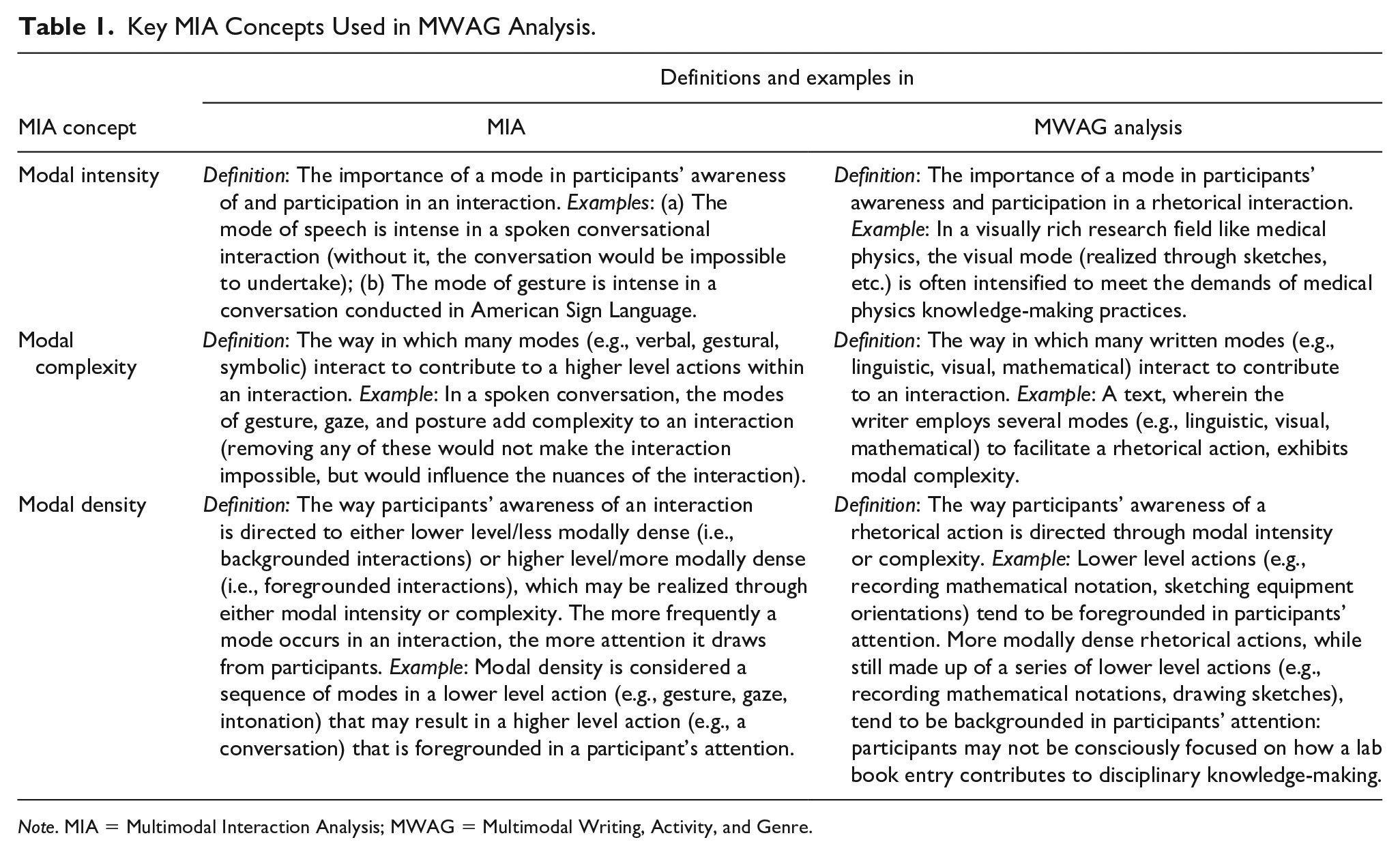
Note. MIA = Multimodal Interaction Analysis; MWAG = Multimodal Writing, Activity, and Genre.
The Multimodal Genre of the Lab Book
Within a larger study of the complex “text-person-activity-mediation-society” (Prior & Thorne, 2014, p. 35) work of a university medical physics laboratory, we have focused on the relatively occluded, hidden from the public eye (Swales, 1996)—and yet, relatively well studied (e.g., Holmes, 1990; Latour & Woolgar, 1986; Wickman, 2010)—multimodal genre of the laboratory notebook (lab book). Such notebooks represent: literary activities in their own right, circumscribing a space that lies between the materialities of experimental arrangement, or the unexplored potentials of theoretical formalisms, and the structured formats of printed communication that are released eventually to the scientific community. (Holmes et al., 2003, p. viii)
In the illustrative example presented in this article, we discuss the application of the proposed theoretical and analytical approach to the investigation of the role the lab book genre plays in the knowledge-making activity of the medical physics laboratory.
Lab books, as objects of study, reflect the authentic everyday practices of experimental scientists (Hanauer, 2014; Holmes et al., 2003; Latour & Woolgar, 1986) and are an important source of knowledge about laboratory work as they reflect the tacit knowledge and practices of scientists and allow for validation and reproduction of experimental results (Sarini et al., 2004, p. 132). This function, in addition to its role as a legal document (Roberson & Lankford, 2010), and, at times, as a collaborative tool within single labs (Walsh & Cho, 2013) and multinational research groups (Carter-Thomas & Rowley-Jolivet, 2017; Stafford, 2010), positions the lab book as a window into the routine activities of scientists (e.g., Bazerman 1999; Holmes, 1990; Wickman, 2010).
Understanding the lab book as a site for documenting and organizing the work of scientists (Bazerman, 1999, p. 75) has been especially generative from a writing studies perspective. As science has progressed to increasingly digital and technological approaches, lab books have been described as a “constructive resource” (Wickman, 2010, p. 285): a conceptual space where phenomena that cannot be seen directly are depicted, inscribed, and transformed into a material resource—one which reifies (cf. Wenger, 1998) laboratory practices. In these cases, lab books as instantiations of the lab book genre are “epistemic object[s]” (Wickman, 2010, p. 289) wherein the physical and material objects of study, and, we add, disciplinary practices, become “warranted as knowledge” (p. 289) in part through textual documentation. The lab book as a “recognizable genre, helps to close the metaphorical gap between production and use, insofar as it disciplines how inscriptions . . . are read in light of [other] resources” (p. 285). Noteworthy here is the view of the lab book as a genre, a rhetorical space where the practices of a scientific community are inscribed and used (cf. Holmes et al., 2003). The exploration of this relatively occluded genre offers a glimpse of the authentic everyday practices of scientists (Bazerman, 1999; Latour & Woolgar, 1986) that are often hidden from the outside world, while providing an opportunity to understand how these practices and activities are shaped by, and shape, the discourse within the lab book itself. Furthermore, since the lab book is central and significant in professional scientific work (Hanauer, 2014), it has potential to facilitate the enculturation of emerging scientists into authentic scientific inquiry practices (cf. Rogoff, 1990).
The combined theoretical and analytical framework developed on the basis of WAGR (Russell, 2009) and MIA (Norris, 2004), further referred to as Multimodal Writing, Activity, and Genre (MWAG) analysis, informs our understanding of the lab book as a genre which performs a rhetorical action through its various multimodal components and their interactions (cf. Campbell & Jamieson, 1978). This understanding positions the lab book as a mediational means 8 within both the activity system of the lab (Figure 1) and the complex network of activity systems of the medical physics community (cf. Spinuzzi & Guile, 2019). By drawing on the proposed theoretical and analytical framework, we pose the following research question:
How does the multimodality of the lab book genre contribute to its power as a mediational means in the knowledge-making work of the medical physics laboratory?
Using an illustrative example of a doctoral student’s use of the lab book, we employ the MWAG framework to explore how the lab book genre is implicated in knowledge making and in the disciplinary enculturation of this emergent (Emerson, 2016) member of the medical physics community.
Method
The illustrative example discussed in the article is part of a longitudinal multiphase qualitative research project, which focused on the culture of a group of medical physicists working at a university medical physics unit who were at different stages of their careers at the time of the study (Doody, 2015). The research project followed an emergent research design, which enabled us to be responsive to unforeseen events occurring during the research process (e.g., Charmaz, 2006, p. 25) and allowed us to approach the research process as generative; that is, working with data revealed new questions, hypotheses, and insights, which were integrated into the research agenda (and at times shifted it), so that findings were corroborated through the subsequent stages of data generation and analysis (Schwandt, 2001, p. 100).
The research project received ethics approval from the university’s research ethics board. Written informed consent was obtained from all participants. To protect the identities of study participants, all identifying information has been altered and pseudonyms have been assigned.
Research Site and Participants
The research project was undertaken within the medical physics unit of a midsize North American Research-intensive University (NARU). This unit specializes in two major research areas in medical physics: imaging and radiation therapy. Imaging research in the department aims to improve medical imaging techniques, such as X-rays (e.g., improving contrast between bone, muscle, and fat) and positron emission tomography (PET) scans (e.g., improving the image quality of heart and lung scans). The medical physics unit is also involved in radiation therapy research, which focuses on modelling radiation treatments and developing and monitoring novel radiation therapies. As much of the research conducted within the unit has medical applications, members often collaborate with outside facilities, including local hospitals and health research centres.
To conduct a theoretically informed and analytically grounded investigation of the lab book’s role in knowledge making, we relied on theoretical sampling, a process of data collection . . . whereby the analyst jointly collects, codes and analyses the data and decides what data to collect next and where to find them, in order to develop the theory [of the phenomenon under study] as it emerges. (Glaser & Holton, 2004, para. 51).
Five members of the medical physics unit in total, each at a different point of their career, were recruited for the ethnographic research project. The participants were observed and/or interviewed in their labs and offices in the NARU medical physics unit over a span of 7 months.
For our illustrative example of MWAG analysis, we draw primarily on the data obtained from Sean (S), a doctoral student entering his final year of studies within the medical physics unit. While our main focus is on Sean, we support our analysis by using insights from established members of NARU’s medical physics unit, Professor Burke (B), Professor Poole (P), and Dr. Britney (Br), all of whom were active members of the medical physics community and graduate supervisors at the time data were collected. As such, their experiences using the lab book for research and mentoring offer insights that further illuminate its role within the medical physics research unit.
Data Collection
The first phase of the project included touring the medical physics labs located on the NARU campus and conducting preliminary observations. The tours, observations, and field notes informed a semistructured interview guide focusing on the kinds of writing the medical physicists were engaged with (see the appendix). Once the interview guide was developed, semistructured interviews with all participants were conducted (further referred to as “Participant’s pseudonym initial_INT_Date” in the references to interview data). The interviews were audio-recorded and transcribed by the first author.
Notably, Sean was not a participant we were able to observe in phase one of the project. Because his research was often carried out in hospitals and other medical environments, constraints of the ethics approval prevented in situ observations off the university premises. Nonetheless, the semistructured interview guide developed on the basis of the initial observations of other participants enabled us to conduct informative interviews with Sean at a later date.
The second phase of the study, informed by the outcomes of the interview analysis, involved collecting and analyzing lab book entries. During the interviews, study participants indicated that their lab book entries were representative of how they produced and organized their records and were illustrative of different facets of their work (e.g., collaborations, research protocols, experimental trials, research planning). A total of five lab books, each kept over approximately 3 years by five different participants, were analyzed over the course of the study. The sample of multimodal entries was drawn from among experimental entries from the beginning, middle, and end of each lab book used by participants at the time of our project in order to better understand the progression of the entries and trace the activities that the lab books mediated over time. Because participants worked in imaging and simulation research, the majority of experimental lab book entries were multimodal and included sketches (e.g., experimental set ups, equipment diagrams), graphs (e.g., of simulated radiation doses), mathematical notation (e.g., calculations of radiation angles), computer printouts, and written notes (e.g., computer code, procedures). Purely linguistic entries tended to be records of phone or research group meetings. As our focus was specifically on the multimodal characteristics of the lab book as a genre, the main criterion for the selection of the lab book entries was that the entry be multimodal. In our illustrative example below, we focus on the multimodal entries from Sean’s lab book.
The third and final phase of data collection included the development of follow-up interviews, or member checks (further noted as “Participant’s pseudonym initial_MC_Date”), often informed by the analysis of lab book entries (cf. discourse-based interviews, Herrington [1985]) and served as a means of triangulating data (Bazeley, 2013).
Data Analysis
The unit of analysis for the interviews and lab book entries was defined as a meaningful chunk of discourse, which represents a segment of discourse data “whose size and content” lend itself “to fruitful analytic reflection” that helps answer the research questions (Wertz, 2011, p. 131). In the interview data, these meaningful chunks took the form of a section of the interview transcript that communicated a complete idea and/or coherent piece of information (cf. Artemeva, 2005).
Interviews were analyzed using qualitative thematic analysis, where recurring codes that emerged from the data were grouped into categories (cf. Charmaz, 2006), which then would be further grouped under more theoretical concepts, or themes (Saldaña, 2009). When these themes emerged, they were investigated in order to understand hierarchical relationships among them and accommodate unforeseen connections within the data (King, 2004).
In the lab book, the unit of analysis was selected in a similar way: a meaningful multimodal chunk performing a mediated action (cf. Pirini et al., 2018). A meaningful multimodal chunk sometimes consisted of a whole single lab book entry, while at other times it was a portion of the entry and consisted of a collection of sketches and notes within that one entry. For example, a portion of a lab book entry from Sean’s lab book (Figure 2) constituted one meaningful multimodal chunk: it conveyed one complete idea by presenting the location of a device used to track patient movement during a nuclear medicine imaging test and that records images on a computer (PET [positron emission tomography] scan), and included a sketch of the configuration of the irradiated and nonirradiated plates and the scanner.
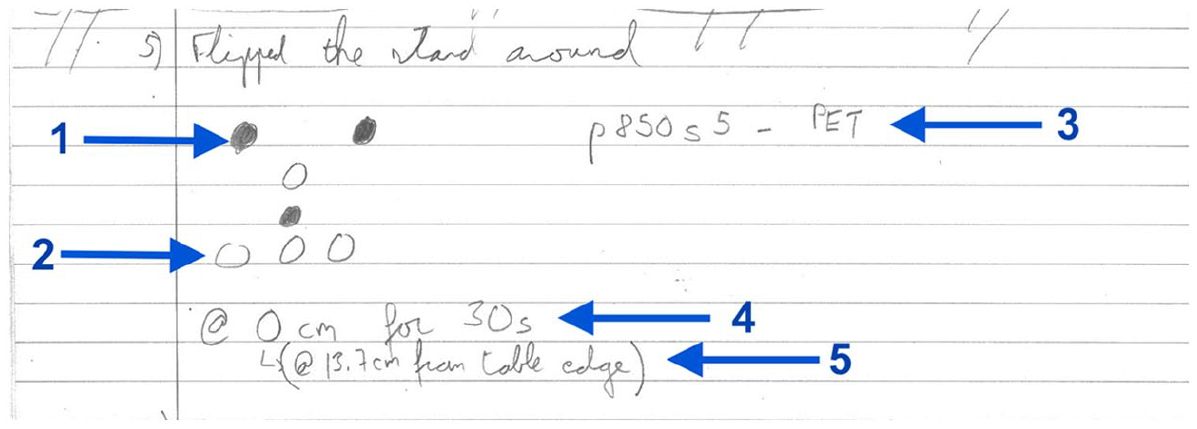
A sample meaningful multimodal chunk from Sean’s lab book, representing a tracking experiment, with: (1) dark circles representing irradiated plates, (2) blank circles representing nonirradiated plates, (3) a filename, (4) the duration of the scan, and (5) distance from the scanner.
Multimodal chunks were first analyzed inductively in much the same manner as interviews. Specific multimodal chunks were characterized by their presumed function as record keeping, analysis, procedure, or planning. This inductive analysis provided an initial framework for how the multimodal elements of the lab book rhetorically facilitated research activities. In follow-up (member check) interviews, the inductive analysis was compared with how participants explained the multimodal entries. This included their initial purpose for creating entries, how the entries were used in past research, or how they were used to guide subsequent research. Both the inductive analysis and participant interviews thus shaped our understanding of how the multimodal features of the lab book facilitated rhetorical actions of the genre (e.g., knowledge inscription, enculturation) as well as practical research activities (e.g., planning research, record keeping, note taking). Understanding participants’ use and reading of these entries allowed us to perform a more in-depth MIA analysis, characterizing multimodal lab book entries according to their modal intensity, complexity, and density.
Findings and Discussion
In this section, we use the example of multimodal entries in Sean’s lab book to illustrate the application of the MWAG framework. The analysis has allowed us to unpack how the multimodality of the lab book entries contributes to its power as a mediational means in the activities of knowledge construction and the disciplinary enculturation of an emerging scientist.
“Sketches Are a Big Deal”
Realizations of a visual mode, a common element of the lab book genre, were often mentioned by participants in interviews as an important research heuristic used to solve problems and answer questions or to plan and facilitate experiments (e.g., S_INT_July21). Participants differentiated between the kinds of visual realizations (e.g., printed out images, sketches, simulated images) as each of these visual mode realizations represented different research processes, procedures, and results. In many of the lab book entries analyzed, the visual mode took the form of drawings drawn by participants and, for consistency and specificity, we label such participant-drawn realizations found in the lab books as sketches.
During the initial multimodal analysis of the lab book entries, we noted that sketches were often deployed in combination with realizations of other modes, such as written linguistic notes and mathematical notation, especially in the entries that were created to work through research obstacles (Figure 3). Participants, such as established NARU member Dr. Britney, explained that in medical physics, describing research with verbal text is sometimes difficult: “it’s hard to describe things in words . . . [so] sketches are a big deal” (Br_MC_February2). Specifically, “[visuals] take on more of a primary role” (Br_INT1_July9) in the lab book because they succinctly represent complex physics phenomena and provide researchers with a visual research heuristic. This sentiment was echoed by Sean who also characterized sketches as being very important (a “big deal” in Sean’s own words; S_MC_December11). Sean shared that, in physics, parsing text is like, ugh, just look at the figures. So in physics most of the time you can get away by using a figure. A nice figure will tell you, will tell a physicist . . . a lot about your results. (S_INT_July21)
These visual representations were used by participants to identify mathematical solutions to problems they encountered. In one example of how sketches served to shape his research (Figure 3), Sean used his lab book to determine the correct angles to predict the future movement and location of a device used to track patient movement during a PET scan.
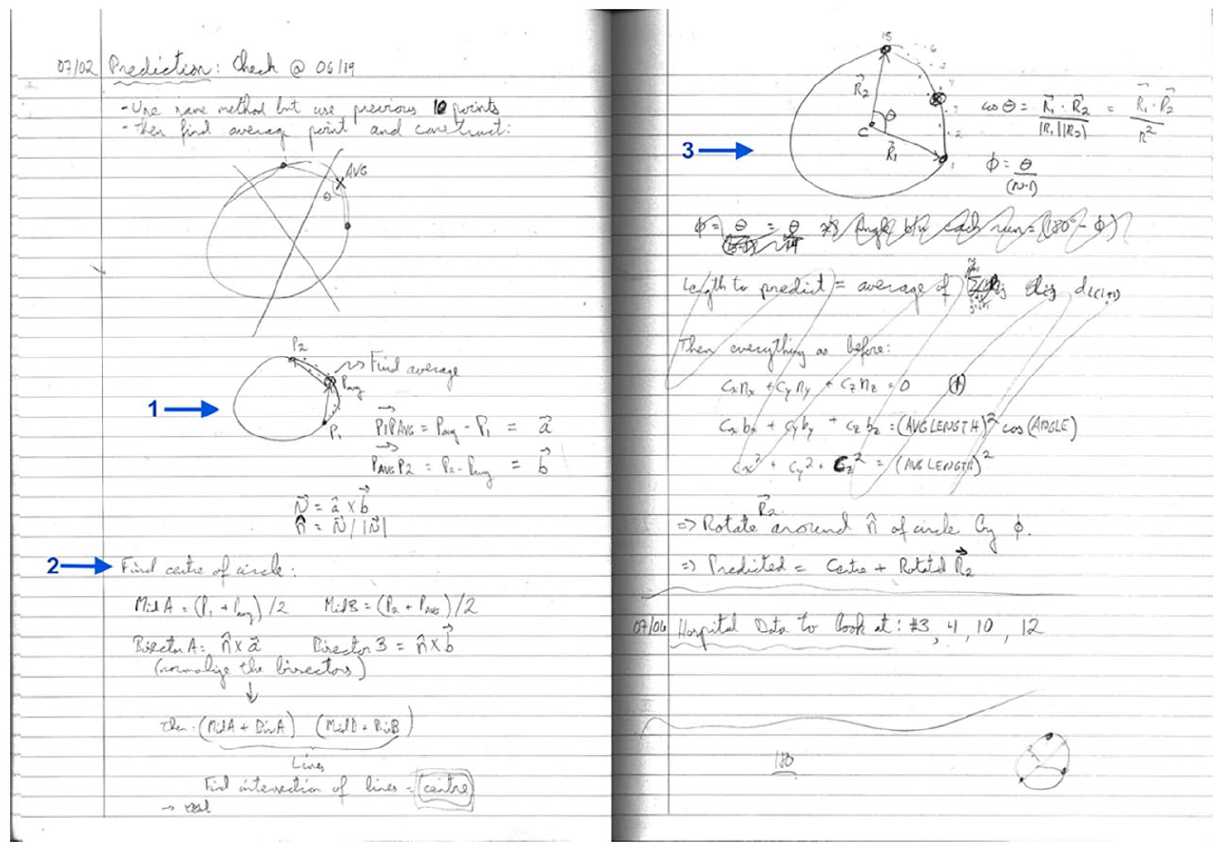
Sean’s lab book entry representing the deductive process used to calculate the motion of the track marker, where: (1) is the initial sketch, (2) is the problem to be solved, and (3) is the solution.
When interviewed about the entry shown in Figure 3, Sean explained that the sketches at the top of the lab book pages (indicated by arrows 1, 3) were especially important because he used them to derive the formulas (indicated by arrow 2) to solve the research problem, in this case, to correct for the PET scanner’s lag in data transmission, that is, the time it takes for an image to be taken, transmitted, and captured (indicated by arrow 3). The sketches served as the means of determining the required mathematics and were thus essential to how the remainder of the lab book entry would take shape. As Sean explained, “I’m drawing the situation [to] figure out, alright, what do I need to do? I need to make an assumption, so this equation will give me this . . . so I need to convert this there” (S_INT_July21). The sketches carried primacy within the rhetorical action performed by Sean’s lab book entry: they determined further content and structure of the entry (cf. Norris, 2004) by focusing Sean’s attention on a particular part of the entry and enabling him to derive the formulas to accurately correct for the scanner’s lag in data transmission. The ability of the sketch to focus Sean’s attention indicates that, in this entry, the mode had a high modal intensity: the activity of solving a problem in the research is foregrounded and Sean is consciously engaged in problem solving. Without the initial sketches, the subsequent formulas would have been more difficult to derive, or might not have emerged at all, indicating that the sketches appear to shape the activity of the entry (S_MC_December11). It is because of the modal intensity of the sketches, or their “weight” (Norris, 2004, p. 76), that they carry in this lab book entry that we identify them as being modally intense.
The presence of sketches in lab book entries produced for heuristic purposes by all study participants shows that the multimodal elements of the lab book have significant implications for knowledge construction within the medical physics laboratory and for how the lab book is able to mediate the laboratory’s activities: the sketches are key to planning research. The activities that the lab book facilitates/mediates indicate that it is a key locus of knowledge construction embedded in a complex interaction of activity systems involved in facilitating medical physics research (Figure 4). The lab book serves an important higher level rhetorical function for Sean: it plays a central role in planning research, solving problems, and enabling new experiments and simulations.
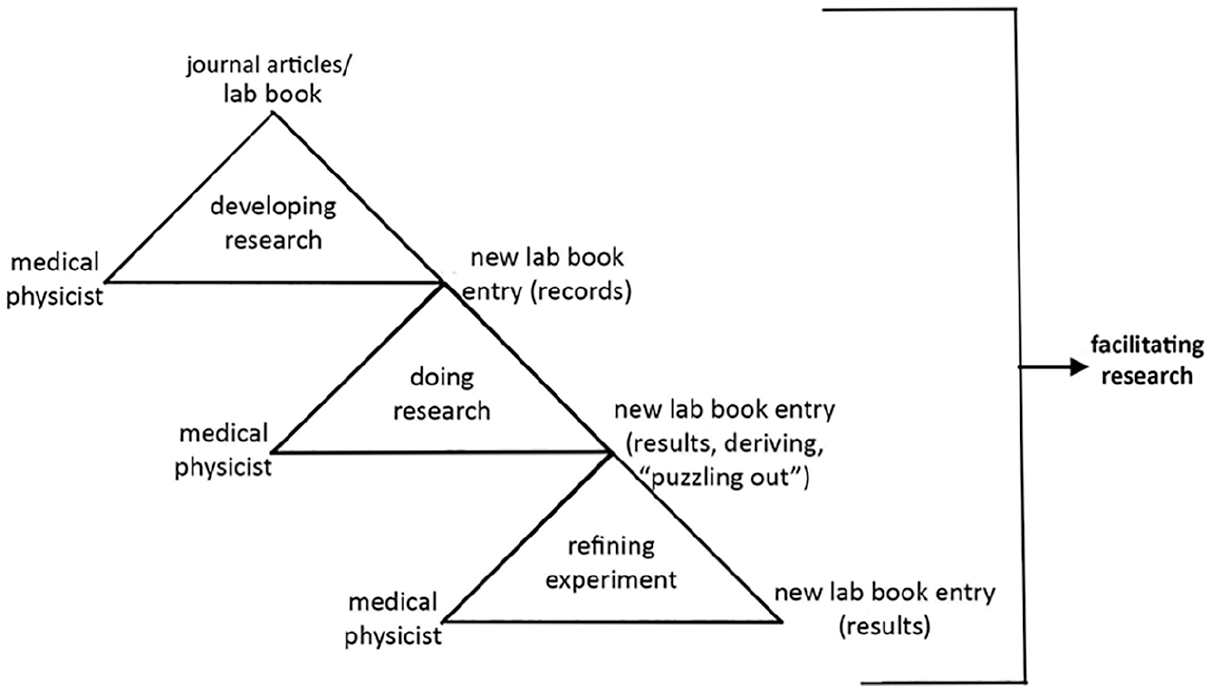
The role of the initial lab book entries as a mediational means in a complex activity of facilitating research (a simplified representation).
Figure 4 represents the process of connected sequential activities of a medical physicist (subject) working in a lab and acting upon lab book entries (object), which, from the object of the activity in a preceding activity, turn into a mediational means for the subsequent activity (cf. LeMaistre & Paré, 2004). In the lab book entries that facilitate research, sketches are central to planning and record-keeping necessary in experimental work (Sarini et al., 2004). In such entries, sketches are characterized by a high modal intensity (Norris, 2004) and their omission would presumably constrain the development of the higher level rhetorical action of facilitating research. In the multimodal entries included in the lab books of the study participants, the modal intensity of sketches focuses genre producers’ and readers’ attention (Norris, 2019) on the research questions under investigation in order to generate results. The high-intensity nature of sketches foregrounds research processes and practices associated with medical physics research.
As Sean’s lab book demonstrates, the entries are used within the activity system of the medical physics lab to plan, refine, and solve problems. When sketches serve as a central component of a lab book entry, they focus the physicists’ attention on one particular aspect of their research or on a set of salient relationships (Vertesi, 2014). Attention becomes foregrounded (Norris, 2016) on a research problem that needs to be solved (see Figure 3) in ways that can be argued and justified to the medical physics community at large, thereby reinforcing the knowledge-making practices of this community and the credibility of its members (Vertesi, 2014). Notably, the lab book provides a space for these problems and their solutions to be disciplined (Wickman, 2010), to establish how research problems are situated in and have grown out of broader questions within the community of medical physics.
Pinning Down Knowledge With Multimodality
While some lab book entries contained instances of modal intensity (i.e., modes taking on primacy in an interaction), other entries contained several, intertwined modes deployed simultaneously in a constellation (cf. Campbell & Jamieson, 1978). These entries are modally complex (Norris, 2019): instead of one intense mode focusing participants’ attention, all modes operate together to create meaning. Sean’s lab book provides an example of how modal complexity emerges in lab book entries (Figure 5).
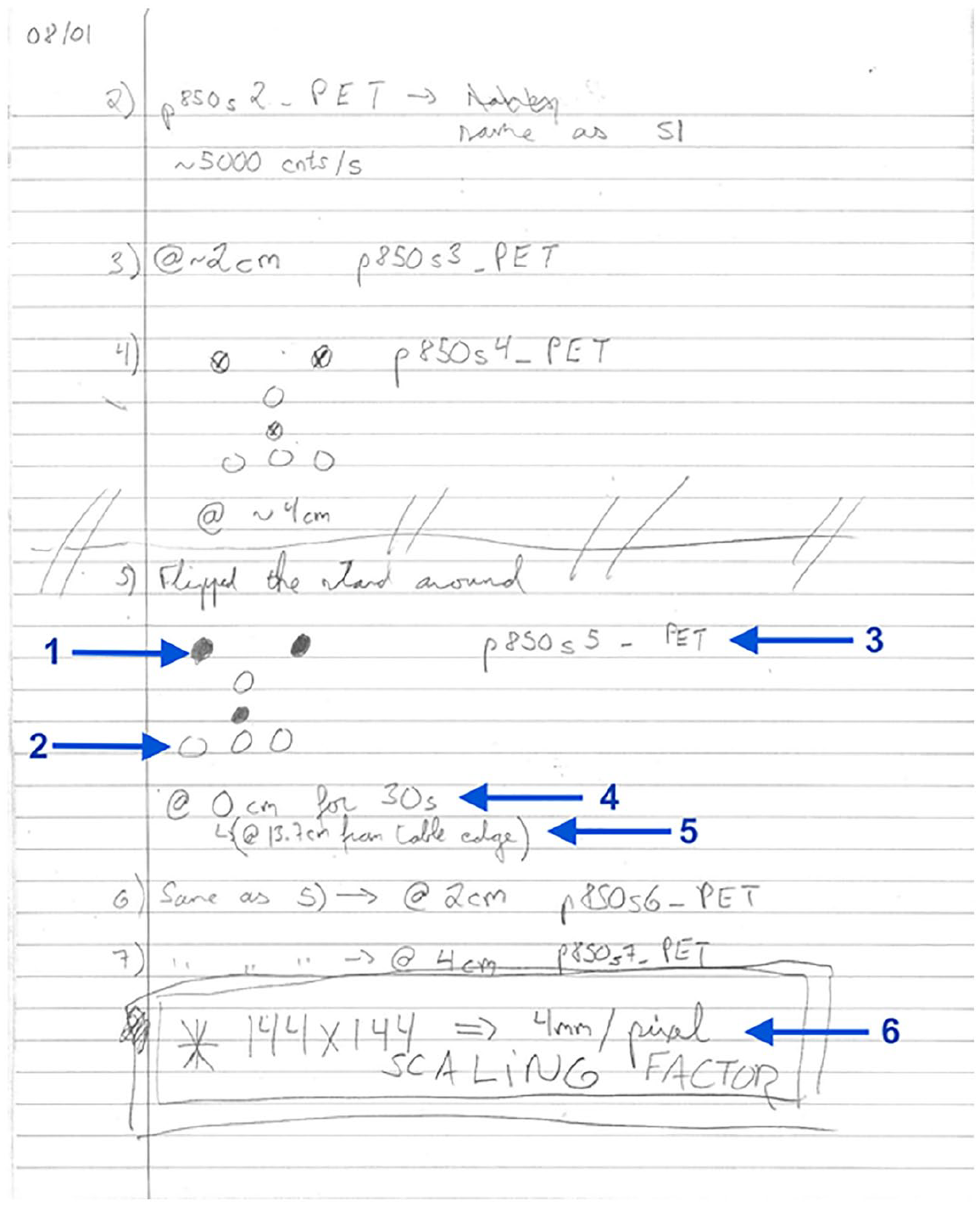
An excerpt from Sean’s lab book showing the set-up of a PET (positron emission tomography) scanner experiment with irradiated (1) and nonirradiated (2) plates, corresponding filenames for simulation results (3), length of the scan time (4), location of the plates from the scanner edge (5), and a note on the resulting scanned image (6).
In the entry presented in Figure 5, Sean drew out the configuration of one of his experimental scans for his research. When discussing this entry in an interview, Sean explained how it was essential that the different modes were integrated in order to create a complete and accurate record of the simulation and the results (S_MC_December11). Alone, none of the modes in these complex configurations created a meaningful representation of experimental work; instead, it was necessary to deploy a combination of linguistic modes alongside sketches and numerical information to mediate the research and facilitate the lab book’s higher level rhetorical action of knowledge construction (cf. Norris, 2004; see Figure 6). Sean discussed the importance of these lab book entries saying they contained “everything I needed to know . . . everything during the experiment that I needed that wouldn’t be recorded by a computer” (S_INT1_July21). This is particularly important as lab books sometimes function as a shared resource for collaborating scientists (Stafford, 2010; Walsh & Cho, 2013). Sean, in fact, acknowledged the importance of inscribing research records in his lab book, saying that “a good lab book maybe should be readable by someone else . . . whatever I do that’s really important, I try to write it . . . with someone else in mind” (S_INT1_July21). The modal complexity of the lab book entry enabled Sean to create a complete record of an experiment: he had access to computer records, but the lab book also served to record important information about the experiment.
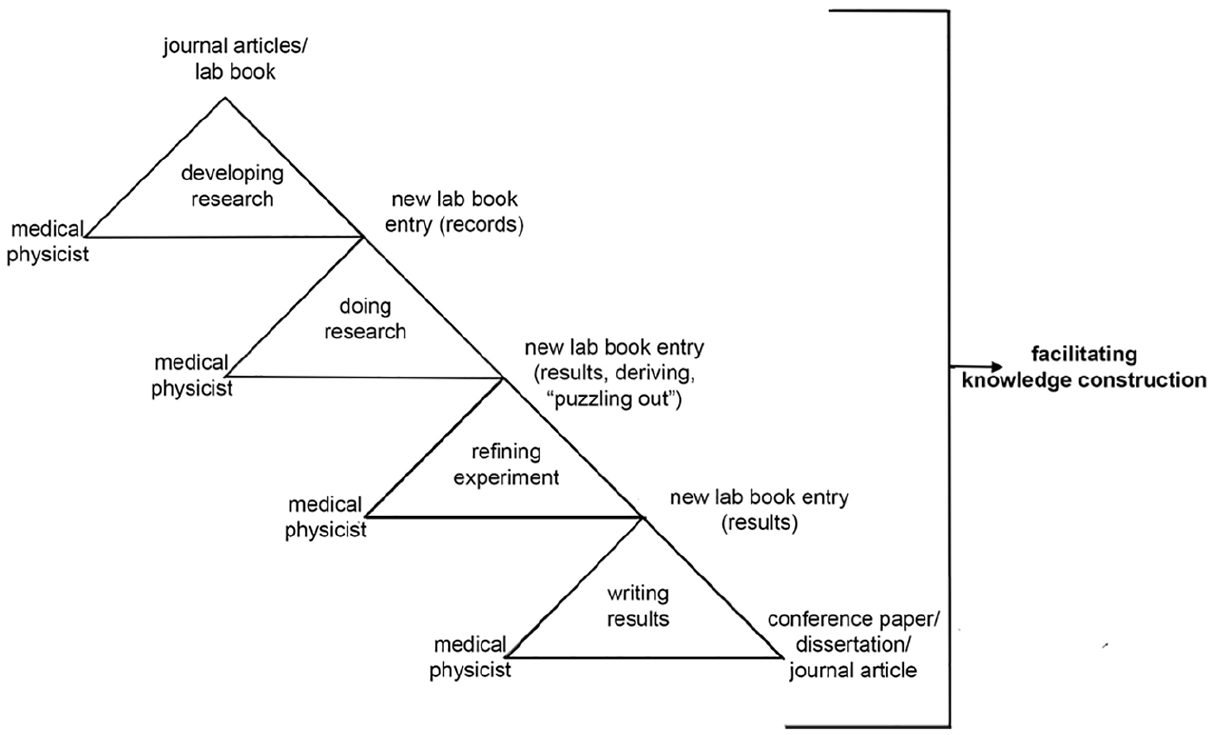
Facilitating knowledge construction (a simplified representation).
The multimodal elements of the lab book are crucial to the process of reifying (cf. Medway, 1996; Wenger, 1998) the otherwise ephemeral research undertaken by the medical physicists. The process of reification essentially serves to “congeal” experiences into “thingness” (Wenger, 1998, p. 58) by materializing abstract tools and concepts (cf. Holmes et al., 2003). Through the process of creating modally complex entries in the lab book, medical physicists reify the implicitly agreed upon ways of doing research and constructing knowledge, as well as warrant the claims emerging from objects and processes that the medical physicists have created (cf. Wickman, 2013). In our illustrative example, this is noteworthy because much of the medical physicists’ research is computer simulation based. The simulations produced within the NARU medical physics labs are transient and ephemeral objects of study, and function as spaces where “scientists can project meaning that has yet to be realized in any material sense” (Wickman, 2015, p. 67). In order to be useful to medical physicists, the computer simulations must be somehow concretized to exist materially, or be reified—a process that is enabled in part through the multimodal nature of the lab book.
The multimodal text of the lab book offers a means for the medical physicists to transform the simulations into a reified knowledge-making resource as it “realizes, pins down, and brings into the zone of the confirmed, a shared something” (Medway, 1996, p. 501). The multimodal elements within the lab book enable medical physicists to document, keep track of, and share otherwise virtual information and to record interpretations of this virtual information in a shareable resource. While it could be argued that outputs of computer simulations, and certainly the machines on which these simulations are run, are already material and concrete entities, here it is the action of recording (reifying) researcher practices into the lab book that makes them usable in the context of knowledge making (Figure 6). Furthermore, the multimodal elements significantly facilitate the interpretation of computer simulations within the context of a research problem or question, thus transforming the lab book entries into rhetorical resources that may be circulated within the medical physics laboratory, especially in those instances wherein lab books are used as shared disciplinary resources in planning, conducting, and indeed writing research (e.g., Walsh & Cho, 2013). The concretizing nature of the lab book entries, therefore, serves to congeal the ephemeral nature of the research itself and does so in order to make this research shareable with the broader medical physics community.
Writing, Drawing, and Graphing Participation in Medical Physics
The lab book is ubiquitous at the medical physics unit at NARU: every student and almost every faculty member keeps a lab book. As follows from the interviews and observations, keeping a lab book is a necessary part of doing research because it serves as a repository of records of experiments, plans, and procedures that constitute acceptable scientific protocol. As Sean explained, “if it’s an experiment, I’m gonna write down whatever parts I need in my lab book” (S_INT1_July21). The notations in the lab book are produced not only for recall purposes for the same writer at a later date but also kept for someone else: that is, the lab book can serve as a record of institutional memory for other researchers and as proof of data (i.e., evidence that the data published in journals were not falsified) should the published claims be challenged (Holmes et al., 2003; Roberson & Lankford, 2010).
When investigating entries in the lab book, we have drawn on the notion of modal density, which is used to analyze when and how modes structure attention toward and away from higher level actions, including those “beyond the focus” (Norris, 2016, p. 153, 2019, 2020), for instance, how medical physicists engage in acceptable research practices of their community.
In Sean’s lab book, sketches used when planning research—and intertwined modes of mathematical notations and verbal text used when refining experiments—focus his and, possibly, external readers’ attention on the research process itself: the process of creating and eventually disseminating knowledge claims. At the same time, these entries contribute to a background activity that performs a higher level rhetorical action: learning how to participate in the process of knowledge construction and how to do so in a way that conforms to disciplinary expectations. In other words, as students create entries in their lab books, they do so with a developing consciousness of a larger medical physics audience. Emerging members of the medical physics community use the lab book both to acquire and to engage in disciplinary practices. When students are trained to keep a lab book, they are being inducted into the disciplinary practices of medical physics—practices which are both embedded within and shaped by the lab book (cf. Bawarshi, 2000; Paré & Smart, 1994) and that result in outcomes that must be recorded multimodally. When Sean creates a lab book entry detailing the methods and schematics of a PET imaging experiment (Figure 7), he is essentially recording the disciplinary practices of conducting imaging research in medical physics. As Sean explained, such lab book entries are later drawn upon when preparing methods sections for academic publication (S_INT_July21).
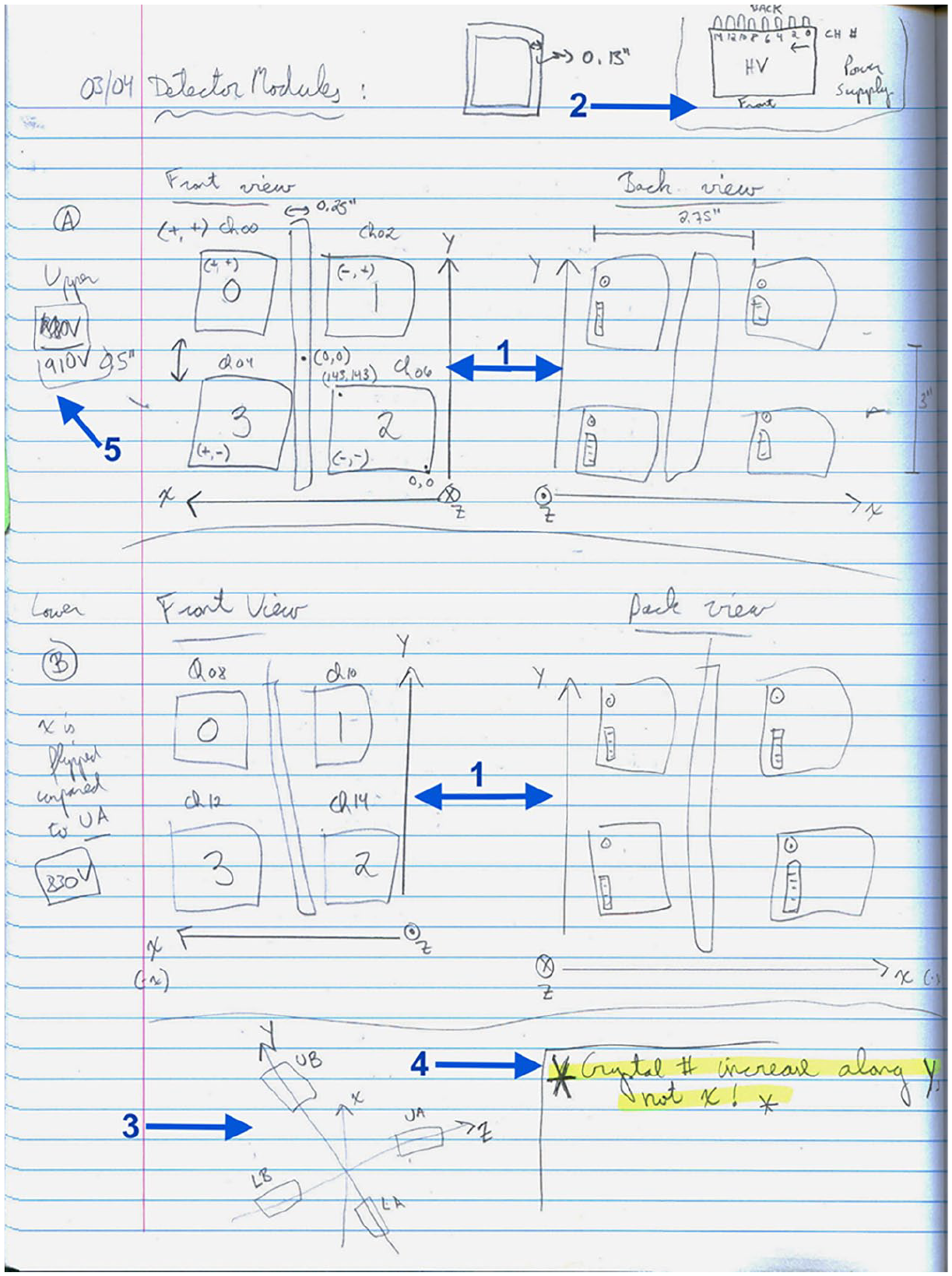
An excerpt from Sean’s lab book containing sketches of detector modules: (1) used in experiments, the scintillator crystals in the modules (2), the orientation of the modules in the lab (3), a note about determining the location of a specific scintillator crystal (4), and the voltage of the detector modules (5).
Working within the multimodal conventions of the lab book genre, Sean learns how medical physicists approach, plan, and refine research. The modal density of the lab book entry in Figure 7 provides an opportunity for Sean to learn to participate meaningfully as a member of the disciplinary community by transforming research procedures into a material resource that could be circulated among the medical physics community within NARU and more broadly—another higher level rhetorical action of the lab book (cf. Wenger, 1998). The modal density of the lab book, in this case, focuses the researcher’s attention on research procedures (i.e., accurate record keeping and schematic information), while more subtly prompting the researcher to consider how these sketches of the detector module might need to be communicated to a broader disciplinary audience. Here, then, the modal density of the lab book can be seen in how Sean’s attention is focused: the lower level action producing sketches focuses Sean’s attention on record keeping practices; simultaneously, this focused lower level action is nested within higher level actions of learning disciplinary conventions and practices, and learning to consider the expectations of medical physics audiences. While not the direct focus of attention, the higher level rhetorical action (i.e., acquiring/learning genre conventions and audience expectations) is occurring in the background, which marks the entry as modally dense. Experienced members of NARU’s medical physics unit addressed this learning and teaching purpose of the lab book explicitly in their interviews, further suggesting the importance of modally dense lab book entries in learning disciplinary conventions.
One study participant and experienced faculty member, Professor Poole, encouraged students to start writing research papers from their lab books. He advised students to go to their lab books to “get all of the figures and all of the tables together . . . basically, get all of your results together into a document because that’s what the paper’s for” (P_INT1_August19). Another experienced faculty member, Professor Burke, spoke about the lab book as a site where students learned medical physics conventions of recording results and the research process. He expected his students to “record an equation in the logbook and understand it” (B_INT1_July9). Dr. Britney, too, expressed that lab books were essential to “training grad students” (Br_MC_February2) to follow research procedures, and produce and record reliable results. Indeed, Sean revealed that he received such advice from his own supervisor. Talking about his lab book, Sean explained, “these [lab book entries] will become one of my . . . reference PowerPoints. A combination of those might become a [research] talk eventually” (S_INT1_July21). Using the lab book to train students how to undertake and, importantly, disseminate research is particularly notable because of the nature of medical physics research. The results of medical physics research are often difficult or impossible to record purely linguistically—often, results are X-ray or CT images, strings of numbers, or simulated images. The lab book, then, becomes a space for doctoral students like Sean to develop awareness of research practices and planning as well as an understanding of how to represent results multimodally and transform them into other more public genres (e.g., conference talks and manuscripts). Furthermore, these training entries can be considered modally dense (cf. Norris, 2020) as they often focus writers’ attention on learning how to record and annotate research—a lower lever action—while simultaneously using the lab book as a rhetorical space in which they may rehearse how research is expected to be communicated to other medical physicists—a higher level action, in which the lower level (at least, for doctoral students) actions of recording and annotating are nested. The dual nature of these entries foregrounds writers’ focus on the creation of medical physics sketches and recording results, while in the background of such entries, writers implicitly shape and discipline such recordings to conform to the expectations of a broader medical physics audience.
The lab book, in effect, becomes a place where multimodal realizations of research can be recorded by emerging researchers and subsequently shaped to satisfy the expectations of the medical physics community within the lab and beyond. The lab book becomes a rhetorical rehearsal studio—researchers may record and note their interpretations of research, but use the lab book as a space to discipline knowledge in recognizable forms for a medical physics audience (cf. Wickman, 2010). The multimodal entries created in the lab book are not just heuristics for the individual researchers—these records are shaped by a larger, imagined disciplinary audience, the audience that influences how research is presented in the lab book, and how the lab book serves as an antecedent (Jamieson, 1975; Rachul, 2019) for such genres as, for example, conference talks and journal articles.
The MWAG analysis once again indicates that the lab book genre plays an integral role in the work of medical physicists. Specifically, the constellation of multiple semiotic resources deployed in lab books entries mediates knowledge-making and disciplinary practices; that is, key elements of the multimodal entries, such as sketches, graphs, images, linguistic text, and mathematical notation enable the lab book’s role as a mediational means (Norris, 2016; Vygotsky, 1986).
Conclusions and Implications
In this article, we set out to develop a theoretically grounded analytical framework for the investigation of a multimodal written genre of the lab book in a medical physics laboratory. Following calls for more theoretically grounded research of multimodal genres (e.g., Hiippala, 2014) and responding to an increasing interest in multimodal genres from writing and genre research communities (e.g., Bawarshi & Reiff, 2010; Kuteeva & Mauranen, 2018; Luzón & Pérez-Llantada, 2019; Smith, 2018; Weedon & Fountain, 2021), we have proposed a theoretical and analytical framework, Multimodal Writing Activity Genre analysis, informed by Writing Activity Genre Research (Russell, 2009) and Multimodal Interaction Analysis (e.g., Norris, 2019). Since our perspective on genre was originally grounded in WAGR, our aim was to find a compatible approach to multimodality that would emphasize the notion of action. To explore written (drawn, notated, etc.) rhetorical actions in the lab book, we have adapted MIA (e.g., Norris, 2019), originally designed to investigate embodied human actions. To the best of our knowledge, this is one of the first attempts to adapt MIA to explore social and rhetorical actions performed by a written genre. We suggest that this framework may prove useful to writing studies researchers by facilitating future multimodal written genre analyses that focus on rhetorical actions genres perform.
Given that the lab book exists (in some form) in most, if not all, professional and academic research laboratories (Stafford, 2010) and is widely regarded as an integral part of research practices (Hanauer, 2014; Holmes et al., 2003; Wickman, 2010), we see it as a window into the practices that scientists are often engaged in. More precisely, we view the lab book as a written entry point to the quotidian research activities of established and novice/emerging scientists—it is, after all, through multimodal texts that research protocols and processes, experimental materials, and results are recorded and interpreted. By exploring how the lab book is produced and used in a medical physics laboratory, we have aimed to develop a better understanding of how multimodality contributes to the power of the lab book genre as a mediational means in the knowledge-making work of the medical physics laboratory, and how scientists at different stages of their career, and, specifically, a doctoral student, participate in meaningful, knowledge-producing disciplinary/professional activities (cf. Paré et al., 2009).
We applied the MWAG framework to the investigation of a doctoral student’s use of the lab book. The illustrative example presented in the article demonstrates the power of the MWAG framework in further reconciling and extending rhetorical genre and activity theory analyses. As our analysis illustrates, the multimodal lab book genre is “seriously invested with” scholarship (Swales, 1996, p. 46)—this genre appears to serve as a key mediational means in enabling the research activities of academic medical physicists. And yet, the genre remains relatively occluded (Swales, 1996) for novices and individuals outside of scientific communities.
The lab book’s existence for a relatively small audience allows it to provide a low-risk environment for emerging scientists to test out accepted research and record keeping practices, while simultaneously serving as a productive site for enculturation into such practices. Like trainees in other fields who use notebooks as a space to learn and develop professional practices (e.g., Medway, 2002; Parkinson et al., 2017), the medical physics doctoral student, Sean, used the lab book to learn and exercise the ways of the field. As we have detailed above, the visual representations (i.e., sketches), linguistic notes, mathematical notation, and other realizations of multiple modes in lab book entries enable novice medical physicists like Sean to work through research problems. By using the lab book, Sean becomes habituated (Schutz, 1967) to the practices involved in research and knowledge making, which end up included in the lab book with varying degrees of modally intense and modally complex lab book entries. Like notebooks in physics (e.g., Stanley & Lewandowski, 2016) and in other fields (e.g., Bopegedera, 2011; Hanauer, 2014), the lab book in the medical physics laboratory is a fairly private space 9 where novice community members may take more risks, experiment, and gradually discover how to write (and sketch, and derive equations) like a professional. To cite Thieme (2021), “a university student becomes a university student by enacting the many genres, written and spoken, that are associated with that role. A physicist becomes a physicist in like fashion” (p. 3).
In seeking to understand how the lab book works in the practices of medical physicists, we have illustrated how the multimodal nature of the lab book enables its rhetorical action. By conceptualizing the lab book as a genre and exploring its multimodality as a way to foreground actions facilitated by the modes used in the book, we have come to understand the multimodal nature of the lab book as being central to mediating knowledge-making work and participation in the medical physics laboratory. In the unique role played by the lab book, the multimodal components of this genre help cement it as a “durable textual resource” (Wickman, 2010, p. 285)—one wherein the acts of writing notes, creating visual representations (e.g., sketches), and performing mathematical derivations and calculations serve to bring transient objects into reified material existence while also providing a site to negotiate and engage in the accepted practices of the discipline.
We also wanted to acknowledge that in our desire to understand the role of multimodality in medical physics lab books, we made the decision to focus on entries that were obviously multimodal. 10 In doing so, we may have limited our insights to the themes emerging from multimodal analysis, potentially to the detriment of the themes that may have emerged from entries that were largely linguistic. It is worth reiterating, however, that the medical physics laboratory at NARU specializes in imaging techniques and radiation therapy modeling, both of which include significant attention to visualizations of research outcomes (images and simulations) and to the sketches and representations of imaging and medical machinery. As study participants explained again and again, medical physics research often depends on the precise positioning of equipment, radiation rays, and so on, and, therefore, finds accurate representations in sketches, mathematical formulas and calculations, and graphs. The different ways that disciplinary knowledge is reified in the medical physics laboratory notebook are central to making the lab book perform its rhetorical action. It comes as no surprise, then, that the lab books in our study did overwhelmingly rely on multimodality. In other words, the multimodal genre of the lab book is an integral part of how research is developed, refined, and eventually shared through the medical physics community. Without the affordances multimodality provides, medical physicists would lack an efficient means of working toward the larger disciplinary goals, and the genre might no longer facilitate the social goals of the discipline in the same way. Indeed, without the multimodal affordances of the lab book, the ways in which the discipline constructs knowledge, particularly in record keeping and research planning, would be altered and potentially limited. Knowledge making in medical physics, a discipline that often relies on visual data and data collection processes, would have to be undertaken quite differently were these multimodal resources unavailable. In fact, the kind of knowledge medical physicists could generate might be limited given the field’s interest in imaging and simulations. Of course, for emerging members of the medical physics community the lab book also mediates participation in meaningful research practices while providing a site to engage in the professional practices of academic medical physicists. The lab book links students into the larger medical physics community, and, at the same time, serves as a space for them to try on new professional practices (Kamler & Thomson, 2014).
Finally, looking forward to future studies of multimodal genres, we would like to turn to the following observation made by Räisänen (2015): We need to think multimodally, not only in terms of the modalities we can control and use as mediating tools, such as discourse, paralanguage, kinesic features, as well as the available technology (I will call these internal modalities), but also those modalities that may wield power and control over our performance, which are external to the performer, for example, spatial arrangements, traditional conference props and time of day, to name a few. (p. 134)
She continued by urging researchers to broaden approaches to multimodality by considering material objects as imbued with agency and taking into account such nonhuman agents involved in activities. For example, in a study of lab books, researchers may want to investigate the effects of the notebook itself (e.g., its format, materiality, affordances and limitations with regard to integrating printouts, and indexing and searching for information) on the nature of notes that are kept by scientists (what is being recorded and how). We suggest that following Räisänen’s (2015) call for “focusing on agential processes in interactions between human and nonhuman entities in social practices” (p. 135) may provide new and exciting opportunities for MWAG analysis.
Footnotes
Appendix
Acknowledgements
The authors would like to thank the editor of Written Communication, Chad Wickman, and the anonymous reviewers for their precise and insightful feedback on earlier drafts of this article. The study would not have been possible without the participants who kindly volunteered their time.
Declaration of Conflicting Interests
The authors declared no potential conflicts of interest with respect to the research, authorship, and/or publication of this article.
Funding
The author(s) disclosed receipt of the following financial support for the research, authorship, and/or publication of this article: The research reported here was supported in part by funding from the Social Sciences and Humanities Research Council of Canada.