



Abstract
This article examines the power of special topoi to characterize the discourse of literary criticism, and through emphasis on rhetorical action, it sheds light on the limitations of topos analysis for characterizing research articles in disciplinary discourse more generally. Using an analytical approach drawn both from studies of topoi in disciplinary discourse and rhetorical genre theory, I examine a representative corpus of 21st-century literary research articles. I find that while most of the special topoi recognized by Fahnestock and Secor and Wilder remain prevalent in recent criticism, contemporary literary critics tend to draw on only a select subset of those topoi when making claims about their rhetorical actions. The topoi they use most often—mistaken-critic and paradigm—help identify the ways knowledge-making work is undertaken in literary criticism, a discipline often considered epideictic rather than epistemic. But what the special topoi do not capture is precisely the distinctly motivated, actively epistemic character of this disciplinary rhetoric. Based on these findings, I suggest that special topoi must be seen as functioning in the context of the rhetorical action undertaken by literary research articles. These articles undertake not simply persuasion but the particularly humanistic act I refer to as contributing to scholarly understanding: a rhetorical action worth attending to for scholars of disciplinary discourse, because it is deliberately more concerned with practice than product.
Keywords
This article offers to do two things for writing studies. One is to update and extend our understanding of the rhetoric of literary criticism. The other is to outline an analytical method that can combine insights about disciplinary rhetoric gained from topos analysis—a lens used in several important analyses of literary criticism (Fahnestock & Secor, 1991; Wilder, 2005)—with the focus on rhetorical action offered by genre theory.
As one academic discipline among many, literary studies may have only a mild claim on our attention; as an eccentric, “problematic” discipline, according to early analyses (Fahnestock & Secor, 1988, p. 427), it may promise only marginal interest. Meanwhile, it is a neighbor against whose dominance rhetoric and composition once had to build fences to survive (Hairston, 1985, pp. 273–274), and we have sometimes approached its rhetoric with wry skepticism (see Fahnestock & Secor, 1988, 1991). But literary studies is an evolving discipline. In 2005, Wilder published “‘The Rhetoric of Literary Criticism’ Revisited,” which qualified and updated Fahnestock and Secor’s (1991) earlier analysis of the stases and special topoi that characterized academic literary criticism. Wilder (2005) found that the rhetoric of the discipline had changed markedly in two decades (p. 111): one of five special topoi that Fahnestock and Secor (1991) found in articles published between 1978 and 1982 had nearly disappeared by 1999 to 2001, when the articles in Wilder’s (2005) sample were published, while three new special topoi had emerged and risen to prominence.
My study returns again to the rhetoric of literary criticism, with an interest in both how it may have continued to change since Wilder’s (2005) study and what more can be perceived with an added focus on rhetorical action. I examined 28 research articles in literary criticism—hereafter referred to as literary research articles—published in 2015, 15 years after Wilder’s turn-of-the-century sample. While there has arguably not been the same sea change in literary studies in these 15 years as in the 20 that concerned Wilder (2005)—when, as Wilder observed, European poststructuralist theories and other social movements substantially influenced criticism—even a period of more modest disciplinary change may have an effect. In particular, certain trends in the opening decades of the 21st century may have encouraged Humanists to claim rhetorical actions that are more widely recognizable as a form of research, or knowledge-building practice, than criticism published in 1980 or even 2000. Digital Humanities initiatives, which use computer algorithms rather than artisanal interpretive methods, won major recognition (and funding dollars) in research universities; the past two decades also witnessed the ever-deeper entrenchment of neoliberal economics in university management and government granting agencies (Coleman & Kamboureli, 2011; Dobson, 2011; MacDonald, 1994). My own prior work (Banting, 2016) noted that criticism in the subfield of Canadian literature studies claimed, in 2013 to 2014, to be contributing to collective “understanding” in the field (p. 56), so I reasoned that literary criticism in North America more broadly might likewise have begun to develop a kind of knowledge-building rhetoric by 2015.
Indeed, my findings confirm that literary criticism continues to evolve, and importantly, that it has claims on our ongoing attention that ought to shift how we evaluate its rhetoric. Several key studies of how literary criticism uses language to do its work (Bazerman, 1981/2000; Fahnestock & Secor, 1991; MacDonald, 1994) have compared literary criticism to the knowledge-making, or epistemic (MacDonald, 1994), rhetoric of science and social science disciplines. While Bazerman (1981/2000) observed neutrally that research articles in literary criticism, sociology, and molecular biology each make “a different kind of move in a different kind of game” (p. 46), Wilder (2005) remarked that subsequent comparisons tended to hold literary criticism up as a “foil” to the more productive activities of science (p. 77). Fahnestock and Secor (1991), Carter (1992), and MacDonald (1994) suggested that literary criticism might be seen as epideictic rather than epistemic rhetoric: as celebrating the values of the discipline and the proficiency of the critic rather than more recognizably acting to make knowledge. MacDonald (1994) warned that literary critics might want to face the consequences of not practicing a more epistemic rhetoric (p. 197). Thieme (2017/2018), similarly, wondered whether literary critics might not want to name their analytical methods more similarly to how social-science researchers name theirs (p. 99). In highlighting how the rhetoric of literary criticism differs from knowledge-producing activity in other disciplines, these studies raise important questions about how literary critics undertake research activities. But because these studies’ comparative nature holds literary research articles to a science-based model of what knowledge is and how it gets made, they miss the chance to understand literary criticism on its own terms. Like Wilder (2005), then, the present study investigates the rhetoric of literary criticism as a distinctive rhetorical activity. It argues that studies of Humanities disciplines such as literary criticism are important because they offer ways of seeing research as potentially productive even when it is not utilitarian. Literary criticism offers a valuable example of what literary scholar Bammer (2018) calls “humanistic knowledge production” (p. 124)—a kind of contribution that foils instrumental application, that is deliberately more interested in practice than product, but nonetheless attempts to advance collective scholarly understanding.
The present study’s interest in situated, strategically motivated, rhetorical actions thus serves to enrich our understanding of literary research articles. It extends Wilder’s (2005) study by investigating how the special topoi she identified not only characterize discourse in this discipline but, more specifically, participate in the rhetorical actions that motivate one of its central research genres. Corrigan’s (2017) review of Wilder’s (2012) work and Wolfe and Wilder’s (2016) subsequent WID textbook remarked that, while they richly illuminate the topoi that characterize disciplinary discourse in literary criticism, neither of them has much to say about rhetorical purpose (Corrigan, 2017, p. 554). My work highlights purposeful research activity, as it is defined by literary research articles themselves. It is worth remarking, though, I bring together topos and action despite the absence of a supporting theory or established method. Discussions of topoi tend to connect them with stases, with the generalized act of persuading, and with the generalized classical meta-genres of the forensic, deliberative, or epideictic (as in Fahnestock & Secor, 1991) rather than with specific, situated rhetorical actions undertaken to carry out routine business for the disciplinary community. In the next section, I outline the theoretical framework in use in this study, but a more thorough theoretical account of how topoi, as features of specialized discourses, might participate in the specific rhetorical actions undertaken by members of those discourse communities, is needed. My work here begins to illuminate that participation empirically, in the case of one set of texts.
Theoretical Framework: Special Topoi and Rhetorical Action
Because of my interest in how recent literary criticism defines its own activities, the present study attempts to bring together a focus on special topoi, understood as features that characterize a particular disciplinary discourse, with a focus on rhetorical action. With the term “rhetorical action,” which has been widely used by genre theorists as a stand-in (Freadman, 2020, p. 105; Miller, 1984, p. 159; Miller, 2015a, p. 155) for the more carefully theorized concept of social action, I mean to both situate this study within the broad framework of rhetorical genre studies and acknowledge the difference between genre as social action per se and what I am examining here: the specific, motivated, social acts undertaken by individual texts within a particular research genre—the literary research article—as the texts themselves define those acts through explicit claims or implicit signaling.
Examining how individual research articles define their own actions, I am not pursuing the generic (i.e., recognizably typical or recurring) character of these texts. As Miller (2015a) argues, an investigation of singularities—of “texts, . . . persons, [or] specific communicative events” (p. 176)—is not “specifically useful for thinking about genre” (p. 176, emphasis added). Indeed, when I refer to my sample texts as exemplars of a genre, I presume the genre exists. The disciplinary discourse community that produces, recognizes, publishes, and uses these texts does treat them as instances of a certain category of text—often called “article” or “essay” or “paper”—but my study does not directly assess whether they actually perform similar-enough rhetorical actions to be recognized as embodying the same social motive (Miller, 1984) or reproducing the same social function (Miller, 2015a). As such, my study aligns closely with EAP research, which tends to emphasize texts and discrete discourse practices.
In other respects, my use of the term rhetorical action is meant to emphasize precisely what some genre researchers emphasize about the rhetoric of the texts and utterances they study (Bawarshi & Reiff, 2010; Bazerman, 1994/2019; Freadman, 2012, 2020; Giltrow, 2020; Miller, 1984, 2015a, 2015b; 2020; Swales, 1990, 2004): that is, their motivated, active character, and their interactive, dialogic responsiveness (as following Bakhtin, 1986) to situation and to potential uptake. Literary research articles claim a desire to be taken up, by their disciplinary community, as achieving something particular by way of writing. In this respect, they have the pragmatic character of the speech act that genre researchers often ascribe to genre. But the rhetorical actions they claim to undertake are individually expressed. Each one claims its own unique undertaking.
Notably, recent discussions in genre theory have raised questions about the extent to which the characteristics that define a genre are truly recurrent, and while they do not propose that a single genre might be used to undertake multiple different actions, these discussions do suggest that genres act mutably in practice. Swales (2004) recognizes the potential multiplicity—as well as the potential obscurity—of communicative purposes in a single genre (pp. 71–72). Freadman (2020) critiques the idea that a definitional exigence could reoccur across instances of genre, preferring to emphasize the specificities of local situations. And in a response to Freadman, while insisting that we perceive exigence as recurring across instances, Miller (2020) offers an example of how multiple different genres might function in one text or even in one composite genre (p. 138). So while I offer no substantial claim about genre as social action per se, I do propose the value of attending to the rhetorical actions, plural, claimed by users of a community-recognized genre.
An article’s claim to be undertaking something in particular does not singlehandedly bring those actions into effect. Indeed work on uptake (Bawarshi, 2016; Freadman, 2002, 2012, 2020; Tachino, 2016) indicates that a genre is not in sole control of its effects—whatever a text may claim to be doing, its rhetorical action will ultimately be defined by subsequent uptakes, which the text may influence but not fully determine. But a writer’s claims about their own rhetorical actions are worth attending to, especially in the case of complex research genres, like the one I study here. The claims articulate the writer’s efforts to be taken as doing something in particular, and—importantly for this study—the claims establish the immediate textual context within which special topoi operate. Given the elusiveness of the particular genre represented in my sample, moreover, its claims are of particular interest. Analysts have found literary research articles difficult to recognize as research proper. And since such texts’ mere appearance in scholarly journals does not offer much information about the recurring rhetorical situation in which they act—apart from signaling that they have been approved as acting suitably—the writers’ claims about rhetorical action offer one limited way of gauging their articles’ contributions to the discipline.
Previous studies of disciplinary rhetoric have rarely brought together topoi and rhetorical action. Topos-based studies (e.g., Carter, 2021; Fahnestock & Secor, 1991; Walsh, 2010; Wilder, 2005) tend to map patterns in a community’s discourse without examining how those patterns participate in rhetorical action, and studies of how disciplinary genres undertake rhetorical action (e.g., Bhatia, 2012; Paré, 2014; Swales, 2004; Tardy, 2003) tend to analyze arrangements of moves and steps, rather than topoi, on the occasions when they investigate discursive patterns within texts at all. Moreover, the range of approaches taken, in the instances when topoi and rhetorical action are substantially brought together, prompts questions about at what scale within the text, exactly, topoi might be operating, and how flexibly topoi may be placed within a genre’s typical arrangement. The only study, to my knowledge, that uses the vocabulary of topoi in a sustained way while focusing on genre as social action is Bawarshi (2003), which proposes understanding whole rhetorical genres as topoi, in the sense that, like classical topoi, genres are sites of invention. For Bawarshi, the crucial topos for a composing writer is the genre at hand; this topos operates at the macrostructural scale of the entire text. Bawarshi’s connection of topos to genre at the level of overall social action is suited to his theoretical approach based in rhetorical genre studies—an approach broadly more interested in the overall social actions of genres than their more microstructural textual conventions (Bawarshi & Reiff, 2010, p. 54).
In contrast to Bawarshi’s (2003) macrostructural perspective, Carter (2021) investigates special topoi acting at the microstructural level, undertaking precisely located, fine-grained activities within the overall rhetorical action of the research article. Carter (2021) identifies special topoi that help scientists generate arguments for the value of their research, and finds topoi located in a specific niche within the introductions of research articles. Carter recognizes a connection between these special topoi and the sequence of moves and steps that Swales (1990, 2004) mapped out for the introductions to scientific research articles: value topoi, Carter (2021) finds, can be correlated to specific introductory moves (p. 318). Thus, for Carter, the special topoi of interest are quite precisely located, small-scale structures of argument that contribute incrementally and sequentially to the overall rhetorical activity of the research article. Unlike Bawarshi (2003)—but appropriately, given the classical vocabulary Carter (2021) employs—Carter’s study does not specify a rhetorical activity that would characterize the genre his examples participate in, but rather treats those research articles as ultimately aiming at persuasion (pp. 311, 337).
Both Bawarshi’s (2003) macroscopic treatment of topoi and Carter’s (2021) more microstructural approach contrast with many analyses of topoi in disciplinary rhetoric, which see topoi featuring at an intermediate scale in the written text of a research genre. For example, the special topoi found in research articles in literary criticism (Fahnestock & Secor, 1991; Wilder, 2005) seem to operate at an intermediate scale, articulating lines of argument—some sustained, some fleeting—to be found anywhere within the research articles; Wilder (2005) referred to them as “fibers” in the weave of the argument (Wilder, 2005, p. 113). Similarly, Walsh’s (2010) study of the common topoi of STEM discourse sees them as flexible and pervasive building blocks of discourse that might be expected at the rate of at least one per paragraph (p. 130); in Walsh’s treatment, topoi crop up across multiple genres used by STEM researchers and are not directly indexed to genre or rhetorical action, although they may signify the relationship of researcher to topic of study, to method, and to prior research. Such treatments of topoi as flexibly arranged, midlevel features of research genres seem to align with how topoi are analyzed in other discourses—as, for instance, when Jack (2019) traces topoi as recurring motifs (p. 399) running through popular accounts of women’s wartime work, or Freadman (2012) refers briefly to tactics in the repartee of a talk-show interview as topoi, glossing topoi as “‘lower-order’ features” below the level of the whole text (p. 555).
The present study builds from work that locates special topoi at an intermediate scale within the rhetoric of that genre. I find, as follows from Fahnestock and Secor (1991) and Wilder (2005), that the special topoi of literary criticism are flexible in arrangement, available to be used at virtually any moment in a research article. But I also find, importantly, that some of those special topoi seem to be particularly useful for contemporary literary critics in describing their own rhetorical action. Certain special topoi function—not simply to persuade—but to undertake a type of humanistic knowledge-making that, my sample suggests, might be called contributing to scholarly understanding.
In what follows, I explain how I collected my sample of literary research articles, then introduce my method for identifying the rhetorical actions undertaken by these articles. Next, I review the special topoi of literary criticism and illustrate how I coded their appearance according to rhetorical function. I then discuss my findings.
The Sample
I based my sampling method closely on Wilder’s (2005), aiming for both a sample that would be representative of literary research articles published in 2015 and comparability with Wilder’s study of 28 articles. To ensure representativeness, I used circulation numbers in the MLA Directory of Periodicals to identify top-circulating North American journals publishing literary criticism, and I cross-referenced that list with Google Scholar Metrics’s results for most frequently cited journals in the discipline (Google Scholar Metrics, n.d.). Since Wilder’s set of journals did not include all of the prominent journals thus identified, I created a composite set for this study: for comparability, I sampled from all of the journals she sampled from, but I also added eight now-prominent journals Wilder had not included. 1 Like Wilder, I then selected 5% of the articles published in 2015 by each of the journals on my composite list. My choice to add specifically eight journals to Wilder’s set was relatively arbitrary: I added journals from the top of my list until, like Wilder, selecting 5% of the articles from each one would bring my sample to a total of 28 articles. See Appendix 1 for the complete list of articles.
Method of Analysis: Identifying Action, Coding Topoi
Identifying Rhetorical Action in Literary Research Articles
In order to analyze rhetorical action in these articles, I examined the writers’ own claims about the actions they are undertaking—as articulated in the articles—proposing that these claims are the best textual index available of attempted rhetorical actions. I also examined the writers’ claims about their motives, as articulated in the articles, since these claims offer an additional index.
In using the term motive, here, as with rhetorical action, I draw on rhetorical genre theory without investigating the recurrence or typicality of motive that signifies genre. Valuably for this study, genre theory emphasizes both the public nature of social motive and its imbrication with social action. Theorized as, precisely, “social” motive, motive is the acceptable, publicly recognized reason for taking action by way of a particular genre in a particular rhetorical situation (Bawarshi & Reiff, 2010; Freadman, 2020; Miller, 1984, 2015b, 2020); it is not personal and idiosyncratic but a “conventionalized social purpose” (Miller, 1984, p. 162). Accordingly, literary critics’ claims about their motives may be interpreted as indicating what their discourse community considers to be plausible, communally acceptable reasons to undertake rhetorical action through the genre. Meanwhile, studies of other research genres have emphasized how claims about motive are generally bound up with social action. Swales’s (1990, 2004) and others’ studies of the moves scientific articles make when creating a research space indicate that researchers construct exigences for their studies in order to contextualize and hence define the contributions they make in a particular article. By articulating reasons why the research activity ought to be understood as important or necessary, motive claims help to define what the article is undertaking.
Once again, as well, motive claims are particularly worth attending to in the particular case of the literary research article. As Hyland (2000) and Grav (2019) show, researchers in humanities disciplines (and literary criticism specifically) must work hard to construct a research space that might legitimately be taken to motivate their research activities: humanities research projects are often dispersed across a diffuse field (MacDonald, 1994, p. 110), rather than tightly coordinated with other studies, so they spend substantial textual space constructing motive and scholarly context. The articles in my sample often feature explicit explanations of the motives driving the research, and these claimed motives are frequently more fully articulated than their claims about rhetorical action.
Literary critics also often displace credit for what they consider the most striking rhetorical actions from themselves onto the literary materials they are analyzing, as if their primary action is to show what a literary text or cultural phenomenon has itself done: in the rhetoric of these articles, it is the poem or the novel that actively illuminates new ways of understanding the world, and the critic—motivated by the importance of these new understandings—acts to reveal that illumination to fellow scholars. (By “literary materials,” here, I mean what Linkon [2011] calls the “content of literary studies” [p. 2]: literary texts, historical contexts, theories about texts and society, and interpretive methodologies.) Moreover, as an illustration of the tight interweaving of motive and action in these articles, claims about what they are undertaking are often phrased as aspirations rather than accomplishments: as, for example, a “wish to show” that something is the case (Cecire, 2015, p. 8) or an “aim . . . to demonstrate” something (Dawson, 2015, p. 166). Claims about motive, then, contributed to my analysis of the articles’ rhetorical actions. Indeed, claims about motive and action were often so tightly interwoven that it seemed impossible to reliably differentiate them. Ultimately, I decided to code for how the special topoi were being used to express some complex of action/motive, rather than attempting to systematically distinguish the two sorts of claim.
In order to identify claims about action/motive, I examined moments where critics introduced their studies, referring directly to themselves, their work, or their articles, and explicitly naming their purposes or methods. Predictably, these moments showed up most often in early passages, but I read the full articles, attending throughout to self-referential language and meta-commentary. I also paid attention to implicit signs of rhetorical purpose, such as sustained emphases on particular questions or concepts, or trajectories in the overall line of inquiry, reasoning that the discourse community of this genre might well be sensitive to such tacit signals. Even in cases where the writer made explicit claims, I considered these more inexplicit indications of action/motive to be important, as they might substantiate, extend, or complicate the explicit claims. When I had identified the actions/motives claimed in a given article, my next move was to reread the articles, this time coding for the special topoi identified by previous studies (Fahnestock & Secor, 1991; Wilder, 2005) as discursive signatures of literary criticism—to investigate how those special topoi interacted with rhetorical action and motive. The next section explains how I did so.
Linking Special Topoi to Rhetorical Action
Topoi, understood as inventional and analytical resources used by rhetors as they compose arguments, show up as lines of argument in the final version of the arguments themselves. Fahnestock and Secor (1991) first identified the following four special topoi in published literary criticism—all operating, apparently, at an intermediate scale within the arguments.
2
I quote the following directly from Wilder’s (2005) concise summary:
To the four special topoi above, which she adopted from Fahnestock and Secor (1991), Wilder (2005) added three more. Newly appearing, these three topoi signaled to Wilder (2005) that disciplinary rhetoric had developed since the early 1980s. Here I paraphrase her explanations:
In Wilder’s (2005) treatment, these topoi were disciplinary sources of argument; they helped critics generate things to say that would strike the disciplinary community as suitable and warranted arguments. And they were observable midlevel features in the final published texts of those arguments. Both Fahnestock and Secor (1991) and Wilder (2005) additionally identified
Fahnestock and Secor (1991) and Wilder (2005) did not generally account for where in the articles’ arrangement these special topoi showed up or differentiate between the different rhetorical functions they achieved. But when briefly pointing out patterns in their use, Wilder (2005) gestured beyond topos theory toward rhetorical function. She observed that special topoi sometimes played “a significant or recurrent role in the argument” and other times “a minor role . . . warranting claims made in passing” (p. 85). She noted incidentally that the social justice topos tended to crop up most often in the concluding segments of articles (p. 99). And she began to point toward motivated rhetorical action when she remarked that the mistaken critic topos was frequently deployed early in an article, as a strategy for constructing “exigency for a critic’s new work” (Wilder, 2005, p. 102). But she also noted that “corrections of cited critics were also likely to appear throughout these articles, suggesting they served as much an ongoing dialogic function with the disciplinary discourse community”—that is, served as much as minor lines of argument—as an exigency-producing “counterclaim or gap function” (p. 102; see also Balocco, 2000). While Wilder’s (2005) composite list of the special topoi of literary criticism offers insight into recurring episodes of argument that show up in article after article, the present study attempts to observe more systematically how these lines of argument interact with motive and rhetorical action.
Like Wilder’s (2005), my method for identifying special topoi consisted of reading carefully. The special topoi are not named in literary research articles, so I coded for implicit evidence: conventional patterns of wording, such as the language of “seeing” or “revealing” and a claimed contrast between first glance and closer study that often signaled appearance/reality; rhetorical routines, such as the sequence of citation, critique, and counterargument that demarcated mistaken critic; or patterns in the management of literary material, such as the comparison of a conceptual template to textual details that typified paradigm. When I identified a topos, I identified the function it was performing in the activities of the article in that instance: whether it contributed to a claim about the writer’s actions/motives; served instead to represent an analytical method; appeared as an intermediate-scale line of argument—a discursive building-block; or functioned as a tacit warrant, bolstering argument or justifying attention to a topic.
Results
All the special topoi of literary criticism—excluding contemptus mundi but including complexity—appeared in the articles in my sample, and they appeared frequently. Table 1 shows the consistency of their recurrence across the sample, by indicating if a special topos showed up at all—playing any one of the roles I coded for—in a given article. Potential appearances, where I could neither definitely count nor discount the presence of a topos, are marked with an asterix but not counted in the final totals. As Table 1 illustrates, only 1 of the 28 articles used fewer than four special topoi; 23 articles used more than four of them. Social justice, the most seldom-seen topos, showed up definitively in 12, or 43%, of the articles; it may have been present in an additional 2. For comparison with Wilder’s (2005) findings, Table 1 indicates the percentages she reported; while some special topoi—paradigm, for example—appeared substantially more frequently in my study than in hers, and some substantially less frequently, my results are not dramatically different. The dashed vertical line bisecting Table 1 signals a drop-off in frequency between those special topoi, which showed up in at least 75% of the articles and those that showed up in no more than 54%; the line indicates a rough impression, rather than a significant marker, of a distinction between which special topoi were most and least used in the sample.
Appearance of Special Topoi Anywhere, Playing Any Role, in the Sample Articles.
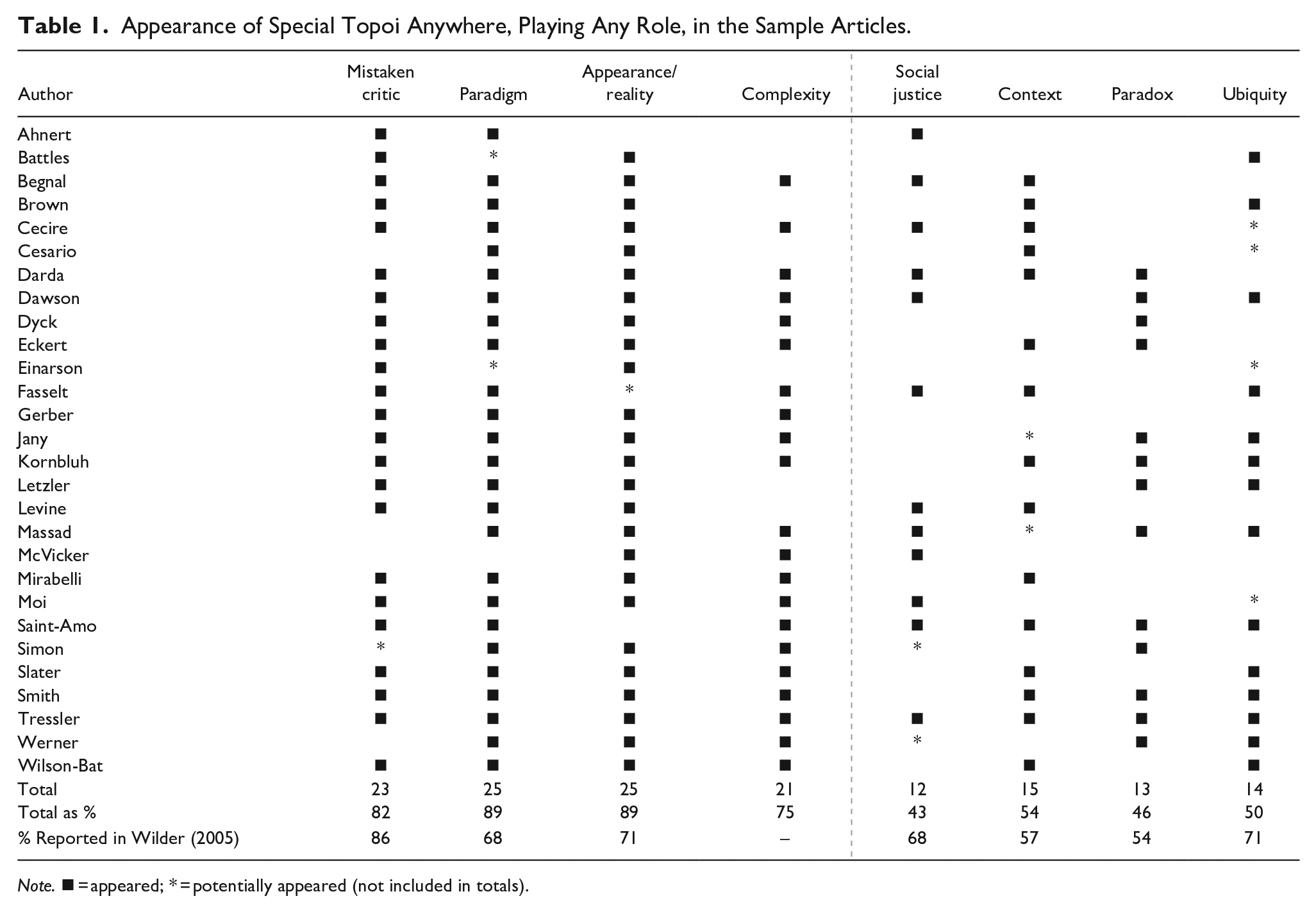
Note. ■ = appeared; * = potentially appeared (not included in totals).
Beyond just establishing the presence of the special topoi, however, I sought to distinguish the function they were performing at each appearance. The following examples illustrate that it was indeed possible to distinguish between functions, and thus to determine how they were being used to accomplish the rhetorical action of the article.
In Begnal (2015), one article in my sample, the introductory section, in which the writer staked out explicit claims about his action/motive, ran for almost three pages. The final paragraph provided the most overt self-referential claims about the rhetorical action being attempted and the motives driving the article; it included the following passage.
This essay seeks to recover [poet Haniel] Long among the ranks of Thirties poets, complementing and occasionally complicating recent studies. . . . The aim is finally to restore Long to his place in the wider discussion of the political poetry of the 1930s generally and the documentary political poem more specifically. (pp. 141–142)
Several special topoi were evident in the expression of these claims. Mistaken critic was a prominent topos expressing motive: these sentences followed a sequence of paragraphs that placed recurring emphasis on how Long has been “vastly understudied” (p. 141). Begnal was acting to correct, or, in his more collegial phrasing, to complement and “occasionally complicat[e]” prior critics’ oversight. Paradigm also shows up here, functioning to specify the rhetorical action by indicating both the study’s project—“recover[ing] Long” and “restor[ing] him to his place”—and its intended product: a more complete history of (i.e., an improved paradigm for understanding) 1930s political and documentary poetry. I debated, indeed, whether Begnal could be interpreted as claiming paradigm as motive as well as action. His claims suggest that he was motivated to correct the current paradigm—could a motive to correct the canon be differentiated from the motive to create a new paradigm? Here two special topoi (mistaken critic and paradigm) are densely interwoven. Also notable is how the language of these claims imbricate action/motive, expressing action in terms of motive: Begnal’s “aim” to accomplish something specific by writing his article.
Complexity also played a role in Begnal (2015). It was not a centerpiece of Begnal’s motive claim, though it definitely participated in expressing that claim, as Begnal’s use of the word in this passage from his introductory section makes clear: as . . . a further example of “ideological and imaginative complexity” especially as expressed in his Pittsburgh Memoranda, the recuperation of the still vastly understudied Haniel Long is well overdue. (p. 141)
Complexity served here as a warrant for Begnal’s project, a deeply held value that would justify Begnal’s action/motive (recuperating Long) in the eyes of other literary critics. But the overall rhetoric of Begnal’s article did not claim identifying the complexities in Long’s poem as a central motive or as a rhetorical action.
The difference between a writer using a topos to claim action/motive and using it as a method of interpretation or line of argument could be detected by examining where in an article the topos appeared, as well as at how the critic framed it. Topoi functioned as lines of argument when they showed up not in an article’s introductory expression of its motive, nor in its sustained focus, but in relatively brief passages of discussion in the middle of the essay. The distinction is evident in how ubiquity showed up in one article as a claimed motive and in another as a line of argument. Battles (2015) claimed that his rhetorical action was to enrich scholarly understanding of “intertextuality in Old English verse” by revealing the insights offered by a theme he had discovered, but Battles drew additional motivation from the very ubiquity of that theme: This essay will investigate [a] recurrent scene [. . .] These passages involve two primary motifs, drinking followed by sleep. Whenever an Old English poem mentions these in close proximity, a third element—deadly danger—always follows. The juxtaposition of these elements in Beowulf has been noted before, but, as I will show, they also occur in Daniel, Genesis A, Judith, and Andreas; all but Daniel feature multiple instances of the theme, so that there are twelve examples in all. (p. 436)
Battles construed himself as motivated to establish that a certain scene recurs more widely than scholars had previously recognized; the language of his motive-claim thus makes ubiquity a central point of the rhetorical actions (investigate, show) he intends to carry out.
For Werner (2015), by contrast, ubiquity was not a claimed action/motive. But that special topos did serve Werner as a way of representing her method of analysis and as a line of argument. In her introductory section, Werner remarked on a pattern she had observed in the notebooks of Cordelia Stanwood: Stanwood’s observations . . . recurrently reveal a complex set of relations between vulnerability, reality, and beauty. Again and again, unwarranted moments of grace precede and follow moments of a heightened awareness of finitude. (p. 1268)
Here, Werner evokes the discipline’s established attraction to complexity in order to warrant attention to the relationships she detects in Stanwood’s notebooks. And Werner indicates here that her analytical method involved detecting and tracing a ubiquitous set of relationships; she emphasizes a pattern she noticed “again and again.” Later, in the body of her essay, Werner deployed ubiquity as a strategy for supporting a claim about Stanwood’s writing, hence using the special topos as a line of argument. The following excerpt illustrates this use. Here Werner supports an interpretive claim by offering a list of four examples that, in their obvious repetitiveness, show a pattern: More interestingly, perhaps, Stanwood’s impulse to see in the early notebooks is accompanied by her instinct to hide—to screen herself from the world observed and noted: 17 June 1906: I concealed myself and watched the bird come back to the nest. (N, I.3) 25 May 1908: I concealed myself among some evergreens. (N, I.5) 17 June 1908: Later, I concealed myself and saw the female go into the nest. (N, I.6) 1 July 1908: I concealed myself to see where he went. (N, I.6) (Werner, 2015, p. 1272)
Werner’s opening words here—“More interestingly”—contextualize this passage of by showing that it offers one focal point in the trajectory of her unfolding argument. The pattern at hand is apparently interesting, for Werner and her audience, because it helps her illustrate the larger reading of Stanwood’s work that Werner claims to be motivated to advance.
But while ubiquity thus functioned for Werner (2015) as warrant, as interpretive method, and as line of argument, that special topos did not motivate or define her claimed rhetorical action. She claimed to be motivated by the responsibility to pay the right sort of attention—to undertake the right sort of reading—of a particular writer’s work. The introductory framing, sustained trajectory of discussion, and self-referential language in Werner’s article indicated this motive. At the close of her introductory section, for example, Werner explicitly claimed her motive, and defined her article’s actions as follows: The reward for approaching Stanwood’s notebooks as writings to think with—to see and hear with—is that they do not turn into a melancholy archive—a repository (edition) of lost records confined to the closed temporality of the past—but become instead a living map of the flora and fauna of forty acres of ground and sky situated between longitude 44.5722° N and latitude 68.4761° W. Let us, then, take care not to reincarcerate her, but instead follow her as far as possible outside to explore more fully her amplified listening as well as her essential claim to anonymity. (p. 1270)
Overall, Werner was not motivated by ubiquity but by a sense of responsibility to Stanwood’s work and by the results that reward her approach. Werner attempted to take a particular kind of performative rhetorical action: to “follow” Stanwood, to “explore” her claims, and to “think with” them.
As in Werner’s (2015) use of ubiquity, the special topoi often appeared as representations of analytical methods. Warren (2006) likewise found that professional literary critics draw on some of the topoi as implicit methods when reading poems in search of arguments about them. Indeed, Wolfe and Wilder’s (2016) textbook puts Wilder’s (2005) and Warren’s (2006) findings about the special topoi into pedagogical practice, instructing students to use topoi such as ubiquity to discover arguments as well as to write them persuasively. In the present study, the special topoi sometimes appeared, framed as methods, even in the midst of explicit claims about motive and action. In those cases, it was still possible to distinguish whether they functioned rhetorically as action/motive as well. In Dyck’s (2015) knowledge-building project, for example, mistaken critic was a claimed motive, but paradigm, which also appeared, was construed as a method. Dyck offered the following in his introductory section: Critics continue struggling to answer the perplexing question of what is wrong with the professor [character in the novel The Professor’s House]. . . . This essay uses concepts from Bourdieu’s Distinction . . . to help explain [the professor’s] displacement as social in origin. . . . Often described as anti-materialist, Professor St. Peter in fact is better understood as a strategic materialist. (Dyck 366)
According to Dyck, he used the paradigm offered by Bourdieu’s concepts—it was his method of interpretation—in order to achieve his motivated rhetorical action of producing a better understanding, and easing critics’ perplexity. Applying the concepts was not an end but a means.
These examples illustrate how the special topoi identified by Fahnestock and Secor (1991) and Wilder (2005) are woven—indeed, interwoven with each other—throughout the discursive fabric of literary research articles. Importantly, in any given instance, the special topoi discernably play one or another role in the article’s rhetorical action. Besides playing the roles to be expected from prior discussions—showing up as intermediate-level lines of argument or as warrants for attention to certain literary materials—they articulate the writer’s actions/motives or methods of analysis.
But, importantly for our conception of knowledge-building in the humanities, certain special topoi were much more frequently used in claims about the writers’ action/motive than other topoi. The left-hand side of Table 2 shows the relative frequency with which the special topoi were used to articulate claims about action/motive. For comparison, the right-hand side of Table 2 reproduces the results shown in Table 1, which tabulated how frequently they showed up at all. Notably, some of the special topoi functioned in a variety of roles, but were seldom used to articulate action/motive. Paradox, for example, was claimed definitively as an action/motive for the research in only one article, whereas it showed up in other roles in an additional 12 articles. Appearance/reality, similarly, performed one function or another in a full 25 (89%) of the articles, but it was only used to claim action/motive in 11 (39%) of them. Some special topoi, by contrast, seem to have been preferred all along for expressing action/motive claims: most (21) of the 25 articles that used the paradigm topos used it to claim action/motive, if not also for other functions. Similarly, 19 of the 23 articles that used mistaken-critic used it to claim action/motive; these results coincide with Wilder’s (2005) observation that mistaken critic often—but not always—functioned to help construct exigence.
Appearance of Special Topoi in Action/Motive Claims Versus Anywhere at All in the Sample Articles.
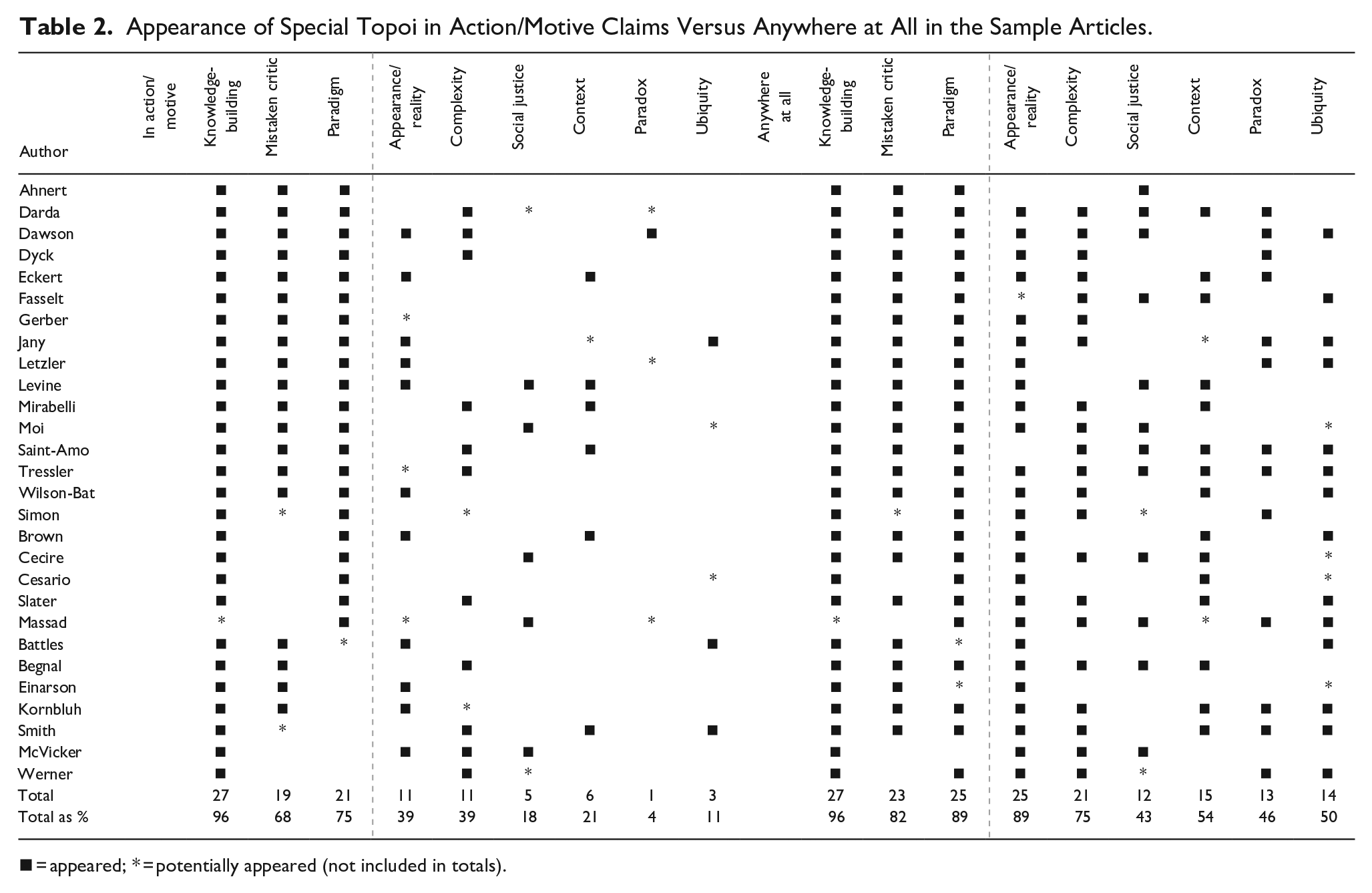
■ = appeared; * = potentially appeared (not included in totals).
Table 2 also introduces a new element that I began to code for in the present study when I recognized how frequently it was showing up in claims about action/motive in these articles. This was a claim to what I called a knowledge-building action/motive. Such claims are exemplified by those expressed by Begnal (2015), who aimed to compliment and occasionally complicate the scholarly record by restoring poet Haniel Long to the canon, or by Battles (2015), who wanted to extend collective recognition of the ubiquity of the three-part motif—drinking, sleep, danger—across Old English poetry. Even Werner (2015), whose project explicitly declined to catalogue Stanwood’s notebooks in routine scholarly ways (p. 1269) and instead invited its readers to join Werner in “follow[ing]” Stanwood outside (p. 1270), claimed an effort at conveying findings and enriching communal knowledge. Werner positioned her invitation to collectively “follow” Stanwood as her chosen way of “report[ing] to you”—her scholarly readers—what Werner “found” when reading Stanwood’s notebooks, and Werner defended her method as the most ethical interpretive response possible to these literary materials. I coded Werner (2015) as claiming knowledge-building activity because, although the experience Werner undertakes to offer does not—to use Bazerman’s (1981/2000) terms—“fix” its produced knowledge as a secure, objective, set of findings, Werner nonetheless exhaustively tries, and deliberately claims, to convey new understanding of her materials to a disciplinary audience.
As in Table 1, a dashed vertical line has been used in Table 2 to demarcate a marked drop-off in frequency between those topoi most frequently used to claim action/motive—including paradigm and mistaken-critic—and those less frequently used. Notably, claims to knowledge-building action/motive were very frequently made: they appeared in all but one (96%) of the articles, and knowledge-building was claimed as an action/motive in more articles than any of the special topoi. The table makes visually evident, however, how frequently paradigm and mistaken critic were used in conjunction with knowledge-making goals to claim the rhetorical actions undertaken by, or the motives animating, the articles in the sample. In Table 2, the order of the articles, as listed along the vertical axis, has been resorted away from alphabetical order to visually highlight how frequently these three most-frequently used coded elements showed up together.
Discussion
As was to be expected from Wilder’s (2005) and Fahnestock and Secor’s (1991) work, the special topoi functioned in this sample as the discursive means with which literary critics carried out their rhetorical actions: as methods of interpretation, as warrants, or as lines of argument. But the special topoi of literary criticism also participated in claims about action/motive. Indeed, action/motive claims were where topoi clustered most densely in the text of these articles, interweaving with one another within the space even of a single sentence—and packed together in single paragraphs—suggesting that special topoi do help critics construct acceptable social motives, and that they even help articulate the rhetorical actions of literary research. Significantly, though, the special topoi identified by Wilder (2005) were not equally likely to be used to articulate action/motives, as the left-hand side of Table 2 makes clear. And the small subset of special topoi that was most frequently used to articulate action/motive reveals important characteristics of humanities knowledge-building, as exemplified in this sample of literary criticism. Here I focus on the most significant results in this respect, starting with what the special topoi did not account for about the rhetoric of literary criticism.
Knowledge-Building
Between them, the special topoi could not fully account for the rhetorical action/motives of the majority of these articles: a claim to knowledge-building was a noticeably distinct element in the language of these claims. Begnal (2015) offers an example that illustrates the distinct presence of a knowledge-building claim, even at its most subtle: Begnal’s interest in correcting critical neglect of poet Haniel Long (mistaken critic) and hence enriching the canon (paradigm) all but encapsulated the entire claim to rhetorical action/motive in the article. Besides the topoi as discursive presences, there was, precisely, a claim to deliberate, motivated, rhetorical action: action directed at existing scholarship. Wording from Begnal’s action/motive claim, including the verbs used to express it— Therefore, this essay seeks to recover Long among the ranks of Thirties poets, complementing and occasionally complicating recent studies (pp. 141–142, emphasis added)
—emphasizes motivated activity, conveying something not quite captured by coding these phrases as instances of a discursive pattern, a topos. In many of the articles, expressions of the special topoi clearly did not exhaust, or wholly encapsulate, the expressed claim to knowledge-making activity/motives. So although the topoi do participate in the rhetorical actions writers undertake in literary research articles, they do not singlehandedly define it.
When the articles explicitly made claims about their rhetorical action/motive, as almost all of them did, they claimed to be primarily motivated by the compelling importance of what they had seen in the literary material. And, given that importance, the critics construed themselves as motivated to take the action of enriching their colleagues’ understanding of that literary material by detailing their insights (see also Banting, 2016). For example, Battles (2015) argued that the ubiquitous theme he had discovered in several Old English poems had “important ramifications for our understanding of intertextuality in Old English verse. . . . [It could] shed light on one of the most notorious problems of Beowulf and Andreas scholarship” (p. 436, emphasis added). Similarly, Cecire (2015) hoped her interpretation would “allow us to understand writers as . . . distinct as Pound and Stein as similarly exemplarily experimental, and thus help to explain the wide diversity of literary forms that [could] be understood as experimental” (p. 17, emphasis added). This expressed appetite for expanding scholarly understanding, by shedding light on problems or explaining diverse materials, is not a straightforward instance of research as knowledge production. But the epistemic language used in almost all of the articles in my sample, as exemplified by Battles (2015) and Cecire (2015), expressed, nonetheless, what I call a “knowledge-building” rhetorical action/motive. Literary criticism remains a diffuse discipline, in which critics often seek to answer questions no one but themselves has thought to pose. But these articles demonstrated that contributing to scholarly understanding is a characteristically claimed undertaking of the genre. The expression of a knowledge-building action was part of what gave overall rhetorical definition to literary research articles published in 2015.
Frequent Appearances
That knowledge-building rhetoric helps to explain why two special topoi in particular occurred most frequently in action/motive claims: they helped 2015 literary critics construe themselves as making knowledge. Mistaken critic and paradigm appeared together in 15 (54%) of the sample articles’ action/motive claims; a further 10 articles (40%) used either one or the other of these topoi as central features in their claims.
Paradigm, which appeared in 21 (75%) action/motive claims, participated in knowledge-building in a way unique among the topoi. While the articles generally claimed to be enriching their colleagues’ scholarly understanding of certain literary materials, paradigm often showed up as a product of research. In some articles, what motivated the critic was an opportunity to offer new understanding in the form of a new or improved paradigm. For Fahnestock and Secor (1991), paradigm comprised all instances when critics interpreted a connection between organizing patterns or schemas in the world and in the text. In macroparadigm cases, Fahnestock and Secor saw, critics applied theoretical frameworks to help organize and interpret the details in the text (p. 89). In microparadigm, critics noticed an organizing pattern in the text, and projected it outward to help them interpret the wider text or establish an even wider theoretical frame (p. 89). Notably, about three-quarters of the instances of paradigm in my sample were microparadigm uses, and these were the instances where the paradigm thus produced, when read out from the text, became a research product: in these articles, the claimed knowledge-building motive centered on a desire to offer understanding in the form of a new or adjusted paradigm. Thus, what Brown (2015) “reveal[ed]” to his colleagues was a generalized understanding (paradigm) of “the structuring power of communication technologies” that he had generated by noting how technologies influence narrative features in three novels (p. 34). Or when Darda (2015) announced that Pham’s travel writing could “tell us something,” he wanted to extrapolate from Pham in order to adjust existing paradigms for understanding “the airport’s relation to memory” (p. 192).
The mistaken critic topos helped writers articulate a knowledge-building action/motive in 19 (68%) of the articles. When mistaken critic was used in a motive claim, critics were construing their colleagues’ oversights and confusion as an external exigence for their article—as a problem that demanded response (Bitzer, 1968. p. 6) and hence helped them establish an acceptable motive, as Wilder (2005) noted. Wilder (2005) also observed that the topos offered critics a metaphorical language of perception (p. 101), positioning them as offering new insights where previously critics had been confused, blind, or ignorant, and this was true as well of the articles in my sample. Battles (2015) worked to “shed light” on a textual enigma that had been a “notorious problem” for previous scholars; Darda (2015) helped fellow critics “recognize,” or “see,” something they had not understood about airports. But characterizing these instances of mistaken critic simply as use of a special topos, as Wilder (2005) did, did not capture the full rhetorical force of these passages. These articles were claiming their motives, staking out an intention to act on those motives, and hence defining the rhetorical action they were hoping to achieve.
Notably, the term “mistaken critic” did not capture the generally collegial, scholarly spirit expressed in my sample, as exemplified by Cecire’s (2015) motivation to contribute to a conversation, or Battles’s (2015) and Darda’s (2015) inclusive pronouns—which put them alongside their colleagues, in an “us” being taught something by their studies. See also, in this next quotation, the courtesy with which Simon (2015) acknowledged—and then departed from—a prior theory. Simon stepped away from others’ work because he was led away by his literary material, Montaigne’s theory of schadenfreude: Portmann presents a thoughtful, wide-ranging account from which I have benefited considerably; he raises a number of questions I accept as fundamental to understanding schadenfreude. . . . Ultimately, however, Michel de Montaigne points me in a different direction . . . away from Portmann’s emphasis. . . Portmann writes, “[One aspect of the topic] can be extremely difficult” (p. 205). My focus is the case in which it’s even more difficult than that. (p. 251 fn 2)
Certainly, some articles in my sample pointed out previous scholars’ mistakes, occasionally in strong terms. Letzler’s (2015) primary motive was to correct literary critical understandings of entropy; in his view, prior critics were confused by the mistaken literary texts they interpreted. He declared baldly that their “entire perspective . . . [was] wrong” (p. 26). But Letzler’s baldness was unusual, and even his project was framed as motivated to contribute to communal understanding: he would “illustrate” the problem “and hopefully gesture toward how this contradiction might be resolved” (p. 32).
Mistaken critic thus contributed to knowledge-building activity by offering critics one possible way of expressing the relationship between their insights and the arguments of prior criticism. But it was not the only possible relationship, and more collegially knowledge-building articles often claimed to be motivated not by prior critics’ mistakes but by some exigent aspect of the literary material, which was so important or fascinating that it “demand[ed]” attention (as in Levine, 2015, p. 600). Indeed, the articles in my sample repeatedly claimed a scholarly motive of being drawn to what the literary materials, if read in a particular way, could “enable us to see” or “allow us to examine” (Slater, 2015, p. 4). This repeated linguistic pattern in the action/motive claims drew on the metaphorical language of perception not to dignify their own seeing against their fellow scholars’ blindness but to emphasize the insights offered by the literary materials and to undertake to share or reveal those insights to their disciplinary community.
Rare Appearances
Wilder (2005) was surprised by the enduring prevalence of certain special topoi—paradox, in particular—that belonged to an old-fashioned New Critical approach to literary interpretation (p. 96). By differentiating the rhetorical functions such topoi play, my study shows that, while the traditional New Critical topoi remained prevalent in 2015 criticism, they were apparently not very useful in claiming action/motive.
Paradox showed up in a total of 13 (46%) of the articles in my sample. But despite this reasonable prevalence, only 1 article definitively claimed paradox as action/motive. Ubiquity was almost as scarce in action/motive claims, though it was a topos Fahnestock and Secor (1991) found “everywhere” (p. 87) in their sample and Wilder (2005) in 71% of hers (p. 91). In the present study, it appeared as method, line of argument, or warrant in half of the sample articles but was only definitely claimed to motivate or articulate the action of three (11%) of them. Tracing patterns was evidently a suitable and unremarkable thing for literary critics to represent themselves doing in 2015, but not, for most of them, a research motive or action.
Appearance/reality, which showed up almost as rarely as ubiquity in action/motive claims, seemed to function as a kind of grammar for presenting interpretive discoveries about literary material. (Indeed, the language of perception was more widespread than my tally of this topos indicates—I counted only 11 [39%] articles definitively using it in their action/motive claims, but up to 60% of them used some part of its typical phrasing.) This special topos was generally not itself emphasized: the phrasing of motive claims construed critics not so much as motivated by the discovery that some “reality” could be seen beneath the surface of their literary material but, as remarked above, by the warranting value of the thing to be seen. For example, Slater’s (2015) interest in what could be “see[n]” in her literary material was expressed in the signature language of appearance/reality. But what could be seen was the “translocal” setting of a novel; Slater (2015) claimed to be motivated to take her analytical approach because it revealed that translocality. Levine (2015) pointed out that realist fiction allows us to see the “crucial,” but generally overlooked, omnipresence of infrastructure in our lives (p. 588) and Eckert (2015) discovered “an important connection” between the poem “Don Juan” and its author’s experience: On the surface, the allusions to farts and fellatio [in the poem] . . . seem worlds apart from the numerous pastoral poems that Clare contributed to British literary annuals. . . . There is, however, an important connection, which has hitherto been overlooked, between Clare’s experiences as a contributor . . . and his focus in “Don Juan.” (p. 428)
In Levine and Eckert, as in seven other articles from my sample, the language of appearance/reality helped the critic phrase a revelation of new insights, and the value of those new insights was warranted by their having been previously “overlooked” by mistaken critics. But it was ultimately the newly seen literary material itself that these critics foregrounded as “crucial” or “important.”
Perhaps paradoxes, ubiquitous patterns, and unseen depths of meaning were, though frequently mentioned, too unremarkable to form a central action or motive of research for literary critics in 2015 precisely because it was by then so securely conventional to presume that they were part of literary material and critical methods.
Conclusions
Like Wilder (2005), this study emphasizes the enduring power of the special topoi to characterize the discourse of literary criticism. But it also sheds light on the limitations of topos analysis for characterizing research articles in any discipline. Rhetorical action- and motive-focused analyses should not sideline topos analysis, because the special topoi prove so useful for pinpointing recurring lines of argument. But because what topos analysis of this genre has produced to date is a list of topoi, undifferentiated by where those topoi tend to show up in the arrangement of a typical article or by their rhetorical function at any given moment, its description of disciplinary rhetoric is somewhat two-dimensional.
Perhaps my study suggests that topos analysis may not—for all its power of insight—be a lens well suited to detecting knowledge-building efforts. Rhetorical action/motive analysis, and genre theory more broadly, is such a lens. Together, the two lenses offer analysts a multidimensional view of the rhetoric of literary criticism. Meanwhile, the type of self-initiated text studied here helps to clarify the value of keeping “social motive” alive in our analytical vocabulary, alongside exigence: it, like Bazerman’s (1994/2019) “social intention,” usefully describes compulsions to act that are forward-looking—focused on the act the agent wants to perform—rather than focused backward, so to speak, on a compellingly exigent cause (compare Miller, 2015a, who similarly distinguishes the backward-focused analysis prompted by the term exigence, although she prefers it to “intention” as a frame for analyzing genre). Actually, my study indicates that literary critics do construe themselves as responding to an exigence—the “crucial” insights afforded by their literary material—but it is an exigence they have individually discovered. Unlike the ideal scientist’s knowledge-building exigence, the pressing gap in collective knowledge, the literary critic works to draw disciplinary attention to insights no one had hitherto noticed were missing.
If I can generalize across the texts I examined, seeing a strong trend in the claimed rhetorical actions of these texts as a glimpse of the genre they exemplify, what this study showed is that, in 2015, the intended social action of an article in literary criticism was to build literary critical knowledge—in a particular, humanistic way. It was to enrich, correct, or expand scholarly understanding of a topic of legitimate interest to members of the discipline. The resounding (“important,” “crucial”) value of the literary material the critic had unearthed, or of the new paradigm the critic had to offer, was the ultimate exigence construed by these articles. And, as this study identified, it was not only complexity or other New Critical aesthetic values that made literary material valuable enough to motivate an article. Most often, the material’s value came from the way it supported new understandings of key topics presumed to resonate with other critics: intertextuality, experimentalism, airports, memory, schadenfreude, translocality, allegory, the global, or Palestinian belonging.
If I were to add to the list of special topoi, I would point to the frequent claims to enrich or expand scholarly understanding of literary material. But because that move is, in context, not just one more persuasive thing to say in an article but distinctly the centerpiece of many claims, I prefer to present knowledge-building rhetorical action and motive as this article’s main finding about the rhetoric of literary criticism. I propose that I witnessed here continued development in the relative scholarliness of that rhetoric. Perhaps, in claiming to make scholarly contributions in 2015, the discipline had begun to reposition itself as knowledge-building for strategic reasons. Likely, the rhetoric of literary criticism has recently been shaped by an effort to frame its work as fundable, in a neoliberal era that values applicable, instrumental research (Coleman & Kamboureli, 2011, pp. xv–xvii), even as it resists such values (see for example Dobson, 2011). In any case, knowledge-building was claimed as a major, motivated rhetorical action in 2015 articles, and the corrective gesture of mistaken critic did not entirely shape how that motive was expressed. In observing as much, this study sides against the argument that literary criticism is an epideictic genre, because it sees such a strong emphasis on scholarly contribution in the critics’ claims about what they are trying to achieve.
While attending to this emphasis on scholarly contribution, my study does not propose that literary criticism makes knowledge claims the way scientific articles do. This discipline claims to be motivated to advance a kind of understanding that is more a signature of the individual scholar’s line of inquiry than a reproducible study. The word “understanding” (distinctly preferred over “knowledge” in this sample), used as a gerund, suggests that literary critical knowledge is embodied in the activities of the critic. This form of knowledge is, perhaps, not so much a product or a useable solid ground for future research to build upon as a demonstration of what can be newly seen in literary materials and an enactment of how to see it (see also Banting, 2016). These understandings might be responded to or argued against in future articles; they might be taught; they might work as guides for future disciplinary practice. In all cases, they are contributions to the ongoing disciplinary discussion. Bammer (2018) gave the following account of rhetorical action as she introduced PMLA’s special section on “How We Write Now”: Writing has been, and into the forseeable future will continue to be, the primary means of humanistic knowledge production. However, while we convey what we know and think through writing, it is not simply a vehicle for delivering knowledge. It is a way of acquiring knowledge. Through writing, we figure things out. . . . Writing is a form of analysis, a method of interpretation, and a mode of thinking. (p. 124)
Bammer’s description of writing in this discipline as “a mode of thinking” frames its product as a practice—of scholarly insight and attention. But this is not exactly epideictic rhetoric, Carter’s (1992) “rhetoric of display.” It is, on its own terms, a scholarly activity: a form of public thinking meant—not to shore up values or to go beautifully through disciplinary motions—but to further refine the critic’s own practice and contribute somehow to others’ future thought as a model or guide.
Future analyses might pursue the many questions left unanswered here, including the question of what genre theory calls uptake (Freadman, 2002): if these articles claim to be motivated to contribute to knowledge, do they have that effect? When articles are cited by later researchers, what are they taken as having achieved? What is the relationship between what the articles claimed to have been trying to do and how they are later taken up? And how do the special topoi of literary criticism inform uptake: are they deployed in later researchers’ summaries of what an article achieved? Do certain topoi seem more likely than others to be cited? Similarly, future research might further compare and differentiate this peculiar kind of scholarly activity from that of the sciences, investigating, for instance, how recent literary criticism takes up prior work in the field. If it has indeed come to claim a knowledge-building motive, does it now cite and closely build upon the recent research of others more than, according to Dowdey (1992), it once did? 3 Or, continuing in the vein of the present study, which sought to differentiate the topoi according to rhetorical action, future research might extend Balocco’s (2000) research by mapping the typical sequence of moves (Swales, 1990) made over the course of a literary critical article, and then assessing the way the topoi differently participate in those moves. It would also be informative to study the response genre of peer review feedback, and the extent to which reviewers recommend improvements in either the deployment of certain special topoi or in the articles’ knowledge-building activities.
Footnotes
Appendix
Table A1 lists the literary research articles included in the sample.
Acknowledgements
This paper is stronger, without question, because of the suggestions offered by Chad Wickman, its editor at Written Communication, and its anonymous reviewers. To them, to Andrea Phillipson, and to Duncan Maclean, who helped me think about topoi, my thanks.
Declaration of Conflicting Interests
The author declared no potential conflicts of interest with respect to the research, authorship, and/or publication of this article.
Funding
The author received no financial support for the research, authorship, and/or publication of this article.