




Abstract
What aspects of writing are doctoral students metacognitive about when they write research articles for publication? Contributing to the recent conversation about metacognition in genre pedagogy, this study adopts a qualitative approach to illustrate what students have in common, across disciplines and levels of expertise, and the dynamic interplay of genre knowledge and metacognition in learning to write for research. 24 doctoral students in STEM (science, technology, engineering, and mathematics) were recruited from subsequent runs of a genre-based writing course and were interviewed within a 2-year period when they submitted an article for publication, 3 to 11 months after course completion. Over time and across disciplines, doctoral students’ metacognition converges on four main themes: genre analysis as a “tool” to read and write, audience and the readers’ mind, rhetorical strategies, and the writing process. Furthermore, these themes are extensively combined in the students’ thinking, confirming conceptualizations of expertise as an integration of knowledge types. Metacognition of these themes invoked increased perceived confidence and control over writing, suggesting key areas where metacognitive intervention may be promising.
Keywords
Even the best writers with the best intentions can produce words that are meaningful to them but will fail to be meaningful to another
Introduction
Recently, the concept of metacognition has received considerable attention in the academic writing scholarship. Metacognition refers to the unique human ability to reflect on, monitor and regulate cognitive and emotional processes, allowing people to take control of their learning (Flavell, 1979). The role of metacognition in education has been extensively demonstrated, and it is clear that effective learning—from math to reading—requires metacognition. In academic writing, metacognition was foregrounded in the late 1990s by Anne Beaufort (2007, 2012), who advocated promoting mindfulness or metacognition to catalyze writing expertise across contexts. Recent work has cast new light on how metacognition helps learners develop expertise and adapt their emergent knowledge of academic genres across contexts and languages (Driscoll et al., 2019; Lee & Mak, 2018; Negretti & McGrath, 2018; Tardy et al., 2020). However, most of the work on metacognition has not addressed writing by doctoral students learning to write for publication, especially in STEM (science, technology, engineering, and mathematics) disciplines, and in general, evidence is needed to support the current theoretical conceptualizations of writing expertise. This gap is somewhat surprising, given writing’s ubiquity and high-stakes nature for the construction of scientific knowledge, institutional excellence, and a successful academic career (Carli et al., 2018). Just like any other learning endeavor, learning to write for publication can be assumed to require metacognition, but how does metacognition help doctoral students take control of their writing?
Academic writing poses unique challenges to learners, who may benefit from enhanced metacognition. Scientific writing is multifaceted, polychromic, and eclectic: academic genres often reflect the work of interdisciplinary communities of discourse, requiring pedagogical approaches that promote flexibility (Kaufhold & McGrath, 2019). Quality criteria are inevitably situated and often implicit, embedded in the genres legitimized by scientific communities that are fluid and often converging from different “fields” (Wingate, 2016). Since accurate metacognition depends largely on knowledge about criteria and standards for quality (Dunning et al., 2003), writing for publication may pose a tough challenge for budding academics—even proficient graduate students struggle in accurately assessing their own texts (Negretti, 2017) and in establishing a convincing disciplinary identity (Castelló et al., 2013). As Casanave (2019) points out, doctoral students seldom receive adequate writing training during their studies; oftentimes, writing expertise is absorbed via supervision and interactional networks (Dysthe, 2002). Thus, to quote Bazerman (2018) “the more fundamental puzzles are often left for the individuals to solve, tied to their own developing knowledge of their fields” (p. 311).
Hence, a focus on metacognition may help us teachers and researchers understand how doctoral writers solve the publication “puzzle.” To meet the demands posed by writing for publication, students need to develop a complex, multifaceted expertise comprising knowledge of subject-matter, sociorhetorical dimensions of writing, writing process (WP) knowledge, and knowledge of genre(s) (Beaufort, 2007; Tardy, 2009; Tardy et al., 2020). Additionally, graduate students should also develop an awareness of genre analysis (GA) as a heuristic for learning and writing across situations (Beaufort, 2012, Cheng, 2018). In this respect, the development of writing expertise not only equates with a nuanced understanding of genres but also with the metacognitive awareness of how to adapt knowledge about writing and genres across situations (Driscoll et al., 2019).
This study contributes to the ongoing scholarly conversation about the role that metacognition plays in the development of writing expertise. Specifically, across different disciplines, backgrounds, languages, and levels of expertise, this study seeks to identify what students have in common, rather than what differentiates them as writers. This aim responds to Bazerman’s (2018) call for an investigation of generalities: the common experiences that (doctoral) writers share, across situations and disciplinary affiliation. It also aligns with Curry and Lillis’ (2019) argument for research on “how less experienced scholars, from any linguistic background(s), working in any context, learn the social and linguistic practices entailed in publishing” (p. 5).
The participants in this study are multilingual doctoral students. Multilingualism in academic writing/writing for publication, typically when writers are using English as an additional language (EAL), can be a potential source of challenges in terms of self-confidence (Wilson & Soblo, 2020) and/or access to academic literacy affordances and networks (see Curry & Lillis, 2019). At the same time, multilingualism can be a source of metaknowledge about writing in different languages, across genres and contexts (Tardy et al., 2020), and should not be assumed to entail deficit. As Curry and Lillis (2019) suggest, “much of the lore about multilingual writers seems to emerge from a perspective that they need particular kinds of text-based ‘remediation’ in order to write for publication in English. This perspective denies that multilingual scholars are competent actors” (p. 4).
While a multilingual identity may possibly shape metacognitive strategies in writing for publication, we need to be careful about assuming its significance a priori: independently from L1 background, novice writers may deal with the same challenges in learning about the social and linguistic practices that lead to publication (Curry & Lillis, 2019), which are often implicitly learned. Thus, in this study, the emphasis on generalities entails that the participants’ multilingual identity is allowed to emerge when salient to the participants, but is not an explicit focus in the analysis. Rather, the present study provides evidence about the aspects of writing for publication on which doctoral students’ metacognition converges, over time and across disciplines: That is, how doctoral students metacognitively engage with their developing genre knowledge, and whether there is evidence of an integration of the various facets of this knowledge. The research questions are as follows:
After a review of relevant theory and research, these research questions will be addressed through evidence gathered via interviews with 24 doctoral students from various STEM disciplines. In Section “Metacognitive Convergences: Common Aspects of Genre Knowledge Doctoral Students Are Metacognitive About (RQ1),” common themes/subthemes across students are presented, with both frequency counts and interview excerpts. In Section “Metacognitive Integration of Genre Knowledge Facets in Writing for Publication (RQ2),” the co-occurrences of these main themes and subthemes will reveal how these aspects combine and integrate in the students’ metacognition about writing for publication.
Metacognition and Writing: Review of Theory and Research
What is metacognition and what is its potential role in writing for publication? As Winne and Azevedo (2014) state, “At the simplest level, metacognition is thinking about the contents and processes of one’s mind” (p. 63). Metacognition occurs in basically all cognitive tasks entailed in learning and is closely linked to the domain being learned. Several theoretical models of metacognition have been proposed since Flavell’s (1979) initial conceptualization. Broadly, cognitive psychologists agree on two types: metacognitive knowledge and metacognitive regulation (cf. Schraw, 1998; Schraw & Moshman, 1995; Winne & Azevedo, 2014):
Metacognitive knowledge (also called metacognitive awareness) comprises: Declarative knowledge: Being aware of possessing a certain type of knowledge, including the self, types of tasks, domain knowledge. It can be verbalized. Procedural knowledge: Being aware of processes and actions to tackle a specific task—the “know how.” Often acquired implicitly through experience and automatized, and learners may benefit from making it explicit. Conditional knowledge: Being aware of when and why certain aspects of declarative and procedural knowledge are relevant to a specific task and its conditions and, thus, a prerequisite for an effective use of declarative and procedural knowledge.
Metacognitive regulation. It includes metacognitive forms of thinking (Winne & Azevedo, 2014) that power self-regulated learning, from monitoring progress and identifying faults, to controlling cognitive activities such as planning and goal setting in light of task conditions, to evaluating one’s performance.
An important point to keep in mind is that although metacognition could be broadly considered a general skill (Dunlosky & Rawson, 2019), in practice it is always domain specific. Like a chameleon, metacognition inevitably changes its appearance to reflect the context to which it is applied (Winne & Azevedo, 2014). This aspect is especially salient in domains that are inherently situated and communicative, such as academic writing. A couple of theoretical points are particularly pertinent to doctoral writers. First, doctoral writers represent a variety of literacy backgrounds and experiences and may likely hold different and/or inaccurate declarative metacognitive knowledge (Dunning et al., 2003), for example, about the nature of writing or themselves as writers, and thus may need support in developing accurate metacognitive knowledge of the different components of expert writing. Second, they are developing writing expertise, but procedural knowledge—knowing how to write—is often implicit (see Beaufort & Iñesta, 2014). Therefore, learners may not be aware of what they are doing, or whether it is effective: conscious and explicit attention to these processes is needed for learning (Winne & Azevedo, 2014). Finally, academic writing is situated and highly sensitive to contextual dimensions: in authentic situations, strategies that may work for some students may not work for others (Dunlosky & Rawson, 2019), and conditional metacognitive knowledge is crucial.
Cognitive models of writing as applied metacognition (Hacker et al., 2009, Hacker, 2018) underscore the interrelatedness of cognitive and metacognitive processes in writing in a continuous flow. Historically, these models have emphasized its problem solving, goal-oriented nature, aimed at the construction of meaning for oneself and others (Bereiter & Scardamalia, 1987; Flower & Hayes, 1980). Expert writers are characterized as knowledge crafters (Kellogg & Whiteford, 2009), possessing the cognitive resources to interweave conceptual development with anticipated readers’ reactions (Galbraith & Baaijen, 2018). Overall, studies in cognitive science have clearly connected writing performance to a variety of metacognitive and self-regulatory dimensions, from the criteria that students adopt for monitoring and evaluating their writing (McArthur et al., 2015; Zimmerman & Kitsantas, 1999), to beliefs about writing and self-efficacy (Limpo & Alves, 2017). However, most of this research has not specifically addressed academic writing nor doctoral students writing for publication, for example, how their metacognitive knowledge of audiences, strategies, and readers’ expectations influences their writing and expertise development.
Academic writing is complex, requiring metacognitive engagement with various knowledge types. This complexity has been accounted for in conceptualizations of writing expertise. For example, Beaufort and Iñesta (2014) converged cognitive psychology research and rhetorical studies to propose a model stressing the multifaceted nature of expert writing. Expert writers not only possess a variety of knowledge types but they also know how to use it and adapt them: They effectively engage in self-regulation of writing or writing regulation (cf. Castelló et al., 2013). More recently, Tardy et al. (2020) further develop the multicomponential conceptualization of writing expertise (cf. Tardy, 2009) and explicitly include metacognition in their model, as a key dimension of genre awareness and a catalyst for the recontextualization of genre knowledge across situation and languages. 1
Doctoral writers thus face tough cognitive and metacognitive challenges. Learning to write in academic disciplines is a process of enculturation, where novice researchers, through relevant social interaction, are expected to acquire disciplinary practices for knowledge construction that are somewhat tacitly recognized by experts (Dysthe, 2002, McGrath et al. 2019). Students often do not have a clear understanding of what is required to successfully produce academic texts (Lillis & Turner, 2001), or lack access to the complexity of disciplinary-relevant criteria, expectations, and text-producing strategies that experts in the field possess (McGrath et al., 2019; Wingate, 2016). Furthermore, doctoral writers need to develop creativity to devise original, novel contributions to their field and negotiate language and argumentative strategies to meet the readers’ expectations and their own communicative goals (Casanave, 2019). To accomplish these goals, they often need to reframe beliefs about themselves, their texts, and their discipline, rethink their approach to the WP, and find new ways to express authorial identity and voice (Castelló et al., 2013). Thus, based on the existing research (Driscoll et al., 2019; Tardy et al., 2020), it is reasonable to assume that learning to write for publication depends on the development of genre knowledge as well as the metacognitive awareness of one’s knowledge of genre(s), and the specific rhetorical strategies (RS) to perform genre(s).
Genre Pedagogy and Metacognition: Present Study
The participants in this study attended an academic writing course adopting a genre pedagogy approach (henceforth GP), aiming to foster students’ ability to make deliberate choices in recurrent, socially recognized communicative situations. GP has been increasingly reframed toward an examination of learning rather than texts: what people do with genres and why, how they learn to master genres, and how to teach them to use their genre knowledge (Cheng, 2018; Swales, 2019). Studies of metacognition in GP have shown that metacognitive recognition and use of genre features promotes academic writing performance (Yeh, 2015) and that metacognitive knowledge of academic genres seems to support students’ self-regulation of writing and their ability to engage with different strategies and/or accurately evaluate their texts (Negretti, 2012, 2017). Recently, Driscoll et al. (2019) examined metacognition in connection to transfer of genre knowledge in college students, validating the theoretical conceptualization by Tardy (2009) and underscoring that effective writing requires both the development of nuanced genre knowledge and metacognitive awareness of how to use it. In this study, writing expertise is conceptualized as the development of genre knowledge, genre awareness, and metacognition (Tardy, 2009; Tardy et al., 2020). As mentioned, this characterization differs slightly from previous models (cf. Beaufort & Iñesta, 2014), but fundamentally it addresses the same dimensions, posing that the trajectory toward expertise entails a gradual integration of knowledge types as well as the ability to orchestrate, manipulate and adapt this knowledge to meet one’s communicative goals across situations.
To explore metacognition in doctoral writing, this study adopts a focus on generalities (Bazerman, 2018). Questioning the usefulness of cognitive models of writing, Bazerman (2018) underscores writing’s social nature, idiosyncrasy, and inventiveness, advocating that to understand the common challenges that writers share, we need to focus on how authentic experiences converge: what he refers to as the generalities. To this end, this study places theoretical conceptualizations of metacognition (e.g., Flavell, 1979, Schraw, 1998) at the backdrop of the analysis. Rather than centering on specific components of metacognition (cf. Gorzelsky et al., 2016; Karlen, 2017; Lee & Mak, 2018), it examines the common themes or “kinds of knowledge” (Beaufort & Iñesta, 2014, p. 146) that are the object of doctoral students’ metacognition: the aspects of writing-related knowledge that are metacognitively salient for doctoral students. This approach allows us to address the important question that, to paraphrase Bazerman (2018), we need to ask first: in authentic situations—across conditions, scientific disciplines, languages, and levels of experiences—what are doctoral students metacognitive about, when it comes to writing for publication? On what aspects of the writing for publication endeavor does students’ metacognitive thinking converge? Informed by these questions, the study extends the recent theoretical conversation on metacognition in genre knowledge development and contributes to our understanding of students’ writing experiences in authentic situations—the generalities mentioned by Bazerman (2018).
Methodology
Participants and Setting
This study was part of a larger project at a university of technology in Sweden. Participants were recruited over 2 years from subsequent runs (12 students each) of an 8-week academic writing course for PhDs. Overall, 60 students consented to participate voluntarily via written and signed informed consent notes, clearly outlining aims, ethical considerations, and privacy. 31 students consented to an interview; the data presented here comes from the 24 participants who were interviewed once. The data are anonymized and mentions of research topics have been eliminated.
Table 1 summarizes relevant information about the participants. These doctoral writers represented different disciplines and were at various stages in their doctoral programs; some had published previously. All were multilingual writers, routinely using English for publication. As can be noted in Table 1, half (12 participants) were interviewed 6 months or later after the course, and more than half (15 out of 24) brought to the interview an additional research article besides the one written during the course. 2
Participants’ Information.
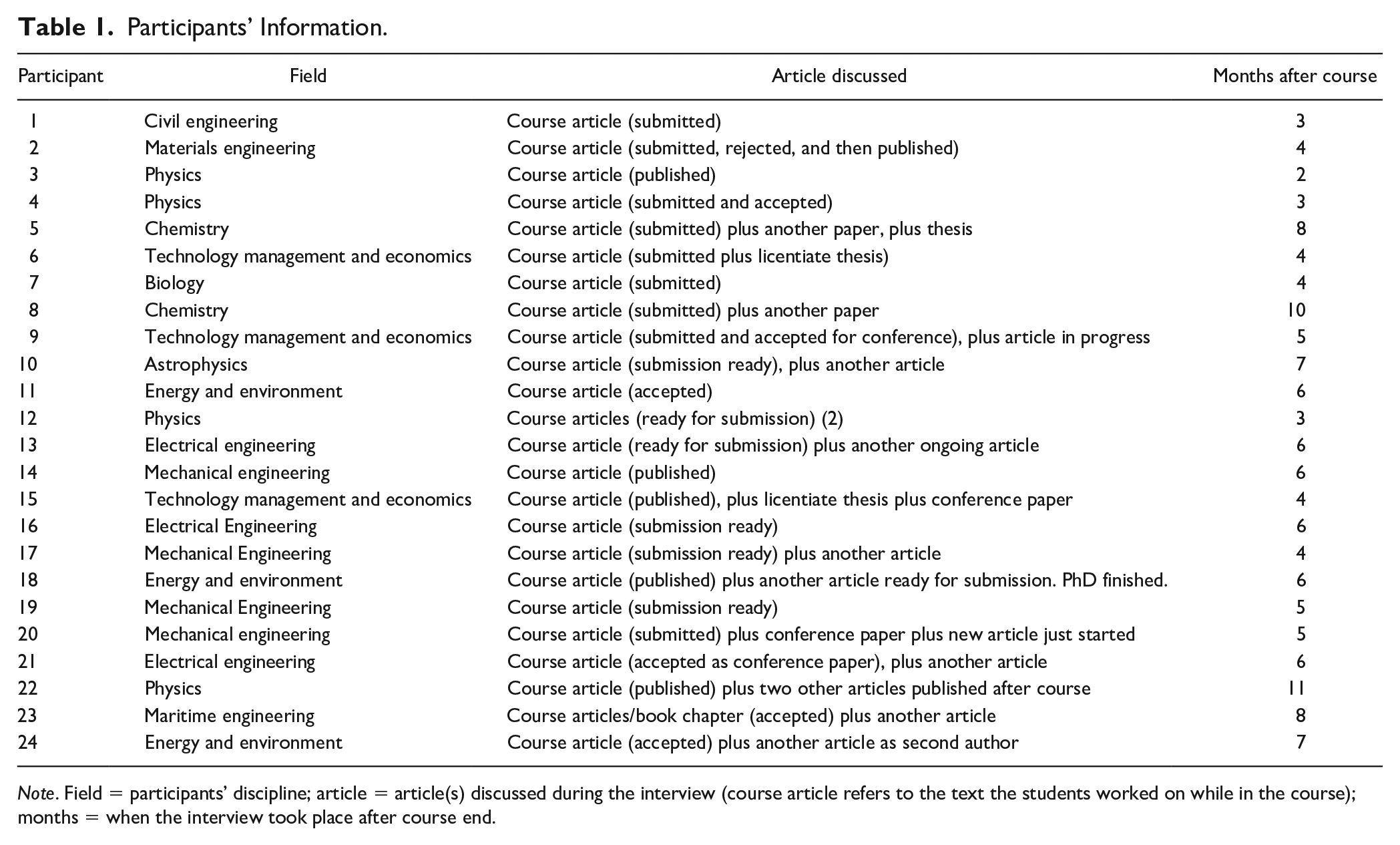
Note. Field = participants’ discipline; article = article(s) discussed during the interview (course article refers to the text the students worked on while in the course); months = when the interview took place after course end.
The course adopts an English for specific purposes (ESP) approach to GP (Swales & Feak, 2012). As mentioned, GP revolves on the concept of genre as a recurrent rhetorical situation (Miller, 1984), and typically entails the analysis of student-chosen genre exemplars to identify recurrent features and variation through comparison and discussion. The ESP approach underscores language and form and has been widely used in educational settings with multilingual writers, especially when attention to language is contextualized in meaningful ways (Tardy & Whittig, 2017). In the course, this attention was fostered through the reading of academic texts, analysis tasks, application to their own writing, and peer exchange and feedback on the students’ own texts. To illustrate: in the first session, students were introduced to the concepts of genre, discourse communities, and other social /disciplinary dimensions of writing for publication, followed by a homework task asking them to describe their academic writing context. To each following session, students brought self-chosen exemplars of research articles (target genre) and were guided in GA, comparing their observations in small groups and discussing what motivated a recurrence of features as well as observed variations. After each session, as an assignment, students were asked to apply what they had learned to a short section of their own research article, exchange this text for peer feedback, revise, and reflect on the revisions done. A final course task asked students to summarize their understanding of genres in their field.
Data Collection
Interviews were conducted a few months after completion of the course, when the research article they had worked on during the course was ready for submission. Because of the disciplinary variation in research practices, the time-lapse ranged from 2 to 11 months (5½ months on average). Some participants had completed and published other articles (see Table 1): 15 out of 24 interviews included a discussion of these other texts in addition to the article written during the course.
Interviews as self-report methods were considered appropriate to investigate individual metacognitive experiences (Winne, 2010). Each interview followed a semistructured protocol of four questions, lasted between 30 and 45 minutes and was recorded (see the appendix). To support the participants’ accurate recall of their thinking, interviews adopted a stimulated recall methodology (Gass & Mackey, 2000): Participants were asked to bring their article(s) and comment on each section, describing their writing approach. The interviews were conducted by the author, also the teacher of the course: as a result, participants may have felt inclined to offer positive comments about the course during the interview. This was addressed by focusing the interview questions on recall (with their article as basis) and by clearly addressing the researcher positionality at the beginning of the interview. The already established rapport with the participants however provided a shared background and an insider understanding of the students’ experiences, facilitating interpretation of the students’ comments.
Data Analysis
Analysis followed multiple-phase cycles characteristic of systematic qualitative research and constructivist grounded theory (Charmaz, 2006, 2011). It entailed not only several recurring steps—compiling, disassembling, reassembling, and interpreting the data but also recursive constant comparisons and interaction with the data. Themes and categories were not just inductively derived in sequential steps; they were also systematically tested and verified through repeated examinations of the data, cross-comparisons of codes, and reflexivity, moving “back and forth” between data analysis and interpretation (see Charmaz, 2011, p. 361).
First, the transcribed data was compiled into a data set, using NVivo software. Second, a round of first-level, inductive open coding was performed—to avoid a priori assumptions, ensure systematic analysis of all the data and to derive an initial emergent overview (Miles et al., 2014). Codes (nodes in NVivo) were created progressively, named after words or short phrases in the data, and focused on the content of the participants’ comments (Miles et al., 2014). Note that the same comment could be coded under more than one code: for example, the code “descriptions of rhetorical strategies,” created rather early in the analysis, often overlapped with comments coded as “reader awareness” (RA) whenever students motivated RS with considerations of readers. However, since not all RS were explicitly linked to readers, the two codes were maintained as independent, rather than merged. In this phase, reflexivity and systematicity were ensured by keeping analytic memos for each emerging code, where coding decisions and examples were annotated.
Next, the data were reassembled into emergent themes, illustrated in Table 2. Coding consistency was then verified for accuracy through cross-analysis of the entire data set (consulting analytic memos), resulting in the first description of main themes and subthemes. In addition, a coding debriefer (a researcher external to the project with expertise in qualitative data analysis and NVivo) was enlisted to independently verify accuracy of data coding and debrief with the author.
Coding Glossary: Main Themes and Subthemes.
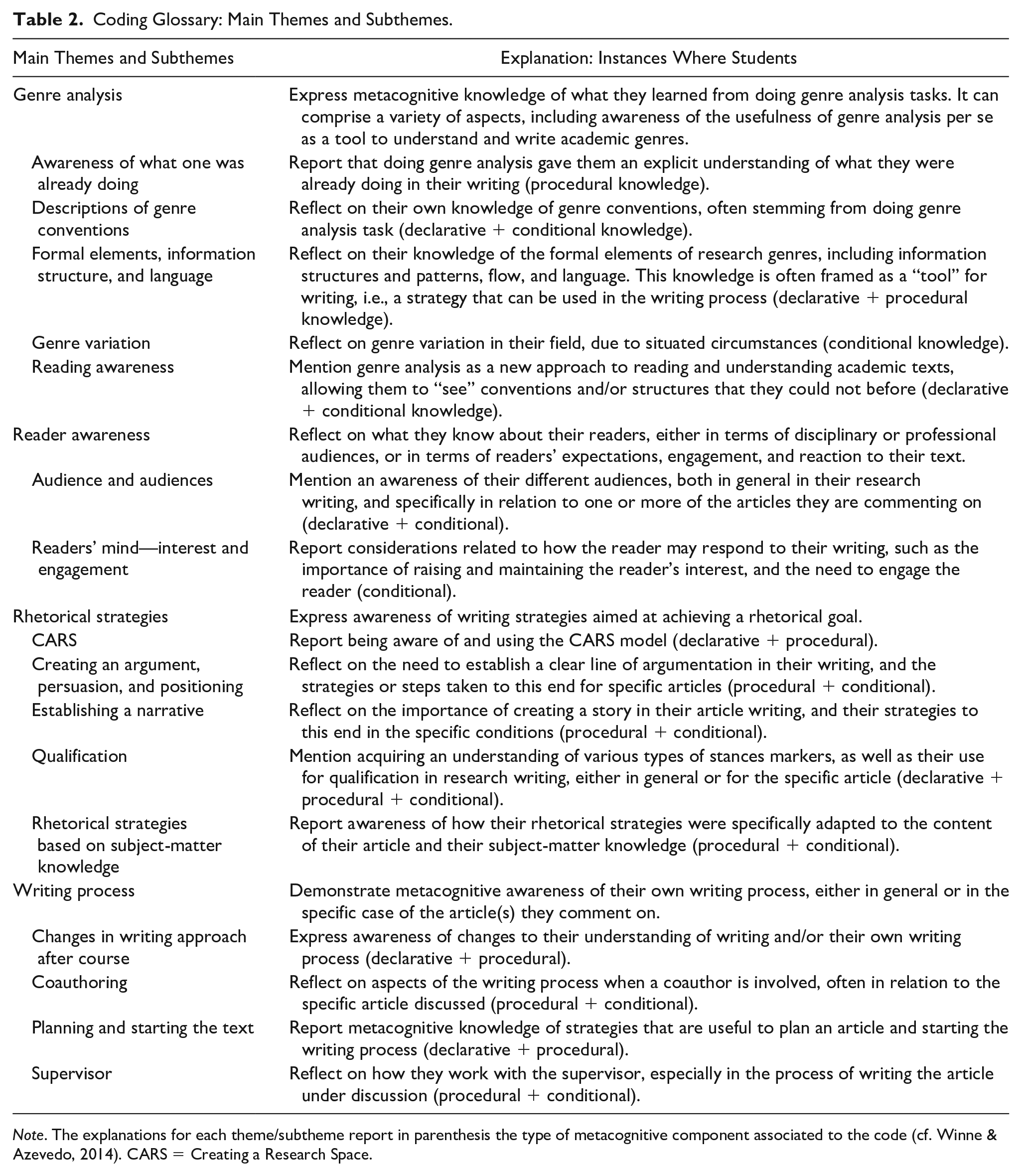
Note. The explanations for each theme/subtheme report in parenthesis the type of metacognitive component associated to the code (cf. Winne & Azevedo, 2014). CARS = Creating a Research Space.
Finally, second-level coding (Miles et al., 2014) required further recursive analysis of the data to establish connections between the themes and determine the robustness and systematicity of the evidence (Charmaz, 2011): not just how frequent a theme was but also whether it seemed to occur often in combination with other themes and subthemes, across all students. This step addressed RQ2: whether students integrated different types of genre knowledge facets in their writing, which ones, and how frequently. To determine co-occurrences, matrix coding analysis was employed, a technique that allows the researcher to identify and extract all the data that is coded under two or more codes, providing a descriptive quantification of qualitative data and offering an overview of trends’ systematicity. As a final step, additional matrix queries were run to determine possible differences in the distribution of themes across different groups of students (e.g., students interviewed before or after 6 months, students commenting on one article versus two or more articles during the interview). None of these disaggregation analyses gave conclusive results, except for two subthemes (Section “Reader awareness: Audiences and the reader’s mind, interest, and engagement”).
Findings
Metacognitive Convergences: Common Aspects of Genre Knowledge Doctoral Students Are Metacognitive About (RQ1)
The first question asked what common aspects of genre knowledge doctoral students are metacognitive about, across individual variations, when writing for publication. Four themes were identified in the data and are presented in the order in which they emerged during the interview:
Genre analysis (GA): Structures, form, and rhetorical conventions as tools for writing and reading.
Reader awareness (RA): Audiences and the reader’s mind, interest, and engagement.
Rhetorical strategies (RS): Creating an argument, taking stance, adapting to discipline.
Writing process (WP): Strategies, changes in the process, lessons learned.
Table 3 illustrates these themes’ distribution across the participants, their frequencies, and the average percentage of text that these instances covered in the data sources.
Distribution of Main Themes and Subthemes Across All Participants.
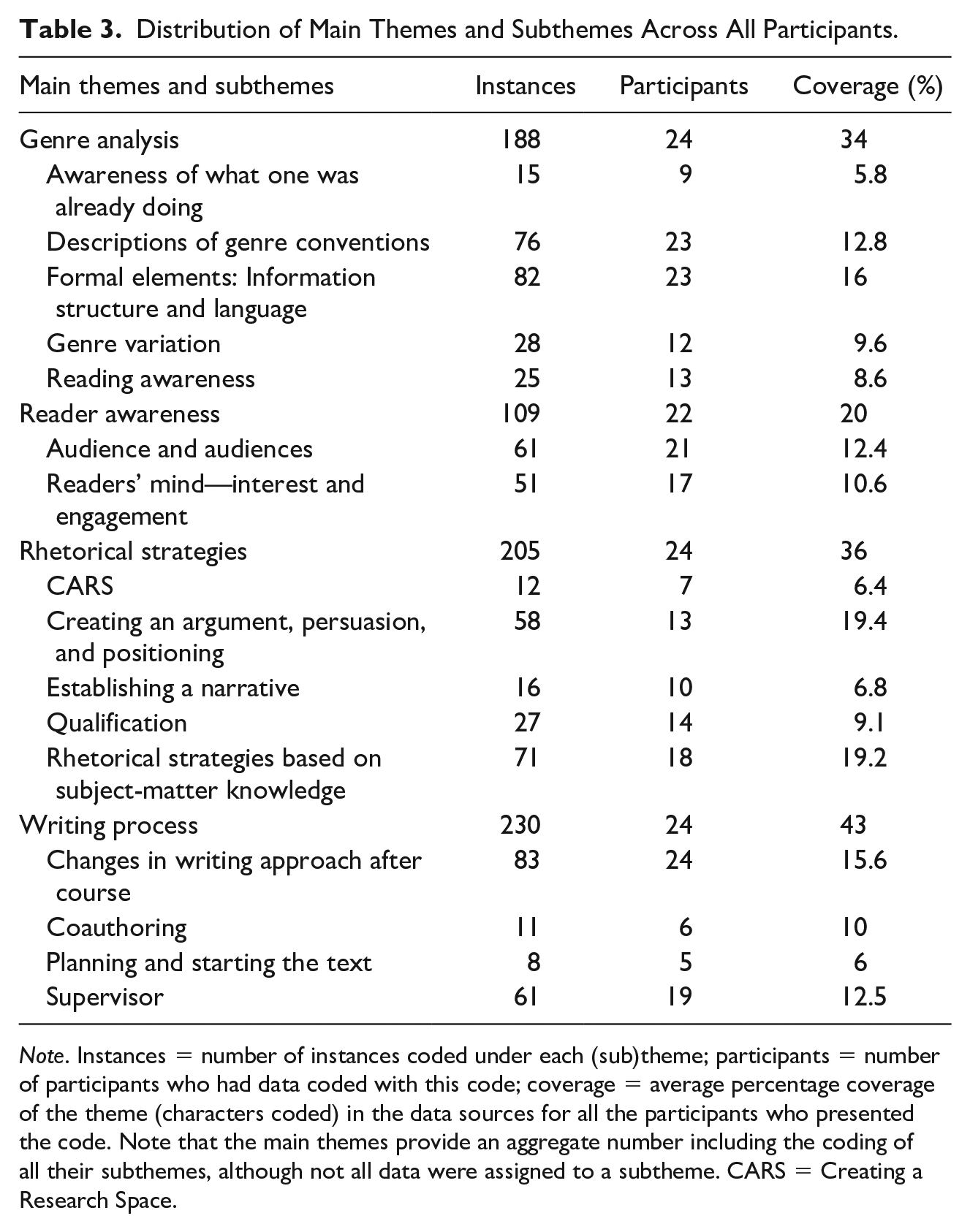
Note. Instances = number of instances coded under each (sub)theme; participants = number of participants who had data coded with this code; coverage = average percentage coverage of the theme (characters coded) in the data sources for all the participants who presented the code. Note that the main themes provide an aggregate number including the coding of all their subthemes, although not all data were assigned to a subtheme. CARS = Creating a Research Space.
Overall, Table 3 illustrates that all four themes were represented across the students, with some subthemes more frequent than others. The theme with the greatest number of references (coded instances) was Writing Process (230 references across all 24 participants), followed by Rhetorical Strategies (205 references, 24 participants), Genre Analysis (188 references, 24 participants), and Reader Awareness (109 references, 22 participants), for a total of 732 coded instances. Percentages of coverage give a dimension of the extent of the coded data in the source (on average), for example, whether the coded theme/subtheme covered just a small part of the interview or not and shows that each theme covered on average a sizeable portion of the sources where it occurred.
First, it is worth noting that metacognitive awareness of GA emerged consistently across all 24 participants. This theme comprises comments students made especially at the beginning of the interview, and it refers to their metacognitive knowledge of what they learned about genres, mostly by doing analysis tasks. It is thus no surprise that participants reported an awareness of genre conventions and formal elements (recurring patterns of information, coherence, and flow; 23 students). Approximately half of the students also reported awareness of genre variation, as well as gaining awareness of how to read published texts (RA). Finally, nine out of 24 students mentioned that GA helped them gain metacognition of their own implicit procedural knowledge, giving a clearer insight into their existing ways of writing (awareness of what one was already doing).
RA corresponded to students’ reflections on how (and why) they thought about their readers and engaged with their audience. This theme emerged both in response to the first interview question and during the discussion of their texts. Table 3 shows that almost all the students reported metacognitive engagement with the reader (22 out of 24). Note also that almost all the participants explicitly reported an awareness of their audience (21 out of 24), and many reported being aware of the need to consider the reader reaction to their texts (readers’ mind, 17/24).
Metacognitive awareness of RS—writing strategies with a discoursal purpose—was also detected in all the students and was well-represented throughout (205 instances). This is perhaps not unexpected considering the set-up of the interview, which asked them to go thought their own article(s) and describe their writing approach. Yet this theme underscores that students did indeed think about their RS quite consistently, and often in relation to the topic of their article or specific aspects of subject-matter knowledge (18 students, 71 instances), suggesting an epistemic use of writing as means to construct knowledge (cf. Galbraith & Baaijen, 2018). Approximately half the students also reflected on aspects of argumentation such as positioning, establishing novelty (58 instances, 13 students), telling a story, and establishing a narrative.
Finally, during the interview participants were asked to describe their approach to writing their articles: this elicited metacognitive awareness of their WP. This theme encompasses both the process for writing the specific article(s), as well as general changes to their own personal process for writing, including changes in attitude toward research writing and themselves as writer. This subtheme emerged primarily in response to the third interview question and was reported by all the participants (83 instances, 24 students).
It is worth noting that analyses of potential data disaggregation, to discern differences across groups of participants, were inconclusive—for example, by time of interview (before or after 6 months), and number of articles discussed (9 students with 1 article, 15 with 2+ articles), especially when the number of instances was averaged by the number of students the subgroup.
On the whole, this data suggests a considerable convergence of all students’ metacognition on these common main themes and on some of the subthemes. We will now see how these themes/subthemes combined: not just their frequency in the data but also if they frequently occurred in combination with each other.
Metacognitive Integration of Genre Knowledge Facets in Writing for Publication (RQ2)
What evidence exists that students metacognitively integrate different facets of genre knowledge in their writing? For instance, Are students who are metacognitive about audience also aware of how this knowledge informs their own RS? How frequent is this combination across all students? This question was addressed by examining how frequently theme/subthemes co-occurred with each other in the data.
Co-occurrence of themes was identified through matrix analysis. The results of this analysis are presented in Table 4, giving an overall picture of the frequency and distribution of these co-occurrences for the main themes (see online Table S1 in Supplemental Materials for a complete master table with all the themes/subthemes co-occurrences).
Overview of Co-Occurrences of Main Themes.
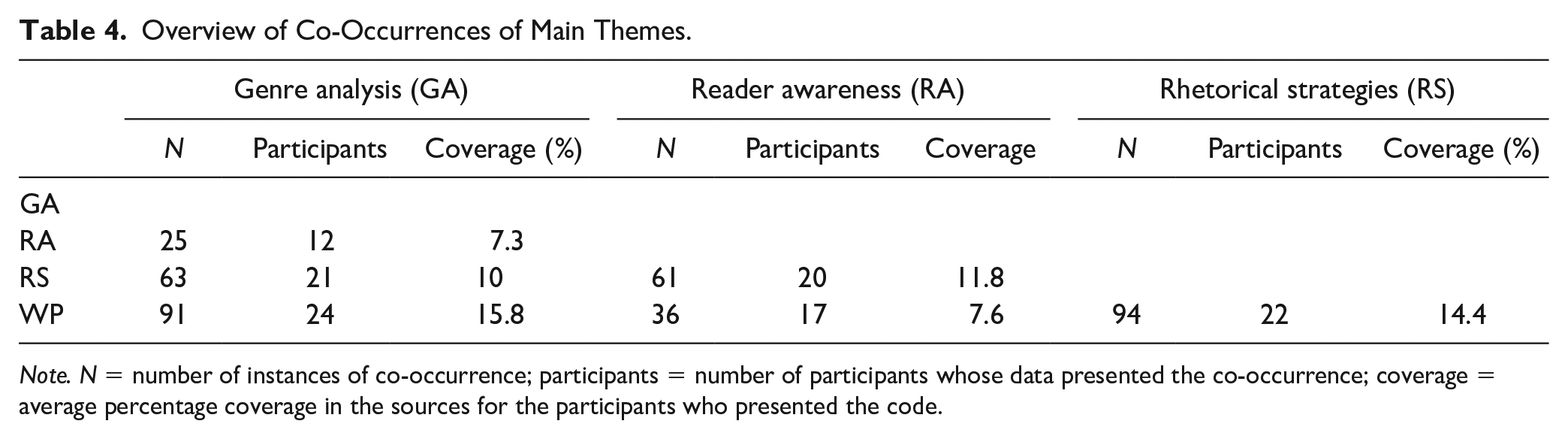
Note. N = number of instances of co-occurrence; participants = number of participants whose data presented the co-occurrence; coverage = average percentage coverage in the sources for the participants who presented the code.
Table 4 shows that the main themes were intertwined and co-occurred frequently across all students. In particular, GA co-occurred with WP (91 instances across all 24 participants). GA co-occurred also with RS (63 instances, 21 participants), a theme that also often combined with RA, where it presented RA’s strongest co-occurrence in the data (61 instances, 20 participants). Finally, awareness of the WP was often connected to RS (94 instances, 22 participants). These results again suggest that not only these themes were strongly represented across all students but that they also frequently occurred together. In other words, to make an example, students were not only metacognitively aware of genre conventions, or audience and readers but they also consistently connected their knowledge of genres and/or readers to their own RS. We will now turn to each theme more in detail. In the next section, theme/subtheme co-occurrences are presented in tables: Each of these tables “zooms in” on the co-occurrences for a specific theme, followed by qualitative examples from the interviews. 3
Genre analysis: Structures, form, and rhetorical conventions as tools for writing and reading
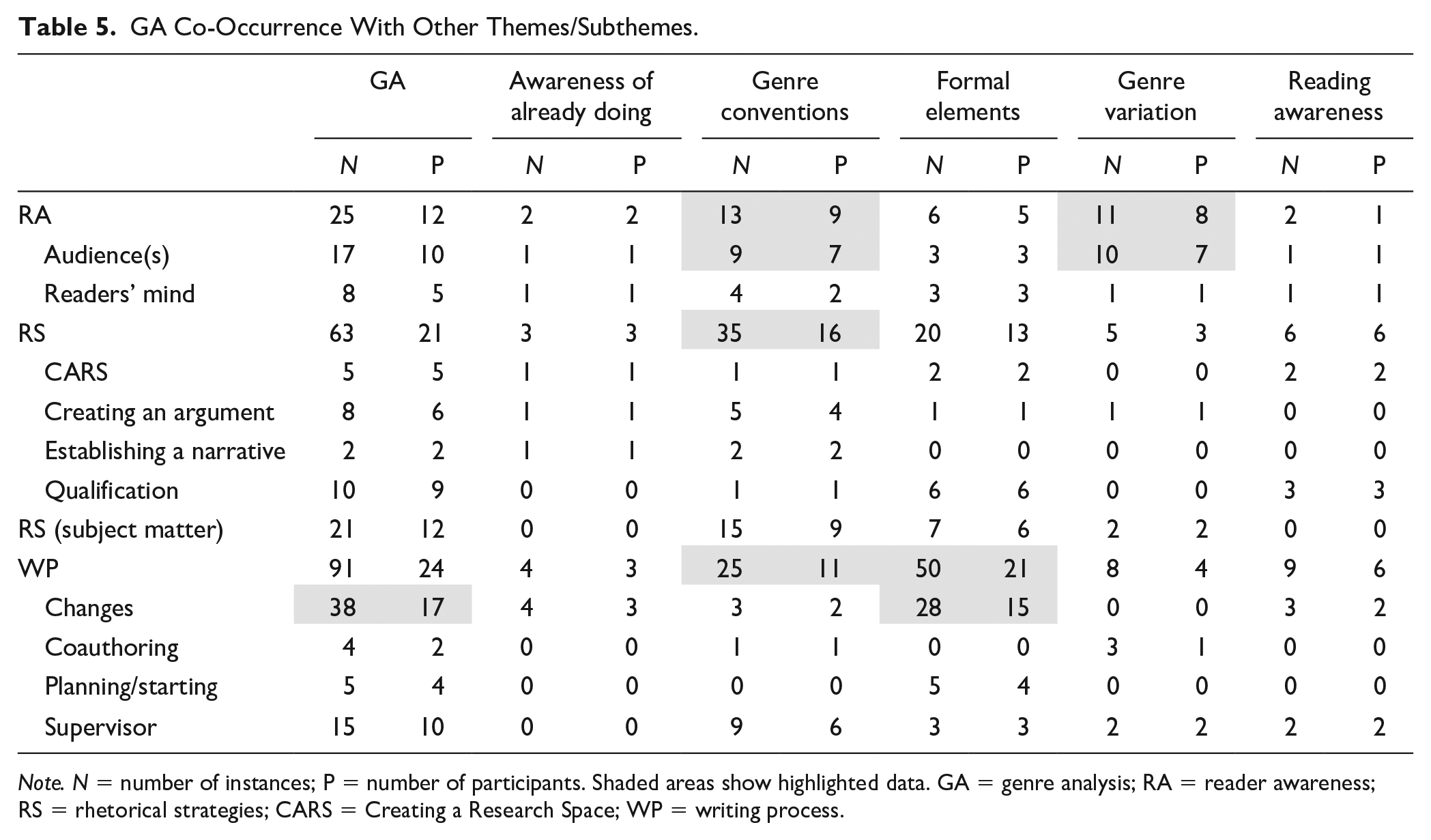
GA indicated students’ metacognitive awareness of genre-related aspects of academic writing, primarily stemming from GA tasks. Table 5 illustrates the results of matrix analysis and shows how this theme and its subthemes were combined with the other themes.
GA Co-Occurrence With Other Themes/Subthemes.
Note. N = number of instances; P = number of participants. Shaded areas show highlighted data. GA = genre analysis; RA = reader awareness; RS = rhetorical strategies; CARS = Creating a Research Space; WP = writing process.
Overall, Table 5 suggests an integration of GA with all the other themes, but specific combinations seem to be more salient (shaded areas): formal elements + WP for 21 students (and especially changes in the process, 15 students), genre conventions + RA, and genre conventions + WP. Genre conventions and genre variation were also connected to RA by around a third of the students (especially awareness of audiences). We will now explore these results more in detail.
The combination between GA/WP is particularly evident: Most students connected GA to changes in their WP (38 instances, 17 students). More specifically, students reported metacognitive awareness of formal elements, including information structures, flow, and linguistic elements typical of academic texts, as useful WP tools: strategies to take deliberate action when writing (50 instances, 21 students). For example:
1. “It’s good to get the tools and to get the name of what you are actually trying to do. Like, for example, when you structure, what are the techniques that you can think about?” (P21, Electrical Engineering)
These tools were appreciated by students who considered themselves writing “rookies”:
2. “It really made sense because you see this pattern all the time. And as a rookie, there is no point for me to try to do something else.” (P20, Mechanical Engineering)
Seemingly, GA helped students become aware of the connection between genre conventions and RS (35 instances, 16 students) as well as RA (13 instances, nine students). Students reported gaining an awareness of genre conventions and underscored the usefulness of this awareness in detecting and implementing rhetorical features of published texts in their fields:
3. “Looking at those papers and trying to see how people in my field . . . How you write this type of texts [sic], that was very useful, specifically regarding structures . . . I had fairly small discussion and conclusion sections, and that was sort of interesting to see, looking at texts in your field” (P12, Physics)
Students also frequently connected awareness of genre conventions with WP (25 instances, 11 students), especially when reflecting on how typical patterns and structures facilitated or affected their writing:
4. “The microstructure of paragraphs makes it easier to structure my own thinking, it improves the speed with which I write, and paragraphs seem more logically consistent” (P22, Physics)
Genre variation was also noted, particularly in connection to RA (11 instances, eight students). Interestingly, awareness of genre conventions did not always result in unquestioned adoption. P3 for instance reports acquiring a critical outlook on their field’s writing practices:
5. “I think texts in other fields are more well written, or at least to my standards, more focused. I realized this during the course. It’s a bit unfortunate, I hope I can at least try to shift toward more focused articles.” (P3, Physics)
Finally, two specific GA subthemes without many co-occurrences but worth mentioning are RA (25 instances, 13 students, see Table 3 in Section “Metacognitive Convergences: Common Aspects of Genre Knowledge Doctoral Students Are Metacognitive About (RQ1)”) and awareness of what they were already doing (15 instances, nine students). The first subtheme signals students gaining metacognitive awareness that GA can provide a new way of reading and decoding academic texts. Students described this newfound awareness as an “eye opener,” a “new world” and “mental data” to understand research texts. Some students even indicated this as the main learning gain from the course. For instance, despite the challenges of GA, P1, a civil engineering student, appreciates the systematicity that GA provides for critical reading:
6. “It was difficult because it was new, but it was good because in a way you split the text and didn’t see it as a narrative . . . it is like two different worlds, I haven’t looked at texts in the same way. It’s really an analysis and not about liking it or feelings. (P1, Civil engineering)
Interestingly, a third of the participants reported also that GA provided metacognitive awareness of what they were already doing: It allowed them to “see” how they used genre conventions in their own writing—a procedural knowledge that was implicit. This realization was their main learning gain:
7. “Most things were stuff that I kind of used already, just that I didn’t know about it. It’s more that it helped me realize which way I was writing papers. I just saw that wow, this really fits very well.” (P10, Astrophysics)
Likewise, the comment below by a PhD in Energy and Environment clearly illustrates GA as an “eye opener,” fostering students’ metacognitive awareness of how and why several dimensions of writing are combined in publication:
8. “I like writing . . . I was doing it more or less like this always, but now I would be able to name it or sort it into the different boxes, and before it was more like a big salad and I would apply some things but not consciously. I thought it was really interesting to know aha, this is how you call it, and that’s how it’s structured, and that’s why we structure it like this . . . These eye openers, seeing that's why you should do it like this, and that’s why people are applying these things.” (P11, Energy and environment)
Reader awareness: Audiences and the reader’s mind, interest, and engagement
RA indicated student’s metacognitive awareness of audience(s) and reader’s reactions. Notably, RA was not only mentioned frequently in connection with RS (61 instances, 20 students) but also quite consistently with aspects of WP (36 instances, 17 students) and, for half the students, GA. Specifically, metacognitive awareness of audience(s) was expressed by more than half the students in combination with RS (31 instances, 16 students), and especially in relation to the creation of an argument, as we will see more closely. Similarly, approximately half the students indicated metacognitive awareness of readers—readers’ mind—in connection with RS (34 instances, 14 students; see Table 6).
RA Co-Occurrence With Other Themes/Subthemes.
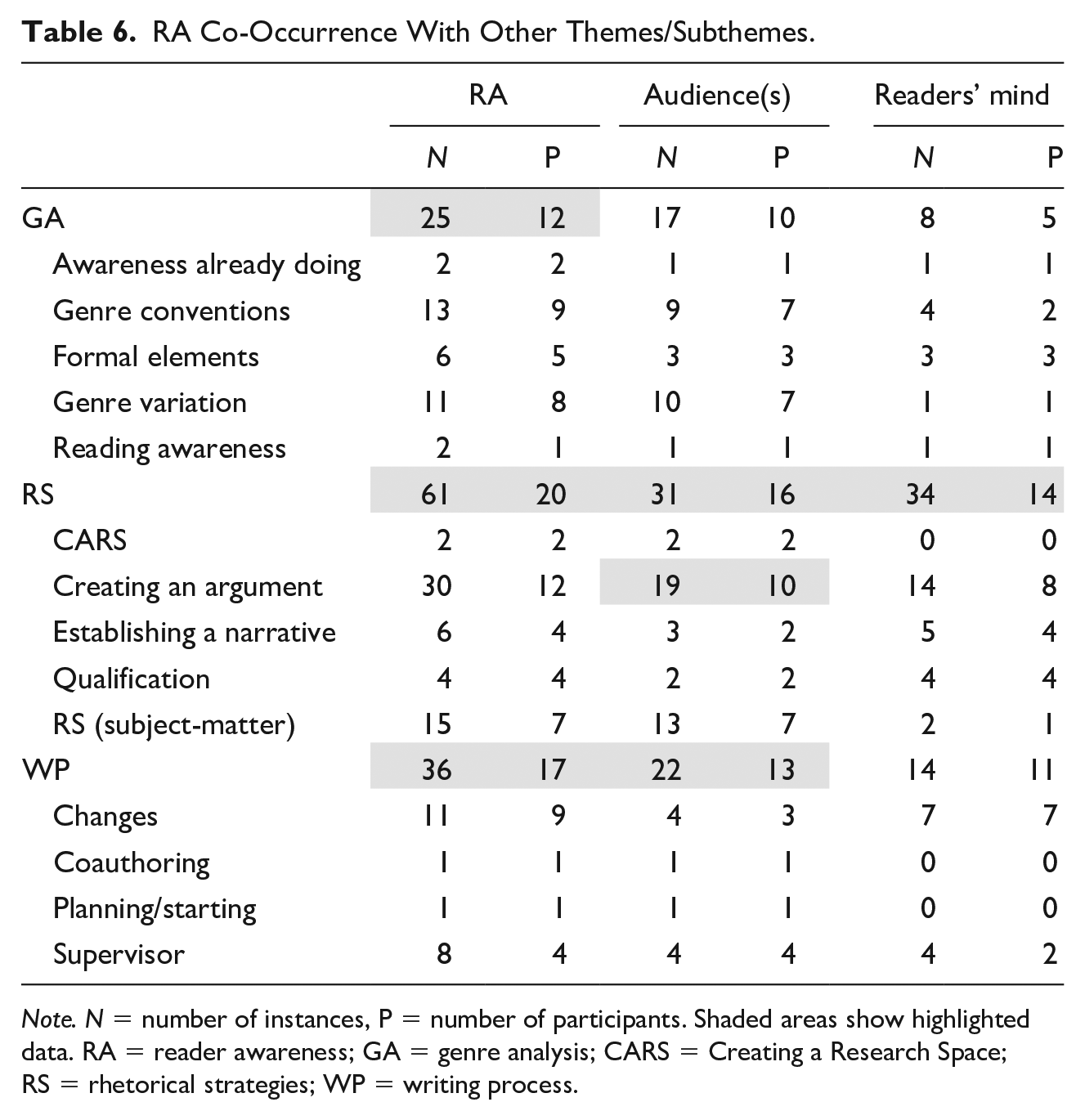
Note. N = number of instances, P = number of participants. Shaded areas show highlighted data. RA = reader awareness; GA = genre analysis; CARS = Creating a Research Space; RS = rhetorical strategies; WP = writing process.
Interestingly, matrix analysis comparing students discussing one article versus students with two+ articles during the interview gave indications of slight differences concerning the combination of RA with RS (Table 7).
RA Co-Occurrence With Other Themes/Subthemes: Comparison of Two Groups.
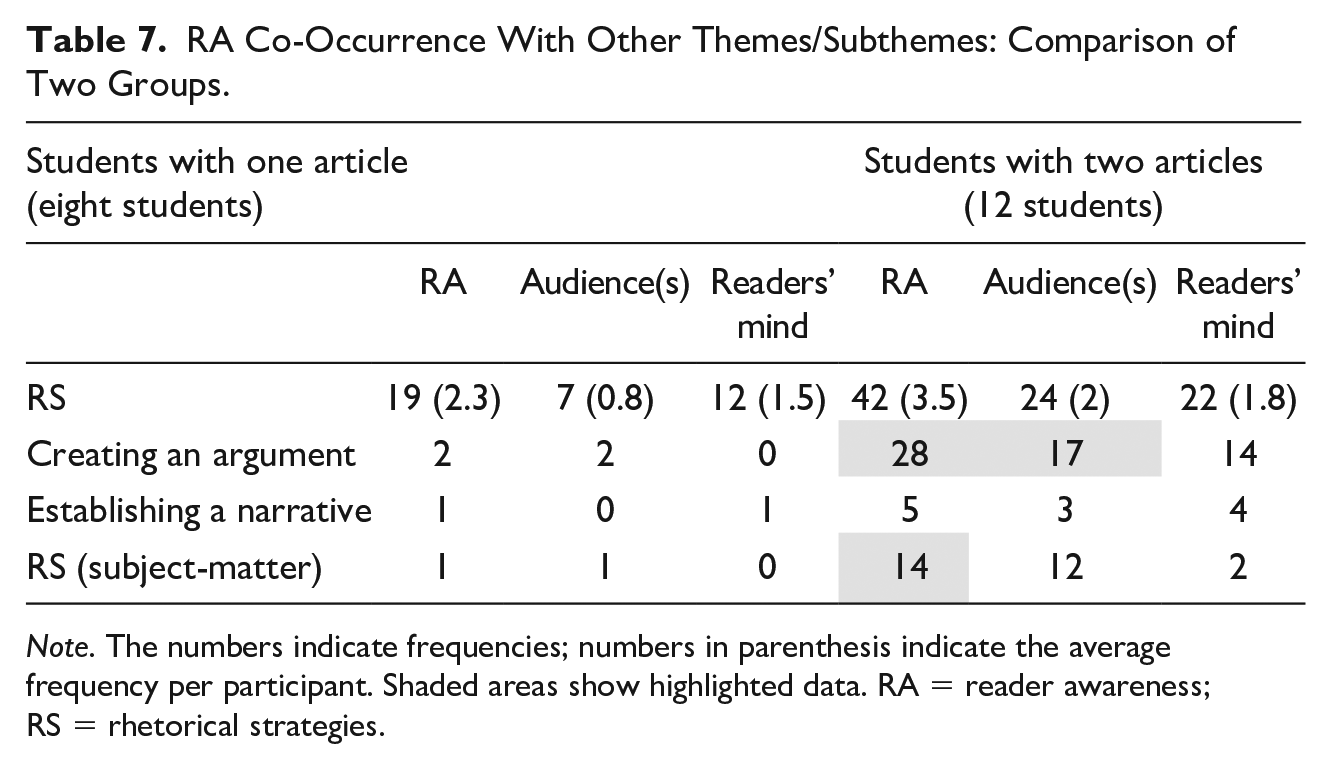
Note. The numbers indicate frequencies; numbers in parenthesis indicate the average frequency per participant. Shaded areas show highlighted data. RA = reader awareness; RS = rhetorical strategies.
Table 7 shows a slight overall difference between the two groups of students, especially when number of instances is averaged by number of students in each group (first row). However, students reflecting on two or more articles during the interview clearly combined awareness of audiences with considerations of RS more frequently than students with one article (28 instances), particularly in relation to argumentation (17 instances) and subject-specific RS (14 instances). Conversely, almost no instances of these combinations were reported by students with one article. This is likely a result of the interview setup and needs to be interpreted with caution. It is thus interesting to look more closely at the data underlying RA and its combinations with other themes.
Thinking about readers’ reactions—The reader’s mind—was seen by some students as the main take away from the course and was reported as a metacognitive strategy to monitor and evaluate the text. Raising/maintaining readers’ interest was seen as an important writing goal, as illustrated by P1’s comment (this student discussed one article during the interview):
9. “Even though you’re writing parts of the article, it’s good to go back and think it through . . . if you close one eye and see it from someone else’s perspective, it’s not as clear as you thought strangely enough. To keep the reader all the way, take the reader with you, that’s what I’ve found difficult before.” (P1, Civil engineering)
RA was combined by students with RS (20 out of 24 students), suggesting that students were metacognitive about the connection between the need to engage the reader, and the kind of reader responses elicited by various RS. For example, P6 (also in the one-article group) reflects on grasping the importance of engaging the reader through narrative and adaptation of rhetorical conventions:
10. “My kind of research writing is fundamental because you have no data, you have no numbers, so the most important aspect is how you expose things, and I had never really reflected upon that. I realized during the course the need to tell a story, to write the article thinking about who is reading it.” (P6, Technology management and economics)
Similarly, readers’ expectations are metacognitively connected to specific RS aimed at signaling novelty and significance:
11. “One thing that really improved in the paper after I worked in the course was clarifying why we do this, this is what we contribute . . . makes it easier for the readers to see whether this is of interest for their particular work.” (P18, Energy and environment)
P13, an electrical engineer, reports that RA made writing more difficult, requiring more thinking:
12. “Actually, it made the writing much more difficult for me. Before that I didn’t think about some stuff . . . after this course, I said, okay but if somebody else read my paper, do they get what I’m writing?” (P13, Electrical engineering)
It is interesting to note that some students explicitly motivate using genre conventions as RS to engage the reader:
13. “It’s not like I decided I want to put [the SPS] there, it’s more like I can identify the structure because it naturally emerged if you want to cover this topic and make it relevant for the reader.” (P3, Physics)
14. “The contextualization, I think we mostly just do not think that the reader would appreciate it . . . from what I read, that’s quite common that you do it like that” (P14, Mechanical engineering)
Another RA subtheme is audience and audiences: instances where students show metacognitive awareness of their varied disciplinary audiences (often tied to different journals). As seen in Table 7, students with two articles during the interview reflected on journal audiences in combination with RS more frequently. In general, irrespective of number of articles at the time of the interview, the comments below illustrate how students metacognitively connected audience awareness, reader engagement, and rhetorical choices. For example, P2, a materials engineering student (one-article group) stresses the importance of reflecting on audience at the beginning of the WP when planning a research submission:
15. “From the start, I had a clear idea of what my audience was. And, I pretty much succeeded, because I also started to think I should write more specific. We are working with some medicine development and then, there are two sections: one is Doctors, one is Engineers.” (P2, Materials engineering)
Similar considerations of audience and its impact on RS emerged in the comments of students working interdisciplinarily. P17 reflects on the discourse communities tied to various journals and uses this knowledge as a metacognitive strategy to evaluate their contribution and choose publication venues:
16. “I don’t think for the Journal that we will send this to . . . the equations are not interesting, this figure is what they will be interested in . . . different audience . . . this is model development paper, which I think we have to itemise. But in here they don’t need it, so depending on which audience, this is more mathematical, this is more industrial, let’s say, very general.” (P17, Mechanical engineering)
Often, students with two articles motivated their argumentative choices with considerations of audience, especially when comparing their RS across articles. For example, P18 is metacognitive about how different journals will require addressing the rhetorical “problem” of motivating one’s questions and method in different ways:
17. It’s not fully decided which is the best journal, but I think it’s a little bit more specific than the other paper, so it’s a little bit easier to define why we’re doing this . . . and motivating why the method is a good choice. So the problem is a little bit different. (P18, Energy and environment)
Finally, some students mentioned that gaining metacognitive awareness of the need to contextualize one’s rhetorical approach in response to audience was the main take-away from the course:
18. “I think the whole genre thing, who I am writing for, the audience, I was trying to be a bit more aware of that. Seeing the necessity of actually contextualizing my work so I actually am sure that I relate this to other things in my field” (P24, Energy and environment)
Rhetorical strategies: Creating an argument, taking stance, adapting to discipline
Overall, students’ metacognitive awareness of RS, both in general and in relation to their own articles, was consistently connected to the other themes (Table 8). Students connected RS to genre conventions in their field (35 instances, 16 participants), indicated that RS are tied to audiences and the need to engage the reader—especially with regard to effective argumentation (30 instances, 12 students), and overall demonstrated metacognitive awareness of how RS were implemented, negotiated, and motivated in their own WP (94 instances, 22 students)—particularly subject-based strategies (26 instances, 12 students). These co-occurrences again suggest a metacognitive integration of genre knowledge facets in the students’ conceptualization of writing for publication. Let us see now more in detail.
RS Co-Occurrence With Other Themes/Subthemes.
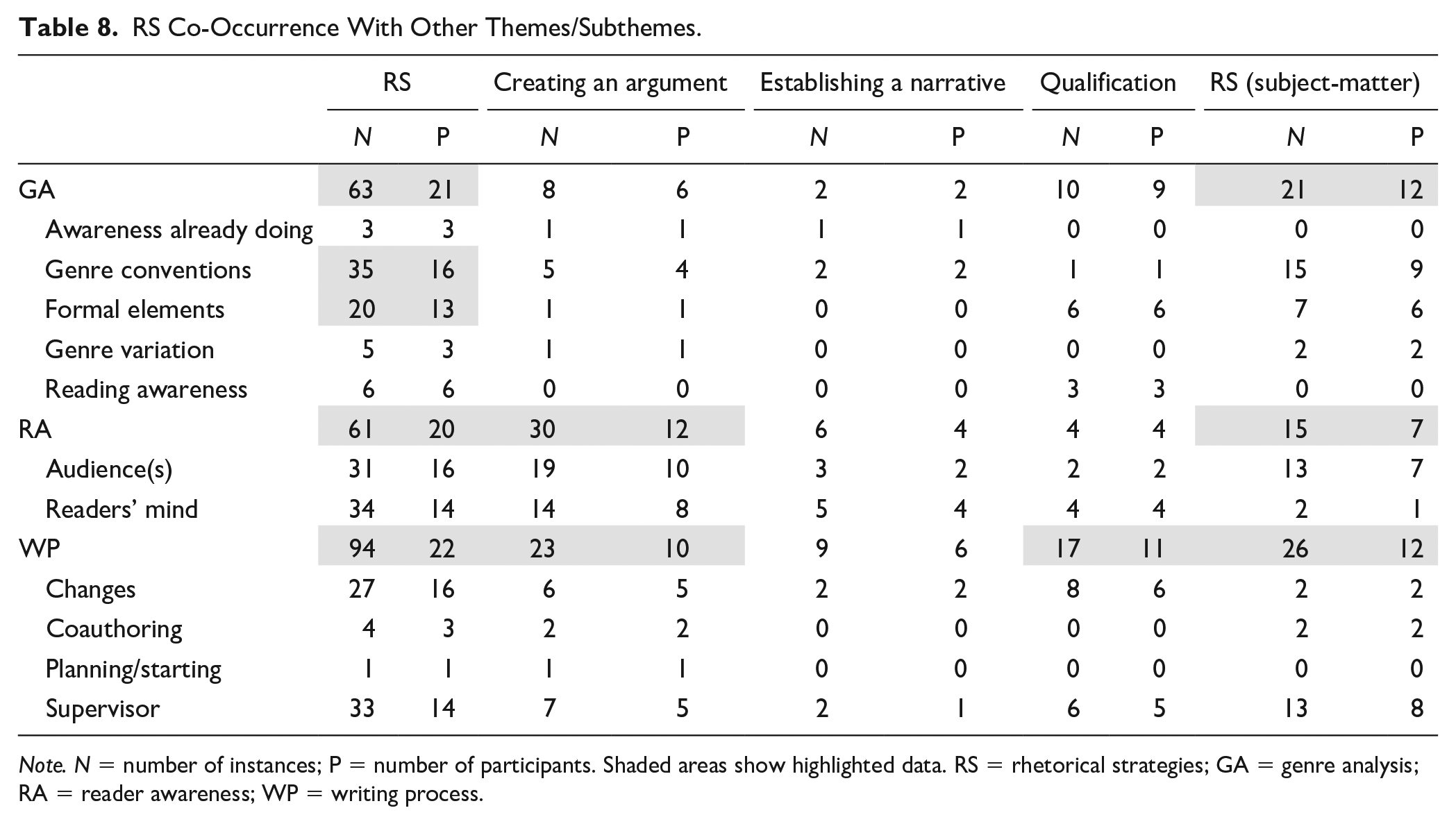
Note. N = number of instances; P = number of participants. Shaded areas show highlighted data. RS = rhetorical strategies; GA = genre analysis; RA = reader awareness; WP = writing process.
RS overlapped with GA (63 instances, 21 participants): students motivated their rhetorical approach based on what they had learned about their target genres (conventions, form, and variation). Because of the link to genre conventions, RS were often subject based (21 instances, 12 participants). For example, this Chemistry student reflects on their own rhetorical choices vis-à-vis genre conventions:
19. “Some papers in my field they just end ‘Oh in this paper we did this and got this, this and that’ and that’s it.’ I think I like more to do a summary . . . that’s how I wrote it . . . there’s the problem, there’s the solution, this is what I got.” (P8, Chemistry)
P11’s comment combines a reflection on genre-specific conventions, the need to optimize the cohesiveness of his text, and the need to keep the reader engaged:
20. “What makes it maybe a little bit boring to write this part is that it’s a lot of equations, and you try to embed them into a nice text that it’s a nice flow, I mean you have to connect them in a way. That was a bit difficult sometimes to have it as a flowing text.” (P11, Energy and environment)
Thus, RS were not only motivated by reader- or genre-considerations but also by topic and subject-matter. This suggests that students were metacognitively aware of the epistemic function of writing (Galbraith & Baaijen, 2018) as in the example below: It is the nature of the data itself, rather than genre conventions or readers’ engagement, that drives this Astrophysics student’s strategies for data visualizations and commentary:
21. The writing of the commentary led in actually constructing these tables and realizing what should be there, which figures did we need and how did they look (how did you decide?) It had a lot to do with the quality of data.” (P10, Astrophysics)
As we have seen in “Reader awareness: audiences and the reader’s mind, interest, and engagement,” students’ metacognitive awareness of RS included a connection with RA, especially when comparing more than one article during the interview. The following comments display students’ metacognitive awareness of the ties between RS, subject-matter knowledge, and audience knowledge especially in interdisciplinary fields:
22. “The conceptual framework . . . it’s the trickiest and most time demanding because it's multidisciplinary, so taking parts of knowledge and then having some sort of framework out of it wasn’t easy . . . It’s a synthesized sort of framework but we will see how (readers) would react on it.” (P9, Technology management and economics)
23. I wrote a very long Introduction, because I couldn’t sum up all things in one paragraph. It’s difficult for me; I should have very good knowledge of all literature. The problem with my paper is it’s a multidisciplinary area, (audiences) . . . I don’t know how to connect those together. (P13, Electrical Engineering)
Interestingly, some students mentioned the importance of communicating Novelty, which they metacognitively related to both their target audience and the need to keep the reader engaged. The following comment by a student in physics not only shows how thinking about the reader but also their own stance and genre conventions, informed their RS:
24. “We expect that this paper will be controversial in the field, so we payed attention to state the main message repeatedly: in the overview paragraph, ‘In this letter,’ which is obligatory for (Journal), as a conclusion of commentary on figures, and in the conclusion” (P22, Physics)
Notably, some students reported a metacognitive use of language for rhetorical purposes, that is, the use of qualification to express stance and engage readers. Students commented on the challenge of calibrating language choices against the backdrop of genre conventions and the readers’ mind/audience expectations. For example:
25. “Some things I wanted to highlight, I tried to also denote the language, like interestingly, note that; it is noteworthy . . . that appears quite a lot. I like that, to try to change the language so that the reader actually gets the points and maybe understands the figure also better.” (P24, Energy and environment)
26. “For example, here when we have ‘we present,’ ‘we show,’ I wanted to change a little more, I don’t always want to present, always show. Those kind of really boring. . . . For example: ‘unrealistic assumptions’ . . . Ah, ‘marginally superior’! Things like that. I noticed that this has improved little bit but still I have a lot of issues.” (P16, Electrical Engineering)
Finally, the following comments illustrate the combination between RS and the WP: writing strategies adopted with a rhetorical goal in mind, suggesting metacognitive awareness of the interrelation between GA, specific RS, and the usefulness of this knowledge to monitor rhetorical gaps in her own texts:
27. “I think the most important part was to sort of generate a clear and concise take-home message . . . a lot of time went into that, what is the actual to take-home message of this paper, because it might not be entirely clear, if you want to summarize it in a few sentences, so . . . I looked at a few papers that were similar to this.” (P12, Physics)
28. (Identify genre conventions?) Yes, I knew some moves before, but I learnt more how you can apply them. So, some moves were missing before I started this course, so I added those, especially the one, establishing the niche. I had left that out completely before. That was one example that added to the article and also to the Kappa” (P15, Technology Management and Economics)
The writing process: Strategies, changes, and lessons learned
All students were metacognitive about the WP (see Table 3, Section “Metacognitive Convergences: Common Aspects of Genre Knowledge Doctoral Students Are Metacognitive About (RQ1)”) both in general—what is required to produce an article, what strategies and tools are useful—and specifically about the article(s) discussed during the interview. Table 9 shows that this metacognitive awareness was intertwined with all the other dimensions of writing. Notably, all students mentioned changes to their WP after the course (91 instances, 24 participants), 4 and in most cases these changes were explicitly connected to insights gained through GA (38 instances, 17 students). Seen that interviews required the students to describe their approach to research article writing, they often reflected on RS in combination with their WP (94 instances, 22 students). Overall the picture that emerges is that students seemed metacognitively aware of how to self-regulate their writing, deliberately combining different kinds of knowledge in this process.
WP Co-Occurrence With Other Themes/Subthemes.
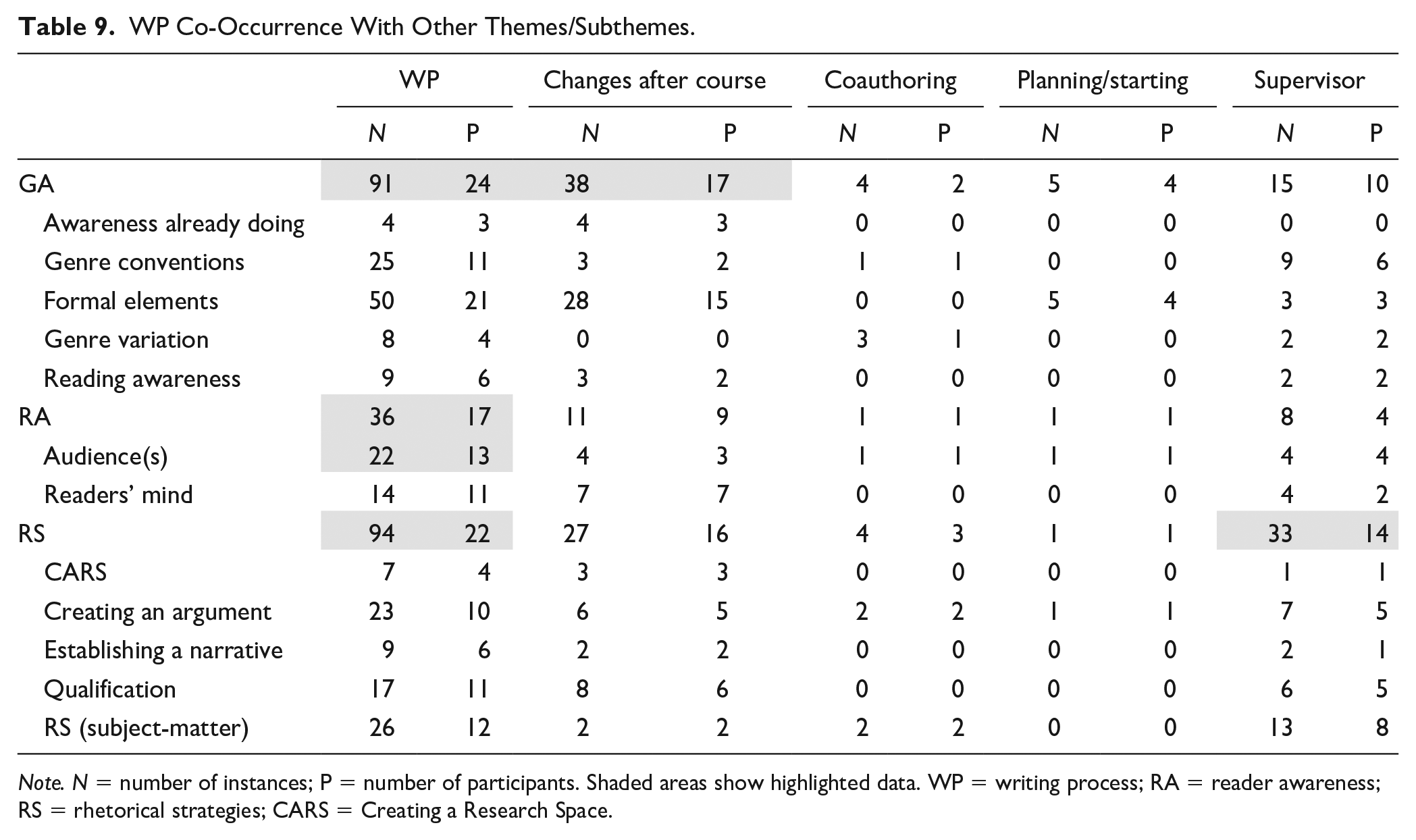
Note. N = number of instances; P = number of participants. Shaded areas show highlighted data. WP = writing process; RA = reader awareness; RS = rhetorical strategies; CARS = Creating a Research Space.
GA was combined and used metacognitively in the WP by all the students. As seen in section “Genre analysis: Structures, form, and rhetorical conventions as tools for writing and reading,” conventions, structures and patterns were “tools” to regulate the WP: in the example below, P12 reflects the usefulness of starting with a “big picture” in mind:
29. “The main part was to get this big picture, the structure of your text. Before I didn’t really think about it; I would just sit down and just start typing, and afterwards when I was done, I had to go back and rewrite everything, because it was a mess . . . now it’s clearer to structure a text, it becomes a lot easier to write. That was probably the main difference between writing before and after the course” (P12, Physics)
Genre-derived structures are seen as strategies to get started and monitor the WP:
30. “Strategies in your head that you could think about when you were writing” (P14, Mechanical engineering)
Other participants emphasized the shifts in attitude provoked by gaining genre knowledge. This shift is clearly tied to changes in efficacy and personal enjoyment:
31. “This course has changed my writing quite well. You can ask my supervisor about that (Laughs). I was quite bad. I never thought about writing as an expression of art. I never found patterns actually. I knew, okay, this writing is good but I never could identify why it was good. . . . I got that there are some patterns that you can use that make sense. It actually changed my perspective on writing quite a bit. More enjoyable, yes.” (P16, Electrical engineering)
In describing their WP, almost all students motivated their decisions in light of rhetorical goals: RS co-occurred with WP in 22 students. For example, P7, a Biology student, displays metacognitive awareness of how their own rhetorical choices vis- à-vis genre expectations affected their writing and self-perceptions as writer:
32. “I think I have a different few points now about how to write and also about myself as writer. I think I always try to explain too much in the introduction. . . . I should be more focused and it’s been difficult. . . . When I was structuring my paper, like which section goes after, I was trying to follow them; that was why I did it.” (P7, Biology)
Furthermore, comments about stance and qualification suggest that rhetorical dimensions, such as positioning, were metacognitively regulated during the WP:
33. “That was very good, about the claims. I think that was very hard at the beginning, when I started my PhD. And me, as personality, I always put ‘maybe, it might be,’ so my claims are very weak. It is something I need to work on. But I won the Best Doctoral Paper award in the conference. I was very, very happy, since I’m the single author of this paper . . . it might have been the boosters, that I occupy the niche, what are the contributions, what is new with this one, which I missed in my other papers.” (P15, Technology management and economics)
Inevitably, consideration of genre also invited considerations about audience and readers. This “communicative” aspect of writing (Beaufort & Iñesta, 2014) was deliberately and strategically translated into authorial decisions during the WP. For example, P24 below describes how positive changes to the WP were related to mastery of structures and RS, as well as an increased awareness about readers in setting goals and planning:
34. “Which journal might fit, I try to go for the audience: What are other people saying? That’s a good exercise to do before you start writing, making sure what’s my actual stand in this field. . . . Just do that in the beginning. . . . Better than doing it at the end and realising, wait a second, this doesn’t fit; this is not a good idea to write at all” (P24, Energy and environment)
Considerations of possible readers’ reactions to the text are thus used metacognitively to plan, monitor and revise articles:
35. “Since I work in this interdisciplinary field, I often get confused. When I wrote this paper you could not figure out who I was addressing. When I revisited the article I did it by thinking about ‘who am I talking to?’ . . . when I was revising the paper I was trying to remind myself to think about who I wanted to communicate” (P6, Technology management and economics)
Finally, an increased sense of control over their writing was clearly connected to enjoyment:
36. “I was very efficient with this [introduction] compared to this one. Although writing is not 100% my interest, I feel I enjoy more writing. I feel that I make a novel to someone else to read, so it’s a positive feeling . . . More positive than before.” (P17, Mechanical engineering)
37. “I probably see more the fun of it [writing]. Before, I was like: writing (sigh) But now I see this is actually not just publishing because you have to publish something; this is more of a tool how to work and communicate. All these things—how you can rewrite and how you can rephrase—this is a bit fun now . . . that’s where my attitude towards writing has changed, and the way I write has also changed: I think about the stylistic approaches, rhetorical figures. . . . That’s what I actually have in my mind.” (P24, Energy and environment)
Discussion and Conclusion
This study aimed to find the metacognitive generalities (Bazerman, 2018) in writing for publication among doctoral students across STEM fields—what they have in common. It posed two questions: (a) on what aspects of writing for publication does students’ metacognition converge and (b) whether there is evidence that students metacognitively integrate these themes in their writing.
Overall, the findings presented above indicate that students’ metacognitive awareness converges on four themes: Genre Analysis (GA), Reader Awareness (RA), Rethorical Strategies (RS), and the Writing Process (WP). Furthermore, all students metacognitively combined these themes in their writing, lending support to theoretical conceptualizations of writing expertise as a deliberate orchestration of various forms of knowledge and skills (Beaufort, 2007, 2012; Tardy, 2009, 2016). Students’ metacognitive awareness of their developing knowledge of research genres (including formal elements, conventions and variation) was seen as a useful tool to move forward and control the WP, “decode” research texts when reading, and in general plot RS in writing their own articles vis-à-vis considerations of reader engagement and audience(s).
Some considerations follow from these findings. First, the combination of GA and WP suggests that genre knowledge development stimulated metacognition of procedural aspects of writing for publication; in other words, students realized “what they were already doing” or acquired an explicit understanding of “how to do things.” As mentioned, making metacognitive procedural knowledge explicit is crucial for learning (Winne & Azevedo, 2014). Second, the combination RA/RS suggests that students also developed conditional metacognitive awareness, that is, they were aware of when and why aspects of declarative and procedural knowledge were rhetorically relevant. Third, and crucially, this evidence comes from 24 different students writing across a variety of fields, interviewed after a relatively long period of time. This fact corroborates the usefulness of GP to develop students’ understanding of genre as a “heuristic” for writing (Cheng, 2018), and confirms that metacognition does indeed feature prominently in a conceptualization of writing expertise, as posed by Tardy et al. (2020). Finally, the themes identified in this study respond to the need to identify common challenges and areas of relevance for doctoral writers (Casanave, 2019; Curry & Lillis, 2019) and could be used as a starting framework in scaffolding their path toward expertise, for instance, in the evaluation of their texts or in the transfer and recontextualization of their writing knowledge (Beaufort & Iñesta, 2014; Castelló et al., 2013; Tardy et al., 2020).
Two specific findings merit further discussion. First, it was noted that students who compared two or more articles during the interview clearly combined considerations of audience and RS much more explicitly than students with only one article, particularly with regard to argumentation and subject-specific strategies. While this is likely due to the interview set-up (no other differences were identified after repeated data disaggregation analyses), it is notable for its theoretical and pedagogical implications and for future research. Specifically, this finding confirms that specific tasks, such as writing for different audiences and commenting/reflecting on these adaptations, may indeed promote recontextualization (Cheng, 2018). Theoretically, this evidence supports the notion that fostering students’ metacognitive awareness of the facets of genre knowledge that are typically associated with task conditions—such as reader reactions, journal audience, and the specific content of the article—informs their procedural decisions in “new rhetorical contexts” (Tardy et al., 2020, p. 312). Second, related to this, the data provided consistent evidence of students’ metacognitive awareness of adaptations of RS to the subject-matter at hand (subject-specific RS). This finding indicates that students were using writing as a means of communication as well as a means of knowledge construction, in its epistemic function: an ability that has been associated with expertise (Beaufort & Iñesta, 2014; Bereiter & Scardamalia, 1987). Together, these findings suggest worthwhile paths for further work on how metacognition is involved in recontextualization, transfer of writing knowledge, and the development of writing expertise.
Some final considerations need to be made about GP in general as a practice to promote expertise in scientific publication. Kellogg and Whiteford (2009) indicate cognitive apprenticeship and deliberate practice as the ideal approach to instruction to promote advanced expertise. This study suggests that GP, as these participants experienced it, can provide opportunities for cognitive apprenticeship and deliberate practice. In addition, promoting students’ metacognition of their emergent knowledge of genre(s) seems to help them construct explicit mental representations of writing in all its complexity, making these representations available for introspection, with long-term gains in learning (Schraw & Moshman, 1995). In this study, the “permanence” over time and the integration of the themes identified corroborates the findings of Driscoll et al. (2019), posing a connection among nuanced genre knowledge, metacognitive knowledge of how to use it strategically (transfer), and an increased sense of self-efficacy. The implication is that metacognitive training explicitly targeting the themes that have emerged here could promote genre manipulation and recontextualization (Tardy et al., 2020) and knowledge transfer (Beaufort, 2012).
Limitations are inevitable. Yet, from limitations stem opportunities for further work. First, the course attended by the participants was optional: These students may have been especially motivated to improve their academic writing, attenuating the generalizability of the findings toward students with low motivation. Second, some interviews occurred long after course completion, posing issues of recall accuracy: future studies could collect data with a more regular time line. Finally, interviews focused exclusively on the research article genre (and hence international publication in English). While this methodological choice was coherent with the goal of capturing self-reported experiences and identifying generalities across all participants, it did not capture potentially interesting dimensions of the students’ multilingual identity and how that identity may shape metacognition in writing, across a variety of genres and languages. Nor did it capture the students’ unique histories of academic literacy and their experiences of publication. These aspects could be examined in future work with a different methodological design and interview questions (see Tardy et al., 2020; Wilson & Soblo, 2020).
To conclude, I offer a reflection. The study reported in this article provides a multifaceted description of metacognition in writing for publication. It offers an evidence-based framework of doctoral students’ metacognitive “generalities,” which can be used in further research—for instance to highlight development across time, academic settings, and students’ languages—and as a basis for pedagogical interventions to support writing for research publication. However, metacognition, just like other theoretical concepts, is a useful notion insofar it illuminates pathways to understand and foster learning in authentic situations. This is especially true for writing. Writing for scientific publication is hard work. It is a competitive form of writing, demanding writers to discursively fight for space and construct an original contribution to a knowledge domain. It is also an act of communication, of crafting knowledge and meaning for oneself and others, and a creative, always unique experience of linguistic invention, “creating fresh meanings from the shards of recycled words” (Bazerman, 2018, p. 316). The students’ experiences reported here suggest that metacognition plays a vital role in this creative enterprise, illuminating possibilities for deliberate action, choices, and discursive avenues to express their voice.
Supplemental Material
sj-docx-1-wcx-10.1177_0741088320984796 – Supplemental material for Searching for Metacognitive Generalities: Areas of Convergence in Learning to Write for Publication Across Doctoral Students in Science and Engineering
Supplemental material, sj-docx-1-wcx-10.1177_0741088320984796 for Searching for Metacognitive Generalities: Areas of Convergence in Learning to Write for Publication Across Doctoral Students in Science and Engineering by Raffaella Negretti in Written Communication
Supplemental Material
sj-docx-2-wcx-10.1177_0741088320984796 – Supplemental material for Searching for Metacognitive Generalities: Areas of Convergence in Learning to Write for Publication Across Doctoral Students in Science and Engineering
Supplemental material, sj-docx-2-wcx-10.1177_0741088320984796 for Searching for Metacognitive Generalities: Areas of Convergence in Learning to Write for Publication Across Doctoral Students in Science and Engineering by Raffaella Negretti in Written Communication
Footnotes
Appendix
Acknowledgements
Heartfelt thanks goes to the editor and the reviewers for their time, engagement, expertise and constructive suggestions. And most importantly, my deepest gratitude goes to the students who participated. I thank them for their trust and enthusiasm. Per aspera ad astra.
Declaration of Conflicting Interests
The authors declared no potential conflicts of interest with respect to the research, authorship, and/or publication of this article.
Funding
The authors disclosed receipt of the following financial support for the research, authorship, and/or publication of this article: This study was partially funded by the Åke Wiberg foundation, Grant n. H16-0110, and by the Magnus Bergwall Foundation, Grant n. ID 2016-01494.
Supplemental Material
Supplemental material for this article is available online.
Notes
Author Biography
References
Supplementary Material
Please find the following supplemental material available below.
For Open Access articles published under a Creative Commons License, all supplemental material carries the same license as the article it is associated with.
For non-Open Access articles published, all supplemental material carries a non-exclusive license, and permission requests for re-use of supplemental material or any part of supplemental material shall be sent directly to the copyright owner as specified in the copyright notice associated with the article.
