



Abstract
In order to contribute to a more nuanced understanding of the varied ways multiple language competencies are invoked in scientific communication and publication, this study features a content analysis of a collection of English, French, and Arabic abstracts from 14 articles of Al-Awamia, a Moroccan agronomic journal. Mapping rhetorically significant differences across abstracts in different languages suggests that EN/FR abstracts are tailored to an international specialist audience and Arabic abstracts favor a domestic policymaker audience in several key ways. The textual moves made to address these different audiences are typical of those studied by scholars of science communication, and accordingly this study indicates that plurilingual textual practices in scientific writing are associated with differences in audience and stakeholders. These findings carry implications for trans/pluri/multilingually oriented scholars of scientific communication, as well as for those who prepare future researchers for the demands of publication, suggesting that the flexible use of diverse linguistic resources is important to scientific practice in a globalized world.
Keywords
In the mid-2010s, Oussama Rafiq, a Moroccan electrical engineer and computer scientist, was working in South Korea as a contractor. Most of his intra-workplace communication took place in English, but his projects were more linguistically complex. In one example, clients from the Arabian Gulf states were constructing a Halal meat market in southern France. Many of their expected customers were not proficient in French, but other customers would avoid shopping at the meat market if French was not offered as a medium. Oussama’s clients wanted to commission a point-of-sale system and interface for the meat market that operated in both French and Arabic and could toggle between languages at will. Among his Korean peers, Oussama was uniquely qualified for this work—most of his undergraduate and graduate education had been conducted in French, and Arabic was his native language. His bid was accepted because of his language proficiencies, clearly construed as assets for this highly situated task. He allotted eight billable hours for the project: two per language, and four total to design the interface. He designed the French portion of the point of sale (POS) over the course of around twenty minutes. The customer-facing Arabic portion took him three days.
~
The various communities and languages of communication invoked in Oussama’s story form a complex web that is illustrative of the finely tuned linguistic skills necessary to navigate transnational science and technical communication in the age of globalization. It is perhaps unsurprising that Oussama struggled with the Arabic-language portion of his design work; for decades, Moroccan STEM education has been conducted in French (with English recently entering the curriculum) because the French and English languages are widely perceived by students, parents, and policymakers as the languages of wider professional access. The Arabic-language POS system was the first document Oussama had composed in Modern Standard Arabic since high school.
STEM writing instruction around the globe often treats one language as paramount to professional communication without acknowledging the linguistic variety of audiences with whom STEM professionals communicate; Morocco is a representative example. The idea that only one standardized “universal scientific/technical English” exists in the professional and academic spheres endures even though it reflects neither the reality of lingua franca English usage around the world nor the roles other languages play in transnational scientific communication (Sharma, 2018). Current popular and policy movements in Moroccan education seek to align higher education and research more strongly with the English language and bibliometric analyses of publishing generally privilege English-medium articles, while acknowledging that most research in Moroccan is still written in other languages (Zebakh et al., 2017). Even news publications intended for the public have been known to boast about increasing rates of English-language Moroccan publications indexed in Scopus and Web of Science relative to scholarship published in French or Arabic (Anouar, 2022).
Because of the prominent role of science communication in professional and industrial spheres across national borders, inquiry that draws on trans- and plurilingual perspectives to interrogate the situated nature of language usage in scientific and technical disciplines is necessary to inform scholarship of communication and contribute to more linguistically just academic spaces and workplaces (Lu, 2006; Mihut, 2020). Accordingly, this study engages in a content analysis of a collection of plurilingual scientific texts represented by a set of research article abstracts from Al-Awamia, a Moroccan agronomic journal, in English, French, and Arabic. Analyses that compare “anglophone” (typically indexed, international journals) and “non-anglophone” (representing a wider range of journal types) contexts often privilege the former and thus reinforce myths of “universal STEM English,” yet professional scientists engage in many forms of communication not represented by the high-stakes English-medium international research article. As a counterpoint to this prevailing pattern, this study focuses on Al-Awamia, a regional agronomic journal published by the Moroccan Institut National de la Recherche Agronomique (National Institute of Agronomic Research) that contains abstracts in English, French, and Arabic. By conducting content analysis on a collection of Al-Awamia abstracts in three languages, this article seeks to investigate the rhetorical demands Moroccan agronomists face when composing across languages, as well as the linguistic and rhetorical tools they use to meet these demands as exhibited in the sampled texts.
Ultimately, this study is guided by the following broader questions about plurilingual scientific practice:
How do plurilingual science texts differ linguistically and rhetorically between language categories within a single publication venue?
What insight into scientists’ communication priorities and practices might analyzing plurilingual scientific texts published on local or regional scales offer which examining monolingual international journals omits?
Literature Review: Translingualism and Publishing
Trans- and plurilingual perspectives emphasize that language users continuously traverse language boundaries and that language difference can thus be more productively thought of as “negotiation” between language repertoires, rather than as error or interference (A. S. Canagarajah, 2013; S. Canagarajah, 2018; Hall, 2018). Translingualism encompasses concepts such as multiregister competence and plurilingualism, all of which “share a commitment to a redefinition of the boundaries between the individual language user and the social context in which all her language actions occur” (Hall & Navarro, 2011, p. 13). Acknowledging the negotiated nature of language in STEM writing specifically is important to counter the widespread misconception of a universal scientific English held in common by science practitioners around the globe. Sharma (2018) demonstrates that the idea of a standard STEM English is founded on a variety of “myths” regarding the transparency, clarity, and universality of scientific/technical English that are generally reinforced by the hegemony of English-medium publications and English-medium higher education. Furthermore, in an interview series with multilingual STEM faculty members, he found that STEM researchers often accept and reiterate these characterizations of English even when they differ from the reality of language use in their professional lives. Indeed, despite the additional barrier in terms of both difficulty and anxiety to L2 scientists that writing in English represents (Hanauer et al., 2019), views of STEM English as standard, transparent, and simple are often reproduced by multilingual scientists, obscuring the complex realities of scientific communication across linguistic boundaries.
The relationship between publication requirements and the understanding of scientific English as “universal” requires translingual studies of scientific articles to interact with the language politics of publication in a globalized world. Most prominently, Curry and Lillis (2018) have described the linguistic pressure exerted by the drive to “publish or perish.” Both English L1 and L2 practitioners across academic disciplines rate research articles in peer-reviewed, indexed journals as extremely important genres to their professional goals (Pérez-Llantada, 2021). English-medium journals predominate in Web of Science, Scopus, and other indexes to the exclusion of research published in other languages, guaranteeing standard English skills a central role in bibliometric analyses of research production (Céspedes, 2021; Johnson et al., 2018; Vera-Baceta et al., 2019). In many institutional contexts, such bibliometric analyses are used to measure research productivity as a basis for the allocation of funding, leading to the formation of language and genre “regimes” (Tusting, 2018) which help explain the significant stress placed upon training international STEM scholars to produce knowledge in the varieties of English favored by international journals. Yet L2 English scientists and journal editors have also been shown to hold competing views on the linguistic fairness of the review process, a divergence that Corcoran (2019) argues compels instructors and journal editors to develop critical language awareness and strategies explicitly “aimed at supporting the robust participation of plurilingual scientists” (p. 538). Corcoran & Englander (2016) have suggested a variety of interventions to this end.
Studies of Research Article Abstracts
Because of “their brevity, well-established purpose, and explicit format requirements,” along with their role in organizing search results, research article (RA) abstracts “are ideal for genre-based studies and cross-linguistic analyses” (Friginal & Mustafa, 2017, p. 46). Abstracts are generally the first point of contact for readers, who often use them to determine whether they will engage further with a research article, and readers of RA abstracts are generally assumed to be fellow disciplinary experts. The importance of abstracts in advertising and disseminating research gives such studies a clear role in writing and publication support for both students and scholars, as embodied in Swales and Feak’s (2009) book-length treatment on the subject.
The rhetorical moves typical in abstracts have been catalogued in corpora-based studies. These studies generally narrow in on either a single context of language-medium, discipline, and rhetorical situation (e.g., Alotaibi & Arabi, 2020) or cross-linguistic analyses of abstracts from similar rhetorical contexts within the same discipline (e.g., Duan & Wei, 2021). Most studies identify and code a selection of rhetorical moves or linguistic features in the abstracts of their corpora (Tovar-Viera, 2019a). When describing the generation of codes, almost all such studies of abstracts reference the CARS (Create a Research Space) model outlined by Swales (1990). The CARS paradigm is broken down into different rhetorical moves which create an exigence for research and occur frequently in proposals or abstracts, such as “gap [identification],” “importance claim,” “benefits,” and “outcome” (Halleck & Connor, 2006, p. 73). The objectives of corpus analyses of RA abstracts range from comparing strategies for creating grammatical and lexical coherence across languages (Amoakohene et al., 2022) to investigating rhetorical and cultural differences incurred in translation (Al Zumor, 2021). Such studies are ill-suited to identifying sociopolitical influences or to describing the rhetorical styles underlying languages and cultures since disciplinary conventions tend to be a far more consistent predictor of linguistic variation than culture or L1 (Yakhontova, 2006). Instead, the vast majority of these authors derive implications for ESP/EAP pedagogy or support for L2 authors writing English-language RAs (Wei & Duan, 2018; Yakhontova, 2006). Many of these authors explicitly compare between “native speaking” and “non-native speaking” contexts in their labeling of corpora and presentation of pedagogical implications, reproducing a preference for privileged varieties of English found in appeals to a universal scientific English (Amnuai, 2019; Tovar-Viera, 2019b).
Most comparative analyses between Arabic and English abstracts analyze English RAs from indexed international journals (Fakhri, 2004; Friginal & Mustafa, 2017). However, comparative research on abstracts suggests that “it is increasingly doubtful whether viable comparisons can be made between ‘big’ English-language journals and ‘small’ ones publishing in other languages” (Van Bonn & Swales, 2007, p. 105) due, among other factors, to substantial differences in breadth of readership and rhetorical function. While such comparisons may seem warranted based on the consistency of the RA abstract, genre theorists have sought to move away from “a focus on the patterned and the typical” to acknowledge “the uniqueness both of individuals’ language-use at any given moment and of communicative purposes, tasks and texts” (Devitt, 2015, p. 47). With regard to multi- and plurilingual writers, this approach to texts resonates with translingual orientations to language and suggests that a deeper content analysis of abstracts within a single communicative context may uncover greater divergence in their function and composition across languages.
Journal Background and Linguistic Context
Before addressing the methods of analysis deployed here, it is necessary to ground this analysis in a description of the journal in question and the context in which it is situated. Al-Awamia is published online and open-access, with the following mission statement:
The objective of the AfriMed Agricultural Journal - Al Awamia is to contribute to the dissemination of research results for a sustainable development of agriculture on the African continent and in the Mediterranean basin by offering national and international researchers a publication support. This journal also offers decision-makers, professionals and researchers the opportunity to access research work likely to inform and guide their decisions and to rationalize their practices. (Institut National de la Recherche Agronomique, 2022)
Originally published in French with Arabic and English abstracts, Revue Al-Awamia has disseminated scientific information both nationally and internationally since its creation in 1961. English-language articles have begun appearing in Al-Awamia recently and with increasing frequency. After a publishing hiatus from 2014 to 2019, “the journal [was] relaunched at the beginning of 2020 under the title African and Mediterranean Agricultural Journal - Al Awamia with reference to the African continent and the Mediterranean basin and to the history of this journal by recalling the old name Al Awamia” and has since published quarterly (AfriMed). Throughout this article, both the original Revue Al-Awamia and its continuation (alternatively referred to as AfriMed) are referred to as Al-Awamia, as neither the journal’s stated aims nor reach changed significantly with this renaming.
Today, research articles in this journal are published in either French or English. While article submissions are accepted in either French or English, authors are asked to submit paragraph-long “autonomous and complete” abstracts in all three languages—the editorial staff offers translation to Arabic if the author is not a native Arabic speaker. Each article thus includes three abstracts: one in French (résumé), one in Arabic (ملخص), and one in English. Although English, French, and Arabic abstracts introduce the same article, differences between languages range from changes in wording to the introduction of entire sentences that are unique to one of the three abstracts. While each language is confined to a single abstract, the negotiation that goes into composing abstracts with subtle differences for different audiences is worthy of attention.
In order to understand the context of language use in Al-Awamia, a note on language education in Morocco is necessary. Arabic and Amazigh are the official languages of Morocco, and most Moroccans grow up speaking Moroccan Arabic or one of several Amazigh languages. 1 Public education in Morocco has long been bilingual, with classes conducted in Arabic and French. French is typically introduced in the third level of primary school. French- and English-medium private schools are common and often seen as means of economic and social advancement. In both public high schools and public universities, modeled on the French education system, STEM fields are taught almost exclusively in French, and the humanities and social sciences are taught in classical Arabic. 2 Traveling abroad for postsecondary education is common, particularly in agronomy. Two of the articles in this collection (E3 and E6) 3 were coauthored with Moroccan scholars at U.S. universities.
Critically, Al-Awamia is intrinsically linked to a specific geographic and national context. As an agronomic research journal, it is literally and figuratively grounded, and Al-Awamia publishes only research conducted in Morocco in response to the geography, conditions, and needs of agriculturalists there. It thus cannot be removed from context in the manner of international journals that often masquerade as universal. Indeed, a bibliometric review of Moroccan agricultural research labels Al-Awamia one of several “local” journals in agricultural and veterinary sciences, and notes that these local publications tend to differ linguistically from publications indexed by Web of Science and Scopus by featuring more prevalent use of French and, rarely, Arabic (Zebakh et al., 2017, p. 258). The authors implicitly suggest that Moroccan researchers face different linguistic situations when communicating via indexed publications or more local venues. This periodical thus provides a counterpoint to oft-overrepresented international journals, allowing for an analysis of textual practices for the deployment of multiple languages in a specific local and cultural context.
On the niche topic of Arabic-language agricultural science publication, relatively little has previously been written, excepting a 1990 dissertation wherein University of Michigan doctoral candidate Najjar (1990)
investigated 48 Arabic introductions of RAs in the agricultural sciences and found out that 55% of these introductions fit “fairly closely” the CARS model, while 35% were “organized as problem–solution texts.” He also noted that previous research is simply summarized as background information with no challenges directed toward other scholars and very little self-promotion. These findings were attributed to the applied nature of the agricultural studies examined, which downplayed theoretical argumentation, and to the low degree of maturity of agricultural research in Arabic where, according to the author, rhetorical conventions of RAs have not been firmly established. (Fakhri, 2004, p. 1123)
It is worth questioning which of these conclusions hold true 30 years later. Some of Najjar’s observations related to CARS and the treatment of previous research, for example, are consistent with the Al-Awamia abstracts in this study. Other translational changes are perhaps better explained with reference to an analogous study, wherein the authors compared paired English and French abstracts for articles from two data sets (Van Bonn & Swales, 2007). They attributed the linguistic and rhetorical differences they observed between languages to different intended audiences; English abstracts tended to be oriented toward an international academic audience and French abstracts tended to be practitioner- or patient-oriented. Similarly, practitioner surveys suggest that, across disciplines, plurilingual practices occur with much greater frequency in nonspecialist communication of research results than in expert-to-expert communication (Pérez-Llantada, 2021). Therefore, differences between English-language abstracts and Arabic-language abstracts in this study are better explained by a difference in audience than by a difference in the maturity of agricultural research.
Methods
The sample under consideration consists of the English, French, and Arabic abstracts of 14 different articles published in Revue al-Awamia and Afrimed from the four volumes published between 2011 and 2020 (2011-2012, 2013, 2020, and 2020, respectively). During this period, Revue al-Awamia and Afrimed published a total of 31 articles, of which 8 articles were published in English. These 8 English-language articles were selected for analysis. One French language article was also selected for analysis from each issue, and 2 more were selected from the remaining French-language articles across all four issues, yielding a total of 6 French-language articles. The French-language articles selected cover a range of topics and generally coincide with the theme of each journal issue where applicable—for example, an article focusing on clementine irrigation (F6) in the “Advances in Citrus Research” special issue—with a mixture of individually and multiply authored articles represented. Each of the 14 articles contains an abstract (English), a résumé (French), and a ملخص (Arabic). The sample was limited to 14 units of observation to allow detailed qualitative investigation of rhetorical phenomena and filter out, and a single-venue sampling plan was chosen to better highlight the differences in abstracts across languages by filtering out variables such as differing editorial preferences that may otherwise affect language use.
This study was conducted using content analysis (see Busch et al., 1994-2021; Neuendorf et al., 2017), a mixed quantitative methodology that empirically examines the characteristics of texts by tallying the number of specific communication phenomena to selectively reduce a collection of texts via a linguistic and rhetorical lens. Content analysis offers a means for bridging the strengths of quantitative and qualitative approaches to textual analysis (Baker et al., 2008) and has been used for inquiry ranging from investigations of academic journals’ English-language and editorial policies (Jin, 2020) to studies of students’ and educators’ discourses on translanguaging in primary schools (Scibetta & Carbonara, 2020). When applied to multilanguage data sets, past content analyses have focused primarily on translations and translanguaging. Amer (2022), for instance, demonstrated the influence of ideological frameworks on Arabic-English translations of news headlines, and Windsor et al. (2019) used content analysis to evaluate the feasibility of machine translations of text corpora for research use. Content analysis allows for the flexible generation and implementation of coding categories, and researchers generally deploy coding taxonomies derived from literature related to study aims; Amer (2022), for example, coded differences between languages based on previously outlined translation procedures. To suit the exploratory nature of this case study, I opted for emergent coding and latent analysis, which “involves interpreting the underlying meaning of the text” in order to “expose previously masked themes, meanings, and cultural values” therein (Thayer et al., 2007, p. 270). I began by identifying impactful differences with rhetorical implications between abstracts of different languages, and I refer to these phenomena in this article as rhetorically significant differences.
Rhetorically significant differences (henceforth, RSDs) could be defined as differences between texts from different languages that supposedly represent the same content or information, such as translations of prose or the paired abstracts in this study. For example, the following lines correspond in the English and Arabic abstracts for article E3 (Abdelwahd et al., 2013):
English: In this study, the integrated protocol for cloning genes of interest from PCR to Agrobacterium transformants via the Gateway multisite System was used to insert a novel construct containing HVA1 sequence, double Cauliflower mosaic virus (CaMV) 2x35S promoter and Nos terminator into an Agrobacterium binary vector pTF101.gw3. The binary vector generated pTFGat101.11 containing HVA1 gene construct was then introduced into A. tumefaciens EHA101 strain. Arabic: (System multisite Gateway) في هده الدراسة تم استخدام بروتوكول جديدالناقل التنائي المستنبط .HVA1 من أجل ادماج صيغة جينية جديدة تحتوي على مورثة.EHA101 تم ادماجه في السلالة الجرعية HVA1 المحتوي على المورثة pTF101.gw3 Translation: In this study, a new protocol (System multisite Gateway) was used in order to integrate a new genetic formula containing the HVA1 gene. The dual transporter thus elicited pTF101.gw3 containing the HVA1 gene was integrated into the dosage strain of EHA 101.
The additional information presented in English about the operative treatment and the nature of the cloning process (referred to only as a “new protocol” in Arabic) marks this as an RSD.
RSD is a term applied only to differences of rhetorical note, such as those that signal something of note about the rhetorical situation in which the text circulates or those that significantly affect the implication or connotation a reader will draw from the text. The majority of the RSDs identified in this sample were segments and phrases that were present in one or two languages and entirely absent from the others. Such conspicuous inclusions and omissions are easily identified as rhetorically significant. Coding taxonomies for RSDs are best developed inductively using tools such as emergent coding and selective reduction to describe the major categories of RSD observed, as the differences which are of most rhetorical note for a given set of texts will vary according to genre standards and rhetorical situations. While the set of codes developed in this study may be relevant to other studies of corpora related to biological or earth sciences, for instance, a study of RSDs between translations of legislative proceedings would be better served by concept categories related to rhetorical scholarship on that genre.
While the term RSD applies to linguistic differences, it is important to note that not every linguistic difference qualifies as an RSD. Coding and quantifying each individual linguistic difference would shift attention toward minor differences in translation. For example, the inversion of two phrases in a sentence is a common feature of translation between Arabic and English. For instance, “a method was used” would generally be translated as تم استخدام طريقة, which could be more literally (but less accurately) anglicized as “completed usage a method.” The subject and predicate are inverted in the sentence, along with any modifiers or phrases that accompany them in more complex sentences. While such inversions change the stress and emphasis placed on each individual phrase, reading rhetorical trends into aggregated linguistic data of this sort could quickly fall into simplistic cultural dichotomies. In the previous example, the change in sentence where the vector pTF101.gw3 first appears would similarly not qualify as an RSD.
After first identifying all RSDs across the 14 sets of abstracts, I proceeded inductively, using emergent coding and selective reduction to create a taxonomy of codes that described the major categories of RSDs observed (Thayer et al., 2007). I initially derived eight concept categories to fit the major types of changes observed in the abstracts of the eight English-language articles in the collection and subsequently coded the French-language articles of the collection using these concept categories. One initial concept category (Signaling Changes) was deemed insignificant to the study’s questions and is omitted here. The remaining seven concept categories are listed in Table 1. The chosen categories reference rhetorical moves previously catalogued in a range of literature; Categories 1, 4, and 5 reference principles of science communication with expert and nonexpert audiences (Brechman et al., 2009; Fahnestock, 1986; Walters & Walters, 1996) 4 ; Category 2 references the frequently cited CARS model (Swales, 1990); and Categories 6 and 7 highlight elements that may affect the way abstracts appear in search results. Notable boundary cases within concept categories are examined in the Results and Discussion section.
Concept Categories Used as a Coding Scheme.
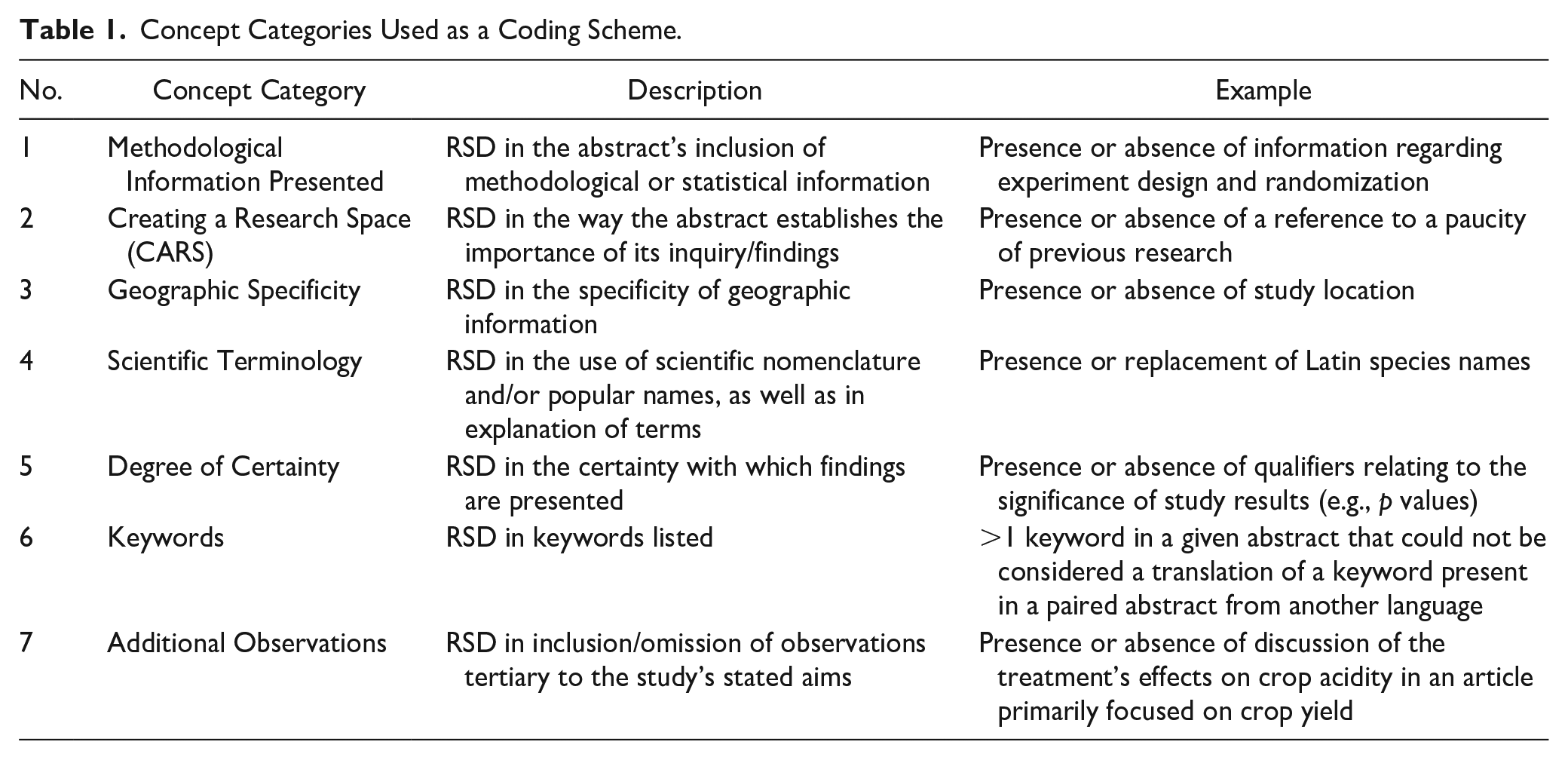
The instances of RSDs that fit a single category in a given set of abstracts varied widely depending on the subject matter. I attempted to account for the differences in frequency and type of RSD within each of the categories by coding only for the presence or absence of a category of RSD between each article’s abstracts. 5 Article E4 is a good example of the reasoning behind this decision: the English abstract features 17 instances of statistical/methodological information absent from the Arabic abstract, all fitting a relatively consistent pattern. In other articles, a single change in Geographic Specificity has clear implications about intended audience. Thus, the presence or absence of a category was of more rhetorical significance than its frequency.
It bears distinction that the variations observed were considered rhetorical differences between finished products. Attempting to analyze the writing process by conjecturing about the “original language” an abstract was written in and observing its translations risks replicating monolingual approaches to language. For multilingual language users, “in the successive moments of meaning making, the use of linguistic resources may aptly be described as a flux of meaning in which language systems are both constantly drawn upon and reshaped in minute ways,” even as users interact with codified language categories that evolve on a different timescale (Gentil, 2018, p. 123). This is particularly apt in the case of Morocco, where most authors’ hybrid first language, Darijah, 6 is a living example of flux that is absent from the finished products of these abstracts. Cataloguing changes between an “original” abstract and its translations is also reminiscent of looking for patterns of “interference” carried from L1 into L2, a paradigm that has been criticized for reinforcing flawed assumptions about the universal nature of scientific English. Even if some authors would describe their process as one of original authorship and translation, Sharma (2018) reminds us that multilingual writers often obscure the complexities of language use in their initial descriptions of their own writing processes. The commonality of multiple authorship among the sampled articles and the possibility of assisted translation complicate this further, and thus discussions of process lie outside the realm of this study. The existence of rhetorical differences between these abstracts as final products, however, suggests nuanced attention to the journal’s differing readership.
Results and Discussion
Changes were initially coded for each of the different language pairings provided by the sample: English ↔ French, English ↔ Arabic, and Arabic ↔ French. However, the English and French abstracts were relatively consistent with one another; only four articles displayed differences of rhetorical significance between English and French (E1, E4, E7, and F3). More than 85% of the RSDs coded were consistent across English versus Arabic and French versus Arabic axes, and by far the more interesting differences were observed between the English and French [henceforth, EN/FR] and Arabic abstracts. Thus, the remainder of this section will examine RSDs between EN/FR and Arabic abstracts, referring to English ↔ Arabic differences (except where otherwise noted) for clarity.
Table 2 displays the presence or absence of categories of RSD identified between each article’s EN/FR and Arabic-language abstracts. The y axis is organized by article, and the x axis denotes different categories of RSDs between a single article’s abstracts. So, for example, the abstracts for article F1 (the body of which was in French) displayed one or more RSD in the use of scientific terminology between EN/FR and Arabic. Articles in the y axis are grouped by language of authorship and are organized chronologically within these groupings. While all articles featured abstracts in English, French, and Arabic, language of publication for the main body of text varied and has been maintained in the articles’ E# and F# designators. Overall, an average of 2.625 categories of RSD were observed between the abstracts of English-authored articles, and an average of 1.5 were observed between the abstracts of French-authored articles.
Presence of Rhetorically Significant Differences (RSDs) Between EN/FR and Arabic Abstracts, by Concept Category.
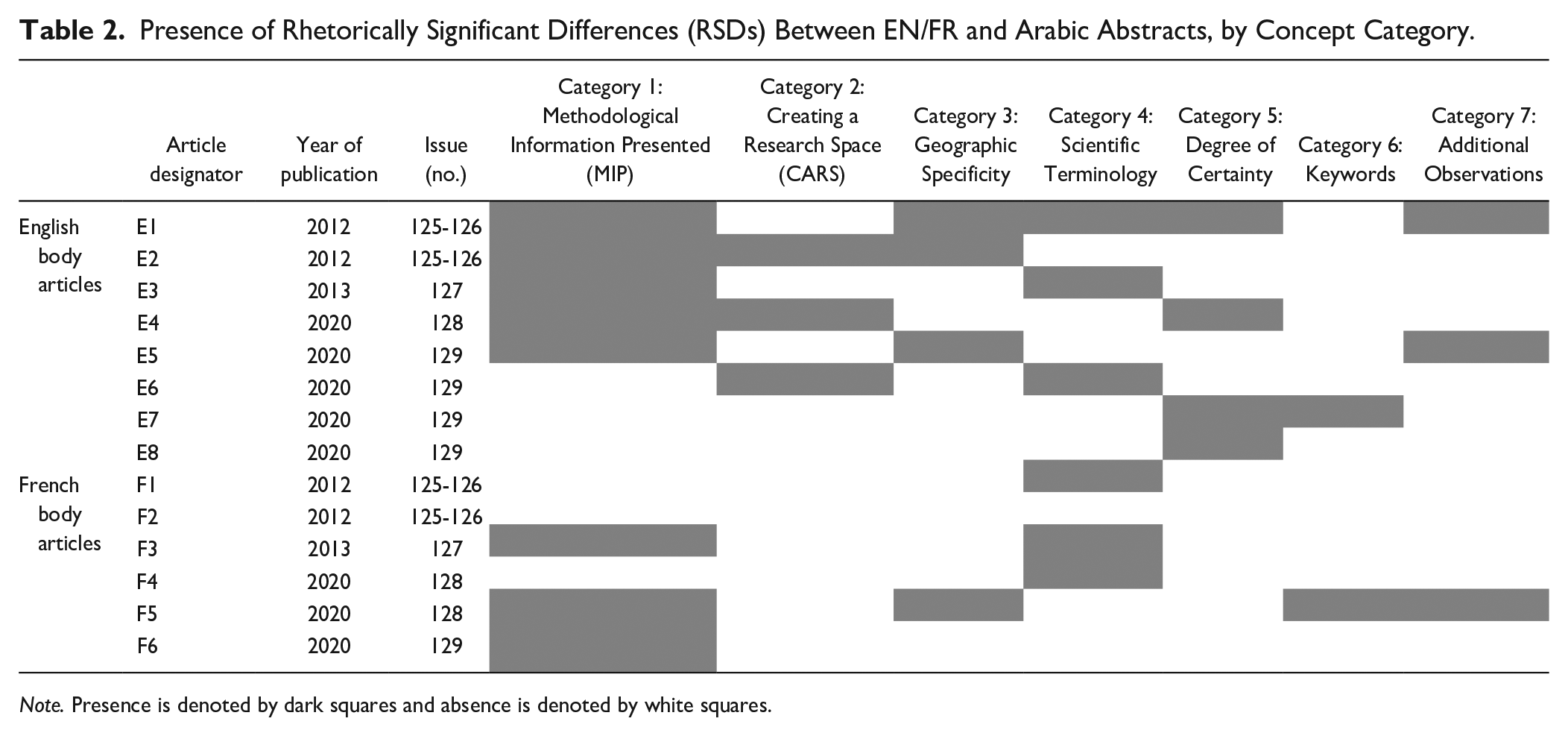
Note. Presence is denoted by dark squares and absence is denoted by white squares.
Taken as a whole, the impression that arises from the RSDs identified in Table 2 is that the abstracts in different languages address different audiences. In several key ways, EN/FR abstracts display changes that favor an international specialist audience and Arabic-language abstracts display changes that favor a domestic policy-maker audience.
The following sections will provide a discussion of data organized by concept category, reproducing and exploring illustrative examples. All translations from Arabic are the author’s, produced via knowledge of the Arabic language with reference to the Wehr (1994) Dictionary of Modern Written Arabic and consultation with a Moroccan scientist.
Category 1: Methodological Information Presented (MIP)
Some of the most telling differences between the EN/FR abstracts and Arabic abstracts were in the amount of methodological information presented to the reader. Eight of the 14 articles displayed changes in this regard, ranging from additional methodological specificity to entire subsections present in one language and absent in another. The prevailing tendency, however, was toward more attention to methodology in EN/FR abstracts than in Arabic. In article E5, for example, the English abstract described experimental design before its independent variable (fertilizer treatments): “The experiment was set up in a complete randomized block design with three blocks and the experimental unit was composed on 4 consecutive trees in the row” (Omari et al., 2020, p. 93). The Arabic abstract omitted this segment and proceeded to describing the study’s fertilizer treatment directly. While article E3’s English abstract (2013) did not contain whole sentences absent from the Arabic, the English abstract does go into greater detail regarding the particular mechanisms of cloning and gene insertion within sentences that introduce the article’s operative treatment.
The additional information provided in English-language abstracts suggests that the intended readership of English-language abstracts places greater weight on methodological transparency. Comparatively, by omitting this information, the indicated Arabic abstracts gave a greater relative weight to their studies’ results. It is thus logical to infer that the English-language abstracts are intended for a specialist audience that is likely to engage with methodological information in more detail, while Arabic abstracts give a quick brief or review to policy makers interested in the implications of the findings presented. These RSDs are analogous to those made by science journalists, who often omit methodological information in favor of implications to make science more relevant to a nonspecialist audience (Brechman et al., 2009), a dynamic that can similarly be applied to policy briefs. Differences in methodological transparency may, therefore, indicate a more vertical “expert to public” relationship between writer and reader in Arabic and a more horizontal “expert to expert” relationship in EN/FR.
In the course of coding, I included inclusions/omissions of statistical information in Category 1. The chief article displaying this concept category in its statistical variant was E4 (Snaibi, 2020), which consisted of statistical analyses of a data set obtained via structured surveys with livestock herders. This article’s conclusions were primarily based on regression and correlation calculations between different variables, and in this context statistical analysis warrants a similar designation to that of experimental design and methodology in articles such as E5. Although article E4’s Arabic abstract did provide information on this statistical methodology, their English abstract went into greater detail and, unlike the Arabic, provided quantitative measures of regression, correlation, and significance. These changes thus fell along the same lines as previously mentioned articles, suggesting one abstract targeted toward an audience more interested in statistical rigor.
It is worth noting that two articles (E2 and F5) provided counterexamples by including slightly more methodological information in Arabic than in EN/FR. This deviation could be explained in part by their subject matter, as both deal with herders and rangeland management. In article E2, for instance, the Arabic contained the following independent sentence:
استخدمت الدراسة منهجية الاستبيان مرفقة باستخدام أدوات تشاركية Translation: “The study used a questionnaire methodology with the use of collaborative elements . . . .” (Nassif & Bouayad, 2012, p. 146)
The English, by contrast, described the conclusions as “based on survey and qualitative methodology” in a dependent clause introducing the study’s findings:
Based on survey and qualitative methodology, the study presented concrete evidence on women’s substantial work in the livestock sector . . . . (Nassif & Bouayad, 2012, p. 145, emphasis added)
In Morocco, rural pastoral groups and especially tribal groups have historically had complex relationships with the central government. Even in relatively contemporary times, some scholars have alleged that agricultural policies have functioned to expropriate tribal land and replace traditional pastoralism with modernized forms of agriculture (Davis, 2006). The addition of the term teshaarukiyya (translation: “collaborative”), specifically, could be a subtle move to address such concerns for a policy-maker audience and show respect for local collaborators. Similarly, while each of article F5’s abstracts referenced individual interviews and group workshops with breeders in the study area, the Arabic abstract elaborated:
وكذا طرق اسغلال المجالات العرفية لمراعي المنطقة التي تم ضبطها على الخرائط الطبوغرافية عبر مشاورات مع المجموعات العرقية Translation: “ . . . as well as ways to map the region’s customary fields and pastures onto topographical maps through consultations with ethnic groups.” (Bechchari, 2020, p. 127)
The additional specificity regarding consultation is likely tied to the observations presented in Category 3 (Geographic Specificity), particularly as this research concerns toponymic maps, which are intimately related to land ownership.
Overall, the fact that both instances of additional methodological information in Arabic concern social science research with pastoral groups and emphasize collaboration, while the other five Category 1 differences emphasize experimental and statistical methodologies, is telling. These exceptions suggest that methodological information is, to a degree, tailored for an international specialist audience in English and a domestic policymaker audience in Arabic.
Category 2: Creating a Research Space (CARS)
As discussed previously, the CARS model originates with the EAP work of Swales (1990) and refers to the act of referencing previous research to establish an exigence for studies. Differing audience priorities, however, suggest that we would see greater attention to CARS elements in abstracts meant for a researcher audience, as arguably less importance is attached to certain elements of CARS for a policymaker audience.
Instances of this concept category in the sampled texts came with varying degrees of difference. Article E2, for instance, displayed a subtle RSD. The English contained the following:
The revisiting process of those communities’ development plans revealed serious knowledge gaps regarding women’s vital contributions. This study aimed at filling the gaps through examining the existing gender division of labor . . . .” (Nassif & Bouayad, 2012, p. 145, emphasis added)
The Arabic, by contrast, read:
أظهرت مراجعة المخططات التشاركية للتنمية للوحدتين نقصا واضحا في معالجة إسهامات النساء و حاجياتهن العملية والإستراتيجية ومنظرهن. تهدف الدراسة إلى تحليل التقسيم السائد للعمل حسب الجنس Translation: “The revisiting of the communal development plans for the two sites revealed a clear lack of treatment of the contributions of women, their practical needs, and their viewpoints. This study aims to analyze the prevailing division of labor according to gender . . . .” (Nassif & Bouayad, 2012, p. 146, emphasis added)
While the distinction is subtle, the operative verbs and nouns of the English emphasize gap identification and research, situating the study within broader literature, while the Arabic emphasizes the language of collaborative decision making and presents the analysis as a means to an end of policy decisions.
Often, elements of CARS are present in both languages with additional moves to create a research space present in English but absent in Arabic. In article E4, for example, both English and Arabic abstracts commented on the potential impacts of climate change on livestock rearing before stating the study’s objective. The English, however, contained an additional sentence meant to highlight the novelty of said research—a clear move to delineate a gap that leads into the study’s objective with “therefore”:
The current climate change adaptation measures practiced in the study area and the determinants of breeders’ implementation of these coping actions are not investigated. (Snaibi, 2020, p. 37)
Again, each abstract exhibits elements of CARS; articles coded for the presence of this concept category, rather, tended to display one or more additional “moves” in English, often “gap identification” or “importance claim.” It is these additional “moves” that grant us insight into the invoked audience.
Category 3: Geographic Specificity
One of the more easily distinguished types of rhetorical changes is the presentation of more specific geographic information. In four articles, Morocco-specific geographical information was presented in Arabic abstracts but omitted in English. Article E2, for instance, gave the individual study sites of Ouled Slimane and Sekouma-Irzaine in all languages, but reserves إقليم تاوريرت بالمنطقة الشرقية (translation: “province of Taourirt in the Eastern region”) for Arabic (Nassif & Bouayad, 2012, p. 146). Similarly, article E5 provided the name of the experimental station (El Menzeh, INRA) in all languages, but while the English and French abstracts followed this location with the rather general “Morocco,” the Arabic abstract specifies the city of Kenitra. The implication of this choice would seem to be that the foreign language abstracts are intended (at least in part) for an international audience who may not be familiar with the research’s country of conduct, while the Arabic abstract is assumed to be read by domestic readers who could identify the city. Article F5’s change with regard to geographic specificity is also significant; while all abstracts situated the research “in rural communities in high plateaus of eastern Morocco,” only the Arabic followed this with the phrase انطلاقا من المجموعة الترابية لبني مطهر ومعتركة (translation: “based on/starting from the rural communities of Beni Maṭher and Meʿtereka”). It is common for geographical names in Morocco to arise from affiliated tribal groups (generally Beni ______, or the sons/people of _____), and Beni Maṫher and Meʿtereka are both tribal names of this variety. While a Moroccan reader could be expected to make this connection, it is unlikely that an international subject specialist would be familiar with this local toponymic pattern. Such linguistic markers may imply that even international specialists who are familiar with Arabic are more likely to interface with the EN/FR abstracts, where specific locales are omitted.
Category 4: Scientific Terminology
Changes in scientific terminology in this collection took several forms, but as a whole throughout the sample, scientific nomenclature was emphasized in EN/FR abstracts while Arabic abstracts featured common names or somewhat more accessible language. Changes in scientific terminology can be grouped into two general categories: articles where scientific terms in EN/FR abstracts corresponded to common terms in Arabic abstracts and Arabic abstracts in which discipline-specific terminology was accompanied by a common-language explanation.
For an example of the former category, where scientific terms were replaced by common terms in Arabic abstracts, take article F3. In F3’s abstracts, Artemisia herba alba Asso. and Stipa tenacissima L., present in EN/GR, corresponded to الشيح والحلفاء, or “wormwood and related plants” (El Koudrim, 2013). Article E1 provided a stark example of the same category; the English abstract listed “cucumber (Cucumis sativus L.), melon (C. melo L.), pumpkin (Cucurbita maxima Duch.), squash (C. pepo L.), watermelon (Citrullus lanatus (thumb.) Matsum. et Nakai), [and] bottle gourd (Lagenaria sciceraria Standl. Var. hispida Hara,” along with their scientific nomenclature, as the species under consideration, while the corresponding Arabic abstract offered a single word: القرعيات (translation: “gourds/squashes”) (Endo et al., 2012, pp. 121-122). القرعية is indeed used in Morocco to refer to many of these species, 7 but the conflation of multiple species into a single category recognizable to a common audience implies an intentional difference in presentation. Latin-letter scientific nomenclature is present in many of the Arabic abstracts (though not all), reinforcing the idea that replacing such nomenclature with common names is a rhetorical rather than editorial choice.
As for the latter grouping: other articles, like F4, included scientific nomenclature and followed it with a common name in Arabic, a practice not replicated in the EN/FR abstracts. Articles E3, E6, and F1 similarly accompanied scientific terminology with short, common-language explanations in Arabic which are not present in EN/FR abstracts. E6’s Arabic abstract, for example, prefaced “greening disease” with a short description of its symptoms. E3’s Arabic abstract also speculated on applications in common language in ways that the EN/FR abstracts did not. This final change in the way applications were discussed relates to the presentation of findings discussed in category 5.
Category 5: Degree of Certainty
Category 5 represents a modification in the degree of certainty with which results were presented across abstracts of different languages. Once again, article E1 provided the most vivid example of such a change. The English abstract made specific, scientifically qualified statements about the study’s findings:
85 samples collected from different regions in the country were used confirming the existence of the characteristics of Sphaerotheca fuliginea; there was no instance of Erysiphe cichoracearum, E. polyphaga, or Leveillula Taurica. Moreover, the morphological characteristics of perithecial stage, which was found on only one occasion, supported the idea that it was Sphaerotheca fuliginea. (Endo et al., 2012, p. 121)
The Arabic, by contrast, presented the study’s findings with considerably more assuredness:
أجريت هذه الدراسة على 85 عينة مأخوذة من جل المناطق المنتجة لهذه الزراعات. ولقد تبين أن الفصيلة المسببة لهذا المرض هيSphaerotheca fuliginea Translation: This study was run on 85 samples taken from different cultivating regions. It has turned out that the causative species for this disease is Sphaerotheca fuliginea. (ibid., p. 122)
Changes such as these are the subject of Fahnestock’s (1986) “Accommodating Science: The Rhetorical Life of Scientific Facts,” in which she studies the transmission of scientific facts from peer-intended publications to popularizations meant for nonspecialist audiences. Fahnestock argues that popularizations tend to exaggerate the degree of certainty and remove hedges and qualifications, occasionally to deleterious effect. While the abstracts observed here all remain academic in nature, article E1’s pronounced difference in degree of certainty suggests correspondingly different rhetorical situations between languages. 8 It is worth noting that Al Zumor (2021) has found that hedges and passive voice in English RA abstracts were frequently replaced with declarations of fact in translations of those abstracts into Arabic, particularly when authors translated their own work. As his corpus consisted of abstracts “[rendered] into Arabic in order to attract local readership” by Arab universities, such changes can be seen as confirming a difference in rhetorical situation and audience in this collection (Al Zumor, 2021, p. 2).
The remainder of the changes coded as Degree of Certainty across the articles E4, E7, and E8 were related to statistical significance. Whereas these articles’ EN/FR abstracts clearly delineated the statistical significance (or lack thereof) of study results, their Arabic abstracts were more ambiguous. For one example, E4’s English abstract included the following text: “[differences in breeders’ adoption rates] are due to a very significant difference (p < 0.001) between small herders on the one hand and large and medium breeders on the other” (p. 37, emphasis added), while the Arabic abstract rephrases this as إلى اختلاف كبير (translation: “to a large difference”) without a quantitative measure attached. Articles E7 and E8 deal with the inverse end of statistical significance, as “no significant effect” corresponds to لم يكن لدى. . . تأثير كبيرعلى هذا العامل or “did not have a large influence on this factor” (El Guilli et al., 2020, p. 195-197). Excepting the presence or absence of a quantity, these changes in wording are subtle. However, as the Arabic word kabiir (translated above as “large”) can be read as “large,” “great,” or “old” in different contexts, it is a less precise indicator than “significant.” Moreover, the Arabic abstracts of articles E5 and E6 demonstrate that language exists in Arabic to discuss statistical significance more directly. These articles include the phrasings بشكل ملحوظ (“in an observable form”) and كانت العالجات ذات أهمية عالية للغاية (“the treatments had a very high importance”), following these phrasings with p values. It is fair to say that the statistical connotations of the results/findings in articles E4, E7, and E8 feature significant differences, as a reader in Arabic has considerably more leeway in interpreting a “not large” difference than a difference not statistically significant enough to reject the null.
It is entirely possible that the authors of the abstracts under consideration simply did not feel the need to include precise statistical information in the Arabic versions of their abstracts. This omission, however, indicates something about their understandings of their readerships’ differing preferences; what for some is essential information is comparatively less important than potentially useful findings for others.
Category 6: Keywords
Although significant changes to articles’ keywords between languages occurred in only two cases (E7 and F3), the relative ease of directly translating individual words in the digital age makes these differences conspicuous when present. Additionally, keywords’ role in organizing search engine results sets them up as a promising site to glean insight about intended audience. The more interesting of the two examples is article E7, where keywords were listed as follows:
English: Nadorcott, rootstock, cold storage, internal quality (p. 196) Arabic: الحمضيات, حامل الطعم, العصير, الحموضة,السكريات Translation: Citrus, rootstock, juice, acidity, sugars (p. 198)
Whereas other abstracts displayed a strong one-to-one keyword correlation between languages, here technical terms like “internal quality” correspond to more consumer-friendly terms like “juice” and “sugars.” A policymaker audience may be more likely to appreciate the benefits of cold storage research in terms of what they would change about the consumable product than on their technical merit alone. Alternatively, comparatively palatable Arabic keywords may indicate a difference in stakes that dovetails with the larger distinction between specialist and nonspecialist audiences.
Category 7: Additional Observations
The EN/FR abstracts of articles E1, E5, and F5 contained additional observations tertiary to the main findings of the research that were not present in the Arabic abstracts. These ranged in size from an entire paragraph of observations about related plant pathology (E1) to individual sentences about which nitrogen treatment produced citrus fruits with the highest acidity (E5). It is possible that these additional observations, incidental to the main outcomes of the study, are included in EN/FR abstracts to be flagged by search engines or to interest international specialist readers working in related areas and are excluded in Arabic-language abstracts for policy makers because they are tangential. Without additional evidence, however, this connection remains conjecture.
Conclusions
Conclusions drawn from the analysis of this collection must be tempered by several qualifications. First, one must consider the limited sample size of this study. The 14 units of observation presented here have limited generalizability. Following up on this exploratory analysis by applying similar analytic tools to additional journals at a broader scale could enhance the applicability of this research, and similar exploratory studies in other regional contexts stand to reveal yet more varied dynamics of communication. Second, while the analysis undertaken above presents a compelling case that different languages of abstracts in Al-Awamia appeal to different audiences, one must note the frequency of the changes observed: an average of 2.625 categories of RSD were present in English-authored articles and 1.5 were present in French-authored articles.
Future research may investigate the causes underlying the differential rates between languages of authorship, which may be connected to the Moroccan educational system, or extend similar lines of inquiry to journals in the social sciences that publish abstracts in multiple languages. For this study, though, the frequencies themselves are more pertinent. On the one hand, these are certainly not insignificant rates of occurrence in abstracts of <250 words. On the other hand, the majority of text in the sampled abstracts runs more or less in parallel without impactful rhetorical differences between languages. RSDs are still the exception rather than the rule, as most of the English, French, and Arabic text in a given abstract directly corresponded. This similarity owes at least in part to the specificity of RA abstract conventions. Previous comparative linguistic studies have attributed such overwhelming structural similarities to “the universality of cognitive paradigms characteristic of hard sciences” and “internationalized rhetorical conventions” in many STEM fields (Yakhontova, 2006, p. 163). The presence of any consistent frequency of RSDs between languages is, thus, worthy of further observation.
It is in this context that consistent patterns in the RSDs observed across these concept categories suggest differing audiences for Al-Awamia’s abstracts: international specialist audiences for EN/FR abstracts and domestic nonspecialist (policymaker) audiences for Arabic-language abstracts. Even in this most academic and formulaic of genres, scientists address multiple audiences and utilize a variety of linguistic resources to do so. These findings are consistent with Pérez-Llantada’s (2021) observation that plurilingual practices are often tied to nonexpert communication of research. They also reflect the broader communicative demands placed upon scientists by their careers in an increasingly plurilingual world. Indeed, as digital forums continue to reshape the media landscape, many scientists have found themselves communicating directly with a wide variety of publics and often serving as “public experts” (Peters, 2013). These interactions range from bilateral communication opportunities like Reddit’s popular “Ask Me Anything” series (Moriarty & Mehlenbacher, 2019) to informing policymakers. Flexible use of multiple linguistic resources to communicate with non-specialist policymakers would seem to be key for ensuring funding for future research, as the importance of grant-proposal writing in any national context would attest, particularly in bureaucratized countries like Morocco. The need extends to other nonspecialist audiences, as well; for instance, the texts analyzed here were published in a context colored by other science communication efforts by the Institut National de le Recherche Agriconomique, including the provision of digital French-medium guides for growers on their website.
When the production and communication of scientific knowledge in languages other than English are neglected in education, hurdles are created for field practitioners and policymakers from different linguistic backgrounds (Amano et al., 2016). These findings, thus, also constitute an educational exigence; in addition to the ethical imperative to avoid reproducing the hegemonic structures of English-medium international publishing, acknowledging and fostering researchers’ use of multiple language competencies is important to their careers as scientists in an increasingly plurilingual world. Often, partnerships with nonscientist actors require specialized, multilingual communication skills that are underemphasized in traditional STEM curricula and must be acquired and developed through extracurricular workshops or tutoring (Gascoigne & Metcalfe, 2020). Activities that center rhetorical flexibility rather emulation of universal scientific English, such as those described by Englander and Corcoran (2019) as “critical plurilingual pedagogies,” may better prepare researchers to consider sociopolitical differences in readership and address multiple stakeholders. More thoroughly embedding nonspecialist communication into STEM writing curricula would serve to emphasize the centrality of such communication to disciplinary practice and develop students’ awareness of their research’s role in society (Gigante, 2014); additionally, pedagogical studies have suggested that explicitly addressing differences in language and register in specialist and nonspecialist scientific communication across languages can increase STEM graduate students’ understanding of research’s content and significance alongside their communication skills (Pelger, 2018; Pelger & Nilsson, 2016).
Finally, the insights this study has provided about the textual strategies used to address differing audiences are consistent with a trans/plurilingual approach, as contextual factors provide a more satisfactory explanation for rhetorically significant differences between language mediums than would interference incurred in translation from one language to another. These plurilingual scientific texts within a single venue thus displayed greater nuance in linguistic practices than would be assumed from a strict interpretation of RA abstract conventions. Greater attention to regional journals in future studies of research articles, as well as to venues of scientific dissemination outside of the traditional RA, may serve to shed additional light on plurilingual practices in scientific communication. As the above analysis demonstrates, such corpora may reveal both generalized patterns in specialist and nonspecialist scientific communication and rhetorical priorities specific to local contexts. Therefore, inquiry into a variety of localized contexts is likely to further complicate universalized notions of scientific English and better illustrate the rich tapestry of scientific communication in a globalized world.
Footnotes
Appendix
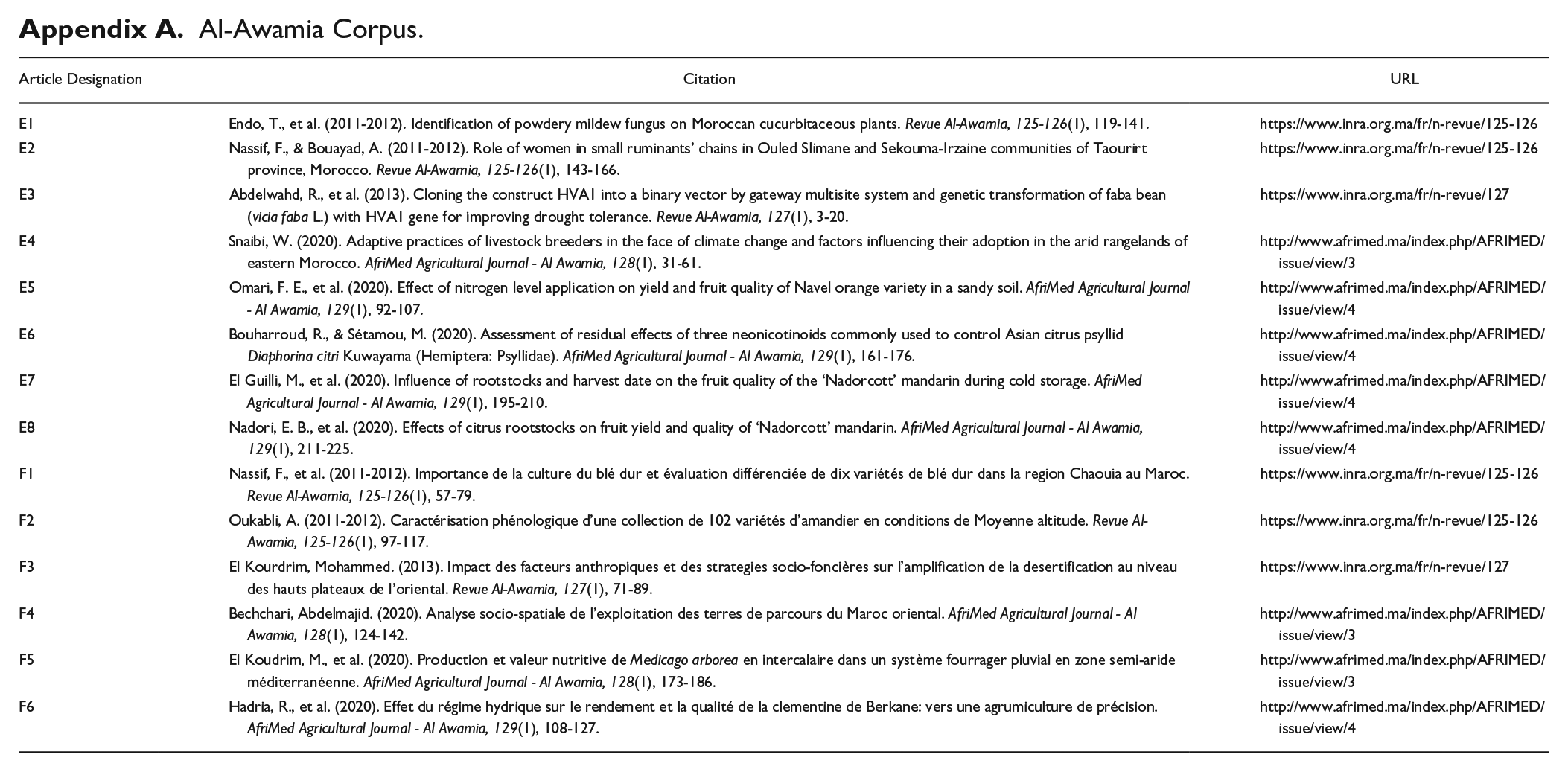
Al-Awamia Corpus.
| Article Designation | Citation | URL |
|---|---|---|
| E1 | Endo, T., et al. (2011-2012). Identification of powdery mildew fungus on Moroccan cucurbitaceous plants. Revue Al-Awamia, 125-126(1), 119-141. | https://www.inra.org.ma/fr/n-revue/125-126 |
| E2 | Nassif, F., & Bouayad, A. (2011-2012). Role of women in small ruminants’ chains in Ouled Slimane and Sekouma-Irzaine communities of Taourirt province, Morocco. Revue Al-Awamia, 125-126(1), 143-166. | https://www.inra.org.ma/fr/n-revue/125-126 |
| E3 | Abdelwahd, R., et al. (2013). Cloning the construct HVA1 into a binary vector by gateway multisite system and genetic transformation of faba bean (vicia faba L.) with HVA1 gene for improving drought tolerance. Revue Al-Awamia, 127(1), 3-20. | https://www.inra.org.ma/fr/n-revue/127 |
| E4 | Snaibi, W. (2020). Adaptive practices of livestock breeders in the face of climate change and factors influencing their adoption in the arid rangelands of eastern Morocco. AfriMed Agricultural Journal - Al Awamia, 128(1), 31-61. | http://www.afrimed.ma/index.php/AFRIMED/issue/view/3 |
| E5 | Omari, F. E., et al. (2020). Effect of nitrogen level application on yield and fruit quality of Navel orange variety in a sandy soil. AfriMed Agricultural Journal - Al Awamia, 129(1), 92-107. | http://www.afrimed.ma/index.php/AFRIMED/issue/view/4 |
| E6 | Bouharroud, R., & Sétamou, M. (2020). Assessment of residual effects of three neonicotinoids commonly used to control Asian citrus psyllid Diaphorina citri Kuwayama (Hemiptera: Psyllidae). AfriMed Agricultural Journal - Al Awamia, 129(1), 161-176. | http://www.afrimed.ma/index.php/AFRIMED/issue/view/4 |
| E7 | El Guilli, M., et al. (2020). Influence of rootstocks and harvest date on the fruit quality of the ‘Nadorcott’ mandarin during cold storage. AfriMed Agricultural Journal - Al Awamia, 129(1), 195-210. | http://www.afrimed.ma/index.php/AFRIMED/issue/view/4 |
| E8 | Nadori, E. B., et al. (2020). Effects of citrus rootstocks on fruit yield and quality of ‘Nadorcott’ mandarin. AfriMed Agricultural Journal - Al Awamia, 129(1), 211-225. | http://www.afrimed.ma/index.php/AFRIMED/issue/view/4 |
| F1 | Nassif, F., et al. (2011-2012). Importance de la culture du blé dur et évaluation différenciée de dix variétés de blé dur dans la region Chaouia au Maroc. Revue Al-Awamia, 125-126(1), 57-79. | https://www.inra.org.ma/fr/n-revue/125-126 |
| F2 | Oukabli, A. (2011-2012). Caractérisation phénologique d’une collection de 102 variétés d’amandier en conditions de Moyenne altitude. Revue Al-Awamia, 125-126(1), 97-117. | https://www.inra.org.ma/fr/n-revue/125-126 |
| F3 | El Kourdrim, Mohammed. (2013). Impact des facteurs anthropiques et des strategies socio-foncières sur l’amplification de la desertification au niveau des hauts plateaux de l’oriental. Revue Al-Awamia, 127(1), 71-89. | https://www.inra.org.ma/fr/n-revue/127 |
| F4 | Bechchari, Abdelmajid. (2020). Analyse socio-spatiale de l’exploitation des terres de parcours du Maroc oriental. AfriMed Agricultural Journal - Al Awamia, 128(1), 124-142. | http://www.afrimed.ma/index.php/AFRIMED/issue/view/3 |
| F5 | El Koudrim, M., et al. (2020). Production et valeur nutritive de Medicago arborea en intercalaire dans un système fourrager pluvial en zone semi-aride méditerranéenne. AfriMed Agricultural Journal - Al Awamia, 128(1), 173-186. | http://www.afrimed.ma/index.php/AFRIMED/issue/view/3 |
| F6 | Hadria, R., et al. (2020). Effet du régime hydrique sur le rendement et la qualité de la clementine de Berkane: vers une agrumiculture de précision. AfriMed Agricultural Journal - Al Awamia, 129(1), 108-127. | http://www.afrimed.ma/index.php/AFRIMED/issue/view/4 |
Declaration of Conflicting Interests
The author declared no potential conflicts of interest with respect to the research, authorship, and/or publication of this article.
Funding
The author received no financial support for the research, authorship, and/or publication of this article.
