




Abstract
Families seeking asylum in the United States are often placed in detention centers after fleeing crime, violence, and government ineffectiveness in their countries. Migration brings more hardship, terror, and trauma. The cumulative psychological and social effects from detention need to be better understood. This exploratory study examines the effects of detention and family separation on immigrant children’s psychosocial wellbeing after released. We recruited 81 Central American children previously detained with their parents to assess their wellbeing since release. A third of the children had been separated from their parents during detention. Over a third of parents and less than a fifth of children reported verbal and psychological abuse by staff and other detainees. Children who reported abuse showed higher anxiety and sense of inadequacy than those who did not. About 12.5% of children met clinical criteria for anxiety while 25% were at high risk, and those who had been released from detention for over a year had more depressive symptoms. To reduce psychological harm, changes in detention policies are needed. Community-based, child-directed, and family-centered interventions can assist with settlement to a new environment and psychological adjustment. Research with larger samples, longitudinal follow-up, refined measures, and qualitative data is needed.
In the early decades of the 21st Century, the United States witnessed a large influx of asylum-seeking families from the Northern Triangle Countries of Central America (NTCA)—El Salvador, Guatemala, and Honduras. U.S. Customs and Border Protection (CBP, 2024) reports that between January 2022 and April 2024 a total of 422,268 encounters with “individuals in a family unit” from the Northern Triangle occurred in the southwest land borders. Immigrants from Honduras accounted for 185,230 of the total number of encounters, Guatemala for 176,972, and El Salvador accounted for 60,066 (U.S. Customs and Border Protection, 2024). Since 2023, asylum-seekers from Central America have been joined by those from Venezuela, Cuba, Haiti, and other South American countries as well as Asia and Africa. Parents flee with their children to escape violence, poverty, social exclusion, and racial and gender discrimination (Oldroyd et al., 2022). The migration flow has continued virtually unabated, accompanied by a growth in the number of unaccompanied children, despite immigration policies and practices intended to deter migration. This phenomenon reflects the understanding that worldwide migration is inexhaustible, inevitable, and inexorable (Zayas, 2023).
The decision to migrate is often born of hardship, stressful, and even traumatic circumstances in the home countries (Garcia & Birman, 2022; Pfeiffer et al., 2022). Forces driving this large-scale migration include poverty, economic instability, high rate of homicides, poverty, gang-related and state-sanctioned violence, government corruption, and organized crime, as well as the recruitment of children by local and international gangs, political instability, climate change, and displacement (Behrendt et al., 2022; Cheatham, 2023; Held, 2018; Oldroyd et al., 2022; Perreira et al., 2019; Sangalang et al., 2019). More recently, the global COVID-19 pandemic and its aftermath has worsened economic conditions and availability of public health systems, adding to the reasons for migration (Angawi, 2023; Garcini et al., 2024; Venta et al., 2024). This contribution focuses on the effects of detention on children who have immigrated to the U.S. with their parents from El Salvador, Guatemala, and Honduras from 2019 to 2021.
The trajectories of forced migration from Central American (Pries et al., 2024) have been characterized as a four-stage process encompassing pre-migration, mid-migration, detention, and post-detention (Zayas, 2023). In the pre-migration stage, families face dangers and insecurity that force their emigration. Central America, particularly Honduras, is known as one of the most violent regions in the world, with crime and violence resembling that of war zone areas (International Organization for Migration, 2024; United Nations High Commissioner on Refugees, 2017). The mid-migration journey crosses international borders sometimes with the assistance of a coyote (i.e., human smuggler; Cleary et al., 2018) and exposes adults and children to thirst, hunger, violence, extortion, detention, and other physical and psychological hardships. The third stage, detention, begins at the moment of apprehension and incarceration by border enforcement and has negative health effects (Bryant et al., 2023; MacLean et al., 2019; Mares & Ziersch, 2024). “Detention trauma” has two dimensions with social and neurodevelopmental consequences on children (MacLean et al., 2019; McLaughlin et al., 2014). One dimension is deprivation, that is, the absence of expected cognitive, social, and environmental inputs and complexity which comes with being institutionalized in prison-like conditions. The other dimension, threat, represents the presence of words and actions by guards and other detainees that involve actual or implied harm to one’s physical integrity or psychological safety. Deprivation and threat are not independent but rather co-occur in detention. Deprivation and threat the individual’s learning, especially “fear learning,” according to McLaughlin et al. (2014), that triggers behavioral and neurobiological responses which may or may not be adaptive as children mature (Perreira & Pedroza, 2019; Saadi et al., 2020). From 2017 to 2019, children were taken from their parents as a result of the federal Family Separation Policy affecting more than 5,000 people (Dickerson, 2022; Young Center, 2020). Children were separated from their parents typically by Immigration and Customs Enforcement or CBP officers and turned over to the Office of Refugee Resettlement (ORR) of the Department of Health and Humans Services. ORR was then responsible for placing the children in shelters, detention facilities, foster care, and other child-serving settings until reunited with parents. These separations lasted days to months, and some children were never reunited with their parents. Empirical evidence exists that traumatic family separations typically occur under frightening, sudden, unpredictable, chaotic and/or violent circumstance, leading to the development of post-traumatic stress symptoms in children in response to the loss of an important attachment figure, such as a parent (J. A. Cohen & Mannarino, 2019; Hampton et al., 2021; Venta & Cuervo, 2022). The fourth stage is post-detention which involves settling into communities (e.g., finding housing, employment, healthcare, schools) and attempting to make the psychological, emotional, and social adjustment to a new life in the U.S. or in their home countries if they are denied asylum. While it cannot be ascertained that the pre-immigration conditions are the most stressful, each stage presents its own challenges and together they add to the accumulation of stresses and traumas that jeopardize children’s development and mental health.
This study focuses on the emotional wellbeing of children during the post-detention period. We sought to describe patterns of children’s detention experience and explore how their detention experience associated with their mental and physical wellbeing after their release, when they were settling and adjusting to new communities. The overriding research question was: What is the psychosocial wellbeing of children who had been held in immigration detention, some of whom had been separated from their parents?
Our hypotheses were: (1) There will be a significant difference in the wellbeing of children from families that experienced separation or any form of abuse during detention; and (2) There will be a significant association between experiencing parental separation or abuse during detention and the log-odds of a child presenting clinically significant problems in wellbeing.
Method
The project is an exploratory study of the psychosocial wellbeing of recent immigrant children. Participant children had emigrated with their parents and siblings from El Salvador, Guatemala, and Honduras to the U.S. between 2018 and 2022, and were interviewed between 2019 and 2022. Families were recruited with the help of community service partners. Eligibility criteria were that (1) the family emigrated from one of the NTCA; (2) the children were 8 to 15 years old; (3) all family members were detained, either together or separately, at the U.S.-Mexico border; and (4) the family was released from detention no more than 24 months from the date of interview. Eighty-one children participated in the study. Participating children completed three standardized questionnaires read to them by native-Spanish-speaking trained interviewers. Measures focused on children’s migration and detention experiences, current living situations, and the child’s health, wellbeing, and social integration into their new communities. During the study’s first 2 years, interviews were conducted in person. In the third year, the COVID-19 pandemic required that interviews be done by telephone. Due to the legal vulnerability of the population under study, we sought and received a waiver of written consent and assent from the Institutional Review Board of the University of Texas at Austin. Verbal consent and assent were obtained from the parent and child participants, respectively.
Sample
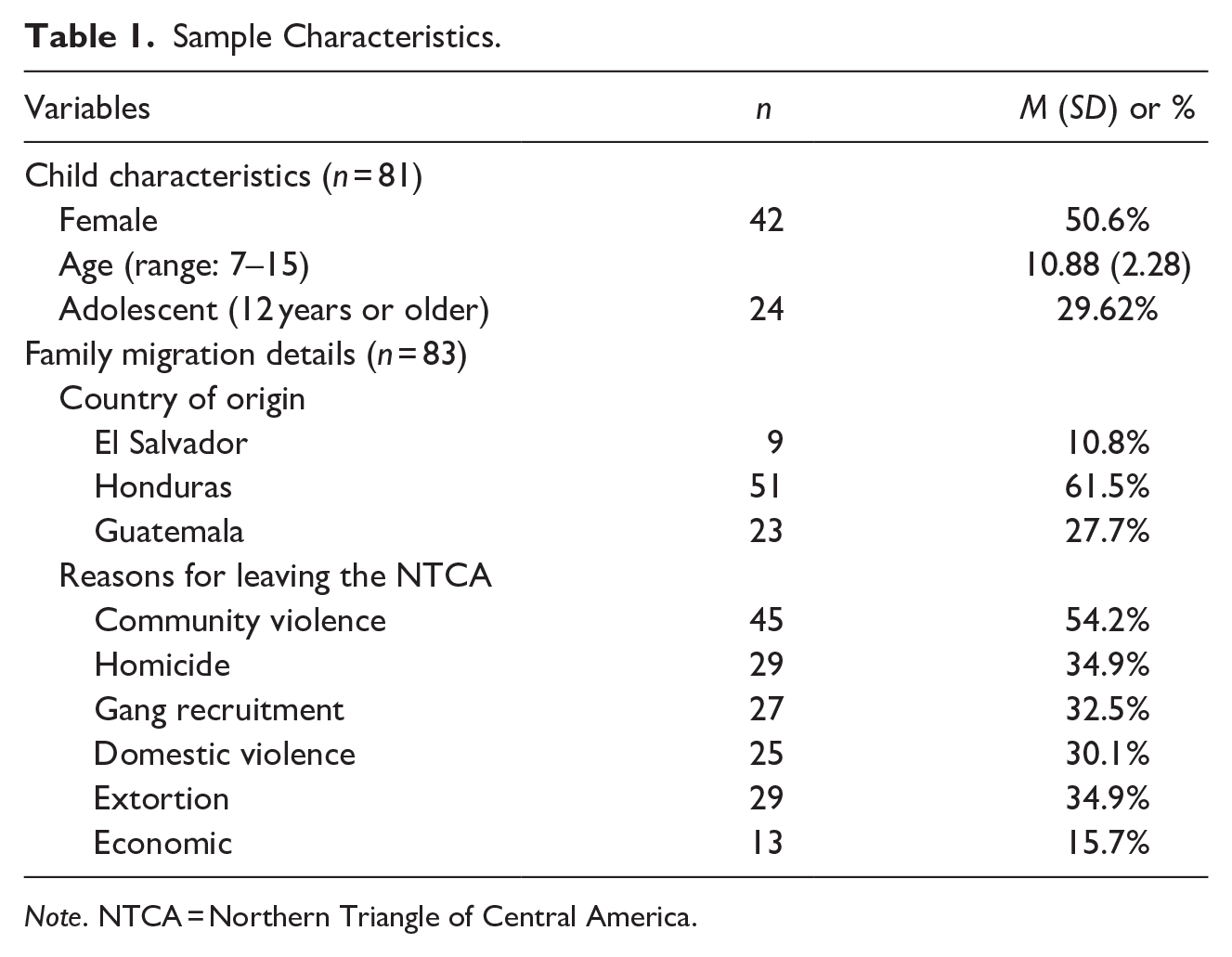
Potential families with children were identified with the help of local community organizations working with immigrant populations in central Texas. Only families who had expressly sought asylum in the U.S. and whose immigration documents verified it were included. In total, 83 families, including 83 parents and 81 children, participated in the study, fewer children were interviewed than parents because not all children assented to participate. One child per family who met inclusionary criteria were interviewed. About a third of the 83 families were separated while in detention (32.5%), another third experienced at least one form of abuse during detention (33.7%), while 13 of them experienced both. Table 1 provides details on child characteristics and family migration details, including reasons for leaving the NTCA.
Sample Characteristics.
Note. NTCA = Northern Triangle of Central America.
Measurement
Detention Experiences
The family’s detention experiences were collected from both children and parents using a questionnaire developed expressly for this project. The questionnaire inquired about the type of setting where they were detained (since many did not know the geographic location of their detention), length of time in detention, if they had any negative experiences (apart from detention itself) while held in the detention center, and if the children were separated from their parents for any length of time. We asked the parents if they or their children had been verbally, physically or sexually abused, threatened, or lied to by detention center staff and/or other detainees. Responses were coded as yes or no responses. Psychological and physical abuse were defined as verbal or symbolic acts by a detention worker or a detainee that resulted in or had a reasonable potential to result in significant psychological harm to the child (American Psychiatric Association, 2013). These experiences were reported by the parent or legal guardian that were detained with the children and those who answered “yes” to some abuse were then asked to elaborate in the qualitative section of the interview (which is not the focus of this paper).
Child Emotional Well-Being
The Behavior Assessment System 3 (BASC-3; Reynolds & Kamphaus, 2015) measured children’s emotional status and behaviors (Bruhn et al., 2014; Edyburn et al., 2020). We used the children’s self-report of Personality scales. Responses are on a 4-point Likert scale ranging from never, to almost always. For this study, we used subscales for atypicality, locus of control, social stress, anxiety, depression, inadequacy, self-esteem as well as self-reliance, and calculated indicator variables for those participants with high-risk and clinically significant ranges using the manual’s t score criteria. The BASC-3 subscales displayed a high internal consistency coefficient (ω = 0.93) and subscales displayed acceptable to moderate internal consistency coefficients.
Data Analysis
Firstly, scale distributions were assessed for univariate normality. To test our first hypothesis and protect our type I error from multiple comparisons, we calculated a MANCOVA. We used child age, gender, family composition and whether they were detained by the CBP as covariates. Main effects were whether the family experienced any detention abuse, and whether the family experienced parental separation. Estimated Marginal Means were contrasted using the Sidak correction for multiple comparisons. To test our second hypothesis, we first computed an indicator variable reflecting if the participant presented at least one of the BASC3 scales in clinical range, then used a logistic regression using child age and family composition as covariates and any abuse experienced during detention and parental separation as predictor variables. Analyses were computed in Rstudio v.4.0.1.
Results
Patterns of Detention Experiences
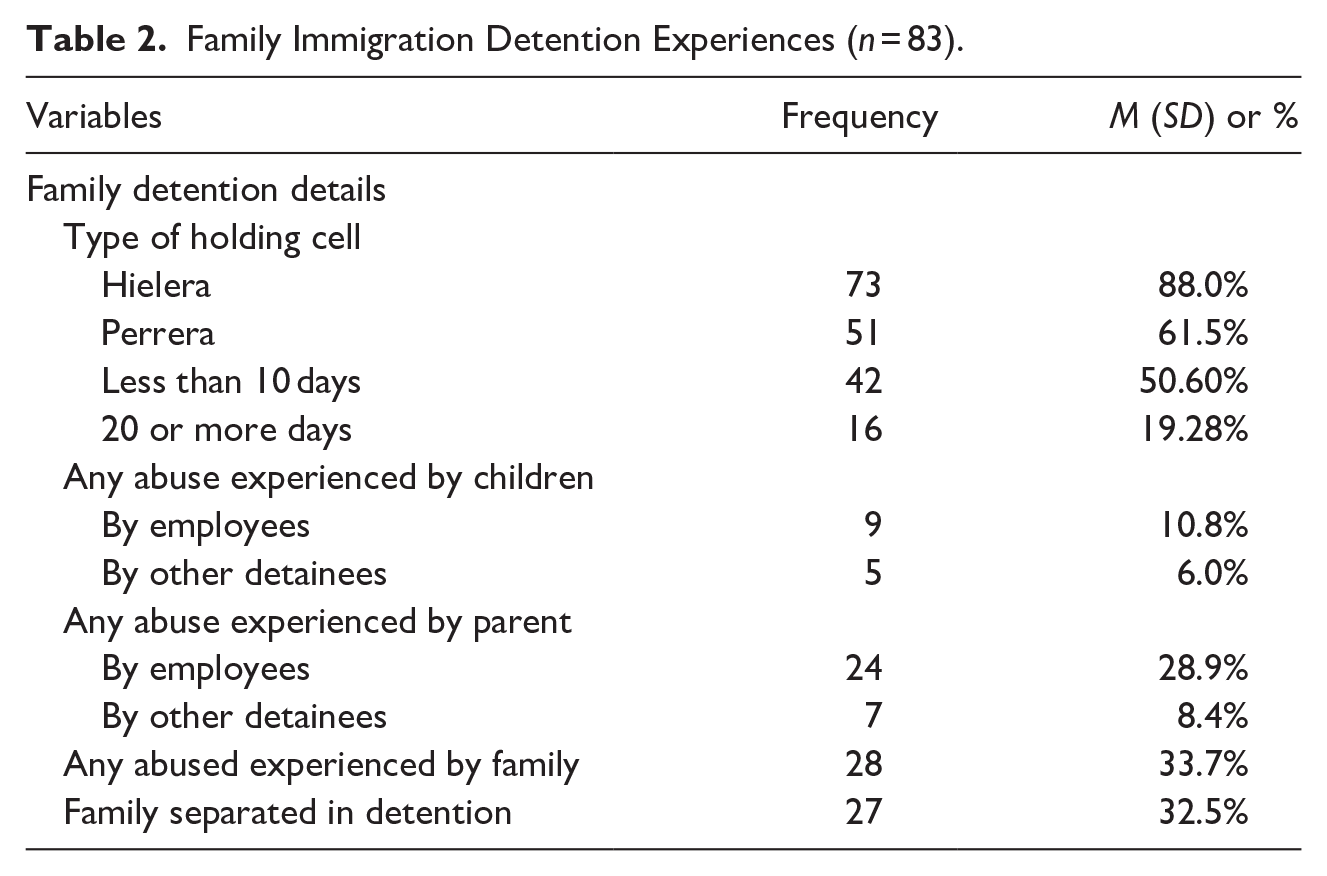
Parents and children cited community violence, homicide, gang recruitment, domestic violence, and extortion as the most common reasons for fleeing their countries (see Table 1; range from 30% to 54%). Only a fraction (15%) mentioned migrating for economic reasons. Most families entered the United States via truck or bus (83%) and had been held in some form of detention center by CBP (92%). Families were detained an average of 14.48 days (S.D. = 22.33), approximately half of them spent 10 days or less, 20% spent more than 20 days, and three families spent 100 or more days being detained. In approximately one third of cases (see Table 2; 32.5%), children were forcibly separated from their families upon detention. Most parents and children were detained together in holding cells commonly called hieleras (literal translation of iceboxes or cold, tiled, barren rooms with one toilet holding about 30 people; 88%) and perreras (kennels or dog pounds which were cages made of chain-link fences typically in a large warehouse-like building with many such enclosures; 61.5%), and slightly more than 1% had been held in what they described as polleras (chicken coops enclosed by galvanized, zinc-coated steel poultry-wire netting). Families could have been held in more than one type of holding cell. Approximately 17% of children and more than a third of parents reported experiencing verbal and psychological abuse during detention from employees or other detainees.
Family Immigration Detention Experiences (n = 83).
Psychological Wellbeing of Previously Detained Children
All BASC3 subscales and continuous covariates followed an approximately normal univariate distribution, even when exploring by groups, as skewness values were below |2| and kurtosis below |6| (Kim, 2013). Using the BASC-3 scales, we found that 13 children presented clinically significant levels in at least one dimension of the BASC3 (i.e., t score of 70 or higher). Regarding high risk (i.e., t score of 60 or higher), nine children presented these high scores for atypicality (11.11%), six for locus of control (7.40%), 11 for social stress (13.58%), 11 for anxiety as well (13.58%), six for depression (7.40%), eight for sense of inadequacy (9.87%), eight for low self-esteem (9.87%), and 13 for low self-reliance (16.04%).
Given approximate univariate normality and equality of covariance matrices (Box M F(36, 2,008.99) = 1.08, p = .34), we interpreted Wilk’s lambda as the multivariate statistic in the MANCOVA. Both main effects presented at least one significant contrast and moderate to acceptable post-hoc power: Any detention abuse (Λ = 0.65, F(8, 36) = 2.35, p = .03, η2 = 0.34, 1−β = 0.66), and parental separation (Λ = 0.69, F(8, 36) = 2.22, p = .04, η2 = 0.33, 1−β = 0.43). Levene’s test for equality of variances only displayed a significant departure from homoskedasticity for the Social Stress and Anxiety scales between parental separation groups.
Results show significant differences in estimated marginal means between children of families that experienced abuse during detention in anxiety, depression, inadequacy and a marginally significant difference in self-reliance. In contrast, parental separation groups presented a significant difference in anxiety, as well as a marginally significant difference in self-reliance. All significant differences had a moderate to large effect size (i.e., η2 > 0.10; J. Cohen, 2013; see Table 3).
Estimated Marginal Means, Two-Way ANCOVA Results and Effect Sizes.

p < .05. ✝p < .10.
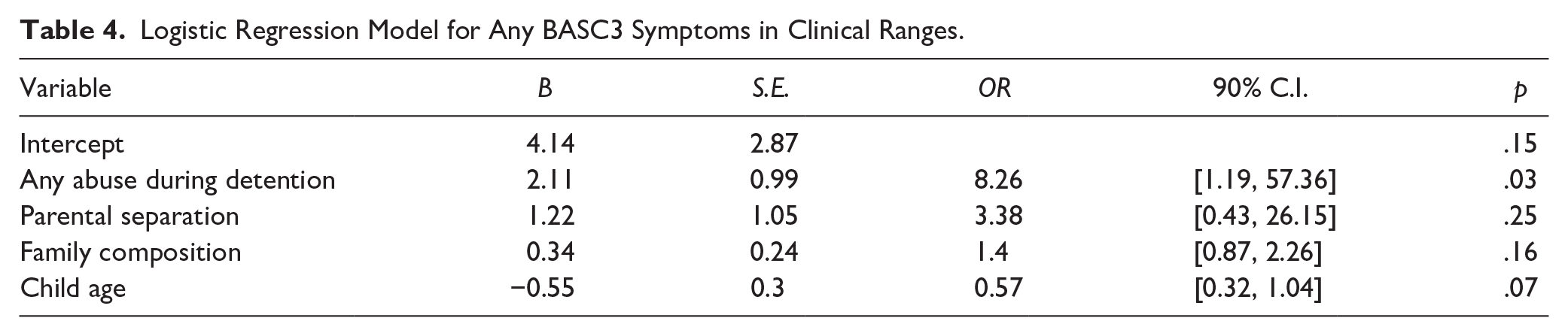
Regarding our second hypothesis test, the logistic model was deemed significantly better performing than a null model (χ2(4) = 12.42, p = .01). Experiencing any form of abuse during detention was associated with more than a eight-fold increase in log-odds of children presenting any form of clinical levels in the BASC3 (i.e., t score >70). Neither parental separation, nor family composition presented a significant association with the log-odds of clinical ranges, but age presented a marginally significant negative association (see Table 4). The model presented a correct classification rate of 73.2% and moderate variance explained (Nagelkerke’s R2 = 35%).
Logistic Regression Model for Any BASC3 Symptoms in Clinical Ranges.
Discussion
This developmental study included a diverse sample of children and families from the Northern Triangle of Central America interviewed between 2018 and 2022 and offers a window into the impact of immigration detention on children. More than half of the families interviewed migrated north to the U.S. because of community violence, homicides, domestic violence, and extortion by gangs and police. Economic hardship was only cited by less than a fifth of the families. A full third of parents mentioned that recruitment of their children, both males and females, by maras (common term for Central American gangs) added to their reasons for emigrating. Our findings align with previous research on the reasons for leaving and the mental health sequelae (Behrendt et al., 2022; Cheatham, 2023; Garcia & Birman, 2022; Held, 2018; Oldroyd et al., 2022; Perreira et al., 2019; Pfeiffer et al., 2022; Sangalang et al., 2019). Additionally, these findings contradict much of the political rhetoric surrounding immigration from the NTCA (Neidhardt & Butcher, 2022)—that people arrive to the United States to appropriate jobs away from “legal” citizens and/or take advantage of social services.
Nearly all families faced negative experiences during their detention. Most of the families spent time in hieleras and some in perreras when they were first taken into custody, while some spent time in both types of settings before being transferred to family residential centers. Parents were more likely than their children to report having experienced some form of verbal and psychological abuse during detention from employees or other detainees. However, it is possible that more children were subject to abuse but did not report it in their interviews.
Our study explored how detention experiences impacted the psychological wellbeing of children as they tried to settle into their new communities. Regarding our first hypothesis, the mean comparisons found that the group of participants that experienced any form of abuse during detention presented higher levels of anxiety, depression, and inadequacy, which goes in line with previous research. Experiences of abuse as defined for this study were associated with high-risk for anxiety and sense of inadequacy.
Regarding the second hypothesis, experiencing abuse during detention meaningfully increased the propensity in children to develop clinical levels of at least one dimension of the psychopathologies measured such as difficulties in locus of control, social stress, anxiety, depression, sense of inadequacy, low self-esteem, and low self-reliance.
Considering the short length of time from release to participation in our study, not enough time may have transpired to impact the mental health of children. Release from detention and avoiding further abuse from detention officials and other detainees may offer children and their families reprieve from long-lasting exposure. However, it remains unclear the longitudinal impacts of these experiences on their mental health.
Before we address directions for research and clinical services, we address the study’s limitations. The sample is small and restricts generalizability and the data collection mixed some in-person with telephonic interviews, possibly affecting the equivalence across reports. The changing immigration landscape and changes in policies were ongoing during the study that could have influenced the consistency of the data we were collecting. For example, at some points during the research project, the detention centers held only mothers and children but by 2020, the detention centers had been occupied by fathers and children. The 2018 family separation policy created a situation in which children were separated from their parents and reunited weeks and months later; there is evidence that some were never reunited. Another limitation was that parents could endorse more than one reason for migrating but were not asked to rank order the reasons for emigrating. This is important for future research. Another limitation is that the currently available instruments and measurements used may not reflect the experiences of this population. We worked with immigrant children who were in crisis and these instruments may not have been ideal for this population. Ertanir et al. (2023) point out that “crisis migration” and the unusual set of traumas and stresses that children and families suffer will require that we improve our measures of trauma and adverse childhood experience that are normed on other populations. More sensitive and culturally appropriate instruments, more reliable and valid measures for a diverse Central American population sample with limited literacy, and in some cases, indigenous languages will continue to be needed for this at-risk population. Methodological innovations are also sorely needed for recruitment. Most research on immigrant children is cross-sectional which is limiting. Longitudinal research is needed in all areas of the immigration process, and especially in the post-immigration phase as immigrant children adjust to their new country. Finally, we opted to trade type I error protection for statistical power, which made our models only detect moderate to large effects. Regardless, the moderate effect sizes observed in the mean comparisons for self-reliance between groups suggests this effect should be further explored. Although a bigger sample size would have helped in achieving statistical significance for some effects, this is a very vulnerable and oversuspicious population, which is why our recommendation is following more robust methods to overcome the limitations of working with small samples.
Nevertheless, the value of this study is in adding to our understanding how stress and trauma accumulate during the migration journey (and the difficulties of separating them in research). Our findings offer early confirmatory evidence of the deleterious effects that immigration detention has on children’s mental health. Children in detention centers and during the post-detention time, have trouble learning to trust other people. This may be because of their language or culture, or partly due to trauma (Cohodes et al., 2021). Increased training of support staff at detention centers is also needed. This training should be child centered, evidenced-based and more communal (Collier, 2015). Mental health professionals should be the first line for working with detained immigrants. Based on data gained from the abuse questions, we strongly recommend that frontline personnel in detention centers be mental health trained personnel, not prison guards. Trained counselors who attend to children’s special needs and who understand the children’s culture are essential. Caregivers should be aware that suppressed anger is most likely to emerge in the post-detention phase. Not all immigrant children have access to post release services, and there is little research in this area. There remain gaps in the mental health needs for asylum-seeking children in the post detention stage.
Footnotes
Acknowledgements
The authors thank the parents and children who participated in the study for sharing their stories.
Declaration of Conflicting Interests
The author(s) declared no potential conflicts of interest with respect to the research, authorship, and/or publication of this article.
Funding
The author(s) disclosed receipt of the following financial support for the research, authorship, and/or publication of this article: The study was supported by NICHD grant #R21HD097486 to Luis H. Zayas.
