




Abstract
Resilience planning has grown in popularity as it offers opportunities to address complex challenges faced by cities; however, operationalizing resilience proves to be difficult. Through a comprehensive policy analysis of 171 Canadian local governments’ strategic planning documents, this research aims to understand how resilience is incorporated into plans. Results indicate that there are many approaches to meaningfully incorporate resilience. Within the Canadian context, local governments also have the opportunity to customize inclusions of resilience to be place-based and use opportunities to be creative.
Introduction
With the impacts of anthropogenic climate change becoming progressively urgent, there is a critical need for cities and their local governments to take responsibility for mitigating and adapting to the impacts of climate change (Ahern 2011; Béné et al. 2018; Chelleri et al. 2015; Evans 2011; Filho et al. 2019; Folke et al. 2021). Urban planning can offer solutions to address the complexities of climate change (Filho et al. 2019); however, traditional planning tools are limited when used on their own (Albrechts 2016, 1). Scholars have identified resilience planning as a promising alternative to traditional planning as it can be more flexible, adaptive, and collaborative and applies a systems-thinking approach (Coaffee et al. 2018; Sellberg et al. 2018; Woodruff et al. 2018).
While different concepts of resilience exist, this study uses urban resilience as defined by Meerow, Newell, and Stults (2016) as: “the ability of an urban system—and all its constituent socio-ecological and socio-technical networks across temporal and spatial scales—to maintain or rapidly return to desired functions in the face of a disturbance, to adapt to change, and to quickly transform systems that limit current or future adaptive capacity” (39). Within this definition, a resilient city is a complex system that can prepare, withstand, and adapt to changes and challenges. The concept of urban resilience has increased in prominence and use by scholars, planners, and policy makers (Wagenaar and Wilkinson 2015; Woodruff et al. 2018) due to its holistic and transdisciplinary nature (Béné et al. 2018; Coaffee 2013; Leichenko 2011; Meerow et al. 2016). This understanding of resilience builds off ecological and engineering conceptualizations and supports a more evolutionary understanding of resilience (Davoudi et al. 2012). However, operationalizing urban resilience is challenging, and scholars have explicitly called for more empirical evidence of resilience planning (Coaffee et al. 2018; Sellberg et al. 2018; Woodruff et al. 2018) to advance planning practice and potentially the status quo of planning frameworks and policies (Moloney and Doyon 2021).
This research responds to calls for more empirical evidence of resilience planning by answering the following research question: How is resilience incorporated into Canadian local governments’ strategic land use planning documents? The question was explored through a comprehensive policy analysis of the incorporation of resilience in strategic land use planning documents. This type of document was chosen due to the significant role they play in local land use planning (Hodge, Gordon, and Shaw 2021). While many local governments have distinct plans for specific topics (e.g., housing, forest management, hazards and risks, and transportation), strategic land use planning documents are the most holistic and long-term plan in the Canadian context. Therefore, if resilience is meaningfully incorporated into local governments’ strategic land use planning documents, it is more likely to be prioritized and implemented over the long term. Canada is a useful location to conduct this analysis as local governments have been engaged in resilience-related initiatives such as the Rockefeller Foundation 100 Resilient Cities and ICLEI—Local Governments for Sustainability’s Building Adaptive & Resilient Communities (BARC). In addition, many local governments across the country have been embedding resilience within their climate change plans and strategies.
This research aims to urge planners, policy makers, and other resilience practitioners to meaningfully incorporate urban resilience into strategic land use planning documents. Strategic land use planning documents that incorporate resilience will enable local governments to be sufficiently flexible, innovative, and resilient to prepare, withstand, adapt, and thrive in the face of challenges such as those related to climate change.
Literature Review: Planning for Resilience
This literature review begins with an introduction to resilience and urban resilience, followed by the role of planning in implementing or operationalizing resilience. It presents the need for more empirical and comparative research of resilience in local government policy, as well as the need for research on the inclusion of resilience in local governments’ strategic land use planning documents in Canada.
The concept of resilience has evolved over time (Davoudi et al. 2012; Moloney and Doyon 2021; Moser et al. 2019; Woodruff et al. 2018). The Latin root word, resilire, means to spring back (Davoudi et al. 2012; Moloney and Doyon 2021), and over time discipline-specific approaches such as engineering, psychological, and ecological resilience have been introduced (Datola 2023; Meerow and Stults 2016). While definitions are varied, most focus on the ability of a system to adapt, persist, absorb, recover, reorganize, transform, or simply deal with change (Adger 2003; Ahern 2011, 2013; Elmqvist et al. 2019; Sellberg et al. 2018). Among more specific definitions, urban resilience in particular has increased in prominence since 2010 (Meerow et al. 2016), which coincides with the increase in use of resilience by local governments and city-focused philanthropic, non-governmental, and international programs. 1 Both scholars and practitioners use urban resilience as a holistic approach to navigating multiple risks and hazards through proactive measures across transdisciplinary boundaries and systems (Béné et al. 2018; Coaffee 2013; Davoudi et al. 2012; Leichenko 2011; Meerow et al. 2016; Moloney and Doyon 2021; Wagenaar and Wilkinson 2015; Woodruff et al. 2018; Yamagata and Sharifi 2018). However, even with this growing popularity and the commonalities among definitions, the concepts of resilience and urban resilience often remain unclear or inconsistent. This can hinder progress by creating difficulties for those trying to understand and operationalize resilience (Meerow et al. 2016; Moser et al. 2019).
Resilience planning has been identified as a promising alternative to traditional planning to address the complexities of climate change as it can be more flexible, adaptive, and collaborative (Coaffee et al. 2018; Filho et al. 2019; Sellberg et al. 2018; Spaans and Waterhout 2017; Woodruff et al. 2018). Traditional planning frequently relies on stability, certainty, and a strong understanding of problems at hand (Albrechts and Balducci 2013; Christensen 1985; Forester 1993; Schön 1971); however, with the uncertainties of climate change, cities today cannot depend on such clarity (Albrechts and Balducci 2013). To plan for the contemporary city, strategic land use planning methods must be more dynamic and adaptable (Wilkinson 2011). Resilience planning differs from tradition planning because it follows “a ‘systems’ approach, acknowledging the interdependencies between shocks and chronic stressors, such as poverty, aging infrastructure, and climate change” (Woodruff et al. 2018, 2). Resilience planners bring this systems approach to strategic land use planning by applying resilience thinking, which aims to understand social-ecological systems while centering resilience concepts and embracing change (Folke et al. 2010; Walker and Salt 2006), to strategic land use planning (Sellberg et al. 2018).
The inclusion and application of resilience in planning has increased rapidly (Meerow et al. 2016; Meerow, Pajouhesh, and Miller 2019; Woodruff et al. 2018), particularly regarding local climate change planning (Alibasic 2018; Kythreotis and Bristow 2016). Since the early 2010s planning began transitioning from focusing on sustainability to climate change to resilience, where each focus has built off the last. (Woodruff et al. 2018). Such a shift has occurred as the opportunities and need for resilience planning become more widely recognized. As urban settings become increasingly complex, resilience planning is seen as part of the solution to address wicked problems and sustainability challenges through adaptation and transformation (Chelleri et al. 2015; Coaffee et al. 2018).
However, resilience is not without its shortcomings. Effectively operationalizing resilience has proved challenging (Bonnett and Birchall 2023; Sellberg et al. 2018) due to the concept’s malleability and inconsistencies, which also make developing metrics difficult (Meerow et al. 2016; Meerow and Stults 2016). To effectively operationalize resilience, more empirical research, understanding, and concrete guidance is needed (Chelleri et al. 2015; Coaffee et al. 2018; Moser et al. 2019; Sellberg et al. 2018; Wagenaar and Wilkinson 2015; Woodruff et al. 2018). Research has found there have been few comparisons of resilience planning in real-world settings, including comparisons on effective implementation strategies (Coaffee et al. 2018; Sellberg et al. 2018) and previous studies have often focused on single cities or on the Rockefeller Foundation’s 100 Resilient Cities Program (e.g., Beheshtian et al. 2018; Croese, Green, and Morgan 2020; Fitzgibbons and Mitchell 2019; Fitzgibbons and Mitchell 2021; Galderisi, Limongi, and Salata 2020; Lu and Stead 2013; Moloney and Doyon 2021; Spaans and Waterhout 2017; Woodruff et al. 2018). This contributes to a gap in resilience planning practice, with practitioners and local governments calling for more guidance and understanding on how to implement resilience within cities (Chelleri et al. 2015; Meerow et al. 2016; Moser et al. 2019).
This research responds to these calls by investigating how resilience is incorporated into Canadian local governments’ strategic land use planning documents. While resilience planning can be incorporated into various types of plans, strategic land use planning documents were chosen to focus specifically on planning, whereas other plans may be authored by other departments. In addition, environmental plans, such as climate or sustainability plans, have a higher potential of incorporating resilience, which is not necessarily common in strategic land use planning documents. Strategic land use planning documents are “long-range, comprehensive, general policy guide[s] for the future” (Hodge et al. 2021, 155). They are “essential to creating public value [by] enhancing quality of life . . . in the face of an uncertain future” (Guyadeen et al. 2023, 1) and can improve organizational decision-making, especially in the allocation of resources such as budgeting to complete identified actions (Albrechts 2016; Guyadeen et al. 2023; Plant 2009). Strategic land use planning can support capacity building (Balducci 2020), complementing resilience planning which seeks to improve the adaptive capacity of a system (Smit and Wandel 2006). Further, strategic land use planning has the power to facilitate the experimentation that is required when planning for uncertainty, urban transformation, and resilience (Balducci 2020; Elmqvist et al. 2019).
The appropriate scope, content, and procedures for local government strategic land use planning documents in Canada have been debated by scholars (Guyadeen et al. 2023), but typically plans share a few key features. Most plans are forward thinking (i.e., ten to thirty years), include both general and broad perspectives (high-level and values-based), contain comprehensive viewpoints (including significant physical and non-physical factors), and focus on the natural and built environment (including local ecosystems and biodiversity, living areas, working areas, transportation, community facilities, amenities, and services) (Hodge et al. 2021, 155).
Methodology
The aim of this research was to determine how resilience is incorporated into Canadian strategic land use planning documents. This was accomplished through a document analysis of strategic land use planning documents from Canadian local governments. The data collection and analysis consisted of three steps: identifying local governments, identifying eligible strategic land use planning documents, and analyzing the plans. Strategic land use planning documents, also known as land use plans, municipal development plans, and community plans (among others), were chosen as they are a significant planning tool across Canadian local governments (Hodge et al. 2021). In Canada, provincial and territorial legislation requires that local governments create strategic land use planning documents, but required content differs across jurisdictions.
Identification of Local Governments
Data for this research was acquired through a publicly available and federally created database of Canadian Geographical Names Data. 2 The data used in this research was last updated on June 15, 2022. The Canadian government collects data from each individual province and territory (10 provinces and three territories). Notably, geographic names are not standardized between provinces and territories (e.g., places are categorized as towns, cities, municipalities, etc.), which made identifying the appropriate local governments a little challenging.
First, due to language limitations, the data from Quebec and its associated local governments was removed as their plans are largely in French. Next, data not relevant (i.e., toponymic feature or geospatial indicators) were removed. The remaining data was filtered to include only populated places, which included places categorized as charter communities, cities, metropolitan areas, municipalities, towns, counties, and districts. Upon reviewing the list, any duplicate locations (locations listed in both French and English languages) were removed. This list included 1,066 local governments across Canada.
Next, any local government with a population of less than 4,500 was removed from the list. 3 In addition, from a scope perspective, we noticed more than half of the local governments had populations below 4,500. While this meant that a large population range existed between some local governments (e.g. 4,500 to over one million), the goal was to include as many local governments and their strategic land use planning documents as possible for a robust and meaningful analysis. 662 local governments had populations below 4,500, which left 404 local governments in the analysis.
Identification and Eligibility of Strategic Land Use Planning Documents
The next step involved collecting the strategic land use planning documents for each of the 404 local governments. As there is no federally standardized process for the naming of strategic land use planning documents, each province and territory mandates their own plan name (see Table 1 for a list of plan names by province and territory). Plan implementation dates were also not standardized or consistent between local governments.
Comparative Provincial Planning Terminology.
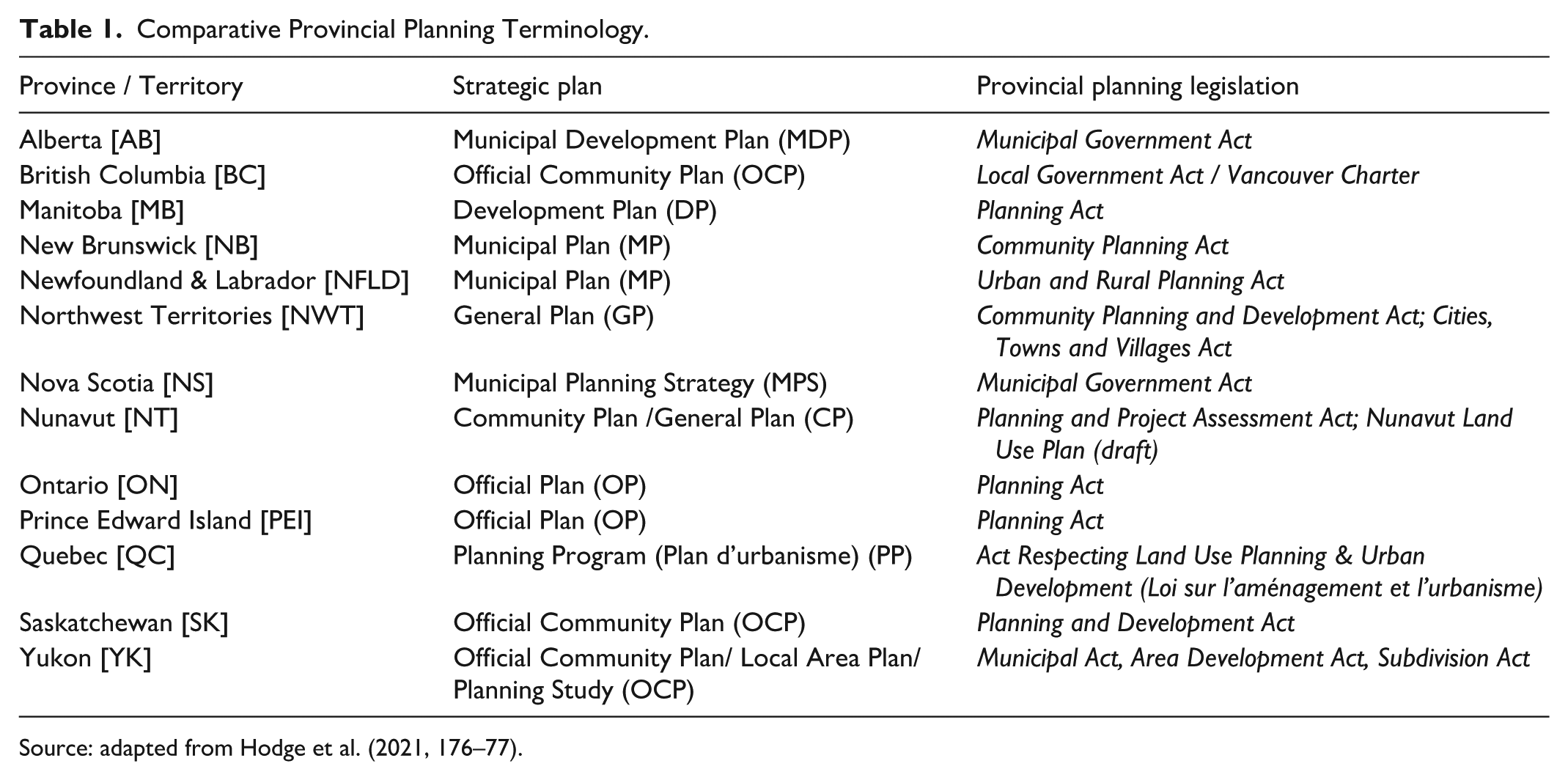
Source: adapted from Hodge et al. (2021, 176–77).
Through this process, local governments were removed if they did not have a clearly identified strategic land use planning document (n = 8) or did not have a plan in English (n = 1). Local governments were also removed if they had a combined plan with another local government (e.g., regional plan, intermunicipal plan), thus lacking full autonomy to implement actions described in the plan (n = 9). If plans were in draft form, but still publicly available, the draft was included in the analysis. 4 Based on this filtering criteria, 386 local government plans remained.
For this research, the year of the plan was recorded as the date the plan was adopted, approved, released, or passed by the local council. Dates were not always obvious or consistent, but the goal was to determine the initial adoption and implementation of the plan (when it initially came into effect) rather than simply when it was amended, updated, or reviewed in between strategic land use planning cycles. Of the 386 plans, 288 were adopted, approved, released, or passed by Council between 2010 and 2022. All other plans were removed from the study. 2010 was chosen as the cutoff date because it corresponds with the rise of resilience as an important issue in urban policy (Coaffee et al. 2018; Davoudi et al. 2012; Leichenko 2011; Meerow et al. 2016). Strategic land use planning documents are normally created every twenty to thirty years, with regular updates and amendments every five years.
The 288 strategic land use planning documents were analyzed using NVivo, a qualitative data analysis software. The plans were first analyzed using the “Text Search” function to determine if the plans included “resilient” and its stemmed words (resilient, resilience, and/or resiliency). Five of plans were excluded because they were scanned images and illegible to the software. 172 of 288 plans (60%) included resilient and stemmed words at least once. Resilience counts were later adjusted to remove repetitive language (such as repetition of the same section heading), references that were not original words of the plan itself (e.g., exact quotes from Regional Growth Strategies, verbatim quotes from community consultation sessions) or if the mentions were part of a neighborhood plan or a supplementary portion of the strategic plan such as an appendix. One plan (Coaldale [AB]) was removed as both mentions of resilience were not in the plan itself but rather in Appendix A regarding a verbatim quote from a community member during the engagement process. The frequency of “resilient” and stemmed words ranged from one to eighty-five once adjusted (Appendix A—Strategic Plan Details). This led to an adjusted count of 171 plans that remained in the analysis (see Figure 1).
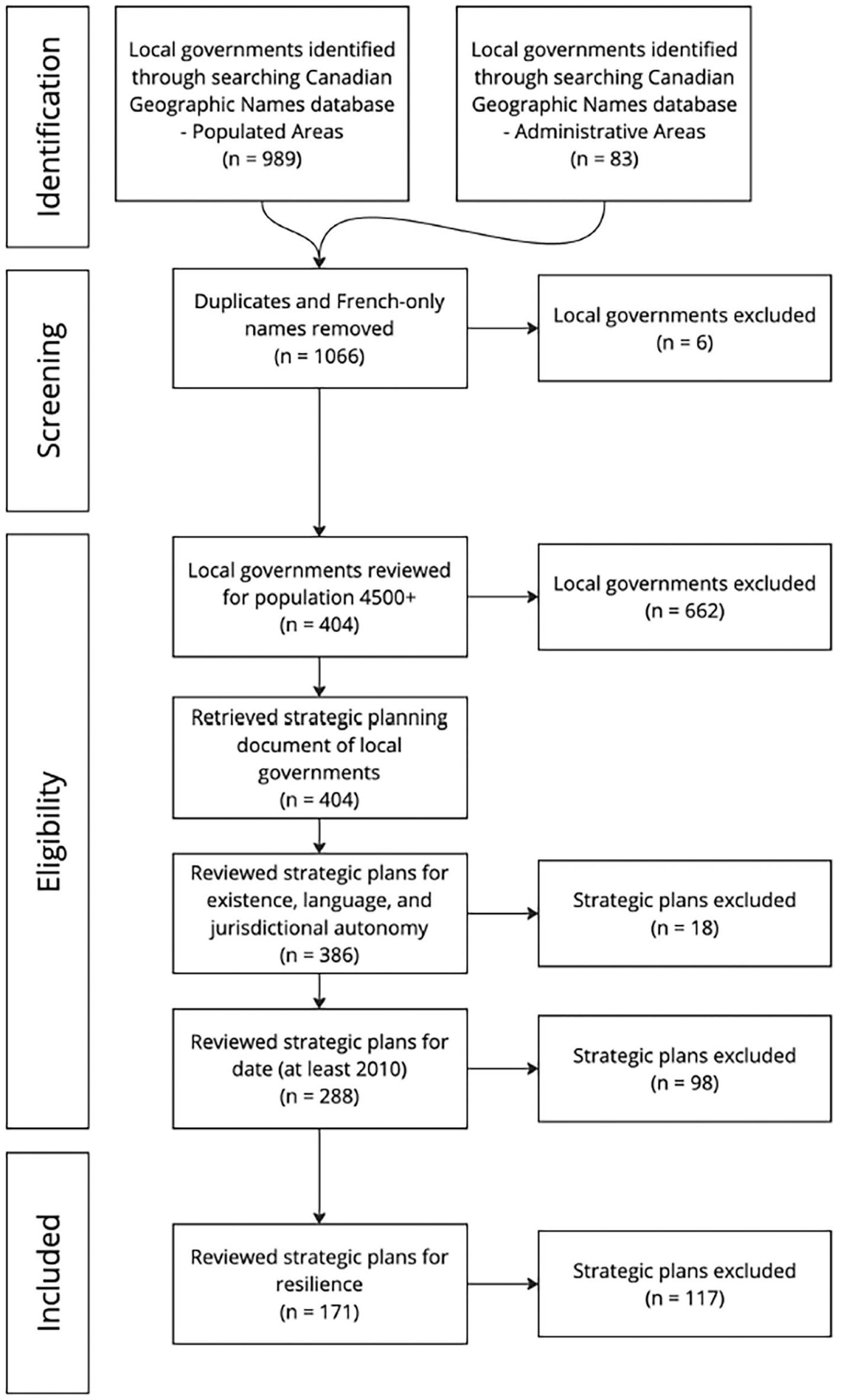
Flow diagram of the systematic review process.
Analysis of Strategic Land Use Planning Documents
The 171 plans were analyzed to determine how resilience is being incorporated into Canadian strategic land use planning documents. The results from this analysis were then used to identify learning opportunities. To assess “good” plans, which are likely to have meaningful content, it is important to look at what key components are present or absent (Guyadeen et al. 2023, 2). This meant reviewing how plans included resilience, considering both theme and location. First, each plan was reviewed to determine if it defined resilience, and if so, how. Second, plans were analyzed to determine the location of resilience, with emphasis on the following locations: the table of contents, the vision, and as an overarching component, which includes goals; principles, pillars, and themes; titles of sections and subsections; values and purpose; and strategic directions or priority areas.
Third, the plans were reviewed for themes of resilience based on sixteen categories (see Table 2). The first set of categories was based on the five common categories included in strategic land use planning documents as provided by Hodge et al. (2021). Two of these categories were adapted for the purpose of this study: community facilities was adapted to be community and public, and circulation was adapted to be transportation. Two categories were created to capture common themes within resilience literature, and nine categories were created to capture recurring themes identified through the data analysis process.
Categories for Analysis of Resilience Themes.
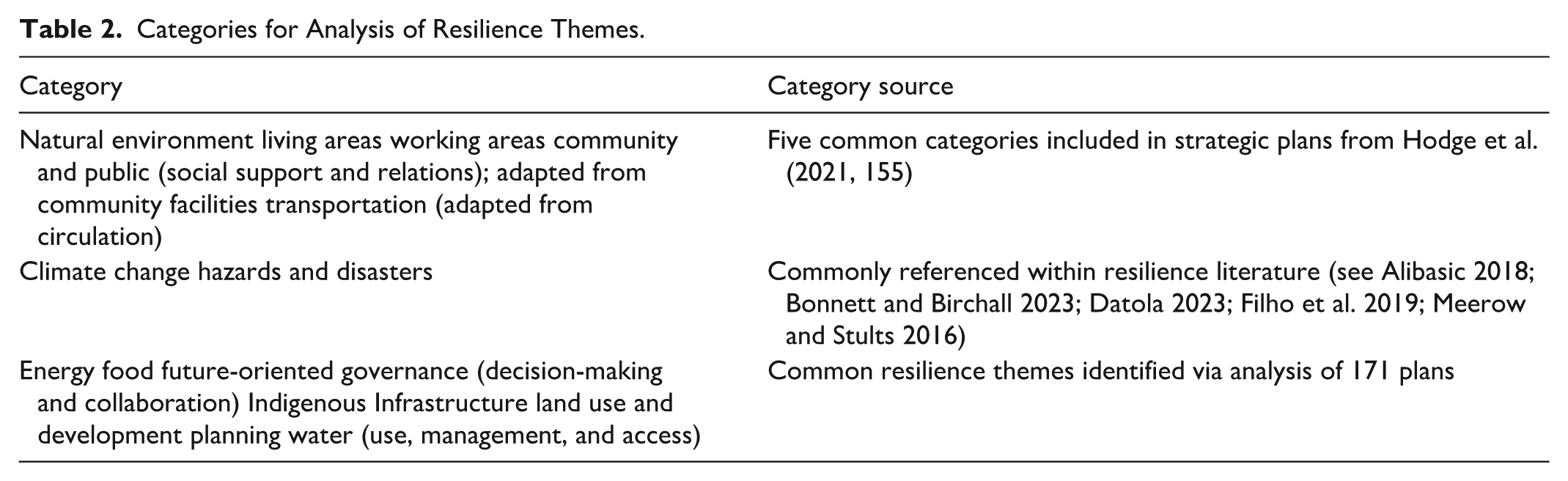
Some specific mentions of resilience were included in more than one category when appropriate (e.g., transportation planning was included in both the transportation and planning categories, climate change resilient communities was categorized in both the climate change and community and public categories) A full list of mentions of resilience across the sixteen categories can be found in Appendix B—Resilience Mention Categorization.
Results
These results summarize the definitions and locations of resilience within the 171 plans. Mentions of resilience throughout the plans are then presented using the sixteen categories with examples, focusing on: community and public, climate change, hazard and disaster, working areas, natural environment, infrastructure, land use and development, food, future oriented, living areas, and planning.
How Is Resilience Defined?
Definitions of resilience are included in 21 percent (n = 36 of 171) of plans analyzed (see Appendix C—Resilience Definitions). Within these thirty-six plans, there are a total of forty-five definitions as six local governments include multiple definitions for different forms of resilience: (Dawson Creek [BC], Huntsville [ON], North Cowichan [BC], Ottawa [ON], Sarnia [ON], and Vancouver [BC]). Definitions are similarly split with 49 percent (n = 22) being definitions for resilience in general, and 51 percent (n = 23) being definitions for specific types of resilience. Community resilience and economic resilience are the most common types of specific definitions. Only two plans include both general and specific definitions: Dawson Creek [BC] defines both the terms resilient and resilient community while Huntsville [ON] defines resilience, resilient economy, resilient environment, resilient infrastructure, and social resiliency. The location of the forty-five definitions varies; twenty-eight definitions are located within the body of the plan and seventeen definitions are located in a specified definitions section such as a glossary. Of the plans that include multiple definitions, these appear throughout the body of the plan, with the exception of Vancouver [BC]which includes definitions within both the body and the glossary.
Where Is Resilience Located?
The table of contents was reviewed as the presence of resilience in the table of contents can indicate the inclusion of resilience throughout the entire plan. Eighteen percent (n = 31) of the 171 plans explicitly include resilience in the table of contents, most often when a section or subsection includes resilience. The visions of each plan were also reviewed for inclusions of resilience. 26 percent (n = 44) of the plans include resilience in the vision. In most cases, resilience is mentioned once in the plan’s vision, but Campbell River [BC], Courtenay [BC], North Cowichan [BC], and Whistler [BC] mention resilience twice while Kamloops [BC] and West Vancouver [BC] mention resilience three and four times respectively in their plans’ visions.
Some plan visions, such as Canmore [AB], centers resilience in its vision plan: “Canmore is a resilient and vibrant community socially, economically, and environmentally. Its strength is in its resourceful and engaged citizens, who thrive together on the strength of the community’s heritage, long-term commitment to the diversity of its people, and health of the mountain landscape” (Town of Canmore 2016, 1). Other plans, such as the City of North Vancouver [BC], reference resiliency in response to climate change: “In 2031, the City of North Vancouver will be a vibrant, diverse, and highly livable community that is resilient to climate or other changes, and sustainable in its ability to prosper without sacrifice to future generations” (North Vancouver [City] OCP 2014, 2). Owen Sound [ON] explicitly states that every decision will consider resiliency: “The City of Owen Sound is where you want to live. A complete community that values the natural environment, cultural diversity, historic streetscapes, vibrant waterfront and provides a sense of belonging. The City will plan to evolve as a center for growth, opportunity and innovation while ensuring that equity, inclusion, diversity, sustainability, resiliency, and quality of life are considered in every decision” (Owen Sound OP, 4).
Thirty percent (n = 51) of the plans include resilience in overarching components through goals (anticipated achievement); principles, pillars, and themes (decision-making frameworks); titles of sections and subsections (distinct named parts of plans); values and purpose (desired outcomes); and strategic directions or priority areas (actionable items or activities). Specific titles of sections or subsections had the highest inclusion of resilience (n = 27; 16%), followed by overarching and specific goals (n = 19; 11%), and principles, pillars, and themes (n = 17; 10%). Least common, but still important, were values and purpose (n = 7; 5%) and strategic directions or priority areas (n = 5; 3%). Some plans incorporate resilience within more than one overarching component. 20 percent (n = 35) of plans include mentions of resilience but not as the primary focus while 50 percent (n = 85) of plans include resilience with little context or relation to the rest of the plan or as a specific policy or objective.
Argyle [NS] includes two resilience-related goals: “Increase the Diversity and Resilience of the Local Economy” and “Foster Resilient, Sustainable, and Distinct Communities” (Municipality of Argyle 2020, 11–12), while Sidney [BC] identifies “Goal 6. A healthy and resilient community that takes action to address climate change” (Town of Sidney OCP 2022, 9). Economic resiliency was included as a specific section or subsection as well as in the table of contents of more than one plan, including Armstrong [BC], Richmond [BC], and Williams Lake [BC]. Osoyoos [BC] also has a section dedicated to economic resiliency, the sole mention of resilience in the entire plan. Some plans, such as Barrie [ON], Huntsville [ON], Nanaimo [BC], North Cowichan [BC], Ottawa [ON], Squamish [BC], and Vancouver [BC], include a variety of overarching components. These local governments often incorporate resilience multiple times within the same component, Barrie has six subsections related to resilience and Huntsville has four pillars of resiliency; or across multiple components, Ottawa includes resilience within a subsection and strategic direction and North Cowichan includes resilience in its purpose, sections, principles, and goals.
What Topics Are Discussed in Relation to Resilience?
Of the sixteen resilience categories identified through literature and data analysis, no plan included all categories (see Figure 2). However, 74 percent (n = 127) of the plans reference more than one type of resilience. Nine local governments reference at least 75 percent of the categories: Oak Bay [BC] and Winnipeg [MB] reference fourteen categories; Vancouver [BC], Ottawa [ON], and Whistler [BC] reference thirteen categories; and Nanaimo [BC], Okotoks [AB], North Cowichan [BC], and Squamish [BC] reference twelve categories. Details of all 171 local governments can be found in Appendix A—Strategic Plan Details. The resilience categories referenced in most plans are community and public (n = 116; 68%), climate change (n = 95; 56%), working areas (n = 87; 51%), and natural environment (n = 69; 40%). The least referenced are water (n = 10; 6%) followed by Indigenous (n = 11; 6%) (see Figure 3).
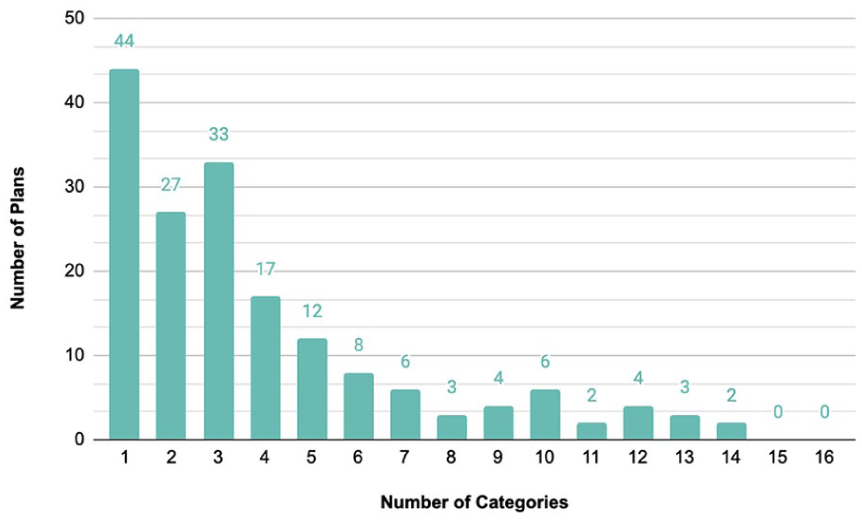
Frequency of resilience categories by number of plans.
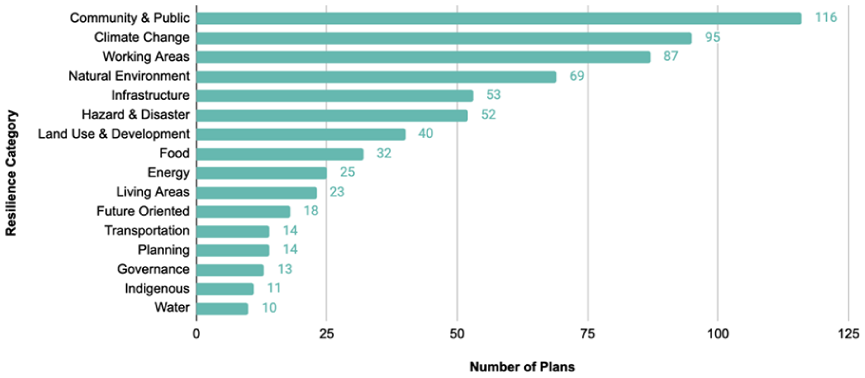
Resilience category by number of plans.
Each of these defined resilience categories have additional subcategories, that is, more specific applications of resilience when read in detail. A full list of categories and their corresponding subcategories can be seen in Appendix D—(Sub)Categories. Key findings from this category analysis are highlighted below starting in order of significance.
Community and public
Resilience is referenced most often and with the most depth with regards to the community and public category. Community resilience is often used to link multiple topics together, given that a resilient community can strengthen resilience in other areas. For example, Sooke [BC] has a goal to “Create a safe and resilient community for all” (District of Sooke 2022, 51), which is supported by policy objectives pertaining to transportation; parks; trails; the health of land, air, and water; climate change impacts; infrastructure; recreation and community facilities; and community partners. It was also very common for local governments to state aspirations of achieving resilience as part of their identity. These cases were categorized as community and public resilience since the local government is representative of the community members and general public. For example, Victoria [BC]) aspires to be “a more sustainable and resilient city” (City of Victoria 2012, 11), while Huntsville [ON] dedicates a section to becoming “a resilient Huntsville” (Town of Huntsville 2019, 3).
Climate change and hazard/disaster
Many plans state the need to be resilient to the impacts of climate change overall and/or to hazard and disaster events. Climate change resilience is mentioned in 56 percent (n = 95) of plans, while hazards and disasters are mentioned in 30 percent (n = 52). While separate categories, these two are presented together because they are highly interconnected. Even though climate change is the second most referenced category, it is most often referenced in a very general sense. More specific impacts of climate change overlap with other defined categories or specific disasters (e.g., flooding, extreme heat, pandemic, sea level rise, seismic hazards, wildfire, etc.), which may be categorized as hazard/disaster. 25 percent (n = 42) of plans reference both climate change and hazards/disasters. Emergency preparedness and risk management are subcategories where resilience is mentioned as valuable in addressing climate change and hazards/disasters. For example, St. Albert [AB] dedicates a subsection to “Risk Management and Resiliency” ( City of St. Albert 2021, 74).
Working areas
This category represents resilience regarding the economy, jobs, businesses, commercial and industrial lands, and related subcategories. 51 percent (n = 87) of plans mentioned resilience in these ways. The economic context is almost always local, but a few plans discuss resilience in the context of the global economy, such as North Vancouver (City) [BC] and Kitchener [ON]. While the economy is also most often applied in a general sense (e.g., a resilient economy), plans like Fort Saskatchewan [AB], Barrie [ON], and North Cowichan [BC] identify specific economic disruptions or changes such as cycles, downturns, shifts, shocks, and stressors. Resilience is also commonly mentioned in relation to jobs and employment, including job security, diversification, general workforce, employment base, etc. Williams Lake [BC] dedicates a policy theme and section to “Resilient Economy” (see Table 2 for definition), which outlines specific policies and objectives to achieve a resilient economy and references this topic throughout other parts of the strategic plan.
Natural environment
The natural environment category was included in 40 percent (n = 69) plans. Many local governments (e.g., Duncan [BC], Nanaimo [BC], Ottawa [ON], Vernon [[BC]] reference broad concepts of ecosystems, the environment, and ecology, while sometimes mentioning-related concepts such as ecosystem services, environmental health, and ecological assets. Plans also highlight environmental systems and networks as being important to resilience and the natural environment. This is evident through subcategories including greenspace networks (Ottawa [ON]), natural systems (Martensville [SK] and North Vancouver [City] [BC]), and Natural Heritage Systems, which is a specific planning term used in Ontario (Barrie, Collingwood, County of Brant, Huntsville, London). Trees, in particular, are commonly linked to resilience through subcategories such as community forests (Moncton [NB]), urban canopy (Sarnia [ON]), urban forest (LaSalle [ON], Lincoln [ON], Markham [ON]), New Westminster [BC], Pitt Meadows [BC], Prince Albert [SK]), and tree canopy (Medicine Hat [AB], Nanaimo, Ottawa). Penticton (BC] dedicates a subsection of land use goals and policies to Environment and Resilience, which references resilience to natural hazards, protection and enhancement of natural areas, greenhouse gas emissions, energy use and production, water reduction, and waste management (City of Penticton 2019).
Infrastructure
Infrastructure-related resilience is mentioned in 31 percent (n = 53) of reviewed plans. Infrastructure involves elements such as municipal services, stormwater management, and utilities. Huntsville [ON] and Winnipeg’s [MB] plans specifically mention resilient infrastructure, but Victoria [BC] mentions sustainable infrastructure while tying in resilience. Drumheller [AB] dedicates an entire subsection to Flood Resilient Infrastructure.
Land use & development
Land use and development is mentioned in relation to resilience in 23 percent (n = 40) of plans. This category includes subcategories such as buildings, development, and urban design, which often involve private property. Resilience in relation to land use and development is sometimes used to connect other categories. For example, Huntsville [ON] links land use and social resiliency: “Sensitive land uses include residential uses, institutional uses, parkland and open spaces, which should be protected from incompatible uses in order to ensure social resiliency” (Town of Huntsville, 173). Winnipeg and Barrie similarly link land use and urban design with climate resilience.
Food
Food and resilience are referenced together in 19 percent (n = 32) of plans. Examples include mentions of food systems (e.g., Vernon [BC], Nelson [BC], Castlegar [BC]), food supply (e.g., Esquimalt [BC], Vancouver [BC]), and food production (e.g., Huntsville [ON], North Cowichan [BC], Fernie [BC]).
Future oriented
As plans were reviewed, it became clear that some local governments (n = 18; 11%) look to resilience as part of a solution for tackling future uncertainties more generally across many categories. For example, Sidney [BC] mentions resilience regarding unpredictability; North Cowichan [BC], North Vancouver (City) [BC], and Surrey [BC] include resilience to address future challenges; and Whistler [BC] and Richmond [BC] reference re-silience alongside external trends and challenges. Growth management is another subcategory regarding resilience. For example, Okotoks [AB] incorporates resiliency to climate events as being important for managing growth, and Dawson Creek [BC] includes a section called “Our Plan for Resiliency” which “describes how Dawson Creek will work towards resilience over the long term with respect to growth” (City of Dawson Creek 2018, 4).
Living areas
Living areas and resilience appears in 13 percent (n = 23) of plans involving subcategories such as neighborhoods (e.g., Canmore [AB], Wheatland County [AB]), residential areas (e.g., Vernon [BC]) and housing (e.g., Barrie [ON], Cornwall [ON], Esquimalt [BC], North Cowichan [BC], Oak Bay [BC], Oliver [BC], Ottawa [ON], Sooke [BC], Vancouver [BC], Winnipeg [MB]).
Planning
Resilience was referenced in relation to planning and specific resiliency actions in 8 percent of plans (n = 14). While planning is sometimes used in a general sense (e.g., planning for a resilient city), some local governments reference subordinate plans specific to resilience, such as Barrie’s Resiliency Strategy and Nanaimo’s [BC] Climate Resiliency Strategy. Specific types of planning were identified as being important to resilience such as disaster resilience planning (Squamish [BC]), resiliency planning (Winnipeg [MB]), transportation planning (Victoria [BC]), and watershed planning (White Rock [BC]).
Other trends
Resilience and governance-related topics appear in 8 percent (n = 13) of plans and include topics such as city systems (Sarnia [ON]), municipal processes (North Cowichan [BC]), and partnerships with other jurisdictions (Dawson Creek [BC]). When resilience is mentioned alongside Indigenous topics (n = 11; 6%), it is most often in reference to reconciliation or naming a specific First Nation(s) as being an important relationship to achieve resilience. For example, in their strategic plan (2022), Courtenay [BC] “commits to ongoing respectful government-to-government relationships with K’ómoks First Nation that nurtures trust and resiliency” (32). The categories of energy, transportation, and water are collectively included in only 15 percent (n = 25) or less of plans. One example is Victoria’s [BC] plan which includes a subsection addressing Climate Change and Energy Resiliency with a focus on greenhouse gas reporting, climate change–related risk and vulnerability assessments, and mitigation and adaptation measures through an updated Climate and Energy Resiliency Plan.
Discussion
Of the 171 plans analyzed, resilience is incorporated through a wide variety of methods, locations, and levels of detail. Some local governments’ plans were distinct from others; however, these plans did not follow a prescriptive format and often varied depending on tactics used. Fifteen local governments’ plans stood out (listed alphabetically): Barrie [ON], Duncan [BC], Huntsville [ON], Kelowna [BC], Nanaimo [BC], North Cowichan [BC], North Vancouver (City) [BC], Oak Bay [BC], Okotoks [AB], Ottawa [ON], Squamish [BC], Vancouver [BC], Victoria [BC], Whistler [BC], and Winnipeg [MB]. Some of these plans include multiple comprehensive definitions of resilience; others wove resilience throughout their plan in the table of contents, the vision, and at least one overarching component; and some included resilience using many different topics. The differences in how these plans incorporated resilience in meaningful ways emphasize the opportunities available for local governments to be creative and customize their plans.
Governance arrangements and membership in transnational municipal networks have been known to influence local governments’ priorities and plans (Nielsen and Papin 2020). Local governments are motivated to include different goals or topics into their strategic land use plans through different means. In Canada, local governments jurisdiction is determined by provincial and territorial legislation (Hodge et al. 2021), in addition, provincial and territorial policies, priorities, and institutional factors can influence or enhance local government actions (Birchall and Bonnett 2021). The two provinces with the highest number of plans included in our review were BC (n = 58) and Ontario (n = 40), have had strong provincial support for climate action (Dale et al. 2018). Twenty-five of 171 local governments were members of and ICLEI—Local Governments for Sustainability’s Building Adaptive & Resilient Communities (BARC) program (ICLEI–Local Governments for Sustainability’s Building Adaptive 2023). While this represents less than 15 percent of plans, when we look at the top ranking fifteen plans, 1/3 of those were part of the ICLEI BARC program, and Vancouver [BC] was also part of the Rockefeller Foundation 100 Resilient Cities (City of Vancouver 2019).
This research suggests a relationship between the inclusion of resilience definitions and resilience being incorporated throughout the plan. Definitions are important for reader understanding, particularly with terms like resilience that have evolved over time and possess many different meanings (Meerow et al. 2016; Moser et al. 2019). As there is no one definition of resilience within local government planning (Chelleri and Baravikova 2021), the different definitions of resilience from the plans analyzed help to shed light on how resilience is being used and defined in practice. Definitions become especially important in policy-making contexts and when shaping discourse around new concepts (Tozer 2018). Birchall and Bonnett (2021) argue that “[c]ommittal language around climate change action in strategic planning documents is critical for action to follow in practice” (1). For example, this analysis shows that Huntsville uses resilience intentionally and comprehensively as their plan includes a general definition of resilience and four specific definitions (economy, environment, social, and infrastructure) located at the beginning of relevant sections.
Having multiple definitions of resilience is important because resilience can function as a boundary object, linking multiple concepts and disciplines, to improve engagement and collaboration among diverse stakeholders (Meerow et al. 2016; Moser et al. 2019; Woodruff et al. 2018). This is well suited for planners who can use resilience to work across systems, sectors, and disciplines. A holistic approach is necessary to tackle the complex problems urban environments face today, especially with the increasing severity of impacts from climate change. This research found that given the transdisciplinary nature of resilience and strategic land use planning, the local governments that were more successful at meaningfully incorporating resilience were those that applied resilience across most of the sixteen categories analyzed.
Plans’ visions are also integral to meaningfully incorporating resilience. As strategic land use planning documents are forward-thinking documents, visions have the ability to summarize the aspirations of the entire plan upfront (Albrechts 2004, 750). Visions are important because they are often situated at the beginning of strategic land use planning documents and provide insight for future directions of the local government. Ideal visions represent citizen preferences for future urban form and natural environments (Hodge et al. 2021, 164; Ruming 2018) and set the tone for the entire plan. When resilience is included in a plan’s vision, it can be used as a lens (or guiding light) through which to view all other parts of the plan, and thus effectively embedding resilience. With this type of approach, decision-makers can use the desired future described in the vision to evaluate the success of plan implementation and prioritize actions effectively when resources are limited.
Conclusion
This comprehensive policy review is the largest of its kind, to the knowledge of the authors, and provides relevant guidance for practitioners of resilience planning. This research analyzed 171 local governments’ strategic land use planning documents to examine “How is resilience incorporated into Canadian local governments’ strategic land use planning documents?” Analysis focused on how resilience is defined, where resilience is located, and what resilience topics are discussed. 21 percent (n = 36) of plans include definitions of resilience with general and specific definitions being nearly equally represented. 18 percent (n = 31) of plans explicitly include resilience in the table of contents, 26 percent (n = 44) include resilience in the vision, and 30 percent (n = 51) of the plans include resilience through overarching plan components. Of the sixteen categories of resilience identified, community and public resilience is the most frequently incorporated category. Other commonly mentioned categories include climate change, working areas, and the natural environment.
This research used the Canadian Geographical Names Data list as of June 2022 and strategic land use planning documents were collected until February 2023 (including only those from 2010 onwards); however, as plans are often updated and reviewed every five to ten years, the specific results only represent a moment in time. As resilience becomes further embedded within Canadian strategic and use planning, it would be worthwhile to examine newer plans to determine if progress or changes have been made in the use or inclusion of resilience (i.e., has the inclusion of resilience increased or decreased? Is there better integration of resilience within and throughout plans?). It would also be worthwhile to study the implementation of the strategic land use plans and the operationalization of resilience. Future studies of strategic land use planning documents should also include plans that are written in French and additional analysis parameters such as income, equity and justice, and political context (e.g., provincial mandates). While this study focused on settler colonial perspectives, Indigenous worldviews should also be considered as resilience planning progresses.
To meaningfully incorporate resilience, strategic land use planning documents, we argue, must define general and specific uses of resilience, incorporate it throughout the plan by embedding resilience in overarching components, and connect to a variety of resilience topics. These approaches prioritize resilience within strategic land use planning documents and must be applied with creativity according to the specific context of the local government.
Footnotes
Declaration of Conflicting Interests
The authors declared no potential conflicts of interest with respect to the research, authorship, and/or publication of this article.
Funding
The authors disclosed receipt of the following financial support for the research, authorship, and/or publication of this article: This research received funding from the Social Sciences and Humanities Research Council (SSHRC) of Canada.
