




Abstract
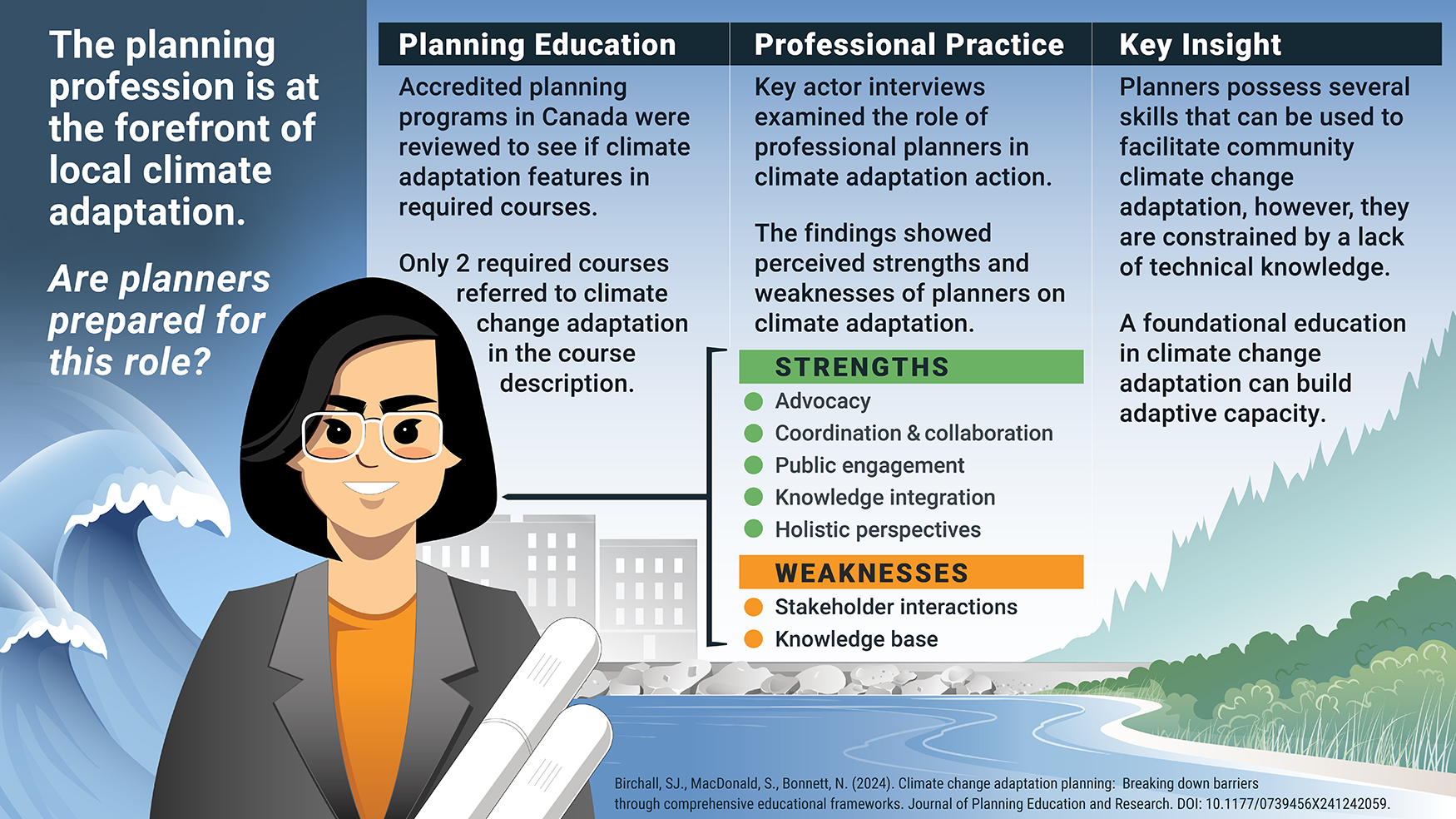
The planning profession sits at the forefront of local climate adaptation action. Yet, novel challenges exist for coordinating and implementing comprehensive actions. Through key actor interviews, this qualitative study examines the role of planners in navigating these challenges. In order to understand how planners are being prepared for this role, attention to how climate adaptation features in required courses across accredited planning programs in Canada is included. This study finds that while planners excel at a range of key skills related to communication, in the context of climate adaptation, these strengths are constrained by a lack of technical knowledge.
Introduction
Climate change is arguably one of the most complex and significant environmental problems facing current and future generations (Zen, Al-Amin, and Doberstein 2019). The cumulative impacts of climate change threaten existing economic and spatial structures, political and governance systems, and natural ecosystems around the world (Shi 2021). In Canada, warming is occurring at a rate twice that of the global average, resulting in more frequent and extreme weather events that negatively influence infrastructure, human life, and livelihoods in communities across the country (Bush and Lemmen 2019; Hicke et al. 2022; Warren and Lulham 2021). In the face of worsening impacts, a more proactive approach to adaptation is likely to foster community resilience by reducing climate risks and vulnerability (Intergovernmental Panel on Climate Change [IPCC] 2022; Ramyar, Ackerman, and Johnston 2021). Indeed, adaptation planning is increasingly observed in municipal policy in Canada; however, implementation of adaptation action tends to be unevenly distributed across sectors and regions, and gaps remain between identified needs and implementation (IPCC 2022).
While climate action requires a multijurisdictional res-ponse across all levels of government, research indicates that local governments are often best positioned to instigate tangible climate adaptation action (McGregor et al. 2022; Nordgren, Stults, and Meerow 2016). Local level adapta-tion, for instance, typically focused on land use, infrastructure, and the well-being of residents, tends to address more specific vulnerabilities (Juhola 2016). A shift to more resilient communities with comprehensive strategic and spatial planning, and improved urban infrastructure is therefore essential to meaningful adaptation (Birchall, MacDonald, and Baran 2022; Zen, Al-Amin, and Doberstein 2019).
Central to the success or failure of local adaptation action is the influence of the planning profession. Land use planning practices, that shape immediate and long-range development, are heralded by scholars and practitioners as having a significant role in climate action and adaptation (e.g. Grafakos et al. 2019; Hurlimann, Moosavi, and Browne 2021; Tanner et al. 2019). Indeed, the numerous factors that shape vulnerability to climate change are closely interconnected with all aspects of land use planning (Baker et al. 2012; Juhola 2016; Thomas et al. 2019). When spatial planning incorporates adaptation measures in a proactive and opportunistic manner, communities can not only mitigate local vulnerability but also reduce the risk of financial impacts tied to climate disasters in the long-run (Abadie, Sainz de Murieta, and Galarraga 2020; De Bruin, Dellink, and Agrawala 2009). Urban planning has long worked to balance the diverse values and needs of urban dwellers; seeking to manage the use and development of land in such a way that aims to find equilibrium in demands for growth, social equity, and the environment (Campbell 1996). Climate change adaptation, in fostering long-term resilience, aims to preserve that balance in the face of mounting challenges and threats.
To foster climate change resilience, it is crucial that proactive adaptation actions, aiming to anticipate and address the likely effects of climate change, be incorporated throughout spatial planning policies (Berke and Stevens 2016; Ramyar, Ackerman, and Johnston 2021). However, adaptation action can be a complex challenge for governance. While local responses to climate change have the potential to reshape the physical, institutional, and social underpinnings of communities in fundamental ways, there are novel challenges for coordinating and implementing comprehensive actions (Birchall and Kehler 2023; Hughes 2017). Climate change impacts span multiple jurisdictions and geographic scales, creating a complex and fragmented policy context for climate adaptation (Woodruff 2022). Adaptation action requires intergovernmental collaboration, political will, and significant resources; when any of these factors are lacking, they create barriers to successful implementation (e.g. Birchall, MacDonald, and Baran 2022; Birchall, MacDonald, and Slater 2021; Schulze 2021).
Planners are expected to play a key role in navigating and addressing these challenges. Indeed, planners must work to build adaptive capacity, through anticipatory long-range spatial planning policy, in order to foster resilient urban environments (Raza 2018). This requires significant technical expertise in climate data and adaptation solutions (Berke and Stevens 2016). However, planners also play a role in championing and coordinating climate action. Climate policy informed by technical expertise must also be credible and accessible to nonexperts in order to cultivate an understanding of climate risks and a desire to take action (Berke and Stevens 2016). This presents a unique challenge for planners, as they must expand their technical capacity in the face of climate change impacts while communicating and collaborating with a broad and diverse audience.
As extreme weather events increase in frequency and intensity across the world (IPCC 2022), the impacts will shape how communities approach spatial planning—from transportation networks to land use development. It is increasingly important that planners are equipped with the skill sets necessary to implement comprehensive, long-range adaptation action. And while lifelong learning is encouraged through professional designation, the foundations in knowledge are facilitated through comprehensive educational frameworks. Through interviews with planners and their colleagues, this qualitative study explores the role of planners in climate change adaptation planning in Canada; and in doing so, sheds light on the strengths and weaknesses that influence adaptation action and the critical skills necessary for successful integration of adaptation and resilience within spatial planning. Supplementing these results is a review and assessment of required course offerings by Canadian planning programs—all within the context of the functional and enabling competencies that shape planning education in Canada. In exploring how strengths and weaknesses emerge in planning practice, this article provides insights on how to improve approaches to climate change adaptation in the planning profession through changes to existing educational frameworks in Canadian universities.
Building from the Introduction, this article is organized around five primary sections. The Context lays out the foundation of all professional planning in Canada, outlining the regulatory powers of the governing bodies, and how they shape planning education in Canada. The approach highlights how we organized the key actor interviews with planners and their colleagues from across the country, and the process for review of Canadian accredited planning programs. The findings identify the key strengths and weaknesses of planners based on the interviews and supported by academic literature, and then explores how climate change, and adaptation in particular, is incorporated into core programming across accredited planning programs in Canada. Finally, through the discussion, we assess how weaknesses in professional planning education programs may create barriers to comprehensive adaptation action in the planning community and, building on the key takeaways from interviews, identify aspects of the programming that could be improved to better provide planners with the skills they need to build adaptive capacity in municipalities across Canada.
Context
Professional Standards and Policies
Practicing planners are encouraged, and in some regions required, to become Registered Professional Planners. The planning profession in Canada is regulated by the Provincial and Territorial Institutes and Associations (PTIAs) and guided by a federal code of professional conduct developed by the Canadian Institute of Planners (CIP). Policies guiding professional planners in Canada are set by PTIAs and the CIP.
In 2018, the CIP published a “Policy on Climate Change Planning” (CIP 2018), recognizing that climate change-informed planning is the responsibility of all planners. This policy outlines the key role planning plays in adaptation and disaster risk-reduction measures and mandates the professional obligations of planners in ensuring climate change is incorporated into all aspects of planning in Canada (CIP 2018). Many of the professional obligations laid out in the 2018 policy indicate the need for interdisciplinary and cross-jurisdictional collaboration, and incorporation of climate and hazard projections in planning practice (CIP 2018). Since the publication of their climate change policy, CIP has endeavored to provide a broad range of resources to practicing planners in the form of reports, continued professional learning activities, and online resources (CIP 2021). In 2019, CIP conducted and published a survey of planners to better understand awareness of climate change in the planning profession and to identify barriers to incorporating climate change into planning work (CIP 2019). With this clear prioritization of climate action in professional planning practice in Canada, it is then valuable to assess how new planners are being prepared for this aspect of their professional practice through university programming.
Planning Education in Canada
University planning programs in Canada are professional degrees, regulated through national and provincial bodies to ensure that emerging planners enter the profession with “a broad base of understanding of the profession and with the ability to continue to develop, gain knowledge, and specialize” (Professional Standards Board [PSB] 2021c). While some programs offer specialization, the core program requirements set by CIP dictate the basic skills and knowledge that students will possess when they enter the planning profession.
There are currently 24 accredited planning programs across undergraduate and graduate levels of study at 19 universities in Canada (PSB 2022). Planning education programs in Canada are built around a set of core functional and enabling competencies: influential planning theory and abstract skills that are meant to equip students with a high-level understanding of the planning profession. Enabling competencies are abstract skills grouped into five domains: critical thinking, interpersonal, communications, leadership, and professional and ethical behavior (PSB 2021a, 2021b). Functional competencies, on the contrary, consist of technical planning knowledge themes such as “Diversity and Inclusiveness” or “Finance and Administration.” Professional planners in Canada are expected by their PTIAs to possess an acceptable level of understanding of a range of these core competencies.
Approach
This research employs a qualitative approach to examine the role that planners play in local scale climate change adaptation. Method and data rigor was bolstered by incorporating key actor interviews and a review of accredited planning programs in universities from across Canada. This study also benefited from the multidisciplinary backgrounds of the research team: authors include a registered professional planner and candidate members; and, across the team, professional and research expertise in environmental science, urban policy and planning, and climate change resilience.
For the interviews, key actors were purposively selected, using a combination of criterion and snowball sampling, from 14 local governments across Canada that have experienced impacts to infrastructure, coordinated emergency response, or implemented policy to adapt to changing environmental conditions. A range of key actors (n = 60) were included in this study in order to provide a breadth of experience and perspectives on climate change adaptation action and the role of planners within their jurisdiction (see Table 1).
Key Actor Interviewees.
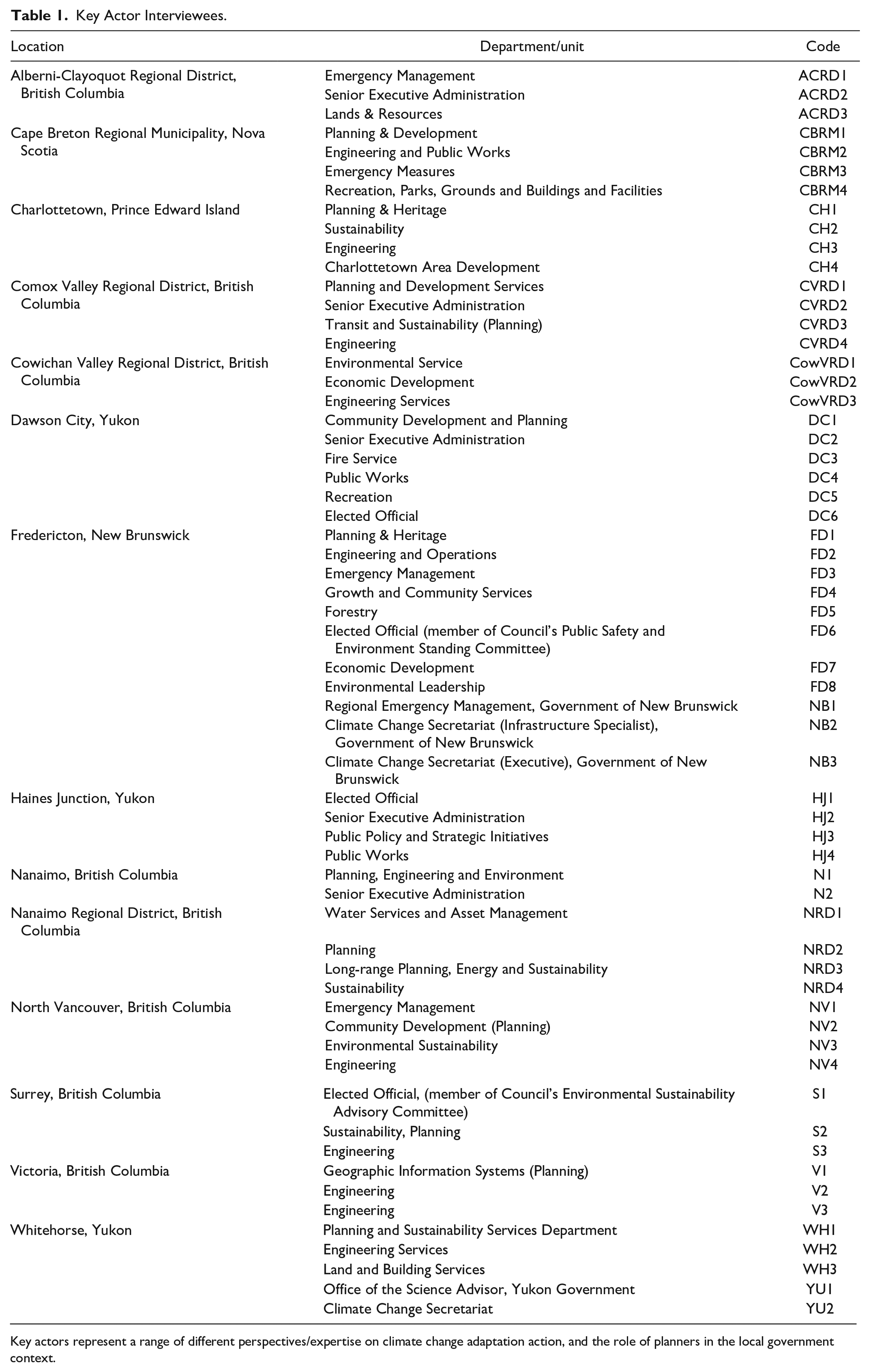
Key actors represent a range of different perspectives/expertise on climate change adaptation action, and the role of planners in the local government context.
The study included local government planners (n = 16) who can shed light on their own perception of the role they play in climate adaptation action. Furthermore, and because of the interdisciplinary nature of community planning, this study included professionals outside of planning departments as well. For instance:
Senior executive administration (n = 8) and environmental/sustainability experts (n = 9): work closely with planners in developing spatial planning policy. Their close collaboration provides insight into the role of interdepartmental coordination in comprehensive policy development.
Engineers (n = 13): work alongside planners and are often impacted by planning policy. They are able to provide technical perspectives on adaptation in the form of hard defenses as well as the potential climate impacts on city infrastructure and utilities.
Elected officials (n = 4): act as the final decision-maker on implementation of planning policy and therefore play a significant role in dictating what adaptation action looks like at a local scale. Elected officials provide a more high-level perspective on land use planning and its role within local governance as a whole.
Emergency management personnel (n = 6): provide insight into the effectiveness of planning policy and play a role in shaping how climate impacts are incorporated into emergency planning policy and response.
Provincial and territorial stakeholders (n = 4): shed light on the role regional and higher level government can play in hindering or supporting climate adaptation action and land use policy development.
During the semistructured interviews, dialogue was guided by a protocol which followed a hierarchy of questions; from broad initiating questions to relevant probes. Sections were designed to generate discussion linked to climate impacts and risks, and the role of planners in developing and implementing climate change adaptation action. Formal interviews and follow-up occurred between 2016 and 2019; interviews were conducted in-person, on-site in each location, and ranged from 50 to 134 minutes in length. The interviews were digitally recorded and professionally transcribed verbatim.
Data (transcripts) were investigated using a theme-based narrative approach: analysis first involved an initial scan to identify key points relevant to the research objectives; the following reading flagged major themes emerging from the data; high-level coded/emergent themes (e.g. role of planners, critical skills, and barriers to adaptation action) were compared, then classified to create honed narratives that join the data within each category (e.g. Birchall and Bonnett 2021; Merriam and Tisdell 2016).
The study also involved a review of accredited planning programs in universities from across Canada. In total (current as of September 2021), 24 professional planning programs, across 19 universities, were investigated. The list of accredited planning programs was cross-referenced with CIP to ensure accuracy (PSB 2022). The program coordinator/administrator for each planning program was contacted to confirm the accuracy of the list of required courses for their program, along with the calendar description of those courses.
For each planning program, analysis began with a review of the program description, including its overarching vision, focus, and intent. Program descriptions were reviewed to identify whether accredited planning programs emphasized or included content related to the following key words: “environmental,”
Given that program and course descriptions are limited in what they can reveal about course content, this systematic review is intended to provide high-level insight into the professional planning programming available in Canada. The availability of climate-related required courses can be used to assess whether perceived strengths or weaknesses in planning practice are linked to a planner’s educational background and reveal areas for improvement in the Canadian planning education system.
Findings
The findings of this research are grouped into two sections: the first showcases identified strengths and weaknesses of planning professionals; and, the second provides a review of planning programs across Canada. In assessing these two fundamentals of the planning profession, weaknesses in planning practice as it relates to climate change can be tied to the foundations of educational frameworks.
Climate Change Adaptation in Professional Practice
Practicing professional planners are faced with the obligation to both communicate the risk that climate change poses to community resilience and find ways to address current and future climate risks through long-range planning policy. Interviews with planning professionals indicate that they are aware of the overarching impact of climate change on planning—“no one should be coming out with a planning degree now that doesn’t have a big picture understanding of where the planet is headed. . . [our job] should be in helping reveal to the community what they’re facing” (NV2). Indeed, the expectation that planners play a key role in climate change adaptation action is reinforced by their colleagues who believe that planners must ensure that decision-makers have the information necessary to understand that adaptation action is a priority, and to identify the resources needed to achieve successful adaptation action (e.g. CH2).
Trends in perspectives emerged through key actor interviews across various fields and positions. Clear strengths and weaknesses, elaborated in Table 2, were identified as factors that can serve to enable climate adaptation action or stand as a barrier to comprehensive and informed policy. The perceived strengths of planners are largely centered around communication, specifically as it relates to five central, recurring traits: advocacy, coordination and collaboration, public engagement, knowledge integration, and holistic perspectives.
Perceived Strengths and Weaknesses of Planners on Climate Change Adaptation.
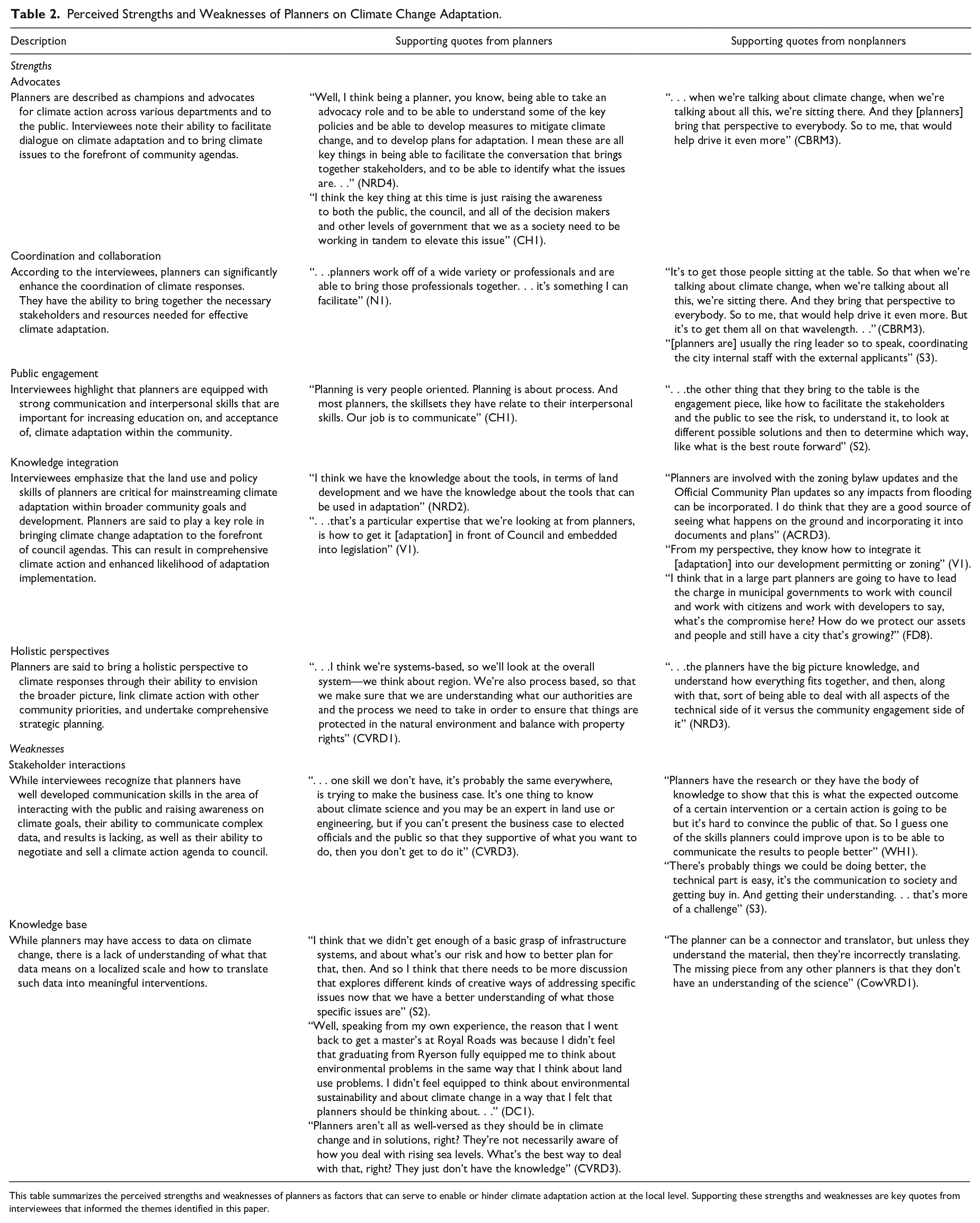
This table summarizes the perceived strengths and weaknesses of planners as factors that can serve to enable or hinder climate adaptation action at the local level. Supporting these strengths and weaknesses are key quotes from interviewees that informed the themes identified in this paper.
Interviewees acknowledged that planners are well equi-pped in many ways to champion climate adaptation action—identifying examples of planners spearheading discussions around climate change impacts and adaptation action (e.g. CBRM3). Planners saw themselves as “a hub” (CH1), while engineers perceived them as a “ring leader” (S3); fostering collaboration amongst internal staff, bringing a wide variety of professionals together, and synthesizing information from various stakeholders.
Planners are also perceived as key advocates with public stakeholders. Interviewees stated that planners are often operating in a public-facing role, building relationships with members of the community. The many opportunities for public engagement enable both informal and structured discussions around climate change risks and adaptation action (e.g. FD1; CH1; S2).
At the same time, planners are well positioned to educate decision-makers and influence policy reform. Planners, in regulating the use of land, are keenly aware of the relationship between climate change impacts and land use on the community (e.g. ACRD3; COWVRD2) and their role provides them with the opportunity to bring these issues before council (V1).
Planners are trained to “think about the broader set of impacts and the intricacies of how these things all relate to each other” (DC1). This broad perspective, fortified by public feedback, allows planners to consider how policies will impact all aspects of a community, and therefore, how to address a contentious issue like climate change adaptation in a way that garners community support.
These traits were identified as strengths that planners already bring to everyday policy and operations but also as critical skills in fostering comprehensive climate adaptation policy development and implementation. At the same time, interviewees expressed concern for the capacity of planners to address worsening climate change impacts with their current skillset. Planners pointed to their lack of education in climate science, impacts and adaptation as a weakness, and felt it limited their capacity to aid in implementing comprehensive climate change adaptation initiatives (e.g. DC1; NV2) – If we don’t have a good, solid understanding of what we need to adapt to, what might be happening, and some evidence and some proof and some education, I think we are less likely to push an agenda. We’re more likely to be conservative with doing things the way they have been done in the past. (NRD2)
Beyond the technical skills necessary to understand climate risks and available solutions, interviewees from various backgrounds also stressed the need for planners to develop better negotiation skills and business acumen (e.g. CVRD3; FD4; NV2). As climate change adaptation creates the need for more interdisciplinary collaboration, it becomes critical that planners have the ability to successfully communicate the risks using accessible language as well as negotiate with a diverse set of public and private stakeholders.
Climate Change Adaptation in Planning Education
In aiming to provide planners with a skillset based in core functional and enabling competencies, accredited planning programs incorporate a mixture of required courses supplemented by various electives. Many required courses focus on environmental planning and concepts of sustainability (see Supplemental Data, Table A). Across 19 universities and 24 planning programs, 102 required courses included the terms environmental, sustainability, resilience, and climate change within their course description (Table 3). In stark contrast, only two required courses, across two programs, referred to climate change adaptation in the course description, revealing a general lack of climate change adaptation focused teaching within required courses in Canadian programs (Table 3). Universities are taking the initiative to address climate change and environmental planning; however, incorporation of these concepts within required courses is inconsistent across programs. For example, one program offers 17 required courses with these concepts in the description while many programs offer none.
Accredited Planning Programs’ Required Courses Title and Description.
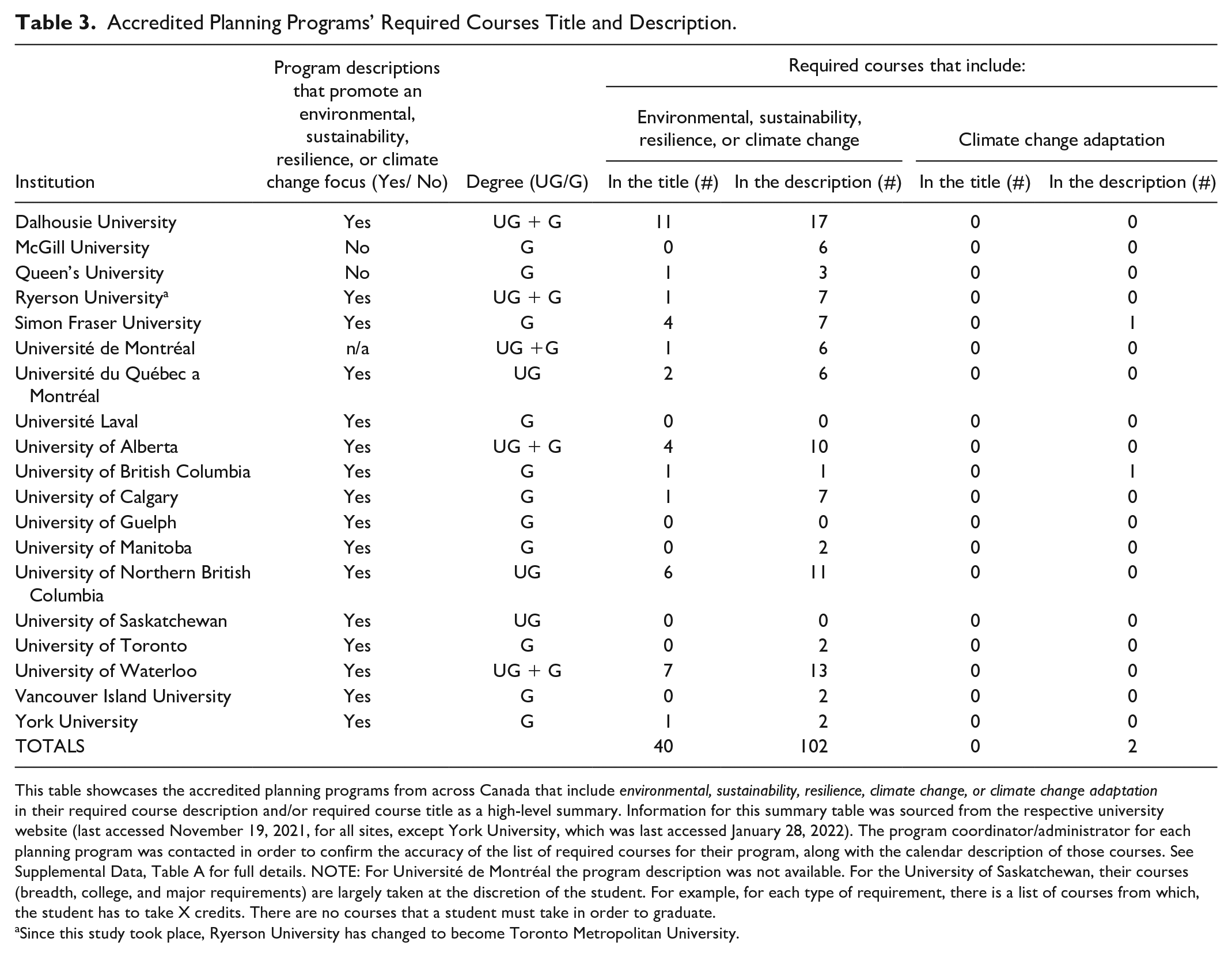
This table showcases the accredited planning programs from across Canada that include environmental, sustainability, resilience, climate change, or climate change adaptation in their required course description and/or required course title as a high-level summary. Information for this summary table was sourced from the respective university website (last accessed November 19, 2021, for all sites, except York University, which was last accessed January 28, 2022). The program coordinator/administrator for each planning program was contacted in order to confirm the accuracy of the list of required courses for their program, along with the calendar description of those courses. See Supplemental Data, Table A for full details. NOTE: For Université de Montréal the program description was not available. For the University of Saskatchewan, their courses (breadth, college, and major requirements) are largely taken at the discretion of the student. For example, for each type of requirement, there is a list of courses from which, the student has to take X credits. There are no courses that a student must take in order to graduate.
Since this study took place, Ryerson University has changed to become Toronto Metropolitan University.
Discussion
The results of this research support the view that planners play an important role in climate change adaptation action. Yet, oftentimes, the expectations for planners do not align with their perceived strengths or abilities. It is in this gap that opportunities for intervention in planning practice and education arise.
Development of the critical skills necessary for comprehensive adaptation action largely begins with the foundations of a planner’s education. It is widely agreed by experts and activists that climate change education is a fundamental part of adaptation strategies (e.g. Reid 2019; United Nations Framework Convention on Climate Change [UNFCCC] 2015). Scholars tout the benefits of providing professionals with a basic knowledge of climate action practices in order to build resilience within the population (e.g. Anderson 2012).
Yet, with a few exceptions, education on climate change adaptation is not incorporated as a requirement in Canadian planning programs. Indeed, a review of the core competencies used to shape planning education programs across Canada brings into question whether planners are being adequately trained to help municipalities cope with climate impacts. While planning programs across Canada have taken the initiative to incorporate climate change education into their course offerings, efforts are inconsistent across programs and lack attention to climate change adaptation.
The following sections, framed by the strengths and weaknesses identified through key actor interviews, explore how CIP can better equip planning professionals with the skills necessary to support climate change adaptation at the local level.
Strengths and Weaknesses
The findings section outlined the strengths and weaknesses that emerged from the key actor interviews. These traits, brought up by interviewees as valued attributes of planners, have also been identified in scholarship as critical enabling factors in climate adaptation action (e.g. Oulahen et al. 2018; Tanner et al. 2019).
Climate change is a complex phenomenon with effects that go beyond physical damage to infrastructure. Vulnerability to climate change impacts can be exacerbated by socio-economic factors, demographic trends, and resource accessibility (Baker et al. 2012; Thomas et al. 2019). In order for adaptation action to facilitate equitable change at the local level, policies must be informed by the lived experiences of community-members from all demographics and socio-economic groups (Kehler and Birchall 2021; Meerow, Pajouhesh, and Miller 2019). The strengths identified through key actor interviews show that planners are in the unique position to help residents articulate goals and objectives related to climate change adaptation and collaborate with various professions to develop sustainable, equitable and informed policies and programs to support adaptation action (Butler, Deyle, and Mutnansky 2016). The complex nature of climate impacts requires this interdisciplinary, collaborative, and comprehensive approach with planners leading the charge to build collective conviction around the necessity to adapt (Hurlimann and March 2012; Oulahen et al. 2018; Susskind 2010).
Building collective support for adaptation action requires not only the amplification of public voices but also political and administrative “champions” advocating for policy action (e.g. Birchall and Bonnett 2021; Pasquini et al. 2015). However, local level decision-makers tend to take a “wait and see” approach to climate adaptation action in the hopes that impacts may not be as bad in their community (e.g. Wallace 2017). Planners were recognized by the interviewees as advocates, well situated to push for policy reform and prioritization of climate change adaptation action, a skill that is especially critical in communities where climate adaptation may not be perceived as an immediate necessity. Planners also have the potential to play a pivotal role in determining how to incorporate climate science within long-term strategic planning. While unable to pass legislation, planners have the capacity to aid in the integration of holistic, sustainable, and resilient, approaches within strategic planning and policy.
While planning professionals clearly possess skillsets critical to climate change adaptation action, these skills will need to be bolstered as climate impacts worsen. The perceived weaknesses of planners in the context of climate change adaptation are centered around stakeholder interactions and technical knowledge base. The complex nature of climate change will require increasingly technical knowledge of climate impacts and adaptation options; knowledge that is often limited to climate scientists. If planners are expected to champion climate adaptation within their communities, as is expressed by interviewees, they will need the technical knowledge to support that role. Communication issues are recognized in scholarship as one of the primary barriers to successful adaptation action (e.g. Ford and King 2015; Wallace 2017). Indeed, Runhaar et al. (2018) identify various factors linked to communication (e.g. guidance, information, coordination and cooperation, and access to adaptation knowledge and expertise), that, when lacking, become critical barriers to mainstreaming adaptation action. Key among those is adaptation knowledge and expertise. While interviewees celebrated planners for their skills in public engagement and knowledge integration, the translation of climate science into user-friendly policy and holistic adaptive solutions can often be challenging. For instance, interviewees acknowledged that planners often struggled to build a business case for adaptation action and scholarship regularly identifies interpretation and communication of climate science as a barrier to adaptation action (Runhaar et al. 2018).
Policymakers often experience difficulty in applying climate change science to adaptation planning and action (Mees, Tijhuis, and Dieperink 2018); planners have the potential to play an intermediary role—interpreting climate change science and conveying its relevance to long-range land use policy. Critically, the way in which scientific knowledge is communicated to practitioners and politicians can influence their willingness to prioritize climate change adaptation in their political agendas (Birchall, MacDonald, and Slater 2021; Krellenberg and Katrin 2014). Yet, planners can struggle to translate high-level climate change science and action into their every-day work (Wamsler, Brink, and Rivera 2013). Beyond the role of championing climate action, the struggle to understand and translate climate change science can impact the success of adaptation action in a multitude of ways. For instance, interpretation of climate change science can impact land use bylaws and long-term development plans (i.e. the necessary setbacks for coastal development). Understanding the climate change science alone is not enough, planners need to have a strong comprehension of climate change solutions as well. A lack of knowledge of adaptation measures has been identified by scholars as a major barrier to successful climate change adaptation (e.g. Mees, Tijhuis, and Dieperink 2018).
The foundation of successful adaptation action lies in a strong understanding of climate change risks and adaptation solutions. Interviewees revealed that planners are valued as communicators, collaborators, and advocates for change, yet planners often felt they were lacking in the technical skills to take the lead on climate change action.
Climate Adaptation: From Education to Action
With the increasing need for technical understanding of climate change amongst planning professionals, it is important to re-assess the educational frameworks that make up the foundation of a planner’s knowledge base. The following subsection revisits the educational frameworks that shape planning programs in Canada in the context of the weaknesses discussed above.
Core competencies
In the context of climate change adaptation planning, interviewees identified key strengths possessed by planners that in many ways aligned with the enabling competencies laid out by the CIP (critical thinking, interpersonal, communications, leadership, and professional and ethical behavior) (PSB 2021a, 2021b). Planners were identified by interviewees as capable contributors to adaptation action as they are trained to be collaborators, often approaching issues through an interdisciplinary lens—a method that scholars identify as valuable when learning about and addressing climate change impacts (e.g. Kagawa and Selby 2010; Reid 2019). Collaborative, practice-oriented training and problem-solving allows for shared learning experiences and the eventual co-production of knowledge and solutions (Borquez, Aldunce, and Adler 2017; Nagy et al. 2017). Yet, while skills such as collaboration and communication can act as enabling forces in adaptive action, they must be supplemented by increased knowledge of climate change science and adaptation solutions. Access to climate change adaptation education is widely considered to be a critical component of adaptive capacity (Anderson 2012; Filho et al. 2019) and new approaches to education can facilitate more comprehensive adaptation action in the planning practice.
While functional competencies cover critical aspects of planning theory and consider environmental and sustainable development under plan and policy considerations, climate change and climate change adaptation are not explicitly included as a functional competency (PSB 2021a). This apparent absence and lack of prioritization in planning education is creating a knowledge gap with significant consequences for the resilience of communities in the coming decades.
Required courses included in an accredited planning program are shaped around the teaching of core competencies—the goal of accredited programs largely center around providing planners with an acceptable level of understanding of a range of core competencies. It can therefore be reasoned that by explicitly incorporating climate change adaptation within PSB’s functional competencies, educators will be more inclined to incorporate it as a key aspect of planning education.
Program design
Beyond incorporating climate change adaptation within the functional competencies that shape planning education, the incorporation of required courses dedicated to technical climate science and adaptative approaches within educational frameworks can help build the foundation of students’ education with a critical understanding of climate risks and solutions.
Climate change education for professional planning programs (and many other fields) has the potential to be most effective with a focus on local, tangible, and actionable aspects of climate change (Anderson 2012). While detailed, technical knowledge of climate change science can be beneficial, often-times, the impacts of climate change vary greatly across geographic regions, making it challenging for a one-size fits all understanding of climate change and adaptation action (IPCC 2022). Planning professionals excel at interdisciplinary collaboration and can leverage those skills to support their work through shared learning. Programs should provide a foundation in climate science that enables students to identify trends in climate change impacts but should also foster creative approaches to complex issues. Learnings should focus on practice-oriented problem-solving—providing students with the opportunity to recognize change, identify potential issues, attribute a change to its causes, and assess potential responses with an understanding of how different interests may shape responses (Anderson 2012; Cinner et al. 2018; Nagy et al. 2017). Not only does this type of learning increase knowledge of climate change impacts and adaptation actions, it also encourages critical, collaborative thinking and problem-solving in the face of evolving risks. Planning programs must provide students with examples of existing approaches to climate adaptation while leveraging strengths in critical thinking and problem-solving to apply those learnings to future climate impacts and solutions (Becker 2018). Planning students can then learn to build adaptive capacity through increased familiarity with current planning practices and ongoing adaptive action.
Comprehensive climate change adaptation education that fosters development of existing strengths will require more than one course dedicated to the subject. Programs should endeavor to incorporate climate change and climate change adaptation within all course offerings. However, a review of required coursework indicated ad hoc and inconsistent incorporation of climate change adaptation into existing required coursework. It is also likely that elective courses may provide opportunities for students to delve deeper into more technical climate change topics and adaptation approaches. Yet, without requirements for courses that address technical climate change science and adaptation action, it is impossible for programs to ensure that all students are provided with the foundations to comprehensively address climate change in their professional work; they lack the foundations to identify gaps in current policy and opportunities to proactively incorporate climate adaptation within long-range planning practice. Scholars indicate that by providing students with technical knowledge as a required introductory course; it provides them with a “filter” or lens through which to understand the field (e.g. Meloncon 2009).
Vulnerability to climate change is based on a diverse set of factors (i.e. population density, socio-economic status, access to green space, availability of affordable housing, etc.). As a multidisciplinary issue, climate change adaptation should be considered as an underlying factor across planning themes. Establishing a strong foundation in climate adaptation planning requires a stronger focus on the strengths and weaknesses identified in this study. By providing all students with a climate lens through which to view land use planning as a whole, educational frameworks can enable planning professionals to build adaptive capacity within their communities. Creating educational programs that tie in technical knowledge of climate change trends and impacts with fundamental skill development enables planners to incorporate adaptation action within a holistic approach to spatial planning and city building.
Conclusion
The planning profession sits at the forefront of local climate change adaptation action, with progressive land use policy playing a critical role in protecting municipalities against climate impacts. As the climate continues to become more extreme and variable, municipalities are already experiencing the impacts of climate change. A historical lack of proactive adaptation action at the local level means that land use planning often serves to exacerbate local vulnerabilities while climate disasters occur with increasing frequency and range. Planners’ holistic and collaborative approaches to strategic planning already enable them to contribute valuable perspectives on the long-range threat of climate change. But efforts at comprehensive action will continue to be stymied if planners are not provided with the necessary foundations in technical knowledge and adaptation approaches.
This article argues that incorporation of climate change science and adaptation within the core competencies and required courses in professional planning programs will bolster planning professionals’ existing strengths and expand critical skillsets in the face of a changing climate. Planning programs in Canada will have to shift to incorporate courses that go beyond sustainability, introducing students to the technical aspects of climate change and encouraging innovative approaches to adaptation planning practices. In prioritizing core competencies that provide a foundation in technical climate science and tangible adaptive solutions, the planning profession can foster greater climate resilience nation-wide.
Many of the strengths identified in this article enable planners to collaborate across disciplines to support climate adaptation action within their municipalities. If planners are provided with a foundational knowledge base in climate adaptation, they can leverage their existing strengths to play a central role in finding creative ways to overcome barriers to climate adaptation while educating and engaging decision-makers and the public. A foundational understanding of climate change science and adaptation solution-based thinking enables planners to better communicate with the public and decision-makers, collaborate with colleagues and climate experts, and advocate for adaptation action within their communities. Through more comprehensive strategic and long-term planning, communities will be better able to reduce future risk with more anticipatory action and increased ability to recover.
Supplemental Material
sj-pdf-1-jpe-10.1177_0739456X241242059 – Supplemental material for Climate Change Adaptation Planning: Breaking Down Barriers through Comprehensive Educational Frameworks
Supplemental material, sj-pdf-1-jpe-10.1177_0739456X241242059 for Climate Change Adaptation Planning: Breaking Down Barriers through Comprehensive Educational Frameworks by S. Jeff Birchall, Seghan MacDonald and Nicole Bonnett in Journal of Planning Education and Research
Footnotes
Declaration of Conflicting Interests
The author(s) declared no potential conflicts of interest with respect to the research, authorship, and/or publication of this article.
Funding
The author(s) disclosed receipt of the following financial support for the research, authorship, and/or publication of this article: This research was supported in part by grants through the Quick Response Program, Institute for Catastrophic Loss Reduction, the Cornerstone Program, Killam Research Fund, and the Ashley and Janet Cameron Research and Education Seed Fund, UAlberta North.
Ethical Approval
All procedures performed in studies involving human participants were in accordance with the ethical standards of the University of Alberta’s Human Ethics Committee and with the 1964 Helsinki declaration and its later amendments or comparable ethical standards.
Permits
This study involved activities in the Yukon Territory and as such required a license, under the Yukon Scientists and Explorers Act (1958). License numbers: 18-72S&E (July 25, 2018–December 31, 2018); 19-08S&E (March 4, 2019–December 31, 2019).

Supplemental Material
Supplemental material for this article is available online.
Author Biographies
References
Supplementary Material
Please find the following supplemental material available below.
For Open Access articles published under a Creative Commons License, all supplemental material carries the same license as the article it is associated with.
For non-Open Access articles published, all supplemental material carries a non-exclusive license, and permission requests for re-use of supplemental material or any part of supplemental material shall be sent directly to the copyright owner as specified in the copyright notice associated with the article.
