



Abstract
Adolescents hold extensive knowledge about their independent travel experiences and aspirations, yet mobility research rarely elevates the voices and visions of youth. This article explores the potential of mobile, map-based, and projective methods to enhance understanding of youth mobility needs and to inform supportive, place-responsive public realm interventions. Based on a participatory research project involving thirty-nine adolescents aged eleven to fifteen in a dense Los Angeles neighborhood, this research demonstrates how moving, mapping, and imagining in collaboration with youth participants can advance justice in both planning processes and in public spaces that support young people’s mobility and urban agency.
Keywords
Introduction
For adolescents in urban environments, mobility is a daily practice that facilitates important connections to neighborhood destinations, to peers and community, and to the city itself (Murray and Cortés-Morales 2019). Yet despite a wealth of experiential knowledge, young people are seldom engaged directly in research, planning, and decision-making processes regarding the mobility issues that directly affect them (Mitchell, Kearns, and Collins 2007). The continued marginalization of youth—both in urban environments and in urban research—limits the ability of researchers and practitioners to understand the complex reality of young people’s mobility experiences and needs and to therefore respond effectively (Li and Seymour 2019).
Urban planners, designers, and policymakers tasked with developing infrastructural and programmatic interventions to support youth mobility have much to gain from engaging young people directly in research and planning efforts (Murray and Mand 2013). By involving youth, researchers may gain new insights and nuanced perspectives on mobility (Noonan et al. 2016), strengthen subsequent analysis and understanding (Banerjee, Uhm, and Bahl 2014; Lin et al. 2017), and produce more effective, context-responsive policies and plans to make daily journeys safer and more enjoyable (Crawford et al. 2017; Mikkelsen and Christensen 2009).
This article explores the potential of youth-centered, interdisciplinary methods to aid urban planning and design researchers and practitioners to better understand, and thus better respond to, the mobility needs and experiences of young people in the city. It centers on a case study of a community-engaged research project, undertaken between 2022 and 2024, that investigated the mobility experiences and future needs of thirty-nine adolescents aged eleven to fifteen in a dense neighborhood of Los Angeles (Nelischer, Cuff, and Loukaitou-Sideris 2023; Nelischer, Cuff, and Wu 2024). The project yielded empirical insight into the travel experiences, perceptions, and needs of youth, applicable to planners and designers in Los Angeles and beyond. Additionally, the project yielded methodological insight into promising principles, strategies, and tools for engaging youth in design dialogues and decision-making regarding their mobility needs—with applications for researchers and practitioners seeking to engage youth in research and planning processes.
The analysis shows that mobile, map-based, and projective methods—including walk-along interviews, collaborative mapping, and participatory design exercises—can help urban designers and planners understand and respond to youth mobility needs. This approach to moving, mapping, and imagining with youth integrates methodological strategies from the new mobilities paradigm (Sheller and Urry 2006) alongside the projective and action-oriented practices of the urban humanities (Cuff et al. 2020). It is underpinned by a commitment to centering the often marginalized voices and visions of youth in mobility research and centering the principles of spatial justice in mobility planning and design practice. Moving, mapping, and imagining mobility in collaboration with adolescents uncovers new understandings about young people’s experience of mobility and their desires for the future, which can then inform more context-responsive and thus effective mobility interventions. Furthermore, this approach empowers young participants to develop the language, capacity, and agency to engage in policy and planning discussions in the future.
This article begins by reviewing the literature on the benefits and barriers to youth mobility and youth engagement. After describing the study context and suite of youth-centered, interdisciplinary methods, findings highlight the insights these methods uncovered. The article concludes with a discussion of the affordances of mobile, map-based, and projective methods for engaging youth in mobility research and visioning, in ways that are flexible and adaptable to other urban contexts and research questions.
Literature Review
Youth on the Move
For young people in the city, mobility is about much more than moving from origin to destination: it is an embodied, everyday practice that facilitates physical connections to neighborhood spaces, social connections to community, and a sense of agency and urban citizenship (Murray and Cortés-Morales 2019). Often negotiated with caregivers, traveling alone or with friends is an important rite of passage through which young people develop the confidence and capacity to navigate the complex terrain of city sidewalks (Mitra 2013). Decades of research on youth mobility and active transportation has documented diverse benefits including improved physical health and wellbeing (Li and Seymour 2019), social skills development and self-esteem (Skelton 2013), enhanced neighborhood knowledge, spatial cognition, and a sense of place (Fang and Lin 2017), and a sense of belonging and urban agency (Cook, Whitzman, and Tranter 2015).
Many young people prefer to travel by active and independent modes but are limited by objective and perceptual barriers in the built and social environment (Mitchell, Kearns, and Collins 2007). Some neighborhoods lack the infrastructure necessary to support young people as they move by foot, bike, and transit, particularly in underserved areas where decades of disinvestment have resulted in poorly maintained sidewalk infrastructure, high risk of traffic-related injuries and fatalities, and fear of violent crime (Banerjee, Uhm, and Bahl 2014). Such conditions diminish both the perception and actual experience of independent travel for young people and their caregivers alike; this may deter youth from traveling independently altogether, or prompt caregivers to restrict permissions and choose instead to chauffeur children to destinations (Vlaar et al. 2019). Overall, freedom of movement and play in public space has become increasingly constrained for children and adolescents in recent decades (Mitra 2013), thereby limiting young people’s ability to access neighborhood environments and to experience associated personal and social growth (Mitchell, Kearns, and Collins 2007).
Youth in Mobility Research
Effective intervention requires clear understanding of adolescents’ nuanced mobility experiences and needs (Porter and Turner 2019). However, the vital perspectives of youth are absent from much existing policy and academic research on mobility due in part to a lack of interdisciplinarity, a lack of youth-centered approaches, and failure to engage youth in future-oriented mobility dialogues. Research on youth travel frequently employs quantitative approaches, including surveys and GPS analyses, which tend to frame built environment features as static variables and overlook the individual meanings young people attach to their environments (Fusco et al. 2013). A growing body of interdisciplinary research on points to the analytical potential of triangulating between multiple methods; ethnographic tools like participant observation and interviews, visual tools like annotated maps and photovoice, and quantitative tools like surveys and GPS tracking can reveal new understandings of young people’s own mobility perceptions and experiences (Mikkelsen and Christensen 2009). Employing participatory, qualitative methods alongside quantitative methods is increasingly recognized as an effective strategy to overcome persistent epistemological barriers between disciplines, to understand complex social problems through multiple lenses, and to respect the agency and knowledge of youth (Casadó et al. 2020).
Where qualitative narratives of travel are considered, studies often ask caregivers to report on the travel behaviors of their children; youth voices remain surprisingly absent from most research on youth mobility. Adult perspectives on safety and the built environment are vital, as caregivers play important roles in decisions about youth travel (Vlaar et al. 2019). However, focusing only on adult perspectives denies the complex decision-making and agency of youth (Renninger et al. 2023). When researchers use “parents as proxies” for the perspectives of youth, they overlook young people’s own perceptions of their own travel (Fusco et al. 2013). Youth hold unique insights into the experience, challenges, and benefits of travel that are absent from adult perspectives (Smeds et al. 2023), yet young people are often rendered invisible in mobility research. This gap in research is consequential for practice, because, as Rothman et al. (2018) argue, “the muted voice of children is a missed opportunity to inform research and policy from evidence gathered from the group most directly affected” (p. 318).
With the emergence of the new mobilities paradigm (Sheller and Urry 2006), mobility is understood holistically as an interconnected physical, representational, and embodied phenomenon (Cresswell 2010). This conceptualization considers not just the effective aspects of travel to reach destinations with ease and efficiency, but also the affective dimensions of travel as an embodied, cultural and social experience (Cass and Faulconbridge 2017). Accordingly, mobilities research emphasizes the importance of youth-centered methods that elevate young people’s experiences and perceptions of travel (Murray and Cortés-Morales 2019). Methods like walking interviews and cognitive mapping enable researchers to transcend epistemological boundaries and access important insights on youth’s environmental experiences (Sletto and Vasudevan 2024). Such first-hand, “situated accounts” of youth travel (Kullman 2010, 830) can inform evidence-based built environment and policy enhancements that directly respond to their mobility needs (Loebach and Gilliland 2022). Furthermore, for young people and for other marginalized populations, such methods can elevate everyday knowledge to enhance research findings while also supporting their agency in research processes (Gómez-Varo et al. 2023).
In addition to involving youth in research to understand existing mobility challenges and opportunities, researchers can adopt participatory action research strategies to meaningfully engage young people in developing, piloting, and monitoring future mobility interventions (Porter and Turner 2019). In other planning and design contexts, authentically engaging youth in decision-making processes has been shown to not only benefit communities by enhancing resulting policy, but also to strengthen a sense of community belonging, civic responsibility, and self-confidence and capacity amongst youth participants themselves ( Botchwey et al. 2019 ). In mobilities research specifically, moving away from “researcher-centered” diagnoses and prescriptions, participatory research can elevate participant-centered data and analysis to ultimately inform more effective mobility interventions (Buttazzoni, Nelson Ferguson, and Gilliland 2023). Creative methods including youth steering committees, digital storytelling workshops, and photovoice offer promising avenues to engage youth in projective dialogues about their mobility futures, as full urban citizens with the capacity to shape the decisions affecting their lives (Derr and Tarantini 2016).
Methods
Research Context
Given the complex challenges facing youth on the move today, participatory research that centers young people is needed to inform more effective design and planning interventions (Porter and Turner 2019). In response, a team of interdisciplinary researchers from urban planning and architecture at cityLAB-UCLA undertook a community-engaged study exploring youth mobility and participation in Westlake, Los Angeles. Extending earlier research on the current use and future potential of Westlake’s public spaces (Wendel et al. 2022), the research was guided by three primary questions:
How do youth experience and negotiate their travel in response to the sociospatial environment?
What place-based interventions do youth believe would best respond to mobility challenges and opportunities?
What participatory research strategies can effectively build capacity among youth to advocate for their own mobility futures?
Located in central Los Angeles, Westlake is a low-income, largely Latino neighborhood (72% Hispanic or Latino), home to many immigrants (57% foreign born), and many people living in poverty (36%). Despite the neighborhood’s high population density, with the vast majority of households renting (94%) in multi-unit buildings (95% of all units), the public realm does little to support young people’s journeys: traffic-related injuries are high, sidewalks are often poorly maintained, and violent crime is prevalent (Nelischer, Cuff, and Loukaitou-Sideris 2023). Despite decades of disinvestment, Westlake’s residents sustain a vital and connected community, anchored by important community organizations (Nelischer, Loukaitou-Sideris, and Wendel 2024; Wendel et al. 2022). Together, these conditions make Westlake a generative setting in which to explore the potential of youth-centered and action-oriented participatory research to enhance the mobility and urban agency of youth.
For this study, cityLAB’s research team partnered with Heart of Los Angeles (HOLA), a nonprofit organization that provides free after-school programming in academics, arts, and athletics to youth in Westlake. This project continues cityLAB’s longstanding research partnership with HOLA, which has included collaborative and community-based participatory research, teaching, and public events focused on parks and the public realm (Nelischer, Cuff, and Loukaitou-Sideris 2023; Nelischer, Cuff, and Wu 2024; Wendel et al. 2022). Taking place from 2022 to 2024, this study engaged a total of thirty-nine participants aged eleven to fifteen and enrolled in HOLA’s after-school programming, and who reflected the racial and demographic characteristics of Westlake: a primarily non-white, Hispanic, socioeconomically disadvantaged community (Nelischer, Cuff, and Loukaitou-Sideris 2023; Nelischer, Cuff, and Wu 2024). After written permission was secured from caregivers, youth granted their informed and enthusiastic verbal assent to participate (UCLA IRB #22-001348 and #23-001951).
Research Approach
In response to noted methodological gaps in youth mobility research, cityLAB’s interdisciplinary study team developed a research approach that prioritized mobile methods and in situ engagement, incorporated visual and map-based methods that elevate the voices of underrepresented youth, and supported projective dialogues and action around youth mobility. The first phase sought to understand the present-day mobility experiences and perceptions of adolescents, as shaped by Westlake’s distinctive sociospatial conditions (Nelischer, Cuff, and Loukaitou-Sideris 2023). We engaged twenty-eight participants aged eleven to fifteen (including fifteen boys and thirteen girls) in a series of participatory activities. First, in October and November 2022, participants completed a route mapping exercise, during which they used a custom workbook to map and record details about their walk from school to after-school activities at HOLA one day per week, for four weeks. The exercise integrated elements of trip diaries and cognitive mapping to generate rich text and map-based data, which we analyzed to understand patterns in travel modes, routes, accompaniment, and experiences.
From this analysis, we selected ten participants who primarily walked or took transit to participate in walk-along interviews in February 2023. A pair of researchers met each participant at their school and traveled with them along their typical route to HOLA. We recorded audio and field notes as we asked participants to describe what they were seeing and experiencing and to take photographs of notable spaces along their route. Upon arriving at HOLA, we conducted a post-walk interview that incorporated photo elicitation and cognitive mapping, during which we asked participants to map and verbally reflect on their journey, their photos, and their mobility experiences more broadly.
We transcribed, compiled, and coded the text, photographs, and map-based data from route mapping and walk-along interviews alongside GIS data on existing neighborhood traffic and public realm conditions into a “thick map.” A thick map is a critical cartographic practice emerging from the urban humanities that interrogates the processes and epistemologies of map making by layering place-based qualitative and quantitative in many mediums and from many sources to reveal and visually represent relationships between built and social environment conditions (Cuff et al. 2020). This thick map (see Figure 1) enabled us to identify a sidewalk segment in front of HOLA where nearly all participants traveled and where a dense cluster of positive and negative built and social environment conditions shaped the mobility experience. This segment served as the focus for the second phase of research.
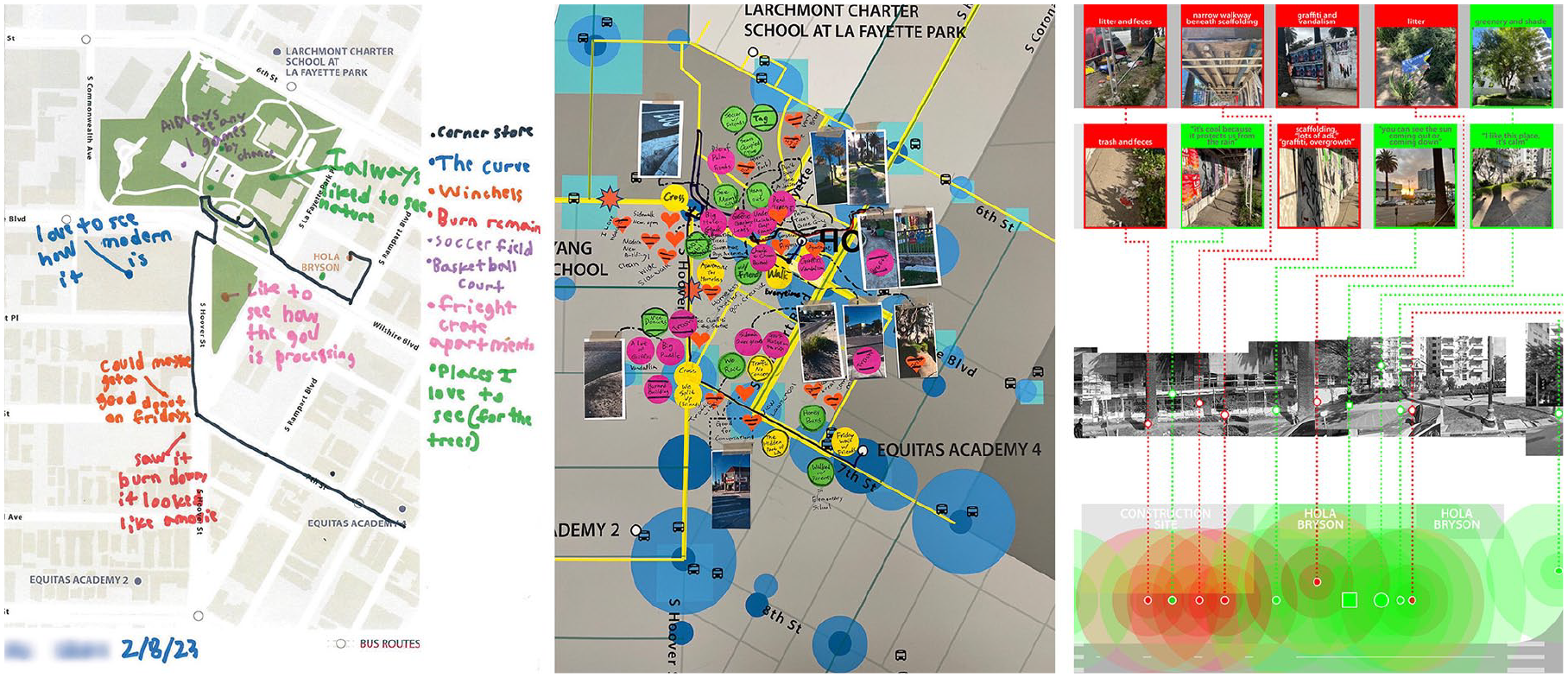
Walk-along interviews informed the thick mapping process and final thick map.
While the first phase emphasized present-day mobility experiences and perceptions, the second phase was projective, focused on understanding youth visions for sidewalks as safe and vibrant mobility environments (Nelischer, Cuff, and Wu 2024). This phase sought to generate both practical and methodological insights by first identifying youth’s preferred infrastructural and programmatic enhancements, and then identifying effective strategies to engage youth in design and decision-making processes regarding mobility futures. In January 2024, we recruited one HOLA class of sixteen students aged eleven to fifteen, five of whom had participated in phase one activities, to participate in a series of seven workshops (because this recruitment was undertaken a year after the first phase, the class composition had changed). While phase one focused on the neighborhood-wide journey from school to HOLA, phase two focused specifically on the sidewalk segment in front of HOLA, as identified in thick mapping.
In March 2024, we conducted a walkabout exercise where participants collectively explored the sidewalk segment and recorded observations and photographs of the built and social environment in a custom workbook (see Figure 2). The following week, in a collective thick mapping exercise participants reviewed their photographs, compared observations, and added layered text and photos onto a shared map, which revealed common mobility challenges and opportunities. In April 2024, in a participatory design workshop participants viewed images of potential interventions to address identified challenges and opportunities and articulated their desired infrastructural, programmatic, and experiential qualities on a shared map. The following week, the study team was joined by a group of graduate architecture and urban planning students enrolled in an urban humanities capstone course exploring interventions to support youth mobility and urban citizenship. Participating youth guided the study team and students along a walking tour of the sidewalk segment, sharing their experiences, perceptions, and desired changes, as articulated in the previous activities.
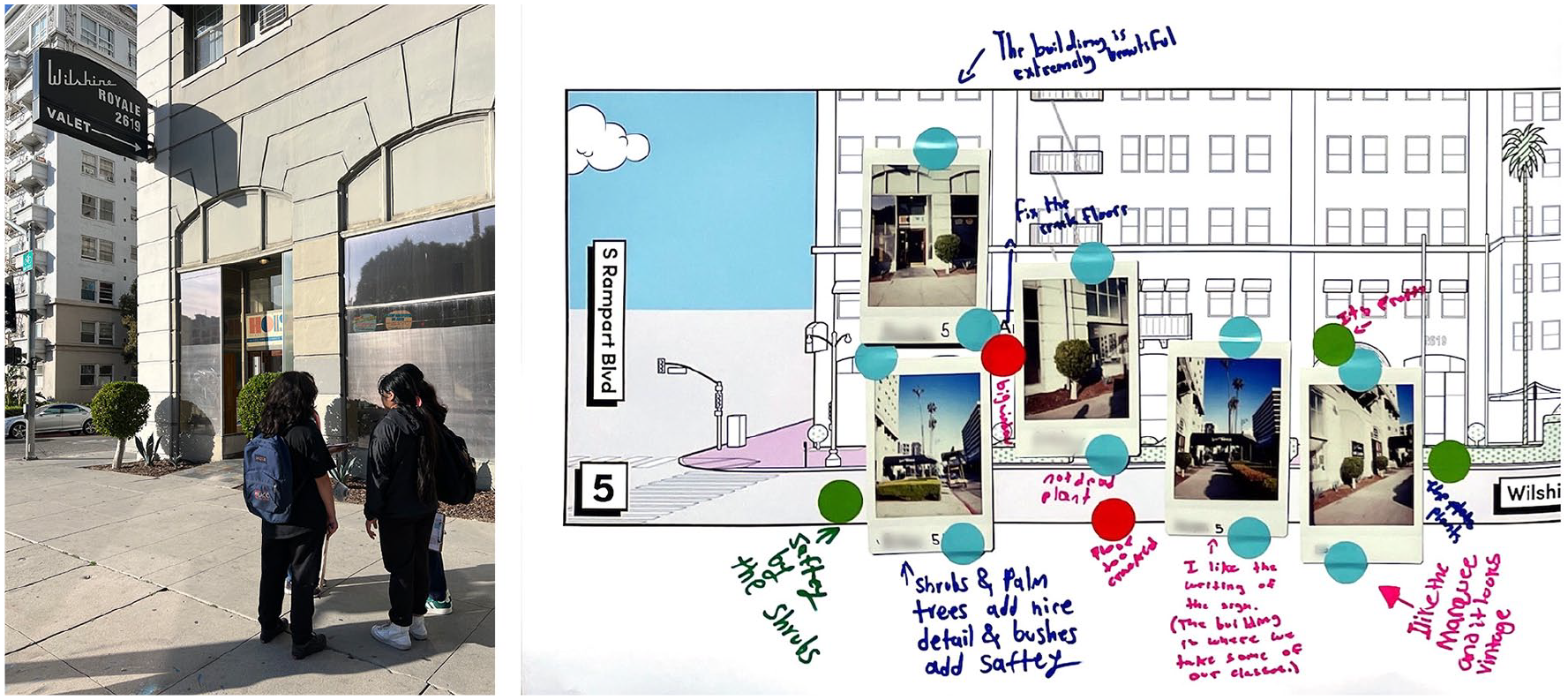
Youth translated observations from walkabouts to a collective thick map.
Throughout May 2024, the study team worked with the graduate students to analyze data to develop a series of design concepts for site-specific infrastructural and programmatic enhancements. We then conducted a feedback session and art workshop with participants to further develop, refine, and contribute to fabricating the design concepts. The study culminated with the installation of temporary demonstration projects in June 2024 that brought to life three of the design concepts generated collaboratively by youth, researchers, and graduate students, and a celebration during which HOLA staff and community leaders were invited to experience the demonstration projects.
Findings
This assemblage of mobile, map-based, and projective methods uncovered empirical insights on the travel experiences, perceptions, and desires of youth participants, as well as methodological insights on the particular affordances of these methods for youth mobility research.
Experiences and Perceptions of Youth Mobility
In response to the first research question, our map-based and mobile methods revealed that youth negotiate built and social environment conditions in ways that countered our initial expectations. Informed by existing research on youth mobility (Mitra and Buliung 2012) and pedestrian conditions in Westlake, we expected that localized, negative environmental conditions would prompt small detours in favor of safer, more pleasant routes. Instead, by tracing and describing their own trips over a series of weeks, the route mapping activity revealed nearly all youth participants consistently traveled the most direct, efficient, and familiar path from school to HOLA, rarely deviating, as illustrated by a quote from a participant: “To be completely honest, I haven’t taken a different route. I always stick with this one.” These routes often followed busy arterial streets, where the presence of other road users offered a sense of comfort. As another participant shared, “I feel like it’s the best, safest route because it’s more open and you can see people and there’s a bus, it’s safe.”
Walk-along interviews, which also integrated photovoice and cognitive mapping elements, further illustrated the relationship between participants’ travel routes, mental maps, and personal identity. By capturing and comparing data across a range of media, walk-along interviews painted a particularly rich and complex portrait of youth travel experiences, and also created opportunities for youth of a range of abilities and levels of confidence to participate fully. For many youth, developing the capacity to navigate their neighborhood over time contributed to a sense of confidence; as one participant shared, I got more comfortable with it . . . it was kind of scary at first. Like, I didn’t know where to go. But since I did it, I feel confident, so I did it again. And then when I get [to HOLA], I’m not scared anymore.
The sights, sounds, and social relationships nurtured during travel also contributed to a sense of freedom and joy: watching the world pass by from the bus window, catching a glimpse of a beautiful sunset, and socializing with friends. A participant shared, “The experience, it’s walking with friends. Just having a time, you know, just trying to transition from school to HOLA. We are just talking. We are talking about how it’s been. It’s catching up.” Complicating the focus on independence in research on youth mobility, we found that the “independence” or unsupervised nature of travel was not central to this sense of freedom, confidence, and joy for participants (Mikkelsen and Christensen 2009). While existing research shows that older children are more likely to travel without adult supervisions (Mitra 2013), aging into independent mobility, walk-along interviews revealed that participants valued not just their independence, or the ability to travel alone, but also their growing ability to engage with the rhythms of the neighborhood and community through the daily practice of travel, whether with friends, family members, or alone (Kullman and Palludan 2011). As one participant reflected on the experience of first taking transit with a friend, “It was good, it felt freeing. I was having little adventures.”
By comparing youth-generated insights with our own site observations and existing neighborhood data, we learned perceptions reported by youth often differ from objective features of the built and social environment; this comparison was a particular affordance of our thick mapping method. For example, when layered on a single map, we noticed many negative conditions observed by our research team, including constrained sidewalk widths and high traffic speeds, went unnoticed by participants during walk-along interviews. Meanwhile, participants noted many positive neighborhood features, including beautiful buildings, favorite places to sit, and spaces with great views, not represented in existing data. In some cases, youth perspectives complicated simplistic understandings of sidewalk elements, as illustrated by one participant’s remarks about pervasive graffiti: “It’s also graffiti, but I can see how beautiful it is.” The in-depth, situated conversations that took place during the walk-along interviews allowed such nuanced youth perspectives of the built and social environment to emerge in the data, adding depth to our research team’s understanding of existing neighborhood conditions.
Together, route mapping and walk-along interviews generated rich, place-based, experiential data, including photographs, observations, and direct quotations, that would otherwise not have been captured by more conventional quantitative, survey-based, or adult-centric methods. When layered onto a thick map alongside GIS data of existing neighborhood conditions, this data revealed important and in some cases unexpected relationships between the built and social environment conditions that shape youth mobility experiences. Despite acute awareness, built environment conditions like traffic speeds and litter were of less concern to participants in our study. Referring to poorly maintained sidewalks, one participant shared, “It’s kind of like, it’s just in the background. I don’t really pay attention.” Meanwhile, social conditions including fears of crime, harassment, and unwanted attention from strangers were of central concern, as illustrated by a participant: It’s kind of scary because there might be some bad people out there. And I can’t figure out where to go. And it’s too dark. So I just roll with it, and I get out my phone, using my flashlight. And then I just take the bus the rest of the way.
Several girls who participated in the study shared gender-based fears, recounting experiences of street harassment, highlighting precautionary measures to avoid groups of unfamiliar men, and taking comfort in the presence of other women and girls on the street. While taking precautions but making only minimal adjustments to their most familiar and direct routes, youth traveled through stretches of “red spots” marked by fears of crime, risk, and discomfort, to reach islands of “green spots” associated with safety, familiarity, and comfort, typically clustered around sites like schools, playgrounds, and community facilities. The findings suggest that, rather than direct mobility enhancements to alternate, quieter routes, supportive infrastructure that enhances the safety and enjoyability of the most direct and well-traveled sidewalk segments may more effectively respond to youth mobility needs.
Infrastructural and Programmatic Needs
In response to the second research question, our suite of map-based and projective methods were particularly accessible for youth of a range of ages, abilities, and comfort levels, enabling them to clearly articulate desires for place-based infrastructural and programmatic interventions to support mobility. Through thick mapping, we identified a segment of sidewalk along Wilshire Boulevard in front of HOLA’s facility with a high confluence of youth travel routes that exemplified the relationship between “green spots” and “red spots,” with potential for transformative interventions. A series of structured exercises then equipped participants with the tools to envision such interventions. During the first walkabout, participants quickly identified positive built and social environment features along this segment, including shade, clear sight lines, pleasant vegetation, and familiar faces, as well negative elements like poor sidewalk maintenance, the persistent presence of litter and graffiti, high traffic volumes and speeds, and a lack of seating and social spaces. One participant shared, “There’s a lot of living plants. They’re taken care of, I guess. This place isn’t that mistreated, but the sidewalk is a little bit cracked, and I feel like that’s a hazard sometimes.” Others remarked on a quiet gathering space in front of HOLA: “It seems kind of peaceful right here . . . many people just crowd around there when they come out, and it’s just calm out here. Yeah, it’s nice.” Unlike unidirectional interviews or questionnaires, the conversational nature of the activities allowed participants to extend each other’s ideas, and in some cases, counter them, revealing new insights. After one participant noted a bus stop that was often littered with garbage and graffiti, another reflected on public responsibility and expectations in this space: “You just gotta put up with some things, you know? Like, you be thinking about it too much. At the same time, you gotta know, it’s public. If it was yours then you’d do the job, you’d clean it. But it’s the City’s I guess.”
Shared experiences and perceptions of this segment emerged further during the collective mapping activity. Participants agreed that certain sidewalk conditions, for example, trees and shade, more generous sidewalk widths, and “eyes on the street,” contributed to a sense of calm and safety, often clustered around community facilities like HOLA. Particularly negative sidewalk conditions, including graffiti, poor sidewalk maintenance and disrepair, high traffic speeds, and a lack of seating and shade, often clustered around intersections and bus stops, made many participants feel unsafe, uneasy, and uncared for. Through collective mapping, participants shared and compared opinions and values and generated a collective portrait of the ideal sites for intervention along the sidewalk, which would not have been captured in a less collaborative activity, such as a survey. Importantly, these activities also prepared participants to engage in projective dialogues to articulate the specific infrastructural and programmatic improvements they wished to see on the sidewalk.
Working with a deck of cards that visually represented possible sidewalk features, participants affixed preferred cards to desired locations on a large map and discussed their selections. The cards extended the limits of participants’ experiences, so they could imagine and advocate for urban settings and infrastructures they may not have previously experienced, and therefore make more informed decisions. Participants also discussed their preferred experiential qualities (for example, more calm or more energizing, more solitary or more social) for each site. Similarities in participants’ mobility needs and desires generated a collective, youth-led vision for how to respond to existing sidewalk conditions. Shared desires for improvements included artistic interventions to mend sidewalk cracks and add color and vibrancy to the sidewalk; crosswalk enhancements to support visibility and slow traffic speeds (“It makes the crosswalk more visible. So the cars don’t try and run us over”); aesthetic enhancements to assert youth identity and presence in the neighborhood (“Like I was saying, the sidewalk cracks need to be colorful because as you see here: boring, boring, boring!”); and shared seating spaces to accommodate waiting, resting, and socializing, particularly as students wait after HOLA activities (“Clustered seating would include more benches, and it would include separators. And along with that, we could add seating with shade”). Important shared desires for experiential qualities along the sidewalk included social and calm spaces of respite from the bustle of the city streets (“I feel like some people rather be independent than social, some people don’t like to socialize a lot, so they want to be independent and do their own, like at their own pace”); and a focus on flexibility and openness (“I want it to be more flexible . . . yeah more open space, that’s kind of my whole thing, open space”).
Urban Agency in Mobility Dialogues
In response to the third research question, findings show that sustained, structured, and participatory activities can effectively support youth to articulate and advocate for their mobility needs. Indeed, earlier research activities demonstrated that participants already had an acute awareness of the ongoing inequities in service delivery in their neighborhood, with one participant sharing, “You’ve heard me talk about how the government doesn’t really pay attention to us. You can see a big hole [in the sidewalk], right?” After identifying challenges along the sidewalk segment, and then developing a shared vision for infrastructure and programmatic improvements, we supported youth in articulating their ideas to the planners, designers, and practitioners who could materialize them. We helped participants lead their own walking tour of the sidewalk segment for an audience of study team members and a graduate class of architecture and urban planning students. The walking tour positioned youth as experts of their own sidewalk experiences and spaces, interfacing with researchers who were tasked with translating youth ideas and desires into design concepts and eventually pilot interventions, thereby disrupting power dynamics common to research involving young people and also enabling new insights to emerge. During the walking tour, youth participants clearly articulated their experiences and perceptions of the sidewalk segment’s existing challenges and opportunities, along with the specific infrastructure enhancements they wished to see in the space, as refined in previous research activities.
The walking tour illustrated youth participants’ ability to quickly develop the confidence, capacity, and language to advocate for their own public space and mobility needs, while a subsequent feedback session offered youth further time and space to inform interventions. As youth provided feedback on a series of design concepts for small-scale, temporary sidewalk interventions, participants were especially attracted to the more playful, colorful interventions, and to interventions that marked the presence and voices of youth on the sidewalk, including proposals for sidewalk mosaics to mend the cracks in the concrete and a mobile art gallery to display the artistic works of HOLA students. Participants also raised practical concerns such as cleaning and maintenance, installation, and theft prevention that helped to refine the intervention designs and demonstrated an acute awareness of local neighborhood conditions.
In collaboration with the class of graduate students, we incorporated this feedback to refine the designs and fabricate a series of demonstration projects for temporary installation along the sidewalk. The final interventions included hand-made mosaic molds that were designed and crafted by the HOLA youth to fill large cracks in the concrete sidewalk; colorful sidewalk art, made with spray chalk and custom stencils, that captured participants’ own ideas and quotations and asserted their presence in the neighborhood; and a mobile, expandable art gallery structure for temporarily displaying artworks by HOLA students on the sidewalk in front of the visual arts facility. During a final celebration event, attended by the research team and graduate students, HOLA teachers, and invited community leaders, youth participants experienced and engaged with the interventions that brought their own ideas to life: they installed their mosaics into the sidewalk cracks, tested out the sidewalk art activity, and created origami creatures to display in the art gallery.
Discussion
These findings demonstrate interdisciplinary, youth-centered methods are indeed effective in elevating youth voices and visions in mobility research, and can help scholars and practitioners uncover insights not captured by other methods. These findings inform the following framework for urban planners and designers seeking to engage youth in planning and design processes about their mobility futures. By integrating mobile, map-based, and projective methods, the framework addresses the persistent methodological challenges that limit youth participation in mobility research to inform more effective interventions and support the urban agency of young people in both research processes and in public spaces.
The framework blends the analytical capabilities of visual and mobile methods of the new mobilities paradigm (Sheller and Urry 2006) with the map-based and projective practices of the urban humanities (Cuff et al. 2020). Emerging with the new mobilities paradigm in the social sciences has been a turn toward mobile and visual methods to better understand the embodied, situated, and everyday experience of mobility (Merriman and Pearce 2017). Together, mobile and visual methods can be particularly effective and empowering for exploring the everyday mobility experiences of participants who are typically excluded from research and decision making, including young people (Murray 2009). The framework extends this approach to include not only mobile and visual methods, but also the map-based, projective, and action-oriented methods of the urban humanities. The urban humanities is an emerging, interdisciplinary field that integrates the practices of architecture, urban planning, and the humanities to understand, represent, and take action in the city to advance spatial justice (Cuff et al. 2020). Notably, the urban humanities extends beyond analyzing issues toward envisioning and actively intervening in the public realm, directing the projective tendencies of architecture toward spatial justice. This framework for moving, mapping, and imagining alongside youth centers epistemic justice, procedural justice, and spatial justice in research on youth mobility.
Mobile Methods: Moving Together
As mobility is increasingly understood as an experiential and embodied practice with deep cultural and symbolic meaning (Cass and Faulconbridge 2017; Cresswell 2010), there has been growing recognition of the empirical and relational possibilities of “less static” and more mobile methods (Murray 2009). In mobile methods like walk-along interviews and guided walking tours, research is conducted in situ and on the move, allowing researchers to access intimate and often overlooked place-based information about the embodied, affective, interactive, and perceptual experience of mobility as it unfolds in space (Merriman and Pearce 2017). Here, place is centered in the research process; by moving alongside the interviewer, participants can more easily reflect on place in the moment, remark on overlooked sites or situations in the immediate environment, and move away from the more generalized or rehearsed responses typical of a sedentary interview (Holton and Riley 2014). As a result, mobile methods can capture participants’ first-hand, multi-sensory, and layered experience of participants of place, and can be powerful tool to understand how individuals experience and interpret images of the built environment, as demonstrated in Lynch’s (1960) early experiments with walk-along interviews (Lynch and Rivkin 1959).
Beyond producing rich, complex, and place-based data, mobile methods also enable more flexible and collaborative conversations between interviewers and respondents that can interrupt conventional research power relations (Finlay and Bowman 2017). Walking interviews can empower youth to generate data on their own terms and in their own voices, repositioning respondents as co-producers of knowledge as they play “a role in shaping the direction (both literally and metaphorically) of the interview” (Holton and Riley 2014, 60). Just as positive mobility experiences can help youth develop a sense of place, urban agency, and belonging in the city (Crawford et al. 2017; Fang and Lin 2017; Skelton 2013), mobile methods can also support youth as they engage in research activities and in the city itself.
With the understanding that safety is essential, but that sidewalks can do so much more to facilitate social relations and support mobility for young pedestrians, mobile methods are especially well suited to research investigating the complex mobility experiences and needs of youth. As the findings demonstrate, methods that allow researchers to share time and space with youth participants in their own mobility environments can reveal powerful insights that are not captured when the research is conducted in a separate, static setting. Furthermore, meeting youth where they already are—in public spaces, sidewalks, and trusted community facilities—can increase a sense of comfort, familiarity, and trust for youth participants and decrease barriers to participation. Conducting research activities in the public spaces that are the focus of study allows deeper reflections on mobility experiences, perceptions, and ideas to emerge. Additionally, mobile methods can embed a spirit of playfulness and delight into research efforts. Positive experiences learning about and providing input into urban infrastructure can be formative for young people; these experiences can support curious minds and growing interest that will shape how young people perceive their own capacity to engage in urban issues in the future. Researchers can generate such positive experiences for youth participants by ensuring that playfulness and joy are centered in the design of all activities and materials as well as in facilitators’ approaches to engagement.
Visual Methods: Mapping Relationships
While dominant perspectives on public realm planning and design prioritize the views of the state or the professional, “seeing like a citizen” elevates alternative epistemologies that value the intimate knowledge of individuals, gathered through direct experience in the public realm (Smeds et al. 2023). As our findings demonstrate, “seeing like a citizen” opens opportunities for greater epistemic justice, procedural justice, and spatial justice. While often labeled as “non-experts” and excluded from planning and design deliberations, youth hold in-depth knowledge and ideas about their urban environments and mobility experiences (Kullman and Palludan 2011; Murray and Cortés-Morales 2019). Furthermore, youth experience and perceive mobility in ways markedly different from adults; this unique perspective can inform more responsive, and thus effective, policies, plans, and design interventions (Fusco et al. 2013; Rothman et al. 2018). Rather than assume youth know less than adults, researchers can acknowledge that youth know differently, and include them directly in research that will guide urban transformations (Smeds et al. 2023). In combination with mobile methods, visual and map-based methods are one such tool to engage the different knowledge of young people in mobility research.
This research demonstrates that collaborative mapping can be deployed as a visual and participatory research tool to engage youth in dialogues around their mobility experiences and needs, thereby supporting justice in research processes and outcomes. Employing the “thick mapping” strategies of the urban humanities (Cuff et al. 2020) can expand the types of knowledge considered relevant to mobility and public realm design to include the first-hand accounts, memories, perceptions, and aspirations of young people, and allow this knowledge to be layered alongside more conventional, quantitative data. Together, this quantitative and qualitative data is layered to reveal new patterns across space, and to capture a rich portrait of youth mobility experiences and needs that may be overlooked by other methods. Furthermore, map-based activities can elevate youth voices and visions at every step of data collection and reporting, including by incorporating youth’s own words, maps, drawings, and other contributions into both interim analysis and final research outputs. This reinforces youth as experts of their own sidewalk experiences.
Mapping workshop structures and design materials can be readily tailored to the skills of youth participants in ways that respect their ideas and agency in research processes. Younger participants may feel more comfortable engaging with visual materials like photos and drawings, while older youth may be ready to read brief instructions, record their own notes, and map paths. Initial introductory activities like cognitive mapping can introduce youth participants to the visual language and strategies of mapping in a low-stakes environment, while also allowing researchers to gauge participants’ capacities and account for age-based skills and interests in subsequent mapping activities.
Projective Methods: Imagining Mobility Futures
Children and adolescents are often framed as vulnerable and in need of protection, which denies their competency and agency in the urban environment (Mitchell, Kearns, and Collins 2007). Centering young people’s voices in conversations around mobility futures counters this framing by asserting their agency in urban space and in urban decision-making. The future orientation and projective capacities of the urban humanities, which seek to understand, represent, and intervene in the city in pursuit of spatial justice, have much to offer researchers and practitioners interested in youth mobility. Indeed, collaborative, community-engaged design is a powerful tool to make material the visions, ideas, and desires of youth, and is thus an essential tool for bringing about more just mobility futures (Jensen 2016).
A novel element of this community-engaged mobility research was its focus on not only understanding the existing experiences of youth mobility, but on empowering youth participants to develop agency to advocate for their own mobility futures (Nelischer, Cuff, and Wu 2024). This disrupts the conventional focus on mobility research in which youth contribute data but researchers undertake analysis and produce recommendations (Buttazzoni, Nelson Ferguson, and Gilliland 2023). Moving beyond perceptual and experiential knowledges of the present, youth also hold capacity to contribute conceptual ideas to improve the public realm in the future. Even without formal design training, youth are able to observe how space is currently used and should be designed, when offered appropriate support to do so (Smeds et al. 2023). Furthermore, processes that empower young people to present their ideas directly to planners, designers, and decision-makers can not only elevate their knowledge, but may also remove an additional layer of “adult interpretation” that may distort messages (Smeds et al. 2023).
Community-engaged, youth-centered research on mobility can be a powerful tool to support the voices, visions, and urban agency of young people in the city. Through a sustained, collaborative research relationship that integrated youth-centered mobile and map-based methods, youth participants in this study developed the confidence and capacity to envision and advocate for their own mobility needs, presenting their ideas as experts to audiences of researchers, students, and practitioners. The mobile and visual strategies—collaboratively walking, writing, mapping, and photographing—that proved effective in centering young people’s perspectives on their existing travel patterns can also elevate their perspectives on the future of neighborhood spaces (Mitchell, Kearns, and Collins 2007).
Projective, youth-centered methods, including participatory design workshops and collaboratively designing and piloting sidewalk interventions, advances the power of youth to participate in present and future policy discussions regarding urban issues that directly affect them (Rutberg et al. 2025; Sarmiento and Duarte 2019). This approach also attends to the intersections between poverty and mobility, in which young people in poorer households face further challenges to their mobility (Porter and Turner 2019). Engaging youth participants in envisioning their own mobility futures can be collaborative, community-based, and justice-oriented. Relationships of respect and reciprocity disrupt conventional power imbalances between researchers and youth participants, position youth as powerful advocates for their own mobility futures, and prepare them for participation in future dialogues and decision-making processes around urban policy, planning, and design issues.
Conclusion
Urban planners, designers, and policymakers tasked with developing supportive interventions to support youth mobility have much to gain from engaging young people in research, design, and decision-making processes. As this research shows, using mobile, map-based, and projective methods to involve youth directly in mobility research can uncover experiential insights to inform more effective infrastructures and policies.
Moving, mapping, and imagining in collaboration with young people are powerful tools in mobility research. These approaches not only help scholars and practitioners to better understand and respond to youth mobility needs; these strategies can also help young people to develop the language, capacity, and agency to participate in policy and planning discussions regarding their mobility futures. Just as cities should support residents as they begin moving independently on sidewalks and streets, so should our research practices engage those same young people with the expectation that their urban participation will continue to grow.
Integrating youth perspectives to better understand mobility issues and formulate supportive interventions requires planners and practitioners to engage with knowledges typically considered outside of professional planning and design practice (Smeds et al. 2023). While challenging, the rewards are significant. By engaging youth, researchers can advance epistemic justice by expanding whose knowledge counts in mobility research, procedural justice by expanding whose voices are included in deliberations, and spatial justice by expanding whose needs and aspirations are reflected in the public realm.
Footnotes
Acknowledgements
I extend my sincere thanks to Dr. Dana Cuff and the wonderful staff and student researchers at cityLAB and in the Urban Humanities Initiative, including Jane Wu, Emma Fuller-Monk, and Kay Wright, for their contributions to this project, and to Dr. Anastasia Loukaitou-Sideris for her guidance in earlier phases of this research. I am grateful to the staff and students at Heart of Los Angeles (HOLA) who participated in this project, to LADOT for their continued collaboration, and to the UC Institute of Transportation Studies for their support of cityLAB’s youth mobility research.
Declaration of Conflicting Interests
The author(s) declared no potential conflicts of interest with respect to the research, authorship, and/or publication of this article.
Funding
The author(s) disclosed receipt of the following financial support for the research, authorship, and/or publication of this article: This study was made possible with funding received by the University of California Institute of Transportation Studies from the State of California through the Road Repair and Accountability Act of 2017 (Senate Bill 1). The author would like to thank the State of California for its support of university-based research, and especially for the funding received.
