




Abstract
Dominant constructions of what looks “appropriate” enable the exclusion of poor immigrants from public spaces around the world. This paper analyzes how Bangladeshi vendors challenge exclusion by tactically appearing and disappearing in Rome’s iconic landscapes. While xenophobic, pro-decorum regulations seek to banish marginalized subjects from the tourist-friendly city center, immigrant vendors mobilize their own visibility by emplacing urbanisms of opportunity, refuge, and belonging. Learning from these urbanisms, planners can deploy a spatial lens of visibility to advance the right to difference. I propose In Plain Site, a policy and place-making approach that helps empower oppressed groups to see and be seen in the city.
Introduction
Social and spatial inequalities continue to marginalize poor immigrants in cities across the globe. Too often complicit with these dynamics, planners should instead seek to empower newcomers to fight injustice and dismantle systemic oppression. More than twenty years have passed since Leonie Sandercock (1998) urged planners to make everyone “feel at home” in the city. At times of increased migrations and growing inequalities, Sandercock argued, spatial justice must entitle all urban dwellers to both a right to the city and a right to difference. Theorized by Henri Lefebvre ([1968] 1996), the former refers to the right to use spaces by participating in their physical—and thus socio-political—production (Purcell 2014). The right to difference expands Lefebvre’s conceptualization by highlighting how injustice operates not only in terms of class but also in terms of gender, race, health, and sexuality, among other dimensions (Young 1990). Demanding that these many elements of oppression be recognized and confronted, the right to difference establishes that all urban dwellers have “the right to presence, to occupy public space, and to participate as equals in public affairs” (Sandercock 2003, 103).
In the two decades since Sandercock’s call, a robust scholarship has analyzed how planning processes amplify immigrants’ exclusion. In the global North, policy scholars have examined how regulations fail to address newcomers’ needs, even when not intentionally advancing xenophobic agendas (Harwood 2012; A. J. Kim, Levin, and Botchway 2018; Myers 2008). Scholars of the built environment have highlighted how urban forms can also perpetuate immigrants’ oppression. Housing and public spaces are designed for “standard,” white users while neglecting the needs of “others” (Gibson, Loukaitou-Sideris, and Mukhija 2019; Tuohy and Talen 2017). Transportation infrastructures, or lack thereof, restrict mobilities (Schindler 2014; Valenzuela, Schweitzer, and Robles 2005). Hostile design makes built environments unwelcoming to poor immigrants and other minoritized groups (Low, Taplin, and Scheld 2005; Rosenberg 2020). And the beautification of public spaces normalizes racialized canons of belonging that banish immigrants and people of color as “out of place” users (Ha 2015; Sandoval 2013).
If a city’s form can further oppress marginalized groups, however, it can also serve as an arena of insurgency. Far from being passive victims of exclusion, immigrants challenge oppression by appropriating and transforming spaces. Scholars have named migrant urbanisms (Hall 2015) the socio-spatial emplacements through which newcomers confront dominant ideas of how cities should look and function (Çağlar and Schiller 2018; Miraftab 2011). Planning theorists have come to agree that place makings should both learn from and empower these migrant urbanisms. Scholars of the built environment are well aware that urban design alone cannot dismantle injustices. Yet, as built forms reflect and affect broader political economies, a consensus is emerging that spatial transformations can seek to reverse unjust power relations (Loukaitou-Sideris 2020; Low and Iveson 2016). Urban designers, then, should facilitate place-making processes that empower immigrants to claim a right to difference (Cruz and Forman 2020; Kamel 2014). To these ends, theorists and practitioners have developed new urban design pedagogies (Loukaitou-Sideris and Mukhija 2016; Sandoval and Maldonado 2012), participatory methods (García, Garfinkel-Castro, and Pfeiffer 2019; Hou 2013), and spatial approaches (Rishbeth, Farnaz, and Vodicka 2018; Valenzuela 2014).
Implicitly, these researchers operate from the assumption that hegemonic constructions of what a city “should look like” stigmatize and oppress immigrant groups because of their appearance as “outsiders.” They also acknowledge that place making processes should support immigrants in making their bodies, needs, and tastes visible in the city. No systematic attention, however, has yet been given to visibility itself as a framework that can help advance spatial justice. As neoliberal agendas seek to remove “undesirable” people from public spaces around the world, the right to see and be seen in the city is an essential but still overlooked prerequisite for the right to difference. Focusing on immigrant street vendors in Rome, this paper analyzes how powerful actors banish vulnerable groups from iconic landscapes, and how poor immigrants in turn mobilize their visibility by asserting difference at the very core of landscapes of power. Every day, roughly two thousand immigrants crowd Rome’s touristic center, selling trinkets without licenses. Most vendors are men from Bangladesh, and often lack regular immigration status.
Making themselves visible, these vendors challenge hegemonic assumptions of Rome as a white, historic place. They disrupt dominant constructions of what is “proper,” confront idealized images of who belongs to the city, and force bystanders to acknowledge difference. How can planners deploy this insurgent power of visibility to help advance spatial justice? Through observations, interviews, and surveys, I investigated what kinds of policies and spatial transformations can help empower immigrants to make themselves visible in the city.
In what follows, I first situate my inquiry within discourses on the politics of visibility, an apparatus that can perpetuate oppression, but at the same time can serve as an insurgent device for the poor and dispossessed. Next, I explain my methods and detail how pro-decorum policies and racialized law enforcement make the lives of Rome’s vendors increasingly dangerous. I then analyze Bangladeshis’ spatial habits and relationships with other vendors, police officers, workers, residents, and tourists. I find that vendors tactically appear and disappear in space by enacting urbanisms of opportunity (by hiding, occupying, or making themselves hyper-visible to sell merchandise), refuge (by creating and inhabiting networks of safe places), and belonging (by eating, praying, and relaxing in iconic landscapes). These urbanisms not only elicit conflicts but also generate opportunities for recognition that could not take place anywhere else in the city. I conclude by proposing a policy and design approach that I call In Plain Site. Spatializing the right to see and be seen—the right to be in plain sight, and thus in plain site—this approach asks planners to learn from how immigrants use visibility while making a city their home. Planners can deploy a spatial lens of visibility by promoting policies and place-makings that empower oppressed subjects to occupy, use, and produce spaces. Using the case of Rome, I discuss how In Plain Site can help dismantling dominant canons of how a city and its users should look like.
The Politics of Visibility
Hannah Arendt ([1958] 1998) argued that appearance and exposure define the democratic essence of public space. As the act of appearing in public space coincides with individuals’ political being, Arendt wrote, people who cannot make themselves visible are denied the right to participate in the socio-political production of their society. And indeed, rulers, policy makers, and law enforcers have long used the symbolic production of landscapes to control and exclude people perceived as “polluters” of the given order (Douglas [1966] 2002), or as “out of place” subjects that should be expelled (Cresswell 1996). In line with these consolidated trends, privatization and beautification initiatives today continue to make cities hostile to “undesirable” publics (Banerjee 2001). In an attempt to attract capital and please elites, policy makers promote laws and placemakings that enable the exclusion of minoritized groups from “prime” landscapes (Blomley 2011; Pospěch 2020).
Social and spatial constructions of race are key in normalizing ideas of who belongs to a given place. Spatial imaginaries that convey values of “the proper,” values that associate whiteness with “properly-ordered” spaces, make bodies of color stand out as transgressors (Lipsitz 2011). And if racialized regimes of visibility have disciplined the lives of subaltern groups throughout history (Ramaswamy 2014), neoliberal forms of governance spatialize these regimes in more and more pervasive ways. Urban authorities banish people of color from prime areas that are geared toward tourists, white-collar professionals, and wealthy residents (Mubi-Brighenti 2010; Sandoval 2013). The ways in which street vending policies are designed and implemented are a case in point. While street commerce provides vulnerable urbanites with a means of living worldwide, urban authorities ostracize vendors as a symptom of “backwardness” (Bostic, Kim, and Valenzuela 2016). Policy makers interpret vendors, and particularly vendors of color, as “out of place” users (Austin 1994; Munoz 2018). They seek to eliminate sellers by approving regulations that are hard to follow (Kettles 2014), enforcing laws discretionally (Tucker and Devlin 2019), treating streets as car-only venues (Cross and Morales 2007), and by making spaces hostile to vendors and customers (Carr 2020; Yatmo 2008).
As much as visibility can facilitate oppression and control, however, it can also serve as a device of insurgency. Objects and bodies can challenge aesthetic norms of “the appropriate” by appearing in spaces where they “should not be.” An aesthetic of insurgency emerges, for example, when public art disrupts top-down constructions of local identities (Deutsche 1996), or when symbols of “otherness” such as foreign flags or ethnic signs destabilize dominant canons of belonging (Irazábal 2012; Pineda and Sowards 2007). The very act of being present can serve as a weapon of insurgency. Drawing from Derrida’s notion of the right to look, scholars have argued that seeing and being seen can empower marginalized groups “to reclaim, rediscover, and retheorize the practices and spaces of everyday life” (Mirzoeff 2011, 496). This power of visible bodies becomes apparent, for instance, when oppressed people inhabit prime urban areas through informal practices (A. M. Kim 2019), when young adults hang out in prime public spaces (De Backer 2019), or when black, feminist place-makers forge new urban imaginaries by means of their presence (Christmas-Rouse 2019).
To be sure, visibility does not necessarily eradicate injustices, and it may even exacerbate them. Stuart Hall (1997) contended that the hyper-visibility of black culture in 1990s British mainstream media reinforced, rather than undermined, a rhetoric of otherness. Similarly, critics of multiculturalism have long argued against policies that celebrate diversity while essentializing immigrant cultures and masking structural injustices (Bissoondath 1994). These trends have accelerated since the 2000s. Herman Gray (2013) has suggested that the hyper-visibility of difference in media and public discourse has dissolved the politics of representation by making exposure an end in itself. Sara Banet-Weiser (2015) called this process a shift from the politics to the economies of visibility. While the former implies a struggle, a political project that aims at the social recognition of the subject made visible, in the economies of visibility images of otherness are produced and diffused to attract capital by marketing difference. The shift from the politics to the economies of visibility materializes in urban projects that market diversity. This is the case, for example, with ethnicized landscapes that are produced and maintained to attract tourists while obscuring the systematic oppression of minoritized groups (Koh and Freitas 2018; Shaw 2011).
Visibility alone, then, cannot guarantee justice. But the ability to see and be seen in the city remains a prerequisite for the empowerment of underrepresented groups. Urban scholars are increasingly aware that dominant regimes of visibility exclude poor immigrants, for example, by banishing them from prime public spaces (Cancellieri and Ostanel 2015), by hiding immigrant pasts in historic landscapes (Díaz-Andreu 2019), by creating policies adverse to minority religious spaces (Garbin 2013), and by confining “foreign” bodies into the “cracks of a city” (Loukaitou-Sideris 1996), or urban interstices that foster the invisibilization of newcomers (Dobrowolsky 2008). Power dynamics within transnational communities can intensify these dynamics by impeding the most vulnerable among immigrants from occupying space (Sandoval 2013).
Urban scholars have also increasingly analyzed how visibility can assist immigrants in asserting their right to difference in the city. Michael Rios (2014) contends that newcomers enact an insurgent aesthetic of marginality by making their demands, tastes, and bodies visible in space. This aesthetic emerges, for example, when immigrants transform their homes to satisfy needs (Irazábal 2012), when immigrant vendors acquire legitimacy in the eyes of others by means of their presence on the streets (Crisman and Kim 2019), when business owners use ethnic signs to both attract customers and construct a sense of home (Sezer and Maldonado 2017), when newcomers use and transform spaces into places of worship (Saint-Blancat and Cancellieri 2014; Sen 2013), and when immigrant groups appropriate spaces by simply playing or socializing in public space (Kamel 2014; Law 2002). Seeking invisibility is another, crucial tactic of survival for the immigrant poor. Undocumented migrants, for example, occupy different public spaces during the day to avoid both police controls and possible abuses from more powerful compatriots (Sandoval 2013; Sandoval and Maldonado 2012). Street vendors, and especially vendors of color, selectively deploy invisibility to both remain undetected from police and optimize business opportunities (Astor 2019; Devlin 2011).
Scholars, then, have established that visibility can serve as both a mechanism of control and an empowering device of insurgency. Urbanists have also associated this ambivalence with spatial justice and migrant urbanisms. Less attention, however, has been given to how immigrant groups mobilize their own visibility by producing spaces, and how planners can learn from their practices to help advance spatial justice. With this question in mind, I analyzed the conflicts and opportunities that emerge when immigrant street vendors make themselves visible in the touristic center of Rome.
Method
My ethnographic research addressed three questions:
I focused on Bangladeshi vendors, the largest group of sellers and part of the third largest immigrant community in Rome following Romanians and Filipinos, respectively (IDOS 2020). 1 After preliminary visits to Italy and Bangladesh in 2016 and 2017, I collected data in Rome between November 2017 and August 2018. I used participant observation, in-depth interviews with twenty-eight Bangladeshi vendors, fifty-two interviews with other groups (twenty-nine police officers, twelve residents, eleven workers), and 100 face-to-face surveys with tourists.
I combined techniques of observation in public space (Low 2000) with spatial ethnography methods (A. M. Kim 2015). I focused on the 1.5 square mile historic area that almost twenty million tourists traverse every year. Vending occurs in thirty locations of which six are occupied exclusively by Bangladeshi vendors. Observations were carried out on both weekdays and weekends from 9:30 a.m. to 5:30 in winter, and until midnight in spring and summer. I remained in each vending location for at least fifteen minutes, mapping the pathways, static activities, and interactions of diverse users. Once observations clarified general patterns of uses and time, I approached diverse groups directly. Interviews with vendors lasted between forty-five and ninety minutes. I hired an interpreter, Rifat, a Bangladeshi resident of Rome for ten years who also worked as a cultural mediator in a hospital. Rifat and I approached vendors in public spaces relying on convenience sampling, which later led to chain-referral sampling. Interviews took place in places chosen by the vendors such as cafes, hideouts, or vending areas. Interview scripts had five parts: general information, relationship with the city’s spaces, relationships with other groups, and aspirations for the future. The fifth part of the interview investigated the vendors’ perceptions of the built environment.
The privileges I embodied—of a white Italian working in the United States at the time—made my relationships with the vendors inherently hierarchical. Due to my position, vendors may have avoided disclosing some information and, especially at the beginning of my fieldwork, some interviewees may have given me answers they thought I wanted to hear. I sought to put my privileges at the service of vendors. While respondents were initially reluctant to engage with me, over time, and with the help of Rifat, they began to see me as an ally who could translate documents, mediate with the police, or make currency exchanges—a favor that not all shop owners are willing to make to immigrants. Some vendors used my presence for safety reasons, for example, by leaving their merchandise with me during police raids, knowing that patrollers would not search me.
As ambiguous regulations and selective enforcement are a problem for vendors, in collaboration with the lawyers’ association A Buon Diritto, I created a multilingual flyer describing the risks that vendors ran and explaining how to get free legal advice (link). I also adapted my research design to the information that emerged during fieldwork. For example, as my initial requests to draw mental maps intimidated most vendors, I conducted walking interviews (Evans and Jones 2011) asking vendors to show me which spaces they liked and disliked. I also changed the interview script as my investigation progressed. I removed some questions on families in Bangladesh which caused distress, while I added a section on religious practices and one on police officers after it became clear that most vendors were eager to discuss those topics.
I investigated police officers’ views through eight interviews and twenty-one informal conversations. Most respondents included municipal police patrollers (nineteen) and commanders (three). I met them either on the street or in two operation rooms where I was granted access a few months into my fieldwork. I asked officers their opinions about immigrant vendors and the policies they enforced. While I clarified my position in support of the vendors, patrollers were generally willing to share their opinions and often criticized the policies they had to enforce. I conducted twelve in-depth interviews with residents of the center asking about their spatial habits, their opinions of Rome, their perceptions toward vendors, and on immigrants more broadly. I asked similar questions to thirteen interviewees who worked but did not reside in the center (seven shop workers, three Italian-born vendors, and three tourist guides). Finally, I conducted 100 face-to-face surveys with tourists by joining free tours in English and by recruiting respondents on the street. I asked tourists about their perceptions of Rome and its people, including the vendors.
Decorum Policies and the Invizibilization of Immigrants in Rome
In April 2017, the Italian government approved the Urgent Measures in Defense of Urban Safety and Decorum. These measures allow mayors to banish from historic centers those individuals who “compromise” the order of public space, for example, by begging for money, dressing “indecently,” or selling merchandise without licenses (L. n. 48/2017). Law n. 48 is but the latest of several regulations that, since the 1990s, empowered mayors to remove “out of place” publics in the name of public safety and decorum (Ambrosini 2013; Moroni and Chiodelli 2014). Institutional attempts to sanitize public space speak to xenophobic feelings that have long shaped Italian society. Logics of “us” versus “them” were crucial to nation-building in nineteenth-century Italy (Pratt 2002), prospered upon the social construction of an Italian whiteness during the twentieth century (Giuliani and Lombardi-Diop 2013), and continue to thrive in a time of rampant xenophobia (Scego 2019). As immigration to Italy increased in the 1990s, newcomers became the new targets of old racisms. The so called refugee crisis aggravated the fragile conditions of immigrants who, consistent with the Southern European Model of incorporation (Fellini and Fullin 2016), can find poorly paid jobs relatively easily, but are rarely able to improve their socio-economic status over time (Barbiano di Belgiojoso 2019).
The xenophobic implications of pro-decorum policies are apparent in Rome, where the number of immigrants has doubled since 2000, and where foreigners currently make up 13.4 percent of the 2.8 million population (IDOS 2020). Scholars have long praised Rome’s public spaces for their “canonical” beauty and vitality (e.g., Kostof 1977; Rowe and Koetter 1978). If these iconic qualities determine the city’s touristic success, at the same time they contribute to increasing socio-spatial inequalities. Since the 1980s, by favoring privatizations, welfare cuts, and encouraging the spread of hotels and B&Bs, urban authorities hastened the displacement of low-income residents from the center (Agnew 1995; Insolera 2001). This trend has further accelerated in the 2010s, increasing the gap between the tourist-friendly, wealthy center and the rest of Rome (Celata and Romano 2020; Lelo, Monni, and Tomassi 2019). Privatizations of public services exacerbated systemic corruption. In 2016, after the Mafia Capitale scandal, residents elected Mayor Virginia Raggi from the Five Star Movement (D’Eramo 2017). While struggling to provide even the most basic services throughout the city, the Raggi administration deployed a rhetoric of decorum to banish underprivileged urbanites from “historic Rome” (Annunziata 2020; Castelli 2019). In June 2019, the city council approved the new Urban Police Rules that outlawed activities such as rummaging through garbage, street-selling without a license, and loitering in public space (Deliberazione n.43/2019).
Meanwhile, as Roman institutions profit from treating immigration as a permanent emergency (Portelli and Vergnano 2015), newcomers struggle to make the city their home. Scholars have studied how immigrant groups inhabit Rome by appropriating its public spaces (Broccolini 2014; Mudu 2006b), fighting for housing rights (Ivasiuc 2020; Montagna and Grazioli 2019; Nur and Sethman 2016), creating places of worship (Ciocca 2018; Moroni et al. 2019), and running cultural initiatives (Rinelli 2013; Vereni 2014). These important studies tend however to exclusively focus on areas outside of the touristic center. Such an approach echoes a widely accepted narrative that sees the historic core as a “disneyfied” niche of staged authenticity, and one that does not represent the “real” Rome, or its “real” inhabitants (e.g., Berdini 2008; Clough-Marinaro and Thomassen 2014; D’Eramo 2017).
The rhetorical distinction between a “fake” city center and a more “authentic” Rome all around it point to how the historic core has indeed become increasingly exclusionary. At the same time, however, narratives of a “fake” center overlook that precisely the iconicity of the tourist core amplifies conflicts and opportunities of encounter in multicultural Rome. It is this iconicity that enables visibility to be at once a dispositive of exclusion and an empowering means of insurgency for oppressed groups.
Given its strong symbolic—and economic—importance, Rome’s historic center is a particularly intense battleground where immigrant urbanisms clash with administrators’ efforts to make them invisible. Street vending policies and related law enforcement are a case in point. Italian laws establish two kinds of vending licenses (d.lgs. 114/1998; L. Cost. 3/2001; d.lgs. 59/2010). Type A authorizes vendors to sell in a designated spot for seven to twelve years. Type B is a permanent “itinerant” license that allows vendors to work in any Italian public space moving constantly, and stopping only for the necessary time to sell. In theory, becoming an itinerant street vendor is relatively straightforward: one must pay a 60 euros fee to the city, register for a Value Added Tax, and join the Chamber of Commerce for 120 euros a year.
In practice however, obtaining a license is nearly impossible for immigrants. As in other Italian cities (Reyneri 1998), in the 1990s, Rome’s immigrants, and Bangladeshis in particular, turned to street vending (King and Knights 1994). But city authorities unofficially stopped giving new vending permits around the same time. They formalized this policy in the early 2000s while also outlawing itinerant vending in central districts (only a few sellers with a special “121” Type B permit for “artisans” are allowed to work in the historic core) (Comune di Roma 2006, 2011). These measures led people who could afford it to buy licenses from retiring artisan vendors, which today can cost between 50,000 and 60,000 euros. Poor immigrants were—and continue to be—forced to sell irregularly. Moreover, unlike Italians who continue to sell informally, most immigrants lack the means and connections to bribe the city employees, patrollers, and established sellers who unofficially regulate street activities (Liguori and Orlando 2012).
Most itinerant vendors in touristic Rome are thus “irregular” from a legal standpoint. Yet, patrollers target almost exclusively immigrants. Regulations expose immigrant sellers to diverse risks depending on the merchandise they sell, the use of space they make, and their immigration status. All irregular vendors risk fines of 5,162 euros and confiscation of merchandise for vending without a license (D.L. 114/1998). Vendors can also be fined from 168 to 680 euros if they stop on streets or sidewalks for too long (art 20, Street Code). Selling “counterfeit” merchandise is considered a crime for which vendors can be detained anywhere from six months to four years and fined up to 35,000 euros (D.Lgs. 685/1994). Furthermore, since 2017, the “Urgent Measures on Decorum” enable police to banish vendors from the center if they believe sellers “disturb mobility” or “spoil urban areas”—a judgment that Law n. 48/2017 leaves to officers’ discretion. A potential irregular immigration status further aggravates risks for vendors who might be fined up to 30,000 euros and be repatriated (L. 189/2002).
That racial constructions determine how these laws are enforced becomes apparent anytime police appear on the street. While all vendors of color run away, white sellers stay put, knowing that patrollers will ignore them. As street-level bureaucrats (Lipsky 1980) in charge of translating policies into practice, patrollers have substantial power to decide which rules to apply, against whom, and where. The officers I interviewed explicitly acknowledged racial patterns differentiating among those whom they referred to as “Italian” vendors—who also included white Eastern Europeans, as “Bangladeshis”—whom most police called with the emasculating term “Bangladini,” as “Africans”—whom some guards referred to as “of color,” and as “Chinese.” Patrollers organize their activities around these racial categories and, broadly speaking, the darker the skin of the vendors, the more officers perceive them as problematic.
Racism, however, is not uniform and the police I interviewed demonstrated a wide spectrum of attitudes toward the vendors. Some openly displayed racist feelings through statements such as “I would sink them all [immigrants] before they even arrive here” or “they [the vendors] make us [Rome] look like a Souk.” Violent discourses translated into physical abuse. At the beginning of my fieldwork, Bangladeshi vendors told me that municipal police occasionally threw away their documents and mocked them. Abuses escalated during my fieldwork. Beginning in May 2018, both state police and the carabinieri forces, which are separate from the municipal police, began chasing vendors. Most operations were carried out under an “anti-terrorism” agenda, which gave police the authority to search the vendors by labeling them “reasonable suspects.” By August 2018, it was common for state police to confiscate vendors’ cellphones as soon as they caught them. Among immigrant as well as Italian vendors, there were persistent rumors of beatings against Bangladeshi and African vendors. Expulsions also ramped up. At the same time, not all patrollers were hostile to the vendors. Some decided to turn a blind eye toward sellers, and especially those with whom they were familiar. Others decided to help vendors, for example, by pretending not to know where they hid, or by purposely slowing down colleagues who wanted to chase sellers. Patrollers worked in pairs. The attitude of the most powerful officer in this pair, usually the person with more seniority, determined the behavior of both patrollers, which made police controls especially unpredictable for the vendors.
Mobilizing Visibility
There is no doubt, then, that the visibility of immigrant vendors in the center of Rome aggravates their oppression by making them targets of pro-decorum regulations and racialized law enforcement. But visibility is more than a ubiquitous mechanism of control. It is also an ordinary device that vendors mobilize in order to survive and hang out in the city. Below I detail how, by tactically appearing and disappearing in space, vendors enact urbanisms of opportunity, refuge, and belonging. The form and appearance of the built environment are crucial in eliciting vendors’ appropriations and facilitating their encounter with other groups.
Urbanism of Opportunity
Vendors take advantage of both the iconicity of touristic sites and their built features to seize economic opportunities. As elsewhere in Italy (Della Puppa 2019), the Bangladeshi community of Rome has grown diverse since the mid-2000s, including more families and middle-class entrepreneurs (D’Ambrosio and Pastori 2019). Informal street vendors represent the bottom segment of this community, a group composed of roughly 1,000 men who struggle to survive earning between ten and twenty-five euros a day. Vendors, however, do not compose a monolithic community. I interviewed men who arrived in Italy through different paths (most recently through Libya), were of different ages (17/74 y.o.), and grew up in rural as well as urban areas of Bangladesh. Seniority on the street and immigration status determine hierarchies of power among vendors. I identified three sub-groups whom I name seniors—six men between their late-fifties and early seventies with residence permits; established vendors—seventeen men who worked in the streets for years but lacked a regular immigration status; and newcomers (or newly arrived)—two minors and three adults who arrived less than a year before my fieldwork and had pending requests for immigration permits.
Despite their differences, all vendors work from seven to thirteen hours a day selling trinkets they bought in shops run by Chinese or Bangladeshi merchants—for example, selfie-sticks, shawls, and cheap toys. A few vendors sell roses, less profitable but considered “safer” because police avoid confiscating flowers. All vendors live with compatriots in apartments officially rented by one or two tenants with residence permits. Scholars familiar with this phenomenon found Bangladeshis living in overcrowded apartments in known “multicultural” districts such as Esquilino or Torpignattara (Priori 2012). I found instead that most of my interviewees lived in central, wealthy districts such as Prati, Borgo, or Flaminio, which made it easier to commute to work. A bed in a room shared by up to eleven men costs 130/150 euros a month, in apartments where up to twenty-five flat mates share a bathroom. Vendors send the little, if any, money they make to their families in Bangladesh, or pay debts (3,000/6,000 euros) to the people who brought them to Italy.
Successful vending strategies require a delicate balancing act of intercepting tourists’ gaze without compromising the city’s views. Vending locations throughout the center differ in dimension, proximity to landmarks, and accessibility. I identified four types of vending spaces: (1) ten streets that connect tourist attractions (with or without commercial fronts); (2) eight streets with landmarks at their end—famous buildings, monuments, and the like; (3) nine piazzas surrounded by buildings and usually with a central element like a fountain or a statue; and (4) three panoramic “terraces” that let people admire the city from an elevated point of view. The need to approach as many tourists as possible, while also remaining able to quickly run away when patrollers arrive, push vendors to use each type of space in different ways. If exposing goods on sidewalks sells better in streets such as Via delle Muratte, for example, walking toward tourists becomes also profitable in avenues with ending landmarks such as the Sant’Angelo Bridge. Standing as close as possible to panoramic spots is the bestselling strategy in terraces like the Pincio Promenade. By contrast, in squares such as Piazza della Rotonda where the Pantheon is located, vendors prefer lining up along access streets, waiting for clients around central fountains, or standing in front of key monuments, but far enough away to let tourists take pictures (Figure 1).
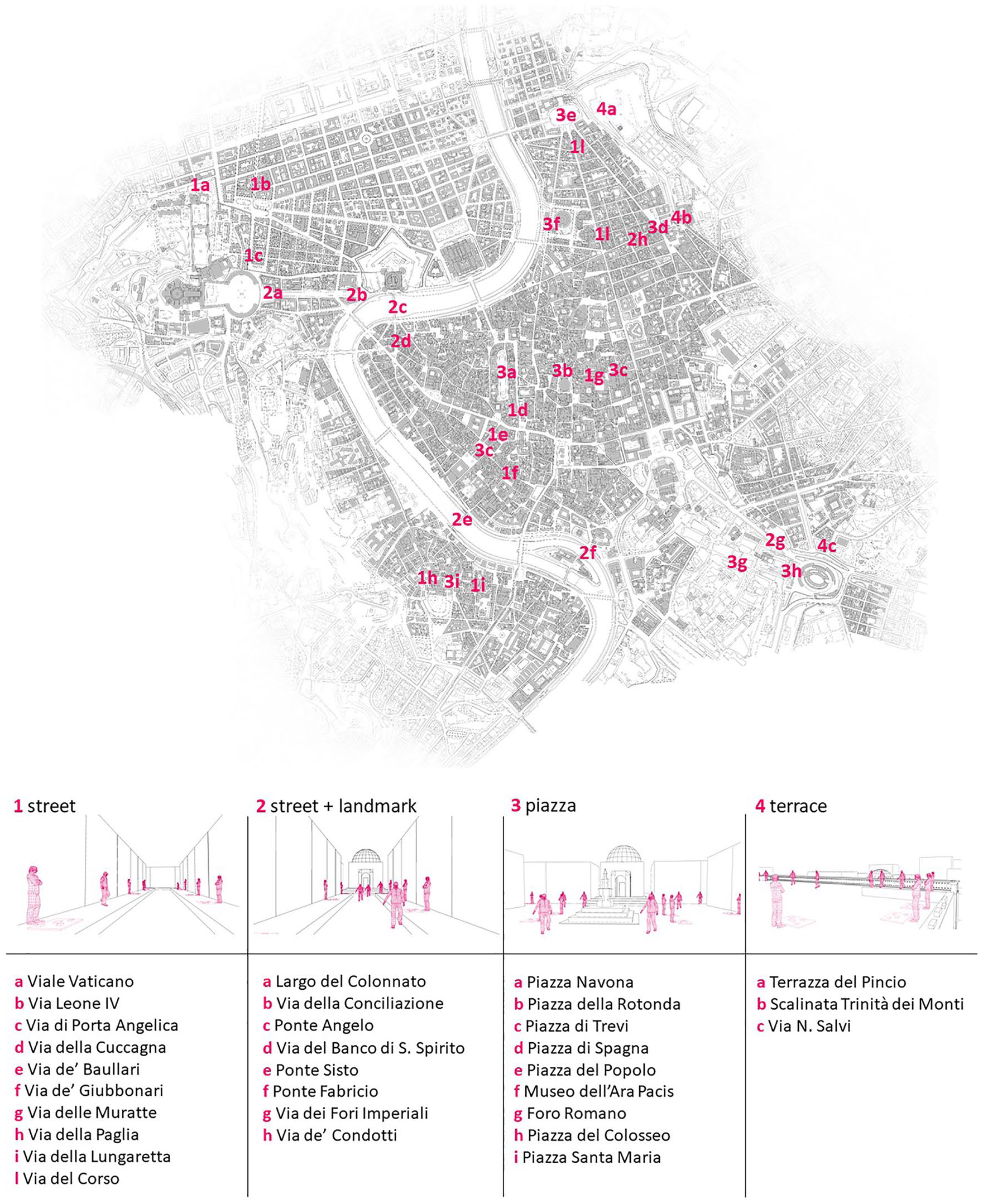
Types of vending spaces.
Built elements determine the attractiveness of different selling spots. Vendors use features such as balustrades and benches to expose merchandise. Sidewalks and pavement materials help to organize vending by directing pedestrian flows. And, while vendors consider proximity to escape routes very important, the level of maintenance of these routes is even more crucial. The terrace in front of the Colosseum, for example, is connected to the street below by poorly maintained stairs. While vending close to the stairs allows vendors to intercept more passersby, established vendor Saifur preferred occupying another spot nearby that was less crowded, but provided a safer way out in case of a police raid. When I asked Saifur whether he would like to send any message to the authorities, he told me I should warn them of the slippery stairs which, he worried, made tourists fall easily, giving Rome “bad publicity.”
Vendors occupy more or less desirable spots depending on their influence within the vending community. Senior vendors are not well acquainted with younger colleagues, but their age and status grant them a certain degree of respect. Ashik, a seventy-one-year-old vendor selling at the Pantheon, liked to occupy good, but not excellent spots so as to avoid conflicts with other vendors. He remained in his position throughout the day and, if police arrived, he only moved a few steps waiting for them to go away. Established vendors and newcomers tended to move more frequently. Despite their irregular immigration status, established vendors are relatively powerful on the street and occupy better selling spots. Some exchange text messages with Senegalese vendors communicating police presence and allowing colleagues to leave fast. Established vendors tend to prevent newcomers from being visible in good spots. Raifur, a newcomer vendor on the Sant’Angelo Bridge, appreciated police raids because they displaced established vendors, giving him hope to occupy a decent spot afterward. Raifur’s chances of making a profit also increased between 2:00 and 4:00 p.m., when established vendors withdrew from the bridge fearing police controls, and when he could make himself visible risking “only” the administrative fine rather than deportation.
Vendors, then, seize economic opportunities by occupying and moving across Rome’s iconic landscapes. They occupy different types of spaces, seeking to catch tourists’ attention without compromising the scenic views. And built features as well as their level of maintenance determine hierarchies of attractive selling spots for which diverse vendors compete.
Urbanism of Refuge
Vendors develop networks of safe places by hiding or making themselves hyper-visible in public space. Tunnels, courtyards, lanes, and churches form a dense system of hideouts that vendors have at their fingertips. As with vending spots, power relationships among sellers determine who can hide where. Rashid, an established vendor of Piazza Navona, hid with a few Senegalese colleagues in a tunnel while pushing less experienced compatriots away. “We have been here for a longer time,” Rashid told me referring to the Senegalese vendors with whom he had sold side-by-side for years. Sometimes vendors rely on other people’s solidarity. A priest, for example, was known to let vendors hide in his church near the Spanish Steps while preventing police officers from entering. Shop assistants in several chain stores of Via del Corso also let vendors seek refuge in their stores during raids. Ordinary features that most passersby take for granted become precious closets to hide merchandise—e.g., electrical cabinets, sewer covers, manholes, and bushes (Figure 2). These closets could be safer than spaces at home. Samsul, a senior vendor of Piazza del Popolo, preferred keeping roses behind a wall near his worlplace rather than in the room he shared with ten strangers. Although Samsul’s flowers were stolen quite often, he continued to believe that his hiding place on the street was safer than home.
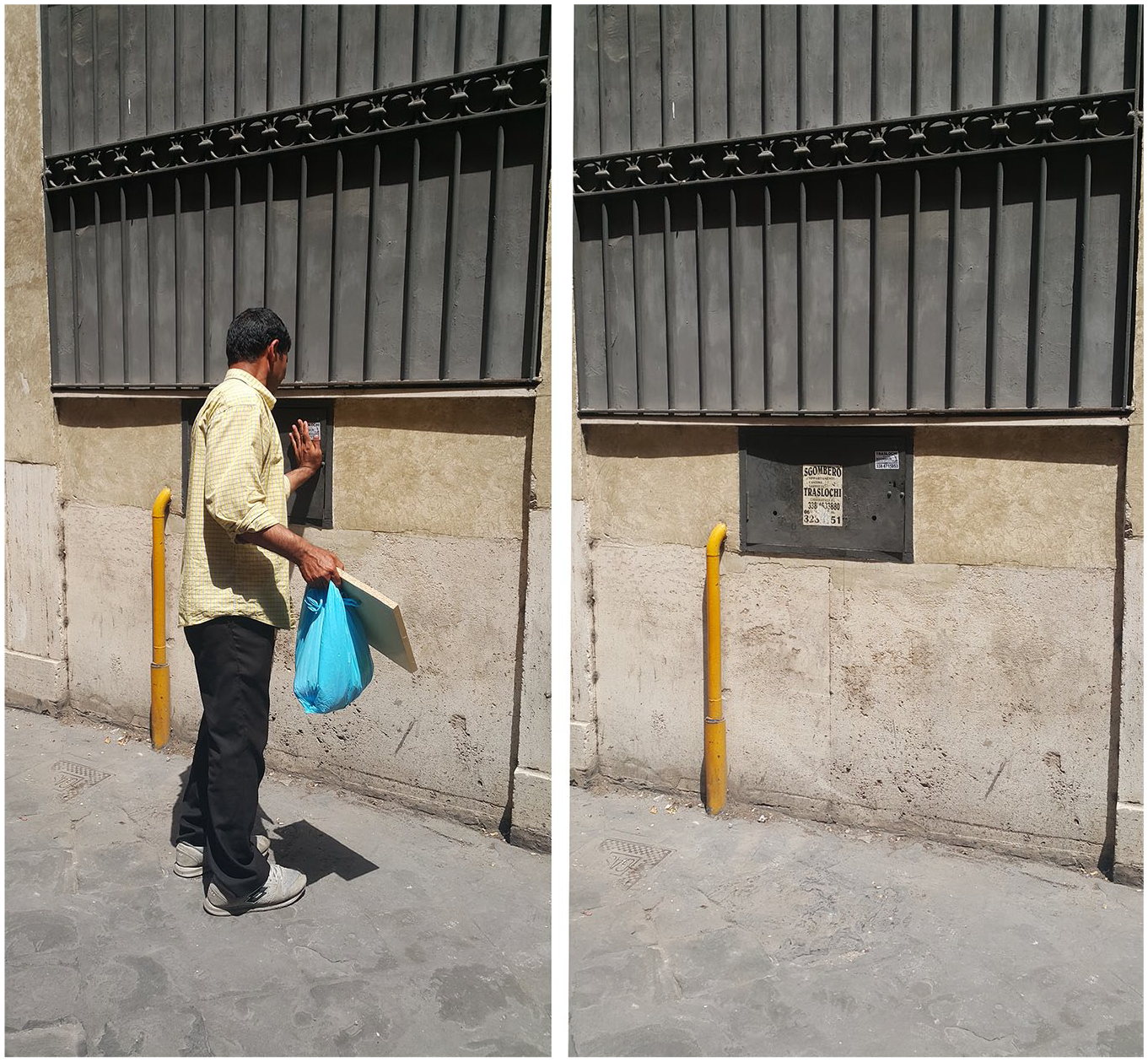
A vendor hides merchandise in an electrical cabinet on the street, a space he considers safer than the room he shares with seven men.
Indeed, public spaces often provide vendors with the room and privacy they lack at home. In the apartments occupied by the vendors, sleeping is hard when people enter rooms at any hour, and everyone must keep their belongings on the bed. Tenants avoid using restrooms at night to not draw the attention of other residents of the building. Showering and using toilets during the day requires time spent in lines that most tenants do not have. The person who signs the lease often charges roommates with extra costs. In the home of Rubel, an established vendor working at the Spanish Steps, charging a phone costed one euro. If a vendor wanted to keep water bottles refrigerated, a popular commodity in the summer, he had to add thirty euros to the monthly rent.
These circumstances push vendors to find spaces to rest, use restrooms, take showers, and charge appliances outside of their home. Most sellers of Piazza del Popolo urinate and rest in a nearby park which, surrounded by dense vegetation, appear inaccessible from the outside. Nafir, who started vending in 2015 after spending two years enslaved in Libya, considered a stone bench near Via Condotti a better bed than the one he shared at home with another man. Some business owners such as the Chinese immigrant who runs a coffee place near the Sant’Angelo Bridge let vendors use the restroom without charge. Others take advantage of the sellers’ precariousness. The guardian of the Colle Oppio Park near the Colosseum, for example, allowed vendors to charge their phones in his home, but only for a fee.
Vendors also feel safe by making themselves hyper-visible in public space. Hiding merchandise in plain sight is one way to go unnoticed and save their livelihoods. During police raids, for example, vendors frequently left merchandise next to uncollected trash bags counting on the fact that nobody would notice them. Three sellers at the Pincio Terrace left their bags behind a crowded bench knowing that police officers would hardly bother picking up the bags. Several vendors at the Colosseum equally counted on the officers’ laziness, leaving bags in places that were easily visible but hard to reach (e.g., behind fenced areas, near slopes, or on trees).
Most vendors considered the touristic center safer than other districts precisely because it was policed. Despite their irregular immigration status, and the aforementioned police abuses, vendors felt generally safe by making themselves subjected to surveillance. Nazir, an established vendor of Via de’ Condotti, walked home every night passing in front of police officers whose presence reassured him. A vendor near the Pantheon appropriated a bank’s window to rest under its surveillance cameras putting fruit boxes on the floor pikes. Ahnaf, an established vendor in Piazza del Popolo, chose to vend under a surveillance camera of the carabinieri corps because he could call the police should he be robbed (by “dangerous people” he identified as immigrants from North Africa or Roma populations). This sense of safety speaks, on one hand, to the fact that most vendors experienced physical and verbal abuses in peripheral districts, which led them to consider the touristic center as safer. On the other hand, the fact that some vendors felt reassured by police’s presence speaks to the ambiguous role of patrollers who, as I explain below, were not always hostile to vendors, but at times acted in solidarity with them.
Vendors thus emplace safe urbanisms of refuge by tactically appearing, disappearing, and making themselves hyper-visible in space. The porosity of the built environment elicits vendors’ appropriations, providing opportunities for hiding from police raids and for satisfying basic needs that would otherwise remain unmet. At the same time, the securitized character of the touristic center reassures the vendors who consider historic Rome safer than other parts of the city.
Urbanism of Belonging
Rome’s iconic center is not only a space of survival for the vendors, it is also a place where they construct and negotiate geographies of belonging. Cafes are expensive in Rome’s center, and going home for lunch would take too long. Most vendors prefer buying the two-euro pasta-and-eggs meals that some compatriots deliver near their vending locations. The very act of eating represents a political statement for some vendors. As a gesture of protest, for example, an established vendor in Via del Corso ate on the stairs of a church where a guard prohibited him from selling. Appropriating the same spot he could not occupy while working, the vendor felt he was talking back to the church’s guard. Other sellers preferred eating near their own vending areas. Ashik usually sat on the stairs in front of the Pantheon where he liked to feel “not a vendor” alongside tourists. Rubel occupied his favorite spot on the Spanish Steps watching people and admiring the view “as anyone else.” Some vendors preferred eating together. Rifat, an established vendor who moved his activity from Piazza del Popolo to the Trevi Fountain, walked ten minutes every day to have lunch with his old friends in front of a church on Via del Corso. The Bangladeshis’ gathering on that site marked time for other Romans and loosened social roles, albeit momentarily. Two employees of a chain store waited to see the vendors arrive to start their own lunch break. A policewoman in Via del Corso reported seeing the Bangladeshis’ lunch in front of the church as a specific moment of her daily routine, a time when “everyone” could relax before Bangladeshis “returned to be vendors” while she and her colleagues went back to “being police.”
While Rome’s many churches might provide refuge for vendors, they can hardly satisfy their spiritual needs. Mostly of Muslim faith, vendors create informal places of worship in the urban interstices they find and inhabit. Some vendors organize group prayers in green areas such as the Colle Oppio Gardens, where most tourists avoid entering due to its run-down appearance. Other vendors pray alone in front of iconic sites, and under the eyes of police and tourists. Taking advantage of his anonymity among the crowds, senior vendor Rasel habitually kneeled on the travertine parapet facing the Colosseum (Figure 3). He felt safe. Only once did an officer interrupt Rasel, but other patrollers reminded their colleague that no law was broken. Some tourists took pictures of the praying vendor, engaged in an activity they did not expect to see in Rome. Increased xenophobia and “anti-terrorism” propaganda, however, pushed most vendors to pray while hiding. The back-shops, mezzanines, and basements of most Bangladeshi-run businesses served as informal prayer rooms for Bangladeshi vendors as well as a few trusted Senegalese colleagues. At other times, business owners provided vendors with provisional spaces to pray. The Albanian manager of a restaurant in Via delle Muratte prayed with his employees in his storage room and let vendors in. A few feet away, the Lebanese Jewish owner of a souvenir shop let his Bangladeshi friends recite Muslim prayers on Fridays, just before closing for Shabbat.
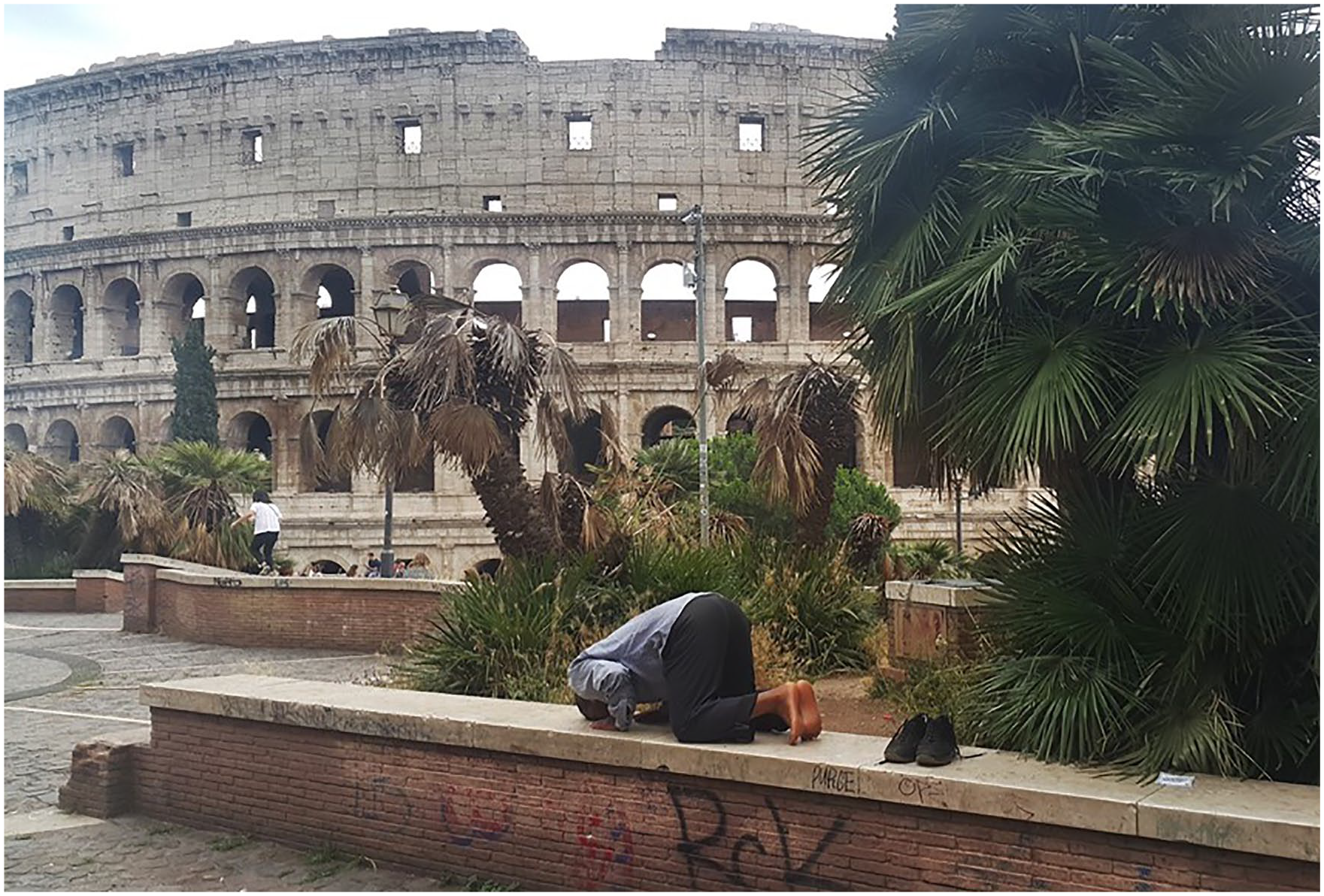
A vendor prays in front of the Colosseum, taking advantage of his anonymity among the crowds.
The vendors’ visibility in the center of Rome generates opportunities for recognition from other city users. Commuting every morning from the city’s outskirts, tourist guide Giulia felt she “arrived at work” as she saw the vendors, whom she felt were her “coworkers in the center.” A young woman living in the Prati district felt reassured by the vendors’ presence when coming home at night. The employee of a Prada store liked to buy coffee for the vendors who sold in front of his shop, considering them part of the “local community.” If almost half of the surveyed tourists (forty-two) criticized the sellers, often referring to them as “visibly non-Italians” or “non-authentic,” others (seventeen) considered vendors a “normality” of European cities. Still other tourists (nineteen), and especially Europeans, saluted the sellers as a “positive sign,” a “symbol of cosmopolitan Europe,” and a reminder that “refugees” should “profit from the tourism economy just as other Romans do.”
If my investigation revealed police abuses, it also shed light on other dynamics of conviviality and solidarity between patrollers and vendors. Fifteen officers reiterated the concept that traders were part of an “inner circle” of city users, albeit contested ones. Officers frequently turned a blind eye when seeing vendors sell, and occasionally exchanged jokes with the sellers they know. Bringing her children for a walk in the city center, a patroller stopped to introduce them to a few vendors she knew. “We [Romans] got used to them [immigrant vendors], Rome is also them now,” an Army soldier guarding Piazza di Spagna told me. A patrolman in Via del Corso told me that he considered vendors more “legitimate” users of Rome than the “swarms of tourists” who invaded the city, littering and getting drunk in the streets. A municipal officer close to retiring purposely slowed down when walking toward vendors, giving them time to leave. Paired with a younger colleague who was more hostile to vendors, the older officer purposely delayed his partner, for example, by taking long coffee breaks.
The crowded, iconic sites of historic Rome thus provide vendors with opportunities to use and transform spaces in ways that give new meanings to the city. The convivial networks that emerge among the vendors and other people loosen social hierarchies. By seeing each other every day, the regular users of the center form a sense of familiarity based on a new “us”—the people who inhabit the center every day, the Rome that stays, and a new “them”—tourists who want to consume Rome’s eternity in a day, the Rome that goes.
In Plain Site
The urbanisms that vendors make and remake in the center of Rome emerge out of the necessity to survive and a desire to hang out, more than out of any intention to confront authorities. Yet, the vendors’ emplacements of survival and belonging become political in that they destabilize dominant constructions of who has the right to see and be seen in the city. I argue that planners should support and learn from these emplacements. To help empower immigrants to occupy and produce the city, I propose that planners operate through In Plain Site, a policy and place-making approach that puts rights of visibility at the core of a more just urban condition.
To be sure, supporting marginalized groups in making themselves visible does not automatically ease their oppression. But empowering poor immigrants to see and be seen in the city can enhance their opportunities to obtain recognition, participating as equals in public affairs (Sezer 2020; Staeheli, Mitchell, and Nagel 2009). And urban forms can very much affect these dynamics. The shape and appearance of built environments concretely affect the capabilities of each individual to use public spaces, access transportation, and meet with others. As these are necessary (albeit not sufficient) conditions for the right to difference, increasing opportunities for vulnerable immigrants to use and produce space can strengthen their ability to assert a right to difference (Loukaitou-Sideris 2020; Low and Iveson 2016).
In Plain Site learns from how immigrants use visibility not only to survive but also to construct a sense of belonging in the city. Systematically asking who has the right to be present and use space, planners can reveal vectors of oppression. They can reach out to those who remain invisible, empowering them to voice their needs, access resources, and become visible, should they wish to do so. As a framework for spatial justice, In Plain Site requires policies and spatial transformations to both address immigrants’ unmet needs and make difference visible in the built environment. While my suggestion for planners to operationalize the politics of visibility spans across regional contexts, I now turn to illustrate how In Plain Site could help empower Rome’s immigrant vendors.
Enhancing Opportunities
While urban planners might not be able to reverse national immigration policies, they can certainly make cities more hospitable to immigrant groups. Empowering Rome’s vendors to meet, organize, and advocate for their rights would be crucial. Unlike in other cities outside of Italy, Rome’s immigrant vendors have not yet organized. Nor have institutional efforts been made to hear the needs of immigrant vendors, whose informal status makes them the target of oppressive regulations. Lack of recognition sustains unbroken cycles of exploitation and bribery. For these reasons, authorities must acknowledge immigrant vendors as key inhabitants of the city center and listen to their needs. The lack of spaces where diverse immigrant vendors can meet and speak openly affects their ability to organize. Providing such spaces in the city center would concretely improve the chances for diverse vendors to designate representatives and advocate for their collective rights.
Planners could also legalize vendors’ activities in order to both enhance their economic opportunities and help end their harassment. Abolishing restrictions to sell in the city center and issuing much-needed vending licenses would be a good start. Releasing permits independently from immigration status would allow “undocumented” people to make a living safely. And declaring the historic center a sanctuary zone would protect vendors from risks of deportations.
Spaces should be maintained and transformed to support these operations. I showed how seemingly banal features of the built environment affect the ability of each vendor to appropriate spaces and interact with tourists. For one thing, planners should acknowledge the political implications of maintenance. Interventions such as filling up pavements’ holes, fixing broken stairs, and regulating traffic lights would improve vendors’ business opportunities while also contributing to enhancing their sense of safety. At the same time, new selling infrastructures could be created. These infrastructures should respond to vendors’ needs while also considering the overlapping temporalities of vending. In Rome, streets that are already used by sellers at certain hours of the day would benefit from provisional infrastructure (e.g., removable stalls, shades, trashcans, and lighting) as well as storage spaces for these infrastructures outside of vending hours. Spread throughout the city center, selling equipment and storage spaces would help empower sellers by legitimizing their presence in the eyes of other city users, and by breaking cycles of exploitation outside and within the vending community.
Making Refuge
Planners could accommodate the vendors’ neglected needs by supporting policies and by creating spaces of refuge. Overcoming the lack of affordable housing in the center of Rome would be key. While the uncontrolled spread of Airbnb and high-end offices displaces original residents, Italian landlords continue to profit from housing undocumented immigrants in crowded apartments and in basements of affluent buildings. Just as it happens on the streets, a lack of institutional recognition of these invisible residents favors their exploitation on multiple levels. Vendors are often overcharged by the official tenants and forced into living conditions that limit their well-being in multiple ways. City authorities should not only control the touristification of the city center by regulating the spread of Airbnb, they should also actively carve out housing opportunities for marginalized groups, and especially those with undocumented status. This is a feasible step, as there are numerous publicly owned buildings in the center which are now abandoned or are military buildings in the process of being decommissioned.
Public spaces should be designed to satisfy basic needs, ensuring the dignity of all urban dwellers while emplacing their right to be in the city. Furnishing the center of Rome with accessible public restrooms, for example, would considerably improve the routines of vendors while also providing a much-needed service to other groups, including tourists. Public showers would be equally needed for the vendors as well as for all the other people who eke out a living by inhabiting the center of Rome. Providing stations to charge electric appliances would be another crucial step toward spatial empowerment. Being able to communicate via phone represents an essential tool of survival for the vendors. Charging and Wi-Fi stations would enable them to maintain transnational networks of care, exchange information about police, and organize collective actions. Built in prime locations, public restrooms, showers, and charging stations would not only ameliorate the lives of vendors and other oppressed groups. They would also visualize these needs, expanding dominant expectations of who is entitled to inhabit historic Rome.
Making Belonging Visible
Critically operating within the aesthetics, and thus the politics, of the built environment, planners can confront dominant canons of “the appropriate” by welcoming a variety of ways to use and sense the city. Creating Muslim places of worship, for example, would not only help vendors find safer spaces than the precarious prayer rooms they now occupy. In a national and urban context where policy makers ostracize non-Catholic spaces, inscribing the right to practice Muslim as well as other faiths into the urban fabric would acknowledge and legitimize difference. Public spaces should be designated as inter-faith spiritual places. Water fountains and Qibla oriented areas would make praying outdoor easier for Muslims. Parks, streets, and piazzas should also accommodate the ways by which immigrant groups use the city center to hang out. Green areas should be equipped with playgrounds for sports such as cricket, which Bangladeshis and other immigrants play in their free time. Seats and tables would provide vendors and others with opportunities to eat and chat more comfortably. Accommodating the ways immigrant groups construct a sense of belonging, these infrastructures would at the same time enhance opportunities for strangers to coexist in space, possibly learning mutual respect.
Finally, other symbolic transformations of space should help to break down narratives of Rome as a historically white city. Rather than reifying myths of glory and empire, Rome’s heritage landscapes should highlight the currently hidden traces of forced labor, colonizations, and migrations that have shaped the city throughout history. Public funds could promote tours that complicate linear narratives of the city’s triumphant past and canonic beauty. Street signage should provide critical information by highlighting, for example, that enslaved people built much of what is now considered classical Rome, that fascist city renewals and spatialized racial laws displaced poor people, and that buildings celebrating the “Italian Empire” speak to systematic rapes, tortures, and killings perpetuated in Africa during the nineteenth- and twentieth-centuries.
Conclusion
This study explored what kinds of policies and spatial transformations can help empower immigrants to see and be seen in the city. The theoretical premise here is that the right to visibility lies at the core of the right to difference. And the right to visibility is not a permission to be seen granted by powerful actors to passive, “vulnerable” urbanites. Rather, the right to visibility is a disruptive, always political process that subaltern publics mobilize, asserting their legitimacy to occupy and transform spaces. While planners are increasingly aware that dominant constructions of what looks “appropriate” perpetuate the marginalization of oppressed groups, they have given little attention to how visibility can serve as a framework to detect and address inequalities. Yet, scholars of feminism and race have long showed that hegemonic constructions of who can be visible, and where, oppress those subjects who do not look like they “belong.” And they have also demonstrated that being seen where one “should not be” can serve as an ordinary weapon of insurgency, an act that destabilizes dominance from within.
It is time for planners to acknowledge and weaponize the political implications of visibility. I have proposed In Plain Site, a policy and place-making approach that puts the right of visibility at the core of a more just urban condition. In Plain Site can support marginalized subjects in making themselves visible, should they wish to do so. Creating spatial possibilities for oppressed groups to use, produce, and transform the city, In Plain Site can help inscribe a right to difference into the urban form.
I have empirically demonstrated my case for In Plain Site by analyzing street vending in Rome. Against institutional attempts to banish difference from the historic center, immigrant vendors construct their own Rome by means of their visibility, by seeing and being seen where dominant aesthetics would not want them to be. The micro-geographies of conviviality and solidarity that emerge between the vendors and other groups destabilize normative assumptions of belonging. Planners should support these geographies in order to confront hegemonic aesthetics of order and decorum. In Rome, the In Plain Site approach would involve three kinds of interventions. First, as vendors seize economic opportunities, planners could enhance these opportunities by legalizing vending, empowering sellers to organize, and by making spaces more comfortable to sell. Second, as vendors satisfy their needs by finding refuge in the urban fabric, planners could provide safe places, for example, by equipping public spaces with basic infrastructures such as toilets and electric charging stations. Finally, as vendors pray, eat, and relax in public spaces, planners could make difference visible in Rome’s iconic landscapes. By opening Muslim places of worship and highlighting the currently hidden histories of forced labor and colonization, for example, planners would empower difference to penetrate crafted landscapes of power.
But my argument for In Plain Site extends beyond the borders of Rome. It suggests that planners can deploy a spatial lens of visibility to help empower not only immigrants, but all groups who are marginalized by dominant constructions of “the appropriate,” all those people whose bodies and practices make them targets of systemic precarizations and dispossessions. Thinking through the politics of visibility opens up new questions for planners. One such question is how they can operationalize visibility while respectfully engaging with, and seeking to empower subjects who might want to remain undetected. The case of Rome has begun to show how planners can reveal and help confront injustice by emplacing the right to difference into a city’s fabric. Further research would need to explore this question in other contexts, investigating what kinds of policies and spatial interventions can help empower oppressed groups to see and be seen in the city.
Footnotes
Acknowledgements
I would like to thank the anonymous reviewers for providing crucial feedback.
Author’s Note
The COVID-19 pandemic has further endangered the livelihood of Rome’s vendors, starving sellers and the families who depend on them. Policy makers have once again failed to provide any assistance to these “invisible” city dwellers. Like other migrants, the vendors are excluded from the Regularizing Measures for Immigrants that the Italian Government approved in May 2020 within a package of “relaunching” initiatives. This purposeful omission, along with the renewed migration deal with Libya and the denial of citizenship rights to second generations, reveals Italy’s long-standing commitment to racist oppression and dispossession.
Declaration of Conflicting Interests
The author(s) declared no potential conflicts of interest with respect to the research, authorship, and/or publication of this article.
Funding
The author(s) disclosed receipt of the following financial support for the research, authorship, and/or publication of this article: This research was funded by the USC Visual Studies Research Institute, the Bedrosian Center for Social Innovation, and the USC Graduate School.
