




Abstract
This paper discusses how Tactical Urbanism aligns with the principles of the ‘open city’ framework. The ‘open city’ is often theorised as the urban condition that best welcomes diverse and flexible use of a city’s public spaces. However, the nature of the planning system at its core is to control and predict urban development, thereby effectively reinforcing the principle of a ‘closed city’ with more fixed and rigid forms. One counter-reaction to the ‘closed city’ is the Tactical Urbanism movement, which applies principles of simple, low-cost, and often temporary public space interventions to achieve and accelerate change. Such interventions can create more ‘open’ and inclusive urban environments, enabling diversity and flexibility. However, Tactical Urbanism is applied in multiple forms by different actors with varying intentions and goals. In this paper, I question the role of Tactical Urbanism in congruence with the theoretical framework of the ‘open (and vibrant) city’, drawing attention to how tactical interventions are used to brand new development projects. Doing so, I ask if Tactical Urbanism can be (mis)used merely as ‘temporary temporariness’ to serve top-down planning strategies, resulting in the ‘closed city’.
Introduction
Triggered by an increased concern for urban and social sustainability and growing interest in human-centred development, there has been significant interest in creating more vibrant, inclusive and flexible public spaces in recent years. ‘Vibrant’ is a broad term used by a wide range of actors, including urban planners, researchers and citizen activists, to describe the overall goal of creating more social and active public spaces. Public spaces provide important settings for social interactions and activities (Jing et al., 2019). These spaces can aid in combatting loneliness and inequality and create welcoming places with equal access (Latham and Layton, 2019). In many ways, the term ‘vibrant public space’ critiques previous functionalist planning practices where zoning, lack of human scale, and car-focussed design were central planning principles that shaped and changed our cities. The prioritisation of vehicles over pedestrians particularly harmed the city’s liveability (Yassin, 2019) and ‘vibrant’ appearance.
While the terms ‘vibrant’, ‘inclusive’ and ‘flexible’ serve as inspiration and success measures in public space projects today (e.g. Amin, 2008: 7; Gehl and Svarre, 2013: 3), public spaces that are programmed in ways that place restrictions on use and interactions between people are of growing concern (Bjerkeset, 2021). Public spaces tend to appear overdetermined, ‘tight’ (Franck and Stevens, 2007), commercialised (Bodnar, 2015), monotonous and often adapted for tourists and the affluent middle class (Bjerkeset and Aspen, 2015). In addition, the development of inner-city areas in the late 20th century increasingly focussed on commodification, mono-functionality and control (Groth and Corijn, 2005).
Critical urban theorists argue that contemporary urban planning and design can lead to limited democratic use of public spaces (e.g. Davis, 1992; Low, 2006; Mitchell, 1995). The new public space norm tends to produce ‘dead’ and rigid spaces where security and surveillance are the most pressing matters, whilst inclusion and diversity have less priority (Franck and Stevens, 2007; Sennett, 1992). Furthermore, several public spaces develop in a typical neoliberal direction where real estate developers and investors are the target groups (Bjerkeset and Aspen, 2017; Hanssen and Millstein, 2021). Public space design is frequently integrated with private development projects, where planning authorities require developers to design and fund public spaces. In addition, public space ownership commonly remains in private hands after development (Hanssen and Millstein, 2021). This privatisation may affect access and participation in public spaces. From a critical theoretical approach, this neoliberal development approach does not contribute to a just city (Andersen and Røe, 2017).
The ‘open city’ is often theorised as the physical condition that best facilitates diversity, change, and adaption (Porqueddu, 2018). However, the established planning systems tend to control urban development and therefore support the principle of a ‘closed(-system) city’ through, for instance, master plans (Porqueddu, 2018). A proposed counter-reaction to planning and design of the ‘closed city’ is the use of temporary space interventions. Such interventions may create a new experience of a place and give room for informality, improvisation, and spontaneity (Rasmussen, 2021), hence supporting the idea of the ‘open city’. One umbrella term for such interventions is Tactical Urbanism (TU), the global movement which is known for its use of short-term, temporary, low-cost and scalable interventions that are often citizen-led (Lydon and Garcia, 2015; Stevens and Dovey, 2023; Wohl, 2018). However, several governments and developers have begun to apply TU in a top-down and neoliberal development approach (Brenner, 2013; Mould, 2014) in an attempt to facilitate more activity and use of an area in anticipation of approved development.
This paper aims to discuss the practice of TU from an urban theoretical perspective. Reviewing the TU movement from a critical theoretical lens, I question if TU is congruent with the ‘open’, and vibrant city: A city that celebrates incomplete and ‘open’ urban forms and supports spontaneous activities and diverse interactions. To answer this research question and place TU in a broader theoretical context, I first outline the ‘open city’ theory and introduce the TU movement. Second, I examine the principles of TU from the theoretical perspective of the ‘open city’. Last, I argue that while TU has many facets, there remains an increasing (mis)use of TU principles in branding new development projects through top-down strategies to attract capital investments and desired user groups, in what I identify as ‘temporary temporariness’.
The ‘open’ (and the ‘closed’) city approach
We can understand the city as a continuous tension between the built, fixed, and rigid on the one hand and the innovative, unexpected, random, and surprising on the other. This perpetual duality captures the complex relationship between the ‘open’ and the ‘closed’ city (Førde, 2021).
The theoretical approach of the ‘open city’ represents a visionary or utopian (Ipsen, 2005) urban society, and it works as an urban ideology (Brenner, 2013) or potential guiding principle for cities (Abou Jaoude et al., 2024). I comprehend it as an urban condition that shares similarities with Jane Jacobs’ urban vitality concept for more dense and complex urban neighbourhoods (1961), Kevin Lynch’s adaptable and experimental ‘possible city’ (Lynch, 1990 [1968]) and Ulrich Beck’s ‘City of And’ that embraces diversity, difference and cohesion (Beck, 1998 in Gleeson, 2001; Abou Jaoude et al., 2024). Richard Sennett (1970, 2018) also contributed significantly to the revitalisation of the ‘open city’ concept, and in this paper, I place particular emphasis on his contributions. Sennett has, over time, argued for more disorder in city life. He celebrates city life as that of unexpected encounters, incompleteness and diversity. Sennett, along with other urban theorists (e.g. Jacobs, 1961; Mitchell, 2003), criticises overdetermination in city planning, stating that modern urban development has created an alienating public realm where social interaction is impossible and encounters with strangers become threatening (Sendra, 2015: 821). He also condemns post-war modern development for evading disorder and seeking an ideal communal life free from conflict (Sendra, 2016: 336). Moreover, while Sennett raises valid concerns about the negative impacts of certain urban development practices, we should acknowledge that the extent of alienation and lack of social interactions he describes vary across cities and contexts.
Sennett’s remark on the sense of time in modern urbanism is a more general, universal concern. He argues that modern planning lacks a forward-looking perspective on time, emphasising the city as a dynamic process shaped by anticipatory imagination (Sennett, 2017: 97). This dynamic understanding of time connects to the notion of ‘designing disorder’, which advocates for designing urban interventions that are flexible, adaptable, and open to constant change (Sendra and Sennett, 2020: 52). Through such deliberate design choices, the city may operate as an open system and foster a democratic and inclusive experience for its citizens (Sennett, 2006).
Recent urban theory describes ‘vibrant’ cities as ‘open systems’ (Christiaanse and Levinson, 2009; Porqueddu, 2018). Sennett suggests that ‘“Open” implies a system for fitting together the odd, the curious, the possible (2018: 5). The open system functions as non-linear, meaning that the different parts of the system must be examined all at once as a coherent entity. It is reflected in Lynch’s description of the ever-changing city where there is “no final result, only a continuous succession of phases” (Lynch, 1960: 2). On the contrary, in a linear system, each part can be analysed and solved separately (Sennett, 2018: 5). To grasp the idea of the non-linear system of the ‘open city’, Sennett presents the example of chemicals interacting to form a compound, making it a new substance of its own (2018). I relate this non-linear system approach to the growing research interest in understanding the city as a complex adaptive system. As Stevens and Dovey (2023) argue, rigid and hierarchical systems are fragile in that any single dysfunction can collapse the entire system, whilst, in complex adaptive systems, the parts adapt to each other in unpredictable ways. The complex adaptive system approach enhances urban resiliency and demonstrates the potential of using temporary interventions to create more open and flexible public spaces (Stevens and Dovey, 2023
The idea of open systems finds resonance in the work of Jane Jacobs and her investigations of dense and diverse American city neighbourhoods. Jacobs stated that the city was a problem of organised complexity: ‘Problems which involve dealing simultaneously with a sizable number of factors which are interrelated into an organic whole’ (Jacobs, 1961: 432). Jacobs highlights the irregular, non-linear and open-ended development paths (Sennett, 2018). Her perspectives also illustrate the planner’s challenging task of balancing the desire for order and control with the local reality of spontaneous, bottom-up and self-organised development. As a result, tensions can arise when, for instance, top-down regulatory planning processes ignore or underestimate the depth and complexity of local knowledge. Urban citizens can have different and sometimes incompatible understandings of what a city should look like and how it should function. For some, the city should, first and foremost, allow for diversity in users and activities; for others, the city should, first and foremost, feel safe and prevent disturbances from unwanted people or activities (Bjerkeset, 2019). These significantly different interpretations create tensions between planning for a dynamic and flexible city and, on the other side, planning a safe and orderly city.
Sennett considers Jacob’s perspectives to reflect the ‘open city’ approach. He explains that she encourages ‘quicky, jerry-built adaptations or additions to existing buildings’, such as ‘putting an AIDS hospice square in the middle of a shopping street’ (Sennett, 2017: 99–100). In contrast to Jacob’s perspectives on ‘open cities’, planning systems often result in a ‘closed city’-development. In general, planning systems aim to steer urban development based on foreseeable societal developments. To cope with urban decline, urban renewal and regeneration processes usually try to remove disorder from the urban environment (Sendra, 2016). Therefore, planning systems depend on controlling and predicting the future, and in that sense, they behave as ‘closed’ systems (Porqueddu, 2018). To ‘control’ is a fundamental principle of planning established with good intentions: to provide foreseeability and to restrict ad-hoc decisions that can potentially harm urban societies. Yet, too much order and control in a city can hinder spontaneity and improvisation (Nyseth and Romuld, 2021).
In this context, Sennett questions if we can ‘design for disorder’ and the more incomplete and ‘open’ forms to allow for spontaneous activities and unexpected interactions (Sendra and Sennett, 2020; Sennett, 1970). His understanding is that cities today fail to provide the ‘open’ and ‘loose’ forms of physical and social life. One of the examples he points to is urban planners’ arsenal of technological tools that could support and enable the ‘open city’ but is instead used to gain control and order. Sennett calls this a paradox and traces it to the overdetermination of the city’s visual forms and its social functions: ‘The technologies which make possible experimentation have been subordinated to a regime of power which wants order and control’ (Sendra and Sennett, 2020: 23). The ‘open city’ is a city where experimentation is possible, and informality is the desired condition. I do not read it as a vision for a society free of long-term plans but as a critique of the permanence and static in existing planning regimes and a call for a more dynamic, open-ended and forward-looking (Abou Jaoude et al., 2023) city.
The idea of ‘designing for disorder’ has been concretised with the concept of ‘Infrastructures for disorder’– an alternative to conventional planning and design principles (Sendra and Sennett, 2020). With this alternative, Sennett, together with Sendra, challenges what they call a contradiction: How can we design disorder if design itself tends to introduce more order? (2020: 53). Using a sociological and urban theory approach (Aspen, 2021), they propose introducing interventions in a public space’s infrastructure that will create conditions for spontaneous activities, citizen-driven initiatives, and social interaction to arise, develop, and change over time. With ‘infrastructures for disorder’, the goal is to make the ‘hard’ infrastructure system more open and allow additional functions to be incorporated, shared, and managed collectively. For example, access to audio-visual equipment, running water and electricity in a public space lets citizens improvise an outdoor cinema or café on a summer’s day. Most importantly, this approach enables citizens to take a more active part in the production and creation of the space.
The vision of the ‘open city’ relates to the notion of ‘the right to the city’ associated with Henri Lefebvre. Don Mitchell (2003) connects Lefebvre’s idea with the relationship between struggles over public spaces and movements for social justice in American cities. Simply put, the right to the city concerns citizens’ democratic right to the public spaces, a progressive call for action to reclaim the city as a place for social interaction and spatial equality. As Sennett and Sendra argue: ‘When the city operates as an open system, it becomes democratic not in a legal sense, but in a tactile experience’ (2020: 35). The theoretical concept of an ‘open city’ extends beyond giving citizens access to public spaces. It is closely related to ‘the right to the city’ and inclusiveness; therefore, ‘open’ implies openness in including various societal needs. In that sense, the open city means empowering local communities to actively shape their social and physical lives and rights in public spaces.
However, public space is increasingly privatised and controlled, which could lead to limited democratic participation and use of public spaces (Mitchell, 1995, 2003). With a particular focus on American cities, Mitchell is critical of what he calls a shift towards demands for surveillance and security of public spaces and the consequences for people’s right to the city: ‘We are already moving towards the sorts of mall-like public spaces (…) public interaction based on the model of commodity and capital flows’ (Mitchell, 2003: 10–11). Mitchell refers to Sennett’s critique of contemporary urban spaces as: ‘dead public spaces’ (Sennett, 1992). With ‘dead public spaces’, he implies ‘closed’ forms of urban spaces that, among other things, value security over interaction and entertainment over politics. This preference for control and order can lead to rigid environments that stifle city life (Sendra and Sennett, 2020). To illustrate, we design public spaces with a focus on crime reduction through, for instance, CPTED (crime prevention through environmental design) or the ‘broken windows theory’ (with a focus on removing both civic and physical disorder). This conflicts with the design of a more vital, just, and open city through flexible design, citizens’ participation, and temporary use.
In the same manner, the growth of ‘private– public’ spaces can produce over-controlled and sterile places (Minton, 2006). Such places often lack diversity and tend to look the same (Minton, 2006). Minton expresses that
Similarly to the ‘open’ and ‘closed’ city, we can describe contemporary public spaces based on the terms ‘loose’ and ‘tight’ spaces (Franck and Stevens, 2007), and these two approaches find resonance with one another. Both terms represent a continuum between two poles (Ipsen, 2005: 646) or opposites on a scale (Abou Jaoude et al., 2023: 18) but are not strict dichotomies. A key feature of ‘loose’ urban spaces is that social encounters and interactions between strangers occur more often than in tight urban spaces. ‘Loose’ urban spaces have a positive significance for social life because they include the vital, the multifunctional, and the temporary (Franck and Stevens, 2007). On the other hand, ‘tight’ urban spaces are critiqued for order, homogeneity, and security. ‘Tight’ spaces are less diverse and provide less room for social encounters and activities. The terms ‘loose’ and ‘tight’ space encapsulate some key contrasts between the ‘open’ and ‘closed’ characteristics of a city’s public spaces.
Today, we design many ‘tight’ outdoor spaces for specific activities, often with furniture for one type of use, which makes improvised activities and encounters difficult (Førde, 2021). Therefore, we should design urban spaces with more ‘loose’ and ‘open’ qualities that allow unplanned social encounters and interactions (Førde, 2021). This argument relates to Tonkiss’ statement on spatial manoeuvring: ‘In over-planned and over-programmed cities where zones of public and private use are clearly demarcated, lines of ownership and access highly secured, and different functions and conforming behaviours tightly prescribed, the room for spatial manoeuvre can be limited’ (Tonkiss, 2013b: 108). We can question if contemporary urban planning and design of public spaces provide typical over-programmed, ‘tight’, strictly regulated, and non-vital spaces adapted for tourists and the affluent middle class (Bjerkeset and Aspen, 2015). However, in this context, words like ‘vital’ and ‘vibrant’ are often used as part of the sales strategy to emphasise the development’s goal of vibrant urban life. Thus, ‘vibrant’ does not have to imply an ‘open city’; it can symbolise ‘vibrant’ and ‘vital’ city life for those citizens with the finances to participate in it. We see this tendency in several transformation areas, where the ambition is often to design ‘innovative centres’, where a market-oriented promotion strategy is applied to attract the so-called ‘creative class’ (people with higher education who contribute to innovation and growth) (Florida, 2004 in Røe, 2019). Newly developed (and often temporary) interventions in such areas are, therefore, one of the vehicles for changing the images of cities in a competitive global marketplace (Madanipour, 1999).
In contrast to ‘tight’ and ‘closed’ urban structures, ‘loose’ and ‘open’ public spaces can create possibilities for improvisation and spontaneous activities. The principle of temporary space can play on similarity to improvisation, where improvisation is a here-and-now experience or force (Pløger, 2021: 25). In public space, improvisation supports the idea of the ‘open city’ and the unexpected and ‘random’, which stimulates the sensory and imaginary forces in people’s interactions with each other and the place (Pløger, 2021). Through this paper, I aim to discuss whether implementing TU interventions facilitates the improvisation that Pløger advocates for and promotes a more inclusive and ‘open city’.
Tactical urbanism: from citizen-led tactics to development strategies?
TU has evolved into a global phenomenon and one of the significant urban design approaches of the 21st century (Stevens and Dovey, 2023: 17). TU comprises simple, low-cost, often temporary, and highly visible interventions in streets and public spaces (Lydon and Garcia, 2015). For example, through the colouring of asphalt and facades, providing simple and flexible seating facilities, basic greenery, traffic calming and other simple installations, public space can, for instance, support active mobility and social interaction (Paukaeva et al., 2021). These interventions can transform the city into a testing ground for innovative forms of thinking in which the power of TU ‘shifts the ontology of the city from being towards becoming; it opens a space of possibility’ (Stevens and Dovey, 2023: 26). TU can be compared with the ‘open city’ approach as they both challenge the more traditional and regulatory planning approach. Like the ‘open city’, TU covers several binary tensions, such as between bottom-up and top-down, temporary and permanent, informal and formal, unplanned and planned and amateur-led and professional-led (Turku et al., 2023: 2).
TU can take many forms, and this movement has no unified definition. Lydon and Garcia provide the most elaborate description of TU so far: ‘TU makes use of open and iterative development processes, the efficient use of resources, and the creative potential unleashed by social interaction. It is what professor Nabeel Hamdi calls making plans without the usual preponderance of planning’ (Lydon and Garcia, 2015: 2–3). However, defining this emerging field of practice is a challenging task (Stevens and Dovey, 2023). Stevens and Dovey (2023) remind us that TU shares many similarities with concepts such as temporary urbanism (Bishop and Williams, 2012), austerity urbanism (Tonkiss, 2013a), insurgent urbanism (Hou, 2010), pop-up urbanism, guerilla urbanism and DIY-urbanism (Talen, 2015). In addition, we can add street experiments (Verlinghieri et al., 2023) and urban living laboratories (Bulkeley et al., 2019) to the list of similar concepts.
In what interpreted her as an attempt to clarify the meaning and scope of the concept, Lydon and Garcia place the variety of TU interventions in the three most common forms of applications. However, they emphasise that these applications are not mutually exclusive (Lydon and Garcia, 2015: 12). As Yassin states, ‘The mentioned three practices are depending on each other’s, where the first drive the second, and the second drive the third respectively in sort of process’ (2019: 256). The three applications are as follows:
1. Citizens demonstrating the need for change: Interventions initiated by citizens to bypass the conventional project delivery process and cut through municipal bureaucracy by protesting, prototyping, or visually demonstrating the need for change. Lydon and Garcia describe this as ‘citizens exercising their right to the city’ (Yassin, 2019: 255). These bottom-up interventions respond to current spatial planning and urban design practices, grounded on rigid rules and long bureaucratic procedures (Silva, 2016: 1046).
2. A tool for public involvement: A tool for city governments, developers, or non-profits to engage the public during project planning, delivery, and development processes. Several city governments now realise the potential of TU interventions in linking the citizens and developers within urban development processes to handle citizens’ opposition against or fear of change, NIMBYs (not in my backyard), through the introduction of sanctioned, temporary projects (Yassin, 2019: 255).
3. Phase 0 implementation: An early implementation tool used by cities or developers to test projects before making a long-term investment. The apparent advantage of this approach is the low risk when following formal planning procedures. This approach also has benefits such as grants or funding, organisational support, and the delivery process (Yassin, 2019). Even though this approach starts with temporary interventions, it is part of the process of implementing permanent installations. If the result is not as desired, it can be redesigned or terminated without economic defeat (Wohl, 2018; Yassin, 2019). Mould criticises the phase 0 implementation, saying TU is becoming utilised by political leaders and policy institutions for ‘“urban redevelopment” in a post-2008 recession-era’ and further arguing that TU’s original citizenry and activist ethos are lost to trendy urban policy language (2014: 530).
Regarding the first form of application, the simplicity of tactical interventions can enable citizens to advocate for change in their streets or urban spaces. The reasons for bottom-up tactical interventions are typically slow municipal regulatory processes, outdated regulations, or unsatisfactory situations (Silva, 2016; Yassin, 2019). The rise of TU, with its focus on open and iterative development processes, is also a result of many cities worldwide suffering diverse challenges such as shifting populations, unstable economic situations (such as the Great recession 2007–2009), citizen dissatisfaction, and rapid technology growth (Yassin, 2019: 254).
As the second and third application forms explain, tactical interventions do not have to be initiated bottom-up by citizens. As Lydon and Garcia suggest: ‘For developers or entrepreneurs, it provides a means of collecting design intelligence form the market they intend to serve (…) For government, it’s a way to put best practices into, well practice – and quickly!’ (2015: 3). TU can be used by diverse tacticians, ‘ranging from the governmental and institutional, Top Down, to the individual or group of citizens, Bottom Up, and everything in between, in order to improve the existing situation or even initiate new ones’ (Yassin, 2019: 254).
This implies that TU embraces a wide range of actions. Even with the abovementioned three application forms, it is hard to distinguish between TU actions and other temporary interventions. Mould points to an ‘unproblematic collectivisation of rather disparate activities that are different both politically and aesthetically (Iverson, 2013), under an umbrella term, that belies such nuances’ (Mould, 2014: 531). Webb understands TU as an umbrella term for guerrilla, pop-up, ad hoc, DIY (Do-it-Yourself) and open-source initiatives (Webb, 2018). Lydon and Garcia differentiate and state that their understanding of TU varies from other forms of temporary space interventions, such as DIY urbanism (Lydon and Garcia, 2015: 6). They explain that not all DIY urbanism efforts are tactical, and not all TU initiatives are DIY, and use the internationally spread practice of ‘yarnbombing’ (the crocheting of trees, street signs, and bike racks, also known as ‘yarnstorming’ or ‘knitted graffiti’ (e.g. Price, 2015)) as an example of a DIY act that lacks the tactics of instigating long-term change to become a TU initiative (Lydon and Garcia, 2015: 8). These different understandings of TU actions show that the principles of TU are not yet commonly agreed upon. Harvey states that TU is an example of planning jargon that might come across as off-putting and inaccessible for some people. He suggests using ‘action planning’ or ‘planning by doing’, if necessary, to make it more accessible and understandable for people involved (Harvey, 2015). Harvey’s argument points precisely to the weakness of the TU concept – and its danger of becoming an empty buzzword that we can use freely about diverse forms of physical interventions in urban environments.
Even without a commonly agreed upon definition, tactical is not randomly part of the TU name. Lydon and Garcia consider the tactical aspect as a central feature of TU. They refer to Merriam-Webster’s definition of tactical as ‘of or relating to small-scale actions serving a larger purpose’ (Lydon and Garcia, 2015: 2). Tactical is commonly associated with strategies in city planning and development. Lydon and Garcia distinguish the two words and write that strategies develop through master plans, policy changes or infrastructure advancements to obtain social, environmental, and economic goals (2015). Using the description of philosopher Michel de Certeau, they state that strategies are formal tools of the powerful (government) and that tactics serve as the response of the weak (citizens) (Lydon and Garcia, 2015: 9–10). Lydon and Garcia view tactics and strategies as mutually necessary and emphasise that governments can – and should – work more tactically, just as citizens can learn to work more strategically. Sure, the two are often found to be pursuing different goals, but we’re more interested in how they can be used together to move our cities forward. (2015: 10)
Some scholars have a more critical understanding of the difference between tactics and strategies within TU (Andres, 2013; Mould, 2014). TU interventions can, for instance, temporarily reappropriate, reconfigure, and enliven places (Mould, 2014). On the contrary, as soon as these intervention practices change the space of a city through engaging with structural strategies (such as neoliberal urban development), they go from tactical interventions to becoming part of the city’s strategy (Mould, 2014: 533). Tactics and strategies can be differentiated based on their scope, degree of formalisation, and the implementation process (Andres, 2013). Strategies are typically put forward by stakeholders with landownership power and decision-making power in development processes (Andres, 2013). Furthermore, we can relate strategies to determinism and regulation and, as Andres states, ‘they have an explicit aim in the production of space and realisation of a set of objectives and of a specific action plan’ (2012: 764). On the other hand, tactics are much more uncoordinated and spontaneous. They are not related to any general strategy: ‘Tactics are based on the re-use and on the non-possession of space whose regulation and control is ensured by other stakeholders’ (Andres, 2013: 764).
What, then, are examples of tactical interventions in Lydon and Garcia’s understanding of TU? TU interventions that have received attention globally are, for instance, the ‘Pavement to Plaza’ transformation of Times Square, the wayfinding intervention called ‘Walk (Your City)’ and various community-led DIY crosswalks and traffic calming initiatives. These projects can facilitate improvised and spontaneous public participation and allow citizens to interact with the urban structures and other citizens in new ways (Coombs, 2012: 64).
One internationally recognised example of a TU initiative is ‘Park(ing) Day’, which began in San Francisco in 2005 by transforming a single parking spot into a public space for two hours. This grassroots initiative became a global artistic, creative, and urban planning tool (Herman and Rodgers, 2020). What makes Park(ing) Day a typical example of a TU initiative is that it is easy to embrace, yet it carries a message (Coombs, 2012). The aim is to draw attention to the lack of green in the city’s downtown area by temporarily transforming parking spaces into ‘parks’ with green grass, benches, and other installations for recreational use (Coombs, 2012).
‘Build a better block’ is another global example of a community-led initiative that started with revitalising and improving neighbourhood streets in Dallas, Texas, through short-term and temporary interventions when designing liveable streets was difficult due to outdated planning regulations (Sadik-Kahn and Solomonow, 2017). Lydon and Garcia argue that this project demonstrates possibilities for neighbourhood revitalisation by transforming one city block to create neighbourhood meeting places and pedestrian-friendly streets in areas struggling with broad streets for driving, empty storefronts, and vacant lots (Lydon and Garcia, 2015: 119). These initiatives started as grassroots actions but are now initiated by local municipalities as part of city planning agendas or by consultancy firms that guide local communities in revitalising once forlorn or underutilised blocks.
Within the broad category of TU, we also find examples of more distinct sanctioned activities often referred to as ‘pop-up’ interventions (Lydon and Garcia, 2015), such as shipping containers and semi-permanent street food buildings (Webb, 2018), pop-up cafés (Mould, 2014: 532), pop-up bars and cinemas (Harris, 2015) and other temporary cultural venues. Such pop-up interventions appear to function first and foremost as spaces for consumption and ‘meanwhile use’ in transformation areas, and through their design, they may not come across as welcoming for someone who is not willing or able to buy something (Douglas, 2019). Moreover, these types of TU interventions can be fashionable choices for creative start-ups and a popular marketing tactic for global brands (Harris, 2015: 592) in an era of a weakened climate for private investments (Webb, 2018: 58).
Short-term interventions allow for imagining and testing ideas in real time before implementing large-scale and costly long-term development. Further, these interventions are opportunities for public participation in planning and design processes. A common understanding is that TU allows all interested people to participate in the decision-making process with only the requirement of being able to share their time and concern for civic problems (Coombs, 2012), but this idea of inclusion is problematised as several of these actions involve specific groups only (Mould, 2014; Silva, 2016). In addition, this real-time testing allows for less risk-taking in future (re)development projects. In other words, TU enables rapid adaptions to changing circumstances and the ability to test new approaches with minimal economic and political risk (Stevens et al., 2021: 264). In sum, TU can be used to test plans or to brand new developments without any financial risk. As a result, it is possible to reverse TU actions quickly and efficiently when they are not favouring the long-term strategic plans. However, this approach and potential reversal cause these actions to lose the bottom-up principles which are outlined here as a characteristic of TU.
Tactical urbanism: between the open and the closed system of the city
In the introduction, I questioned whether TU aligns with the vibrant and ‘open city’ framework. I also asked if TU principles are (mis)used by authorities and developers in a typical neoliberal approach, leading to the opposite – the ‘closed city’. In the following, I will discuss these questions centred around four thematic rationales. I will do so by comparing the practical approach of TU interventions with the theoretical framework of the ‘open city’.
‘Open city’ as ‘long-term temporariness’?
My first point relates to using temporary actions as either goals or means. The ‘open city’ approach calls for ‘long-term temporariness’ where temporariness is a desired, long-term condition. With temporariness, I refer to the ‘unfinished urban space as ambition’ (Pløger, 2021). The ‘open city’ approach emphasises the need for unregulated life, social elements which produce changes over time, and incomplete forms that can be adapted and changed when necessary. These characteristics show the need for unregulated areas and urban planning and design where the result of temporary interventions is the process itself. In other words, the ‘open city’ framework holds a long-term perspective where temporality is not only seen as a means to achieve something else. As Rasmussen suggests, temporary urban spaces can be goals in themselves to create vibrant city life and add qualities to a place or urban space (Rasmussen, 2021). Temporality in the ‘open city’ spirit can result in public spaces with more diversity, changeability, unpredictability, and architectural diversity (Pløger, 2008 in Rasmussen, 2021: 176).
Is it likewise for TU actions? Does the TU movement call for ‘long-term temporariness’ and temporariness as a goal in itself? The TU movement calls for ‘short-term actions for long-term change’ (Lydon and Garcia, 2015). This long-term change might instigate both long-term temporality and temporality as a means to achieve more fixed, complete, and regulated use of an area. As Mould emphasises, Lydon and Garcia’s TU understanding consists of rather disparate practices (Mould, 2014: 532): ‘TU engenders both unsanctioned and sanctioned activities and a wide range of actors that can instigate interventions. From artists and local restaurants to municipalities and politicians’. In other words, the temporary aspects of TU actions vary. For instance, the ‘Park(ing) Day’ and ‘Build a better block’ interventions are both short-term and small-scale actions. If we look at these interventions individually, they are examples of short-term temporality. Yet the process and action of these interventions in themselves are tactics to draw attention to local challenges, such as the lack of green space and pedestrian-friendly streets. If we look at these interventions (which are constantly popping up worldwide) as a collectivised action, they are examples of long-term temporality. However, in TU, the goal of these interventions is, most importantly, policy change, often in a context where public institutions are less responsive to people’s aims (Silva, 2016: 1044).
Tactical urbanism as ‘temporary temporariness’?
In contrast to the ‘long-term temporariness’ the ‘open city’ calls for, I introduce ‘temporary temporariness’ to explain the contrasting time aspect of several TU interventions. Examples of this ‘temporary temporariness’ approach are top-down (re)development projects, such as transformations of harbours and industrial areas into new urban structures. Often, these transformation processes start by introducing temporary interventions (often in the name of TU) that seek to facilitate more activity and use of an area in anticipation of approved development. Examples include temporary food courts, pop-up parks, and cultural venues. These interventions can provide spaces for diverse activities and interactions. At the same time, such interventions are, first and foremost, temporary. With ‘temporary temporariness’, temporariness is not the primary goal. Nevertheless, it is a strategy to implement permanent installation or reach long-term development goals. This approach connects to Andres’ statement regarding top-down master planning versus more unplanned temporary use: Whereas top-down master planning relies on the ideas of permanence, stability, linearity and control and often has no means of developing non-commercially exploitable areas, more unplanned temporary uses can enable flexible, innovative and bottom-up approaches which are not exclusively related to monetary values. (2012: 763)
Another problematic side of this ‘temporary temporariness’ approach to TU is in cases where property developers use temporary interventions to deliver required community services to secure approvals for funding, and similarly, when local politicians use such projects in a short-term perspective to secure votes in elections and to produce quick and eye-catching projects and positive publicity through photo opportunities. As Stevens suggests, tactical and temporary urbanism can influence the various timeframes of planning, as planning activities are fundamentally oriented towards long-term futures (Stevens, 2020 in Stevens et al., 2021).
How can we plan for long-term temporariness in the ‘open city’ spirit? Let’s go back to the concept of ‘Infrastructures for disorder’ (Sendra and Sennett, 2020) and the suggestions to introduce interventions in public spaces’ infrastructure systems to allow for improvisation and flexible use. This idea calls for ‘long-term temporariness’, and a circular rather than linear time approach. The ‘infrastructure for disorder’ concept can allow residents to implement their initiatives in urban spaces, and thus, the infrastructure becomes a place for ‘political action’. In short, ‘infrastructures for disorder’– a way of designing cities as ‘open cities’– promotes long-term temporariness. This infrastructure approach has similarities with the TU movement, yet it more clearly emphasises the need for flexible and dynamic public space design.
In contrast to the ‘infrastructures for disorder’ approach, TU actions can be part of a calculated development strategy to attract investors and potential house hunters to a to-be-developed area (e.g. Bragaglia and Rossignolo, 2021). Therefore, some TU actions evolve from tactical interventions to become part of the city’s strategy (Mould, 2014). These interventions can also facilitate a proliferation of low-quality urban design in times of austerity, where TU promotes deregulation, privatisation and gentrification (Stevens et al., 2021: 262). Further, such application of TU actions can be (mis)used to brand new development projects (Mould, 2014). These types of TU applications do not align with the ‘open city’ framework and could potentially make the city less open.
Who are the drivers of tactical urbanism?
The TU applications of citizens demonstrating the need for change (1) and a tool for public involvement (2) indicate that the citizens are the drivers of or involved in the TU process. Silva states that citizens’ involvement is one of the key characteristics of TU (2016: 1040). The small-scale TU actions led by the citizens fit the ‘open city’ approach in many ways. The ‘build a better block’ initiatives can take form as grassroots and community-led actions to improve neighbourhood blocks and streets, and in that sense, be a tactic to achieve spaces more responsive to citizens’ needs. The Park(ing) Day interventions are examples of citizen-led TU actions that draw attention to peoples’ lack of access to green space. In addition, temporary transformations of parking spots and neighbourhood streets can ‘loosen’ up and ‘disorder’ urban spaces and function as places for social interactions between strangers. These ‘park(ing) interventions’ can be an ‘interaction pretext’, a common reference or concern that legitimises a conversation based on passing by or gathering in a physical space (Henriksen and Tjora, 2014: 9) or similarly, ‘triangulation’, ‘a process by which some external stimulus provides a linkage between people and prompts strangers to talk to each other as though they were not’ (Whyte, 1980: 94). TU interventions, like Park(ing) Day and ‘build a better block’, can in that sense create more ‘open’ spaces with more diversity, both in social activity and people present.
However, I suggest that TU does not always fit the vibrant and ‘open city’ approach, particularly when applied through, for instance, pop-up or temporary cultural venues targeted at specific user groups or introduced to attract capital investments. To illustrate, this form of TU application is part of a transformation process to prepare for future and long-term development. In this approach, citizens are not necessarily active participants in the processes, and these actions do not inevitably lead to inclusive public spaces where citizens’ democratic right to the city (Mitchell, 1995, 2003) is at the forefront. For instance, when TU is (mis)used more as a tool for branding new development rather than for creating diverse and inclusive urban structures, it is not congruent with the idea of the ‘open city’. As Pløger claims, temporary space interventions are often tools to ensure attention to transformation areas in anticipation of investments (Pløger, 2021). TU integrates with practices of privatisation, gentrification, and displacement: some users (investors, consumers, and creative actors) are valuable, while other users are marginalised (Stevens and Dovey, 2019).
Many enthusiasts of TU enjoy significant privilege, which encourages their transgressive practices and influences the types of projects built and legitimised (Douglas, 2019: 319). Such projects as, for instance, commercialised and temporary cultural venues in new transformation areas, are often controlled by CCTV cameras or security guards and targeted at specific user groups. Webb uses Berlin as an example, where ‘meanwhile use’ is positioned as a tool for attracting capital investment to under-used sites (Webb, 2018: 61). Tonkiss shares this idea and states that ‘temporary projects are integrated into an austerity agenda to keep vacant sites warm while development capital is cool; to provide circuses – and in some cases bread – in the absence of public as well as private investment’ (Tonkiss, 2013a). TU may align with processes of neo-liberalisation (Heim LaFrombois, 2017), including austerity politics and depoliticisation (Verlinghieri et al., 2023). In addition, TU interventions emerge and rely on a lean state, financial disinvestment, flexible modes of production and deregulation of urban rules and regulations (Heim LaFrombois, 2017: 430). These arguments that point to a (mis)use of TU within a neoliberal era provide a basis for arguing that the ordinary citizen is not the primary driver for TU today.
‘Temporary temporariness’– the improvisational theatre of the bourgeoise?
The obvious question is, then, what happens if new, built structures replace these ‘meanwhile’ or pop-up TU interventions? Who can afford to live and reside in these areas? Are marginalised groups represented? Lydon and Garcia indicate that the ‘young and well educated’ are moving into ‘once forlorn walkable neighbourhoods’ and that these groups are the main instigators of TU initiatives (2012:3 in Mould, 2014: 532). This clearly demonstrates the gentrifying undertones of TU (Mould, 2014). Moreover, the idea that TU actions are typical bottom-up processes is becoming a topic for discussion as several actions involve certain groups only (Silva, 2016). Privileged protagonists often initiate DIY initiatives in contrast to disadvantaged others who are disempowered and unable to engage in similar actions (Vakkayil, 2022: 14).
Pop-up interventions give the impression of accommodating ‘alternative’ space uses (Harris, 2015). At the same time, official and implicit selection processes and legal requirements favour profitable uses that align with neoliberal economic priorities (Peck, 2015 in Harris, 2015: 598). In that sense, the TU movement struggles with issues similar to those in traditional planning and development mechanisms: representation and inclusiveness. Stevens and colleagues explain that some TU projects ‘contribute to rebranding; a transformation of place identity that also facilitates broader redevelopment, leading to displacement of marginalised groups by middle-class residents and consumption venues’ (2021: 268). These ‘temporary temporariness’ interventions also illustrate that TU enables privileged protagonists, such as middle-class residents and private developers, to work with TU interventions with minimal economic and political risk (Stevens et al., 2021: 264). In other words, they can ‘play’ with temporary interventions to test out or brand future plans or (re)development projects without any form of risk. I suggest this type of (mis)use of TU as a form of urban improvisational theatre of the bourgeoisie. This approach finds little resonance with the ‘open city’ framework.
In contrast to this ‘temporary temporariness’ approach, the ‘open city’ framework emphasises the need for diversity and spatial equality in the city. It also emphasises the need for experimentation and flexibility in public spaces. In that sense, the ‘open city’ approach calls for temporariness as a long-term condition, where interventions and actions in the city can ‘loosen’ up rigidity and create spaces that change, develop, and adapt over time. It does not call for temporary space interventions used in a short-time perspective where branding of future development projects is the intention or goal. Temporary interventions can increase popularity in an area, yet strong commercial actors and gentrification processes often come along (Rasmussen, 2021). Therefore, temporariness for the sake of temporariness alone is not always attractive, and the actors focus more on positioning themselves in a more strategic long-term development (Rasmussen, 2021: 174).
In addition to the fact that TU is used to a greater extent in top-down development strategies, we also see new ways of using TU that concern critical theorists. There is a fear that the radical potential for TU will be lost to more mainstream approaches, which unite established frameworks for democracy and associated forms of economic power (Webb, 2018: 60). One example is the recent growth of policy interest in behavioural ‘nudges’, which Webb refers to as ‘the most extreme example of this more conformist articulation of tactical urbanism’ (Webb, 2018: 60). Thaler and Sunstein stress that ‘unlike Lydon and Garcia’s tactical urbanism, which originates primarily in actors beyond the state, nudges are intended as an additional means by which policymakers or firms might persuade individuals or customers to adopt desired forms of behaviour’ (Thaler and Sunstein, 2008 in Webb, 2018). Even with good intentions, I consider this ‘nudging’ approach to TU incompatible with the just and ‘open city’ that Sennett calls for.
Conclusion
In this paper, I have aimed to discuss the paradoxical relationship between the ‘open city’ (urban theory) and TU (urban practice) by comparing the two. TU promotes practical solutions and immediate action – and serves as a critical reaction to long bureaucratic and rigid planning processes. The ‘open city’ is an ideal (and possibly somewhat utopian) theoretical idea of the urban condition and a critique of established planning and design principles. Both the ‘open city’ and TU lack commonly agreed-upon definitions, making it difficult to make a nuanced and precise comparison of the two. Nevertheless, this paper has attempted to examine where the ‘open city’ and TU agree and disagree (Table 1).
TU and its intersection with the ‘open’ and the ‘closed city’.
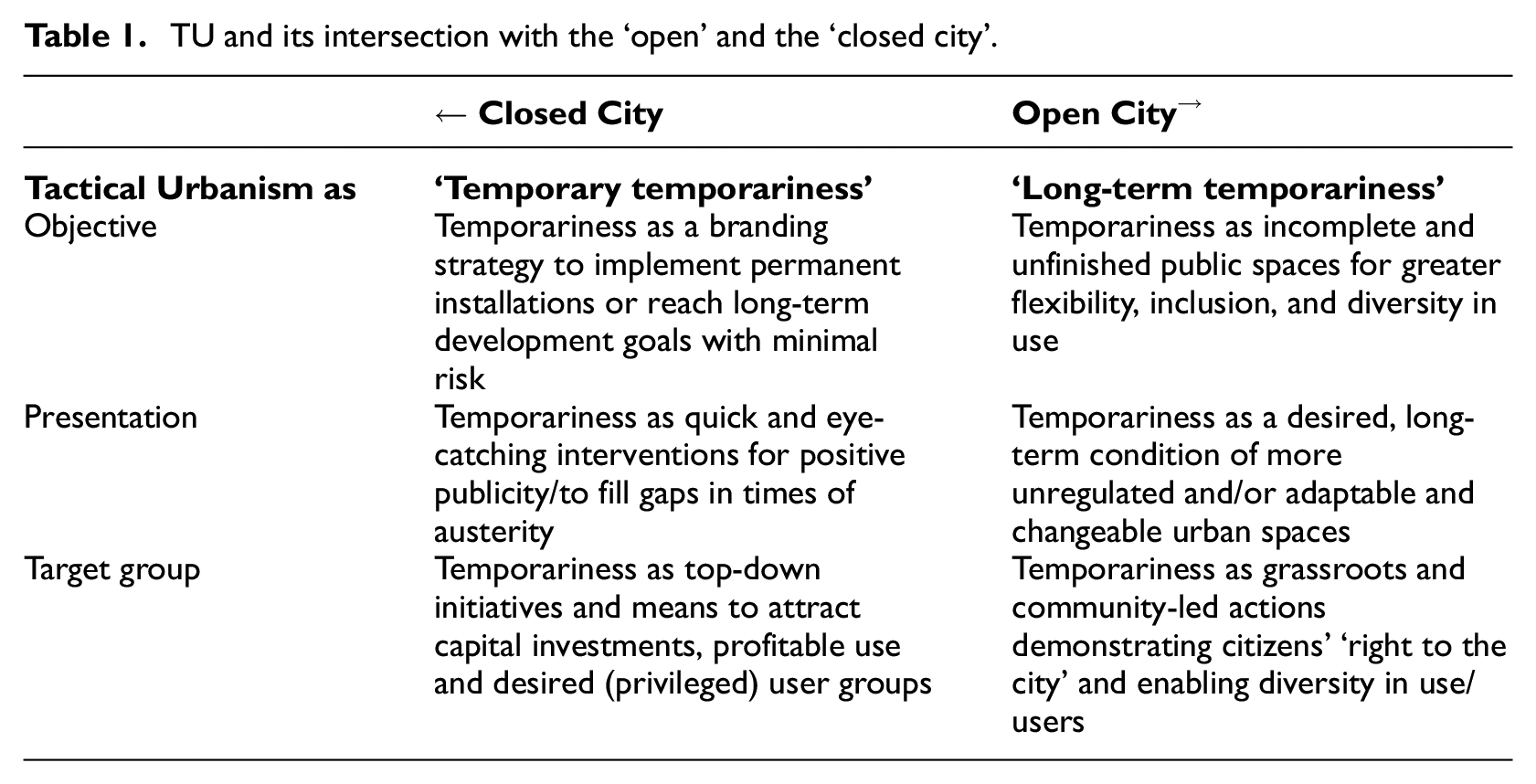
Is TU congruent with the ‘open’ and vibrant city, a city that celebrates incomplete and ‘open’ urban forms and allows spontaneous activities and diverse interactions? The answer to this theoretical question is more likely to be yes when TU projects are citizen-led and aim to create a more democratic, diverse, and equitable urban environment on the inhabitants’ premises in a dynamic and long-term perspective. The answer to the same question is more likely to be no when projects are what I refer to as ‘temporary temporariness’ and a cover or alibi for top-down (re)development agendas initiated by wealthy actors that employ TU interventions as a strategy to promote urban transformations to attract investors and desired user groups. Yet several citizen-led TU actions that could align with the ‘open city’ framework – when it comes to creating room for more flexibility and diversity – involve certain, often privileged, groups only and could potentially, without intention, lead to the marginalisation and displacement of others. Consequently, this form of exclusion indicates that TU struggles with the same democratic problem found within formal and regulatory planning systems, namely representation and inclusiveness.
As a critical urban theory, the ‘open city’ promotes an urban condition where characteristics such as experimentation, temporariness, diversity, change, and adaptation are central. The ‘open city’ has a critical understanding of our established planning systems’ focus on order and control of the urban environment. This understanding distinguishes TU’s main intentions from the ‘open city’ approach: several TU actions operate within current planning systems, but with the intention that these actions can lead to ‘long-term change’ both in planning systems themselves and in the actual results of these actions. However, the TU movement embraces rather disparate activities, which results in a wide range of actions with diverse intentions. For this reason, I argue that some TU actions are congruent with the ‘open city’ approach – contributing to an inclusive and vibrant city – whilst other TU actions result in the ‘closed city’ operating within top-down neoliberal planning strategies to brand new development, contributing to an empty shell of ‘temporary temporariness’.
Footnotes
Acknowledgements
I thank Helge Hillnhütter, Aksel Tjora, Steffen Wellinger, Per Gunnar Røe and Jarvis Suslowicz for insightful comments and suggestions on previous versions of this paper. I also thank the editors and the anonymous referees for valuable and precise feedback.
Declaration of conflicting interests
The author declared no potential conflicts of interest with respect to the research, authorship, and/or publication of this article.
Funding
The author disclosed receipt of the following financial support for the research, authorship, and/or publication of this article: This research received funding from NTNU Health, Norwegian University of Science and Technology (Grant no. 992021149).
