




Abstract
How have urban planners addressed racial equity and justice in their scholarship? Using topic modeling and qualitative text coding, this study analyzed articles from twenty top urban planning journals from 1980 to 2019. The findings indicate that only 1.8 percent of planning articles are related to racial equity and justice throughout the four decades, with a slight uptick in attention paid to these topics in recent years. The dearth of planning scholarship on these topics in high-impact journals suggests that planning, as an academic discipline, has not prioritized and centered research and teaching about racial equity and justice.
Keywords
Introduction
In 2020, the Association of Collegiate Schools of Planning (ACSP)’s sixtieth Annual Conference theme was “Racial Equity and Justice in Urban Planning Research and Education in the Face of Racialized Inequality.” The theme recognized and provided a spotlight on the importance of racial equity and justice in the field. The field of planning has long acknowledged that race and ethnicity are central to planning issues; however, Forester (2000) argued that recognition and problem identification are insufficient and asserted that planners must move beyond asking questions and strive to dismantle unjust planning practices. But, has planning scholarship sufficiently armed students, who after graduation, teach, train, and practice planning, with the knowledge and skills to address complex societal problems such as racial equity and justice to dismantle unjust planning practices?
Given the global reckoning over structural and institutional racism that occurred in 2020 and 2021 after the deaths of George Floyd, Breonna Taylor, Hyun Jung Grant, and so many more people of color, it is imperative that planning scholars take stock of how we have discussed, measured, analyzed, and reckoned with the topics of racial equity and justice in the field to offer insights into future directions for planning scholarship and pedagogy. The motivation for this research was to provide a historical examination of whether and how the planning academy has tackled complex societal issues, such as structural racism, and consequently, how published work in journals addresses how to dismantle systems and structures of oppression through planning tools.
Although there is a wide range of planning scholarship in non-journal outlets, peer-reviewed journal article publications are considered to be the most rigorous research and a reflection of esteem and stature within the planning academy. At research-intensive institutions, being tenured and/or promoted often requires substantial numbers of journal article publications. While book publications are also highly valued, it is more common that planning faculty are tenured and promoted due to their journal article publications. The purpose of this study is not to develop a comprehensive study of the planning scholarship. However, this research can serve as a starting point for discussions about scholarship on racial equity and justice in the field. It is a critical moment of global racial reckoning in our history and also a moment of maturation of the field with the availability of over forty years of articles in peer-reviewed journals to reflect and assess whether and how planning scholarship addresses race, equity, and justice.
This study specifically examined peer-reviewed articles from the most impactful planning journals to analyze four decades of planning scholarship between 1980 and 2019. Mixed-method text analyses, including topic modeling and qualitative text coding, are employed to determine the level of representation of racial equity and justice scholarship within planning journals. The two methods provide an understanding of the trends over time, major topics and subtopics in this field, the geographic scale of research, research methods employed, and the presence of articles related to racism, discrimination, antiracism, structural racism, institutional racism, and white supremacy.
In the following sections of the paper, we begin with a brief history of the planning profession’s stated commitments to racial equity and justice. Next, we review how racial equity and justice are represented in the urban planning literature. We then discuss the data collected for this study, which includes articles in twenty urban planning journals over four decades, and the descriptive results from the journals. We provide the methods employed and a discussion of the results from topic modeling and qualitative text coding. Finally, we conclude with a discussion and implications for the future of planning scholarship.
Racial Equity and Justice within the Profession
Planning associations and organizations such as the Association Collegiate Schools of Planning (ACSP), American Planning Association (APA), Planning Accreditation Board (PAB), and the American Institute of Certified Planners (AICP) have shaped pedagogy, scholarship, and practice within the planning profession and all have expressed their commitment to racial equity and justice. The ACSP, for example, expressly states that the association values including diverse voices and cultural competence in urban planning education and scholarship (ACSP 2021). The ACSP is a membership organization made up of planning schools and was founded in 1969. The association developed the first ever diversity report in 1990. The earliest report showed that two-thirds of minority and female faculty experienced discrimination in their departments (ACSP 1990). In 2009, the Planners of Color Interest Group (POCIG), a group recognized by the ACSP, conducted a survey to understand minority faculty’s perception of their campus climate. The findings revealed that planning departments often failed to retain minority faculty and create environments where faculty felt welcomed as equals (Wubneh 2009).
In the last decade, the ACSP continued to study the challenges related to diversity, equity, and inclusion by conducting three studies on faculty and student race and ethnic representation within the planning field (ACSP 2014, 2016, 2018). In 2019, the Faculty Women’s Interest Group’s workload and climate survey reported that mixed-race/other faculty (as compared with white, black, and Hispanic/Latinx faculty) and female faculty (as compared with male faculty) observed bias and/or discrimination in hiring, tenure, promotion, retention, and salary allocation with the highest rates compared with other groups (Nguyen 2019). Findings from these three studies demonstrated that racial and ethnic diversity among students and planning faculty had not improved significantly over time.
The APA, the professional association for planning practitioners and scholars, has also publicly committed to equity, diversity, and inclusion. The APA has five divisions to address equity and three divisions specifically on race: the Planning and the Black Community Division (PBCD), the Latinos and Planning (LAP), and the Tribal and Indigenous Planning Interest Group. In 1980, two years after the APA was consolidated, the PBCD began its work to foster interest, contribute knowledge, and promote cooperation for black communities (PBCD 2021). The PBCD encountered resistance from the APA, including the rejection of a white paper that guided planners on how to make structural changes to the U.S. criminal justice system for an APA policy guide (Lowe 2015). The LAP Division was formed in 2005; however, this was an arduous process for planning professionals and academics who volunteered to create a division with a very low budget (APA 2021c). The LAP specifically addresses concerns and issues that are important to Hispanic/Latinx planners and communities. The Tribal and Indigenous Planning Interest Group was formed in 2015, and a petition was signed for the division to be recognized as an APA division in 2020. The division promotes awareness, communication, and action on tribal and indigenous planning concerns and continues to grow with more members joining its LinkedIn group (Tribal and Indigenous Planning Interest Group of APA 2020).
Many APA chapters, including Illinois, Iowa, and others, have diversity committees to provide concrete resources and opportunities for underrepresented planners (APA 2021a). The New York Metro Chapter’s Diversity Committee has organized an annual conference, Hindsight, since 2017, focusing on urban planning through an equity lens (APA New York Metro Diversity Committee 2021). In the last few years, the APA also offered various tools for integrating equity into planning practices, including a policy guide for planning for equity, a knowledge base collection on social equity, a guide for diversity and inclusion vision, diversity and inclusion training, and diversity scholarships for people who need assistance to obtain their AICP certification (APA 2021b). The APA strives to recognize and expand representation by integrating diversity, inclusion, and social equity into conferences, chapters, and divisions. However, this change was a long and difficult progress and would not have been achieved without the divisions representing people of color and interest groups and their tireless work to push for change.
The PAB’s proposed accreditation standards and criteria diluted the diversity and equity elements in the 2015 standards as compared with standards in prior years. The POCIG, a group recognized by the ACSP since 2007, wrote a letter to protest these changes and modify the PAB standards. The letter stated that the new standards would not reinforce student and faculty diversity, social justice in curriculums, and diversity goals and actions (POCIG 2015). However, the PAB revised its accreditation standards and criteria in 2017 and eliminated more standards requiring knowledge, skills, and values regarding equity, diversity, and social justice that were deemed difficult to enforce. Only one requirement remained in the accreditation standards:
Equity, Diversity and Social Justice: key issues in equity, diversity, and social justice that emphasize planners’ role in expanding choice and opportunity for all persons, plan for the needs of the disadvantaged, reduce inequities through critical examination of past and current systems and disparities, and promote racial and economic integration. (Planning Accreditation Board 2017, 11)
The document included diversity categories for students, faculty, and curriculum. However, there was no guidance on how to enforce diversity outcomes concretely. The POCIG prepared a letter on January 10, 2021, like in 2015, to suggest necessary changes for the upcoming PAB standards. The letter, which included more than 202 signatories from the planning academy, criticized the 2017 PAB accreditation standards and criteria for having outdated conceptualizations and categories for diversity and also urged the PAB to recruit more faculty of color site visitors that review and accredit schools (POCIG 2021).
Central to urban planning’s code of ethics, as prescribed by the AICP, is for planners to
… seek social justice by working to expand choice and opportunity for all persons, recognizing a special responsibility to plan for the needs of the disadvantaged and to promote racial and economic integration. (AICP 2021)
Thus, addressing racial equity and justice is vital to the planner’s code of ethics. However, a major challenge in tackling racial equity and justice is a lack of shared understanding of language and concepts. Thomas (2008, 228) asserted that definitions of race are ambiguous in terms of biology but are “a powerful concept because of a cultural reality”. Although race is a social construct that evolves over time, race continues to remain a dominant organizing principle in U.S. cities due to the deeply rooted history of racial segregation (Thomas 1994). The call to arm planners with knowledge about justice, equity, diversity, and inclusion in the planning profession has been persistent throughout all the major planning professional associations and organizations; however, questions remain about whether the field has made significant inroads in tackling these complex issues and advancing our collective understanding of how to address them.
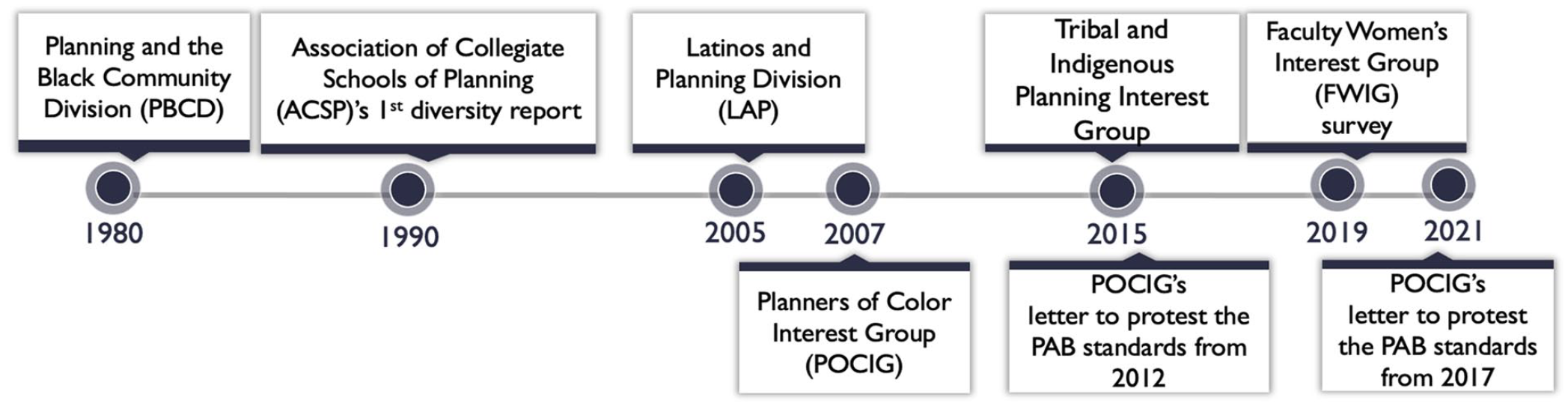
Timeline of milestones for racial equity and justice within the planning professional organizations. (Planning and the Black Community Division 2021;
Urban Planning Literature on Racial Equity and Justice
While the planning professional associations have recognized the need to pay attention to justice, equity, and diversity, so too has urban planning scholarship. Catlin (1993) analyzed articles in three journals, Journal of the American Planning Association (JAPA), Planning, and Urban Affairs Quarterly, from 1955 to 1989, to examine articles that covered black communities in their titles or subjects between 1965 and 1974. He indicated the increase of articles on black communities was the result of the JAPA’s 1969 issue focused on the relation between black communities and the planning processes, which included Stafford and Lander’s “Comprehensive Planning and Racism” (p. 27). Another reason for the increased interest can be attributed to Davidoff’s (1965) JAPA article, “Advocacy and Pluralism in Planning,” which emphasized the need to include marginalized stakeholders in the planning process and briefly addressed racial and social injustices. Catlin’s analysis showed that research focusing on black populations and issues waned considerably after 1974 and returned to a similar percentage as in the early 1960s.
An examination of the planning theory literature indicates that significant attention was paid to advocacy or equity planning (for underrepresented populations), and articles on these topics increased from 1979 to 2009 (Klosterman 2011, 321). While significant attention in planning theory in the 1960s and 1970s was focused on advocacy and equity, explicit discussions about race or structural inequality were not necessarily central to this scholarship. Instead, this body of work emphasized the role of planners to be the voice for the voiceless and underserved, to represent the communities that are typically left out of the planning process due to lack of power, and to promote equitable outcomes, not only equitable planning processes (Davidoff 1965; Krumholz 1972; Krumholz, Cogger, and Linner 1975).
Departing from the race-neutral or absent discussions within advocacy and equity planning, June Manning Thomas’s scholarship squarely emphasized the centrality of the black urban experience in shaping U.S. cities. Her work highlighted the black urban experience after World War II in U.S. cities, critically examined the planning literature and pedagogy on race, and explored the role of minority-race planners (Thomas 1994, 1996, 1997a, 1997b, 2008). Thomas’s (1997a) report on planning literature on race, racism, and race relations included an exhaustive list of articles about race, racism, and race relations in urban planning, with most of the articles published in the 1990s. The report also had a significant number of articles in the area of housing and neighborhoods, covering the topics of land use and zoning, redlining, segregation, and community development. The findings showed that the 1990s articles on race are primarily in housing and neighborhoods. Thomas’s writings brought race to the forefront of planning scholarship and offered the field guidance on the importance of centering the black urban experience and race within planning.
Over the past four decades, the field of urban planning has grown, and urban planners’ research topics have broadened and diversified. As a result, a number of scholars have conducted topical scans of the field of urban planning to assess the state of disciplinary knowledge. Gobster (2014), for example, analyzed four decades of landscape planning and identified hot topics, such as landscape dynamic, heterogeneity, urban ecosystem, green space, and others. Fang and Ewing (2020) reviewed 1,463 research articles from three major journals—JAPA, Journal of Planning Education and Research (JPER), and Journal of Planning Literature (JPL)—and identified fourteen major themes in planning. These included: planning processes, planning methods, plan implementation, community planning/involvement, public finance, economic development, sustainability, neighborhood planning, land use, growth management, urban design, housing, planning education, and transportation. Using a supervised machine learning approach, Sanchez (2020) classified different themes in planning literature by using planning faculty profiles’ Google Scholar citations. What is noticeably absent from all of these recent scans of the planning field are topics and themes related to racial equity and justice. They may be embedded in other topics but do not appear to stand alone.
Data Collection
To examine the treatment of racial equity and justice in urban planning scholarship, this study employed topic modeling, an unsupervised machine learning technique, and qualitative analysis of text. The articles culled for this study were identified using titles and abstracts of published peer-reviewed articles in twenty major urban planning journals from 1980 to 2019 related to racial equity and justice. Topic modeling was used to analyze abstracts to determine the different topics that planning scholarship has addressed racial equity and justice in the past four decades. Moreover, the qualitative analysis allowed us to understand the racial equity and justice articles’ subfields, scale of the unit of analysis, research methods employed, and others.
To assemble the data, a two-step process was employed to select the highest impact journals and then pertinent articles within those journals. First, peer-reviewed journals were selected from the Web of Science Core Collection, a database of citations on research articles from more than 21,419 journals, books, and conference proceedings in various fields under the categories of “Urban Studies” and “Urban and Regional Studies.” Electronic databases, such as the Web of Science database, are commonly used for literature searches due to the abundant coverage of articles within the dataset (Xiao and Watson 2019). The initial search resulted in a total of sixty-five journals. Next, we further narrowed down the list by including only journals that had impact factors greater than 1.0 in 2018 (“InCites Journal Citation Reports” 2020). This resulted in choosing the following twenty of the most impactful urban studies and planning journals: Landscape and Urban Planning, Cities, Planning Theory, Urban Studies, International Journal of Urban and Regional Research, JAPA, JPER, European Urban and Regional Studies, Planning Theory & Practice, JPL, European Planning Studies, Urban Affairs Review, Housing Studies, Housing Policy Debate, Urban Policy and Research, Journal of Housing and the Built Environment, Housing Theory & Society, Journal of Urban Planning and Development, Journal of Urban Affairs, and City & Community. 1 It may be the case that lower impact planning journals publish more racial equity and justice articles; however, more research should be conducted to determine whether this is true.
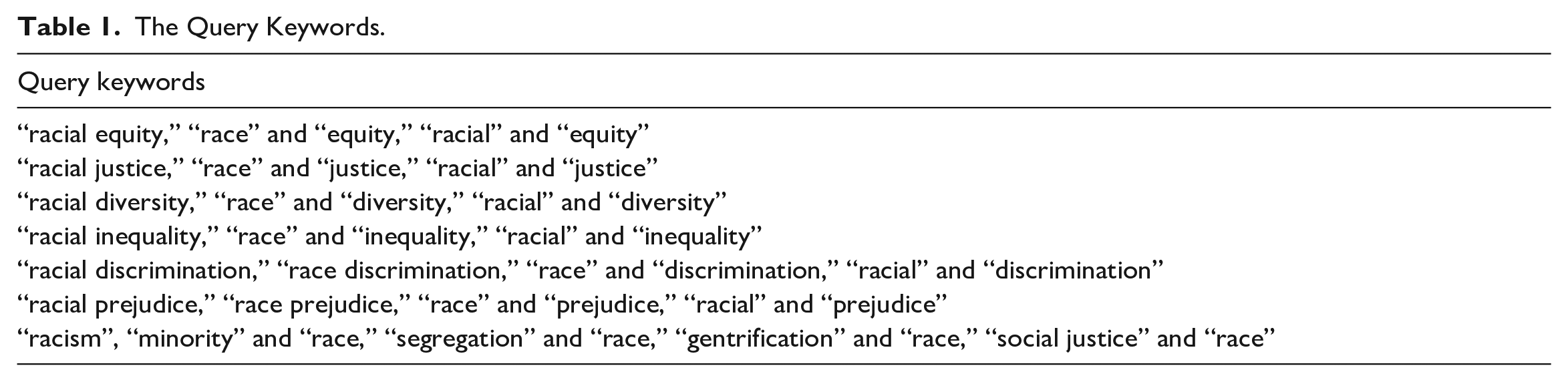
To select articles on racial equity and justice among the twenty journals, we searched the keywords race, (in)equity, justice, discrimination, and prejudice and different combinations of these keywords (see Table 1). These terms were selected after applying and adjusting multiple terms on the comprehensive database. Although the search is confined to these terms, these terms produced a sufficient number of articles that were narrowly focused on racial equity and justice to analyze. We acknowledge that the query may miss some articles related to racial equity and justice, and that our dataset is limited to the Web of Science database; however, this study provides a foundation for future studies to build on. 2
The Query Keywords.
Descriptive Results from Four Decades of Racial Equity and Justice Articles
Between 1980 and 2019, 36,160 articles were published in the twenty journals included in this study. Among the 36,160 articles, we identified 652, including original research articles, book reviews, comments, and replies, 1.8 percent of total articles that were related to racial equity and justice using the Web of Science Core Collection. As shown in Figure 2, from 1980 to 2019, planning scholarship has focused very little on racial equity and justice. However, there appears to be a marginal increase in the number of articles on these topics over the forty years. Specifically, the percentage of articles on these topics in 1998 was 1.8 percent, in 2004 was 2.6 percent, and in 2016 was 3.0 percent. There was a noticeable spike in 1998, which can be explained by several articles reviewing Thomas Sugrue’s The Origins of the Urban Crisis written in 1996. Another noticeable increase in articles occurred in 2004 and can be attributed to a number of articles related to the fiftieth anniversary of Brown v. Board of Education of Topeka. Another spike in articles occurred in 2016 when several articles relating to gentrification and environmental justice emerged as key research topics related to racial equity and justice. In 2019, the percentage of racial equity and justice articles was 4.3 percent (109 articles), the highest in four decades and more than three times the number of articles in 2017 (34 articles). In addition to having the greatest number of articles on these topics in 2019, the variety of topics that address racial equity and justice also diversified.
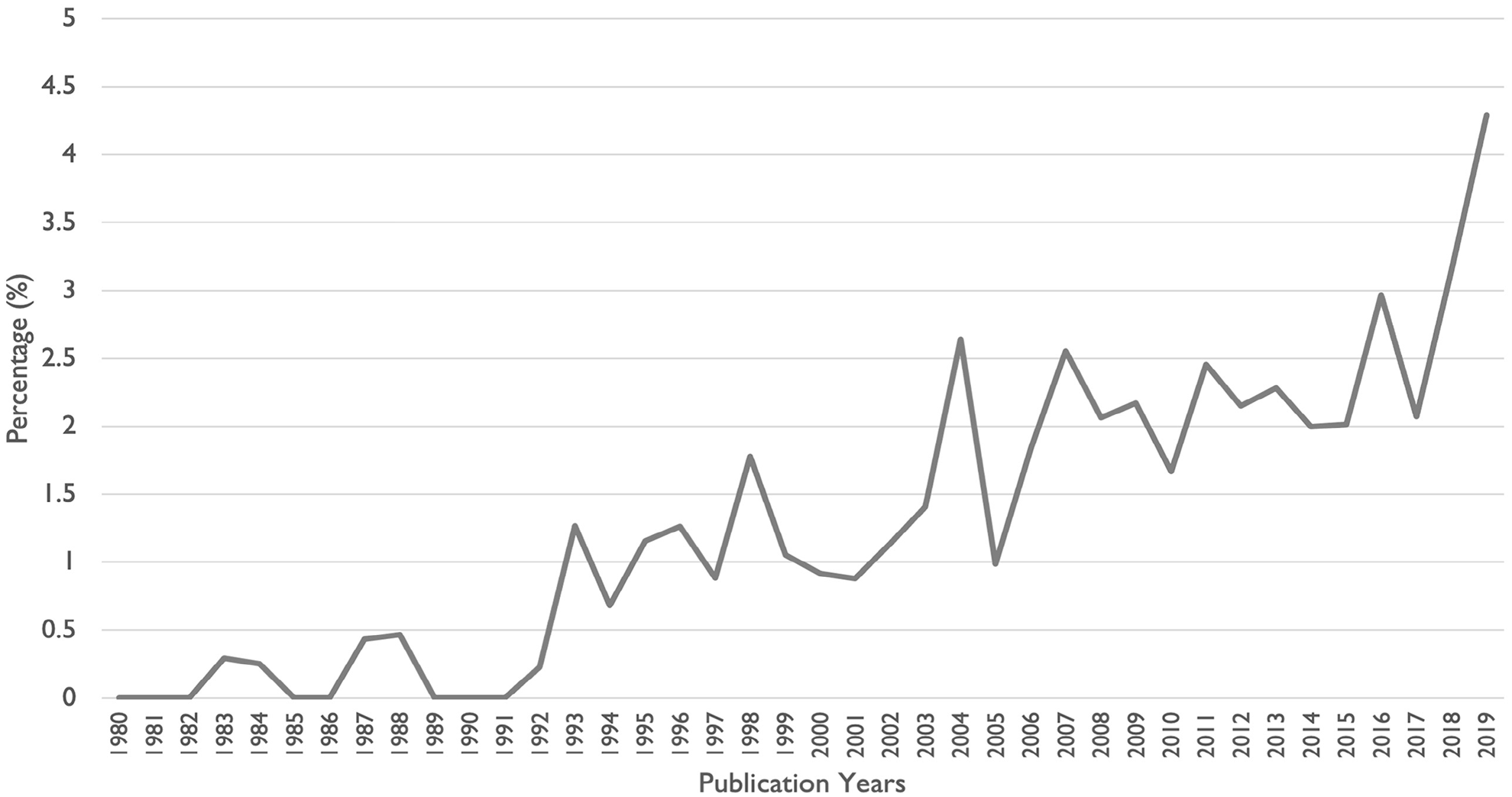
Percentage of racial equity and justice articles in twenty urban studies and planning journals from 1980 to 2019.
Among the twenty urban studies and planning journals, five out of the twenty journals contained over 70 percent of racial equity and justice articles. Urban Studies (115 articles) and Urban Affairs Review (108 articles) had more than a hundred articles over the four decades. Among the top ten journals with the most racial equity and justice articles were: Urban Studies, Urban Affairs Review, Journal of Urban Affairs, City & Community, Housing Policy Debate, Housing Studies, International Journal of Urban and Regional Research, JPER, JAPA, and Cities. Overall, the twenty planning journals did not equally contribute to the 652 articles on racial equity and justice articles.
Data and Methods
Distant Reading Method: Topic Modeling with Latent Dirichlet Allocation
Computational tools are attuned to analyze text at an unprecedented scale, allowing for the batch analysis of entire literary styles, genres, and eras through a “distant,” computational lens (Moretti 2000). Moretti defined distant reading as “a condition of knowledge,” which enables readers to focus on different scales of the text, including microscopic and macroscopic ranges. Analyzing text as information and also as big data, this abundance of data gives rise to new relations for making meaning. Distant reading of articles can offer new insights into the past four decades of scholarship on racial equity and justice in planning. Therefore, topic modeling was used to analyze titles and abstracts to determine the different topics that planning scholarship has addressed racial equity and justice in the past four decades.
Topic modeling uses a generative probabilistic model, which sorts keywords and generates themes, to group sets of data by topics (Blei, Ng, and Jordan 2003). It uses topics that are the latent variables between documents and words, assuming that topics have a distribution over words, and documents have a distribution over topics (Blei 2012). The basis of this understanding is essential that documents are a mixture of topics, and topics are a mixture of words. Latent Dirichlet allocation (LDA) method is a common topic modeling method in natural language processing. LDA is an unsupervised machine learning method that does not require training data labeled by researchers. Research-labeled data can produce an unintentional bias in the grouping process (Silge and Robinson 2020). LDA groups the words into sets in an iterative and generative process and does not label the topics or themes of the word set (Silge and Robinson 2017, 93). LDA is proven to be a useful topic modeling method because it does not assume any distance measure between topics but instead considers that documents are composed of a mixture of topics. 3 The advantage of unsupervised machine learning methods is that it can handle large and complicated unknown data without bias.
Furthermore, the study used topic modeling with the coherence score to identify the appropriate number of topics to optimize the topic modeling process. In topic modeling, a set number of top topic words are said to be coherent if the words describe the same topic well. The coherence score calculates how well the chosen topic is shared across its top words by calculating aggregated pairwise co-occurrence probabilities (Röder, Both, and Hinneburg 2015). Then, the coherence scores of all topics are aggregated, becoming the aggregated coherence score. The aggregated coherence score over a corpus varies with the number of topics, and the optimal number of topics is the number that maximizes the score. Conceptually, the measure tries to increase similarity (homogeneity) among documents within topics and increase dissimilarity between topic document groups. 4 Observing the results of the coherence score and undergoing trial and error, the analysis showed that an ideal number of topics was eight.
We used topic modeling and qualitative coding with keyword frequencies, titles, and abstracts of published papers related to racial equity and justice in twenty high-impact journals from 1980 to 2019 to observe trends in different decades. Titles and abstracts were sufficient topical summaries of articles for the majority of articles, and they are a good source for finding latent topics. We used a keyword search in the twenty journals and found 652 relevant articles. The articles’ titles and abstracts were aggregated by issues, years, and journals together. After the aggregation, the raw text is cleaned. One of Python’s libraries, the Natural Language Toolkit, which is widely used with text mining, was used for text cleaning (Bird, Klein, and Loper 2009; Kwon and Kwon 2017). First, texts underwent tokenization (splitting sentences into words, changing words to lowercase, and removing punctuation, etc.). Second, stop words (e.g., “a,” “the”) were removed. Third, lemmatization, a process of removing words’ affixes, letters that are attached to the root of the word (Affix 2021), such as changing cities to city, is done, and the text is now cleaned. With the correlation of a word’s frequency to its size and color gradation for readability, Figure 3 shows a total of 7,588 words. The text analysis shows that “neighborhood” is the most frequently appeared word in the articles. The different words offer an overview of the common trends in the articles. Finally, the words undergo topic modeling.
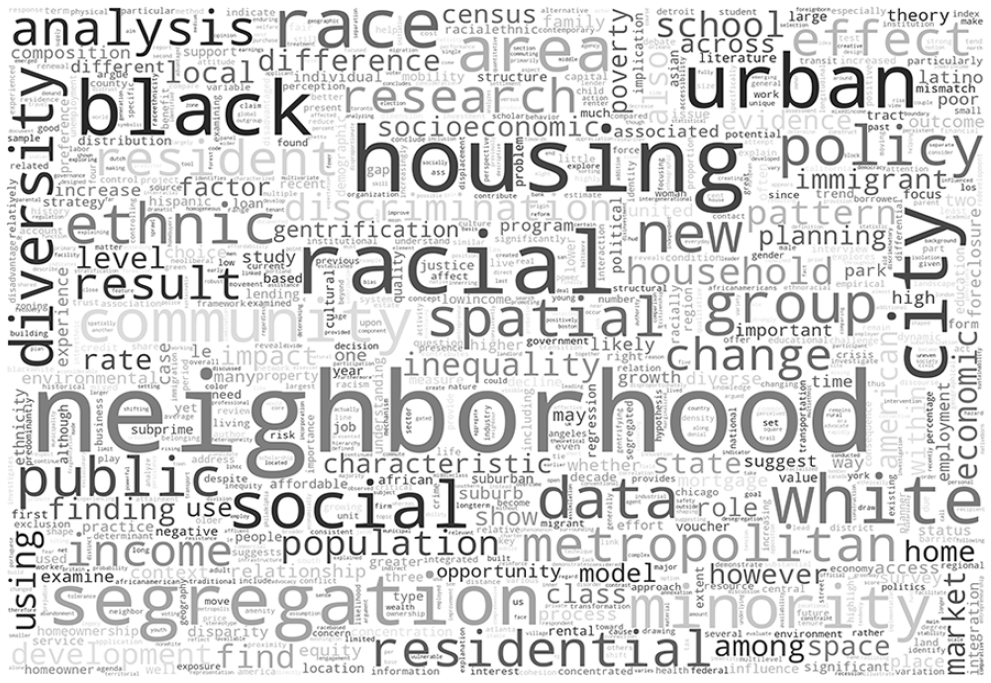
The top 1,000 words from racial equity and justice articles over forty years in planning.
Close Reading Method: Qualitative Coding
While topic modeling offers insight into the different topics found in the articles, we conducted a close reading of the text through qualitative coding to carefully observe text elements that are not apparent, which is needed with distant reading (Underwood 2016). We found 652 relevant articles in the initial step of the topic modeling. However, only including original research articles and excluding book reviews, comments, and replies narrowed down the list of articles to 617. The research team developed a coding scheme using a set of deductive and inductive codes. The PI and graduate research assistant developed a coding manual with an a priori set of codes based on a review of the literature. Then, two research assistants were trained to use the coding manual. The research team randomly selected twenty articles to pilot the coding scheme. After coding the twenty articles, the research team discussed all discrepancies, reconciled the discrepancies, and collaborated on revising the coding manual. The research team met after several rounds of coding to discuss whether new common themes emerged from the coding and revised the coding based on new information. We tested for intercoder reliability and found concordance on 583/617 of the articles in the initial coding (Cho 2008). Any discrepancies were resolved by reviewing the full articles and coming to an agreement by the coders.
The qualitative coding allowed us to better understand what subfields within planning are more likely to conduct research on racial equity and justice. We classified the subfields as: housing and community, economic development, land use policy and governance, transportation, environmental planning, food systems, health, education, gender and sexuality, smart cities and data analytics, politics, methods, planning theory, planning history, and planning education, pedagogy, and practice (some articles include one or more subfields). Moreover, we coded for the scale of the unit of analysis, research methods employed, whether the study explicitly addresses racism and/or discrimination as opposed to only examining race and/or racial outcomes, whether the study addressed structural or institutional racism, and whether the study explicitly names white supremacy. The results offered guidance on how future research can fill gaps within the literature on racial equity and justice.
Results
Topic Modeling Results: Eight Dominant Topics in Racial Equity and Justice Articles
We used topic modeling to analyze 652 titles and abstracts of articles related to racial equity and justice, and the results classified the subject matter of each article into eight main topics (see Table 2). Topic modeling groups words that are commonly found in sets of articles. The keywords and the individual articles’ probabilities of falling within a topic enable the creation of different topics. We labeled each of the eight topics according to our interpretation of the keywords, as listed in Table 2. Topic 1 can broadly be categorized as housing discrimination and segregation. One article that fits within this topic is Moore’s (2016) “Lists and Lotteries: Rationing in the Housing Choice Voucher Program” with 98.5 percent fit with topic 1 shown in Table 2. Topic 2 relates to opportunity neighborhood and was composed of these keywords: neighborhood, urban, black, social, racial, area, housing, metropolitan, white, city, inequality, race, level, income, analysis, employment, spatial, data, trust, and job. Acevedo-Garcia et al.’s (2016) “Neighborhood Opportunity and Location Affordability for Low-Income Renter Families.”
Eight Main Topics Related to Racial Equity and Justice in Urban Studies and Planning Journal Articles.
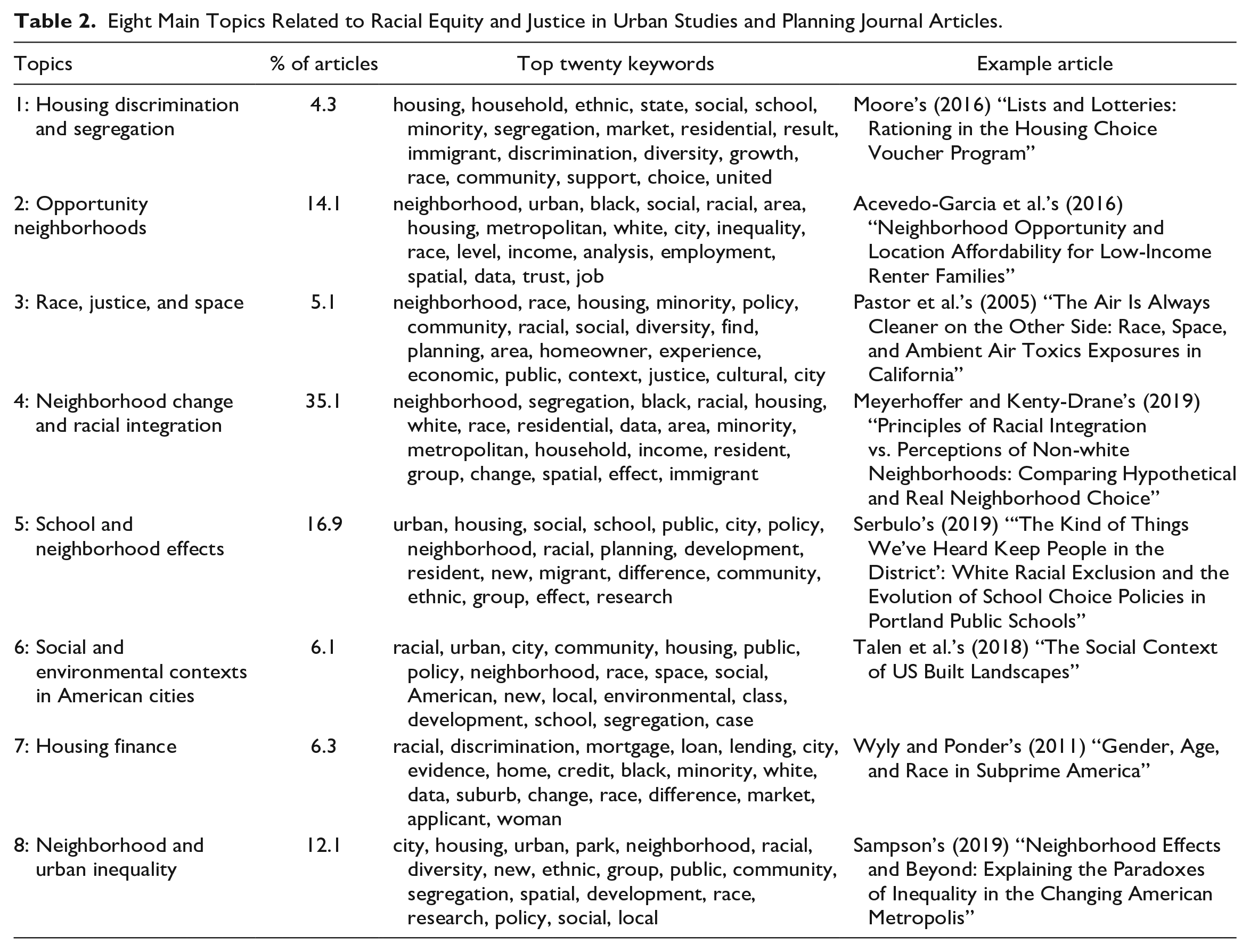
Topic 3 consisted of words describing race, justice, and space. Pastor et al.’s (2005) “The Air Is Always Cleaner on the Other Side: Race, Space, and Ambient Air Toxics Exposures in California” is one representative example of topic 3. Topic 4 was a mixture of words related to neighborhood change and racial integration. Meyerhoffer and Kenty-Drane’s (2019) “Principles of Racial Integration vs. Perceptions of Non-white Neighborhoods: Comparing Hypothetical and Real Neighborhood Choice” is an article in topic 4. Topic 5 included words such as housing, school, public, city, policy, and neighborhood. Serbulo’s (2019) “‘The Kind of Things We’ve Heard Keep People in the District’: White Racial Exclusion and the Evolution of School Choice Policies in Portland Public Schools” is an article in topic 5. Topics 4 and 5 included the majority of articles, comprising 35.1 and 16.9 percent of all articles, respectively, and both topics are closely affiliated to housing scholarship.
Topic 6 included racial, urban, city, community, housing, public, policy, neighborhood, race, space, and others, which relate to social and environmental contexts in American cities. Topic 7 comprised words related to housing finance and urban neighborhoods and included Wyly and Ponder’s (2011) “Gender, Age, and Race in Subprime America.” An example of topic 8 was Sampson’s (2019) “Neighborhood Effects and Beyond: Explaining the Paradoxes of Inequality in the Changing American Metropolis,” which described neighborhood and urban inequality topic. All eight topics identified in the topic modeling included scholarship on housing and/or community development.
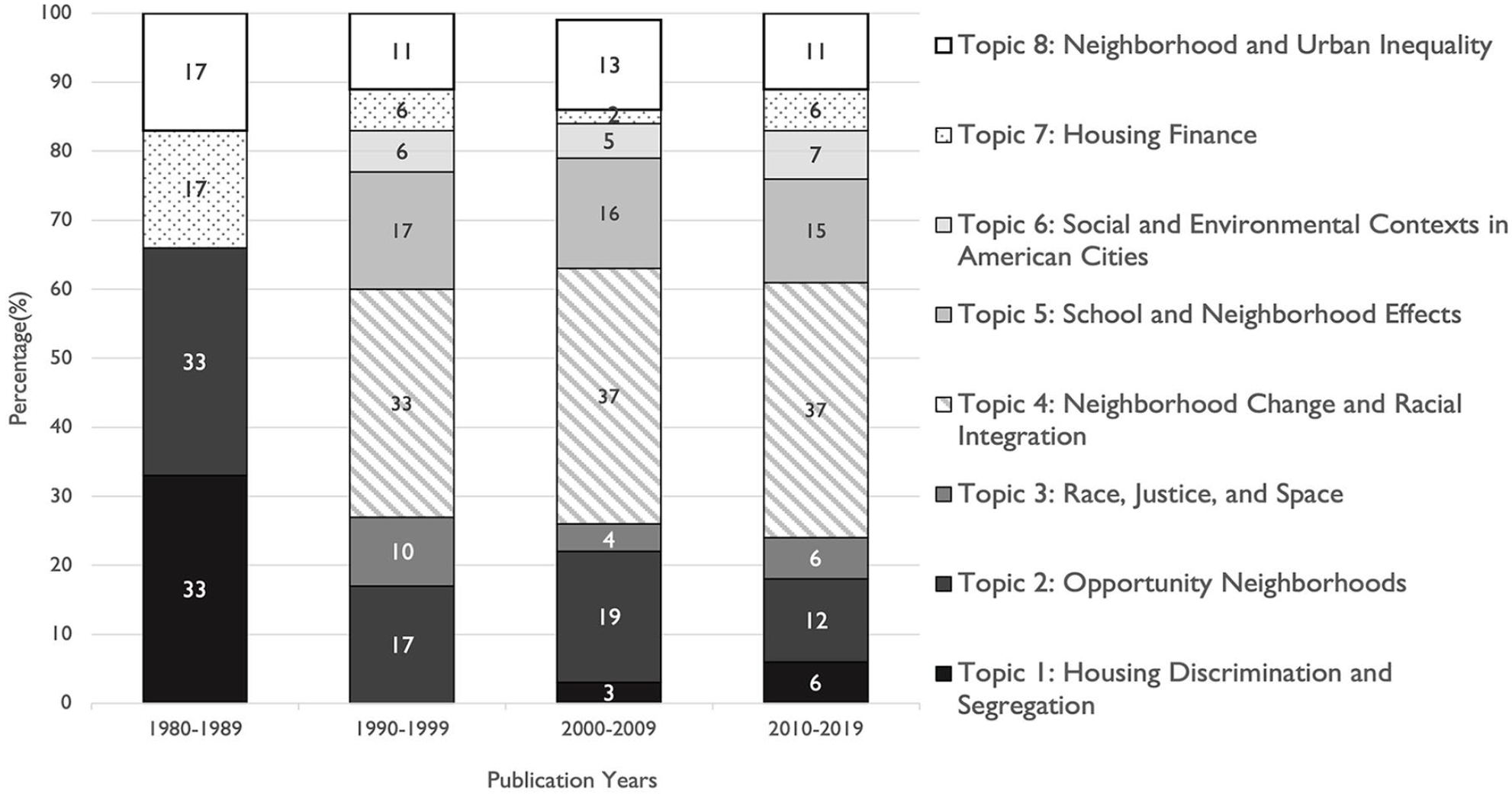
The topic modeling results also revealed that the prevalence of articles within each topic category changed throughout the four decades of the study (see Figure 4). During the first decade, articles related to housing and neighborhood dominated. From 1980 to 1989 of the six articles, four were included in topics 1 (housing discrimination and segregation) and 2 (opportunity neighborhood). However, housing discrimination and segregation only represented a small portion of the articles in the next three decades. From 1990 to 1999, topic 3 (race, justice, and space), topic 4 (neighborhood change and racial integration), topic 5 (school and neighborhood effects), and topic 6 (social and environmental contexts in American cities) started to appear more often in the racial equity and justice literature. Topic 2 (opportunity neighborhood) and topic 8 (neighborhood and urban inequality) consistently have a portion from 1980 to 2019.
Distribution of eight main topics from 1980 to 2019.
The prevalence of topic 4 (neighborhood change and racial integration) increased from 1990 to 2019 and continues to be a dominant topic. From 2000 to 2009, all eight topics are prevalent and topics 2 and 4 are the most dominant. Over the years, the number of articles within all topics increased, with more diversity across topics. The results from the topic modeling reveal: (1) a consistent but modest upward trajectory of scholarship on racial equity and justice over the four decades and (2) the majority of articles about racial equity and justice were related to housing and neighborhoods. These topic changes reflect how the racial equity and justice scholarship has grown and changed. While we can document the trends and patterns of articles over time, our study does not address what explains these changes. There has been a slight increase in faculty of color in the planning academy over time, which may contribute to interest in studies on race; however, there were only slight increases in black or African American faculty (1%) and Asian faculty (3%) over time, as documented in ACSP’s (2018) report on race, ethnicity, and foreign origin. In the next section, we further examine racial equity and justice scholarship with urban planning using qualitative coding.
Qualitative Coding Results
Consistent with the topic modeling results, the qualitative analysis revealed that housing and community development was the dominant subfield within planning that addresses racial equity and justice. There were 396 articles relating to housing and community, which was over half of the total articles. The other top subfields were economic development with 92 articles, land use policy and governance with 47 articles, and environmental planning with 35 articles, as shown in Figure 5. One explanation for the concentration on housing and community development is due to the United States’ long housing history of racial injustice with residential segregation, mortgage markets, neighborhood spatial change due to gentrification, and others, as the topic modeling results suggested. Housing has played a large part in planning history to intensify racial injustice. The municipality that a person’s housing is located in influences their access to education and basic services, such as safety, street, and sewer maintenances (Gordon 2020, 51–79). The basic services are the most fundamental elements that impact peoples’ living. Therefore, more research in housing and community can result from focusing on people’s primary needs.
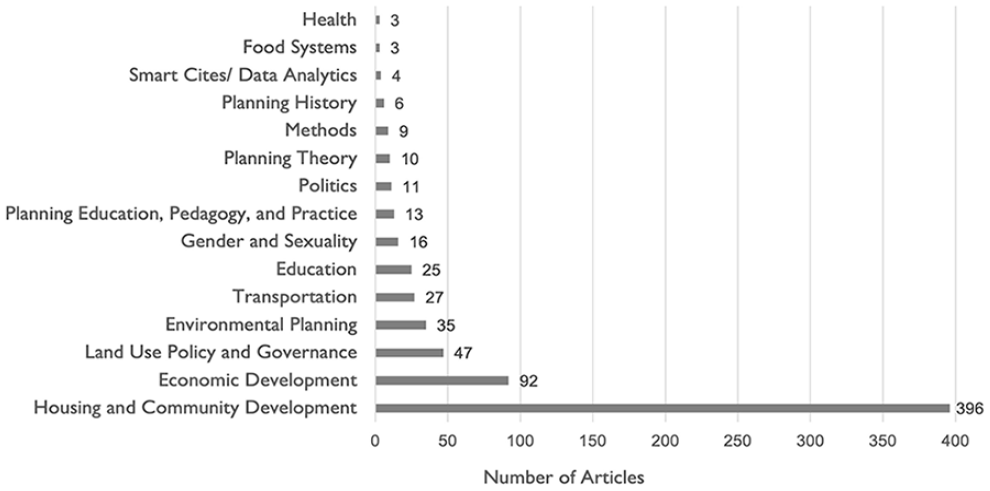
Racial equity and justice articles by planning subfields, 1980 to 2019.
Our study also examined the scale used to study racial equity and justice and found that the most frequent scales studied were the neighborhood (180 articles), city (138 articles), and metropolitan or regional (93 articles) scales (see Figure 6). A large number of housing and community development articles analyze the neighborhood scale in their studies. Furthermore, the research methods employed in these studies were mostly quantitative (64%), with fewer using qualitative methods (19%; see Figure 7). Quantitative analyses commonly used census data and longitudinal data. Studies using qualitative methods often involved interview data of individuals in a neighborhood or city. Other methods made up a small amount of the 617 articles, including Medford’s (2004) “Housing Discrimination in US Suburbs: A Bibliography.”
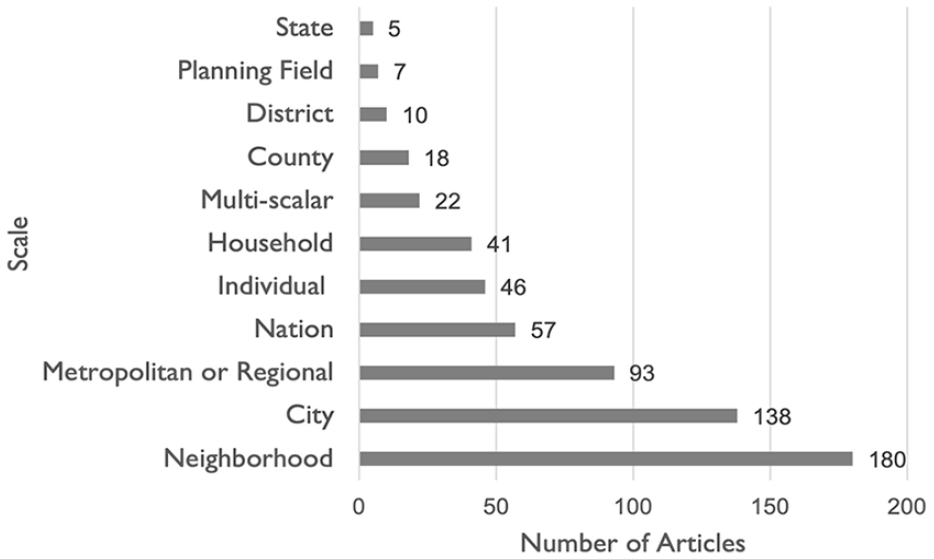
Scale of study in racial equity and justice articles, 1980 to 2019.
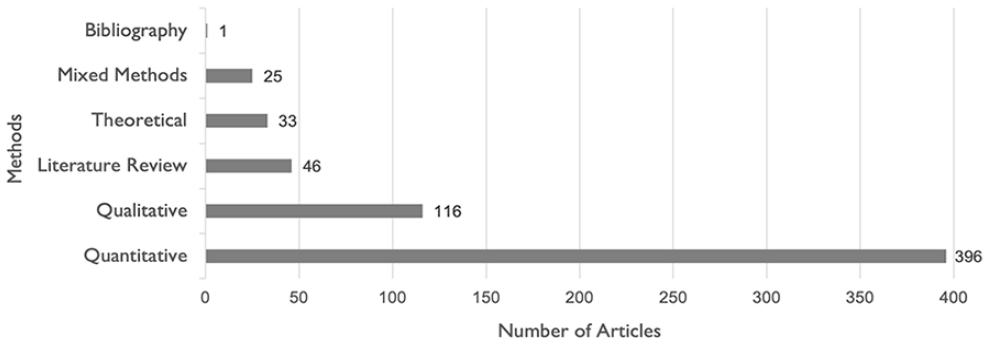
Research methods used in the literature of racial equity and justice from 1980 to 2019.
Next, we were interested in knowing whether racial equity and justice articles specifically addressed racism, discrimination, antiracism, structural racism, institutional racism, and white supremacy. The qualitative analysis revealed that racism, discrimination, or antiracism was mentioned in 15 percent of the articles. Moreover, structural or institutional racism is discussed by only 5 percent. An example that mentioned discrimination at the individual and structural level is Douglas Massey’s “Riding the Stagecoach to Hell: A Qualitative Analysis of Racial Discrimination in Mortgage Lending.” The article applied qualitative coding on 220 documents from the fair lending lawsuits to find evidence of individual discrimination, structural discrimination, and potential discrimination in mortgage lending practices (Massey et al. 2016). White supremacy was rarely mentioned in planning scholarship, with only three articles or less than 1 percent discussing this topic. These results suggest that the scholarship within the field of urban planning has not paid serious attention to understanding and addressing racism, structural racism, and white supremacy.
Discussion and Implications
Urban planning, as a professional field, has attempted over the last four decades to elevate conversations about racial justice and equity, diversify the profession with more students and faculty of color, support interest groups for planners of color, and center justice within the AICP code of ethics. However, is planning scholarship reflective of these aspirations espoused from planning professional organizations, and does the available research and scholarship equip planning students with the knowledge and skills to address complex societal problems such as racial equity and justice? Our results show that the literature to date on racial equity and justice within top urban studies and planning journals is sparse, which suggests that the scholarship in the field is not aligned with the profession’s stated goals. Racial equity and justice are not core topics within planning but instead marginalized and relegated to a few subfields, particularly housing and community development. Therefore, students and scholars specializing in other subfields of urban planning may not be exposed to the scholarship on racial equity and justice unless they actively seek it out.
Given the current moment in which we are facing a global racial reckoning and recognition of systemic racism, research on racial justice and equity is absolutely essential and urgent in planning schools. The research that is produced within the field also shapes pedagogy. For example, Sen et al.’s (2017) review of a hundred North American planning schools’ syllabi from 2012 to 2013 identified only a small percentage of diversity and social justice articles from planning journals. Sen and colleagues found that planning schools often relied on resources from other disciplines, including geography, urban studies, and American studies, to supplement the planning content (p. 356). Klosterman’s (2011) thirty-year review of planning theory pedagogy showed that race/diversity was missing in the 1970s and 1980s and only started to emerge in 1999.
Similarly to Thomas (1996), Jackson et al. (2018) argued that planning departments should reform the planning curriculum to integrate diversity and social equity and further state the need for representing diverse populations in students and faculty. Lung-Amam et al. (2015, 341) also noted that planning pedagogy should teach diversity and equity to foster a generation of equity and advocacy planners. Goetz, Williams, and Damiano’s (2020) research showed the social construction of whiteness significantly influenced planning research. However, the paucity of planning scholarship on racial equity and justice over the forty years of this study limits planning educators’ ability to deeply embed these topics within teaching.
The body of peer-reviewed planning scholarship is a reflection of the field’s research and educational priorities and foci, which shapes planning curricula and teaching. If dismantling racial inequity and injustice is the goal of planning, the dearth of planning scholarship on these topics suggests that planners have not been armed with the knowledge and skills necessary to accomplish this goal. Both planning scholarship and pedagogy have sidelined and marginalized racial equity and justice topics. As a result, students who become future planning practitioners and educators are ill-equipped to address racial equity and justice in the field of planning.
Learning from the past and incorporating this knowledge into how we plan, build, and design equitable cities of tomorrow contribute to reducing biases existing in a planning system and ameliorating racial segregation and inequality. The planning scholarship and profession must center these topics and develop a more robust understanding of how structural racism and inequality shape cities. Planners in all specialization areas should pay greater attention and increase the depth of research on racial equity and justice as these topics should not be siloed in housing and community development.
Our study was limited to published articles over four decades in the top twenty journals according to the Web of Science database. Future research could be more expansive by analyzing published peer-reviewed publications by planning academics inside and outside of planning journals. If planning scholars who work on racial equity and justice are submitting their research to nonplanning venues, we need to learn more about why they are doing so. Could the reason why planning scholarship lacks representation of research about race, equity, and justice be due to epistemic exclusion, which keeps the underrepresented scholars and research methods that are relevant to a topic from being published? In a discussion about the need to restructure the National Institutes of Health, Hekler, Anderson, and Cooper (2022) argue that epistemic exclusion occurs when certain types and topics of research become trustworthy and used as the standard by which to distribute research funding, thereby systematically favoring some perspectives and methods over others. This becomes a gatekeeping method for what is deemed worthy of the scholarship.
The field of planning must critically assess why there is a paucity of peer-reviewed journal articles on the topic of racial equity and justice despite the profession’s public recognition of the need for scholarship and action in this area. Future research could examine whether there is a sufficient amount of research funding, who is making decisions about allocating research funding, the racial and ethnic composition of faculty and leadership (e.g. academic and editorial board leadership), and how the planning curriculum adequately prepares future scholars to address these topics through other methods such as interviews. Otherwise put, does epistemic exclusion of research on racial, equity, and justice exist within planning?
The planning academy must fix the system and structures that perpetuate exclusionary scholarship to promote more and richer racial equity and justice scholarship. One step in this direction is the new journal on Race, Ethnicity, and the City created by the Urban Affairs Association. After careful market research, the staff and governing board determined that there was a market gap in scholarship related to these topics. One way for journals to encourage more scholarship and publication of racial equity and justice is to diversify the editorial board and solicit writing from scholars actively working on these topics through invited essays, editing special issues, or submitting original manuscripts. In addition, the national planning associations, ACSP, APA, and PAB, should incorporate a racial equity lens within their entire organization and not outsource or sideline the hard work of racial equity and justice to committees, interest groups, or divisions.
Footnotes
Acknowledgements
The authors thank Morgan Edmonds, Maria Cuenca, and Kathy Uber for their work on qualitative text coding.
Declaration of Conflicting Interests
The author(s) declared no potential conflicts of interest with respect to the research, authorship, and/or publication of this article.
Funding
The author(s) received no financial support for the research, authorship, and/or publication of this article.
