



Abstract
Studio courses are a common way to teach problem-based and applied skills in the field of urban and regional planning. In this article, we reflect on the experiences from a planning studio course that builds on the idea of gradually increasing student autonomy, peaking in the final phase of the course when the whole class self-organizes the content and delivery of a strategic plan. We term this approach “collaborative student-led learning,” arguing that it enables students to learn subject-related knowledge and skills related to communication, organization, and negotiation, while also supporting students’ personal and professional growth and identity development.
Introduction
Studio courses are a common setting for simulating planning practice in urban and regional planning curricula. Students are presented with a complex task (or several sub-tasks), which often relates to a real-life planning problem. Over the course of several months, students iteratively and creatively develop a response to this problem, typically individually or in small groups. While the idea of the studio originates from design-oriented disciplines such as architecture (Long 2012), course work in planning studios can take a variety of forms, including plans, design proposals, or policy documents.
Studios are designed to provide a hands-on learning experience and to bridge the gap between theory and practice, by enabling students to synthesize what they have learned in other less applied courses (Németh and Long 2012; Pojani et al. 2018). Studio courses are thus an example of student-centered and problem-based learning and differ significantly from many other forms of conventional classroom teaching. Neuman (2016) describes studio courses as “perhaps the most challenging and most rewarding environment for actively engaging learners in the practice of place-based problem solving” (p. 596). He also acknowledges the complexity associated with these courses, stemming from their interdisciplinarity, dynamic problem contexts, cooperation with the private or public sector (e.g., municipalities), and collaborative environment. Yet, these courses play a crucial role in planning education, as they hold the potential to enable learning skills highly valued in planning graduates, such as spatial thinking, critical analysis, project management, and leadership (Pojani et al. 2018). If executed in the context of, and engagement with, real-life problems, studio courses can also have a positive impact on real-life planning processes, as students are in a position to, through their work, present alternative solutions and stimulate discussion in a more innovative way than other stakeholders (Viswanathan, Whitelaw, and Meligrana 2012).
However, while recreating planning processes in many respects, studios often do not resemble real-life planning processes with regard to collaboration and negotiation. More often than not, students or teams of students solve the same task and present competing solutions to the challenge at hand. While this involves communication and decision-making within small teams, it does not reflect the complexity of the planning process, often characterized by clashes between various planning scales and time horizons, as well as competing interests and values. Although it is nowadays widely acknowledged that interactive and interpersonal skills are vital in the planning process, students rarely have the opportunity to explicitly practice these skills during their education. Shalinsky and Norris (1986) argue that group forums can help students to test the tools and acquire the experience needed to understand and manage such complex negotiations. They claim that in addition to content-related activities such as preparation of a plan or writing of a report, students learn from socio-emotional group maintenance activities, such as defusing conflict and encouraging their colleagues. Training interaction between various actors in a complex setting resembling the planning process thus contributes to the “professional socialization” of planners and familiarizes them with the community of practice and its social norms (Németh and Long 2012; Oonk, Gulikers, and Mulder 2016). It can also advance understanding and reflection on the role of planners among other professionals, such as developers, architects, or community organizers in the planning process (Pojani et al. 2018).
Another deviation from the real-life planning situation is that in conventional studio settings, the tasks, methods, and schedules are determined by teachers. This partly undermines the crucial challenge of framing the problem and finding ways to design the process of decision- and plan-making. The importance of the process of “sense-making” has been pointed out, for example, by Schön (1987), who acknowledges that in the process of attempting to solve problems, practitioners must make a conscious effort to identify and define these problems. Rittel and Webber (1973) similarly state that “[t]he information needed to understand the problem depends upon one’s idea for solving it” (p. 161), thus emphasizing the concomitant character of problem definition and problem resolution when dealing with “wicked problems.” Correspondingly, in real-life planning situations, problems do not present themselves as givens, but must be derived from identifying situations that are puzzling, troubling, or uncertain (McLaughlan and Lodge 2019, 82). The studio environment should thus require students to identify “what is important, what should be cared for and what is worth doing” (Markauskaite and Goodyear 2017, 604) instead of presenting them with predefined tasks to complete.
Both of these aspects provide students with the opportunity to practice vital skills needed in their professional careers as planners. We argue that they also play a key role in supporting students in their personal and professional growth toward developing their own understanding of what it means to work as a planner. In the educational literature, this process has been referred to, for instance, as “professional identity development” (Barnett and Coate 2005; Murtagh, Odeleye, and Maidment 2019), “epistemic fluency” (Markauskaite and Goodyear 2017; McLaughlan and Lodge 2019), “professional socialization” (Long 2012), or engagement with the “community of practice” (Schweitzer, Howard, and Doran 2008).
It is worth to mention here that we do not understand professional identity development as the process of conforming with a predefined ideal of what a planner should be. Rather, the goal for students is to develop their own understanding drawing on their own experiences, values, and motivations. In this process, students will be confronted with multiple issues that command ethical considerations, such as how to reach a fair resolution between conflicting interests, and how to bring common good and sustainability concerns to assessing planning options. Professional identity is thus a multifaceted and ultimately personal concept, which can vary depending on characteristics such as gender, race, nationality, and socio-economic and cultural background. That being said, teachers have a critical role in providing scaffolding during this process by posing ethical questions related to the planning issues at hand, enabling students to have experiences that resemble planning practice and encouraging them to develop an awareness of their moral compass (Stekelenburg, Ruyter, and Sanderse 2021) and a sense of deliberative reflexivity (Forester 1999; Leo and Forester 2017). Although professional identity development is occasionally included in the learning objectives for planning studios, it is often tacitly assumed rather than explicitly supported by the pedagogical framing of these courses (Long 2012), or expected to be acquired off-campus through internships and work placements (Das et al. 2020).
A potential response to these shortcomings is presented in this article under the term “collaborative student-led learning.” We highlight how this approach enables learning according to three dimensions identified by Barnett and Coate (2005): knowing, acting, and being. Knowing refers to knowledge and the learner’s personal engagement with it. Acting relates to the learning and conscious application of skills. Being acknowledges the development of human capacity for self-awareness, self-confidence, and self-criticism. We are interested in how collaborative student-led learning may contribute especially to the latter.
We build on the experiences obtained between 2016 and 2019 from a course entitled “Planning Studio,” taught annually at Aalto University, Finland. Like other studio courses in planning education, our course follows principles of active and problem-based learning and presents students with a real-life case in which they interact directly with planning actors from a municipality. In addition, however, our course strives to support professional identity development through collaborative student-led learning. What we associate with collaborative student-led learning is that students jointly obtain responsibilities related to setting the agenda and handling in(ter)dependently the organization of the course. By gradually empowering students to take decisions, not only on the content of their course work but also on the framing thereof, the course simultaneously teaches subject-related knowledge and skills; enhances abilities related to communication, organization, and negotiation; and supports students’ personal and professional growth and identity development. By reflecting on the experiences from the course, the aim of this article is to examine what collaborative student-led learning in a studio course setting can offer in enabling the students to attain such capacities.
After presenting the context and setting of the course in Section “Content and Setting of the Course Planning Studio,” we discuss, in Section “From Student-Centered to (Collaborative) Student-Led Learning,” student-led learning and locate it in our Planning Studio course structure. In Section “Knowing, Acting, and Being”, we reflect on student independence, engagement, and empowerment by relating these variables to three dimensions of learning: knowing, acting, and being (Barnett and Coate 2005). We then locate the appearances of these dimensions in the design of our Planning Studio course. In Section “Student and Teacher Experiences in the Planning Studio Course,” we present the course experiences from the student and teacher perspective, the former based on learning diaries completed by the students as part of the course. In Section “Discussion: Potentials and Challenges of Collaborative Student-Led Learning,” we discuss the potentials and challenges of collaborative student-led learning. Finally, in the conclusions, we summarize our argument and highlight its relevance for planning education.
Content and Setting of the Course Planning Studio
The course “Planning Studio” is taught at Aalto University as compulsory part of the master’s program Spatial Planning and Transportation Engineering. Students can choose to attend the course in the first or second year of their master’s degree. The course addresses a real-life case in cooperation with a municipality in Finland and is intended to complement more theoretically oriented courses taught in the master’s program, specifically “planning theory,” “land use planning systems,” “transportation system planning,” and “transport policy and economics.” Between 2016 and 2019, 20 to 35 students attended the course each year. The course follows the principles of problem-based learning and teaches ideas of scenario planning to enable the students to navigate the complexities associated with strategic spatial planning. The course puts special emphasis on land use and transport planning and the coordination of these two fields of planning.
The foresight scenario planning methodology acknowledges social, technological, economic, ecological, political, and cultural driving forces. In urban planning, scenarios have gained popularity as a way to acknowledge uncertainties and the interplay of global driving forces, national trends, (city-)regional policies, and local identities and circumstances (e.g., Chakraborty and McMillan 2015; Zegras and Rayle 2012). Strategic planning should accommodate both short-term measures that guide development toward a desired future direction and long-term resilience that can accommodate several possible futures. At the same time, the plans need to build on current knowledge, data, and existing trends. By learning about scenario planning, students thus gain an understanding of long-range planning not as “blueprint” but as strategic and flexible, enabling them to develop resilient planning tools that can cope with uncertainty and complexity. The course teachers have called this approach to planning “strategic incrementalism,” referring to iterative updating of a long-term city plan and its short-term implementation program in incremental steps, as synchronized with and informed by the iterative policy of making and updating the city strategy (Mäntysalo et al. 2019).
Table 1 provides an overview of the course structure, including assignments, the role of the teachers, and expected learning outcomes. Teachers and students meet weekly over the course of three months to discuss the assignments and progress. Students work in varying groups on the assignments and comment on each other’s work. Teachers provide input lectures and give hands-on tutoring and feedback to the groups and discuss in review and critique sessions with the whole class. In addition, visits to the collaborating municipality are organized where the students familiarize themselves with the urban landscape and existing data and plans, get information from planning practitioners, and present their work on two occasions during the course.
Course Overview.
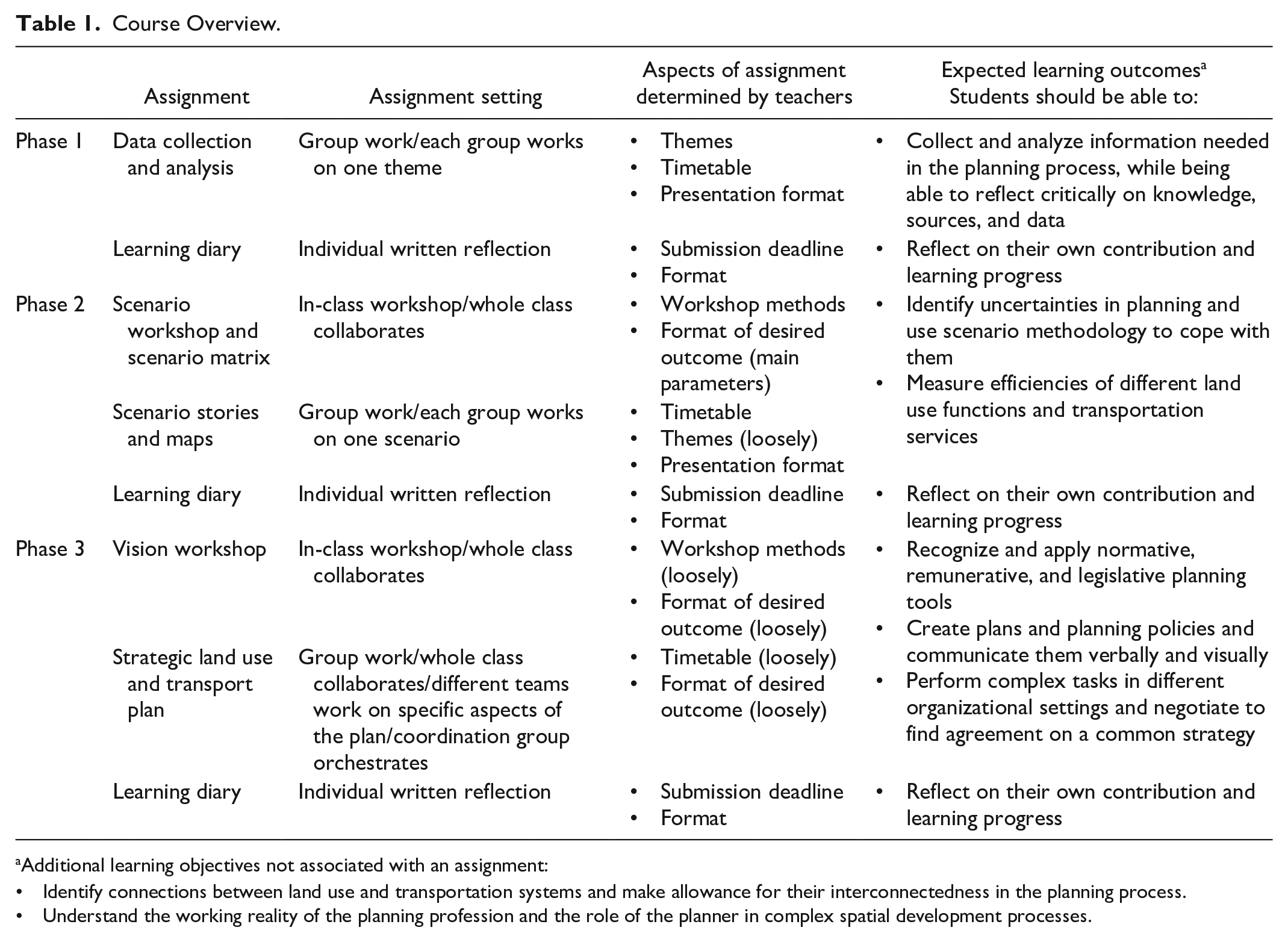
Additional learning objectives not associated with an assignment:
• Identify connections between land use and transportation systems and make allowance for their interconnectedness in the planning process.
• Understand the working reality of the planning profession and the role of the planner in complex spatial development processes.
The course is organized in three phases, each of which lasts four to five weeks. During each phase, students work on an assignment in a group:
The groups are reshuffled for each phase for two reasons. First, each task requires different group sizes. Second, and more importantly, the groups are reshuffled to distribute the learnings gained by the students in the previous phase as evenly as possible among the newly formed groups. This means that in Phase 2 each scenario group has access to a broad range of knowledge offered by students who collected and analyzed different types of data. In Phase 3, when the students work jointly toward a single strategic plan, each sub-group consists of students having explored different scenarios in Phase 2.
As the final task of each phase, every student submits an individual learning diary, in which they reflect on their experiences and learning. In these learning diaries, the students discuss challenges in the assignment and the group’s work, reflect on their contribution to the group work, and review their learning process. At the beginning of Phase 2 and Phase 3, some of the issues raised in the submitted learning diaries are discussed with the whole class in order to avoid misunderstandings and resolve challenges in the future. At the end of the course, students are graded based on their group’s performance in the three assignments.
From Student-Centered to (Collaborative) Student-Led Learning
Student-centered learning is currently a popular approach in university education, especially with teachers who follow constructivist learning philosophies, which build on the idea that the student is not an empty vessel that is to be filled with knowledge, but that knowledge can only be constructed in the mind of the learner (Stewart 2013). Student-centered learning emphasizes student responsibility and activity rather than content or teacher activity (Baeten et al. 2010). The teacher’s role is seen as facilitating the student’s learning process or as providing scaffolding to ensure the student has the knowledge, skills, and support to learn.
In turn, student-led learning builds on the same ideas but affords even greater learner autonomy to the student in defining the tasks, tools, and resources during the process of learning (Henri, Morrell, and Scott 2018; Humer 2020; McLaughlan and Lodge 2019). Student-led learning empowers students with direct ownership of the learning experience within an agreed set of boundaries and can create a shared learning experience among peers (Marvell et al. 2013).
Planning Studio aims to gradually achieve student-led learning and puts emphasis on student autonomy instead of teacher control especially in Phase 3 of the course, when the whole class collaborates to produce a strategic land use and transport plan. A coordination group consisting of students takes over project management tasks, including the organization and moderation of the teaching sessions, while other groups focus on different aspects of the plan (ten-year plan, long-term visionary plan, long-term scenarios and uncertainties brought by them, detailed plans of selected areas).
As shown in Table 1, the aspects of the assignments defined by the teachers are gradually reduced or relaxed, giving the class more freedom in deciding how to frame challenges and solutions. By gradually giving more decision-making power to students, and by creating a setting in which the whole class works together, students are afforded the agency and capacity to co-construct their project together with their peers. We thus understand this setting as enhancing student-led learning by adding a collaborative dimension.
Knowing, Acting, and Being
In the literature focusing on university education, learning has been conceptualized in a myriad of ways, often with the aim of highlighting the benefits and shortcomings of various pedagogical approaches. In order to reflect on the potential of collaborative student-led learning, we build on the ideas of Barnett and Coate (2005) who propose to understand learning along three dimensions: “knowing,” “acting,” and “being.”
Knowing refers to the knowledge dimension in university education. According to Barnett and Coate, knowledge is not external to the student but is incorporated into committed knowing acts when the student is making claims of their own. What matters is thus “the student’s own engagements with knowledge—in other words his or her knowing” (Barnett and Coate 2005, 48). These ideas are in line with constructivist learning theories (Baeten et al. 2010; Stewart 2013), and principles of problem-based and situated learning (Schweitzer, Howard, and Doran 2008). However, Barnett and Coate emphasize that the relationship between learner and knowledge must be one of personal engagement, through which a person establishes a connection with the intellectual field in question (Barnett and Coate 2005, 60). Collaborative engagement of students acting and working together can contribute to enhance such personal engagement.
Acting refers to the learning and application of skills. For years, a focus on acting has been at the heart of university pedagogics, for example, in the context of student-centered learning, which concentrates on “what the student does” (Biggs and Tang 2011). Currently, acting as a way of learning is the dominant paradigm in most studio courses in planning curricula (Bertolini et al. 2012). Barnett and Coate (2005), however, warn about too narrow conceptions of skills and actions, and refer with acting to willed action by a self-conscious human being.
Being refers to the development of human capacity and dispositions for self-awareness, self-confidence, and self-criticism. These aspects become increasingly important in a complex world where individuals are expected to take responsibility and work things out for themselves instead of following orders. The language of “self,” “being,” and “becoming” is rarely used in the context of university education, yet Barnett and Coate argue that being is the most significant of the three dimensions, because a “student cannot be expected to try to get on the inside of a discipline [. . .] and engage in challenging practical tasks unless the student has a firm self (a ‘self-confidence’)” (Barnett and Coate 2005, 164). By developing their selves, students learn to better articulate themselves, become more self-critical, daring and deliberate, and come more fully into their own being (Barnett and Coate 2005, 124).
Barnett and Coate (2005) argue further that each of the three dimensions of learning requires students’ active engagement with their experiences, which can only develop if students are accorded “space.” They distinguish between three kinds of spaces that parallel the dimensions of learning: epistemological space in which students can acquire a deep, informed, and critical understanding of knowledge; practical space so that students can develop the capacities for purposive but critically judged actions; and ontological space for the development of the student’s own self-awareness, self-confidence, and capacities for self-critique and self-direction (Barnett and Coate 2005, 135). If such spaces are created in university education, students can be at the same time operationally engaged, for example, through means of student-centered learning, and ontologically engaged, that is, committed through their inner and personal involvement in their acts of learning. Through ontological engagement, students do not simply complete a task put before them, but indeed make the task their own, enabling them to learn with more enthusiasm, more vigor, more imagination, and more determination. The challenge for the teacher here is to strike a balance between creating spaces accorded to students and the reasonable control of these spaces.
Barnett and Coate (2005) also acknowledge the importance of collaboration among students for learning. By working together, students can generate their own “collective space,” which offers collective safety while also stimulating creativity and motivation. When students become a “learning community,” they can take up and try out various roles among the group. Barnett and Coate (2005) describe this as the wonder of curriculum-in-action: “a forum in which everyone is engaged, is playing their part and is being creative, caught up in the complexity of the myriad interactions among many intelligent and committed individuals” (p. 141). In order to provide space for students to collectively flourish and thus give educational power to them, teachers need to cede some of their power. However, this does not mean that the teacher’s responsibilities are diminished. On the contrary, supporting the learning process when students have a collective space of their own is a demanding and complex task.
The arguments brought forward by Barnett and Coate (2005) resonate with the design of our studio course. Relating the ideas about different dimensions of learning to our Planning Studio course, we can clearly identify a dominating dimension in each of the three phases of the course. In Phase 1, the dimension of knowing is emphasized in the data collection and analysis assignment which also enhances students’ ability to critically reflect on knowledge, sources, and data. Knowing also plays a key role in the scenario methodology used in the course, which aims to account for the limitations of current knowledge through flexible long-term plans. In Phase 2, the dimension of acting is in the foreground during the development of scenario stories and maps. In groups, students develop their scenario plans and ultimately try to persuade the class of their group’s ideas in the vision workshop. Phase 3 focuses on the dimension of being by enabling students to take up different roles in a collective project. By giving more decision-making power to students, their agency and capacity to co-construct their project together is strengthened during this phase. Students can thus grow professionally and develop their own understanding of what it means to be a planner.
Moreover, in all three phases of the course, learning as being is supported through the obligation to keep learning diaries. In these learning diaries, students are asked to discuss in one to two pages their learning progress and challenges, difficulties with the assignment, group dynamics and experiences, most important learning achievements, things that remained unclear, as well as suggestions for improvement of the assignment. By asking students to regularly contemplate the tasks they had just completed, the learning diaries enable them to reflect on the task and their own role and performance. Inquiring about suggestions to improve the assignments additionally appeals to the students’ personal engagement and feeling of ownership over the course. Through the repetitive nature of the task, students are shown that reflection should be turned into a habit and fixed element of the work process.
Student and Teacher Experiences in the Planning Studio Course
In this section, we reflect on the experiences, advantages, and challenges of collaborative student-led learning in the course “Planning Studio.” In addition to our own experiences as teachers, this section is informed by learning diaries completed by the students in the course.
Student Experiences Based on the Learning Diaries
As part of the course, students were required to submit an individual written reflection in the form of a learning diary after each phase of the course. While the content of these diaries was not subject to grading, their submission was obligatory to complete the course. For the purpose of this article, the contents of the learning diaries were analyzed in order to understand the students’ experiences during the course. The content analysis covered general statements relating to the course setting as well as the students’ reflections on their learning process with a view to knowing, acting, and being. The quotes below are taken from the course held in autumn 2019.
In their learning diaries, many students highlighted their satisfaction with the student-led approach and acknowledged its innovativeness compared to the other courses they had attended. Collaboration among the whole class was regarded as challenging but rewarding by several students:
The best part of the project was definitely that it was so strongly student—driven and done and steered by us students—the whole class together, working on the very same plan. The most interesting observation for me during this task was to see that a class of more than twenty students can create a fairly coherent story and presentation together. This last group task of the Planning Studio course was definitely one of the most interesting group assignments that I have had so far.
Several students specifically pointed to the increase in motivation derived from their autonomy in the assignment:
The third assignment was well designed in that we had remarkable power to decide what (not) to do and how to design the actual content of the task and sub-tasks. [. . .] That way all of us got more motivation than usually in project courses, because we felt more responsible for our work when we had set the goals and the framework ourselves and we really wanted to achieve the goals. The third assignment of the Planning Studio course was absolutely the most interesting, motivating and rewarding one. This time, when I dove into the work with my colleagues, everything felt smoother and more meaningful than before in my studies. In the end, I am very happy and satisfied with this project. It was demanding, time-consuming and sometimes stressful especially in the last weeks, but the motivated class and good and motivated coordination group really created a good spirit on the course. And especially when I myself was presenting the outcome in [the municipality], I felt really proud of our work!
These statements clearly point toward successful ontological engagement of the students on the course. Instead of completing a task, the increased autonomy enabled the students to make the project “their own” and assume collective responsibility for the outcome.
The student feedback also indicates that the course contributed to the students’ professional identity development. On one hand, the students positively highlighted the course setting that enabled them to better understand the realities and complexities of the planning process. They specifically appreciated the opportunity to work on a real-life case and to present their work to planners from the collaborating municipality:
I have never experienced at the university an arrangement that simulates a real planning situation: some students act as a steering group and some focus on the plan from their own starting point. I learned the great joy and difficulty of having the sky as a limit in a planning assignment. It is hard to try to innovate and be open-minded and brave enough in proposing changes but stay realistic at the same time. I learned new things about how difficult it is to cope with the complexity of both the large group with so many people and the versatile planning task itself: one just has to prioritize, simplify, and leave out so many things and accept that we never will achieve a perfectly informed and optimized result but are just able to do the best we can with the resources we have. There is also a lot of anxiety realizing how little power a single actor has in a city: planners themselves can facilitate change but cannot just decide the future of a city, no matter how good their ideas are. A lot of cooperation, time, nerves and politics is needed to establish actual change. Sharing the ideas with the planners [from the municipality] was rewarding—the atmosphere was supportive and we received a good, enthusiastic reception.
On the other hand, students positively commented on the skills they learned while completing the course, including learning more about themselves. Students mentioned that they gained more confidence from self-organizing their project and learned how to coordinate and communicate with others. These experiences indicate that students achieved a state of learning through being, especially during the last phase of the course:
I believe that the most important lessons learnt are not clear yet but will realize themselves later on during my career, when I may find myself again in situations similar to the ones during this course. In fact, it already happened: [last week, I had to facilitate a workshop for the first time in my life] and the experience in this course had clearly made me more self-confident and determined. What this assignment taught me is that even though I like to see myself as a good leader figure, I still need practice not only in leading but most of all in communicating with people sharing the leadership with me. The best learnings from this course came through the collaboration in and between different groups. We really got to see what it is like to work as a group, communicating ideas and views which sometimes are hard to translate from your head to others so that they see the idea as well—and vice versa. This transaction of ideas and communication between people with different ideas and knowledge backgrounds have been the themes of this first semester in all of the courses in this master’s program and here we got the proof of the challenges and richness in that regard. This final part and task of the course especially showed this as we had to collaborate and communicate tightly with the whole class, not just with the group we were part of. Sometimes the communication and discussions were really challenging and frustrating as sometimes it really felt like we were not going to reach any conclusion and that we had to talk about the same things over and over again [. . .]. However, this was really valuable considering what planning practice really is—this final strategic plan phase was a small simulation of that. I also learned that land use planning may not be my thing. During this course, I got more interested in transportation planning and details. I’m not interested in planning land use of a municipality or a city, I would much rather solve smaller problems and focus on details.
Although the last statement might not be what teachers of planning want to read in response to their courses, we understand this as an indication that this student has progressed in developing his own professional identity.
In their learning diaries, some students also point to challenges and problems they experienced during the final phase of the course. A few students disliked the open-endedness of the task and would have wished for clearer instructions, while others found it challenging to make their ideas heard. This indicates that students need different degrees of scaffolding in their learning. While some are more comfortable to take over responsibilities and decisions, others might feel uneasy about the increase in autonomy. Although we must assume that the latter group did not achieve an equally deep learning experience, or at least felt somewhat frustrated during the course, we believe that university education is a suitable environment for gradual empowerment of students with the goal to push them to develop their own understanding of the planning profession.
It is also worth noting that several students appreciated the student-led approach strongly and some suggested that it could be introduced already at the beginning of the course and applied to all assignments, instead of fading teacher control gradually during the course.
Teacher Experiences
While we believe that the students’ reflections provide a good impression of the advantages and challenges encountered in the course, we also want to briefly reflect on our experiences as course teachers. Since starting this course in 2016 as part of a newly established master’s program, we aimed to incrementally improve the setting of the course, including the assignments. In 2019, we had learned from the previous years while also being faced with a slightly bigger group than in previous years, which however did not turn out to be more challenging.
One main advantage of the student-led approach from our perspective is related to student engagement, both in operational and ontological terms. We could observe an increase in student motivation, which was also visible in rules and deadlines enforced by the coordination group which were stricter and more ambitious than the ones previously set by us teachers, and generally met with less resistance by the class. The fact that students were jointly responsible for their own project encouraged deep learning. Moreover, we think that the course succeeded in supporting the learning of both subject-related knowledge and procedural knowledge, that is, that students obtained expertise in the field of strategic spatial planning while they also learned how to review information critically, work within various groups, and negotiate agreements among a group with potentially differing opinions.
As regards professional identity development, we could observe changes in attitude among many students throughout the course. In many cases, these impressions from the classroom were confirmed by the students’ own assessment in their learning diaries. While not everyone was equally outspoken especially in discussions with the whole class, many initially “quiet” students seemed to gain confidence to voice their ideas during the last assignment of the course. The division of tasks among the whole class required these negotiations, while the division into smaller teams enabled students to build on their existing strength, and work on the themes they were most interested in. The different types of assignments thus enabled learning in different settings, including individual reflection, small group work, and negotiation within a bigger “organization.” Collaboration with planners from a municipality made the project more meaningful and provided students with the opportunity to get a glimpse of the concerns of real-life planning professionals.
One of the biggest challenges for us teachers was to find a balance between giving clear and unambiguous instructions while giving space and freedom to students to shape their own project and way of working. We noticed that some students flourished as a result of the additional freedom given, while others felt inhibited and insecure about the loosely defined requirements regarding the content of the assignment. Another challenge, which is present in all courses based on group work, was related to group dynamics and grading. Group work always brings about the risk of “free riders” not contributing their fair share of work. From the teacher’s perspective, such behavior can be difficult to identify, especially vis-à-vis hard-working students with more introvert personalities who might not be comfortable to speak up in a bigger group. More time for the course as a whole could have enabled us to dedicate more time to give input on efficient team work as well as communication and negotiation skills in order to support students who are less versed in these skills. Although we did not witness any serious cases of freeriding on the course, the introduction of peer evaluation after each group work phase could diminish the risk of an uneven workload.
Discussion: Potentials and Challenges of Collaborative Student-Led Learning
Our experiences, as well as the feedback from students, show that collaborative student-led learning entails several advantages, including increased student motivation through collective responsibility for a meaningful project, a confidence boost for students when succeeding as a group, the potential for deep learning through complex and open-ended tasks, the possibility to demonstrate and strengthen skills related to leadership, communication and organization, as well as experience in maneuvering difficult situations as a group.
However, the approach also brings about challenges for students and teachers. Some students struggled with the loose definition of assignments and the open-endedness and complexity of the tasks. Other students regarded the level of communicative and persuasive skills required to make their argument heard and group dynamics, triggered for example by varying expectations regarding workload and scheduling, as challenging.
As teachers, we found it at times challenging to provide concrete instructions and feedback without curtailing students’ creativity and self-determination. Then again, educating planning students to work on and resolve wicked planning problems can also be expected to be challenging and difficult to both students and teachers. For the teachers it is crucial to identify which part of the uneasiness experienced belongs to the nature of the educational task itself and which part is to be avoided with better course design and teacher performance. In subsequent iterations of the Planning Studio course, more time has been dedicated to preparing the students at the start of the course to deal with the wickedness of the planning problem. Teacher input and discussions with the students have thus been used to highlight that the problem may become understood only through attempts to solve it. In addition, the students have been informed more clearly of the pedagogical aims of the course, following the ideas presented in this article.
The course design builds on the assumption that gradually reducing the rigidity of guidelines given by the teachers over several phases of the course would facilitate students’ learning toward assuming ownership over their project. In principle, and considering suggestions from students presented above, it might be worthwhile to introduce, to a degree, the student-led approach already during earlier assignments in the course. Special emphasis would then have to be put on providing the necessary scaffolding to enable all students to benefit from the student-led learning environment. However, following the arguments by Barnett and Coate (2005) presented in Section “
We are of course well aware of the limitations of the collaborative student-led approach as applied in the Planning Studio course. As the course only lasts three months, the final phase of heightened student autonomy is limited to approximately five weeks. During this limited time frame, students do not have the opportunity to shift between roles in the collaborative setting, in the sense of taking part in different sub-groups of the plan. However, through mutual negotiations, the students in their sub-groups have to deliberate and consolidate different perspectives, such as short-term determination and long-term resilience of the plan, and the relationship between detailed plans, thematic plans, and the vision. The limited time frame of the last phase of the course also did not allow to completely break away from the perception of the teachers defining the course setting and planning problem. Nonetheless, as illustrated by the student reflections above, students acknowledged and mostly appreciated the change in leadership during the final phase of the course, even if it concerned only a part of the course.
Without a doubt, a single studio course can only make a small contribution to students’ knowing, acting, and being. In aspiring for these pedagogical aims, the Planning Studio course relies on the theoretical and conceptual tools offered in other more theory-driven courses, as regards communicative planning, conflict resolution, strategic spatial planning, transport system planning, or the land-use planning system. As our course is intended for master’s level students, students already possess some skills regarding teamwork, communication, and negotiation from their school education and previous studies. Planning Studio can, however, give them an opportunity to put these skills into practice in a course environment where teachers take the back seat instead of controlling the course setting.
Thus, while we do not claim that our course alone enables students to develop their own understanding of professional identity, many students asserted to have gained a deeper understanding of the planning profession and the challenges related to sharing responsibility, communicating, and cooperating with others, which are an essential part of planning practice. In the Finnish context, where most planning professionals are educated in architecture schools, such an understanding is urgently needed. In a study investigating the skills of architecture graduates working in planning, Kangasoja et al. (2010) show that social and interactional skills including negotiation, presentation, project, and conflict management are crucial for planners, yet rarely taught in university education. Instead, an emphasis in education, and especially in studio courses, is put on individual creativity and purified problem-solving, that is, solving tasks which are detached from the messiness and complexity of real life (Kangasoja et al. 2010).
These challenges are not unique to Finland but can be identified in planning education globally. Das et al. (2020) argue similarly that although the “knowledge, skills, and values required for maneuvering deftly through the messiness are often difficult to codify in curricula” (p. 12), an attempt should be made to practice such experiences. Recent writings on planning education have hinted toward the broad set of skills that planners ought to master in order to address wicked problems in challenging and fluid institutional settings (Frank and Rosa Pires 2021). These skills include, for example, cultural humility, self-reflection, and power sharing (Wilson 2020), communication with different stakeholders and the general public (Das et al. 2020), action-orientation, the ability to build alliances and creativity (Frank and Rosa Pires 2021) and empathy, compassion, and solidarity (Hoch 2022). We understand collaborative student-led learning as a possible contribution to equip planning students, and thus in many cases future planners, with some of these skills—while being aware that one course can only contribute a small piece in the complex jigsaw of higher education and professional practice.
While we have not specifically addressed the subject of ethics in this article, considerations regarding values and moral choices can of course not be excluded from planning and planning education. On the contrary, knowledge, actions, and ethical principles are recursively linked (Winkler 2018). Especially when considering the exploration of professional identity, a practical engagement with ethical choices and considerations is needed, rather than the treatment of ethics as a stand-alone subject. While other courses in the program, for instance Planning Theory, introduce students to various normative schools of thought, Planning Studio offers a space for students to embody values into their actions and to develop skills and habits of judgment and reflection. The course thus contributes “to stimulate students to use their ethical compass (which they already have) in challenging situations and calibrate their compass while taking professional standards into account” (Stekelenburg, Ruyter, and Sanderse 2021, 99). By being exposed to challenging issues in a complex decision-making environment, students are guided to discuss the ethical aspects of professional practice, especially ambiguities and gray zones, and presented with strategies to cope with the complexity of ethical considerations. Teaching ethically aware actors in planning is thus “about providing them with a sense of the idea of planning and the confidence to be able to do better, not providing them with excuses for inaction” (Campbell 2012, 394).
Conclusion
In this article, we have shared and reflected on our experiences regarding collaborative student-led learning obtained in the course “Planning Studio,” held at Aalto University, Finland, between 2016 and 2019. Planning Studio builds on the idea of gradually empowering students by giving them autonomy vis-à-vis the teachers, and decision-making power over their collaborative project. In practice, this is reflected by different settings for assignments, peaking in the final phase of the course in which the whole class self-organizes the content and delivery of a strategic plan that is presented to real-life policy makers. This approach, which we describe as collaborative student-led learning, aims to enhance students’ knowledge, skills, and professional identity development. In combination with the scenario approach introduced in the course, students acquire skills in creative thinking and storytelling (Hoch 2022), as well as take steps toward becoming facilitators who empower others, co-create, and co-shape spatial development trajectories (Frank and Rosa Pires 2021; Peel 2000). Planning Studio thus responds to a plea to planning educators recently voiced by Hoch (2022) to treat “spatial planning as more craft than science, more practical than precise, and more collaborative than solitary” (p. 2).
We do not want to claim that we are the first ones to apply such an approach in teaching planning. However, in this article, we have liaised experiences from teaching with a systematic view of the pedagogy involved. Drawing on the conceptualization of learning as “knowing,” “acting,” and “being” (Barnett and Coate 2005), we have shown how affording epistemological, practical, and ontological space to students can address existing pedagogical gaps in studio education and frame professional identity development as a learning outcome.
Encouraged by the mostly enthusiastic feedback from our students, we intend to call upon planning educators to ask themselves a few simple questions when designing studios: Where could students be empowered to take decisions about the course setting? Where could students collaborate instead of solving the same problem in parallel? How could problem framing be transformed from a given assignment to a first step in approaching the task? Keeping in mind that the use of studios in planning education is diminishing (Long 2019), it would be worthwhile to explore how a collaborative student-led approach could be incorporated into other course settings such as lectures and seminars.
As we have demonstrated in the article, even small increases in student autonomy can make university education more meaningful and consequently help students to become more confident, more creative, and better equipped for their future careers. Barnett and Coate voice similar ideas, and although they refer to university education in general, it seems that this notion touches upon many expectations held for planning education:
If students as human beings are not just to survive but add to the world and be exemplars of human being as such (which presumably are desirable aims for a higher learning), then they will have to be able to engage with the world and put in something of themselves. But they are hardly going to be able to develop the will, the energy, the courage and the resilience to engage with a changing and challenging world unless they are also engaged in suitable ways in their curricula. (Barnett and Coate 2005, 137)
Footnotes
Acknowledgements
The course Planning Studio received a commendation in the competition for the AESOP Excellence in Teaching Award 2020. We would like to thank Olivier Sykes, as chair of the award committee, and the other members of the committee for their positive assessment of the course which was a motivation to share the course experiences with a wider audience in this manuscript. We also want to thank other teachers involved in the course over the last years, especially Vesa Kanninen, Jouni Ojala, and Oya Duman. We would like to express our gratitude to the reviewers and editor for their invaluable comments which greatly helped to improve the manuscript.
Declaration of Conflicting Interests
The author(s) declared no potential conflicts of interest with respect to the research, authorship, and/or publication of this article.
Funding
The author(s) disclosed receipt of the following financial support for the research, authorship, and/or publication of this article: This research was supported by the Academy of Finland (338335) and H2020 Marie Skłodowska-Curie Actions (707404).
