



Abstract
This study examines how the COVID-19 pandemic reshaped planning education in the United Kingdom and what this transformation implies for future delivery models. Drawing on a phenomenological approach, it presents findings from forty-one semi-structured interviews with planning academics and leaders of professional bodies across the United Kingdom, offering the first U.K.-wide empirical account to capture both academic and professional perspectives across the full pandemic cycle. The findings show that, despite significant challenges related to workload, digital inequality, and the loss of embodied studio and fieldwork experiences, academics demonstrated resilience and pedagogical innovation. The pandemic acted as a catalyst for rethinking teaching, assessment, and student engagement, revealing both the limitations of fully online provision and the pedagogical potential of hybrid models. The study extends existing planning education literature by clarifying how hybrid delivery can support core planning pedagogy, while highlighting the institutional, market, and professional factors shaping its future adoption.
Keywords
Introduction
Online higher education will never be able to compete with traditional in-person higher education, according to a study conducted by Times Higher Education (2018), which surveyed 200 leaders of prominent international universities from forty-five nations across six continents. Despite 63 percent of respondents expecting well-established universities to provide full degrees online by 2030, only 24 percent believed that the online versions would be more popular than conventional campus-based degrees. Only two years after the publication of this study, the COVID-19 pandemic hit the world, resulting in the urgent transition of previously in-person university courses to online delivery. Therefore, this pandemic provided an experimental environment to examine the success of online education for all universities and courses worldwide, an experiment that would not be possible otherwise. However, to fully appreciate how this global transformation unfolded, it is necessary to position it within the wider dynamics of national higher education systems. In the United Kingdom, in particular, the trajectory of online education has been shaped by the intersecting forces of internationalization, marketisation, and technological innovation, factors that extremely influenced how universities adapted during and after the pandemic. The U.K. higher education sector has undergone fundamental transformation determined by this complex interaction over the last two decades. These shifts have not happened in isolation but have reinforced each other, changing how universities operate, how students learn, and how higher education is valued and accessed globally, as well as how online education has developed within the country. The introduction of tuition fees in 1998, initially capped at £1,000, is widely cited as the starting point of marketisation in U.K. higher education (Brown and Carasso 2013). Subsequent fee increases intensified competition between institutions and reinforced the positioning of students as consumers, with greater emphasis placed on value for money, graduate outcomes, and institutional performance (Brown and Carasso 2013). From a global perspective, universities also began to recruit international students more actively, as these students were not subject to domestic fee caps and represented an important revenue stream. By the early 2000s, internationalization had become a strategic priority for many institutions. Growing reliance on international student recruitment, alongside transnational education initiatives such as overseas branch campuses, joint and dual degrees, and franchised programs, thus became central to institutional financial sustainability and global positioning (Altbach and Knight 2007).
Alongside these shifts, digital technologies were progressively integrated into U.K. higher education, primarily to support rather than replace face-to-face teaching. Virtual learning environments became standard tools for distributing learning materials and facilitating communication, while large-scale initiatives such as MOOCs (Massive Open Online Courses) signaled increasing institutional interest in scalable online provision. Although MOOCs attracted attention for their potential reach, they were also criticized for limited interactivity and low completion rates (Bayne and Ross 2014).
Since 2015, the evolution of online education in the United Kingdom has sustained alongside new initiatives. Degree apprenticeships, introduced in England, joined university study with employment, sometimes using blended or online delivery to accommodate full-time workers (Department for Education [DfE] 2017). Despite this gradual growth of online learning, face-to-face teaching remained the dominant and often favored mode of delivery, specifically for international students pursuing the U.K. residential experience (QAA 2021). This preference was also evident among domestic undergraduates, while practice-based disciplines such as architecture and urban planning continued to present challenges for online delivery (Sun et al. 2022).
These pre-existing conditions shaped universities’ responses to the COVID-19 pandemic. The rapid transition to fully online teaching exposed limitations in digital infrastructure, staff preparedness, and student access, while simultaneously accelerating digital experimentation and institutional reflection on the future role of online education (Crawford et al. 2020; Watermeyer et al. 2021). Although these changes affected the higher education sector broadly, their implications were uneven across disciplines.
Research Gap
While many studies across various fields have explored the broader impact of the COVID-19 pandemic on education, empirical research specific to urban planning has been limited (Elrawy and Abouelmagd 2021; Garcia 2021; Katsavounidou 2022; Kim 2023; Mironowicz and Schretzenmayr 2020). Despite the limited number of studies, these investigations in planning education have provided valuable findings regarding the challenges and adaptations in urban planning during the COVID-19 pandemic, each with various geographical and institutional contexts, employing different research approaches and focus. Yet despite these contributions, no empirical study has examined how U.K. universities navigated the transition to online planning education during the pandemic. Moreover, while existing literature discusses immediate challenges and adaptations, the longer-term influence of pandemic teaching on current practice and its implications for the future of planning education have not been fully explored.
Research Aim
This study aims to examine the impact of the COVID-19 pandemic on planning education in the United Kingdom by exploring the experiences of academics during the transition to online teaching, assessing how these experiences have shaped current pedagogical practices, and identifying potential future scenarios for the discipline. By incorporating the perspectives of both academics and professional planning bodies, the study seeks to provide a comprehensive understanding of how the pandemic has reshaped planning education and its possible future directions. Professional planning bodies are defined here as organizations that set the professional and academic standards for those entering the planning profession (Wallace 2015).
While the study acknowledges that students’ experiences are equally essential and encourages further investigation, the focus here is on planning academics and leaders of professional bodies. This focus is grounded in the idea that academics were the primary agents responsible for reconstructing teaching content, adjusting pedagogical methods, and maintaining professional standards during the rapid digital shift, changes that ultimately formed student experiences. Moreover, as Lundberg and Stigmar (2025) point out, the double disruption brought about by the pandemic, first as a public health crisis and then as a forced digital transformation, activated a re-navigational moment in academics’ professional identity, demanding an in-depth exploration of their experiences. This paper, therefore, aims to provide a deeper understanding of the academic perspective, complemented by insights from professional body leaders, whose policies and strategic visions play a significant role in shaping the future of planning education.
Research Questions
Accordingly, the study is guided by one overarching research question and three sub-questions:
How has the COVID-19 pandemic shaped planning education in the United Kingdom, both through its immediate impacts and its implications for future scenarios?
Sub-questions
How did planning academics in the United Kingdom experience the transition to online teaching during the COVID-19 pandemic?
In what ways have these experiences influenced current teaching practices in planning education?
What future scenarios for planning education in the United Kingdom can be anticipated based on the lessons and perspectives emerging from both academics and professional body leaders?
Literature Review
This research adopts a phenomenological approach. As outlined by Creswell (2007), this approach involves establishing broad assumptions about the phenomenon under study and gathering data from individuals who have directly experienced it. In phenomenological research, the literature is less often used to set the stage for the study but instead serves as an aid when categories are identified inductively through data collection (Creswell and Creswell 2018). Accordingly, this section provides background to the phenomena under investigation, while the findings are discussed in relation to the existing literature later in the paper.
Online Delivery for Planning Courses before the Pandemic
It is important to acknowledge that online delivery did not emerge solely during the COVID-19 pandemic. Distance learning, defined as alternatives to conventional face-to-face instruction, has existed for nearly two centuries (Spector et al. 2008). Its origins lie in correspondence study using print media and postal services, first introduced in Europe in 1840. The first U.S. correspondence program was established at the University of Chicago in 1892 (Garrison 1989). In the United Kingdom, the Open University, founded in 1969, pioneered large-scale distance education using television. Since then, universities have expanded distance learning provision across disciplines, with digital technologies enabling increasingly sophisticated modes of delivery.
Despite major technological advances, distance learning in urban planning has remained limited. A survey by Godschalk and Lacey (2001) covering 1998 to 1999 found that only seven U.S. planning programs offered off-campus courses using distributed learning technologies. Barriers included limited faculty resources, lack of staff interest, perceived incompatibility with planning curricula, and insufficient technical support. Two decades later, online provision remained scarce. By 2021, only eight online planning programs existed in the United States. (Garcia 2021), including one bachelor’s program, three graduate certificates, and four master’s programs. At that time, the University of Florida’s Master of Urban and Regional Planning was the only accredited online planning degree in the United States. Since 2021, however, several new programs have emerged, including accredited online master’s degrees at Arizona State University and East Carolina University, alongside non-accredited offerings such as Liberty University’s online Master of Public Administration (MPA) in Urban Planning. These developments indicate a shift from a single accredited program in 2021 to multiple accredited online options. In the United Kingdom, distance learning in planning was similarly limited, with only one program available until 2024. The MSc Urban and Rural Planning, delivered through the Joint Distance Learning Consortium, is led by UWE Bristol with support from four partner institutions (Sheppard 2021). Following the pandemic and growing recognition of a changing market, UWE Bristol launched its MSc in Planning and Urban Leadership in 2020, while the University of the Built Environment introduced an online planning program in 2025.
Much pre-pandemic literature argued that distance learning was unsuitable for planning education (Ryan 2002; Wagner 1997). Face-to-face teaching was considered superior due to its support for collaboration and the development of essential professional skills, including communication and teamwork. Critics suggested that limited interaction in online settings risked leaving students underprepared for professional practice, which relies heavily on collaborative and interpersonal competencies. Planning education was also seen as dependent on site visits and oral presentations, which were perceived as difficult to replicate online (Lawhon 2003). Consequently, some scholars argued that distance learning might support specific skill development but was inappropriate for full planning degrees. In Godschalk and Lacey’s (2001) survey, incompatibility with planning content emerged as a central concern. Other studies proposed blended delivery models to address these challenges (Roy, Potter, and Yarrow 2008). Additional issues identified included student engagement (Gibson et al. 2001), facilitating critical discussion online, tutor workload, student anxiety around technology use (Hughes and Daykin 2002), expectations for rapid tutor responses (Croft, Dalton, and Grant 2010), and the need for integrated academic, technical, and well-being support (Holder 2007). Much of this literature implicitly assumed a traditional, full-time student cohort, while earlier online provision in planning was often oriented toward part-time, professionally employed learners, for whom flexibility may have outweighed some of these pedagogical limitations.
Planning Courses during the Pandemic
Across different phases of the pandemic, planning programs adopted fully online, blended, and synchronous delivery modes, requiring significant adaptation of teaching and learning activities. To date, there have been relatively few empirical studies examining the experiences of tutors and students in urban planning programs during the urgent transition from in-person to online teaching. Existing literature largely focuses on challenges, including difficulties in developing students’ soft skills and critical thinking (Elrawy and Abouelmagd 2021), managing site visits, and delivering studio-based teaching (Kim 2023; Mironowicz and Schretzenmayr 2020), all of which are central to planning education. Garcia (2021) highlights that urban planning, as a place-specific discipline, relies on site visits and community engagement to develop ethnographic understanding. During the pandemic, however, interaction with sites and communities was largely limited to satellite imagery, literature, and online resources. The study calls for robust, socially collaborative online learning environments tailored to the specific demands of planning programs.
Similarly, Katsavounidou (2022) examined the online delivery of urban planning and design courses in Greek universities over three semesters, using surveys and interviews to explore how instructors adapted studio teaching to virtual formats. The study highlights strategies used to address delivery challenges, engage students digitally, and respond to unexpected outcomes, emphasizing the importance of problem-based learning, enhanced virtual platforms, and continued online guest engagement. It argues for platforms specifically designed to support studio-based learning and active participation. Drawing on experiences at Gdańsk University of Technology and ETH Zurich, Mironowicz and Schretzenmayr (2020) also note the benefits of recorded lectures, de-localization, and increased learner autonomy, while cautioning against fully replacing interactive elements such as studio work, group activities, and discussion. Their work underscores the ambiguity surrounding online planning education and highlights the need for further investigation.
Methodology and Research Design
To examine academics’ experiences of teaching on U.K. planning courses during the COVID-19 pandemic and to explore future scenarios for online provision, this study adopted a phenomenological research approach (Creswell and Creswell 2018). The approach was selected to capture participants’ lived experiences and meaning-making during a period of rapid pedagogical change. A transcendental phenomenological design was employed (Moerer-Urdahl and Creswell 2004), with intentional bracketing used to minimize the influence of the researcher’s own pandemic teaching experiences. Reflexivity was addressed through systematic documentation of the researcher’s positionality, data-collection decisions, and interpretive processes (Creswell and Creswell 2018).
Data were collected through semi-structured interviews with academics who taught on U.K. planning programs during the pandemic and leaders of professional planning bodies. Interviews were conducted after the lifting of pandemic restrictions, enabling participants to reflect across phases of fully online, blended, and synchronous delivery. In this paper, the term “online teaching” is used as an umbrella term encompassing these delivery modes. Ethical approval was granted by the authors’ institution, and the study adhered to institutional guidelines for research integrity (details withheld for anonymity).
Participants
The Royal Town Planning Institute (RTPI) 1 website reported that in 2023, there were twenty-four universities in the United Kingdom that offer planning programs (Figure 1). In total, there are 108 planning programs (BSc and MSc levels) offered by these universities, with eighty-four in England, ten in Wales, eight in Scotland, and six in Northern Ireland.
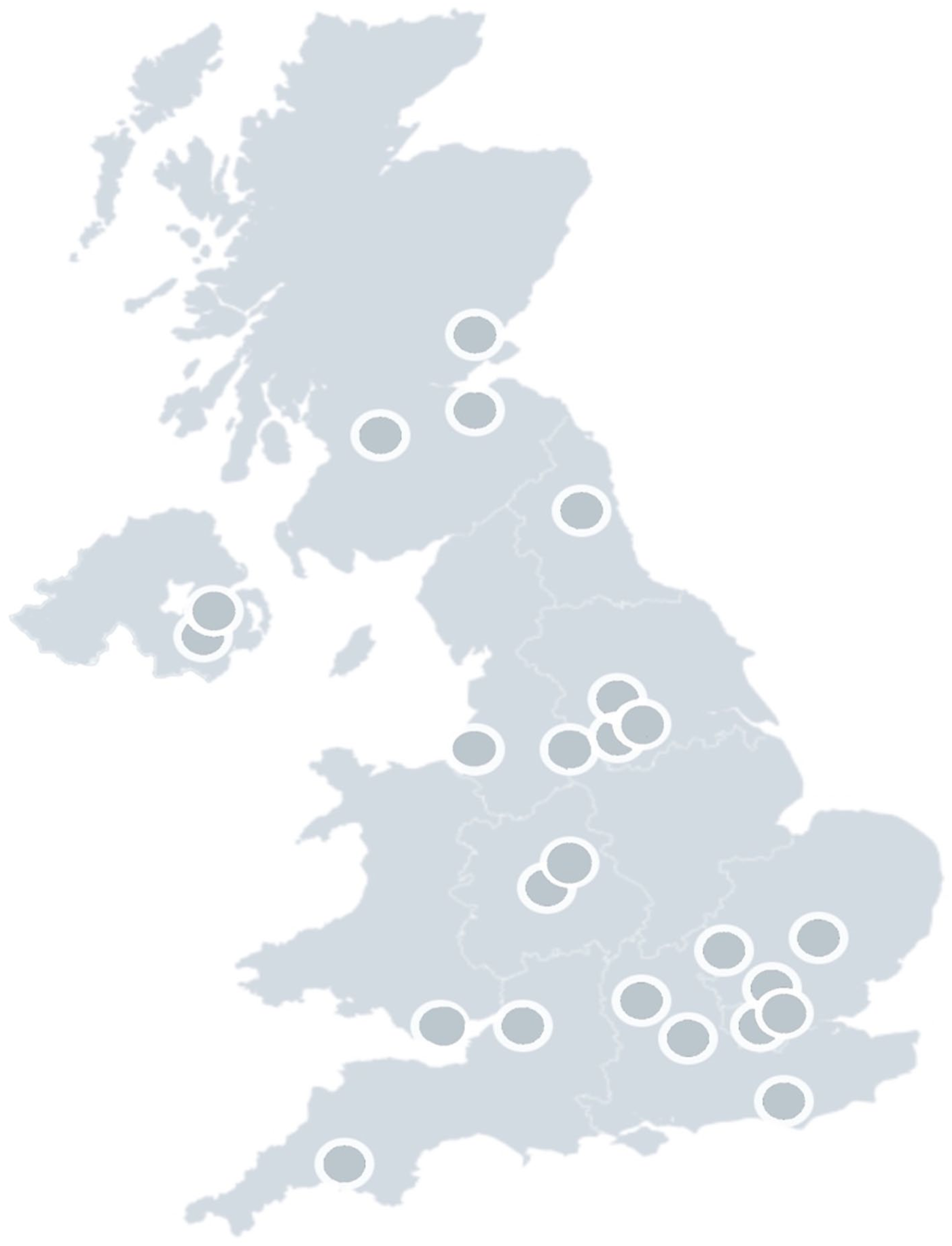
Map of U.K. planning schools (adopted from the RTPI website).
Purposeful sampling and snowball sampling techniques were employed to select interview participants from U.K. planning programs and professional bodies. Initially, interview invitations were extended to course directors of planning programs, who were then tasked with disseminating the invitations among their teaching staff. Concurrently, leaders of professional bodies were identified through their respective organizations’ websites and contacted via email. Interviews commenced with those who accepted the invitations, and participants were subsequently asked to nominate additional relevant interviewees. The interviews were conducted between July 2022 and April 2023. A total of forty-one in-depth semi-structured interviews were conducted with thirty-six academic staff who taught during the pandemic, from fourteen universities offering planning programs, and five leaders of professional bodies. The sample size in phenomenological research depends on the topic and the diversity that each study attempts to capture (Creswell and Poth 2016). In this study, to cover the geographical diversity, it was made sure that the number of participants from England (twenty-eight), Wales (three), Scotland (three), and Northern Ireland (two) is proportionate to the number of planning programs that each country offers. Table 1 provides some details regarding the academic participants.
Interview Participants’ Characteristics.
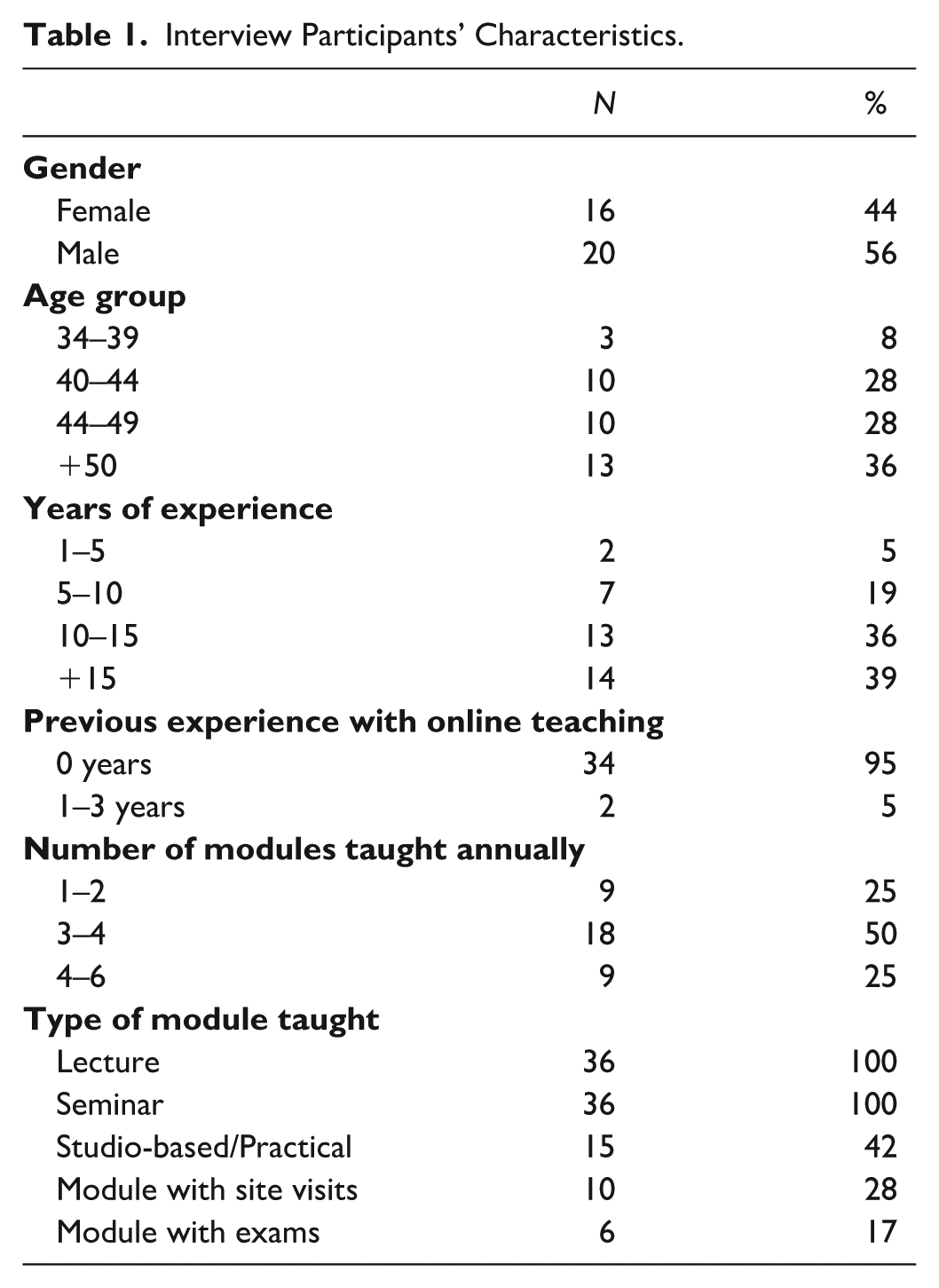
In terms of participant demographics, the sample comprised 44 percent female and 56 percent male individuals, reflecting a similar distribution across age groups: forty to forty-four (28%), forty-five to forty-nine (28%), and fifty and older (36%). Experience levels varied, with 5% having one to five years of experience, 19 percent with five to ten years, 36 percent with ten to fifteen years, and 39 percent with over fifteen years of experience. During the pandemic, all participants were engaged in teaching both postgraduate and undergraduate modules, with 50 percent responsible for three to four modules, 25 percent for one to two modules, and another 25 percent for four to six modules. Moreover, all participants conducted both lecture and seminar classes, while 42 percent also facilitated studio-based classes, and 28 percent were involved in modules requiring site visits.
Leaders of professional bodies exhibited extensive teaching and professional experience, each with over twenty years of involvement in planning both within the United Kingdom and internationally, and exerting considerable influence within U.K. planning education. However, the leaders interviewed for this study were not engaged in teaching during the pandemic. There was only one female interviewee in this group.
Procedure
Interviews were carried out as one-to-one video calls via Microsoft Teams and lasted between 30 and 120 minutes. The interviews followed an interview guide, and informed consent was obtained for recording the interview and using their answers in the research. To ensure anonymity, names or employers are not cited when quoting them. Given the relatively small population of leaders of professional bodies related to planning in the United Kingdom, all information pertaining to them has been intentionally kept general to maintain anonymity.
Semi-structured interviews were guided by three broad questions (experiences during the pandemic, teaching post-pandemic, and views on the future of planning education). These were complemented by follow-up prompts such as “How did you manage delivering studio teaching online?” For leaders of professional bodies, the interviews focused on their views regarding the future of planning education, shaped by the lessons of the pandemic.
For validity purposes (Creswell and Creswell 2018), the interview protocols and interview questions were reviewed and discussed with an experienced independent researcher in planning, and adjustments were applied.
Data Management and Analysis
The interviews were audio-recorded, transcribed, and coded using QSRNVivo12. Two independent researchers within the field coded the data using an open approach, where they found themes inductively and grouped them. They then discussed and agreed on the themes with the author, and the reliability percentage was over 90 percent. To assure the validity of the findings, the member checking approach (Creswell and Creswell 2018) was used. Subsequently, follow-up interviews were conducted with participants who responded to the follow-up email, providing them with an opportunity to offer feedback on the findings. Adjustments were made to the findings based on the comments provided by the interviewees.
Results and Discussion
The findings from interviews are discussed in three main categories. The pandemic experience: resilience, challenges, and serendipities explores the ways in which instructors adapted their teaching to fit the situation, the challenges they encountered, and the unexpected outcomes observed in online teaching. Resilience, challenges, and serendipities are discussed within six sub-categories of teaching, assessment, students’ engagement, pressure, technology, and university policies and institutional context.
The second category, the post-pandemic experience: current teaching and learning practice, delves into the elements of online delivery that have transitioned from pandemic teaching to current practices in U.K. universities.
Lastly, the third category, the post-pandemic experience: the future of planning education, summarizes the possible future scenarios for planning education.
The Pandemic Experience: Resilience, Challenges, and Serendipities
All interviewees testified to their satisfaction with the overall success of their delivery, despite the challenges they faced. At the onset of the pandemic, they entered an unknown world and grappled with uncertainties regarding transitioning their modules to an online format. Nevertheless, they overcame these initial doubts, “transforming what previously seemed impossible into reality,” as articulated by one of the interviewees.
Commencing with a spirit of “trial and error,” they gradually gained confidence in their online delivery methods throughout the pandemic. The challenges they encountered fuelled their creativity, leading to innovative approaches in designing and executing teaching and learning activities, assessments, and maintaining student engagement in harmony with their respective modules.
While they discussed the challenges they faced and how they overcame them, they also revealed some of the unexpected outcomes and experiences that they had in relation to teaching, assessment, and students’ engagement. No specific trends were observed between the interviewees’ location, age, years of experience, and the results within teaching, assessment, pressure, and students’ engagement. However, those with prior online teaching experience (5%) stated a more positive experience in delivering lectures, conducting studio-based teaching, using innovative methods for site visits, and managing assessments online.
Teaching
All interviewees emphasized their resilience and commitment to maintaining high-quality teaching. Most participants (82%) compared their pandemic teaching with pre-pandemic practice and stressed that the shift in delivery did not necessarily result in reduced quality. Discussions of teaching quality were independent of preferences for online or face-to-face delivery. One interviewee expressed a strong aversion to online teaching, stating, “I hated teaching online, and you know, I don’t want to ever have to do that again.” However, they clarified that significant effort was invested in adapting pedagogy, noting that regardless of disliking online teaching, we put a lot of effort into making sure what I didn’t do was just taking what I would do face to face and go and say that it will work online because that was never going to work.
The emphasis was therefore on strategies tailored to the online medium, recognizing modal differences rather than positioning one approach as inferior. Evidence from related disciplines, such as architecture, similarly shows that when teaching, feedback, and interaction are redesigned for online delivery rather than “lifting and shifting,” student outcomes and satisfaction are maintained or improved (Asfour and Alkharoubi 2023; M. N. Saleh et al. 2022).
Interviewees (62%) reported that online teaching worked better than expected for some modules and learning activities. A key benefit was universal online presence during the pandemic, enabling immediate instructional engagement, as one interviewee noted: “everybody was online, next to the internet, so you could ask them to do something right there.” This contrasts with traditional lecture settings, where some students lack access to computers or the internet. However, the literature complicates accounts of such “immediate accessibility” by highlighting digital inequalities. While online delivery can increase immediacy for many students, others face barriers, including unstable connectivity, inadequate devices, and limited domestic study space. Studies in geospatial education, therefore, emphasize the need for structured online tutorials and live support sessions to support learners facing digital access challenges (Vojteková et al. 2021).
Another interviewee described adapting a plan panel activity for a planning course. In face-to-face settings, students attended the panel in-person, followed by a later discussion. During the pandemic, students watched the panel online and discussed it simultaneously: I always take the students to a plans panel. And when we’re doing it face to face, we go to plans panel in person. And, a few days later, we then have a discussion about what happened in the plans panel, but when it was online during the pandemic, we watched it online. And we could have a chat online at the same time.
Compared with the face-to-face format, this real-time interaction enabled deeper, “richer” analysis and immediate exploration of decision-making processes. These findings highlight the specific pedagogical benefits online delivery can offer for certain learning tasks. Related research in architecture similarly shows that staged online walkthroughs using screen-sharing and annotation tools enable time-stamped, targeted feedback and asynchronous review, enhancing reflection and iterative improvement (Baigi, Yeganeh, and Bemanian 2024).
Hybrid delivery during the pandemic
Interviewees reported that fully online delivery during the initial phase of the COVID-19 pandemic was the most challenging mode of teaching. Hybrid delivery, adopted later, was viewed more positively as it enabled social distancing while retaining some face-to-face interaction. All interviewees agreed that hybrid teaching struck a balance between the safety of remote learning and the benefits of in-person instruction and was particularly effective for modules requiring physical presence, such as studio-based courses. This finding aligns with studies identifying hybrid delivery as the most effective mode during the pandemic (e.g., Sumandiyar et al. 2021).
Interviewees noted that the effectiveness of hybrid teaching varied depending on factors including access to technology (72%), the quality of online instruction (42%), and available learning support resources (42%). Many reported that some students continued to join sessions online during face-to-face teaching, requiring synchronous delivery for both cohorts. This necessitated appropriate technologies to share in-class activities with remote students. One interviewee teaching a studio module explained: “I had to wear head cameras in class, and that was the only way I could share the design steps that I was teaching to my face-to-face class with online students.” This supports arguments that spatial planning education requires tailored digital platforms and technologies (Garcia 2021; Katsavounidou 2022). Some interviewees (32%) also reported the need for additional staff support, such as tutors, to manage hybrid sessions effectively, reinforcing claims that hybrid teaching requires careful integration into course design and sustained investment in staff capacity (Munday 2022).
Assali (2023) similarly found that hybrid studios improved inclusivity by enabling participation from students with health, disability, or geographical constraints but required substantial reconfiguration of assessment and feedback practices. In their study, traditional desk critiques were replaced with shorter, structured sessions supported by digital annotation tools, improving clarity while reducing the spontaneity associated with physical studio culture. These findings indicate a broader consensus across spatial disciplines that hybrid formats can enhance inclusivity, efficiency, and continuity of learning, but demand pedagogical redesign and cannot fully replace the experiential core of studios and fieldwork without more effective technological mediation of embodied learning.
Lecture and seminar modules
Interviewees (60%) reported that delivering lectures online was challenging due to the inability to observe students’ reactions. As one interviewee explained, “I could not ask many quick questions during the lectures to keep students engaged, as it would take some time for students to turn on and off their microphones, and we did not have time for that.” Consistent with this, previous studies found that the quality and spontaneity of discussion were reduced compared with in-person settings unless sessions were carefully structured (Asfour and Alkharoubi 2023; Assali 2023). Seminar modules involve a range of learning activities, including discussion, reading, blog writing, and role play, and most interviewees (82%) reported that delivering seminars online was even more challenging than lectures, though more effective in hybrid formats. One interviewee noted: For the discussions when you’re in a class, it might be easier for the lecturer to kind of balance the dynamic and you can find more space for less vocal students to talk. But online, this was more difficult. So, I think some students had a better experience online than others.
Another added: In an online platform, it’s difficult when you kinda want students to immediately respond. When you’re in a face-to-face classroom, even three people can talk at the same time. And you know, they use their body language to take into turn, but when it’s a vocal session, and it all happens online, it’s very different.
Similarly, Wang (2023) found that informal peer-to-peer exchanges and tacit turn-taking were particularly difficult to reproduce online. These accounts highlight the challenges of delivering seminar teaching online. Seminars rely on multiple forms of interaction, including peer-to-peer, team-based, and instructor-led communication, many of which were constrained by available technologies. This aligns with wider findings on online education during the pandemic (Detyna et al. 2023; Elrawy and Abouelmagd 2021; Kéri 2021).
Studio-based modules
Notably, 42 percent of interviewees were involved in at least one studio-based module and reported a shared challenge: traditional face-to-face studio teaching methods were seen as incompatible with online delivery. In response, they demonstrated resilience by adapting to the virtual environment and developing new strategies to recreate the collaborative atmosphere central to studio learning. For example, one interviewee explained: I was teaching the concept of sense of place, and I stopped the class and asked them to go to their garden, balcony or neighbourhood and pay attention to their senses, what they see, what they smell, pay attention to what they walk on, is it soft?
This approach leveraged students’ immediate environments, introducing experiential elements that enhanced understanding of place-based concepts.
Interviewees noted that the challenges of moving studios online highlighted the importance of access to technology and instructor competence in online and hybrid pedagogy. A small proportion (5%) with prior experience of online teaching through distance programs transitioned more smoothly. For instance, in modules requiring hand drawing, these instructors used multiple screens and cameras to demonstrate design processes step by step, enhancing the virtual learning experience. Similar improvisations are reported in design education literature, though they raise concerns about increased workload and the need for technical support to sustain such practices (Fewella 2023).
Unexpected outcomes also emerged through innovative delivery strategies adopted by interviewees without prior online teaching experience. One interviewee described teaching urban design theories during hybrid delivery through city-based site visits, noting: when we were allowed to go to university for hybrid teaching, to teach some of the concepts such as the evolution of urban design theories, you know where we talk about elements of different eras, such as modernism, I was taking students on many site visits [in the city] and I was talking about those elements by showing them the real-life examples in the city. Students loved it and I thought why I did not do this before.
This example highlights how adaptation during online and hybrid teaching prompted the adoption of previously unexplored yet effective pedagogical approaches. A hybrid model is therefore considered more appropriate, using online modes for scaffolding, coordination, and iterative feedback, while reserving in-person engagement for activities dependent on co-presence (Hurrell et al. 2025).
Site visits
Place-based learning is a core component of urban planning education, linking teaching with professional practice (Shepherd and Cosgrif 1998). Problem-based learning in planning is oriented toward envisioned futures (Freestone 2012) and typically relies on project work supported by site visits. During lockdowns, all in-person site visits were canceled. Among interviewees whose modules included site visits (28%), several alternatives were adopted: some replaced visits with virtual ones (17%), often using satellite imagery (Garcia 2021); others invited guest lecturers to describe sites remotely (17%); while some relied on their own site descriptions (28%). When restrictions eased and sites were accessible, students were encouraged to visit nearby locations independently. As one interviewee explained: I gave them a virtual site visit with an interactive map using a software, where they could click on different points to come up with information and a list of references to relevant documents. This was at the time that students were also allowed to leave the house. So, I encouraged those who could go out on their own and take photos, and some of them did.
Interviewees (28%) also reported that in hybrid delivery, students attending in-person participated in instructor-led site visits.Interviewees (28%) emphasized that while virtual approaches were effective under pandemic constraints, they could not permanently replace physical site visits. As one interviewee noted, The experience of the place cannot be only based on a series of online images and videos. Without walking in the area, students cannot have any real understanding of the dimensions of the place, how people use the area at different times of the day, and how they feel about it. The literature similarly identifies localization of fieldwork as a common pandemic adaptation, with students examining nearby sites when travel was restricted (Fuller et al. 2021). Although browser-based virtual site visits and interactive mapping tools lowered technical barriers, studies emphasize the need for additional support, such as structured online tutorials, to ensure effective learning (Vojteková et al. 2021).
Assessment
Assessment methods
During the pandemic, assessments were conducted online, with uncertainty among lecturers, faculty, and students. Interviewees reported that most assessment methods remained largely unchanged, except for exams, which were the most challenging to deliver online. Among interviewees whose modules included exams (17%), approaches to online examinations varied depending on staff expertise, convenience, and student compatibility. Exam dishonesty was identified by 17 percent of interviewees as a major challenge in remote e-exams. Measures adopted to mitigate misconduct included online invigilation, restructuring exams, such as using different formats, one-way exams, fewer questions, or reduced time limits, and changing assessment modes, including oral exams or replacing exams with alternative assessments. These practices align with findings from previous studies (Elsalem et al. 2021; M. N. Saleh et al. 2022).
While some interviewees (31%) reported that online student presentations were delivered without major issues, most (69%) found them challenging. Difficulties were largely attributed to technical constraints, including limited access to suitable devices, quiet study spaces, and stable internet connections, particularly for international students in different time zones. To address these challenges, interviewees often required students to submit recorded presentations. However, this reduced opportunities for peer learning and complicated the assessment of presentation skills. Even in live online presentations, interviewees noted that the assessment focused on students’ online delivery skills rather than face-to-face presentation competencies. In planning courses, many assignments involve group-based projects. Interviewees (50%) reported that collaboration was difficult when students were working remotely across countries and time zones, leading instructors to convert group assignments into individual tasks. Similarly, assignments reliant on site visits were redesigned to include more individual components when visits were canceled or inaccessible to some students.
Assessment results
According to interviewees, assessment outcomes varied depending on students’ learning styles, personal circumstances during the pandemic, assignment types, and the support available. Some interviewees (39%) reported that certain students performed better than in the pre-pandemic period, which they attributed to increased time at home that enabled more focused work. They also noted that students who achieved strong results before the pandemic generally maintained this performance. In contrast, some interviewees (22%) observed an overall decline in assessment quality in certain modules, which they linked to heightened psychological stress and reduced motivation caused by prolonged social restrictions. This aligns with Chen and Lucock’s (2022) study of 1,173 students at a university in northern England, which found elevated levels of stress, depression, and social anxiety during the early stages of the pandemic, potentially undermining academic performance.
Student engagement
Interviewees reported that student engagement during online delivery varied according to learning skills, abilities, personalities, and access to appropriate technology and internet connectivity. Half of the interviewees (50%) observed that students who were engaged before the pandemic remained engaged online, while an equal proportion noted that previously disengaged students became more active in online discussions. Online delivery may have increased confidence for some students, particularly through affordances such as chat functions and low-stakes contributions, which can broaden participation for quieter students (Stokoe 2024). All interviewees also noted that some students remained passive by keeping cameras and microphones off. As one interviewee explained: “Then, you know, there’ll be all the students that aren’t going to engage in that online discussion, that aren’t really paying any attention, actually logged on but not really locked on.” Interviewees attributed low engagement to limited interest in the topic, disconnection from peers and tutors, and difficulty sustaining motivation and focus online, alongside technical issues. Research similarly links camera-off behavior to disengagement, privacy concerns, home environments, self-presentation anxiety, and internet problems (Farid et al. 2022).
Interviewees (81%) also reported lower engagement among international students who joined programs during the pandemic. This was attributed to unfamiliarity with the U.K. education system, which was harder to navigate online, and physical distance from U.K.-based peers, leading to reduced social connection. Engagement improved over time, particularly in modules offering greater support and instructor contact. Existing studies likewise report lower participation among international students during the pandemic due to time-zone differences, language barriers, and limited social integration (Dennen 2024).
Pressure
Interviewees (50%) reported that a key challenge was using teaching methods that were new to them. As one interviewee explained: we did not previously, before the pandemic, examined some of these teaching strategies, students’ engagement, and assessment methods that we used online during the pandemic, so we were not sure if they were going to work online or not, this was the most challenging experience and added to our mental pressure.
Studies similarly note that the abrupt shift to online teaching forced instructors to experiment with unfamiliar pedagogies without adequate preparation or training, contributing to stress, reduced confidence, and increased mental pressure (Hodges et al. 2020; Rapanta et al. 2020).
All interviewees stated that preparation time for teaching materials increased significantly at the start of the pandemic compared with pre-pandemic face-to-face teaching. This workload gradually decreased as materials were reused and refined. However, those teaching studio-based modules (42%) reported consistently higher preparation demands due to the need to develop innovative delivery approaches.
Interviewees (50%) also reported working longer hours to meet increased expectations for communication, including responding to emails and providing additional feedback, particularly for group projects. More junior staff (25%) and those teaching multiple modules (25%) reported greater workload pressures. These findings align with U.K. and international surveys showing that the shift from informal, face-to-face interaction to online communication intensified workloads and blurred work–home boundaries (Watermeyer et al. 2021). In planning and architecture education, synchronous hybrid teaching further increased cognitive load, as instructors managed in-person and remote students simultaneously, unless supported by co-teaching or technical assistance (Grover and Emmitt 2021).
Technology
Technology appeared in interview accounts not as a separate topic but as a cross-cutting factor determining teaching, assessment, student engagement, and pressure during the pandemic. Interviewees defined both opportunities and challenges. The interviewees’ experience of working with technologies exemplifies how digital tools could provide access, but they also underline the added workload and technical proficiency required to make them efficient. Similar results are repeated in architectural and design education, for example, where hybrid studios used platforms with annotation features and digital walkthroughs to support critique sessions, but these adaptations required substantial reshaping of assessment and feedback practices (Assali 2023; Baigi, Yeganeh, and Bemanian 2024).
Moreover, digital inequality was a persistent obstacle. Some interviewees shared that not all students had access to suitable devices, steady internet connections, or appropriate study spaces in their house, issues mostly severe for international students studying from abroad.
Technology also formed staff experiences of workload. Interviewees (50%) reported that added communication demands were intensified by the need to master the use of unfamiliar platforms at a fast pace within a short period of time. This contributed to longer work hours and increased stress. These pressures reflect wider studies that describe the pandemic shift as a period of “digital disruption,” with many staff grappling to adapt to new technologies while simultaneously delivering courses under emergency conditions for remote teaching (Hodges et al. 2020; Watermeyer et al. 2021).
These outcomes highlight a two-edged role for technology in planning and design education during the pandemic. On the one hand, it allowed innovative forms of teaching, improved accessibility for many, and introduced new pedagogical possibilities; on the other, it showed and exacerbated inequalities, created hidden workload, and required skills and infrastructure that were unequally available across staff and students. Therefore, technology cannot be considered as a neutral backdrop but as a critical factor impacting how efficiently online and hybrid models can be continued in planning education.
University policies and institutional context
Since before the pandemic, digital accessibility has been a core element of U.K. universities’ inclusive approaches to teaching, assessment, and student support. Institutions had developed internal requirements to ensure online teaching materials complied with the Government’s Accessibility Regulations (UK Government 2018), which, before COVID-19, largely applied to resources uploaded to virtual learning environments. During the pandemic, as lectures moved online and were recorded, these requirements were extended to live and recorded teaching. The Quality Assurance Agency for Higher Education (QAA) issued guidance in 2021 to support the maintenance of educational quality and learning outcomes, informing university-level teaching and learning guidance during this period.
Universities rapidly produced, and often expanded, guidance for delivering traditional teaching formats online. All interviewees reported receiving some level of guidance through written materials, meetings, and online training, though support varied considerably. Interviewees (47%) from larger, typically better-resourced institutions reported more comprehensive provision than those from smaller universities. While some institutions offered internal or external training, this was often limited to basic use of platforms such as Zoom, Microsoft Teams, and Miro. All interviewees noted a lack of subject-specific guidance for planning and architecture. As a result, many developed their own solutions, sharing practice informally and experimenting with tools found online, some free and others personally funded. As one academic explained, We got the usual “how to use Zoom” training, but when it came to running a planning studio online, we were on our own really. We ended up cobbling things together … a mix of free tools we found ourselves and a couple of bits of software we paid for out of pocket. It was very much a case of trial and error and swapping tips over online coffee meetings with colleagues.
Some interviewees (42%) reported institutional investment in hardware to support online delivery, such as touchscreen tablets, which were particularly valuable for architecture and planning courses where drawing and visual demonstration are central. These tools enabled live design demonstrations and remote participation. Digital accessibility was also addressed more broadly. Universities recognized that some students lacked reliable internet access or suitable devices (Office for Students [OfS] 2020), and interviewees reported measures including laptop loan schemes, mobile internet provision, and greater use of asynchronous learning to accommodate bandwidth and time-zone constraints. Some institutions also relaxed policies, including the University of Manchester’s (2020) No Disadvantage Policy, allowing deferrals or alternative arrangements without academic penalty for students affected by IT issues.
Within planning education, the Royal Town Planning Institute (RTPI) encouraged schools to move design studios, fieldwork, and stakeholder engagement activities online, reflecting the profession’s wider shift toward virtual planning processes. Accredited programs were required to report assessment changes to maintain compliance, while the RTPI supported educators through continuing professional development (CPD) opportunities and free webinars on teaching and working from home.
Post-Pandemic Experience: Current Teaching and Learning Practices
All U.K. planning courses, except pre-pandemic distance learning programs, have now returned to face-to-face delivery. All interviewees reported that online teaching enhanced aspects of their pedagogy. One interviewee stated: “we are now using best of both [online and face to face teaching methods].” Online platforms provided flexibility and helped overcome physical distance. A common post-pandemic practice was inviting guest speakers from across the world via online platforms. As one interviewee noted: “I think that we have the vocabulary and facilities now, we are more comfortable doing that [inviting guest speakers] online. So, it’s an asset in our toolbox.” One interviewee also described designing a learning activity based on a seminar series at a non-U.K. university that students could attend online. Interviewees further reported occasionally delivering lectures online when attending conferences, unwell, or unable to travel due to U.K. rail strikes. Digital platforms were seen as a valuable contingency, replacing class cancelation in such circumstances.
Some interviewees (22%) reported increased use of flipped classrooms where appropriate. This experience of spatiotemporal autonomy (Mironowicz and Schretzenmayr 2020) appears to have had a lasting impact on students, who are now more receptive to the flipped approach. Students can watch recorded lectures asynchronously and attend in-person seminars. Interviewees (61%) continued recording lectures, assignment briefings, and complex explanations for sharing on virtual learning environments, with many (58%) indicating this had become institutional policy. Interviewees (72%) also continued using co-learning software, platforms, and interactive tools introduced during the pandemic to support group work, site visits, and discussions. Challenges were not identified as a theme in interviewees’ responses.
According to UCISA (2020), investment in technology-enhanced learning (TEL) increased significantly between 2020 and 2022, with most universities expanding centrally managed services such as Microsoft Teams and Zoom. Most institutions had at least one dedicated TEL unit, and 40 percent recruited additional staff, while over a third restructured provision to improve consistency and quality (UCISA 2020). However, interviewees reported no specific post-pandemic investment in course-level digital infrastructure, potentially reflecting wider financial pressures across the U.K. higher education sector. Since COVID-19, many universities have operated in deficit due to structural constraints, including frozen domestic tuition fees and reliance on international student income (The Economics Observatory 2023). Recent reports suggest that around 40 percent of universities recorded deficits in 2023–2024, with this figure projected to exceed half the sector by 2025 (OfS 2025).
Post-Pandemic: Future of Online Education for Planning Courses
Although the future is unknown and there remain considerable uncertainties, we can talk about different possible scenarios for the future of planning courses given our experience of the pandemic. Interestingly, none of the interviewees rigidly argued that face-to-face teaching is the only effective way of delivery for planning courses, which would contradict what was generally stated in the pre-pandemic literature as reviewed previously (Godschalk and Lacey 2001; Lawhon 2003; Willson 2000). This theme emerged from the interviews with both academics and leaders of professional bodies.
Fully online or distance learning courses
All interviewees acknowledged the potential for online education or wider integration of distance learning in planning programs, though many doubted that universities would pursue a full digital shift. As one interviewee observed, “Some universities seem to be reluctant to have distance learning delivery for planning courses or any form of online delivery.” Explanations varied. One participant argued: I understand why universities do not want online teaching, as it can change the whole landscape of education and the hierarchy of existing teaching and learning, but if it’s just about the quality of teaching and the learning experience, I think we can definitely provide a very high-quality learning experience using online platforms.
Another added: “There’s a view that [distance learning] is somehow easier because you don’t need a physical classroom to get more students in. But it takes just as much time and resources to keep on top of it, if not more.”
Universities were widely seen as cautious about launching fully online planning programs. Interviewees highlighted concerns that online routes could cannibalize demand for face-to-face provision, dilute the campus experience, and create uncertainty around fees. During the pandemic, perceptions of reduced value in online delivery and calls for fee reductions reinforced fears that online provision could generate downward price expectations unless enrolments scale substantially (House of Commons Petitions Committee 2020; OfS 2021). As one interviewee summarized: “If we put the MSc online, well . . . students will expect it to be cheaper. Unless we can recruit substantially more to make the numbers stack up, without hollowing out the campus course, the university’s unlikely to go for it.”
Participants noted that while interest in online courses exists, progress has been slow. Interviewees described discussions that have yet to mature into established programs. Although online provision is seen as a potential revenue stream, financial pressures limit upfront investment: Well, I think unis are quite keen because it looks like a good way to bring in a bit of extra income. But everyone’s a bit wary about throwing too much money at it, what with the financial squeeze we’re all under at the moment.
The sector, therefore, appears to be in a trial phase. For example, the University of Birmingham announced an online MSc in Urban Planning in late 2024 but later withdrew it, while the University of the Built Environment plans to launch an online planning course in September 2025 and pursue RTPI accreditation. Several interviewees attributed this caution to market considerations, noting that growth strategies remain heavily reliant on international fee income, for which demand is clearer in campus-based provision than in fully online planning programs. Uncertainty around international demand, combined with finite design and teaching capacity, discourages diversion of investment from face-to-face routes.
Interviewees also emphasized that, while senior leadership may be broadly supportive, many planning academics view fully online provision as rarely the “best version” for studio- and field-intensive subjects, where studio critique, peer learning, and embodied fieldwork are difficult to replicate without substantial investment. This aligns with Mironowicz and Schretzenmayr (2020) and with geography education research recommending virtual fieldwork as a complement to, rather than a substitute for, in-person experiences (Hurrell et al. 2025). Collectively, these findings support a cautious, pedagogically grounded adoption of online modes. This position is consistent with the U.K.’s mode-agnostic quality framework: the QAA (2024) Subject Benchmark Statement: Town & Country Planning specifies learning outcomes without prescribing delivery mode, implying that well-designed online or blended provision can meet equivalent standards. Fully online delivery in planning, therefore, appears promising but uncertain, dependent less on pedagogical feasibility than on institutional appetite, market conditions, and available financial and staffing capacity.
Drastic change
Interviewees also discussed alternative delivery options beyond traditional face-to-face teaching, some of which would require more fundamental changes to the current education system. One interviewee argued: Given the experience of digital delivery, why should every university provide exactly the same course to its students as everybody else? Why should every university planning department teach planning ethics when we got two excellent people in [the names of the lecturers and universities], who are quite capable of putting on a module and selling it around to universities? So, I think there’s something far more dramatic than lecture halls versus online delivery, I think all universities are going to have to demand and think much more fundamentally about the business case for their delivery options.
Another interviewee similarly suggested that I think, both in terms of more digital forms of delivery, more delivery of pedagogical standard modules provided by one or two institutes and much greater expansion of apprenticeships is something we’re likely to see over the next 10 years.
Interviewees also reflected on the future of planning education in relation to changes in work practices and employer expectations. The planning profession has increasingly adopted hybrid and remote working, potentially increasing demand for programs that offer flexible delivery and develop both in-person and online professional skills. As one interviewee observed, “City centres are exploding with coffee shops. That’s to do with the hybrid nature of work. That must be a reflection, don’t you think of the changing nature of work?” This suggests a growing demand for hybrid or remote education. Interviewees also noted that students who completed planning degrees during the pandemic reported greater confidence in online meetings, presentations, and group work, which may encourage employers to value digitally enhanced learning experiences. Finally, interviewees highlighted the need for post-pandemic planning programs to retain contingency options when face-to-face delivery is not possible.
Hybrid model
While interviewees discussed a range of future delivery scenarios, they agreed that, based on pandemic experience and practical considerations, a hybrid model is the most effective approach for planning education. One interviewee explained: It seems to me that from a student perspective, any kind of study online, wholly online doesn’t make any sense. And you can’t study astrophysics without sitting around the laboratory. You can’t really think about moral philosophy unless you sit around the seminar and debate it. You can’t study architecture if you never go into the studio and sit down because, you know, you need to listen and study with experts, you need some kind of in-person peer experience as well. So, I think it’s very unlikely that you could only rely on that. So, I think at the very least, you’ve got a hybrid version.
A hybrid model offers flexibility, reduces travel with environmental benefits, and enables in-person learning through seminars, discussions, and studio teaching, while allowing some studio activities and discussions to take place online.
Pandemic and post-pandemic studies similarly suggest that hybrid delivery can offer a better teaching and learning experience for both staff and students, as studio-based teaching, group work, fieldwork, and debate benefit from in-person interaction (Fewella 2023; Hurrell et al. 2025; Katsavounidou 2022; Wang 2023). Research on urban planning and design studios shows that hybrid formats better preserve core pedagogical elements, including critique, drawing, group work, tacit learning, and dialogic problem-solving, while online components can support scaffolding, coordination, and feedback (Asfour and Alkharoubi 2023; Assali 2023; M. N. Saleh et al. 2022). Reviews of fully online studios during the pandemic report persistent deficits in peer interaction and studio culture unless extensive redesign and support are provided, leading scholars to advocate a blended-first trajectory (Katsavounidou 2022). Studies in geography similarly recommend combining virtual field trips with in-person fieldwork rather than relying solely on virtual formats.
Pedagogically, hybrid delivery appears well-suited to urban planning programs; however, interviewees expressed uncertainty about market demand and institutional willingness to pursue it. The hybrid model was seen as particularly appropriate for home students, especially those in employment or apprenticeship pathways, where flexibility and proximity to practice are important. As one interviewee noted: Well, . . . I can see a hybrid model working brilliantly for our home students, but you know, . . . I can’t imagine international students paying hefty fees to come to the UK and then sitting in halls to join some sessions online, and . . . only turning up in person for a few others.
These scenarios suggest that the international student market, a major source of marginal revenue, will continue to shape decisions about delivery modes. Interviewees emphasized that any move toward hybrid, fully online, or alternative formats depends on institutional risk appetite and a robust business case demonstrating demand, viable pricing, and investment in digital infrastructure, instructional design, and staffing. In the short term, progress is likely to remain incremental, with more substantial change dependent on future catalytic shifts.
Catalysts for change
Interviewees noted that there are five catalysts that could accelerate the adaptation of digital delivery, including fully online, hybrid, or even more innovative formats. First, educational–technology enhancement: the advancement of educational technology and the systematic use of innovative platforms and tools to support engaging teaching and learning. Interviewees spotted that this was uneven during and after the pandemic. Second, wider acceptance of online delivery: better appreciation among students, staff, and professional bodies regarding the online modes that are a valid part of higher education. Third, practice-led demand: since COVID-19, interviewees reported growing enquiries from applicants about online options, alongside requests from employers supporting apprenticeships. They noted that demand is greater among home students, but international uptake may also rise as digital technologies become more embedded in professional practice worldwide. Fourth, advances in e-learning pedagogy: this includes updating teaching methods by considering pandemic lessons and ongoing technological advancements, supported by academic research and reiterative practice. Fifth, staff training and capacity building: this focuses on equipping academics with the advanced digital and instructional skills necessary to use educational technologies successfully. Without such support, progress will remain slow (Figure 2).
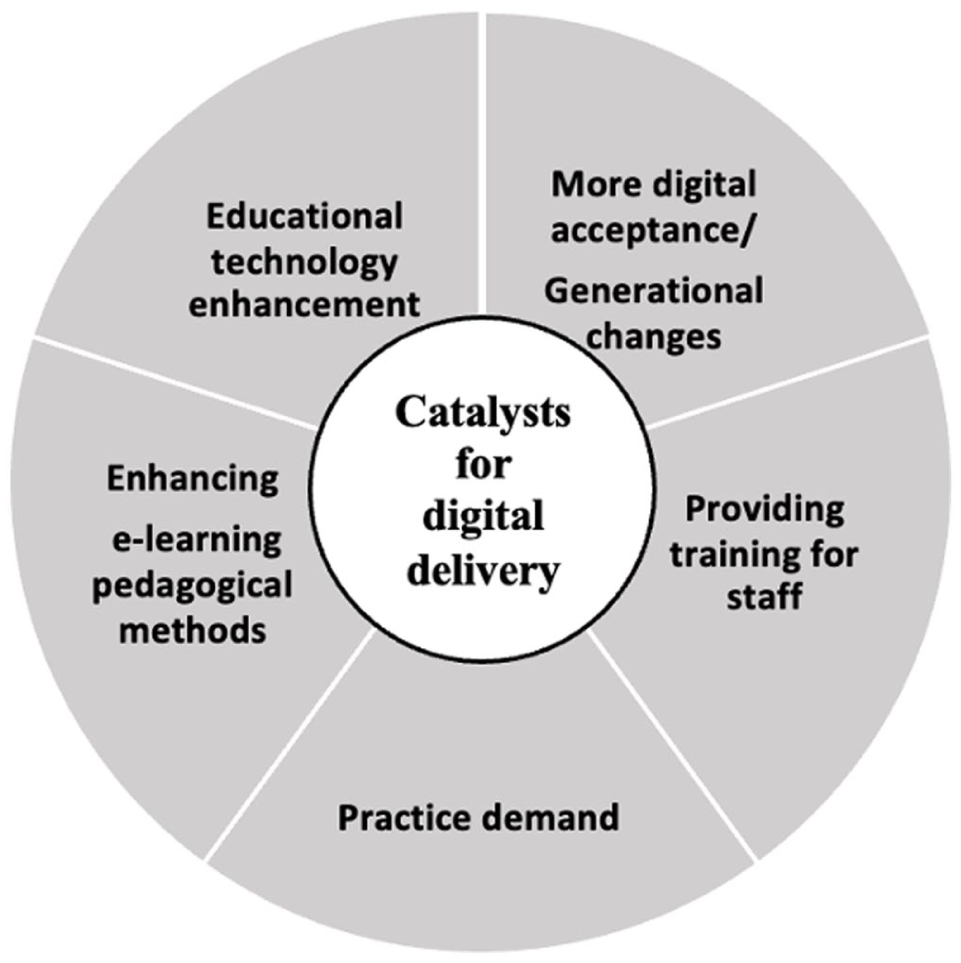
The five catalysts of digital delivery.
Therefore, these catalysts can potentially reinforce and reform universities’ strategies, risk appetites, and investment decisions for all forms of online delivery.
Conclusion
This study provides the first U.K.-wide empirical account capturing both academic and professional perspectives on the rapid transition to online and hybrid teaching across the full pandemic cycle, addressing a gap in planning education research that has largely focused on other national or disciplinary contexts.
The findings both support and extend existing literature on online and hybrid education in planning and related spatial disciplines. Consistent with earlier studies (e.g., Garcia 2021; Mironowicz and Schretzenmayr 2020), the results confirm that fully online delivery struggles to replicate the embodied and co-present dimensions of studio culture, fieldwork, and place-based learning. However, rather than reinforcing narratives of loss, this study demonstrates that academics actively reconfigured pedagogy through experimentation, resulting in context-specific innovations in teaching, assessment, and engagement. The pandemic, therefore, functioned not only as a disruption but as a catalyst for pedagogical reflexivity, prompting educators to reassess long-standing assumptions about delivery modes. The findings also challenge and partially overturn pre-pandemic assumptions that framed planning education as fundamentally incompatible with online delivery (e.g., Godschalk and Lacey 2001; Lawhon 2003). While interviewees largely rejected fully online planning degrees as substitutes for face-to-face provision, they simultaneously reported that online and hybrid approaches enhanced flexibility, inclusivity, and, for some students, engagement and confidence. This evidence complicates binary framings of “online versus in-person” learning and aligns with mode-agnostic quality frameworks such as the QAA (2024) Subject Benchmark Statement.
A key contribution of this study is its articulation of hybrid delivery as a pedagogically grounded, rather than purely technological, approach. Interviewees conceptualized hybridity as a deliberate allocation of activities to modes best suited to their pedagogical purpose: online delivery for scaffolding, coordination, and feedback, and in-person teaching for studio critique, tacit learning, and field-based engagement. This provides empirical support for a blended-first trajectory in planning education and advances existing literature by specifying how, rather than whether, hybrid models can support core planning pedagogy. Crucially, the findings show that in the U.K. context, pedagogical innovation was strongly mediated by structural conditions, including marketisation, competition, and financial dependence on international student recruitment. These factors shaped institutional risk aversion toward fully online provision and reinforced the prioritization of campus-based delivery for international cohorts, even where hybrid models were recognized as pedagogically effective. In this sense, U.K. planning education responses were not simply pedagogical choices but strategic adaptations to a highly competitive and consumer-oriented higher education system.
These findings suggest that the pandemic’s legacy in U.K. planning education is not a wholesale shift to online delivery but a recalibration of pedagogical practice, professional identity, and institutional priorities. Rather than resolving whether planning education can be delivered online, the pandemic clarified which elements of planning pedagogy are genuinely mode-dependent and which can be productively reconfigured within hybrid models. The U.K. planning education is therefore likely to remain predominantly face-to-face, while selectively integrating digital approaches that enhance resilience, flexibility, and inclusivity within existing institutional constraints.
Future research should extend this work by examining students’ perspectives, particularly differences between home and international cohorts, and by exploring employer expectations in an increasingly hybrid planning profession. As universities continue to navigate financial pressures, technological change, and workforce challenges, the findings of this study provide timely evidence to inform strategic decisions about pedagogically coherent and context-sensitive delivery models in planning education.
Footnotes
Acknowledgements
This research extends gratitude to all participants for their invaluable contributions, particularly those who participated in follow-up interviews to review findings. Special appreciation is owed to research assistants Chloe Salmon and Imogen Bullen-Smith for their diligent work in transcript analysis. Dr David Mathewson’s and Adam Sheppard’s early contributions to project discussions are also acknowledged. The author would also like to acknowledge the late Professor Tony Crook for his generous engagement and thoughtful encouragement during the development of this research. Constructive feedback from reviewers greatly enriched this work.
Declaration of Conflicting Interests
The author declared no potential conflicts of interest with respect to the research, authorship, and/or publication of this article.
Funding
The author received no financial support for the research, authorship, and/or publication of this article.
