



Abstract
Few studies have investigated the importance of attacks on educational infrastructure, personnel, and students on educational loss. This study overcomes this gap by examining how this type of conflict-related attack impact children's enrollment and attainment. In examining these relationships, we combine a new, georeferenced dataset on attacks on education (AoE) in Nigeria from 2000 to 2020 with georeferenced individual-level data from several Nigerian Demographic and Health Surveys. Our analysis shows that geographical proximity to AoE leads to significant educational loss: children in areas exposed to AoE are less likely to enroll in school and receive fewer years of education in total.
Introduction
Violent conflict not only leads to human suffering and destruction, but it also significantly affects human capital formation and the accumulation of education (Diwakar, 2015). Recently, the United Nations Educational, Scientific and Cultural Organization (UNESCO, 2024a) estimated that 251 million children worldwide were out of school in 2022, including 71 million children of primary school age. Available evidence suggests that out-of-school numbers are especially high in conflict-affected countries (UNESCO, 2022).
Educational loss is linked to a range of negative consequences. A lack of education is associated with lower agency of the child, child marriage, child labor, health problems, and enduring poverty throughout the life of the child and future generations (e.g. Cardoso and Verner, 2007; Wodon et al., 2016). Additionally, educational loss has also been linked to broader macro-level consequences, such as an increase in income inequality (Gradstein, 2003), social instability (Ritzen et al., 2000), and even the risk of conflict recurrence (Collier, 1999).
Much research has been conducted on the link between conflict and education (e.g. Justino, 2016; Kazibwe, 2025; Unfried and Kis-Katos, 2023). In examining this relationship, however, few scholars have investigated the specific effect of attacks on education (AoE), defined as any threat or actual use of force by state armed forces or non-state armed groups, on students, education personnel, or educational infrastructure (GCPEA, 2022: 23). These types of attacks are increasingly used (GCPEA, 2022) and include the systematic targeting of perceived ‘Western-style education’, as in the case of Al Shabaab in Somalia and the Boko Haram in Nigeria (e.g. Ryckman and Henshaw, 2025), but also direct attacks on individual students and teachers, such as the attack on Nobel laureate Malala Yousafzai.
To address this gap, we examine whether exposure to attacks on education around the time children reach school-entry age is associated with both immediate enrollment decisions and longer-term educational outcomes, measured as completed years of schooling later in life (attainment). We examine these two associations in the case of Nigeria, a country known for severe educational inequalities in terms of both school enrollment and attainment and AoE by actors like Boko Haram (e.g. Abayomi, 2018; Østby and Urdal, 2014). More precisely, we collect spatial and temporal information on the occurrence of AoE in Nigeria by analyzing five international newspapers, commonly used to collect conflict event data, from 2000 to 2020. 1 We combine this newly collected event data with information on primary enrollment and educational attainment for more than 150,000 individual household members from five georeferenced Nigerian Demographic and Health Surveys (DHSs).
Empirically, we analyze the associations with linear estimators, including household and cluster fixed effects, thereby controlling for all time-invariant household and location characteristics. Our analysis shows that residing in areas exposed to AoE at the expected time of school enrollment is associated with lower primary enrollment and lower educational attainment. Furthermore, we find important heterogeneous effects: AoE are especially negatively associated with the enrollment of boys, children in households where the head has lower levels of education, in urban areas, and in northern Nigeria.
Our study contributes to the literature on armed conflict and education in several ways. First, existing research has largely focused on the overall impact of armed conflict on schooling outcomes (e.g. Unfried and Kis-Katos, 2023), often treating conflict as a homogeneous phenomenon. This may obscure important differences across types of violence. We address this gap by focusing explicitly on attacks on education and examining their association with educational enrollment and attainment.
Relatedly, prior research has emphasized demand-side mechanisms linking armed conflict to education, such as increased poverty and fear (e.g. Chamarbagwala and Morán, 2011; Di Maio and Nandi, 2013; Justino et al., 2014). While important, attacks on educational infrastructure may also operate through supply-side channels, including school closures, destruction of facilities, and teacher absenteeism. We discuss these mechanisms to contextualize our empirical results but emphasize that we are unable to empirically examine these causal pathways. Rather, we examine the association between AoE and educational outcomes.
Second, we contribute to the growing literature on attacks on education by shifting attention from the determinants of these attacks to their consequences. While prior work has primarily examined why attacks on education occur (e.g. Asal et al., 2022; Fahey and Asal, 2020), we analyze the relationship between exposure to AoE and individual-level educational outcomes.
Finally, this study makes a data contribution. Research on AoE has been limited by data constraints, as many existing conflict datasets record such attacks only as secondary attributes or fail to capture their full range. To address this, we introduce a new subnational dataset on attacks on education in Nigeria. To our knowledge, this is the first dataset enabling systematic analysis of AoE across Nigeria over two decades, thereby facilitating future research on this important yet understudied form of violence.
Armed conflict and education: A brief review of the literature
With a sharper focus on the human security consequences of armed conflict, scholars have become increasingly interested in examining the effect of conflict on educational outcomes (e.g. Burde et al., 2017; Justino, 2016). With few exceptions, the existing literature finds a negative association between armed conflict and a range of educational outcomes (e.g. Justino, 2016; Kazibwe, 2025; Unfried and Kis-Katos, 2023). Two points are worth noting regarding the existing research.
First, most studies have measured exposure to armed conflict either via a binary measure or by different measures of conflict intensity. For example, Unfried and Kis-Katos (2023) examined the relationship between education and armed conflict, differentiating between different levels of conflict intensity (moderate vs. high intensity) based on the number of recorded battle-related deaths. They found that high-intensity conflicts reduce local educational attainment. Swee (2015), on the other hand, uses information on municipality-level war casualties. He finds that Bosnian children exposed to greater war intensity are less likely to complete secondary schooling.
Few studies, however, have examined other and more nuanced measures of conflict exposure, such as the occurrence of specific conflict tactics aimed at harming the educational infrastructure. Those who have examined these types of attacks have largely neglected their consequences. Fahey and Asal (2020) and Asal et al. (2022), for instance, found that government coercion, government oppression of religious expression, and greater political empowerment of women were associated with increased terrorist attacks against educational targets. Similarly, Biberman and Zahid (2016) have shown the importance of inter- and intra-organizational characteristics of insurgents, factors that make it more likely that conflict actors would attack schools.
Second, besides a narrow focus on conflict exposure, most existing work linking armed conflict to educational loss has either been agnostic about how conflict influences educational loss or has emphasized the importance of so-called demand factors, i.e. factors influencing the willingness of parents and caretakers to send their children to school. For instance, Akresh and De Walque (2008) show that school-aged children exposed to the Rwandan genocide experienced a drop in educational achievement. However, they acknowledge that their data do not allow them to determine which mechanism(s) were the primary driver of this effect (Akresh and De Walque, 2008).
More recently, scholars have started to empirically examine these drivers (see Diwakar (2023) for a good overview of potential factors that might be of interest). Most notably, poverty is seen as a crucial factor influencing the willingness of parents and caretakers to send their children to school (Justino, 2016). Armed conflict often negatively affects a household's economic situation (e.g. loss of crops and assets and the disruption of business activities). In these circumstances, households can save a considerable amount of money by withdrawing their children from school or not enrolling them in the first place. An additional benefit is that households can put these children then into income-generating work (Di Maio and Nandi, 2013).
Although we do not deny the effect of poverty and other demand factors on parents’ or caretakers’ decisions to withdraw or withhold their children from school, we argue that this is only one part of the equation. Educational outcomes can also be influenced by the supply or opportunity mechanism: armed actors might destroy the educational infrastructure, such as buildings, limit the availability of teachers, and reduce the available teaching materials (Kazibwe, 2025). This can influence children's educational loss, even though the demand for education is high.
A few important exceptions to these two broad patterns are worth mentioning. Kazibwe (2025) is one of the very few studies that examine the role of supply-side factors in assessing the impact of the Lord's Resistance Army insurgency on educational outcomes in northern Uganda. He finds that reduced school construction and maintenance, overcrowding, and increased student–teacher ratios owing to displacement exacerbate the negative impact of the insurgency on education. In contrast, he finds limited evidence regarding poverty as a demand-side factor. However, it is important to note that Kazibwe (2025) does not focus on the specific impact of AoE in his analysis.
The studies of Bertoni et al. (2019) and of Ajogbeje and Sylwester (2024) are also important exceptions, especially as they focus on the case of Nigeria. Bertoni et al. (2019) examine the impact of the Boko Haram insurgency (2009–2016) on educational outcomes in north-east Nigeria. The authors report a clear negative effect of conflict on education, including an extra analysis that focuses specifically on attacks against schools. However, it remains unclear how these attacks are operationalized—specifically, whether the analysis captures a wide range of violence against education or is limited to the physical destruction of school infrastructure. Moreover, Boko Haram constitutes a particularly extreme and ideologically driven case: the group is explicitly opposed to Western-style education and, in particular, to the education of girls (e.g. Ryckman and Henshaw, 2025). Its activities during the study period are also spatially and temporally concentrated in the north-eastern part of Nigeria (e.g. Thompson, 2025). As a result, the observed effects are shaped by the actions of a uniquely motivated actor, in a defined context, during a specific timeframe—conditions under which strong negative impacts on education are especially likely. This substantially limits the extent to which the findings can be generalized to other conflict settings where violence against education is less ideologically motivated or more diffuse.
These issues are also acknowledged by Ajogbeje and Sylwester (2024), who extend the work of Bertoni et al. (2019) by examining the impact of Nigerian farmer–herder (FH) conflicts, which are primarily concentrated in the central region of the country. Their findings suggest that FH conflicts have a more pronounced negative effect on educational attainment than the Boko Haram insurgency. They attribute this to the fact that FH conflicts more frequently target household resources, thereby leading to a decline in schooling as children are often required to contribute to household labor and asset protection (Ajogbeje and Sylwester , 2024). However, their response to Bertoni et al. (2019) does not specifically address AoE. Furthermore, they do not extend the original study's timeline, nor do they examine the full range of conflict types, such as those involving separatist groups active in the southern regions of Nigeria. This study also extends this analysis by primarily focusing on the influence of AoE in Nigeria from 2010 to 2018.
Attacks on education and educational outcomes
In this study, we argue that exposure to AoE, i.e. attacks on school infrastructure, attacks on teachers and students (including harassment and abduction), and the use of schools for military purposes by state and non-state forces, is likely to be negatively associated with educational outcomes, above and beyond the general negative effect of growing up in a conflict-affected area. Specifically, AoE may be associated not only with short-term disruptions in school enrollment but also with longer-term reductions in educational attainment, measured as the total number of years in schooling accumulated over time. Existing theoretical and empirical work suggests several plausible channels.
First, the destruction of educational buildings might directly affect the availability of education for many children in the affected area, independently of the willingness of parents to send their children to school. It forces parents to find alternative schools or other learning facilities, which are not always available in the immediate vicinity. This might force students to travel long distances, potentially harming their educational outcomes. For instance, Burde and Linden (2013) show that geographic proximity has a dramatic effect on children's schooling in rural areas in Afghanistan. The presence of a nearby community-based school increases overall enrollment in formal schools by 42 percentage points.
Even if alternative schools are available in the near distance, they are likely to become overcrowded as they need to host pupils of the targeted school(s). For instance, Brück et al. (2019) show that the Israeli–Palestinian conflict is resulting in negative academic achievements owing to increases in student–teacher ratios and overcrowding in classrooms. This relationship is also recognized by teachers themselves: interviews conducted with teachers in Cameroon indicated that the closing of schools because of armed conflict expanded the class sizes of other schools that were still operational, thereby increasing the workload for the available teachers (Agbor et al., 2022). Overcrowded classrooms and a high student–teacher ratio have a detrimental effect on the quality of education, which in turn might negatively affect educational outcomes (e.g. Kazibwe, 2025). For example, Pryor and Ampiah (2003) concluded in their study in Ghana that many villagers consider education as not always worthwhile because schooling in the village is not of sufficiently good quality to warrant the investment of time, energy, and economic resources. Consequently, it might lead to a decrease in enrollment and attainment.
Second, AoE also includes the use of these buildings for military purposes by state and non-state armed groups (GCPEA, 2022). The military use of schools not only significantly affects students’ and teachers’ safety, but it also negatively affects students’ access to quality education, lowering enrollment rates and attendance (Assefa et al., 2022; Sheppard, 2019). Parents may withdraw their children from school to keep them safe from those groups that occupy the school. Additionally, space constraints and overcrowding caused by the presence of armed groups might also limit the number of classes that are taught (Assefa et al., 2022; Sheppard, 2019), thereby influencing parents’ decision to not enroll their children.
Relatedly, the military use of schools is often accompanied by the destruction and loss of educational materials and school property (GCPEA, 2012). For instance, armed forces in the Democratic Republic of the Congo occupied the courtyard of a primary school in Mbau, Beni territory (UNSG, 2006). They not only burned school doors and desks as firewood but also looted stationery and other learning materials. School materials, such as computers, flipcharts, and textbooks, significantly support the learning process, improve teaching quality, and decrease dropout rates (e.g. Barrera-Osorio and Linden, 2009; Masino and Niño-Zarazúa, 2016). The looting and destruction of these school materials can then also negatively affect children's educational outcomes.
Third, targeting educational personnel and students as a form of AoE might also have a detrimental effect on children's educational enrollment and attainment. Attacks on teaching personnel will have ripple effects: they are likely to lead to teacher absenteeism and an increase in the student–teacher ratio (GCPEA, 2014; Mulkeen, 2007). Teacher absenteeism, in turn, is negatively associated with different educational outcomes, such as a substantial loss of learning time (e.g. Agbor et al., 2022; Cervantes-Duarte and Fernández-Cano, 2016). For example, León (2012) showed in his study on the effect of the Peruvian conflict that the injury or death of a teacher leads to a significant delay in school enrollment. At the same time, attacks on teaching personnel also reduce teaching quality because of increased student–teacher ratio, having a knock-on impact on school access and dropout rates, as parents are less motivated to make sacrifices to send their children to school (World Bank, 2010). Consequently, they might affect not only enrollment but also educational attainment. Similar arguments can be found when examining the effect of attacks on students. Attacking students on the way to and from school, or in the schoolyard, not only affects the direct victims but might also affect those not directly involved (Williams et al., 2018). Children may no longer want to go to school out of fear and physical and psychological trauma.
While the above discussion outlines several plausible causal pathways through which attacks on education may affect schooling outcomes, the available data do not allow us to empirically test or disentangle these mechanisms. Instead, we focus on estimating the associations between AoE and educational outcomes. This leads us to the following main hypothesis, linking these types of attacks to both short-term educational loss (enrollment) and longer-term consequences over time (educational attainment):
Furthermore, we believe that the relationship between AoE and educational outcomes also depends on several conditional factors that vary for each child. We focus in this study on what we believe are crucial conditional factors, occurring at the individual, community, and regional levels. First, we anticipate that AoE may impact boys and girls differently (see Diwakar (2023) for a good overview of the importance of gender disaggregation when it comes to examining the link between armed conflict and education). Boys often face a higher opportunity cost for schooling, as their potential income-generating capabilities are generally perceived to be greater than those of girls. As a result, boys are more likely to be withdrawn from school and sent into the labor market during times of crisis (Brown et al., 2023; Vásquez and Bohara, 2010). Conversely, girls are less likely to enroll in school initially, and concerns related to fear and insecurity can significantly influence parents’ decisions to forgo enrolling their daughters or to remove them from school entirely (e.g. Guariso and Verpoorten, 2013; Shemyakina, 2011).
Second, we examine the impact of household socioeconomic status on educational outcomes. Wealthier households may be better equipped to mitigate the adverse effects of AoE compared with households with fewer resources. Specifically, these households are often more able to utilize alternative educational infrastructure in response to disruptions. For example, they may be able to find substitute schools, reduce their children's travel time, or purchase additional school supplies following attacks. Consequently, children from wealthier households might experience less disruption in their educational enrollment and attainment.
Lastly, we propose that the impact of AoE on both children's educational enrollment and attainment may be shaped by regional factors. In urban areas, for example, a higher concentration of schools and teachers may provide families with more alternatives in the face of AoE, potentially lessening the adverse effects of these disruptions. Additionally, certain regions may be targeted more frequently than others, which could disproportionately affect the educational outcomes of children residing in those areas. The potential conditional effects described above can be summarized in the following hypothesis:
Methodology
Case: Nigeria
To investigate the relationship between AoE and educational enrollment and attainment, we examine the case of Nigeria. This country exhibits substantial geographical variation in both conflict intensity and educational outcomes (e.g. Abayomi, 2018; Haer and Østby, 2025; Kotsadam et al., 2018; Østby and Urdal, 2014). Between 2000 and 2020, over 50,000 conflict-related deaths were recorded in the country, with more than 40,000 attributed to violence perpetrated by the state and various non-state actors in different parts of the country (Sundberg and Melander, 2013). The conflict escalated notably in 2009 and 2010, reaching its peak in 2014 and 2015. Although violence has gradually declined since 2015, conflict levels remain significantly higher than those observed before 2014 (see also Figure 1; Sundberg and Melander, 2013).

Geographical distribution of attacks on education, conflict events, and the Nigerian Demographic and Health Surveys survey clusters in Nigeria in 2000–2018.
This persistent instability has profoundly affected education in Nigeria, with armed groups frequently targeting schools, leading to widespread disruptions. The frequency and lethality of such attacks have increased over time, exacerbating the challenges facing the education sector (UNESCO, 2024b). At the same time, like many Sub-Saharan African nations, Nigeria has struggled to accommodate its rapidly growing school-age population within the formal education system (USAID, 2022). Adopted in 1989, Nigeria follows a 6–3–3–4 educational structure, comprising 6 years of primary school, 3 years of lower secondary school, 3 years of senior secondary school, and 4 years of higher education. While public schooling is officially free, households bear a significant financial burden owing to costs associated with books, supplies, uniforms, parent–teacher fees, examination fees, and food (National Population Commission (Nigeria), 2016). These financial pressures stem largely from the chronic underfunding of Nigeria's public education system. In response, growing calls for major reforms have emerged, advocating not only for changes to the 6–3–3–4 system itself but also for a fundamental restructuring of its financial framework (USAID, 2022).
Empirical strategy
In examining how attacks on education are associated with educational outcomes (enrollment and attainment), we integrate newly collected data on AoE in Nigeria from 2000 to 2020 with educational information from five georeferenced household surveys conducted by the Nigerian Demographic and Health Survey (DHS) in 2003, 2008, 2010, 2013, and 2018. The DHSs are nationally representative surveys in which, among others, questions are asked about education. One important characteristic of these five surveys is that they record the location of the respondents, i.e. the so-called DHS cluster, allowing us to combine this with the location of AoE. Our unit of analysis is the individual household member who resides in these DHS cluster locations. Figure A1 in the Online Appendix shows the distribution of these DHS survey clusters (the black dots) in Nigeria for the period 2000–2018.
Our sample includes all individuals who were of school-starting age (6 years for primary) at some point during the period 2001–2018. 2 In other words, we include all individuals born between 1995 and 2012, regardless of which DHS wave they were part of or their age at the time of the DHS interview. This means some respondents were already adults when surveyed. For example, an individual interviewed at age 20 in 2018 is included, since they turned 6 in 2004, which falls within our observation period.
Each household member is observed only once—at the expected school-starting age of 6. We acknowledge that not all children enter school exactly at 6, but we expect that exposure to AoE around this threshold plausibly influences the likelihood of ever enrolling. Hence, our design focuses on exposure to attacks on education at the school-entry margin, when the enrollment decision is typically made, and leverages within-household variation in exposure across siblings by including household fixed effects. 3 In total, our sample includes 178,913 individuals.
Dependent variable: Educational enrollment and attainment
Since we are interested in the extent to which local exposure to AoE affects enrollment and educational attainment, we use two dependent variables.
First, relying on variables from the DHSs, we construct a dichotomous variable for educational enrollment, indicating whether an individual has ever enrolled in primary education (coded as 1) or not (coded as 0), based on the original DHS variable hv106 (highest education level attained). Among the 178,913 household members in our sample, 123,450 (69%) had enrolled in primary education. 4 Differences in enrollment can be found across gender and region: 71% of males had attended school at some point compared with 67% of females. Additionally, there are significant regional differences: while only 59% of household members in northern Nigeria had been enrolled in school, the figure rises to approximately 89% in the south.
Second, we measure educational attainment relying on the DHS variable hv108, which records the total number of years an individual has received a formal education, ranging from 0 to 20 years. On average, individuals in our sample have 3.5 years of education. 5
Independent variable: AoE
To examine the effect of AoE, we collected systematic information on these types of attacks in Nigeria in the period 2000-20206, 6 relying on the Global Coalition to Protect Education from Attack's (GCPEA: a coalition of organizations, including United Nations entities and non-governmental organizations, working together on advocacy and research on education and armed conflict) definition of attack on education as ‘any threat or actual use of force by state armed forces or non-state armed groups on students, education personnel, or educational infrastructure’ (GCPEA, 2022: 23). We collected this information based on the manual coding of five different sources: Agence France, the Associated Press, BBC Monitoring Africa, Reuters, and Xinhua News Agency. We selected these news sources based on their widespread use in established conflict event datasets, such as the Uppsala Conflict Data Program's Georeferenced Event Dataset (UCDP GED; Sundberg and Melander, 2013). Using the same sources allows for greater consistency with other scholarly work and ensures a comparable standard of reporting, especially regarding verifiability, regular publication, and geographical coverage. 7
With the help of a set number of keywords 8 in combination with the country name and the time period (2000–2020), we made a preselection of articles. The resulting articles were read and coded if they were about an event that adhered to the GCPEA criteria. In addition, we collected information on the timing, location (village, local government areas, and state), and type of attack (attacks on the physical infrastructure of schools, attacks on students and teachers, and the military use of schools).
We combined our newly collected information with data from the Global Terrorism Dataset, which also records information on attacks on education, and removed the duplicates. 9 All in all, our dataset includes 271 AoE events in the period from 2000 to 2020, the majority of which occurred from 2010 onwards. Most of the recorded attacks (157) were attacks focused on destroying the educational infrastructure by destroying school buildings, 140 events involved attacks on teachers and students, and only in very few cases were schools used for military purposes (seven). It is important to note that AoE events can encompass more than one category.
Each AoE is geocoded by attributing the centroid coordinate of the most precise geographical unit for which we have information. To examine the local-level effects of AoE, we focus our analysis on events with known village or town locations (precision level 1), which account for 87% of all recorded AoE events (237 out of 271). Concretely, for each DHS household member, we record whether at least one AoE occurred within 25 or 50 km of their household in the year before they turned 6 (coded as a binary AoE variable), as well as the total number of AoE within the same spatiotemporal window (a count variable). In choosing 25 and 50 km as buffer sizes, we follow the conventional standard in the literature that examines the impact of local spatial relationships (e.g. Østby et al., 2018).
Figure 1 illustrates the distribution of AoE events, DHS household members, and armed conflict within Nigeria. 10 A few points are worth noting. First, the figure shows that most AoE (red triangles) occurred in the north-east and south regions of the country. Second, our data show significant variation in terms of exposure to AoE. Third, the figure also shows how our AoE data overlap with conflict events from the UCDP GED version 24.1 (Sundberg and Melander, 2013). It reveals that there is no perfect overlap between the location of conflict events and AoE events, with some conflict locations not seeing any AoE during the entire period and vice versa (correlation is 0.28). For example, large parts of the north-east, north-central, and north-west regions have seen several conflict events (blue crosses) but did not see many AoE (red triangles). This is not surprising, as many of the AoE did not result in any fatalities and were therefore not recorded by the UCDP GED (Sundberg and Melander, 2013).
Modelling and covariates
We focus primarily on school enrollment, which we model using a linear probability model given the binary nature of the outcome. Linear probability models are widely used in microeconomics and development research because their coefficients are directly interpretable as marginal effects and they allow for the inclusion of complex fixed effects and interaction structures (Friedman, 2012; von Hippel, 2017). Although linear probability models can yield predicted probabilities outside the [0,1] range, such cases are rare in our data, and the estimates are highly similar to those from logistic regressions when probabilities lie within the interior of the unit interval. Additionally, we estimate models of educational attainment—measured as completed years of schooling—using ordinary least squares. Using linear estimators for both outcomes eases interpretations and ensures a consistent modeling framework and comparability across specifications.
Specifically, we estimate the following model:

In this specification, i indexes individuals, h households, and c cohorts, defined by the year in which the child turned 6, the official primary school starting age in Nigeria. The dependent variable
The key explanatory variable,
We also include some control variables. First, we control for armed conflict, which might not only influence AoE but might also affect educational loss. The vector
Additionally, we include household fixed effects,
Descriptive statistics.

AoE, Attacks on education.
Results
Table 2 presents our main analysis of the short-term effect of exposure to AoE on children's primary school enrollment. Models 1–4 report standard errors clustered at the DHS cluster level. Because exposure to AoE is geographically defined and largely shared within local communities, clustering at this level may be overly conservative. At the same time, once household fixed effects are included, identification comes primarily from within-household variation across children rather than across households within the same DHS cluster. We, therefore, also report models without standard errors clustered around the DHS cluster (Models 5–8). The estimated coefficients remain substantively unchanged, while statistical precision increases. Consequently, we treat Models 5–8 as our preferred specifications.
Individual-level effects of local exposure to AoE on educational enrollment.
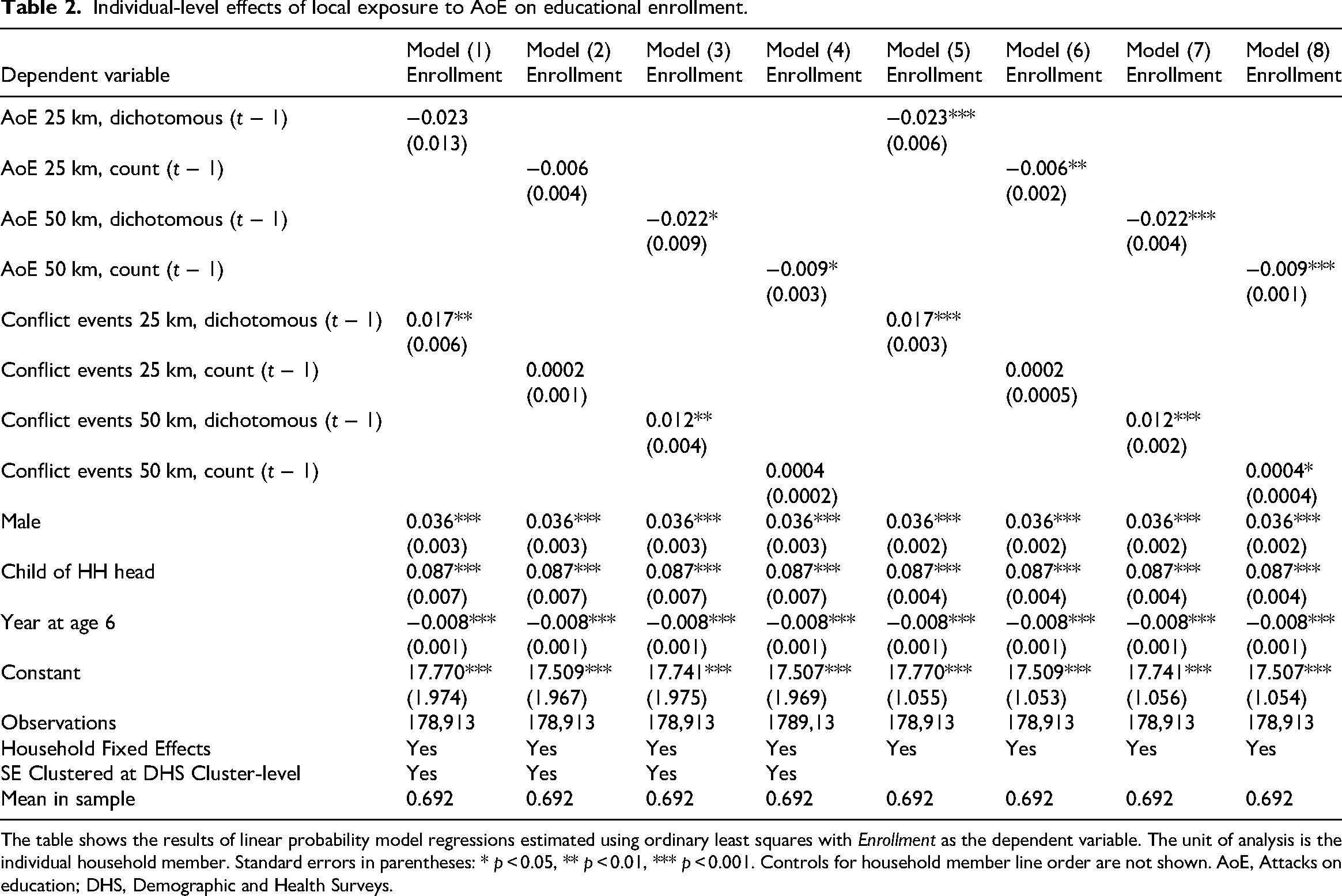
The table shows the results of linear probability model regressions estimated using ordinary least squares with Enrollment as the dependent variable. The unit of analysis is the individual household member. Standard errors in parentheses: * p < 0.05, ** p < 0.01, *** p < 0.001. Controls for household member line order are not shown. AoE, Attacks on education; DHS, Demographic and Health Surveys.
Models 1–2 and 5–6 examine exposure within a 25 km radius of the child's residence in the year prior to turning 6 (i.e. the expected school entry age), while Models 3–4 and 7–8 use a 50 km radius. Models 1, 3, 5, and 7 use a dichotomous indicator capturing whether at least one AoE occurred within the specified radius, whereas Models 2, 4, 6, and 8 use a count measure capturing the number of AoE. Across all specifications, the estimated coefficients are negative. However, results are generally not statistically significant for the narrower 25 km radius when clustering standard errors (Models 1–2).
In our preferred specifications (Models 5–8), exposure to AoE is consistently associated with a statistically significant reduction in school enrollment (p < 0.01 in Model 6 and p < 0.001 in the remaining models). This indicates that residing near one or more AoE in the year prior to expected school entry is associated with a lower likelihood of enrollment in primary school. For example, as shown in Model 5, exposure to at least one AoE within 25 km reduces the probability of enrollment by 2.3 percentage points. Relative to the sample mean (0.692), this corresponds to approximately a 3.2% decrease relative to the average enrollment rate.
To put the magnitude of our findings in perspective, prior studies of general conflict exposure report negative effects on education outcomes ranging from 2 to 10 percentage points (see e.g. Chamarbagwala & Morán, 2011; Justino et al., 2014; León, 2012). Our estimates—indicating a 2–3 percentage point reduction in enrollment from local exposure to AoE—may fall at the lower end of this range but are notable given that AoE are rarer and more directly targeted disruptions of schooling. Moreover, while a 3 percentage point reduction may appear modest in relative terms, in a country the size of Nigeria, it translates into a substantial number of children whose education is disrupted.
To further assess the impact of this decline in enrollment, we combine our regression results (Model 5) with information on the potential number of Nigerian school starters per year (United Nations, 2022) and how many people live in the AoE-affected areas each year (based on CIESIN (2018) data). This suggests that AoE exposure is associated with approximately 6600 fewer children enrolling in school each year in Nigeria. While this calculation is necessarily approximate, it illustrates the broader societal implications of the estimated effects. 13
All individual-level control variables behave as expected. Table 2 demonstrates that there is a clear independent effect of AoE, even when controlling for the overall exposure to conflict. 14 Moreover, the likelihood of enrolling in school is larger for males and biological children of the household head. Surprisingly, however, the effect of year at age 6 (school-starting age) is negative. This implies a somewhat lower probability of enrollment for the younger individuals in our sample.
In Table 3, we examine the longer-term educational consequences of local AoE at the year of expected school-starting age on the number of schooling years completed (attainment). We report results using a 25 km buffer zone; corresponding models with a 50 km buffer are shown in Table A1 in the Online Appendix. Models 1–3 report standard errors clustered at the DHS cluster level, while Models 4–6 report conventional standard errors without clustering. As in Table 2, clustering at the DHS cluster level may be overly conservative given that identification primarily comes from within-household variation once household fixed effects are included. The results are substantively similar across specifications, but statistical precision increases in Models 4–6, which we treat as our preferred specifications.
Individual-level effects of local exposure to AoE on educational attainment.

The table shows the results of ordinary least squares with Attainment as the dependent variable. The unit of analysis is the individual household member. Standard errors in parentheses: *p < 0.05, **p < 0.01, ***p < 0.001. Controls for household member line order are not shown. AoE, Attacks on education; DHS, Demographic and Health Surveys.
Across all models, the estimated coefficients for AoE exposure are negative and statistically significant at the 5% level or lower. For example, Models 1 and 4 in Table 3 show that a household member exposed to an AoE in the same year that the respondent should enroll (at age 6) has, on average, approximately 2 months less education (0.2 years) than a household member who did not experience any AoE at this critical age. Models 2 and 5 show a similar effect. However, in these models, we consider the effect of local AoE exposure the year before school-starting age. In Models 3 and 6 we consider the effect of local exposure to AoE at both ages 5 and 6 together (i.e. t − 1:t, both the year before and the year of expected school-starting age). In all models, we see similar results: being exposed to AoE results in fewer years of education in total.
The control variables included in Table 3 show similar effects to those portrayed in Table 2. Importantly, the negative association between AoE exposure and educational attainment remains robust when controlling for overall conflict exposure, indicating that attacks on education have an effect beyond general conflict dynamics. To explore the relationship between conflict events and AoE in more depth, we also ran all models for AoE (without controlling for conflict events: Tables A2 and A3 in the Online Appendix) and for conflict events (without controlling for AoE: Tables A7 and A8). The tables show that the presence or absence of conflict does not influence the impact of AoE on educational loss (Tables A2 and A3). However, when we solely look at the effect of conflict on educational outcomes (without taking AoE into account—Tables A7 and A8), the effects are less stable: conflict has both negative and positive (weak) effects.
Heterogeneous effects
In addition to the main results presented above, we also explore the impact of AoE conditional on individual, household-, and regional-level factors (Hypothesis 2). Tables 4 and 5 show the results. 15
Heterogeneous effects of AoE on enrollment conditional on individual and household-level factors.

The table shows the results of linear probability model regressions estimated using ordinary least squares with Enrollment as the dependent variable. The unit of analysis is the individual household member. Standard errors in parentheses: *p < 0.05, **p < 0.01, ***p < 0.001. Controls for household member line order are not shown. AoE, Attacks on education.
Heterogeneous effects of AoE on enrollment by rurality and region.

The table shows the results of linear probability model regressions estimated using ordinary least squares with Enrollment as the dependent variable. The unit of analysis is the individual household member. Standard errors in parentheses: *p < 0.05, **p < 0.01, ***p < 0.001. Controls for household member line order are not shown. AoE, Attacks on education.
In Models 1 and 2 of Table 4, we examine the role of gender. Our analysis of the impact of AoE on enrollment reveals a negative effect for both boys and girls. Notably, this effect is statistically significant only for boys. At first glance, this result may seem somewhat puzzling. However, it may provide support for the opportunity cost mechanism: boys typically have higher income-generating potential, making them more likely to withdraw from school during crises. The observed gender difference could also be explained by the nature of attacks on education in Nigeria. Certain types of attacks, such as the abduction of students for recruitment into armed groups, might disproportionately affect boys, given the higher likelihood of male recruitment in conflict zones. Although girls are still at risk, they may be less likely to be targeted for such recruitment, which could make school attendance appear to be a safer option for them. Currently, however, we have limited data to test the explanatory power of these potential factors.
In Models 3–7, we examine the influence of household socioeconomic status on school enrollment. We measure this using two indicators: wealth quintiles (based on the number of household goods) and the educational level of the household head. Models 3–5 reveal the results when examining the effect of wealth quantiles. They show only a statistically significant effect for middle-income households, possibly because the poorest households are less likely to be enrolled initially, while the wealthiest households have access to more educational alternatives when schools are attacked. As this measure of wealth is often criticized (e.g. Bellows et al., 2020), we also examine an alternative measure: the influence of the educational level of the household head (e.g. Estrada-Mejia et al., 2020; Pham et al., 2024). To explore the influence of the level of education of the household head, we compare households where the head has limited education (did not complete primary school) with those where the head has completed primary school. The results can be found in Models 6 and 7. The results confirm our hypothesis, showing that AoE significantly reduces children's enrollment only in households where the head did not complete primary school.
Table 5 presents the potential differential effects of attacks on education (AoE) in urban and rural areas (Models 1 and 2) as well as in northern and southern Nigeria (Models 3 and 4). Models 1 and 2 reveal, somewhat unexpectedly, that the effect of AoE is negative and statistically significant only in urban areas, where we observe a substantial decline in enrollment of approximately 5%. This result may be driven by several factors. First, urban areas, with their higher population density, may experience faster transmission of information regarding AoE, which can heighten fear and anxiety among a larger proportion of the population. This, in turn, may prompt more parents in urban areas to withdraw their children from school. In contrast, rural areas, where information about attacks may not spread as quickly, might not experience the same level of fear. Second, the observed difference may be explained by variations in the level of development between urban and rural areas. Urban schools generally benefit from more advanced infrastructure and facilities, including larger school buildings, specialized classrooms, laboratories, and administrative offices (Sumida and Kawata, 2021). While we cannot directly test these mechanisms with our data, we think that these features, while improving educational quality under normal conditions, also might make urban schools more complex and costly to repair or rebuild after an attack. Consequently, the prolonged disruption in urban schools can lead to extended periods during which children are unable to attend school, resulting in a more pronounced decline in enrollment and attendance. In contrast, rural schools tend to have simpler infrastructure, such as basic classrooms and fewer facilities, and operate with greater flexibility in terms of management and repair. The rebuilding or replacement of rural schools may face fewer regulatory constraints, lower costs, and less dependence on specialized labor and materials. Furthermore, rural communities may have stronger informal support networks that facilitate quicker recovery through community-led rebuilding efforts. These factors may reduce the duration and severity of school closures following attacks, mitigating the impact on enrollment.
Models 3 and 4 examine the differences between the northern and southern regions of Nigeria. We explore this difference as it is often suggested that Boko Haram, an armed group that is known to consciously attack educational institutions, is most active in the northern regions (see map in Figure A3 in the Online Appendix). Our results show that AoE harms enrollment in both the north and south, but that the substantive effect is stronger for the northern regions (the substantial effect suggests a decline of 4% in comparison with a 2.8% decline in the south).
Robustness tests
Our results are robust to several additional tests. The results of these tests can be found in detail in the Online Appendix.
First, as we show in the Online Appendix, the effect of AoE on educational outcomes is robust to different geographical radii (see Online Appendix Table A1).
Second, in the above-presented models, we used household fixed effects, a rather strict test, which could potentially reduce the effects and power of our estimates. Hence, we also ran the models replacing household fixed effects with DHS cluster fixed effects (see Online Appendix Tables A5 and A6). The results remain largely the same.
Third, in our main analysis, we focus primarily on exploring how AoE influences primary enrollment. To extend our analysis, we also examine in the Online Appendix (Table A4) how AoE influences enrollment in secondary education. The results also show a negative effect, although it loses statistical significance, indicating that the impact of AoE is most pronounced for primary enrollment. This might be caused by the small sample size, i.e. very few children are going to secondary school to begin with.
Fourth, to explore whether Boko Haram involvement is largely driving the impact of AoE on educational outcomes, we tested the isolated impact of AoE with Boko Haram involvement vs. the impact of AoE not perpetrated by Boko Haram (see Online Appendix Table A9 for the results). Our results still show a negative effect, albeit stronger effects of AoE perpetrated by other groups than Boko Haram. However, if we distinguish between northern and southern Nigeria, it is only the AoE perpetrated by Boko Haram that holds a significant negative effect on educational outcomes in the north, whereas the effect of other AoE dominates in the south (see Online Appendix Table A10). It is important to note, however, that we have limited information regarding the specific actors involved in these attacks, including the role of Boko Haram. News reports often refer to armed assailants without clearly identifying the perpetrators. Hence, we must exercise caution when drawing strong conclusions from these findings.
Fifth, we also disaggregate the analysis, looking at heterogeneous effects by each of Nigeria's six geopolitical zones. We see significant negative effects of AoE on enrollment in the northwest, southeast, and southwest, whereas effects in the northeast—Boko Haram's main area of operation—are not statistically significant (see Online Appendix Table A11). We interpret this as possibly reflecting different conflict dynamics, high baseline levels of educational disadvantage, or displacement patterns that cannot be fully captured with DHS data.
Sixth, to assess robustness to model choice and functional form, we estimated the enrollment specification using Poisson pseudo-maximum likelihood with household fixed effects. Poisson pseudo-maximum likelihood is consistent for binary dependent variables and offers additional robustness to heteroskedasticity. Results are shown in Table A12. We also re-ran our main models, which include fixed-effects logit models (see Online Appendix Table A13). The estimated effect of AoE exposure remains negative and of similar magnitude to the linear probability model, confirming that our findings are not driven by model choice.
Eight, to disentangle the effect of attacks on education from broader conflict exposure, we re-estimate the models entering general conflict exposure and AoE separately. The results show that general conflict is not systematically associated with lower enrollment, while exposure to AoE consistently exhibits negative effects (Online Appendix Table A14).
As a final robustness check, we re-estimate the enrollment and attainment models including age-at-interview fixed effects to address concerns that differential time at risk could mechanically drive the results, particularly among the youngest children. In these specifications, we omit the “year-at-age-6” term since age fixed effects capture the mechanical increase in enrollment with observation time and avoid conflating cohort and timing effects. The substantive interpretation of the results remains unchanged (see Online Appendix Tables A17 and A18).
Conclusion
In this study, we have examined the educational effect of one of the grave violations against children: attacks on educational institutions and their students and personnel. In doing so, we contribute to the literature on conflict and education in important ways. First, existing studies largely neglect the fact that different tactics employed by armed actors during conflict might have different effects on children's education. Second, by focusing on AoE, we emphasize the importance of educational infrastructure and how this interacts with motivations.
Theoretically, we argue that AoE is associated with significant educational loss among children in affected areas. Such attacks may lead to school closures, teacher absenteeism, and declines in education quality. While we do not test these mechanisms directly, our focus is on estimating the overall association between AoE and both short- and longer-term educational outcomes.
Empirically, we examine these relationships using newly collected subnational data on AoE in Nigeria (2000–2020), combined with five georeferenced DHSs containing individual-level information on educational outcomes. Consistent with our expectations, we find that proximity to attacks on education is associated with educational loss, in terms both of a reduced likelihood of school enrollment and lower educational attainment. We also uncover important heterogeneous effects: boys are more affected than girls, children in households where the head has completed primary education are less affected by attacks, and effects are more pronounced in urban areas and in northern Nigeria.
To the best of our knowledge, this study provides the first systematic examination of the association between attacks on education and children's educational outcomes. However, several limitations should be acknowledged. While our household fixed-effects models yield conservative estimates, they cannot fully resolve potential endogeneity concerns. Moreover, our analysis is constrained by data limitations: the DHS only indirectly captures the timing of school enrollment, media-based reporting of attacks on education may be incomplete, and our spatial exposure measures are necessarily imperfect. These caveats imply that our findings should be interpreted as robust associations rather than definitive causal effects.
Future research could extend this work in several directions. First, comparative analyses across conflict-affected countries would help assess the generalizability of our findings beyond Nigeria, which represents a particularly high-conflict and high-inequality context. Second, combining survey data with administrative school records or satellite imagery could improve the measurement of enrollment dynamics, dropout, and infrastructure destruction. Third, expanding our AoE dataset across settings would also allow researchers to differentiate between types of attacks and to assess whether specific forms of violence drive the heterogeneous associations we observe, such as gender or regional differences. Fourth, a limitation of the current study is that migration patterns might represent a source of bias. The DHSs do not provide complete migration histories for all household members, making it difficult to account for migration directly. To the extent that conflict-induced migration occurs from conflict-affected to safer areas, this would probably attenuate rather than inflate the estimated effects. However, future surveys should ideally include migration histories for all household members. Finally, qualitative or mixed-method approaches could help unpack underlying mechanisms, while quasi-experimental designs could strengthen causal inference.
Despite the mentioned limitations, our findings carry important policy implications. They underscore the urgent need for stronger protection of schools, teachers, and students in conflict-affected settings. While frameworks such as the Safe Schools Declaration provide guidelines and political commitments, implementation remains uneven and monitoring and enforcement are often weak (Minor, 2021). Strengthening such frameworks—through improved accountability, training of armed actors, and investment in early-warning systems—is therefore crucial.
On the supply side, increasing the cost of targeting educational institutions—through legal accountability, international pressure, or enhanced physical protection (e.g. school fortification, community watch systems)—may deter attacks. Programs that have been implemented in countries such as the Philippines—where schools are declared zones of peace—offer models that could be adapted to other conflict-affected contexts (UNESCO, 2024c). Future efforts should, therefore, focus on both strengthening existing mechanisms and addressing remaining gaps in the protection of education.
Supplemental Material
sj-docx-1-cmp-10.1177_07388942261444751 - Supplemental material for Children's schooling in the context of attacks on education: Evidence from Nigeria
Supplemental material, sj-docx-1-cmp-10.1177_07388942261444751 for Children's schooling in the context of attacks on education: Evidence from Nigeria by Gudrun Østby, Roos Haer and Kristine Helskog in Conflict Management and Peace Science
Supplemental Material
sj-zip-3-cmp-10.1177_07388942261444751 - Supplemental material for Children's schooling in the context of attacks on education: Evidence from Nigeria
Supplemental material, sj-zip-3-cmp-10.1177_07388942261444751 for Children's schooling in the context of attacks on education: Evidence from Nigeria by Gudrun Østby, Roos Haer and Kristine Helskog in Conflict Management and Peace Science
Footnotes
Acknowledgment
We would like to thank all the participants and discussants of the 2024 Jan Tinbergen European Peace Science Conference (Dublin, 17–19 June), the 2024 European Political Science Association annual conference (Cologne, 3–6 July), and the Conflict Patterns Research Group at the Peace Research Institute Oslo for their helpful comments and suggestions.
Funding
The authors disclosed receipt of the following financial support for the research, authorship, and/or publication of this article: This research was funded by the Research Council of Norway (grant no. 350187).
Declaration of conflicting interests
The authors declared no potential conflicts of interest with respect to the research, authorship, and/or publication of this article.
Data availability statement
The data used in this study combine newly collected data on attacks on education in Nigeria with individual-level survey data from the DHS Program. The authors cannot publicly share the DHS data, as access requires prior registration and approval from the DHS Program. Researchers may request access directly through the DHS Program website ( ). To ensure transparency and replicability, the data on attacks on education in Nigeria, as well as all code necessary to reproduce the analyses and estimate the models, can be downloaded.
Supplemental material
Supplemental material for this article is available online.
Notes
References
Supplementary Material
Please find the following supplemental material available below.
For Open Access articles published under a Creative Commons License, all supplemental material carries the same license as the article it is associated with.
For non-Open Access articles published, all supplemental material carries a non-exclusive license, and permission requests for re-use of supplemental material or any part of supplemental material shall be sent directly to the copyright owner as specified in the copyright notice associated with the article.
