




Abstract
How does interethnic marriage influence the occurrence of ethnic violence in sub-Saharan Africa? Previous studies on the relationship between intergroup contact and conflict onset have produced mixed findings. Some scholars have argued that this might be due to the way interethnic contact is measured. Building on insights of social psychology, this study examines the influence of interethnic marriage as the ultimate form of positive intergroup contact. In doing so, we combine information of the Demographic and Health Surveys with event data on ethnic conflict. Our analysis shows that areas with higher levels of exogamy significantly experience less ethnic conflict.
Introduction
While generally not regarded as a direct cause of conflict, a large share of African conflicts have been fought along ethnic lines (Williams, 2016). For instance, the recent troubles in Burundi after President Nkurunziza sought a third term in office have opened old ethnic divisions and instilled interethnic rivalry (Mikhael, 2019). Also, in the Democratic Republic of the Congo, interethnic tensions between the Lendu and Hema communities over land and other resources have continued for decades (Pottier, 2010). These examples highlight the fragility of interethnic relations on this continent. It is then also no surprise that ethnic conflict has been at the forefront of research agendas in the social sciences and on the policy agenda of many governments and (international) organizations.
Recent disaggregated empirical studies on interethnic relations and their association with ethnic conflict have produced mixed results. Some scholars have argued that ethnic segregation has a pacifying effect (e.g. Field et al., 2008). According to these scholars, interethnic contact increases competition, which can lead to increased ethnic mobilization, ultimately leading to armed conflict. Other studies, however, show that ethnic diversity decreases the likelihood of ethnic armed conflict (e.g. Kasara, 2016). They assume that interethnic contact reduces prejudice and violent behavior toward other groups.
Several explanations are offered for these seemingly contradictory results. First, some scholars have argued that instead of measuring interethnic interaction, most studies rely on a spatial distributional measure of ethnic diversity. These kinds of measures conflate the opportunity for intergroup contact, with actual intergroup contact (e.g. Al Ramiah and Hewstone, 2013). Second, scholars have argued that existing studies often overlook the nature of contact (e.g. Pettigrew, 1998). Negative contact, in contrast to positive contact, might reinforce ethnic identification and prejudice, thereby increasing the likelihood of mobilization by political entrepreneurs and armed conflict.
Taking this into account, we propose an alternative measure of interethnic contact: interethnic marriage. Interethnic marriage (or exogamy), defined as a marriage between spouses who belong to different ethnic groups (Furtado and Theodoropoulos, 2011), is not only a measure of intergroup contact but is also regarded as a form of contact that is highly positive and meaningful (McDoom, 2016). Interethnic marriage fulfills all necessary criteria set forth by the intergroup contact theory to produce positive effects countering mobilization and armed conflict (Allport, 1954; McDoom, 2016). Consequently, we expect that interethnic marriage is negatively associated with the occurrence of ethnic conflict.
Examining this relation is important for several interrelated reasons. First, by using the interethnic marriage measure, we follow the suggestion of Green and Seher (2003), who emphasize the importance of integrating the insights of social psychology more into the study of ethnic conflict. Second, by examining the behavioral consequences of interethnic marriage, we extend the literature on intergroup contact and intergroup marriages. The former strand of literature has been primarily devoted to the inquiries of mediators (how does contact work) and moderators (under which conditions does contact work). The latter strand has treated marriage as an explanandum rather than as an explanatory factor. Extraordinary behavioral consequences of interethnic marriage as a form of intergroup contact, such as ethnic conflict, are seldom studied in both strands (Green and Seher, 2003). Third, an overwhelming number of empirical studies on the intergroup contact theory and interethnic marriage are based on Western samples (e.g. Bandyopadhyay and Green, 2018; Wagner and Hewstone, 2012). They have largely ignored continents, such as Africa, where ethnic diversity is perceived to be especially problematic (Bandyopadhyay and Green, 2018; Dulani et al., 2021). Lastly, since ethnic conflicts are especially long, deadly, and have devastating social and economic consequences (Sambanis and Shayo, 2013), it is important to examine contact as a powerful condition for stability. If positive contact decreases the likelihood of ethnic conflict, we can tailor and implement more effective bottom-up reconciliation programs.
This study proceeds in several parts. After briefly reviewing the existing research on interethnic group relations and conflict, we present our theoretical argument on the importance of interethnic marriages as an indicator for positive intergroup contact. Although the lack of available data does not allow us to examine the identified causal mechanisms in detail, we examine the overall net effect: the association between interethnic marriage and ethnic conflict. To examine this relation, we make use of married couples’ data from the Demographic Health Surveys (DHS) and combine this measure with conflict information coming from the Uppsala Conflict Data Program Geographical Event Data (UCDP GED; Sundberg and Melander, 2013). Our results show a statistically robust negative association: areas with high levels of interethnic marriage are less likely to see ethnic conflict. We conclude with a brief discussion of policy implications resulting from the findings and directions for future research.
Interethnic contact and conflict
Early empirical studies on the relationship between ethnicity and conflict onset generally find that diversity is an insufficient explanatory factor (e.g. Collier and Hoeffler, 2004; Fearon and Laitin, 2003). However, with the availability of new data, recent work has examined this association in a more disaggregated fashion, showing significant local and regional variation. This literature roughly distinguishes between two conflicting notions on how interethnic contact is associated with armed conflict.
First, a prominent segment of the literature argues that ethnic diversity decreases the occurrence of armed conflict and promotes stability. For example, Varshney (2002) shows that networks of civic engagement bring Indian urban communities together. Strong associational forms of this engagement can restrain political entrepreneurs, who would otherwise polarize Hindus and Muslims along communal lines. Also, McDoom (2014) shows that ethnically diverse Rwandan communities resisted the longest against the pro-genocide forces seeking to divide them. In turn, scholars within this tradition argue that ethnic segregation, i.e. the enforced or voluntary separation of ethnic groups, increases political violence and the likelihood of armed conflict. For instance, Kasara (2016) demonstrates that local ethnic segregation increases the incidences of communal violence in Kenya. She shows that segregation helps political leaders and other extremists to build support for this type of violence. This conclusion can also be found in other studies, which show that a lack of ethnic diversity ameliorates group-based mobilization by political entrepreneurs (e.g. Toft, 2003).
The often-implicit casual mechanism of these studies is based on the intergroup contact theory, a prominent theory within social psychology (Allport, 1954). Proponents of this theory argue that the best way to reduce existing negative attitudes and behaviors between members of different antagonistic groups (defined by culture, language, skin color, ethnicity, nationality, etc.) is to bring them into contact with each other. This contact, in turn, leads to greater knowledge of the other ethnic group (i.e. they exchange information), alleviates negative intergroup emotions such as anxiety, fear, and the feeling of being threatened, and increases intergroup empathy, trust, and tolerance (e.g. Brown and Hewstone, 2005; Pettigrew and Tropp, 2008; Swart et al., 2011; Tausch et al., 2007). In turn, these attitudinal changes decrease prejudice and increase prosocial behavior. 1 Research has, for instance, shown that contact influences civil courage, altruistic behavior, and support for policies that would promote the interest and welfare of the out-group (e.g. Batson et al., 2002; Dixon et al., 2010; Labuhn, et al., 2004; Malhotra and Liyanage, 2005). For instance, Oliner and Oliner (1988) and Wagner and Hewstone (2012) show that intergroup contact with Jews in the pre-violence period inhibited violent behavior during the Holocaust.
Second, a competing perspective maintains that ethnic diversity enhances the prospects of violence in at least some cases (e.g. Forbes, 2004). For instance, Field et al. (2008) find that violence between Hindus and Muslims was significantly lower in segregated as opposed to interethnically mixed neighborhoods. They show that the patterns of violence are consistent with a story of an intensified struggle for property in Indian inner-city neighborhoods. Weidmann and Salehyan (2013) present an agent-based model which predicts that ethnic segregation makes violence less likely. Also, the model of Bhavnani et al. (2014) shows that segregation is associated with fewer murders and assaults. Employing Jerusalem as a demonstration case, they show that ethnic segregation is more likely to produce peace in neighborhoods where the social distance between groups is high. These results lend support for arguments made by some scholars and policymakers in favor of ethnic segregation as an important way to prevent conflict (e.g. Kaufmann, 1996).
Scholars within this second strand argue that, because ethnic groups interact in shared economic and political spheres, ethnic competition over scarce resources is likely to occur (e.g. Olzak, 1983). This competition increases the tendency of people to prioritize their own group over others. Moreover, because competition can mean loss, people are likely to experience a mix of negative emotions, such as fear, the feeling of threat, frustration, anger, and prejudice toward others (Esses et al., 2001; Jackson, 2020). These negative attitudes are likely to make individuals more willing to participate and support negative behavior. High levels of prejudice, anger, perceived threat, and fear are often associated with aggression (e.g. Spanovic et al., 2010), hate crime (Green et al., 2001), and support for violent behavior (Feddes et al., 2012). For instance, Cunningham (2012) shows that ethnic competition is connected to the rise of the Ku Klux Klan in the United States by easing mobilization by political actors.
Several explanations are offered for these seemingly contradictory results. First, some scholars have argued that how interethnic contact is measured is inherently flawed (e.g. Hewstone, 2009). Most of the reviewed studies have measured intergroup interaction by examining diversity, described in terms of the spatial distribution of ethnic groups in a particular area, assuming that ethnically diverse areas heighten the latent potential for intergroup contact (Blau, 1994). Research has, however, shown that opportunities for contact are imperfect predictors of contact (e.g. Al Ramiah and Hewstone, 2003; Dixon and Durrheim, 2003; Hewstone, 2009). To be more precise, physical proximity is often associated with coexistence rather than meaningful contact. For instance, Durrheim and Dixon (2005) show in their famous study that racial contact seldom occurred in South Africa even in small public spaces.
Second, most of the reviewed studies overlook the kind of contact that occurs. More precisely, they fail to differentiate between negative and positive contact. Only positive contact is likely to reduce prejudice and discrimination. Negative contact, typically involving situations where people do not choose to have the contact, might reinforce hostile stereotypes, thereby re-establishing or increasing existing ethnic salience (e.g. Forbes, 2004). For instance, Paolini et al. (2010) show that negative face-to-face interactions with an outgroup member cause one to rely more on stereotypes to refer to that outgroup. Furthermore, negative contact is likely to cause heightened anxieties and negative emotions toward the outgroup (Voci and Hewstone, 2003). 2
To overcome these problems, we propose using an alternative measure that fulfills all optimal conditions set forth by the intergroup contact theory (Allport, 1954) to produce positive results: interethnic marriage.
Exogamy as the ultimate form of positive contact
Scholars examining the effect of intergroup contact have argued that there are several optimal conditions among which contact is highly likely to have positive outcomes. 3 They have shown that when the contact is direct (face-to-face), friendly, voluntarily, among people of equal status, in a non-competitive environment supported by authority, between those who hold common goals, and ideally involving several individuals of the other group over a long period of time, it can produce positive outcomes (Allport, 1954; Pettigrew et al., 2011). For instance, Pettigrew and Tropp (2011) have stressed the importance of intimacy. They found that interethnic friendship is more influential than interethnic contact with colleagues or neighbors.
Others, such as Hewstone et al. (2008), have argued that pre-genocide Rwanda is an example of what can happen if intergroup contact is superficial and far from any of these optimal conditions.
Given the characteristics of the institute of marriage, we argue that exogamy is one of the most important forms of contact that can positively influence the attitudes and behavior between ethnic groups for three important reasons. First, interethnic marriage is an intimate form of contact that goes beyond brief encounters. It requires frequent and extended contact. Moreover, it is a non-threatening encounter between members of different ethnic groups that is in some ways supported by state or customary authorities.
Second, the institution of marriage is much more influential than any other form of interpersonal contact. Marriage brings not only two individuals together and changes their attitudes and behavior, but it potentially influences two families and social networks or communities that may otherwise rarely interact (e.g. McDoom, 2016; Monden and Smits, 2005). As such, interethnic marriage is more than just interpersonal contact, it is a form of intergroup contact (Dixon and Durrheim, 2003). As one of the Rwandan respondents of Paluck’s (2009: 581) study states: “Sometimes the two fiancés overcome the hate, even when the parents have not. But then the [marriage] ceremonies come, and they bring a change of perspective, for all those who have been invited to come to see them unify … the guests see and are inspired to reconcile with one another.”
Third, marriage is a mechanism for the transmission of ethnically specific cultural values and practices to the next generation. Children of interethnic marriages are less likely to identify themselves with a single group (Kalmijn, 1998). Moreover, they have a heightened awareness of prejudice (e.g. Davenport, 2016). Consequently, interethnic marriages have the potential to decrease the salience of cultural distinctions in future generations: they weaken group boundaries in a new generation (Kalmijn, 1998). 4
Given these features, we argue that interethnic marriage is both a very good measure of assimilation and an agent producing it (e.g. Monden and Smits, 2005). As interethnic marriage fulfills many of the optimal conditions set forth by the intergroup contact theory, we expect that this kind of positive contact is likely to foster tolerance and prosocial behavior, and inhibit (support for) violent behavior toward members of other groups. To be more precise, we expect the following association: high levels of interethnic marriage reduce the probability of violent ethnic conflict. It is important to note that a lack of micro-level data on the hypothesized attitudinal and behavioral changes prevents us from testing the underlying micro-level causal mechanisms linking interethnic marriage to armed conflict.
Research design
Most studies on interethnic marriage have examined its occurrence in Western countries (Bandyopadhyay and Green, 2018). There is a notable absence of empirical studies examining interethnic marriage in sub-Saharan Africa. This is surprising for a couple of reasons. First, there is a long-standing qualitative focus on the subject from anthropologists (e.g. Arens and Arens, 1978; Jacobson et al., 2004; Smith, 2005). Second, although most sub-Saharan African marriages are within ethnic boundaries, interethnic marriage in this region has a long history (Matz, 2013). Recent examinations of interethnic marriage have shown that rates are around 20% on average and rising across Africa over the past 30 years (Bandyopadhyay and Green, 2018; Crespin-Boucaud, 2020; Dulani et al., 2021). 5 Third, given that ethnic diversity is perceived to be especially problematic and because scarcity increases the stakes of resource competition on this continent, examining the effect of interethnic marriage in this region provides for a harder test (Bandyopadhyay and Green, 2018; Kasara, 2013; Robinson, 2020). Lastly, some studies have argued that the integrative effect of interethnic marriage is more contingent than commonly believed (e.g. Hamilton et al., 2009; Rodríguez-García et al., 2016; Song, 2009). They have shown that marriage dissolution rates are higher among exogamous couples than among endogamous couples in Western contexts (Goldstein and Harknett, 2006; Kalmijn, 2015). However, divorce rates in sub-Saharan Africa are extremely low owing to the high level of stigma connected to divorce (Kicha, 2012). Consequently, examining the integrative effect of interethnic marriage in this region might lead to more robust conclusions.
To measure the potential integrative effect of interethnic marriage in sub-Saharan Africa, we make use of the DHS. The DHS are nationally representative household-level surveys carried out in many countries of the Global South at different periods of time. As such, the surveys offer the cross-sectional and temporal variation necessary to examine the relationship between individual and household behavior and wide-reaching events, like conflict. Initially, the DHS only interviewed women about health, nutrition, family, and other demographic factors. Over time, however, many countries have also surveyed men. Some of these men are married to the sampled women. Their data is combined in the couple datasets that form the basis of our analysis.
Independent variable: interethnic marriage
Detailed information on ethnic identities is necessary for our measure of exogamy. Given the controversial nature of ethnic categorization, not all DHS surveys include a question on ethnicity. This limits our sample to 28 countries, of which 20 completed multiple survey rounds. The earliest survey was held in 1992 and the latest surveys included in our analysis were conducted in 2018. Table A1 in the Appendix shows the available data per country.
Respondents are asked to self-categorize into ethnic groups, thereby increasing the reliability of ethnic identification relative to top-down classification. 6 Some DHS surveys have, however, re-categorized these responses. This can lead to highly aggregated ethnic categories or important differences in the coding of ethnicity over time. One solution is to categorize ethnicity into more aggregated groups per country and keep them constant over time (see, for instance, Crespin-Boucaud, 2020). The drawback of this approach is that it reduces the sample to countries with at least two surveys and that while longitudinal comparison is possible, less can be said about cross-sectional comparisons. Instead, we rely on the Ethnic Power Relations (EPR) dataset (Vogt et al., 2015) to develop a cross-nationally and longitudinally comparable ethnic classification scheme. We match DHS categories to broader EPR categories based on linguistic distance (Müller-Crepon et al., 2020). Specifically, a DHS ethnic group was matched to an EPR group based on the minimum language distance between them. 7 If a DHS group could not be matched, it was categorized as a neutral, politically irrelevant group. Discounting this neutral group, the number of EPR groups in the included countries ranges from 1 to 9. Interethnic marriage (IE marriage) is defined as marriage between members of different EPR groups or between members of an EPR group and a neutral group. It is important to note that the use of the DHS–EPR match provides a conservative test of our hypothesis, as we specifically investigate ethnic groups that have already become politically active. Even in these cases, we expect interethnic marriage to have a dampening effect on the outbreak of ethnic violence.
We calculate the rate of interethnic marriage per country and subnational region for each available survey round. 8 Regional rates of interethnic marriage are especially important since ethnic group concentrations vary strongly within a country (Sassler, 2005). Moreover, quantitative conflict scholars have increasingly called for a focus on localized measures of conflict as overly aggregate cross-national analyses may jeopardize conclusions (e.g. Gleditsch et al., 2014). Anecdotal evidence on interethnic marriage in Rwanda proves this point. Although pre-genocide Rwanda was said to be characterized by high levels of interethnic marriage (Williams, 2016), most of these marriages were found in the south of Rwanda, where violence remained limited in comparison with the north (McDoom, 2014). 9 Taking only a country-level perspective, we would have overlooked this unequal distribution. To ensure the reliability of our regional measures and to keep the regional areas constant over time, we recoded the DHS administrative regions into larger territorial units. We based these larger units on former territorial divisions (i.e. before decentralization) or the recorded regions in the first DHS round included in the analyses. As a result, the sample size per region is relatively large, allowing for more reliable estimates. 10 The dataset contains 133 unique regions. Some countries have only two regions, while others have 11. See Table A1 in the Appendix for more information.
Dependent variable: ethnic violence
Our dependent variable of interest is ethnic violence. The basis of our measure is the UCDP GED version 20.1 (Sundberg and Melander, 2013), which records different types of conflict events: state-based conflict, one-sided violence, and non-state conflict. These events are only recorded if the conflict between specific actors has reached 25 battle-related deaths in a calendar year since 1989. Since we do not expect a difference between the types of conflict events, we incorporate all three forms in our analyses. For each of these types, we determine the number of conflict events per area, in the year of a DHS survey (t).
We only include events related to ethnic violence based on the following procedures. First, to identify ethnic state-based violent events, we make use of the ACD2EPR 2019 dataset (Vogt et al., 2015). This dataset allows us to identify conflict events that involved actors with links to specific EPR groups. Data on state-based ethnic conflict events are available for the period 1989–2019. Second, to identify ethnic one-sided violence events, we use the ethnic one-sided violence dataset developed by Fjelde et al. (2021). This dataset identifies episodes of one-sided violence where targeted civilians were members of a specific ethnic group. It covers the period 1989–2013. 11 Lastly, we include non-state conflict events related to communal violence. Communal conflict in the UCDP non-state conflict dataset (Sundberg et al., 2012: 7) occurs between “groups that share a common identification along ethnic, clan, religious, national or tribal lines”. We match this dataset to UCDP GED (Sundberg and Melander, 2013) to identify non-state conflict events that are ethnically motivated.
Table 1 provides an overview of the proportion of the countries and regions in the DHS datasets that have experienced these types of ethnic violent events in the periods covered by the conflict datasets. The last column, “Ethnic violence”, combines all three types of violence. Table 1 shows that 71% of the countries and 62% of the regions in the sample experienced ethnic violence between 1989 and 2019 (or 2013 for ethnic one-sided violence). Our dependent variable, Ethnic violence, counts all ethnic conflict events that took place in the calendar year of a DHS survey (t).
Ethnic violence in Demographic Health Surveys (DHS) countries.

Control variables
We have included several control variables in our analyses. Most importantly, we have controlled for contact opportunity. Interethnic marriage is a function of positive intergroup contact and the structural arrangements of the marriage market (e.g. Blau and Schwartz, 1984; Kalmijn, 1998). The likelihood that one marries outside one's own ethnic group increases the more often one interacts with members of other ethnic groups on a day-to-day basis. When interaction occurs randomly, the chance that a woman in a certain group marries someone from her own ethnic group equals the proportion of men who are in that group. As a result, members of a small group will have a higher chance of exogamy than members of a larger group. The effect of group size implies that interethnic marriage is positively related to the degree of heterogeneity of a population (Blau and Schwartz, 1984). To take this into account, we control for ethnic diversity, i.e. the Ethno-Linguistic Fractionalization (ELF) index, calculated from the DHS data. 12 Figure 1 shows the relationship between our measure of interethnic marriage and this index for the most recent survey round available per country. We use the country-level data by way of illustration here, but the same effect is found for our subnational data. 13 Figure 1 shows that interethnic marriage rates are strongly and positively related to ethnic diversity. This means that any effect of interethnic marriage must be investigated together with the level of diversity.
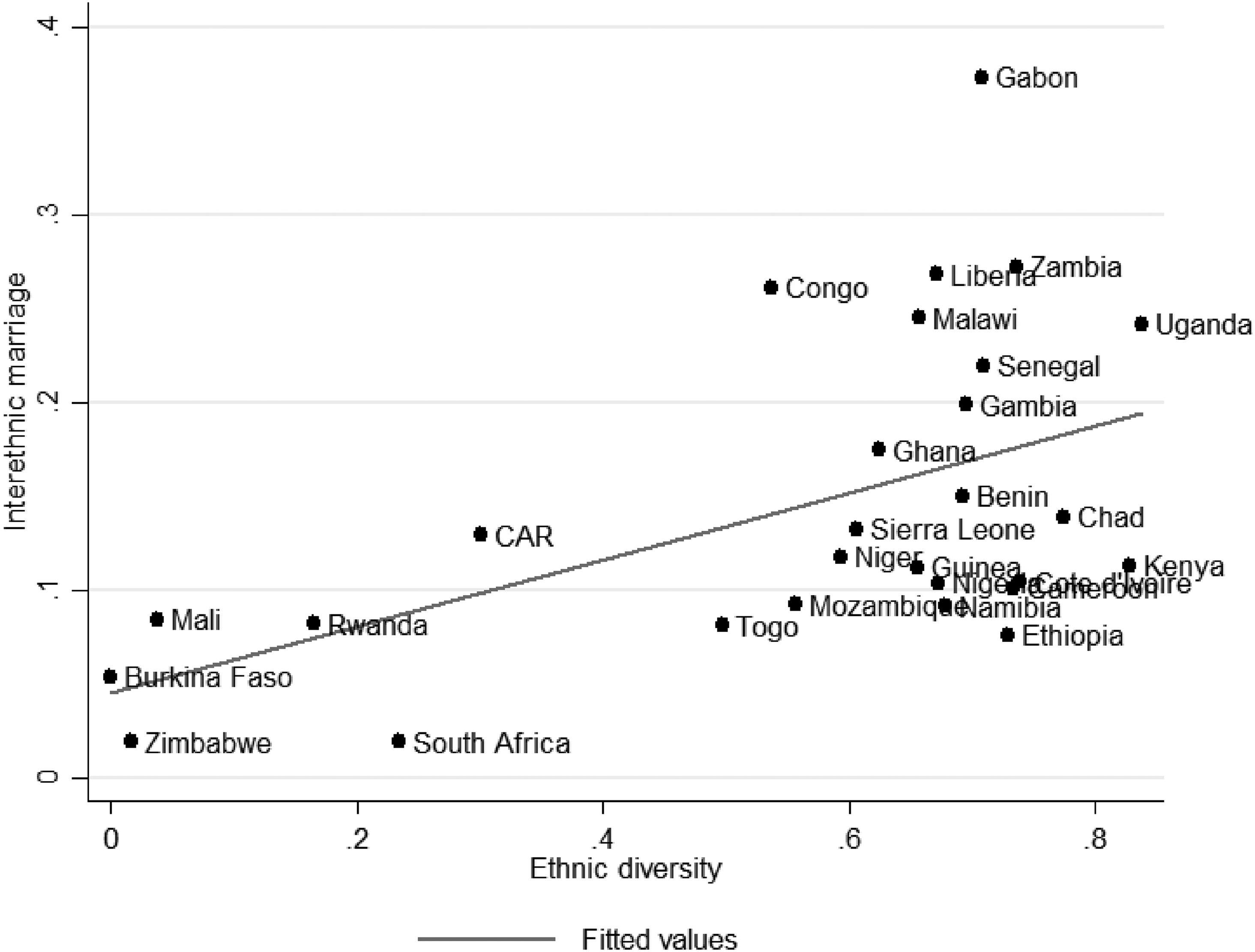
Interethnic marriage and Ethno-Linguistic Fractionalization index.
Besides controlling for ethnic diversity, we include several other controls in our analysis that may influence not only our dependent variable (Ethnic violence) but also our main independent variable (IE marriage). We use several country and subnational control variables based on the DHS data. First, urbanization is associated with lower levels of ethnic identification, higher levels of interethnic marriage (Crespin-Boucaud, 2020; Robinson, 2014), and lower levels of violent conflict (Kalyvas, 2006). Our urbanization measure is the share of urban respondents in a DHS country/region. Second, we included a measure of education in our analysis. Highly educated members of ethnic groups are more likely to marry exogamously (e.g. Furtado, 2012; Kalmijn, 1998; Qian and Lichter, 2011). At the same time, lower education levels have been associated with a higher likelihood for conflict (Collier and Hoeffler, 2004). We calculate the mean number of years of Education that women have obtained. Third, we also construct a DHS-based measure of Wealth. Higher levels of development may be associated with an increased acceptance of ethnic differences (e.g. Hodson et al., 1994; Robinson, 2014) and hence higher rates of interethnic marriage. Conversely, low levels of development have been associated with violent conflict (e.g. Blattman and Miguel, 2010; Collier and Hoeffler, 2004; Fearon and Laitin, 2003). We follow Østby’s (2008) strategy and create an index of available household goods. The variable ranges from 0 to 7. The mean per area is used.
We also control for several other relevant macro variables. First, we include GDP per capita (in constant US dollars) and GDP per capita growth. Both measures come from the World Bank's World Development Indicators. Low levels of development, negative economic shocks, and slow economic growth have been associated with the outbreak of violent conflict (e.g. Blattman and Miguel, 2010; Fearon and Laitin, 2003), while higher levels of development, and in the same vein higher levels of growth, may also lead to higher rates of interethnic marriage.
Second, we control for the level of Democracy. For this measure, we use the Polity2 scores from the Polity V dataset (Marshall and Jaggers, 2002). The original variable ranges from −10 (full autocracy) to +10 (full democracy). We make use of a dichotomous democracy variable that takes on the value of 1 if the polity score is 6 or higher, and 0 otherwise. Low levels of democracy may spur conflict. At the same time, authoritarian rule in many African countries is associated with ethnic dominance and exclusivity (e.g. Marshall, 2005), which may result in low rates of interethnic marriage.
Third, low degrees of interethnic marriage and high levels of conflict may both stem from a specific colonial regime. In particular, British indirect rule has been linked to interethnic tensions in society (Robinson, 2014). To control for this, we include in our analysis a dichotomous indicator measuring whether a country was a former British colony (coded as 1) or not (coded as 0). Fourth, we use the natural log of a country's Population size as a control variable. Population data are drawn from the World Development Indicators of the World Bank. A large population may be associated with more diversity and higher rates of interethnic marriage. At the same time, it can also make it easier to reach the conflict casualty thresholds (Sambanis, 2004).
Lastly, previous ethnic conflict can promote distrust among ethnic groups, which can affect attitudes and identities (Besley and Reynal-Querol, 2014). Moreover, previous conflict could also have other economic and political legacies, making regions or countries more prone to future ethnic violence. To control for these dependencies—to some extent—in our analyses, we include a variable that measures previous conflict as the number of conflict events experienced in the three years before the DHS survey (Past ethnic violence). We use this measure instead of a simple yearly lag to reduce the likelihood of measuring very short spells of peace in otherwise violent regions, which would bias our results. Table A3 in the Appendix summarizes the descriptive statistics for all variables and models. 14
Analyses
As the dependent variable, Ethnic violence, is an over-dispersed count variable, we make use of negative binomial regression. We conduct our analysis first at the country level, with country-survey round observations as units of analysis, then at the subnational level, with region-survey round observations as units of analysis. We cluster the standard errors at the country level for our country-level analyses, and at the region level for the subnational analyses. Given the low number of observations, we use the 90% level as our lowest significance threshold.
Country-survey round analyses
Table 2 shows the result of our country-level analyses. Model 1 shows the bivariate effect of IE marriage on Ethnic violence. This effect is negative and statistically significant; higher interethnic marriage rates reduce the likelihood of ethnic violent events. This is in line with our hypothesis. In Model 2, we add the ELF index as a control given that the effect of interethnic marriage is best considered jointly with diversity in the marriage market. The effect of interethnic marriage remains statistically significant. This is also the case when adding our DHS-based control variables for Urbanization, Education levels, and average Wealth (Model 3).
Interethnic marriage and ethnic violence, country-round analyses.
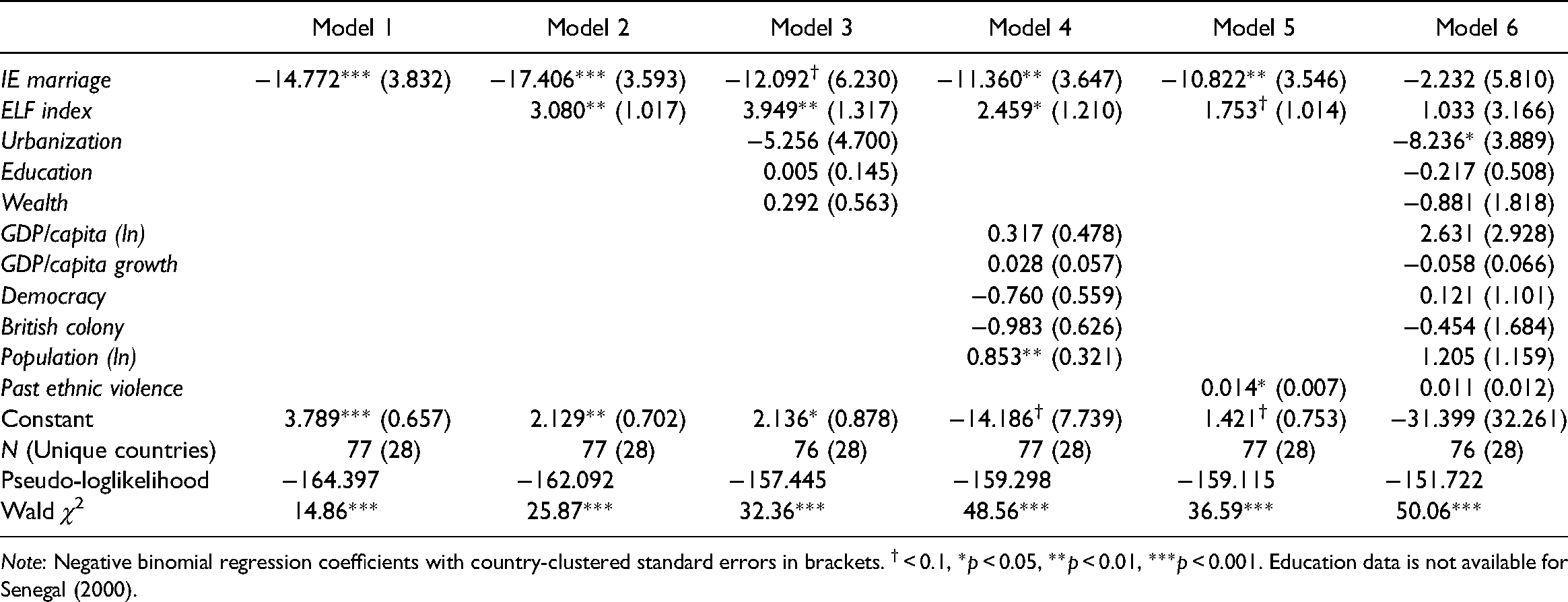
Note: Negative binomial regression coefficients with country-clustered standard errors in brackets. † < 0.1, *p < 0.05, **p < 0.01, ***p < 0.001. Education data is not available for Senegal (2000).
In Model 4, we include the country-level predictors for economic development, growth, democracy, past colonial rule, and population size to the model. The inclusion of these controls does not substantially impact the effect of IE marriage, leaving it negative and highly statistically significant. 15 The effect remains even after controlling for Past ethnic violence (Model 5). Adding all control variables to the model renders also a negative (but insignificant) effect (Model 6). This model is, however, subjected to multicollinearity (variance inflation factor (VIF) > 5) (O’Brien, 2007). Moreover, given that control variables largely lack significance and standard errors are high, this saturated model is likely to obscure the existing effect of IE marriage.
The marginal effects show that going from the minimum (0.02) to the maximum observed interethnic marriage rate (0.37)—with other variables held constant at their mean—reduces the probability of one or more conflict events with at least 30 percentage points for all models, except for Model 6. Another interesting finding is that, controlled for IE marriage and hence positive intergroup contact, diversity generally has a positive effect on ethnic violence.
Region-survey round analyses
We conduct a similar analysis at the subnational level (see Table 3). Model 7 estimates the bivariate effect of interethnic marriage on ethnic violence, while Model 8 adds the ELF index as a control variable. Also at the regional level, we find a statistically significant negative effect of the interethnic marriage rate on ethnic violence. In other words, high levels of interethnic marriage reduce the likelihood of observing ethnic conflict events. In Model 9, we add the DHS-based control variables for regional Urbanization, Education levels, and average Wealth. Including these variables, does not alter the effect of IE marriage substantially. Adding the country-level predictors in Model 10 also does not impact the effect of IE marriage on Ethnic violence. 16 With the inclusion of past ethnic violence, the effect also remains negative (Model 11).
Interethnic marriage and ethnic violence, region-round analyses.
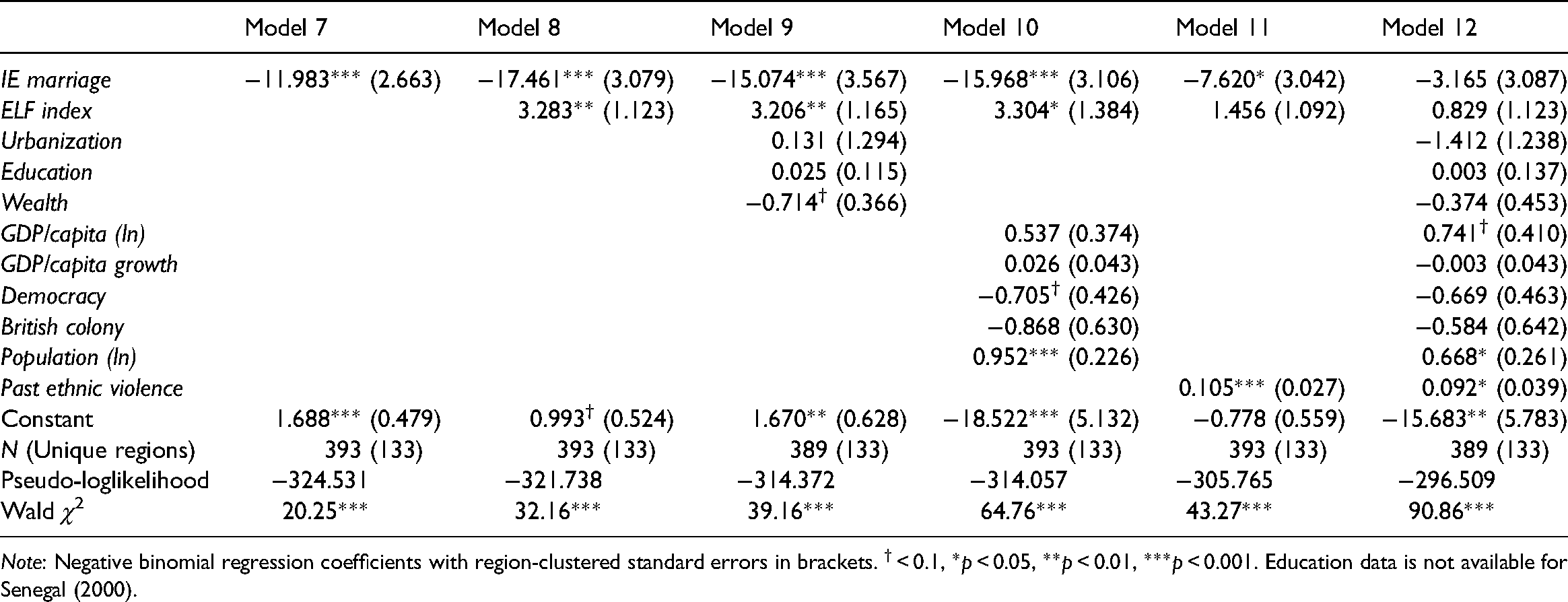
Note: Negative binomial regression coefficients with region-clustered standard errors in brackets. † < 0.1, *p < 0.05, **p < 0.01, ***p < 0.001. Education data is not available for Senegal (2000).
Adding all control variables renders the effect of IE marriage insignificant, although it remains negative (Model 12). Again, this is likely because the inclusion of insignificant control variables obscures the effect of IE marriage. Using only the significant control variables from Model 12 (with or without the ELF measure) results in a statistically significant coefficient for IE marriage (not shown here). This strengthens our conclusion that there is a negative relation between interethnic marriage rates and ethnic violence. Regions with high levels of interethnic marriage are less likely to see ethnic violence.
In terms of effect size, an analysis of marginal effects shows that going from the minimum (0) to the maximum subnational interethnic marriage rate (0.5)—with other variables held constant at their mean—reduces the probability of one or more ethnic conflict events by about 15 to 20 percentage points for all models except for Model 12. The effect of the ELF index is, again, generally positive.
All in all, by focusing on interethnic marriage as a form of positive contact, our analysis overcomes the lack of attention to the type of contact that occurs. Moreover, our analysis goes beyond the assumption that ethnically diverse areas heighten the latent potential for intergroup contact. The above-presented analyses show that sub-Saharan African countries and regions with higher rates of exogamy (given diversity levels) experience fewer ethnic violence events than countries and regions with fewer interethnic marriages. In other words, the results suggest that positive contact, even in highly diverse societies, is associated with positive outcomes. This confirms our main hypothesis and is largely in line with the intergroup contact theory.
Robustness checks
To examine the robustness of the negative association between interethnic marriage and ethnic violence in more detail, we ran some additional analyses, primarily focusing on the subnational level. The results of these analyses can be found in the Appendix. We highlight the most important additional analyses.
First, we use alternative ways of measuring ethnic violence. Our original dependent variable measures the number of conflict events in the year of the conducted DHS survey. A potential drawback of this measure is that it can include short spells of peace (i.e. zero counts) for an otherwise violent region, which could bias our findings. Hence, we redefined our dependent variable by counting the number of ethnic conflict events occurring in the DHS year plus the three years after the DHS survey year. In addition, we count the number of ethnic conflict events in the three years consecutive to a DHS year, without including the DHS year itself. Our results remain robust: there is a statistically significant negative association between interethnic marriage and ethnic conflict (see Table A4 in the Appendix).
Second, instead of measuring the number of ethnic conflict events, we also looked at conflict intensity as the outcome of interest. Ethnic conflict intensity, measured as the number of deaths caused by these ethnic conflict events, might also be linked to increased prejudice and intolerance. Our results (Table A4 in the Appendix) indicate that interethnic marriage is statistically significantly related to intensity; regions characterized by high levels of interethnic marriages are less likely to see intense ethnic conflict.
Third, the sample used in the main analysis is based on the DHS data of 28 countries, of which 20 countries have been surveyed multiple times over the years (see Table A1 in the Appendix). This implies that our dataset includes some countries and regions multiple times. The inclusion of the same countries and regions measured at different periods in time may bias our findings. For example, if more peaceful regions are included more often in the dataset, our results might not hold. To ensure the robustness of our findings, we recalculated the above-presented models by including each region only once in the dataset (N = 133). We restrict the sample in two different ways (see Table A5 in the Appendix). Analyses of the restricted samples support the results reported above. Interethnic marriage is negatively and statistically significantly associated with ethnic conflict. Additionally, we have also estimated conditional fixed-effects models (see Table A6 in the Appendix). The interethnic marriage predictor remains negative but turns insignificant when adding regional fixed effects. The loss of information is, however, also substantial (109 observations within 34 unique regions remain). The interethnic marriage predictor is negative and significant in models with country fixed effects (265 observations remain in 84 unique regions, in 15 unique countries).
Fourth, we use a range of additional control variables at the regional and country levels (see Table A7 in the Appendix). These include education and wealth levels relative to the country mean rather than absolute levels, the ethnic polarization index, alternative measures for democracy, a variable measuring natural resource presence, and variables measuring temperature and precipitation shocks. Our results remain robust to the inclusion of these variables. We also include additional past violence variables which consider long-term effects of past conflict. The statistically significant negative association between interethnic marriage and conflict remains robust.
Fifth, given that ethnic (re-)categorization of both survey respondents and conflict events may be subjected to measurement error, we also investigate whether our interethnic marriage predictor has a negative effect on conflict in general. To investigate this, we look at all conflict events from the UCDP GED 20.1 dataset (Sundberg and Melander, 2013). The results are presented in Table A8 in the Appendix. Interestingly, the main coefficient remains negative and significant when predicting general conflict events. Furthermore, an alternative interethnic marriage predictor, based on the original DHS categories rather than the EPR categorization, provides similar results.
Finally, we also make use of an alternative estimation strategy. Instead of focusing on country and subnational analyses, we employ an ethnic group-based disaggregation approach. In this approach, we construct a new dataset in which we estimate the interethnic marriage rate for each EPR group per DHS survey. 17 This dataset contains 121 unique EPR groups, clustered in 28 countries. Again, some EPR groups are repeated because 20 countries are included more than once in the dataset. We estimate the effect of the new group-based interethnic marriage rate on conflict events that involved that specific group, either as a perpetrator or victim. Using this alternative approach, we also find a statistically significant, negative association between group-based interethnic marriage rates and conflict events involving that group (see Table A9 in the Appendix). This strengthens our conclusion that interethnic marriage is negatively associated with ethnic violence.
Conclusion
Existing studies on the relation between interethnic contact and armed conflict can be divided into two strands: those studies that suggest that contact between ethnic groups improves intergroup relations, reducing the likelihood of ethnic conflict, and another strand that implies that contact between ethnic groups will enhance the prospects of violence owing to competition. In explaining these contradictory results, scholars have argued that existing measures of interethnic group contact fall short (e.g. Al Ramiah and Hewstone, 2013). They argue that most studies conflate the opportunity for contact with actual intergroup contact. Moreover, scholars have often ignored the fact that not all interethnic contact is beneficial. In this study, we have tried to overcome this gap by focusing on the ultimate form of positive interethnic contact: interethnic marriage.
We draw on DHS and UCDP GED conflict data (Sundberg and Melander, 2013) to examine the potential negative association between interethnic marriage and ethnic violent events at the country and regional level. Our analyses show an overall robust statistically significant negative effect of interethnic marriage on armed conflict: countries and regions with high levels of interethnic marriage experience fewer ethnic violence events. This statistically significant relationship remains robust in several additional analyses.
Further research is needed to overcome some important limitations. First, conflict might exacerbate tensions between ethnic groups, thereby potentially influencing the occurrence of interethnic marriage. While we have controlled for past conflict in several ways, the available data does not allow for completely separating cause and effect. Second, the intergroup contact theory is a micro-level theory, i.e. it focuses on attitudinal and behavioral changes within individuals. Currently, however, we lack large-scale systematic information on these changes. We are merely able to show an association between contact and ethnic conflict. Future research might want to explore the impact of these causal mechanisms, such as the reduction of prejudice and stereotyping, on armed conflict and violent behavior. Third, our analysis is largely based on individual's self-categorization into ethnic groups. Consequently, we cannot entirely rule out the possibility that people strategically misreport their ethnic identity. For example, it might be the case that owing to previous armed conflict, people have become more cautious when talking about ethnic identification. New data projects on ethnic self-identification may substantially improve our knowledge of interethnic relations.
Concerning policy implications, although our analyses suggest an important association between interethnic marriage and ethnic conflict, we do not argue that high interethnic marriage rates are a sufficient condition for peace and stability. It cannot offer “immunity” and we should not have unrealistic expectations of what it can achieve. That does not mean, however, that it is ineffective, or that it is not worth attempting (Hewstone, 2003). Monitoring the level of interethnic marriage can be useful in defining potential ethnic conflict areas in the world. It can be used, for instance, in ethnological monitoring models as an early warning indicator (Smits, 2010). This is especially important given the rise in multiethnic societies across the world owing to immigration. Furthermore, policymakers can draw on our findings and plan contact interventions between groups in potential conflict areas. For instance, civil society organizations or associations can be set up to improve intergroup relations. Even after conflict, these types of activities can impact the achievement of peace and reconciliation.
Supplemental Material
sj-docx-1-cmp-10.1177_07388942211050875 - Supplemental material for A perfect match? The dampening effect of interethnic marriage on armed conflict in Africa
Supplemental material, sj-docx-1-cmp-10.1177_07388942211050875 for A perfect match? The dampening effect of interethnic marriage on armed conflict in Africa by Leila Demarest and Roos Haer in Conflict Management and Peace Science
Supplemental Material
sj-zip-2-cmp-10.1177_07388942211050875 - Supplemental material for A perfect match? The dampening effect of interethnic marriage on armed conflict in Africa
Supplemental material, sj-zip-2-cmp-10.1177_07388942211050875 for A perfect match? The dampening effect of interethnic marriage on armed conflict in Africa by Leila Demarest and Roos Haer in Conflict Management and Peace Science
Footnotes
Acknowledgements
The authors are thankful to the anonymous reviewers, colleagues of Leiden University's Department of Political Science, and all participants of the XXth Jan Tinbergen conference (2021) organized by the Network of the European Peace Scientists for their helpful suggestions on earlier drafts of this paper.
Declaration of conflicting interests
The authors declared no potential conflicts of interest with respect to the research, authorship, and/or publication of this article.
Funding
The authors received no financial support for the research, authorship and/or publication of this article.

Supplemental material
Supplemental material for this article is available online.
Notes
References
Supplementary Material
Please find the following supplemental material available below.
For Open Access articles published under a Creative Commons License, all supplemental material carries the same license as the article it is associated with.
For non-Open Access articles published, all supplemental material carries a non-exclusive license, and permission requests for re-use of supplemental material or any part of supplemental material shall be sent directly to the copyright owner as specified in the copyright notice associated with the article.
