



Abstract
In recent years, a record number of people have been forcibly displaced or migrated due to conflict. Whilst established political science research suggests that displaced communities are an added risk factor for conflict due to their support for extreme co-ethnic political parties and movements, this has been challenged by recent research which shows that migrants can be a moderating force. We offer a potential reconciliation of these divergent findings by distinguishing between first- and second-generation migrants. Due to their relative lack of conflict exposure, second-generation migrants will have significantly less support for co-ethnic political parties than first-generation migrants and those who remain. We test our argument using granular survey data comparing Kurds who migrated out of the conflict zone in Turkey with those who remained. The results support our theoretical framework and have important implications for our understanding of migrant attitudes and the long-term effects of conflict exposure.
As of 2019, there were an estimated 79.5 million forcibly displaced people worldwide, of which 45.7 million were internally displaced. This is almost double the same figure in 2000, and alongside an ever increasing global migrant population, it has catalyzed a significant interest in the political attitudes of these groups (Ozden et al. 2011, UNHCR 2020). Initial research suggested that migrant communities, particularly those displaced due to conflict or oppression, were a radicalizing influence, financing co-ethnic rebel groups, and providing political support to co-ethnics internationally and domestically (Anderson 1998, Bock-Luna 2007, Collier and Hoeffler 2004, Gleditsch 2007, Roth 2015). Yet, the empirical support for these arguments has been often weak or partial, rarely capturing representative individual-level variation in the attitudes of migrants (Hall 2016). In recent years, there has been an increased focus on the peace-building and moderating influence of migrant communities. Using more granular data, this research shows that migrants appear to have less extreme views than those who remain, provide greater support for nonviolent interventions and in countries which are not suffering from conflict they may even help to strengthen democracy (Cochrane, Baser and Swain 2009, Hall 2016, Hall 2018, Koinova 2011, Pérez-Armendáriz and Crow 2010). Explanations for these divergent findings highlight the different groups of migrants studied, the time period in which data was collected and, in particular, the absence of “micro-level data necessary to validate claims about migrant attitudes” (Hall 2016).
In this paper, we attempt to provide some reconciliation of these competing perspectives by differentiating between first- and second-generation migrants. Focusing on migrants who move away from conflict-afflicted regions and their descendants, we argue that as a result of growing up away from conflict, second-generation migrants will have weaker attachments to their ethnic group and thus lower support for co-ethnic political parties than first-generation migrants and those who remain. 1 Conversely, first-generation migrants and those who remain, grew up amidst intergroup conflict, and thus will have similarly high levels of support for co-ethnic political parties, which endure even after migration. 2 This granular comparison of subgroups within migrant populations, and between migrant populations and those who remain, is made possible by a rich and extensive dataset that was not available in previous studies.
The core argument of this paper is that the act of migration and resettlement in a new community is not the primary determinant of migrant community attitudes towards politics and conflict in their country of origin. For first-generation migrants, growing up in an environment where there is ongoing intergroup conflict has hardened their attitudes. They maintain relatively strong support for the political objectives of their co-ethnics, despite migration and resettlement. Conversely, second-generation migrants have grown up in a relatively peaceful environment away from violent intergroup conflict and therefore have weaker support for co-ethnic political parties. By taking into account the differences between migrant generations and their variation in conflict exposure, we are able to account for studies which claim diaspora communities exhibit strong political support for co-ethnics and more recent studies that contradict these findings.
We test our argument through an analysis of Kurdish migration patterns within Turkey, comparing people who migrated out of the conflict zone with those who remained. Using monthly survey data collected over 7 years, we have more than 20, 000 respondents and are therefore able to capture the differential effect of conflict exposure and migration. We do this by splitting our sample into those who remain, first-generation migrants, and second-generation migrants, something which has not been done in any prior research, to our knowledge. We then use this data to analyze variation in their support for the Kurdish nationalist party. The results indicate that whilst first-generation migrants maintain similar attitudes to those who remain, second-generation migrants have significantly less support for the Kurdish nationalist party. The results fit with recent research which found that the effect of migration on the attitudes of first-generation migrants towards political institutions in their place of origin is relatively limited (Careja and Emmenegger 2012).
We also address a number of alternative explanations (particularly with respect to socialization through education and language, and the level of intergroup contact), potential issues raised by self-selection into migration, and employed coefficient stability analysis to ensure our results are robust (Oster 2019). Our main results hold through all these tests. Finally, in an exploratory analysis section, we show that this theoretical framework extends to attitudes towards conflict resolution and identity, with second-generation migrants demonstrating weaker Kurdish identity and greater support for aggressive military action against co-ethnic rebel groups.
This article provides an important reconciliation of the competing perspectives regarding the attitudes of migrants towards political conflict in their country of origin. In doing so, it highlights the problems with treating migrant communities as a homogeneous block and the importance of integrating the different experiences of migrants, particularly conflict exposure, into the theoretical framework. We also address a number of methodological shortcomings in prior literature with a rich dataset which allows us to use matching and a range of statistical models to ensure our results are robust whilst also isolating the different attitudes of those who remain, first- and second-generation migrants. Finally, the additional analysis of attitudes towards identity and conflict resolution highlights the broader implications of our theoretical framework and provides avenue for future research.
In the following section, we first describe the traditional nostalgia nationalism thesis which argued that migrants hold extreme political attitudes before discussing more recent research that challenges these findings. We then outline our theoretical framework which provides a potential reconciliation by differentiating between first- and second-generation migrants and integrating conflict exposure.
Understanding the Political Attitudes of Migrants
The scale of migration in the second half the 20 th century has been unprecedented (Marsella and Ring 2003). Alongside increased global interconnectedness, this has led to large and influential migrant communities (Cohen 2008) 3 . Initial academic research on the attitudes of migrants towards politics, conflict, and intergroup relations in their country of origin argued that migrants often harbored more extreme opinions than those who did not migrate (Anderson 1998, Bock-Luna 2007, Gleditsch 2007, Roth 2015). The “nostalgia nationalism” thesis argued that migrants retained strong emotional and political connections to their homeland, and were an important source of financial support for co-ethnic rebel groups, increasing the likelihood of recurring conflict (Collier and Hoeffler 2004).
An opposing line of research indicates that migrants may in fact be a force for moderation (Cochrane, Baser and Swain 2009, Koinova 2011). One particularly striking example found that despite ample attention focused on Irish-American support for republican paramilitaries in Northern Ireland, the $3 million of financing for violent activities of the IRA was dwarfed by the $600 million in international funding put towards organizations and movements which supported nonviolent resolution of the conflict (Cochrane, Baser and Swain 2009).
However, these conflicting perspectives on migrant attitudes relied primarily on qualitative analysis, or relatively blunt quantitative analysis of remittances, and other financial flows. Unfortunately, these do not provide a representative reflection of the attitudes of migrant communities as it is unclear from this type of analysis what proportion of migrants support the actions of rebel groups or are willing to provide financial assistance to them (Adamson 2013, Roth 2015, Collier and Hoeffler 2004, Lyons 2007). 4 Crucially, the focus on financial flows prevents any differentiation between subgroups within migrant communities or comparison with those who remained in the country of origin.
However, a number of recent studies have attempted to partially address this gap. Focusing on the conflict in former-Yugoslavia, two studies used concurrent surveys to compare the attitudes of refugees in Sweden with those who had remained in now Bosnia. The findings highlight that migrants had more conciliatory political and intergroup attitudes than those who did not migrate (Hall 2016, Hall 2018). This new moderate migrant thesis provides a robust empirical challenge to previous studies which found that migrants maintain aggressive attitudes towards political conflict in their country of origin. Finally, a more limited study on the attitudes of returning migrants suggests a more ambiguous effect. This study found that whilst migration can have a positive impact on sentiment towards political institutions which enhanced the migration experience (i.e., EU institutions in this case), it has no effect on political attitudes towards democratic institutions in the migrants place of origin (Careja and Emmenegger 2012).
Building on this recent research we argue that these competing perspectives on the political attitudes of migrants can be at least partially reconciled by differentiating between first- and second-generation migrants, something which previous studies were unable to account for due to data limitations outlined above. 5 In particular, first-generation migrants and those who remain in the country of origin are likely to have high levels of conflict exposure, unlike second-generation migrants who grow up away from the conflict environment. Below, we outline the potentially significant impact of variation in conflict exposure on the attitudes of those who remain, first- and second-generation migrants.
The Impact of Variation in Conflict Exposure on Migrant Attitudes
Surprisingly conflict appears to have a range of positive side-effects on individuals including increased levels of political participation and greater willingness to cooperate. Unfortunately, these effects are highly heterogeneous—prosociality and cooperation increase towards the in-group but are either flat or decline towards out-groups (Bauer et al. 2016). Furthermore, experience of conflict violence hardens ethnic identities at the expense of shared national identities and increases support for co-ethnic political parties (Nair and Sambanis 2019, Hadzic, Carlson and Tavits 2020). Related research shows that attitudes developed to cope with living in a conflict environment are difficult to change and often endure long after wars end. Beliefs such as the justness of one’s goals, victimization, delegitimization of opponents, and in-group unity appear to persist long after intense conflict has abated (Bar-Tal 1998, Tint 2010).
The logic of these findings can easily be extended to the different experiences and attitudes of those who remain, first-generation migrants, and second-generation migrants. Whilst those who remain and first-generation migrants have similarly high levels of exposure to conflict and the shared beliefs developed to cope with enduring conflict (Bar-Tal 2007), this is not the case for second-generation migrants who have grown up away from the conflict zone. Due to their lack of exposure to the conflict environment, second-generation migrants are likely to have weaker ties to co-ethnics and lower support for co-ethnic political parties than first-generation migrants and those who remain. 6 Previous studies which focused on financial flows are unable to account for this variation within diaspora communities, nor provide a consistent comparison with those who do not migrate.
This research on conflict exposure in political science is supported by an extensive literature in sociology on the differences between first- and second-generation migrants. 7 These studies indicate that first-generation migrants have greater feelings of social exclusion and a higher propensity towards violence (Bui and Farrington 2016), whilst second-generation migrants have weaker ethnic solidarity compared to first-generation migrants (Bui and Farrington 2009). Additional studies have found that first-generation migrant parents have a stronger identification with their country of origin and a more collectivistic orientation than second-generation children (Lalonde and Cameron 1993). Therefore, we argue that second-generation migrants are likely to have significantly lower levels of support for co-ethnic political parties, relative to first-generation migrants and those who remain.
There are other factors which may also impact the political attitudes of migrants towards co-ethnics, particularly intergroup contact and discrimination, both of which first- and second-generation migrants are more likely to experience. Research on intergroup contact suggests that contact can reduce prejudice between different groups under the right conditions, which may result in first- and second-generation migrants having less out-group animosity due to higher rates of out-group contact, and therefore weaker support for co-ethnic political parties than those who remain (Pettigrew, Tropp, Wagner and Christ 2011, Dovidio, Eller and Hewstone 2011). However, more recent research on intergroup contact suggests these positive effects may be weaker between ethnic groups or that contact can even have a negative impact on intergroup attitudes or increase prejudice in certain contexts, particularly where contact is experienced negatively (Paluck, Green and Green 2019, Enos 2014, Laurence and Bentley 2018, Tropp 2003).
Furthermore, research on the experience of immigrants suggests that many of them are victims of discrimination and prejudice, which can have knock-on effects on important social outcomes, ethnic identity and political attitudes (Ayón 2015, André and Dronkers 2017, Fischer-Neumann 2014, Laurence and Bentley 2018, Celik 2015). The effects of discrimination on identity and political attitudes are complex, with some literature suggesting that discrimination makes individuals more reliant on their in-group, generating stronger group identification and decreasing trust in formal political institutions (Jetten et al. 2001, Maxwell 2010, Celik 2015). However, this “reactive ethnicity” hypothesis has been challenged by research showing that the effect of discrimination on identity and attitudes is fully mediated through other factors (Skrobanek 2009), or that discrimination has no effect on ethnic identification (Jasinskaja-Lahti, Mähönen and Ketokivi 2012). Additional research finds that whilst perceived group discrimination can increase ethnic identification, perceived personal discrimination reduces ethnic identification (Armenta and Hunt 2009). Similarly research on the link between discrimination and political outcomes is complex, with discrimination decreasing formal participation but increasing mobilization in non-electoral activities such as contacting a public official (Bilodeau 2017).
Taken together, these findings indicate that although contact may improve attitudes amongst some first- and second-generation migrants potentially reducing political support for co-ethnics, negative contact and experience of discrimination may worsen intergroup attitudes and strengthen ethic identity, increasing support for co-ethnic political parties. 8 However, whilst the level of contact and experience of discrimination may differ between first and second-generation migrants, it is a shared experience compared to those who remain, and therefore we argue that it is unlikely to fully account for why the attitudes of second-generation migrants towards co-ethnic political parties differ from both first-generation migrants and those who remain.
Based on the above, we argue that exposure to intergroup conflict will have an important enduring impact on the political and intergroup attitudes of those who remain and first-generation migrants, an experience which is not shared by second-generation migrants (Nair and Sambanis 2019, Hadzic, Carlson and Tavits 2020, Tint 2010, Bar-Tal 1998). Although it is unlikely that first-generation migrants will have identical political attitudes to those who remain due to the impact of migration highlighted in previous research (Hall 2016, Hall 2018, Pettigrew et al. 2011, Ayón 2015, Laurence and Bentley 2018), and through contact and discrimination, we do not believe that these will significantly displace the enduring effect of conflict exposure on first-generation migrants’ political support for co-ethnics. Additionally, we do not believe that the attitudes of second-generation migrants will be identical to other ethnic groups in society. In fact, we predict that although second-generation migrants will have less support than those who remain and first-generation migrants, they will be more supportive of their co-ethnic political parties than other ethnic groups given the importance of ethnicity in shaping political attitudes.
The Differential Attitudes of Those Who Remain, First-Generation Migrants, and Second-Generation Migrants Towards Co-Ethnic’s Political Objectives.
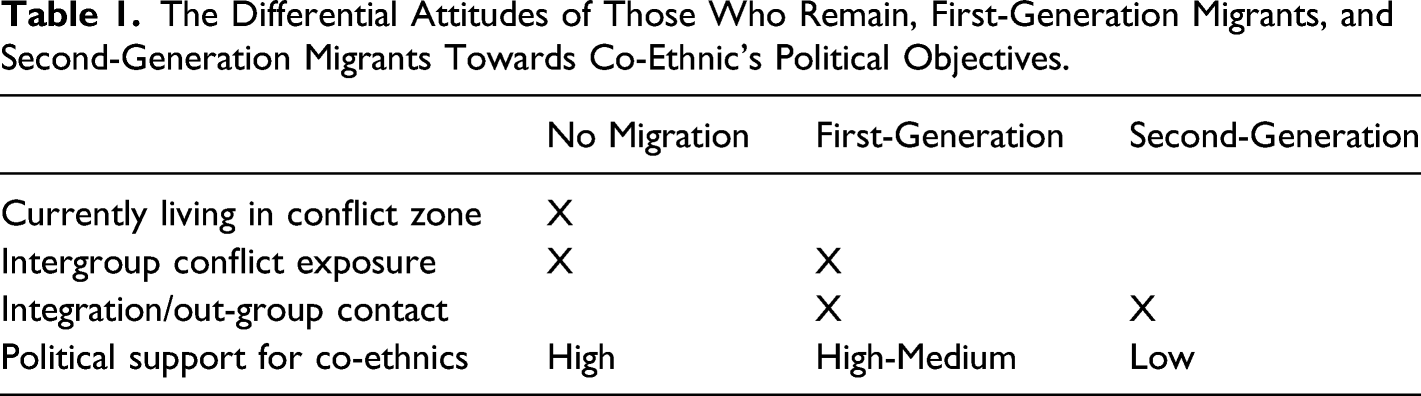
Based on this combination of research from political science and sociology, we argue that second-generation migrants will have lower support for co-ethnic political parties than first-generation migrants and those who remain.
The Turkish Case
To test our argument, we analyze Kurdish migration in Turkey. We focus on Turkey due to availability of rich survey data, the clear geographical confinement of the conflict, and the variation in patterns of migration. Kurds live primarily in the Eastern and Southeastern parts of Turkey bordering Iran, Iraq, and Syria. Since the establishment of the Republic, Kurds have experienced various forms of repression and exclusion from power. Towards the end of the 1970s, a group of leftist Kurds established the rebel group PKK (Partiya Karkerên Kurdistan – Kurdistan Workers’ Party), whose initial objective was secession. Since 1984, the government of Turkey has been in an ongoing conflict with PKK, with a short ceasefire for peace talks, which later failed (Gleditsch et al. 2002).
Conflict intensity was relatively high between 1984 and 1992, with around 200 battle deaths per year on average. The fighting escalated from 1992 to 1999, peaking in 1997 with more than 4, 000 deaths in a single year, then declining somewhat up to the peace negotiations in 2014 before resurging after their collapse. Available data shows that that between 1989 and 2019, more than 97% of battle deaths took place in the Eastern and Southeastern parts of the country. Of the other 3% of battle deaths occurring in the rest of the country, two-thirds occurred in cities neighboring the conflict zone (Sundberg and Melander 2013). The dichotomy in the geographic distribution of conflict deaths highlights the different levels of conflict exposure for those living in the Eastern and Southeastern regions compared to those living in other parts of the country. Based on this clear delineation in conflict events and fatalities we classify the Eastern and Southeastern regions 9 as the conflict region and the rest of Turkey as peace (non-conflict) regions. Whilst we recognize that using a proximate measure of conflict exposure such as geographical location presents challenges to causality, there are obvious ethical impediments to experimental random assignment. Furthermore, we believe that the high intensity and all-pervading nature of the conflict in the Kurdish regions during the early 1990s and near ubiquitous awareness of the ongoing ethnic conflict amongst people living in these regions makes this a reliable measure of conflict-exposure.
Civil conflicts are one of the main causes of forced migration (Moore and Shellman 2004, Turkoglu and Chadefaux 2019), and Turkey is no exception. Internal displacement is a prominent aspect of the conflict, though there is no sole reliable source for estimates of displaced persons, which vary from 378,335 (a parliamentary report) to three to four million (NGO reports). 10 The real volume of internal displacement likely falls between the official government number and the high NGO estimates (Aker et al. 2005, Ayata and Yükseker 2005). Internal Displacement Monitoring Centre (2020) as the leading institution in internal displacement puts the estimate slightly over one million.
The causes of displacement are likely to be a mixture of voluntary and forced migration by the government or rebels. Village evacuations by the Turkish armed forces and rebels were quite common between 1991 and 1994, and the main objective of the government was to establish territorial control; whereas for rebels, it was to police and silence the dissent (Ayata and Yükseker 2005, Belge 2016, Tezcür 2010). In addition to forced relocation, many people had to leave their homes and migrate to the west of the country due to problems caused by fighting and deprived conditions in the region (Icduygu, Romano and Sirkeci 1999). Although government officials minimize the role of security forces and exaggerate the effect of rebels, all three causes (i.e., evacuation by the government, evacuations by rebels, and migration due to deprived conditions) seem to play a significant role in the displacement process (Aker et al. 2005, Ayata and Yükseker 2005).
Our key measure of political attitudes is support for the Kurdish party. Since 1990, there has been a Kurdish nationalist party focused on improving the rights and living conditions of Kurds. Due to the authoritarian nature of the Turkish state, the Kurdish nationalist party is intermittently abolished by the Constitutional Court. However, each party abolition is quickly followed by the formation of a new party. Even though the name has to change and some members are banned from politics, each new party can be considered the continuation of the previous one with the same cadre, buildings, and overall party infrastructure. Halkların Demokratik Partisi – HDP (Peoples’ Democratic Party) is currently the active political party.
Data
To test our argument, we use monthly survey data from Konda Research and Consultancy (Konda Barometresi). 11 Since March 2010, Konda has run face-to-face nationally representative monthly surveys with 2, 500 people on average. 12 In addition to demographics and voting attitudes, a different political or social issue is covered in each survey. Our sample uses surveys between March 2010 and November 2017. 13 Given that we are interested in the effect of migration away from active conflict settings, we limit our sample to Kurds living in Turkey as they have suffered ongoing violent and nonviolent repression by the government and attacks from rebels. 14
Our dependent variable is a binary indicator of voting for HDP. 15 The question on voting is “which party would you vote for if elections were held today?” and respondents can pick a party, abstain, or state that they do not know which party to vote for. Respondents who pick HDP are coded as 1 and those who pick any other party are coded as 0. 16 Respondents who abstain or do not know which party to vote for are excluded from the analysis. 17
Our main explanatory variable is migration (out of the Eastern and Southeastern regions) and we split it into two dichotomous variables as first- and second-generation migrants. As noted above, we follow the UN Migration Agency’s definition of a migrant as “any person who is moving or has moved across an international border or within a State away from his/her habitual place of residence.” Based on this definition, first-generation migrants are those who migrate and settle away from their habitual place of residence to a new location, whilst second-generation migrants are those who are born and reside in a location one of their parents previously moved to as a migrant. 18 Therefore, people who were born in the conflict-afflicted Eastern and Southeastern parts of Turkey 19 but move to live in other parts of Turkey are coded as first-generation migrants. Conversely, Kurdish respondents who were born and live in regions other than the Eastern and Southeastern parts are coded as second-generation migrants. People who were born and live in the Eastern and Southeastern parts are coded as 0 for both variables since they did not leave the conflict region. 20 In our sample, around 29% of respondents are first-generation and 13% are second-generation migrants whereas 58% did not migrate. 21
Unfortunately, there is no granular data which allows us to isolate the specific reasons why individuals chose to migrate. As noted above, research by the Turkish government and NGOs have identified the conflict as a primary cause of Kurdish migration out of the region from the 1980s onwards; however, it is not clear whether people migrated due to government violence, Kurdish rebel violence, or a combination of both (Ayata and Yükseker 2005). These are important differences which are likely to affect the political attitudes of those who migrate. Specifically, those who migrate due to Kurdish rebel violence only may have less support for co-ethnic political parties and blame them for their displacement. Conversely those who migrate due to intergroup conflict and government violence are likely to have stronger support for co-ethnic political parties. These challenges may be overcome by future research.
In the analysis, we also account for the following demographics which may affect the migration decision and voting behavior: age, gender, household income, employment status, education, and religiosity. Summary statistics are reported in the online appendix Table A1.
Model
Estimating the causal effect of migration on support for co-ethnic political parties is challenging given the likelihood of self-selection into migration. While we cannot randomize migration, we carefully select a set of covariates to minimize differences between migrants and those who stayed. We also account for the characteristics of neighborhoods people settle in at a highly disaggregated level. As with the migration decision, the decision of which neighborhood to settle in is not random. Neighborhoods have certain characteristics and people spatially cluster depending on their demographic, political, and socio-economic attributes (Galster 2001, Manzo and Perkins 2006, Rivlin 1982). When migrants move into new cities/countries, they can settle with their co-ethnics and create their own communities (Erman 1998), or they can choose to live in mixed neighborhoods or those that are dominated by the out-group. 22
In addition to variation in ethnic composition, neighborhoods differ with respect to their political ideologies (Erman and Coşkun-Yıldar 2007). Therefore, individuals may choose their neighborhood to align with their prior beliefs. 23 Previous studies that examined how neighborhoods influence political attitudes and identity emphasize the importance of contact with the out-group (Lin, Wu and Lee 2006, Schmid, Ramiah and Hewstone 2014, Johnston et al. 2005). Migrants choose neighborhoods to settle in depending on ideologies and the ethnic composition of neighborhoods, which can also be considered as a choice for contact with the out-group. Therefore, by controlling for where people choose to settle, we hope to minimize the differences between migrants and those who did not migrate with respect to their support for co-ethnic parties and account for the role of contact.
We control for the political ideology of the neighborhood using two variables: neighborhood HDP vote share and neighborhood size. Election results are available from 2009 at the ballot box level on the website of the Turkish Supreme Electoral Council with neighborhood information for each ballot box. 24 In total, there are more than 50,000 neighborhoods in Turkey 25 and from the ballot boxes, we calculated HDP vote share for each neighborhood. 26 For the temporal scope of this study, there are three elections that can be used in the analysis: 2011, June 2015, and November 2015. We cannot use the 2011 elections because HDP did not run as a unified party, choosing instead to run as independent candidates only in certain cities. Between the 2015 elections, we opted for November 2015 primarily because the June election took place during the peace process which depicts a more optimistic picture than the whole scope of this study. However, irrespective of which election we use the results are similar and support our argument. 27 On average, there are 1,000 voters per neighborhood ranging from as low as 10 in villages to as high as around 60,000 in metropolitan cities. 28 In addition to neighborhood HDP vote share, we also account for the logged neighborhood size.
The model of this study is defined as
Results
Logistic Regression of Voting for the Kurdish Party.
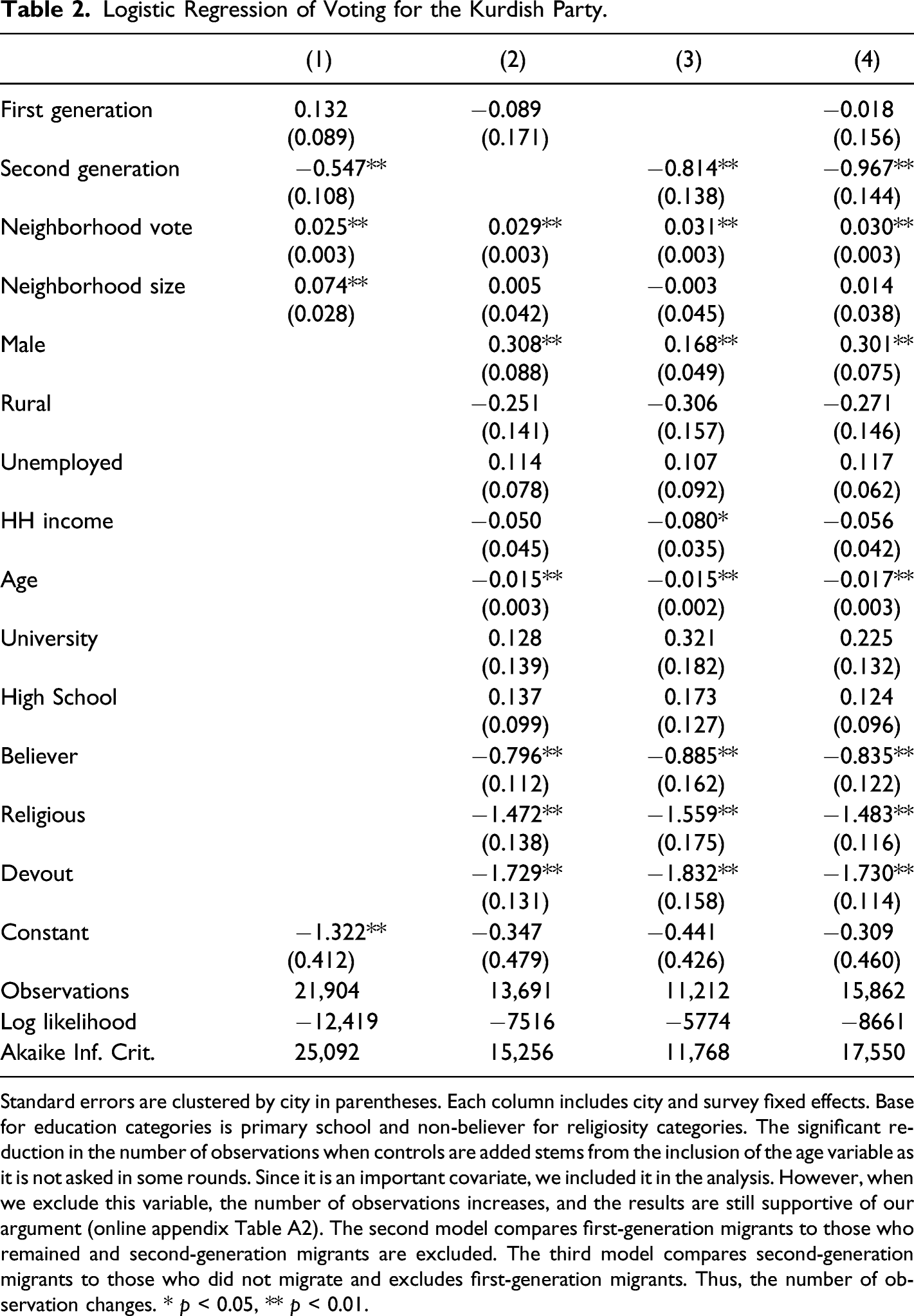
Standard errors are clustered by city in parentheses. Each column includes city and survey fixed effects. Base for education categories is primary school and non-believer for religiosity categories. The significant reduction in the number of observations when controls are added stems from the inclusion of the age variable as it is not asked in some rounds. Since it is an important covariate, we included it in the analysis. However, when we exclude this variable, the number of observations increases, and the results are still supportive of our argument (online appendix Table A2). The second model compares first-generation migrants to those who remained and second-generation migrants are excluded. The third model compares second-generation migrants to those who did not migrate and excludes first-generation migrants. Thus, the number of observation changes. * p < 0.05, ** p < 0.01.
To make the substantive effect interpretation easier, we plotted marginal effects in Figure 1 when binary variables increase from 0 to 1 and continuous variables increase by one standard deviation.
30
While there is no significant difference between first-generation migrants and those who did not migrate, second-generation migrants are around 23% less likely to support co-ethnic political parties than those who stayed in the conflict zone. Furthermore, to exemplify the effect of migration, we estimated predicted probabilities by migration type and setting all variables to median values. The predicted probability of voting for the Kurdish party for those who did not leave the conflict zone is around 78.7%. For first-generation migrants, it is around 78.3% whereas for second-generation migrants, it decreases to 58.4%. Marginal effects on the probability of voting for the Kurdish party when binary variables increase from 0 to 1 and continuous variables increase by one standard deviation. Horizontal lines denote 95% confidence internals. Model 4 in Table 2 is used for the estimation.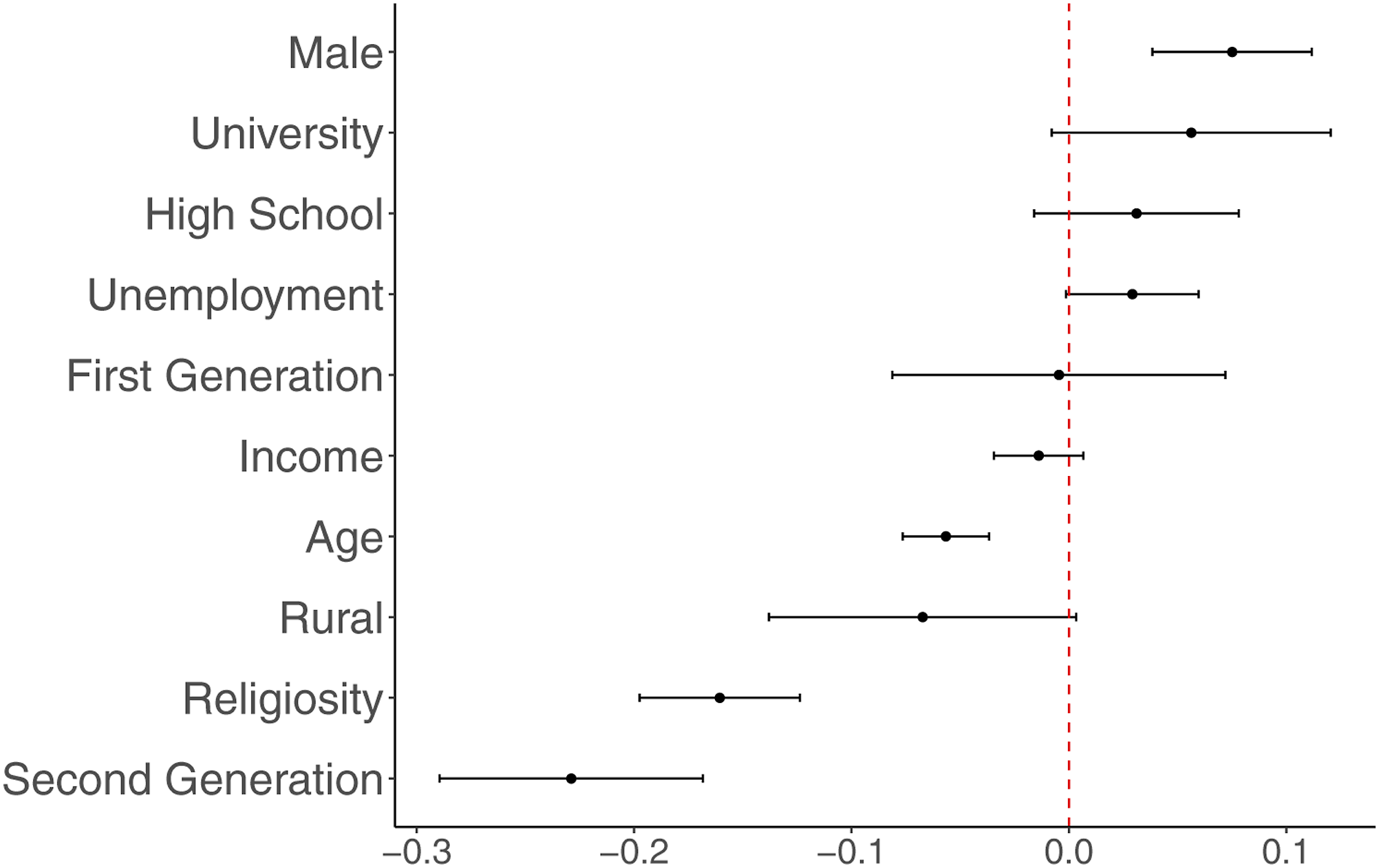
For control variables, men are more likely to vote for the Kurdish party than women by around 7.5%. Unemployment increases support for the Kurdish party, whilst support for the Kurdish party decreases as household income increases. Although higher education appears to increase support, it is only weakly significant at 0.1 level. Finally, religiosity is a significant determinant of voting behavior. High religiosity decreases the likelihood of voting for the Kurdish party by 16%. Furthermore, as with previous studies, we find a significant effect of neighborhood voting behavior.
Logistic Regression of Voting for the Kurdish Party among Migrated Kurds.
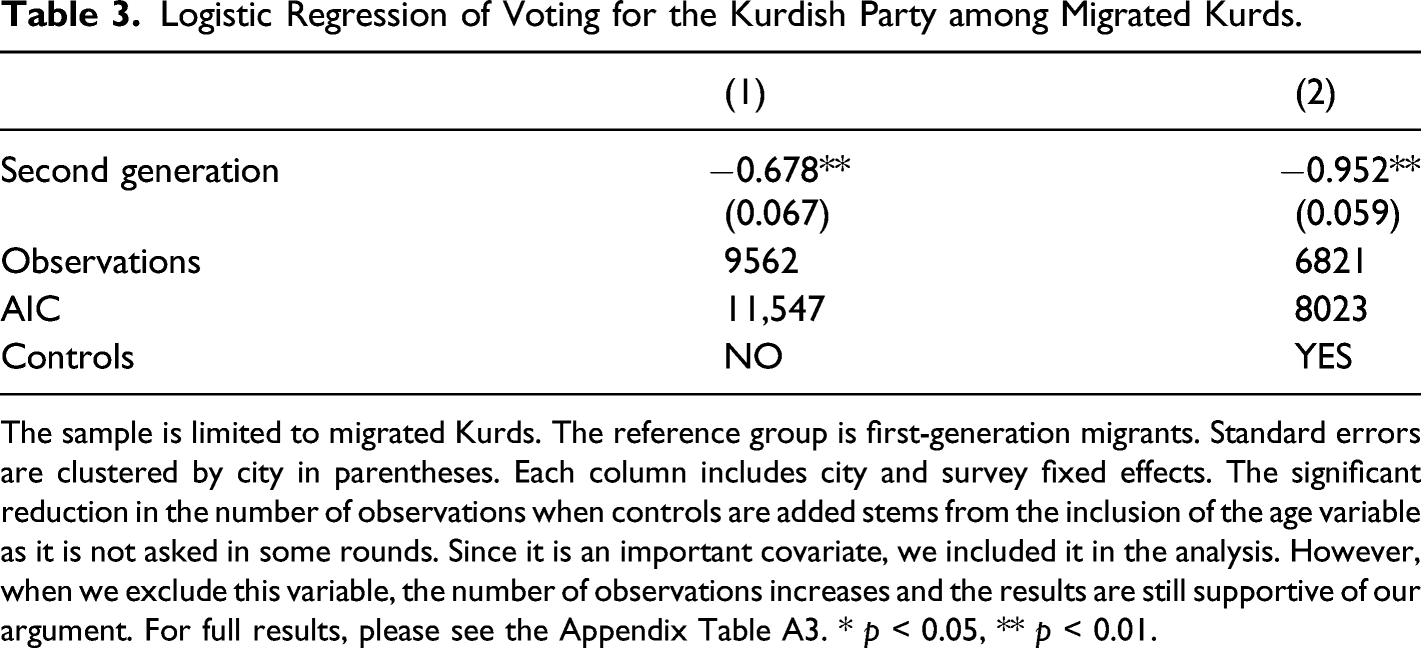
The sample is limited to migrated Kurds. The reference group is first-generation migrants. Standard errors are clustered by city in parentheses. Each column includes city and survey fixed effects. The significant reduction in the number of observations when controls are added stems from the inclusion of the age variable as it is not asked in some rounds. Since it is an important covariate, we included it in the analysis. However, when we exclude this variable, the number of observations increases and the results are still supportive of our argument. For full results, please see the Appendix Table A3. * p < 0.05, ** p < 0.01.
If second-generation migrants are less likely to vote for the Kurdish party, for which party do they vote instead? We replicated the analysis for two other main parties in Turkey: AKP (the party in government since 2002) and CHP (the main opposition party since 2002). While second-generation migrants are more likely to vote for CHP compared to those who remained in the conflict zone, there is no significant difference between these two groups for the probability of voting for AKP.
Matching
Model dependence is a common challenge in social science research, particularly in highly imbalanced datasets where extrapolation bias might result in unreliable estimates. To overcome these concerns, we also employed matching procedures and estimated the sample average treatment effect on the treated (SATT). Matching involves identifying units with similar observable characteristics and enables a reduction in bias, model dependence, and estimation error, which improves claims of causal inference (Ho et al. 2007, Iacus, King and Porro 2019). We opt for coarsened exact matching (CEM) as it guarantees a reduction in imbalance and estimation error by restricting data to common empirical support whereas propensity score matching may increase imbalance and fail to alleviate relevant concerns (Iacus, King and Porro 2012, King and Nielsen 2019). Furthermore, matching allows us to compare individuals with similar age and explore potential generational effects, which might be an important alternative explanation.
In the analysis, we used the same covariates as model 4 in Table 2. Binary variables were exactly matched and for continuous variables, 10th percentiles were used as cut points. 33 We matched first-generation migrants to people who stayed in the conflict zone (the second column), second-generation migrants to those who did not migrate (the third column), and first-generation to second-generation migrants (the fourth column).
Matching Analysis – SATT of Migration on Voting for the Kurdish Party.
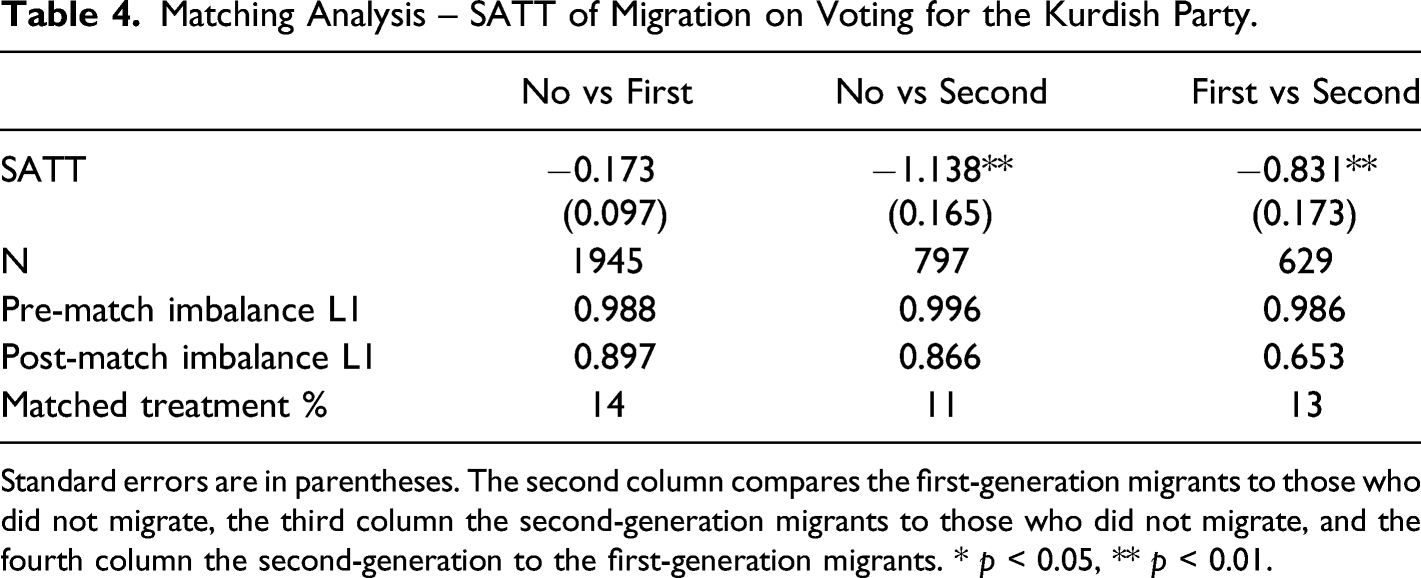
Standard errors are in parentheses. The second column compares the first-generation migrants to those who did not migrate, the third column the second-generation migrants to those who did not migrate, and the fourth column the second-generation to the first-generation migrants. * p < 0.05, ** p < 0.01.
In the analysis, continuous variables are matched by using specific intervals. By coarsening the cut-off points (e.g., five cut-offs instead of 10), scholars can match more observations and increase the sample size. However, it comes at the cost of a reduction in the balance, which increases the degree of model dependence. Therefore, choices of cut-off points have a significant impact on the estimates and may result in misleading inferences. To overcome related concerns, we employed matching frontier analysis as suggested by King, Lucas and Nielsen (2017). For each possible sample size, this procedure computes the matching solution with maximum balance and returns the solution. Afterward, we can see whether the effect changes once we get a more balanced but smaller dataset. We reported results in Figure 2.
35
The upper left panel shows the results for the comparison of first-generation migrants to those who did not migrate, upper right panel for the comparison of second-generation migrants to those who stayed in the conflict zone, and the lower panel for the comparison of second-generation to first-generation migrants. The x-axis denotes the number of observations pruned, and the more observations are dropped, the more balanced the dataset gets. The y-axis shows the SATT estimates.
36
Matching frontier analysis.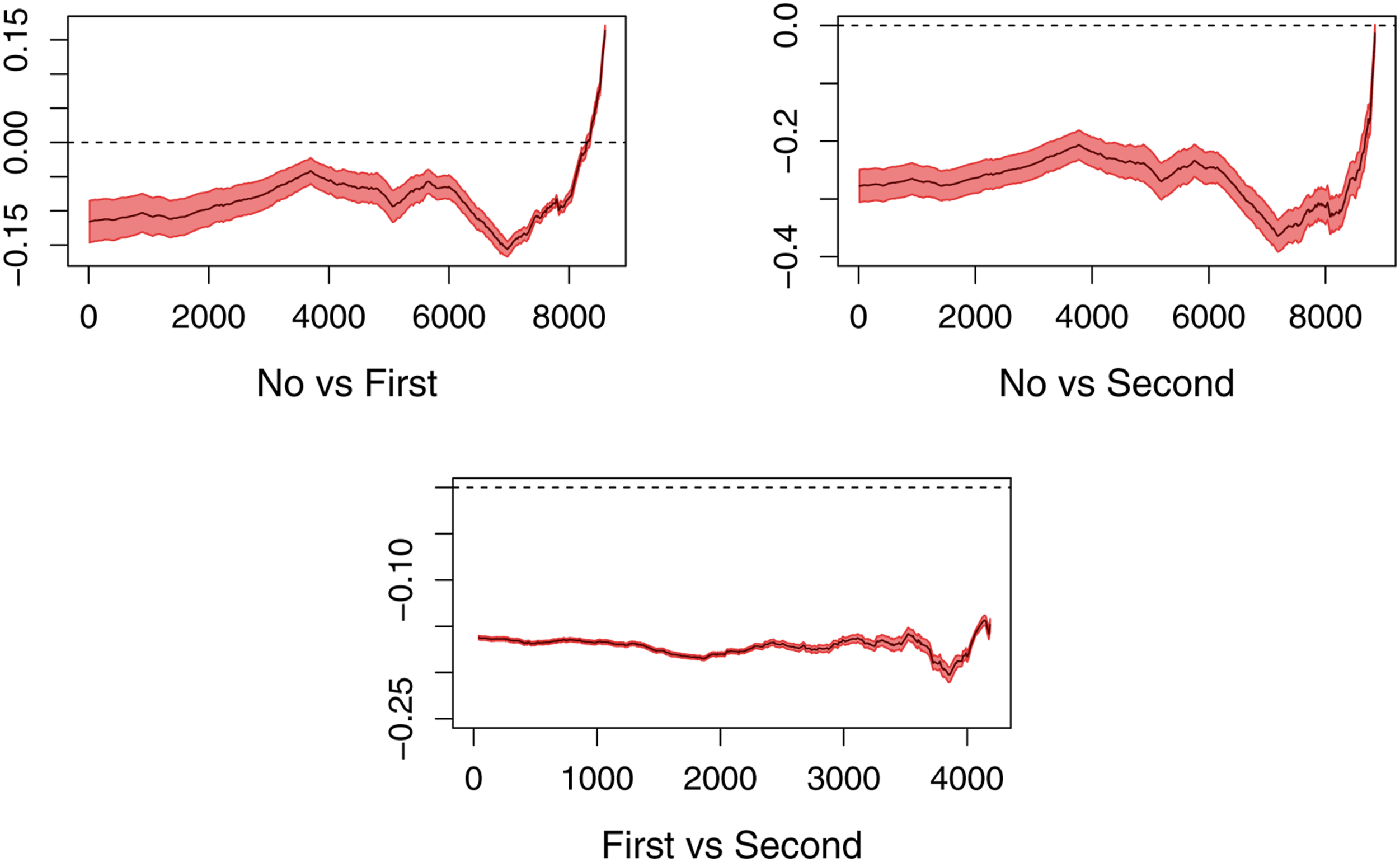
The frontier analysis also suggests that second-generation migrants are less likely to support the Kurdish party compared to other groups. When we prune more and more observations, the difference between second-generation migrants and those who did not migrate gets smaller, whereas the difference between the first- and second-generation migrants is quite stable. When it comes to the comparison of first-generation migrants to those who stayed in the conflict region, the results suggest that even though initially there seems to be an effect, when the dataset gets more and more balanced, the effect disappears. 37 In conclusion, by comparing people with similar observable characteristics such as age, education level, and neighborhood, the matching analysis strongly indicates that second-generation migrants are less supportive of the political movements of their co-ethnics than first-generation migrants and those who did not migrate and there is no significant difference between first-generation migrants and people who stayed in the conflict zone.
Alternative Explanations
As noted, matching allows us to account for some alternative explanations, including age and generation effects. However, there are other potential explanatory factors which are important to address. Firstly, migrants often move to countries or regions with a different language, which can be much more difficult to master for first-generation migrants who migrate as adults. Conversely second-generation migrants who grow up speaking the language are often fluent. This language barrier may prevent first-generation migrants fully integrating into a new community and make them more reliant on their ethnic in-group, and potentially explain the attitudinal differences between first- and second-generations. Fortunately, this is not a significant problem for our research as almost everyone in Turkey can speak Turkish, including Kurds. Crucially all compulsory education (primary, secondary, and high school) is conducted in Turkish which ensures that the overwhelming majority of the population have a basic level of Turkish. Related to this, a different educational environment or curriculum between these groups might also account for different attitudes; however, the education system is centralized in Turkey and the curriculum is dictated by the government. Finally, given Turkish is the official language of Turkey all interaction with the government and state services (e.g., health), require citizens to have a basic level of Turkish. Therefore, both groups of migrants and those who remain in the conflict zone are subject to the same education. Therefore, this is unlikely to be a significant factor in the differing attitudes amongst second-generation migrants.
Secondly, it could be argued that the act of migration itself accounts for changes in attitudes. This would fit with findings from sociology which shows that immigrant religious participation decreases substantially as compared to the same immigrants prior to their migration (Connor 2008). Similarly, in their review on religious change in migrants, Voas and Fleischmann (2012) note that group norms, particularly “what was expected in the old country“ will not be required in the new and may even be ‘frowned on’ after migration (Voas and Fleischmann 2012). However, although it is indeed likely that migration may have an effect on some attitudes and behavior, the lack of a difference between first-generation migrants and those who remain suggest it is not the act of migration itself which is driving these changes.
Another potential alternative explanation is contact with the out-group or socializing in a different environment. However, we do not believe this is likely to account for the totality of the effects we find. Firstly, controlling for neighborhood characteristics allows us to capture some of the likely variation in contact (i.e., the variation in contact with co-ethnics or other groups caused by migrants who settle in neighborhoods with high Kurdish populations or Turkish dominated areas). Secondly, whilst it is plausible that contact may affect the attitude of migrants, this cannot fully account for the lack of any significant difference between first-generation migrants and those who remain, nor can it account for the clear difference between first- and second-generation migrants. First-generation migrants will be exposed to a much greater level of contact than those who remain, yet we find no difference between these groups. Conversely, first-generation migrants are socializing in the same environment as second-generation migrants after migration, yet we find a significant difference between these groups. Therefore, whilst it is possible that the effect of socialization or contact may be greater for second-generation migrants, it is unlikely that this is the primary or only explanation for our findings.
Internal and External Migration
Our research is focused on Kurdish migrants who are displaced from the conflict zone in East and Southeastern parts of Turkey to other regions in Turkey. This understanding of a migrant fits both the classic Collins English dictionary definition of a migrant and the United Nations Migration Agency’s definition of a migrant which defines the term migrant as, “An umbrella term, not defined under international law, reflecting the common lay understanding of a person who moves away from his or her place of usual residence, whether within a country or across an international border, temporarily or permanently, and for a variety of reasons.” 38 Although the term migrant can sometimes be used colloquially to refer to those who travel across international borders as opposed to those who are “internally displaced,” both of the definitions highlighted above are clear that the term migrant includes those who move within countries also. We recognize that it does not imply that our theory or findings apply uniformly to both those who migrate within countries and those who migrate across borders. However, we argue there are a number of reasons that our theory and findings can help us understand both internal and external migrants with similar characteristics and experience to the Kurds. We cover these arguments in summary below and further details are available in the online appendix.
Firstly, the critical causal factor in this paper is not migrants crossing an international border, but rather migration away from conflict. Secondly, existing research suggests that migrants in general are likely to settle in communities and form networks with other co-ethnic migrants which suggest the experience may be similar for internal and external migrants (Fennema and Tillie 1999, Fennema and Tillie 2001). We also control for the characteristics of neighborhoods in our model. Thirdly, although the process of political socialization may differ for external and internal migrants, access to information via the internet, and particularly social media, has reduced these differences, particularly in regards to accessing information from and about co-ethnic political movements. Finally, it is important to note that as of 2007, over 150 countries allow emigrants to vote in elections in their home country, therefore, understanding the political attitudes and likely voting behavior of both internal and external migrants is critical (Ellis 2007). Given the arguments outlined above regarding the way a migrant is defined, the applicability of our theoretical framework to both external and internal migrants, the steps taken in our empirical analysis to address potential issues, and the ability of both internal and external migrants to vote in relevant elections, we believe that with some reservations the findings in this paper provide an important insight into the political attitudes of both internal and external migrants. As noted, we expand further on these points in the online appendix.
Selection Into Migration
Estimating the causal effect of migration on support for co-ethnic political parties is challenging given the possibility that self-selection into the migration could account for differences between migrant and non-migrant populations. Carrying out an experiment by randomly relocating people is neither ethical nor feasible. One might think that the government and rebels’ forced relocation practices can be used as a natural experiment as people do not have any choice in this decision to migrate. But the decision of the government and rebels to forcibly relocate people is not random. Armed groups are likely to resettle people/groups whom they see as a threat in their fight. Therefore, comparing people that armed groups relocate and do not relocate will also lead to biased estimates. A possible solution would be to use difference-in-difference estimation. However, this requires following respondents over time (i.e., panel data) and collecting information in conflict settings which is particularly challenging and often impossible. Shift-share instruments are often considered as an alternative (Card 2001); however, the exclusion restriction is not likely to hold. Therefore, the most feasible way to estimate the effect of migration is to use observational data.
In this study, we compared first- and second-generation migrants to those who did not leave. These three groups are highly likely to be different from each other in many aspects. We controlled for demographics in the analysis and we also employed matching. However, there might still be factors we cannot account for as they might be difficult to measure or data might not be available. To see whether the omitted variable bias is severe enough to change the direction of migration variables’ effects, we employed Oster’s (2019) coefficient stability analysis.
39
Changes in
We ran the coefficient stability analysis for Table 2. The results suggest that the effect of first-generation migration is not robust to omitted variable bias—although what we observed initially was a negative estimate, this was insignificant and, the consistent bias-adjusted estimate is positive. Conversely, the analysis indicates that whilst the difference between second-generation migrants and those who did not migrate might be slightly overestimated, it is still negative. On the other hand, the difference between first- and second-generation migrants might be underestimated but it is also still negative. Similar to matching, the coefficient stability analysis strongly supports our argument that there is a significant difference between second-generation migrants when compared to those who did not migrate and first-generation migrants, whereas, there is no significant difference between first-generation migrants and those who remained.
Furthermore, in this paper, our theoretical framework and results are focused on the different attitudes of second-generation migrants relative to those who remain and first-generation migrants. Crucially, selection into migration is not a serious problem for second-generation migrants. Unlike first-generation migrants they are born and reside in the same place. Whilst there may be an effect stemming from differences in parents if first-generation migrants are different than those who stayed, our analysis suggests that there is no significant difference between these two groups. To further alleviate the concerns, we control for the father’s education level which is available for a limited number of rounds and the results still support our argument (online appendix Table A4).
Additional Robustness Checks
In the main analysis, we dropped those who abstain or express their indecisiveness about the elections. Coding both groups as not supporting the Kurdish party (online appendix Table A5) or coding those who abstain as no support and dropping indecisive ones (online appendix Table A6) does not affect the results. Furthermore, in the analysis to account for neighborhood characteristics, we used November 2015 elections as explained above. Using June 2015 elections, results are still supportive of our argument (online appendix Table A7).
In the operationalization of our migration variables, we used where people were born and live. Whilst the majority of Kurds in our sample are either first or second-generation, our second-generation migration variable may also include generations beyond the second. Since our theoretical explanations are related to intergroup conflict exposure, they are also applicable to these generations. However, to alleviate possible concerns, we also run additional analyses. In some rounds, there is an explicit question about migration history, and through this question, we are able to isolate only second-generation migrants. We replicated the main analysis with this restricted data. The results are very similar and still supportive of the argument (online appendix Table A8).
In addition to in-sample analysis, we also ran out-of-sample cross-validation as it can be a critical measure of model success, reinforces causal claims, and helps to overcome the overfitting problem (Beck, King and Zeng 2000, Chadefaux 2014, Chadefaux 2017, Ward, Greenhill and Bakke 2010). Here, we adopted the leave-one-out method. Models were run with all the observations except for one city (i.e., learning set) and predicted for the one left out (i.e., test set) and calculated area under the curve (AUC) score. We repeated this procedure for model 4 in Table 2 (i.e., full model) and taking out a variable at a time (i.e., reduced model) to see the contribution of each variable to the predictive capability.
The results of the out-of-sample cross-validation process are reported in Figure 3. Higher values denote increases in the predictive capability of the model and that this variable is essential to the model. Unemployment, income, education, and rural variables do not improve our predictive capability. Male, age, and religiosity variables help us to explain variation in the support for political movements of co-ethnics. When it comes to migration, adding it as a binary variable (i.e., migration vs no-migration) results in a small improvement in the predictive capability. However, splitting it as first- and second-generation migrants significantly increases the predictive power of the model and it has the largest impact on explaining variation. This analysis highlights that migrants should not be treated as a homogeneous group but it is critical to consider the differences between first and second-generation (as argued in our core hypothesis). Increases in AUC score in out-of-sample cross validation by variable. Horizontal bars denote 95% confidence intervals obtained by bootstrapping with 1, 000 draws.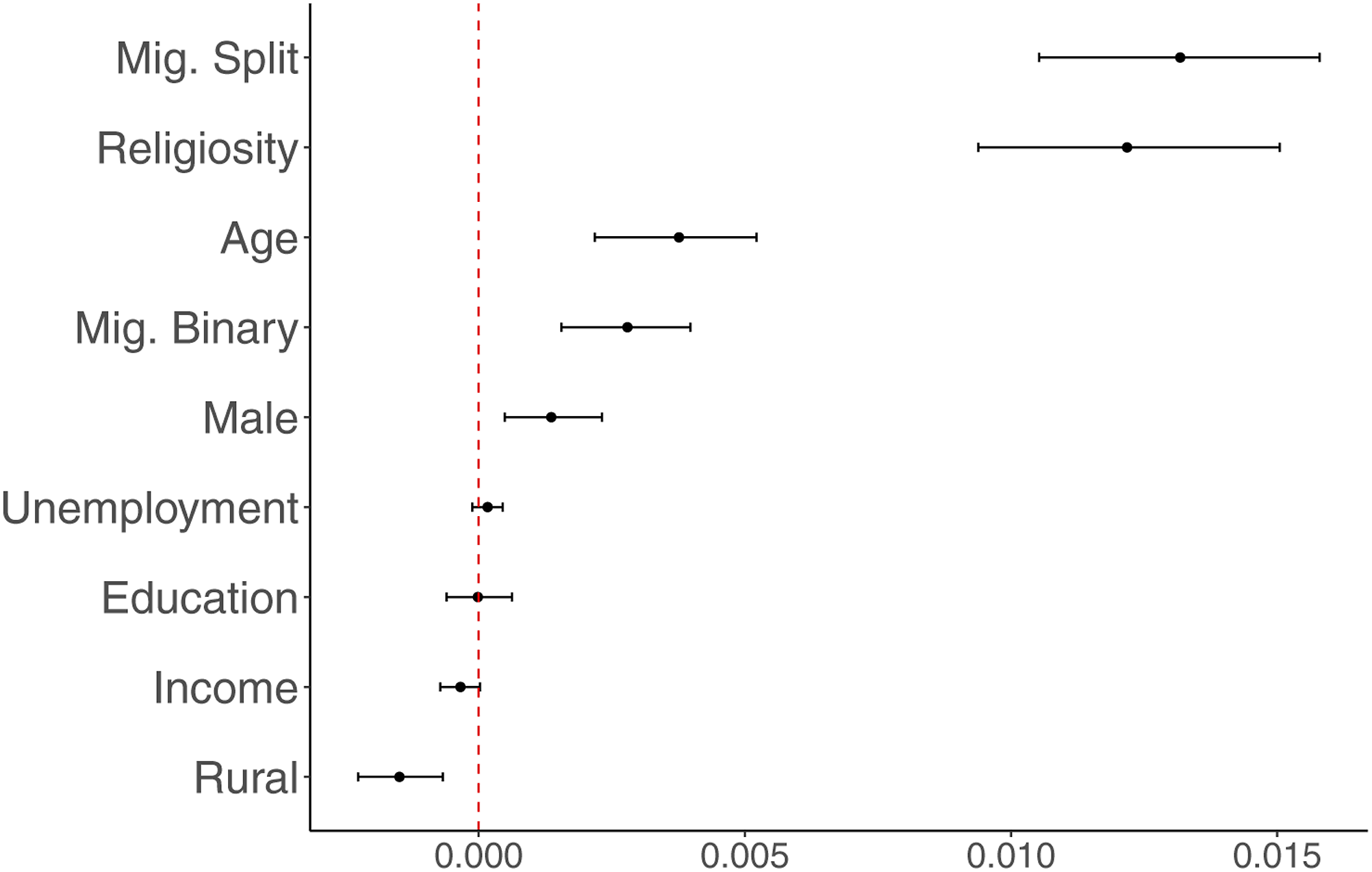
Exploratory Analysis: Migration, Identity, and Conflict Resolution
Our central argument about the effect of migration and conflict exposure on support for co-ethnic political parties can potentially be extended to attitudes towards conflict resolution and identity. Whilst we do not have space to develop a full theoretical model, we believe that the core argument regarding the effect of variation in conflict exposure holds for these attitudes also. More specifically, existing research indicates that conflict exposure can polarize ethnic identities and change perceptions of realistic conflict resolution (Bauer et al. 2016, Beber, Roessler and Scacco 2014, Canetti et al. 2017). Therefore, we expect the second-generation’s lack of exposure to intergroup conflict will result in a weaker ethnic identity and increase their support for aggressive conflict resolution to suppress co-ethnic rebels. Conversely, those who remain and first-generation migrants who have grown up in the conflict environment will perceive greater differences between ethnic and national group identities (Nair and Sambanis 2019) and be less supportive of aggressive government suppression of co-ethnic rebels.
Unfortunately, data on conflict resolution is not as extensive as data on the support for the political objectives of co-ethnics. Only one survey round (September 2015) asks respondents about the conflict and how to solve it. The total number of Kurdish participants in this round is 568.
41
Respondents are asked to read certain statements and then express their level of (dis)agreement by responding that it is: absolutely wrong; wrong; neither right nor wrong; right, or; absolutely right. These variables are coded from 1 to 5 where higher values denote agreement with the statement. For each relevant variable, we ran a model using the first- and second-generation migrant variables as our explanatory factors as well as accounting for demographics. Therefore, the reference group is people who did not migrate and coefficients denote the difference between them and migrants. The coefficient estimates are reported in Figure 4. Attitudes towards conflict resolution. For each variable, a regression analysis is run with the first- and second-generation migrant variables as well as controls. Points refer the coefficients and horizontal bars denote 95% confidence intervals.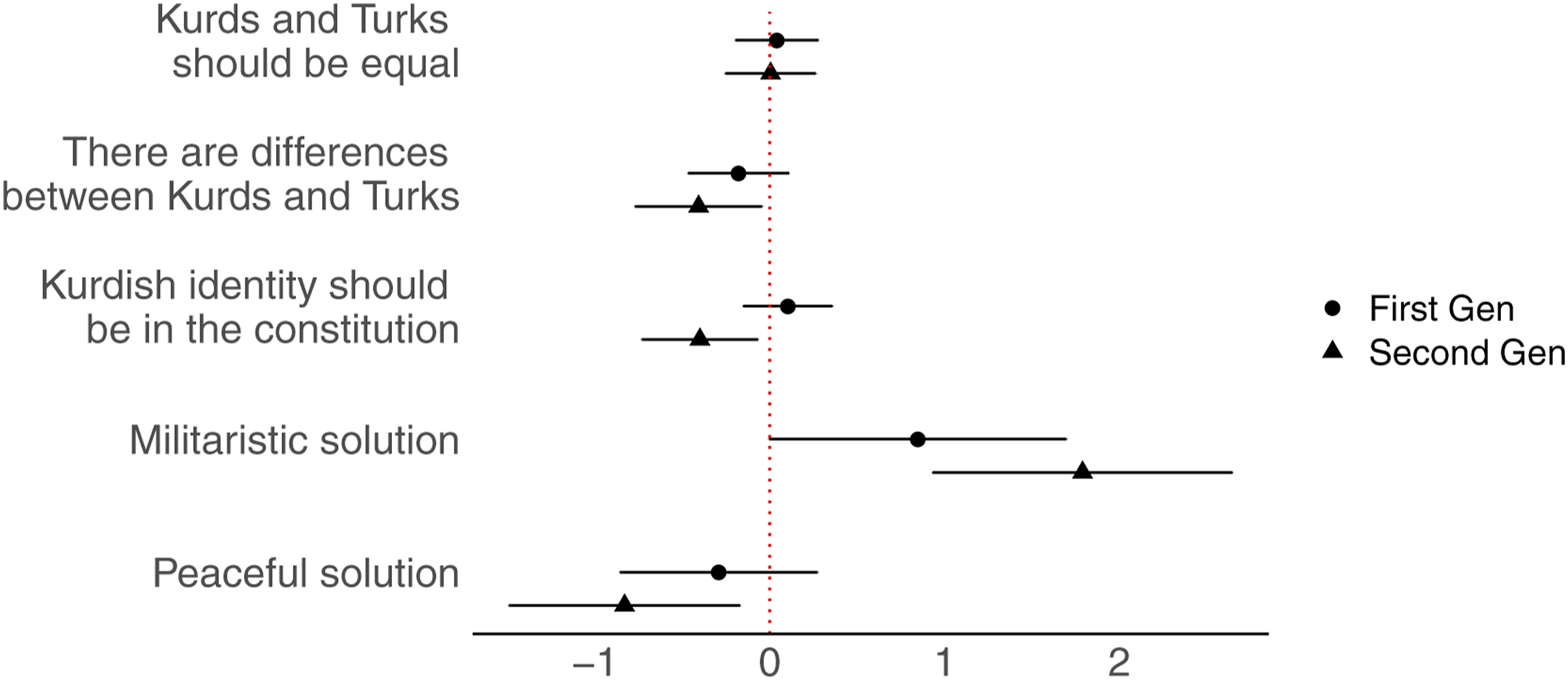
The first statement is related to equality: There should not be any difference between Kurds and Turks with respect to rights, government, and wealth. Migrants and those who did not leave the conflict zone show no significant difference and believe that Kurds and Turks should be equal. However, when it comes to the perceived differences (“In this country, there are serious differences between Turks and Kurds in the eyes of the state”) and constitutional recognition of Kurdish identity (“The Kurdish identity should be included/defined in the constitution”), second-generation migrants agree less with these statements than first-generation migrants and those who stayed in the conflict zone. In other words, second-generation migrants perceive fewer differences between Turks and Kurds and are less in favor of constitutional recognition of the Kurdish identity compared to first-generation migrants and those who did not migrate.
Furthermore, in a separate question, respondents are asked about what to do to solve “the Kurdish problem” and to choose one among different options under three main categories varying from very aggressive to more conciliatory: (1). Militaristic repression and/or Kurdish surrender 42 , (2). Peaceful compromise 43 , and (3). Other solutions. The results indicate that second-generation Kurdish migrants are more in favor of militaristic solutions which involve greater repression of their co-ethnics and less in favor of peaceful solutions. There is no difference between first-generation migrants and those who did not migrate (although the coefficient for militaristic solutions is almost significant for first-generation migrants with a p-value of 0.051).
This exploratory analysis again highlights that the differences between migrants and those who remain are primarily manifested in second-generation migrants. 44 There appear to be no significant differences on these issues between those who remain and first-generation migrants, but second-generation migrants differ on a number of important issues. Whilst these results provide an important insight into the broader intergenerational effect of migration, this analysis cannot go beyond being exploratory given the limited sample size. Further data collection and analysis are required for robust inferences.
Conclusion
In this study, we analyzed the effect of migration on political support for co-ethnics, attitudes towards conflict resolution and identity. By disaggregating the migrant groups into first- and second-generations, we make a theoretical contribution about conflict exposure and intergenerational effects of migration. We argue that second-generation migrants have lower levels of support for co-ethnic political parties which stem from their relative lack of conflict exposure compared to first-generation migrants and those who did not migrate. Existing research has shown that conflict exposure has long-term effects on political attitudes, and we apply this to shed light on the differential effects of migration on first- and second-generation migrants.
We tested our main argument using detailed survey data and granular neighborhood-level data on voting behavior in Turkey. By using concurrent and consistent surveys of both migrants and those who remain as well as accounting for neighborhood characteristics, we make an important methodological step forward and are therefore able to make more robust inferences regarding the effect of migration. Furthermore, to ensure the robustness of our results, we employed matching procedures as well as a series of additional tests, particularly with regards to the omitted variable bias. The results consistently indicate that second-generation migrants have lower levels of support for co-ethnic political parties than first-generation migrants and those who did not migrate.
Although second-generation migrants have lower levels of support for co-ethnics than those who remain and first-generation migrants, they have significantly higher levels of support than other ethnic groups. This highlights the enduring impact of in-group solidarity despite limited or no direct exposure to intergroup conflict. The results also indicate that there are not significant differences between first-generation migrants and those who remain in the conflict region on political support for co-ethnics, suggesting that displacement has little impact on their solidarity with co-ethnics. However, there is scope for further analysis of differences between these groups on other issues.
The core of our argument is that growing up and socializing in a conflict environment has long-term effects on the political attitudes of first-generation migrants and those who remain which do not extend to second-generation migrants who grow up away from a conflict environment. Unfortunately, given available data, we cannot account for the variation in levels of direct conflict exposure (e.g., whether a given individual was injured, or had a family member who was injured). Theoretically, higher levels of direct conflict exposure may increase in-group solidarity and make people even more likely to vote for co-ethnic political parties (Hadzic, Carlson and Tavits 2020). Similarly, depending on which actor civilians escape from (i.e., the government or rebels), their voting behavior might change. If the government is the main reason for fleeing, civilians might be more supportive of the co-ethnic political party and if the rebels are the main reason, they are likely to be less supportive of the co-ethnic political party. Unfortunately, we are unable to test these arguments but with additional data and cases, future studies may be able to overcome these limitations. As we are focused on internal migration and displacement, our findings are significant for understanding the long-term effects of this growing phenomenon; according to 2019 UNHCR statistics, the number of Internally Displaced People’s (IDPs) is double the number of refugees at approximately 45.7 million. Furthermore, as we argued in the paper, we believe our explanations are likely to extend to external migration and displacement, particularly for ethnic groups who migrate away from conflict, and also with regards to differences between second-generation migrants and others.
The ongoing migration context is a global challenge which will require a nuanced understanding of the long-term effects of conflict and displacement, and a policy agenda which takes this into account to help migrants thrive. This paper contributes to our understanding of this complex topic by combining a rich and granular dataset with a new theoretical framework, highlighting the importance of understanding variation in conflict exposure and political attitudes within migrant communities. The results highlight the long-term effects of conflict on political attitudes. The results are very robust and our extension of the analysis to identity and conflict resolution highlights the broader applicability of our theoretical framework, suggesting there are a number of potential avenues for future research.
Supplemental Material
sj-pdf-1-jcr-10.1177_00220027211065421 – The Effect of Migration on Political Support for Co-ethnics: Evidence From Turkey
Supplemental Material, sj-pdf-1-jcr-10.1177_00220027211065421 for The Effect of Migration on Political Support for Co-ethnics: Evidence From Turkey by Miceal Canavan, and Oguzhan Turkoglu in Journal of Conflict Resolution
Footnotes
Acknowledgments
We thank Gizem Arikan, Trasa Canavan, Thomas Chadefaux, Caroline Coogan, Ben Elsner, Andrea Guariso, and Sigrid Weber for invaluable feedback. We also thank Konda Research and Consultancy, particularly Eren Pultar, for sharing data. Finally, we thank Muharrem Sönmez for his immense help in scraping election data.
Declaration of Conflicting Interests
The author(s) declared no potential conflicts of interest with respect to the research, authorship, and/or publication of this article.
Funding
The author(s) received no financial support for the research, authorship, and/or publication of this article.

Supplemental Material
Supplemental material for this article is available online.
Notes
References
Supplementary Material
Please find the following supplemental material available below.
For Open Access articles published under a Creative Commons License, all supplemental material carries the same license as the article it is associated with.
For non-Open Access articles published, all supplemental material carries a non-exclusive license, and permission requests for re-use of supplemental material or any part of supplemental material shall be sent directly to the copyright owner as specified in the copyright notice associated with the article.
