




Abstract
Does the public in authoritarian regimes disapprove of their leaders’ backing down from public threats and commitments? Answers to this question provide a critical micro-foundation for the emerging scholarship on authoritarian audience costs. We investigate this question by implementing a series of survey experiments in China, a single-party authoritarian state. Findings based on responses from 5375 Chinese adults show that empty threats and commitments expose the Chinese government to substantial disapproval from citizens concerned about potential damage to China’s international reputation. Additional qualitative evidence reveals that Chinese citizens are willing to express their discontent of leaders’ foreign policy blunders through various channels. These findings contribute to the ongoing debate over whether and how domestic audiences can make commitments credible in authoritarian states.
Introduction
How domestic publics can constrain and inform foreign policy has long been a topic of interest to scholars of international relations. Recent attempts to identify the causal mechanisms of the domestic sources of foreign policy have shifted to survey experiments (Chaudoin, 2014; Davies and Johns, 2013; Levendusky and Horowitz, 2012; Tomz, 2007; Tomz and Weeks, 2013; Trager and Vavreck, 2011). These studies find micro-evidence of domestic audience costs—the punishment citizens impose on their leaders for backing down from fulfilling their foreign commitments or threats (Fearon, 1994). With a few recent exceptions (Bell and Quek, 2018; Quek and Johnston, 2018; Weiss and Dafoe, 2019), however, the majority of empirical contributions to the audience cost literature to date have focused on democratic countries. As a result, we know relatively little about whether and how the public’s political preferences matter in non-democracies.
Our goal in this study is to contribute to the emerging scholarship on authoritarian audience costs by empirically examining the micro-foundation of authoritarian audience costs in the case of China. Choosing China as the focus of our study is significant for two reasons. First, China is a single-party authoritarian state, where audience costs are believed most likely to arise (Weeks 2008). The case of China thus provides an excellent plausibility probe into the complex relationship between domestic politics and foreign policy in authoritarian regimes. Second, China is the most powerful autocracy today, and its foreign policy decisions have global repercussions. In the Asia-Pacific region in particular, the rise of China has already led to tensions that could escalate into military conflicts. These conflicts could in turn affect the security and economic interests of countries both within and outside of the region. Thus, the findings of this study could generate policy implications for countries in Asia and the rest of the world.
We fielded three waves of surveys in China between 2014 and 2015, with a total of 5375 Chinese adults. In the first two waves, we replicated the experimental design in Tomz (2007), which gauged respondents’ approval rating of their leader’s performance in a hypothetical military crisis. In the third wave, we designed an experiment with a realistic scenario about China’s participation in a hypothetical United Nations (UN) peacekeeping operation. The results lend strong support to the presence of autocratic audience costs: empty threats and botched commitments expose the Chinese government to substantial disapproval from its citizenry. Furthermore, we find that the disapproval is primarily induced by citizens’ concern about potential damage to China’s international reputation, which is consistent with the reputation-based theory of audience costs (Guisinger and Smith, 2002).
We also used closed and open-ended questions to explore how authoritarian citizens can constrain their leaders. Answers to these questions suggest that a sizable proportion of respondents do not shy away from expressing their disapproval through both formal and informal channels, including traditional and social media, constituency service agencies, and the National People’s Congress. Of particular interest is the finding about social media, which has become an important avenue for public discourse and is actively monitored by the Chinese government. This leads us to suspect that audience costs could very well factor into leaders’ decision-making processes even in the absence of popular elections. Moreover, given the nature of China’s authoritarian regime, the government has reasons to worry about the potential consequences of online disapproval, because this could eventually lead to street protests and social instability, which the government is constantly trying to prevent (Weiss 2013).
The rest of this article is organized as follows. First, we briefly survey the existing literature on audience costs in democracies and autocracies. Next, we discuss the research design in the first two survey waves, followed by the presentation of the main findings, which are compared with the original study in the United States. We then report additional findings from our third wave, including qualitative evidence that suggests that citizens react negatively to leaders’ empty threats primarily out of concern for potential damage to China’s international reputation. We then examine the possible mechanisms through which audience costs may be transmitted to leaders. The last section concludes with discussions of this study’s broader implications.
Audience costs in democracies and autocracies
Scholars of international relations have devoted considerable attention to the relationship between domestic politics and foreign policy. One linkage that has received substantial coverage is the concept of audience costs—that is, the domestic punishment that leaders can incur for backing down from public threats and commitments (Fearon 1994). Leaders who are better at generating and signaling their audience costs are believed to enjoy an advantage in conveying their preferences credibly during international conflicts and negotiations (Tomz 2007). Scholars have since built the causal mechanism of domestic audience costs into theories of democratic peace, crisis bargaining, and interstate cooperation (Schultz 2001). 1
Early empirical work of audience cost theory primarily focuses on crisis behaviors of states using observational data (e.g. Eyerman and Hart, 1996; Gelpi and Griesdorf, 2001; Partell and Palmer, 1999) or historical case studies (Snyder and Borghard, 2011; Trachtenberg, 2012). Owing to the inherent issue of selection bias in historical and statistical analyses designed to test the theory of audience costs, scholars have recently turned to survey experiments to examine the micro-foundations of audience cost theory (Chaudoin, 2014; Davies and Johns, 2013; Levendusky and Horowitz, 2012; Tomz, 2007; Tomz and Weeks, 2013; Trager and Vavreck, 2011). These studies demonstrate robust evidence of audience costs, often measured as (dis)approval ratings embedded in public opinion surveys. 2
Nevertheless, most existing scholarship examining whether and how public opinion affects foreign policy has been carried out in democracies, primarily the United States. The focus on democracies can be attributed to the commonly held assumption that these countries face greater domestic audience costs, as democratic accountability increases the likelihood that leaders will actually face punishment for backing down (Eyerman and Hart, 1996; Fearon, 1994; Gelpi and Griesdorf, 2001; Levy, 2012; Partell and Palmer, 1999; Schultz, 1999). A large number of studies have indeed found evidence to support the observable implications of this core argument: democracies do tend to win or gain advantages in various international disputes (Leventoglu and Tarar, 2009; Schultz, 1998; Schultz and Weingast, 2003; Slantchev, 2006; Smith, 1996).
The assumption of democratic advantage has, however, been problematized by recent scholarship arguing that democracies should have no particular audience cost advantage over autocracies (Weeks, 2008, 2012, 2014; Weiss, 2013, 2014). In particular, Weeks (2008: 37) suggests that authoritarian leaders should be equally likely to generate audience costs as long as the following three conditions are met: “First, there should exist mechanisms for domestic audience to punish the leaders. Second, domestic audience must view backing down negatively. Third, outsiders must be able to observe such processes.” Indeed, as Tolstrup (2014: 129) states, “all political actors, democratic or not, must pay attention to the preferences and interests of the groups that back them. The cost of displeasing your supporters is your audience cost.”
Despite advances in the theory of autocratic audience costs, empirical evidence at the micro-level is lagging behind. 3 Are authoritarian publics more or less likely to disapprove of leaders who make empty threats or promises in the international arena? What are the reasons behind their disapproval? What can the public do if they are dissatisfied with their government’s foreign policy? For scholars of autocratic audience costs, answers to these questions are often assumed but not empirically established. 4 Nevertheless, only after we can demonstrate that citizens in autocracies do view backing down unfavorably and have some channels to express such disapproval can we begin to discuss the foreign policy implications of autocratic audience costs and explore recent refinements in audience cost theory that further decompose audience costs into “belligerent cost” and “incompetence cost” (e.g. Kertzer and Brutger, 2016; Nomikos and Sambanis, 2019).
Experimental design: military intervention
To explore audience costs in the authoritarian context, we implemented two survey experiments in China, a single-party authoritarian state. We chose China because it is believed that audience costs should be more likely to arise in single-party regimes compared with other types of autocracies (Weeks, 2008). In addition, given the significant implications of the rise of China for regional and international order, even though the findings of this study may not be generalizable to other authoritarian states, they can offer a window into the Chinese public’s reactions to the country’s foreign policy choices, and whether such views may be relevant for the Chinese government.
We fielded the first survey experiment to a total of 3261 Chinese adults in two waves (February and October 2014). 5 SoJump, an Internet marketing research firm in China, administered both waves by randomly drawing from its panel of 2.6 million registered subjects using an opt-in method. 6 The respondents’ gender, age and other social demographic indicators are comparable with those in online samples drawn for similar studies conducted in China (Fang and Li 2020; Huang, 2015; Truex, 2017). While the respondents to online samples are by no means representative of the Chinese populace as a whole by being younger, better educated, and more likely to reside in urban areas, a recent study shows they are much more representative of Chinese netizens, who now account for over half of the Chinese population (Li et al. 2018). 7
We replicated the same experimental template utilized by Michael Tomz (2007) in his pioneering study on domestic audience costs in the United States. Doing so allows us to directly compare our results with those from a democracy. For the experiment, which was embedded in a longer public opinion survey, each respondent read the following vignette with four randomized contextual variables that varied in regime type, motive, power and interests (a 2×2×2×2 factorial design): The following question concerns China and its relation with other countries in the world. This is a hypothetical question China may encounter in the future: country A sent its military to take over a neighboring country B. The attacking country was led by a [dictator, who invaded/democratically elected government, which invaded] country B [to get more power and resources/because of a longstanding historical feud.] The attacking country had a [strong military, so it would/weak military, so it would not] have taken a major effort for China to help push them out. A victory by the attacking country would [hurt/not affect] China’s economic and security interests.
We then randomly assigned one-fifth of the respondents to each of the five scenarios for potential courses of action by the Chinese government. The first scenario establishes the baseline, with the government staying out of the conflict. In the other four scenarios, the government made a threat but eventually backed down. The differences are the levels of escalation from mild to severe, which include verbal threat, display of force, and use of force with and without Chinese casualties. 8 In both waves, the four treatment groups and the control group are balanced in their key demographic characteristics, such as age, gender, education, geographical location, Chinese Communist Party (CCP) membership and international news readership, as well as the four contextual variables—motive, capability, regime type of the invading country, and the stakes for China. 9
After reading the scenarios, the respondents were asked to express their opinions of the Chinese government’s potential responses. In wave 1, we followed the design in Tomz by first asking: “Do you approve, disapprove, or neither approve nor disapprove of the way the Chinese government handled the situation?” (Tomz, 2007: 825). Respondents who approved or disapproved were further asked whether they held their views “strongly” or “only somewhat strongly.” Those who answered “neither” were prompted to further clarify whether they leaned toward (dis)approving or were completely neutral. In wave 2, we simply asked the respondents to place their evaluation on a five-point scale, ranging from strong disapproval (1) to strong approval (5). For ease of comparison, in the analyses we collapsed both measures to a three-point scale: disapproval, neutral, and approval. In the combined sample, 33% approved the government’s course of action and 40.7% disapproved, suggesting that the respondents were quite comfortable about voicing their opinions.
The experimental design yields one simple observable implication. If audience costs do exist in China, respondents assigned to the scenarios in which the Chinese government threatened either verbally or by action but then backed down should disapprove of their leaders more than those who were told that the Chinese government stayed out of the conflict. By virtue of randomization, any systematic difference in the respondents’ ratings should be entirely due to the treatments—i.e. the Chinese government’s different courses of action—and not to variations in the demographic or contextual variables. Findings from the survey experiments will thus provide direct micro-level evidence of audience costs in China while at the same time avoiding problems of endogeneity and collinearity.
Findings: evidence of autocratic audience costs
We first examine the difference between the scenario in which the government stayed out and the scenario in which the government made a verbal threat, i.e. the mildest scenario of backing down. To do so, we calculate the percentage of respondents who disapproved, approved, or held a neutral opinion about the government staying out of the conflict or backing down, respectively. We then calculate the differences between the two. The results are reported in Figure 1 for both waves, separately and combined. For comparison, we also included results from table 1 in Tomz (2007).
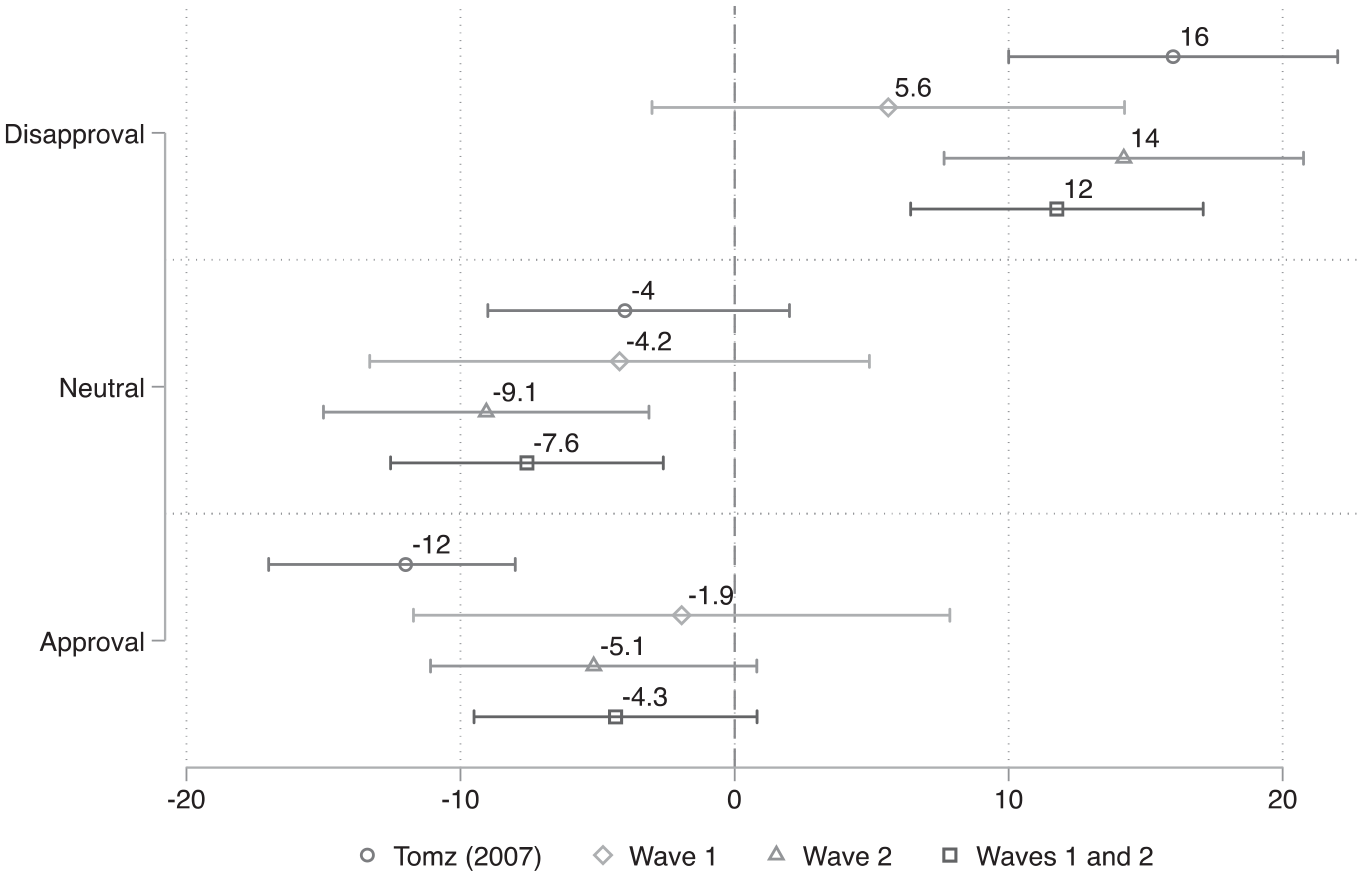
Autocratic audience costs of backing down from verbal threat.
What to do if dissatisfied with government’s foreign policies by party members and college graduates.
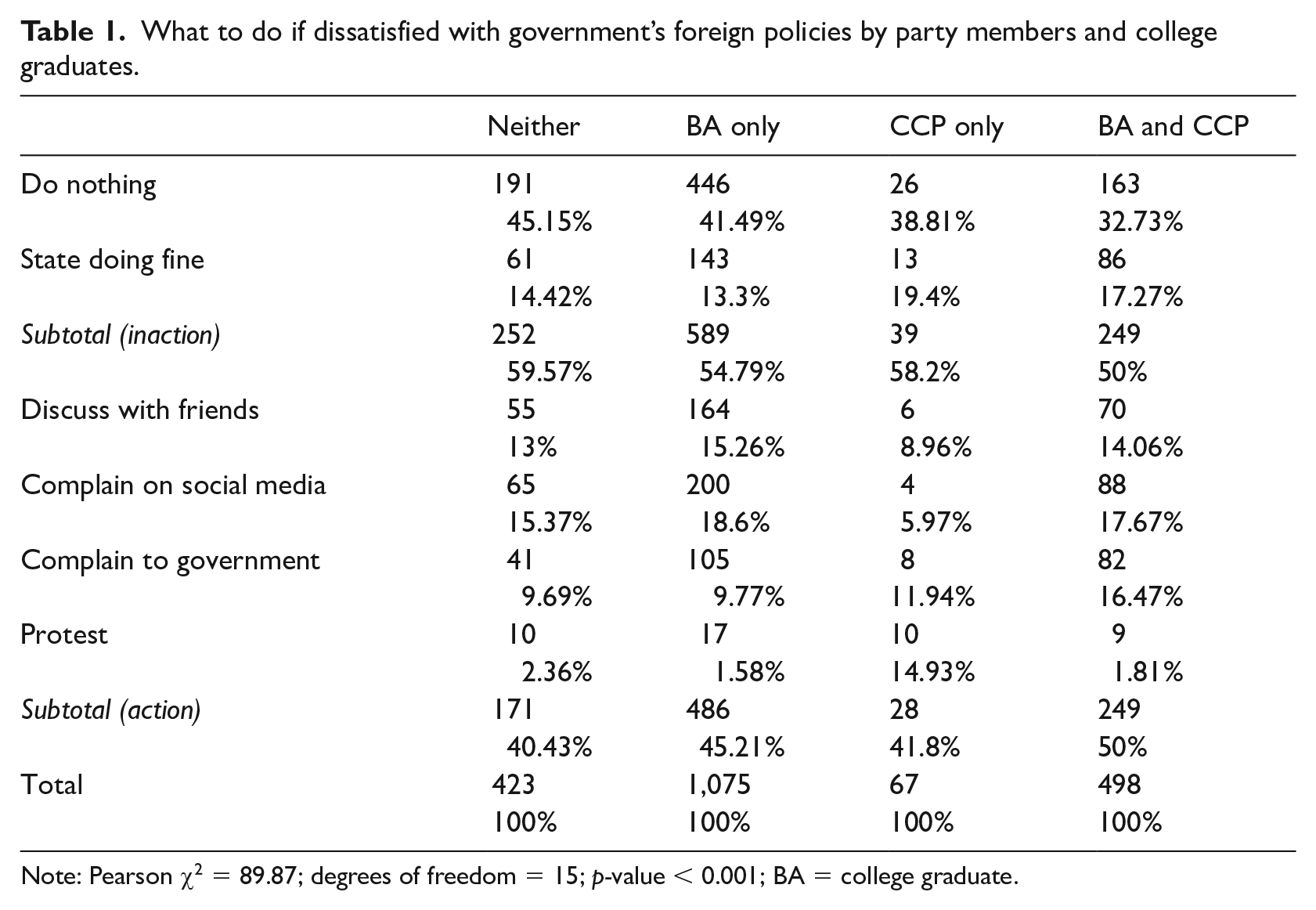
Note: Pearson χ2 = 89.87; degrees of freedom = 15; p-value < 0.001; BA = college graduate.
Focusing on the “disapproval” category first, we can see that compared with the baseline scenario of staying out of the conflict, the government’s failure to follow through on its public threat, even a mild one, is associated with a jump in domestic disapproval by 5.6 points in wave 1, 14 points in wave 2, and 12 points when both waves are combined. These numbers can be considered the “absolute audience costs”—i.e. the “surge in disapproval from staying out to backing down after escalation” (Tomz, 2007: 829). Because of its small sample size and lack of power, the absolute audience costs from wave 1 fail to achieve conventional statistical significance. However, the results from the wave 2 sample and the combined sample are both statistically significant. These results lend strong support to the hypothesis that empty threats could expose the Chinese government to disapproval from its citizens. The substantive effects are slightly smaller than those found in the United States (Tomz, 2007: 827). 10
In the meantime, the shares of the fence-sitters and approvers fall by 7.6 points and 4.3 points in the combined sample, although the drop in approval is statistically insignificant. In other words, the surge in disapproval comes mostly from people who would have held the neutral opinion when the government stayed out of the conflict. This contrasts with the results in the US survey, where the surge in disapproval was matched by a similar drop in the percentage of approvals. In China, it seems that approvers are not too bothered if the government backs down from public commitment, but those in the moderate center appear to adjust their opinions downward.
Does public sensitivity to government about-facing increase with the level of hostility? Figure 2 plots the absolute audience costs (i.e. change in disapproval) for each of the four scenarios, involving progressively stronger signals sent by the government: verbal threat, display of force, use of force without casualty, and use of force with casualty. The estimates in the figure present two patterns. First, similar to results in democracies, audience costs in China arise in all levels of escalation, although the effects are much smaller at higher levels of escalation; the surges of disapproval in the three scenarios involving the display and use of force fall between 6.8 and 13 points in the combined sample, which are 53–70.5% smaller compared with the US sample. Second, unlike results in the US, audience costs in China do not increase monotonically with each level of escalation. In fact, the display and use of armed force exposed the government to lower audience costs than verbal threats. The Chinese public appears to reward the government for flexing its military muscle more than blame it for not following through on its commitments. Only after the leaders ratchet crises up to the highest level of hostility, involving casualties in the Chinese military, do we see audience costs revert to the level in the empty-threat scenario. These findings suggest that Chinese leaders may enjoy greater maneuvering room in foreign policy decision-making than their democratic counterparts.
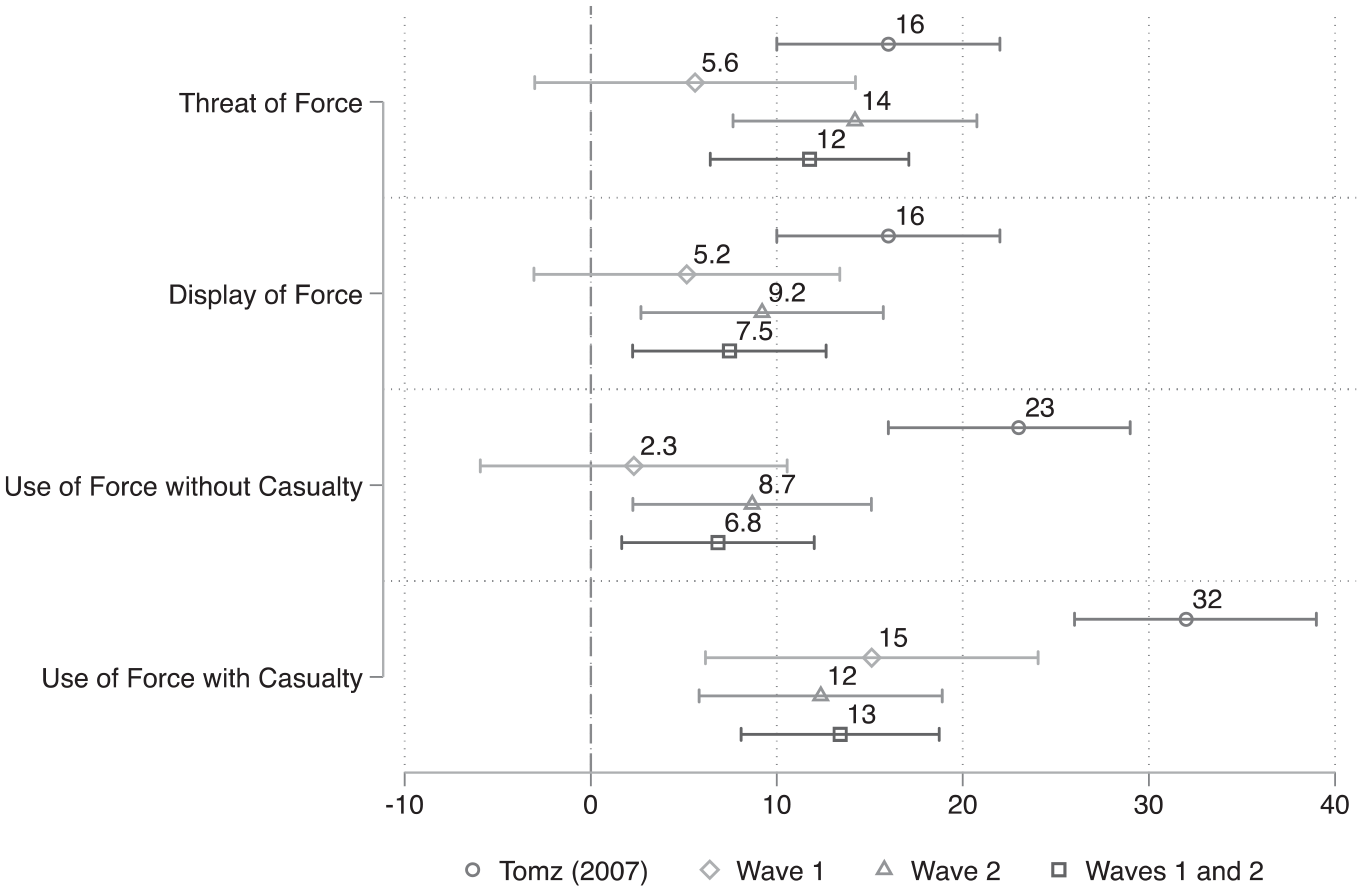
Autocratic audience costs by level of escalation.
In Online Appendix E in the Supplemental Materials, we also examine the heterogeneity of treatment effects in the combined sample, also known as “local treatment effects” (Imai and Strauss, 2009), across five socio-demographic variables: age, gender, education, CCP membership, and interest in international news. Here we highlight the finding regarding CCP membership. Previous research has suggested that regime insiders in single-party regimes can generate audience costs and thus hold their leaders accountable to some extent (Weeks, 2008). Our results, however show that empty threats have a much larger effect on regime outsiders (i.e. non-CCP members), increasing their level of disapproval by 11 points. In comparison, the absolute audience cost is 6 points for CCP members but is statistically insignificant, most likely owing to the much smaller number of CCP members in our sample.
One possible explanation is that the non-party members are less susceptible to social and political desirability bias (Tsai, 2010). CCP has a monopoly over political appointment, and party leaders are not elected but selected. As such, personal or factional networks are more important than semi-open competition in official promotions, thereby posing strong constraints on party members’ behaviors (Shih et al., 2012). Meanwhile, with mounting domestic problems in the recent years, such as corruption, environmental deterioration, and urban–rural inequality, Beijing has increasingly resorted to stronger foreign policy positions to divert public attention and stoke support for the regime. The downside of this strategy is that the public (mostly non-CCP members) is more likely to regard the government’s bluffing in international crisis as either damaging China’s international reputation or demonstrating incompetence. This also suggests that the bigger challenge to the CCP’s legitimacy might come more from the public than internal party members.
Additional evidence: UN peacekeeping experiment
The benefit of replicating an existing experimental design is that the survey results from the two countries are directly comparable. However, the scenarios were developed in the US context and thus may not be appropriate in China. Americans were probably thinking of one of the many cases of US invention abroad when evaluating the hypothetical situations. What did Chinese respondents have in mind when they read that China decided to “push out the invader in another country”? If respondents used history as a reference, the two most prominent cases that somewhat fit this scenario would be the Korean War and the Vietnam War, and both times, the US was the “invading” country. This casts doubt on the external validity of transferring the design to China, which is further complicated by the country’s official rhetoric on non-intervention and the importance it places on sovereignty.
We addressed this issue by designing an experiment with a more realistic scenario about China’s participation in a hypothetical UN peacekeeping operation. We chose peacekeeping because China has participated in a number of missions since sending its first peacekeepers to Libya in 2003 (Fang et al. 2018). In this new experiment, also implemented through SoJump with a sample of 2114 respondents in May 2015, each respondent read the following scenario with four randomized contextual variables that varied in the regime type and motive of the attacking country, the cost of participation in the peacekeeping operation, and China’s interest at stake (a 2×2×2×2 factorial design): A humanitarian crisis has occurred as a result of the military conflict between country A and its neighboring country B. The country that initiated the conflict was led by a [dictator, who invaded/democratically elected government, which invaded] country B [to get more power and resources/because of a longstanding historical feud]. The United Nations passed a resolution to send peacekeeping troops to maintain order in the conflict zone. The Chinese government now faces an important decision on whether or not China should participate in the UN peacekeeping operation. The conflict zone is [large/small] and thus requires [significant/small] contributions of material and human resources from China. In addition, failure of the peacekeeping operation would [hurt/not affect] China’s economic and security interests.
After receiving this background information, each respondent was randomly assigned to one of four scenarios. In the first scenario (the control group), China remained neutral and did not participate in the UN peacekeeping operation (staying out). In the next two scenarios, China committed to participating in the operation but differed in whether it honored the commitment by sending peacekeepers to the conflict zone as part of the UN mission (deployed) or not (empty promise). In the last scenario, China sent the peacekeepers initially but withdrew in the middle of the operation (deployed but withdrew). At the end of each scenario, respondents read that the peacekeeping mission eventually failed and the humanitarian crisis in the conflict zone continued to worsen. Similar to wave 1, we asked the respondents to rate the course of action taken by the Chinese government on a seven-point scale, from strong disapproval (1) to strong approval (7). Overall, 47.5% of the respondents approved the government’s course of action and 20.6% disapproved. Compared with the previous scenario, the higher support seems to indicate that Chinese citizens on average prefer multilateral to unilateral intervention when it comes to conflict resolution in third countries.
The peacekeeping scenario departs from most existing empirical research on audience cost theory, including the first two waves of experiments reported earlier, where respondents are presented with the “repel an invader” scenario introduced first by Herrmann et al. (1999). Nevertheless, the core argument about audience costs revolves around public aversion to inconsistency (Kertzer and Brutger, 2016). In this sense, the leader’s backing down from making a threat and reneging on public commitments are functionally similar in eliciting public disapproval that translates into audience costs. Furthermore, this scenario presents a hard test for audience costs, given that peacekeeping operations do not involve active threats to core Chinese interests and thus would be relatively unlikely to generate public disapproval.
Figure 3 shows the rating changes between the three treatment scenarios and the control scenario. Clearly, there is no evidence of audience costs when the Chinese government honored its commitment by deploying peacekeepers (deployed). The percentages of respondents in the approval, neutral, and disapproval categories are all statistically indistinguishable between the control group and the treatment group in which China “committed to participating in United Nations peacekeeping operations, and sent peacekeepers to the conflict zone”. On the other hand, the two backing down scenarios (empty promise and deployed but withdrew) both lead to substantial surges in disapproval and even larger drop in approval of the government. Combining these two scenarios, backtracking from the commitment to the peacekeeping operations results in an average surge in disapproval of 8.7 points and drop in approval of 10 points. Interestingly, the Chinese audience seems to view their government’s withdrawal from the operation midway even more unfavorably (7.3 points) than not following through on its verbal promise to deploy peacekeepers (10 points). Overall, the fact that a relatively “weak” scenario is nonetheless generating substantial public disapproval provides further evidence of audience costs in China.
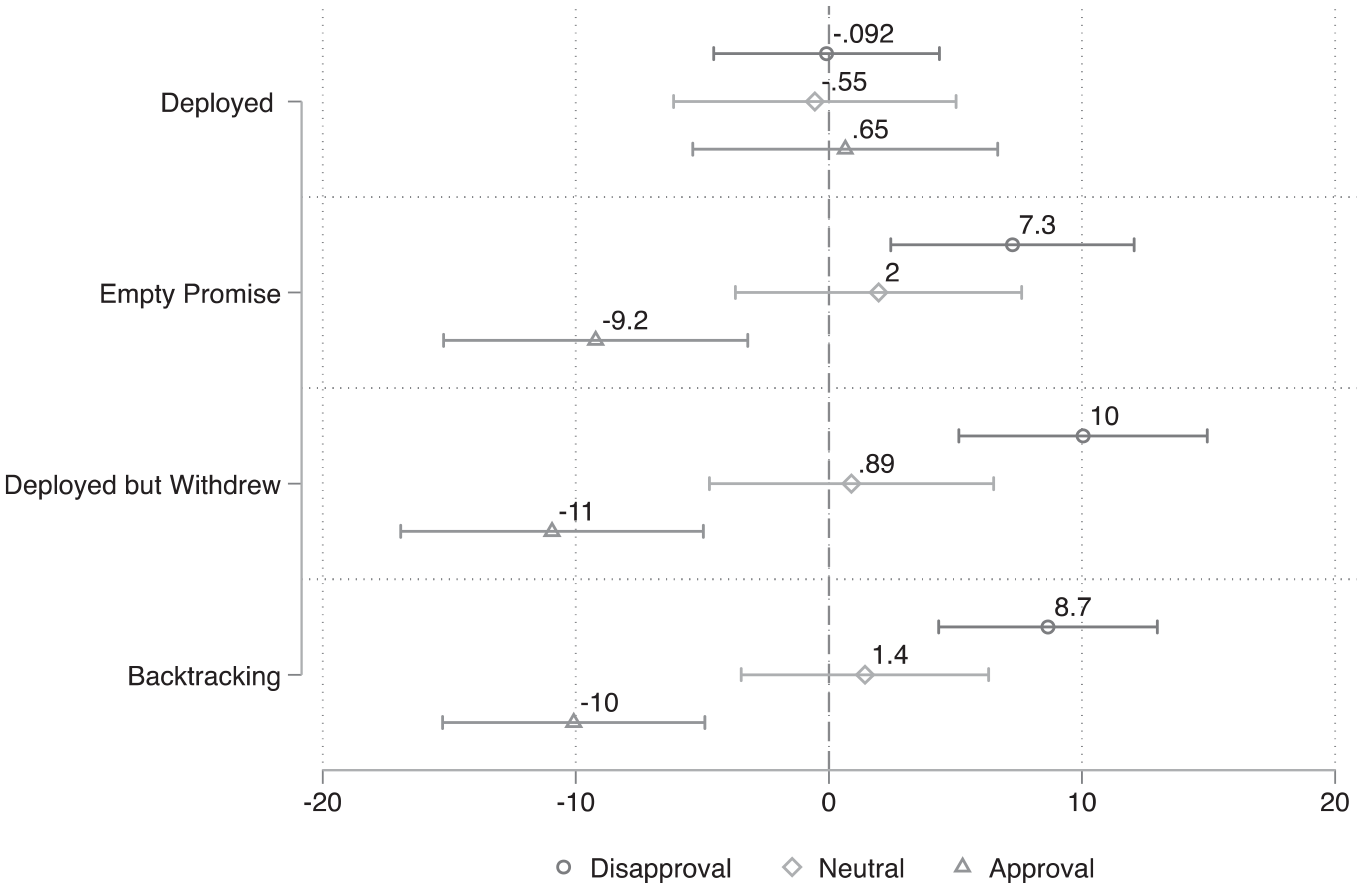
Autocratic audience costs in the UN peacekeeping experiment.
Why do citizens view empty threats and promises negatively? We explored this question in the third wave by asking respondents to further elaborate in an open-ended follow-up question on why they approved or disapproved of the government’s course of action. In total, 264 of the 1057 respondents who received the backing down scenarios strongly or somewhat disapproved of the government’s decision. Among them, we obtained 256 valid responses to the open-ended question, which can be grouped into four different categories. 11
The first group, which includes the majority of the disapprovers (158 out of 256, or 62%), singled out potential damage to China’s “international reputation and credibility” as the main reason why they disapproved of the government’s “inconsistent attitude” (前后态度不一) and “unfulfilled promise” (承诺没有兑现). One respondent wrote: “Honoring its commitment is an important reflection of a country’s national reputation. Broken promises not only undermine the credibility of the country but also cause harm to the national interest, which is very undesirable” (国家承诺是非常重要的国家信誉的体现,违背承诺不仅破坏了国家信誉,同时也给国家利益造成危害,十分不可取). Similarly, one respondent observed: “Since [China] decided to participate after weighing the pros and cons, it should stick to the end; otherwise it would hurt China’s national image” (既然在权衡利弊后决定参加,就应该坚持到底,否则影响中国国家形象). Another respondent shared the same concern: “A country should keep its commitments; backtracking or empty talks with no action will make one lose credibility in the world” (做为国家政府应当信守承诺,出尔反尔或光说不做会失信于天下). These responses echo those found in the United States (Tomz, 2007). That the majority of disapprovers in both countries are concerned with the reputational cost of saying one thing and doing another suggests that the same micro-mechanism may apply in democracies as well as autocracies.
The next group of respondents (49 out of 256, or 19%) provided a more instrumental reason for disapproving of the government’s decision, stating that “the failure of the peacekeeping operation would hurt China’s security and economic interests” (维和运动失败会伤害到中国的安全和经济利益). Not surprisingly, many of these respondents were primed with the scenario involving high stakes for China. The third group (31 out of 256, or 12%) included people who thought China should have participated in the peacekeeping operation because it was the right thing to do. One respondent wrote: “China is a permanent member of the United Nations Security Council; thus, it is obligated to assist the UN in maintaining world peace by sending peacekeepers to the UN operation” (中国是联合国的常驻理事国,理应协助联合国维护世界和平,派遣维和人员参与行动). Another wrote: “Being a responsible great power, [China] should take on relevant tasks and assume responsibilities in international humanitarian rescue” (作为负责的大国,理应承担相关任务,承担国际人道救援责任). Notably, the instrumental and normative considerations accounted for 28 and 58% of the reasons for disapproval in the control scenario, suggesting they are less likely to be the main reasons for audience costs.
In the residual group, some respondents disliked China participating in the operations in the first place, noting that China “hasn’t addressed many of its own internal problems” (中国自己内部都还有很多问题没有解决). One respondent summed up this sentiment quite passionately: “China is facing crises everywhere: Diaoyu Island, South China Sea, Sino-Indian border disputes, corruption, unemployment, economic decline, pollution, education, patient–doctor conflict, to name a few. The government hasn’t solved any of these, and yet it is meddling in other countries’ affairs!” (自己国家到处都危机,钩鱼岛、南海、中印边境等,国内官员腐败、失业、经济下滑、污染、教育、医患矛盾等,自已没搞好管别人闲事!). A few respondents criticized the government for “underestimating the potential risks in a failed peacekeeping operation” (对维和失败的风险预估不足). The remainder did not articulate a clear reason for disapproving.
Overall, the responses to the open-ended questions are consistent with the reputation-based theory of audience costs (Guisinger and Smith, 2002; Tomz, 2007). In fact, this is a common concern for most Chinese citizens. At the end of the experiment, we asked every respondent: “How do you view national reputation in international relations? Do you think that countries need to honor their commitments?” (您怎么看待国际关系中的国家信誉问题?国家需要遵守做出的诺言吗?) The large majority of the respondents (1573 out of 2017, or 78%) said that national reputation is very important, and countries (including China) must honor their commitments. One respondent elaborated: “Honesty is the foundation of a country. National reputation is part of a country’s soft power. Countries with good reputation can be trusted and accepted by other countries; otherwise, they will be looked down upon” (诚信是立国治本。国家信誉是国家软实力的一部分,信誉好在跟别国打交道的时候才能被信任,才能更好的被其他国家接受。国家必须遵守诺言,否则会被别人轻视、看不起). About 17% of the respondents subscribed to a more instrumental view, saying that whether or not a country should honor its commitment “depends on the particular situation” (具体情况具体分析). One respondent remarked: “[The concern for] national reputation does not mean that one needs to commit to its words unconditionally. The key is whether or not it is in the interest of the country. For those countries that fail to honor their commitments, we can respond in kind, a tooth for a tooth” (国家信誉不能简单承诺,关键还是看是否对自己国家有利,对于那些出尔反尔的就可以相应的以牙还牙). The rest of the respondents (5%) believed that “national interest trumps everything else” (国家利益至上), and countries should not be bound by their words, because “there are no permanent friends, only permanent interests” (没有永远的朋友,只有永远的利益). As one respondent observed: “National reputation is built on military and economic power. International relations is more of a game between countries. Commitments are meaningless to powerful countries. The United States is still powerful, even after breaking its commitments” (国家信誉是建立在军事和经济实力上的,国际关系更多的是国与国之间的博弈。诺言对于强国没有意义,美国不遵守承诺却依然强势).
Do audience costs matter in autocracies?
The findings thus far confirm that audience costs do exist in China, and citizens often exercise it out of concern for potential damage to China’s international reputation. Of course, autocratic audience costs may not matter in foreign policy making unless they satisfy two additional conditions: first, autocratic leaders pay attention to and are constrained by audience costs; second, citizens will act in some way to convey their disapproval to their leaders. We investigate the second condition first. In wave 1, we posed a follow-up question to those respondents who disapproved of how the Chinese government handled the hypothetical crisis: “How would you express your disapproval?” The answers included four choices: “do nothing (什么也不做),” “post comments online (上网发帖),” “forward relevant posts online (上网转发相关帖子),” and “other (其他)”; if choosing “other,” they were asked to elaborate.
Over half (52.3%) of the respondents said they would forward relevant posts online. Another 22.6% of the respondents preferred to post comments themselves. Three respondents provided more detailed answers, which included “discuss with colleagues (和同事聊聊),” “discuss with friends (和朋友讨论),” and “general exchange (平时交流,只做一般性谈起).” On the other hand, less than a quarter (23.9%) chose not to do anything. Even though the features of our sample—younger, better educated than average, and urban netizens—may create a bias toward these results, the fact that a substantial majority of those who disapproved of the government’s bluffing chose not to remain silent suggests that citizens are willing and able to express their disapproval.
It is possible that the response choices for these closed-ended questions were too limited and discouraged disclosure of respondents’ true opinions. Hence, in wave 3, we asked all of the respondents to elaborate on what they would do if they were dissatisfied with the government’s foreign policies. The 2063 responses can be roughly divided into six categories. Figure 4 lists some of the representative quotes, and Figure 5 shows the distribution. The majority of the respondents (40%) lamented that there was “nothing [they] could do” because “opinions from ordinary [citizens] don’t mean anything.” About 15% of the respondents were firm supporters of the government’s foreign policies even if they “seemed relatively weak.” Many of them also expressed their “love for the country.” Neither of these views is surprising, as they fit the conventional inclination of Chinese public opinion toward supporting government policies. Nevertheless, the remainder of the responses revealed a multitude of channels for disgruntled citizens to express their disapproval. In addition to “venting to friends and coworkers” and “complaining on social media”—the two options we provided in wave 1—some respondents (11%) said that they would complain directly to the government through “media and official government websites” and the National People’s Congress. A few of the respondents (2%) even mentioned “protest” as an option. Notably, respondents who disapproved of the government’s decision in the peacekeeping scenario were more likely to take action.
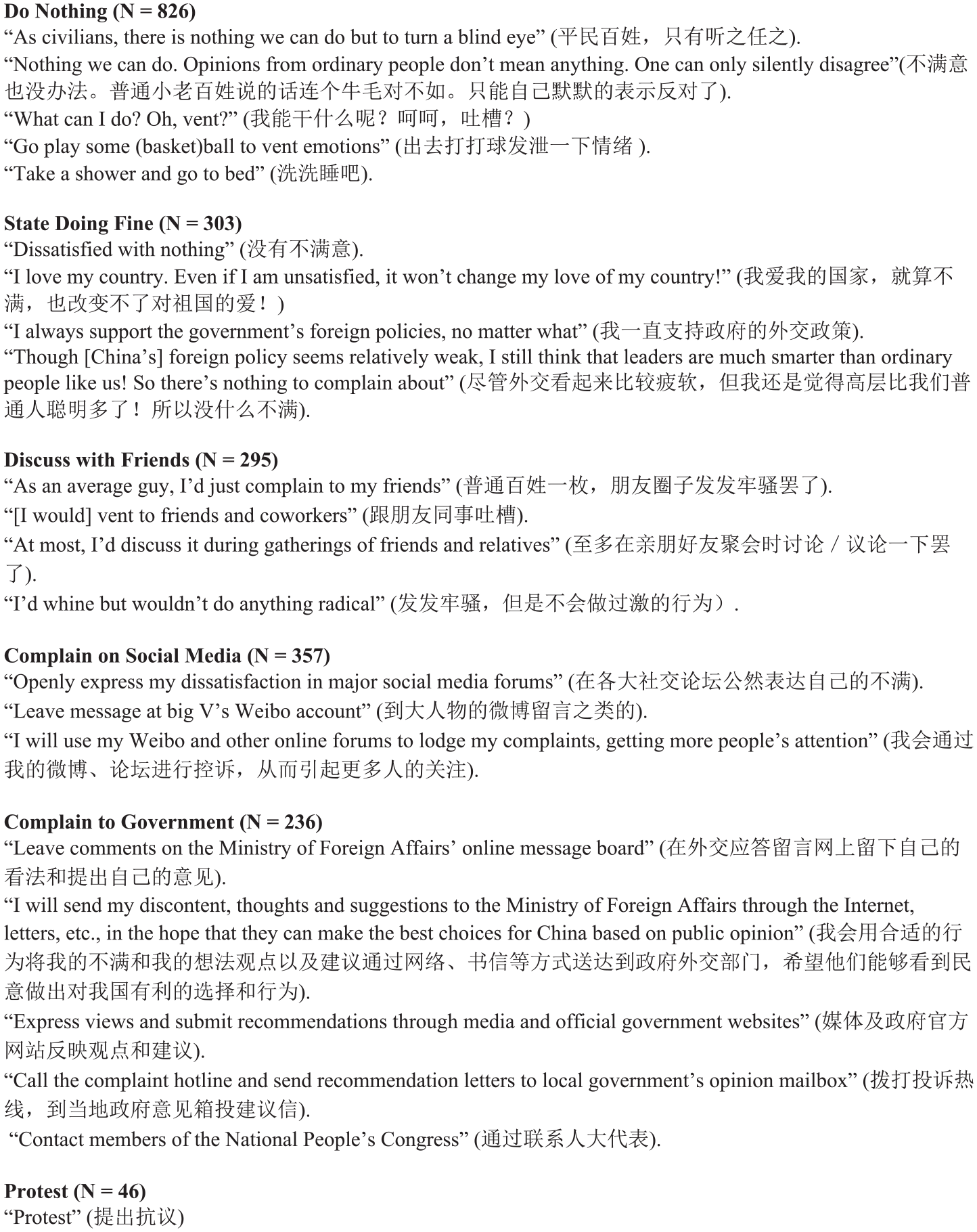
Actions following dissatisfaction with government’s foreign policy.
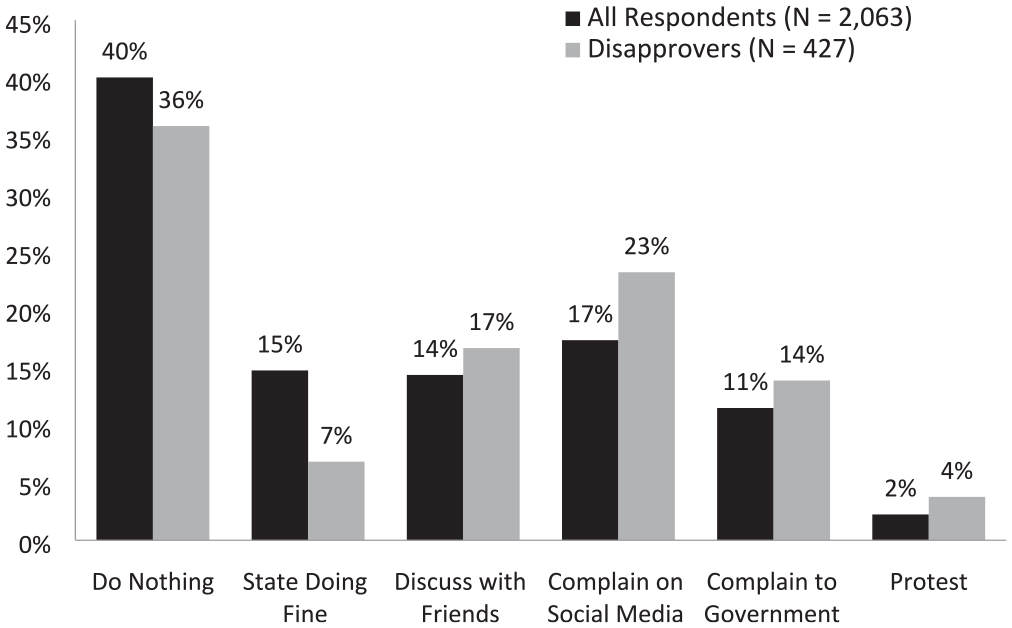
What to do if dissatisfied with government’s foreign policies.
The results from the closed and open-ended questions suggest that Chinese citizens do take advantage of the legitimate channels to make their voices heard. Of particular interest is the finding about social media, which has become an important avenue for public discourse and is actively monitored by the Chinese government. 12 Thus, we have reason to suspect that audience costs could very well factor into leaders’ decision-making calculus even in the absence of popular election. Moreover, given the nature of the authoritarian regime in China, the government has more reasons to worry about the potential consequences of online disapproval because that response could eventually lead to street protest and social instability, which the government is constantly trying to prevent. 13 One can even argue that the Chinese government is more vulnerable to online public opinion than democratic governments are to approval ratings. This is because the leaders in authoritarian regimes may face more dire consequences if they are overthrown by popular protests, whereas leaders in democratic regimes do not need to worry about their personal safety (Debs and Goemans, 2010). The recent upsurge in Internet policing is a telltale indication of such fears (Xu, 2014).
Finally, we turn to the first condition about the constraining effect of public opinion in autocracies. Notwithstanding the rise of social media, Chinese leaders may not worry too much about what the general public is thinking, owing to the lack of electoral accountability; instead, they may pay more attention to the views of members in the selectorate—“the set of people whose endowments include the qualities or characteristics institutionally required to choose the government’s leadership” (Bueno de Mesquita et al., 2003: 42). In China, Communist Party leaders are chosen by an elite selectorate consisting of “the members of the Central Committee, the revolutionary elders, and top military leaders—fewer than five hundred people in all” (Shirk 1993: 10). While it is infeasible to survey these people for their opinions, we can examine responses from those who more closely resemble this elite group than the general public; if this group is equally or even more likely to express disapproval than the general public, we can have more confidence that leaders would respond to public opinion. To do so, we divide our wave 3 sample into four groups: CCP member only, college graduate only, CCP member and college graduate, and neither. We then look at how each group responded to the open-ended question on what they would do if unhappy with the government’s foreign policy.
The results are shown in Table 1, which reveals some interesting patterns. First, about 40% of the respondents among the general public and CCP members without college degrees said they would act in some way to express their disapproval. Their choices of action, however, differed sharply. While social media was the preferred channel for the general public, the majority of less-educated CCP members chose protest, although the small sample size (28 willing to take actions) makes it difficult for us to draw any meaningful inferences. Second, of college graduates who are not CCP members (the largest group out of the four), 45% were willing to take action. These are also the most likely users of social media. Finally, for CCP members with college degrees—the group most similar to members of the selectorate—the percentage of respondents willing to act is the highest: half of this group said they would express their disapproval, the majority choosing official channels. Given the small sample size of this group, we take this as suggestive evidence that audience costs can matter in China.
Conclusion
Previous research using survey experiments to empirically assess the presence and effects of audience costs has almost exclusively focused on democracies. While recent studies have suggested that audience costs could exist in authoritarian regimes as well, scholars have yet to offer direct empirical evidence to support such claims. Joining a few notable exceptions recently, this study takes a step toward such an endeavor by directly testing the presence of audience costs in authoritarian regimes, thus filling an important gap in the audience cost literature. Moreover, this study also explores the mechanisms through which the public in authoritarian regimes might punish their leaders caught bluffing.
There are three central findings to be taken away from our analysis. First, we have found that audience costs do exist in China, as citizens would disapprove if the government failed to honor a public commitment, and the magnitude of the effect is comparable with findings in the United States. These results also confirm recent empirical works that demonstrate that Chinese leaders can face public opinion costs akin to audience costs in democracies (Bell and Quek, 2018; Quek and Johnston, 2018; Weiss and Dafoe 2019).
Second, we have determined that audience costs are primarily invoked by citizens out of concern for potential damage to China’s international reputation, which is consistent with the reputation-based theory of audience costs. Finally, we have identified potential mechanisms through which Chinese citizens may punish their leaders for backing out of public commitments. The majority of our respondents who disapproved of the way the government handled the hypothetical crisis are able and willing to let their voices be heard through both formal and informal channels. This in turn may constrain the Chinese government’s maneuvering room in crisis bargaining, although this mechanism of punishment might not be as powerful as the election mechanism in democracies.
This study has important implications for policy makers as well. Our results show that the display and use of armed force exposed the government to lower audience costs than verbal threats, suggesting that the Chinese public seems to reward the government for flexing its military muscle more than blame it for not following through on its commitments. This suggests that slow criticism from Chinese citizens may embolden the Chinese government to take more assertive, even aggressive, positions in the early periods of an international crisis, thereby increasing the level of tension and likelihood of conflict. 14
While our findings provide direct support for some important micro-foundations that underpin the theory of autocratic audience costs, there are many unresolved questions. For example, our experimental study has identified mechanisms through which citizens might be able to punish leaders, but we do not know how leaders actually perceive this information and how they would react to it. In other words, we need more evidence to show that in their decision-making processes, authoritarian leaders (and democratic ones) pay serious attention to how the domestic public reacts to their foreign policies. These are challenging questions that demand future research through carefully designed case studies combined with quantitative and experimental analyses.
Research Data
replication – for Public opinion, international reputation, and audience costs in an authoritarian regime
replication for Public opinion, international reputation, and audience costs in an authoritarian regime by Xiaojun Li and Dingding Chen in Conflict Management and Peace Science
Supplemental Material
Online_Appendix – Supplemental material for Public opinion, international reputation, and audience costs in an authoritarian regime
Supplemental material, Online_Appendix for Public opinion, international reputation, and audience costs in an authoritarian regime by Xiaojun Li and Dingding Chen in Conflict Management and Peace Science
Footnotes
Acknowledgements
We wish to thank Jonathan Chu, Songying Fang, Robert Gulotty, Alastair Iain Johnston, Masaru Kohno, Brett Ashley Leeds, Robert Pape, Kai Quek, Rachel Vanderhill, Jessica Chen Weiss, seminar participants at University of Chicago Beijing Center and Shanghai Jiaotong University for feedback on earlier drafts of the paper. We also wish to thank the anonymous reviewers and the editor of CMPS for helpful comments.
Funding
The authors received no financial support for the research, authorship, and/or publication of this article.

Supplemental material
Notes
References
Supplementary Material
Please find the following supplemental material available below.
For Open Access articles published under a Creative Commons License, all supplemental material carries the same license as the article it is associated with.
For non-Open Access articles published, all supplemental material carries a non-exclusive license, and permission requests for re-use of supplemental material or any part of supplemental material shall be sent directly to the copyright owner as specified in the copyright notice associated with the article.
