



Abstract
How do civic groups judge what issues are appropriate for public discourse? And how do they know what kinds of arguments to use where? Cultural sociologists identify varying “orders of worth,” that is, historically defined systems of typification and evaluation people draw on to evaluate public arguments. Yet it remains unclear how these take form in ongoing group practices. This article theorizes how groups’ ongoing interaction patterns, or “style,” typify social scenes to steer members toward distinct orders of worth in varying situations. As I argue, different typifications of public and private scenes condition the type of arguments members deem appropriate for public discourse, with meaningful implications for their politics. Combining style and orders of worth allows us to ask how ostensibly similar groups may publicly define different political goals and value varying forms of civic engagement. I illustrate this theoretical framework with an ethnographic study of two culturally distinct groups of libertarians in the United States.
How do civic groups judge what issues are appropriate for public discourse? And how do they know what kinds of arguments to use in their public talk? By combining two different approaches to this question, this article offers a systematic framework for theorizing how civic groups “typify” 1 (Berger and Luckman 1967) their varying social scenes. Specifically, the proposed framework formulates how groups ascribe different scenes to different “types” by making varying judgments about what counts as a good member and what forms of speech are appropriate and by orienting members toward varying shared conceptions of what makes good participation in public life. To do this, I draw on Boltanski and Thévenot’s (1991) concept of orders of worth, which represents historically based models for classifying and evaluating people and their actions according to distinct conceptions of the common good. This approach has been extremely influential, for good reason. But it has a gap. It does not theorize the ongoing processes by which people in varied civic collectivities cue each other on which order of worth is appropriate to invoke in a given situation. This makes it difficult to explain how people who share political beliefs can invoke different orders of worth when arguing their beliefs or how they learn to switch from one order of worth to another even when speaking and acting within the same collectivity (Lichterman 2021).
As I argue, to bridge this gap, the orders of worth approach needs to be complemented by another approach, focused on the ongoing relationships between participants in a collectivity over time. Although any given society presents actors with multiple orders of worth, I argue that groups’ patterns of interaction developed over time, or style (Eliasoph and Lichterman 2003), work as a road map, helping members navigate their cultural environment and guiding them toward orders that fellow members deem appropriate in varying social scenes. Specifically, group style guides members on which orders of worth are appropriate for their group’s public discourse and which should be relegated to private settings. By establishing different ways to typify varying social scenes, style guides people on how and when to switch from one order of worth to another, even within the same organization. This way, different group styles orient members toward varied shared understandings of the common good, forming distinct shared standards of evaluating people and actions in different social scenes.
In other words, I theorize how style relates directly to orders of worth, guiding actors’ choices as they draw on and adopt different orders in diverse situations. Or, in short, how they form varying “situational orders.” Understanding how groups adopt different orders in varying social settings allows us to consider how different common goods, actions, and actors are valued in various social contexts and how the same people may raise different arguments in different situations. Situational orders thus represent the varying moral contexts in which people tie their arguments not simply to what they want but also to some shared sense of what is right in specific social circumstances.
Furthermore, I argue that these relations between style and orders of worth have important implications for groups’ politics. First, by guiding members toward the orders of worth that are appropriate for their public discourse, style limits the type of arguments that can be made in a group’s public settings, thereby shaping the type of issues, conflicts, or needs that can become a legitimate subject for public deliberation and decision-making. In other words, style conditions what can and cannot be politicized (Eliasoph and Lichterman 2010; Levitsky 2014). Second, by defining groups’ public standards of evaluation, this mechanism shapes what actions are publicly valued and with that, which actors are publicly appreciated. And third, by orienting the group’s public discourse toward certain common goods, this mechanism shapes how members publicly define their common goals.
Both style and orders of worth explore how people typify social situations and classify actors; however, these two approaches differ in a key way that is central to this article. They have different starting points, so they each focus on different moments in the same process. Orders start with a typology of historically defined systems of classification and evaluation that reappear in different contexts across society. Style starts with the ongoing process that groups develop to classify and evaluate situations and people through their routine interactions. Each approach theorizes a different step in this process of “typification”: the moment of argument for a certain public good for orders of worth and the ongoing dynamics of relationships between members for style.
Theorizing the relations between these two steps presents at least two analytic advantages. First, understanding the role of style can help us see how varying groups offer different road maps for navigating the same cultural environment and how groups in varying cultural environments may offer similar road maps and accordingly, develop a similar public discourse. Second and relatedly, by connecting style to historically defined models of the common good, the “situational orders” approach brings to light how groups’ patterns of interaction relate to deeper moral conceptions of what is good and just. This approach can help us understand how the same group may come to value different common goods in varying social contexts and how certain goods rather than others end up governing the group’s public discourse.
In what follows, I first unpack the main theoretical concepts guiding this article, style and orders of worth, to explain their distinct approaches to questions of typification. Next, after reviewing some past efforts to theorize the instantiation of orders of worth in specific organizations, I present a new theoretical framework for how the two concepts work together to establish varied situational orders in different civic groups. Finally, to illustrate the working of this framework, I draw on my fieldwork with two civic groups of American libertarian activists. I show how despite their similar ideological convictions, the groups’ distinct styles typified public and private scenes differently. Accordingly, members of each group drew on different orders of worth in their respective public settings, with meaningful implications for their public discourse and relations to politics.
Style: Interaction Patterns, Scene Typification, and Democratic Imagination
Students of civic society are increasingly paying attention to the patterned ways members of civic groups interact, focusing on how civic actors coordinate action and how different forms of coordination shape political attitudes and behaviors (Blee 2012; Fine 2023; Lichterman 2021; Lichterman and Eliasoph 2014). This approach allows scholars to examine the ongoing patterns of interaction through which people develop shared assumptions of what constitutes adequate behavior in any given group’s settings. Through their varying interaction patterns, civic groups develop distinct styles (Eliasoph and Lichterman 2003) that reflect members’ shared understanding of their mutual obligations and group boundaries and of what constitutes appropriate speech in varying social contexts. 2 Style, therefore, filters, interprets, and instantiates variously available cultural elements to typify (Berger and Luckman 1967) different social scenes and to help participants better answer the unspoken questions of “What is it that’s going on here?” and “How do I act in accordance?” (Goffman 1974; Lichterman and Eliasoph 2014). 3
Style is meaningful for shaping civic groups’ relations to politics. For example, it shapes how members develop varying activist identities, envisaging different political tactics as appropriate (Binder and Wood 2013). Style also influences civic groups’ trajectories by shaping how members evaluate success (Luhtakallio 2019) and their understanding of the social problems they seek to address (Blee 2012). Groups’ interaction patterns also distinguish between symbolic categories that are legitimate or illegitimate for public discussion, thereby limiting the types of claims members can make publicly (Lichterman and Dasgupta 2020).
In this way, group styles facilitate different “democratic imaginations” (Perrin 2006) in civic groups, shaping members’ understanding of what is appropriate for public debate, what solutions are possible, and what action can be taken to advance such solutions (Eliasoph and Cefaï 2020; Eliasoph and Lichterman 2010; Patsias, Hermann, and Patsias 2019). As past studies have shown, groups often develop varying democratic imaginations based on different images of the role of civil society and the political tactics they deem appropriate for “groups like them” (Braunstein 2017). For example, civil groups may vary in whether they imagine the civic sphere as a collection of self-interested individuals or as a shared arena for working together toward the common good. Similarly, groups differ in whether they view social problems as mere practical challenges that require ad hoc solutions or as deeper issues of structural power differences. Each image of the social world has its own focus and blind spots, thereby inviting different forms of civic engagement and limiting others (Baiocchi et al. 2014).
As these studies show, people’s democratic imaginations are shaped within certain social contexts, inspired by prominent stories and symbols in their environment. These explanations emphasize how individuals’ images of the civic sphere are shaped by their social location, personal trajectories, and experience with politics. And they describe civic groups’ routine ways of acting and interacting as the product of their members’ shared imaginations.
But moreover, as some of these works emphasize, once established, these routines gain a power of their own to shape the way people draw on and invoke their imagination. Indeed, routine interactions have their own structure and rules that organize action and meaning in orderly and recognizable ways, allowing participants to anticipate others’ behavior and act with relative confidence (Fine 2021; Goffman 1967; Rawls 1987). As I argue, as groups develop unique interaction patterns, these patterns guide members on how, when, and where to draw on their rich and sometimes disparate images of the social world. Focusing on group style can thus help us explain why the same people may attempt to invoke different visions of the social world in different contexts and why these attempts do not always succeed. It can also explain how local group process may lead people with varying visions to subscribe to the same form of civic engagement.
Orders of Worth: Classification, Evaluation, and Common Goods
Systems of typification are the bedrock of the cognitive processes of social interaction. Because social interaction requires an agreement on common terms and identifications (e.g., of the situation, the activity), coordination of shared practices requires classifying things into agreed-upon categories (Berger and Luckman 1967; Boltanski and Thévenot 1991). Similarly, to evaluate a thing (an action, an object, a person), we must first ascribe it to one or more categories and then consider whether and how these categories fit into one or more hierarchies (Lamont 2012). Hence, as groups develop shared operations of classification, they also develop shared operations of value attribution.
The classification of things into agreed categories is integral to the existence of social order and to communities’ ability to share a “moral code” (Durkheim 1915; Lamont and Molnár 2002; Wuthnow 1987). Agreement on how to pass judgments implies agreement over certain symbolic distinctions that allow people to classify behaviors, objects, events, and even themselves into categories that make sense within a cohesive system of meaning. In this way, classification creates internal and external hierarchies. For example, the classification of certain habits, lifestyles, and expressions as “civilized” or “distinguished” and others as “barbaric” or “vulgar” marks certain groups as legitimate or illegitimate, thereby justifying unequal access to resources (Bourdieu 1984; Elias 1937). Hence, classifying and categorizing are contentious operations in which groups wrestle over the meaning of their shared social world and the power relations it produces.
Importantly, our everyday operations of classification and judgment do not emerge spontaneously but are conditioned by the availability of broad cultural resources (Lamont 1992). As comparative research demonstrates, varying cultural environments present actors with different classification systems they can draw from when trying to evaluate the world, leading people to develop different arguments when discussing topics such as racism (Lamont and Aksartova 2002), civic engagement (Camus-Vigué 2000), or environmental conflicts (Thévenot, Moody, and Lafaye 2000).
In their seminal work, On Justification, Boltanski and Thévenot (1991) offer a partial taxonomy of historical classification systems that people use to evaluate and justify their actions. These systems tie people’s classifications to certain evaluation criteria and common goods they can appeal to when justifying their actions to others. These criteria also imply shared standards for what is considered proper and relevant evidence to validate one’s judgment. In this way, groups establish varying orders of worth, ranking and valuing members and actions based on their relation to the group’s common good.
For example, people are evaluated differently whether they are classified as market competitors or members of a civic collective. Market actors are evaluated based on their acquired wealth and their contribution to the free exchange of desired goods. Members of a civic collective, on the other hand, are evaluated based on their commitment to the law and their contribution to the orderly execution of the “general will” (see Boltanski and Thévenot 1991:43–61, 107–17). Similarly, scholars of institutional logic (Friedland and Alford 1991) have shown how varying institutional fields invite actors to refer to different “elemental categories” (Thornton, Occasio, and Lounsbury 2012:54) when typifying their actions and imbuing them with meaning and value. Thus, actors are classified and valued differently as members of a nuclear family than as members of a religious congregation, a bureaucratic state, a capitalist market, and so on (Thornton et al. 2012:42–44). Different social contexts subject people to different classifications and accordingly, different standards for assessing their relative worth.
As comparative studies have shown, varying classifications of actors have meaningful implications for how people make political arguments and their preferred form of civic engagement (see Lamont and Aksartova 2002; Moody and Thévenot 2000). For example, civic groups that adopt orders of worth in which members are valued for their ability to create new collaborations or to experience personal spiritual growth also tend to avoid political conflicts and curb expressions of ideological tenacity (Eliasoph 2013; Shachar et al. 2018). However, rather than excluding themselves from public engagement, studies of political disavowal show how such tendencies often reflect a preference for nonconfrontational modes of participation in public life, allowing members to address public problems while dissociating themselves from the ambiguities and contradictions of the existing political system (Bennett et al. 2013; Eliasoph 1998).
Different orders of worth thus offer different standards for evaluating actions, making political arguments, and carrying out civic engagement. As I argue next, by acknowledging the role of style, we can explain how groups adopt different orders of worth in varying social settings, thereby guiding members on which arguments and evaluations are appropriate for their public discourse and which are not.
Setting the (Public) Scene: Establishing Situational Orders
Any cultural environment presents actors with a given set of orders of worth. But people still enjoy a level of agency to reinterpret, manipulate, or contest dominant categories and practices. This way, actors can transform and even reinvent the prevailing orders in their social environment (Friedland and Alford 1991; Thornton et al. 2012). Organizations and groups are “inhabited” by agents who negotiate the constraints of institutional symbols and practices in creative ways through their everyday interactions (Binder 2007; Hallett and Ventresca 2006). Thus, agents strategically draw on available orders to influence group decisions, justify activities, or advocate for change (McPherson and Sauder 2013). Actors may combine compatible elements from different orders or try to compartmentalize them, following different orders in different contexts (Pache and Santos 2013). Indeed, orders of worth rarely appear in their “pure” form, and many organizations hold multiple orders at the same time, blending or aligning them in various ways (Battilana and Dorado 2010; Boltanski and Thévenot 1991; Eliasoph, Lo, and Glaser 2019; Skelcher and Smith 2015; Tavory, Prelat, and Ronen 2022).
Several studies have theorized the way different factors shape how individuals negotiate the relations between available orders. These studies suggest people’s past experiences may increase their commitment to certain orders, and their interpersonal relationships with other group members may motivate them to find creative ways to make their preferred orders work together with others’ (Besharov and Smith 2014; Pache and Santos 2013). Similar orders may thus materialize differently in different contexts, according to the everyday practices and relationships in which they are instantiated (Smets, Aristidou, and Whittington 2017).
As these studies show, local practices and shared understandings are a product of specific external structural conditions and actors’ creative and strategic use of available cultural resources. In other words, of structure and agency. Yet actors’ choices are always made within local circumstances. And these circumstances can shape how people understand the choices available to them and even their preferences and goals (Joas 1996; Whitford 2002). 4 Thus, as Braunstein (2017) showed, members’ perceptions of which actions are appropriate for their group are not predetermined but established through ongoing group negotiations, including selective reference to historical figures and events. In the process, members develop a shared understanding of who they are and how their work relates to broader historical projects that render it meaningful. Similarly, Lichterman and Dasgupta (2020) illustrate how local interaction patterns constrain and enable actors’ choices as they strategically draw on their available cultural environment to make political claims. As they show, varying scene styles can privilege certain claims while “sidelining” others, shaping how participants frame their demands, critiques, and statements in relation to public debates. 5
Here, I seek to advance this theoretical project. I offer a systemic framework theorizing how style relates directly to systems of classification and orders of worth, guiding actors’ choices as they draw on available orders in their cultural environment.
To understand the relationship between style and orders of worth, we should first reexamine how style guides members to typify varying social scenes in different ways. As groups develop shared interaction patterns, they also develop varied understandings of “what is going on” in different social settings. Members learn to distinguish between, for example, casual social gatherings, shared religious ceremonies, and political meetings and thereby come to expect and perform different behaviors in distinct scenes. In particular, different types of scenes involve different understandings of the nature of communality between members (a group of friends, a community that shares religious affiliations, a group working together toward a shared political goal) and accordingly, what makes one a “good member” (Eliasoph and Lichterman 2003). Thus, different scenes define mutual obligations between group members that correspond with distinct ways of classifying members as subjects (a friend, a church member, a political activist, etc.).
As style guides group members on how to typify different scenes, it also guides them on how they should evaluate each other in different social contexts. A good friend is evaluated differently than a good church member or a good activist. In this way, style acts as a road map, helping group members navigate their cultural environment by guiding them on which orders of worth are appropriate to invoke in varying social settings.
This relationship between style and orders of worth is particularly meaningful for groups’ public discourse because groups often typify their private and public scenes differently. Actors commonly assign certain norms of behavior, forms of speech, and even topics of conversation to public scenes, where they see themselves as representing the public face of the group and believe their self-presentation requires adherence to certain formal standards. In contrast to such “frontstage” settings, private (or “backstage”) settings allow actors to be more relaxed and drop such performance standards, giving room for other behaviors, speech norms, and topics (Goffman 1959; Scott 1990). In this way, members learn to distinguish between categories and norms that are appropriate for public discussions and those that are best kept for private conversations (Eliasoph 1998; Lichterman and Dasgupta 2020).
Thus, as groups typify public and private scenes differently, members learn to distinguish between orders of worth that are appropriate to invoke in public versus private settings. Actions and members highly valued in private settings may be valued poorly in public conversations and vice versa. Evidence presented in one setting may be deemed irrelevant in others. Accordingly, arguments and issues that cannot be supported with relevant evidence may be deemed inappropriate for public discussion, thereby limiting groups’ public discourse in meaningful ways.
Moreover, members and their actions are forever evaluated according to their contribution to some shared good. As groups invoke certain orders of worth in public settings, they also invoke distinct public definitions of the common good that members are expected to advance. The typification of public scenes thus orients members toward a certain public conception of their goals and certain standards for evaluating each other’s contribution.
The working of this theoretical framework is formalized in Figure 1. Cultural environment presents actors with many orders of worth from which they can draw. Because style typifies varying social scenes, it guides members on which orders of worth are appropriate to draw on in which social settings. Particularly, it guides them on which orders are appropriate for the group’s public settings and which orders should be relegated to more private settings. In this way, the group’s public discourse becomes oriented toward a certain common good, a public conception of the shared goal that members are expected to advance. Correspondingly, the typification of public scenes defines what constitutes a “good member” in these settings, subjecting members and their actions to particular evaluation standards.
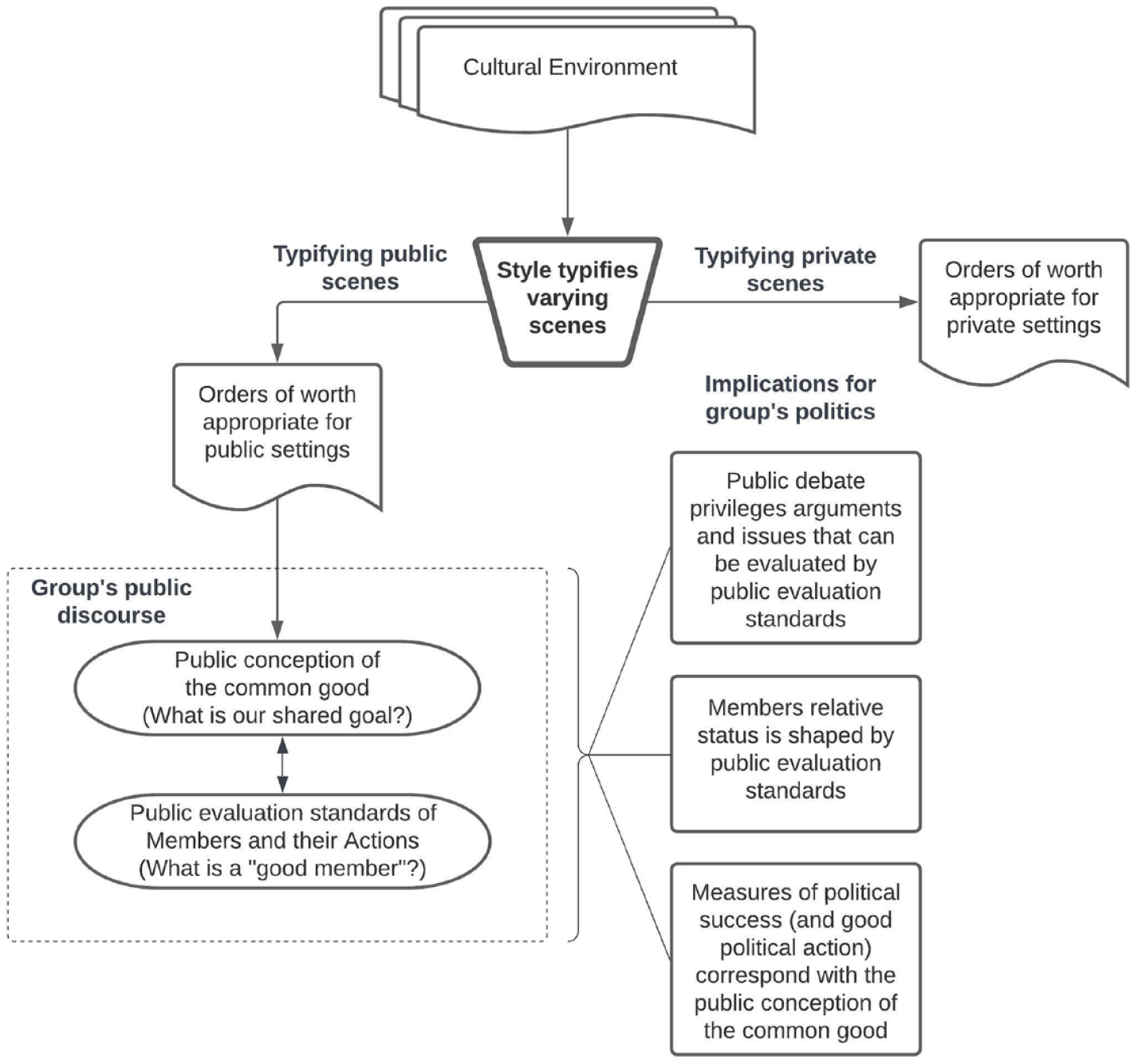
The situational orders framework.
This mechanism has at least three implications for a group’s relations to politics: First, it constrains and enables the types of arguments and issues that can be properly assessed in public discussions. Arguments that do not correspond with the public evaluation standards are more likely to be deemed inappropriate or irrelevant in public debate. Second, it shapes how members are publicly evaluated and thus meaningfully affects their relative status in the group. And third, by orienting public discourse toward certain conceptions of the common good, this mechanism shapes how members publicly define their prospects of political success and accordingly, the type of political action they value for promoting it.
Cases and Methods
To illustrate this analytic framework, I draw on an ethnographic study of two groups of libertarian activists in the United States with two distinct styles of interaction. First, the Free State Project (FSP) is a political migration movement looking to create a libertarian community in New Hampshire. Second is a coalition of libertarian activists in the Los Angeles (LA) area, congregating around events and social gatherings associated with the Libertarian Party (LP) and other local libertarian-leaning institutes.
As I show, although both groups advocated for similar political ideas, their distinct interaction styles led members in each group to typify their prospective public scenes differently. Accordingly, members in each group invoked different orders of worth in public settings, evaluating each other differently and developing different conceptions of their common good. This mechanism shaped each group’s public discourse in a very different way.
My study of the FSP consisted of four years of participant observation, from winter 2016 to fall 2019, during which I visited and lived with the community frequently for two- to six-week periods. During my visits, I rented a room in neighborhoods near where many community members lived and joined them daily in regular social gatherings or specially organized events. I joined the group’s political events, attended their annual camping festivals, hung out with members at community “clubhouses” and other social events, and met them for lunches and drinks both individually and in groups. In total, I conducted over 600 hours of participant observation, producing over 800 pages of field notes and 36 hours of audio-recorded conversations.
During the same time, between my New Hampshire visits, I also regularly attended various social and political meetings of the Southern California libertarians, taking part in three LP regional monthly meetings and the gatherings of several social clubs and attending online video meetings of the Libertarian Party of Los Angeles County (LPLAC) Executive Committee. I also joined members in their political events, training, planning meetings for political campaigns, and other civic actions and social events. In total, I conducted over 300 hours of participant observation, producing over 400 pages of field notes and 27 hours of audio-recorded conversations.
At both sites, I presented myself as a sociologist interested in how libertarians organize politically, documenting members’ interactions by jotting notes in the field and expanding them to full field notes later. When meetings were recorded by participants and made publicly available, I relied on these recordings to supplement my written field notes, mostly to draw more expansive and accurate quotes. I focused on how members made arguments in public and private settings and on the different elements of the groups’ interaction styles. 6 I particularly paid attention to how people defined what constitutes good membership in the group, what they said about their commonalities, and how they described their common goals. I also focused on how members defined appropriate and inappropriate behavior in various group settings.
Coding was done in an iterative process, developing working hypotheses about the relationships between interaction patterns and political arguments and then returning to the field to reexamine the hypotheses in light of new observations (Glaser and Strauss 1967). All field notes, transcriptions, and recordings were uploaded to NVivo12 software and were coded in a two-cycle process, starting with topic coding (Saldaña 2013), noting each passage’s subject matter. I then focused on passages where people made arguments or justified their behavior and coded them line by line to identify patterned differences and similarities between the arguments people used in each field site. Drawing on the literature (Boltanski and Chiapello 2005; Boltanski and Thévenot 1991; Thornton et al. 2012), I coded each statement according to its best fit to various recognized orders of worth (see the Methodological Appendix for more details). 7
Through this process, it became apparent that members in each group tended to make different arguments, drawing on different orders of worth in different social settings, particularly as they moved between private and public scenes. Given the ideological affinity between the groups, the differences in their public argumentation were illuminating, and their relations to the groups’ style differences 8 were gradually clarified and refined throughout the analytic process. My findings illustrate how varying styles conditioned members to appreciate different orders of worth as appropriate in varying scenes and how this related to their diverse understandings of their political goals and accordingly, their evaluations of one another.
From Typification to Expectations: How Style Conditions Distinct Evaluation Standards in Varying Social Settings
A group’s style typifies its varying social scenes differently. Through their ongoing interactions, members develop some shared understanding of how they should relate to one another in varying situations. Accordingly, members develop different expectations of one another in diverse social settings (Eliasoph and Lichterman 2003) and are subject to distinct evaluation standards based on different orders of worth. In the FSP, that meant members typified their private scenes in various ways and thus classified and evaluated each other in diverse ways in private meetings, yet their public scenes were consistently typified as “community events.” Accordingly, in public settings, members were consistently evaluated based on how a “good community member” is expected to behave. These patterns had meaningful implications for the types of arguments members made in public and correspondingly, their political discourse.
These dynamics were clearly illustrated in the summer of 2016, as the FSP became immersed in a debate over the value of several of its members. These members, who were colloquially called “Keeniacs” due to their concentration around Keene, a college town in the south of the state, became notorious for their civil disobedience and other abrasive activism tactics that upset the locals. The debate erupted after one prominent Keeniac, a daily radio talk-show host named Ron Moyer, 9 used his show to discuss recent news regarding a New Hampshire state representative the FBI had accused of soliciting sex from a minor. Ron argued on air against “age of consent” laws, claiming that mental capacity to consent to sexual activity varies across individuals and that the state should not intervene in any consensual activities, sexual or other. Many Free Staters were upset by this argument, and some called for the group to dissociate itself from Ron and his friends.
In a private meeting of the FSP board, which oversees organizing some of the group’s public events, board members debated banning Ron from any FSP events until further notice. The discussion was intense. Some members argued that the decision to ban people for their views, no matter how provocative, contravenes basic libertarian principles. However, theirs was the minority position, and the ban proposal was carried. In a private conversation, Sam, the FSP chair, explained the board’s decision as an attempt to protect the FSP “brand”: If I get 20,000 people to move here, and they are branded—fairly or unfairly, accurately or inaccurately—as pedophiles or pedophile sympathizers, then what’s the point? We’re never going to get anything done, right? We’ll never hold office; we will never be able to start a business; we will never, you know, it will be over before it begins.
This strategic argument was central to the board’s decision. During the meeting, a board member who owned a public relations company warned that should the FSP not sever its relationship with Ron and his radio show, they could expect a “PR disaster.” Conversely, board members objecting to the ban argued that sacrificing the movement’s commitment to free speech for strategic reasons would defy its very purpose. “We are not here for public relations,” one insisted, “we are here for principles.”
However, these arguments were hardly heard outside private settings. The debate between principles and strategic calculations remained mostly confined to backstage, private discussions and closed-door meetings. In those scenes, members raised various arguments, drawing on diverse orders of worth with different classifications of members. For example, arguments about members’ prospects of starting a business relied on their classification as businesspeople, while those about their ability to get elected or to express their voice (“free speech”) corresponded with their classification as democratic actors. However, on the frontstage, when speaking in public, Free Staters invoked a more limited array of arguments, framing the debate in very specific terms.
In a community gathering during the FSP’s annual “Porcupine Festival,” some members raised the issue of Ron’s ban and the overall tension with the Keeniacs. Alan, a community veteran and a former FSP chair, responded that the Keeniacs’ activism tactics were not his “favorite.” People, he explained, tend not to listen to people they do not like; therefore, he tries to project an image showing that not all libertarians are bad, so people will be more likely to listen to them. Another longtime Free Stater pitched in, adding that people just need to find a few things they agree on, which is enough to create a dialogue and, indeed, friendships. What is important, he said, is to be a good neighbor in one’s community. People see you are a good neighbor, he explained, and then later, when they realize you are also a Free Stater, they learn Free Staters can be nice.
With that, the public discussion about the Keeniacs and Ron concluded. Rather than talking about the PR or occupational risks of associating with Ron and his show, the Free Staters in the gathering chose to talk about proper and improper behavior for a community member. Proper behavior for them meant being a good neighbor and making friends. By being abrasive and clashing with the locals, they suggested, Keeniacs were not helping the FSP’s political cause of reaching out and building bridges to people outside the movement. The common goal here was not branding the FSP or making sure Free Staters could start businesses and get elected, as Sam, the FSP’s chair, had suggested in private, but to reach out to nonlibertarians and warm them up to the cause; and the way to do so is to be a good neighbor and a valued member in your community.
This language of being a good community member was not exclusive to Ron’s and the Keeniacs’ detractors. It was also shared by his defenders. On the sixth day of the festival, the Free Staters held their annual speechmaking competition, and two speakers took the opportunity to argue against Ron’s ban. Banning Ron for expressing controversial opinions, they argued, went against the openness and inclusiveness the community represents. As one speaker argued: Ban who you want! Ban somebody because they’re an asshole. Controversial opinions? Come on! I don’t agree with Ron Moyer on everything, so what? This is a place where we welcome everyone. . . . People have told me that I have a loyalty bias. Yeah, I consider Ron a friend and a powerful ally, so you damn right I have a loyalty bias. That means I give him the benefit of the doubt automatically. Because he’s earned it, year after year. Through my personal interactions with him, he’s proved the nature of his character, so I’m not gonna question that. . . . Ron has supported every project I’ve ever been involved in, and I think everyone here can say the same thing.
The speaker described Ron’s radio show as “the most powerful liberty-advancing tool ever invented” and told the crowd how even after he was banned, Ron provided equipment for other radio shows that wanted to broadcast from the festival.
The two speakers obviously disagreed with Alan and his lot over Ron’s value in the group. Whereas Alan argued that Ron and his colleagues’ actions were stifling efforts to reach out to new people, Ron’s advocates described his radio show as a powerful tool for spreading the message of liberty to the public. And while Ron’s denouncers saw his behavior as unneighborly and discourteous, his supporters insisted Ron was a model community member and a good friend who had proven his selflessness and willingness to place the good of the community above his own ego. However, despite their disagreements about the character of the man himself, both sides agreed on the values that should guide the group when assessing Ron and his position in it. Much like the veterans who denounced Ron for failing to act as a good neighbor and make friends in his town, his defenders protested his ousting by citing his virtues as a friend and the community’s commitment to tolerance and outreach.
In this public debate, both parties shared a common style of interaction. Seeing the FSP primarily as a community, both parties typified the group’s public scenes as community events and evaluated members based on the obligations expected of good community members: being a good neighbor, helping your fellows, and maintaining these commitments even in the face of ideological disagreement. This shared understanding of what constitutes appropriate behavior in public situations had important implications for how members related to people outside the group as well. For the Free Staters, these qualities were important because they were tied to the group’s prospects for political success and their ability to build a wide and cohesive community that could reach out to nonlibertarians and bring them into the cause.
Thus, Free Staters’ interaction style defined a shared public conception of the group’s common good and shared evaluation standards that corresponded with the community order of worth (Thornton et al. 2012). Other considerations, such as the group’s “branding” or its public relations, did not completely escape Free Staters’ attention. Rather, the typification of their public scenes as community events deemed arguments about these goods—taken from other orders of worth—unfit (or irrelevant) for public discussion. Free Staters may have acknowledged that such considerations help advance their political goals, but they left discussions of these issues to backstage, private settings. Figure 2 summarizes this process in terms of the situational orders framework.
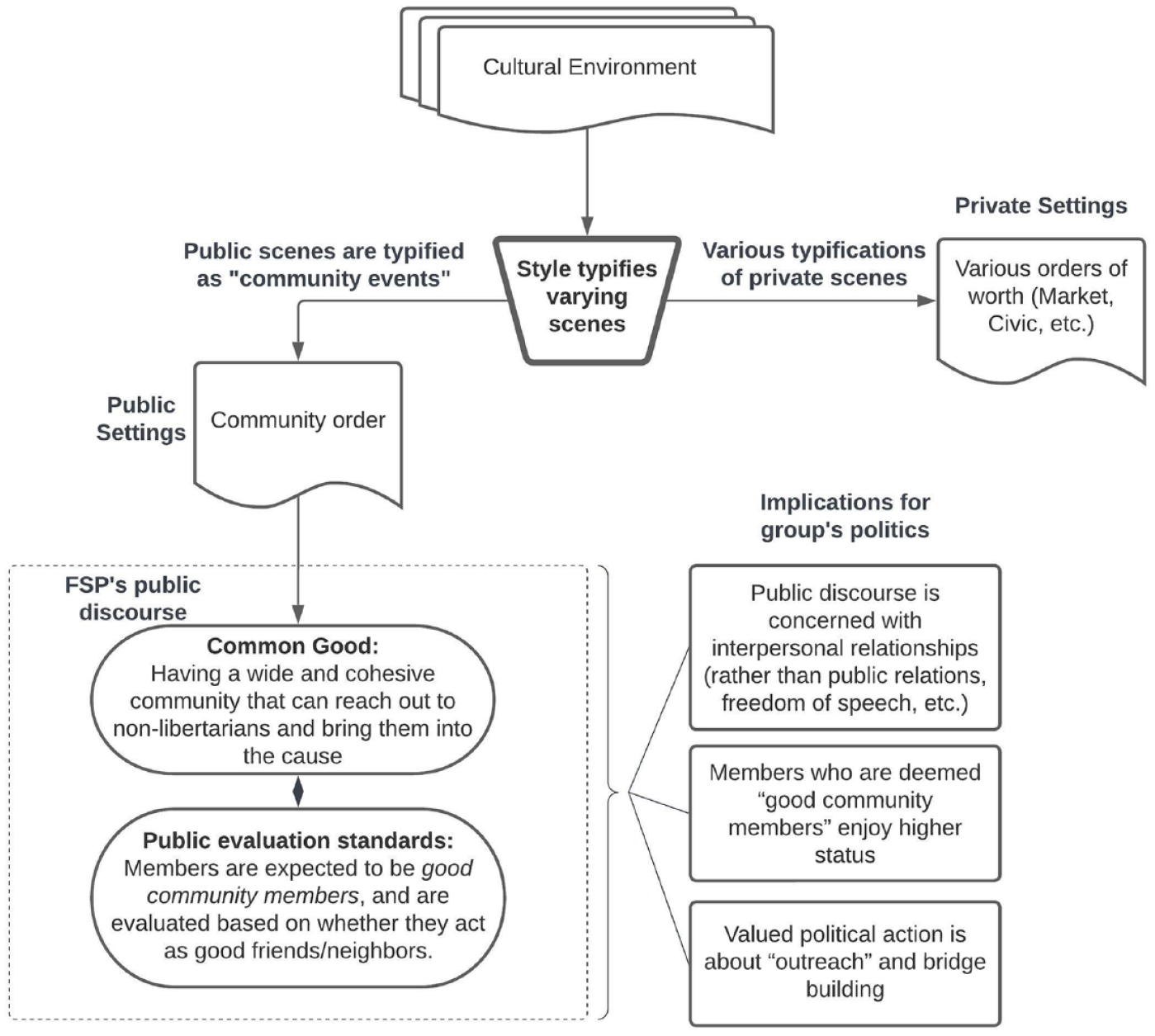
Situational orders in the Free State Project.
Style is thus central in shaping how groups publicly evaluate their members and their actions. As I show next, this mechanism has important implications for groups’ politics. Particularly, it shapes the type of arguments members can make in public settings, their relative status in the group, and how they value different forms of civic engagement. These implications are best revealed in times of conflict, when members divide over which cultural models should dominate their public sphere and which should be relegated to private settings.
“This isn’t a Social Club”: Style Establishes Situational Orders
Because different evaluation standards rely on different evidence, individuals may benefit unevenly from the dominance of different orders of worth. People draw on available orders strategically to advance their interests and status (Binder 2007; McPherson and Sauder 2013); however, their ability to do so is constrained and enabled by their group’s established interactional patterns. As group style deems different orders appropriate in different settings, attempts to invoke an order outside its appropriate setting will likely encounter challenges or even sanctions from other members. In such conflicts, as members divide over how to properly evaluate each other, they effectively divide over the proper way to typify a social scene and the kind of mutual obligations such typification entails. That is, they differ over what it means to be a good member in those settings. These differences are meaningful for groups’ politics because when groups engage in such struggles over the typification of their public scenes, they effectively struggle over the type of arguments that can be reasonably considered in public debates. The outcomes of these struggles condition the types of grievances members can bring up in public discussions and the type of qualities and actions that count when assessing their value in the group.
Such a typification struggle unfolded in the LA libertarian group when several activists, hereafter referred to as “Allies,” clashed with other regular attendees of the LPLAC Executive Committee’s business meeting. At the root of the conflict was each side’s distinct perception of the obligations among the meeting participants and correspondingly, of the standards for evaluating members and their actions.
The struggle between these two factions became tangible in early 2019, as the LA group clashed over a decision by the LPLAC chair, Rachel, to ban an Ally, an activist named Luke Graham, from party meetings. Rachel’s justification for the ban was Luke’s disruption of party meetings, but new arguments emerged during the debate, illustrating the dynamics of the group’s struggle over which order of worth should govern its public discourse.
Much like the Free Staters, the Allies understood the obligations between the meetings’ participants in terms of personal relationships. They commonly referred to politics as “the art of making friends,” and they often evaluated members based on their tendency to help others in their political projects. Like the Free Staters, they commonly advocated for group inclusivity and public mitigation of personal conflicts. Hence, they saw banning their friend as both an offense against their personal loyalties and a violation of the group’s moral commitments. In party meetings, several Allies argued that the decision to ban anybody goes against the group’s inclusive values and maintaining good relationships among its members. One Ally insisted that “this is the Party of everybody” and pleaded with the group to “put down our swords and start welcoming people in.” Bans, he argued, cause rifts in the party, and rifts invite rebellion. He asked members to “not [be] afraid to talk to somebody you consider an enemy” and called on the chair to use the meetings to allow people to air grievances and mitigate interpersonal disputes. “We can bring each other in,” he promised the group, adding: “There’s nothing we can’t get through together.” For the Allies, LAPLAC members were, above all, friends, and they saw the breakdown of group solidarity and commitment to inclusivity as the greatest threat to the group and its success.
However, for other LPLAC members, such arguments were beside the point. The ban, they insisted, was necessary for removing a “very disruptive member” who prevented the group from conducting orderly and productive meetings. The notion of welcoming everybody, they claimed, overlooked the need to remove individuals whose presence sabotaged the group’s order and productivity. Speakers pointed to the party’s bylaws and Robert’s Rules of Order, arguing that individuals who refused to adhere to them inhibited the meetings’ productivity and prevented the group from getting anything done. The problem, as one member explained, is that “there is one specific crew . . . who values their own clique . . . above the Party and above the cause.”
Whereas the Allies spoke in terms of group solidarity and cohesion, the other LPLAC members restricted the discussion to terms of formal party procedures. In their view, participants came together as “party members,” not friends, and should be evaluated as such. Accordingly, the evidence they used to assess each other’s worth related to the expectation of a good party member—adherence to the party’s formal code of conduct and contribution to its overall productivity. For them, valuing personal relationships over the group’s general cause contravened the common good that party members were expected to advance.
The conflict over how to properly evaluate members was, in essence, about how to properly classify them and their obligations to each other. Whereas the Allies imagined a valued member as one who helps others and can overcome personal differences (a “good friend”), the others envisaged a valued member as one who follows the party’s formal codes and does not place personal relationships before the collective cause (a “good party member”). In other words, the Allies, like the Free Staters, appeared to draw on the community order of worth, whereas the rest of the group drew on evaluation standards and classifications that corresponded with the civic and industrial orders of worth (Boltanski and Thévenot 1991). The two factions’ claims came from distinct orders of worth and as a result, could not be equivocated and measured against one another. Unlike the Free Staters, who presented contrasting evidence for and against Ron’s value as a community member, the two factions of LPLAC presented evidence of entirely different kinds that supported two different concepts of good membership. Each side’s arguments relied on different evaluation standards and as a result, could not be compared and assessed on the same scale.
This problem is hardly unique. Often, when two orders of worth clash, actors find it difficult to convince one another or reach an agreement. Such disagreements can only be settled once one party convinces or coerces the other to accept its order of worth or if all parties agree on a third model that somehow combines the evaluation criteria of the two clashing orders (Boltanski and Thévenot 1991). It is here, in determining the relationship between different available orders, that style plays a key role.
This role was clearly illustrated when Rachel, LPLAC’s chair, responded to a motion made by an Ally, calling on the party to formally acknowledge its commitment to welcoming all Central Committee members to business and party meetings: I’m just gonna say that, if anyone gets out of order, as the Chair, I have the right to remove them. It’s in Robert’s. It’s “Protection from Annoyance by Nonmembers in a Meeting.” So you can make this motion and we can vote on it. It’s my opinion as Chair that it’s gonna be essentially meaningless. Because we have the right for [reads from Robert’s Rules]: “protection from annoyance by nonmembers in a meeting, and removal of an offender from the hall: Any person who attempts to disrupt the proceedings in a manner obviously hostile to the announced purpose of the meeting can be treated as a nonmember under the provisions of this paragraph.” That will happen again if you guys pass this motion and someone disrupts the meetings. We care about the Party and moving forward, not petty squabbles. This isn’t a social club. We have 10 very successful social clubs all over. People are welcome to attend them. So keep that in mind.
By insisting that party meetings are not a “social club,” Rachel rejected this plausible typification of the social scene and with it, the Allies’ classification of members as “friends.” As opposed to friends, she asserted, the arguments that party members find meaningful are “about the Party and moving forward.” Any arguments about personal grievances and conflicts (“petty squabbles”) or appeals for inclusivity belong to a different kind of social setting. In the setting of LPLAC’s public business meetings, such arguments are simply irrelevant and “essentially meaningless.”
Other members quickly followed suit, criticizing the Allies for placing their interpersonal loyalties over the good of the party and arguing that the discussion should revolve around the violation of LPLAC’s rules of conduct. Eventually, the Allies found themselves in the minority, and their motion failed. The group insisted on typifying the public meetings as strictly a “party meeting” and rejected the Allies’ alternative typification of the scene. Interpersonal relationships and friendship were deemed inappropriate criteria for assessing members in the group’s public settings, and such arguments were dismissed.
Notably, Rachel did not find interpersonal matters unimportant. Often, when members raised personal grievances during party meetings, Rachel tried to meet with them privately to resolve the matter. She even organized some of the group’s social events to bolster cohesion and camaraderie. Similarly, when their appeals for group solidarity faltered, some Allies changed tactics and accused the chair of being guided by her personal biases against Luke Graham rather than by the party’s formal rules of conduct. Both the Allies and the other LPLAC members knew and acknowledged the validity of various orders of worth and could draw on them when they saw fit. Their differences were about which order fit which setting.
Different styles thus offer different interpretations of how and when it is proper to invoke similar orders of worth. Whereas Free Staters interpreted the community order as appropriate for public discourse, the LA libertarians interpreted it as unfit for public discussions. Rather than community events, public meetings in LA were typified as “party meetings.” Participants in those meetings understood their obligations as those between party members, and they evaluated each other accordingly. Similarly, rather than promoting solidarity and cohesion, LA libertarians described their common good in these public settings in terms of maintaining an efficient and productive party organization that could carry out collective decisions. Therefore, public discourse in LA was governed by the civic and industrial orders. Accordingly, questions of solidarity and friendship, which belonged to the community order, were relegated to private settings, where social scenes were typified as “social events.” Figure 3 summarizes this process.
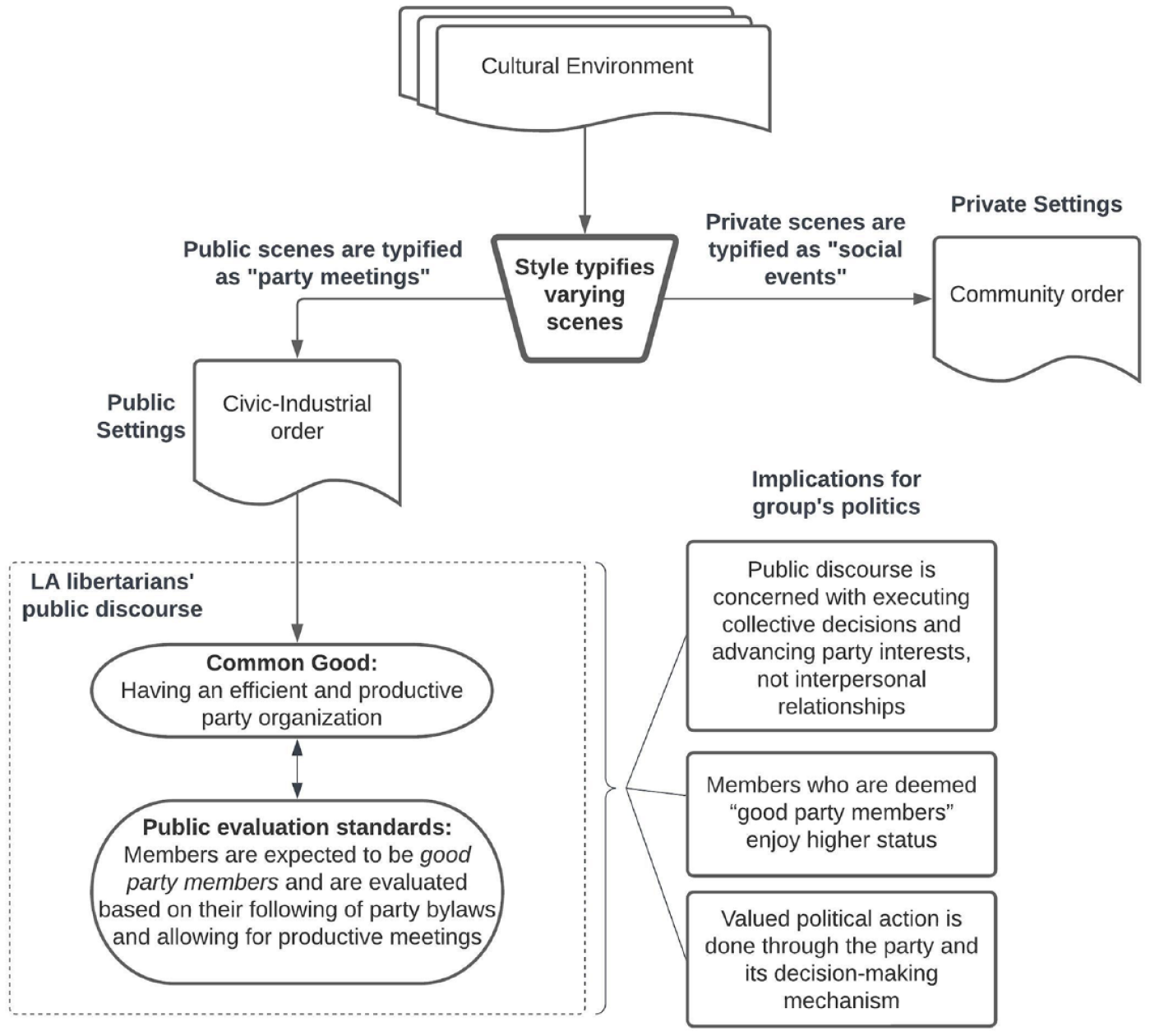
Situational orders in the Los Angeles libertarian group.
Contrasting the LA libertarians with the FSP helps reveal how style differences are meaningful for the politics of each group. First, finding different orders of worth appropriate for public discourse meant different issues could become a matter of public debate in each group. Whereas Free Staters could engage in a lively public debate about the merits of interpersonal relations and group solidarity, in LA, such issues were deemed irrelevant and inappropriate for public discourse. In LA, questions of solidarity lay outside the realm of public discussion and collective decision-making and as a result, could not be politicized.
Second, their adoption of different orders meant members in each group were valued differently for similar qualities and actions. Whereas in the FSP, Ron Moyer’s qualities as a friend and community member were debated as the group discussed his status and future in it, Luke Graham’s similar record could not count in his favor in the LA group. The groups’ different styles meant that in their public discourse, different qualities were deemed important for determining members’ relative status.
Finally, these differences in evaluation standards directly corresponded with the different ways each group publicly presented its prospects of political success. In the FSP, political success was presented as a product of facilitating interpersonal relationships with nonlibertarians and assuaging their concerns about the ideology and its advocates. Conversely, in LA, political success was presented as a product of an effective party organization. For each group, political success was discussed as resulting from different forms of civic engagement. And in each group, this understanding of political success corresponded with how members were classified and how their actions were evaluated in public. The groups’ different styles conditioned members to draw differently on available orders of worth in their cultural environments, orienting them toward different conceptions of the common good with different standards for appreciating what should be considered good behavior and good participation in public life.
Conclusion
As previous studies have shown, people’s cultural environments, organizational settings, and personal histories shape how they draw on and utilize available cultural frameworks. Yet culture is forever utilized within group contexts (Fine 2021). Groups’ established interaction patterns, or style, provide the settings in which culture “jells” (Lichterman and Dasgupta 2020) and takes form in concrete tasks, claims, and arguments. As I showed, this is particularly important for how people distinguish between proper and improper ways to evaluate people and actions and how they make arguments in various social situations. By typifying their varying social scenes, style creates the meaningful context in which members find it appropriate to invoke certain orders of worth while making others seem out of place.
As the empirical sections of this article illustrate, this mechanism has meaningful implications for groups’ politics. First, as the case of the FSP shows, different typifications of social scenes distinguish between arguments and evaluations groups find appropriate in public and private settings. Whereas Free Staters drew on various orders and made diverse arguments in their private social scenes, their public discourse was predominantly governed by the community order of worth. Seeing their group primarily as a community, Free Staters typified their public scenes as “community events,” and they classified and evaluated each other as community members accordingly.
Second, as the case of the LA libertarians shows, established typification patterns can constrain a group’s public discourse by limiting the type of arguments members can make in public scenes. Unlike the Free Staters, LA libertarians typified their public scenes as party meetings and thus drew on the civic and industrial orders of worth to classify and evaluate each other as party members. Accordingly, when some members tried to invoke a different order, their arguments were deemed inappropriate, and their evaluations were denied. In both cases, the dominance of certain orders of worth in the groups’ public scenes oriented members toward certain common goods, shaping how each group publicly presented its prospects of political success and thus valued different forms of civic engagement.
In this way, style establishes what I describe as situational orders, common orientations among actors toward certain orders of worth that direct their standards of evaluation and judgment in different social scenes. These situational orders are the moral context in which actors not only find political arguments appropriate but also connect them to their sense of what is good and just in specific social circumstances. Understanding how style guides members on interpreting, combining, and navigating orders of worth across social scenes allows us to consider how different goods may gain salience in different social contexts and how the same actors may make different arguments or even different judgments in different circumstances.
This framework also focuses our attention on the situational aspect of people’s democratic imagination. People may have different visions of the social world, and those visions are invoked differently in varying situations. The situational orders framework allows us to consider how civic groups’ discourse about who they are and what actions are appropriate for “groups like them” represents a “working agreement” among members, which can vary across social contexts and over time.
The situational orders framework thus helps explain how style shapes civic groups’ political culture. But style is not a static variable. Indeed, groups’ patterns of interaction are shaped by external and internal variables and are continually subject to change. Previous studies show how group founders’ shared vision often continues to inspire participants and can meaningfully direct their interaction style (Baiocchi et al. 2014). But certain events or decisions during a group’s life can cause members to change their political vision and adopt new interaction patterns, shaping their trajectories in meaningful and often unforeseeable ways (Blee 2012). Further research into these processes could help us better understand how groups form and reform their style and how this may lead to new typifications and new situational orders. Such research could help reveal, for example, when challenges to the existing public orders of worth are more or less likely to succeed. We may also ask: What happens when members cannot agree on how their scenes are typified or when groups have more than one type of public scene? And how do different scenes, with their varying situational orders, relate to people’s more stable beliefs and sense of personal and collective identity?
As a group’s style evolves, we can expect new situational orders to emerge. And with that, new democratic imaginations may come into play. As members typify their public scenes in new ways, new arguments become appropriate for public discourse, and new forms of civic engagement are valued. In this sense, the situational orders framework offers a useful scope to analyze how groups adopt new ways of relating to the civic sphere, adopt new tactics, or even define new goals. Civic groups are living things. As time goes on, new people join, others leave, environments change, new events occur, people grow old, and group dynamics change. As symbolic interactionists like to point out, people are products of interactions. And it is through their interactions and shared commitment to common practices that people’s worldviews and interpretations become palpable. Patterns of interaction thus create the conditions in which personal agency and social structure take form. As this article showed, theorizing this process can help uncover how groups create the situational context where culture and politics become relevant in specific circumstances for specific people who do specific things together.
Methodological Appendix
Participants’ statements were coded based on their best fit to recognized orders of worth in the literature. Specifically, I relied on Boltanski and Thévenot (1991) and Boltanski and Chiapello (2005) for a typology of available orders of worth. However, during the process of coding, many statements did not fit nicely into any of the orders offered by this typology, so I relied on Thornton and et al.’s (2012) review of the “community institutional logic” to supplement this typology with what I termed the “community order of worth.” The following is a quick review of the orders mentioned in this article, with a few examples of coded participants’ statements that fit them.
Order of Worth: Market
Subjects are classified as businesspeople, salespersons, clients, independent workers, and so on. They are deemed worthy based on their ability to offer goods and services that others desire. The common good is the lively competition between these subjects that guarantees a variety of quality goods and services that satisfies a variety of needs.
Coded statements
Selling products to people who need them proves capitalism is benevolent.
In a free society, if you have a good product, you’ll succeed.
Black market barter is a form of activism.
We can promote liberty by offering different things to different people.
Schism in the community creates “more choices in the marketplace for activists.”
Order of Worth: Civic
Subjects are classified as collective persons and their representatives, parties, committees, party members, delegates, elected officials, and so on. Their common good is the objectification of the collective persons in such a way that can give them body and voice. Accordingly, members are valued for contributing to the formal processes that allow collectives to come together and make decisions. Good members thus adhere to certain rules and procedures that guarantee the proper working of such formal processes.
Coded statements
Disputes should be presented neutrally in the minutes of the meeting.
Disruptive members—who violate bylaws and Robert’s Rules—should be banned.
Party leadership has to remain neutral.
Worried the committee will not represent the membership after some members have been excluded.
Banning members is justified by the freedom of association.
Order of Worth: Industrial
Subjects are classified as professionals and valued based on their efficiency and productivity. The common good is thus the efficient execution of goals, whatever those may be.
Coded statements
Moving the meetings online allowed for a more productive discussion.
The decision to ban a member came after he became disruptive in meetings, making it hard to get things done.
Libertarians do a better job than the government (in cleaning a national park) because we are more meticulous.
We shouldn’t consider Jon’s motion. We already discussed it last month.
We care about moving forward.
Order of Worth: Community
Subjects are classified as friends, neighbors, people who share emotional connections and personal concerns, and so on. They are valued based on their ability to maintain amicable interpersonal relationships with others and their personal investment in the group’s well-being. The common good is unity and solidarity.
Coded statements
Maintaining group unity is valuable.
Party membership is like marriage—it’s about trust.
Keeniacs try people’s patience, risking the relationships between the community and regular people, as well as within the community.
A good member creates and contributes to the community—not just talks ideology.
Getting things done is easier when you bring many people together.
Footnotes
Acknowledgements
I thank Nina Eliasoph, Gary Alan Fine, Paul Lichterman, Kushan Dasgupta, and the participants of the 2021 ASA Panel on Pragmatist Theorizing in Sociology and the Ethnography of Public Life workshop at the University of Southern California for their helpful comments on earlier versions of this articles. Thanks also to the three anonymous reviewers for their comments and suggestions.
Funding
The author disclosed receipt of the following financial support for the research, authorship, and/or publication of this article: I am grateful to the Institute for Humane Studies for their support (Grant No. IHS016593).
