




Abstract
In 2017, an old satellite dish in Ghana was repurposed into a radio telescope. While highly celebrated in public, complications surrounding this conversion resulted in criticism in the African astronomy community. While ‘repurposing’ has been optimistically embraced in recent Science and Technology Studies literature, we challenge ‘repurposing’s’ seemingly natural alignment with the common good, defined here as the path towards technoscientific modernity in Ghana. Instituting a distinction between a project of ‘repurposing’ for capacity development and building a new radio observatory in South Africa for global science presupposes a difference between real ‘inspired’ science and technology that serves a ‘civic’ orientation. In postcolonial societies, we cannot speak of singular ‘orders of worth’, but inevitably multiple orientations towards technoscientific modernity and visions for the ‘common good’. We locate a converted radio telescope and its digital infrastructure within such contested visions through phases of materially inscribed ‘orders of worth’. Over time, successive ‘worths’ are materially inscribed Ghanaian ground station as a site for 1) global telecommunications, 2) capacity building, 3) satellite data transfer. We present the material politics at work between various stakeholders: astronomers, government, the private sector and residents living near the observatory.
Introduction
Social science thinking about space science has inadvertently tended to naturalize a distinction that is somewhat taken for granted in space science projects themselves—that is—how we attend to space science activities in the Global North and South. While stories about space innovation and progress tend to emerge from the Global North, the detritus of the space industry, experimental sites, launch sites and analog sites seems to emerge more naturally in the Global South, postcolonial and Indigenous, settler colonial sites. The former narrative tends to focus on those space science imaginaries offering an extraordinary new perspective on or off Earth, sometimes seeking recourse to notions such as vertical power, experiences of space flight, zero-gravity, or life on the International Space Shuttle (see, e.g. Helmriech, 2012; Parkhurst and Jeevendrampillai, 2020; Valentine et al., 2012). The latter tends to emphasize the political, material and infrastructural assemblages of off-Earth ambitions embedded in and contingent on Earthly politics and inequalities (see, e.g. Klinger, 2019; Mitchel, 2017; Parks, 2020; Redfield, 2000; Siddiqi, 2019).
Astronomy is both firmly embedded within this dialectic while also challenging it. Its value as a science, for example, is seemingly untouchable in the Global North—often seen as the purest of sciences—but when viewed from the equator, astronomy indeed carries the taint of coloniality. In postcolonial or settler colonial societies, astronomy may come across as extravagant, attract criticism and raise questions over its usurping of more tangible or moral concerns such as rural development (Chinigò and Walker, 2020) or indigenous cosmologies (Lehuedé, 2022; Parkington et al., 2019; Sammler and Lynch, 2021). We certainly agree that existential problems throw into relief space science’s expenditures. We abstain, however, from naturalizing the impulse to rectify this incongruity by aligning astronomy with development in resource-poor settings. Development, as is well-understood by now, is controversial as to whose imaginaries it gratifies, who benefits from it and how it is undertaken. Notions and practices that have plagued understandings of development apply in kind to ‘astronomy for development’.
Our case in point concerns the trope of ‘repurposing that was meant to encourage development through capacity building. The study unfolds around a troubled radio telescope repurposing project: the Ghana Radio Telescope Observatory (GRAO) in Nkuntunse at the outskirts of Accra, Ghana’s capital city. The newly renovated GRAO is built in the shell of redundant telecommunications infrastructure, an old satellite ground station (Gwynne 2012). It was the first of eight such unused dishes across Africa slotted for repurposing—sites whose member states signed agreements with the South African Radio Astronomy Observatory (SARAO). In a benevolent yet highly politicized gesture, SARAO would fund the repurposing of these satellite dishes that had fallen into disrepair. The receiving states would allow rusting old dishes to be repurposed for radio science training and skills transfer, with the promise, ultimately, of facilitating ‘real’ science through a project known as the African Very Long Baseline Interferometry Network (or AVN). 1 While funding the AVN, SARAO is (at the time of writing) building an entirely new radio observatory, the Square Kilometer Array (SKA) in the Karoo, South Africa. While the SKA has been set up as an instrument for the world of globalized astronomy, with its headquarters in Manchester, the AVN—casually called ‘the African project’—has been slotted as a development branch of the SKA, a project ‘for Africa’, where “repurposing” old dishes and trainings in radio science are aligned through development goals. However, as of 2023, given the number of complications with the Ghana observatory, no other sites will now be repurposed, and a new strategy of ‘colocation’ has taken over for the AVN member sites.
While entirely sympathetic with the ethics of ‘repurposing’, ‘maintenance’ and ‘repair’, the anti-capitalist ethos to counter the constant pull of innovation (Strebel et al., 2018; Jackson, 2014, etc.), we are concerned with the trope of ‘repurposing’ as a broad orientation for African engineering and development. Repurposing is a tempting characterization for science taking place in Africa, indexing the notion that things work differently—that the way technoscience plays out is part and parcel of ‘African’ modes of reasoning and politics that glorify ‘creativity’ or emphasize ‘precarity’ (Cassiman et al., 2022). Repurposing has been a focus of social approaches to technology that has been broadly applied to the Global South, subject to the same romanticizing tendencies of ‘bricolage’ (Levi-Strauss, 1966), or ‘tinkering’ (Mavhunga, 2017: 25). But this attribution hinges on a false dualism between so-called modern societies that are differentiated, and the rest of the world. People repurpose not because they are ‘bricoleurs’ (Levi-Strauss, 1966: 17), but because they may lack resources. SARAO gave Ghana a repurposing project, not a facility for conducting cutting-edge science.
Our case study illustrates that repurposing as a practice and a value is challenged by aspirations of high modernity and vertical imaginaries, even at the equator. Repurposing proved to be a disappointing approach for astrophysicists working at the GRAO aspiring to produce real science from it. Drawing on our ethnographic research at the observatory, a number of interviews with various involved actors, as well as literature and discourses surrounding the AVN, we elaborate on how the GRAO evolved, materially and discursively through various historical phases. Emphasizing the shifting but always aspirational politics, we detail how Ghana has sought to assert its participation at the forefront of technoscientific modernity through different material investments and commitments to industry and science and how those actors and stakeholders have reacted in turn, with respect to the evolving material politics of the site.
Our empirical material from interviews with scientists and engineers involved in the project and ethnographic observations from our site visits concerns the recent phase for the site, and the turn to radio astronomy. 2 Radio astronomy is a data-intensive science that mediates between our planet and the universe through digital processing tools for making the electromagnetic spectrum (EMS) legible. The EMS is arguably a common good (Calabrese, 2012; Nianias, 2018; Smith, 2001) which becomes controversial via its materialization into data needing to be stored and transferred. Radio astronomy’s intensive demands for fiberoptic cables, servers and bandwidth seem to compete with concerns more closely related to everyday needs: electricity, clean water, healthcare etc.—even for a modern state such as Ghana that has otherwise embraced the fourth industrial ‘digital’ revolution in telecommunications development. Thus, in Ghana, as with the seven other sites participating in the AVN, astronomy has been positioned to stimulate economic growth by introducing requisite skill-sets in mechanical and data engineering—those who would ‘tinker’ in this digital-infrastructure-poor environment.
In order to draw out the controversy surrounding Ghana’s Earth Station, we adopt the conceptual language from Boltanski and Thévenot’s (1999, 2006) pragmatic sociology of critique. These authors offer a ‘moral grammar’ through which criticisms, compromises and the material politics of outer space can be understood to participate in debates over ‘the common good’ without resorting to narrow tropes of individualized interests and values that dominate in social understandings of political philosophy. The conceptual language from this approach helps grasp the multiple and conflicting imaginaries for this telescope and the EMS it is meant to capture, within political, economic, and moral struggles to loosen the relentless grip of coloniality. Thus, in a vision inspired by astronomy capacity building through data infrastructure, high modernity is fashioned as access to knowledge through data-intensive radio astronomy. Our main protagonist, James Chibueze, illustrates this orientation, that of an ‘inspired’ astrophysicist who balances his aspirations of groundbreaking science with the ‘civic’ orientation of the repurposing project. In a notion of ‘industrial’ development promoted with respect to the telecommunications sector, modernity means connectivity and access to the internet and mobile phone networks, thus competing with radio astronomy science since electromagnetic activity may interfere with the detection of faint signals and compete over similar bandwidths (depending on the type of science being done). Economic modernity in this setting, further means self-interested profit and wealth for the private international investors who channel EMS data through Ghana in the rhetoric of ‘market’ stimulation.
Therefore, our research on the Ghana Earth Station, contributes to debates on postcolonial space science knowledges and infrastructures not by pointing to a relativist ‘African’ space-age through ‘repurposing, but to argue for the plurality of worths, the inevitable multiplicity of interests and orientations that accompany aspirations for technoscientific modernity. We shall delink the project from benevolent humanitarian and development goals as the singular politics motivating this project—what is called ‘civic worth’ in Boltanski and Thévenot’s (2006) terms. And instead we will demonstrate the GRAO’s multiple alignments emerging from historical and economic forms of worth that encircle the project. While these orders of worth are materially inscribed, they become salient when actors issue critiques, and feelings of injustice towards notions of the common good are expressed. These criticisms complicate the notion that astronomy in this site can be reduced to a ‘civic’ orientation—that is—its funding, its actors and activities are to be separate from ‘real’ science producing sites, where truly ‘inspired’ science can take place.
Following the Introduction, this article is structured in five sections and a Conclusion. In section ‘Inspiring astronomy on the African continent’, we offer an ethnographic vignette to illustrate our empirical observation of the challenges that James Chibueze, our ‘inspired’ astrophysicist, faced in heading up the repurposing project. In section ‘Debating the Repurposing of Space Science Infrastructure’, we present our conceptual orientation of ‘orders of worth’ and the pragmatic sociology of critique developed by Boltanski and Thévenot (2006). Sections ‘‘Industrializing Ghana through Telecommunications’, ‘Developing Ghana through Civic Astronomy’ and ‘Privatizing the Spectrum’’ chronologically detail the competing orders of worth that we saw in section ‘Debating the Repurposing of Space Science Infrastructure’. Section ‘Industrializing Ghana through Telecommunications’ describes the telescope’s emergence during a first ‘industrial’ phase through its operation as a ground-based satellite Earth Station in conjunction with the global development of International Telecommunications Satellite Organization (INTELSAT) in the 1980s. In section ‘Developing Ghana through Civic Astronomy’, we describe how the telescope was repurposed into a radio telescope through the SKA’s ‘civic’ worth ambition of a continental scale scientific experiment known as Very Long Baseline Interferometry (VLBI), and where the path to modernity was envisaged through a trickle-down development effect of high science. In the latest turn of events (section ‘Privatizing the Spectrum’), the telescope, now stagnating from lack of funding and activity, has been repurposed into an opportunity for making money as per a ‘market’ worth, capitalizing on the site as a ground station for the private satellite data transfer industry.
We conclude by suggesting that the Ghanaian dish is fully immersed in postcolonial politics, contested orders of worth, and criticism from actors tinkering with different visions and multiple worths for technoscientific modernity. We thus contribute to the growing number of case studies of space science beyond elite contexts of Europe and North America (Barker, 2005; Hadjithomas and Joreige, 2013; Lehuedé, 2021; Palmarola and Alonso, 2014; Parks, 2020). While postcolonial approaches help to expose the taken-for-grantedness of particular technoscientific arrangements, such as the value of astronomy as a pursuit in and of itself, we argue that the relativist counternarrative of development through ‘repurposing’ is equally troubling. The ordering of values around technoscience is subject to temporal and situational circumstances alongside shifting institutional arrangements, rather than essential features of places and continents.
Inspiring astronomy on the African continent
During our visit to the GRAO in 2019, Nigerian radio astronomer and Professor of Astrophysics in South Africa, James Chibueze, handed over what he humorously called his ‘black box’ within which were several hard drives containing data from observations recorded at that observatory. The process of collecting electromagnetic waves was pretty straight forward: the waves bounced from the 32-meter dish toward a sub-reflector and wave guide. This elemental substance was then converted from an analogue to a digital signal via a stack of computers, and later stored as data bits inside one of the several hard drives housed in the black box. Ideally, data from single dish observations would be computed on site. However, VLBI 3 experiments need to be synchronized and correlated with data from other telescopes, for which there was no infrastructure in Ghana. James’ black box had to get to Dwingeloo in the Netherlands for processing, exemplifying the interrelation between high-tech science and the necessity of networked infrastructure. It would have been possible to send the data to a supercomputer in Dwingeloo via the internet. However, James was faced with an unstable connection and the low bit rates of sending the data via a mobile service provider through WIFI connection. In 2019, there was no fiber optic cable connecting the observatory to a node off the Ghanaian coast. 4 While James could have driven to downtown Accra in order to send the data from there, the high cost of data transportation made it easier and more dependable for James to simply take the black box physically on a plane to the Netherlands for high-performance computing of the data at the correlator. Such ad hoc improvisations are part of the work of repurposing, when the infrastructure necessary to accomplish the work is not in place.
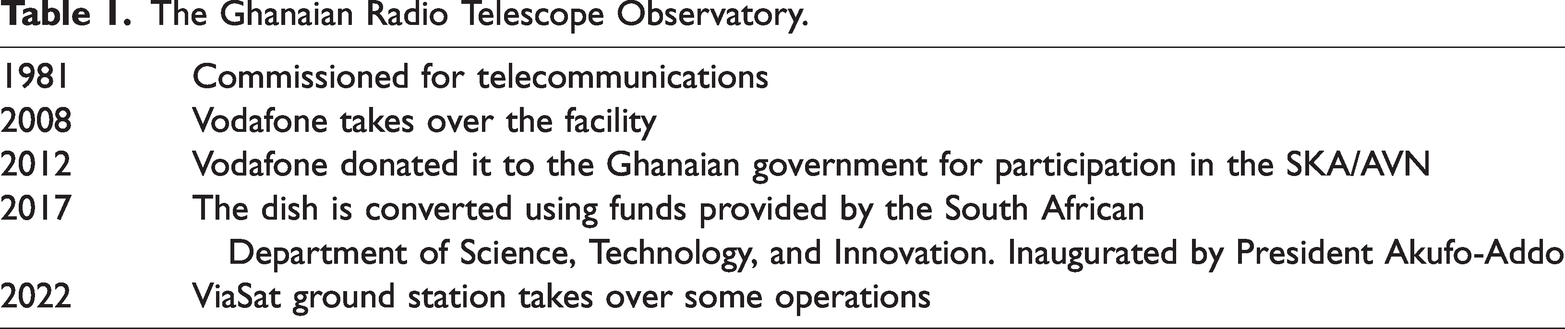
Three years later, the situation is different. A fiber optic cable now connects the observatory to one of several oceanic lines that direct data to Europe. 5 The cable extends from the observatory toward ‘satellite junction which connects the main arterial road from Accra to the observatory and out to the ocean. Importantly, this new cable was financed by ViaSat, a US-based private satellite communications giant. The private sector took an interest when, having done market research, they identified residential settlement happening in the area due to the activity around the radio astronomy observatory and incoming infrastructures, which began in 2017. This is the latest turn of events at the GRAO, building on several earlier phases, each time bringing with it a transformation in the materiality and the politics of the dish. First, in the period of high modernity, the dish was built as a satellite Earth Station for INTELSAT 6 commissioned in 1981, accompanied by the building of a dirt road and connection to the electricity grid. It participated in the liberalization of telecommunications under the auspices of Vodafone in the 1990s, only to be abandoned when fiber optic cables made the service redundant in the 2000s. 7 The telecom dish was then abandoned until it was enrolled in the repurposing project and converted into a radio telescope in 2017 (Table 1).
The Ghanaian Radio Telescope Observatory.
Converting the dish in Ghana was riddled by unprecedented technical complications. The original antennae were shaped like a parabola designed to receive or transmit information by radio waves from a communication satellite (see Figure 1). Rather than capturing man-made waves, radio telescopes capture radio waves from outer space, requiring a heightened degree of sensitivity. Repairs began in 2017, and James Chibueze was recruited from a post he had been occupying in Japan to the position of Commissioning and Operations Scientist for the SKA/AVN, to oversee the conversion. The position emerged from a chance encounter between James and the Chief Director of Astronomy at the South African Department of Science and Innovation in 2015, at the American Astronomical Society meeting in Seattle, Washington. James was offered the job but was reluctant to take the position, preferring to return to Nigeria to continue his research on VLBI. However, by mid-2016 it became clear that his own research would not easily be funded, leading him to accept the offer of commissioning the radio astronomy observatory in Ghana.
As the commissioning scientist of the GRAO, it was necessary for James to know both the engineering as well as the science that the facility could produce. His role as an engineer was evident when we were given a tour of the Ghanaian telescope in Nkuntunse in 2019. As James was demonstrating the host of renovations—including the data pipeline process through which the analogue signal is converted into a digital format through a series of high voltage power cables and computer systems (see Figure 2)—the main power to the facility shut off, prompting James to skip a few steps and direct our attention directly to the UTS, a system that “holds the power together” when the connection to the main grid is disrupted. This was important because the computers in the facility run non-stop, which should make it possible for James to monitor the integrity of the system from South Africa where he was able to control the dish. And yet, James was frequently on site solving a host of unprecedented issues as they came up.
In addition to his mechanical engineering know-how, James was busy educating his and other students by participating in trainings across the African continent, regularly jumping on airplanes for invited talks and workshops on data-intensive astronomy or interferometry. When we visited James at his then new position at North-West University in Potchefstroom in 2022, he drove us out to the site of his own DIY astronomy project Africa Radio Astronomy Network (ARAN) which he fund-raises himself. It consists of four dispersed three-meter dishes that he installed with his students. His astronomy students can manually rotate these dishes, conducting observations and practicing interferometry. A similar site exists at his previous university at Nsukka in Nigeria. James aims to develop a “critical mass of astronomers on the African continent”, a motive situated in between two mutually constitutive goals: producing ground breaking science and supporting nation building through developing the knowledge economy. Based on his account, astronomers are inspired to “find new things.” However, doing astronomy means also justifying investments. As James put it, “you have to tell the government what they stand to benefit from making such an investment.” Compared to his European and North American colleagues, James is under pressure to frame his research as a contribution to the national economy. Acknowledging that large scientific projects require leveraging support from the government, James is faced with the additional task of meeting quotas established by the South African government to build a knowledge economy that helps redress legacies of racial and gender inequality. Legitimizing astronomy in this way gives the impression that “the inspiration for doing astronomy seems largely for development.” However, as James made clear, “my inspiration comes from both directions:” doing ground breaking research and publishing results from data, and training students.
As can be seen in the short summary of James’ activities, he has to wear many hats, as well as make concessions, with the ultimate goal of doing groundbreaking science. For James, repurposing was a flawed approach to developing astronomy capacity. The cost of retrofitting the satellite ground station into a radio telescope was much more than anticipated. Further, he had been frustrated with the lack of local infrastructure for processing his data. While always humorously recounting the ironies of infrastructural connections, such as having to fly from Accra to South Africa with his black box, in order to get a flight to the Netherlands, James takes a more critical tone when speaking about the latest developments—namely the turn in 2022 to ViaSat, the private satellite company to keep the GRAO afloat by paying for some of the expenses needed to run the observatory by literally selling off some of the bandwidth. While the site adjacent to the observatory has enabled better fiber optics connecting the observatory to undersea cables, obviating the need to fly to the Netherlands, it also engendered a sacrifice to the treasured EMS, and a potential source of ‘noise’ or ‘radio frequency interference’ (see Merron, 2020, 2023). To further complicate aspirations for pure science, infrastructures contingent on the repurposing project—the construction of the tarred road, electricity, and eventually the connection to fiber optics for better internet connection—have attracted residents, housing developers and IT companies. The buzz around the site—everyday cell phones and microwaves—interferes with the extremely sensitive equipment of the astronomers, counterproductively affecting radio astronomy by producing noise in the EMS. As of 2022, James Chibueze sees this urban development, and the presence of ViaSat, as signaling the end of the potential for doing meaningful science in Ghana (see Figure 3).
We will elaborate on this ‘critical moment’ further by unpacking the various forces and positions which have led to this moment (sections ‘Debating the Repurposing of Space Science Infrastructure’, ‘Industrializing Ghana through Telecommunications’, ‘Developing Ghana through Civic Astronomy’ and ‘Privatizing the Spectrum’), forces which we understand to be shaped by competing visions between science, development, and industry over how to benefit from the EMS as a common good. The methods and analytical categories we use to make sense of this critical moment are based on attending to the various structures of value or ‘orders of worth’ (Boltanski and Thévenot, 1999, 2006) taken up in critiques and counternarratives emerging from our ethnographic material from fieldwork observations, analyzing documents, discussions, and interviews.
Debating the repurposing of space science infrastructure
We understand the relationship among astronomers, government, private actors and ordinary Ghanaians in Nkuntunse to be dynamic and disputed. The GRAO is embedded in postcolonial politics, a series of successive, contested dynamics of somewhat ad-hoc economic and developmental opportunism—akin to what Lisa Parks has called ‘a discursive site’ concerning satellite infrastructure where questions of meaning and power are at play (Parks, 2005: 167). When feelings of injustice are expressed as well as tinkered with, materiality too becomes tangible and visible not only in terms of infrastructures, cables, concrete, and steel, but moments of critique. In this sense, space science infrastructure is part and parcel of multiple expressions for the common good, entangled with and positioned by power, hope and imaginaries at vastly different scales across sets of actors and over time. To focus on such dynamics and disputes, we adopt the vocabulary of Boltanski and Thévenot (1999, 2006) from the pragmatic sociology of critique by referring to ‘critical moments’ in which ordinary actors draw attention to perceived injustices or inequalities vis-à-vis access to the common good. When access to the EMS becomes a problem (mobile phone services may break down), or when the infrastructure is not available (no fiber optic cables), or when legal negotiations over bandwidth allocations are not respected, or when portions of EMS are literally cordoned off for public or private use, actors voice complaints and the EMS becomes a concern. This is achieved through discursive acts or meaningful practices by actors drawing on collective norms or ‘orders of worth’ governing situations whereby equivalences must be claimed.
Orders of worth refer to differing conceptions of how to realize universal well-being for society, here through EMS at the service of technoscientific modernity. Orders of worth are based in shared (and disputable) perceptions of the common good which are invoked as normative common sense for a broader consensus (Boltanski and Thévenot, 2006: 66). In other words, they reference shared norms, ‘forms of generality’ or higher common principles’, which are externally accepted and hold across the people and settings (Boltanski and Thévenot, 2006: 140–141). Any singular act of claims-making means that an actor must ‘ascend to generality’ and reference that order of worth so as to convince others of the validity of an argument. Referencing the common good serves to legitimize radio astronomy in a context of dispute between surrounding users, the need for maintenance and operations of the observatory and the wider justification of spending by an overstretched postcolonial state.
Boltanski and Thévenot’s (2006) choice of the word ‘worth’ (French for valeur) instead of ‘value’ (valoir) is intentional; it is meant to capture ‘worths’ that hold for situations in which collective norms govern, rather as ‘values’ held by individuals. ‘Worths’ hold together actors, actions and the common good. Actors mobilize orders of worth through acts of ‘justification’ because their particularized interests are always linked with notions of common worths and cannot be successful in disputes if made through self-interest alone. Boltanski and Thévenot emphasize analyses of ordinary understandings of justice with a pragmatic approach, taking seriously actors’ own critical capacities and justifications, rather than rational, strategic action that transcends situations (Boltanski and Thévenot, 2006: 7). Due to highly varied empirical situations and research contexts, the authors leave the definition of the orders of worth and the claims of justification to the researchers to establish. Unfolding within a postcolonial setting, our case study makes it necessary to unpack the intricacies of placing outer space from Africa where multiple visions for the common good become visible in moments of discursive and infrastructural breakdown. Like any other study done within the frame of orders of worth, this leads to a highly situation-specific conception of ‘justice’. For their own case study of civic complaints in France, the authors identified at least six orders of worth, namely, ‘market’, ‘industrial’, ‘civic’, ‘opinion’, ‘domestic’ and ‘inspired’, although the list is potentially infinite not only for settings but also within settings as actors mobilize different orders in making claims.
Of particular relevance to our analysis of the tensions between astronomy for the sake of discovery, development as capacity building, peri-urban settlement and economic growth are the inspired, market, industrial and civic orders. The worths will differ as well in that they do not carry the same institutional, political and economic support. And yet, each of these orders of worth serves to legitimize or uphold visions for the common good—here to be understood in terms of global inequality and avenues towards technoscientific modernity for Africa. Technoscientific modernity is a principle of equivalence to which all humanity can claim a right as a form of the common good. Critical moments are reflexive, drawing attention to the lack of equivalence and the need to change a course of action. As Boltanski and Thévenot write, “The possibility of protest stems from the presence, in the same situation, of different possible orders. Tacit agreement among the participants on the kind of qualities that must be emphasized […] is the condition of a harmonious, smooth-running scene” (1999: 363).
In a postcolonial context, normative orders are inevitably plural and often in competition. For example, when the Opportunity and Development spokesperson for the SKA emphasizes the transfer of data processing skills from the practice of astronomy to the earth observation or health science sectors, astrophysics is positioned as a benevolent actor at the service of African capacity development. This gesture takes up a civic order of worth that emphasizes a collective interest and solidarity for Africa broadly. When a radio astronomer that we interviewed criticizes any pretense that the building of radio telescopes lends itself to development, she is exposing the industrial ambitions of the SKA in Africa as a self-interested science. The publicly stated civic orientation of astronomy infrastructure in Africa is similarly criticized by a project manager, but differently since she sees the real sustainability of the science through market investment and value chain stimulation. And when James Chibueze regrets the noise surrounding the Ghana observatory, he is appealing to his aim of inspired astronomy, at the expense of a civically-oriented repurposing project, now sold off in part to the market.
Importantly, orders of worth concern not only actors, discourses, and conceptual argumentation, they also host material, tangible objects, and institutional entities. Here, the “equivalencies which maintain the coordination of actions may be, for example, encapsulated in objects or by objectified rules” (Boltanski and Thévenot, 1999: 362). For example, the market order of worth may involve the movement of goods and money, the civic order mobilizes policy, and rules, while the industrial order is replete with plans, maps, and project-based materials. They also contain certain types of authoritative figures, temporalities, and forms of evidence. To give one example, on the SARAO website is an announcement calling for studies that link high-tech data science to economic growth. Such studies to date, are few and not very well substantiated. But if found, this research would lend evidence to the argument that data-intensive astronomy could potentially contribute to the market economy, justifying a state’s investment in astronomy through a market order of worth, which both South Africa and Ghana are counting on. As in the Ghana case, the lack of a fiber optic cable to transmit data signals the uncertain investment in certain projects over others (Gagliardone, 2018). The AVN (the African VLBI Network) project has been institutionally ratified through contracts signed by member states, in a testament to the recognition of civic worth and so on. This analytical framework helps locate the Earthly entanglements of outer space within postcolonial politics and visions for a common good by ascending to generality when making justifications for one or the other material arrangement. We now develop each institutionally and politically-supported phase of materiality in a historically-informed description of the repurposing project.
Industrializing Ghana through telecommunications
In the 1970s and 1980s, large satellite dishes (at least 26) were built across Africa as satellite communication came to be the most efficient way to send voice and television signals around the Earth through the US initiated INTELSAT program, at first an intergovernmental consortium owning and managing a number of satellites to provide international telecommunications and broadcast services, until privatization in 2001.
This industrial era reshaped the telecommunications and media landscape, with deregulation spurring investment in satellites for some countries while for others, investment by the United States and USSR in conjunction with the growth of INTELSAT and Intersputnik created the conditions for global coverage within the geopolitical logic of the Cold War. By the early 1980s, nearly all nations had a receiving dish or Earth Station to provide a television network (Parks and Schwoch, 2012: 8). The dish built at Nkuntunse in Ghana was one such dish, constructed by Spar-Aerospace Technology of Canada. On the same patch of land, which is at the end of ‘satellite junction’ approximately 25 kilometers from Accra, are two additional medium and two smaller dishes built by Japanese contractors. The main 32-meter dish was built in 1981 as a communications antenna and was commissioned at the same time that Princess Diana married into the British Royal family, a highly significant event remembered by Ghanaians newly connected to global information circuits. The dish was operated by Ghana Telecommunications Corporation until 3 July 2008, when Ghana Vodaphone took over as a major shareholder. 8 Prior to the building of the Nkuntunse Earth Station, communication within Ghana and between Ghana and the outside world was limited, relying on the Plain Old Telephone Service lines for voice and terrestrial microwave networks for radio and television.
In a clear demonstration of industrial worth, this was the era of highly centralized and regulated telecommunications monopolies, when satellite facilities were part of state-run postal, transportation and communications ministries in Africa (Horwitz, 1992). They were further symbols of national development and pride as can be seen by a plethora of postage stamps commemorating their construction in this period (see Figure 4). They were also seen as portals to global networks through the INTELSAT system, and the vision of whole Earth communication that transcended even the cold war divisions (Evans and Lundgren, 2022). Given the independence politics at the time, such stamps certainly also participated in pan-African visions of progress and space-age development for the continent broadly. These developments highlight the ground station as entangled within national, geopolitical, and sociotechnical relations materially embodied in the Nkuntunse Earth Station.
Even as these satellite dishes were being built for sovereign communications monopolies, the United States and the International Telecommunications Union (ITU)—driven by the market worth logic of cost and benefit—were putting pressure on international providers to deregulate and liberalize their telecommunications services (Horwitz, 1992: 392). The United States exported 25 billion US dollars in telecommunications technology, making clear the persuasive power of liberal economics (Horwitz, 1992). Ghana did not hesitate. It was one of the first African states to deregulate the telecommunications industry in conjunction with the Accelerated Development Plan in 1994 (Frempong and Atubra, 2001). The Ghana Post and Telecommunications was privatized and competition over the market quickly followed with a plethora of providers springing up. Today, these include the telecom giants MTN, Vodafone, Airtel, Tigo, Expresso and Globacom. During this new phase, Vodafone took over partial ownership and management of the satellite station at Nkuntunse until fiber optic cable installed around the turn of the millennium rendered the satellite dish redundant. The dish as a ground-based telecommunications satellite therefore fell out of use from 2000, until the South African government, through the Department of Science, Technology, and Innovation took an interest in it a decade later.
Before astronomers took note of Ghana’s abandoned ground station, another industrial-scale project had been afoot in South Africa since the early 2000s. Arguably motivated by a similar global, whole-Earth imaginary that underlay the earlier global telecommunications network, the SKA Organisation, based in South Africa, is currently constructing what is meant to become the world’s largest telescope’ to be finished towards the end of the 2020s. It is a transnationally funded multilateral consortium established by 12 member states (now 14) and headquartered in the UK. The actual instruments will be hosted in South Africa and Australia—South Africa with the mid-frequency telescopes and Australia with the low frequency telescopes.
The project’s industrial-scale orientation is evident in the sophisticated systems engineering, precision, the value placed on expertise, and wide-scale application. This is due in large part to the increasingly ‘big science’ approach of astronomy, which strives towards superlatives at every angle, aiming to be able to see further in space and in time, faster and with greater sensitivity and accuracy. The engineering and scientific challenges involved have led to innovative developments in computing, most notably by the South African built ROACH (reconfigurable open architecture computing hardware) used to correlate the massive amounts of data produced by the observatory. The challenge of moving the data via an internet connection remains a major hurdle. South Africa hosts new undersea cables and intra-national fiber optic networks that have been able to keep up with the anticipated quantities of data so far, but engineering challenges will continue to follow the lofty scientific imperatives set by this project.
Developing Ghana through civic astronomy
In difference to the earlier industrial phase, the postcolonial and post-apartheid era of the SKA saw South Africa adopting an orientation towards technoscientific modernity that relied on capacity building, prioritizing local African-based public and private partnerships, and promoting an image of ‘giving back’ to Africa through development programs in a gesture of civic worth. Civic worth, as it is understood by Boltanski and Thévenot (1999: 372) means “to lay stress on beings who are not individual beings but collective ones. […] In this world, important persons are, therefore, federations, public communities, representatives or delegates”. For example, when actors emphasize the benefit of the Ghana radio telescope for capacity and training of not only astronomers, but also budding data scientists, the site is positioned as a benevolent actor at the service of African capacity development and a collective interest and solidarity for Africa broadly. In this spirit, the African (VLBI) Network (AVN) was proposed as a way to extend the capacity of the SKA beyond South Africa and to include eight other African partner countries (Gaylard, 2013). The idea was to convert redundant telecommunication ground-based satellites that had sprung up in the previous era into radio astronomy telescopes. During two years of repairs to the Hartebeesthoek radio telescope in South Africa, astronomer Michael Gaylard scoured Google Earth for the facilities across Africa that could be transformed into space science infrastructures, made obsolete by the advancement of fiber optics cables to Africa.
Under the auspices of the AVN, in 2012, Vodafone Ghana handed over the Earth Station to the Ghanaian government, and an MOU between the Minister for Environment, Science and Technology and the Chief Executive Officer of Vodafone indicated that the redundant telescope would be converted into a telescope for research and development in the field of astronomy. The telescope was seen as part of a wider initiative to promote national space science and technology programs in Remote Sensing, GIS, Communication, and Metrology. 9 Thus, the first (and to date only) conversion happened at the Nkuntunse Earth station in Ghana in 2017, connecting the country to the larger SKA observatory in South Africa using a contribution of $9 million from the African Renaissance and International Cooperation Fund and administered by the South African Department of Science, Technology and Innovation. In addition to building telescopes capable of complex VLBI experiments, the repurposing project was intended to develop the capacity of Ghanaian engineers to do further conversions on at least eight other countries starting with Kenya and Madagascar.
As we saw earlier with James’ experiments, VLBI is a technique of radio astronomy where dishes, spaced out across an observatory or even across a continent, can be correlated and their results combined. Perhaps the most well-known example of this is the 2017 Event Horizon Collaboration that led to the first image of a blackhole. VLBI works by connecting the data gathered by distant observatories via a central correlating super computer. Developing a network of VLBI-capable radio telescopes on the African continent was imagined as a means of transferring knowledge and technology, as well as necessary skills within participating countries. The AVN was thus literally made attractive to the member states as a program of development under a regime of civic worth. Indeed, James Chibueze participated as an educator in a series of workshops designed for equipping African students from the AVN member states with these skills. It came along with a host of capacity-building programs such as the Development in Africa through Radio Astronomy training programs for astronomy and big data analytics. These programs also offered hardware in the form of computers, access to a cloud, and the costs and engineering expertise of renovating the satellite dishes.
The global connections and visions required to conduct these sorts of experiments are similar to—and indeed layered upon—the vast networks established by INTELSAT decades earlier. Yet, interferometry also relies on the processing of big data sets, requiring high-speed computing infrastructure. Although the common good is positioned as African development through capacity building, the AVN implementation remains a challenge on a number of levels. Whether participating in radio astronomy or other technology programs, the same basic elements are required: stable electricity supply, uninterrupted access to fiber networks, data storage infrastructure, data transport infrastructure, data analytics capability, scientific capacity, governance structures and operational funding (Sharpe, 2020). These infrastructural challenges signal the degree of commitment by African partner governments to the AVN. Thus, in James’ estimation, besides providing use of the land, Ghana has not “paid a cent” for the GRAO, with the brunt of the funds coming from South African tax payers.
Returning to James’ biography, we see that many of his choices have been related to securing funding for the advancement of astronomy—and VLBI in particular—on the continent. He did not leap at the job offer of commissioning scientist for the AVN project in 2015, preferring to continue his own research. And yet, without funding, he re-strategized towards the AVN, as a way to secure funds through development while pursuing his own work of VLBI. After preparing the GRAO for VLBI science, James then joined North-West University as a professor to secure various funds to develop his own project, the ARAN, which has allowed him to build a radio astronomy dish in Nigeria and in South Africa hoping to use low-cost GPS solutions in order to conduct VLBI experiments. In this process, James concedes to securing money through development aims, even thought it would have been optimal if the money flowed directly to science that would then lead to development, rather than the other way around, revealing the first of tensions that have encircled this project.
Privatizing the spectrum
In a clear turn to market worth, the SARAO developed a strategy called ‘colocation’ in 2022 by facilitating an agreement between the Ghanaian government and ViaSat, to resolve the problem of operations and maintenance costs at the Nkuntunse telescope. This newer program entails merging space science with the remote sensing satellite industry for each of the remaining AVN partner countries. This move opened up a number of functional capacities, transforming the observatory into a site of science as well as a data center with computing infrastructure, storage, and backup for commercial satellite companies. As a combination of software and hardware designed to process data requests and to receive and deliver these to clients over a network, this intermediary prestige infrastructure was transformed into a node not only for VLBI but for proprietary data transfers.
Colocation is envisaged as using already existing ground stations as a means to generate revenue by charging hosting fees for satellite companies to download and transmit data (also referred to as uplinking and downlinking). Satellite companies can benefit from already existing ground-based assets such as the built facilities, roads, and electricity connections. The satellite company would pay for the maintenance of the facilities and communication networks while co-existing with radio astronomy. Since radio astronomy and satellite operation require comparable engineering, the operations are supposed to benefit one another. According to Carla Sharpe, manager of the Africa Program at SARAO, and an economist, the benefit of a fully functional ground station in Africa for a company located elsewhere is that it could generate a substantial amount of revenue for local governments, who would then have access to cheaper and faster Earth observation data. In an interview, she gave the example of data needed for disaster relief which typically takes several days when purchased from an outside source that needs to filter and handle the data. With a ground station, a government could download the data directly and have the necessary expertise to translate this data into usable information. And this sharing of expertise is part of the rationale to colocate the satellite operations with radio astronomy as, according to Sharpe, the skill sets to transmit, receive, and process the data are interchangeable between the two domains of practice.
Further, Sharpe explains that satellites are becoming smaller and smaller which has limited the amount of data that they can carry. This means that satellites need to downlink data as often as possible. Europe, North America and large parts of Asia and Oceania are already saturated with ground stations; however, Africa is relatively open. Indeed, the ViaSat company boasts their global network of ground stations, and the value of the Ghana location is to fill a gap in their global portfolio. They further claim to be “bringing jobs and economic growth to the region”. 10 As their website repeatedly insists, alongside providing services to their satellite operator clients: “We’re making the dream of connectivity a reality for some of the world’s most challenging emerging markets.” 11 Thus, on the one hand the placement of radio astronomy infrastructure on the continent is meant to capitalize on an underexplored Southern Sky and to increase the resolution of galactic views through interferometry. On the other, the placement of these facilities opens up market investment in blank spots on the map of satellite downlink stations in the Southern Hemisphere. Companies that invest in colocation will be paying governments for us of their ground stations, while setting up the equipment and skills that will make the acquisition of satellite imagery and remote sensing faster and cheaper.
Respectful of the colocation project’s motivations, James Chibueze nonetheless argues that colocation is the end of radio astronomy science in Ghana. As James later elaborated to us when we met with him in Potchefstroom in 2022, ViaSat’s operations—especially when uplinking data—may interfere with radio astronomy science.12 The concern is that their operations will ‘flood the band.’ Although a radio frequency document drafted for the GRAO in addition to the ITU mandate are meant to protect bands for radio astronomy globally, it is not possible to know in advance what bands will be compromised by satellite technology because it is not known how the industry will develop and change in the future. To revisit the anecdote at the beginning, somewhat paradoxically, in order to correlate his data, James needed to take his black box on a plane to the Netherlands. Today, James is able to correlate his VLBI data without traveling. In fact, now, with the fiber optics, James does not even need to go physically to Ghana anymore since the increased bandwidth makes it possible for him to operate the telescope remotely from South Africa. What he gains in connectivity he sacrifices in terms of science since the quality of his data may be suboptimal with the extra noise. While the value of the market in the built environment indirectly supports networked infrastructure, it interferes with James’ inspired desire for self-realization as an astrophysicist and to participate on the world stage. The arrival of the satellite company signaled that science was being devalued in favor of industry. This ‘battle over the terrain of signals’, in James’ summation, is a critique echoed by the wider community of astronomers, engineers and other personnel through rumors, awkward silences, and general discomfort over the topic of the ‘Ghana telescope’ and its purported ‘failure’ to produce science that may result in what James called a ‘white elephant’. 12
Conclusion: the “battle over the terrain of signals”
A developmental paradox has emerged at the confluence of material transformations and politics that have accumulated across more than 40 years of aspirations for technoscientific modernity in Ghana. This situation evolved from the remnants of an earlier phase of industrial aspiration, a subsequent turn towards ethically-motivated big science in the promise of repurposing, the more realistic requirements of high-tech, data-intensive radio astronomy, and the economic environment for sustaining the infrastructural needs for daily operations. Entangled with these phases of worth is an inadvertent but interesting slippage between high-tech transformations at the site of the GRAO and infrastructural changes leading to peri-urban development. When the Ghana Earth Station was commissioned in the 1980s, a dirt road was built from the main highway leading out of Accra alongside electricity cables that connected the facility to the grid. And, as a consequence of the conversion to a radio telescope in the late 2010s, the dirt road leading from the highway to the dish was upgraded into a tarred road, which was finished in time for the commissioning visit by the President of Ghana, Nana Akufo-Addo.
At the 2017 inauguration, the dish stood as a monument of national pride and the state’s embrace of technoscientific modernity, although its purpose was unclear to ordinary Ghanaians. As expressed by those working in and around the site, the observatory itself is no-go zone. Residents tend to keep a wide berth, and aside from children and dogs who slink carefully around the site collecting mangoes, it is a place to avoid. It is said to host snakes, and the dish itself has been called a giant water collecting bowl (agba), but that the water from it could be toxic, indexing the invisible and intangible nature of its functioning. Technologies whose purpose and whose control are unknown to communities can disrupt local moral economies as Jane Parish demonstrated for ATM and credit card transactions in Ghana (Parish, 2000). As intangible as space science might be to ordinary Ghanaians, its materiality in terms of infrastructural transformations was highly tangible. Roads and electricity are basic infrastructures for urban life, and Ghanaians began to move onto the land at the outskirts of Accra, along with their cell phones and microwaves, which consequently flooded the spectrum with other devices operating at competing bandwidths.
The built environment near the radio astronomy telescope in Ghana became an attractive choice for the other noisy neighbor—the satellite company ViaSat—who saw the site as having the basic infrastructure and network of maintenance workers seconded from the Ghana Space Science and Technology Institute. Apart from installing their own satellite receiving station, and installing a fiber optic network to the site, ViaSat did not have to build its own roads or set up its own structures, revealing a patchwork and improvised texture to projects of radio astronomy, satellite colocation data centers as well as peri-urban development. What is somewhat paradoxical about these arrangements are the incompatibilities between the extreme sensitivity of radio astronomy instrumentation and the ‘noise’ generated by computing and telecommunications infrastructures, which has led to compromising the quality of scientific data for more capital investments.
Taking a step back, it is clear that no single order of worth, such as repurposing for African development, could govern the emplacement of the Ghana ground station. We thus defer from universal descriptions of what it is that certain technologies mean and do in locations, both in terms of their hegemonic power and functional capacities (Menser and Aronowitz, 2014; Parks, 2005: 75). This is a discursive situation which is mobilized by inevitably plural normative concerns, whereby both people and things take up differing positions vis-à-vis this Earth Station. In the ‘battle of over the terrain of signals’, modernity is produced both through the buzz of electromagnetic activity in Nkuntunse and through attempts to analyze it, control that very noise as well as sell some of it off.
Extending from South Africa, the placement of radio astronomy infrastructure on the African continent is meant to capitalize on an underexplored Southern Sky and to increase the resolution of our own milky way. Astronomy capacity building and infrastructural development come with the promise of skills development in data intensive work with scope to apply outside of this esoteric science (for instance to the banking sector). The promises of infrastructure and capacity building that accompany the expansion of radio astronomy gain new meaning within the expansion of the telecommunications industry. As a vision of development promoted with respect to the telecommunications sector, modernity means greater access to electricity, internet, and mobile phone networks. The observatory in Ghana, although limited by a certain lack of connectivity, participates in an information economy by extracting the EMS from outer space that can be reproduced into worldly matter in the form of data that is sent, stored, sorted, combined, and integrated. As such, it can be considered alongside other infrastructures that have been reanimated by capital flows associated with data transportation and storage more generally (Jacobson and Hogan, 2019).
As the critical moment of our colleague James Chibueze makes visible, outer space comes with the highly tangible benefits of modernity and convenience: a tarred road, fiber optic cables, electricity. In common parlance, the contradictions of radio-emitting devices result in an electromagnetic mash-up. In the language of pragmatic sociology, several orders of worth start to rub up against one another at the GRAO. While colocation as an ad hoc ‘technofix’ is meant to fill a maintenance and operation gap created by postcolonial conditions of doing science and business, it makes visible a critical moment in which the EMS becomes a contested resource in between the interests of doing inspired science as illustrated by James, and the institutionally supported industrial ambition, civic development, and market growth illustrated by the radio astronomy and satellite downlink infrastructure. Access to the EMS is a principle of equivalence to which all humanity can claim a right as a form of the common good. Critical moments draw attention to the lack of equivalence and the need to change a course of action. As Boltanski and Thévenot write, “the possibility of protest stems from the presence, in the same situation, of different possible orders” (1999: 363).
In a postcolonial context, normative orders governing vertical ambitions for techno-scientific modernity are inevitably multiple and often in competition. When actors emphasize the benefit of the Ghana radio telescope for capacity and training of not only astronomers, but also emerging data scientists, astronomy is characterized as a benevolent actor at the service of African capacity development. This gesture emphasizes a civic order of worth and a collective interest and solidarity for Africa’s access to technoscientific modernity broadly. Science for science’s sake and the self-realization of African astronomers through inspired worth—such as that demonstrated by James Chibueze—comes in conflict with the market logic and the tangible ‘cash in pocket’ materialization of harvesting the EMS through satellite colocation. All the while, ordinary people and communities that live near or around these sites—here the Ghana observatory in particular—benefit from infrastructural changes which channels their access to the EMS directly in the domestic worth sphere associated with the network grid, electricity, development, and global connectivity, all seen as common goods in their own right.
We present the material politics at work between various stakeholders: astronomers, government, the private sector and residents living near the observatory, regarding a dispute over imaginaries of technoscientific modernity. Ultimately, a somewhat ad hoc solution has stabilized various worths through ongoing repurposing—none of which points to Africa’s essential creativity, but to its being positioned as such.
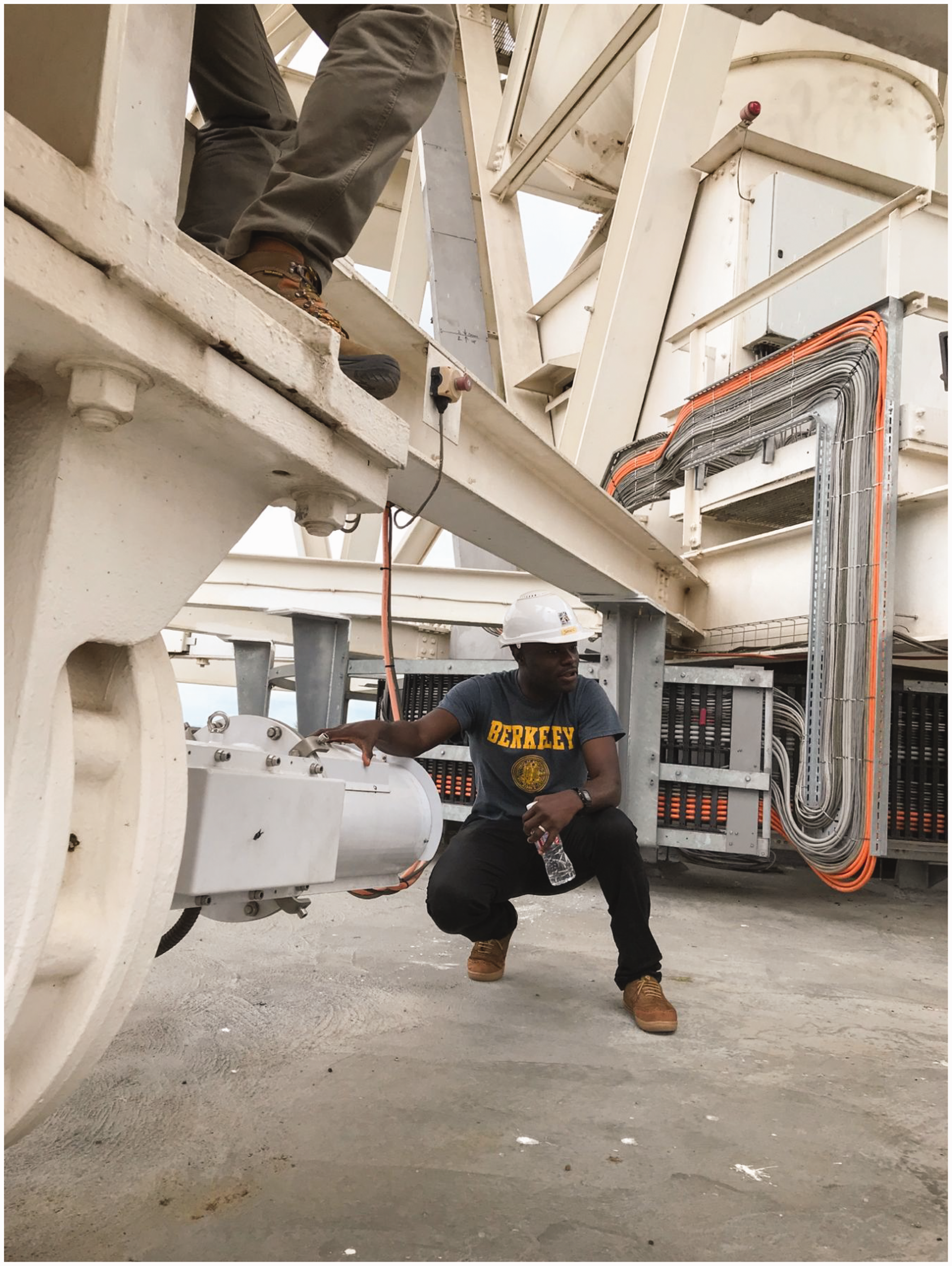
James Chibueze demonstrating the motor he helped design which drives the telescope. Behind him is the cable wrap connecting power and signal from the observatory computer room to receiver system. Photograph by James Merron, 19 August 2019.
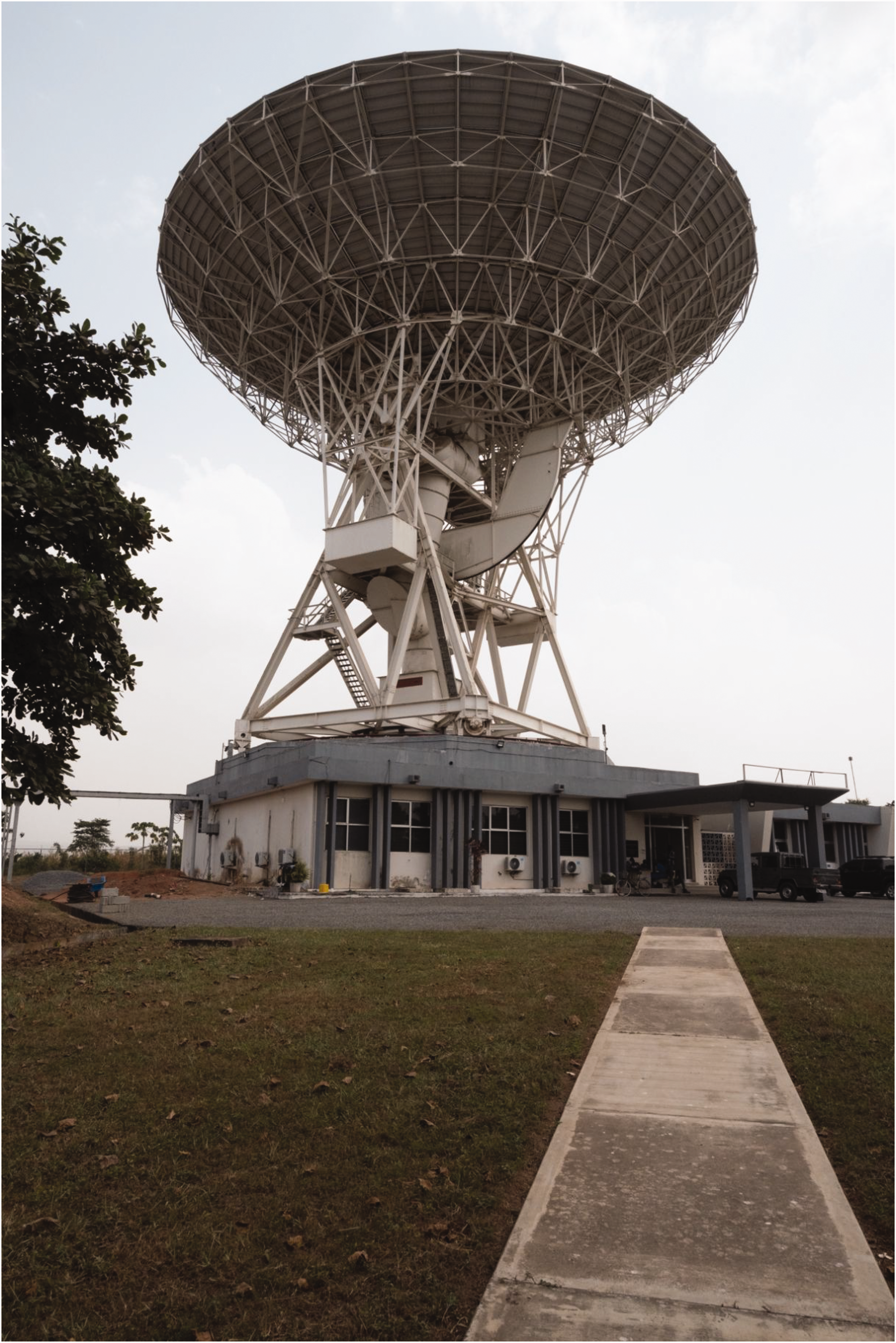
Ghana Radio Astronomy Observatory. Photograph by James Merron, 16 January 2023.

1981 Postage stamps, commissioning of the earth satellite station. Source: postbeeld.com.
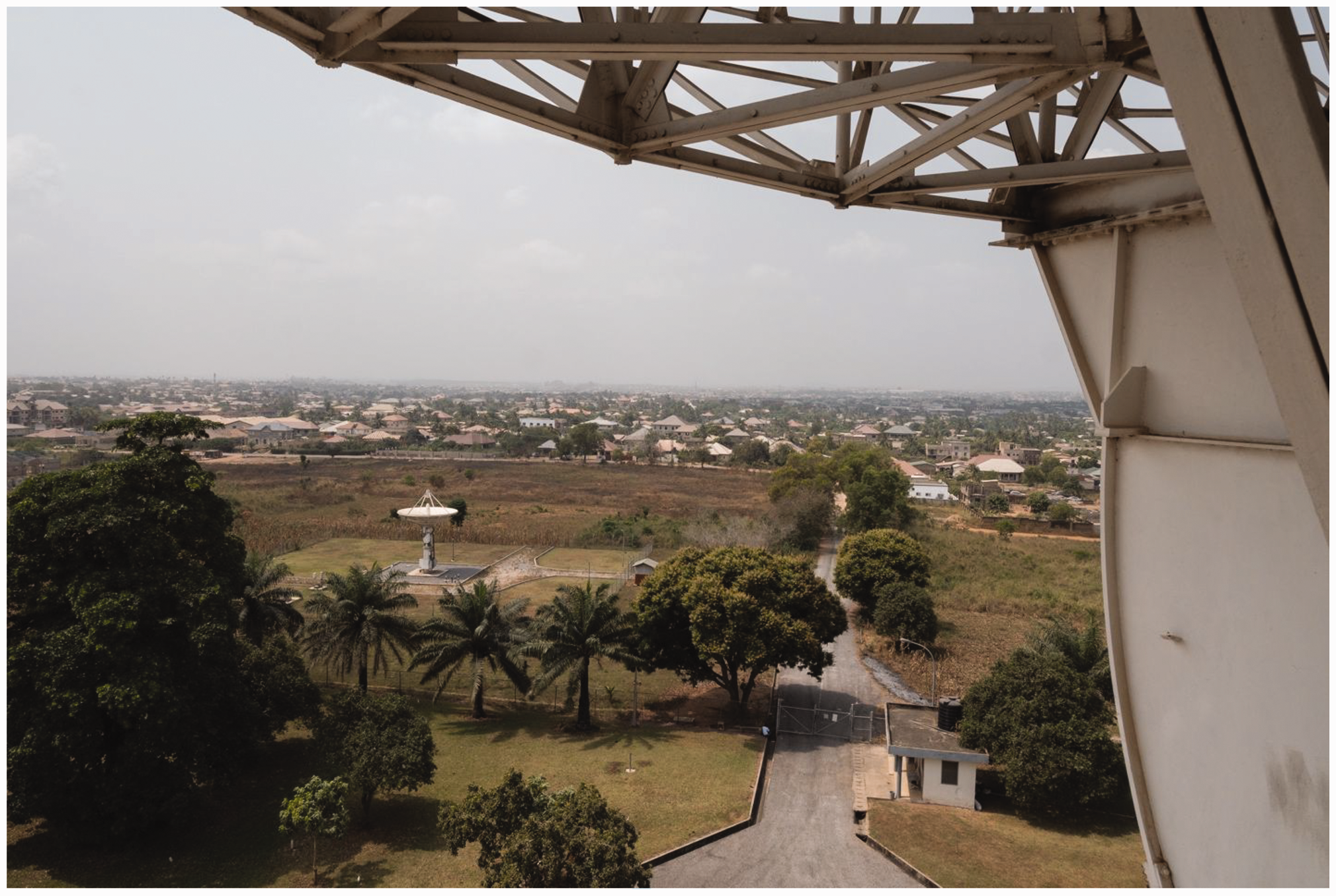
View of the ViaSat dish (left) from the perspective of the Ghana Radio Astronomy Observatory dish. Photograph by James Merron, 19 January 2023.
Footnotes
Declaration of conflicting interests
The author(s) declared no potential conflicts of interest with respect to the research, authorship, and/or publication of this article.
Funding
The author(s) received no financial support for the research, authorship, and/or publication of this article.

Notes
From Makhanda (South Africa),