



Abstract
Drawing on ethnographic research with two Orthodox Jewish outreach organizations, this article conceptualizes interpellative styles and offers a framework to analyze how styles are variously situated, mediated, performed, and disruptive. I mobilize a micro-interactional approach to parse out how these four dimensions shape ideological recruitment and their roles in the choreographies of identity disruptions and repairs. The two case studies illuminate why and how groups deploy different interpellative styles and what elements shape whether styles are (in)effective. In these ways, the article contributes to scholarship on how people become persuaded to take on new identities and provides insight into the resistance and failures groups encounter when attempting to interpellate others. I conclude with a discussion of how a theory of interpellative styles can be applied more broadly and used to investigate the overlap between cultural, physiological, and psychological processes in identity formation and alteration.
“Excuse me, are you Jewish?,” nine-year-old Jacob said as he walked over to a student in the Tristie campus center with a bright yellow citrus fruit and three species of branches tied together in his hands. Jacob walked with his cousin, who had instructed him to ask anyone who looked White if they were Jewish. From his experience during outreach in New York City, his cousin had learned this was the only way to maximize the number of people they could get to perform the mitzvah (commandment) of shaking the branches in honor of the holiday of Sukkot. 1
“Uh . . . ,” the student was caught off guard. The children looked up at him, waiting expectantly. Would they get their chance to lead him through the ritual? “Yeah, sure, I guess.” Their faces broke into wide grins. “Will you shake the lulav?” “Um, okay?”
Jacob showed the student how to hold the branches and the citron and what to say during the blessing. He stated the words of the blessing, and the student followed along: “Baruch . . . [Blessed] . . . Baruch . . . Ata [is He] . . . Ata.” They went through the blessing one word at a time, and then he showed him the proper way to shake.
“Great job! You did a mitzvah!”
The children seemed joyous at having accomplished their divinely mandated mission and went on to ask more students their religious identities and instruct them on proper practice. The student returned to the conversation with his friends.
What happened in this interaction? I argue that the interaction represents a moment of interpellation—the process through which individuals are recruited and constituted as ideological subjects through the enactment of specific material-discursive practices 2 (Althusser 2014; Butler 1997b; Hultin and Introna 2019; Lampert 2021; Tavory 2016; Vila, Avery-Natale, and Ford forthcoming). Jacob was inviting the student to enact an Orthodox Jewish ideology through engaging in ritual behavior, and in doing so, the student affirmed this identification 3 and constituted himself as a religious subject. More specifically, the encounter represents a style of interpellation that took place in public, was directed at the student, and was made up of several interactional turns, including a pre-interpellative screening based on race and the performance of ritual actions. At each turn, the student had to decide how to respond and how these behaviors aligned with expected lines of action and his existing sense of self.
In this article, I use ethnographic data on two Orthodox Jewish outreach organizations to conceptualize interpellative styles and how these styles function through various sociocultural pathways. Drawing on Eliasoph and Lichterman (2003), I define styles as the “patterns of interaction” that arise during interpellative encounters and present a framework for examining how styles are variously situated, mediated, performed, and disruptive. Detailing these four dimensions contributes analytic specificity to understandings of interpellation and illuminates how encounters involve cultural, physiological, and psychological processes. In particular, I show how these dimensions inform power dynamics, emotions, and self (non)recognition.
The case studies offer insight into why and how groups deploy different interpellative styles and what elements shape when the styles are (in)effective. Building on scholarship that examines how people become persuaded to take on new identities, I investigate the choreographies of identity disruptions and repairs, drawing attention to the resistance and failures groups encounter when attempting to interpellate others. I conclude with a discussion of how a theory of interpellative styles can be applied more broadly and used to investigate the overlap between cultural, physiological, and psychological processes in identity formation and alteration.
Developing a Theory of Interpellative Styles
Interpellation has become a central framework for scholars to understand how ideologies shape individuals’ self-definitions and behavior. Althusser (1971:86) introduced the term “interpellation” to describe the “very precise operation” through which ideologies function to recruit and constitute individuals as concrete subjects. 4 These ideologies include moral values, religious beliefs, aesthetic principles, and scientific knowledge that form within ideological state apparatuses (e.g., schools, families, religious institutions, legal systems) and interpellate individuals through specific material practices that maintain ruling class domination (Althusser 2014:186). The material practices involved in apparatuses take many forms, such as going to mass, making the sign of the cross, a devotional prayer, a greeting, or a handshake (Althusser 2014:186). For Althusser (2014:186), ideology is rooted in action, as he invoked Pascal: “Kneel down, move your lips in prayer, and you will believe” (see also Lampert 2021:170).
Althusser viewed interpellation as a continuous and cyclical process, but to illuminate a moment of interpellation, he presented an allegory of a police officer shouting at a person, “Hey, you there!” In the 180-degree turn to answer the police officer’s hail and following instructions, the person is interpellated—becoming a subject to Justice. The person becomes a subject because he recognized himself in the call—it “really” is him that is being hailed—and then enacted the material practices associated with this subject position (Althusser 1971:86). Similarly, an individual can be interpellated as a subject to God when she recognizes herself as Catholic while engaging in devotional practices. Or an individual can be interpellated as a subject to Capitalism when he recognizes himself as a worker as he performs daily labor.
When individuals are addressed or act in such a way that they respond, “it really is me, I am here, a worker, a boss or a soldier”; they identify with this position and the behavior it entails (Althusser 2014:195). At this moment, identity “irrupts”—individuals are endowed with an identity that is retroactively projected back into their pasts and fictively constructed as having always-already been there (Choi 2013:26). The individual perceives this identity as self-evident, and it is teleologically introverted to be the cause of their behavior rather than an effect of the ideological apparatuses (Pêcheux 1982). Furthermore, in their subjugation, they retroactively constitute the Absolute Subject (God, Justice, Duty) in the name of which ideology interpellates in a way that is truly mirror-like—their actions are what produces the Subject and its authority, not the other way around. With the recognition of this Subject, individuals are guaranteed that if they behave properly and are “good” subjects, all will be well. In this way, “the individual is interpellated as a (free) subject in order that he shall submit freely to the commandments of the Subject . . . i.e., in order that he shall make the gestures and actions of his subjection ‘all by himself’” (Althusser 1971:182).
Since the first excerpt of Althusser’s work on interpellation was published in 1971, many scholars have worked to parse out the process. The first wave of scholarship primarily examined interpellation through a psychoanalytic and linguistic lens (Butler 1993, 1997a, 1997b; Dolar 1993; Pêcheux 1982; Žižek 2008). 5 For Butler (1993, 1997b, 1997a), interpellation was something that happened in and through naming and name-calling. Naming constitutes an individual as a subject because it provides the person with the possibility for linguistic existence (Butler 1997a:24). Individuals gain an “I” and a way to refer to themselves. Interpellation allows for the retroactive recognition of self and confers an identity; without recognition (or being recognizable), there is only abjection (Butler 1997a:5). Individuals will therefore submit to even injurious labels because they have a “passionate attachment” to their subjecthood (Butler 1997b:6). As gendered, racialized, and other labels are reiterated by authorities, they sediment into more stable identifications and governing norms. Other scholars have also looked to how people are continuously in the process of becoming and “multiply interpellated” through dominant discourses into multiple subject positions, which they navigate to form their sense of selves (Hall 2000; Hultin and Introna 2019; Law 2000; Vila et al. forthcoming).
More recent scholarship has focused on the many modes of material practice involved in interpellation (Hultin and Introna 2019; Lampert 2015, 2021). Tavory (2016) turned his attention to how Orthodox Jews are “summoned” (an English translation of interpellated) to construct and sustain their Orthodox selves and social world through participating in appropriate communal behaviors. To be summoned, individuals have to recognize they are being hailed and learn to act in the proper ways as a result of this summoning (e.g., knowing the rituals to participate in communal prayer). People also set themselves up for summonings based on their past actions, such as attending synagogue or Talmud 6 study, or in the case of secular Jews, sharing their email address with religious leaders or hanging mezuzahs 7 on their door frames. Hultin and Introna (2019) show that interpellations do not always center on human actors—the material-discursive arrangements of a setting may shape the possibilities for the enactment of certain subject positions and their associated identity workings. Their research illustrates how the three different ways the Swedish Migration Board’s reception units are arranged governs whether asylum seekers are constituted as potential safety threats, customers, or unique and empowered guests. Vila and colleagues (forthcoming) illuminate how interpellation involves material-discursive, situational, and contingent “identitarian articulations”—an assemblage of identifications (gender/age/race/sexuality/religion/ableness) and human and nonhuman elements that shape encounters (see also Vila 2000, 2005; Vila and Avery-Natale 2020).
My orientation to interpellation builds on existing theories but intervenes in a few key ways. First, I look specifically at moments when there is a misalignment between individuals’ existing identifications and the subject positions and associated behaviors the interpellator is asking them to perform. In other words, I attend to nonrecognition. 8 Scholarship has explored the psychological and social effects of a related process during identity misclassification wherein people are perceived as belonging to a social group with which they do not identify (Bosson, Taylor, and Prewitt-Freilino 2006; Campbell and Troyer 2007; Lagos 2019; McLemore 2018). Researchers have also considered the trauma of “misinterpellation,” in which a person believes themselves a subject to a collective ideology (e.g., universalism, Whiteness) only to be rejected and excluded from the practices (“No. I wasn’t talking to you.”) (Fanon 2008; Hage 2010:122). Whereas these studies focus on the experiences of those being positioned into othered and devalued groups, my work is motivated by the dearth of data on intragroup nonrecognition in which an interpellator views a person as a member of the same social group but the recruit may not. During intragroup interpellation, what it means to be a member of the group and what is entailed in prototypical subjecthood are called into question (Rosch 1973).
Orthodox Jewish religious outreach is a useful case study for examining intragroup interpellation because it aims to recruit non-Orthodox Jews, who come from a variety of different Jewish backgrounds. Denominational differences are important because the question of “who is a Jew” and the criteria for conversion differ between the communities (i.e., whether Jewish subjecthood is based only on maternal descent or maternal and paternal descent) (Lugo et al. 2014). Along with questions of “who is a Jew” come ideas and expectations about “authentic” practice and religious literacy for the “ideal” Jewish subject. Given the vast diversity in U.S. Jewry and the sociopolitical implications of denominational differences, Orthodox outreach often presents Judaism in a form foreign to non-Orthodox individuals’ understanding of Judaism and their own religious identifications. 9 As such, nonrecognition will be common as recruits identify as Jewish but not that type of Jew.
Second, like others who have considered agency and resistance, I do not see becoming an “interpellated individual” as an inevitable outcome of participating in the interaction (Butler 1993; Lampert 2021; Tavory 2016; Vila et al. forthcoming). Instead, I present the choreographies of identity disruptions and repairs and how they play out on a micro-interactional level (Burke and Stets 2009; Schegloff 1992; Stets et al. 2020; Tavory and Fine 2020). I illustrate how individuals navigate new gaps that form between how they see themselves and what practices those identifications entail and how others see them and what others expect from them. I ask: When do individuals change their behaviors to repair these gaps, and when do they refuse to answer the interpellative call? I track power differences involved in these interactions to map out the spectrum from subtle to outright coercion and how religious authority and other identifications function in these encounters (Guhin 2021; Tavory 2016; Vila et al. forthcoming; Wuthnow 2020). I show how guilt, pleasure, shock, and other positive and negative emotions influence how individuals respond to a summons and the intensity of the event (Butler 1997b; Tavory 2016; Turner and Stets 2005; Vila et al. forthcoming; Žižek 2008). In contrast to the majority of the existing work on interpellation and identification that studies the dynamics behind successful cases, I work to better understand failures (Mahmood 2012; Tavory 2016; Tavory and Winchester 2012; Winchester 2008).
Third, in line with scholars who aim to distill the material-discursive elements of interpellation, I introduce a framework for investigating interpellative styles. I take a micro-interactional approach to investigate how ideological recruitment is variously situated, mediated, performed, and disruptive, as presented in Table 1. These dimensions allow me to parse out the sociocultural processes through which interpellation may shape selfhood and offer a way to operationalize styles for research.
Dimensions of Interpellative Styles.
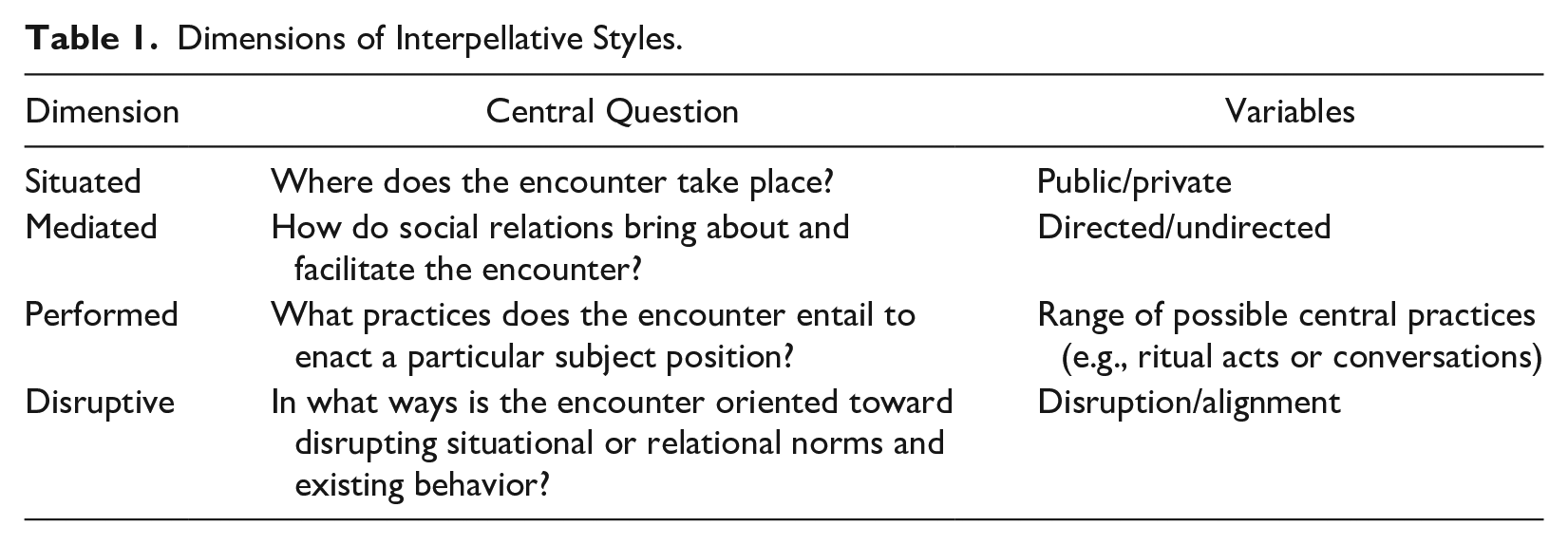
The situated dimension recognizes that interpellation occurs in spaces that have norms for appropriate behavior as well as distinct “audiences” for self-presentation (Eliasoph and Lichterman 2003; Goffman 1959; Hochschild 1983; Lefebvre 1991; Wuthnow 2020). In the public domain, individuals typically adhere to “civil inattention” and present themselves in ways that align with their publicly understood roles (e.g., student, doctor) (Goffman 1971:385). More private settings often facilitate intimate interactions as well as informal and experimental behavior. Spaces fall on a spectrum, but I use “public” and “private” as axes of difference to parse out variation in styles’ situated dimensions and the associated outcomes.
The mediated dimension considers how social relations bring about and facilitate ideological recruitment. I differentiate between summonings that are directed at specific individuals and those that are undirected, such as organizational arrangements, spectacles, or events (Hultin and Introna 2019; Smith 2005). These are important variables for analysis because directed encounters single out individuals and force responses in ways that undirected encounters do not, which have significant consequences for emotions and power dynamics. Furthermore, directed encounters include explicit or implicit pre-interpellative screenings to determine appropriate targets. Whether an interaction is an intra- or intergroup interpellation, these screenings serve to reify boundaries between insiders and outsiders (Eliasoph and Lichterman 2003).
The performed dimension isolates what practices are involved in enacting a particular subject position. These practices are what bind members from a shared ideology together and are a primary avenue through which identities (fail to) irrupt (Choi 2013; Eliasoph and Lichterman 2003). Power is integral in this dimension because authorities typically define what are authentic practices and show mastery over them. Encounters likely contain multiple practices; I look to the varying centrality of ritual actions and conversations to explore variation in how styles are performed. Other fruitful variables for future analysis include object use, language patterns, and standards for dress and grooming.
The disruptive dimension builds on the first three to assess if and how styles are oriented toward disrupting situational or relational norms and existing behavior. Disruption is crucial to consider because breaches to expected lines of action can both break down interactions and give rise to new social ties and sense of selves (Tavory and Fine 2020). Breaches may lead to changes in cognitive processing, emotions, and physiology (heart rate, cortisol levels) as the brain mobilizes to respond to misalignment (Fuller 2008:200; Ledoux 1998; Turner and Stets 2005). Such disruptions also have deeply entrenched power dynamics, given that attempts to change another’s behavior or generate specific emotions are often intrusive and can be a mechanism for control (Foucault 2012; Freeman 2004; White 2005). To examine the role disruption plays in interpellation, I consider whether styles are oriented toward “disruption” or “alignment” with existing conditions.
Examining Orthodox Jewish outreach enabled me to parse out styles because traditional Jewish practice contains many public and private mitzvot (commandments) that are religiously mandated and have divine significance. Orthodox Jews, particularly men, are regularly summoned to perform these mitzvot, such as participating in daily communal prayer, wrapping tefillin (phylacteries), and studying Talmudic and rabbinic literature (Tavory 2016). The case studies illuminate the strategies Orthodox Jewish outreach organizations use in their work; why, how, and to what effect different interpellative styles are deployed; and what factors influence whether the styles are (in)effective.
Research Strategy and Case Studies
This article is based on my four-year ethnography of Orthodox Jewish outreach on college campuses in North America. My initial research question was: What strategies do Orthodox Jewish outreach organizations use to recruit students to join their communities, and how do students respond to these recruitment efforts? I was particularly interested in studying outreach targeting college-age adults because emerging adulthood is typically when individuals begin to question and solidify their worldviews from childhood and adolescence, especially around religion (Arnett 2006). Moreover, when students enter residential college settings, they may become spiritually vulnerable because they are distanced from their home spiritual and religious communities and their families, and they may begin to question their faith or struggle to reconcile beliefs with new realities (Winfield 2021, 2022).
On each campus and with each organization, I attended Shabbat 10 dinners, weekday-evening Jewish learning classes, and formal and informal events, and I shadowed the outreach leaders as they went about their recruitment efforts. Gaining entrance to these spaces was straightforward as a Jewish researcher. The rabbis knew I was both a Jew eager to learn more about Judaism and a sociologist interested in the experience of newly religious individuals. Indeed, they wanted to make me into an Orthodox Jew of their sect; as such, I paid close attention to my own experiences being interpellated through the course of the research. I focused on Chabad and Nishma, 11 two outreach organizations that have been successful at leading halachically Jewish students (i.e., individuals with Jewish mothers or who had an Orthodox conversion) to become Orthodox on college campuses. Both organizations aim to make students more religious, but their actual ideologies and recruitment strategies vary.
Chabad’s theological approach to outreach stems from three concepts: (1) all Jews naturally want to grow close to God; (2) do not judge other Jews until you have been in their place (the physical and emotional environments that lead one to sin); and (3) mitzvot have cosmic importance—they unite Jews with God. The group believes that by helping Jews perform even just one mitzvot, they are hastening the coming of the messiah. For example, lighting Shabbat candles or wrapping tefillin even one time brings the Jewish people one step closer to redemption. Additionally, their spiritual leader endorsed the phrase, “mitzvah goreret mitzvah” (one commandment will lead to another), which means each Jew recruited to perform a mitzvah was more likely to perform another mitzvah in the future thanks to Chabad’s efforts. These theological foundations shape their interpellative style and help explain why Chabad directs their energy toward asking as large a number of recruits as possible to perform rituals. Even if the recruits do not know why the ritual is important or do not believe the ritual has any theological importance, over time, one action leads to another, and the recruits might take on practices and beliefs of traditional Judaism.
My research with Chabad consisted of participant-observation and interviews with students at three different Chabad centers on North American campuses (west and east coasts of the United States and Ontario, Canada). I chose these locations to examine if there was variation in outreach strategy depending on region and country. I formally interviewed the four rabbis who head each Chabad house and nine participants (five men and four women), and I spoke informally with many more.
The Nishma program is rooted in a stream of traditional Judaism that emphasizes Torah and Talmud study as the center of Jewish life. This stream is often identified as yeshivish because of its deep connection to the yeshiva, an institution devoted to Torah and Talmud study. Yeshivish groups focus on learning and discussion of Jewish texts as the pillar of Jewish life. Mitzvot are also of cosmological importance for this group, but it is through text study that one learns to properly perform the mitzvot and live piously. Nishma’s founders believed that by offering classes and Jewish text study to college students, students would realize the relevance of traditional Judaism in the modern era. Nishma leaders see themselves as directly combating the low levels of religious literacy across North American Jewry that lead to assimilation and apathy toward Jewish identity and practice. For these reasons, Nishma interpellation leverages more intellectual and discussion-based approaches in their initial recruitment and focuses on students with limited religious education.
I was a participant-observer at a Nishma House on the west coast for two years and interviewed eight students (four women and four men) who were involved in the program. I spoke in detail with many more students who were involved in this location and others in the United States. The rabbi at one Nishma House, Rabbi Shlomo, was unwilling to speak with me on the record; however, I was able to interview Nishma Rabbi Levi and one of the directors of Nishma.
In the next two sections, I present Chabad’s and Nishma’s distinctive interpellative styles. I show how Chabad used public outreach and ritual practice, whereas Nishma relied on more private conversations with students who had already shown some interest in being involved with the Jewish community on campus. Both of these styles were directed, and they disrupted norms for behavior, but they did so in strikingly different ways. I analyze the interactional turns that comprised their approaches and how students responded to and experienced each stage.
Shaking the Lulav: Public Outreach and Ritual Interpellation
On Tristie campus in a small Northeastern town, it is not rare to see Chabad Rabbi Gold walking between meetings with students. He is easy to spot with his large, black yarmulke (skullcap) and white beard. When he comes across a student he knows, he will stop to chat for a few minutes and invite the student to come for Shabbat dinner that week. Often he will approach students he does not know, ask if they are Jewish, and if the answer is yes, he will help them do whatever mitzvah he has at hand. For example, he eagerly told me about his experience convincing a student to listen to the shofar (ram’s horn) on Rosh Hashana (Jewish New Year): On a college campus, crazy is good. I walked up to a kid on Rosh Hashana and said, “Hey, can I stop you for four minutes so I can blow shofar in your face.” If you phrase it that way, you have a good shot at a yes, because if you say, “Hey! Are you Jewish? Stop I want to blow the shofar . . . ” it won’t work. But if you say, “I want to do something crazy for you—because you are Jewish—that you are going to remember it forever” it works. He [the student] said, “What does that mean?” I said, “You are going to get off your bike for four minutes while I blow, and at some point, you are going to get a little red in the face because people are going to be walking by and thinking, ‘I have no idea what is going on, but this is really bizarre,’ and it will be awesome and you will tell your mother you had an experience you will never forget.” And he said, “Rabbi, that sounds amazing, can we do that?”
Rabbi Gold is comfortable approaching students at random and asking them to do an out-of-the-ordinary activity. In fact, he views the “crazy” nature of this approach as a reason students will participate; the shock factor gets more results than taking the time to explain the meaning behind the action. By disrupting students’ routines in a dramatic way, he is able to get the majority of students he approaches to participate in rituals that he believes have metaphysical implications and, perhaps, even spark their curiosity about traditional Judaism.
Engaging strangers in religious rituals is a common practice among Chabad rabbis. Rabbi Yankel, another Chabad rabbi at Tristie, shared with me, “there is a sense of mission and duty beforehand, and when I am actually engaging, a sense of truly wanting to connect with the people on the soul level.” Rabbi Yankel had substantial experience in New York City asking men who looked Jewish if they wanted to wrap tefillin. He told me that sometimes it “feels great and sometimes it feels horrible” for him, depending on how people respond, but the experience is not about feelings—it is about fulfilling his religious obligations. Even when rabbis are ignored or harassed during public outreach (which is common in big cities), they do not give up on their work because of their belief in the inherent value of helping a Jew do a mitzvah.
One overcast fall day during the Jewish festival of Sukkot, I joined Rabbi Gold and his children as we searched for Jewish students to shake the lulav (bundle of myrtle, palm, willow) while holding an etrog (citron). We split into groups to reach more students, and I went with Jacob and Rivkah, who were 9 and 12 years old, respectively. We walked around campus with large branches and yellow fruit in our hands on a mission to help people perform the ritual action of the holiday—interrupting cell phone conversations and study groups if necessary. I asked Jacob his strategy, and he said he would go up to people who looked familiar and occasionally ask random people if they were Jewish.
We entered the cafeteria, and partly on a dare from his sister and partly because he believed it was his mission to help Jewish people perform this mitzvah, Jacob climbed up on a table and shouted, “IS ANYONE HERE JEWISH?” Everyone stared at us. To our surprise, one student raised his hand. Jacob eagerly went over to him and explained how to hold the branches and citron and what to say. He began the Hebrew blessing, and the student followed along: “Baruch [Blessed] . . . Ata [is He] . . . Adoni [my Lord] . . . Eloheinu [our God] . . . Melech HaOlam [King of the Universe] . . . .” They went through the blessing one word at a time, and then Jacob showed him the proper way to shake the branches: forward, back, side to side, up and down. Afterward, Jacob said, “Mazel tov! You did a mitzvah!” We went to the other side of the cafeteria and Jacob tried yelling out, “Excuse me! Are you Jewish?” again, but no one raised their hand. He laughed happily as we made our way outside.
Back on the quad, we ran into his cousin who was visiting from New York to help in the outreach efforts. We compared notes on our experiences, and the cousin shared that we were doing it wrong: “You need to go up to everyone and ask if they are Jewish. Otherwise, you won’t get anyone.” The cousin explained to us his technique: “You ask anyone who is White if they are Jewish. You don’t really need to bother with the Asians.” We spent the rest of the afternoon walking around, asking random students if they were Jewish, and if they said yes and complied, having them shake the bundle of leaves.
I followed up afterward with some of the students we approached to learn more about how they understood the encounters. One young man we met when Jacob stood up on a table and shouted, “Is anyone here Jewish?!” told me this was his first time participating in this ritual since Hebrew school. He had gone to a Reform Hebrew school as a child, but after his bar mitzvah, he stopped his Jewish education and practice. When I asked if he knew what it meant or why we shook the branches, he told me no. He just thought it would be fun to try. During the interaction, he did not feel any particularly strong emotions or any need to follow up to learn more about the ritual. Although being called out as Jewish in a public space was unusual, he was happy to respond and perform a ritual that was outside his typical practice.
One woman, who regularly attended events in the Jewish community, was surprised and delighted when Jacob asked her to shake the lulav because she was used to Chabad outreach being directed toward men. Another woman who was active in the Jewish community told me: “It was so nice! I hadn’t been able to shake the lulav yet in school, so it was great and so convenient.” I asked her how she felt about shaking the lulav in public, and she told me, “Doing the ritual in public maybe made me feel a little uncomfortable just because I was literally shaking a tree, but nothing about you guys approaching made me uncomfortable.” Both women who had existing identifications with the campus Jewish community (but not the Chabad sect) shared that the experience of being called out as Jewish and asked to perform the ritual action was positive. It affirmed their Jewish self-definitions and made them feel included in the community, whereas they often felt excluded when rituals were exclusively for men. Furthermore, the ritual itself was familiar to them and was already afforded ideological importance; as such, the outreach did not challenge their existing behavior.
Other students, however, found the interpellative interactions to be coercive and in conflict with their existing religious identifications. One graduate student told me she agreed to shake the lulav because she felt bad only a few people were saying yes. She did not experience the ritual as spiritually significant, but she could tell the children were excited about her participating. In this way, she was subtly coerced into participating in the ritual due to guilt or possible shame; she explained it was not something she wanted or intended to do, but she felt obligated to please the children. Her experience of guilt is reminiscent of Žižek’s and Butler’s approach to interpellation, in which subjects participate in ideological apparatuses to free themselves of the guilt of not knowing what is expected of them (Žižek 2008) or to prove innocence from accusations of being “bad” or “non”-subjects (Butler 1997b). Yet the student’s guilt was not about feeling guilty “as a Jew,” but rather an interpellation about what it means to be a sympathetic human being. What she personally felt comfortable doing in public as a Jewish woman was challenged during the interaction, but she affirmed her self-image as a conscientious person.
One of the men we encountered during our journey was not interested at all and said he had already shaken that day. He told me later that he was lying and did not want to be bothered to participate in the action. Another student said no at first but then decided to humor the children and shake. Again, he was subtly coerced into the act because of ideologies about how adults should interact with children. He accepted the interpellation as an adult relating to children, not specifically as a Jew. He told me later that he did not particularly enjoy the experience. I found that many students who were familiar with Chabad outreach but did not identify with Orthodox Judaism either braced themselves for the interaction or purposefully avoided us when they saw the children approaching with the branches. Those who were not familiar were a little thrown off by strangers asking them in public if they were Jewish. Two people just said no to shaking, and several said they were not Jewish (even if they were).
These interactions provide insight into Chabad’s specific interpellative style. The rabbis and their children entered into the situation (in this case, public university campuses) with the explicit plan to find individuals to participate in a religious ritual. They directed their efforts at people who looked like they could be Jewish according to perceived race, and they conducted pre-interpellative screenings. For shaking the lulav, both men and women were included, but for other rituals like wrapping tefillin, only individuals perceived as men were approached. The use of race and sometimes gender as preliminary screeners underscores that interpellations do not work in isolation but in relation to other identifications (Vila et al. forthcoming). More than just approaching individuals as potential religious subjects, Chabad was also approaching them as White men or women, students, and adults who have a myriad of other self-definitions.
Individuals who met the pre-interpellative screening criteria were then asked the common Chabad outreach phrase, “Excuse me, are you Jewish?” The phrasing of this introductory speech act as a question makes it markedly different from Althusser’s allegorical police officer yelling, “Hey, you there!” Recruiters were not forcing a subject position on students through a declarative statement (“Hey, you Jew there!”); rather, they were giving students the option to affirm or deny this identification. 12 Although the students may not have had prior intentions to enter the interaction or consented to have their religion questioned in public, they had to create “intention in action” to decide how to respond (Wuthnow 2020:86). Students had the option of their identities not irrupting—they could choose not to participate in the religious ideological apparatus (Choi 2013). Still, in being asked the question, they were forced to choose between an assemblage of subject positions (Vila et al. forthcoming).
In answering the question, recruits had to decide if they recognized themselves in the interpellative call and if they would be recognizable to the recruiters: “Do I consider myself Jewish? Will this person consider me Jewish?” Orthodox Jews are the most exclusive on who is able to claim the Jewish identity, that is, only those who are halachically Jewish with Jewish mothers or who had an Orthodox conversion. The rabbis, as religious authorities, held the power to adjudicate Jewish personhood. 13 Responses in my fieldwork included “yes,” “no,” “kind-of,” “I’m Jew-ish” (i.e., slightly Jewish), “yes but I am not religious,” “I’m not that kind of Jew” (i.e., I do not do those practices), “why?,” and many more. The location meant recruits also had to contend with being singled out as a potential Jew and asked to declare their religious subjecthood publicly. They were required not only to recognize themselves as Jews but to announce their Judaism in front of others. This was crucial to students’ feelings of embarrassment, unease, and elation. To be called to identify and labeled as a Jew in a public space has a traumatic history and can be emotionally charged, especially for descendants of Holocaust survivors (Butler 1997a:36). I found that fear or vulnerability around Jewish identification in public depended on students’ perceptions of anti-Semitism on campus.
If students answered affirmatively to the pre-interpellative screenings, they then had to consider, “Do I want to publicly perform this ritual?” The recruiter was defining the ritual as religiously obligated and significant for “good” subjects, but students may not have been familiar with the practice or objects. For many non-Orthodox Jews, these rituals are either not practiced widely in their home communities, not seen as obligatory, or in some cases not even known. In the case of shaking the lulav and etrog, many non-Orthodox students I encountered did not even know about the holiday of Sukkot. These rituals were nonrecognizable to their current religious identifications. Even students who privately performed mitzvot on their own, such as wearing tefillin in the morning or at synagogue, told me they found it off-putting and intrusive when asked to perform rituals in public.
When students agreed to perform the action—whether out of curiosity, excitement, conscientiousness, guilt, or because “Why not?”—they spoke and moved in a way that not only “act[ed] on them as subjects, but also, in a transitive sense, enact[ed] the subject into being” (Butler 1997b:13; see also Hultin and Introna 2019). They were enacted as religious Jews. To begin, they spoke a blessing that constituted God as an Absolute Subject, declaring God is “my Lord” (Adonai), “our God” (Eloheinu) who is “King of the Universe” (Melech HaOlam) who sanctifies them and makes them holy through the performance of the commandments. These words were not translated, so students unfamiliar with the blessing or Hebrew were not aware of what they were saying. Then the students performed the ritual in which they redefined objects as props for religious expressions even when they did not know the symbolism behind the act. The objects held particular affordances for the recruiters, which they claimed mastery over and consecrated, and they asked recruits to do the same. The students moved their arms around to shake the branches and citrus fruit—repurposing the organic materials into ritual items that symbolize Jewish unity and entreat God for rain. They stood still as the loud sound of a horn pierced their ears—placing the ram’s horn and sound into the sacred realm that is meant to coronate God as King on Rosh Hashana. The students were performing and embodying a specific religious subject position regardless of whether it was intentional or they experienced the interaction as spiritually meaningful.
Although these dynamics were not always conscious to the recruit during the interaction, they contributed to the disruptive nature of the interaction. Not only were Chabad interpellators intentionally disrupting situational norms around appropriate behavior for public spaces (“crazy is good”), but for many students, they were also disrupting what it means to be a Jew. The rabbis and the children presented a new approach to “authentic” Judaism, in which their actions could have messianic potential. During these moments, disconnects could emerge between the actual religious identifications of recruits, who they would like to be as Jews, and the “ought-to-be” religious identity the rabbis were presenting as part of an Orthodox Jewish ideology. The positions of “bad” subjects, “good” subjects, and what the rabbis present as “ideal” subjects emerged.
When disruptions to a sense of self occurred, recruits had the choice to repair the breach through performing the ritual and aligning with the recruiter’s version of an ideal subject or to repair the breach through resisting the recruiter’s definition of proper Jewish practice. I found that larger disruptions produced more distress and a greater probability of being counteracted through participation; for instance, a person who strongly self-identified as Jewish yet had never heard of the holiday Sukkot was more likely to participate in the ritual. In contrast, students with more stable Jewish identities and existing knowledge about Chabad were generally not interested in engaging with the rabbis. For example, one student who refused to shake the lulav had a strong non-Orthodox self-definition and was confident that the Chabad approach to Judaism was not for him.
On the other hand, students who for long periods of time had not thought about their religion or what it meant to them to be Jewish or were feeling spiritually disconnected now that they were separated from their home communities were more sensitive to breaches. These students often accepted the rabbis’ invitations, at the end of the encounters, to attend Shabbat dinner, and they began to participate in rituals and learn more about traditional Judaism. Enacting an Orthodox Jewish subject position once did not create durable changes to individuals’ identifications; however, in some cases, it created openings that Chabad could leverage to get students to participate more in the ideological apparatuses in the future.
Coffee Dates: Private and Conversational Interpellation
Unlike Chabad, Nishma rabbis do not approach students in public to engage in religiously salient rituals. Instead, they invite recruits out for coffee to talk. These first meetings occur in “low-stakes spaces” where the rabbis can learn what the students are looking for and if they would be compatible with the Nishma Jewish learning program. Over coffee, the rabbis make sure the student is, in the words of Nishma Rabbi Levi, of “good caliber and has the interest and ability to engage in this learning”; the students then choose if they want to explore traditional Jewish intellectual exchange. This slow start gives the rabbis time to figure out if the student is halachically Jewish and allows for the recruit to consent to the interaction ahead of time. To get top-notch students to agree to these first meetings, the rabbis make connections at Jewish community events and through referrals.
Rabbi Shlomo, a Nishma rabbi with a short stubble beard and piercing green eyes, first approaches many of his recruits at the university’s Jewish center barbecues or other social events. Jewish students find themselves at these events in several ways. I was first invited when a student asked me, “Are you Jewish? You look Jewish! Come to the Jewish center!” I responded, “I guess?,” and I went home and googled “Jewish women” to figure out what it meant to “look Jewish.” After he encouraged me several times, I went to the center. Some students came with strong Jewish identities, others were dragged along by friends, and others came for the free hamburgers. The event included Jews from all denominations, from Orthodox to those who proudly proclaimed they were Jew-ish or completely secular.
Rabbi Shlomo would walk around the events greeting new students, and after speaking with a student who showed potential for his program, Rabbi Shlomo invited the student out for coffee. George described Rabbi Shlomo as the “rush chair of the Jewish community.” George met Rabbi Shlomo during his first year at campus, at a Jewish community event; afterward, the rabbi “aggressively” tried to get him and his friends to join the rabbi’s “little club.” Following each Jewish event at the community center that George attended, Rabbi Shlomo would follow up with an email inviting him to get coffee, join for Shabbat dinner, and to join the learning program. Rabbi Shlomo did not give up on engaging with George even after years of rejection. He continued to pursue a relationship with George and was eventually successful in getting George to agree to a coffee meeting three years later. George explained to me that he was very resistant to these requests to learn together because he was unsure of how involved he wanted to be with the Jewish community.
Other students also told me how they were not interested in meeting with Rabbi Shlomo for years until something changed. For George, it was when he realized, “the imminent ‘thinning’ of [his] Jewish Identity” due to his lack of interaction with other Jews and decreasing attendance at Jewish community programs. His religious identity, which was stable when he entered university, was starting to destabilize, and it made him more open to interpellative efforts. Many students never agreed to meet with Rabbi Shlomo because they were not interested in interacting with him or learning more about Orthodox Judaism. Yet I noticed that Rabbi Shlomo generally pursued a specific type of student when choosing whom to ask out for coffee. In contrast to Chabad recruiters who approached anyone who might be Jewish, Rabbi Shlomo took a more targeted approach in his pre-interpellative screening. He did not invite students who had strong preexisting Jewish identities, whether they were strong non-Orthodox identities or strong Orthodox identities. Students in these groups were too rooted in their current beliefs, practices, and communities to allow for the transformative change Nishma was hoping to create. Instead, Rabbi Shlomo directed his attention to students with unformed or unstable Jewish identities.
When I first met Rabbi Shlomo, he invited me out for coffee. We sat down at a small round table at the bookstore coffee shop and started to chat. He asked me questions about my life, where I grew up, and my past experiences with Judaism. He casually confirmed that my mother was Jewish by asking about my parents’ religious practices. At the start, the conversation was not too serious, and he told me some jokes. About 10 minutes into the conversation, however, he started asking some big questions: “What does it mean to you to be Jewish? Why are people still practicing Judaism after thousands of years? What was the point of it all?” I was startled by these deep questions in our first conversation; I had not discussed these topics with my closest friends or family members, let alone with a stranger in a coffee shop. I had not considered most of them because Judaism was not a salient identification for me. I tried my best to answer his questions, yet I struggled to find responses because I had not thought about the topics in detail before. He gave me possible explanations, for and against the tradition. As we got deeper into the discussion, he continued to push me to think deeper about Judaism: “Why are Jews so relevant? How is it possible that there are so many Jewish Nobel Laureates when Jews make up such a small percentage of the world’s population?” More and more he pushed me to think about my preconceived notions about Judaism and other ideas I had not considered before. At the end of the coffee meeting, he told me that if I enjoyed engaging in these kinds of conversations, I should come for Shabbat dinner, start meeting with him one-on-one, and take his course exploring these topics for a stipend. He invited me to start a journey with him exploring Judaism and my religious self.
My intellectual back-and-forth with Rabbi Shlomo during our first coffee meeting was similar to other students’ experiences. George told me how during his coffee meeting, he was “incredibly impressed” by how Rabbi Shlomo answered his “most challenging questions and pointed skepticism.” He shared with me, “Rabbi Shlomo would counter the holes I’d poke with thoughtful messages rooted in scripture yet translated into lessons applicable for a more modern life.” However, he made sure to clarify that “these Torah lessons still felt hollow to me as ‘faith’ felt too difficult to express, but I felt for the first time a potential relevance to a life grounded in my more secular reality.” Rabbi Shlomo was challenging George to see how the tradition could fit into his day-to-day life. George did not experience a world-shattering disruption to his religious self-definition through these conversations, but rather a small expansion. He could now see how he could integrate what he liked into his existing ways of being Jewish—which did not include traditional adherence to Shabbat or keeping kosher—without any major changes to his lifestyle. Rabbi Shlomo’s words provided him with new meanings for his Jewish subject position, which he could incorporate without having to completely disrupt his existing one. In other words, the conversations caused a minor breach in George’s Jewish identification that he was easily able to repair through integrating small shifts in belief and action.
Rachel, on the other hand, experienced a disruption to her existing perceptions of traditional Judaism as “life-altering.” She explained to me: Rabbi Shlomo got me to ask big questions of myself—not to just float through life, accepting things the way they are. He asked me to ask myself important questions like: what is the best way to be me, fulfill my potential, and be the best person I can be in the world? This conversation sparked my thirst for Torah, realizing that Hashem [God] built this world and gave us an instruction book about how to be the best you.
Through meeting with Rabbi Shlomo, Rachel realized that Torah was much more relevant to her life than she had previously thought. She redefined it in her mind from an old artifact of the past to an “instruction book” that would guide her future. Rachel described this meeting as essential to her religious journey; it was a moment of rupture to her prior beliefs that set her on a new path. She spent the next few years learning about traditional Judaism with Nishma rabbis to gain new understandings of the tradition and appropriate conduct and with this knowledge, secure her religious subjecthood.
Martin’s first coffee meeting with Rabbi Shlomo was “very agreeable.” He explained, “I think Rabbi S did not challenge me personally because my practice and beliefs were headed in the direction he agreed with.” Since coming to college, Martin had been spending more and more time with Orthodox students on campus and was slowly taking on their customs. Martin told me that during the meeting, Rabbi Shlomo introduced him to two main concepts that he described as “very clever phraseology.” The first concept was “Balanced Growth.” “Balanced Growth” is the idea that a person can take on mitzvot a little bit at a time without having to take on everything at once: “If you try to take everything on at once, you won’t be able to, and then you will feel like a bad Jew.” He reflected, “Also the phrase growth to describe taking on mitzvot is clever because then anything else you do is the opposite of growth.”
The second concept was “Guilt-Free Judaism”—giving students permission to let go of anything negative they have done in the past and move forward one step at a time, letting go of guilt about all the mitzvot they are not yet doing. These phrases changed the way Martin thought about the process of becoming religious and made it feel manageable. Rabbi Shlomo introduced ideas that destabilized Martin’s previous notions of what it would take to become an Orthodox Jew. Instead of viewing Orthodox Judaism as a foreign, unobtainable state, Martin felt he could take on the identity of a religious Jew and slowly move toward his goal. He now had a plan on how to close the gap between his current subject position and the “ideal” Orthodox version that Rabbi Shlomo had shown him.
Similar to George, conversations with Rabbi Shlomo expanded Martin’s views about what was possible for his religious identification and practice. Neither George nor Martin had the same earth-shattering revolutions as Rachel, but still, both saw Judaism as more relevant and more accessible in their lives. Martin, in particular, was eager to apply this new knowledge in his everyday life and started spending more time with Rabbi Shlomo. He began to notice that in each meeting, Rabbi Shlomo attempted to explicitly reframe his and other students’ conception of traditional Judaism and show it was more meaningful than “consumerist” and “superficial” secular society. Rabbi Shlomo always emphasized that the “simple Jew” had responses to those problems: Judaism was the antidote and the key to a meaningful life.
Students had varying responses to these techniques. Some students decided not to engage with Rabbi Shlomo again after an off-putting discussion. Yoni, for example, decided after the initial encounter that the organization was “too conservative for him.” He was put off when Rabbi Shlomo asked, “Why does everyone hate Israel?” He understood the rabbi was trying to push buttons but wondered why this was part of the discussion. Rick, in contrast, said the Nishma environment was exactly what he had been searching for. He had finally found someone who was willing to answer all of his questions and give him the mentorship he was searching for. Shira too was grateful that Rabbi Shlomo did not seem to care if she was breaking Shabbat and not performing mitzvot; she found he was happy to engage with her as long as she was there to learn and grow.
As described above Nishma’s recruitment strategy differs significantly from Chabad’s style. Unlike Chabad, Nishma rabbis do not approach students at random in public for their pre-interpellative screening; they select recruits among those who chose to attend an explicitly Jewish event. These students had already situated themselves as Jewish subjects to some extent by coming to the university Jewish center and participating in its events. During these events, the rabbis then subtly screen which students are halachically Jewish according to an Orthodox ideology. After the initial introduction, the rabbis follow up several times with halachically Jewish students who they think have the “potential for growth,” asking if they want to get coffee. This category excludes students who are already secure in their Jewish identifications and practices. Recruits then decide whether they would like to meet one-on-one with the rabbi. In some cases, the consent act stems from prior intentions—a desire to learn more about Judaism—but in others, the intention in action is based in politeness, curiosity, or a desire for free coffee.
If a student agrees to a coffee date, the active interpellation begins at the meeting. To start, the Nishma rabbis disrupt relational norms regarding first meetings between strangers. Instead of spending the whole time trying to get to know the students and letting them talk about whatever they want, Rabbi Levi explained to me that the rabbis jump right into challenging recruits “to ask hard questions of themselves.” He said students often “have been deprived or never afforded the opportunity to engage in serious questions about their responsibility in the world, about their responsibility to achieve the best versions of themselves.” This is similar to the style of traditional Jewish Talmud study in which havrutas (study partners) purposefully challenge each other and debate to fully understand the meaning of the text. In this situation, the rabbis and students are debating the relevance of a Torah-observant life. As part of their style, the Nishma rabbis intentionally create tension and discomfort to evoke strong emotions. And their attempts often work: Rachel described this process as “shaking the ground underneath you.”
Rabbi Levi shared with me that not all Nishma rabbis are as assertive as Rabbi Shlomo. Rabbi Shlomo was a “fire-brand” personality of Nishma, whereas other rabbis used more subtle methods, such as telling a story or posing a scenario, to help students learn the “bedrock, integral Torah value which is dissatisfaction with complicity.” This approach is less direct than Rabbi Shlomo’s method, but it still asks students to engage in discussions designed to complicate their preconceived notions of proper Jewish practice, ethics, and the role of the Torah in their lives. During the conversations, the rabbis sometimes used logical strategies to try to prove the validity of Orthodox Judaism. For example, Rabbi Shlomo liked to explain that the Jews must have received the Torah at Mount Sinai because 600,000 people were witnesses. Unlike other religions that are mainly based on the testimonies of one person, Judaism was based on more than half a million. If the events had not taken place as recorded in the Torah, there was no way people who witnessed the event would allow for the bible to continue as an authority through the ages. The rabbis would often combine their arguments with verses from the Torah or Talmud as evidence.
In these ways, Nishma’s interpellative style centered on making the recruits’ religious identifications salient and disrupting their perceptions of what it means to be a Jew and the moral and practical responsibilities this subjecthood entails. They engaged recruits in forms of traditional Jewish dialogue that not only acted on them but also enacted them into being as traditional Jewish subjects and aimed to illuminate the “obviousness” of God as Absolute Subject (Althusser 1971:85; Butler 1997b:13; Hultin and Introna 2019). The rabbis then promised recruits a concrete and “guilt-free” way forward to achieve “ideal” subjecthood and mend any breaches in their religious identifications, if they continued to participate in the Orthodox Jewish ideological apparatuses.
Comparing and Extending Interpellative Styles
In these case studies, I introduced Chabad’s and Nishma’s distinctive interpellative styles and detailed how these styles were variously situated, mediated, performed, and disruptive. Chabad’s style was directed religious recruitment that screened and asked strangers to publicly identify as Jews (or non-Jews). Those who passed the screenings were then invited to perform ritual actions that explicitly constituted them as subjects and God as Subject within an Orthodox Jewish ideology. Theologically, Chabad believes that each mitzvah a Jew performs has cosmological implications and will hasten the coming of the messiah. Furthermore, they believe that each mitzvah will lead one to perform another mitzvah, with individuals forming new habits and taking on more religious behavior over time. As such, their initial outreach efforts center on making as many halachically Jewish people as possible perform mitzvot, even if the recruits do not hold that religious identification or are not even aware of the theological ramifications of their actions. In later stages of recruitment, private text study and theological conversations become more prominent.
Nishma’s style was also directed religious recruitment, but Nishma focused on screening and then shifting the beliefs of select individuals who had already declared an identification with Judaism. This approach took place in more private settings and asked recruits to think and talk about Judaism in new ways through asking pointed questions, telling stories, using logical strategies, and citing biblical passages. These meetings situated recruits as subjects and God as Subject through engaging in Talmudic-style discussions about religion and the validity of an Orthodox ideology. Nishma’s style stemmed from the yeshivish tradition in which the yeshiva is paramount; as such, their strategy focused on intellectual and educational interventions. Through conversations, the rabbis aimed to make Judaism seem more relevant to recruits’ lives and challenge assumptions they had about traditional practice. If the first stage of recruitment was successful, then the rabbis would invite students to join them for Shabbat dinner and text study to start learning about and enacting ritual practice.
In both styles, the organizations intentionally disrupted behavioral norms in attempts to alter recruits’ current identifications; however, they did so in different ways. Chabad recruitment called out to individuals in the public sphere and broke the “civil inattention” that usually dominates behavior between strangers in public (Goffman 1971:385). In encountering the interpellative hail, students had to decide how to respond and whether to enact their religious identifications in a secular space. Should they ignore the call and simultaneous interpellations about what it means to be a polite stranger or how to treat children? Or should they comply and then become part of a spectacle in front of others? The way individuals identify and act publicly has striking implications for their sense of selves because there is a large audience. In announcing and performing their Judaism in front of others, the recruits were in an important sense being asked to interpellate themselves.
On the other hand, the prescreening for Nishma interpellation took place in an explicitly Jewish setting where religious identifications were already activated; being approached by a rabbi in such a setting was less jarring than being approached in the middle of campus. It was during the coffee dates that Nishma rabbis broke relational norms about how a first meeting between strangers should go. Instead of wading into the conversation and getting to know each other, the rabbis delved quickly into pointed questions and statements about recruits’ personal Jewish beliefs and practice, the ills of the secular world, and why traditional Judaism was the most meaningful path in life. The rabbis were purposefully trying to poke holes in students’ existing beliefs and elicit strong emotions. In this style, recruits had already agreed to enter into the situation—consenting to a coffee date—but they still had to decide how deeply to engage in the conversations and how much they wanted to open up their religious worlds and selves to the rabbis. Rabbis were the authorities in the meeting, so they were primarily in charge of the flow and content of the discussions (van Dijk 1993).
Heightened power dynamics were at play for both groups and styles of interpellation. Direct attempts to alter behavior and induce emotions are often intrusive and may be a mechanism for control (Foucault 2012; Freeman 2004; White 2005). Furthermore, the rabbis were ordained clergy, men, older than the recruits, and held restrictive definitions of Jewish practice and identity. These identifications and roles as religious leaders likely encouraged deferential behavior and afforded them authority to disrupt behavioral norms (McRoberts 2003; Tavory and Fine 2020; Vila et al. forthcoming; Wuthnow 2020). Even the children held some leverage to garner reactions through their positioning as “ideal” Jewish subjects, proximity to religious leaders, and ideologies that dictate behavior between adults and children. As a whole, recruiters showed mastery over ritual objects and held substantial knowledge of Jewish law, tradition, and history, which they could disseminate through their own lens. In addition, gender was salient because within Orthodox Judaism, many mitzvot and intellectual pursuits, such as Talmud study, are available only to men. Women were not excluded from the recruitment activities presented in the case studies (with the exception of tefillin) but would be limited in the activities and types of knowledge they could engage with after the initial encounter. These patterns mirror other spaces and groups where manhood, Whiteness, heterosexuality, expertise, or upper-class practices are held up as “ideal” subject characteristics and others are abjected (Butler 1997a; Fanon 2008; Hage 2010).
In these ways, during moments of intragroup interpellation, there was often a disconnect between recruits’ actual religious identifications and the subject positions they were being asked to perform. Recruiters, who held the authoritative position in the interactions, presented a prototypical Jewish subjecthood for the recruits to try on and measure against their own practice (Rosch 1973). Recruits then had to decide whether to accept the summoning and participate in the activity or ignore it and refuse to engage. For some, the gap between the recruiters’ and their own approach to Judaism spurred action; even when no action occurred, recruits had to cognitively grapple with any discrepancies that emerged. Prior literature suggests that identity discrepancies produce behavioral and cognitive changes in the direction of others’ views (Stets et al. 2020). In most cases, students experienced this process as relatively innocuous—mildly uncomfortable or amusing—yet in others, it inspired feelings of annoyance, confusion, or inferiority. When strong emotions did arise, it was often because the Judaism the recruiters were presenting was incongruent with recruits’ own religious identifications. These encounters forced recruits to think about their religious selves in different moments and in alternative ways.
The exact physiological and psychological mechanisms through which interpellative styles function to disrupt a sense of self remain unknown, but existing literature suggests several plausible pathways. These moments involve a breakage in the habitual, expected ways individuals navigate their lives and perform their identities, which can disrupt one’s cognitive and emotional equilibrium (Fuller 2008; Tavory and Winchester 2012). Mental activities likely become conscious as participants encounter these new situations and approaches to religion, and one’s emotional programs may mobilize to help a person decide on appropriate responses (Fuller 2008:15–16, 33). Recruit surprise and shock are integral to the disruption process because these emotions have an instigatory effect on attentional behaviors and can alter heart rate, adrenaline, and cortisol levels (Fuller 2008:33; Ledoux 1998; Turner and Stets 2005). Nishma rabbis aimed to actively manipulate recruits’ emotions. The more times recruits witness and perform these activities, the less physiological and psychologically disruptive these encounters will likely be for them (Fuller 2008:57; Tavory and Winchester 2012); however, increased frequency of identity breaches may increase distress even if the interactions begin to feel more familiar (Burke 1991).
The sociocultural processes underlying these styles of interpellation are not particular to religious recruitment. In the course of everyday life, individuals are constantly interpellated into subject positions and their corresponding practices. Even when one is summoned into a group in which one recognizes oneself as a member and the interaction is oriented toward “alignment,” it does not mean the interpellation is welcome. Interpellative encounters that stem from a place of solidarity and commonality rather than difference can still be disorienting. For example, in the quad, a Black student approaches another student who identifies as Black to invite her to the Black Student Union to an event that celebrates African American culture. The student may recognize herself as Black, but she may not have wanted to be positioned as a racial subject in public. Furthermore, she may not identify as African American (because she is an African immigrant), or she may not relate to a certain aspect of African American culture due to her particular upbringing. Does she choose to attend the event? At the event, does she engage in new behaviors in an attempt to fit into this community? Take another individual who is approached by a stranger who starts asking her directions in Spanish. Although she may recognize herself as Latina, she may not speak Spanish, and thus she might feel a disconnect between her current abilities and the prototypical version of this identity. A senior may invite a first-year student from her class to a spa night, where a group of women come together to paint their nails to build community. Does the first-year student choose to go and practice femininity in this way to make new friends and fit in even if these activities deviate from her current gender practice? These examples may seem innocuous and mundane, but in each case, the individual experiences direct interpellation into a subject position that includes expectations for behaviors that are misaligned with their current practices. A gap arises between what is presented as “ideal” subjecthood and the individuals’ identifications and behavior. Another person is indicating (either explicitly or implicitly) how they should be according to certain dominant ideologies. Because individuals hold multiple identifications, several identities could be challenged at the same time, or recognition in one may intersect with nonrecognition in another.
In both case studies, recruiters asked specific students to try on new behaviors and ultimately self-definitions associated with them. As such, it is useful to consider how the recruitment experience compares to undirected interpellations, for example, if secular Jewish students notice other students in a classroom wearing yarmulkes or if these students ask project partners to get together on Saturday but the partners say they cannot do schoolwork on the Sabbath. In these scenarios, a gap may open between the secular students’ religious performances and the religious performance of their classmates. These encounters may challenge their conceptions of how a “good” Jewish subject behaves and lead them to consider how this lines up with their own Jewish identifications. Similar situations could arise for a less observant Muslim student encountering a Muslim student who prays five times a day or a Christian student who encounters someone who proudly wears a cross and attends daily bible study.
Interpellation might also occur in response to national or international events. During the Black Lives Matter protests, protest leaders and advocates illuminated structural racism in the United States and the continuous murder of Black and Brown bodies by state officials (Vesely-Flad 2017). Black Americans who were not previously engaged in protests had to determine how they wanted to relate to the movement in terms of their own lived experiences of being Black in America. Those who grew up feeling safe and welcome in their neighborhoods were forced to contend with a racial ideology that contrasted with their own experiences—their sense of physical and ontological security as a Black American was called into question. During these moments, some individuals had to revise the way they saw themselves racially in the world. Another example may be how a secular individual who grew up culturally Muslim reacts to the burning of a mosque in town. In reaction to the event, the individual’s Muslim identification may become more salient, and the person may be forced to contend with what it means to be part of the Muslim community in America. Examining how interpellative encounters are variously situated, mediated, performed, and disruptive offers a way to compare cases and theorize how different styles may function to influence selfhood.
In the aftermath of interpellation, individuals may take actions to repair any disruptions to their sense of selves that occurred. Through these follow-up actions, a temporary enactment of a new subject position can create durable change in self-definitions and behavior. In the case studies, whether the recruitment interaction inspired recruits to move forward in the conversion process depended on if the recruits decided to initiate further changes to their habits and routines. None of the individuals I interviewed who became Orthodox in college described their initial encounter with the rabbis as the only reason they decided to become religious. Instead, they told narratives of continuity similar to those found in studies of newly religious individuals about how they had always been interested in Judaism or that they were always searching for something more and, in that encounter, the rabbi revealed a way to fill their needs (Davidman 1991).
Some individuals who became Orthodox told me that the first time they interacted with the rabbi or went to Shabbat dinner, they experienced nothing other than disinterest or even annoyance. However, as they started to feel a desire for change in their lives, stemming from feelings of meaninglessness or a desire to connect with a community, these interactions became extremely important for them. When the recruitment interaction occurred for students who were already searching for alternatives to secular life, the interpellation exposed an underlying current that had always been part of them. In these moments, the identity of a religious Jew irrupted—the identity was retroactively projected onto their pasts and was seen as having always-already been present.
Once identity irrupted, students started experimenting with new religious practices, such as eating kosher food and studying Torah. They took on practices to reduce the distance between their prior behavior and what was expected of the “ideal” religious subject in an Orthodox ideology. As they acquired mastery over these new practices, and accordingly altered their embodied dispositions (Bourdieu 1977; Mahmood 2012; Tavory and Winchester 2012), the moments of recognition that were sparked during initial recruitment solidified into more durable social identities and entanglement with the ideological apparatus. This process is in line with Butler’s (1997b:116) argument, building on Althusser (2014:236), that “the more a practice is mastered, the more fully subjection is achieved. Submission and mastery take place simultaneously, and this paradoxical simultaneity constitutes the ambivalence of subjection.” So too in other cases, a single or handful of interpellative encounters will likely create emotional disturbances without resulting in a durable change in behavior and sense of self unless identity irrupts in such a way that an individual sees herself as an always-already subject and reconfigures her embodied practices accordingly. However, frequent hailing, coerced practice, or large breaches in a salient identification may have the power to shift individuals’ subject positions over time (Butler 1997a; Fanon 2008; Tavory and Fine 2020).
Resistance to interpellation, which can be a form of repair, is also a situated, performed, mediated, and disruptive process (Lampert 2015; McFarland 2004). Some individuals in the case studies chose not to participate in the ritual actions or conversation, and others avoided placing themselves in certain situations (e.g., attending a Jewish barbeque or walking close to a visibly Orthodox rabbi). They refrained from using their bodies and minds in the ways demanded by the religious authorities. Some resisted by not agreeing to be singled out as Jewish by the recruiters even if they personally identified in this way. Others lied and said they had already performed the action. Some just said no, they were not interested in the action or discussion. Some refused to speak to the rabbi again after an off-putting conversation. Resistance required subverting the power structure in the event, and in many cases, breaking the codes for conscientious interaction between strangers. Individuals who were confident in their subjecthood as-is and had more stable identifications were often more assertive during and after the interactions about deeming their own behavior as authentic manifestations of Judaism. Resistance challenged the idea of a hierarchical approach to proper practice and introduced a situation with several equally valid ways to behave.
These types of resistance can be seen in other scenarios, from small acts of nonconformity in hair or clothing, performing drag, and reclaiming words like “queer” to the way Black Lives Matter protesters constructed new narratives on Blackness in which they were able to flip the dominant narrative of Blackness and criminality to one of the criminalization of Black and Brown bodies (Butler 1997a, 1997b; Vesely-Flad 2017). Resistance can occur through language patterns, object use, dress, and movements that redefine “appropriate” behavior and restructure ideological apparatuses (Allen 2008; Bobel and Kwan 2011; Bosworth 1999; Dubler 2013; Lampert 2015; Rouse and Hoskins 2004). Collective protest, in particular, can pave the way for the creation of alternative apparatuses and new possibilities for social recognition and subjecthood (Allen 2008; Lampert 2015). Thus, emancipation can occur through the same processes that underlie interpellation into dominant ideologies.
In short, individuals enact and alter their identities through multidimensional processes that function via several sociocultural pathways. Conceptualizing interpellative styles not only builds on existing scholarship on how people are persuaded to take on new self-definitions, but it also provides a step toward further integrating materiality and the full body—physiologically, psychologically, and culturally—into sociological theory. My analysis highlights how context, social relations, material-discursive practices, and disruption all work in tandem to shape self-formation and alteration. Existing literature provides insights into the role of behavior in joining new social groups (Benor 2012; Davidman 2015; Mahmood 2012; Tavory and Winchester 2012; Winchester 2008), but there is significant value in looking at moments of resisted or “failed” interpellations, particularly for individuals who belong to the “same” group. A theory of interpellative styles offers an interdisciplinary framework to explore how individuals are summoned in the course of everyday life and how their responses shape their sense of selves and ways of being in the world.
Footnotes
Acknowledgements
Thank you to Jeffrey Guhin, Janna Klosterman, Jan Stets, Daniel Winchester, and Robert Wuthnow for their help on developing and refining this article. I am especially indebted to Dr. Winchester for drawing my attention to the “interpellative styles” in the data and encouraging me to pay attention to how and why different groups employ different styles and when they are (in)effective. Thank you to Daniel Haboucha, Renee Kline, and the members of the Princeton Religion and Public Life Workshop for their support and feedback on the work-in-progress. A final thank you to the anonymous reviewers at Sociological Theory whose extensive suggestions significantly shaped the theoretical contributions and to Gianpaolo Baiocchi for his comments and serving as guest editor for this article.
Funding
The author disclosed receipt of the following financial support for the research, authorship, and/or publication of this article: This research was generously funded through the Princeton Center for Culture, Society, and Religion; the Canadian Studies Program; the Judaic Studies Program; and the Department of Sociology. The author’s work was also supported by the Wexner Graduate Fellowship Program, the Schusterman Family Foundation, the Dorot Foundation, and the National Science Foundation Graduate Research Fellowship Program under Grant No. DGE-1656466. Any opinions, findings, and conclusions or recommendations expressed in this material are those of the author and do not necessarily reflect the views of the National Science Foundation. This publication was supported by the Princeton University Library Open Access Fund.
