




Abstract
This article contributes to the growing body of knowledge about gendered ageing at work through an examination of the embodied experiences of women undergoing menopause transition in the UK police service. Drawing on 1197 survey responses, providing both quantitative and qualitative data gathered across three police forces in 2017–18, the findings highlight the importance of a material-discursive approach that considers contextual influences on women’s bodily experiences. The article evidences gendered ageism and the penalty suffered by women whose ageing bodies fail to comply with an ideal worker norm. It makes an important contribution both to theorising embodiment, drawing in age as well as gender discourses, and to promoting a material-discursive approach that recognises the materiality of the body while also offering the potential for agency, reflection and resistance.
Introduction
This article contributes to the growing body of knowledge about gendered ageing at work through an examination of the embodied experiences of women undergoing menopause transition in a male-dominated sector – the UK police service. This is important as age, as an embodied identity, has received negligible attention to date in management and organisation studies (Riach et al., 2015; Thomas et al., 2014), particularly with regard to how age discourses impact on bodies, and how age and ageing intersect with other identity categories. Examining embodied experiences of menopause transition in the workplace, this article explores the complex inter-relationship of age and gender through its focus on (predominantly) older women workers.
Menopause is, for most women, a natural process of ageing involving the cessation of menstruation. In the UK, the average age of menopause is 51 and menopause transition, or the peri-menopause phase leading up to menopause, is estimated to last between four and eight years (McPhail, 2018), with women often experiencing a number of symptoms that are ‘bothersome’ (Brewis et al., 2017). Menopause at work has recently attracted attention through a number of high-profile policy publications including a report for the Government Equalities Office (Brewis et al., 2017) and a guide produced by the Chartered Institute of Personnel and Development (CIPD, 2019). A key reason for this attention relates to the increased labour market participation of older women. OECD (2019) data show that the proportion of women aged 55–64 in the workplace in the UK has grown from 38.7% in 1990 to 60.4% in 2017 – almost double the rate of growth for men (ONS, 2019). This results from a combination of factors, including: an ageing population; employers’ efforts to retain skilled workers; and increases in the state pension age and the abolition of the default retirement age (Brewis et al., 2017). Together, these factors suggest that more women will continue to work during and after menopause transition, making it important to increase understanding of their embodied workplace experiences. Despite an upsurge of policy interest in menopause transition, however, and despite some exceptions (Butler, 2019; Jack et al., 2019), it remains under-theorised and poorly understood in work and employment literature.
This study focuses upon the police service, a setting which is argued to be highly masculine and subject to intense scrutiny of ‘bodily conformity’ (Westmarland, 2017). It develops a contextualised understanding of women’s embodied experiences of menopause transition. The article makes three contributions. First, empirically, to understanding workplace experiences of menopause and how aspects of work can ameliorate or amplify these experiences. Second, to embodiment theory, arguing for the importance of combining age and gender, and adopting a material-discursive lens that acknowledges both bodily and contextual matters. Its third contribution is to practice, in demonstrating the need for a supportive organisational culture.
The article begins with an overview of literature examining embodiment and menopause transition, with particular consideration of the police service context, followed by methods. The findings/discussion are then presented, together with conclusions and contributions.
Embodiment and menopause transition
Recent interest in menopause transition at work chimes with an increasing concern with corporeality and embodiment in management and organisation studies (Morgan et al., 2017). Corporeality generally refers to the relatively unmediated materiality of bodies. It describes the actions and reactions of bodies. While these may be realised socially, according to Haraway (1997), this is without recourse to concepts of agency or intent. Conversely, embodiment captures the complex and dynamic nature of bodies, as objects and subjects. The concept encompasses all those actions performed by, on and through bodies which are oriented toward the social and which are both subject to and made meaningful by the reciprocal actions and expectations of the self and others (Gilleard and Higgs, 2018). According to Tulle (2015), it also denotes the dynamic relationship we develop with our bodies: we have bodies but we also are bodies. Embodiment thus recognises that the Cartesian dichotomy separating mind and body fails to account for lived experiences in the world (Kringen and Novich, 2018) and argues that these are inescapably inter-related (Barad, 2003). Bodies thus become central to the labour process (Lee, 2018) and have been the focus of a substantial amount of research (Yates et al., 2018).
Following Ussher’s (2008) work on embodiment, this article adopts a material-discursive approach (Barad, 2003) to understanding menopausal experience. The relationship between the material and the discursive is one of ‘mutual entailment’ (Orlikowski and Scott, 2015), as material phenomena and discursive practices/subjective meaning are inextricably entangled and mutually constitutive (Barad, 2003). Our approach towards embodiment corresponds with a good deal of feminist new materialist writing, suggesting a shift away from determinism and constructivism toward performativity and materialism (Dolphijn and Van Der Tuin, 2012). This recognises that bodies are ‘not purely brute flesh that exist outside cultural conventions and to which human experience can be reduced; nor are they solely a product of signification determined by cultural scripts or discourses written onto the body’ (Jack et al., 2019: 126). According to Zembylas (2016: 395), feminist new materialist scholars focus on life and meaning as performative presentations that enact and co-constitute social worlds. For Coffey (2019: 75), this ‘offers a new perspective for thinking about the body as an active force without falling back on imaginary essences which so often underpin social inequalities’. Following Coffey (2019: 77), in this article, gender is taken as produced through ‘embodied “doings” at the intersection between the body and social and cultural forces’. This performative approach towards gender shares some similarities with the work of Judith Butler but, according to writers such as Alaimo and Hekman (2008: 3), it avoids a ‘flight from the material’, as while language may structure how we apprehend the ontological, it does not constitute it. Thus, the approach towards menopause adopted here considers both materiality and discourse in our understanding of gender, and how it is enacted and neither is privileged.
An embodiment lens highlights the gendered nature of organisations dominated by taken-for-granted masculinist discourses (Calás et al., 2014). The norm of the ‘ideal worker’ (Acker, 1990) results from an emphasis on the rational self (mind) in the workplace, whereby the ideal worker brings their skills, experience, etc., to work, unencumbered by external commitments or indeed bodily demands (Lee, 2018). This implicit disembodied worker status is more difficult for women than men to achieve (Kringen and Novich, 2018), not only because of external encumbrances such as caring commitments, but also because of the materiality of their bodies, which may require attention to personal rather than organisational needs and reduce worker availability (Grandey et al., 2020).
While there is little research to date that relates to embodied experiences of menopause at work (Brewis et al., 2017), initial understanding can be developed through wider research on embodiment at work focusing on, for example, pregnancy (Gatrell, 2013), menstruation (Grandey et al., 2020) and breastfeeding (Lee, 2018). In combination, these studies show how the materiality of the body challenges the public/private and personal/professional division in relation to work. Aspiring to be an ideal, disembodied worker demands discretion around bodily functions and leads to secrecy and concealment (Gatrell, 2013). Women must strive to minimise the visibility of their bodily demands, yet at times their bodies become obvious (Yates et al., 2018) and evidence of their reproductive capacities and/or bodily fluids is problematic (Kringen and Novich, 2018). Discourse thus positions reproduction and women’s bodily functions as shameful, at least in the workplace, and they are often shrouded in stigma and secrecy (Grandey et al., 2020).
This wider embodiment research undoubtedly has resonance for menopause transition. Early studies of menopause focused on its material effects, viewing it as a bio-medical event and a ‘deficiency syndrome’ (Hyde et al., 2010), described by Wilson (1966: 43) as an inevitable ‘living decay’. While recognising that symptoms can impact upon women’s lives, a biological-determinist model of menopause is explicitly rejected here. Drawing on more recent studies that have critiqued the failure to engage with women’s embodied experiences, this article positions menopause transition as a bio-psycho-cultural process and highlights the complex discursive ways in which women may have very different experiences of menopause in the workplace depending upon individual characteristics and organisational context (Hardy et al., 2018). Indeed, international research highlights the diversity of experience that exists with regard to menopause transition, in relation, for example, to national context, ethnicity and socio-economic status (Delanoë et al., 2012; Hunter and Rendall, 2007; Salik and Kamal, 2015). Moving on from a bio-medical perspective that fails to understand women’s embodied experiences to a material-discursive position that embraces the possibility of re-configurings (Barad, 2003) also offers the potential to afford greater agency to women (Jack et al., 2019). To date, however, there remains little research that explicitly examines embodied experiences of menopause at work, and that which does tends to focus on women working in professional or administrative office-based work (e.g. Jack et al., 2014). Less is also known about the impact of organisational cultures, particularly hyper-masculine ones such as the police service, a point which is returned to below.
While a useful lens, considerations of embodiment in management and organisation studies currently focus predominantly on gender. An important contribution here is the inclusion of age, which is neglected both as an embodied identity in its own right (Thomas et al., 2014), and as it intersects with gender. As noted at the outset, this is important as older women make up an ever larger proportion of the workforce, yet understanding is lacking of ageing as an aspect of gendering processes and gendered organisational and workplace structures (Riach et al., 2015). However, it is difficult/impossible to separate out influences of gender, ageing and biological transitions (Grandey et al., 2020), as exemplified by menopause, the point when (predominantly) older women cease to menstruate.
Menopause transition, or peri-menopause, is the period leading up to this cessation and, when a woman has not menstruated for over a year, she is considered post-menopausal. Common symptoms include heavy/irregular periods, hot flushes, night sweats, sleep problems, fatigue and reduced concentration, and women can experience these over a span of several years, many at moderate or severe levels (Atkinson et al., 2020). These can have a dramatic impact on quality of life (Hardy et al., 2018) and be problematic in the workplace (Brewis et al., 2017). An approach to embodiment that interweaves gender and age is thus essential to a more complex understanding of menopause transition. According to Barrett and Naiman Sessions (2016), women suffer the dual impact of ageism and sexism, or gendered ageism, in organisations as a result of the dominance of prevailing societal norms around gender roles and perceptions of ageing bodies (Riach et al., 2015; Segal, 2013). Older women are vulnerable as gender and age make bodies subject to increased scrutiny (Grandey et al., 2020), combined with a preoccupation with youth that leads to a potential ‘double marginality’ (Woodward, 1999: xi). This results from a bio-medical perspective that sees menopause in terms of deficiency and loss (Hyde et al., 2010: 807). Discursive practices exacerbate this as Gullette (2004), for example, argues that cultural discourses construct female ageing as a life-course decline narrative such that women are aged by culture more profoundly than by biology. Menopausal women in particular are seen as ‘suffering, hormonal, emotional, and asexual’ (Putnam and Bochantin, 2009: 60) and can elicit concern and even disgust (Butler, 2019). From a feminist perspective, however, writers have begun to challenge existing discourse, arguing that menopause could be a positive, or at least acceptable and natural, event in a woman’s life (Dillaway, 2005; Hvas and Gannik, 2008; Hyde et al., 2010). This offers agency to women in creating alternative discourses surrounding menopause to give meaning to their experiences (Ussher, 2008) and highlights the limitations of earlier bio-medical approaches that assumed a deterministic model where older women were considered to be at the mercy of their symptoms.
While these streams of research offer interesting insights into experiences of menopause, very few studies examine women’s subjective experience of menopause in the workplace (for notable exceptions see Butler, 2019; Jack et al., 2019). Studies that do exist have tended to centre on women’s symptoms and their coping strategies (Griffiths et al., 2010; Jack et al., 2014). Where context has been considered, the decline associated with menopause transition is not viewed as a legitimate concern (Griffiths et al., 2010), exposing women to ridicule and hostility when discussed with managers (Grandey et al., 2020). Wider embodiment research in the workplace suggests that this silencing of women’s bodies creates a loss of agency (Kringen and Novich, 2018) and many fear disclosing their menopausal status (Brewis et al., 2017). Indeed, acknowledgement of menopausal status may be career-limiting (Atkinson et al., 2015) at a time when older women already risk discrimination (Jyrkinen and McKie, 2012). Fear of disclosing this status (Grandey et al., 2020) means that, as with other embodied matters, efforts to combine bodily demands and work are usually individually rather than policy-driven (Lee, 2018) amid organisational neglect of bodily matters (Kringen and Novich, 2018).
It is important to understand how the police service context might influence embodied experiences of menopause transition. Again, there is no research specific to this, but insight can be gleaned from synthesis of other studies. The police service has been characterised as a ‘hyper-masculine’ context, where aggressive and macho behaviours are routinely accepted by men and women (Yates et al., 2018). Both enact masculine norms (Britton, 1997), which can lead to women being excluded or harassed (Kringen and Novich, 2018). Indeed, a significant body of research has highlighted the obstacles to acceptance and integration that women encounter on entering this male-dominated occupation (Höpfl, 2003). Exclusionary practices like homophile behaviour, homo-social reproduction and tokenism hamper women at work (Cassierer and Reskin, 2000). Yet women are encouraged to behave ‘as if the fiction of gender neutrality is a reality’ (Rosenberg et al., 1993: 430). This context makes women’s bodies problematic in the police service, where the ‘ideal’ officer has been constructed as being ‘ever available’ and wholly flexible (Dick, 2009; Silvestri et al., 2013). Bodies must conform (Yates et al., 2018) by being masculine, strong, fit and without family commitments (Charlesworth and Whittenbury, 2007; Dick, 2009; Westmarland, 2017). The male body is valorised (Kringen and Novich, 2018), while women’s bodies are subject to intense scrutiny (Yates et al., 2018) and rendered as ‘other’ (Kringen and Novich, 2018). Appearance is regulated, restricting gender expression (Yates et al., 2018), yet menopause symptoms, when visible, evidence the feminine and prevent compliance with the expected appearance of a police officer. A macho culture of self-reliance dominates in which individuals are expected to manage unsupported and to ‘find some way of making day-to-day working life bearable’ (Yates et al., 2018: 102). How age or its intersection with gender impacts here is unknown, but women experiencing menopause symptoms might expect little support in a less than accommodating context.
Drawing upon the above, this article explores gendered ageing at work through an examination of the embodied experiences of women undergoing menopause transition in the UK police service. It poses the following research questions to examine relationships between the material and the discursive:
What menopausal symptoms are experienced and how do women’s individual characteristics and organisational context influence these experiences?
What attitudes are displayed towards menopause and how do these influence experience of symptoms?
How likely are women to disclose their symptoms and how do attitudes and organisational context influence disclosure decisions?
Sample and methods
The study comprised an online survey that collected both quantitative and qualitative data in 2017 and 2018. Three large UK police forces serving predominantly urban areas, each employing over 10,000 people, participated and circulated the survey link by email to all female employees; those aged over 40, or self-identifying as in early menopause transition, were invited to complete it. Table 1 outlines the sample by police force, job role and menopausal status, either pre-, peri- and post-menopausal, defined by the regularity of and time since last period. The mean age of the sample was 50; the oldest participant was 69 and only 14% of the sample was under 45. This article draws on the experiences of the sub-sample of those in or post-menopause transition and those who also answered questions about attitudes to menopause (N=1197). Table A1 gives the numbers of police officers and staff in each force and shows all three organisations were male-dominated, particularly in terms of police officers, though each employed a large number of female police administrative staff.
Participant numbers and menopausal status.
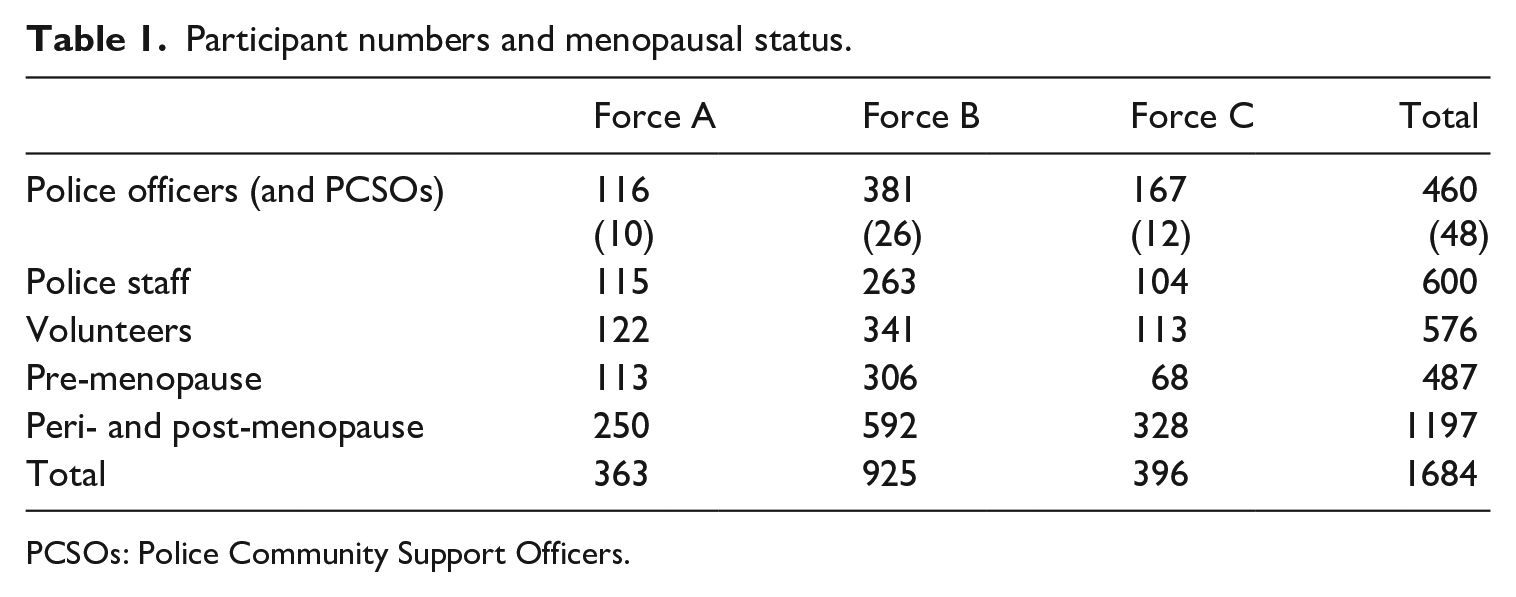
PCSOs: Police Community Support Officers.
Participants were asked about the degree, on a scale of 0–6, to which a range of 39 possible symptoms were/had been bothersome (taken from the MENQOL survey (Lewis and Hilditch, 1996); Table A2). Participants were also asked 12 questions, on a scale of 1–5, on their strength of (dis)agreement with attitudinal statements about menopausal women in the workplace (adapted from Griffiths et al., 2010; Table A3). Finally, they were asked whether they had disclosed their menopausal status (YES/NO) and 10 questions, on a scale of 1–5, on their strength of (dis)agreement with attitudinal statements about the reasons for their disclosure decision (Griffiths et al., 2010; Table A4). After each set of closed questions, a text box was provided to gather open comment and an additional open comment box at the end of the survey asked for further comment on workplace experiences of menopause. The survey also captured a range of contextual workplace and individual characteristics (e.g. working patterns, whether uniform was worn, age and gender of line manager, gender balance of the workplace).
Data relating to experiences of symptoms, captured first the material effects of menopause. All other data, both quantitative and qualitative, explored contextual influences on workplace experiences of menopause and the findings that follow, clearly evidence entanglement of the material and the discursive. Multivariate analyses were conducted to address the research questions by examining parallel propositions laid out in the online supplementary material and relating to the influence on experiences of symptoms of individual characteristics, organisational context and attitudes to menopause (research questions 1 and 2), and the likelihood of disclosure (research question 3).
First, to analyse relationships between experience of symptoms and individual/organisational characteristics, an index capturing the overall experience of symptoms summed individual scores for each of the 39 symptoms (the index takes values from 0 to 234, with a mean value of 81.5). This evidences the degree to which symptoms overall were bothersome/had bothered women. The difference between means t-tests and ordinary least squares (OLS) multiple regression analysis was then used to test for significant associations (see Table 2). Next, for attitudes to menopause, principal component factor analysis with orthogonal varimax rotation was used to describe the underlying data, a Cronbach’s alpha of 0.81 indicated sufficient intra-correlation. This identified three underlying factors (eigenvalues > 1) and correlations show how these related to experiences of symptoms (see Table 3). To understand how the likelihood of disclosure related to experiences of symptoms, attitudes towards menopause and individual characteristics, a logit regression was estimated in which the dependent variable takes the value one if menopause was disclosed (zero otherwise) (see Table 4). As the logit estimation is non-linear, odds ratios rather than coefficients are presented, as the former have a convenient linear interpretation. In addition, statistical tests explored differences across the three police forces (Table A5).
Experience of symptoms.
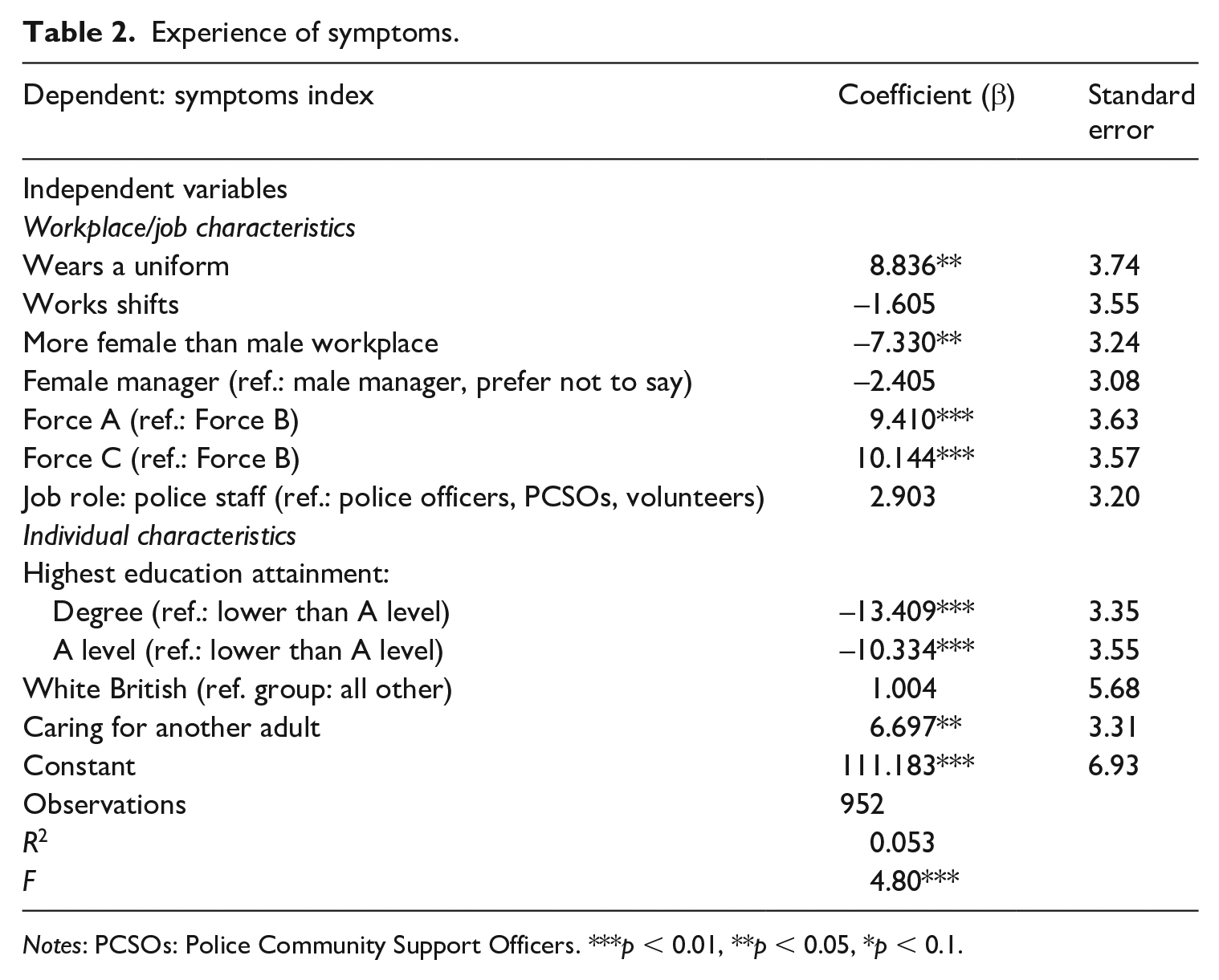
Notes: PCSOs: Police Community Support Officers. ***p < 0.01, **p < 0.05, *p < 0.1.
Correlations between experience symptoms index and attitudes towards menopause.
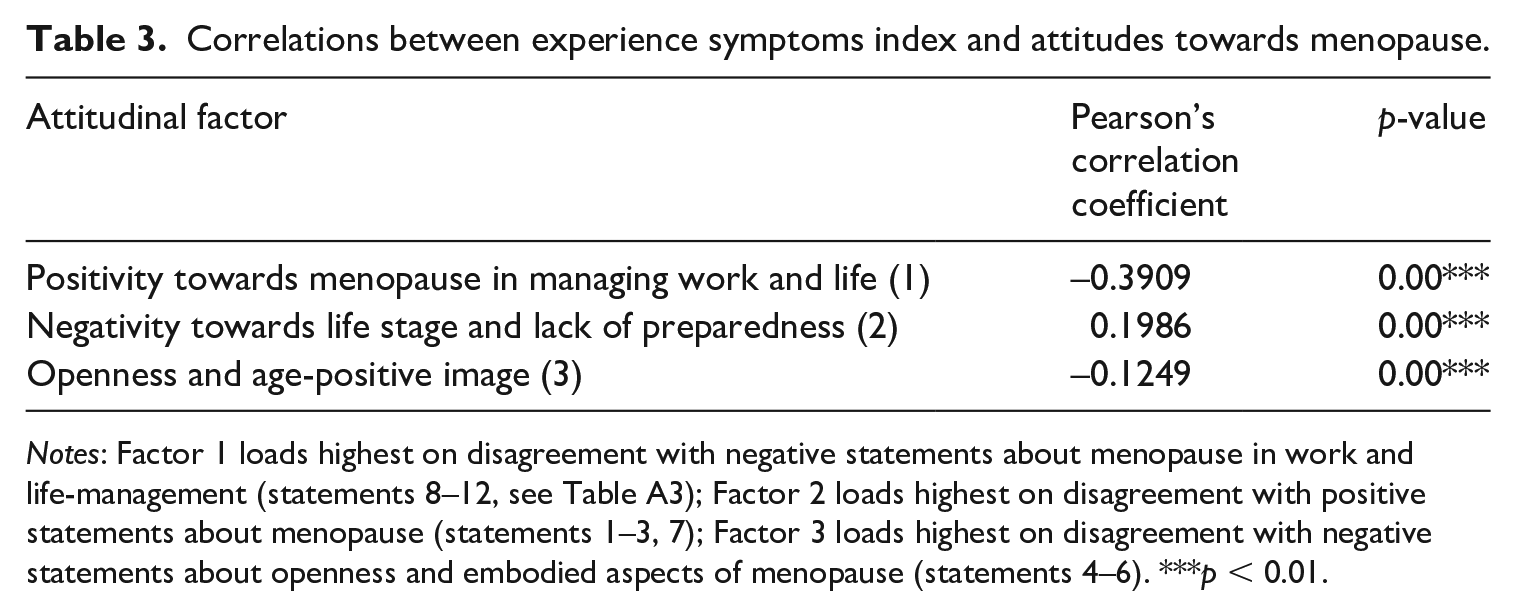
Notes: Factor 1 loads highest on disagreement with negative statements about menopause in work and life-management (statements 8–12, see Table A3); Factor 2 loads highest on disagreement with positive statements about menopause (statements 1–3, 7); Factor 3 loads highest on disagreement with negative statements about openness and embodied aspects of menopause (statements 4–6). ***p < 0.01.
Likelihood of disclosure.
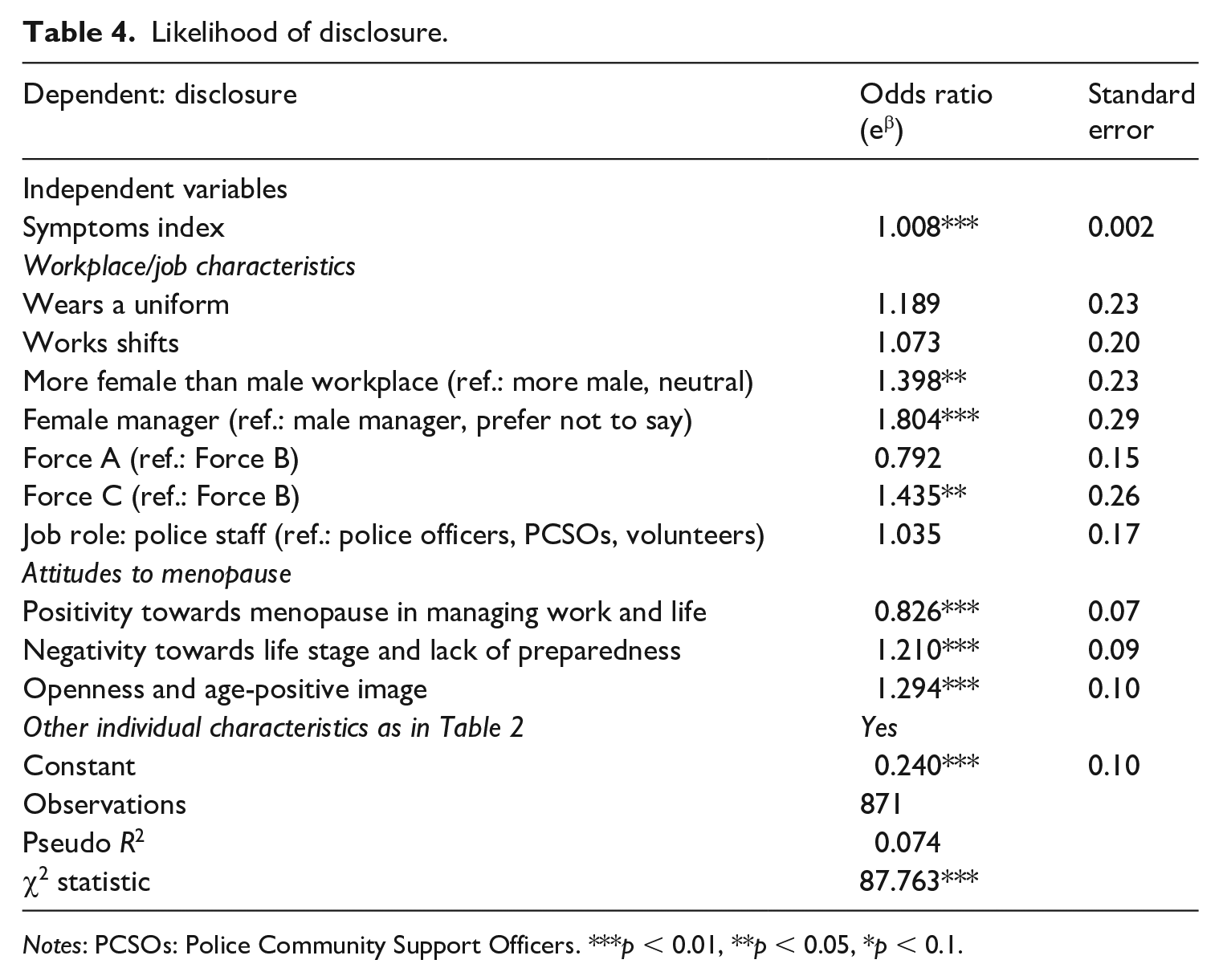
Notes: PCSOs: Police Community Support Officers. ***p < 0.01, **p < 0.05, *p < 0.1.
Quantitative data were powerful in evidencing material-discursive interplays, but offered little understanding of why. Qualitative data, however, provided substantial insight as 345 participants offered over 37,000 words of open comment. Although this may lack the depth of interview data, it provided breadth of coverage not possible in interviews and a surprising level of detail and emotion. Thematic coding (Braun and Clarke, 2006) was conducted in Excel and was informed by the research questions and quantitative findings. Codes comprised: experience of symptoms, women’s attitudes and their perceptions of line manager/peer attitudes, and decisions on disclosure. The close interplay between quantitative and qualitative data is evidenced in the findings, where regression analyses outcomes are explained through powerful quotes that evidence relationships between the material and the discursive in women’s workplace bodily experiences.
Ethical approval was gained for the project through Manchester Metropolitan University’s Research Ethics and Governance procedures. Project information was provided on the front page of the survey and participants were asked to tick a box confirming their consent to involvement. Information on sources of organisational support was also provided in this way.
Findings
Findings are presented in three parts, experiences of menopause symptoms, attitudes towards menopause and disclosure of menopausal status. In each, the descriptive statistics contained in the online supplementary material are briefly discussed (Tables A1–A5), accompanied by more in-depth discussion of the multivariate analysis presented in Tables 1–4. Open comment data, with quotes, are woven through each section to deepen understanding of contextual influences.
Experience of menopausal symptoms
The material effects of menopause were clear; mean scores for the degree to which 39 symptoms were considered bothersome (on a scale of 0–6) ranged from 0.92 up to 4.41, with an overall mean of 2.67 (Table A2). Most bothersome were (in order of importance): sleep problems, fatigue, poor memory, hot flushes, irritability, poor concentration, night sweats and feeling low or depressed. Symptoms, particularly sleep problems, fatigue and cognitive function, were often inter-related, for example:
As my main symptom has been insomnia, experienced for over three years, with many nights not sleeping at all, I have found it extremely difficult to function at work. The lack of sleep has exacerbated headaches, daytime fatigue and focus/retaining information has been a massive problem. (Force A)
Here, bodily symptoms negatively impacted on both quality of life and experience of work. The embarrassment of the intrusion of the feminine into the workplace was also apparent, particularly when bodily functions became visible:
I had to endure being stuck on a phone to Crown Prosecution Service . . . I could not end the call as the custody clock was ticking. I had a bad wave of period that soaked my clothing and through to the chair I was sitting on. I was in a busy office with men. (Force C)
OLS regressions, where the dependent variable was the symptoms index, were estimated to identify the effects on symptoms of particular independent variables captured in individual and workplace characteristics (Table 2). The results evidence the material-discursive nature of menopause transition, as symptoms were more or less troubling depending on particular characteristics and context. Significant contextual factors included: wearing uniforms, having caring responsibilities and working for Forces A and C. Conversely, older women working in more female-dominated workplaces and who were educated to A-level and above were less troubled by symptoms. Although ethnicity has been identified as impacting on menopause experiences (see, for example, Dillaway, 2005), it remains insignificant here, probably because the majority of the sample self-reports as white British (93%).
Qualitative data demonstrated the tensions generated when female bodies occupied male spaces. Participants gave examples of how bodily demands made it difficult to achieve the disembodied worker norm and its required predictability and reliability. Those wearing uniforms often found symptoms more difficult to manage:
I have nowhere to go to take my kit off when out on [the beat] having a hot flush. I have to travel back . . . to remove layers of clothing to get comfortable. I go through two to three shirts a shift . . . If I do come back in early, it is frowned upon as to why I am in, and it is difficult explaining that you are sweating – or flooded with a period . . . It’s like being back at school, when it is quite an embarrassing situation. (Force B)
Police uniforms serve to regulate appearance, removing expressions of the feminine, and here allowed for scrutiny of bodily conformity. Widespread in the data, as in the above quote, was the disapproval generated as bodies became visible and transgressed masculine norms. In the police service, bodies should be young, strong and fit, and older women’s menopause symptoms did not fit this macho discourse. Often, this led to ridicule, and negative experiences of symptoms resulted as older women’s bodies were silenced and agency lost. That symptoms were also more bothersome for women with caring responsibilities, suggests that external burdens made compliance with the ideal worker norm difficult.
More highly educated women, however, experienced less bother with their symptoms (supporting, for example, Delanoë et al., 2012; Salik and Kamal, 2015). These women were more likely to work in senior, office-based roles and have greater autonomy to make decisions around work timing and environment, evidencing an important role for agency. They had greater opportunity to minimise the visibility of symptoms, reducing bother experienced as the transgression of male norms was avoided. Symptoms were similarly less bothersome in more female-dominated workplaces, suggesting a capacity for mutual support and understanding. This is explored more fully below. Finally, context was important as experiences of symptoms varied across forces, with participants from Force B (the reference group) being less bothered by symptoms (Tables 2 and A5). This may in part relate to higher educational attainment, more female-dominated workplaces and more female managers in Force B than in the other forces (Table A5). They also, however, had more positive attitudes to menopause in relation to managing work and life (Table A5 and discussed further below), which may have resulted from a very senior female leader in that force championing a programme of menopause support.
Attitudes towards menopause
Bodies are made meaningful by the actions of self and others (Gilleard and Higgs, 2018) and this was reflected in attitudes displayed towards menopause (Table A3). A majority agreed that menopause was a natural stage of life and a release from having to think about periods and contraception, but only just over half were prepared for menopause. Although few saw it as a positive new phase, agency via reflection was possible, as Jack et al. (2019) also found, and in open comment some women talked positively about entering a potentially enriching, life stage:
I personally think this period is one that should be enjoyed and appreciated as there are so many positives. Being older is very releasing. . . . I am getting old but am happy to embrace it and experience all aspects of life. (Force A)
There were other comments in a similar vein: one participant suggesting that it is a stage that brings ‘maturity, wisdom and greater self-assurance’ (Force B) and another that said: ‘I actually feel very lucky to have the menopause’ (Force C), as she had lost loved ones before they had reached menopause.
Yet the materiality of bodies did entangle with discourses of decline and deficiency, with a third of women indicating that they felt less attractive, reflecting the sexual redundancy described by Hyde et al. (2010), and that ‘my body is letting me down’ (Force C). While only a minority agreed that menopause meant they did their job less well, just over half indicated they needed to make more effort to maintain job performance and a similar proportion that it was harder to manage life. The intrusion of their ageing bodies into the workplace rendered ever more illusory the unencumbered ideal worker. Women also feared the negative attitudes of managers and colleagues, a sizeable minority agreeing that menopausal women were perceived as less competent. Concerns over gendered ageism were frequently expressed:
[Menopause] is something else that makes women a less desirable commodity in the workplace. As an older woman, I thought I was genuinely now on a level playing field to men, but if ‘menopause’ becomes another issue . . . it’s something that I could be prejudged on. (Force A) I feel like there is an expectation that my work will suffer because I’m of a certain age and that isn’t the case . . . I don’t want to feel stigmatised just because of my age. (Force B)
The potential workplace benefits of ageing, that the career disadvantages of pregnancy and child-rearing were behind them, thus failed to materialise amidst negative perceptions of older, menopausal bodies. Many felt they had much to give and were aged more by culture than biology in an environment where in open comment women suggested that they had been laughed at, made to feel stupid and belittled, or were seen as not pulling their weight:
It’s just seen as a laugh [menopause] and you’re fair game to poke fun at, which absolutely destroys your confidence. (Force B) I was made to feel like the naughty officer that was ‘swinging the lead’. (Force C)
The male body was valorised and menopausal women became the other (supporting Kringen and Novich, 2018) amidst displays of homophile behaviour. Women absorbed and enacted hyper-masculine norms within a police service culture of self-reliance, arguing ‘we are police officers, we just get on with it’ (Force C).
Organisational neglect of their bodies was evident in lack, for the most part, of supporting policy, with women left to devise their own coping strategies. Notably, however, in Force B, which had undertaken a substantial programme of work in relation to menopause support, women displayed the most positive attitudes towards the menopause in relation to managing work and life (Table A5):
I feel very lucky to work for such a forward-thinking force . . . They’ve moved attitudes from stigmatism to openness and acceptance. This makes me feel more valued in my role and consequently I think makes me better at my job. (Force B)
Analysis exploring relationships between these attitudes and experiences of symptoms clearly evidenced a material-discursive interplay. Three underlying factors in the attitudinal data explained 61% of the overall variance: ‘Positivity towards menopause in managing work and life’, ‘Negativity towards life stage and lack of preparedness’ and ‘Openness and age-positive image’ (Table 3). Pairwise correlations between the symptoms index and the attitudinal factors indicated that more positive attitudes were associated with less problematic experiences of symptoms. In particular, the large negative correlation between symptoms and positivity towards menopause in managing work and life suggests that women’s individual discourses on menopause have important implications for workplace experiences. However, the interpretation of these associations is complex, since causality is likely to be bi-directional, reflecting the interplay between the material and the discursive.
Disclosure of menopausal status
The intrusion of bodies into the workplace led to secrecy and concealment of its (female) functions and needs (supporting Grandey et al., 2020), and the majority of women (61%) had not disclosed their menopausal symptoms to their line manager. Reasons for non-disclosure included concerns over being regarded as less competent; line manager gender and age; that it would be embarrassing to disclose; and because it was a private/personal subject (Table A4). Logit regression analysis shows that, even after controlling for attitudes, disclosure was positively linked to the extent to which symptoms were experienced as bothersome; for a standard deviation (43.44) increase in the symptoms index, the odds of disclosure increase by a factor of 1.426 (or 42.6%, p < 0.01), holding all other variables constant (Table 4). Results also evidence the influence of context. Disclosure was more likely in a more female workplace (the odds of disclosure are higher by 1.398, just under 40%, p < 0.05), with a female manager (the odds are higher by 80.3%, p < 0.01) and in Force C (being employed in Force C rather than Force B increases the odds of disclosure by 43.5%, p < 0.05). Attitudes also played an important role. Negativity towards life stage and lack of preparedness, for example, were related to women being more likely to disclose (for a standard deviation, 1.005, increase in negativity, the odds of disclosure increase by 21.1%, p < 0.01), as was openness and age positivity (for a standard deviation, 0.98, increase in openness, the odds increase by 25.8%, p < 0.01). However, positivity towards menopause in managing work and life meant women were less likely to disclose (a standard deviation, 1.015, increase in positivity reduces the odds of disclosure by 17.6%, p < 0.01).
That women who had worse experiences of symptoms or were unprepared for menopause were more likely to disclose, presumably related to their symptoms being more problematic at work. Conversely, those who could manage symptoms without disclosure chose to do so, perhaps also linked to lower disclosure by those with positive attitudes towards menopause in managing work and life. This may also, however, result from the masculine ‘just get on with it’ norms and culture of self-reliance discussed above (see, also, Yates et al., 2018). Concerns were also expressed about attempts to normalise discussion of menopause in a hyper-masculine environment:
Talking about the menopause is another reason to ridicule, embarrass and talk down to the females. (Force C) There is more emphasis on the menopause at the moment, it seems an ‘in’ term . . . If this goes too far it will be detrimental to women. We have fought hard for equality, but people will start to think [older] women . . . are less able to do their work, and a group apart. (Force B)
Fears about gendered ageism thus reappeared in a context that valorised fit (implicitly young, male) bodies and engaged in homophile behaviour that stigmatised older women who failed to comply with ideal worker norms. Grandey et al. (2020) suggest that disclosure reduces stigma but resistance to its discussion and concerns about the personal/professional divide were apparent here, even in Force B, which had been the most proactive in developing menopause policy, given its challenge to dominant masculine norms and the resultant potential for disadvantage:
I feel like it is becoming the new ‘flavour of the day’ and therefore colleagues, who are not going through it, are getting to the point where they think it is ‘overkill’. (Force B)
‘Colleagues’ here refers to both men and other (younger) women not experiencing menopause transition, both of whom enacted male norms.
Contextual influences were further evidenced in that disclosure was more likely in female-dominated workplaces with female managers. In male-dominated spaces, participants commented: ‘It’s hard to talk properly with my line manager as he is a young man’ (Force B) and ‘Working with an all-male police management team, I would not have mentioned it under any circumstances’ (Force C). Even where women did not disclose, they risked being stigmatised and excluded as their ageing bodies were viewed with suspicion and disdain:
Because most of my colleagues were male, I didn’t speak about it, but I have no doubt they looked on me as having some problems. At one point, I worked alone because nobody wanted to work with me. (Force A) My line manager isn’t someone who I would trust to discuss the effect of peri-menopause with. He is not understanding and would definitely see me as weak . . . (Force B)
Underlying this was a fear of transgressing the ideal worker norm, standing out as different to (and weaker than) the male majority and losing credibility by drawing attention to their menopausal status. Context was thus inextricably entangled with bodily symptoms and the particular effects of the hyper-masculine police service context were evident.
These findings demonstrate the mutual entailment of the material and discursive (Orlikowski and Scott, 2015) in menopause transition. They evidence the material effects of menopause, its bodily symptoms and how these experiences were mediated by context (as per Ussher, 2008), where both individual and organisational characteristics affected women’s experiences of menopause (supporting Hardy et al., 2018). Age and gender discourses combined with biological transition (as suggested by Grandey et al., 2020) to impact experiences of menopause to, usually, negative effect. Within this, the findings reflect some, albeit limited, agency for women (as per Jack et al., 2019). Despite this, negative attitudes prevailed and disclosure of menopausal status was limited due to masculine norms and the particular police service context.
Conclusion
This article has explored gendered ageing at work through examination of the embodied experiences of women undergoing menopause transition in a male-dominated sector, the UK police service. Building upon existing research that has challenged the idea that menopause is a universal phenomenon (Delanoë et al., 2012), this research points to how experiences of menopause differ and supports Ussher’s (2008) material-discursive approach whereby the materiality of bodies is mediated by context. Gendered ageing as both a bodily experience and a phenomenon shaped by contextual influences is clearly demonstrated (Riach et al., 2015). Within this, there was space for agency, with women having capacity (albeit often limited) for positive reflection on the menopause and resistance to the gendering processes they encountered (Jack et al., 2019). Women who were more aware and better prepared for menopause appeared to manage its symptoms more effectively. While this challenges Gullette’s (2004) view of menopause as a ‘magic marker’ of decline, the penalty suffered by older women who failed to comply with the ‘genderless’ ideal worker norm that is so embedded in organisational cultures, systems and processes is nevertheless clearly evidenced (Acker, 1990). As Morgan et al. (2017: 76) highlight, there is often a tendency to dichotomise between the ‘the neutral employee or manager without body, gender and sexuality’ on the one hand and the ‘female employee or manager’ on the other. Fotaki and Harding (2018: 76) extend this analysis by drawing on De Beauvoir’s argument that ‘the male is somehow able to transcend the body while women remain immanent to a flesh that is marked as close to nature’. Thus, female employees are positioned as ‘other’ and a potential challenge and/or problem to the rational and efficient order of organisations (Höpfl, 2003), exacerbated by the hyper-masculine police service environment (Dick, 2009; Kringen and Novich, 2018). It was common for women to hide their femininity (Höpfl, 2003) (and symptoms) in order to cope, which resulted for many in silencing of their bodies (Kringen and Novich, 2018) and any discussion of menopause.
This research is empirically novel in that it explores menopause transition through an embodiment lens, surfacing gender to draw on a wider tradition of embodiment research (e.g. Kringen and Novich, 2018; Lee, 2018). Its theoretical novelty is in drawing age into an exploration of embodiment and, in particular, its intersection with gender. There has long been recognition that Acker’s (1990) ideal worker is implicitly male, but here analysis demonstrates that it is also implicitly young. This is particularly so within a police service context that demands strength, fitness and the ability to ‘battle through’ (Yates et al., 2018). Menopause symptoms were a marker of older, female bodies and negative attitudes about older women’s capability and contribution abounded and created reluctance to disclose. Using an embodied lens to explore gendered ageing, a relatively recently recognised phenomenon (Riach et al., 2015), offers great insight into the substantial disadvantage that older women, particularly in menopause transition, experience and, as others have noted, that this is greater than that experienced by older men (Atkinson et al., 2015).
While an embodied approach brings consideration of bodies into the workplace, it is important to recognise the risk of essentialising women through constructing them as somehow more embodied than men and ‘positioning the female body (smaller, weaker, leakier than its masculine counterpart) once again as inferior’ (Fotaki and Harding, 2018: 163). This is particularly so for older, menopausal women for, as Carter (2016: 209) reports, ageing is particularly hard for women as it ‘symbolises a loss of control over their bodies’ which, she argues, engenders a feeling of personal responsibility for regulating the body. This speaks to neo-liberal discourses of individualism, agency and self-surveillance, as well as a focus on the body. These concerns were clearly shared by some participants who argued that they did not want special treatment and feared a backlash from the attention given to menopause. Gendered ageism was widely apparent and challenging this requires the careful navigation of these tensions. Yet the experiences of gender and age are inseparable, both from each other and from larger economic and social dynamics. As the workforce ages and older women are present in rapidly increasing numbers, organisational and individual positions that facilitate open discussion of, and effective responses to, menopause transition are essential.
This article makes a number of important contributions. First, empirically, to the understanding of how menopause transition is experienced in the workplace. Second, to the theorising of embodiment in moving beyond a focus on gender. This article demonstrates the intricate web woven by intersections of age and gender as reflected in women’s embodied experiences of menopause and demonstrates the importance of an approach to embodiment that captures age. Critical to this is the material-discursive approach to exploring embodiment that recognises both the materiality of the body and contextual influences and allows women the capacity for agency, reflection and resistance (Jack et al., 2019; Ussher, 2008). The article also makes a practical contribution in evidencing the need for a supportive organisational culture in enabling women in menopause transition to maintain dignity at work and fulfil their potential.
The research has limitations, predominantly that it is a cross-sectional, single-sector study. While the inclusion of qualitative data addresses some shortcomings of cross-sectional quantitative data, context is important and is restricted here to the police service. As demonstrated, this is a very particular environment and studies of other contexts, including manufacturing and front-line service roles such as care and retail, would be of benefit. The study also focuses on older, female workers’ views. Investigation of the views of managers and younger and male co-workers would also provide a more nuanced understanding of menopause transition in contemporary workplaces. Other theoretical positions might also be of relevance: Grandey et al. (2020), for example, call for examination of disclosure decisions through a stigma lens. Finally, it would also be fruitful to examine men’s experiences of gendered ageing at work.
Supplemental Material
sj-pdf-1-wes-10.1177_0950017020971573 – Supplemental material for The Menopause Taboo at Work: Examining Women’s Embodied Experiences of Menopause in the UK Police Service
Supplemental material, sj-pdf-1-wes-10.1177_0950017020971573 for The Menopause Taboo at Work: Examining Women’s Embodied Experiences of Menopause in the UK Police Service by Carol Atkinson, Fiona Carmichael and Jo Duberley in Work, Employment and Society
Footnotes
Funding
The authors received no financial support for the research, authorship, and/or publication of this article.

Supplementary material
The supplementary material is available online with the article.
Notes
References
Supplementary Material
Please find the following supplemental material available below.
For Open Access articles published under a Creative Commons License, all supplemental material carries the same license as the article it is associated with.
For non-Open Access articles published, all supplemental material carries a non-exclusive license, and permission requests for re-use of supplemental material or any part of supplemental material shall be sent directly to the copyright owner as specified in the copyright notice associated with the article.
