




Abstract
This paper responds to recent calls to study how materiality is implicated in the process of subject positioning by grounding itself in a relational and performative ontology. By situating our analysis in Barad’s post-humanist view of discourse as material-discursive practice, and by drawing on the concepts of interpellation and hailing, we show how material-discursive practices at three different service sites of the Swedish Migration Board are profoundly constitutive of the manner in which asylum seekers and officers become hailed into various subject positions. In so doing, our study contributes to the development of a post-humanist understanding of how subject positions are enacted and governed within organizations. More precisely, we move beyond the conception of the intentional human and the non-intentional non-human in order to foreground the manner in which mundane material-discursive practices always and already condition (or govern) the possibilities for subjects (and objects) to be and to act, specifically and immanently. Thus we suggest that matter and soul are intertwined in ways that make their separation less convincing, if tenable at all.
Introduction
In a fluid and fragmented society in which individuals are confronted with multiple and fast-changing sources of identification, assuming some notion of identity, that is, something distinct, stable and enduring, becomes not only challenging but also unconvincing (Alvesson, Lee Ashcraft, & Thomas, 2008; Braidotti, 2013; Knights & Clarke, 2017). Acknowledging the ephemeral nature of organizational realities, scholars have thus started to move away from reductionist and essentialist conceptions of identity and embraced a view of the subject as always in the process of becoming, continuously (re)produced in discursive practices (Brown & Lewis, 2011; Harding, Lee, & Ford, 2014; Hardy, Palmer, & Phillips, 2000; Kenny, 2010; Kuhn, 2009; Laine, Meriläinen, Tienari, & Vaara, 2016; Meriläinen, Tienari, Thomas, & Davies, 2004). In this ongoing becoming, subjects are not bounded, stable entities, but rather a number of subject positions made available to the individual, in and through discourses, which prescribe certain ways of being and acting as appropriate and legitimate (Butler, 1993a; Hall, 2000). Thus, in this literature, the subject finds itself always and already positioned, discursively, as it attempts to position itself in doing what is referred to as ‘identity work’ (Hall, 2000; Sveningsson & Alvesson, 2003). In acknowledging this fact, we want to orient ourselves to this prior subject positioning by attending more carefully to its situated and material-discursive enactment. Although the literature on subject positioning – and by implication ‘identity working’ – in organization studies has established new ground in studying practices of subject formation from a post-structural perspective, this work has been criticized for its narrow definition of discourse as ‘text’, which tends to limit and obscure the degree to which the enactment of certain subject positions is already governed by the situated material arrangements of daily work practices (Bardon, Clegg, & Josserand, 2012; Bisel & Barge, 2011; Harding, Ford, & Lee, 2017; Paring, Pezé, & Huault, 2017; Rennstam, 2012; Symon & Pritchard, 2015). As a result, a number of scholars have called for studies that consider the ways in which material-discursive arrangements work to produce the conditions of possibility for the enactment of particular subject positions (Alvesson et al., 2008; Bardon et al., 2012; Harding et al., 2017; Knights & Clarke, 2017; Paring et al., 2017; Symon & Pritchard, 2015).
In responding to these calls, we locate ourselves within the performative tradition in which agency is not attributed to individual actors – doing assumed identity work – but rather flows continuously through practices and constitutes the conditions of possibility under which the subject becomes positioned to be and act (Barad, 2007; Butler, 1993a). In our paper, we draw on the theory of interpellation (Althusser, 2006a, 2006b; Butler, 1990, 1993a, 1997a, 1997b). However, by situating our analysis in Barad’s (2003, 2007) post-humanist understanding of discourse – as the specific material-discursive (re)configurings of the world through which the determination of boundaries, properties and meanings is differentially enacted (Barad, 2007) – we provide an account that contributes to the development of a notion of interpellation no longer centred on the human. That is, the ongoing processes of subject positioning are always and already governed in and through a heterogeneous multiplicity of mundane material-discursive organizational work practices.
The location for our study is the reception unit of the Swedish Migration Board in Stockholm. More specifically, our study is situated within the material-discursive practices at three different sites: the old reception area, which was located in a former police station; the current reception area, which is located in an office building; and the new national service centres that are currently replacing reception sites across the country. Our study shows how, at these various sites, the officer and the asylum seeker become interpellated in very different ways. In our analysis and discussion, we show how these differences lie in the conditions of possibilities provided in and through different subject positions, which are enacted in and through the performative flow of material-discursive practices.
Our study thus contributes to extant post-structural literature on the enactment and governing (Foucault, 1982) of subject positions (Bisel & Barge, 2011; Brown & Lewis, 2011; Harding et al., 2014, 2017; Hardy et al., 2000; Kenny, 2010; Kuhn, 2009; Laine et al., 2016; Meriläinen et al., 2004; Paring et al., 2017; Rennstam, 2012; Symon & Pritchard, 2015) by foregrounding the situated, material-discursive and performative nature of this process. Specifically, through the development of a post-humanist understanding of interpellation, we show how the relationships among human subjects and the material objects and technical artefacts that engage them in everyday work practices can be understood, not primarily as an interaction among separate and distinct beings in which the intentional and interpretive human has a privileged position, but as an ongoing flow of material-discursive practices, which performatively enact both the subjects and the objects that it purports. Ultimately, our case and analysis raise more fundamental questions about the assumed division between the ‘inside’ and the ‘outside’, as enacted in mundane material-discursive work practices. Indeed, we will suggest that matter and soul are intertwined in ways that make their separation less convincing, if tenable at all.
The Discursive Positioning of the Subject: A Human Endeavour?
In common for many post-positivist perspectives such as social constructivism (Berger & Luckmann, 1967; Dutton, Roberts, & Bednar, 2010) and critical realism (Fleetwood, 2014; Mole & Mole, 2010) is the notion of a more or less sovereign human subject, who possesses a singular self, and a knowing mind, that relates to the world and re-presents it, more or less accurately in language (Hosking, 2011). In these perspectives, ‘construction’ is a more or less autonomous process initiated by a prior subject. Discourse and power are single acts that can be attributed to a single actor (Salih, 2002). Post-structural accounts, on the other hand, do not accept the idea of a more or less bounded subject that proceeds to relate to a separately existing ‘other’. In these accounts, ‘construction is neither a subject nor its act, but a process of reiteration by which both “subjects” and “acts” come to appear at all. There is no power that acts, but only a reiterated acting that is power in its persistence and instability’ (Butler, 1993a, p. 9).
From this perspective, it is not possible to speak of ‘identity’ per se, since such a notion would require a subject that a relational ontology does not accept as valid. Rather ‘identities’ are taken as ‘points of temporary attachment to the subject positions which discursive practices construct for us’ (Hall, 2000, p. 19, emphasis added). Indeed, it is exactly for this reason that it is possible to govern the ‘identity’ formation practices of organizational practitioners – through discourses and other symbolic means – which provide storylines and associated subject positions suggestive of how organizational members should think about themselves and their work (Alvesson & Wilmott, 2002; Davies & Harré, 1990).
In this literature on subject positioning, the most significant governing agency is normally identified in organizational members’ own discursive practices – for example, in their talk about organizational routines (Brown & Lewis, 2011), organizational strategies (Harding et al., 2014; Laine et al., 2016), professional careers and identities (Meriläinen et al., 2004), corporate power and ethics (Kuhn, 2009), new public management (Thomas & Davies, 2005), or their everyday professional lives (van Laer & Janssens, 2011). In these accounts, subjects are simultaneously enacted and governed in and through these very same discursive practices – they make talk and are made by talk. Although we agree with much of this literature, it has been argued that the ways in which materiality is constitutive of discourses and practices – and thus of the enactment and governing of subject positions – have been largely neglected (Bardon et al., 2012; Bisel & Barge, 2011; Harding et al., 2017; Paring et al., 2017; Rennstam, 2012; Symon & Pritchard, 2015). Acknowledging this neglect of materiality, these studies have adopted different sociomaterial perspectives to study subject positioning as an imbrication (Leonardi, 2011; Paring et al., 2017), as a mangle (Pickering, 1993; Symon & Pritchard, 2015) or as interactions (Rennstam, 2012) of discourses, artefacts and bodies through which subject positions emerge and are reproduced.
What these studies have in common (apart from their important contributions to pushing the debate beyond discourse) is a more or less explicit assumption that humans and objects in the material world have their own, independent ontological existence. In these accounts, the entanglement or imbrication is taken as empirical, rather than as ontological. Moreover, in these accounts, the original agency (and intentionality) is most often ascribed to the human actor. In other words, humans are assumed to be the actors who ultimately elect, more or less explicitly, how they respond to the material actors that engage them (Leonardi, 2011; Pickering, 1993; Symon & Pritchard, 2015). For example, even in Harding et al.’s (2017) account, which is indeed explicitly grounded in a performative approach (Barad, 2007; Butler, 1990, 1993a), the speech-acts performed by human actors are foregrounded at the expense of the performativity of the material-discursive practices. While materialities such as bodies, clothes and boardroom tables, figure in the account, they are backdropped and enacted, for example, as ‘resources used against female-speaking-subjects seeking control of the organizational stage’ (Harding et al., 2017, p. 27). In this understanding, the materiality of objects clearly matters. Nonetheless, they matter mostly as an external regulator of assumed self-formation practices – thus enacted as some sort of bridging mechanism between the ‘internal’ and the ‘external’. In other words, the subject becomes enacted as transcending the contingent and situated context of its enactment. Such an understanding serves to give credence to the idea that rational and intentional strategies can be deployed in order to procure more or less stable selves, which can then become more productive, creative and legitimate organizational members – a view that Knights and Clarke (2017) are very critical of.
Together with other scholars aiming to move beyond a dualistic, essentialist view of the subject-object relation (Barad, 2007; Ingold, 2007, 2015; Introna, 2013; Orlikowski & Scott, 2015), we argue that in assuming that the governing agency is located within, or in the interaction between, the assumed separate entities or actors (social or material), we forfeit the possibility to account for how these actors are always governed by being already positioned in certain ways within the performative flow of material-discursive practices.
In the following section, we discuss how the concept of interpellation (Althusser, 2006a, 2006b; Butler, 1990, 1993a, 1997a, 1997b), combined with Barad’s (2003, 2007) post-humanist view of discourse, can help us refrain from the tendency to reproduce assumptions of subjects and objects as separate entities, and identity as a realizable goal, and to foreground the manner in which mundane material-discursive practices always and already condition (or govern) the possibilities within which all subject and object positionings become taken as meaningful ways to be and act.
The Hailing of Material-Discursive Practices
The notion of interpellation in social sciences is associated in particular with the work of the French philosopher Louis Althusser. In his essay titled ‘Ideology and ideological state apparatuses’ (2006a), Althusser uses the term interpellation to describe the ‘hailing’ of a person into her or his social and ideological position. Althusser uses the example of a policeman calling out, urgently and commandingly, ‘Hey, you there!’ to a man on the street. By calling out, the policeman interpellates the man as a subject of a certain kind (a suspect). The man for his part, by turning around, takes up this position as such; by the mere act of turning his body 180 degrees, he becomes a particular subject. Thus, it is this prospect that subjects can be subjected to an address – by other subjects – that constitutes the conditions of possibility for them to become subjects of a particular kind. In this manner, a subject is originally a position or a positioning – that is, the address implied in the act of hailing. Similarly, Davies and Harré (1990, pp. 48–50) suggests that the interpellative hailing happens through the way situated discursive interactions provide a normatively governed storyline (or grid of intelligibility) that cites certain subject positions – or normal character parts within the unfolding story – which are then taken up by those involved in their ongoing interaction. For example, if I, at a funeral, say to a member of the family ‘I am sorry for your loss’ and they reply ‘thank you’,’ then in so replying they take up the cited subject position of ‘the bereaved family member’. As this interpellation becomes repeated, as part of the unfolding event, they become repeatedly positioned as such, and take themselves to be exactly that, ‘a bereaved’ family member, – with all its associated and norm-governed ways of being and acting.
Building on these conceptualizations, Butler further develops the theory of interpellation by insisting on the need to understand it, not as a singular act, but as a citational and recurring constitutive practice that depends on a normative context and convention that exceeds the interpellator (Butler, 1997a, pp. 32–3). In this way, the policeman in Althusser’s example is not in complete control of his speech but repeats the conventional practice of hailing. The ‘I’ neither precedes nor follows the process of interpellation, rather, the subject emerges within and through this process. Similarly, ‘although Althusser posits a subject who turns around and reflexively appropriates the term when she or he is called, Butler asserts that the constitution of the subject may take place without the subject’s even registering the operation of interpellation’ (Salih, 2002, p. 106). In this formulation, interpellation is what provides the subject’s ongoing condition of possibility – indeed, it is the very precondition of its agency.
How can we understand the role of materiality in the process of interpellation? Both Althusser (2006a, 2006b) and Davies and Harré (1990) acknowledge the material nature of discourse and thus of interpellation. However, in foregrounding discursive practices and the actors (re)producing these practices, materiality becomes enacted as a structural (or structuring) background separate from discourse, rather than as an ongoing co-constitutive process, always and already implicated in performative enactments. In Butler’s (1993a) attempts to resolve the agency-structure, passive-active, nature-culture dualisms, she proposes that we understand matter as a ‘process of materialization that stabilizes over time to produce the effect of boundary, fixity, and surface we call matter’ (p. xviii). This conceptualization of matter brings to the fore the importance of recognizing matter in its historicity and directly challenges representationalism’s view of matter as a static entity, surface, support, or as a passive and blank slate awaiting the active inscription of culture. However, in her critique of this conceptualization, Barad (2007, pp. 150–1) has argued that, in the recognition of matter’s historicity, Butler assumes that the meaning of materiality is ultimately derived (yet again) from the agency of language or culture. Barad (2007) argues that, in Butler’s analysis, matter becomes enacted as a passive product of discursive practices rather than as an active agent participating in the very process of materialization. In other words, materiality is only analysed in terms of how discourse comes to matter and fails to analyse how matter comes to already matter (Barad, 2007, pp. 150–1).
In our work, we build on the theory of interpellation and hailing (Althusser, 2006a, 2006b; Butler, 1990, 1993a, 1997a, 1997b) and attempt to extend it beyond the realm of its humanist, anthropocentric and mostly discursive interpretation. We do so by drawing on the agential realism of Barad in which matter is not simply ‘a kind of citationality’ (Butler 1993a, p. 15), the surface effect of human bodies, or the end product of linguistic or discursive acts. Rather, it is an ongoing material-discursive enactment ‘through which the determination of boundaries, properties, and meanings is differentially enacted’ (Barad, 2007, p. 148). This material-discursive approach means that material objects, human subjects, structure and agency do not pre-exist as such, and they are never pure cause, nor pure effect. Rather, they emerge as part of the world in its open-ended becoming – intra-actively, that is, relational enactments without pre-existing relata (Barad, 2007, p. 50). While other conceptualizations of interpellation (Althusser, 2006a, 2006b; Butler, 1990, 1993a, 1997a, 1997b; Davies & Harré, 1990) privilege linguistic performances – and the subject positioning enacted through interpellation requires a more or less intentional human actor (who the subject is positioned in relation to) – an agential realist view of interpellation posits it as an ontological performance of the world in its ongoing material-discursive articulation.
In an agential realist account of interpellation, it is not the actors, human or material, that hail, as such. Rather, hailing occurs as the flow of material-discursive practices constitute, collectively and continuously, conditions of possibility for certain subject (and object) positions to appear as obvious and legitimate ways to be and to act – implicitly governing (Dean, 2009) the practices of self-formation of those implicated. One might also say, following Davies and Harré (1990), that the situated flow of material-discursive ensembles provides a normatively governed scenery (and associated storylines), which cite certain subject positions as obvious and legitimate ways to be and act. Think, for example, how the flimsy queuing barriers, the lines on the floors, the lighting, the many notices, etc. at airport security, hail us to take up the position of the docile queuing subject, waiting to be scanned and searched, in the flow of material-discursive practices we might usefully denote as ‘getting ready to go on board’.
By assuming Barad’s (2003, 2007) posthumanist view of discourse, as material-discursive, and by working through the concepts of interpellation and hailing as accounted for by Butler (1990, 1993a, 1997a, 1997b) and Althusser (2006a, 2006b), our following account responds to recent calls to study how materiality is implicated in the process of subject positioning from a relational and performative ontological perspective. In discarding the constructivist and critical realist separation of structure and agency, human and material, subject and object, and instead, studying the material-discursive practices through which boundaries defining normative behaviour and meaningful categories are drawn, we create a post-humanist account of how subject positions are enacted and governed within organizations. Specifically, we show how material-discursive practices at the three different service sites of the Swedish Migration Board are profoundly constitutive of the manner in which asylum seekers and officers become hailed into different subject positions (and likewise with objects).
Research Methodology
Data collection
The fieldwork for this study was conducted by the first author beginning in November 2012. The approach was explorative and initially focused on the introduction of the ‘lean’ management philosophy (Womack & Jones, 2010) at the Swedish Migration Board. The first part of the study focused on the examination unit of the board and continued throughout the spring of 2013. Building on insights from this first explorative study, and our intellectual resources, our focus gradually shifted away from the interpretations and translations of lean management practices toward the subject positioning performed in the daily work practices of the operational staff. Starting in January 2014, the first author conducted four months of observations of the operational work at the reception unit in Stockholm. She began her fieldwork just as a group of seven newly employed case officers joined the unit and participated in the same week-long training programme. She had regular close contact with two newly employed junior officers during the months of fieldwork. Accompanying these officers provided opportunities to interview and observe many of their colleagues and managers. More recently, in early 2017, the first author spent one day observing the operations in the new Gothenburg service centre – which was developed in accordance with a national standard and which will inform the main design and operational practices of the new Stockholm service centre, more or less directly.
While our data includes observations of diverse operational practices at the reception unit, this paper is primarily based on observations of those in the reception area. We chose to focus on this operational space because the recent move to new office facilities, as well as the ongoing work to develop new, national service centres, provided a rare opportunity to study how the subject positioning of the case officers were governed in different material-discursive sites. During observations in the reception area, the field researcher sat or stood next to the case officers and observed and took notes of how the meetings between the officer, the applicant and the interpreter evolved, how people moved around the reception area, and how various materialities were engaged in the operational practice. As our fieldwork progressed and as we gained a deeper understanding of the reconfigurations of material-discursive practices over time (from the old reception, to the current reception, to the service centre) we became increasingly aware of the way certain assumed subjects (the officers and the applicants) and certain assumed objects (the reception counters and the queue ticket system) became implicated (and enacted) in the material-discursive practices of ‘receiving the asylum seekers’ at the SMB.
Complementary to these observations, a total of 67 interviews were conducted with staff members from all professional categories and management levels. Twenty-eight of these interviews were conducted with staff members who had experience working in the reception area. Most interviews focused initially on current operational practice, that is, on the nature of a work day in the reception area. The questions were designed to provide a situated and nuanced sense of the flow of current work practices and how interviewees saw themselves and their responsibility as professionals. When interviewees made reference to past experiences or commented on future plans, they were encouraged to elaborate their accounts. The majority of interviews were recorded and transcribed.
Our data collection does not include interviews with asylum seekers, for two reasons. First, acquisition of such data would have been problematic from a research ethics point of view, given the power asymmetries involved, thus raising serious doubts as to the degree to which consent could have been knowingly and freely given. Second, in decentring the human we wanted to observe the performative flow of the material-discursive practices. Thus, it was more important to observe how they conducted themselves, in the flow of the material-discursive practices of the reception area, than to ask them what they thought, or why they acted in a certain way. Having said that, we do not discount the possible value of this type of data (as is evident from our interviews with officers) and we would have pursued it had there not been significant ethical questions at stake.
Data analysis
In assuming a performative view, we acknowledge the performative nature of the epistemic practices involved in our data collection and analysis (Barad, 2007, p. 361). This means that we do not assume that we as researchers exist as separated knowing individuals who construct knowledge about others. Moreover, we do not believe our discursive account represent, refer to, or ‘mirror’ a non-linguistic ‘real’ world of objects (Barad, 2007, pp. 87–8). Rather, our performative approach implies that just as we assume our subjects of study do not exist outside material-discursive practices, we assume that we as researchers are continuously enacted and reconfigured in (and at the same time reconfiguring) these practices (Barad, 2007; Koro-Ljungberg & Mazzei, 2012; Kuntz & Presnall, 2012; Introna, 2013; Lorino, Tricard, & Clot, 2011; Sørensen, 2013). Such an assumption requires a shift in focus, from the doings of predefined actors (social and material) to the constitutive conditions that allow particular doings to seem obvious, meaningful or legitimate. It is a shift from ‘what is’ and ‘what is likely to be’ to the ‘how’, to the ways relational processes (re)produce particular relational enactments (e.g. subjects and objects) and constrain other possible enactments.
Besides careful notetaking of observations and experiences in the field, photos – archival photos from the old reception and photos taken by the field researcher in the current reception and the service centre – of the everyday material-discursive practices of the three sites were important forms of data. Inspired by other performative research (Hultman & Taguchi 2010; Kuntz & Presnall, 2012; Pink, 2009; Shortt, 2015; Warren, 2008) we used photos throughout our fieldwork and analysis, not as representations of a reality observed by the field researcher or described by interviewees, but as a way to insert ourselves into, and engage with, the flow the material-discursive practices at the different sites. This practice allowed us to decentre the narrative accounts of the informants, to sense the various hailings enacted at the different sites, and to foreground the performativity of material-discursive practices.
To structure our data and to obtain an overview of the material-discursive practices at our three sites, we began the analytical process by coding passages within interview transcripts and field notes using the codes ‘old reception’, ‘current reception’, and ‘service centre’. Within each segment, we further coded passages with practices that we identified as we read through the text. These codes included, for example, practices of standardization, specialization, forming a line, and teamwork. We then read the text within each of these categories closely in order to identify both individuals’ explicit accounts of their experiences of becoming certain kinds of subjects (‘I did not like to feel like the big, evil authority’) and instances of material-discursive practices in which suggestions or assumptions about the individuals involved were enacted (for instance, the applicant enters the reception area and approaches the open counters without taking a ticket). At this stage, we used photos as a way to recreate an engaged encounter (Kuntz & Presnall, 2012) within the material-discursive practices of the three sites to broaden our understanding of how the ‘who’, the assumed subject or being, is constituted by the ‘how’ (Butler, 1990; Ingold, 2015).
Inspired, as discussed, by the work of Althusser (2006a, 2006b) and Butler (1990, 1993a, 1997a, 1997b) regarding the notion of hailing, in the sense of being already positioned, we looked at the material-discursive practices of the three sites and asked the following questions: How are the individuals involved in this work becoming hailed in relation to each other? What practices and behaviours are being assumed or suggested as appropriate or legitimate in these positions? What are the constitutive conditions that allow these particular practices and behaviours to seem obvious, meaningful, or legitimate? More than trying to ‘identify the salient grounded categories of meaning held by participants in the setting’ (Marshall & Rossman, 1995, p. 114) through their own accounts, this practice helped us to account for why certain categories of meaning, and thus the accounts of the participants, become enacted in, and seem obvious and meaningful, in precisely the way that they do.
Throughout the process of analysing/constructing the data, we were able to merge related key notions that we had identified (such as standardization, specialization, flexibility, efficiency, teamwork, personal, and threat) into broader and more refined subject categories (such as ‘specialist or expert in a specific region’, ‘available service provider’, ‘more or less legitimate case from a specific region’). Using these codes as organizing labels, we began to write accounts of how the subject positions of case officers and applicants in the old and current reception areas and in the service centre had become enacted and governed in the material-discursive practices of these sites. In the iterative process of more in-depth engagement with the relevant literature, ongoing discussions within the research team and the collection of more data, these accounts gradually developed around the main differences between the material-discursive practices of the three sites. These differences concerned (a) the ways in which the material-discursive practice of ‘lining up’ sorted and categorized the applicant and (b) the ways in which the material-discursive practice of ‘giving or receiving help’ positioned the applicants in relation to the officers. In the following presentation, we account for the significance of these differences in the governance of the officers’ and asylum seekers’ ongoing subject positioning.
From Police Station to Reception Area to Service Centre: An Account of the Material-Discursive Apparatuses
The Swedish Migration Board and the discursive context
The SMB is the central authority for the implementation of migration policy in the country, managing asylum applications, making asylum decisions and defending these decisions in appeals court. It is also responsible for managing integration and settlement for those granted asylum. The board has approximately 8,400 employees (as of January 2017). From year to year, the number of asylum seekers can vary from approximately 20,000 to 80,000 individuals; 2015 was an exceptional year, with more than 160,000 applicants.
Operating in a politically critical and sensitive area, the SMB is often subject to intense media coverage and has to relate to different and sometimes conflicting societal discourses. One example of such a discourse is the increasing criminalization of immigrants and asylum seekers noticeable in media and public debates since the early part of the twenty-first century (Khosravi, 2009; Schierup & Ålund, 2011). Another discourse is that of new public management (NPM), that started to spread in the 1980s as a way to gain control of public expenditure and make administrations more receptive to political and societal demands (Meyer & Hammerschmid, 2006; Pollitt & Bouckaert, 2004). These societal discourses constitute an important backdrop to our study. Indeed, the design of the various reception areas (which we will consider below) were driven to some extent by the NPM discourse, and in particular, ‘lean management’, which was also implemented in other public service organizations, for example municipal contact centres. Clearly these broader societal discourses are, to some degree, constitutive of the grid of intelligibility within which the operations within the SMB can be situated – constraining and enabling that which can be taken as legitimate, or not. However, we would suggest, based on our empirical work, that the most significant grid of intelligibility seemed to be the concrete, specific and situated material-discursive practices through which these discourses became manifested, reproduced or faded as a result of their enactment in these situated, often contingent, mundane everyday work practices.
The reception unit in Stockholm – where we did our fieldwork – includes a reception area that functions as the ‘face’ of the organization. Asylum seekers report here to enquire about their rights, the asylum process and the progress of their particular cases. An estimated 1,264 asylum seekers per week visited the reception unit from January to April 2014. Shortly after lean management practices were introduced at the reception unit in 2010, the operations moved to new office facilities in a nearby suburb of Stockholm. Other reception units are located in twenty-five locations scattered across the country. Like those in Stockholm, they serve to inform applicants regarding the authority’s decisions, the asylum process, and applicants’ rights to healthcare, education and work. They also enact grant decisions and issue debit cards and asylum seeker cards.
In 2014, the SMB identified the need to create more uniform and efficient processes at its reception sites. Rather than having asylum applicants visit several different reception units at various stages in the asylum process (as was the case everywhere and still is in many cities), the development of so-called standard national service centres would enable the applicant to receive information about and assistance through all steps of the asylum process under the same roof. Gathering all the necessary competence in one centre was expected both to improve service quality and to create operational synergies. Guiding principles were developed to ensure homogeneity across sites. Since 2014, national service centres have opened in three Swedish cities: Malmö, Norrköping and Gothenburg. In Stockholm, a service centre is under construction and scheduled to open in August 2018, at which point the examination and reception units, which are currently located at different sites, will move into a new common office building. The design of the reception area and the development of operational routines will, as noted, be modelled on the service centre built in Gothenburg in 2016.
In the following section, we account for the process of subject positioning as enacted in the three different sites (the old reception area that operated before 2010, the current reception area and the new national service centres). Specific attention is given to how the material-discursive practices of these sites are constitutive of the process through which the applicants visiting and case officers working in these sites become interpellated.
The old reception area: the police station
Prior to 2010, the Stockholm reception unit was organized into five independent subunits with responsibility for streams of applicants from certain geographical regions, such as Russia or West Africa. At this time, officers were often called ‘social officers’ and had full responsibility for all of the applicants’ social concerns while they were awaiting a decision. This regional specialization was also mirrored in the operational structure of the old reception area, which was divided into eight counters, five of which were manned by case officers from each of the five subunits according to a rotating system. Every case officer worked approximately one day per week in the reception area, always operating the same counter. The three remaining counters were manned by assistants who were responsible for the distribution of asylum seeker cards and for informing applicants about their opportunities to participate in the work- and education-related activities organized by the board. This reception unit had since 1998 been housed in a former police station, to which its operations had been transferred because the property in which they previously resided had been sold and converted into housing. The police station was not in use and had sufficient space for the staff of the three regional areas that were at this time merged into one.
Applicants entering the reception area, which was located on the first floor of the building, found themselves in a quite small space, no more than 80 square metres, which is approximately half the size of the current reception area. Each counter was responsible for handling cases from a specific region, and each used a distinct system, designated by a specific colour, for the applicants to take their turns. Thus, once applicants entered the reception area, they obtained a ticket of a certain colour with a number that was used to alert them when an officer was ready to process their request. According to interviewees, the clear division of applicants into groups on the basis of regional origin often resulted in different groups being assigned different degrees of legitimacy and, consequently, receiving different treatment at the hands of case officers.
People from Congo or Eritrea came from very exposed circumstances and had very strong reasons for asylum. Then there were people from Estonia and Latvia, trying to claim they were Russian to be able to apply for asylum. They did not have the same need for protection and you tended to meet them with a different approach. (case officer) If you met a Congolese who had been a child soldier, it felt like a special and important thing to work at the migration board. If you met a Russian who had been caught by the police, stealing boat engines in the Archipelago, you had somehow a different approach to that person. (case officer)
Across from the counters was the waiting area. The walls were painted white, and the applicants sat on wooden benches. Interviewees describe the furnishing as ‘very sterile’. Friends or relatives sometimes accompanied the applicants to the reception area so that, at times, it became crowded. The waiting times ranged from ten minutes up to a couple of hours. Since any collaboration among the staff at the reception counters was rare, the waiting times for the various counters could vary greatly. For example, when the inflow of applicants from a certain region was high and the line for that counter grew long, the case officers at the other counters did not offer assistance, preferring to take a coffee break or to perform administrative tasks while the applicants in the other lines waited their turn to be helped by the officer handling their specific region.
The room was usually relatively quiet, although it could become noisy depending on the time of day and number of people waiting. Police officers would occasionally enter the reception area to escort an applicant into police custody, which happened when applicants who had been denied a permit refused to cooperate. Depending on the circumstances, such incidents could involve force and violence and, according to the officers, be quite frightening.
‘I remember that the room went completely silent and you could see that applicants became afraid or uncomfortable, me too I mean, I did not like to be the big, evil authority’ (case officer).
The reception counters were separated by small walls, creating the impression of a number of separate stands. Because of these walls, it was difficult, but not impossible, to hear other conversations. Above the counters, thick glass windows designed to protect the officers separated them from the applicants. Slots in the windows allowed officers and applicants to hear one another and to pass information from one side to the other. Under no circumstances were the windows opened, for doing so was thought to represent a safety risk.
‘I remember once when I tried to open the window to hear the applicant better – colleagues told me to close it immediately. Talking to the applicants was perceived as a safety risk’ (case officer).
The photograph in Figure 1 depicts a family visiting the old reception area in 2009, showing the separate reception counters and the glass windows.
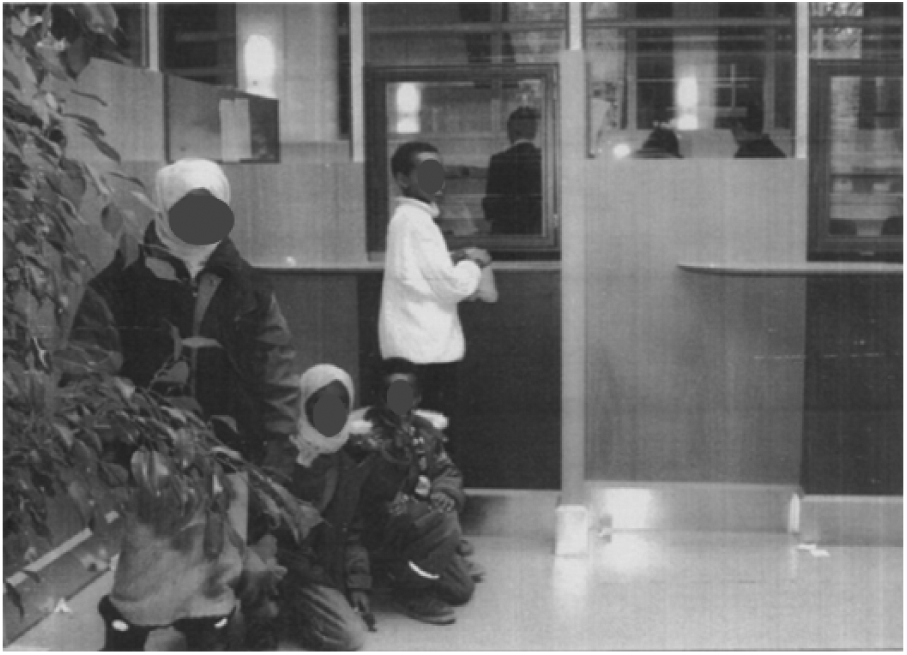
The old reception area.
The unit manager who began his employment just before the move to the new reception unit explained that, when he first entered the old unit, he felt that he was walking into a ‘dangerous place’. Other interviewees recalling the work that went on in the old reception area described the interactions with asylum candidates as old-fashioned and characterized by an unreasonably strong focus on security.
‘It was a very closed and police-like environment and you thought that this must be a dangerous place’.(unit manager). ‘Talking through those glass windows feels old school now, I cannot imagine it – as if the applicants would bite me (laughs)’ (case officer).
The current reception area: the reception lobby
The current reception area is located on the first floor of an office building. The first hour after the reception opens at 8:30 am is normally quiet, but as the day goes on the room fills up and the waiting time can increase to a couple of hours. As can be seen in Figure 2, the current main reception counter consists of four open counters with no glass windows for handling general inquiries and three glassed counters for handling cash (as is typical in banking halls). Although the background noise is relatively low, officers and applicants can easily hear each other’s conversations. One of the counters (number 7, on the left in Figure 2) is height-adjustable so that case officers can adjust the space between themselves and the applicants. All of the working desks are adjustable. All of the case officers wear civilian clothes, rather than uniforms.
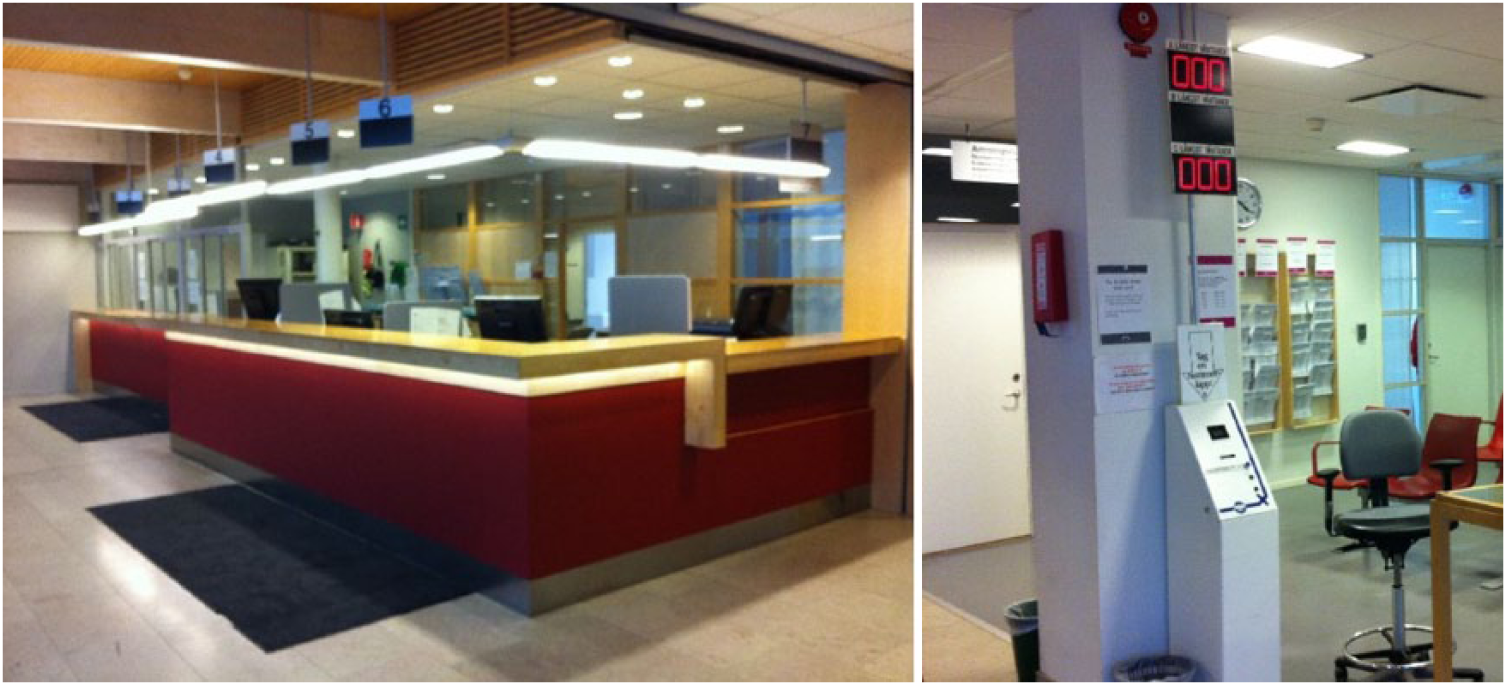
Left: the reception has open reception counters and one adjustable desk. Right: the common ticket system.
While some applicants wait in the reception area to be summoned by a case officer for scheduled appointments, most are directed to a ticket machine (on the right in Figure 2) upon entering; each draws a ticket and awaits a turn to meet with an officer at the counter. In the current reception area, there are no colour codes that sort the applicants into regions, but instead one common ticket system very similar to those found in government departments. Once applicants have taken their ticket, they sit on one of the red and orange plastic chairs that are mounted in rows on the floor in the waiting area. Applicants often engage with their smartphones while waiting. The in- and out-flow of people and the conversations between applicants and officers and between officers by the open counter create a moderately noisy environment. The manner in which police escort failed asylum seekers has also changed. Applicants that are to be placed in police custody are gathered once a week and picked up by the police from a separate room. In contrast to the routine in the old reception, the police do not enter through the main entrance but rather through the separate staff entrance.
During our observations, it sometimes happened that applicants entered the main entrance and, instead of taking a ticket, came straight to the counter, approaching the case officers with utterances such as ‘Excuse me, could you help me?’ or ‘I just have one question’. In contrast to the old reception procedure, in which applicants, according to an interviewee, ‘stood there waiting with cap in hand and didn’t want to make themselves difficult’, applicants entering the new reception area sometimes walk up to the counter as casually as if they were checking into a hotel, expecting to be served as a guest or a customer. An officer describes how this approach contrasts with that of officers in the old reception area: I believe the applicants feel freer now. They just walk up to me as if they were in a hotel lobby. It was different before, then [in the old reception area] they just took the ticket and didn’t think of anything else. (case officer)
A meeting involving an applicant, an officer and an interpreter often unfolds in a quite intimate and personal manner. The parties stand approximately 60 to 80 cm apart, often leaning toward each other and supporting themselves with their elbows on the counter while they speak quietly. We also noted that it was common practice for case officers to adjust their desks and positions according to the height and body language of the individual applicant. Thus, in the case of a tall applicant with expressive body language or a tendency to lean toward the case officer, the latter often raises his or her working desk. For shorter applicants with more timid voices and body language, the case officers often lower their desks and sit forward on their chairs. All actors listen attentively. Various documents, forms and paper notes – such as identity cards, receipts from hospital visits and post-it notes with phone numbers – are handed back and forth across the desk. The officer sometimes searches the database to review information about an applicant’s case, at which point the computer screen is usually turned so that the applicant is able to see some of the information – thus allowing the computer also to ‘speak’ in the conversation.
The service centre: the centre of service
A preliminary sketch of the new Stockholm service centre (which largely mirrors the design of the centre in Gothenburg) is outlined on the left in Figure 3. When they enter the service centre, applicants first encounter a so-called ‘floor walker’. Floor walkers are positioned close to the entrance (on the right in Figure 3) by a service station that is equipped with a touch screen and a ticket machine. These officials wear neat jackets and are identified by personal name tags. When an applicant enters the centre, a floor walker approaches them and inquires about the purpose of their visit. If an applicant’s inquiry does not require access to a computer, floor walkers offer direct assistance. Sometimes they use iPads, for example to help applicants book appointments or to indicate where they can find more information on a certain topic. This so-called ‘help to self-help’ is an important task of the floor walkers. If further assistance is needed, the floor walker prints one of two kinds of ticket, marked either ‘short’ or ‘long’. Applicants issued ‘short’ tickets are called to a service counter that manages simpler inquiries; those issued a ‘long’ ticket usually face a somewhat longer wait to be called to a counter that handles more complicated inquiries. In addition to guiding applicants entering the centre, floor walkers sometimes also talk to applicants approaching them in the waiting area. This is usually to explain why the waiting time is long and to offer some idea of when they can expect to be served. According to interviewees, having someone to whom they can always turn helps the applicants to remain calm. In the words of one floor walker, ‘Our task is to be available to the applicant, not always to assist with information, but to calm their frustration over long waiting times.’
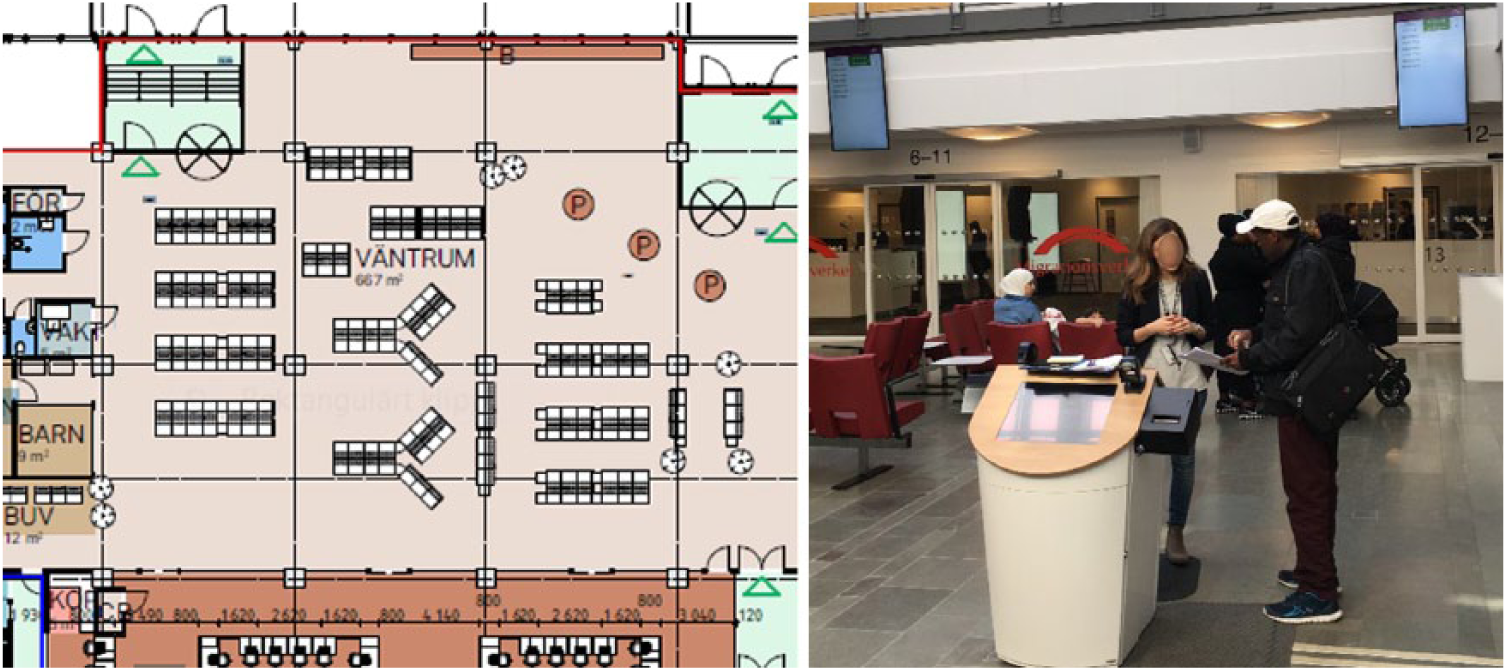
Schematic representation of the Stockholm service centre. Left: the positions of the floor walkers by the main entrance are marked with three circles and the letter P. Right: a floor walker positioned by one of the service stations in the Gothenburg service centre.
At the Gothenburg service centre, the waiting area is separated from the service desks by a glass wall, as can be seen in Figure 4. The purpose of this wall is to keep the noise in the waiting area from disturbing conversations between applicants and case officers. During our observations, both the waiting area and the working areas were relatively calm. White curtains can be drawn across the glass wall and, on rare occasions, for example when a disruptive incident occurs, they are used to shield the waiting area from the service counters. The service counters visible in Figure 4 do not have glass windows but are open in a manner similar to the reception area in Stockholm (Figure 2). When a case officer becomes available, she or he pushes a button in the administrative system and the next number in line appears in green on large screens in the waiting area (on the right in Figure 3). The case officer then pushes another button to open the glass doors for the applicant.
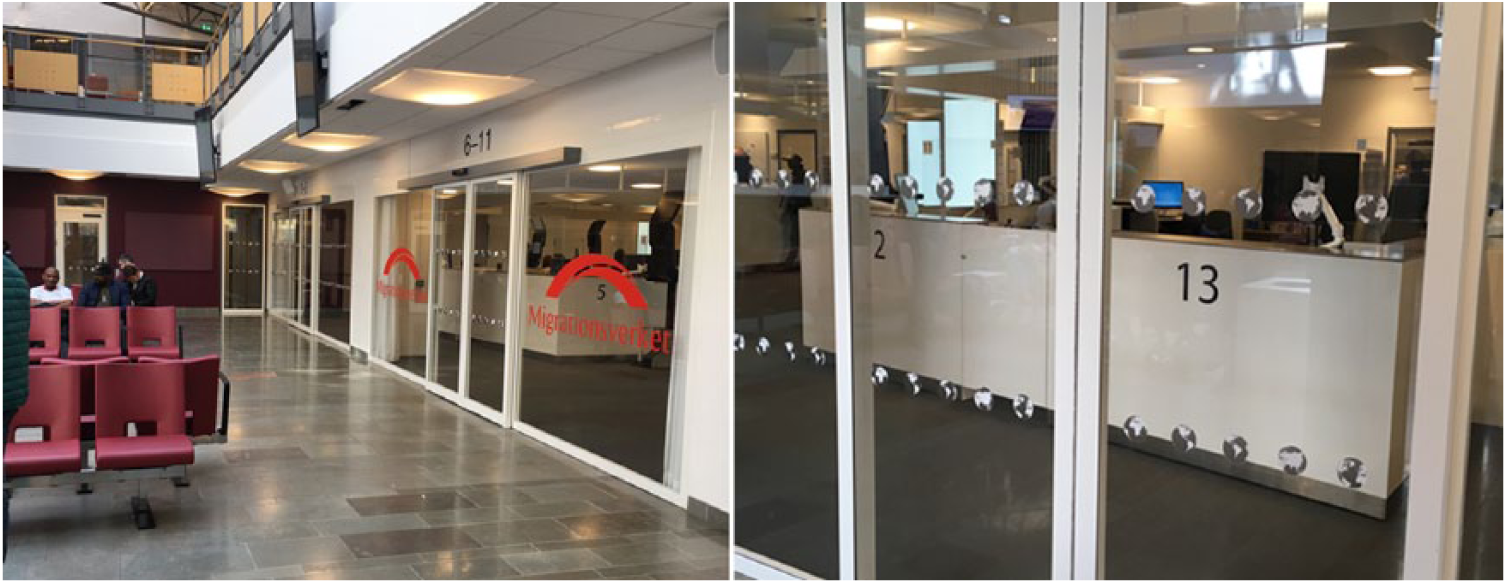
Waiting area and service desks at the Gothenburg service centre.
Not all applicants visiting the service centre are required to wait in line. Approximately half book an appointment online and simply show up at the time of their scheduled meeting. Online booking is done by filling in personal and contact information and selecting an available time on an interactive calendar displayed on the screen. Online booking has been available at most sites since the beginning of 2014, but it can only be done for certain kinds of meetings, such as for biometrics or application for asylum seeker cards. Nonetheless, the goal for the service centres is for the majority of meetings eventually to be booked online, thus enabling the board to ensure that staff members with the right competence are always available to take care of the specific needs of the applicants.
Becoming Criminal, Customer, or Unique Individual: The Material-Discursive Interpellation of the Officer and Asylum Seeker
Ordering the subject
In the discussion above, we showed how, in the three different material-discursive sites – the old reception area located in a former police station, the current reception area in Stockholm located in an office building, and the national service centre – the case officers and asylum seekers conduct themselves very differently in their mundane everyday work practices (in spite of the fact that they are essentially doing ‘the same work’). We would suggest that this is the case because, in each of these material-discursive sites, they become hailed differently. In order to understand how these interpellations occur and enact the subject of the asylum applicant and the case officer, we begin by returning to the scene of the old reception area and to the minutes, and sometimes hours, that applicants had to wait, as more or less passive subjects, for their numbers to be called at the counter. This time spent waiting, passively, did not implicate any specific or discernable human interaction, broader social discourse, or narrative accounts. To use Althusser’s metaphor, there is no policeman calling the attention of the asylum applicant, prompting her to turn around and to take up a certain subject position. Yet the moment in which an applicant took a ticket of a certain colour was also a moment of interpellation. A moment in which she became positioned to be taken as – and to take herself to be – a certain type of subject. Through the act of approaching the reception counter, holding a ticket of a certain colour, the applicant became hailed as a subject from a certain region. That is, someone whose reception and legitimacy would be conditioned by a set of cultural and political entailments which would position her as being more or less legitimate from the start. Moreover, in taking the coloured ticket in hand, the ticket itself becomes hailed into a position of the one that legitimately identifies, categorizes and sequences cases. In its positioning, it gains authority that can be called upon if anyone wants to ‘jump’ the queue, question the sequence of service, and so forth. Finally, in this material-discursive practice the officer becomes hailed into a position of a specialist with knowledge about a specific region who is conditioned to meet and treat those on the other side of the window, first and foremostly, not as unique individuals with unique life stories, but as persons with a ticket of a certain colour, instances within a given, more or less legitimate category of asylum seeker.
One might be tempted to ask ‘who’ or ‘what’ is performing these hailings? In proposing that agency does not emanate from (or adhere in) any one actor but flows through material-discursive practices, we would answer that the hailing is performed as an open-ended reiteration within the ensemble of material-discursive practices where certain subject positions are cited, repeatedly, as obvious and meaningful ways to be and act. It is the practice of taking a queue ticket of a certain colour, and the assumed position of this ticket as the authority to categorize and sequence cases, that conditions (or governs) the practice of waiting in line for a certain counter, which in turn governs the conversation between the applicant and the officer. It is this temporal and performative flow of material-discursive practice which hails the applicant, the officer and the ticket to assume and enact certain ways of being and doing as appropriate and meaningful.
In the current reception area, the hailing of the officer and the applicant occurs differently, thus positioning them differently. With only one ticket machine that prints out superficially indistinguishable white tickets, applicants become hailed into a position of ‘waiting for the next available case officer’. The white queue ticket becomes enacted as an authority of sequence, nothing more. The fact that there is only one waiting line implies that all applicants have an equal status, equal right and opportunity to be served according to their needs. Consequently, when approaching the open counter, applicants do not expect to meet a person with expert knowledge of a certain region, but a person who can adjust to their comportment and listen in order to assist with their individual needs. In approaching an officer behind a desk, queue ticket in hand, the applicant is already positioned as being a potentially valid and legitimate seeker of asylum, even before any conversation starts.
In the national service centre, on the other hand, the first point of contact for applicants is not a ticket machine, but a floorwalker meeting point at the entrance. There the floorwalker greets them and receives them in the manner of a host receiving guests. The short or long tickets issued by floor walkers, in cases in which they are unable to answer applicants’ questions on the spot, enacts these officials as flexible service providers who are able to adjust their work practices according to the applicants, who are in turn hailed into the position of subjects with a legitimate expectation to be heard and served according to their specific needs. They are not expected to endure an extended wait only to be informed of the need to print a certain form or, still worse, to visit another reception site. Situated in these practices, applicants are not obligated to make their voices heard and actively claim their rights to efficient service. Rather, they become enacted – in the flow of the material-discursive practices – as ‘guests’ whose needs are taken as the natural starting point, from the very start, at the door, upon entry. Likewise, applicants who book their appointments online do so as subjects who have legitimate expectations to customize the administrative process according to their individual needs. The applicants do not wait, and the officers do not call or schedule. Rather, applicants are hailed by the performative flow of the material-discursive practice into the position of scheduling officers to be ready for them – that is, the scheduling system becomes enacted as the one who can require officers to be available according to the individual needs and convenience of the applicants.
Separating the subject
Returning to the old reception area, we now turn our attention to what happens once an applicant has been summoned by an officer at a certain counter and to the material-discursive practices unfolding thereafter. The question we want to answer is who the applicant is in the moment of walking up to the glassed counter to meet with the officer. Just as the hailing of the applicant holding a queue ticket of a certain colour did not require any human interaction, the subject approaching the glassed window is already positioned to take herself to be – a certain type of subject. In this material-discursive practice, the glass window, separating the officers from the applicants, is not simply a medium through which the subjects perform themselves, and each other, in their ongoing social interaction. Rather it is constitutive of a material-discursive practice that has already hailed the applicant into the subject position of someone who needs to be kept at a distance as a potential threat, as she approaches. Correspondingly, the officer – on the other side – is already hailed into the subject position of someone at risk and in need of protection. Being a possible source of harm yet a legitimate petitioner, the applicant is allowed to speak, but only at a distance. Also, the booth and glass wall becomes positioned as a separator and protector, which allows for inspection, but not too close.
These positions are in contrast with the behaviours enacted in the current reception, where applicants regularly approach the open counters without a ticket. As an attempt to understand these differences in behaviour, we suggest that, in the same way that the performative enactment of the glass window in the old reception area hailed the applicant into the position of a ‘potential safety risk’, the enactment of open counters of the current reception area hail the applicant to assume the position of a subject with the right to initiate contact and express her interests and needs with the expectation of being served. Similarly, the case officers are no longer hailed into the position of distant and powerful authorities behind glass windows who are in need of protection, but as available service personnel. They no longer think of themselves as highly valued individual specialists vulnerable in the face of the potentially ‘risky’ other on the other side, but as flexible and collaborative providers of services to ‘customers’. From a post-humanist, performative perspective, the choice to think and act in this manner is always and already to some degree circumscribed. Indeed, impressions of autonomy and choice – by the subjects involved – is already enacted by the conditions of possibility provided by the material-discursive practices that position the individual to consider certain thoughts and actions as normal and meaningful. Thus, when an officer adjusts the height of her desk in order to come closer to and better hear the applicant, the situation is not simply one of a human (the officer) interacting with another human and a non-human actor (the desk), but rather an ongoing process of positioning and repositioning that is constitutive of all the actors involved. The participation of the adjustable desk positions the applicant as someone to and for adjustments must be made. For the applicant, the desk makes possible, and perhaps even necessary, the imagination of a reception that responds and adjusts to ‘my’ specific individual need. In being adjusted, the desk becomes constituted, not merely as a surface for working on, but rather as a possibility for interaction and proximity to be negotiated, accordingly.
In the national service centre, yet other subject positions are enacted. In their ‘counterless’ interactions with the floorwalkers, the applicants do not become positioned as potentially dangerous, nor as simply ‘waiting for’ their respective case officers; rather, they are welcomed and enacted from the moment they enter the reception area as the most relevant actors – like guests being received by the host. Rather than being at the mercy of an administrative system that determines the order in which they will be seen, applicants always have someone (a floorwalker) to whom they can turn. Further, unlike the glass windows in the old police station, which remained barriers during conversations with applicants, the glass wall in the service centre is opened for the applicants. They are welcomed, not in this case as hotel guests passing through a quick check-in procedure, but instead as unique individuals whose needs and questions are worthy of respect and of being handled confidentially in a quiet and intimate space.
Table 1 summarizes our analysis, illustrating how, in the material-discursive practices of assigning/taking turns and giving/receiving help, objects and subjects become hailed differently at each site.
Summary of the interpellation practices in the three different material-discursive sites.
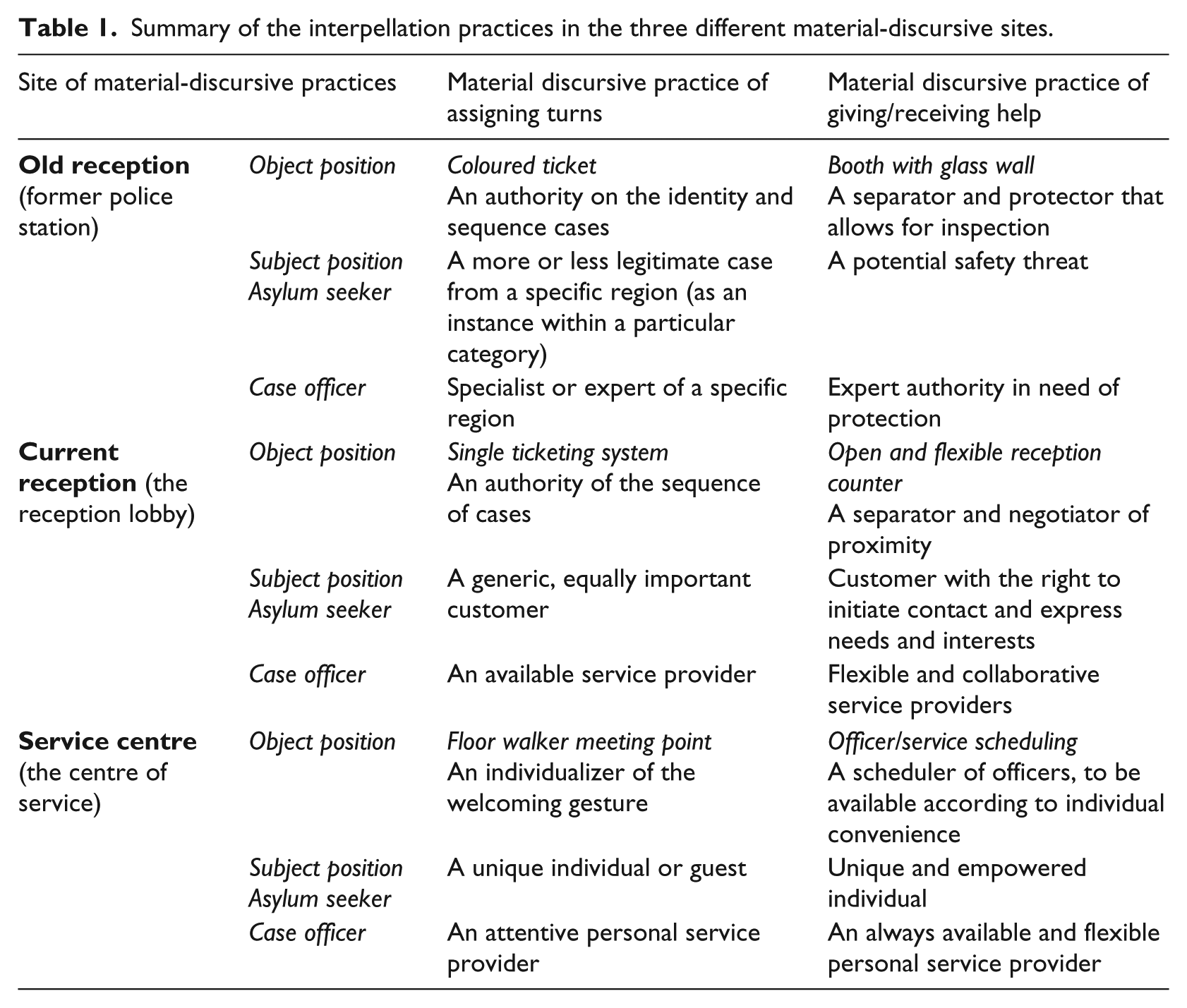
The table illustrates how, in the old reception, the conditioning flow of the material-discursive practices (where the coloured tickets and glass windows are positioned as appropriate and legitimate) allows the applicant and the officer to become hailed into specific subject positions, that of the ‘more or less legitimate case from a specific region’ and of ‘a potential safety threat’ in the case of the asylum seeker, and that of a ‘specialist’ and ‘authority in need of protection’ in the case of the officer. In the current reception area, the conditioning flow of the ensembles of material-discursive practices (where the single ticket system and open and flexible reception counters are positioned as appropriate and legitimate) hails the officer and applicant into different subject positions – that of a ‘generic, equally important customer’ and a ‘customer with the right to initiate contact and express needs and interests’ in the case of the asylum seeker, and that of an ‘available service provider’ and ‘flexible and collaborative service provider’ in the case of the officer. Finally, in the service centre, the floor walkers with their name tags and the mobile ticket systems are constitutive of a flow of practice that hails the applicant as a ‘guest’, a ‘unique individual’, and the officials as an ‘always available and flexible personal service provider’.
Having accounted for the process of interpellation as enacted in the flow of material-discursive practices at the three different sites at the SMB, we will now discuss how our account matters (performatively) for our understanding of how subject (and object) positions become enacted and governed in organizations.
Discussion: On Being Hailed
We began this paper by showing how previous research on subject positioning (Bisel & Barge, 2011; Brown & Lewis, 2011; Harding et al., 2014, 2017; Hardy et al., 2000; Kenny, 2010; Kuhn, 2009; Laine et al., 2016; Meriläinen et al., 2004; Paring et al., 2017; Rennstam, 2012; Symon & Pritchard, 2015) has focused on discursive practices, tended to centre the human actor, and to account for subject positioning as a more or less intentional and strategic practice through which humans draw on ‘discursive resources’ (Hardy et al., 2000; Kuhn, 2009), submit to specific understandings of discourses (Laine et al., 2016), or move between various managerial subject positions (Harding et al., 2014) in attempts to bring about strategic change or construct and maintain preferred visions of selves and groups. Underlying these accounts is either an explicit ontological commitment that takes humans and material objects (or ensembles) as more or less bounded entities that interact and affect each other emergently (as critical realism does) (Paring et al., 2017), or, that takes subjects to be more or less masters of their own discursive and materially mediated constructions (Bisel & Barge, 2011; Brown & Lewis, 2011; Kuhn, 2009; Meriläinen et al., 2004; Rennstam, 2012; Symon & Pritchard, 2015). Even though the subject tends not to be defined within strict boundaries, in these accounts, she is nevertheless assumed to exist – as a constructor of practices and an author of discourse – in a way that transcends the very situated discursive practices in which she is entangled (Barad, 2007; Latour, 2003). Consequently, relationality is accounted for as the relational interaction between humans and material tools (resources, props, etc.) assumed and enacted as more or less ontologically distinct.
In contrast, our study accounts for relationality as the ongoing subject positioning, enacted in and through the ongoing flow of situated material-discursive practices. In this account, the positioning of the subject has no original or given starting point, nor any clear dividing lines that demarcate an assumed boundary between the self and the other – that is, the positioning does not originate in any specific discursive practices, such as for example in talk about organizations or professions (Brown & Lewis, 2011; Harding et al., 2014; Kuhn, 2009; Laine et al., 2016; Meriläinen et al., 2004). Rather, in our account, boundaries are continuously reenacted through a process of sedimented iterability (Butler, 1995, p. 134), whereby, in Barad’s (2007, p. 149) terms, material-discursive practices engage individuals to iterate an action that conforms to a more or less established and normative grid of intelligibility within these mundane situated practices. This means that once the officers and applicants become hailed into specific subject positions, they tend to be kept in these positions by appeals to ‘common sense’. As such, they tend to accept their positioning, and its implied grid of intelligibility, as obvious and appropriate ways of being and acting. From this perspective, for example, officers in the old reception area who went for coffee while letting applicants wait in line for hours at other counters were not being lazy, but rather were citing a material-discursive convention that hails both themselves and their colleagues into a position in which this behaviour is appropriate and legitimate – it would not make sense, or be proper, to serve people for whom one does not have the necessary expertise. This sense of ‘what is appropriate to do’ is what the ensemble of material-discursive practices of the reception areas enacts as the ‘normative measure of the real’, as the supposed origin that regulates and excludes (Jackson, 2004).
The constitutive enactment of the material-discursive practices, then, does not necessarily reflect the intentions of the individuals working in the reception area; rather, it (re)produces the material-discursive possibilities of their positioning in which ‘the doer’ becomes an effect of these practices. Compared to critical realist accounts which recognize the existence of relata and relations, but rejects the possibility of there being relations without relata (Fleetwood, 2014, p. 206), our account grounded in agential realism shows how the material-discursive practices ‘not only acts “on” the subjects but also, in a transitive sense, enacts the subjects into being’ (Butler, 1997b, p. 13). This means that the subject emerges as a relational enactment – not, however, between the ‘I’ and the ‘other’, in the interaction between two actors modifying each other, nor as causal consequence of agents drawing upon some form of pre-existing structures (such as critical realist accounts would suggest) (Fleetwood, 2014, p. 206), but as the momentary and historical outcome of an ensemble of specific and ongoing – always concrete and mattering – material-discursive practices. Significantly, such ongoing subject positionings do not transcend their contingent and situated enactment.
This does not mean that the doer (the subject) is determined by these material-discursive practices. On the contrary, as Butler (1993b) has noted, ‘It is precisely the repetition of that play [assuming a subject position] that establishes as well the instability of the very category that it constitutes’ (p. 311). In other words, because subjects are constantly reproduced (through reiteration), they are never fully constituted, so that there is always space for reworking and resisting (Jackson, 2004). Repetition is partial, fragmented and unstable, and it continuously produces new possibilities for being and acting. Thus, for example, the officers in the old reception area could have refused to accept the subject position of ‘officer in need of protection’ by opening the window, as one of the officers quoted earlier in fact attempted to do. Through such an act, the subject positions of both the officer and the asylum seeker become exposed as unstable, incoherent categories, and possibilities for rearticulations of whatever it means to be a case officer or an asylum seeker are disclosed. Agency is produced within the possibilities of reconfiguring the subject and can, through ‘subversive repetition’ (Butler, 1993b, p. 317), provide possibilities for subject repositioning or transformation. However, in the specific situation of the officer opening the window in the old reception, these possibilities are not realized because, as the subversive act of opening the window is performed, the material-discursive positioning of the ‘potentially criminal and violent asylum seeker’ is again accepted as valid, and such hails the officer and the asylum seeker back into the grid of intelligibility enacted within and through the implicated ensemble of material-discursive practices. Within this grid (as the window is closed), they are once again positioned, iteratively, as subjects/objects: the officer in need of protection, the applicant as a potential threat, and the window as the legitimate and obvious actor to separate and protect.
Moreover, our account contributes to the discussion of how the flow of material-discursive practices always and already matters in the enactment and governing of subject positions. Unquestionably, recent literature has attempted to move beyond an anthropocentric understanding of the enactment of the subject by inviting into the arena of subjectivity those who are usually excluded from it, i.e. ‘things’, bodies and objects (Bisel & Barge, 2011; Harding et al., 2017; Paring et al., 2017; Rennstam, 2012; Symon & Pritchard, 2015). However, while taking account of more-than-human agency in the positioning of the subject is certainly desirable, we agree with Orlikowski and Scott (2015) that mere empirical inclusiveness of the more-than-human into our conception of agency does not suffice. Clearly one could suggest, practically, that discourse refers to matter and matter prefigures discourse (Hardy & Thomas, 2015). However, with Barad (2003, 2007) we would suggest that the entanglement of the material and discursive, in the ongoing enactment of the subject, is not primarily empirical but rather ontological. ‘Neither discursive practices nor material phenomena are ontologically or epistemologically prior’ (Barad, 2003, p. 822). In this view, ‘material agency’ is not something that inheres in material objects, which then somehow imbricates with human agency (Leonardi, 2011; Paring et al., 2017). Nor is it something that emerges in interaction between assumed separate subjects and objects (Rennstam, 2012) or that may either ‘be “captured by” … or resist enrolment into identity work’ (Symon & Pritchard 2015, p. 255). Rather, in our account, agency ‘is the enactment of iterative changes to particular practices’ (Barad, 2007, p. 235) and what we call the ‘material’ matters as profoundly constitutive, historically contingent, ensembles of material-discursive practices that hail subjects/objects by conditioning the possibilities for subjects/objects to be and act as part of mundane practices. Just as there is no subject outside the positions enacted in material-discursive practices, there is no object that can act/work or resist acting/working outside such subject/object positions (Barad, 2007, p. 150). Subjectivity and objectivity are not opposed to one another; objectivity is not the antithesis of subjectivity. In accounting for how matter matters in this way, we show how we can include and account for materiality in the citational practice of interpellation (Butler, 1997a, p. 33) without ‘thingifying’ it (Barad, 2003, p. 812) and without acknowledging it solely as an effect or consequence of discursive practices, consequently restoring the equation between matter and passivity. In doing this, we extend (or transform) the use (or mattering) of the theory of interpellation and hailing in organization studies.
In trying to show the distinctive contribution of agential realism to the material-discursive enactment of subjects we should take careful note of temporality. While critical realism assumes that structures exist as emergent properties created through past actions – and can therefore causally shape present actions – agential realism does not have such a linear view of time and agency. Time (or rather duration), and material-discursive properties, do not have an existence outside of their situated enactments in the durational flow of practice. As Barad explains: the past is never left behind, never finished once and for all, and the future is not what will come to be in an unfolding of the present moment; rather the past and the future are enfolded participants in matter’s iterative becoming. (Barad, 2007, p. 234)
This means that asylum seekers and officers (in our narratives above) do not behave differently in the former police station, the current reception area and in the new national service centres because historically emergent structures such as the material-discursive properties of the reception desks, glass windows, queue tickets, signs, gestures and so forth cause them to behave differently, collectively. Rather, in our agential realist account, they act in certain ways (rather than in other ways) because the ongoing situated enactment of material-discursive practices already make such ways of speaking and doing conform to a grid of intelligibility, which already appears as appropriate and meaningful ways to be, exactly. In this account, the capacity for action is not taken as being prior to the action, because there is no particular thing-ness, nor any particular one-ness prior to action – which is different to saying that there is nothing. Possibilities to be and to act, and thus, possibilities to become a particular subject, exist only in and through the flow of situated material-discursive practices – and only while they endure.
This insight has important implications for how we might study subject positioning in organizational practices, how we observe, what sort of questions we ask, and so forth. While post-positivist perspectives such as social constructivism (Berger & Luckmann, 1967; Dutton et al., 2010) and critical realism (Fleetwood, 2014; Mole & Mole, 2010) subscribe to representationalism in the sense that they believe that theoretical concepts, graphs, images and so on mediate our access to the material world, an agential realist view disputes representationalism, individualism and other essentialist assumptions that underlie traditional forms of both realism and social constructivism. In contrast to critical realism, agential realism does not assume a single reality with several discourses that act as interpretations of it, but multiple realities, continuously enacted in situated, material-discursive practices. Thus, for agential realism the, material-discursive practices are not ‘objects’ available for our inspection, from the ‘outside’, as such. Thus, studying them requires a situated material engagement with them (Barad, 2007, p. 342). Hence, the prominence of images, as explained in our methods section, and featured in our discussion above. Differently stated, it requires that we do not start with the ‘what’ and the ‘why’ but rather with that which is already assumed, in the ongoing flow of material-discursive practices, to render certain ways of being and acting as obvious, meaningful and legitimate.
Finally, this paper started as an attempt to take the question of ‘materiality’ seriously in the ongoing positioning of subjects and objects – inasmuch as they are already taken to be exactly subjects and objects. In doing this, however, it has also done much more. It has problematized the assumed division between the inside (subject, intentions, rationality, etc.) and the outside (objects, properties, affordances, etc.), and accounted for the always and already entanglement of matter and soul in ways that make the subject of the autonomous, cognitively privileged human, more or less rationally working out her identity, less convincing, even untenable. However, this is not to claim that individuals do not attempt to form, repair, maintain, strengthen, or revise their sense of ‘identity’ (Sveningsson & Alvesson, 2003) in order to create or maintain some sense of subjectivity and agency. Rather it is to problematize such assumed ‘identity work’ and to reveal its conditions of possibility – that of a subject always already positioned. Furthermore, as argued above, we are also not suggesting that subjects are determined by the hailing of material-discursive practices. However, our account shows how one must not underestimate the degree to which individual attempts at repositioning are always and already governed by a multiplicity of material-discursive practices in the mundane flow of everyday life. The power of this positioning lies exactly in its mundane obviousness and in the fact that it is everywhere and nowhere as such. Individuals can of course resist or ignore these hailing practices, intentionally or unintentionally. However, such attempts will always in some way already cite their prior material-discursive positioning and necessarily draw on the grid of intelligibility already assumed in such positioning (Butler, 1993a, p. 124). This, we would suggest, is very significant for the study of subjects and their ongoing positioning in and through mundane organizational practices.
Conclusions
This paper takes as its starting point the argument that the constitutive role of material-discursive practices has not sufficiently been addressed in the literature on how subject positions (and associated identity working) are enacted and governed within everyday organizational practices (Bardon et al., 2012; Bisel & Barge, 2011; Harding et al., 2017; Paring et al., 2017; Rennstam, 2012; Symon & Pritchard, 2015). We proposed that we study such positioning as a process of material-discursive interpellation (Althusser, 2006a, 2006b; Barad, 2007; Butler, 1990, 1993a, 1997a, 1997b) by attending to the situated, material-discursive and performative nature of it. In order to achieve this, we situated our analysis in Barad’s (2007) post-humanist view of discourse – as the specific material-discursive (re)configurings of the world through which the determination of boundaries, properties and meanings are differentially enacted. As such, we provide an account of interpellation that contributes to extend our understanding of subject positioning as an ongoing relational accomplishment by decentring the actor and foregrounding the performative flow of material-discursive practices. Specifically, through the development of a post-humanist understanding of interpellation, we show how the human-material relationship can be understood, not just as an interaction among separate and distinct beings in which the intentional and interpretive human has a privileged position, but as an ongoing flow of material-discursive practices that hail subjects/objects into being by conditioning the possibilities for subjects/objects to be and act as part of mundane practices.
The paper also points out the ways in which an analysis grounded in agential realism cuts across well-worn oppositions such as agency versus structure and inside versus outside that circulate in organization studies debates, and shows how an agential realist view enables us to discard representationalism, individualism and other foundationalist assumptions that underlie traditional forms of both realism and social constructivism. Specifically, in contrast with critical realism, our account grounded in agential realism does not privilege the human actor by granting her the ability to reflexively and intentionally draw upon structures in order to reproduce or transform them. In our account, the ‘material’ (and its assumed properties) is nothing that exists prior to the ongoing flow of material-discursive practice, and neither is the human. Nor is subjectivity something that exists outside the positions that material-discursive practices already make available as sensible and meaningful.
Our work is of course not without its limitations. First, ideally we would also have wanted to include interactions (such as interview material) with asylum seekers in order to understand how they made sense of who they thought they were when visiting the different reception locations – that is, beyond our observations of them. The way they understood their positioning might have been revealed by the way they referred to themselves, or how they referred to the officers, or how they referred to the practices that they encountered. As we indicated above, we did not do this for ethical reasons. Second, it would have been helpful to engage with the public and official discourse on asylum seekers in Sweden (and Stockholm specifically). Also, with the discourse on new public management and public service delivery, it might have been possible to get a sense of some of the reasons for particular designs and approaches. More importantly, it might have revealed why certain subject positions (such as being threatened by asylum seekers, or being ‘at the service’ of asylum seekers) were taken as obvious and legitimate by the officers. Third, a narrative writing style such as the one used in this paper can sometimes work against the ambition to decentre the actor and foreground the performative flow of material-discursive practices. Discursive conventions make it easy to talk about beings and doings, and more difficult to talk about ongoing becomings. To refrain from thingification, that is, from transforming becoming into being (Barad, 2003), future research could identify, and experiment with, further useful vocabularies rooted in relational ontologies. It would be particularly interesting to explore the extent to which a broader set of process-oriented notions – or narrative styles – could curb the tendency to ‘thingify’ and enable a more subtle expression of the ways in which subjects become, performatively, in and through the temporal and material-discursive flow of practice.
Finally, we would suggest that further work on subject positioning, grounded in agential realism, might help to show how any attempt at identity work (or working) is always and already more or less circumscribed in and through the heterogeneous ensemble of material-discursive practices where we necessarily are becoming the subjects we already take ourselves to be. This, we would suggest, might transform our understanding of identity working and the governing intra-actions already implicated in it.
Footnotes
Acknowledgements
We gratefully acknowledge the generous access provided by the Swedish Migration Board. Furthermore, we would like to express our sincere appreciation for the highly valuable feedback and guidance provided by Senior Editor Robin Holt and three anonymous reviewers during the review process. We are also grateful for feedback that has helped substantially improve the article from Magnus Mähring and Ulrike Schultze.
Funding
Financial support from the Jan Wallander and Tom Hedelius Foundation (P2011-0179:1; P2016-0085:1), Marianne and Marcus Wallenberg Foundation (MMW 2016.0078) and the Torsten Söderberg Foundation (E54/15) is gratefully acknowledged.
