



Abstract
Understanding the motivational mechanisms of administrative corruption is of paramount importance for public integrity. We propose and test a novel demands-resources model of civil servants’ corruptibility from a micro-level perspective, focusing on important personality and job-related demands and resources, that is, personality traits, motives, and states. Drawing on experimental evidence (Obs. = 263) from Swiss public administration, this study reveals how public service motivation and social value orientation function as integrity-enhancing resources but through different psychological mechanisms. Furthermore, Machiavellianism and psychopathy—but not narcissism—significantly stimulate civil servants’ capacity to morally disengage and hence increase corruptibility, serving as integrity-draining demands, while job-related burnout has no effect. These novel insights contribute to the “bright side” discourse of PSM, advance the conceptual understanding of administrative corruption, and expand the state-versus-trait debate of public integrity, providing important insights for the effective design of anti-corruption strategies and public personnel selection for public integrity.
Keywords
Introduction
Administrative corruption is an unresolved issue worldwide, lacking theoretical and empirical explanations about the psychological mechanisms that allow individuals to derive moral justification for corrupt actions. The abuse of public office and positions of power for private gain is a pervasive phenomenon in public administrations that undermines public administrations’ core principles of equal treatment, impartiality, and professionalism, resulting in severe societal harm (Weißmüller & Zuber, 2023). Thus, understanding why some bureaucrats are more likely to engage in corruption than others is of paramount importance to warrant the legitimacy and effectivity of civil service provision (Jancsics, 2024; Liu et al., 2023; Weißmüller & Zuber, 2023).
Despite prolific research into administrative corruption, the psychological micro-mechanisms that translate opportunities for corruption into corrupt action are still not well enough understood due to the complexity of motives, motivations, and cognitive processes involved in moral judgment (Jancsics, 2014; Weißmüller & Zuber, 2023), so that the urgent call for building and empirically testing comprehensive models of how corruption works at the micro level has largely remained unanswered since Jain’s (2001) seminal review. One particularly promising concept for the study of administrative corruption as a complex phenomenon and from a micro-level perspective is corruptibility. Corruptibility refers to individuals’ susceptibility or predisposition to engage in corrupt behavior. As a multi-facetted construct, corruptibility is argued to being the outcome of the interaction of individual factors such as perceived self-efficacy and public service motivation (PSM), and work-related factors such as work stress and P-O fit with regards to values and motives (De Waele et al., 2021; Zhang et al., 2019). While some authors argue for a trait-based appraisal of corruptibility, meaning that some people are simply inherently more corrupt than others (Hauser et al., 2021), others argue that affective states such as job-related exhaustion may crowd out integrity (Ripoll & Breaugh, 2019). This mix of conceptual approaches paired with empirical evidence highlighting the interconnectivity of a variety of psychological, individual, and work-related factors issues calls for research that explores how these factors combined shape civil servants’ corruptibility in context to deepen our understanding of how to conceptualize and fight administrative corruption (Jain, 2001).
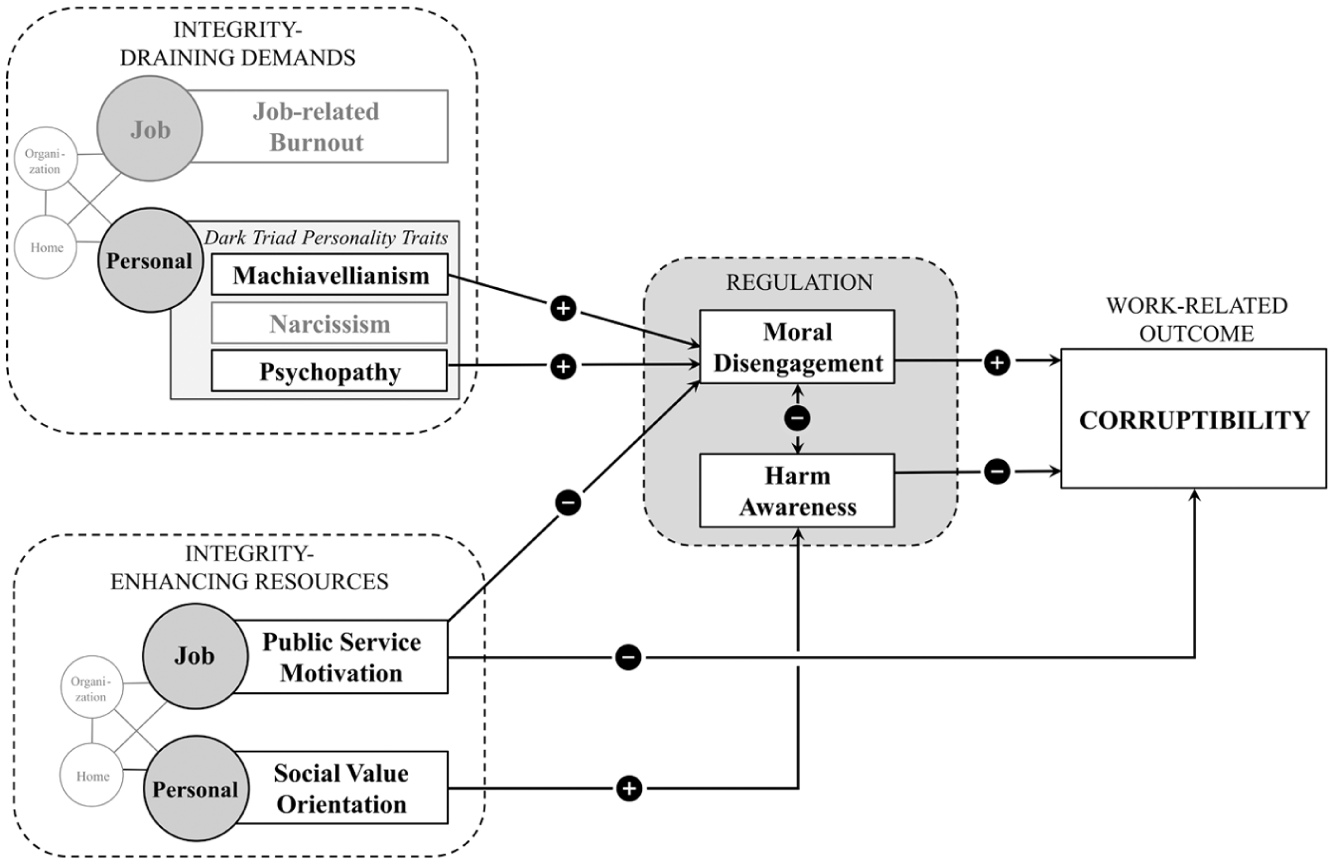
To close this research gap, we propose and test a novel demands-resources model of civil servants’ corruptibility, based on Demerouti and Bakker’s (2023) generalized job demands-resources (JDR) model. Our model conceptualizes civil servants’ corruptibility as the outcome of integrity-draining demands (burnout and dark triad personality traits), integrity-enhancing motivational resources (PSM and social value orientation), and corruptibility-regulating factors that calibrate the interplay of these resources and demands in regulating corruptibility. The research question is: How do integrity-draining demands and integrity-enhancing resources affect civil servants’ corruptibility, and how do moral disengagement and harm awareness regulate this psychological process?
Out of the various potential demands and resources (e.g., organizational, private life, leadership-related; Demerouti & Bakker, 2023; Weißmüller et al., 2024), the study purposefully focuses on the individual, micro-level factors that may serve as demands, resources, and regulators and shape civil servants’ corruptibility, concentrating on the role of burnout, personality traits, and motivation specifically for three reasons: First, burnout among civil servants is on the rise and there is ample evidence connecting burnout with several types of unethical behavior of which bribery is a self-evident example (Giauque et al., 2022; Pulich & Tourigny, 2004). Second, burnout’s association with a gradual loss of moral engagement—which is linked significantly with corrupt behavior in organizations (Moore, 2008)—points toward potentially complex interaction effects with PSM and traits (Meyer-Sahling et al., 2019; Ripoll & Breaugh, 2019). Third, only little research has explored the relationship between distinct states of employee wellbeing, personality traits, motives, and corruption as a work-related outcome (Hauser et al., 2021; Zhao et al., 2016), although more research is clearly needed (Thomann et al., 2025). This research gap highlights the need to focus not only on the impact of individual characteristics and dispositions but calls for research to identify the motivational regulators that determine how these factors in tandem affect civil servants’ corruptibility. Prior research by Weißmüller and Zuber (2023) specifically highlights the impact of moral disengagement—individuals’ ability to cognitively and affectively dissociate their moral concept of self from the psychological burden associated with engaging in socially undesired actions (Bandura, 2002)—and harm awareness as potential regulators between integrity-enhancing resources and integrity-draining demands.
Hypotheses were tested by conducting a vignette experiment with experienced bureaucrats in Switzerland. The empirical evidence reveals that PSM and social value orientation function as integrity-enhancing resources but through different psychological mechanisms. Machiavellianism and psychopathy—but not narcissism—significantly enhance civil servants’ capacity to morally disengage and hence increase corruptibility, serving as integrity-draining demands, while job-related burnout has no effect. Both integrity-draining demands and integrity-enhancing resources are partially moderated by the regulating factors moral disengagement and corruption harm awareness. These results significantly advance the state-versus-trait debate of public integrity by showing that resources, demands, and regulatory mechanisms in tandem shape civil servants’ corruptibility.
The remainder of this study is structured as follows. The next section reviews the literature on civil servants’ corruptibility to derive a theoretical model that links these micro-foundations with the D-R model to derive hypotheses. Then, the study design and data, and the empirical findings are presented. The study concludes with a discussion of these results’ implications for theory and practice.
A Demands-Resources Theory of Corruptibility
Working in public administration can be tough. Bureaucrats regularly struggle with coping with the value paradoxes ingrained in public administration and policy making, struggling with red tape-ridden organizations and lengthy procedures in civil service provision particularly so if they are highly engaged and intrinsically motivated. Prior research shows that these value conflicts (e.g., equality vs. compassion in client treatment) posit impactful psychological demands on civil servants that may lead to deviant work-place behavior such as prosocial rule-breaking and client skimming (Jilke & Tummers, 2018; Weißmüller et al., 2022). These effects are exacerbated by stress, lack of harm awareness, and moral disengagement (Wang et al., 2020; Weißmüller & Zuber, 2023), but why exactly is this the case?
According to the job demands-resources (JD-R) theory (Bakker et al., 2007), every work context is characterized by two categories of job characteristics: job demands and job resources. Job demands refer to those aspects of a job that are associated with physiological or psychological costs, they consume energy. Job resources refer to those job aspects that are functional in achieving work goals, because they reduce job demands and their associated costs, and stimulate personal growth and development. Demands and resources interact and may buffer or boost each other’s effect, thus determining work-related outcomes. However, recent cross-domain research into public employee engagement and burnout (Weißmüller et al., 2024) shows that these demands and resources are not strictly limited to the work context. In line with Demerouti and Bakker’s (2023) generalized demands-resource (D-R) model, work-related outcomes such as performance but also integrity are based on the “complex interplay between work (job and organizational) and nonwork (family and personal) [. . .] because time and energy are finite resources” (Demerouti & Bakker, 2023, pp. 217–218). This means that individuals’ work-related outcomes are affected by various types of tangible and/or psychological demands and resources that spillover from private life and individuals’ personality into work—partially regulated by for example, organizational or individual factors—affecting individuals’ energy/health, motivation, and capacity to cope with on-the-job challenges (Weißmüller et al., 2024).
From the perspective of the generalized D-R model, administrative corruption is a work-related outcome of the interaction between demands, resources, and regulating factors which determine individuals’ corruptibility. Acts of administrative corruption—such as bribery, nepotism, kickbacks, financial fraud, and state capture—occur if situational opportunities to engage in corruption coincide with sufficient motivation (e.g., greed) and moral justification to do so. Moral justification is the key element priming corruptibility because it entails complex implicit and explicit rationalization processes that allow individuals to maintain their moral concept of self despite engaging in corruption, a socially harmful and stigmatized behavior that violates basic principles of work ethics (Weißmüller & Zuber, 2023). Given that civil service predominantly attracts individuals with a distinct set of specific values, motives, and traits (Nabatchi, 2018), the assumption that corruptibility is mainly caused by self-serving, monetary incentives falls too short and calls for more in-depth public sector-specific exploration.
Focusing on the behavioral and psychological aspects of corruptibility, the current study concentrates on the micro-level factors this D-R model, namely personality and job-related demands and resources, as well as individual-level regulators (see Demerouti and Bakker (2023 for an in-depth discussion of further meso-level factors that are beyond the scope of the current study). The reason for this is that, first, organizational outcomes fundamentally rely on individual decision-making, judgment, and behavior both with regards to collegial conduct within organizations and in interaction with citizens (Cyert & March, 1992). Second, ignoring the human factor, that is, the behavioral psychology behind (im)moral action renders anti-corruption efforts utterly inefficient. While research into the micro-level antecedents of civil servants’ corruptibility is still scarce (cf. Weißmüller & Zuber, 2023), prior research clearly established links between employee characteristics such as personality traits, their affective states, and motivations and their likelihood of engaging in deviant and corrupt behavior. Particularly the role of strain and psychological burden on moral judgment are argued to affect integrity and on-the-job behavior. For instance, Penney and Spector (2005) show that job-related stress results in voluntary integrity violations and counterproductive work behavior, jeopardizing integrity in work performance. Hence, we propose a micro-level demands-resources model of corruptibility (see Figure 1), arguing that integrity-draining job and personality-related demands drain individuals’ capacity to act with integrity when faced with opportunities for corrupt action, while public administration-specific integrity-enhancing resources may increase integrity, if not diminished by regulatory factors.
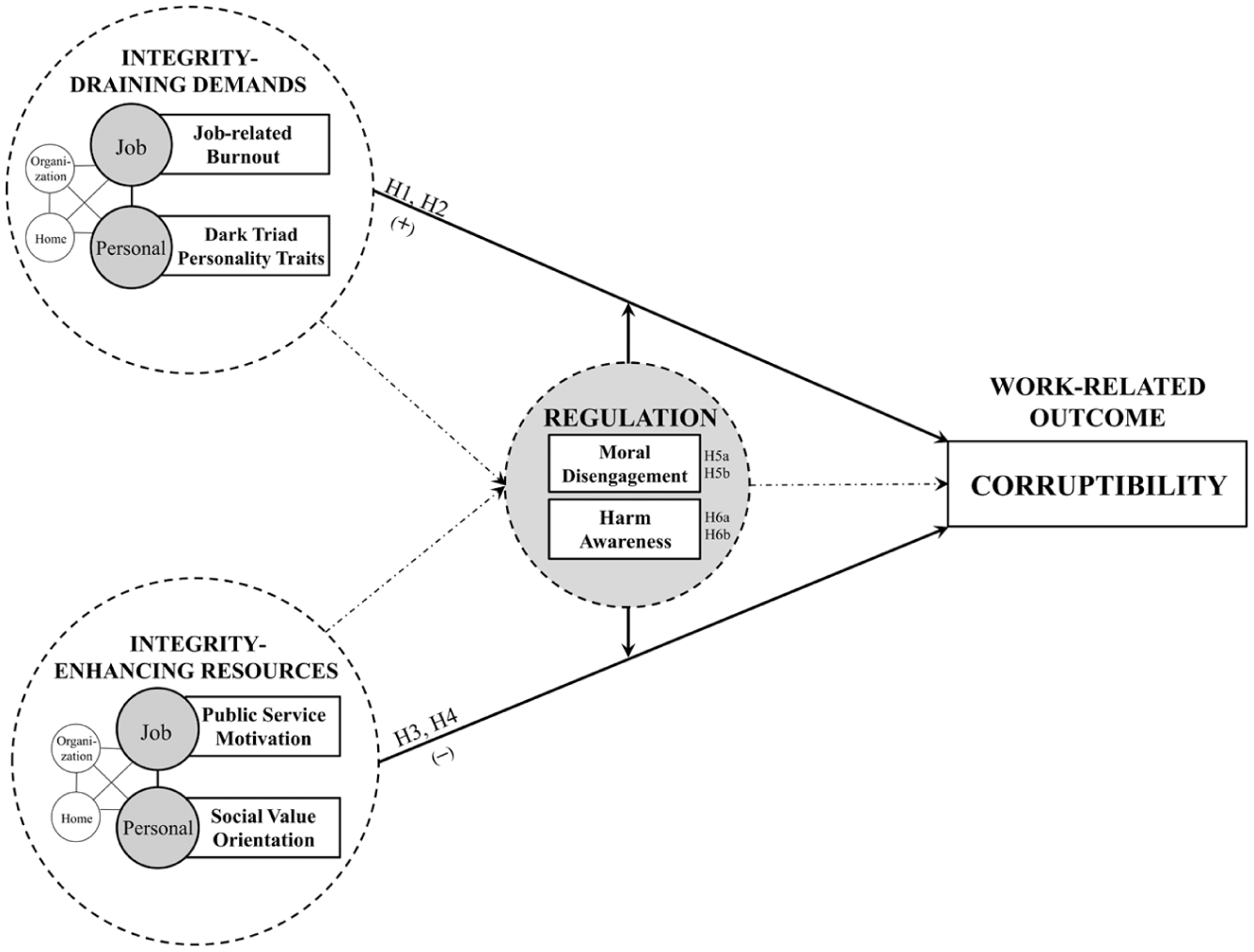
Theory: A demands-resources model of corruptibility.
Integrity-Draining Demands
Job-Related Demands: Burnout
The intention to engage in a specific behavior based on subjective, normative, and control beliefs is affected by individuals actual and perceived control over their behavior (Ajzen, 2020). As argued before, experiencing emotional strain such as work-related burnout can strongly inhibit this capacity to direct oneself toward ethical behavior and, therefore, functions as an integrity-draining demand. Burnout is a chronic and stable state in response to prolonged stress (Basinska & Gruszczynska, 2020), which has been shown to be positively related with corruptibility (Zhang et al., 2019). Freudenberger (1974), Maslach et al. (1986), and Maslach and Leiter (2008) developed the concept of burnout further by defining it as a syndrome of emotional exhaustion, depersonalization, and reduced personal ability to cope with job and life demands.
There are many reasons that explain why people develop burnout symptoms, but the existing body of scholarship points out that workload does not solely drive this development (Leiter & Schaufeli, 1996). Instead, developing burnout is especially likely in contexts in which individuals experience substantial levels of stress in executing their tasks, high personal engagement, and high task identification, a typical scenario for highly engaged civil servants. Prior research demonstrates a clear link between burnout and adverse work outcomes. For instance, Ceschi et al. (2016) and Jacobs and Dodd (2003) found an empirical link between overwhelming job demands, burnout, and deviant behavior, such as bribery (Pulich & Tourigny, 2004). Prior research shows that negative affectivity and burnout are also strongly correlated with a higher likelihood for engaging in unethical behavior to cope with undesired events such as failure in important tasks (Penney & Spector, 2005). The emotional burden and overwhelm of suffering from the emotional strain and stress associated with burnout reduces individuals’ perceived behavioral control to withstand opportunities for corruption (Zhang et al., 2019), clearly indicating that job-related burnout should be regarded as an integrity-draining demand in the D-R model. It follows that:
Personality-Related Demands: Dark Triad
On a fundamental level, employee’s integrity and work-place behavior relates to their personality (Collins & Schmidt, 1993). Personality traits play an essential role in shaping moral decision making because they prime cognition by serving as a lens of how individuals make sense of the world. Personality traits are relatively stable over time and profoundly influence the perception about our self and our environment (Ajzen, 1991; Costa et al., 2019), and hence affect individuals’ efficacy in exercising behavioral control when tempted with the opportunity to act unethically (Hauser et al., 2021).
Prior research suggests that one set of personality traits is particularly predictive of unethical and corrupt behavior and can hence be conceptualize as a personal demand: The dark triad of Machiavellianism, narcissism, and psychopathy (Harrison et al., 2018; Szabó et al., 2021). A Machiavellian personality is characterized by an avowed belief in the effectiveness of using manipulation tactics on others to reach their goals, high cynicism about human nature, and a tendency to cut corners and violate principles to reach their desired ends (O’Boyle et al., 2012). Prior research by Hauser et al. (2021) shows that Machiavellian for-profit business professionals are more likely to condone the use of bribery through the proxy of facilitating moral justification for corruption. However, the degree to which these findings generalize to the public sector workforce has not been explored yet. Narcissistic individuals share an unhealthy self-love, over-confident grandeur, refuse to compromise and a tendency to exaggerate their achievements and feel entitled to promote their own ends while disregarding the adverse consequences of their actions for others (O’Boyle et al., 2012). Their sense of entitlement and inflated self-beliefs provide moral license for corrupt behavior (Blanken et al., 2015). People who score high on psychopathy are characterized by low self-control, high stress tolerance while violating social norms, and a systematic bias in their appraisal and perception of risk allowing them to disregard even substantial risks to themselves and others (Jones, 2014). Consequently, psychopathic individuals are significantly more likely to engage in criminal activities to achieve their subjective goals (Hare & Neumann, 2009).
Studies of counterproductive work behavior have long recognized that individuals who exhibit dark triad traits have a distinct tendency to be callous, selfish, and malevolent in their interaction with others (Paulhus & Williams, 2002) and are significantly more likely to engage in fraud, crime, and corruption (Harrison et al., 2018; Perri & Brody, 2011), with a significantly higher intention to take bribes (Zhao et al., 2016). Understanding and containing the damage of these personality traits in leaders is of particular concern (Hanson & Baker, 2017). It follows that the dark triad personality traits may function as personal integrity-draining demands because they allow people scoring high on these traits to maintain their positive moral image of self despite engaging in self-serving, socially undesirable and unethical acts, suggesting that:
Integrity-Enhancing Resources
Job-Related Resources: Public Service Motivation (PSM)
Civil servants’ corruptibility is likely to be influenced by their attitudes toward corrupt behavior which is based on work-related motives related to the values internalized by the individual. A large body of scholarship grounded motivational psychology and professional role identity theory argues that the salience of personal and professional values, ethical principles, and pro-social motives play a key role in guiding individual behavior particularly in ethical dilemmas (Lee & Park, 2025; Moore et al., 2012; Ripoll, 2019). A strong morally-charged professional identity directed toward the immediate and long-term benefits of society assists individuals in self-regulating their actions toward honest and socially desirable behavior—in contrast to unethical and self-serving behavior—so that they will be less likely to engage in corrupt behavior (Ajzen, 1991; Olsen et al., 2019). In the context of administrative corruption, civil servants’ PSM as a manifestation of their moral identity and central behavioral beliefs about whether engaging in corruption is considered as right or wrong acts as a strong predictor for integrity (Weißmüller et al., 2022; Weißmüller & Zuber, 2023). Civil servants’ internalized commitment to the public interest and public service identity is likely to function as a integrity-enhancing job-related psychological resource and hence weaken the perceived appropriateness and attraction of exploiting self-serving opportunities for corrupt behavior (March & Olsen, 2011; Wright et al., 2016). Thus, we formulate the following hypothesis:
Personality-Related Resources: Social Value Orientation (SVO)
Behavioral psychology has long established that individuals do not act in accordance with the self-serving premises of normative rational choice theory and that people tend to act collaboratively instead of selfishly (Balliet et al., 2009). This tendency is captured by individuals’ social value orientation (SVO), a stable and intrinsic personality-related trait that assesses the extent to which a person is concerned with personal versus group well-being. Individuals’ SVO is highly relevant and desirable employee characteristic. It is argued to be beneficial for work-related outcomes because these individuals strive to make a positive difference in the lives of others through their work and are likely to be highly engaged, productive, intrinsically motivated, and go the extra mile in case person-job fit is high (Bolino & Grant, 2016). Prior research by Sattler and Kerr (1991) and De Cremer and van Lange (2001) suggests that high-SVO individuals’ judgment is to a greater extent driven by concern for others and society at large, basing their decision making on non-egoistic, prosocial values such as fairness, honesty, and equality. Moral justification theory suggests that by sacrificing particular and immediate interests for the (collective or individual) well-being of others, high-SVO individuals gain a strong sense of self-worth as a form of society-oriented self-transcending care and are hence motivated to refuse place individual interests before the collective interests (Ylä-Anttila, 2023). It follows that:
Regulation: Moral Disengagement and Harm Awareness
The D-R theory suggests that the effect of the aforementioned micro-level demands and resources may be conditional upon regulating factors—that is, cognitive mechanisms—that may moderate or mediate their effect on individuals’ corruptibility. Prior research on moral judgment and ethical behavior highlights that two of the most impactful of these factors are moral disengagement and harm awareness, because they either facilitate or mitigate the psychological rationalization processes that prime corrupt behavior (Thomann et al., 2025). For instance, Hauser et al. (2021) found that the integrity-eroding effect of Machiavellianism is fully mediated through the psychological process of moral justification, that is, individuals’ capacity to rationalize their corrupt engagement and hence “neutralize” its psychological burden. This is in line with research by Bandura (2002), Schott and Ritz (2018), and Weißmüller and Zuber (2023) who argue that individuals’ capacity to morally disengage from the adverse societal consequences of their corrupt actions is a particularly strong predictor for integrity violations in public administration. Being morally disengaged is a state that inhibits pro-social and altruistic considerations and motives that may otherwise result in rule-compliant, empathic, and value-based behavior, hence eroding integrity (Abraham et al., 2018; Detert et al., 2008; Moore et al., 2012). Moral disengagement facilitates elastic justification for corrupt action by separating individuals’ internalized positive moral concept of self cognitively and affectively from the expected societal harm associated with engaging in corrupt actions (Abraham et al., 2018; Bandura, 2002; Yang, 2020). Recent empirical research from general psychology demonstrates that moral disengagement is a process of implicit social cognition that is predictive of unethical behavior because it regulates moral judgment by inhibiting moral self-regulation (Bandura et al., 1996; Fida et al., 2022; Ogunfowora et al., 2022). By facilitating self-serving moral rationalization for corrupt behavior, higher moral disengagement is associated with higher workplace corruption, integrity violations, the Machiavellianism and psychopathy, and antisocial attitudes (Egan et al., 2015; Moore et al., 2012; Newman et al., 2020; Ogunfowora et al., 2022). In summary, research points toward a regulatory—mediating or moderating—role of moral disengagement integrity-enhancing effects of moral resources (i.e., internalized public values, pro-other motivation) and aggravate the integrity-draining effects of moral demands, suggesting that:
Similarly to how moral disengagement facilitates corrupt behavior by lowering the mental burden of integrity violation, cognitive elaboration about the societal harm associated with engaging in administrative corruption may buffer the impact of integrity-draining demands and strengthen the effect of integrity-enhancing resources. Prior research suggests that one such positive regulator in a D-R model of corruptibility could be higher awareness of the socially undesirable direct and indirect effects associated with corrupt actions. Fostering corruption harm awareness through training is a cornerstone of integrity-based anti-corruption strategies in public organizations (De Graaf, 2007; Perlman et al., 2023), and prior research suggests that individuals who are aware that corruption harm others will be less likely to engage in corruption either from pro-social concern or to preserve their moral concept of self (Belle & Cantarelli, 2017; De Waele et al., 2021; Jain, 2001; Weißmüller & Zuber, 2023). In contrast to moral disengagement, harm awareness is assumed to be largely based on explicit cognitive processes that are the outcome of a risk-benefit appraisal, functioning as an internalized behavioral control mechanism (Park & Blenkinsopp, 2013). It follows that integrity-enhancing resources such as PSM will be strengthened if harm awareness is high. Likewise, lower harm awareness will exacerbate the corrupting impact of individuals’ personal or job-related integrity-reducing demands, suggesting that:
Materials and Methods
Empirical Design and Dependent Variable
The hypotheses were tested by conducting a vignette survey experiment with active civil servants from Switzerland. Following recent examples for experimental research into corrupt behavior (De Waele et al., 2021; Weißmüller et al., 2022) and bribery susceptibility (Fitzgerald et al., 2025), three bribery-related treatment scenarios were designed. Set in a public sector context, they describe typical examples of Heidenheimer’s (2017) three shades of corruption (white, gray, and black), which model bribery acts of varying degree of expected societal harm (low, medium, and high) and moral ambiguity (low vs. high); see Supplemental Appendix A. The vignettes describe realistic scenarios that involve moral conflicts and violate bureaucratic integrity to trigger context-sensitive responses. The vignettes represent typical cases that constitute distinct acts of bribery for Swiss public officials under Swiss criminal law (Swiss Criminal Code (1937/2025) Article 322quarter and Article 322sexies), 1 and the scenarios were pretested with practitioners to maximize treatment plausibility. Specifically, the white vignette serves as the analytical reference category and it involves waiving an inspection due to favoritism (i.e., petty corruption), the gray vignette offers personal non-monetary gain on a work trip leading to unethical entanglement (i.e., collusion), and the black vignette scenario involves accepting a large bribe for withdrawing testimony against a criminal offender to compromise the legal system (i.e., undermining bribery). The vignette’s design is grounded in von Alemann’s (2004) definition of acts of corruption that typically feature a bribe-offerer who wants a rare good (e.g., a license, preferential treatment, or concession) that the potential bribe-taker (i.e., the bureaucrat) may grant due to their administrative or political power. A proposition of a personal incentive that violates socially accepted norms, public values, and bureaucratic procedures is offered in secret. If accepted, the damage is afflicted upon a non-involved third party—that is, the general public in the vignette scenarios—creating degrees of diffuse societal harm.
Study participants randomly received two out of three vignette treatments in random order, following best practice advice by Hughes and Huby (2004) and Wallander (2009). This form of treatment distribution simultaneously inhibits response fatigue and allows for both between-subject and within-subject comparison to analyze the variance in normative judgment elicited by distinct types of corruption. After each vignette treatment, respondents’ corruptibility—our dependent variable—was measured with De Waele et al.’s (2021) four-item five-point Likert-type scale which captures the rationalizing aspects of corruption engagement likelihood, affect, justification, and sense of guilt. Treatment realism was controlled with a four-point Likert-type item see also Supplemental Appendix A for more detail.
While the design does not include a pure control group—which limits its internal validity—randomly administering the three systematically varied treatment scenarios creates meaningful variance, which increases external validity because it allows for the assessment of the generalizability of the findings across a larger spectrum of corruption acts. This approach is consistent with methodological best practice for vignette research, where the goal is to assess relative judgments across varied realistic scenarios (Charbonneau & Van Ryzin, 2015; Wallander, 2009). Hence, the average treatment effect is defined as the between-subjects difference in means relative to the designated benchmark category (i.e., the white bribery treatment) following best practices in (quasi-)experimental research for causal inference (Kim & Steiner, 2016).
Independent and Moderating Variables
After each vignette treatment, contextual harm awareness (HARM) was assessed with a single four-point Likert-type item following the example of Weißmüller et al. (2022), see also Supplemental Appendix A for more detail. The dark triad personality traits were captured with Jonason and Webster’s (2010) 12-item Likert-type seven-point scale split into its three scale subdimensions Machiavellianism (α = .81; AIC = 1.07), narcissism (α = .78; AIC = 0.49), and psychopathy (α = .62; AIC = 0.44). Principal component analysis shows that although the dark triad scale may also be used confidently as a single-factor mean-scored measure, it consists of three distinct independent factors. Job-related burnout was assessed with Schaufeli et al.’s (2002) 14-item seven-point Likert-type scale with wording successfully adapted for plausibility for the target population. Social value orientation (SVO) was captured with Bogaert et al.’s (2012) validated dictator game measure in which respondents make nine decisions about sharing a hypothetical reward with another anonymous person. Each choice task offers three systematically varied and randomized options about splitting the amount either prosocially, self-servingly, or equally (see also Weißmüller et al., 2022). Circumventing the downsides of categorized SVO measures (Murphy & Ackermann, 2014); the measure results in a count score based on the number of prosocial decisions (range: 0–9) in which higher scores indicate higher SVO. Public service motivation (PSM) was measured with Kim’s (2011) 12-item seven-point Likert-type scale. Moral disengagement (MD) was measured with Moore’s (2008) eight-item seven-point Likert-type scale.
Control Variables
A voluntary socio-demographic questionnaire complemented the survey to warrant sample representativeness for Swiss civil service personnel. It captured work experience (in years), civil service tenure (in years), leadership and anticorruption responsibilities (both items measured as binary categories; 1 = “applies”, 0 = “does not apply”), respondents’ age, gender, and level of education (categorical variable, recoded into binary variable; 1 = “higher education attained”, 0 = “no higher education attained”). Since acts of corruption entail inherent risk, respondents’ risk tolerance was revealed with Madden et al.’s (2009) choice-based measure using Weißmüller’s (2022) algorithm. The resulting logarithmic discounting parameters ln(h) were categorized into a binary variable with 1 = “risk-averse” and 0 = “risk-seeking” based on whether respondents scored above or below the scale’s point of neutrality, that is, ln(h) = 1.
Construct Validity
Following best practice recommendations by Podsakoff et al. (2003), we control for common method bias and construct distinctiveness and convergence with Hinkin’s (1998) method of conducting confirmatory factor analysis (CFA). The results indicate high scale reliability since internal consistency (see Supplemental Appendix B) and data adequacy for each study variable is high with Cronbach’s α > .82, clearly surpassing the common threshold. Furthermore, factor analysis and SEM trait/method modeling showed no significant relationship between each variables’ measurement items and any hypothetical unobserved latent factor, corroborating the reliability of the results presented in the next section.
Sample
Data were raised with a sample of active civil servants from the German-speaking regions of Switzerland, using a non-profit research panel of on the Swiss public sector in fall 2019. Participation was strictly voluntary with guaranteed anonymity to inhibit social-desirability response bias (Kreuter et al., 2008), resulting in a convenience sample. As a symbolic incentive, CHF 2.50 were donated to UNICEF for each complete response. Respondents were approached by email invitation reaching 2,092 individuals, 193 (9.2%) of which participated. 134 (69.4%) respondents completed the survey experiment and passed all attention checks. For rigor, only complete responses were considered for analysis. However, 5 respondents only finished 1 of the 2 treatments, so that the dataset resulted in 263 observations which were included in the analytical dataset. This data is of adequate sample size for detecting small to medium sized correlations (Cohen’s d ≥ |.20|, power = 0.80, α = .05; n ≥ 193; Ellis, 2010).
Study participants are on average M = 52.1 (SD = 7.9) years old, mostly identify as male (70.0%), who have an elevated level of education with 71.9% having obtained a bachelor’s degree or a higher tertiary study degree. 79.9% hold a leadership position but only 17.1% state that their job explicitly involved anticorruption duties. These characteristics indicate that the sample is highly representative for upper echelon staff of Swiss public administration (EPA, 2022). Respondents are risk averse (97.7%; ln(h): M = −0.98, SD = 0.48), have high PSM (M = 5.06, SD = 0.75), high SVO (M = 7.23, SD = 3.43), low moral disengagement (M = 2.03, SD = 0.67), but a slightly above average degree of burnout (M = 3.92, SD = 0.52). The sample score low on both narcissism (M = 1.87, SD = 0.79) and psychopathy (M = 1.94, SD = 0.85) but comparably high on Machiavellian traits (M = 3.18, SD = 1.15); see Table 1.
Pairwise Correlations and Descriptive Sample Statistics.
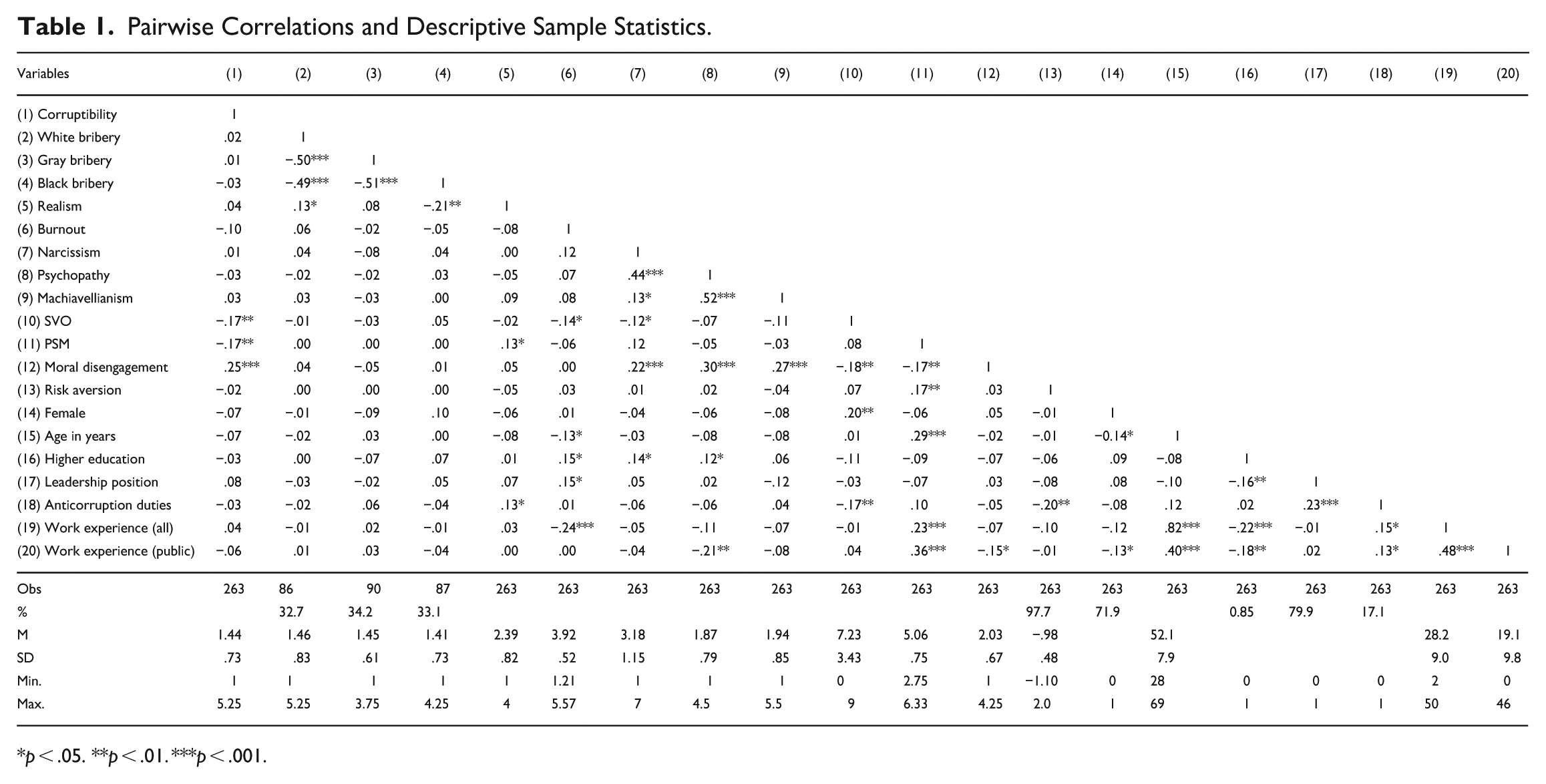
p < .05. **p < .01. ***p < .001.
The generalizability of survey data that relies on voluntary participation may be limited by non-random response associated with self-selection effects. However, comparing the aforementioned sample characteristics with data raised by the Swiss Federal Statistics Office and by prior scholarship conducted with samples of Swiss civil servants indicate that our sample is largely representative regarding PSM (Anderfuhren-Biget et al., 2010; Giauque et al., 2018; Weißmüller et al., 2024), job-related burnout (BfS, 2024; Weißmüller et al., 2024), engagement (Ritz & Sinelli, 2011), and the prevalence of the dark triad character traits (Atitsogbe et al., 2020). This high similarity suggests that selective non-response does not impair the generalizability of the results to the population of Swiss civil servants.
Results
Descriptive Results
As by design, the three bribery vignettes created some topical treatment variance without leading to significantly different response outcomes between bribery shades (corruptibility: white vs. black t = .383, p = .702, d = .058; gray vs. black t = .384, p = .702, d = .058; white vs. gray t = .059, p = .953, d = .009), pointing toward the invariability and reliability of respondents’ relatively low baseline corruptibility score (M = 1.44, SD = 0.73); see also results of pairwise correlation analysis in Table 1.
Participants perceived the vignette scenarios as above-average realistic (M = 2.39, SD = 0.82; four-point scale). Treatment distribution and sampling balance was achieved (see Supplemental Appendix C), which indicates that non-random response refusal due to the topical sensitivity of the vignettes treatments (i.e., corruption) was not an issue and that there are no latent unobserved by-treatment clusters of the sample characteristics which may otherwise bias the validity of the results. This vignette response invariance points toward a high robustness of the findings presented in the next section because any response variance relates to the effect of the integrity-related demands and resources on the micro-level, that is, states, traits, and motives—in contrast to situational factors—pointing toward high generalizability.
Pairwise correlation analysis (Table 1) indicates strong direct relationships between corruptibility and moral disengagement (ρ = .25, p < .000), PSM (ρ = −.17, p = .007), SVO (ρ = −.17, p = .006), but not burnout (ρ = −.10, p = .105), and the dark triad (ρ = .01, p = .937). There are significant correlations between the moral disengagement and the dark triad (ρ = .34, p < .000), as well as SVO (ρ = −.18, p = .003) and PSM (ρ = −.17, p = .007), providing support for the presented theoretical model, which suggested complex interactive relationships, calling for a non-linear modeling approach.
Hypothesis Testing
Given that (a) the theory model suggests that resources, demands, and regulators are likely to moderate and partially mediate each other (see e.g., Hauser et al. (2021), and (b) preliminary analysis reveals multiple inter-correlations and pathways that may bias linear regression modeling through multicollinearity, SEM-based investigation is best suited to test our hypotheses reliably and rigorously (Hair et al., 2019). Following the example of Zhang et al. (2019), the relationships in the proposed model were tested using component-based structural equation modeling, that is, partially least squares structural equation modeling (PLS-SEM) using the software SmartPLS 4 (Ringle et al., 2022). PLS-SEM combines both exploratory and confirmatory path analyses and reveals models’ causal-predictive relationships with higher predictive accuracy than linear modeling, particularly in complex models (Hair et al., 2019). PLS-SEM’s bootstrapping algorithm handles multicollinearity more effectively than regression analysis’ estimators which rely on restrictive parametric assumptions (e.g., multivariate normality, large sample sizes) which are not all met for this study’s data. Using a PLS-SEM is particularly recommended for reliably testing causal mechanisms in complex models with potential latent variables that involve multiple constructs and relationships, while simultaneously allowing for the exploration of recursive and equifinal relationships based on multiple correlations between the IVs (Chin et al., 2020). PLS-SEM’s estimations are prediction-oriented and algorithmically maximize the explained variance of the DV while bias correcting the CIs through non-parametric bootstrapping. This allows the reliable estimation of complex models with multiple interaction effects without suffering from variance inflation regression analysis’ issue of variance inflation (Hair et al., 2019; Streukens & Leroi-Werelds, 2016).
We estimate the PLS-SEM model by following a two-stage analytical procedure, following best practices proposed by Henseler et al. (2015) and Hair et al. (2019): first, the measurement model and its structure is calibrated and, second, hypotheses are tested. Investigating the reflective measurement model indicates very high internal consistency reliability (all constructs α = [.714–.989], well within the recommended boundaries of .70–.90), and SRMR estimation indicates excellent model fit since the resulting value of 0.09 is clearly below the threshold value of 0.80 (Hair et al., 2019). The outer, formative measurement model indicates no collinearity issues (all VIF ≤ 1.861; threshold: VIF < 3.0) and high convergent validity. However, not all variables load unto the target construct corruptibility. To test for significance with due rigor, percentile bootstrapping was conducted by running 5,000 subsamples with fixed seed and two-tailed testing to establish the bias-corrected confidence intervals, following best practices (Hair et al., 2019; Streukens & Leroi-Werelds, 2016). The results of the bootstrapped model estimation process are reported in detail in Supplemental Appendix D. The standardized direct, indirect, and total path coefficients (β) are reported in Table 2, including the statistical significance of the paths. Given that statistically significant paths between constructs in PLS-SEM models represent a (in)direct causal effect with a clear specification of the direction of influence, the revealed relationships are not merely correlational but are the outcome of robust causal inference. Figure 2 summarizes the empirical findings. Moderation analyses revealed no significant further specific indirect effects.
Direct Path Coefficients, Indirect, and Total Effects on Corruptibility.
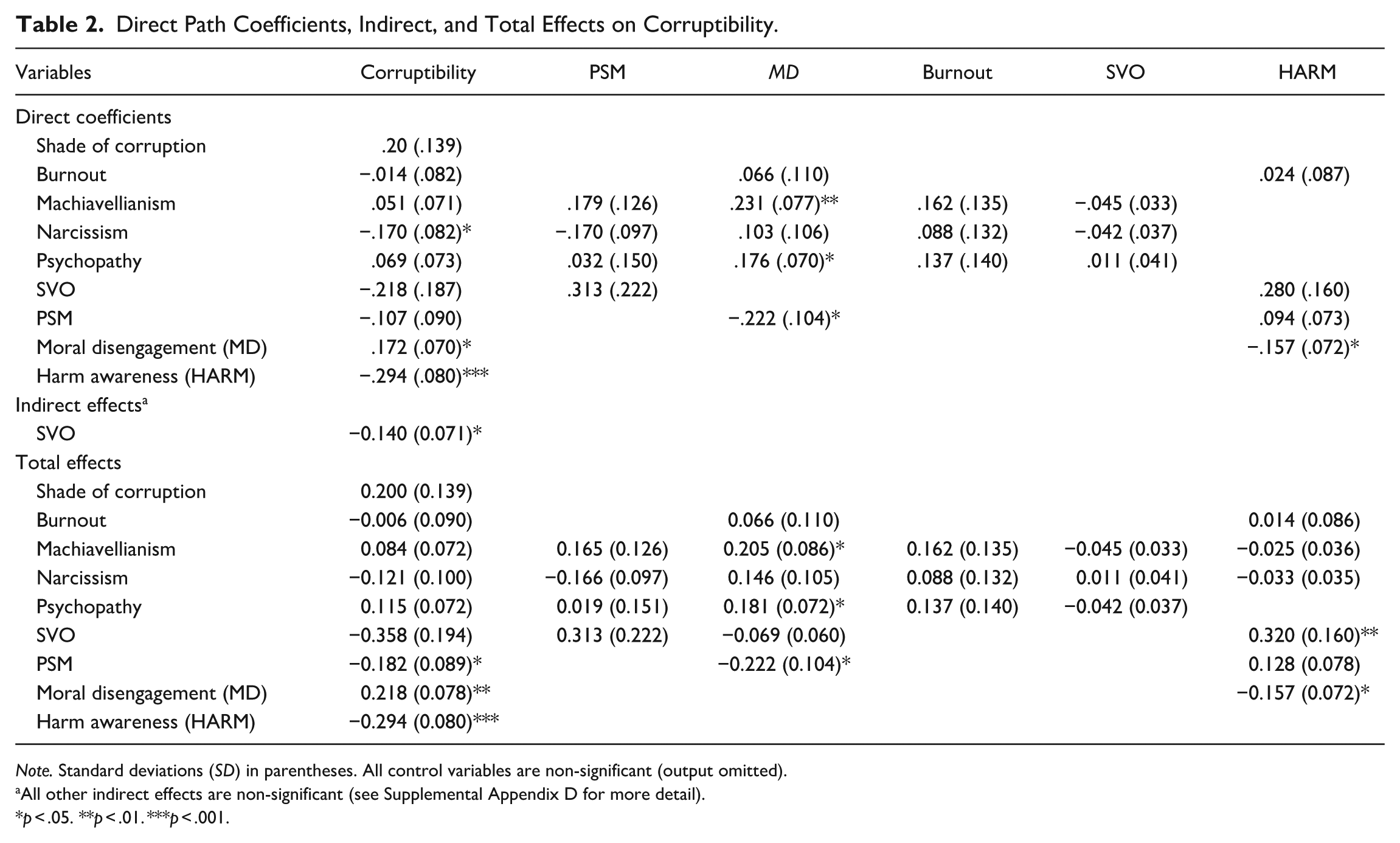
Note. Standard deviations (SD) in parentheses. All control variables are non-significant (output omitted).
All other indirect effects are non-significant (see Supplemental Appendix D for more detail).
p < .05. **p < .01. ***p < .001.
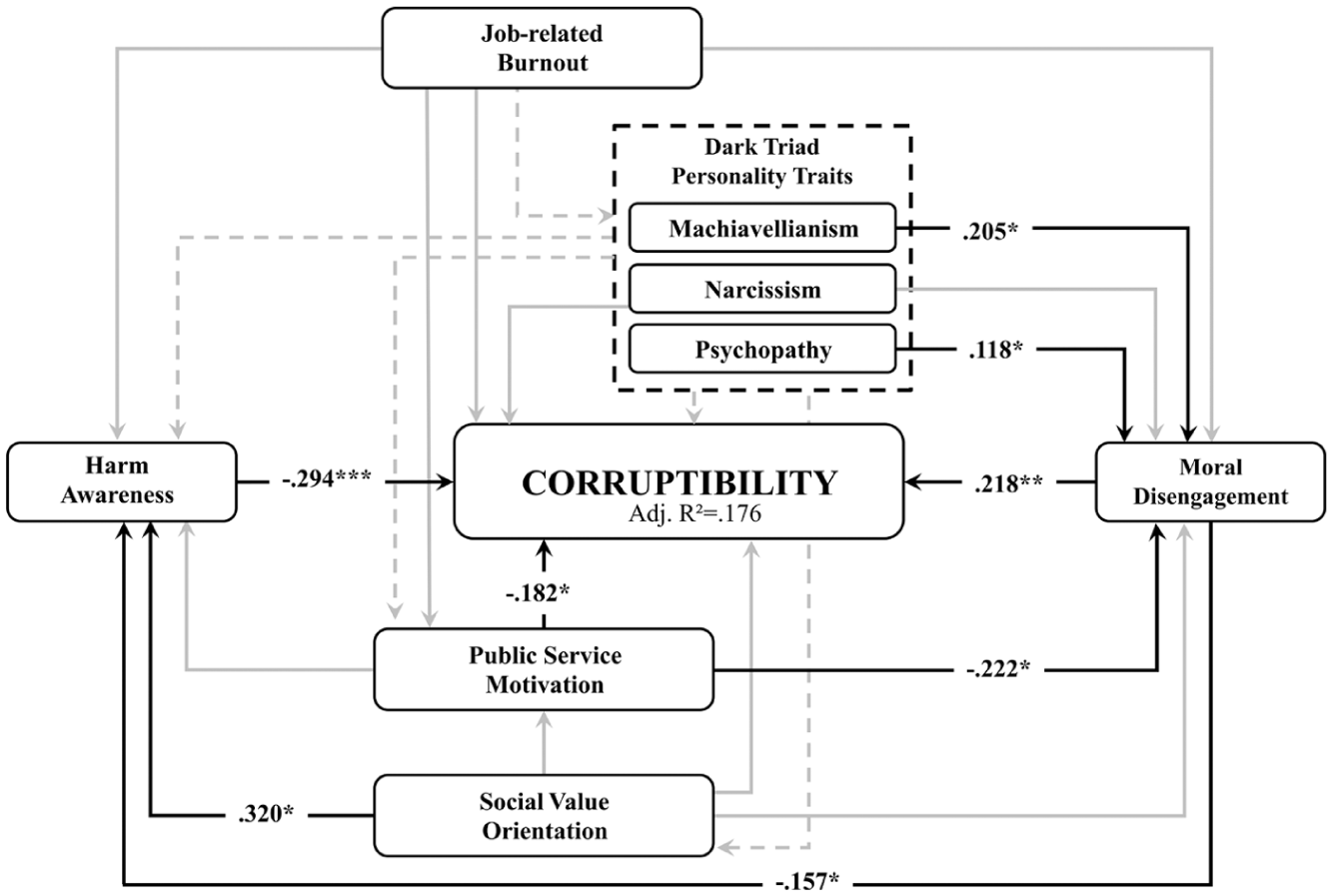
Empirical findings: Direct and indirect effects on corruptibility.
Analysis reveals that
Discussion
The goal of this study was to develop and test a novel demands-resource model of corruptibility. Survey data raised with a representative sample of seasoned civil servants from Switzerland provides empirical evidence supportive of a more nuanced understanding of administrative corruption that goes beyond prior conceptions based on rational choice models of decision making or principal agent conflicts of interest. Synthesizing and expanding prior streams of research by Hauser et al. (2021)—who highlighted the impact of the dark triad personality trait Machiavellianism on rationalization strategies for corruption—and Zhang et al. (2019)—who highlighted how work stress, employee well-being, and intrinsic motivations interact in forming Chinese civil servants’ corruptibility—we indeed find empirical support for the proposed demands-resources model of corruptibility, which is summarized in Figure 3.
Refined, empirical demands-resources model of corruptibility.
This study makes several fundamental empirical contributions that advance our understanding of civil servants’ corruptibility from the micro-level lens of behavioral public administration. First, civil servants’ corruptibility is independent from job-related burnout. This is an important null finding because it contributes to the clarification of the so-called trait versus state debate. The question whether traits—that is, stable personality dispositions—or situational factors or both in tandem drive motivational behavior has been an on-going debate for decades (Geiser et al., 2017), and it is highly relevant for understanding institutional deviance and administrative corruption as well.
Personality traits do significantly impact corruptibility which is an important insight for public personnel management and leadership research and practice. Our findings support prior findings by Hauser et al. (2021) and they are in support of personality trait theory in general, which suggests that individuals that score high on the dark triad are more likely to engage in self-serving, unethical, and opportunistic behavior due to a lower degree of moral engagement. Besides a higher likelihood to engage in corruption, this can also have detrimental effects for subordinates’ well-being and career success (Volmer et al., 2016). The data suggests that narcissism did not exercise any direct or indirect effect on corruptibility. Although this null effect is novel with the particular sample of civil servants, it is in line with recent findings by Gu et al. (2021) who—in contrast to general personality trait theory—found that narcissists working in for-profit industries exhibit higher corruption risks only if they are prone to boredom and experience situational and task-related boredom. Furthermore, it is important to note that this study measures reported behavioral intent to engage in corruption—in contrast to actual observed behavior in the field. Narcissists typically hold an inflated self-image about their own virtuosity (Morf et al., 2000), which is the very factor that provides them with a moral license for integrity violations and the transgression of societal norms (Blanken et al., 2015), leading to adverse organizational and societal outcomes. These characteristics may also result in a trait-related bias in self-awareness and dysfunctional work outcomes for subordinates of dark triad leaders in the form of exhaustion and dissatisfaction (Volmer et al., 2016), calling for further exploration in the specific context of the public sector.
Only two out of the three dark triad traits (Machiavellianism and psychopathy) affect corruptibility and indirectly so, namely by increasing moral disengagement from one’s own corrupt action or intent. For Machiavellians, who tend to exhibit non-reciprocal, opportunistic, and decisively self-serving utility maximizing behavior (Paulhus & Williams, 2002), this positive relationship can be explained with their typical trait of justifying means based on the ends achieved, which in turn facilitates moral justification despite awareness about the organizational and societal harm associated with administrative corruption (Birkás et al., 2015). For people who score highly on the psychopathic character trait, the significant relationship with moral disengagement originates from their typical lack of concern for social and institutional regulatory mechanisms and their lack of the morally inhibiting feeling of guilt in case their action may result in harm to others (O’Boyle et al., 2012). It is important to note however that the survey data allowed us to clearly differentiate between harm awareness with regards to the harm directly associated with the proposed act of corruption in the treatment and general moral disengagement in their professional environment. In their role as demands on moral judgment, the dark triad personality traits do not impact respondents’ perception of situational harm but rather increase their general level of moral disengagement which also explains why their response did not vary between the three different types of corruption treatments. Individuals who are particularly able to disengage their moral identity from their (immoral) behavior report a significant intent to engage in corrupt behavior, irrespective of the type of bribe offered. This result aligns with prior research by (Bandura, 1999, 2002), who pointed out that highly morally disengaged individuals are able to dissociate their moral self-concept from the psychological burden associated with a misfit between moral identity and moral action (Chiu et al., 1997) as well as from the adverse consequences of their corrupt behavior on others and society at large (Abraham et al., 2018). Taken together with the null result with regards to burnout, the study highlights the impact of traits—that is, stable personality dispositions—versus variable situational characteristics in predicting corruptibility in civil servants.
By illustrating the applicability of Demerouti and Bakker’s (2023) generalized job demands-resource model for explaining the complex interactions between personality traits, motives, demands, and behavioral regulation, this study also significantly extents our conceptual understanding of civil servants’ corruptibility because it provides a novel conceptual model that is supported by empirical evidence. Its novel insights regarding the function of character traits and social value orientation as antecedents of corruptibility that are mediated by distinct cognizant states of moral judgment (i.e., harm awareness and moral disengagement) extend prior models of corruptibility by Zhang et al. (2019) and Hauser et al. (2021) by clarifying the micro-level motivational mechanisms that directly and indirectly constitute individuals’ corruptibility. These novel insights substantiate prior meta-level research by Weißmüller and Zuber (2023) that conceptualized administrative corruption as a behavioral outcome of a linear psychological evaluation process culminating in moral justification based on traits, believes, and contextual factors that moderate behavioral intent. The current study advances their conceptual model by clarifying that (a) PSM and social value orientation function as two distinct psychological pathways instead of related behavioral beliefs, and (b) by providing novel evidence that moral justification for corruption is the outcome of the two regulating antipodes (moral disengagement and harm awareness) which regulate people’s behavioral response to distinct integrity-enhancing resources and integrity-draining demands as mediators. These novel, evidence-based contributions add important nuance to our understanding of the micro-foundations of administrative corruption, closing a relevant research gap as highlighted by Jain (2001), Jancsics (2014), Zhang et al. (2019), and Hauser et al. (2021).
The study relies on highly representative data of civil servants in Switzerland (BfS, 2022; Giauque et al., 2015), a typical example of the Rechtsstaat tradition of public administration. Switzerland is generally regarded as a low-corruption country (Transparency International, 2023), in which administrative corruption is deemed illegal, illegitimate, and rare. In countries with endemic administrative corruption, the psychological burdens of moral justification and disengagement may be lower (Weißmüller & Zuber, 2023). Although basic psychological mechanisms should be stable across sectors and societal contexts, future comparative research is encouraged to assess the generalizability of this study’s findings across cultural contexts and administrative traditions because they tend to exhibit different personnel compositions due to different pull factors and public value signaling (Ritz & Weißmüller, 2025).
Second, this study reveals a strong negative relationship between PSM and corruptibility, contributing to the “bright side” perspective of PSM. While the PSM discourse has recently started to discuss and explore the potential dark sides of PSM (Schott & Ritz, 2018) and provides empirical evidence that high-PSM individuals have a higher likelihood of engaging in pro-social rule breaking (Ripoll & Schott, 2023; Weißmüller et al., 2022), and strategic deviation in public-private partnerships (Weißmüller & Vogel, 2021), the current study clearly indicates the positive aspects of PSM as an integrity-enhancing moral resource, which is an important finding for the practice of public personnel selection and motivation. The study contributes to the PSM discourse (Ritz et al., 2016) by stressing that PSM with its strong grounding in an call to service and commitment to the greater good of society indeed functions as a reliable predictor for integrity. Furthermore, its path model reveals novel evidence on the underlying motivational mechanism that drives the corruption-inhibiting effect of PSM, namely (a) its direct negative effect with corruptibility and (b) its indirect effect by reducing individuals’ ability to morally disengage from their actions. This indirect relationship may be particularly useful for practice in that it can serve policy makers and public leaders to design anti-corruption appeals more effectively and clearly communicate with their high-PSM staff in order to foster compliance and integrity in administrative conduct. Furthermore, and in line with research by prior research on PSRB by De Waele et al. (2021), the data reveal that SVO and PSM are indeed clearly separate motivations that function through two dissimilar processes of cognition: SVO significantly reduces corruptibility by the proxy of increasing situational harm awareness, while being independent from PSM, which functions as a stable trait. This means that anti-corruption trainings can leverage appeals to both PSM and SVO successfully to increase civil servants’ integrity, particularly for high-PSM individuals who respond particularly positively to anti-corruption initiatives (Lee & Park, 2025).
Third, the finding that civil servants’ corruptibility is independent from job-related burnout is (a) a good sign and (b) in contrast to prior research from for-profit work contexts by Kalliath et al. (2000), Pulich and Tourigny (2004), and Ceschi et al. (2016) linking burnout and work-related integrity violations, which further substantiates the notion that due to the unique combination of complex and partially conflicting goals and high societal stake in a public value-infused work environment (Simon, 1947/1997), insights from private sector research cannot be transferred unconditionally onto the realm of the public sector to predict behavior. Furthermore, this finding reveals that the loss of self-efficacy, engagement, and motivation associated with the psychological burden of burnout (Crawford et al., 2010) does in fact not spill over into a higher likelihood of integrity violation. This is an important and novel finding for Public Administration research because it indicates that civil servants’ moral disengagement functions as a stable trait rather than as an outcome of acute job-related stress, overwork, or psychological strain, and independent from burnout. This empirical result is in line with the recent development of the discourse on the origins and outcomes of moral disengagement that increasingly recognizes moral disengagement as a trait-like disposition associated with character traits as discussed above rather than a state (Newman et al., 2020).
Limitations and Future Research
Despite these important theoretical and practical contributions, it is important to acknowledge some limitations. First, this study’s dependent variable is corruptibility, that is, behavioral intent in contrast to actual behavior. This is due to the delicate nature of researching corruption with active civil servants. Measuring corruption engagement directly (i.e., by explicit survey questions type and frequency of behavior) invariably leads to strongly distorted data due to social desirability bias and fear of persecution—even in a fully anonymized study designs (Bernardi et al., 2011)—rendering it both impractical and inadmissible with ethical boards due to the research principle of preventing study participants from any research-related harm.
Second, the level of abstraction associated with vignette designs limits their external validity. While the scenario was designed with expert involvement and controlled for realism following best practice (Aguinis & Bradley, 2014), the vignettes’ ability to allow systematic parameter manipulation cannot represent the full complexity of the organizational environment in which administrative corruption materializes. However, this level of abstraction and systematic topical variation is also the unique quality of vignette-based research designs. They reliably trigger context-dependent behavior with high validity even for self-reported data which is prone to social desirability-related response bias, turning this research design characteristic into a strength rather than a weakness (Aguinis & Bradley, 2014; Hughes & Huby, 2004). Using this design allowed us to determine the relative benchmark of study participants’ corruptibility across distinct types of acts of corruption, contributing to the external validity of the findings. Yet, it is important to recognize that the three vignettes vary regarding the intensity and stakes of the scenarios described, which may lead to upward response distortion in the case of the black corruption scenario due to social desirability bias. While the data do not indicate statistically significant differences in civil servants’ corruptibility between treatments, future studies that systematically explore the impact of bribe amount offered, external pressure or duress, and the situational probability of detection and prosecution are encouraged to assess how these contextual factors may impact civil servants’ susceptibility to bribery in context.
Third, using a convenience sample limits the generalizability of the findings compared with a probability sampling strategy due to unobserved non-random self-selection or non-random refusal of study participants. While the sample’s high level of homogeneity and representativeness for Switzerland’s civil servant population indicates that this potential issue is of minor concern for the finding’s validity (Jager et al., 2017), future replication studies are needed to clarify the full scope of their generalizability.
Fourth, as demonstrated by Zhang et al. (2019) and Weißmüller and Zuber (2023), civil servants’ likelihood of engaging in administrative corruption is the outcome of the combination of many individual and organizational factors. The current study is limited with regards to its scope by focusing strictly on the micro-level of traits (i.e., the dark triad), motives (i.e., PSM and SVO), and states (i.e., burnout) associated with work life that may serve as job demands and resources, respectively. Its dependent variable is corruptibility in a work-related context of public administration, serving as a potential that is aggravated by job demands and ameliorated by job resources. Future studies will build upon the study’s empirical insights by expanding its purposefully narrow focus. For instance, the JDR model suggests that private life events, such as financial hardship or health issues (Ripoll & Breaugh, 2019), may spill over into work life and impact job-related outcomes for both civil servants (Weißmüller et al., 2024) and private sector workers (Amstad et al., 2011). Organizational factors such as low person-organization fit, a lack of due diligence in administrative procedures, high degrees of administrative discretion and institutional inefficiencies can accelerate bureaucrats’ likelihood to engage in corrupt behavior (Weißmüller & Zuber, 2023). Future research linking these meso-level factors with the micro-level characteristics investigated in the current study are needed to further deepen our understanding of administrative corruption as the outcome of corruptibility, context, culture, and opportunity, as also highlighted by Thomann et al. (2025).
Fifth, corruption research is inherently subject to a latent culture-specific normativity that calls for research to replicate the current study’s design to allow for cross-cultural comparative research. In Switzerland, corruption is not a salient issue for the large majority of the population because Switzerland is generally regarded as a low-corruption country in which public administration functions as a reputable and trustworthy institution concerned with generating public value (Ritz et al., 2023; Transparency International, 2023). Consequently, engaging in corrupt acts as described in the vignette scenarios constitutes both a legal norm violation and an illegitimate hyper-norm violation. While the demands-resources model of corruptibility relates to basic psychological functions of moral judgment that should generalize beyond the current empirical context, further research is encouraged to investigate the degree to which this study’s findings replicate exactly in countries characterized by endemic administrative corruption. In high-corruption contexts, prior research suggests that gradual normalization effects may reduce the psychological burden associated with corrupt behavior so that the preventive effect of integrity-enhancing resources may be diminished (Ateş, 2012; Weißmüller & Zuber, 2023), calling for further research.
Conclusion
The “spirit of formalistic impersonality” (Weber, 1947, p. 331) is the effective principle of civil servants’ work and a main characteristic of public bureaucracies. Office holders are recruited in accordance with impersonal criteria, and they are trustees of an impersonal rational-legal order based on upholding public values (Höpfl, 2006). Put simply, in an ideal world, bureaucrats’ character traits and mental health would not affect their decision making and work outcomes. But, of course, civil servants are real people with real differences regarding their traits, beliefs, motives, and capacity to control their behavior. Modern societies have a vital interest in knowing the factors that drive civil servants’ capacity to withstand opportunities for corruption. Investigating the interaction between micro-level motives and personality traits and job-related demands, resources, and regulators allowed us to derive and test a novel micro-level demands-resources (D-R) theory of corruptibility that goes beyond prior conceptualizations of corruption based on rational choice theory (Rose-Ackerman, 2010), principal-agent (Schuster et al., 2020), or collective action problems (Persson et al., 2013), all of which are limited in their capacity to explain public sector corruption. This study elevates our understanding about the relationships between traits, motives, and demands on corruptibility to help policy makers design more effective anti-corruption strategies in the future. Taken together with the relative longitudinal stability of PSM, the study suggests that practical efforts of anti-corruption aimed at warranting integrity in public administration should emphasize attracting, selecting, and retaining individuals into civil service that hold high levels of PSM and SVO, exhibit lower Machiavellian and psychotic traits, and a low capacity for moral disengagement in general. These factors are crucial predictors of corruptibility, and they ameliorate or aggravate each other in tandem as demands and resources for integrity. The good news is that prior research has demonstrated that signaling in targeted HR advertisements can successfully attract this type of talent to public sector employment (Asseburg et al., 2020). Consequently, it is important to recognize the importance of these individual differences in corruptibility and focus compliance efforts on understanding how a workforce’s traits, states, and motives affect moral disengagement and harm awareness. These insights allow practitioners to design anti-corruption trainings and policies more effectively by recognizing the impact of the human factor in the fight against administrative corruption.
Supplemental Material
sj-docx-1-rop-10.1177_0734371X261417649 – Supplemental material for A Demands-Resources Model of Corruptibility: Empirical Evidence on How Moral Disengagement and Harm Awareness Regulate Civil Servants’ Moral Judgment
Supplemental material, sj-docx-1-rop-10.1177_0734371X261417649 for A Demands-Resources Model of Corruptibility: Empirical Evidence on How Moral Disengagement and Harm Awareness Regulate Civil Servants’ Moral Judgment by Kristina S. Weißmüller and Adrian Ritz in Review of Public Personnel Administration
Footnotes
Acknowledgements
We thank Lode De Waele and Arjen van Witteloostuijn for assistance with developing the vignettes employed in this experiment under the general purview of the multi-country Corruption in the Public Sector (CorPuS) research project.
Declaration of Conflicting Interests
The authors declared no potential conflicts of interest with respect to the research, authorship, and/or publication of this article.
Funding
The authors disclosed receipt of the following financial support for the research, authorship, and/or publication of this article: An earlier version of this article was presented at the EGPA conference 2022 with generous support by the travel grant of the Swiss Academy of Humanities and Social Sciences (SAGW).

Supplemental Material
Supplemental material for this article is available online.
Notes
Author Biographies
References
Supplementary Material
Please find the following supplemental material available below.
For Open Access articles published under a Creative Commons License, all supplemental material carries the same license as the article it is associated with.
For non-Open Access articles published, all supplemental material carries a non-exclusive license, and permission requests for re-use of supplemental material or any part of supplemental material shall be sent directly to the copyright owner as specified in the copyright notice associated with the article.
