




Abstract
While it is known that life events are predictive for psychological and physiological illnesses, empirical research on the relationship between private life events and their effect on work-related outcomes in a public sector context is scarce. Based on the extended job demands-resources model, this study argues that experiencing private life events may exercise spillover effects into the sphere of professional life affecting public employees’ work engagement and their risk of burnout. Longitudinal survey data from Switzerland reveals that negative private life events are associated with an increase in burnout but not necessarily lower levels of work engagement. Furthermore, experiencing transformational leadership exerts a mild stabilizing effect on work engagement in the face of private life events while public service motivation has no moderating effect. These findings have important implications for the practice and theory of public personnel management and leadership, employee performance, and well-being.
Keywords
Introduction
During our lifetime, everybody experiences important life events that may be either enjoyable or demanding. Profound changes in work and private life constantly affect employees’ well-being and may have significant spillover effects on their performance at work (Amstad et al., 2011). Recently, the worldwide COVID-19 pandemic disrupted most people’s lives not only with the experience of sickness and hardship but also by challenging the “given” principles and processes of work life on a fundamental level (Demerouti & Bakker, 2022). The sudden demand for working from home and increased care-related demands revealed that private and work life are inextricably linked, and many employees and personnel managers have experienced that private life events directly affect productivity, coordination, and work climate (Wood et al., 2021). Prior research showed that both negative private life events (e.g., the death of a partner, or severe health-related issues; see e.g., Dohrenwend, 2006) but also positive private life events (e.g., the birth of a child to people wishing to start a family or other life enriching occurrences) demand social adaptation and readjustments at work (Bhagat, 1983; Maslach & Jackson, 1981; Rabkin & Struening, 1976). This interconnection between the spheres of professional and private life has now moved into the spotlight of collective awareness and marks a central challenge for human resource management and personnel motivation in the 21st century.
To date, there is only limited empirical evidence on how employees’ private life events affect work-related outcomes with a special focus on civil servants. Prior research provides strong support for the idea that negative life events are predictive of psychological and physiological well-being, leading to a variety of adverse health-related outcomes (Anderson et al., 2022). Negative private life events may result in additional strain so that extant job demands cannot be fulfilled anymore in the workplace, resulting in reduced productivity and detachment from work as a form of stress coping (Diener et al., 2009; Greenhaus & Beutell, 1985; Luhmann et al., 2012). This research gap is remarkable given that the separation of private life and office is one of the core principles of modern Weberian bureaucracy (Weber, 1947). Yet, the consequences of adverse private life events have been detected to spill over into work life (Hakanen & Bakker, 2017), so these private life events can be interpreted as impactful interventions into individual employees’ lives that will also affect work-related outcomes (Hakanen & Bakker, 2017).
Based on the cross-domain hypothesis of work-family conflict (Greenhaus & Beutell, 1985; Wayne et al., 2017), this study argues that private life events and work-related outcomes are inextricably linked on a psychological level through spillover effects that can best be explained by a theoretical framework based on the extended demands-resources (D-R) model (Demerouti & Bakker, 2022). This framework is the generalized version of the job demands-resources (JD-R) model (Bakker & Demerouti, 2007; Demerouti et al., 2001), which grew out of job stress research (see, e.g., Holmes and Rahe, 1967; Bledow et al., 2011; Dohrenwend, 2006; and Anderson et al., 2022), and it has been used extensively to explain the relationships between individuals’ experiences, health, and work-related outcomes. The current study is the first to test Demerouti and Bakker’s (2022) conceptual proposition that supportive (i.e., transformational) leadership and employees’ individual motivation may regulate the impact of positive and negative private life events on employees’ work-related outcomes in the form of work engagement and burnout.
Following this novel moderation hypothesis, this study specifically explores the effects of transformational leadership (TL) and public service motivation (PSM), two essential contextual and motivational factors that are argued to affect public personnel performance, work engagement, and well-being (Alfes et al., 2018; Borst et al., 2019). Following calls by Hakanen and Bakker (2017), Alfes et al. (2018), Carless et al. (2000), and Demerouti and Bakker (2022), this study investigates whether TL’s value-based and sense-giving qualities may ameliorate the adverse effects of negative private life events on the aforementioned work-related outcomes—compared to experiencing positive life events—while PSM’s light side may function as an additional resource during private life events and ameliorate their adverse effects (Borst et al., 2019; Paarlberg & Lavigna, 2010).
The research question is answered by conducting multiple regression analyses on original data from a civil servant employee survey conducted in two waves in Switzerland, which controlled for the occurrence of private life events in the form of a quasi-intervention between survey waves. The remainder of this study is structured as follows: the next section derives the theoretical framework, which integrates the discourse on the spillover effects of private life events into work-related outcomes with the extended D-R model to derive hypotheses. Subsequently, the methods and data are described, followed by a presentation of the empirical results. The findings are discussed with a special focus on the practical and theoretical implications of these empirical results while considering their limitations to encourage future research.
Theory
Private Life Events
Life events are specific and impactful incidents that affect individuals profoundly and on a very personal level. While such life events can occur both in the spheres of private and work life, the current study focusses on private life events and their impact on work exclusively, purposefully excluding the impact of work-related life events, as their effect on work-related outcomes is already well-documented. Life events are typically examined from two major theoretical lenses, mainly nested in psychology (Luhmann et al., 2012). On the one hand, the stress perspective researches life events that significantly disturb individuals’ daily routines. While these events can be subjectively perceived as positive (e.g., the birth of a child for people who want to become parents) or negative (e.g., becoming unemployed, experiencing a major accident, or a financial misfortune), these life events’ impact is usually dramatic and can be traced back to a specific point in time. On the contrary, the developmental perspective characterizes critical life events as specific phases of transition that can either be slow and continuous (e.g., growing up into adulthood) or fast and discrete (e.g., taking up a new profession). The current study follows Luhmann et al.’s (2012, p. 594) synthesis of these two perspectives by defining private life events as life-changing “time-discrete transitions that mark the beginning or the end of a specific status quo” related to individuals’ private life, in which the transition from one status to another marks a specific life event.
While some researchers argue in line with the hedonic treadmill theory (Brickman & Campbell, 1971; Diener et al., 2009) that the positive or negative effects of life events abate as a function of time—in the sense that individuals will gradually adapt to the new status quo after a private life event occurs (Lucas et al., 2003; Luhmann et al., 2012)—a review by Luhmann et al. (2012) shows that life events may actually have lasting effects on individuals’ productivity and well-being.
Of course, individuals vary with regards to their self-efficacy and vulnerability to negative life events depending on their personal situation in life, their life experience, social capital, and resilience (Anderson et al., 2022), rendering the severity of private life events inherently subjective. Yet, some generalizations can be derived from the fact that virtually all working individuals need to find ways to balance the various challenges of work and private life to maintain their health, motivation, and performance (Demerouti & Bakker, 2022). A general framework encompassing this challenge is the job demands-resources (JD-R) model. The JD-R model illustrates how the effect of private life events translates into work-related outcomes. In its most general form, the extended demands-resources (D-R) model proposes that employees’ work-related outcomes rely on a sufficient level of employee energy/health and motivation (Demerouti & Bakker, 2022). Both employee health and motivation are subject to various types of demands and resources
Demands require sustained physical and/or mental effort and are, therefore, associated with physiological and/or psychological burdens that drain energy and impair employee well-being and health (Demerouti & Bakker, 2022). Resources stimulate personal growth, learning, and development and hence facilitate the achievement of work goals and increase motivation (Demerouti et al., 2001). Besides these direct relationships between demands and the impairment of employee well-being on the one side, and resources and employee engagement on the other side, organizational and personal demands and resources may moderate the strength of these relationships (Demerouti & Bakker, 2022). For instance, the positive motivational effect of resources associated with, for example, having high job autonomy and fulfillment, an interesting task, and personal support may be weakened by the impact of a daunting and stressful life event—such as the death of a loved one. Similarly, the energy-impairing, adverse effect of job-related demands (Alfes et al., 2018) may be ameliorated by experiencing a positive life event such as the long-awaited birth of a child, which may help restore depleted (psychological) resources through cross-role resource transfer (Demerouti & Bakker, 2022). Private (i.e., non-work-related) life events are likely to alter the relevance of work in individuals’ life by fundamentally shifting priorities and perspectives leading to either psychological enrichment (Brummelhuis & Bakker, 2012; Greenhaus & Powell, 2006) or strain (Amstad et al., 2011; Greenhaus & Beutell, 1985). Following the D-R model, public employees’ private life events either constitute subjectively stressful (i.e., negative) personal demands or subjectively joyous (i.e., positive) personal resources and should influence their work-related outcomes.
Private Life Events’ Impact on Burnout and Work Engagement
For the individual employee, the spheres of private and professional life are inextricably linked, creating a psychological and motivational microsystem consisting of interdependent relationships (Voydanoff, 2005). Consequently, cross-domain spillover between private and work life can lead to resource depletion or resource generation, leading to changes in work-related outcomes (Amstad et al., 2011; Edwards & Rothbard, 2000).
Negative life events are demands as they will “cost” energy by increasing psychological as well as tangible burdens that are likely to reduce employees’ cognitive, physical, and psychological resources at work (Demerouti & Bakker, 2022). These interdependencies are of high interest from a bureaucracy viewpoint. The expectancy of professional and impersonal public service implies that bureaucrats are assumed to be capable of separating the spheres of private and work life, at least so that private life events do not lead to a decrease in work engagement or increase in burnout that would affect the productivity and quality of their public service. This argument is in line with prior research which found consistent support for the extended D-R model in the public sector, linking personal demands and resources with public personnel engagement and burnout (Alfes et al., 2018; Borst et al., 2019; Giauque et al., 2013; Hakanen et al., 2005; Hsieh, 2014). Yet, empirical findings from life events research in a work-related context are scarce, with Hakanen and Bakker (2017) and Suzuki et al. (2017) being important exceptions.
Freudenberger (1974), Maslach et al. (1986), and Maslach and Leiter (2008) developed the concept of burnout by defining it as a syndrome of emotional exhaustion, depersonalization, and reduced personal ability to cope with the job and private life demands. The current consensus is that burnout comprises three different but interacting dimensions: (a) exhaustion, that is, a person’s fatigue, (b) cynicism, that is, a person’s indifference toward work, and (c) professional efficacy, which encompasses the loss of both social and non-social aspects of occupational accomplishments (Leiter & Schaufeli, 1996). As a chronic and stable state in response to prolonged stress (Basinska & Gruszczynska, 2020), burnout has a significantly negative impact employees’ well-being and work outcomes. While people may develop burnout symptoms for various reasons, extant scholarship agrees that the reasons clearly go beyond mere workload (Leiter & Schaufeli, 1996). Instead, developing burnout is especially likely in contexts in which people experience substantial levels of emotional stress when executing their tasks and in which individuals’ perceived locus of control is relatively low (Schmitz et al., 2000), that is, the typical experience of an existential, life-changing event, and a negative private life event in particular. Hakanen and Bakker (2017) note that it is surprising that non-work-related factors are seldomly integrated into burnout research albeit HR research in the for-profit sector points toward potential cross-domain spillover effects (Amstad et al., 2011).
Most studies concerning the outcomes of life events relate to psychological disturbances and physical illness, stressing the predictive power of negative life events as a form of stress for a variety of health-related outcomes. For instance, prior studies by Bhagat (1983) and Anderson et al. (2022) reveal negative relationships between stress-inducing negative life events (e.g., cardiac problems, pregnancy with birth-related complications, anxiety disorder, or depression) and performance. Experiencing negative private life events can result in affective mood shifts which immediately reduce work engagement (Bledow et al., 2011). Public employees’ well-being is a highly important topic for public organizations charged with warranting the delivery of high-quality public services because employee well-being is related to public employees’ work engagement and performance (Borst et al., 2019; Van Loon et al., 2015). Work engagement is “a deep state of mind that connotes the satisfaction of basic psychological needs (physically, cognitively, and emotionally)” in a work-related context (Borst et al., 2019, p. 379). Work engagement is predictive of organizational commitment and turnover intention and typically relates to employees’ vigor, their dedication, and their individual and job-related resources, and it is typically regarded as summative of the eudemonic and hedonic components of work. In their study among managers from Exxon, Vicino and Bass (1978) show that retrospectively perceived stability in life—that is, the absence of private life events—was associated positively with job success measured by the job grade attained, comparative on-the-job effectiveness, and employee potential. In contrast, negative life events are strongly correlated with a higher likelihood of developing burnout symptoms and moral disengagement in the workplace (Penney & Spector, 2005). The only research closely related to the current study is Hakanen and Bakker (2017) and Suzuki et al. (2017), both of which relate negative life events with burnout and found that particularly negative life events are related to a higher likelihood of developing burnout.
Furthermore, meta-analytic research by Amstad et al. (2011) illustrates a robust relationship between private life-related conflicts and adverse outcomes at work such as burnout on the one hand, and reduced work satisfaction and organizational commitment, on the contrary, two concepts closely connected with work engagement. Following these studies, it is reasonable to assume that burnout and work engagement are directly related to the experience of a private life event (Bliese et al., 2017).
The Moderating Effect of Transformational Leadership and Public Service Motivation
The extended D-R model suggests direct effects of demands and resources on work-related outcomes, but it also proposes moderating effects in the form of so-called regulators, see Figure 1, which summarizes the current study’s conceptual model. The baseline assumptions are that (a) individual and organizational resources can buffer the negative effects of excessive demands and that (b) highly demanding work or private life situations in combination with high levels of (job) resources result in higher levels of work engagement (Bakker et al., 2007; Borst et al., 2019; Demerouti & Bakker, 2022). Although prior studies (e.g., by Hu et al., 2011) strongly suggest such interactive effects, the influence of these potential moderating effects is less well-researched compared to the direct effects of (job) demands and (job) resources usually explored in empirical JD-R studies (Borst et al., 2019; Hu et al., 2011, 2017; Taris, 2006).
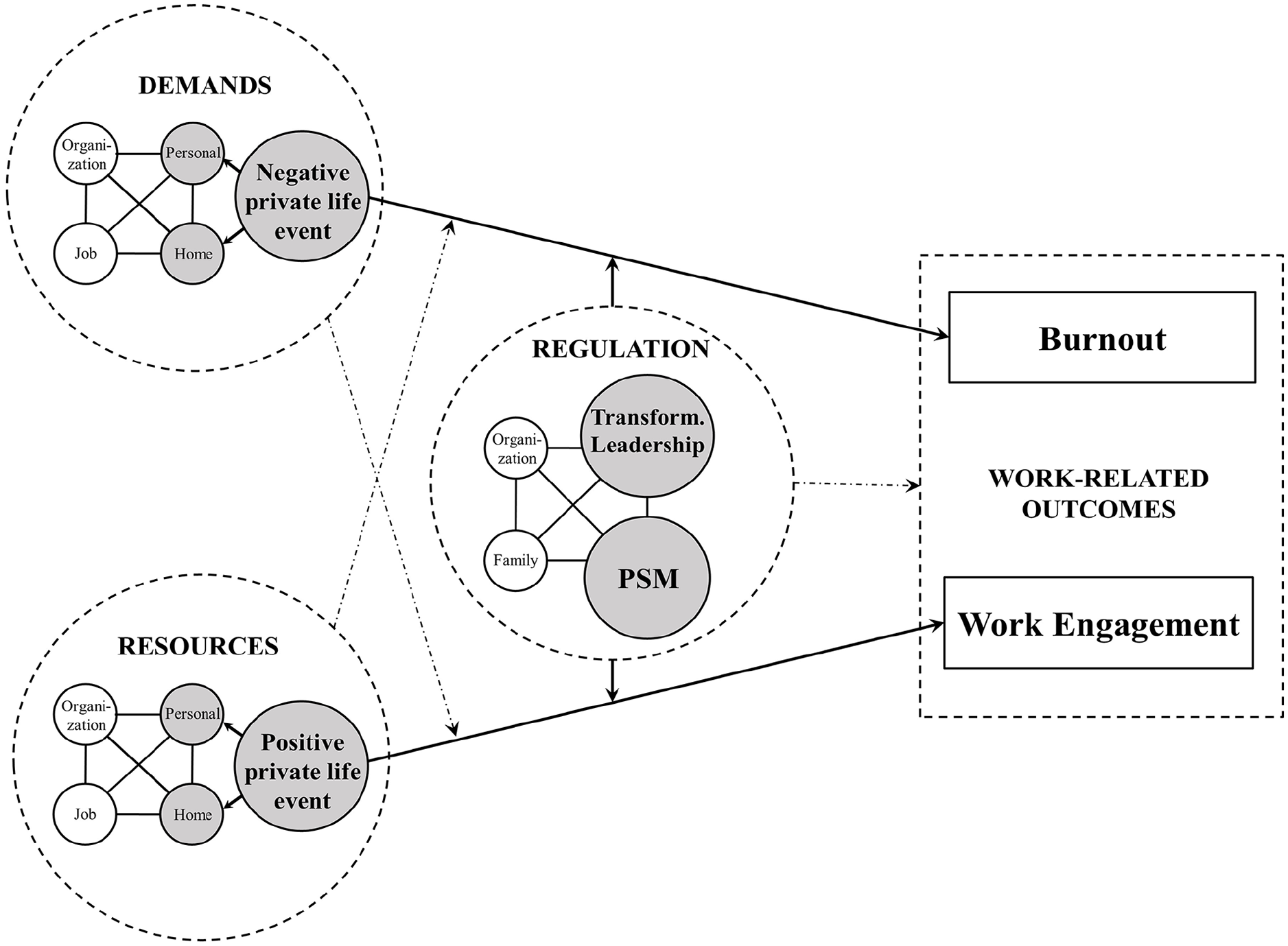
Conceptual Model.
In the previous section, positive private life events were introduced as a resource and negative life events as a demand in the extended D-R model, respectively. Obviously, the effects of these life events on engagement and burnout will depend on other moderating factors that interact with resources and demands as well (Amstad et al., 2011; Brummelhuis & Bakker, 2012; Wayne et al., 2017). Following Demerouti and Bakker (2022), who stress that supportive forms of leadership and personal factors nested within the individual may increase employees’ resilience in times of crisis, this study focuses on two central factors commonly used to understand employee behavior and motivation in the context of public administration—transformational leadership (TL) and public service motivation (PSM)—with a particular focus on their ameliorating effect on the adverse resource draining spillover effect of negative private life events.
The Moderating Effect of Transformational Leadership
Employee engagement cannot be fully understood without taking into account leadership processes. In public administration research, leadership has become a highly relevant variable for explaining public sector reforms, organizational outcomes, and employee behavior (Vogel & Masal, 2014). TL is characterized by a highly motivating and supportive leader–follower relationship in which the leader creates a shared vision based on public values, articulates clear and meaningful goals, empowers employees, and serves as a model of ethical and trustworthy behavior (Paarlberg & Lavigna, 2010). Transformational leaders support their followers by reducing cognitive and emotional job demands and by providing emotional security and a supportive work climate, which decreases employees’ role overload and the likelihood of developing burnout (Alfes et al., 2018; Moriano et al., 2021). Consequently, TL is positively associated with followers’ work engagement because transformational leaders create job resources such as social support, feedback, higher-quality relationships, and opportunities for growth (Breevaart, Bakker, Demerouti, et al., 2014; Breevaart, Bakker, Hetland, et al., 2014; Fernet et al., 2015; Schaufeli, 2015). In contrast to these well-researched direct relationships between TL, job demands, and job resources, there is little empirical evidence on whether TL may also moderate the demands/resources-outcome relationships (Tummers & Bakker, 2021). However, Breevaart and Bakker (2018) show that TL moderates the effects of challenging and adverse demands on work engagement. It follows that TL should have a buffering effect on the relationship between private life events and work-related outcomes. This will be especially the case for negative life events: On the one hand, TL may help employees who experience a private life event by stimulating individuals’ personal resources by providing support and facilitate the sense-making process, which allows employees to better cope with the hardship and resource drain associated with negative private life events. On the contrary, transformational leaders’ stimulating and energizing vision may weaken life events’ adverse resource-draining effect and hence help maintain work engagement and decrease the risk of burnout (Tummers & Bakker, 2021).
The Moderating Effect of Public Service Motivation
PSM is one of the few home-grown concepts within public administration research (Moynihan et al., 2013; Ritz et al., 2016). While Giauque et al. (2013) use the JD-R model to test the negative direct relationship between PSM and stress perception—a connection, which had to be rejected—Bakker (2015) integrated PSM within the JD-R model as a personal resource. The extended D-R model then stresses that such individual traits and motivations (such as PSM) may also function as regulators because they may increase employees’ resilience, particularly in times of crisis (Demerouti & Bakker, 2022). Following this reasoning, PSM may have an ameliorating effect that buffers the adverse outcomes of experiencing negative private life events on both work engagement and burnout: First, employees with higher levels of PSM will be more able to deal with demands through their high commitment to public service, which mobilizes other resources to remain highly engaged despite being challenged by negative private life events. This mobilization of resources through PSM can be explained by its engaging and eudemonic motivation components (Borst et al., 2019; Grant, 2008; Houston, 2011; Neumann & Ritz, 2015) which links with meaningfulness as a central component of employee engagement (Sonnentag, 2015). Therefore, PSM may inhibit the resource-draining effect of negative private life events on public employees’ work engagement. Furthermore, this meaningfulness also has a buffering effect on the relationship between job demands and exhaustion—which is one of the dimensions of burnout (Bakker, 2015). If this reasoning is transferred to the effects of private life events on work-related outcomes, PSM will weaken the presumed effect of negative private life events on burnout:
Materials and Methods
Longitudinal Survey and Sample Characteristics
Hypotheses were tested with data from a large-N survey of active civil servants in the canton of Bern, Switzerland. The data were raised in collaboration with the Bernese cantonal tax office (“Steuerverwaltung”) and the cantonal administrative office for prison services (“Amt für Freiheitsentzug und Betreuung”), two independent public administrations. Sampling bureaucrats at two different bureaus entails two distinct methodological advantages. First, this sampling strategy increases the maximum sample size to be raised from a relatively limited population of potential survey participants. Larger samples increase the likelihood of detecting small effect sizes and allow for testing moderation effects more reliably. Second, the two bureaus operate within similar policy domains, both are entrusted with exercising regulatory and enforcing tasks, hence functioning as most-similar cases. This similar case design is important because pooling samples across different policy areas—for example pooling samples drawn from social services or education (Anderfuhren-Biget et al., 2014)—may result in unaccounted-for measurement invariance with regard to the variables concerning work motivation and employee well-being because motivations to join public employment varies across policy areas. Consequently, this study’s sampling strategy increases the generalizability of its empirical findings because it minimizes the aforementioned measurement invariance based on potential staff self-selection effects.
Data were raised in two identical survey waves in spring 2014 and 2015, capturing the relevant study variables engagement, burnout, transformational leadership, and PSM as well as common socio-demographic control variables presented in the following section in detail. In addition, the second wave asked respondents to indicate whether a private life event had occurred in the time past between the two survey waves. In each wave, all employees of the two offices (n = 1,718 civil servants in total) received an e-mail invitation with the link to the online survey and a project description as well as two reminders to increase response rates. The survey was made available in both German and French, the two administrative languages of the canton of Bern to maximize accessibility and, hence, response rate. In each study wave, participation was strictly voluntary and anonymous to minimize social desirability response bias and to reduce common method bias (Podsakoff et al., 2003). The survey asked participants to create an anonymous but unequivocal identifier to allow matching individuals’ responses reliably across the two waves.
In all, N = 725 civil servants participated in the first wave, achieving a response rate of 42.2%. N = 496 respondents fully completed both survey waves and were successfully matched through their unique anonymous identifiers (follow-up response rate: 68.4%). For rigor, only complete responses were considered, resulting in a final dataset of n = 496. This data is of adequate sample size for detecting small- to medium-sized effects (Cohen’s d <|0.30|, power = 0.8, α = 0.05; n = 172; Ellis, 2010).
Respondents are experienced Swiss civil servants, with an average tenure of M = 11.3 (SD = 9.6) years within their current organization. Table 1 presents the descriptive sample statistics and respective pairwise correlation coefficients with reliabilities. The sample consists of 51.8% male respondents. Respondents are on average M = 44.0 (SD = 11.9) years old, and 17.9% have obtained a university degree. Most participants’ first language is German (86.6%), 61.2% work at the tax office, and 38.8% at the office for prison services. This sample closely matches the overall population of civil servants working in the canton of Bern: Personnel data at the end of 2014 showed that 52% of employees were male, their average age was 44.6 years, and the average length of service was 11.7 years which is similar to the raised sample, suggesting a high degree of representativeness.
Correlations, Reliabilities, and Descriptive Results.
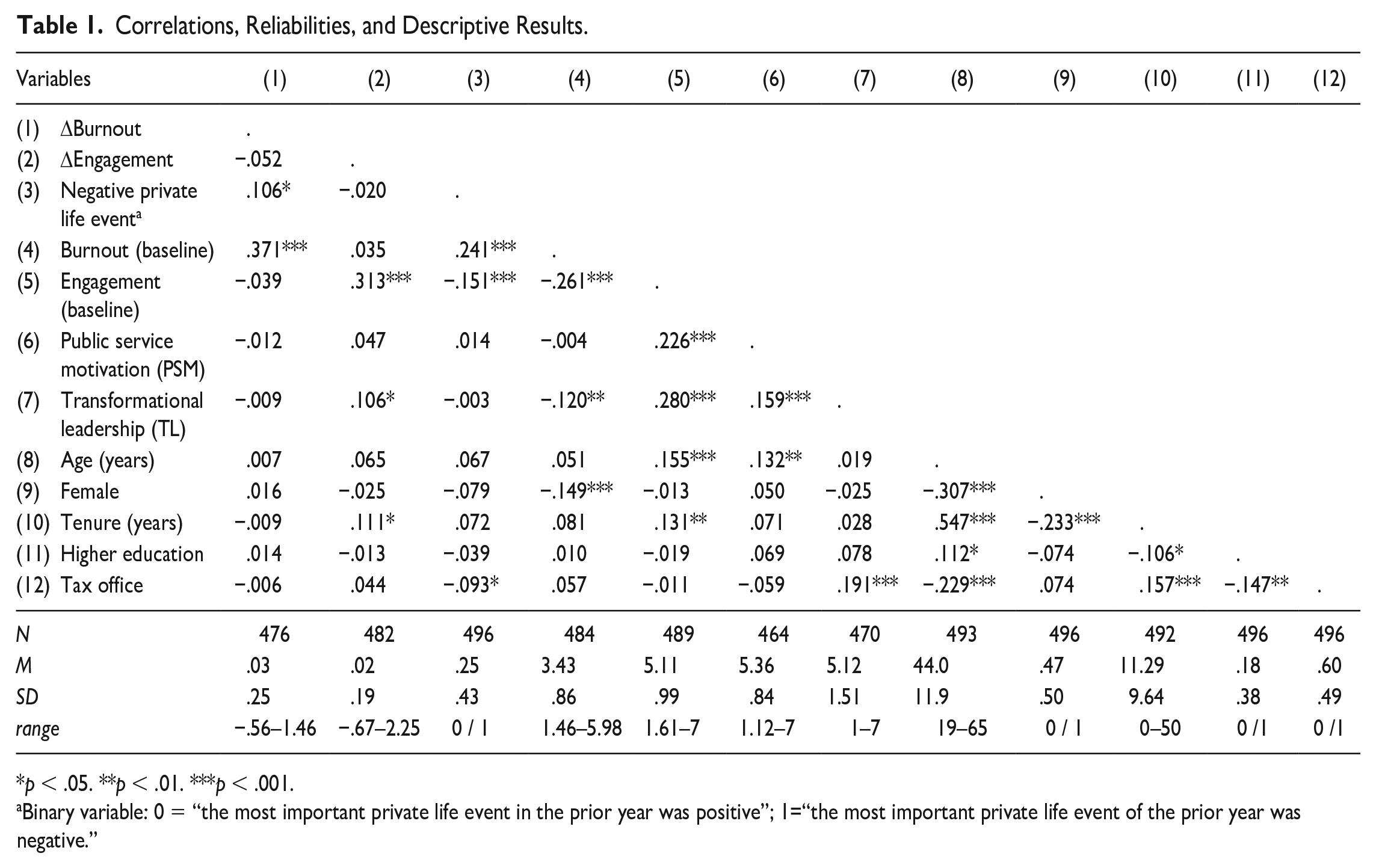
p < .05. **p < .01. ***p < .001.
Binary variable: 0 = “the most important private life event in the prior year was positive”; 1=“the most important private life event of the prior year was negative.”
All scale measures presented in the following sections were measured with 7-point Likert-type scale items with opposite value labels ranging from min.= 1 to max. = 7. Independent variables were grand mean-centered (Paccagnella, 2006).
Dependent Variables: Work-Related Outcomes
Respondents’ level of work engagement was measured with Schaufeli and Bakker’s (2003) shortened version of their “work & well-being survey” (UWES-9) comprising nine items (Cronbach’s α = 0.943). Because the participating offices imposed strict limitations on survey length, a shortened compound measure was used to capture respondents’ levels of work-related burnout as a nine-item scale. This study follows recommendations by Macky and Boxall (2008) to warrant the reliability and validity of this scale by capturing all relevant construct dimensions (i.e., Beehr et al.’s, 1976; work intensification and Maslach and Jackson’s (1981) work-related emotional exhaustion), resulting in a reliable construct similar to more extensive burnout scales (Cronbach’s α = 0.890).
This study uses individually matched longitudinal data from two survey waves to investigate the degree to which experiencing private life events changes civil servants’ levels of burnout and engagement at work. Consequently, the two dependent variables Δburnout and Δengagement are defined as the relative numeric changes of these two variables between wave 1 and wave 2. Taking the relative numerical change between survey wave 1 and wave 2 controls for response invariance between subjects by centering at individual participants’ subjective response baseline. This means that Δburnout is calculated as the difference between each respondent’s (i) level of burnout in wave 1 (measured in the survey of 2014) and respondents’ level of burnout in wave 2 (measured in the survey of 2015) relative to the benchmark value of the first wave measure.

The same principle applies to the calculation of Δengagement:

Independent and Control Variables
The type and valence of private life events were captured in the second survey wave. Respondents were asked to retrospectively indicate whether they had experienced a private life event in the year that passed since their participation in the first survey wave. This study defined a private life event as a particularly impactful, unusual, and important occurrence that resulted in a major change in respondents’ private—in contrast to their professional—lives. Given that within the time span of 1 year, several important private life events may occur, respondents were asked to indicate their most important private life event. As a guidance, six topical categories 1 were provided for further specification. Furthermore, the survey asked respondents to indicate whether this most important private life event of the prior year was positive or negative (in respondents’ subjective opinion). This procedure follows suggestions by Holmes and Rahe (1967) and Dohrenwend (2006), by measuring the private life event as a binary indicator (i.e., 0 = “the most important private life event in the prior year was positive”; 1 = “the most important private life event of the prior year was negative”), because retrospective life event severity appraisals (e.g., measured on Likert-type or ranking scales) are associated with significant reliability and validity measurement issues (Dohrenwend, 2006). Given that post-life event adaptation trajectories for high valence life events are typically stable over months after the event (Luhmann et al., 2021), temporal variations with regard to the recency of life events within this 1-year time frame are considered as randomly distributed across the data. By focusing on respondents’ most important life event and its valence, the current study follows best practice advice to circumvent this issue and simultaneously offers the possibility to relatively quantify and disentangle the relationships between positive (i.e., a personal resource) or negative (i.e., a personal demand) private life events and work-related outcomes compared with the baseline measures measured in 2014 in the form of a quasi-experimental intervention. PSM was measured with Kim et al. (2013) 16-item Likert-type scale (Cronbach’s α = 0.938). Respondents’ experience of transformational leadership (TL) at their workplace is measured with Carless et al.’s (2000) reliable seven-item scale (Cronbach’s α = 0.963).
Following best practice recommendations by Podsakoff et al. (2003) and Richardson et al. (2009), SEM trait/method modeling was conducted for each variable to test for common method bias, and to explore the relationships between each variable’s measurement items and a (potentially) unobserved latent factor. SEM trait/method modeling revealed no significant relationships between the study variable items with a latent, unobserved marker. Given that all variables exhibit high-scale reliability, these results further corroborate the reliability of the findings presented in the results section.
These measures were supplemented by a sociodemographic questionnaire to capture relevant control variables, measuring tenure, respondents’ age, gender, and level of education because sociodemographic characteristics may affect individuals’ resilience and vulnerability toward negative life events (Anderson et al., 2022).
Results
Descriptive Results
Out of the sample of 496 respondents who participated in both survey waves, n = 372 (75.0%) report that their most impactful private life event in the year between the two survey waves was positive; n = 124 (25.0%) report that their most impactful life event was negative. Reported private life events are distributed unevenly across the six response categories. Leisure and recreation-related (n = 95, 25.5%) and non-specified life events (n = 110, 29.6%) are the most frequent in the positive category, while the most frequently reported negative private life events relate to health issues (n = 43, 34.7%) and relationships (n = 34, 27.4%); see Supplemental Appendix B for more detail.
Clustering respondents by the subjective valence (positive vs. negative) of their reported most impactful life event shows that these two sub-groups are well-balanced regarding their levels of PSM, TL, age, gender, tenure, and education, which allows for meaningful between-group testing (see Supplemental Appendix C).
The sample is characterized by above-scale average levels of PSM (baseline of first survey wave: M = 5.36, SD = 0.84), and most respondents work within a professional environment in which a transformational leadership style is prevalent (M = 5.15, SD = 1.51). Respondents report medium levels of burnout (M = 3.43, SD = 0.87) and show above-scale average levels of work engagement (M = 5.11, SD = 0.99) in the first survey wave (benchmark values). As expected, the dependent variables Δburnout and Δengagement are significantly correlated with individuals’ respective baseline values of burnout (r = .371, p < .000) and engagement (r = .313, p < .000; see Table 1), which is controlled by including these values as control variables in the subsequent hypotheses testing.
Hypotheses Testing
Hypotheses were tested by conducting t-tests and by estimating linear regression analyses with heteroscedasticity-prove standard errors. Models I and II (see Table 2) report the direct effect estimates with the dependent variables Δburnout and Δengagement and all relevant independent and control variables, respectively, to test hypotheses H1 and H2. Subsequently, Models III and IV add interaction effects to assess the hypothesized moderation effects of TL (H3 and H4) and PSM (H5 and H6), as hypothesized regulators of the relationships between private life events and work-related outcomes. All models include the respective centered benchmarks of burnout and engagement of the first survey wave to control for exalted response bias and for potential measurement endogeneity. All models are well-specified, F(df) = 6.12–8.78, p < .001, and explain a significant amount of variance (adj. R2 = .208–.222). For each estimated regression model, very low variance inflation factors indicate that multicollinearity was not an issue (all mean VIF ≤1.27).
Linear Regression Analyses.
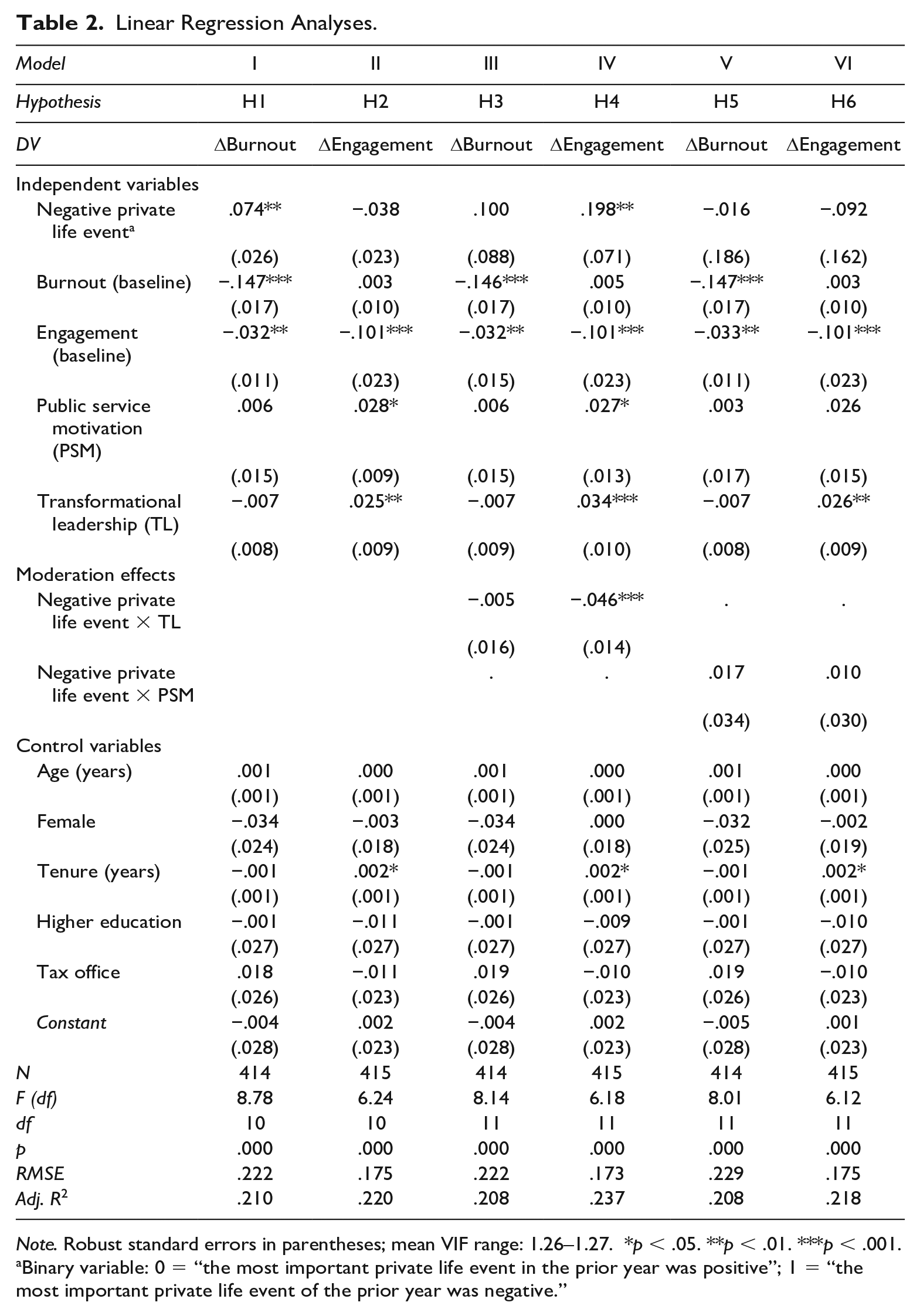
Note. Robust standard errors in parentheses; mean VIF range: 1.26–1.27. *p < .05. **p < .01. ***p < .001.
Binary variable: 0 = “the most important private life event in the prior year was positive”; 1 = “the most important private life event of the prior year was negative.”
Conducting Welch-adjusted t-tests shows that civil servants who experienced a negative private life event in the prior year exhibit a significantly higher increase in burnout than their peers who experienced a positive private live event (t = −2.307, p = .022; Cohen’s d =|0.246|). These group differences are supported by multivariate regression analysis including all control variables, which reveals that experiencing negative private life events—compared with positive private life events—is significantly associated with higher levels of burnout in civil servants (model I: bI = 0.074, p = .004), 2 thus supporting H1.
With regard to the desired work-related outcome work engagement, hypothesis H2 finds no support because experiencing negative—in contrast to positive—private life events are not associated with significant changes in civil servants’ work engagement relative to their subjective benchmark (t = .451, p = .653; Cohen’s d = 0.046; linear regression model II: bII = −0.038, p = .108). Furthermore, both hypothesized moderators TL and PSM have no direct (TL: bI = −0.007, p = .352; PSM: bI = 0.006, p = .687) or moderating effect (negative life event × TL: bIII = −0.005, p = .761; negative life event × PSM: bV = 0.017, p = .626) on the experienced changes in employee burnout so that both H3 and H5 find no support.
Concerning changes in work engagement, regression analysis shows that TL significantly moderates the adverse impact of experiencing negative life events (TL: bIV = −0.046, p = .001) such that the positive relationship between experiencing negative private life events and work engagement is ameliorated if civil servants experience TL at their workplace. While this finding is at odds with the initial hypothesis, which suggested that the relationship between work engagement and experiencing negative life events would be negative, this empirical evidence still supports the moderation hypotheses. Furthermore, there is a small but significant positive direct relationship between TL and work engagement (which is in line with the regulation theory of leadership); bII = 0.025, p = .004. While model II reveals an equally small but statistically significant direct relationship between PSM and work engagement (bII = 0.028, p = .037), the hypothesized moderating effect of PSM on the relationship between experiencing negative private life events and employees’ work engagement (H6) finds no support (bVI = 0.010, p = .733). No other meaningful relationships regarding control variables (i.e., respondents’ age, gender, level of education, and workplace) and the dependent variables were observed. 3
Discussion
The purpose of this study was to examine the links between civil servants’ private life events and work-related outcomes testing the propositions of the extended D-R model (Demerouti & Bakker, 2022) with a specific focus on burnout and work engagement as well as the potential ameliorating effects of TL and PSM. Private life events matter and do indeed spill over into employees’ work-related outcomes.
Empirical evidence on the effects of experiencing private life events on work-related outcomes such as engagement and burnout is still scarce. To date, these effects have rarely been studied in a public sector context before, with Suzuki et al.’s (2017) study on the relationship between experiencing disaster and burnout being an important exception. Based on the cross-domain hypothesis of work-private life entanglement (Amstad et al., 2011; Demerouti & Bakker, 2022), the current study expands this research and showed that private life events function as demands or resources that spillover into public employees’ work and, consequently, affect relevant work outcomes such as work engagement and burnout.
Specifically—and besides its methodological advancements—the current study contributes to the discourse on life events in three important aspects. First, Hakanen and Bakker’s (2017) study focused on job demands and negative life events only while the current study contrasts the effects of experiencing a negative private life event (functioning as a demand) in contrast with a positive private life event (serving as a resource), thus substantiating the idea of cross-domain contamination of private life-related burdens into work-related outcomes as proposed by the extended D-R model by Demerouti and Bakker (2022) with quantitative evidence. This is a substantial enhancement of the conceptual and empirical perspective of the JD-R model (Hakanen & Bakker, 2017), with important implications for the practice of PA and PM. Second, the current study investigates the specific effects of PSM and TL as potential moderators of the relationship between private life events, burnout, and work engagement, respectively. It is the first study to empirically show the merits and limits of the extended JD-R model for PA and PM by illustrating the merit of TL and the limits of PSM in this context. Third, while Hakanen and Bakker (2017) focused on burnout and life satisfaction, the current study also includes work engagement as a highly relevant work-related outcome variable from a JD-R perspective (Borst et al., 2019).
The current study shows that private life events significantly affect public employees’ development of work-related burnout: Compared with experiencing positive life events, negative life events significantly increase individuals’ levels of burnout. This finding highlights that there is no clear separation between the spheres of private and work life and additional demands—but not resources—are likely to transfer from private life to work. This important insight is in line with prior research from general personnel management research by Amstad et al. (2011), it supports recent conceptual work by Demerouti and Bakker (2022) with quantitative evidence, and it needs to be integrated more prominently into theories of public personnel management and leadership scholarship. However, public personnel management research often still neglects this private life–work life interface. Future research is encouraged to analyze the various interdependencies between bureaucrats’ private lives, interferences of private and professional work environments, and their effects on professionalism.
Besides, these indications of resource depletion and spillover effects, findings furthermore suggest a positive relationship between experiencing a negative private life event and work engagement, with TL weakening the baseline relationship between negative life events and work engagement. The counterintuitive direct relationship may be explained by the phenomenon of “escape into work” and workaholism as a coping mechanism. Prior research shows that the two theoretically distinct constructs of work engagement and workaholism are empirically correlated (Clark et al., 2016; Gorgievski et al., 2010). While work engagement is primarily driven by intrinsic motivation, workaholism is motivated by “introjected motivation (i.e., they work because of an internal compulsion to work),” which may be triggered by extensive stress and resource drain associated with experiencing negative private life events as suggested by Barnett et al. (2012). Furthermore, the moderation effect could indicate that transformational leaders provide so much support during life events that their followers increase their engagement as a response. More research into the post-life event adaptation trajectories and the coping behaviors adopted by both followers and leaders is needed to further explore the causality behind this correlational relationship.
Practical Implications and Future Research
These empirical findings have important practical implications that also call for future research. First, this study contributes to research dealing with the interface between private life and work in PA research (Brummelhuis & Bakker, 2012). The ideal-type Weberian administration is supposed to act upon the principles of impersonality and the strict separation of work and private life, which also implies that bureaucrats are asked not to relate their feelings stemming from private life events to work behavior (Höpfl, 2006; Weber, 1947). While reformed public personnel systems recognize employee well-being as a strategically important factor to attract talent and maintain their motivation, engagement, and performance (Ritz, 2019), the Rechtsstaat tradition of bureaucracy theory and HR management often still expects to suppress non-task-relevant influences from their daily conduct, regulating their behavior in accordance with professional norms, to be considered professional enough (Wilson, 1989). Bureaucracies and formal regulations also establish codes of conduct that provide tangible and intangible guidelines for the adequacy of certain work-related behaviors such as the rights and duties of public employees (Noordegraaf, 2015; Vandenabeele et al., 2006), irrespective of their personal situation or strain. However, the current study shows that in practice this normative separation is an illusion. Providing empirical evidence in support of the (J-)DR model and the cross-domain hypothesis of work–family conflict (Greenhaus & Beutell, 1985; Wayne et al., 2017), this study calls for a more realistic characterization of civil servants as individuals with individual needs in their pursuit of coping with the inevitable challenges of life. Public managers with leadership responsibility need to account for their followers’ individual struggles and their individual situation to warrant employee well-being and to allow them to maintain high work performance and encourage work–life balance (Demerouti & Bakker, 2022). Essentially, employee burnout is a sign of management failure (Gabriel & Aguinis, 2022; Moriano et al., 2021). For instance, empirical research by Wayne et al. (2017) suggests that low levels of work scheduling autonomy—that is, the high levels of bureaucratic formality typical for traditional public personnel systems—may aggravate the negative effects of private life spillover effects on work-related outcomes. In line with qualitative insights from the discourse on the role of line managers in helping employees maintain work–life balance (Maxwell & McDougall, 2004), these insights highlight the relevance of allowing for flexibility in work scheduling to meet employees’ needs and maintain work–life balance, particularly after experiencing a life event. Furthermore, in today’s world and especially after the Covid-19 pandemic and its enormous implications for new work settings and employee well-being in the unprecedented home office settings for public employees, the separation of the two spheres of private and work life gets increasingly blurred, blending the two spheres together with unknown consequences for employee well-being and performance (Demerouti & Bakker, 2022). This calls for a more explicit recognition and anticipation of private life-to-work spillover effects in public personnel management and leadership (Döring & Willems, 2023).
Second, the theory suggested that TL would regulate the relationship between experiencing private life events, burnout, and engagement, functioning as an ameliorating resource. Indeed, there is a small buffering effect of TL on the relationship between experiencing negative life events and work engagement. According to this study’s empirical evidence, the “stimulating and energizing” effect of TL does counterbalance the “resource-draining” effect related to experiencing a negative private life event at least to some degree. In other words, transformational leaders may help employees deal with the burden of negative life events leading to smaller changes in work engagement. Individuals who experience negative events in private life may feel comparatively less emotional burden and pressure if a particularly engaging leader articulates support for their employee’s situation, but this positive direct effect is rather small (albeit significant) in the data analyzed. TL is an excellent strategy for motivating employees to perform above expectations in certain circumstances which explains the direct positive effect on work engagement, albeit only to a limited extent. It is possible that followers experiencing a private life event may simply be unable to derive additional strong mental support from their leader when undergoing additional demands because they have other things on their minds and may disengage as a coping mechanism. This idea is in line with the research on the dark side of TL showing that TL can lead to detrimental effects on health and well-being at work (Tourish, 2013, see also Clements & Washbush, 1999). Our finding may result from the converse effects of transformational leadership on employee well-being by stimulating and overstraining at the same time. Furthermore, the absence of a significant direct relationship between experiencing a negative life event and changes in work engagement may hint at the asymmetric impact of further motivational hygiene factors that decouple the impact of negative life events from generalized work engagement but may well impact task-specific or situational work disengagement (Sachau, 2007). Thus, we call for further investigation into the leader-follower motivational nexus in the context of negative life events and employees’ work outcomes.
Third, while the results of this study support the main spillover argument that private life events impact important work-related outcomes—in contrast to the theoretical expectations—the moderating effects of PSM and transformational leadership are mostly different than hypothesized. PSM was expected to exercise a regulating effect on the relationships between life events and burnout. Yet, no significant moderation effect was detected. These findings link to the observation made by Jensen et al. (2019) that not only the composition of the work environment but also the private environment determines whether public service motivation becomes a motivator, a stressor, or has any effect at all. The data show that high-PSM individuals are more engaged at work despite having experienced a negative private life event and, thus, PSM certainly acts as a motivator in certain work-life situations according to the empirical findings—which still aligns well with Demerouti and Bakker’s (2022) proposition that individuals may have different individual-level regulators, supporting the differential vulnerability hypothesis by Anderson et al. (2022). Moreover, against the backdrop of the conservation of resources theory (Hobfoll et al., 2018), it is of great interest to investigate further which psychological resources besides PSM become more salient and valuable for a person when experiencing private life events and how these resources translate into work-related outcomes. However, there could also be adverse effects and future research should disentangle the separate roles that the dimensions of PSM may play in relationships between distinct types of life events and work outcomes for a better understanding of the dark side argument (Schott & Ritz, 2018).
Limitations
Some limitations should be acknowledged. First, this study distinguishes between positive and negative private life events but does use a simplified and binary subjective measure—namely whether respondents regarded these events as either positive or negative. While our results clearly show that private life events exercise spillover effects into work-related outcomes and that TL significantly impacts this process, future research is needed to investigate the effect of distinct life events. Due to a limited number of potential study participants, it was not possible to conduct meaningful analyses on the level of specific types of private life events. Instead, this study focuses on the subjective affective valence (positive vis-à-vis negative impact on employees’ lives) of the most important recent life event, a measure that is inherently subjective but which also circumvents the confounding issues associated with more detailed score ratings of life events (Dohrenwend, 2006). Scholars replicating this research design in the future are encouraged to either use a more differentiated categorical measure of life events or larger sample size to explore the effects of specific types of life events on work-related outcomes. In this way, the potential nuances of the effects that different types and clusters of life events may have on work-related outcomes may be understood in more detail, particularly how their impact develops in different trajectories longitudinally if different life events co-occur and accumulate over time.
Second, future research may complement extant scholarship with more qualitative research to investigate individual cases and a wide range of factors that may affect the impact of private life events and their consequences in context and over time. Such qualitative research could generate new insights about potential processes of how individuals deal with private life events at the workplace and how these coping strategies affect work outcomes. Particularly, the effect of discretion, work schedule autonomy, and work-life policies may be worthwhile exploring in more detail (Wayne et al., 2017).
Third, the data are limited with regard to the information covered by the control variables to warrant respondent anonymity. The interaction between private life and the workplace may be contingent upon various aspects of individuals’ private lives (e.g., having care responsibilities or family conflict, see e.g., Greenhaus & Beutell, 1985), and future studies are encouraged to explicitly include such control variables of private life—if possible—to paint a more nuanced picture. Furthermore, the data are also limited with regard to its generalizability. The data were raised with civil servants engaged in administrative work in two most-similar organizational environments in regulatory and enforcing policy areas. Consequently, the data do not allow identifying the impact of job differences between policy areas, such as, for instance, the impact of people-changing versus people-processing work or frontline versus back-office activities. Thus, future research is encouraged to include more specific control variables at the organizational and job level.
Conclusion
This study offers a more encompassing view of demands and resources at work by integrating the sphere of private life events into the (J)D-R model (Bakker & Demerouti, 2014; Demerouti & Bakker, 2022) and by empirically highlighting their spillover effects and the demand for transformational leadership to counteract undesired work outcomes. Public management practice needs to take a more comprehensive view of public employees’ well-being and address the impacts of spillover effects explicitly and proactively. For instance, burnout may start much earlier than observed, and rigid work routines ignoring life event-induced stressors, burdens, and demands may aggravate the condition. Experiencing private life events may actually have lasting effects on employees’ attitudes, motivations, and behaviors at work (Luhmann et al., 2012). Whenever supervisors observe employees’ difficulties in adapting to private life events, this should be recognized as a potential cause of future health or motivational issues which can only be achieved in a trust-based leader–follower relationship. Leadership and motivation training should be more reflective of followers’ private life situations because the microsystem of private and work life is interdependent (Voydanoff, 2005). However, this care approach needs to be accompanied by appropriate case management strategies to avoid equity issues, favoritism, and biases in subsequent performance appraisals if an employee’s private situation impacts work-life excessively. PSM and TL are often taught as a panacea in the workplace of public officials because there are constant requests for increasing motivation and better leadership in a world of financial austerity, and public employees under political and media scrutiny. However, this study shows that these concepts’ impacts are somewhat limited and call for further exploration to warrant public employee engagement and well-being, particularly in times of crisis.
Supplemental Material
sj-docx-1-ppm-10.1177_00910260231187535 – Supplemental material for Private Life Events as Antecedents for Public Employees’ Engagement and Burnout
Supplemental material, sj-docx-1-ppm-10.1177_00910260231187535 for Private Life Events as Antecedents for Public Employees’ Engagement and Burnout by Kristina S. Weißmüller, Adrian Ritz, A. J. (Bram) Steijn and Kerstin Alfes in Public Personnel Management
Footnotes
Declaration of Conflicting Interests
The author(s) declared no potential conflicts of interest with respect to the research, authorship, and/or publication of this article.
Funding
The author(s) received no financial support for the research, authorship, and/or publication of this article.

Notes
Supplemental Material
Supplemental material for this article is available online.
Author Biographies
References
Supplementary Material
Please find the following supplemental material available below.
For Open Access articles published under a Creative Commons License, all supplemental material carries the same license as the article it is associated with.
For non-Open Access articles published, all supplemental material carries a non-exclusive license, and permission requests for re-use of supplemental material or any part of supplemental material shall be sent directly to the copyright owner as specified in the copyright notice associated with the article.
