



Abstract
The first months in a new organization are a sensitive phase for newcomers as their attitudes are not yet settled. However, public management research has paid limited attention to onboarding tactics that support newcomer integration. This study explores “microinterventions”—brief reflective tasks on the social impact of one’s work—as a novel onboarding tactic. In an eight-week diary study, 31 public management students (Level 2) in placements (194 weekly observations, Level 1) were randomly assigned to a reflection-task or control group. Multilevel analyses showed no significant main effect of reflection tasks on socialization, positive affect, negative affect, or career commitment and no significant interaction effect of reflection task and time. Descriptive means suggested a higher treatment-group level at the first wave, but this early difference did not persist. Findings indicate limited efficacy of reflection-based microinterventions for newcomer integration in this real-world public sector context, though the tactic appears low-risk. We discuss implications for public sector onboarding.
Keywords
Introduction
The first few months in a new job play a pivotal role in shaping newcomers’ long-term relationship with their organization. During this critical phase, newcomers’ experiences, whether positive or negative, shape their perceptions of their employer, as their attitudes and beliefs are still malleable. These early experiences strongly influence the development of beliefs that become increasingly resistant to change (Bauer & Green, 1994; Klein & Weaver, 2000). Newcomer integration is the initial period of employment, typically spanning the first days, weeks, and months, during which employees begin to establish themselves in their new organizational context. For new hires, this phase is characterized by high uncertainty, the formation of initial relationships, and the alignment of personal expectations with organizational realities (Bauer & Erdogan, 2011; Saks & Gruman, 2018). During this newcomer integration period, socialization takes place, whereby individuals acquire the knowledge, skills, attitudes, and norms necessary for effective functioning, and usually organizations implement onboarding instruments to deliberately support newcomers’ adjustment and well-being (Kammeyer-Müller & Wanberg, 2003; Klein et al., 2015; Wanberg, 2012). If newcomers’ perceptions of their work’s meaning erode in the early stages, so too may their well-being and commitment. Thus, this study examines newcomer integration in the public sector with a focus on organizational socialization (the acquisition of role-relevant knowledge, skills, and cultural understanding), well-being (positive and negative affect), and career commitment (dedication to pursuing a career in one’s chosen field or sector). Together, these capture both the adaptation to the organization and the affective and motivational consequences that are critical for sustainable integration. This is crucial, as failure to adjust can reverse the positive outcomes of recruitment, especially as employees increasingly change jobs on their own initiative (Bauer et al., 2007). Consequently, scholars and human resource (HR) managers must prioritize understanding and managing this critical integration phase. While public management research has extensively explored recruitment (Jakobsen et al., 2023), the equally critical phase of newcomer integration has been overlooked. In the public sector, employees are often driven by strong prosocial motives, seeking to contribute to the public interest (Asseburg & Homberg, 2020; Perry & Wise, 1990; Ritz et al., 2016). However, research shows that newcomers may lose sight of their societal impact over time, leading to diminished idealism (Kjeldsen, 2014). This process is often exacerbated by reality shocks, where expectations formed during recruitment clash with organizational realities (Schott et al., 2019). When new employees face recurrent discrepancies between anticipated and actual organizational realities, this may contribute to a rising level of unmet expectations (Ślebarska & Soucek, 2020).
A potential way to address this challenge comes from interventions that increase the perceived prosocial impact of one’s work. Reflection tasks, short, structured exercises in which employees recall or consider the societal value of their work were introduced in public administration research by Vogel and Willems (2020) and Hansen (2023). For instance, Vogel and Willems (2020) demonstrate that when public sector employees reflect on how their work benefits society, it boosts positive work outcomes, such as well-being. These short reflective exercises are referred to as “microinterventions”: brief interventions that are easy-to-implement and low-cost (Backhaus & Vogel, 2025; Lambert et al., 2022; Vogel & Willems, 2020). Reinforcing prosocial motivations through reflection tasks may serve as an onboarding tactic to help newcomers maintain a sense of purpose during the integration process. Such reflections can be effective at various stages of an employee’s career, but the early integration phase is particularly promising: attitudes, role perceptions, and social relationships are still forming (Bauer & Green, 1994), making them more receptive to interventions to make them aware of their job’s impact.
This study examines the effects of weekly reflection tasks on newcomers’ integration experience into public sector organizations, addressing the following research questions: How do public sector employees’ organizational socialization, well-being, and career commitment develop over the first weeks of employment, and how do reflection tasks (“microintervention”) influence this process? Do the effects of these reflection tasks accumulate linearly over time, or does their impact vary depending on the timing of the intervention? The sample consists of early-career bachelor’s students in public management who alternated between academic study and practical placements in administrative units. While not permanent employees, they represent future public servants entering the work contexts, making them highly relevant for studying integration dynamics. By employing an 8-week longitudinal diary study with interventions, this research investigates the immediate and cumulative effects of weekly reflection tasks on newcomers’ experiences.
This study contributes, first, to the literature on newcomer integration in the public sector (Moyson et al., 2018). Beyond the general call for more research in this still-limited field, we particularly address the quest for longitudinal designs in research on organizational socialization (Moyson et al., 2018); a quest that has also been raised in public management research more generally (Boselie et al., 2021; Jakobsen et al., 2023; Murdoch et al., 2023). Second, we extend the literature on intervention, as previous studies have implemented microinterventions at single points in time and examined only short-term attitudinal outcomes as observed immediately after the intervention (Bellé, 2013; Hansen, 2023; Vogel & Willems, 2020). Applying a more long-term perspective, we observe whether microinterventions in the form of reflection tasks that make employees repeatedly aware of the social nature of their work, result in varying effects on employee outcomes when repeated over time. Third, and in more practical terms, this research offers practical insights for HR practitioners on low-cost, scalable tools like microinterventions to enhance outcomes related to integration into public sector jobs.
The remainder of this article is structured as follows. The next section reviews literature on newcomer integration and introduces microinterventions in the form of reflection tasks. The subsequent sections describe the diary study design, present results from multilevel regression analysis, and discuss the findings, limitations, and implications for both research and practice.
Literature Review and Hypotheses Development
Newcomer Integration in the Public Sector
Demographic changes and the resulting looming wave of retirements (Fillichio, 2006) have created a surge in open positions within public organizations, increasing the challenge for public employers to recruit and retain talented employees (Asseburg et al., 2019; Ritz et al., 2016). Contrary to the attraction stage that has been well-studied, post-entry integration and retention processes remain underexplored (Jakobsen et al., 2023; Moyson et al., 2018). Yet this period is crucial: recruitment investments can only yield long-term returns if newcomers are successfully integrated and retained (Bauer et al., 2024). Failed integration is costly, both socially and economically (Klein & Polin, 2012).
Newcomer integration refers to the early-stage employment period in which individuals adapt to a new organization or role. This phase can occur repeatedly across a career—when moving from education to work, changing organizations, or shifting roles within the same employer—but the transition from school to work is often considered the most challenging (Frögéli et al., 2023). During this temporal window, two related but distinct processes typically occur. Organizational socialization describes the individual-level process of acquiring the knowledge, skills, and role clarity needed to perform effectively (Chao et al., 1994; Van Maanen & Schein, 1979), while onboarding encompasses the structured organizational practices and policies designed by the organization to facilitate that process (Klein & Polin, 2012). The early months after organizational entry are especially formative, since newcomers develop attitudes that, while initially malleable, quickly solidify and become harder to change over time (Bauer & Green, 1994; Klein & Weaver, 2000). In the public sector, this adjustment is shaped by specific contextual factors. Bureaucratic structures and complexity can slow down adjustment processes. Formal bureaucratic structures and rigid hierarchies can hinder employees ability to access information and support (Whetsell et al., 2021), which can impede the speed and ease of newcomer adjustment. At the same time, many individuals enter public service driven by prosocial motives and a desire to create societal impact (Bolino & Grant, 2016; Jensen, 2018). When these motives are supported, they can foster high engagement and enthusiasm (Aryee et al., 2012). Yet there is the risk of newcomers experiencing a reality shock, caused by mismatches between pre-entry expectations and the realities of the job (Blau, 1960). Such disillusioning experiences may diminish motivation, create cynicism, or even prompt early turnover. These shocks are especially likely when individuals begin with idealistic expectations about challenging, meaningful, and impactful work, only to encounter constraints, ambiguity, or bureaucratic hurdles. Research shows that such initial idealism often erodes in the first stages of employment (Kjeldsen, 2014), with public service motivation declining significantly early in one’s career across both public and private contexts (Kjeldsen & Jacobsen, 2013).
Given these risks, public organizations must design onboarding tactics that not only integrate newcomers quickly into their roles but also transmit a public institutional logic (Brewer, 2008), to preserve newcomers initial enthusiasm and sense of impact, rather than eroding it. Onboarding instruments (Baker & Feldman, 1990) are central in this regard: They reduce uncertainty and anxiety, foster role clarity, and strengthen perceived fit, thereby accelerating adjustment (Cooper-Thomas & Anderson, 2005; Zhao et al., 2023). Empirical research shows that onboarding tactics can influence both proximal outcomes, such as task knowledge, role clarity, and organizational understanding (Bauer et al., 2024; Haueter et al., 2003) and distal outcomes, such as well-being, organizational commitment, job satisfaction, and retention (Bauer et al., 2024; Liu et al., 2024). In this study, we treat newcomer integration as the early-stage employment phase within a new organization and / or new role. Within this phase, both proximal indicators of adjustment (organizational socialization) and more distal, affective outcomes (well-being and career commitment) are important to respond to increased job mobility and retain scarce talent.
Reflection-Based Microinterventions
Microinterventions are brief, low-cost, and easy-to-implement activities designed to generate small but meaningful changes in attitudes and behaviors in real work contexts (Backhaus & Vogel, 2025; Luthans et al., 2006; Thiese, 2014; Vogel & Willems, 2020). Originally introduced in management and psychology, they have recently gained traction in public management research as promising tools for improving employee outcomes (Hansen, 2023; van Roekel & Schott, 2022; Vogel & Willems, 2020). Recently, microinterventions gained attention in public management research (Hansen, 2023; van Roekel & Schott, 2022; Vogel & Willems, 2020). Vogel and Willems (2020), for instance, designed a microintervention in which employees were asked to recall events with prosocial and societal relevance. The intervention increased well-being, job satisfaction, and retention intentions. Vogel and Willems (2020, p. 488) argue that it is “the process of being aware of the impact employees have with their job and not the sole opportunity to do so that produces these positive outcomes.” Similar motivational priming interventions in other contexts have also shown improvements in work-related outcomes (Arieli et al., 2014; Bellé, 2013). For example, Wright and Grant (2010) recommend that public employees reflect on the societal value of their work, while Backhaus and Vogel (2025) show that leaders who engaged in reflective practices reported greater motivation to develop and willingness to train.
In this study, we conceptualize reflection tasks as a distinct subtype of microintervention and, importantly, as an onboarding tactic aimed at strengthening integration outcomes in the early months of public sector employment. Even though reflection often occurs informally, structured practices, such as reflective journaling or guided prompts, intentionally trigger conscious self-reflection to support learning and development (Lambert et al., 2022). These serve as onboarding tactics designed to reinforce newcomers’ awareness of their societal impact. By situating reflection within the framework of microinterventions, we highlight its potential as a practical and scalable approach to potentially strengthen both proximal outcomes (organizational socialization) and more distal affective outcomes (well-being and career commitment) during the early months of public sector employment (see Figure 1).
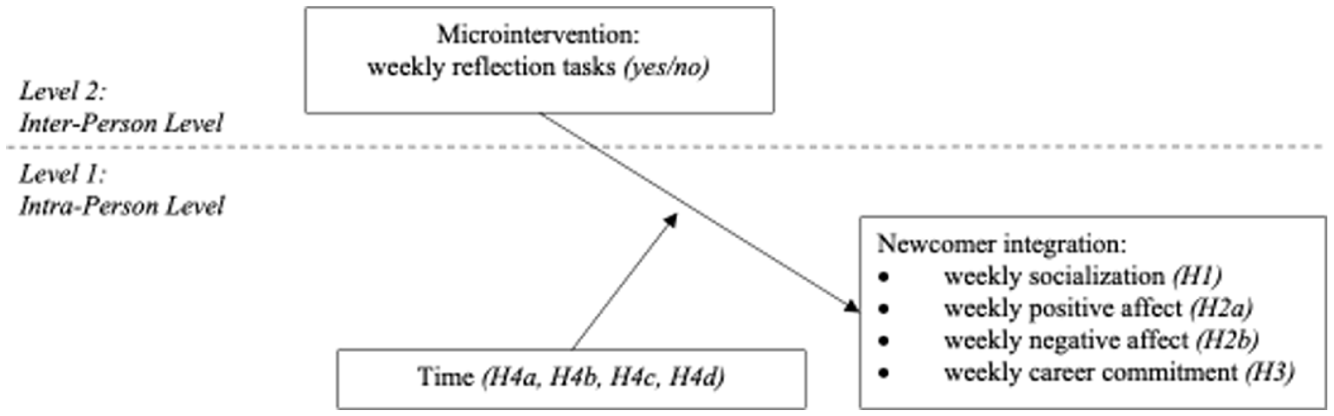
Research framework.
Reflection Tasks and Newcomer Socialization
Organizational socialization is “the process through which individuals acquire the knowledge, skills, attitudes, and behaviors required to adapt to a new role” (Wanberg, 2012, p. 3). Socialization also entails the internalization of norms, values, and collective understandings that define membership in a given community (Checkel, 2005; Cooper-Thomas & Anderson, 2005). Successful socialization can lead to motivation, performance, organizational commitment, intentions to remain, role clarity, job satisfaction (Bauer et al., 2007) and proactive behavior (Crant, 2000).
Reflection tasks may serve as a lever to strengthen socialization: if one understands why one’s work matters, it becomes easier to grasp how to enact the role effectively. By prompting newcomers to recall events in which their work had social impact, these interventions can shift the newcomers’ attention toward the significance of their contributions. These mechanisms are particularly salient in the public sector, since many individuals seek employment in the public sector because they want to create prosocial (Bolino & Grant, 2016) and societal impact (Jensen, 2018) with their work. In reinforcing the social relevance of their role, reflection tasks can support the internalization of public service norms and values during the formative early months of employment. We hypothesize:
Reflection Tasks and Employee Well-Being
In a recent meta-analysis, Bauer et al. (2024) highlighted the growing focus on well-being in newcomer integration literature. Defined as “people’s cognitive and affective evaluations of their lives” (Diener, 2000, p. 34), well-being is a subjective perception of one’s positive or negative affect, with studies emphasizing its importance for both individual health and work performance (Diener & Chan, 2011; Robertson & Cooper, 2010; Wright & Cropanzano, 2000). For newcomers, the transition into a new role entails navigating unfamiliar tasks and managing shifting expectations (Moyson et al., 2018), and is considered a period characterized by stress and uncertainty (Bauer & Erdogan, 2011), factors that can undermine well-being. The preservation of well-being emerges as a critical factor in how newcomers experience this transition period.
A growing body of research indicates that even small, low-intensity interventions can enhance well-being. For example, Vogel and Willems (2020) found that reflecting on one’s contributions to the public good can increase one’s well-being. These findings align with studies demonstrating that perceived prosocial impact (i.e., helping others at work) fosters positive emotions (Sonnentag & Grant, 2012). Results from a recent study further support the positive impact of interventions, showing that a resilience intervention improved psychological well-being (Avey et al., 2023). Affectively, reflecting on one’s social impact can evoke positive affect (Sonnentag & Grant, 2012). However, reflecting on one’s social impact may also yield unintended consequences, such as fostering critical self-reflection that could heighten negative affect. Making new hires repeatedly aware of the extent to which they can, or cannot, make a difference in their public sector job may make them become more aware of organizational barriers or unmet expectations, potentially triggering critical self-reflection, and invite them to critically reflect on their career choice. For instance, Wang et al. (2016) found that unmet expectations lead to lower job satisfaction. Consequently, while such reflections can reinforce a sense of purpose and alignment with organizational values, they may also contribute to disillusionment or a reality shock if newcomers’ expectations are not met – presenting reflection tasks as a double-edged sword in public service onboarding. This highlights the need to examine both the potential benefits and risks associated with reflective interventions. Exploring this potential dual effect, we hypothesize:
Reflection Tasks and Career Commitment
Public sector organizations, competing with private and nonprofit organizations, must prioritize strategies to retain employees and foster their commitment to long-term public service careers (Moynihan & Pandey, 2008). In today’s labor market, where boundaryless careers and increased job mobility (Arthur & Rousseau, 1996; Seibert et al., 2024) have made long-term retention less common, career commitment is crucial. Career commitment is defined as “individuals’ commitment to the goal of pursuing a long and successful career in an organization” (Lapointe et al., 2018, p. 898). Research suggests that when individuals experience disappointment in their exchanges with the organization, their commitment is likely to weaken (Brown, 1996). In such situations, employees may psychologically distance themselves from the employer or even the sector, and reduce their willingness to advance organizational goals. This underscores the importance of early interventions that support positive evaluations of the employment relationship. Prior studies found that effective onboarding plays a pivotal role in cultivating such career commitment. A recent meta-analysis of 83 field experiments found that participants engaged in onboarding programs were 1.46 times more likely to be retained (Liu et al., 2024).
Reflection tasks, as a subtype of microintervention and thus as an onboarding tactic, hold promise for enhancing career commitment. Dryzin-Amit et al. (2022) emphasize that employees who perceive their organization as prioritizing public service values are more likely to exhibit dedication, loyalty, and devotion. Additionally, studies by Vogel and Willems (2020) and Hansen (2023) demonstrate that reflection-based microinterventions can reduce turnover intentions. Building on these insights, we hypothesize that reflection tasks emphasizing the social impact of employees’ work can foster a stronger sense of career commitment and reduce the likelihood of seeking an alternative career elsewhere:
The Moderating Effect of Time
Newcomer integration is inherently a dynamic process, unfolding over weeks and months rather than in a single event. Yet, previously much of the research has collected data at a single point in time (Moyson et al., 2018). More recent studies emphasize the importance of delivering onboarding interventions over multiple sessions rather than treating newcomer integration as a singular event. For instance, a meta-analysis of 83 field experiments highlights that onboarding programs are more effective when delivered over multiple sessions, compared to isolated single events (Liu et al., 2024). Similarly, Bauer et al.’s (2024) meta-analysis of 183 studies highlights that socialization, by its very nature, involves change over time. However, research has frequently overlooked the role of time in shaping the outcomes of onboarding processes, underscoring the need for more longitudinal studies.
Timing is supposed to play a role in determining the effectiveness of onboarding interventions, because early stages of newcomer integration represent a highly sensitive period for newcomers, as assumptions and attitudes are still forming. Interventions during this phase are likely to have a stronger impact compared to those introduced later, when attitudes have become more entrenched. This aligns with findings from Bauer et al. (2024), who argue that newcomers are more receptive to interventions in the initial stages of integration. Prior research suggests that the earlier interactions are especially influential in shaping lasting impressions of the workplace, since these establish a baseline perception of the social environment (Kammeyer-Mueller et al., 2013). In their longitudinal study of newcomer socialization, they showed that early coworker and supervisor support had stronger associations with work outcomes assessed after 90 days than did later changes in these experiences. Their interpretation was that initial interactions help newcomers form enduring impressions of the workplace’s social environment, which then shape subsequent attitudes and behaviors. In other words, early social experiences may “set the tone” for later stages of the newcomer integration phase. Despite these insights, much of the research on microinterventions has focused on their short-term effects. Studies such as Christensen and Wright (2018), Vogel and Willems (2020), and B. E. Wright and Christensen (2021) implemented microinterventions at single points in time and observed immediate outcomes shortly after the intervention. While these findings demonstrate the short-term benefits of microinterventions, their long-term efficacy and sustainability remain underexplored, particularly in real-world settings. This gap calls for research into how microinterventions, specifically in the form of reflection tasks, influence employee outcomes when implemented repeatedly and over extended periods.
The literature on priming offers valuable insights into the fluctuating effects of repeated interventions. For instance, Murdoch et al. (2023) emphasize the importance of differentiating between short- and long-term impacts of interventions to capture their full trajectory. In line with this, interventions may not yield constant outcomes due to habituation or desensitization effects when exposed repeatedly (Bolgeret al., 2003). These findings highlight the need to consider both the timing and frequency of interventions to maximize their effectiveness. Building on this, we hypothesize that the effects of reflection tasks on socialization, well-being, and career commitment are not independent of their timing. Early interventions are likely to yield the most substantial benefits, but the incremental effects of repeated interventions may decrease with each repetition:
Data and Methods
Sample
Following Hansen’s (2023) emphasis on using authentic samples, data was collected from bachelor’s students of public management enrolled in a dual study program in Germany. This real-world sample, composed of future public sector employees working in a genuine organizational setting, enhances the ecological validity of the study. These students, as civil servant candidates, alternated between academic semesters and practical placements in administrative units, providing relevant first work experiences in public administration. The placements were typically full-time and involved tasks such as administrative support, project work, and frontline service. Students were placed across a broad range of Hamburg’s public sector organizations, including Bezirksämter (district offices) and Behörden (e.g., for labor and social affairs, economy, education, science, urban development etc.), as well as various Senatsämter (senate offices). The practical placements provide the students with one of their first work experiences in the public sector, which makes them an ideal sample for studying newcomers. A relatively homogeneous sample was selected to better observe the association between the intervention and outcomes, minimizing confounding factors that a more heterogeneous sample might introduce (Shadish et al., 2015).
A total of 97 students were invited to participate in a weekly online survey, with 31 respondents completing the study, yielding a 32% response rate. Although the sample size is at the lower threshold for diary studies (Maas & Hox, 2005; Ohly et al., 2010), it remains adequate. Following Scherbaum and Ferreter’s (2009) pragmatic recommendation to increase the number of repeated observations at the within-subject level, participants completed the survey over eight weekly waves, resulting in 194 observations. This is consistent with preceding diary studies, which applied 3 to 10 repeated observations (Ohly et al., 2010).
Participants were 71% female (n = 22), with an average age of 22.6 years (SD = 2.4). The respondents reported they were in contact with citizens for around 13% of their working day during a regular working week (SD = 24) and worked extensively from home during the Covid-19 pandemic, reflected in high use of digital tools (M = 4.19, SD = .62).
Data Collection Procedure
Data was collected from March to June 2021. The initial survey gathered information on participants’ job characteristics, age, and gender. As the diary study design requires real-time responses across multiple observations (Ohly et al., 2010), respondents participated in repetitive questionnaires over an 8-week period. Surveys were distributed via email on Fridays, with reminder emails sent on Mondays to encourage timely responses. In the third week, additional questions regarding job characteristics were included, as participants had accumulated enough work experience to provide informed responses. To maintain engagement, participants received EUR 5 for each completed survey. Headphones were offered as a raffle prize for participants who completed all questionnaires.
Research Design
A pre-registered between-subjects experimental design was used, with participants randomly assigned to either the treatment or control group. The treatment group completed a weekly reflection task, while the control group received no intervention. Participants in the treatment group were asked to recall a work-related event that demonstrated their positive societal impact. In this study, we implemented reflection tasks as our chosen subtype of microintervention. The task was adapted from Vogel and Willems (2020). Contrary to Vogel and Willems, who distinguished between prosocial and societal impact, the intervention merged the respective interventions into “social impact” because Vogel and Willems identified that both influence employees’ attitudes in the same direction. The English description of the reflection task can be found in Appendix 1.
Unlike Vogel and Willems’ (2020) focus on immediate effects, this study examined the long-term impact of repeated interventions. Using a longitudinal diary study design, participants recorded responses at regular intervals, providing real-time data across 8 weeks, allowing tracking of changes in attitudes and behaviors over time (Ohly et al., 2010). Although the term diary study implies daily measurements, measurements several times a day or on a weekly basis also fall into this category. At the individual level, longitudinal databases on public employees remain rare, apart from administrative data collected by the government (Murdoch et al., 2023). Houtgraaf’s (2023) and Bernards et al.’s (2020) studies are two recent exceptions, emphasizing the rarity of diary studies while pointing to their growing adoption in the field.
The diary study approach has several strengths that allow us to better answer our research question. First, the diary studies enable the collection of data across multiple time points from the same individuals, capturing changes with greater accuracy (Bolger et al., 2003; Ohly et al., 2010). To account for the fact that divergences between cross-sectional and longitudinal research may be explained by the unobserved mixing of between-variance with within-variance results (Curran & Bauer, 2011), we measure both variances through the diary study approach. Second, it allows us to evaluate whether the effects of reflection-based microinterventions are stable or transient. Many studies assess interventions at a single point in time, however, our design allows us to observe how participants’ responses to reflection tasks might change. By tracking participants across multiple weeks, we can investigate whether the initial impact of the reflection task holds steady, increases, or tapers off. Following Laurano (2013), that the newcomer integration phase typically spans 1 to 3 months, participants completed weekly questionnaires over 8 weeks. Third, studying future public managers in their natural work environments enhances ecological validity (Ohly et al., 2010), providing deeper insights into the effects of reflection-based microinterventions in real-world settings.
Measures
The validated scales, adapted for the study context, can be found in, Table A1. To minimize participant burden, we limited the weekly questionnaires to 5 to 7 min, following recommendations by Reis and Gable (2000). For multi-item scales, we selected items with the highest total correlation and adapted them to reflect a weekly time frame (Chudoba et al., 2005; Ohly et al., 2010). For example, Grant’s (2008) item “I am very conscious of the positive impact that my work has on others” was adapted to “This week, I was very conscious of the positive impact that my work has on others or the society at large.” The original English scales were translated into German and back-translated for accuracy (Mullen, 1995).
Dependent Variables (Level 1)
Organizational Socialization
This variable was measured with six items by Chao et al. (1994). The original 34-item scale was reduced to one item per dimension, resulting in six items (α = .73), and the order of items was randomized.
Positive and Negative Affect
Positive and negative affect were measured using the “Scale of Positive and Negative Experience” by Diener et al. (2009). Respondents reported the strength of their feelings during the working week. The scale includes six negative (α = .78) and six positive feelings (α = .93).
Career Commitment
Career commitment was measured with a scale by Lapointe et al. (2018), which originally consisted of five items. For brevity, it was reduced to three items (α = .82).
Independent Variable (Level 2)
The independent variable captures whether participants were assigned to the treatment or the control group. This dummy-coded variable is located at Level 2 because treatment assignment was fixed at the person level and did not vary across weeks. Participants assigned to the treatment condition completed a weekly reflection task at the end of each survey wave. The task was designed as a short, structured self-reflection, encouraging employees to consider the meaning and impact of their work. At the end of each weekly survey, respondents indicated the topic of the reflection task they had completed. Response options included “Your job,” “Your job and how you helped others or society as a whole,” and “I do not remember.” Since no participants failed this check, no observations were excluded. Consistent with the approach by B. E. Wright and Christensen (2021), the survey software enforced a minimum length of 250 characters for each open-ended reflection. All entries complied with the criterion and exhibited no evidence of copied or nonsensical content; consequently, no observations were removed. The final sample comprised 31 participants (Level 2) contributing 194 observations (Level 1).
Moderator Variable (Level 1)
Time of intervention is a count variable and reflects the wave of data collection (i.e., week 1–8).
Control Variables
The respondents were asked to report socio-demographic characteristics (age and gender). Virtuality refers to the share of working time in which respondents worked digitally and from home (Chudoba et al., 2005). Citizen interaction was assessed with two items, asking for the number of citizens with whom respondents have contact during a regular working week and for the share of working time with citizen contact, measured in percent of their working week.
Attention Check
An attention check was embedded to ensure participants paid sufficient attention. A sample item is “Please click ‘Fully Agree’ here.” Participants failing the attention check were excluded (n = 1).
Data Analysis
Our data covers weekly observations of socialization, well-being and career commitment (Level 1, N = 194) that are nested within 31 individuals (Level 2). Cases with missing data were not deleted, as multilevel modeling does not require equal numbers of observations per respondent (Ohly et al., 2010), and deleting cases with missing data could result in biased outcomes (Snijders & Bosker, 2012).
To determine the proportion of variance attributable to the within-person and between-person levels, we first estimated unconditional multilevel models without predictors for each dependent variable, called the Null model. From these null models, we extracted the variance components: the within-person variance (σ²), the between-person variance of intercepts (τ00), and the intraclass correlation coefficient (ICC). The ICC represents the proportion of the total variance explained by stable between-person differences, while σ² captures week-to-week fluctuations within the same individual. This variance decomposition justified the application of multilevel modeling (Snijders & Bosker, 2012).
For each dependent variable, we estimated five models in line with recommended model-building procedures for multilevel analysis: The Null model, a baseline model, Model I (random intercept) adding the main effects of Time (Level 1) and Treatment (Level 2), Model II (random intercept and random slope) extending this by allowing slopes for Time, Model III includes control variables (virtuality, citizen interaction, age, gender), and finally, Model IV adding the interaction term (Time × Reflection task). Treatment was specified only as a fixed effect, since it was assigned at the between-person level and did not vary within individuals. To analyze this interaction effect, we followed the approach outlined by Aguinis et al. (2013), to examine whether the nature or strength of the relationship between the treatment and the outcome variables varies over time (Level 1). The estimates are drawn from restricted maximum likelihood (REML) analysis. To account for potential heteroskedasticity and small-sample bias in standard errors, we applied cluster-robust CR2 variance estimators with Satterthwaite-adjusted degrees of freedom as implemented in the clubSandwich package (Bell & McCaffrey, 2002; Pustejovsky & Tipton, 2018). To aid interpretation of interaction effects regardless of significance, we plotted them across the observed range of time separately for the treatment and control groups, by using model-based estimates. To compare models, AIC (Akaike information criterion), BIC (Bayes information criterion), and −2log-likelihood estimates were studied. For AIC and BIC, the lowest values indicate the model fitting best (Snijders & Bosker, 2012). We tested each hypothesis separately, with distinct dependent variables (well-being, career commitment, and socialization). Following recent methodological arguments (Rubin, 2024), no correction for multiple testing was applied, since applying family-based corrections in this situation would represent what Rubin (2024, p. 1) terms an “inconsistent correction.”
Results
To determine the proportion of variance attributable to within-person variation, we calculated a ICC, ranging from 28% to 67% (see Table 1), indicating that a considerable amount of variance occurs at the within-person level. Specifically, the between-person variance of intercepts was τ00 = .18, and the within-person residual variance was σ² = .23 (see Table 1). This indicates that socialization varied considerably both across individuals and across weeks within individuals, justifying the application of multilevel analysis. Similar patterns emerged for positive affect (τ00 = .30; σ² = .23), negative affect (τ00 = .10; σ² = .15), and career commitment (τ00 = .57; σ² = .20). These results confirm that variance is distributed across both levels. Given this distribution, simple linear regression would be inappropriate, and multilevel modeling is the proper analytical approach (Snijders & Bosker, 2012).
Number of Items, Mean, Standard Deviations, ICC, σ² (Within-person), τ00 (Between-person intercept), and Cronbach’s Alphas.
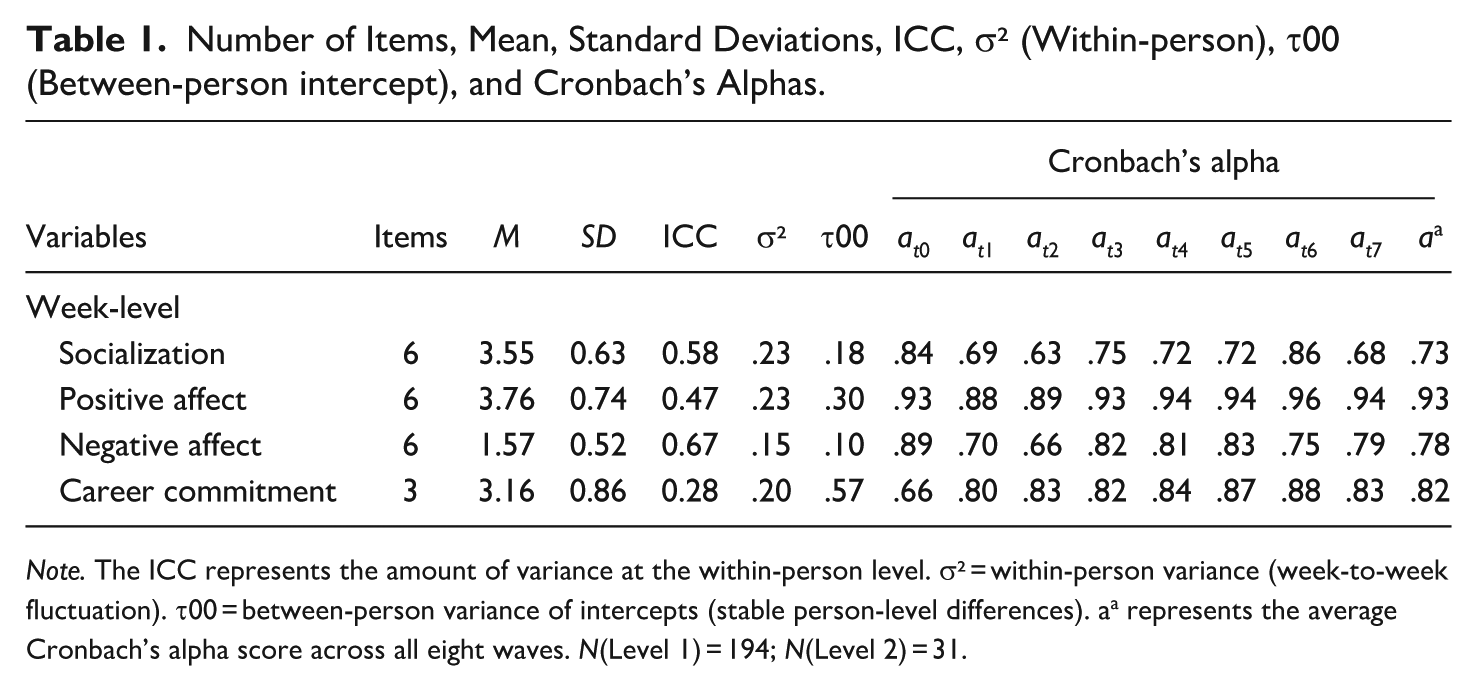
Note. The ICC represents the amount of variance at the within-person level. σ² = within-person variance (week-to-week fluctuation). τ00 = between-person variance of intercepts (stable person-level differences). aa represents the average Cronbach’s alpha score across all eight waves. N(Level 1) = 194; N(Level 2) = 31.
Table 1 also displays the means and standard deviations of the study variables (weekly variables at aggregated levels, for the weekly means and standard deviations, see Table A2). The correlations among the study variables can be found in Table A3.
Descriptive means of the outcome variables (see Table 2) indicated that participants in the reflection-task group reported somewhat higher levels of socialization (M = 3.50 vs. 2.83) and positive affect (M = 3.95 vs. 3.52) than the control group already at the first measurement point (wave 1). A similar pattern was visible for career commitment (M = 3.81 vs. 2.97). However, these initial differences did not persist: across subsequent waves, the trajectories of treatment and control groups largely converged. For instance, by wave 8, mean levels of socialization were highly similar between groups (treatment: M = 3.69, control: M = 3.65). Positive affect even showed a relative decline in the treatment group by wave 8 (M = 3.44) compared to the control group (M = 3.85). This descriptive pattern suggests that while the reflection tasks may have been associated with an early short-term increase, their effects did not accumulate and did not result in sustained between-group differences over time.
Descriptive Means of Outcome Variables by Wave and Condition.
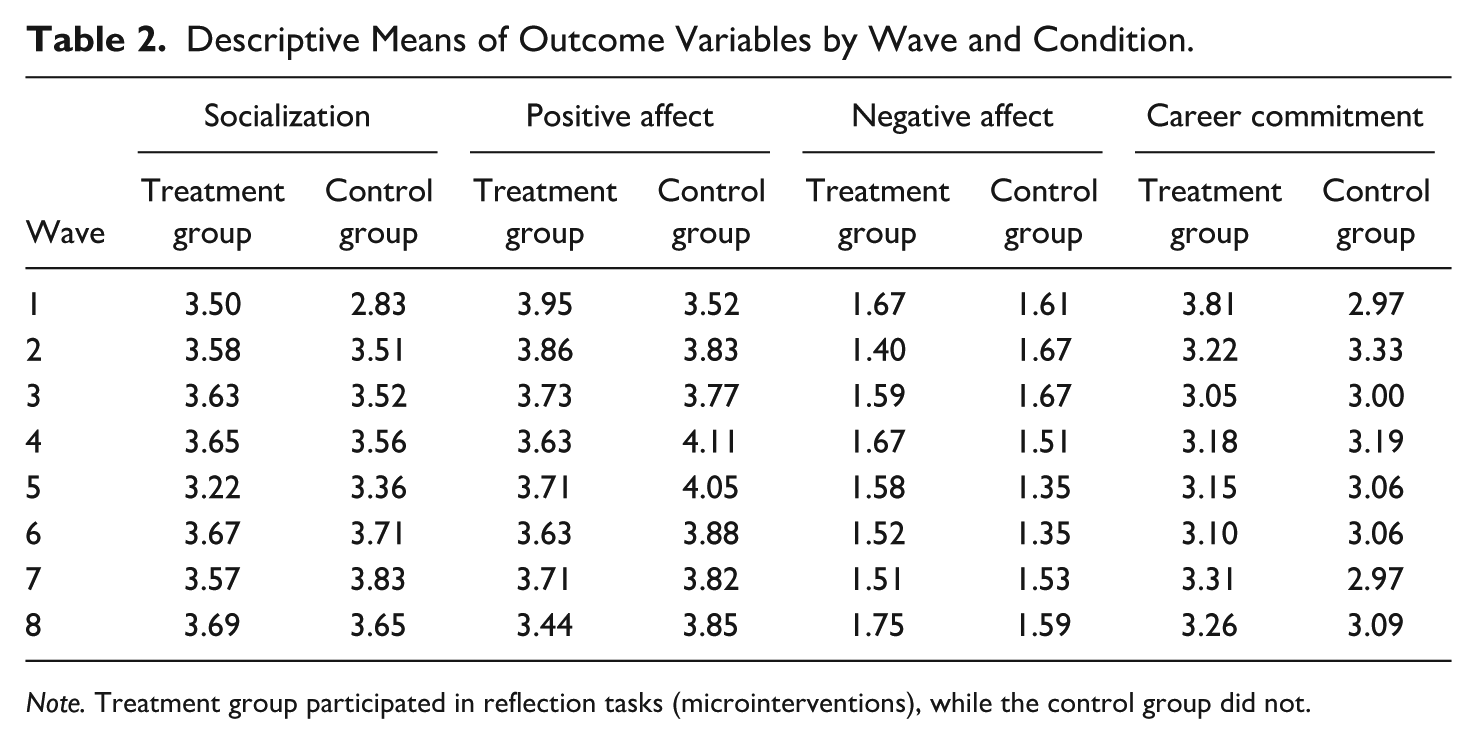
Note. Treatment group participated in reflection tasks (microinterventions), while the control group did not.
Socialization (H1)
Results from the multilevel analysis (Table 3) show that the main effect of reflection tasks was not significant across all models (Model III: b = −0.08, n.s.). This indicates that newcomers assigned to the reflection-task condition did not report significantly higher levels of socialization compared to the control group. Thus, the findings do not provide support for hypothesis 1. Time showed a positive effect on socialization (Model I: b = 0.04, p = .01), meaning that participants’ socialization increased over the 8 weeks of the study. However, this effect attenuated once controls were included (Model III: b = 0.12, n.s.). Among the controls, age was negatively associated with socialization (Model III: b = −0.65, p < .001), indicating that younger participants reported higher levels of socialization. However, given the small age range in the sample, the coefficient should be interpreted cautiously. Gender, virtuality, and citizen interaction were not significantly related to socialization in any model.
Multilevel Analysis With Socialization as Dependent Variable.
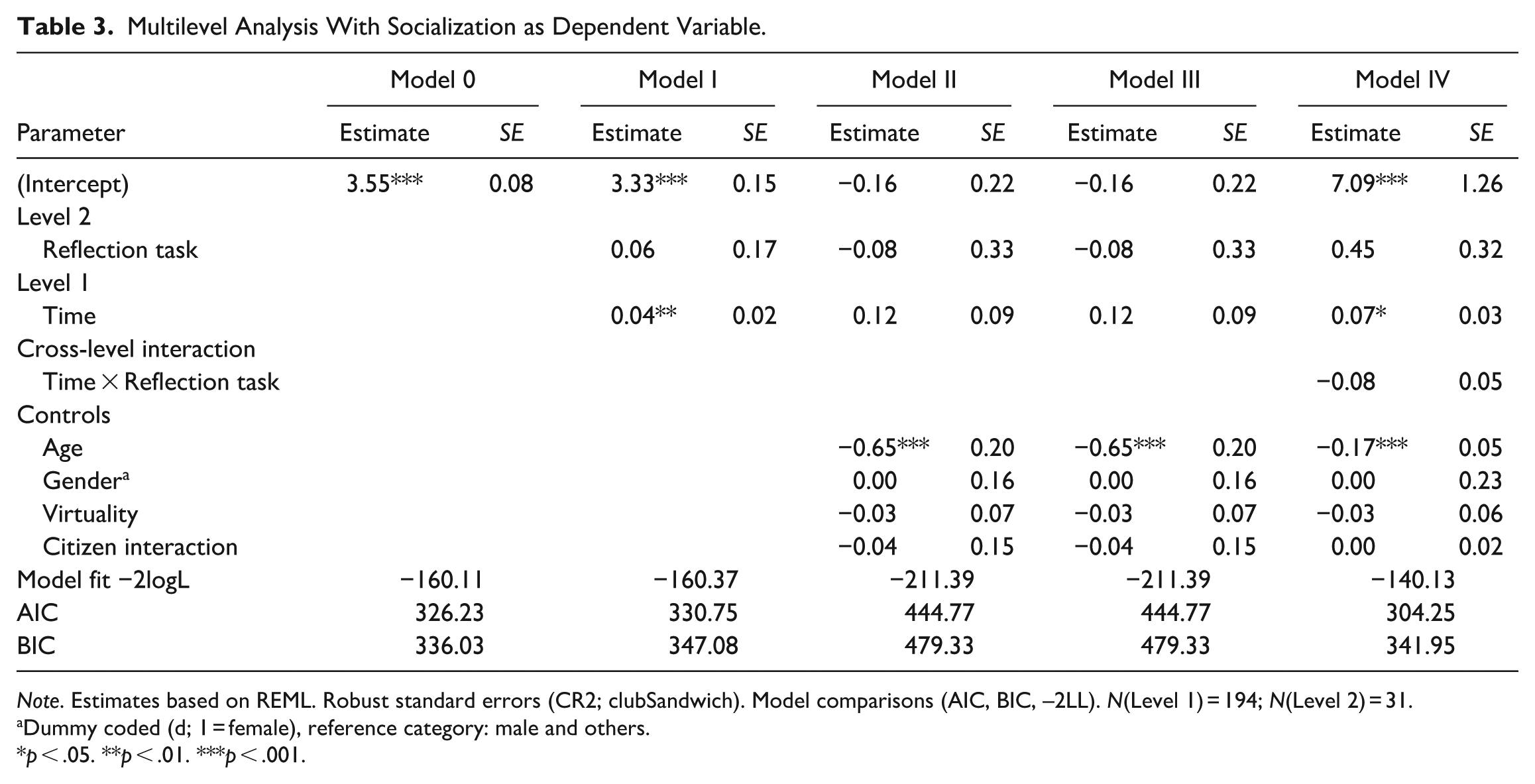
Note. Estimates based on REML. Robust standard errors (CR2; clubSandwich). Model comparisons (AIC, BIC, –2LL). N(Level 1) = 194; N(Level 2) = 31.
Dummy coded (d; 1 = female), reference category: male and others.
p < .05. **p < .01. ***p < .001.
Well-Being (H2)
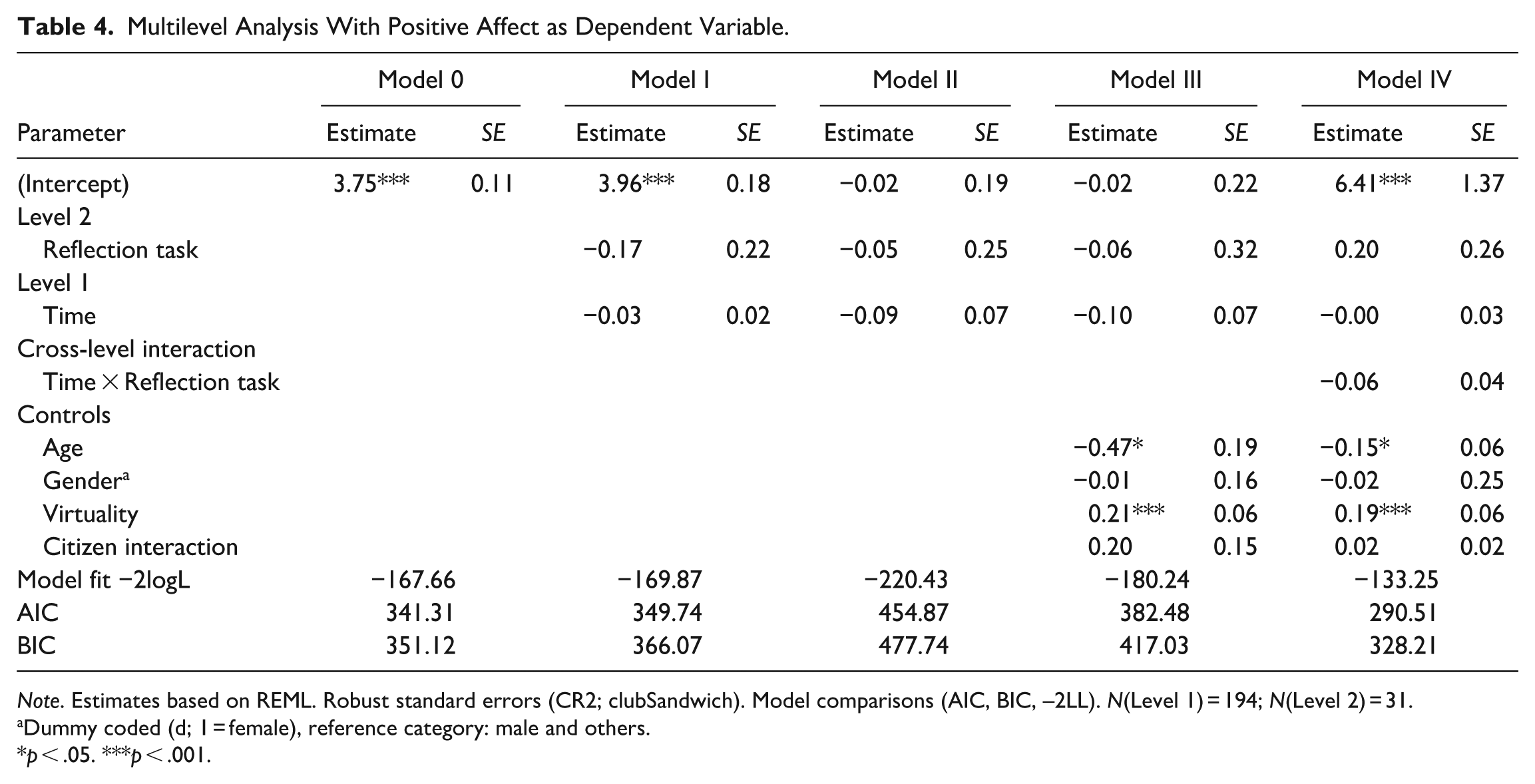
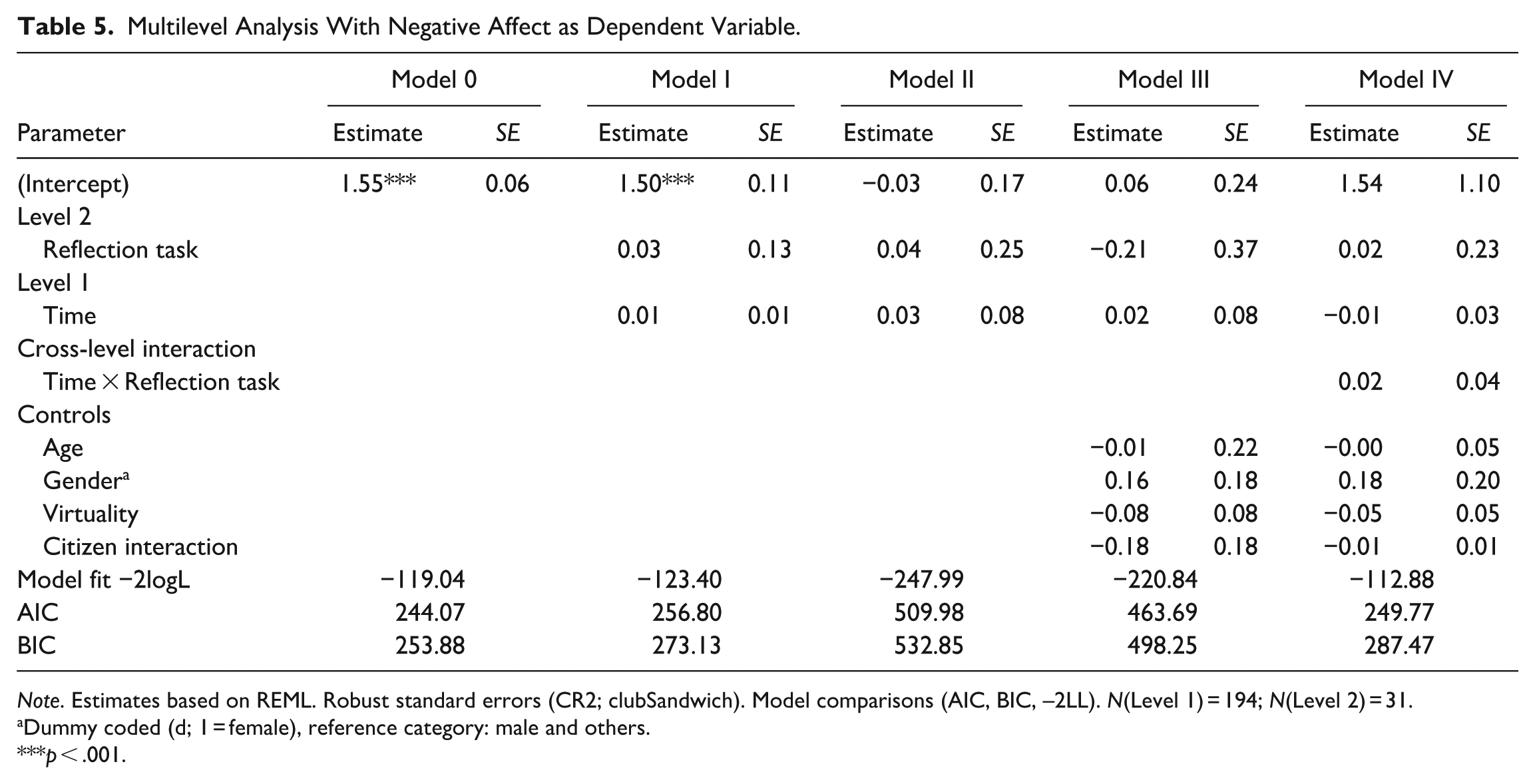
Tables 4 and 5 report the results of the multilevel regression with the dependent variables of positive and negative affect. Those variables were tested separately. Surprisingly, no significant effect of reflection task, neither on positive affect (see Table 4, Model III, b = −0.06, n.s.), nor negative affect (see Table 5, Model III, b = −0.21, n.s.) were found. Thus, reflection tasks did not lead either to higher positive affect or higher negative affect compared to the control group. Time did not exert a consistent effect on positive affect or negative affect (see Table 4, Model III: b = −0.10, n.s.; see Table 5, Model III: b = 0.02, n.s.). Age showed a negative relationship with positive affect (Model III: b = −0.47, p = .03), suggesting that younger participants experienced higher levels of positive affect than older ones. However, negative affect is not dependent on age. Virtuality was positively related to positive affect (Model III: b = 0.21, p < .001), indicating that participants working more digitally or from home reported higher weekly positive affect. Again, no such effect can be found for negative affect.
Multilevel Analysis With Positive Affect as Dependent Variable.
Note. Estimates based on REML. Robust standard errors (CR2; clubSandwich). Model comparisons (AIC, BIC, –2LL). N(Level 1) = 194; N(Level 2) = 31.
Dummy coded (d; 1 = female), reference category: male and others.
p < .05. ***p < .001.
Multilevel Analysis With Negative Affect as Dependent Variable.
Note. Estimates based on REML. Robust standard errors (CR2; clubSandwich). Model comparisons (AIC, BIC, –2LL). N(Level 1) = 194; N(Level 2) = 31.
Dummy coded (d; 1 = female), reference category: male and others.
***p < .001.
Career Commitment (H3)
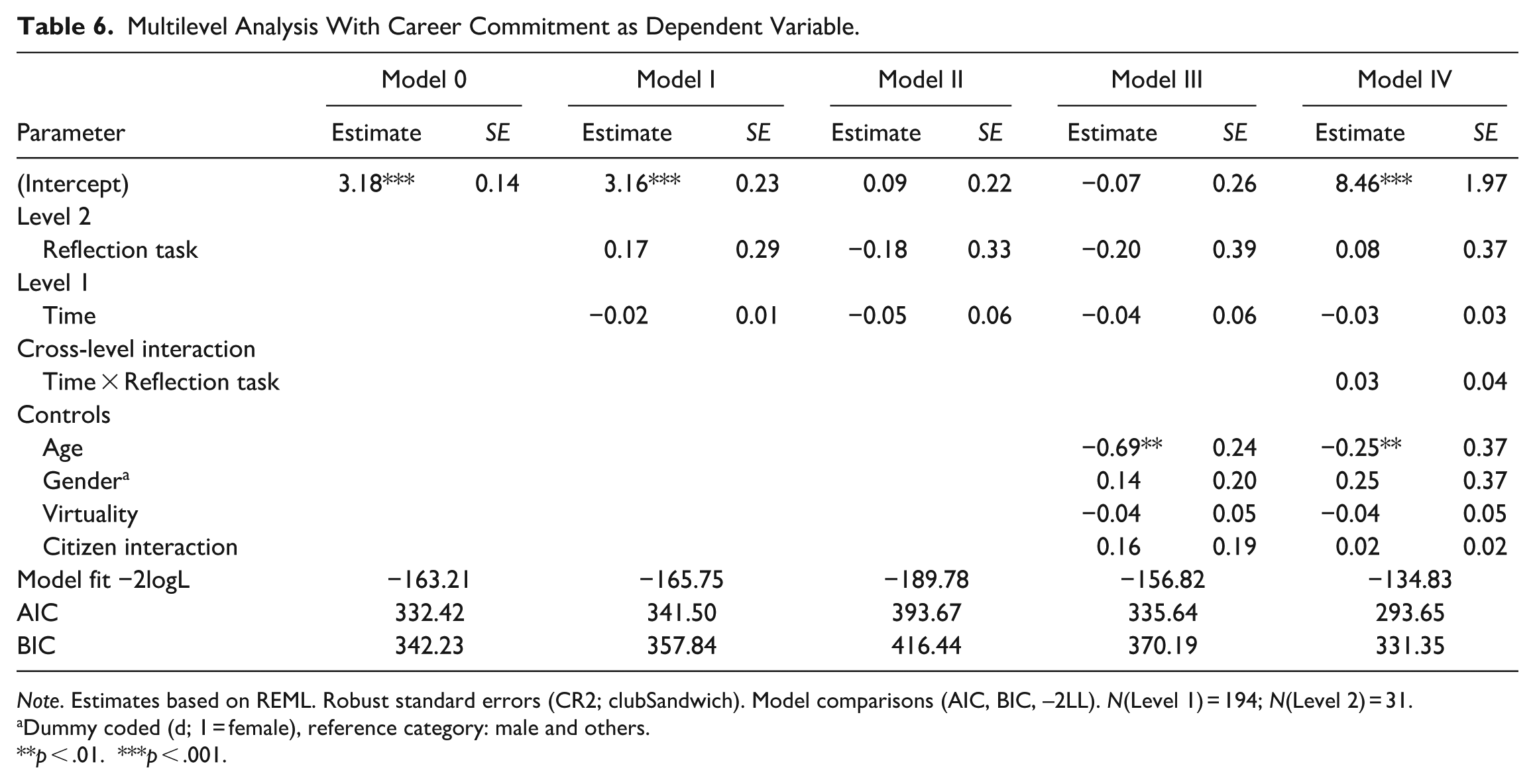
Results from the multilevel analysis (Table 6) show that the main effect of reflection tasks on career commitment was not significant in any model (Model III: b = 0.08, n.s.). Thus, reflection tasks did not significantly increase career commitment compared to the control group. Time was also unrelated to career commitment (Model III: b = 0.06, n.s.). Regarding control variables, age was negatively associated with career commitment (Model III: b = −0.69, p < .01).
Multilevel Analysis With Career Commitment as Dependent Variable.
Note. Estimates based on REML. Robust standard errors (CR2; clubSandwich). Model comparisons (AIC, BIC, –2LL). N(Level 1) = 194; N(Level 2) = 31.
Dummy coded (d; 1 = female), reference category: male and others.
**p < .01. ***p < .001.
Time (H4)
To test hypotheses 4a, 4b, 4c, and 4d, we examined whether the effect of reflection tasks on newcomer outcomes varied depending on the timing of the intervention, using the interaction term Time × Reflection task in Model IV for each dependent variable. Across all four outcomes, the interaction effects were statistically non-significant (see Model IV in Tables 3–6). For organizational socialization and positive affect, the interaction was negative, indicating that the increase in socialization over time was slightly weaker for participants in the reflection condition than in the control group, though this was not statistically significant. For negative affect and career commitment, the interaction was small and positive, but likewise non-significant. To visualize the hypothesized moderation effect, we computed model-based predicted values across time separately for treatment and control groups, based on marginal means from Model IV. The plots serve a descriptive purpose and illustrate that the trajectories ran largely in parallel, again showing the absence of significant interaction effects (see Figure A1). Taken together, these findings provide no support for hypotheses 4.
Discussion and Conclusion
Interpretation of Results
Onboarding has recently gained increased attention as a research stream, yet it remains an underexplored area, particularly within the public sector (Moyson et al., 2018). While attracting talent is critical, effectively integrating new employees is equally important, as early organizational experiences significantly shape employees’ attitudes and long-term perceptions (Bauer et al., 2024). For public sector organizations, onboarding serves an additional purpose: transmitting public institutional logic and reinforcing employees’ commitment to societal impact (Brewer, 2008). This study examined whether low-intensity, reflection-based microinterventions could strengthen newcomers’ integration into public sector roles.
The overall pattern of findings was different than expected. Across the 8-week period, the reflection tasks did not produce significant main effects on socialization (H1), well-being (H2), or career commitment (H3). In other words, the intervention group did not, on average, outperform the control group. An inspection of descriptive means (see Table 2) suggested that participants in the reflection-task condition reported higher levels of socialization, positive affect and career commitment than the control group at the very first measurement point (wave 1). At face value, this could indicate that the intervention had an immediate short-term effect after the first reflection exercise. However, in multilevel regression, change is modeled relative to the first available measurement (wave 1). Because the treatment group had already completed one reflection task in wave 1, this time point cannot serve as a true pre-intervention baseline. As a result, it is not surprising that we observe no significant treatment differences over time, since the reflection group’s descriptive advantage at wave 1 is absorbed into the baseline and cannot be disentangled from treatment effects. Thus, because our design did not include a true pretest (wave 0, prior to intervention), we cannot determine whether these differences reflect a genuine treatment effect, a random baseline imbalance due to the small sample, or novelty effects of being prompted to reflect. Importantly, the two groups’ trajectories converged over subsequent weeks, such that the early advantage did not persist and the effect of reflection tasks did not accumulate over time.
The absence of main effects invites several interpretations. One plausible explanation is that the reflection tasks may not have been sufficiently intensive to shift outcomes in a real-world onboarding context. Prior microintervention studies often observed effects in short-term or controlled settings (Bellé, 2013; Vogel & Willems, 2020), whereas our longitudinal field implementation may have introduced competing influences that diluted the intervention’s impact. A second explanation relates to ceiling effects (Meyer-Sahling et al., 2019): baseline levels of well-being and career commitment in our sample were already high (see Table 1; Table A2), leaving limited scope for upward change. This pattern mirrors findings in other intervention studies, where benefits are more likely when starting points are low (van Roekel & Schott, 2022). Third, we cannot rule out that some null effects reflect insufficient statistical power to detect small differences. And finally, data collection took place during the COVID-19 pandemic. While our analyses did not reveal systematic differences related to virtuality, it remains possible that the pandemic context influenced participants’ experiences in ways not fully captured by our measures. Contrary to our expectations, none of the Time × Reflection task interactions reached significance across the four outcomes (H4). For socialization and positive affect, the interaction terms were negative, suggesting descriptively that increases over time were slightly weaker in the reflection-task group compared to controls, but these differences were small and non-significant. For negative affect and career commitment, interaction terms were positive, but close to zero and likewise non-significant. These findings suggest that the reflection tasks did not exert time-contingent effects on newcomer outcomes. While descriptively the treatment group started slightly higher on socialization and positive affect, these advantages converged with the control group over time. The insignificant interaction effect is surprising, since the earliest weeks after entry are often seen as a sensitive period for shaping attitudes and adjustment (Bauer et al., 2024). In these early stages, expectations are still forming and newcomers may be more receptive to reframing their experiences. Over time, attitudes tend to stabilize, potentially reducing responsiveness to intervention. This pattern is consistent with evidence from other behavioral intervention research showing that effects often weaken as novelty fades and routines set in (Bunge et al., 2016; Elefant et al., 2017). In our study, the absence of moderation suggests that the outcomes are not sensitive to timing; these variables may depend more on structural and long-term factors than on early cognitive reframing alone. Although the findings of this study suggest that microinterventions in the form of social reflection tasks are not the strongest onboarding tactic, they did not yield any significant negative effects, even with repeated use, indicating that reflection-based microinterventions are a low-risk onboarding tactic. Below, we discuss the main contributions of our findings.
First, by employing a longitudinal diary study, this research addresses gaps in onboarding literature, which often lacks long-term perspectives (Murdoch et al., 2023). Unlike cross-sectional studies (Bellé, 2013; Hansen, 2023; Vogel & Willems, 2020; B. E. Wright & Christensen, 2021), the eight-week design tracked intra-individual changes over time, revealing substantial week-to-week variability in well-being and career commitment, while socialization increased progressively. We conceptualized these as state variables rather than stable traits, acknowledging that they can vary substantially over time in response to experiences during organizational entry. Despite the absence of significant treatment effects, the outcomes showed substantial within-person fluctuations across the study period (ICCs 28%–67%). This suggests that newcomer adjustment is indeed dynamic. Our methodological approach allowed us to observe these intra-individual fluctuations and aligns with previous diary and experience-sampling research showing that work-related well-being exhibits meaningful day-to-day variation depending on situational factors (Niessen et al., 2012; Sonnentag, 2001; Sonnentag et al., 2008). This underscores the calls for more longitudinal designs in public management research (Boselie et al., 2021; Jakobsen et al., 2023). Second, this study contributes to the growing body of literature on microinterventions (Ahmedani et al., 2015; Backhaus & Vogel, 2025; Hansen, 2023; Vogel & Willems, 2020) by being the first to explore their effects in public sector onboarding. Researchers argue that “microinterventions do not sufficiently activate the underlying psychological mechanisms that are theorized to produce change in mood as thoroughly as more in-depth interventions” (Elefant et al., 2017, p. 21). While prior research demonstrated short-term benefits (Vogel & Willems, 2020), the results of this study underscore the limited efficacy of microinterventions in real-world settings. In a similar vein, Hansen (2023), replicating Vogel and Willems’s (2020) study with real-world Danish caseworkers, found that none of the experimental intervention groups showed significant differences from the control group in terms of turnover intention or job satisfaction. These findings suggest that despite reflection-based microinterventions showing positive outcomes in more controlled environments, their effect sizes may be smaller when deployed “in the wild,” and therefore can be used to complement, not replace, more sustained onboarding strategies. Third, by analyzing the moderating role of time, this study adds a temporal lens to microintervention research, expanding on earlier work focused on the short-term effects of microinterventions (Bellé, 2013; Hansen, 2023; Vogel & Willems, 2020). While the descriptives hint at an early advantage for the reflection condition, this pattern of an early descriptive advantage cannot be causally attributed, since no significant interaction of reflection task and time was found. While some studies show that interventions often have temporary impacts (Bunge et al., 2016; Elefant et al., 2017; B. E. Wright & Christensen, 2021), this study’s results did not show accumulating effects of reflection tasks.
Limitations
This study has several limitations. First, the small Level 2 sample size (N = 31) limits statistical power, making it difficult to detect small effects. This is especially relevant here, as prior microintervention research (Hansen, 2023; Vogel & Willems, 2020) suggests that their impacts are indeed micro, making it challenging to capture their effect without larger, more powerful samples. Following Aguinis et al. (2013) this study prioritized maximizing Level 1 instead of Level 2, since the main focus is on testing lower-level direct effects. However, detecting cross-level effects requires a larger Level 2 sample (Mathieu et al., 2012). A G*Power sensitivity analysis (α = .05, 80% power, N = 31) showed that the minimal detectable effect size for an independent-samples t-test was d = 1.04, whereas Vogel and Willems (2020) report Hedges’ g of 0.03 to 0.63. Effects of such magnitude would likely go undetected here. Recruiting a large, real-world sample that remains engaged over multiple weeks is a known challenge in organizational diary studies (Ohly et al., 2010), and this constraint inevitably affects the precision of estimates. While the eight-wave design captured within-person change, a larger Level 2 sample would have provided a stronger basis for detecting subtle effects. Second, due to the longitudinal design, the split in treatment and control groups might be less distinct. Because the first survey wave (week 1) was collected after the treatment group had already completed one reflection, we were not able to measure a true pre-intervention baseline. Thus, the descriptives showing higher socialization and affect for the treatment group at wave 1 should be interpreted cautiously and may partly reflect novelty or priming effects. Participants know they are part of a study which can affect the results of the study (McCambridge et al., 2014), and the repeated participation may prime reflection in both treatment and control groups. Survey questions alone might have prompted reflection among control group participants (Zaller & Feldmann, 1992). Recently, researchers have begun to express their concerns of possible distortions in diary studies: “repeated reflection on the variables of interest may change individuals’ perceptions of their work, thereby compromising the benefits of diary studies” (Gochmann et al., 2022, p. 1209). Additionally, self-selection bias is possible: individuals who are more motivated to contribute or interested in the topic may have been more likely to participate, a challenge common to many research designs but potentially amplified in diary studies (Bolger et al., 2003). Third, the sample’s homogeneity may restrict the generalizability of findings. Participants were public management students in Hamburg, with similar work experience, age, and occupational context. All were employed in dual-study arrangements resembling internship-like assignments. These temporary employment conditions may have shaped attitudes toward socialization, well-being and career commitment, limiting the generalizability of results to other public sector contexts or to more experienced employees.
Future Research
As this study only finds limited support for the effect of reflection-based microinterventions, the relationship between perceived social impact at work and employee outcomes remains complex and warrants further investigation. First, employing larger samples would increase statistical power to detect small effects, while using both, an active and passive control group could help better isolate the effect of the intervention itself. We invite future scholars to further pursue research to untangle under which conditions public employees can indeed become aware of their social impact and whether this improves their well-being or career commitment. The findings suggest that retrospective reflections may not be the most effective intervention during the newcomer integration stage. Alternatively, interventions that encourage employees to proactively seek meaningful contributions might better align with their prosocial motivations. This aligns with findings from Bauer et al. (2024), who stress newcomer proactivity as crucial to the socialization process. Second, newcomer experience should be observed over a longer period to expand on the findings. This 2-month study primarily captured the initial phase of integration. As some scholars investigated newcomer orientation over a period of up to 12 months (for an overview, see Bauer et al., 2024), longer studies could provide deeper insights. Moreover, conducting microintervention studies with employees who have been with their organization longer but may have lost sight of their societal impact (Kjeldsen, 2014) could reveal whether such interventions reignite motivation at later career stages. Third, not all newcomers may respond equally to the same interventions (Bauer et al., 2024), and some may require tailored approaches to facilitate their integration. For instance, seniority could moderate the effectiveness of microinterventions: employees with prior experience in similar roles may react differently to reflective thinking tasks than those at the very start of their careers. For instance, Kowtha (2018) found that prior related work experience moderated the effects of onboarding tactics on role clarity, role conflict, and organizational commitment. In other words, the same measure can work differently for experienced employees than for true beginners. Moreover, individual differences, such as information-seeking behavior, can significantly influence how onboarding tactics translate into newcomer integration outcomes (Gruman et al., 2006). In addition, leadership behaviors have been shown to enhance socialization (Ellis et al., 2017), well-being (Choi et al., 2017), and career commitment (Perryer & Jordan, 2005). Future studies should therefore examine how personal attributes, prior experience, and leadership context interact with onboarding interventions to shape the full spectrum of newcomer integration.
Practical Implications
The findings of this study are relevant for both research and HRdecision-making in public organizations. Newcomer integration should be treated as a process rather than a one-time event, as Bauer et al.’s (2024) meta-analysis identifies the initial phase as critical for employees and organizations. We encourage HR managers not to overlook this phase and to design comprehensive onboarding experiences that extend beyond the first day or week, ensuring thorough integration over time. Structured onboarding programs are proven to enhance retention and boost motivation, performance, productivity, and job satisfaction (Bauer et al., 2024; Moyson et al., 2018). A recent meta-analysis found that newcomers participating in such programs are significantly more likely to be retained (Liu et al., 2024). Organizations should view onboarding as a strategic element of the employee journey, essential for fostering long-term engagement and retention. While traditional onboarding instruments usually focus on task mastery and procedural knowledge (Bauer et al., 2024), microinterventions in the form of reflection tasks offer a low-cost, scalable instrument that could be considered as a supplementary tactic in the early weeks of employment. Evidence from other contexts (van Roekel & Schott, 2022; Vogel & Willems, 2020) indicates that reflective thinking about social impact holds potential as a management tool, but its impact in complex, real-world settings may be more modest. In this study, reflection tasks did not significantly improve well-being, socialization, or career commitment. The null results of this study help identify the limits of microinterventions in such real-world contexts: they should not be relied upon as the sole integration strategy. It may be worth experimenting with as an add-on to more robust onboarding strategies, particularly if timed during the initial weeks when newcomers are most receptive.
Footnotes
Appendix
Declaration of Conflicting Interests
The author declared no potential conflicts of interest with respect to the research, authorship, and/or publication of this article.
Funding
The author received no financial support for the research, authorship, and/or publication of this article.
