



Abstract
Accountability plays an important role in the daily work of frontline professionals, yet it is unclear whether it affects them either positively or negatively at work. This study therefore examines how employee accountability (EA), as a job demand, impacts employee engagement and emotional exhaustion. Furthermore, we assess to what extent psychological safety, as a job resource, moderates the impact of EA on emotional exhaustion and engagement. Based on a survey among 3,691 frontline professionals in Dutch healthcare, we show that different dimensions of employee accountability have contradictory, albeit small, effects on emotional exhaustion and engagement. In addition, our study reveals that the validity and reliability of the measurement of employee accountability are dependent on professional and national contexts. Recommendations for future research are discussed.
Keywords
Introduction
Accountability plays an important role in frontline professionals’ daily work practice. Frontline professionals, who provide public services, are increasingly expected to explain their actions or inactions to others, such as governmental institutions, quality institutes, colleagues, supervisors, and citizens or clients (Schillemans et al., 2015). Despite the increasing and inevitable presence of accountability in the public sector, it is still disputed what accountability entails for frontline professionals and whether it engages or exhausts them at work (Bovens & Schillemans, 2014; Hall, 2005; Hall et al., 2017).
On the one hand, scholars generally reason that accountability impacts frontline professionals negatively (Aleksovska et al., 2019). In the public sector, frontline professionals often face multiple accountabilities, meaning that different stakeholders put accountability demands on professionals simultaneously. These accountability demands can be conflicting, and frontline professionals may feel threatened by the possibility of being sanctioned (Aleksovska & Schillemans, 2021). This does not only affect frontline professionals’ decision making and task performance (Aleksovska, 2021; Aleksovska & Schillemans, 2021; Aleksovska et al., 2019), it also affects their well-being at work (Hall, 2005). Accountability, then, may be experienced as an externally imposed bureaucratic process that exhausts professionals and is associated with disempowered and less motivated employees, weaker performance (Jakobsen et al., 2017), higher levels of red tape (van Loon & Felsager Jakobsen, 2022), more job tension (Hall et al., 2006; Laird et al., 2009), less job satisfaction (Hall, 2005), blame games, and inhibition of innovation and learning (Bovens & Schillemans, 2014).
On the other hand, there is evidence that accountability can be considered as something positive or even necessary for frontline professionals to do their job adequately (Aleksovska et al., 2019). Accountability can help to get insight into organizational and professional processes and stimulate performance, as it may serve as a prerequisite for learning practices, such as feedback on organizational activities (Schillemans et al., 2013). In this line of reasoning, accountability is suggested to stimulate rather than decrease performance (Han & Hong, 2019; Thoms et al., 2002) and job satisfaction (Thoms et al., 2002), and could be considered as something that engages professionals.
Scholars thus emphasize that the positive and negative effects of accountability for professionals might both be true. This has led to an increase in research that addresses how professionals experience accountabilities on the individual level: “the implicit or explicit expectation that one may be called on to justify one’s belief, feelings, and actions to others” (Lerner & Tetlock, 1999: page 255). The rise of studies that analyze the impact of accountability on an individual level has shifted the focus from the question of whether accountability influences professionals positively or negatively to questions about the circumstances under which accountability impacts professionals’ well-being positively or negatively, and why (Bovens & Schillemans, 2014; Hall et al., 2017). Accountability on the individual level has been studied under the label of individual accountability (Lerner & Tetlock, 1999), felt accountability (Overman et al., 2021; Overman & Schillemans, 2022), and employee accountability (EA) (Han & Perry, 2020a, 2020b). While felt accountability is mainly focused on individual perceptions of a specific accountholder, EA is focused on accountability on a more general level, thus not focusing on specific accountholders but taking the entire accountability landscape into account. We use the term and measurement scale for employee accountability as professionals, especially in healthcare, often have to deal with multiple accountabilities (Aleksovska & Schillemans, 2021), and are not always able to clearly delineate which accountability demands or requests come from which account holder.
This study adds to research on individual level-outcomes of accountability by studying the association between employee accountability and employee engagement and emotional exhaustion, and to what extent these relationships are moderated by psychological safety. Employee engagement and emotional exhaustion are core interests of public organizations around the world because of its link to different types of outcomes such as organizational performance, turnover intention, job satisfaction, and other relevant outcomes (Borst et al., 2020; Breaux et al., 2009)
Drawing on Job Demands and Resources Theory (JD-R) (Bakker & Demerouti, 2007, 2017; Bakker et al., 2014, 2023; Schaufeli & Bakker, 2004), this study conceptualizes employee accountability as a job demand that can both engage and exhaust professionals at work, depending on the presence of psychological safety as a resource. Psychological safety can be defined as “a shared belief held by members of a team that the team is safe for interpersonal risk taking” (Edmondson, 1999, p. 354). As such, it reflects a climate in which individuals feel comfortable asking questions, admitting mistakes, and expressing concerns without fear of negative consequences to self-image, status, or career. Earlier studies suggest that professionals are more likely to experience accountability positively, leading to higher engagement, in working climates that are psychologically safe (Bakker & Sanz-Vergel, 2013; Garrick et al., 2014) as accountability in such circumstances adds to learning.
Taken together, our research question, is: How is employee accountability associated with emotional exhaustion and engagement among frontline professionals? And does this relationship depend on psychological safety?
This study is based on a cross-sectional survey among healthcare professionals in the Netherlands (N = 3,691), The empirical research is situated in Dutch healthcare as this sector is characterized by high levels of accountability, with healthcare organizations being held accountable by (semi) governmental bodies and organizations, healthcare insurers, professional bodies and organizations, and patients and clients. It can thus be expected that Dutch healthcare professionals are confronted with demands for accountability daily, albeit in different ways and to different extents, making this an appropriate research setting to study employee accountability.
The contribution of this paper is threefold. First, we aim to contribute to research on well-being of public sector employees by focusing on EA as a relevant, but understudied job characteristic, and study both its possible engaging and exhausting effects on frontline professionals. Recent studies have shown that job characteristics such as job autonomy (Fleischer & Wanckel, 2024), red tape (Fuenzalida et al., 2024), work pressure and task variety impact the well-being of employees (van der Meer et al., 2024). However, only a handful of studies have examined the association between accountability and work outcomes (see for exceptions, Hall, 2005; Hall et al., 2017), despite the prevalence of accountability in frontline professionals’ daily work.
Second, this study contributes to the empirical study of employee accountability by applying a recently validated scale for EA in a different national (the Netherlands) and professional context (healthcare). It is crucial to test validated scales among different samples and in different contexts (both in terms of profession and nationality) in order to improve their validity and reliability (Flora & Flake, 2017). We used the employee accountability measurement scale as developed by Han et al. (2020) which is based on the contingency model of Lerner and Tetlock (Han & Perry, 2020b; Tetlock, 1992). This scale captures employee accountability through five dimensions, which proved to be consistent and reliable among a population of TurkPrime respondents (Han & Perry, 2020a, 2020b). Applying this measurement scale in our research setting reveals several shortcomings, spurring further debates on the measurement as well as the conceptualization of employee accountability. By doing so, this study adds to the first steps of developing a more nuanced understanding of the effects of employee accountability on engagement and exhaustion (Han et al., 2025).
Third, this study adds to recent studies on accountability that have taken a micro-level focus with a stronger emphasis on the experiences of accountability on the individual level (Overman & Schillemans, 2022), and its effects. Most of these studies, so far, have focused on the impact of EA on public professionals’ compliance (Overman & Schillemans, 2022; Overman et al., 2021) and decision-making behavior (Aleksovska, 2021; Aleksovska & Schillemans, 2021; Aleksovska et al., 2019). We add to these studies by arguing that EA may both be challenging and demanding for professionals, depending on the working climate, and, hence, affect both their engagement and exhaustion at work.
Theoretical Framework
Employee Accountability
Accountability can be considered as a relational mechanism through which an agent can be held accountable by a forum for his or her conduct (Bovens, 2010) through the stages of informing, questioning, and passing judgment (Schillemans et al., 2015). A forum can be a manager or a client, but also a (governmental) institution, and can refer to both formal and informal arrangements. In public administration research, accountability is traditionally studied as a formal mechanism on the institutional or organizational level, where researchers address how and why organizations give account for the public services they provide (Schillemans, 2016). Recent studies, however, have shifted the focus from the organizational to the individual level by building on the social contingency model of Tetlock (1992).
The central line of thought is that (frontline) professionals interpret the (macro) accountabilities they face in their daily practice (Tetlock, 1992), creating a perception of employee accountability (EA) that may affect their decision-making and behavior, ultimately resulting in (macro) organizational outcomes (Overman & Schillemans, 2022). Employee accountability, in this regard, refers to an individual state of mind, defined as “the implicit or explicit expectation that one may be called on to justify one’s belief, feelings, and actions to others” (Han & Perry, 2020a, 2020b; Lerner & Tetlock, 1999; Tetlock, 1992).
There are three central propositions to the social contingency model of Tetlock: (1) EA is an internalized psychological state of accountability. It is a state of mind, in which humans perceive and interpret the accountabilities they face in daily practice; (2) Individuals can perceive and interpret the same accountability circumstances differently. While EA is heavily dependent on the accountability measures professionals face, the internalization is subjective and may differ between individuals (Hall et al., 2017; Han & Perry, 2020a). EA thus refers to an individual’s perception of accountability, reflecting, but not similar to the accountability measures in place; (3) EA is a changeable state, not a personality trait. The perception of accountability may vary over time within individuals (Lerner & Tetlock, 1999).
The Relationship Between Employee Accountability, Engagement, and Emotional Exhaustion: A JDR-Approach
We draw on Job-Demands and Resources (JDR) model to understand how EA may engage and exhaust professionals at work.
Job demands can be physical, psychological, social, or organizational aspects of the job that demand physical and/or psychological (i.e., cognitive or emotional) effort from professionals and are associated with burn-out and emotional exhaustion. Job and personal resources, on the other hand, help professionals cope with those demands (Bakker & Demerouti, 2007, 2017; Schaufeli & Bakker, 2004; Schaufeli & Taris, 2014), and engage professionals to do their job. Emotional exhaustion and engagement are often considered as two sides of the same coin. However, in the JDR model they are two separate constructs, central in different pathways (Bakker & Demerouti, 2007). Thus, in order to get a more nuanced understanding of the demanding and resourceful impact of EA, we also threat emotion exhaustion and engagement as separate constructs.
Public administration research tends to emphasize the demanding aspects of accountability (Aleksovska et al., 2019). Having the implicit or explicit belief that you need to justify your work to somebody else might create pressure to perform, increase the fear to make mistakes, or might limit the feeling of autonomy at work. A body of empirical research underlines the demanding aspects of EA, and shows associations between EA and employee outcomes such as emotional exhaustion (Hall 2006), job tension (Hall 2006), a depressed mood at work (Lanivich et al., 2010), and lower job-satisfaction (Lanivich et al., 2010). (Aleksovska & Schillemans, 2021; Bovens & Schillemans, 2014) Accountability, in such cases, is seen as externally imposed demands that result in red tape (van Loon & Felsager Jakobsen, 2022), blame games, and inhibition of innovation and learning (Bovens & Schillemans, 2014). This might lead to disempowered and less motivated employees and weaker performance (Jakobsen et al., 2017). In addition, scholars speak about accountability overloads where frontline professionals find themselves in dense webs of (multiple) accountability obligations towards multiple institutions (Aleksovska & Schillemans, 2021; Bovens & Schillemans, 2014). The public sector is characterized by multiple accountabilities, as public organizations are not only held accountable for the public services they provide by their clients, but also by the public in general and a multitude of (semi)public organizations on, for example, how they spend (public)funding or for the quality of care. This might increase the demanding aspects of EA for frontline professionals even more, not only because the number of forums that create the need for justification increases, but also because these forums may have more demanding and conflicting interests and therefore judge their conduct differently. We, therefore, theorize that EA can be understood as a job demand and expect a positive association with emotional exhaustion:
Generally the relation between EA and negative work outcomes is less contested than its potential relationship with positive work outcomes (Hall et al., 2017). Nevertheless, there are also studies that suggest that EA is associated with positive work outcomes, such as job satisfaction (Thoms et al., 2002; Hall et al., 2017; Breaux et al., 2009) and performance (Han & Hong, 2019; Han & Robertson, 2021).
This resonates with recent developments in JDR scholarship, where scholars have found that some demands do not only have hindering effects but might actually challenge professionals and enhance their engagement. This has resulted in a distinction between hindering and challenging job demands (Bakker & Demerouti, 2017; Bakker et al., 2023; Crawford et al., 2010). Hindrance job demands are defined as job demands or work circumstances that involve excessive or undesirable constraints that interfere with or inhibit an individual’s ability to achieve valued goals and growth and thus affect one’s emotional exhaustion. Examples of this are role conflict, role overload, or role ambiguity (Bakker & Demerouti, 2017; Webster et al., 2011)
Challenging job demands, on the other hand, such as high workload, time pressure, and responsibility (Crawford et al., 2010; Webster et al., 2011) are defined as demands that cost effort but that may promote personal growth of employees. Based on this reasoning, EA might function as a challenging demand that engages professionals. In line with aforementioned research that shows a positive association between EA and job satisfaction and performance, there are studies that show that challenging demands have direct positive correlations with engagement (Bakker & Sanz-Vergel, 2013; Crawford et al., 2010). We therefore theorize that employee accountability might not only function as a hindrance demand but might also function as a challenging demand, and therefore engage professionals. This results in our second hypothesis:
Following the JDR model we further hypothesize that the associations of EA with exhaustion and engagement depend on the context and the resources available. The availability of learning opportunities, personal growth, and sufficient resources is central to understanding how professionals cope with challenging and hindrance demands (Crawford et al., 2010). One key resource is psychological safety, which has been shown to enhance the positive relationship between job demands and engagement (Garrick et al., 2014). Psychological safety refers to the perceived consequences of taking interpersonal risks, such as speaking up without fear of embarrassment, rejection, or punishment in a particular context such as the team or the workplace (Edmondson, 1999; Edmondson & Lei, 2014).
Studies, albeit performed in the private sector, have shown that in environments of high psychological empowerment, EA was associated with increased performance (Higgins et al., 2022; Wallace et al., 2011) For example, Bakker and Sanz-Vergel (2013) show that challenging job demands only increased engagement when professionals experience high self-efficacy and optimism (Bakker & Sanz-Vergel, 2013). In a psychologically safe team, professionals trust that their team members will not penalize them for sharing information or making mistakes. This environment is crucial for fostering learning behaviors, which are often hindered by fear of negative reactions. Since accountability inherently involves justifying one's actions to others, the absence of psychological safety can exacerbate stress and exhaustion and hinder engagement. We therefore argue that in psychologically safe environments, professionals can not only cope with the demanding challenges EA poses to them, but use these accountabilities to learn and develop professionally, improving personal growth and enhancing their engagement (Figure 1). Our third and fourth hypotheses, therefore, are as follows:
Methods
Data Collection
This empirical study is situated in Dutch healthcare. Dutch healthcare professionals face multiple accountabilities in their daily practice. They are held accountable through formal ways; external organizations monitor the quality of provided care through audits, norms and quality checks, while professional bodies develop norms for healthcare procedures, and managers, patients, and clients monitor the performance of healthcare professionals. Informally, healthcare professionals often work together in interdisciplinary teams and need to continuously learn and evaluate their work to keep up with the latest professional insights. Healthcare professionals in the Netherlands have been addressing high levels of employee accountability and its negative impact on their well-being and daily work practice (Raad voor Volksgezondheid en Samenleving, 2019).
Data were collected through a survey among 3,691 Dutch healthcare professionals in May-July 2023. The survey was delimited to frontline professionals, that is, healthcare professionals with direct contact with clients in different sectors such as hospitals and long-term elderly care facilities. The survey was distributed to healthcare professionals via e-mail through the member bases of two institutions, referred to as institution A and institution B. Institution A and B are non-healthcare organizations themselves, but their members work in a multitude of healthcare organizations in the Netherlands. Professionals received a Qualtrics-link to participate in the survey and received two reminders after several weeks to fill it in. Respondents were informed about the purpose of the survey, data collection, and privacy protection and were subsequently asked to sign an informed consent form. Only healthcare professionals currently working in healthcare were asked to fill in the survey. No contact information or names were asked, and all data was protected. Permission for this study was granted by the ethical committee of Leiden University.
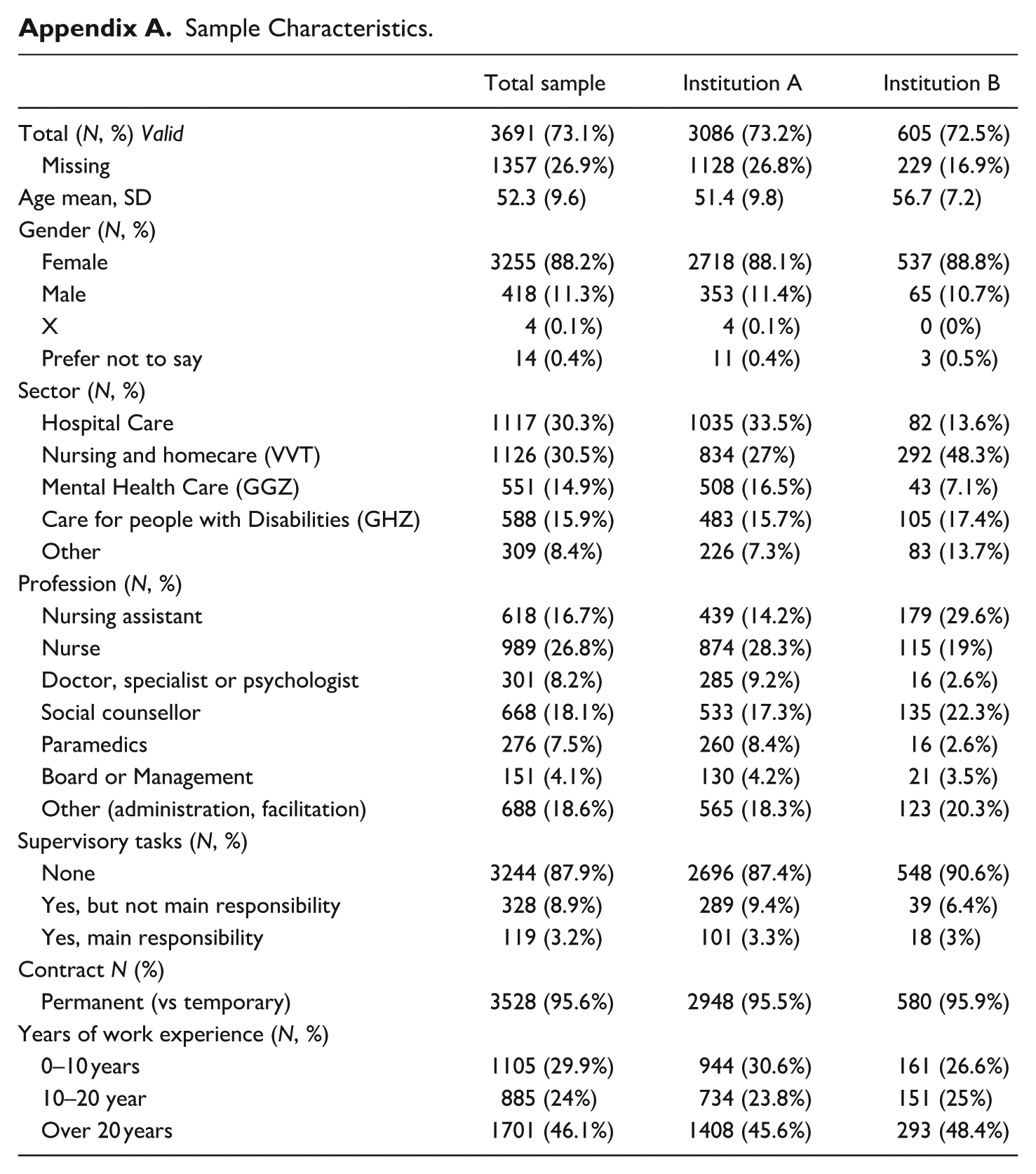
The survey was started by N = 5,048 respondents, of which N = 3,691 (73,1%) healthcare professionals completely filled in the questionnaire for the variables of interest. The average age within the sample of healthcare professionals was higher than the national average (52.3 in comparison to 42.0), and 88.2% of all professionals in our sample were female (compared to 81% in the Netherlands) (CBS, 2020). Multiple healthcare sectors were represented: 30.3% of all professionals worked in the hospital sector (34.9% in the Netherlands), 30.5% worked in nursing homes and home care (29.2% in the Netherlands), 14.9% in mental healthcare (6.4% in the Netherlands), 15.9% in disability care (9.1% in the Netherlands) (CBS, 2020), and 8.4% in youth care, general practice or other healthcare sectors. Most respondents were frontline professionals and were either nursing assistants (16.7%), nurses (26.8%), or social counselors (18.1%). Nearly half of all professionals had over 20 years of working experience in their current position (46.1%). A complete overview of the sample characteristics can be found in Appendix A.
Measurement
Employee Accountability
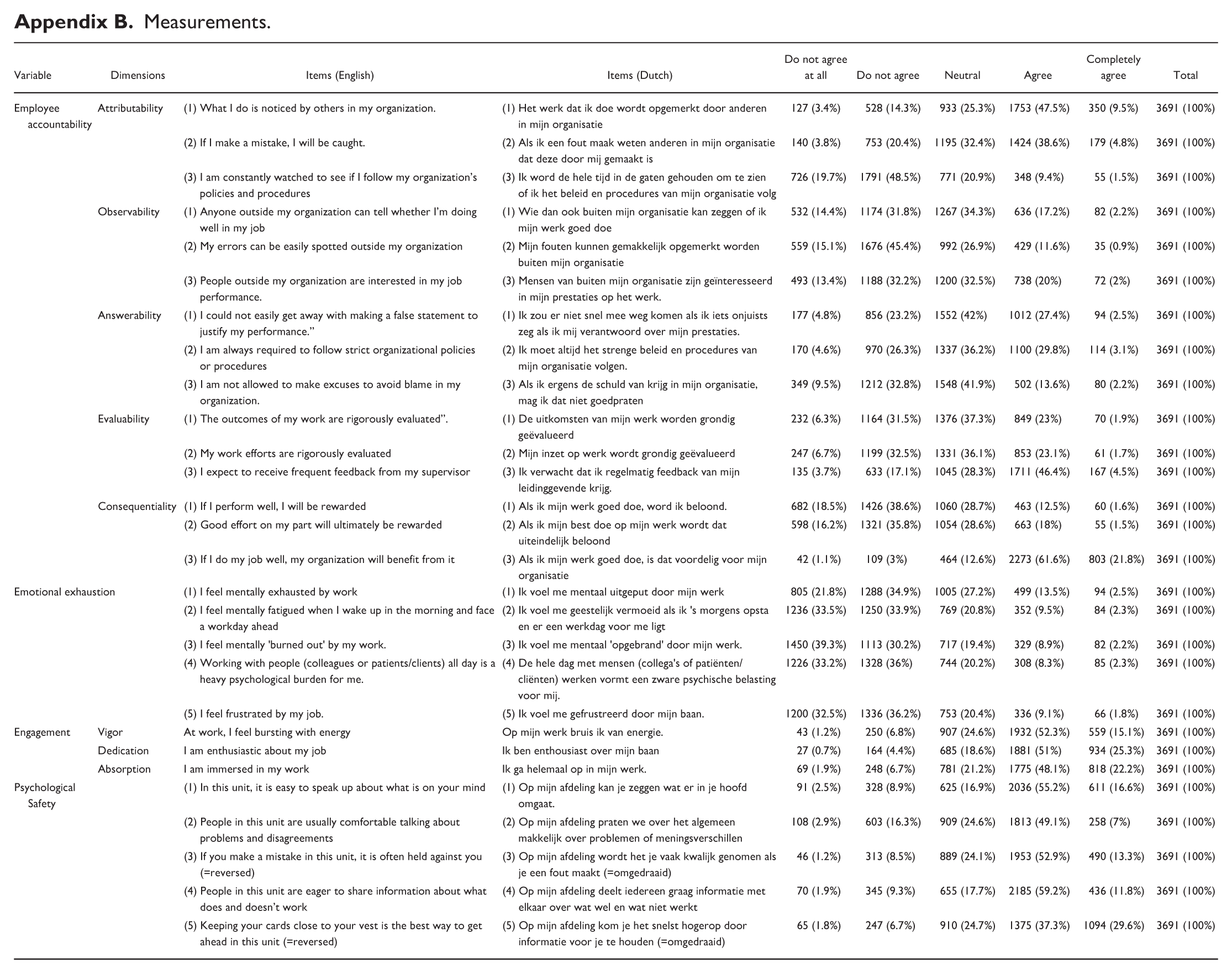
We used the employee accountability scale (EAS) as developed by Han et al. (Han & Perry, 2020a, 2020b; Han & Robertson, 2021). The EAS is based on the social contingency model of Lerner and Tetlock (Han & Perry, 2020a, 2020b; Lerner & Tetlock, 1999; Tetlock, 1992) and captures the concept of employee accountability through five dimensions: attributability, observability, evaluability, answerability, and consequentiality, each measured through 3 separate statements, resulting in 15 items in total (Table 1) (Han & Perry, 2020b). Respondents could indicate whether they disagreed or agreed with the statements based on a 5-point Likert scale. We translated the EAS from English to Dutch and checked the translation of the survey during cognitive interviews with two nursing assistants, asking them to think out loud about their interpretation of every item on the scale. During these interviews, we checked whether items were clear and had to be adapted based on interpretation and understanding. The Cronbach of some of the subdimensions of the 5-factor scale were relatively low in comparison to the original validation study. Especially the dimensions of Attributability (0.31) shows poor reliability in our sample.
Dimensions and Items of the 5-Factor Model of the Employee Accountability Scale (EAS) α = 0.71*.
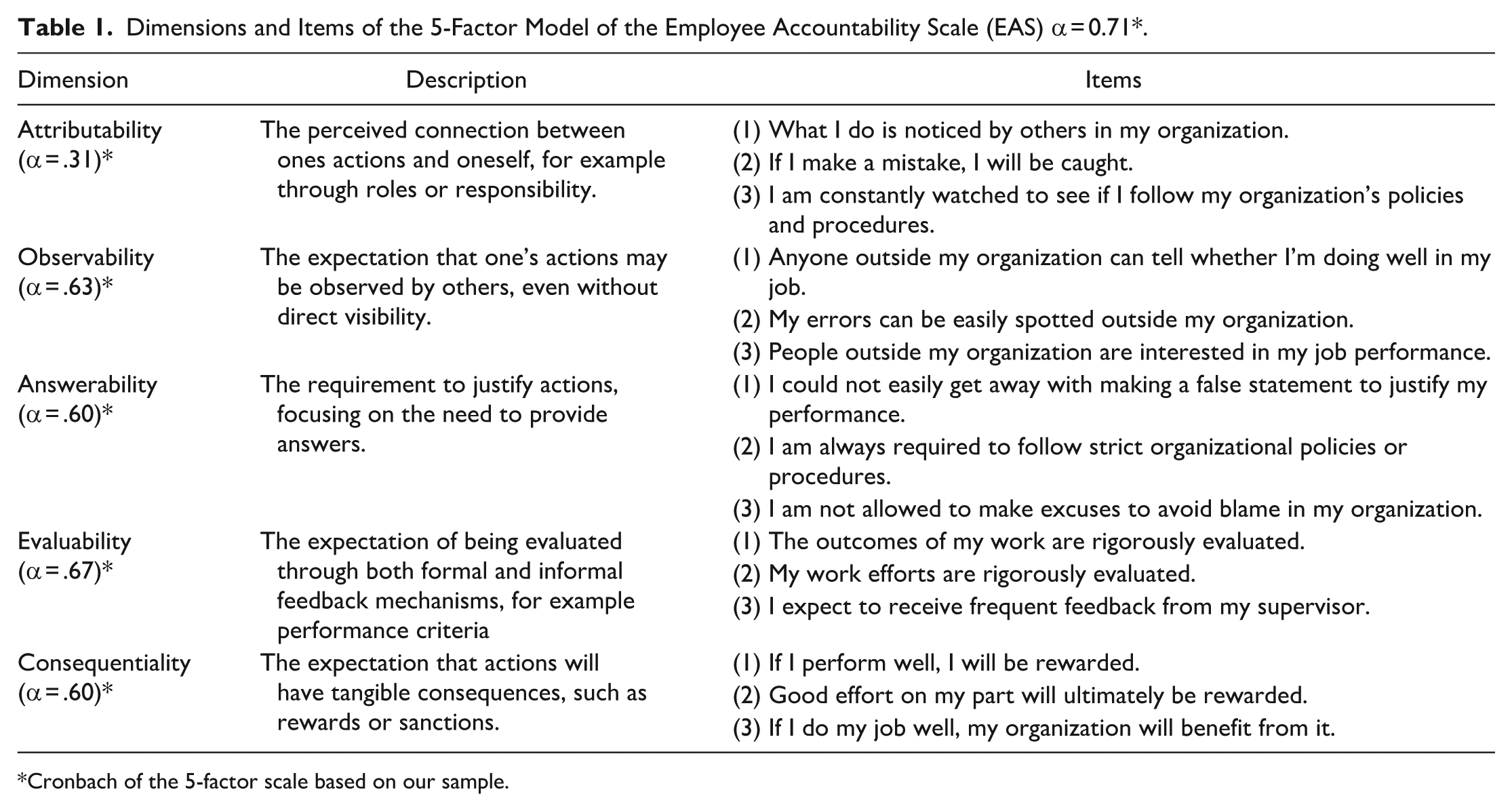
Cronbach of the 5-factor scale based on our sample.
Emotional Exhaustion
Emotional exhaustion is the core dimension of burn-out, and was measured through 5 items based on the Maslach-Burnout Inventory general version, based on a 5-point likert scale (e.g. “I feel mentally exhausted by work”) (Maslach et al., 1996; Schaufeli et al., 2001). The Cronbach of emotional exhaustion was .91, which indicates a high reliability.
Engagement
We measured engagement using the “ultra-short” three-item Utrecht Work Engagement Scale (UWES-3), which is a shorter and validated version of the UWES-9 and UWES-17 questionnaires (Schaufeli et al., 2019). The scale consisted of three items: “At work, I feel bursting with energy” (vigor), “I am enthusiastic about my job” (dedication), and “I am immersed in my work” (absorption). Engagement had a Cronbach of .78, which is between generally accepted values of .7 and .8 (Field et al., 2012)
Psychological Safety
We measured psychological safety through the 5-item measurement scale developed by Edmondson et al. (Edmondson, 1999). Items include “In this unit, it is easy to speak up about what is on your mind” and “People in this unit are usually comfortable talking about problems and disagreements.” The Cronbach of psychological safety .78.
In testing our hypothesis, we controlled for age, gender, profession, sector, and supervisory tasks. All items and variables can be found in Appendix B, including translation.
Analytical Approach
The analysis consists of two parts: (1) Exploratory factor analysis (EFA) to assess the configural equivalence of the factorial structure of the employee accountability scale in a different national and professional context, resulting in a 3-factor model instead of a 5-factor model; (2) OLS regressions in which we use our 3-dimensional model of EA to test our hypotheses. All statistical analyses were conducted with R version 4.2.1.
Exploratory Factor Analysis
Researchers emphasize the importance of establishing cross-national equivalence when applying surveys in different national contexts (Jilke et al., 2015).When a relatively new scale is applied in a different country or context, exploratory factor analysis is preferred over confirmatory factor analysis, especially if the questionnaire shows different patterns in dimensions than expected (Boniol et al., 2022; De Vet et al., 2005; Flora & Flake, 2017). Given that the EA-scale was originally validated in a U.S. context and is now being applied in a Dutch context, and that the Cronbach’s alpha values for some subdimensions are relatively low compared to those reported in the original validation study, we conducted an exploratory factor analysis (EFA) on the 15 EA items to further examine the underlying factor structure. Barlett’s test (p < .005) and the Kaiser-Meyer-Olkin (KMO) test (0.78) verified the sampling adequacy and indicated that correlations are sufficiently large to conduct exploratory factor analysis (Field et al., 2012).
The inflection of the scree plot suggests 3 factors (Appendix C). Table 2 shows the factor loadings after orthogonal rotation (varimax). Single items were considered to load on a factor if the factor loading was equal to or higher than 0.4. Items with factor loadings lower than 0.4 were excluded from the model. Item 3 of the Consequentiality dimension, “If I do my job well, my organization will benefit from it,” was therefore dropped. The low factor loading might be due to the reference to the organization rather than to the individual and their direct work environment which was also signaled in the interviews. As a robustness check oblique rotation was also performed, and this resulted in the same dimensions with the same items as with varimax rotation.
Exploratory Factor Analysis of Employee Accountability (N = 3,691).
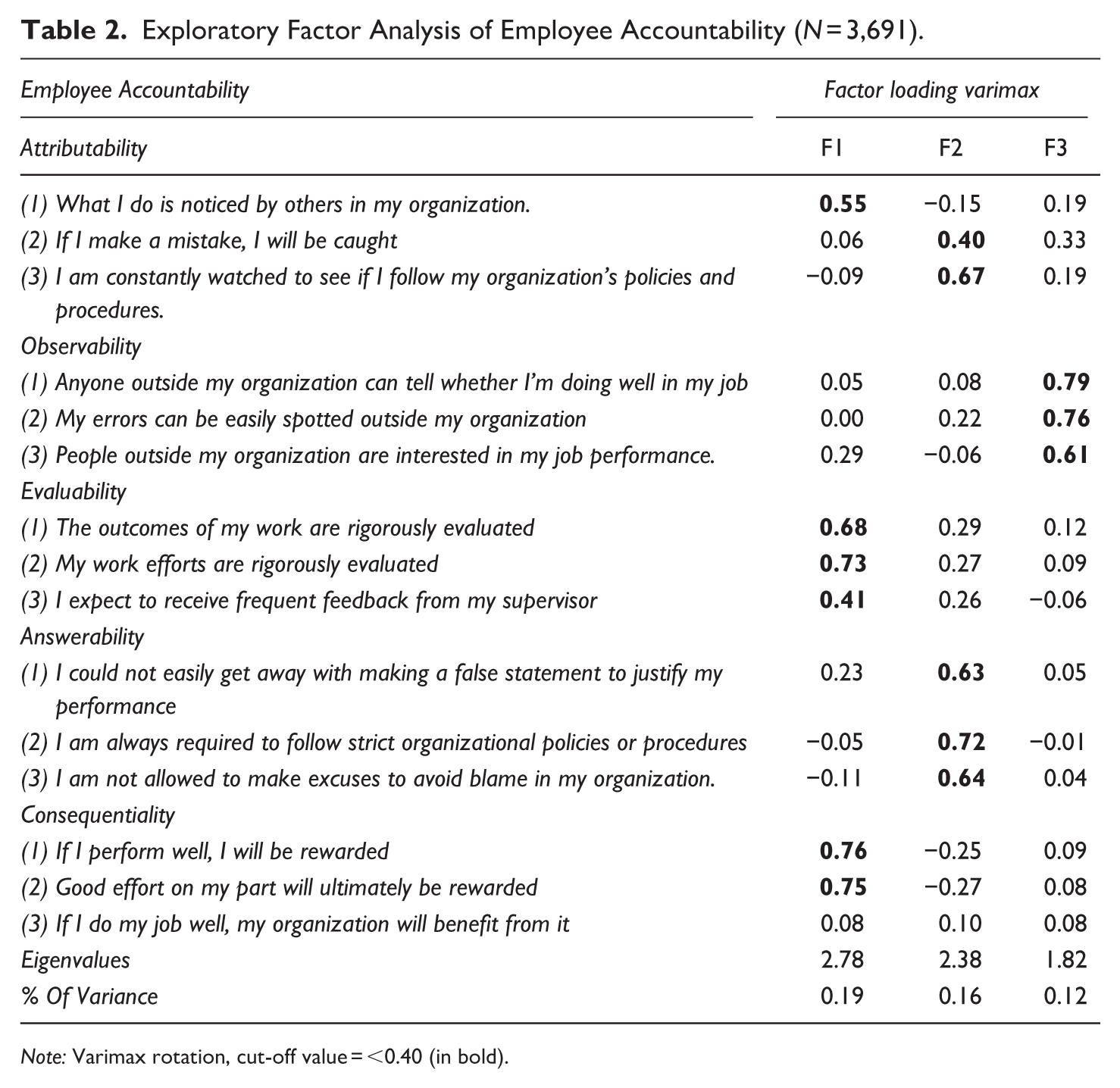
Note: Varimax rotation, cut-off value = <0.40 (in bold).
Table 3 summarizes the interpretation of the 3-factor solution based on 14 items which is used in the statistical analysis. The three factors F1, F2, F3 correspond largely with the dimensions of Evaluability, Answerability, and Observability of the five-dimensional model in the original validation study (Han & Perry, 2020b). F1 and F2 correspond to the original 3-item dimensions of Evaluability and Answerability respectively. In our 3-factor model however, these dimensions are extended with other items from other dimensions. We will still refer to them as Evaluability (F1) and Answerability (F2), and will explain how other items fit into the factors in light of the Dutch context.
3-Factor Model of Employee Accountability (α = .71).
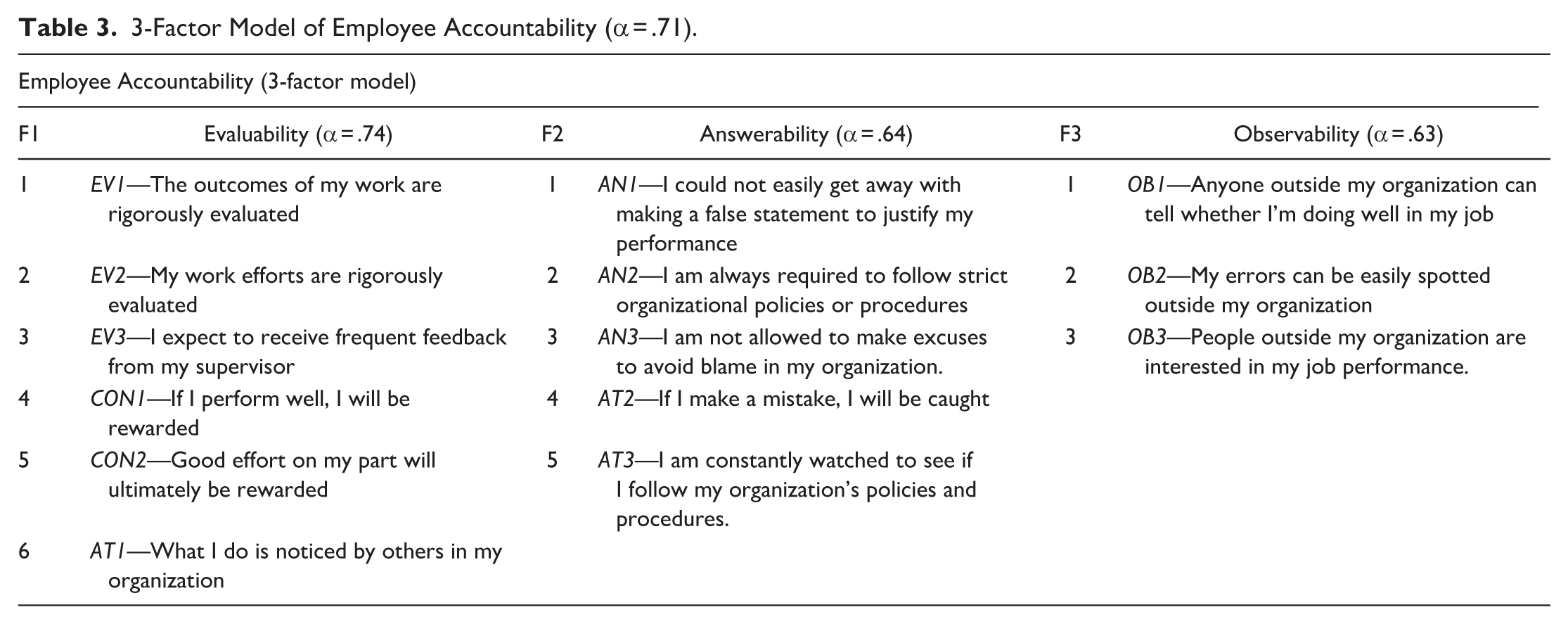
As for the first factor (F1), “Evaluability,” our exploratory factor analysis shows that the three items of evaluability all indeed load on the same factor (factor loadings of 0.68, 0.73 and 0.41). Additionally, three other items load on F1: “If I perform well, I will be rewarded” (factor loading 0.75), “Good effort on my part will be rewarded” (factor loading 0.75), and “What I do is noticed by others in my organization.” (factor loading 0.55). The first two items originally belong to the theoretical dimension of consequentiality, where consequences are captured as “rewards.” (Han & Perry, 2020a). Although consequentiality is a theoretically distinct dimension from evaluability, the overlap can be explained by the fact that evaluation and consequences may be inherently linked in practice in the Dutch context. For example, a consequence always follows evaluation, and they do thus not occur separately. Among frontline healthcare professionals in the Netherlands, evaluation from colleagues, supervisors, patients, and others is a routine part of daily work. When it comes to rewards, professionals are always evaluated in some manner before receiving any. Even if an evaluation is not formally tied to, for example, a salary increase, rewards can still occur, as they may see recognition or appreciation from colleagues for professional expertise as rewarding.
The item “what I do is noticed by others” originally pertains to attributability. However, it may also refer to evaluability because of the term “noticed” in the wording of the item. In both English and Dutch, “noticed” refers not only to seeing something or to being aware of oneself or one's action but also to a notion of appreciation for the actions professionals perform, which can be considered as a form of Evaluability. This extended dimension of Evaluability, therefore, has a total of 6 items and a Cronbach of .74, which is considered acceptable. The eigenvalue was 2.78, and factor loadings varied between 0.41 and 0.76, explaining 19% of the total variance in EA.
Our second factor (F2), “answerability” also encompasses all three items of the version of Answerability in the 5-factor scale of the original validation study, with factor loadings of 0.63, 0.72, and 0.64. In addition, two items of Attributability load on this factor. These items are: “If I make a mistake, I will be caught” (factor loading 0.40) and “I am constantly watched to see if I follow my organization’s rules and procedures” (factor loading 0.67). One could argue, again, that Attributability and Answerability are inherently linked in practice in (Dutch) healthcare. Professionals are intensively monitored regarding mistakes and compliance to rules and procedures. Some of the rules and regulations are adopted from external organizations, such as professional bodies that develop professional guidelines for treatments or quality institutes that develop rules and procedures for safety and quality of care. As the actions of professionals are almost always attributable to individual professionals through the digital registration system, not following rules or making mistakes does not only make professionals attributable but answerable as well. In fact, some mistakes involve obligatory reporting to external organizations or are automatically followed up by evaluation committees in which professionals or their organizations are held answerable. This extended version of answerability consisted of a total of 5 items (Cronbach .64). This resulted in an eigenvalue of 1.82, explaining 12% of the variance.
The Observability (F3) dimension shows the same patterns in our healthcare context in the Netherlands as in the USA-context of the validation study. The overall Cronbach’s Alpha is .63.
We calculated the mean scores for each of the three dimensions as well as a mean score based on all 14 items as a measure of EA (Table 3).
OLS Regression
We used multiple linear regression models with ordinary least squares (OLS) to test our hypotheses. For all composite scales, the average score of the items were used as input for the regression. Independent and moderating variables were grand mean-centered in all models to improve the interpretability of the beta coefficient (Dawson, 2014). We checked for normality of residuals, independence (Durbin-Watson >1 <3, histograms, outliers), multicollinearity (VIF, correlations). No assumptions were violated.
Descriptive Statistics
The descriptive statistics and correlations between our key variables are presented in Table 4. The overall EA scale (all three dimensions taken together) is positively correlated with engagement (0.10, p < .001), and shows no significant correlation with emotional exhaustion (0.00). The separate factors however, show different and contradictory patterns. Evaluability correlates positively to engagement (0.26) and negatively to emotional exhaustion (−0.23), whereas answerability correlates negatively to engagement (−0.16) and positively to emotional exhaustion (0.25). Observability was positively correlated to both outcomes (0.05 and 0.03).
Means, Standard Deviations, Reliability and Correlations Between Central Variables (N = 3,691).
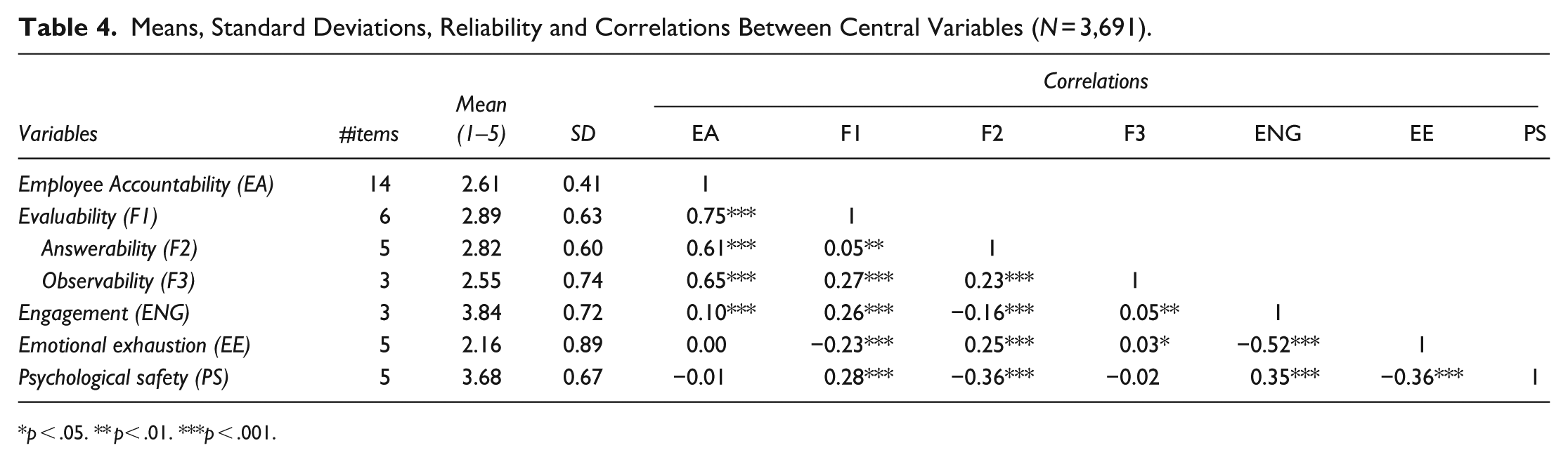
p < .05. ** p< .01. ***p < .001.
Results
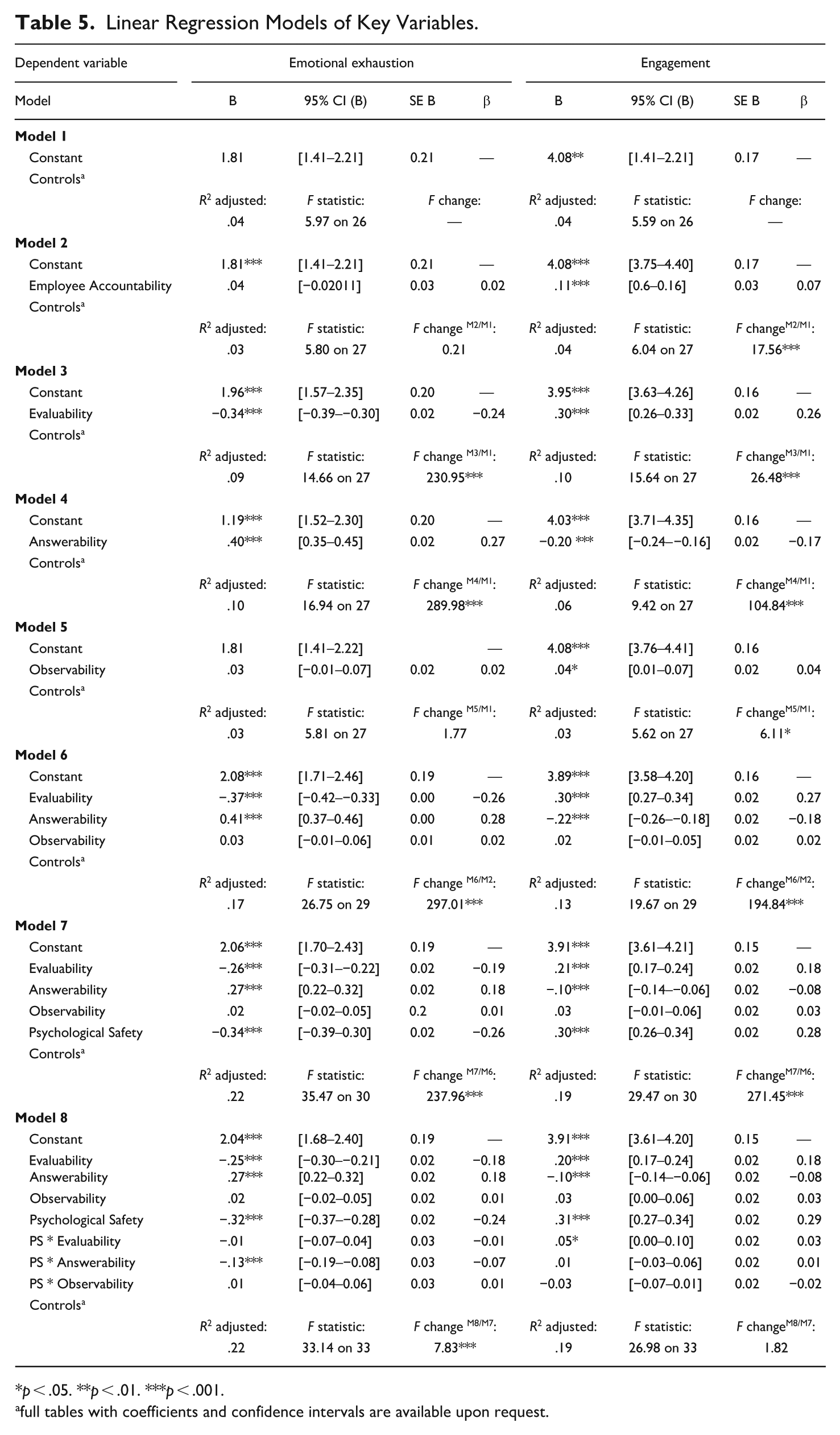
Table 5 shows the results of the OLS regression analyses based on the (centered) average item scores of EA and each subdimension with emotional exhaustion and engagement. Model 2 shows that the overall EA-scale has no significant association with exhaustion (β = .02), and a small but significant association with engagement (β = .07), Models 3 to 5 show that different dimensions of EA have opposite, albeit small, effects on emotional exhaustion and engagement. An increase in Evaluability is significantly associated with a decrease in emotional exhaustion (β =−.24) and an increase in engagement (β = .26). Answerability, on the contrary, is significantly associated with an increase in emotional exhaustion (β = .27) and a decrease in engagement (β = −.17). An increase in Observability is significantly associated with an increase in both emotional exhaustion and engagement (β = .02 and β = .04, respectively). When including the three dimensions together (model 6), similar patterns are found; the association between Observability and emotional exhaustion, however, is no longer statistically significant. Adding all the dimensions together significantly improved the models. Evaluability, Answerability, and Observability, together with all control variables explained 17% of the variance of emotional exhaustion and 13% of engagement. We argued that EA might be demanding in terms of engagement and exhaustion of professionals and expected that an increase in EA would be associated with an increase in emotional exhaustion (Hypothesis 1). This hypothesis, however, can only be accepted for Answerability but must rejected for Evaluability and Observability. We also argued that EA might also have some challenging aspects, and therefore also expected that an increase in EA could also be associated with an increase in engagement (Hypothesis 2). This hypothesis, however, can only be accepted for Evaluability but must rejected for Answerability and Observability.
Linear Regression Models of Key Variables.
p < .05. **p < .01. ***p < .001.
full tables with coefficients and confidence intervals are available upon request.
Psychological safety is included in Model 7 for both dependent variables. An increase in psychological safety is associated with a decrease in emotional exhaustion (β = −.26) and an increase in engagement (β = .28). The interactions between each dimension of EA and psychological safety are included in Model 8 for both dependent variables. As for emotional exhaustion, only the interaction term of Answerability and psychological safety is significant, and marginal effects are plotted in Figure 2. This means that in more psychologically safe environments, an increase in Answerability is associated with lower levels of exhaustion. Figure 2 shows that this is especially the case among higher levels of answerability. Hypotheses 3 can thus be accepted for Answerability and rejected for Evaluability and Observability. When speaking of engagement of professionals, only the interaction term between Evaluability and Psychological safety is significant. Marginal effects are plotted in Figure 3. This indicates that in a psychologically safe work environment, an increase in Evaluability is associated with higher levels of engagement. Figure 3 shows that this is especially the case among higher levels of evaluability. Hypotheses 4 can thus be accepted for Evaluability and rejected for Answerability and Observability.
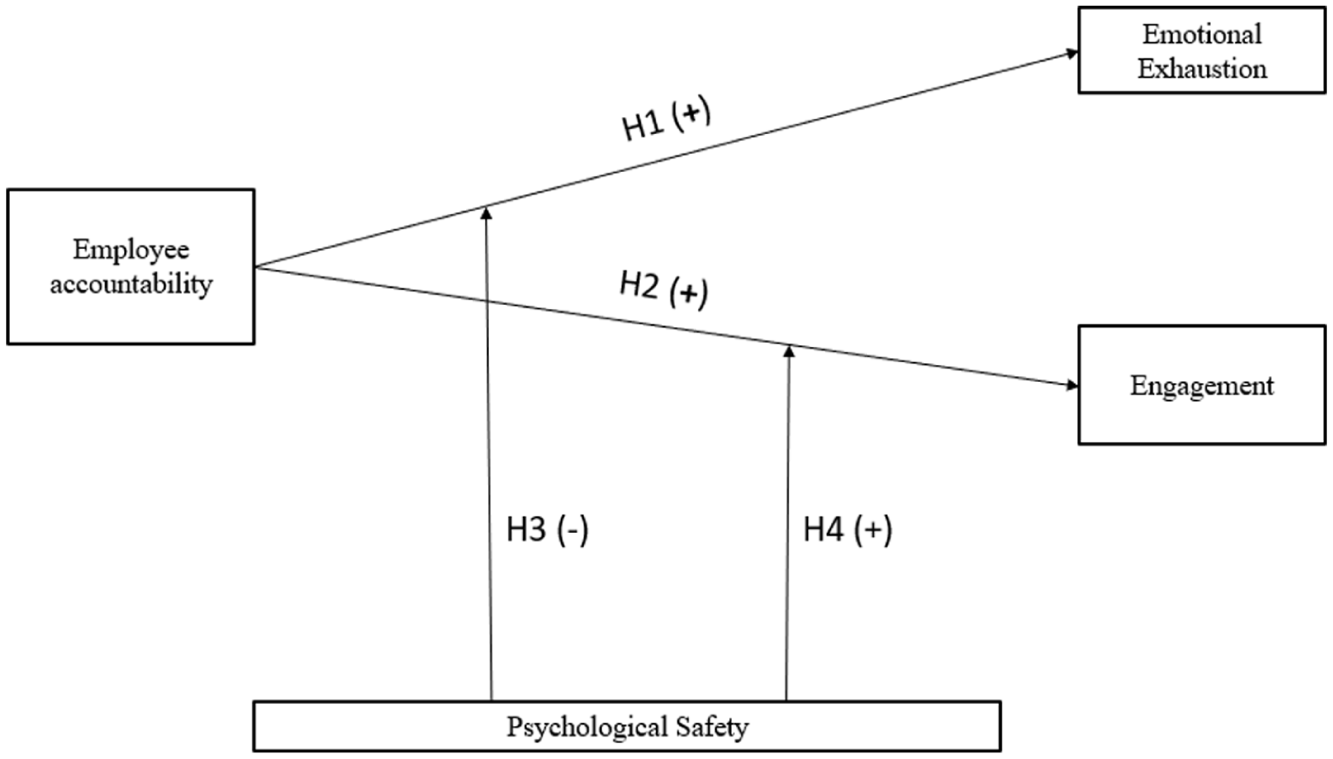
Hypotheses.
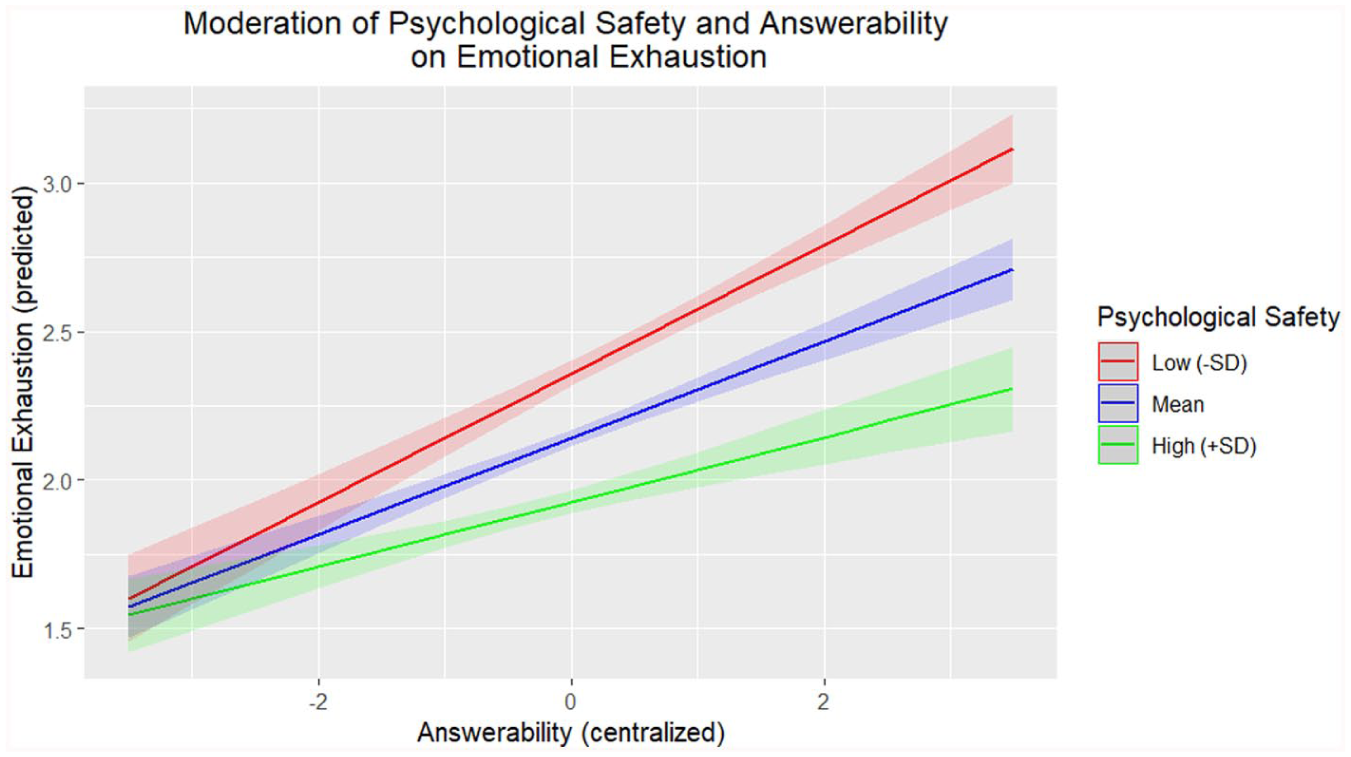
Marginal effect of answerability on emotional exhaustion moderated by psychological safety.
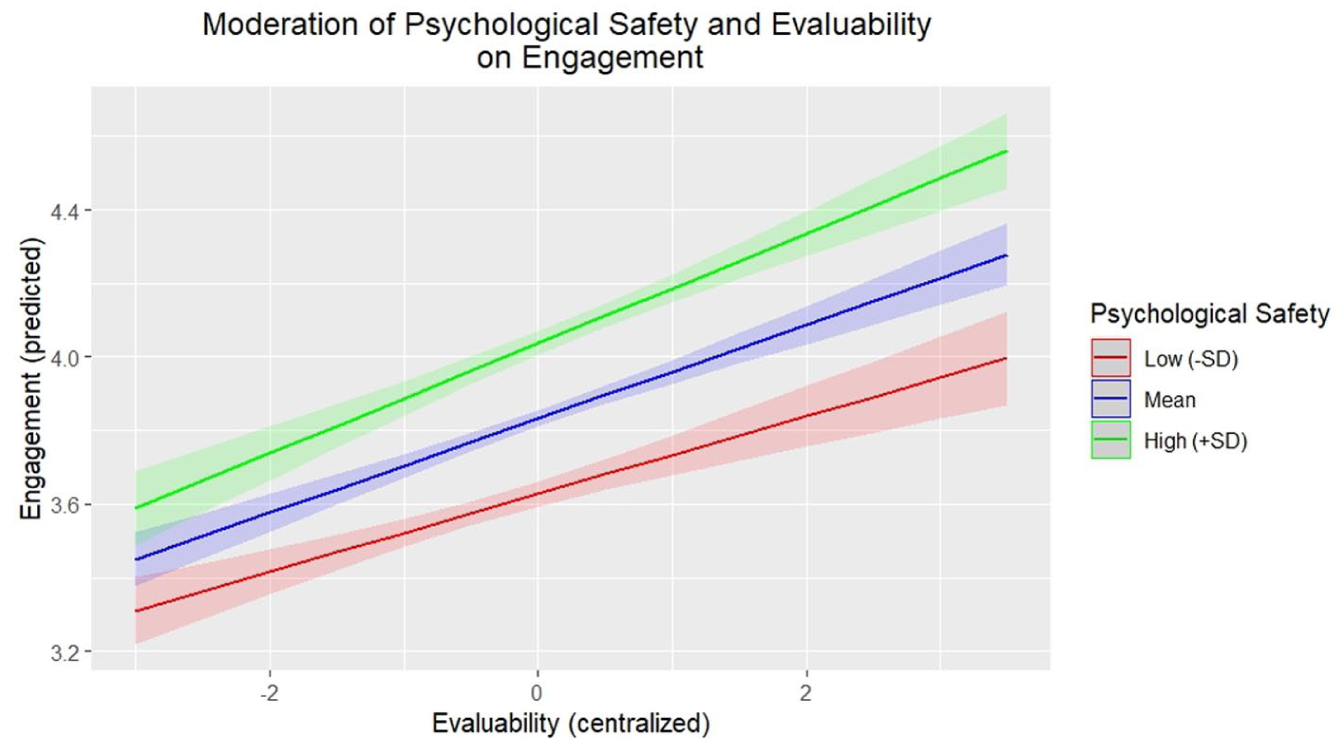
Marginal effect of evaluability on engagement moderated by psychological safety.
Discussion and Conclusion
This paper empirically examined how employee accountability (EA) affects the engagement and emotional exhaustion of frontline professionals in the Netherlands. We hypothesized that EA could be seen as a challenging job-demand, that could have positive as well as negative effects on engagement and emotional exhaustion of professionals, depending on the work environment. More specifically, we hypothesized that psychological safety would mitigate a positive association between EA and exhaustion and foster a positive association between EA and engagement. Our hypotheses were partially confirmed. The results suggest that different dimensions of EA are indeed associated with both emotional exhaustion and engagement, but sometimes in divergent ways. Whereas Evaluability is associated with increased engagement and decreased emotional exhaustion, Answerability is associated with less engagement and more emotional exhaustion. All associations were statistically significant, yet the effect sizes were small. Our study underlines that scrutinizing different dimensions of EA reveals divergent patterns with regard to the association of EA with both positive and negative work outcomes, which offers an explanation for apparently mixed findings in earlier research (Hall, 2005; Hall et al., 2006).
An explanation for the contradictory effects of Answerability and Evaluability dimensions of EA, could be found in how these dimensions were measured. The items of Answerability, for example, almost exclusively refer to what Bovens & Schillemans (2014) calls “default accountability”, or accountability operationalized as compliance through rules and procedures (Bovens & Schillemans, 2014). In a professional context, such forms of accountability might be experienced as red tape, especially when it is unclear to professionals what purpose certain rules and procedures carry. Research has shown that red tape is negatively associated with well-being (Fleischer & Wanckel, 2024; Fuenzalida et al., 2024) and it may thus be that accountability through rules and procedures is negatively associated with engagement because accountability creates red tape, which is often burdensome to professionals. The dimension of Evaluability, on the other hand, includes many items relating to elements such as (peer) feedback, getting noticed, and getting recognition for one’s actions. Such elements might be closely related to the learning orientation of professionals, thus signaling how accountability can contribute to learning and, subsequently, performance. This might explain why Evaluability is positively associated with engagement and negatively associated with emotional exhaustion. An important takeaway from this study is, therefore, that the exhaustion or engagement of frontline professionals at work does not depend on whether accountability is present or not but on how they are being held accountable.
The dimension of Observability was not significantly associated with emotional exhaustion nor engagement. This is surprising, as Observability is defined as inherent to the public sphere. Our study was conducted in a (semi)public context where frontline professionals are, by definition, always observed by the patients, clients, or citizens they serve. Again, a possible explanation could be found in how this dimension’s items were measured. The use of the term “anyone outside my organization”, for example, might be too broad to capture observability in a (semi) pubic healthcare context; in healthcare, patients, and clients are often inside the organization (such as in hospitals or elderly care homes).
Lastly, we also hypothesized that the degree to which EA is associated with engagement and emotional exhaustion, depended on whether one works in a psychologically safe context. These hypotheses are only partially true; psychological safety moderates the relationship between Answerability and emotional exhaustion and between Evaluability and engagement. Hypothesis 3 is, therefore, only accepted for Answerability, and hypothesis 4 is only accepted for Evaluability. In both cases, however, the general line is still that, when being held accountable, psychological safety might contribute to less emotional exhaustion and more engagement. In more psychologically safe environments, being held answerable might be less emotionally exhausting for employees, whereas being evaluated might be even more engaging. This is in line with earlier research that suggests that the performance of professionals might improve if professionals accountability is high and when professionals are in a psychologically safe environment (Wallace et al., 2011). However, moderation effects were very small and the average of psychological safety in our sample was relatively high. Further research should explore this moderating role of psychological safety for separate dimensions of EA, especially comparing professionals with low levels of psychological safety to high levels of psychological safety, and what this means for employee outcomes.
Our study makes several contributions to the literature and has implications for future research. Firstly, our study shows that EA is a relevant aspect of professionals’ daily work in terms of engagement and emotional exhaustion. We observe that emotional exhaustion and engagement are often two sides of the same coin, as negative association between EA dimensions and engagement imply positive associations between EA and emotional exhaustion, and vice versa. However, much more important, we find that distinguishing between different dimensions of EA is the first relevant step in understanding the complex ways through which accountability engages or exhausts frontline professionals at work. Rather than testing whether EA is negatively related to all kinds of individual and organizational outcomes, this study underlines the need to focus on the different dimensions of EA and their diverse effects on engagement and emotional exhaustion. We also show that psychological safety is associated with higher engagement and less emotional exhaustion and plays a moderating role in the relationship between EA and both emotional exhaustion and engagement. We, therefore, show that psychological safety is an important resource at work for frontline professionals, not only because it engages professionals but also because it might compensate for demanding aspects of work. Future research should explore other contextual moderating factors under which EA can impact both positive and negative employee outcomes. Contextual factors such as job autonomy (Hall et al., 2006; Han & Hong, 2019) and political context (Hochwarter et al., 2007) are possibly relevant factors to be considered, as they might enable us to understand in what contexts EA engages professionals and under what contexts it results in emotional exhaustion.
The second contribution of this study is that we tested the configural equivalence of the factorial structure of the EA scale in different national and professional contexts compared to the one in which it was validated. Our exploratory factor analysis shows that the construct validity – the extent to which the measured items represent the theoretical latent constructs the items are designed to measure - differs from the context of the validation study and three out of five dimensions are (partly) distinguishable in our context. Our finding that Attributability is not distinguishable from Evaluability and Answerability, however, is not surprising, as explanatory factor analysis in the validation study also showed relatively high correlations between the dimensions of Answerability and Attributability on the one hand (0.63), and Evaluability and Attributability on the other hand (0.70) (Han & Perry, 2020b). Nevertheless, the reliability of the newly formed dimensions is relatively low (Cronbach between .63 and .74). It is, therefore, crucial that future research improves the validity and reliability of measuring EA in different cultural and professional contexts. Our first suggestion is that future research should not only distinguish the theoretical dimensions of Answerability, Observability, Attributability, Evaluability, and Consequentiality but also distinguish to whom professionals give account and how they are asked to do so in practice. As for to whom, earlier research already emphasizes that the perception of the legitimacy and expertise of to whom professionals give account matters when making choices (Overman et al., 2021; Overman & Schillemans, 2022). For each dimension, items could be repeated for several fora (e.g. “The outcomes of my work are rigorously evaluated by colleagues” versus “The outcomes of my work are rigorously evaluated by citizens”). Of course, this is closely related to the context of the applied scale, and we argue that this should be taken into account. Furthermore, we suggest that future research on EA broadens its understanding of EA and moves away from its heavy emphasis on the New Public Management framework. In this approach, research often focuses on procedures, managerial control, and adherence to rules. Our study indeed suggests that Evaluability has different effects in comparison to a more NPM-oriented dimension, answerability. Future research should continue to explore different forms of accountability, other than NPM-oriented dimensions, and how it impacts employee well-being. Given that accountability is often based on not one governance paradigm (such as NPM) but on a mix of governance paradigms, it remains important to study EA also through attention of sub-dimensions, as these can tell us more about the impacts of particular governance paradigms over others.
Limitations and Future Research
There are several limitations to this study that require some caution regarding the results. First, the cross-sectional design of this study does not allow for claims about causality. While the theoretical argument assumed a causal relationship between EA and emotional exhaustion and engagement, studies using a longitudinal design or experimental design are needed to determine to what extent the associations found in this study are also causal relationships. Reverse causality should also be considered with engagement and emotional exhaustion impacting employees’ perception of accountability demands. Furthermore, we acknowledge the possible presence of common source bias in our data, which may have influenced the observed associations. Some measures were taken to minimize the risk of common source bias, for example, by randomizing the order of the questions for the independent and dependent variables in the survey, and making sure they were not presented consecutively However, future research should explicitly address this limitation, ideally through the collection of independent data sources, as statistical remedies are generally regarded as limited or insufficient in addressing CMB (Favero & Bullock, 2015; Podsakoff et al., 2003). Additionally, while the sample is largely representative of the Dutch healthcare workforce regarding sector, our sample is slightly older and includes slightly more females compared to the entire workforce.
Second, our conclusions about the relationship between EA and engagement and exhaustion should be interpreted cautiously, as the reliability of the EA scale leaves room for improvement which might have impacted the associations found in this study. While, as argued, this study contributes establishing cross-national equivalence of a validated measurement scale by applying it in a different national and professional context, more (comparative) research in other national and professional contexts is warranted to improve the measurement of employee accountability and identify its invariant components. Additionally, we need different types of designs, both qualitative and quantitative, to study why certain dimensions of EA have a positive or negative effect, rather than only focusing on the effect of the uniform EA scale.
Implications for Policy and Practice
Policymakers and healthcare organizations in the Netherlands and other countries have increasingly expressed concern about the unintended effects of accountability practices on professionals—such as red tape, registration requirements that poorly align with clinical practice, and the expanding role of external oversight—especially in the context of growing shortages of healthcare professionals. In response, national, regional and organizational (HR-)initiatives have risen to reduce this burden, for example by streamlining documentation or improving digital infrastructure to ease the workload for professionals. In light of these efforts, this study underlines that accountability is not simply a matter of more or less, but rather about understanding which forms of accountability can genuinely support professionals. To mitigate the exhausting bureaucratic aspects of accountability, fostering psychological safety within organizations may help reduce its negative impact. In addition, this study highlights that different forms of accountability—such as evaluative practices—might even enhance professional engagement. These findings encourage policymakers, organizations, and regulators to explore diverse approaches to giving meaningful substance to accountability.
Appendices
Sample Characteristics.
Measurements.
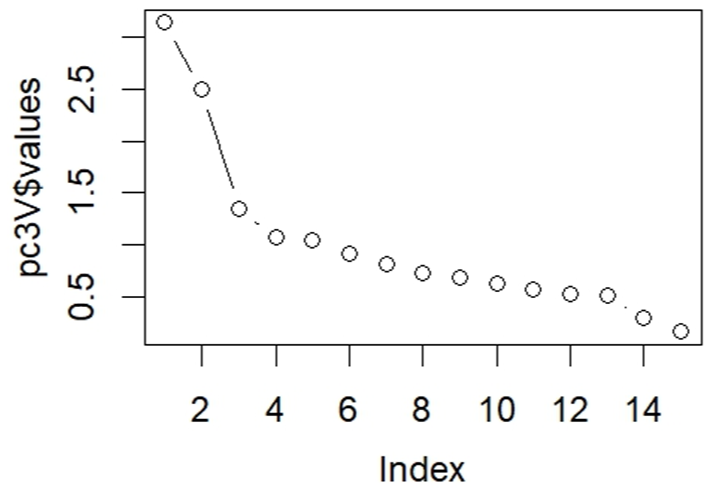
Scree plot of Exploratory Factor Analysis of Employee Accountability.
Supplemental Material
sj-docx-1-rop-10.1177_0734371X251390513 – Supplemental material for Accountability at Work: Effects of Employee Accountability on Emotional Exhaustion and Engagement among Healthcare Professionals in the Netherlands
Supplemental material, sj-docx-1-rop-10.1177_0734371X251390513 for Accountability at Work: Effects of Employee Accountability on Emotional Exhaustion and Engagement among Healthcare Professionals in the Netherlands by Lynn Colder, Eduard Schmidt, Sandra Groeneveld and Jet Bussemaker in Review of Public Personnel Administration
Footnotes
Declaration of Conflicting Interests
The authors declared no potential conflicts of interest with respect to the research, authorship, and/or publication of this article.
Funding
The authors disclosed receipt of the following financial support for the research, authorship, and/or publication of this article: this article is part of the research project “Accountability & Leadership in Healthcare”, funded by IZZ and PGGM. IZZ is a foundation that collaborates with health insurers, employees and employers working in healthcare and aims to improve the working life and health of healthcare professionals in the Netherlands through research, interventions in healthcare organizations and health insurance with additional benefits for professionals. PGGM (Pension fund for Healthcare, Mental and Societal interests), is an pension provider for healthcare professionals, and offers knowledge and interventions aimed at the well-being of healthcare professionals that have their pension at PGGM. Except for the cooperation with IZZ and PGGM in collecting the data, the funders had no role in the research.
Data Availability Statement
Data is available upon reasonable request.
Ethical Approval
Ethical approval was granted by the Ethics committee of the Faculty of Governance and Global Affairs, Leiden University.
Consent to Participate
All respondents in this study signed a (digital) informed consent form.

Author Biographies
References
Supplementary Material
Please find the following supplemental material available below.
For Open Access articles published under a Creative Commons License, all supplemental material carries the same license as the article it is associated with.
For non-Open Access articles published, all supplemental material carries a non-exclusive license, and permission requests for re-use of supplemental material or any part of supplemental material shall be sent directly to the copyright owner as specified in the copyright notice associated with the article.
