



Abstract
This study increases our understanding on how to improve the well-being of street-level bureaucrats. We test the effect of social belonging interventions on street-level bureaucrats’ well-being in times of crisis. We argue stimulating social belonging is especially relevant during crises, because it mitigates identity threats caused by high levels of uncertainty and adversities. We conducted a pre-registered survey experiment during the Covid-19 pandemic among Belgian inspectors (n = 423). We find social belonging interventions have a small, positive effect (d = 0.26) on street-level bureaucrats’ work engagement but have no effect on street-level bureaucrats’ burnout. We outline directions for future research by discussing explanations for our (in)significant findings.
Introduction
In times of crisis, the duties, roles, and responsibilities of many street-level bureaucrats, such as nurses, teachers, and inspectors, are expanded. For instance, during the recent Covid-19 crisis, healthcare professionals had to take on new and additional tasks because colleges were quarantined (Cox et al., 2021) and teachers had to switch to online contact with students, often learning as they went (Malandrino & Sager, 2021). Consequently, since the outbreak of Covid-19, many street-level bureaucrats experience increased levels of stress and reduced well-being (Fisher et al., 2020; Stogner et al., 2020; Van Roekel et al., 2021). This raises the questions on how to improve this well-being; there is general agreement that the concept of social belonging—which can be defined as a subjective feeling that one is an integral part of one’s surroundings (Hagerty et al. 1992)—is an important predictor of well-being (e.g., Allen et al., 2021; Mobasseri et al., 2021; Walton & Cohen, 2011; Yeager & Walton, 2011).
Linos et al. (2021) recently demonstrated increasing perceived social support and affirming belonging among street-level bureaucrats decreases burnout. Social belonging scholars, mainly in the field of educational science, study what it means and what it implies if people feel they are an integral part of their surroundings (Allen et al., 2021). For example, studies have shown that social belonging can reduce feelings of uncertainty experienced by incoming minority students (see Yeager & Walton 2011 for a review). The theoretical explanation of this findings is that social belonging presents a buffer against identity threats when facing obstacles, such as adversity, uncertainty, and exclusion. If individuals feel they are part of their surroundings, then they are more likely to put their concerns into perspective and to seek support from others, which prevents them from experiencing an identity threat (Kizilec et al., 2017; Walton & Cohen, 2011; Walton et al., 2015).
We are not arguing street-level bureaucrats and minority students entering school or college are the same. However, just like minority students, street-level bureaucrats can experience identity threats and related feelings of uncertainty (see Linos et al., 2021). These experiences are especially prominent during a crisis (Allgood et al., 2022). First, crisis situations are unique because organizations and their employees experience urgent and highly uncertain threats to their core values (t’Hart & Tummers, 2019). Second, in times of crisis, street-level bureaucrats are likely to lack expertise and skills to perform their new roles (Fisher et al., 2020; Malandrino & Sager, 2021). Professional expertise is, however, essential for street-level bureaucrats’ expert role (Hupe, 2019) to provide advice to their clients. Finally, street-level bureaucrats experience more public unrest and increased resistance during crises because their extended roles require them to enforce severe restrictions in people’s lives that are “unprecedented in peacetime” (Stott et al., 2020, p. 575). Put differently, in times of crises, street-level bureaucrats are likely to feel insecure because their professional identity is threatened.
From research on social belonging, we know concerns and feelings of uncertainty can be mitigated by increasing a sense of social belonging (Walton & Cohen, 2011). Social belonging helps individuals to put their concerns into perspective and equips them to successfully seek support when facing difficulties (Kizilec et al., 2017; Walton et al., 2015). Based on this line of reasoning, we answer the following research question: Do social belonging interventions have a positive effect on street-level bureaucrats’ well-being in times of crisis? To answer this question, we conducted a preregistered survey experiment with two interventions stimulating a sense of social belonging among inspectors (n = 423) employed by the inspection department of five Belgian federal government agencies. These inspectors are relevant because their tasks were expanded substantially across various countries in our most recent global crisis: the Covid-19 pandemic (De Wispelaere & Gillis, 2021; Williams, 2020). Overnight inspectors were tasked to also enforce social-distancing and other preventative Corona measures in addition to their core tasks. These abrupt and substantial changes disrupted informal routines (Brodkin, 2021, p. 19) and created a sense of urgency to help tackling the consequences of the Covid-19 crisis. Inspectors had to perform duties overnight that were far beyond their comfort zone, experience, and long-built expertise.
We contribute to the literature in three ways. First, to the best of our knowledge, only three recent studies analyze social belonging in a workplace setting (Allgood et al., 2022; Linos et al., 2021; Mobasseri et al., 2021). We contribute to this scarce literature on social belonging in the workplace studying study Belgian inspectors, thereby contributing to the generalizability of the scarce empirical findings, as to date, research on social belonging has solely been conducted in the United States. Second, this recent work does not always clearly conceptually distinguish social belonging from social support, which is part of the widely used JD-R model (Bakker & Demerouti, 2017). To illustrate, Linos et al. (2021) use the term social support to study social belonging. Allgood et al. (2022) explicitly refer to social belonging and—in line with Linos et al. (2019)—argue it is a job resource. Job resources, however, refer to “aspects of the work context” that help employees deal with job demands, including autonomy and task significance (Bakker, 2015, p. 724) rather than “subjective feelings” that characterize social belonging (Allen et al., 2021). By drawing explicitly on social belonging literature (e.g., Baumeister & Leary, 1995; Mobasseri et al., 2021), rather than using concepts interchangeably, we help to create conceptual clarity in the literature. Third, we test the effect of social belonging interventions in a unique context, namely that of a “creeping crisis” (see also Allgood et al., 2022). Such crises increase the dependency of society upon street-level bureaucrats (Boin et al., 2020; Gofen & Lotta, 2021), which makes it particularly important that inspectors feel and function well.
Our study makes important methodological contributions. First, we expand Linos’ et al. (2021) study by, in line with the social belonging literature, testing the impact of two (instead of one) distinct social belonging interventions on well-being (Yeager & Walton, 2011). Second, in line with Allgood’s et al. (2022) study we study social belonging in times of crisis. However, Allgood’s et al. (2022) study uses a cross-sectional survey to measure social belonging. Using 2 items, which are unfortunately poorly correlated (α of .34), they measure social belonging. This cross-sectional set-up, however, does not allow them to make causal claims. We do use experimental methods (see also Linos et al., 2021). In that way, we are able to make causal claims about the effect of social belonging interventions on the well-being of individuals in times of crisis.
This article proceeds as follows. First, we discuss the concepts of employee well-being, and social belonging in times of crisis. Second, we elaborate on two psychological mechanisms underlying the effectiveness of social belonging interventions in general and applied to the context of street-level bureaucrats in particular. After that, we develop our hypotheses about the relationship between social belonging interventions and employee well-being. Following a description of the methodology applied in the study, we test our three hypotheses. We conclude with a reflection of the main contributions of this study, its limitations, and implications for future research.
Theoretical Framework
Employee well-being has gained increasing attention among public organizations (Borst et al., 2020). This is the result of a changing and challenging work environment that potentially affects public employees’ well-being (Liu et al., 2015; L. Tummers & Brunetto, 2016; Van Roekel et al., 2021). Employee well-being can broadly be described as the overall quality of an employee’s experience and functioning at work (Warr, 1990). Work engagement and burnout are often seen as two dimensions of employee well-being (Bakker & Demerouti, 2017; Schaufeli & Salanova, 2014). 1 Another way of thinking about this can be captured by Borst and Knies (2023, p. 1), who maintain “work-related well-being can have both a pleasant energizing side, often framed as work engagement, and an unpleasant energy-sapping side known as burnout.” Work engagement is therefore defined as a positive, fulfilling, work-related state of mind that is characterized by vigor, dedication, and absorption (Schaufeli et al., 2006). Burnout is defined as “a syndrome of chronic exhaustion, a cynical, negative attitude regarding work, and reduced professional efficacy that could occur in any job” (Bakker & Demerouti, 2017, p. 273). Burnout consists of a physical and emotional exhaustion component (Bakker et al., 2014). It refers to a mental state where employees experience chronic feelings of exhaustion and a cynical attitude toward work and the people with whom they work. Employee well-being is, thus, a multidimensional concept including both psychological as well as physical aspects.
Social Belonging in Times of Crisis
Recent evidence suggests that social belonging helps to reduce burnout among local government employees (Allgood et al., 2022) and 911 dispatchers in the United States (Linos et al., 2021). Street-level bureaucracy studies have also shown that social connections and relations with colleagues play an important role in frontline behavior (Lotta & Marques, 2020; Raaphorst & Loyens, 2020). Social belonging can be defined as “as a subjective feeling that one is an integral part of their surrounding systems, including family, friends, school, work environments, communities, cultural groups, and physical places” (Allen et al., 2021, p. 88). It refers to the subjective feeling of connectiveness in a social group. Scholars agree that the feeling of belonging is a basic human need that almost all people seek to satisfy (Baumeister & Leary, 1995; Deci & Ryan 2000). Some scholars have referred to social belonging as a trait (i.e., belonging as a core psychological need), others as a state (i.e., situation-specific senses of belonging) (Allen et al., 2021). Cultivating a sense of belonging is especially important in times of crisis. For instance, the Covid-19 pandemic has greatly affected the ability to develop or preserve a sense of belonging by lockdowns and quarantine measures that severely restricted in-person interactions (Okruszek et al., 2020). Slavich et al. (2021) even argue that social belonging, next to compassion and kindness, present key ingredients for resilience, recovery, and growth from the Covid-19 pandemic.
A concept related to and often confused with social belonging is that of social support, which is frequently studied in the field of public management (e.g., Nguyen et al., 2020; Linos et al., 2021). The literature differentiates between received social support (i.e., the number of supportive actions that were recently provided and perceived social support (i.e., the expectation of receiving support) (Wills & Shinar, 2000). Both types of social support are a) often described as a job resource (Bakker & Demerouti, 2017; Jolly et al., 2021) and b) involve either actual or perceptions of receiving assistance. Social belonging, in contrast, involves feeling valued by and connected to a collective of others without necessarily expecting or receiving anything from them. This makes social belonging conceptually distinct from the concept of social support.
Empirical research on social belonging is primarily conducted in the context of education. Scholars focus on interventions that boost social belonging to reduce feelings of uncertainty and identity threat experienced by incoming minority students (see Yeager & Walton, 2011 for a review). A large body of research provides empirical evidence that stimulating social belonging has positive effects for the students involved. Classic examples are the studies of Wilson and Linville (1982, 1985) who developed a brief video that strengthens the social belonging of students. In this video, students are shown that poor academic performance is normal during the transition to a new school, that it is not a sign of poor ability, and that performance typically improves as they adjust to the new school. One year later, students in the treatment group had better GPAs compared to students in the control group. More recently, Walton et al. (2015) tested if a nonthreatening social belonging narrative 2 and an affirmation-training about social belonging could mitigate the effects of a “chilly climate” that female students may experience in the male-dominated world of engineering. They found that both social belonging interventions led women to view daily adversities as more manageable and improved their academic attitude. Other successful interventions involve asking students to write letters to younger students advocating social belonging by explaining how they have dealt with difficulties and giving advice concerning potential challenges (e.g., J. Aronson et al., 2002; Walton & Cohen, 2007). Together, these study provide strong evidence for the effectiveness of social belonging interventions in educational setting. But what are the psychological mechanisms underlying these social belonging interventions?
Two Psychological Mechanisms Preventing Identity Threats
Interventions that stimulate individuals’ sense of social belonging have a strong theoretical foundation that may explain their effectiveness. The underlying theoretical argument of these interventions is that they buffer individuals from experiencing identity threat (Kizilec et al., 2017; Walton et al., 2015), which can be defined as “experiences appraised as indicating potential harm to the value, meanings or enactment of an identity” (Petriglieri, 2011, p. 645). Put differently, when individuals feel like outsiders and are uncertain about whether they belong, they are more likely to view adversity as a threat to who they are—their identity—and subsequently experience reduced wellbeing and perform poorly (Walton & Cohen, 2007, 2011).
First, by encouraging individuals to attribute adversities not to deficits unique to themselves or their social identity but to common and temporarily aspects of adjustment processes—by encouraging them to reappraise difficult situations—individuals are more likely experience social belonging. As a result, they are better equipped to navigate in an environment that may otherwise feel adverse and unwelcoming (Mobasseri et al., 2021; Walton & Cohen, 2011). A concept that is different from, yet interrelated with, social belonging is that of social identification. Social identification refers to identify with a group and incorporating the group’s values into one’s self-concept or identity (Van Vugt & Hart, 2014). If these values are threated, then individuals are likely to experience an identity threat. This means that social belonging goes beyond social identification, which is simply about identifying with others. While social identification can present the starting point for identity threats, the experience of social belonging can help to buffer identity threats. If individuals feel that they belong, then threats to their identity matter less.
Second, self-persuasion or asking individuals to share their experience and to provide peers with advice has been found to increase their confidence en sense of belonging (Eskreis-Winkler et al., 2018). When individuals feel insecure, receiving advice or help can feel stigmatizing, because feelings of competence are highlighted. However, the act of advice giving is likely to restore confidence—or decrease the experienced identity threat—because the implication of being asked to give advice is that the advice giver possesses the ability or skills in question (Eskreis-Winkler et al., 2018). This means identity threats can be buffered by experiencing social belonging. Two mechanisms that stimulate this feeling of belonging are a) reappraisal and b) self-persuasion. In the next section we will discuss how these two mechanisms work in the context of street-level bureaucrats.
Two Psychological Mechanisms Preventing Identity Threats Applied to Street-Level Bureaucrats
We argue that much like minority students dealing with identity threats, street-level bureaucrats in times of crisis experience a threat to one of their core identities: their professional identity. Identity threats result in negative emotions such as an aversive state of anxious uncertainty (McGregor et al., 2010). In addition, sadness and anger are common outcomes of feeling ostracized (Chow et al., 2008; Richman & Leary, 2009). This means there is a close relationship between individuals’ well-being and the threats they experience toward their identities. We propose that interventions aimed to boost social belonging can be used to improve the well-being of street-level bureaucrats in times of crisis.
Minority students entering elite educational institutions feel threatened and marginalized because they face a dominant culture they experience as unwelcoming, unfamiliar and unfair (Stephens et al., 2012). They experience a threat to what is important to them, their identity as a competent college student. This uncertainty and unfamiliarity can hinder their ability and motivation to reach out for help and to take advantage of all the opportunities college has to offer (Housel & Harvey, 2009).
In a similar vein, street-level bureaucrats may experience identity threats in times of crisis. In their foundational work Maynard-Moody and Musheno (2003) illustrate that the professional identity is important to street-level bureaucrats. They “strongly identify with their occupation and similar occupations” (p. 58). A key element of crisis is that it threatens “the core values or vital systems of a community” (t’Hart & Tummers, 2019, p. 120), in our case, the community of street-level bureaucrats. Although dealing with various types of uncertainty is at the core of daily frontline work (Raaphorst, 2018), during crises uncertainty may drastically increase if, for example, new tasks far beyond their expertise and ability are assigned without providing training (Davidovitz et al., 2021; Fisher et al., 2020; K. Loyens & Schott, 2022). Professional knowledge is essential for sound decision-making in uncertain situations (Møller, 2021) and—more importantly—an essential aspect of a street-level bureaucrat’s identity (Cecchini & Harrits, 2021; Harrits, 2019). The lack thereof in crisis times may produce feelings of insecurity that is comparable with the insecurity minority students feel when entering mainstream institutions.
In addition, street-level bureaucrats experience more public unrest and increased resistance because worker-client interactions have changed due to restrictions, or their new role requires them to enforce these restrictions in people’s lives that are “unprecedented in peacetime” (Stott et al., 2020, p. 575). Scholars even suggest that citizens may respond hostile or uncooperative because they dislike the new way of working or consider the new roles as illegitimate (Klenk, 2020). This is particularly true for policemen and inspectors who are tasked to enforce measures intended to fight the recent Covid-19 crisis, but also for health care workers. The World Medical Association has indeed condemned increased levels of aggression and frustration toward health care workers since the outbreak of the Covid-19 crisis (Vento et al., 2020).
Different, albeit related, psychological processes help explain why boosting social belonging has positive effects on street-level bureaucrats’ well-being. Forestalling perceptions of threats in daily social encounters facilitates positive outcomes because it helps to reappraise identity threats (cf., Walton & Cohen, 2011; Walton et al., 2015). For instance, by reading, hearing, or seeing that role-related doubts are also experienced by other street-level bureaucrats, and that they will dissipate with time, street-level bureaucrats perceive that it is normal and okay to experience feelings of insecurity and that they are unrelated to who they are, that is, their professional identity. Another psychological mechanism is self-persuasion and the so-called “saying is believing effect” (E. Aronson, 1999). Research, particularly within the dissonance theory, suggests that attitude change is greatly fostered by getting people to generate a persuasive message to a receptive audience—that is, an audience that struggles with similar problems, such as peers (J. Aronson et al., 2002; Hulleman & Cordray, 2009). In particular, public commitment to advocacy has shown to help accepting the advocated position (c.f., Pallak et al., 1981). Put differently, getting street-level bureaucrats to communicate to peer about how adversity related-issues can be solved is beneficial for them, because they become more likely to apply these strategies themselves.
Hypotheses
As discussed, scholars commonly agree that boosting social belonging is a useful tool to increase the well-being of marginalized student groups experiencing an identity threat (e.g., Baumeister & Leary, 1995; Walton & Cohen, 2011, Yeager & Walton, 2011). Reappraising perceptions of adversities and self-persuasion are two mechanisms explaining this relationship. Street-level bureaucrats facing crises show important similarities with minority students entering college: in both cases identity threats are experienced because the environment is both unwelcoming and unfamiliar, and key aspects of their identity are threatened (the identity as competent professionals/street-level bureaucrats and the identity as competent college students of a minority group). However, because they feel that they belong regardless of the feeling of uncertainty and aversity, the experience of an identity threat is buffered. This feeling of belongingness helps them to uphold an identity as competent professionals who belong to the community of inspectors—and at the same time—dissuades them from attributing adversites to their professional identity alone. Based on this line of reasoning, we expect that interventions that increase the sense of social belonging will have a positive effect on the well-being of street-level bureaucrats. More specifically, social belonging interventions will increase the pleasant energizing side of street-levels bureaucrats’ well-being in times of crisis (i.e., work engagement) and will reduce its unpleasant energy-sapping side (i.e., physical mental exhaustion). This leads to our preregistered hypotheses:
H1a: Social belonging interventions increase work engagement.
H1b: Social belonging interventions decrease physical exhaustion.
H1c: Social belonging interventions decrease mental exhaustion.
Methods
Case
The survey experiment was embedded in a survey on the impact of Covid-19 on the work of inspectors employed by the inspection department of five Belgian federal government agencies. 3 These inspectors were assigned—by means of the Royal Decree of June 24th 2020 4 —the additional task to inspect and enforce Covid-19 policy measures at the workplace (e.g., social distancing measures, obligation to wear face masks, and teleworking). They performed these new tasks in combination with their core tasks, which are different for each agency and include, for example, providing employers or independent entrepreneurs information or advice on the application of labor law, enforcing rules and legislation on wages or work conditions, and inspecting undeclared or illegal work. These inspection agencies also perform regular joint inspections that are coordinated by the Social Intelligence and Investigation Service (SIOD) and focus on social fraud and illegal employment. The Social Penal Law of June 6 2010 5 grants inspectors the discretion to respond to violations of labor laws with a warning, a report to the labor prosecutor or a settlement agreement. From June 2020 onwards, the Covid-19 related tasks quickly increased. Since the Covid-19 pandemic was not only the first of its kind, but literally affected all aspects of society, there was a great urgency to implement these substantial new tasks as quickly as possible, even though they were far beyond their long-built expertise and experience.
Experimental Design
A large-scale survey experiment with two experimental groups (i.e., treatment and control) was used to test our hypotheses. Our set-up followed the common standards in our field, which means that, amongst others, we separated core variables, anonymity guaranteed, and our dependent variable was presented in random order (see George & Pandey, 2017). Our experiment was preregistered at the Open Science Framework (https://osf.io/9k8uj/?view_only=f66408a2ac36473aab670037e78875dc). Unlike many other survey experiments in our field (Asseburg et al., 2019; Ripoll & Schott, 2020), both our interventions were not hypothetical but real (behavioral) interventions.
We developed a two-step behavioral intervention to test the effect of social belonging on inspectors’ well-being based on interventions developed by Walton et al. (2015) and Eskreis-Winkler et al. (2019). A two-step intervention is suitable because each one targets a different psychological mechanism underpinning social belonging. Combining social belonging interventions has shown to produce additive effects (Yeager & Walton, 2011). We adhere to the recommendation of Yeager and Walton (2011) about designing social belonging interventions. This means that we targeted inspectors’ working experience in times of Covid-19 crisis from the inspectors’ perspective (i.e., Intervention 1). This strategy has been proven to be extremely powerful in previous social belonging research in various contexts (e.g., Kulesza et al., 2010; Petry et al., 2008; Walten & Cohen, 2007).
Intervention 1: Our first intervention was a non-threatening narrative inspired by Walton et al. (2015). This intervention was based on data from 41 qualitative interviews with inspectors and their supervisors. This intervention is real in terms of content and not hypothetical. The psychological mechanism behind this intervention strategy is that by forestalling perceptions of threats in daily social encounters, identity threats are reappraised and positive outcomes are facilitated (cf., Walton & Cohen, 2011; Walton et al., 2015). Respondents in the treatment group were asked to read a short summary of frequently mentioned concerns related to identity threat and their dissipation over time from the interviews. Respondents in the control group also read a short summary but unrelated to those concerns.
Intervention 2: The second intervention was an advice-giving intervention (Eskreis-Winkler et al., 2019). The psychological mechanism behind this intervention relates to research on the “saying is believing effect” (E. Aronson, 1999), showing that conveying a persuasive message to a receptive audience is a powerful means of self-persuasion (Hulleman & Cordray, 2009). This intervention consists of real and not hypothetical behavior of respondents. Respondents in the treatment group were asked to write down one to three tips for their peers on how to best deal with these new measures. They were informed these tips would be distributed to their peers. Mimicking the experimental intervention of Szydlowski et al. (2022), we collected all tips and published these tips online via Tumblr. We created two Tumblr pages, because some respondents speak solely French, and some speak solely Dutch. We kept the tips in their original language as provided by our participants (see https://conseilspourletravaildinspection.tumblr.com, and https://tipsvoorinspectiewerk.tumblr.com). The Tumblr website was distributed among all inspectors of all five inspectorates. In line with Eskreis-Winkler et al. (2019), after the intervention, both the experiment groups were asked to fill in two multiple choice questions about work-related technological difficulties they faced. We adapted the items by asking about technical difficulties experienced during COVID-19 to fit our research context.
A total of 459 tips were given by respondents, of which 234 in Dutch and 225 in French. 27 tips were removed because they were gibberish or because they included sentences indicating that a respondent did not have tips (see Szydlowski et al., 2022 for a similar procedure). Examples or tips that were given include: “try to keep up with the constantly changing laws and read new instructions immediately”; “when you have even the littlest of doubt, inform yourself via co-workers with more expertise”; “during the first inspection after new materials have been made available, always check the guidelines and background information even if you do not expect to need them”; and “try your best to talk to co-workers about how they see and implement the new measures.” All messages, including ones not posted are available on OSF. Likewise, a full explanation of our interventions is available on OSF and attached as Appendix.
Procedure
Data were collected between June and August 2021 via the five participating inspection agencies. The inspection authorities distributed the link to our experiment. Two reminders 6 were sent to provide as many inspectors as possible with the opportunity to participate. Before starting the experiment, respondents were asked to sign an informed consent form. After that, respondents filled in demographic questions. To minimize the impact of confounding factors, respondents were randomized into experimental groups. After the first intervention, respondents were asked to fill in an attention check for intervention 1. After completing intervention 2, respondents answered questions about our dependent variables. Our dependent variables were randomized to avoid order effects.
We used an attention check for intervention 1 and not a manipulation check. Using manipulation checks is criticized (Ejelöv & Luke, 2020). We did not use a manipulation check because of the risk of undesirable reactivity. In our field, the manipulation check is often placed between the intervention and dependent variable(s). However, there is a risk that the manipulation check affects respondents’ answers because it discloses the study’s purpose (Ejelöv & Luke, 2020). This risk is seen as a justification to not use manipulation checks (Hauser et al., 2018). Therefore, we used an attention check for our first intervention. We asked respondents to mark the correct number of interviews that the intervention was based on using a multiple-choice question.
Measures
Following Borst and Knies (2023), we operationalize well-being as a multidimensional concept consisting of physical and mental exhaustion and work engagement. First, emotional exhaustion “refers to feelings of being emotionally drained by one’s contact with other people, and it is the central strain dimension of burnout” (Bakker et al., 2014, p. 390). Second, physical exhaustion “is characterized by low energy, chronic fatigue, and weakness” (Pines et al., 1981, p. 12). Both types of exhaustion were measured using 5 items adapted from the Maslach Burnout Inventory General Survey (MBI-GS) (Schaufeli et al., 1996). Note that 1 item was excluded from the physical exhaustion scale due to cross loadings of above .3. Likewise, 1 item was dropped from the mental exhaustion scale because cross loadings above .3. Factor analysis revealed that both variables constitute separate factors with good reliability (α = .89 for both physical and mental exhaustion). Third and finally, work engagement refers to “a positive, fulfilling, work-related state of mind that is characterized by vigor, dedication, and absorption” (Bakker & Xanthopoulou, 2009, p. 1662). It was measured using the Utrecht Work Engagement Scale (Schaufeli et al., 2006). In line with our expectations, work engagement makes up one factor with good reliability (α = .93). A table including all items used to measure our dependent variable “well-being” can be found in the Appendix. All items were measured on a 5-point scale. All variables were measured on a 5-point Likert-type scale ranging from never (1) till always (5).
Sample
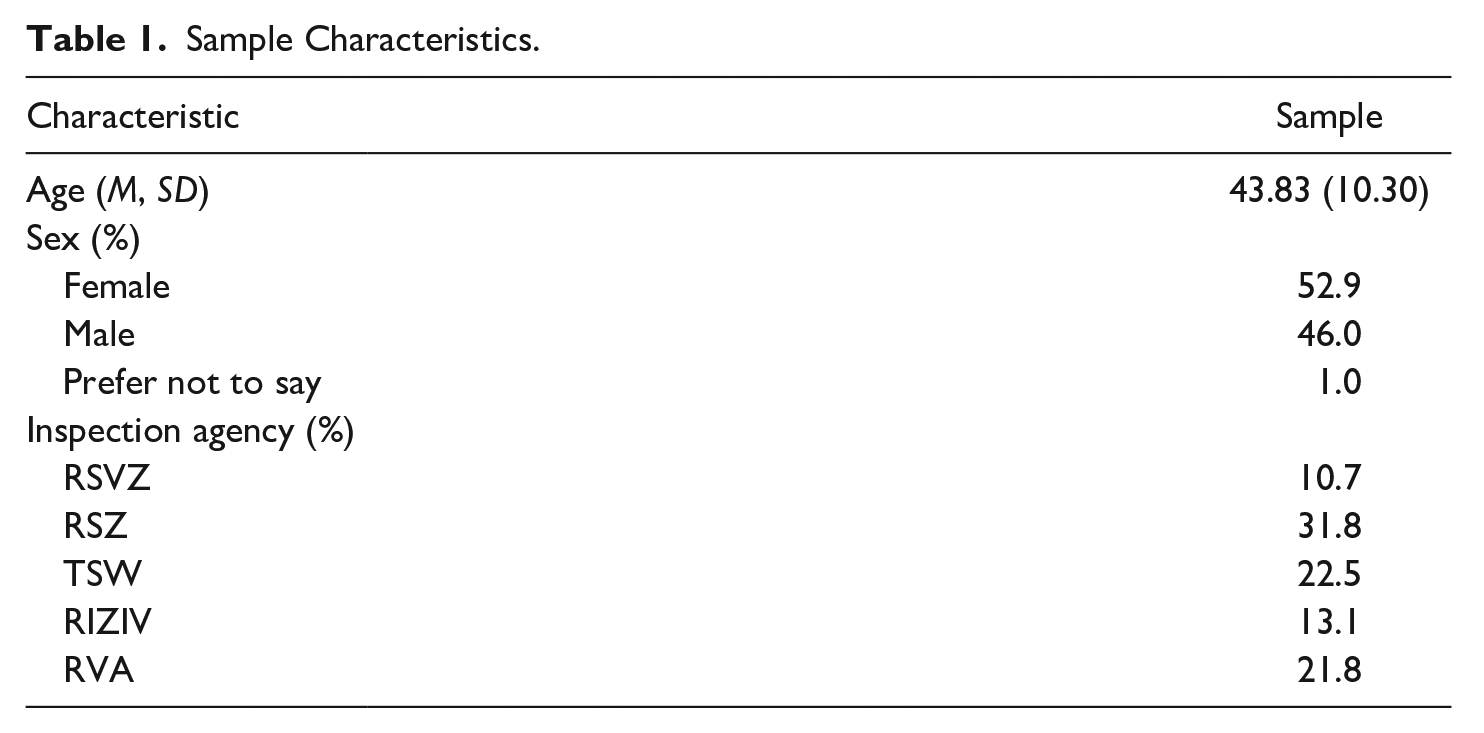
Our survey experiment was sent to 1,142 inspectors 7 and their supervisors. In total, 423 respondents participated in our study. We excluded 134 respondents from the analysis for several reasons: (1) 8 respondents were not inspectors but administrative staff, (2) 125 respondents failed the attention check, (3) 1 respondent did not give informed consent. Thus, our final sample size is N = 289. Despite this exclusion, we are not underpowered. Using G*Power we estimated the need of a sample of 280 respondents for a 0.95 power, 0.05 alpha error probability detection of a medium effect of 0.0625 with 2 groups. In total 119 respondents were in our treatment group and 170 in our control group. Table 1 shows the sample characteristics of our respondents.
Sample Characteristics.
Balance Checks
A series of (logistic) regressions were used to verify that the balance of the experimental groups in terms of age, sex, and years of experience. It was found that none of these demographics were statistically significant (with p = .806 for age, p = .652 for sex and p = .768 for years of experience). Randomization was, thus, successful.
Results
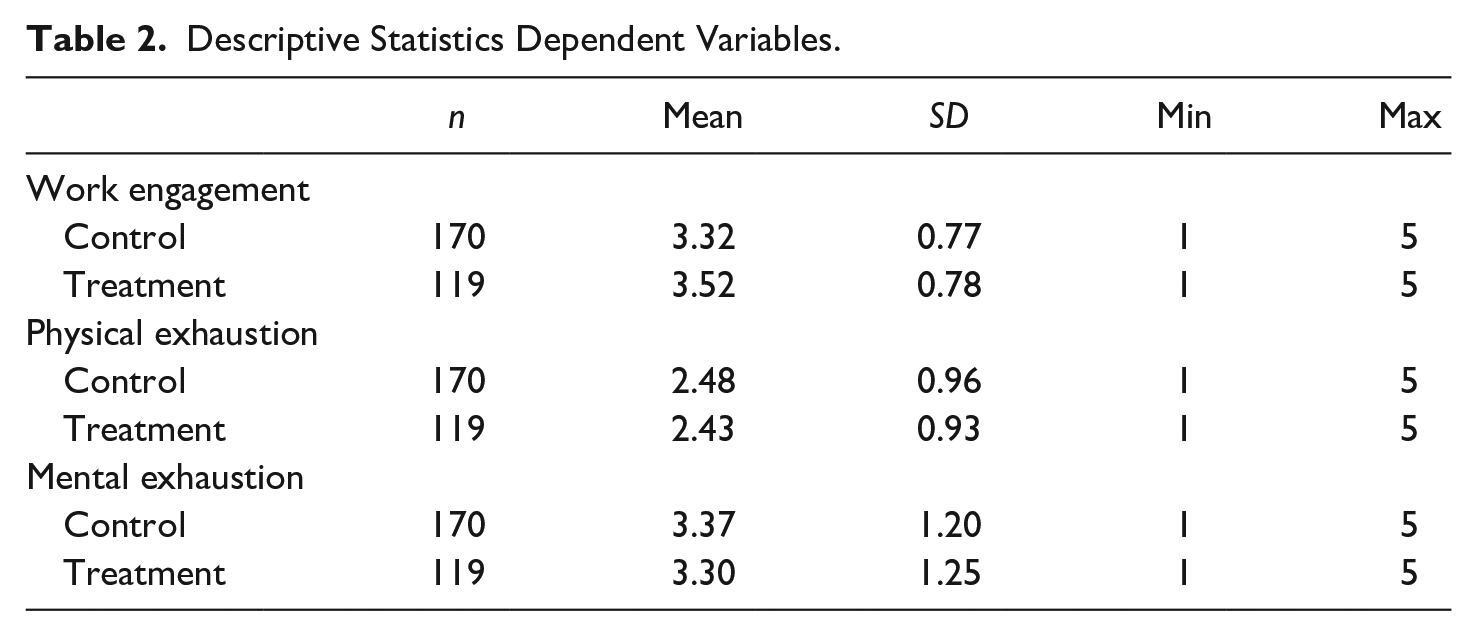
Levene’s test showed that the variances for work engagement (F[1, 287] = 0.129, p = .71), physical exhaustion (F[1, 287] = 0.068, p = .80) and mental exhaustion (F[1, 287] = 0.175, p = .68) were not significant, indicating that the variances across are experimental groups are equal. Hypothesis 1 predicted a main effect—specifically that social belonging interventions (a) increase work engagement and (b) decrease physical exhaustion as well as (c) mental exhaustion. In line with our expectations, multivariate analysis of variance (MANOVA) indicates that the main effect of social belonging intervention on work engagement is statistically significant (F[1,287] = 4.835, p = .029). In addition, post hoc analysis shown in Tables 2 and 3 indicates that our expectations are confirmed. Work engagement is highest among the treatment group (M = 3.52, SD = 0.782). The mean difference is 0.20 when compared to the treatment group. This difference is statistically significant, yet small with d = 0.26.
Descriptive Statistics Dependent Variables.
Main Effect on Dependent Variables.
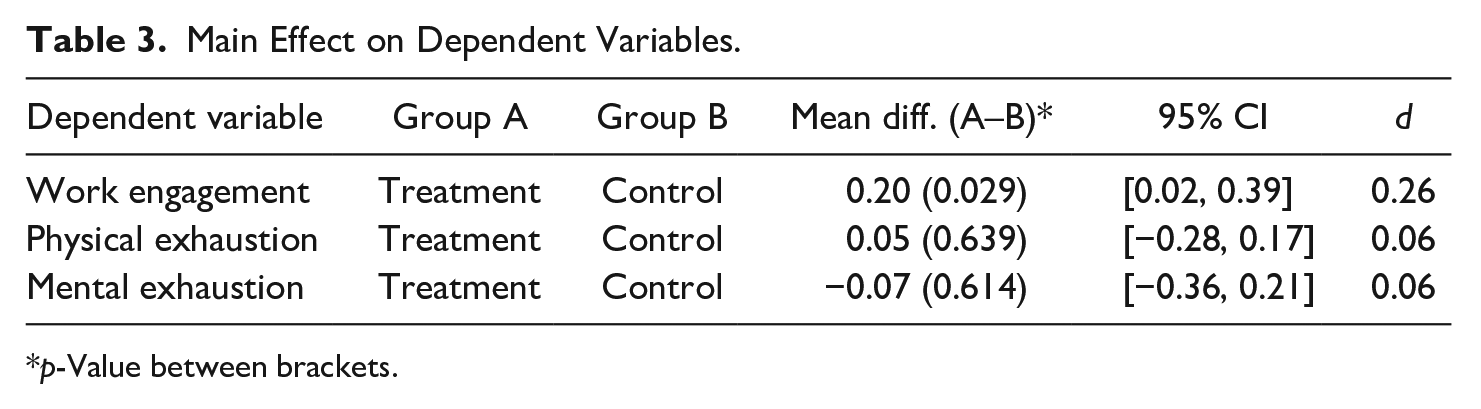
p-Value between brackets.
Contrary to our expectations, MANOVA indicates that the main effect of social belonging interventions on physical exhaustion is not statistically significant (F[1,287] = 0.221, p = .639). The effect on mental exhaustion is also not statistically significant (F[1,287] = 0.255, p = .614). This is also reflected in the negligible effect sizes (d = 0.06 for both physical exhaustion and mental exhaustion). To check whether it is justified we excluded participants who did not pay attention, we ran our analyses with all 414 respondents. This analysis can be found on OSF. Those findings mimic our overall findings but are no longer significant. This shows that to be effective, the intervention requires respondents’ conscious awareness. In sum, social belonging interventions have a small effect on work engagement and do not affect physical—and mental exhaustion. We therefore accept Hypothesis 1a and reject Hypothesis 1b and 1c.
Discussion
The aim of this study is to test whether stimulating social belonging has a positive effect on street-level bureaucrats’ well-being in times of crisis. We do not find support that social belonging interventions decrease bureaucrats’ burnout (i.e., physical exhaustion (H1b) and mental exhaustion (H1c)), which is one aspect of their wellbeing. This finding directly contradicts Linos et al. (2021) who do find that social belonging reduces burnout among 911 dispatchers. We offer three possible explanations for these contradictory findings, namely (1) the type of crisis, (2) the type of street-level bureaucrat, and (3) the type of intervention in our study.
First, the type of crisis could explain our null effects. Although the global Covid-19 pandemic made well-being even more important to study as many bureaucrats reported reduced well-being (Fisher et al., 2020; Stogner et al., 2020; Van Roekel et al., 2021), the impact of the pandemic went far beyond the workplace. To illustrate, work and private life blurred for everyone—including bureaucrats—because of lockdowns and quarantines combined with technology for teleworking. This resulted in bureaucrats working from home as much as possible while at the same time managing their private life. On top of that, bureaucrats worried about the health of loved ones and/or managed the care of family members in the same space as their at-home office. These stressors in bureaucrats’ private life could explain why boosting social belonging with peers at work did not reduce their burnout in our study, while it did in Linos et al.’s (2021) study. The positive effects of social belonging on well-being (see Linos et al., 2021) could be leveled out by the stressors from their private life. This is in line with recent literature on work motivation highlighting the need to pay more attention to outcomes beyond work and to realize the interrelatedness of work and private life (Grant & Shandell, 2022). Future research is needed that studies the role of private life stressors for street-level bureaucrats. For example, do informal care tasks diminish the negative effect of social belonging interventions on street-level bureaucrats’ mental and physical exhaustion? And which role does a reliable and large social network of street-level bureaucrats with young children play in the social belonging-burnout relationship?
The type of street-level bureaucrat we study—inspectors—could also explain why we do not find that social belonging interventions reduce burnout. In line with other prominent street-level bureaucracy scholars, we study a particular type of bureaucrat, namely inspectors (see de Boer et al., 2018; Raaphorst, 2018; Raaphorst & Loyens, 2020; Rutz et al., 2017). Unlike the 911 dispatchers studied by Linos et al. (2021), many inspectors conduct on-site face-to-face interactions with citizen-clients in teams, not alone (K. Loyens, 2019; Rutz et al., 2017). Therefore, the work of inspectors is inherently more collective in nature than that of other street-level bureaucrats, such as teachers or 911 dispatchers. This entails that much of their decisions are made in deliberation with others and responsibility is shared (K. Loyens, 2019; Visser & Kruyen, 2021). There is empirical evidence that deliberation alleviates uncertainty and emotional strain (Møller, 2021). It could, therefore, be that social belonging does not buffer burnout among inspectors because they already rely on their co-workers (Raaphorst & Loyens, 2020) and thus already experience a strong sense of belonging from the start. Future research is needed to compare social belonging experiences and its effects across different types of street-level bureaucrats. Comparing bureaucrats who do collaborative work with bureaucrats who do not may be particularly fruitful. This will allow us to increase our knowledge about the role of deliberation between co-workers in the effectiveness of social belonging interventions on street-level bureaucrats’ well-being.
A final explanation could be the type of intervention we used. Unlike Linos et al. (2021) we did not study the effects of social belonging interventions on burnout over time. Linos et al. (2021) convincingly show that the effects grow stronger over time. We only studied the effect of social belonging at one point in time. We did so because we expected our effect to occur even at one point in time because we use multiple interventions (i.e., affirmation and a non-threatening narrative). 8 Nevertheless, our two interventions did not result in less burnout. It could, therefore, be that if we measured the effects over a longer period, burnout would be reduced significantly. Future research is needed that explicitly studies the element of time when boosting social belonging as well as test the accumulative effect of two or more social belonging interventions. The effectiveness of social belong interventions may be curvilinear and dependent on synergetic effects of multiple interventions.
We do find that social belonging interventions increase street-level bureaucrats’ work engagement. This finding contributes to our existing knowledge on street-level bureaucrats in three ways. First, we contribute to the public management literature on well-being. We show that social belonging is an additional factor that helps to understand part of street-level bureaucrats’ well-being, specifically that of work engagement. Traditionally, public management scholars study the well-being of street-level bureaucrats from JD-R perspectives (e.g., Ancarani et al., 2021, Baekgaard et al., 2021; Borst & Knies, 2023; Hsieh, 2012; Linos et al., 2021; Usman et al., 2021). Central to this model is the idea that job demands and resources need to be balanced for high levels of employee-well-being (Bakker & Demerouti, 2017). We identify an additional source of employees’ well-being, which is not captured by the frequently used J-DR model (Bakker & Demerouti, 2017; Borst & Knies, 2023), namely social belonging. We thus argue that while there is great merit in using the JD-R perspective to understand employees’ well-being, it may not be fully exhaustive for understanding employees’ well-being. Next to job resources, social belonging is an important ingredient for street-level bureaucrats well-being.
Future research is needed to test if our findings about social belonging interventions replicate across different sectors and occupations. Comparing employees in the public and private sector may be an especially relevant starting point. To illustrate, unlike Linos et al. (2021) and our study, Mobasseri et al. (2021) do not find any evidence that social belonging interventions result in positive effects for employees working in the private sector. Street-levels bureaucrats’ strong identification with their professional role (Hupe, 2019) may help to explain these conflicting findings. There is also empirical evidence that private sector employees value prestigious work more than public servants (Baarspul & Wilderom, 2011; Lyons et al., 2006). Consequently, we expect them to be less affected by threats to their professional identity and therefore benefit less from social belonging interventions.
Our second contribution is to the street-level bureaucracy literature. A dominant focus in the street-level bureaucracy literature is on what stressors street-level bureaucrats must cope with while implementing policies (e.g., Schott et al., 2016; L. L. Tummers et al., 2015). While we do not study coping directly, our findings do contribute to our knowledge on coping. To illustrate, a recent stream of coping literature shows that trust is fundamental to how bureaucrats cope (Davidovitz & Cohen, 2022a, 2022b). Davidovitz and Cohen (2022a) show that if bureaucrats feel disconnected from their field or experience a clash of values, this results in them distrusting state regulators. While they do not call it social belonging, both capture feeling a sense of connections to others which is social belonging (Allen et al., 2021; Walton & Cohen, 2011; Yeager & Walton, 2011). This indicates that it is worthwhile for street-level bureaucracy scholars to include the notion of social belonging when it comes to understanding coping mechanisms of bureaucrats. Future research could investigate other positive effects of social belonging interventions for street-level bureaucrats beyond their work engagement, for instance, testing the effects on coping mechanisms.
Our final contribution is to the crisis management literature. We show that social belonging interventions increase the work engagement of street-level bureaucrats in a unique crisis setting: the Covid-19 pandemic. Studying what contributes to employee well-being in times of crisis is highly relevant because crises do not only increase the dependency of society upon street-level bureaucrats’ services, but also the uncertainties, pressures, and challenges they face, which makes street-level bureaucrats vulnerable (Boin et al., 2020). This indicates that it is valuable to study social belonging when there are exceptional contexts at play for street-level bureaucrats (Gofen & Lotta, 2021). Future research is needed that explicitly takes context into account as a comparative factor. Not only different types of crises (see next paragraph), but also any other situations that involve uncertainties, such as organizational and career changes, present relevant research contexts.
Our study was conducted during a “creeping” situational crisis: the Covid-19 pandemic. Like any crisis, this pandemic can be argued to be a unique situation that can exist because of multiple causes that combined led to a critical event (Fleischer, 2013). It is therefore important to discuss how our results translate to other types of crises. Crises may vary, for instance, in terms of government crisis responses. To illustrate, critical actors may not agree on the cause of the critical event and, therefore, use different reference points of the past to base their knowledge on for fitting responses (Fleischer, 2013). Since the Covid-19 pandemic was the first of its kind, there may be a lot of differences in reference points on how to act, resulting in even more uncertainty. This suggests that our findings do translate to an acute situational crisis, where uncertainty is traditionally very high as well, but less to institutional crises, such as institutional or chronic policy failures (t’Hart & Tummers, 2019). We hope that future research investigates if our results hold in other types of crises.
Like any study, our study has limitations. Theoretically, we first must be cautious in generalizing our finding that social belonging interventions increase work engagement of all street-level bureaucrats. We expect our findings to generalize to other street-level bureaucrats who are tasked with new responsibilities during crises and operate in an unfamiliar and at times even hostile environment, such as police officers. However, there can also be street-level bureaucrats for whom we would expect even larger effects of social belonging interventions on work engagement. To illustrate, Linos et al. (2021) study a particular type of street-level bureaucrats, namely 911 dispatchers. 911 dispatchers are—arguably—more used to working in uncertain and crisis contexts than the inspectors we study. It could be that working during a crisis, therefore, creates less uncertainty and, in turn, boosts their work engagement even more. The teaching context, in contrast, is traditionally more stable. This indicates that future research is needed that explicitly replicates boosting social belonging across different occupations at the front line of public services.
Methodologically, we must acknowledge the number of respondents who failed the attention check. This may suggest that our attention check was not clear enough and/or too demanding. Participants had to rely on memory recall to pass the attention check. However, our supplementary analysis shows that the interventions only worked for participants who passed the attention check (see OSF). This suggests that when a high level of attention is present our social belonging interventions work effectively to boost well-being. Future research could develop and test social belonging interventions that require less cognitive awareness or compare different types of interventions. A comparative experimental design may be particularly useful. Moreover, our study is experimental in nature and, thus, allows us to conclude that causal effects of social belonging interventions on well-being have been found. It does not, however, allow us to explain why our expected effects do (not) occur. In line with social belonging research in the educational field (see Yeager & Walton, 2011 for a review) we did not explicitly measure identity threat in our experiment. Future research using qualitative methods in addition to experimental methods is needed to deepen our understanding of why social belonging interventions do (not) increase street-level bureaucrats’ well-being in times of crisis. In-depth interviews or focus groups may be especially suitable (Bjorklund 2019).
Conclusion
Based on the results of our survey experiment, we conclude that social belonging interventions can have a positive, small impact on a specific aspect of street-level bureaucrats’ well-being in times of crisis. Our interventions do boost the energetic aspect of well-being (i.e., work engagement) but they do not buffer the burnout dimensions emotional and physical exhaustion. Nevertheless, we demonstrate the power of very simple and low-cost social-psychological interventions on street-level bureaucrats’ positive work experiences in times that are characterized by uncertainties and resistance from the public.
Supplemental Material
sj-docx-1-rop-10.1177_0734371X241227899 – Supplemental material for Increasing Street-Level Bureaucrats’ Well-Being in Times of Crisis: A Survey Experiment With Two Social Belonging Interventions
Supplemental material, sj-docx-1-rop-10.1177_0734371X241227899 for Increasing Street-Level Bureaucrats’ Well-Being in Times of Crisis: A Survey Experiment With Two Social Belonging Interventions by Noortje de Boer, Carina Schott and Kim Loyens in Review of Public Personnel Administration
Footnotes
Declaration of Conflicting Interests
The author(s) disclosed receipt of financial support for the research, authorship, and publication of this article: This research was funded by Social Intelligence and Investigation Service (SIOD), a Belgian agency that coordinates joint social fraud inspections by five national inspection agencies.
Funding
The author(s) received no financial support for the research, authorship, and/or publication of this article.

Supplemental Material
Supplemental material for this article is available online at OSF (DOI 10.17605/OSF.IO/9K8UJ).
Notes
Author Biographies
References
Supplementary Material
Please find the following supplemental material available below.
For Open Access articles published under a Creative Commons License, all supplemental material carries the same license as the article it is associated with.
For non-Open Access articles published, all supplemental material carries a non-exclusive license, and permission requests for re-use of supplemental material or any part of supplemental material shall be sent directly to the copyright owner as specified in the copyright notice associated with the article.
