



Abstract
This conceptual article investigates the critical role of street-level bureaucrats (SLB) as potential “eliminators” of dysfunctional policies and drivers of digital change in the public sector. Working on the front lines of government, they have a distinctive viewpoint that allows them to challenge persistent ineffective policies. The present work introduces a framework that illustrates the roles SLBs could assume within the context of the ongoing digitalization reform of German public administration. It explores the conditions under which public servants are likely to be reflexive about existing practices—including reform practices—and can promote real innovation.
Keywords
Introduction
In the cartoon “The Twelve Tasks of Asterix, the protagonist and his companion Obelix must solve twelve tasks to become the rulers over Rome. If they lose, the two and the people of their Gaul village become slaves. Task 8 mandates the two Gaul to find Permit A 38. To complete that, they must encounter several public servants in a public administration building, which is described as the place that sends you mad. The challenge to get Permit A 38 is as demanding as winning the Olympics. When they get in touch with public servants within the building, they are diverted to various authorities and swamped with forms, which gradually frustrates Asterix and Obelix.
Even though the cartoon is from the 1970s citizens still experience bureaucratic processes in which they must negotiate dozens of applications (Sicken et al., 2024) while moving from one authority to another.
The image of public servants in the cartoon is especially interesting against the background of the well-established literature on street-level bureaucrats. Street-level bureaucrats implement policies; they work in the frontline of the public sector; they “determine eligibility for government programs” (Keiser, 2010, p. 247), and to some extent they are assumed to identify with the needs of their clientele. They may act as their clients’ advocate (Finlay & Sandall, 2009) and understand the needs of people while helping citizens navigate through complex policies. 1 Street-level bureaucrats are not just “passive victims” of dysfunctional policies (van Gestel et al., 2019); they may defend their room to maneuver, develop coping strategies (Jacobsson et al., 2020), and try to work around dysfunctionalities as much as possible (Cohen & Aviram, 2021). Street-level bureaucrats could use “creative mediation,” and reframe organizational and policy expectations to support the results they want. Street-level bureaucrats know the administrative burdens (see Herd & Moynihan, 2018) citizens face; therefore their experiences and knowledge should be considered in reforms.
This leads to an intriguing research question: Under what conditions are we likely to have public servants who are reflexive about existing practices—including reform practices—and can promote real innovation? This article employs Germany’s Online Access Act (Onlinezugangsgesetz—OZG) to explore conditions under which street-level bureaucrats may utilize digital transformation reforms to address observed dysfunctionalities.
Germany’s National Regulatory Council (NKR) reported in its latest annual report of 2023 that the OZG did not achieve its original goal of digitizing all public services by the end of 2022. According to the report, the policy failed not only because a handful of public services were digitized by 2022, but also because of fragmented IT solutions within the states and municipalities. Municipalities and other agencies are still unable to exchange data because they use different standards and IT systems. The OZG has not made the work of public servants any easier. Rather, they struggle with technical issues and the complexity of the system (Kuhlmann & Heuberger, 2023). The potential of digital transformation remains largely untapped.
One problem is the lack of responsible actors who can enact standards and set technical specifications and requirements: “There is not one single instance of unilateral decision-making and enforcement, but numerous entities with their own rights and powers” (Kuhlmann & Heuberger, 2023, p. 6). This dysfunctional outcome can be explained by Germany’s federal system and the way it is implemented. The NKR argues that federal and departmental sensitivities led to the failure of the reform.
This article focuses on the OZG and the role of street-level bureaucrats in the reform. Its purpose is to develop an analytical framework to systemize different roles that street-level bureaucrats may assume during digitalization reforms. To develop the framework I draw upon literature concerning technology acceptance at both the individual and organizational levels, integrating them into a fourfold typology. This sheds light on the conditions that support street-level bureaucrats in the endeavor to eliminate ineffective policies and to foster innovation. Conditions here are understood as an interaction between an organizational and environmental pillar (Cohen, 2016). Although this analysis is conceptual, it substantiates its arguments with illustrations from in-depth and continuous empirical insights gained through active participation in consultation processes in the context of the OZG. The study demonstrates that street-level bureaucrats can play a crucial role in the success of digital reforms. They may use a digital transformational reform like the OZG to question established routines and find room for innovation; Borins, 2001, for example, who finds that internal problems and technology are among the key drivers for innovation in the public sector. At the same time, it is essential to address the involvement of street-level bureaucrats.
Street-Level Bureaucrats
The concept of street-level bureaucracy was first introduced by Lipsky in 1980. He argues that “the decisions of street-level bureaucrats, the routines they establish and the devices they invent to cope with uncertainties and work pressures, effectively become the public policies they carry out” (Lipsky, 1980, p. xii). Street-level bureaucrats translate a policy into action (Cohen, 2016; Cohen & Aviram, 2021). The lower-level individuals in public bureaucracies, such as social workers, those checking applications for the recognition of a foreign qualification, police officers, schoolteachers, and environmental inspectors, possess a significant amount of discretion in their decision-making. They regularly exercise this discretion, which has immediate consequences for citizens. The outcomes of their discretion can determine whether someone’s foreign professional qualification is recognized, whether someone gets a certain service or information on a question he/she has, is arrested, is suspended, or receives the benefits they seek (Dubois, 2010).
Against this background, it is crucial to understand the factors that affect the decision-making of street-level bureaucrats. Cohen (2016, p. 4) differentiates among three factors: personal characteristics, organizational conditions, and the environment. Personal characteristics include the “values, beliefs, standards, and economic preferences in response to incentives” (Cohen & Aviram, 2021, p. 2). Cohen (2016, p. 33) characterizes organizational conditions as “the availability of organizational resources or the organizational incentives offered to the street-level bureaucrat.” Third, the environment “includes the pressures street-level bureaucrats face outside their organizations” (Cohen & Aviram, 2021, p. 3).
This article first looks more closely at the individual and the organizational pillars. Then, the organizational and attitudinal pillars are combined, and a 2 × 2 table is presented as an analytical framework. Attention then focuses on the environmental pillar and describes the contextual background of the study, the OZG reform in Germany.
The Individual Pillar—Attitudes
Rokeach (1973, p. 5) defines attitudes as an “enduring belief that a specific mode of conduct or end-state of existence is personally or socially preferable to an opposite or converse mode of conduct or end-state of existence.” Orientations play a crucial role in shaping human behavior; however, they only make a certain behavior more likely. Eagly and Chaiken (1998, p. 1) define attitudes as “a psychological tendency that is expressed by evaluating a particular entity with some degree of favor or disfavor. [. . .] psychological tendency refers to a state that is internal to the person, and evaluating refers to all classes of evaluative responding, whether overt or covert, cognitive, affective, or behavioral.”
Hence, it is interesting to understand which factors might influence the attitudes, values, and work-related role understandings of professionals in the public sector. Attitudinal patterns shaped by socialization processes can influence perceptions and behaviors (Nagel & Peters, 2021). In principle, social, educational, political, or occupational socialization can shape individual attitude patterns and role understandings (Peters et al., 2015)
Although attitudes do not always predict a certain behavior, it is important to acknowledge that they may make a certain behavior more or less likely. Several studies indicate that public servants have varying attitudes toward digitalization (Adam et al., 2021; Barrutia & Echebarria, 2021; Buffat, 2015; Busch & Henriksen, 2018; Cordella & Tempini, 2015; de Boer & Raaphorst, 2023; Lee et al., 2009). Some are skeptical about digitalization, and some are just not motivated to change their routines (Kuhlmann & Heuberger, 2023). Some may believe that a new technology enhances their job performance whereas others may perceive the ease of use to be a hindrance. The Technology Acceptance Model (TAM) (Davis, 1985), for example, measures the user’s acceptance of technology based on two variables: the user’s perceived ease of use and usefulness of the technology. Those who are skeptical might fear that digital features will control them or that the digital transformation will affect their work and reduce their discretionary power (Busch & Henriksen, 2018; de Boer & Raaphorst, 2023; Marienfeldt, 2024). They might become “screen-level bureaucrats being guided and assisted in decision-making by the digital tools or into helpdesk employees assisting citizens during self-service or handling complaints” (Marienfeldt, 2024, p. 5). However, Hofmann and Ogonek (2018, p. 130) argue that it is crucial that “people have the ability and willingness to learn, are open to new experiences and have cognitive skills.” Hofmann & Ogonek, 2018 describe public servants as characterized by a general fear of everything new. Maybe they are afraid because “digital transformation strategies used for the public sector are often based on experiences and expertise from the private sector although the aims and responsibilities of the public and private sector differ and may even be at odds” (Edelmann & Mergel, 2022, p. 392). Here, general negative experiences with the private sector may play a role and produce skepticism towards digitalization. Rehouma et al. (2020) observe that public servants’ participation in digitalization projects leads to a positive attitude towards information technology. Nonetheless, others remain skeptical, although they participate. Gunduez et al. (2019) ask in their paper what public managers think of big data. Gunduez et al., (2019, p. 5) introduce nine technological frames. Groups 1 and 2 share that they are defined as techno-skeptics. Both groups have doubts about big data and have concerns about data protection. Groups 4 and 5 are techno-enthusiasts that have a positive stance towards technology. Some public servants may have a positive stance towards digitalization because it could increase transparency and reduce the overall time needed for procedures (Kuhlmann & Heuberger, 2023).
However, public servants are all members of an organization, and they are socialized with the views of the organization. A successful digital transformation requires “a comprehensive organizational approach rather than one that merely makes forms available online or the transition from analog-to-digital public service delivery” (Mergel et al., 2019, p. 10). The organization needs to encourage a cultural change and must support the digital transformation. This and positive attitudes towards digitalization are crucial factors, Hamner and Qazi (2009) argue; they also include organizational culture in the TAM. As a corollary, it is important to understand organizational influences as well.
The Organizational Pillar
The moment a person takes on a new job or position, a process of organizational socialization begins (or they might be pre-socialized and choose to work in an organization because they genuinely believe in it). During this socialization, “organizations may replicate their ideas and their biases as they socialize new members and pass along the policy commitments of the organization” (Peters & Nagel, 2020, 22). Here, public servants follow the logic of appropriateness (March & Olsen, 1998). They interpret situations and behave according to what they understand to be socially appropriate. This occurs “according to the institutionalized practices of a collectivity, based on mutual, and often tacit, understandings of what is true, reasonable, natural, right, and good” (March & Olsen, 2011, p. 478). However, there can be different understandings of what is right and appropriate within an organization (Christensen et al., 2020).
Similar to the individual level one can assume that some organizations are keen to innovate and implement new technologies directly, while others are skeptical about and more resistant to digitalization (Hamner & Qazi, 2009). Pittaway and Montazemi (2020, p. 2) argue in their study on public servants in local governments that “unlike incremental change […] digital transformation can only be achieved by actively engaging managers and employees in making new ways of operating a reality.” Organizations need to question their own ideas, which guide their actions (Fitzgerald et al., 2014). Kanungo et al. (2001, p. 42) observe that public sector organizations with a bureaucratic culture “show a significant correlation with scarce-resource IT strategy.” Kanungo et al., (2001, p. 48) found that “cautious and risk-averse approaches [in a hierarchical and procedure-heavy environment] have limited the amount of investment that could have been made in IT” and argue that bureaucratic cultures tend to hinder innovative IT techniques. Digital transformation can only succeed if the organization encourages cultural change. Hence, this might be problematic if the organization has a strong bureaucratic tradition or if it is on a path-dependent track. This could hinder digital transformation, especially when the organization does not educate its public servants or even denies “the possibility to attend digitalization-specific trainings” (Hofmann & Ogonek, 2018, p. 131). Lin (2000, p. 162) observes that street-level bureaucrats try to make sense of their work and to understand their jobs as a series of related tasks all directed toward the same purpose. This typically leads them to refer each new policy to the values that are most salient in their organization.
Why do organizations transfer these ideas and socialize their members the way they do? Path dependence, groupthink, and the filtering of information may serve as explanations (Peters & Nagel, 2020). Path dependence is among the “simplest explanations for the persistence of ideas” (Peters & Nagel, 2020, p. 24). It highlights the influence of historical processes in shaping the persistence and behavior of organizations and their members. The concept suggests that initial decisions, events, and historical legacies create self-reinforcing trajectories that influence subsequent choices and limit the range of options (see, for example, the tragedy of the two NASA space shuttles that exploded [Hall, 2003]). Early decisions can shape the organization’s future behaviors and policies, leading to a lock-in effect that may hinder adaptability and innovation (see also Blyth’s [2001] discussion of the locked-in effect of ideas). The mechanisms underlying path dependence in bureaucracies include institutional inertia, where existing structures and routines become deeply ingrained and resistant to change, and historical baggage, referring to the persistence of past practices that continue to exert influence despite their decreasing relevance.
Feedback effects and positive feedback loops further contribute to path-dependent outcomes, as initial advantages or disadvantages can be perpetuated and magnified. Groupthink can play an important role as well. According to Janis (1991), groupthink is the propensity for small groups to not question the received wisdom within the group. This can be viewed as an illustration of the influence that social norms have on public policy and ideas. To maintain internal coherence within the group and to justify their actions, this perspective on decision-making contends that groups form internal beliefs. Organizations and policies often face criticism for making decisions based solely on the input of top-level executives, without considering the perspectives of lower-level employees (Thompson, 1977). It is important to avoid information filtering that may prioritize established ideas over newer, potentially better alternatives (Peters & Nagel, 2020, p. 33). To combat this issue, experts from lower levels can be brought in to provide alternative viewpoints.
Thus, the question is what role public servants who support or oppose digitalization would assume in their respective organizations. The following section combines the two pillars just described and builds the analytical framework.
Combining the Individual and Organization Pillars: Four Ideal Images
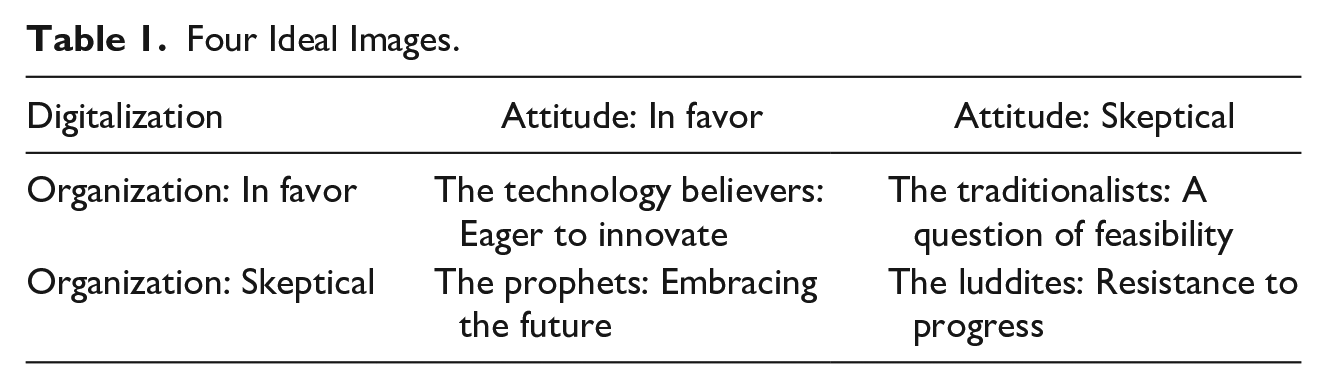
Based on the combination of the organizational and the individual dimensions, I introduce four ideal images of public servants. Various studies show that attitudes (Barrutia & Echebarria, 2021; de Boer & Raaphorst, 2023; Dreas & Klenk, 2021; Edelmann & Mergel, 2022; Guenduez et al., 2020; Hamner & Qazi 2009; Hofmann & Ogonek, 2018; Lee et al., 2009; Rehouma et al., 2020; Wihlborg & Iacobaeus, 2023) and organizational factors (Cordella & Tempini, 2015; Dreas & Klenk, 2021; Di Giulio & Vecchi, 2023; Hofmann & Ogonek, 2018; Kanungo et al., 2001; Staniulienė & Lavickaitė, 2022) are crucial for implementing digitalization policies. Yet, the combination of both dimensions in a four-fold table is unexplored. Against this background and research gap, the four images may help us to better understand the conditions under which we are likely to have street-level bureaucrats who are reflexive about existing practices and can promote innovation. The four ideal images indicate that different combinations need to be taken into consideration and addressed accordingly.
In Table 1, the rows represent the two stances of public servants toward digitalization (in favor or skeptical), while the columns represent the two stances of public sector organizations toward digitalization (in favor or skeptical). The names for each cell reflect the different attitudes and motivations behind each combination of variables. For example, “The Luddites” refers to an historical movement of English textile workers who opposed the introduction of machinery (Table 1).
Four Ideal Images.
Before examining these ideal images, the next section looks more closely at the OZG reform in Germany and one of its projects.
The Contextual Background: The OZG Reform in Germany
The digital transformation of societies all around the globe has created both new opportunities and difficulties for governments (Haug et al., 2024). Germany has been ranked as a slow adaptor to the digital world, struggling especially with the digitalization of public services. The Online Access Act is a key reform that is supposed to address the lack of digital infrastructure and to make it easier for people and businesses to access administrative services online (Mergel, 2021). It mandates the digitization of public services, allowing citizens to access administrative procedures and information online, streamlining processes, and fostering citizen-centric governance. All public services were supposed to be delivered “in a joint digital portal by the end of 2022” (Fleischer & Carstens, 2022, p. 1208). This is challenging in Germany, because of its federal system and the various actors that are involved [see Edelmann & Mergel, 2022) who discuss the difficulties of implementing a digital strategy in Austria, also a federal state]. There is a highly fragmented landscape in many policy sectors: security, infrastructure, and social services to name just a few. The OZG then sought to unify and harmonize several forms, requirements, services, and processes across Germany and its states (Mergel, 2019; Wegrich, 2021). The ambitious date could not be met. By the end of 2022, only a handful of public services had been digitized. A revision of the policy was supposed to be in force in July 2024.
Germany started to promote digital technologies in the early 2000s. The National IT Summit in 2006, the E-Government Act in 2013, and the Digital Agenda for Germany in 2014 illustrate these efforts. Despite these early endeavors, challenges such as fragmented administrative structures and varying levels of digital maturity across federal, state, and local governments hindered progress. The German federal government enacted the OZG to address these challenges; it went into effect on August 18, 2017 (Proll, 2020).
The Federal Ministry of the Interior and Community (BMI) coordinates the implementation of the OZG. The policy is divided into two parts:
- In the Federal Government Digitization Program, the BMI manages and coordinates the digitization of federal administrative services across all departments. These services are regulated and executed at the federal level. One example is the service ELEFAND (Electronic registration of Germans abroad) where registered Germans get informed by German authorities abroad in the event of a crisis.
- In the Federal States Digitization Program, the Federal Ministry of the Interior primarily manages and coordinates the digitization of administrative services. Here, the federal and state governments have divided the administrative services into 14 thematic areas (e.g., “education”), each overseen by a federal ministry and a state ministry. In June 2018, the federal and state governments grouped over 6,000 administrative services thematically into 575 OZG service bundles (so-called OZG services).
The BMI hopes that “private citizens and companies would use services offered by the public administration more often if they could access them easily on the internet from their home computer or mobile device” (BMI, 2023). This shows that the reform is expected to lower administrative burdens.
Two administrative burdens that the OZG may address in Germany are, for example, that citizens still need to submit every document by mail. Everything has to be paper-based. Second, administrative procedural law and legal regulations typically demand personal contact. At some point in the administrative process verification is required, which typically leads media discontinuities. Citizens, for example, must make appointments at their local authority when they change residence (Kuhlmann & Bogumil, 2021). Relaxing such regulations may save time and costs for citizens, improving efficiency and access to service.
By the end of December 2022, however, only 19% of the services that could be digitized were available online. Yet, online in this context often meant that the service was available in 1 out of 11.000 municipalities. Unexpected technical complexities, bureaucratic and data protection-related issues, and the large number of services to be digitized may explain the relatively low percentage. Furthermore, interoperability is nonexistent, and there is no data standard (Kuhlmann & Heuberger, 2023). States and local governments do not have to collaborate with other states or local governments and can design their own solutions.
Yet, the OZG reform has the potential to address these dysfunctional policies. To explore this opportunity further, attention turns to the recognition of foreign qualifications and the role of street-level bureaucrats in the OZG project in greater detail.
Recognition of Foreign Professional Qualifications
Germany is expected to experience an increase in demand for skilled foreign workers. Under the official Federal Government’s skilled labor strategy, there will be 240,000 more job openings than available workers (Bundesregierung, 2023). The Ministry of Work, Health, and Social Affairs of North Rhine-Westphalia is collaborating with the Federal Ministry of Education and Research on an OZG project. The project aims to digitize standardized paper forms that citizens must submit when requesting recognition of their foreign professional qualifications. The goal is to make the application process more efficient, user-friendly, and standardized among competent authorities. State authorities and chambers are primarily responsible for recognizing foreign qualifications (Antragsservice, 2022).
To digitize the application process and forms for citizens, all professions have been clustered based on their professional qualifications. Similar professions that require the same documents have been grouped together. There are regulated and non-regulated professional qualifications, each requiring separate documents. Regulated professions, such as medical professions and teaching, are legally protected and require recognition. Professions that are not regulated are not legally protected, and no recognition is required. For instance, journalism is an unregulated profession. Although it is not mandatory, it is advisable to seek recognition: “recognition does, however, bring benefits. Recognition shows that your professional qualification is equivalent to the German professional qualification. Employers are better able to assess your professional qualification” (Berufsbildung, 2023).
The project developed 12 clusters of professional qualifications covering nearly 1,500 professional qualifications. However, the divide between regulated and non-regulated professions is not sufficient. Some professions are recognized under federal law, while others are under state law. The recognition for medical doctors and nurses, for example, is under federal law, while teachers are recognized under state law. This implies that states may have different requirements for teachers when they apply for recognition. However, even though the recognition of medical nurses is under federal law, competent authorities that oversee the recognition may vary in their demands. Overall, this means that there are at least 12 different clusters of professions, and each cluster and profession may vary internally.
To address this complexity, MAGS NRW formed 12 working groups, one for each cluster. The ministry invited experts from competent authorities in the 15 other states to participate and contribute their knowledge. The working groups consisted of public servants who deal with applications daily, interact with applicants, and understand the needs of skilled workers from abroad. These public servants may have a better understanding of the needs and burdens of citizens than top-level officials in ministries. They can contribute their expertise to help ensure that their knowledge is considered. The working groups aim to digitize and harmonize the application process. Within these groups, members decide on the content of and questions included on the forms, and they can even deviate from federal or state law. Members exercise significant autonomy because they can decide that certain documents are no longer needed. They also determine which documents must be supplied and whether certain documents must be submitted by mail. Additionally, creating user-friendly forms can help reduce bureaucratic obstacles.
During the implementation of OZG, street-level bureaucrats have the power to create new structures and shape the digital future for skilled workers interested in relocating to Germany. They are responsible for interpreting policies and adapting their practices to meet the specific needs of their clients. Street-level bureaucrats in the working groups can influence digitalization in Germany by shaping policymaking and creating forms and processes that may be used by fellow public authorities.
Street-Level Bureaucrats and OZG Reform
The following section describes the four illustrative images of street-level bureaucrats in the context of OZG reform. These images are based on expectations and experiences gathered during consultation procedures and are informed by extensive and ongoing empirical insights.
The Technology Believers: Eager to Innovate
This type of street-level bureaucrat works in a digital-oriented public organization and may have studied e-government or an IT-related program before joining the organization. Technology Believers bring in a set of pro-digitalization attitudes, and they work in public sector organizations that advocate new ideas and may be forerunners for projects.
With the support of their organization, Technology Believers use their discretion to promote their positions, pursue the digitization of all public services, and question the status quo. They perceive many current regulations as outdated, such as the requirement for written forms and represent this position in the working groups. Although citizens can access online forms and sometimes even submit them remotely, they still need to print them out and send them by mail to the competent authority. Technology advocates prefer a digital process without any interruptions. If they work for a competent authority that recognizes foreign professional qualifications, they are aware of the difficulties faced by applicants from countries such as Thailand or Mexico who need to travel to Germany to prove their identity. They may even introduce new technologies and promote best-case solutions from other countries, such as AI-based solutions.
Yet, ideas can become harmful if they are based on unproven innovative inventions. Technology Believers sometimes can be too enthusiastic about a new technology as it may create new problems that are even more difficult to solve.
Two relatively new German state-owned agencies are presented as ideal employers. Possible examples of organizations that may offer digitalization-related trainings include the young byte and d-NRW digital agencies in Bavaria and North Rhine-Westphalia, respectively, as well as staff positions in state governments, particularly in e-government departments, and IT administrators in counties and cities. It is probable that these organizations provide opportunities for attending digitalization-related trainings. The organization might have its own digitalization strategy and host strategy meetings, invite experts from other public sector organizations or from private sector companies such as consultancies.
Characteristics of this ideal type can be found in the role of system-level bureaucrats (Bovens & Zouridis, 2002, p. 176) who “are no longer involved in handling individual cases but direct their main focus towards [. . .] optimizing information processes and towards creating links between systems in various organizations.” Real-world examples may include those public servants that collaborated in the digitalization labs. Digitalization labs were introduced together with the OZG in 2017; “a unique feature of these labs is that they challenge classical processes and means of bureaucratic decision-making, focusing on a user centric approach rather than on formal competencies of the administration, by involving various actors who are traditionally uninvolved in the policy design process in executive federalism” (Carstens, 2023, p. 250). Street-level bureaucrats were members of the labs. These labs may come up with innovative solutions; however these solutions can only be understood as recommendations that have no binding effect. Another example of this ideal type can be found in the work by Sperling et al., who studied medical centers. They discuss the role of nurse champions (Sperling et al., 2022). These are “front-line practitioners who implement innovation and reconstruct policy” (Sperling et al., 2022, p. 1). In line with other studies (Meier et al., 2013; Sørensen & Torfing, 2015; van den Heuvel et al., 2014) Sperling et al., 2022 find that street-level bureaucrats need organizational support to foster innovation.
The Traditionalists: A Question of Feasibility
Although their organization is open to and supportive of digitization, some employees may still be skeptical due to more traditional values (Lemke et al., 2021). This may be especially true for public servants who entered the sector decades ago with a vocational education background and a focus on practical rather than academically acquired knowledge. These individuals may have been raised with traditional values, which can lead to skepticism about digitization. They believe that administration must adhere to the requirements of predictability and controllability (Elixmann & Jarke, 2022). In their perception public administration operates like a machine with predictable outcomes. The purpose of established norms is to prevent corruption and arbitrary behavior. The idea is that officials who are guided solely by rules do not act corruptly or arbitrarily.
Traditional public servants view the increased discretion of the OZG more negatively; they insist on maintaining the status quo. They convert paper forms to digital ones but insist on exact replicas, as observed in the consultation process. This suggests a lack of willingness to question the necessity of certain queries or documents or to provide more user-friendly materials. Citizens are required to submit their applications and supporting documentation by mail. Some individuals may have had negative experiences with citizens and are concerned that digitalization could lead to unrestricted betrayal due to the lack of a reliable service to confirm the identity of the applicant. Data protection is a significant concern in Germany. Those who are skeptical of digital services may be influenced by traditional beliefs and uncertainty about where their data are stored (Elixmann & Jarke, 2022). Public servants may fear that criminals will attempt to access data and steal citizens' personal information. As a result, they may view themselves as protectors of the people and the common good. Furthermore, some individuals may fear that a fully digitized and automated recognition process could replace their jobs. As a result, they may attempt to maintain the current situation and even manipulate the project. This could cause them to question the effectiveness or necessity of digital transformation initiatives and express concerns about the impact on job roles, training requirements, and the ability to adapt to new technologies. In the context of the OZG reform, their role may involve ensuring thorough evaluation and risk mitigation while addressing their concerns.
Traditional public servants with a such a mindset often act as blockers within their organizations when it comes to digitalization. This is not because they feel like betraying their employer, but because they believe they are defending the public interest. While employers may provide training and workshops on digitalization and encourage open-mindedness, traditional public servants may act against their employer’s interests.
They may even try to maintain a dysfunctional policy because they either want to sabotage the reform due to certain beliefs or because they want to keep the status quo. Research on policy alienation (Tummers, 2012; Tummers et al., 2015) indicates that street-level bureaucrats who believe that policies are not beneficial to society or who do not understand the rationales behind them (Thomas & Davies, 2005) may show resistance to change.
Various examples of the real-world show characteristics of this ideal type. Elixman and Jarke (2022) explore the different reasons why public servants are reluctant to introduce open data. Despite political and organizational support, public servants show resistance and negative attitudes towards the introduction of digital innovations, which leads to delays in implementation. Furthermore, several British street-level bureaucrats feared that they would lose their jobs because of automation and expressed concerns about privacy when AI based systems were introduced in different municipalities (Dencik et al., 2019). Hence, they were unwilling to support the new programs. Another example are secondary school teachers in Chicago (Anagnostopoulos, 2003) who evidently passed students that did not meet the course requirements, because they disagreed with a new policy on student failure.
The Prophets: Embracing the Future
Prophets working in the public sector typically have backgrounds in information technology or e-government, similar to Technology Believers. Prior to joining the public sector, they may have worked in the digitalization industry. Their motivation for change stems from a desire to improve society and make a positive impact (Maynard-Moody & Musheno, 2003). They aim to share their expertise and address the perceived stagnation of the public sector. When choosing government work, individuals may opt for a traditional organization under the belief that it is where change is most necessary. It is important to understand the needs of the people and support their desires. However, organizational reluctance to embrace digitalization has made improving the quality of social services a challenge (West, 2005). This situation can feel like Don Quixote’s battle against the windmills of bureaucracy. Implementation of the OZG may present challenges for individuals seeking to persuade their organization to embrace change and overcome internal resistance, as they may be viewed as disruptors (Dunleavy & Evans, 2019). However, as members of the working groups, they can influence policies and their implementation while exercising autonomy, even if it means acting in opposition to their organization’s interests. The working groups allow individuals to pursue their interests, such as completing user-friendly forms that do not require personal contact or written forms. Proactive individuals are likely to seek out training on digitalization and initiate exchanges with other public and private sector organizations. Their organizations, however, may not provide support or funding for these activities due to their bureaucratic structure, which may discourage digital transformation (Lemke et al., 2021; Syed et al., 2023).
This ideal type is consistent with the findings of Barral and Ghosh (2023) who analyze the case of conservation banking and the implementation of market-based instruments in the US. They observe that organizational conditions can restrain street-level bureaucrats’ autonomy to implement such instruments. Furthermore, the interviews Elixmann and Jarke (2022, p. 65) conducted with Open Data experts indicate that some experts may align as Prophets, pursuing a digital transformation and changes that “run counter to the present organizational culture [. . .] and are perceived critically by the administrative staff.”
The Luddites: Resistance to Progress
The Luddite movement of the early 19th century provides historical context for understanding resistance to development. Skilled workers in the textile industry, known as Luddites, perceived mechanization of labor as a threat to their livelihoods and traditional abilities, and therefore opposed it. The Luddite movement opposed mechanization for economic, social, and ideological reasons. Economic problems, such as job loss and skill devaluation, were the primary catalysts for opposition to automation. Professionals were concerned about losing their sense of professional identity, being fired, and having the quality of their work suffer. The Luddite movement also opposed the social upheaval caused by the rapid industrialization of the time, which threatened traditional worker and community ties.
Professionals in public sector organizations who oppose digitization may have similar concerns. These employees may worry that digitization efforts will lead to job losses, changes in roles and responsibilities, and a loss of specialized skills. They may view digitization as a threat to their professional identity, job security, and the quality of public service delivery (de Boer & Raaphorst, 2023; Marienfeldt, 2024; Meier et al., 2013). Some street-level bureaucrats may fear losing their jobs and being replaced by AI or automation (Baldwin et al., 2012; Bovens & Zouridis, 2002), which could be characterized as Luddite behavior.
They may fear an intensification of work without improving the quality of services (Coursey & Norris, 2008; Savoldelli et al., 2014). Resistance to digitization projects also may be exacerbated by organizational culture and opposition within public sector organizations (Meier et al., 2013). In organizations with oppositional cultures, both Luddites and other employees may use a variety of strategies. Public servants may exhibit bureaucratic lethargy, passive resistance, or overt obstructionism (Tummers et al., 2015). This contrasts with the Luddites who committed acts of sabotage and machine breakage.
This may be due to negative experiences with digitalization and virus attacks, leading to mistrust in the process. They generally prefer to adhere to established procedures and methods. Public servants in this group may express concerns about data security, privacy, and the feasibility of implementing digital solutions (Elixmann & Jarke, 2022). It is important to address these concerns and provide reassurance about the safety and effectiveness of digital solutions.
Individuals with characteristics of this ideal type can be found in various German local governments. As Kuhlmann and Heuberger (2022) discuss, the success of the digital transformation of German local governments depends on organizationa’ willingness to change and individuals who push the digital transformation forward. Luddites may be found in those local governments that characterize as digital immature (Kuhlmann & Heuberger, 2023), those that are not pushing the digital transformation with civil servants that show resistance to change. This resistance to change was observed by Meier et al. (2013) who studied civil servants’ resistance to change towards the implementation of an electronic record system in the state of Brandenburg, Germany. Meier et al., 2013, p. 327 observe that civil servants who perceived that their colleagues and managers supported the introduction of EL.DOK showed a lower resistance to the organizational transformation than those who scored low in their perception of colleagues’ and managers’ support. Luddites may be those civil servants with colleagues that do not support the introduction and themselves resist its introduction.
As part of their role in the OZG Reform, public servants may suggest alternative methods of service delivery and raise public awareness of potential risks. They may prioritize maintenance of current systems and procedures. They may be expected to support established practices, maintain the status quo, and express concerns about the feasibility or risks of digitization. Within the working group, some members advocate for the need to maintain established practices and express concerns about the feasibility or risks of digitization. Others, however, argue that written forms and personal contact are necessary. They refer to procedural law and argue that routines and established processes guarantee legality and predictability. It is important for managers and peers to maintain a balanced perspective and consider all viewpoints. If individuals are advocating for certain routines without a clear understanding of their necessity, it may indicate path dependency. This has implications for the OZG reform and its potential to combat dysfunctional policies. This is especially problematic when one image dominates.
Why the Domination of One Image Should be Avoided
The implementation of digitalization projects and the spread of outdated ideas within the public sector may be hindered if one ideal type dominates the others within working groups (which are mixes of different street-level bureaucrats that come from different organizations).
It is important to avoid reinforcing and perpetuating existing outdated ideas, particularly those held by Luddites. All four images can be observed within the working groups. Street-level bureaucrats who resist digitization initiatives by clinging to outdated habits and rejecting change within their organizations can be considered Luddites. This resistance can impede innovation and progress, hinder the ability to successfully embrace digitalization, and prevent the investigation of novel concepts. It is important to avoid such dominance and embrace alternate viewpoints.
Other members of the working groups, such as Prophets or Technology Believers, may be marginalized when Luddites or Traditionalists dominate. This can result in the formers’ critical opinions, creative suggestions, and transformative activities being ignored or silenced, limiting the diversity of viewpoints and the range of ideas considered. This, in turn, can hinder the development of innovative solutions to problems and successful digitalization plans.
The persistence of traditional written forms and personal contact can perpetuate outdated ideas, hindering innovation and the advancement of digitalization initiatives. Conventional viewpoints may impede innovation, calculated risk-taking, and the implementation of new technologies, resulting in missed opportunities to improve service delivery, streamline procedures, and enhance citizen experiences.
A dominant pattern of behavior can limit the discretionary actions of street-level bureaucrats, curbing their ability to challenge or deviate from established practices. This can lead to adherence to the dominant stance becoming the norm, and street-level bureaucrats may be compelled to follow outdated procedures and maintain the status quo. This can create a reinforcing feedback loop. Street-level bureaucrats’ actions and decisions can reinforce prevailing dysfunctionalities when they conform to the dominant cell’s ideology. Although they have discretionary power that could be used for creative problem-solving and adaptive responses to emerging challenges, this power becomes limited within the confines of the dominant cell's perspective. As previously mentioned, if the Prophet and Technology Believer images predominate, this could produce excessive enthusiasm and a certain amount of naivete. In this situation, a well-intentioned policy or idea could be harmful and have negative consequences.
It may happen that two ideal types can be observed in one organization. This is likely for Technology Believers and Traditionalists as well as for Luddites and Prophets. It is possible that all four types could be present within one organization. If the organization is big enough, then there could be differences between departments, with those supporting the digital transformation and those that are more skeptical. These internal differences could be functional because they give street-level bureaucrats some discretion and also promote adaption and learning within the organization.
Thus, the question remains, under what conditions are street-level bureaucrats (and public servants) likely to critically challenge existing practices and promote innovation?
Conditions
The exploratory insights from the OZG process highlight that the four types of street-level workers may shape reform dynamics in the real world.. If the OZG and other digital transformation reforms are to succeed in squelching dysfunctional ideas permanently, then both individual and organizational dimensions need to be addressed. Public servants and administrative leaders need to be open-minded and advocate new thinking and different methods. If leadership and public servants act in this way, then this affects the organizational culture and other public servants within the organization (Lee et al., 2009; Nguyen et al., 2023). The organization should provide budgets for training, allow mistakes, and encourage participation (Borins, 2001). Marienfeldt (2024) illustrates the fear of street-level bureaucrats becoming screen-level bureaucrats who only follow commands. Leadership must be aware of and address this fear. It seems that too many public servants fear that the digital transformation will either replace them or change the ways they work (de Boer & Raaphorst, 2023; Kuhlmann & Heuberger, 2023). The digital transformation comes along with new positions that existing staff need to fill. They must be educated for this. These incentives might, for example, be set by the federal government.
Yet, even if street-level bureaucrats are well prepared and trained to innovate in the public sector, more is needed to make the digital reform a success. The most ambitious digitalization reforms reach their limits if the technical infrastructure is not in place. Backend solutions are much needed so that digitalization reforms can unleash their full potential. A reform can be a window of opportunity that opens the chance to overcome outdated solutions (Borins, 2001). The automatization of processes and the incorporation of artificial intelligence can increase efficiency in the public sector (Kuhlmann & Heuberger, 2023). If agencies cannot exchange information digitally or rely on automated processes, OZG will not be a relief, but a dysfunctional policy itself. And that dysfunctionality cannot be addressed by street-level bureaucrats alone. Rather, the dysfunctionality street-level bureaucrats observed in both the analog and digital worlds during implementation must be communicated and recognized by officials in state ministries and, first and foremost, by the federal ministry; in the case of the OZG, the key actor is the federal ministry of the interior. For OZG’s success, this means that networks must be formed between street-level bureaucrats and officials in the federal and state ministries. In contrast to more traditional approaches, these networks are not horizontal but vertical administrative networks. The networks then must put the dysfunctions they identify on the political agenda. It is the responsibility of federal government ministries to foster and establish vertical administrative networks. This would allow street-level bureaucrats to contribute their insights and experiences, thereby enabling them to shape the policy in a more effective manner. The networks should be organized by the federal government, including, for example, by the BMI. Street-level bureaucrats may get input from the political system and social changes as well as from changes in their organizations. They have to adopt (or may choose to adapt to) such changes.
However, reform also depends on political support, which can be associated with Cohen’s environmental pillar. It is uncertain how the various projects that digitize the services will be financed in coming years. Confronted with budget constraints, the Länder evidently do not have the money to pay for ongoing digitalization. In addition, forms need to be further developed, and feedback of users must be incorporated. The policy and its various subprojects need to be evaluated as well. To do this, political support and money are needed. In 2024, the federal government’s commitment was support two focus services.. All other projects that Länder implement must be financed Länder. Hence, it is intriguing to ask whether and how such an environment may influence the four types. If the various OZG transformation projects lack political and financial support, this might help Traditionalists and Luddites preserve the status quo. Simultaneously, Prophets and Technology Believers may find it challenging to pursue their agenda. This scenario could lead to the dominance of Traditionalists and Luddites within working groups and inside their organizations. Again, the BMI could be a crucial actor to set the right environment by fostering vertical networks and granting support.
Another crucial factor that can be associated with the environmental pillar is the expectation that the OZG will change interactions between the state and citizens. The OZG has the potential to lower administrative burdens, which could lead to more satisfied citizens (Busch & Henriksen, 2018; Wihlborg & Iacobaeus, 2023). This could influence the attitude of citizens towards the state (Miller & Keiser, 2021), which is especially important in times in which political disenchantment is high and most citizens perceive the German government as being overwhelmed (Tagesschau, 2023). It might be useful to make public servants and their organizations aware of the impact of digital transformation and the positive and negative consequences it might have. This could help Technology Believers and Prophets to pursue their goals and give them more leverage in working groups and within their organizations.
Organizations must consider the insights and experiences of street-level bureaucrats to foster an open culture in which information from the bottom makes its way to the top to address dysfunctional policies. On the one hand, if information filtering is too well established, it could demotivate officials and make it more likely that dysfunctional policies will persist. On the other hand, if the conditions are right, then street-level bureaucrats are likely to reflexively challenge existing practices and promote innovation with real impact.
These conditions facilitate reflexivity and innovation among street-level bureaucrats while simultaneously creating an atmosphere that allows street-level bureaucrats to address “zombie ideas” (Peters & Nagel, 2020). Zombie ideas are “policy ideas that, although largely unproven in practice, tend to survive and be adopted again and again” (Peters & Nagel, 2020, p. 2). It is possible that some of these policies may have been effective in the past under different conditions but are now outdated, dysfunctional, and have become malign (Peters & Nagel, in press). In contrast to dysfunctional policies that are discarded due to their inability to achieve the desired outcomes, zombie ideas linger despite evidence that they are ineffective (Peters & Nagel, 2024). Policies that are based on zombie ideas are repeatedly introduced whereas dysfunctional policies can be abandoned. The persistence of zombie ideas may be driven by ideological factors, the influence of powerful interest groups, their symbolic value, or the lack of viable alternatives.
The proposed balance among the ideal types may prove instrumental not only in addressing dysfunctional policies but also in challenging zombie ideas. While a network comprising solely Prophets and Believers may prove beneficial in challenging the status quo, it also may exhibit excessive enthusiasm for certain reforms (such as AI or automatization). Accordingly, a combination that incorporates Luddites and Traditionalists, which may facilitate the anchoring of the other types, should ensure a dynamic interaction to identify, critically discuss, and analyze zombie ideas. It therefore is suggested that a combination of street-level bureaucrats from a variety of policy domains may prove helpful, as negative unintended consequences of a policy can often be observed in other policy domains than the one in which the policy is implementedAt the same time, it is recommended that this combination should include a variety of ideal types in addition to street-level bureaucrats from different policy domains. By doing so, vertical networks can gain valuable insights from these street-level bureaucrats, who possess expertise on unintended consequences and the effectiveness of policies.
Conclusion
The conditions that facilitate nurturing street-level bureaucrats who can both challenge prevailing practices and drive innovation are multifaceted, incorporating elements at both the individual and the organizational levels. Several works argue that digital transformation is a fragile reform that depends heavily on individual leaders within an organization (Staniuliene & Lavickaitė, 2022), an innovative culture (Edelmann & Mergel, 2022; Kanungo et al., 2001), participating public servants (Pittaway & Montazemi, 2020), and a digital strategy that is linked to the organizational strategy (Edelmann & Mergel, 2022). Against this background, one can only view the OZG, with its ambitious goal to digitize processes in over 11.000 municipalities and in many more public sector organizations, as a huge reform project that depends on various variables. Street-level bureaucrats are one prominent player (Kuhlmann & Heuberger, 2023). This article shows that street-level bureaucrats can play a key role, but they need to be incorporated appropriately. While implementing the OZG, they can actively shape future policies, and organizations should be aware of that.
The four images can serve as a starting point for the identification, mapping, and discussion of different types of street-level bureaucrats and organizations during reforms. The typology can function as a proto-theory of innovation by street-level bureaucrats. Future studies must provide insight into the beliefs, attitudes, and work-related role understandings of street-level bureaucrats and their organizational backgrounds. Surveys and interviews are potential methods for learning more about them, their cooperation, and the conditions they perceive to be conducive to challenge the status quo and to foster innovation. This article makes a theoretical contribution by highlighting these conditions. They are crucial for the success of digital transformation reforms such as the OZG. By better understanding them, pitfalls that have been encountered in previous reforms can be avoided.
Footnotes
Data Availability Statement
Data sharing not applicable to this article as no datasets were generated or analyzed during the current study.
Declaration of Conflicting Interests
The author(s) declared no potential conflicts of interest with respect to the research, authorship, and/or publication of this article.
Funding
The author(s) received no financial support for the research, authorship, and/or publication of this article.
