




Abstract
Public servants’ mental health can impact how, how well, and to whom services are delivered. In this article, we extend the Job Demands-Resources (JD-R) framework to consider whether employees’ perceptions of themselves, their co-workers, and beneficiaries predict higher psychological distress during the COVID-19 pandemic. Through a survey of state and local public servants (n = 3,341), we report alarming rates of psychological distress: one in three employees are burnt out and one in five are experiencing compassion fatigue. Those who view government as the place to make a difference, and those who perceive co-workers as competent, are less likely to report distress. Those who attribute poverty to systemic factors, and not to individual flaws of beneficiaries, experience higher distress. These findings suggest an urgent need to prioritize public servant mental health, and show that individual perceptions of self and others can predict variation in psychological distress, even in periods of widespread crisis.
Introduction
As COVID-19 continues to ravage much of the planet, scholars have documented high rates of burnout, exhaustion, and anxiety amongst nurses, doctors, and other healthcare workers (e.g., van Roekel et al., 2020). Yet, other public sector workers outside of healthcare also saw their caseloads skyrocket and their job tasks change, while others still were asked to quickly adapt to new demands of teleworking, all while continuing to deliver high quality public services.
These changes put many public servants at heightened risk of compassion fatigue and burnout. Compassion fatigue is correlated with intrusive thoughts, sleep problems, strains on interpersonal relationships, and depression (Adams et al., 2006; Nolte et al., 2017). Burnout is similarly associated with significant health challenges, absenteeism, and turnover, and costs the U.S. healthcare system up to $190 billion dollars annually (e.g., Borritz et al., 2006; Goh et al., 2016; Salvagioni et al., 2017). Burnout may also affect public servants’ ability to deliver equitable and quality public services. For example, compassion fatigue and burnout have been associated with more medical mistakes, accidents on the job, lower compliance of regulations, and client satisfaction, as well as lower in-role and extra-role performance (Bakker et al., 2004; Dai et al., 2015; Leiter & Maslach, 2009; Shanafelt et al., 2010).
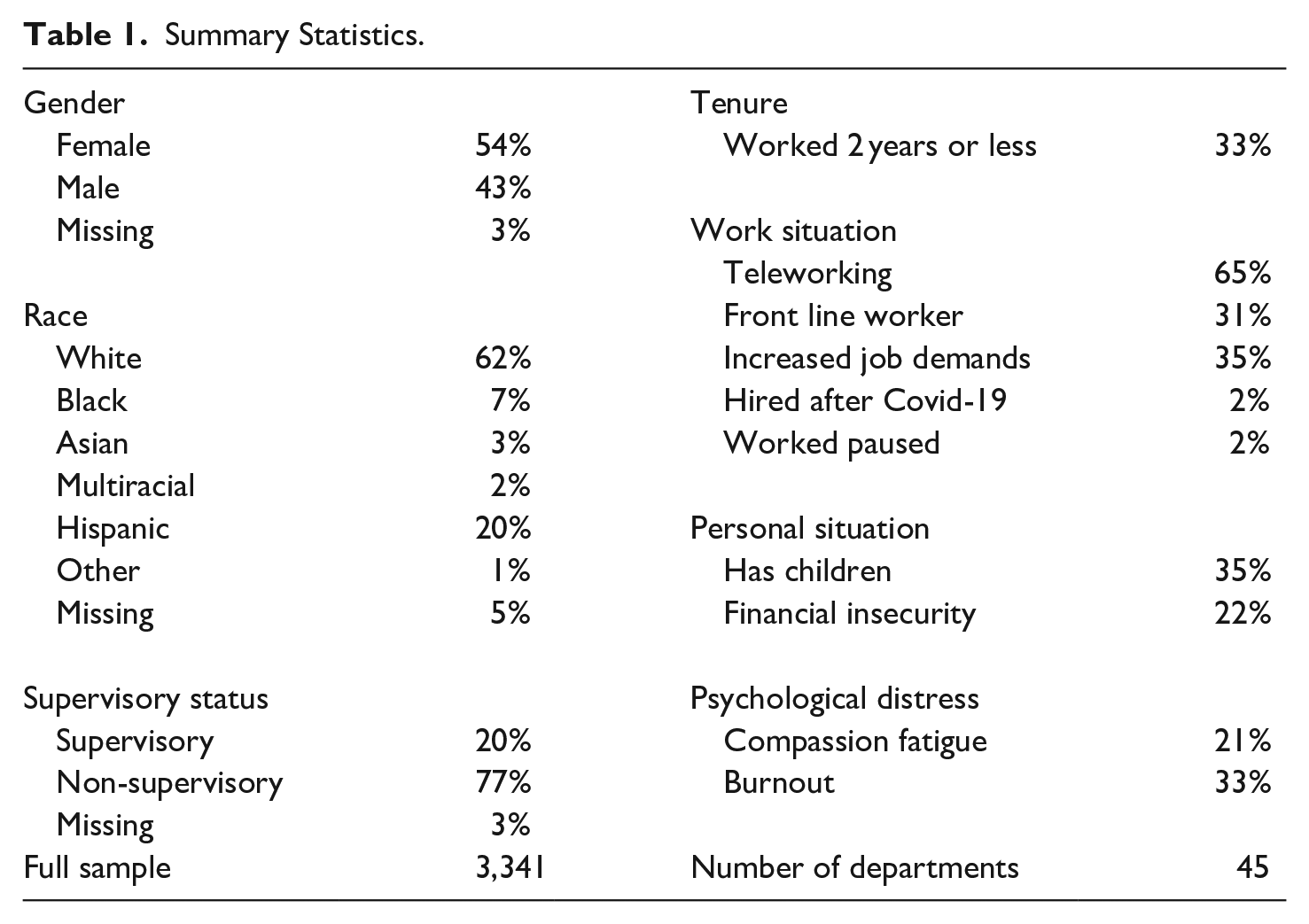
Given the importance of burnout and compassion fatigue as a challenge in the public sector, it is not only urgent to document the levels of psychological distress during this pandemic, but also to better understand what predicts higher or lower psychological distress, for individuals who are facing similar work conditions and job demands. In this article, we do both. We report on the results of surveys of government workers (total n = 3,341) across multiple state and local government departments, documenting public servants’ state of mind during the (first) height of the COVID-19 crisis. First, we document alarmingly high rates of burnout (33%) and compassion fatigue (21%) among government workers across the board. While there are very few studies that consider burnout and compassion fatigue in such a wide range of local government positions, the rates we report are 122% and 34% higher than what previous studies have found for some of the most burnt-out professions, such as social workers (Adams et al., 2006).
Second, we explore the conditions under which a public servant is likely to be at risk of higher psychological distress during this period of crisis. To date, public administration scholars have leaned heavily on the Job Demands-Resources (JD-R) model to categorize predictors of burnout and compassion fatigue. This framework argues that high job demands may lead employees to experience chronic stress, fatigue, and ultimately, burnout. But job resources, such as social support or having opportunities for growth and development at work, can directly reduce stress or buffer against the risk of burnout in the future (Bakker & Demerouti, 2017; Hakanen et al., 2005, Demerouti et al., 2001).
We extend the JD-R model and posit that public servants’ psychological distress will not only be associated with high job demands and low job resources but will also depend on government workers’ perceptions of themselves and others. Specifically, we formalize three channels that may predict mental health during crises: how public servants view their own role as public servants; how they view their co-workers; and how they view the beneficiaries they serve.
First, we find that public servants’ perception of their own role in government is highly predictive of mental health outcomes. While broader public service motivation (PSM) is not significantly associated with psychological distress, those employees who view government as the place where one can make the biggest difference report lower levels of compassion fatigue and burnout. Conversely, those employees who are uncertain about whether they belong in public service report higher levels of burnout. The association between psychological distress and public servants’ perceptions of their co-workers operates on two dimensions. We find public servants who perceive their co-workers and supervisors as professional and competent, respectively, also report lower levels of psychological distress. Last, we document a strong association between how public servants view beneficiaries and their levels of burnout and compassion fatigue. Those public servants who attribute poverty to systemic factors, such as lack of opportunities in society, as opposed to individual factors, such as laziness or lack of willpower, report higher average levels of psychological distress during this crisis. This is deeply linked to beliefs about beneficiary deservingness in our sample as the given employees are providing unemployment benefits to those who have lost their jobs. In a horse-race of these three dimensions, perceptions of one’s own role as a public servant have the strongest negative association with psychological distress, compared to perceptions of co-workers and beneficiaries.
The findings of this article have significant theoretical and empirical implications. First, our findings suggest that psychological distress in the government workforce during the COVID-19 pandemic may have broader and more long-lasting consequences than what the current emphasis on health-care workers and a small group of front-line workers would imply. The levels of compassion fatigue and burnout across state and local government agencies are likely to contribute to an already growing human capital crisis in the public sector, where high early turnover and persistent staffing shortages threaten to reduce the quality of public service delivery (Califf & Brooks, 2020; Kim & Stoner, 2008). Second, our theoretical extension of the JD-R framework may be useful for scholars studying decision-making and bureaucratic discretion beyond a crisis situation. Specifically, our findings highlight new avenues for research on how reframing public servant perceptions of themselves and others could change decision-making or improve retention in the public sector.
Predicting Psychological Distress in the Public Service
High employee burnout and compassion fatigue are widely documented in a range of humanitarian crises and emergencies (e.g., Chatzea et al., 2018; Kroll et al., 2021; Naturale, 2007). Yet, even outside of crisis situations, the levels of psychological distress in the public service can be particularly high, especially for those whose job involves secondary trauma. Previous studies have documented burnout rates of 15% for social workers, 43% for 911 dispatchers, and 76% for medical residents (Adams et al., 2006; Linos et al., 2021; Shanafelt et al., 2002). Additionally, 53% of correctional officers screen positively for PTSD, and up to 35% of child welfare workers report symptoms of vicarious trauma (Jaegers et al., 2019; Middleton & Potter, 2015).
In this article, we explore predictors for two specific forms of psychological distress: compassion fatigue and burnout. Compassion fatigue is defined as the “the stress resulting from helping or wanting to help a traumatized or suffering person” (Figley, 1995, p. 7). Burnout is a work-related syndrome characterized by emotional exhaustion, depersonalization, and reduced personal accomplishment (Maslach et al., 2001).
Over the past four decades, a rich literature has documented predictors of psychological distress, both in relation to individual characteristics and work environments. For example, we know that burnout and compassion fatigue are negatively related to tenure and age (Boyas et al., 2013), likely to be higher for women (McLean et al., 2011), and likely to be under-reported for people of color (Snowden, 1999, 2001).
What is perhaps most relevant in a crisis context, however, is a line of scholarship that analyzes how the same people can fare worse (or better) under different work conditions. The JD-R model posits that high job demands—any part of the job that requires sustained physical or psychological effort such as high workload, irregular working hours, or psychologically demanding interactions with beneficiaries—can create strain that increases the risk of exhaustion (Bakker & Demerouti, 2017; Hakanen et al., 2005). In crises like the COVID-19 pandemic, job demands increase in two ways. First, for front-line workers who were serving low-income populations, the direct surge in the number of beneficiaries significantly increased workload and the likelihood of interacting with people in severe personal distress. For instance, agencies that process unemployment insurance, such as the Employment Development Department of the State of California (2020), saw a 293.5% increase in initial claims in December 2020 relative to the 2019 caseload.
Second, job demands may increase when job responsibilities change rapidly. We conceptualize a sudden change in job responsibilities as an increase in job demands, because—like other job demands—sustained cognitive or emotional effort is required to fulfill new responsibilities in a rapidly changing environment. For example, when social workers who were accustomed to working in child welfare are re-deployed to staff new homeless shelters, we expect burnout to be higher. When in-person interactions now must quickly shift to an online virtual environment, we also expect burnout to be higher. While measuring the increase in beneficiaries served is outside the scope of this article, we hypothesize that psychological distress will be higher for those employees who saw an increase in workload, namely workers who remained on the front line during this period and those whose work responsibilities changed.
Hypothesis 1a (H1a): Public servants whose job responsibilities changed during the COVID-19 pandemic will report higher levels of burnout and compassion fatigue than public servants whose work responsibilities did not change during the crisis.
Hypothesis 1b (H1b): Public servants who served on the front line of the COVID-19 pandemic will report higher levels of burnout and compassion fatigue than public servants who did not serve on the front line.
Although high job demands may predict exhaustion and strain, perhaps the most powerful component of the JD-R model is the prediction that job resources available to public servants may mitigate the risk of psychological distress either directly, by reducing stress, or through a buffering mechanism. Social support satisfies the basic human need for relatedness and can operate as a job resource because it can increase motivation and organizational commitment (Borst et al., 2019; Cohen & Wills, 1985; Eldor, 2018), while also enhancing self-efficacy (see enabling hypothesis in Benight & Bandura, 2004).
While many scholars theorize that social support at work should operate as a buffer against burnout and compassion fatigue, the empirical evidence is mixed, and depends on varying definitions of social support (Feeney & Collins, 2001; Kaul & Lakey, 2003; Kristensen et al., 2005). A closer look at the literature suggests that it is not receiving support, or enacted social support, that improves mental health outcomes. Rather, perceived social support is more predictive of better mental health outcomes. That is, the belief that your co-workers and supervisors care about your wellbeing, and that you would have someone to turn to, should you need them, seems to be more predictive of improved mental health outcomes (Linos et al., 2021; Prati & Pietrantoni, 2010; Shrout & Bolger, 2002). As such, we focus on perceptions of co-workers and supervisors that are unrelated to enacted or direct support. We hypothesize that, during a crisis, public sector employees who think their co-workers and supervisors care about them and that they could turn to them if needed, will report lower levels of psychological distress. This matches the “buffering” hypothesis of the JD-R model (Bakker et al., 2005).
Hypothesis 2a (H2a): Perceiving social support in the workplace is associated with lower levels of burnout and compassion fatigue.
Hypothesis 2b (H2b): Perceiving supervisory support in the workplace is associated with lower levels of burnout and compassion fatigue.
Extending the JD-R model: Perceptions of self and others
While the JD-R model provides a particularly useful framework for exploring the impact of job demands and job resources on psychological distress, we posit that there is a third dimension that may predict psychological distress in times of crisis: how public servants perceive themselves and others. In a crisis, a public servant may question whether they are the kind of person who should be working in government; whether government can make a difference at all; whether their co-workers and supervisors are as committed to the cause as they are; or whether the people served are deserving of the extra time and effort required to serve them. Any perceived uncertainty about these factors may be associated with additional cognitive and emotional strain that leads to compassion fatigue and burnout. Conversely, perceptions of belonging, either to the public service more broadly or to a given team, may buffer against burnout by strengthening employees’ sense of self-efficacy and personal accomplishment.
Perceptions of one’s own role as a public servant
A long literature on public service motivation (PSM), the Attraction-Selection-Attrition (ASA) model, and person-organization fit (P-O fit) notes that public servants who report higher levels of PSM also report higher engagement, higher extra-role performance, and are more likely to find themselves in government (Andersen et al., 2014; Bellé, 2013; Wright & Christensen, 2010). More specifically, a rich literature reports high values congruence between public servants and public sector organizations: public servants are more likely to be attracted to public policy making, show a strong commitment to the public interest, be willing to self-sacrifice to serve others and make a difference in society (e.g., Perry et al., 2010).
However, in a world where the government does not have a “monopoly” on social impact; that is, in a world where other sectors also emphasize serving the community and can attract employees with high PSM, it is unclear if PSM alone can predict who feels like they belong in government (Andersen et al., 2011; Boyd et al., 2018; Bright, 2008). For example, employees who work in non-profits and social enterprises also report high levels of PSM (Bright, 2016; Christensen & Wright, 2011).
A narrower definition of PSM, one that sees government specifically as the place to serve, may be a necessary prerequisite for increased motivation in government when job demands are very high. That is, for public sector workers who already perceive themselves as motivated by public service and will report high levels of PSM, believing that government is where service occurs may translate into a perception that they are where they need to be, buffering them against the stressors of a crisis. For example, the compassion satisfaction literature notes that feeling like you are effectively helping those in need and reflecting on the impact you are having, protects against the psychological cost of being exposed to their pain and emotional distress (Butler et al., 2017; Cummings et al., 2021; Dehlin & Lundh, 2018). Analogously, perceiving the role of government as central to making a difference when you yourself are a government worker could reduce strain.
Hypothesis 3a (H3a): People who view government as the place to make a difference will report lower compassion fatigue and burnout during a crisis than those who do not.
A related perception that one “belongs” in public service may buffer government workers against the threat of adversity on their mental health. Research in education psychology suggests that being uncertain about whether one belongs increases stress (Walton & Cohen, 2007). Therefore, we hypothesize that more uncertainty about whether one belongs in public service will be positively associated with higher levels of compassion fatigue and burnout.
Hypothesis 3b (H3b): People who are uncertain about whether they belong in public service will report higher compassion fatigue and burnout.
Perceptions of co-workers and supervisors
Perceived professional competence is characterized by a commitment to carrying out professional responsibilities and an adherence to ethical principles. In a service delivery context, perceived professional competence is associated with trust that the professional will act in their beneficiaries’ best interest (Gillespie et al., 2009). We predict that perceiving co-workers and supervisors as competent and professional during a crisis will be negatively associated with psychological distress. This may be because feeling like part of a team of competent or professional public servants increases the sense of team self-efficacy or professional accomplishment, which should in turn reduce this dimension of burnout. Moreover, the perception that an employee can rely on the judgment of their colleagues to do what is best for beneficiaries may reduce compassion fatigue.
Hypothesis 4 (H4): Public servants who perceive their co-workers and supervisors as competent and professional are more likely to report lower levels of compassion fatigue and burnout.
Perceptions of beneficiaries
A long literature on “street-level bureaucrat” discretion documents the many choices that public servants make when they interact with beneficiaries, such as deciding who to prioritize or to whom to give extra leniency (Keulemans, 2021; Lipsky, 2010; Zacka, 2017). There is now a growing interest in understanding how street-level bureaucrats make those discretionary choices and how that relates to who they perceive to be most deserving of their time and attention (Jilke & Tummers, 2018; Keulemans & Van de Walle, 2020; Tummers, 2017; Tummers et al., 2015). What is less known is to what extent perceptions of broader beneficiary deservingness are associated with experienced psychological distress for the public servant. While a large literature documents the emotional toll faced by public servants whose job requires managing someone else’s distress (Adams et al., 2006; Maslach, 1978), do perceptions of beneficiary deservingness mitigate or exacerbate that emotional toll?
We hypothesize that front-line workers who attribute poverty mainly to systemic factors, such as lack of opportunities for development, as opposed to mainly to individual factors, such as people’s laziness or lack of willpower, are more likely to experience psychological distress when serving beneficiaries who are facing financial insecurity. We draw from the large literature on poverty attribution that shows that willingness to help is associated with the perceived morality of the receiver (Gilens, 1995; van Oorschot, 2000; Weiner et al., 2011). Under attribution theory, if beneficiaries are perceived as “to blame” for their situation, they are more likely to cause feelings of anger or neglect in public servants, whereas if they are perceived as “victims” (experiencing poverty through no fault of their own), they are more likely to elicit sympathy and willingness to help. In a crisis, when sympathy increases but the workload is such that not all who need help can be helped, this additional sympathy may increase the emotional strain of the work, leading the public servant to experience higher levels of burnout and compassion fatigue. As such, we hypothesize that front-line workers who attribute poverty to systemic factors are more likely to experience compassion fatigue and burnout when job demands are high.
Hypothesis 5 (H5): Public servants who believe that poverty is mainly due to systemic factors are more likely to report higher levels of compassion fatigue and burnout.
Setting and Methods
Setting
We tested the hypotheses outlined above in online surveys distributed to all government workers in one mid-sized city government in April 2020, and to one additional state government agency in May 2020. All full-time employees in the specific city government and state agency were invited to participate, as part of a larger survey project that includes other questions. Responding to the survey itself and to any specific question was voluntary. As such, while the number of people who responded to any given question varied (and is documented below in all summary tables and regression analyses), 44% of the city sample and 46% of the state agency sample responded to at least one question. Participants received the survey in two ways: the state government sent their employees an email with the link to the survey directly, whereas the city government sent an email explaining that researchers would send a link to the survey directly, and participants received a Qualtrics link immediately thereafter. For both the city and state government, we sent the survey three times (the initial time and two reminders). While most questions in the survey were quantitative, as described below, we also included some open-text survey questions. All survey participants were asked at the end of the survey whether there was anything else they wanted to share (n = 1,000 responses). In the state agency, we also asked what motivated them to join the government (n = 375 responses) and what worried them about being able to serve their clients well (n = 111 responses).
The composition of the surveyed sample in terms of demographic and work-related characteristics is displayed in Table 1 below.
Summary Statistics.
Methods
In our main models we estimate the association between public servant perceptions of themselves and others, and psychological distress outcomes, presenting average marginal effects of logistic regressions where the main outcomes are binary indicators for high burnout and high compassion fatigue, respectively. Due to survey space limitations, we were able to ask all questions in the state agency sample, but only a subset of questions in the city sample. Below we outline which questions were asked in both samples. In our main models, we also include demographic controls for gender, race and ethnicity, tenure, supervisory status, increased job demands, and front-line worker status. We use department fixed effects for the city sample and administrative region fixed effects for the state agency to capture time-invariant unobservable differences between departments or localized teams. In Supplemental Appendix I, we show that using OLS instead of a logistic regression does not meaningfully change the findings.
Our main outcomes are two measures of psychological distress: compassion fatigue and burnout. To measure these, we used the Compassion Fatigue Short Scale (CF-SS) (Gentry et al., 2002), which contains a compassion fatigue subscale with five questions and a job burnout subscale with eight questions. In the compassion fatigue subscale, a score of 15 or higher is indicative of vicarious trauma, whereas in the job burnout subscale a score of 30 or higher is indicative of burnout. Our main models use these predetermined binary cut-offs as outcomes, because they allow us to calculate a policy-relevant percentage of individuals who may need additional psychological support. In Supplemental Appendix I, we present substantively similar results where we regress the same predictors on the raw score of compassion fatigue and burnout.
To measure respondents’ increase in job demands, in line with Hypothesis 1, we use the following indicators. First, we asked respondents directly if their work responsibilities have changed and how, and created a binary variable where 1 accounts for employees who saw their work responsibilities change and 0 reflects employees whose work responsibilities did not. Second, we create a binary variable for “front-line worker” status, where 1 equals all non-supervisory roles in the state agency (as it was a beneficiary-facing agency) and all city employees who were given priority access to the COVID-19 vaccine, because their priority status was based on likelihood of interacting directly with beneficiaries.
To gauge perceived social support, in line with Hypothesis 2, we include a general measure of social support that could reflect relationships with any type of co-worker including peers and supervisors: “There is someone at work I can talk to about my day-to-day problems if I need to” (Richer & Vallerand, 1998). In the state agency only (n = 518), we included a more specific measure of lack of supervisory support: “My direct supervisor shows very little interest in the feelings of subordinates,” which is reverse-coded.
To measure respondents’ self-perceptions about their role in government, in line with Hypothesis 3, we ask three questions. The first, selected from Perry and Wise (1990)’s Public Service Motivation Scale asks: “Meaningful public service is very important to me.” In line with our hypothesis that a commitment to government will operate differently than broader PSM, we ask: “Government is the best place for those who want to do public service.” The first and second measures were only asked in the state agency (n = 518). Last, we capture if respondents are uncertain about whether they belong in public service by adapting a question from Walton and Cohen (2007): “When something bad happens, I feel that maybe I don’t belong in public service.” All questions are measured on a 5-point Likert Scale, that ranges from Strongly Disagree to Strongly Agree.
To measure respondents’ perceptions of their co-workers and supervisors, in line with Hypothesis 4, we adapted measures of organizational professionalism (Mowday et al., 1979; Wright et al., 2006) in the state agency only (n = 518). We included a measure of supervisor competence: “My direct supervisor is competent at doing his or her job” and a measure of commitment to professionalism, which we consider a form of competence in co-workers: “There is a commitment to professionalism at all levels of this organization.” All questions are measured on a 5-point Likert Scale, that ranges from Strongly Disagree to Strongly Agree.
In the state agency only, we are also able to capture how front-line workers perceive beneficiaries in line with Hypothesis 5. To do so, we use a measure of poverty attribution validated in the World Values Survey that asks where the respondents’ views would be placed, on a scale from 1 to 10, where 1 denotes agreement with the statement “People are poor because of laziness and lack of willpower” and 10 denotes agreement with the statement “People are poor because of an unfair society.”
To analyze the relative importance of each type of perception measured as a predictor of psychological distress, we created three indices that reflect an overall score of the perception of one’s one role as a public servant, the perception of peers and supervisors, and the perceptions of beneficiaries. We averaged the responses to the statements pertaining to each category of perception, reversing the ones that went in a negative direction, so that overall, higher values are indicative of positive outcomes.
Empirical Results
We find high overall rates of burnout (33%) and compassion fatigue (21%) among government workers during the COVID-19 pandemic. These rates look statistically similar across the city and state sample and match what employees say themselves in open-text responses. As a white female front-line worker shares, “it is hard to handle [clients’] fear and anger all day long when we are dealing with a lot of anxiety and stress of our own.” A Hispanic female respondent shares: “I can’t do a good job of supporting the people I’m serving when I can barely support my family’s well-being and my own.”
To explore Hypothesis 1, Table 2 presents the association between psychological distress, demographic characteristics, tenure, and nature of work.
Demographic and Job Characteristics as Predictors of Psychological Distress.
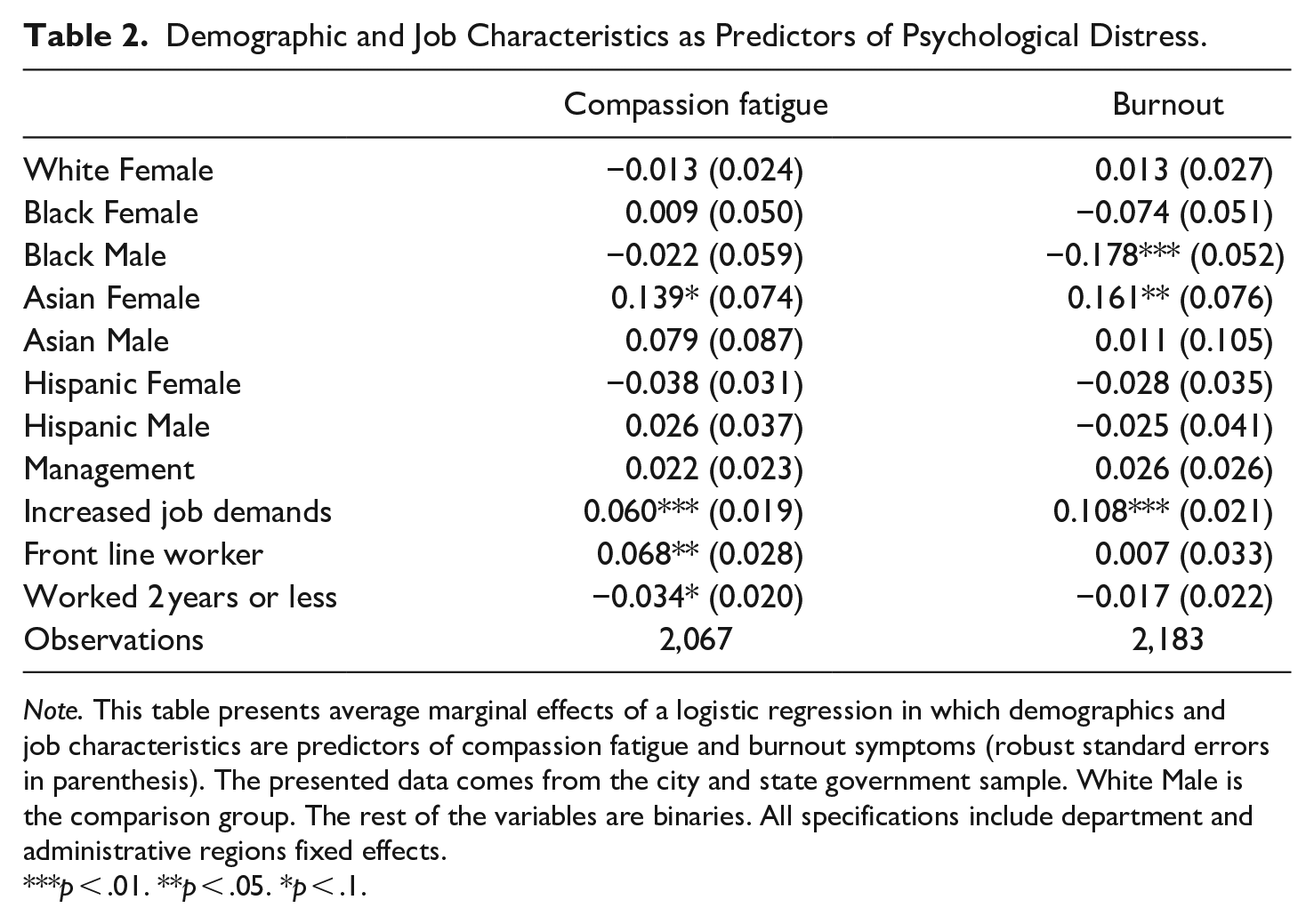
Note. This table presents average marginal effects of a logistic regression in which demographics and job characteristics are predictors of compassion fatigue and burnout symptoms (robust standard errors in parenthesis). The presented data comes from the city and state government sample. White Male is the comparison group. The rest of the variables are binaries. All specifications include department and administrative regions fixed effects.
p < .01. **p < .05. *p < .1.
Compared to white men, Black men report lower levels of burnout and Asian women report higher levels of burnout and compassion fatigue. The finding on Black men is not new: African Americans are less likely to report worse mental health outcomes (Conner et al., 2010; Snowden, 1999, 2001), and this may be due to differences in reporting, rather than underlying differences in mental health. What is less common outside of the context of the current pandemic is a level of burnout for Asian employees that is higher than that reported for white employees (Garcia et al., 2020; Primack et al., 2010). This may be related to the xenophobia and racism against Asian Americans that was significantly more pronounced during the early months of the COVID-19 pandemic (Darling-Hammond et al., 2020; Dhanani & Franz, 2020). In line with Hypothesis 1, those with higher job demands report higher and statistically significant levels of both psychological distress measures. Front-line workers report higher levels of compassion fatigue, which is consistent with the time and effort they invest in attending to the needs of highly distressed populations, but they do not report statistically higher burnout levels.
To explore Hypothesis 2, Table 3 presents the relationship between perceived support and psychological distress. Feeling like there is someone to turn to at work is associated with a 15.7 percentage-points lower likelihood of experiencing burnout (−0.16 standard deviations, p < .01). Conversely, perceived lack of support from supervisors is associated with higher levels of psychological distress on all measures, and for burnout we observe a strong association: if a respondent agrees that supervisors do not care about the interests of their subordinates, they are 26.2 percentage-points more likely to be experiencing burnout (0.18 standard deviations p < .01). The magnitude of the relationship between social support and burnout is larger in the city sample relative to the state sample. For employees in the city government, perceived social support from co-workers is associated with 17.7 percentage-points lower likelihood of experiencing burnout (−0.18 standard deviations, p < .01), whereas for employees at the state government, the relevant coefficient is 4.7 percentage-points and not statistically significant (−0.04 standard deviations). In open text-responses, survey respondents often turn to perceptions of co-workers and supervisors to explain their levels of stress. A white male who has been working at the agency for more than 16 years shares that their “issues at work do not emanate from COVID-19; they emanate from my supervisors.” Another respondent, a white female, states that their “supervisor has made little effort in helping our team feel connected to one another while working from home.” Last, another white female expresses that she feels “alone and unseen.”
Perceived Social and Supervisory Support as Predictor of Psychological Distress.
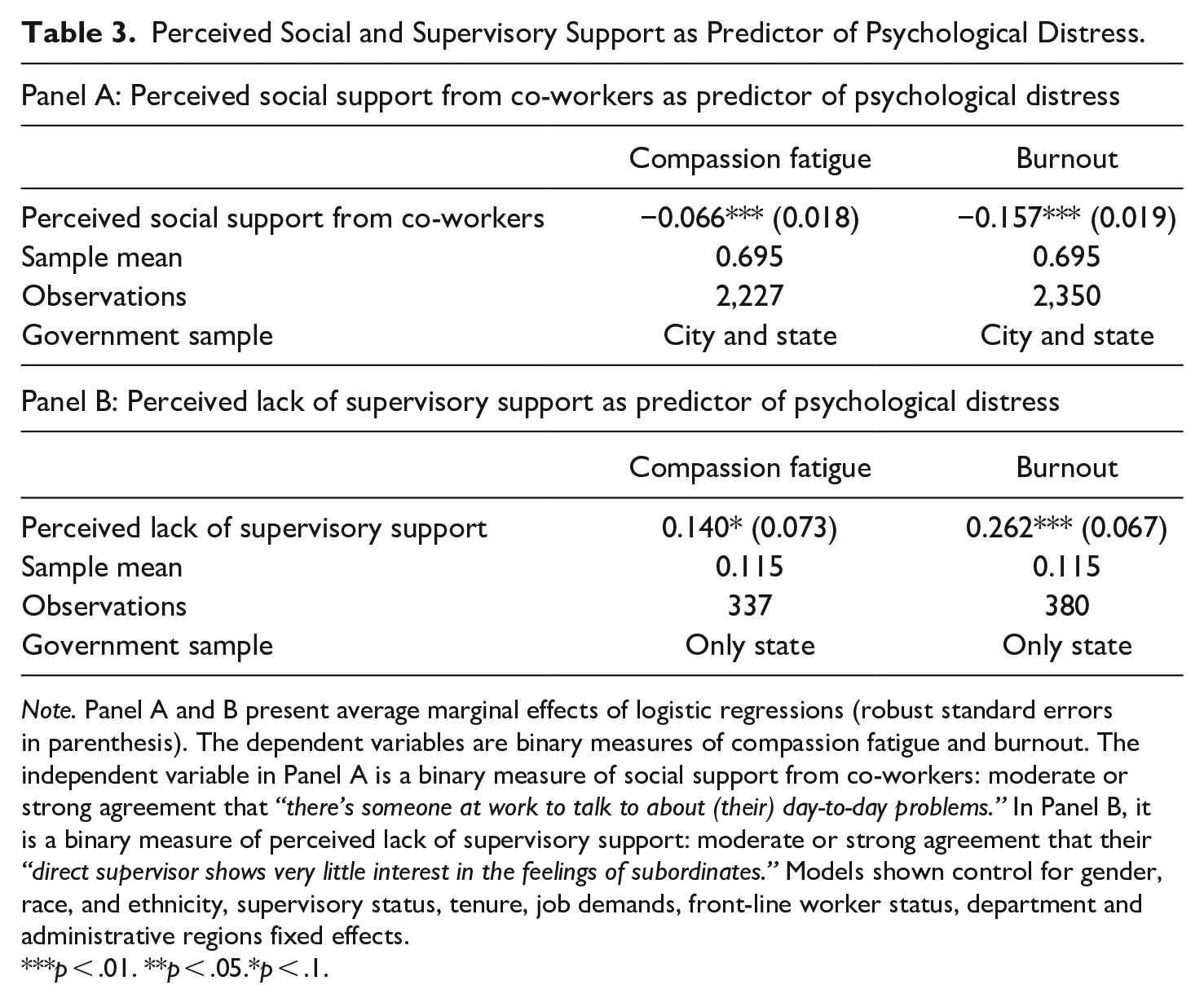
Note. Panel A and B present average marginal effects of logistic regressions (robust standard errors in parenthesis). The dependent variables are binary measures of compassion fatigue and burnout. The independent variable in Panel A is a binary measure of social support from co-workers: moderate or strong agreement that “there’s someone at work to talk to about (their) day-to-day problems.” In Panel B, it is a binary measure of perceived lack of supervisory support: moderate or strong agreement that their “direct supervisor shows very little interest in the feelings of subordinates.” Models shown control for gender, race, and ethnicity, supervisory status, tenure, job demands, front-line worker status, department and administrative regions fixed effects.
p < .01. **p < .05.*p < .1.
Public Servants’ Perceptions of Their Own Roles as Public Servants
Like many studies before ours, the public servants in our sample report high levels of PSM. Table 4 presents the relationship between perceptions about one’s role in public service and psychological distress as per Hypothesis 3. In our sample, 90% moderately or strongly agreed that meaningful public service was important. In open-text responses to a question on what motivates them to work in government, they say they want to “be of service,” “help others succeed,” “work for a good cause,” “work doing something I strongly believe in,” and “work on something I can be proud of.” As a white female front-line worker notes, “I have always worked in service-oriented activities. What drew me to my current job was not being a part of the government, but helping people get back to work.”
Perception of One’s Role in Public Service as Predictor of Psychological Distress.
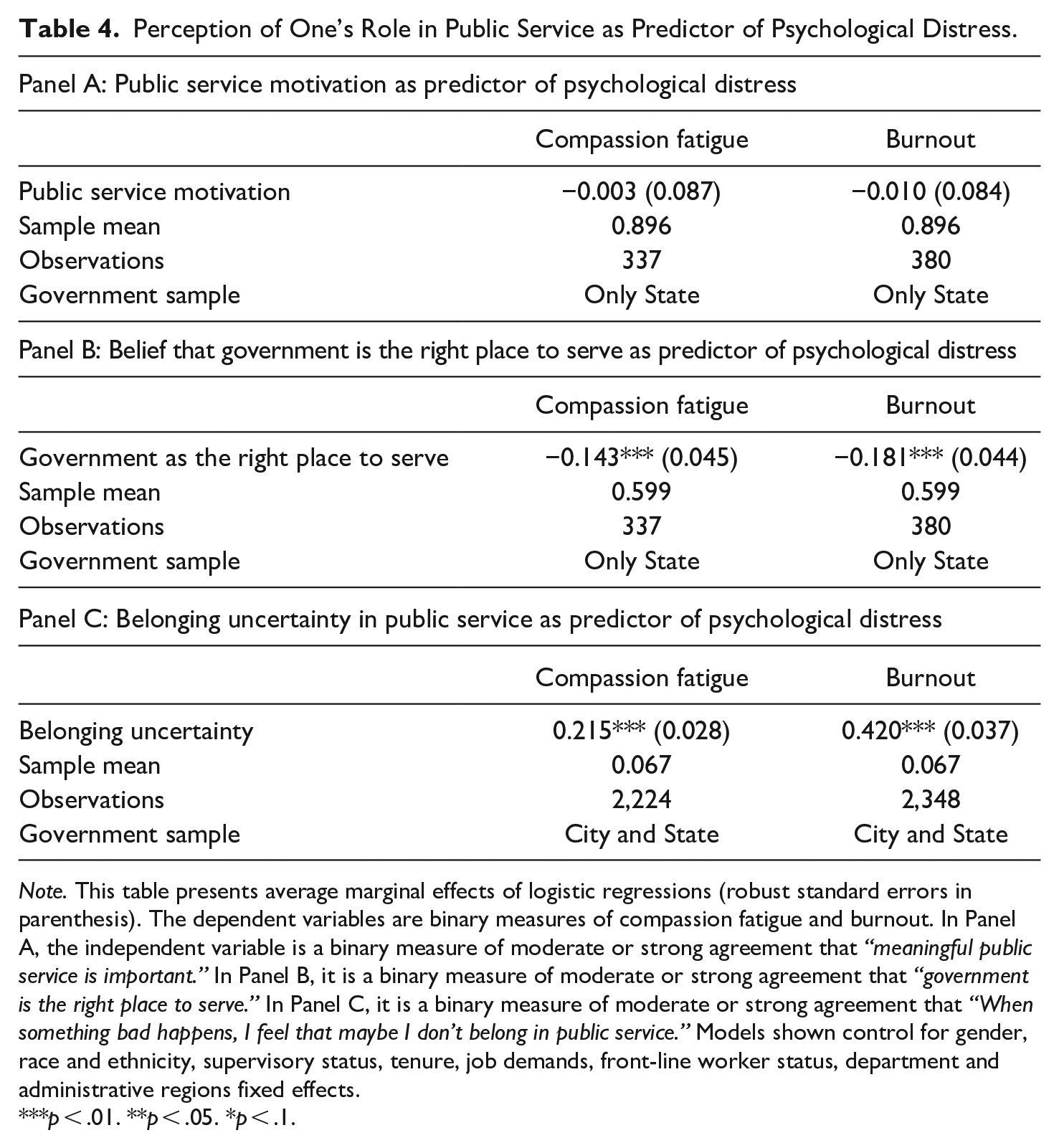
Note. This table presents average marginal effects of logistic regressions (robust standard errors in parenthesis). The dependent variables are binary measures of compassion fatigue and burnout. In Panel A, the independent variable is a binary measure of moderate or strong agreement that “meaningful public service is important.” In Panel B, it is a binary measure of moderate or strong agreement that “government is the right place to serve.” In Panel C, it is a binary measure of moderate or strong agreement that “When something bad happens, I feel that maybe I don’t belong in public service.” Models shown control for gender, race and ethnicity, supervisory status, tenure, job demands, front-line worker status, department and administrative regions fixed effects.
p < .01. **p < .05. *p < .1.
However, only 60% moderately or strongly agreed that the government was the right place for public service. In line with our hypotheses, viewing government as the right place to serve is significantly and consistently associated with lower psychological distress. Beyond statistical significance, the magnitude of this relationship is striking: believing that government is where people should do public service is associated with a 18.1 percentage-point lower likelihood of experiencing burnout during a crisis (−0.20 standard deviations, p < .01), and 14.3 percentage-point lower likelihood of experiencing compassion fatigue (−0.17 standard deviations, p < .01).
Given that everyone in our sample currently works for the government, asking whether the government is the right place to serve is equivalent to asking respondents if they believe they are in the right sector to make a difference in society. The converse is also true: those who are uncertain about whether they belong in public service report significantly higher levels of burnout and compassion fatigue. There are no significant differences between the city and state sample in terms of the relationship between belonging uncertainty and compassion fatigue or burnout.
Perceived Competence in Co-Workers and Supervisors
Table 5 illustrates the relationship between perceived competence of co-workers and supervisors, and psychological distress, in line with Hypothesis 4. Perceived competence of co-workers is strongly associated with lower burnout, but there is no significant association with compassion fatigue. This is reasonable, given that compassion fatigue aims to capture a relationship with beneficiaries. Specifically, perceiving competence at all levels of the organization is associated with 18.6 percentage-points lower likelihood of experiencing burnout (−0.19 standard deviations, p < .01). Additionally, perceived competence of supervisors is negatively associated with both measures of psychological distress, but only significantly so in reported burnout. In this case, perceiving your direct supervisor as competent is associated with 15.1 percentage-points lower likelihood of experiencing burnout (−0.14 standard deviations, p < .01).
Perception of Co-Workers and Supervisors as Competent as Predictors of Psychological Distress.
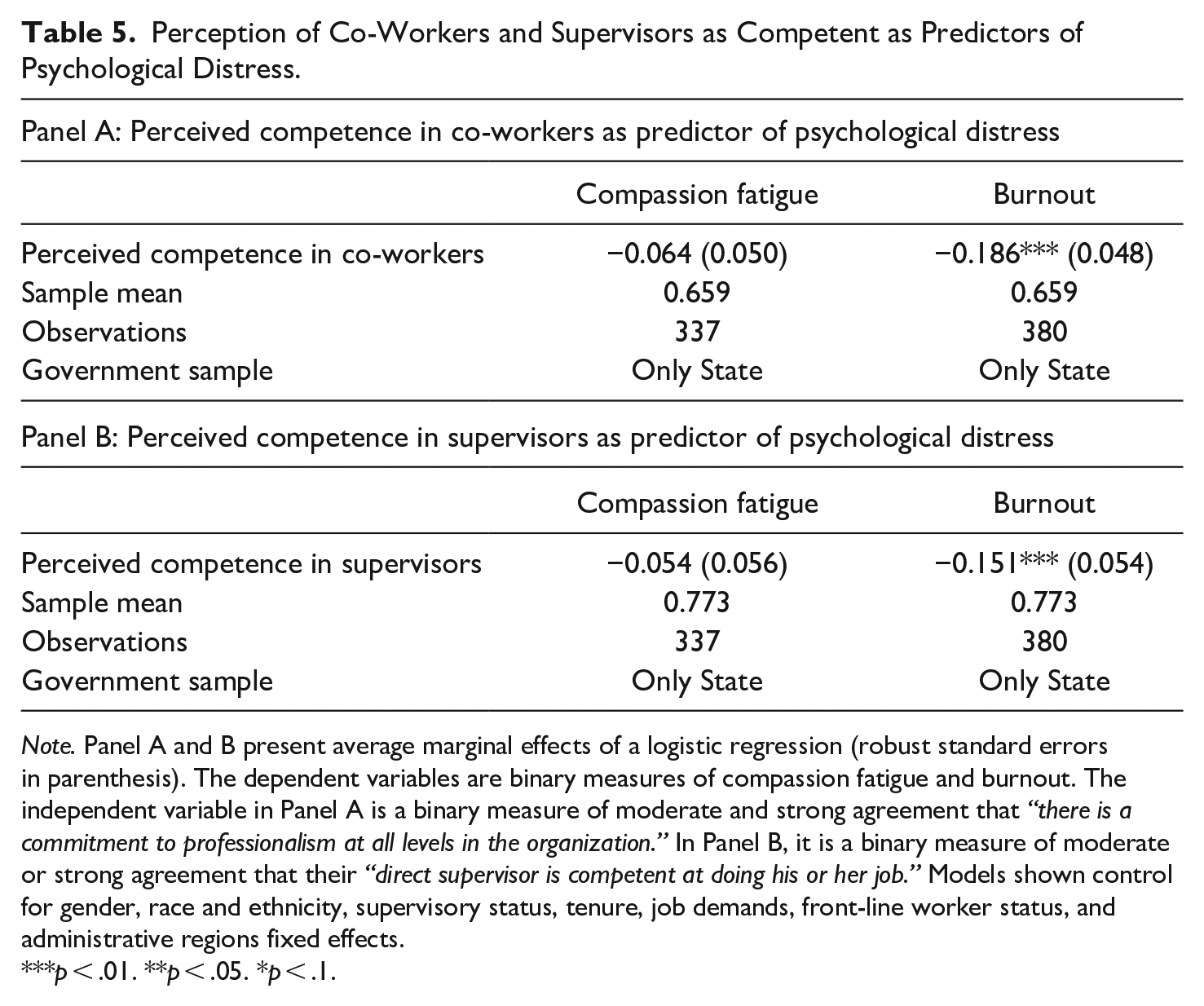
Note. Panel A and B present average marginal effects of a logistic regression (robust standard errors in parenthesis). The dependent variables are binary measures of compassion fatigue and burnout. The independent variable in Panel A is a binary measure of moderate and strong agreement that “there is a commitment to professionalism at all levels in the organization.” In Panel B, it is a binary measure of moderate or strong agreement that their “direct supervisor is competent at doing his or her job.” Models shown control for gender, race and ethnicity, supervisory status, tenure, job demands, front-line worker status, and administrative regions fixed effects.
p < .01. **p < .05. *p < .1.
Perceptions of Beneficiaries
Table 6 presents the relationship between poverty attribution and psychological distress in line with Hypothesis 5. Attributing poverty to systemic causes is associated with higher compassion fatigue and burnout during this period. For each additional unit-score in the direction of agreeing that poverty is due to systemic factors, we observe a 3.8 percentage-point higher likelihood of experiencing compassion fatigue during crises (p < .01) and 2.8 percentage-point higher likelihood of experiencing burnout (p < .05). Put differently, one standard deviation increase in perceiving poverty as systemic is associated with 8 percentage-point higher likelihood of compassion fatigue and 6.5 percentage-points higher likelihood of burnout.
Poverty Attribution as Predictor of Psychological Distress.
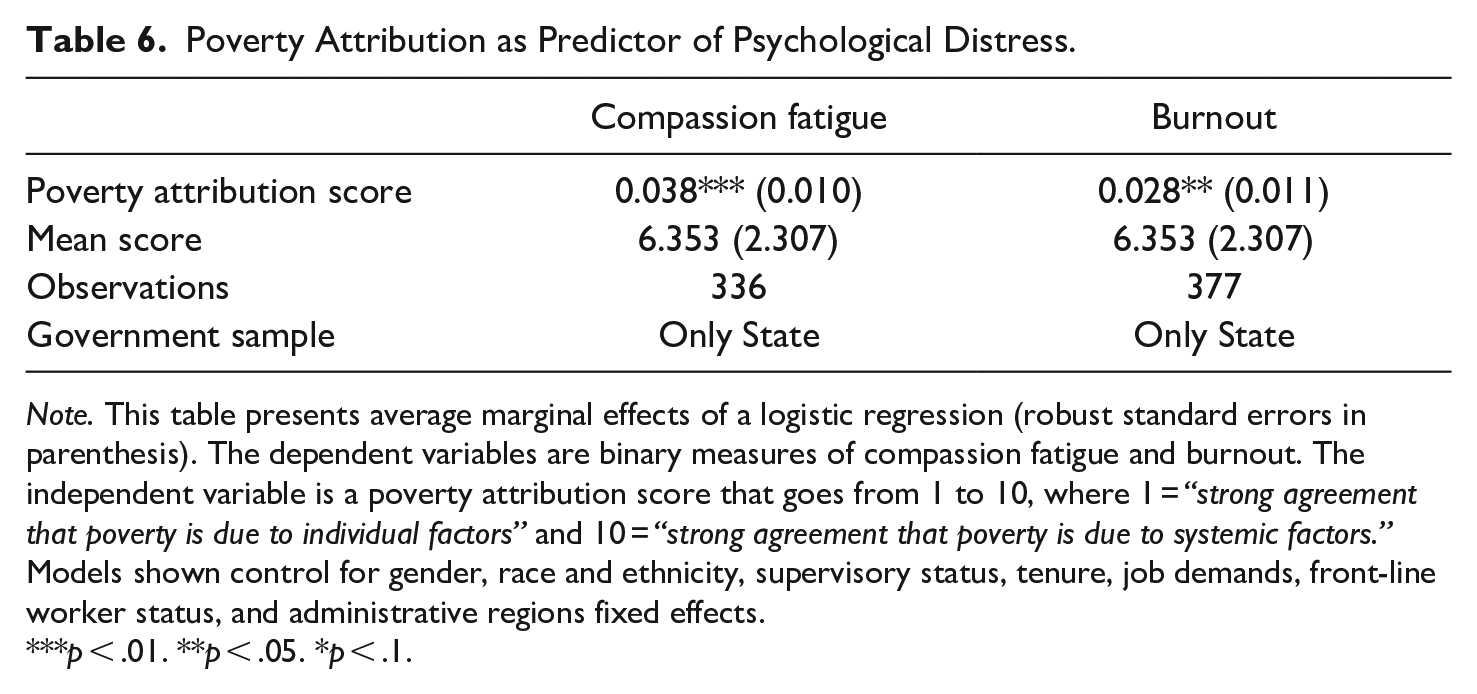
Note. This table presents average marginal effects of a logistic regression (robust standard errors in parenthesis). The dependent variables are binary measures of compassion fatigue and burnout. The independent variable is a poverty attribution score that goes from 1 to 10, where 1 = “strong agreement that poverty is due to individual factors” and 10 = “strong agreement that poverty is due to systemic factors.” Models shown control for gender, race and ethnicity, supervisory status, tenure, job demands, front-line worker status, and administrative regions fixed effects.
p < .01. **p < .05. *p < .1.
One female front-line worker shared about her beneficiaries that “their needs are through the roof. I am only one person. . .I cannot help them all. There are too many needing help.”
We also observe that perceptions of government workers about beneficiaries vary by demographics. Compared to white men, Black employees are much more likely to attribute poverty to systemic factors, while Asian employees are more likely to attribute poverty to individual-level factors, although the association is not statistically significant. Interestingly, managers are more likely to attribute poverty to systemic factors. Controlling for these factors in our main model does not meaningfully change the association between poverty attribution and psychological distress.
The Relative Importance of Different Perceptions on Psychological Distress
The hypotheses and empirical results point to an important role of public servant perceptions in predicting compassion fatigue and job burnout during this crisis. Public servants’ perception of one’s own role, perceptions of co-workers, and perceptions of beneficiaries, each predict psychological distress. Table 7 runs a “horse-race” of each of these types of perceptions to estimate their relative importance on psychological distress, by putting all perceptions in the same model.
Relative Importance of Different Types of Perceptions as Predictors of Psychological Distress.
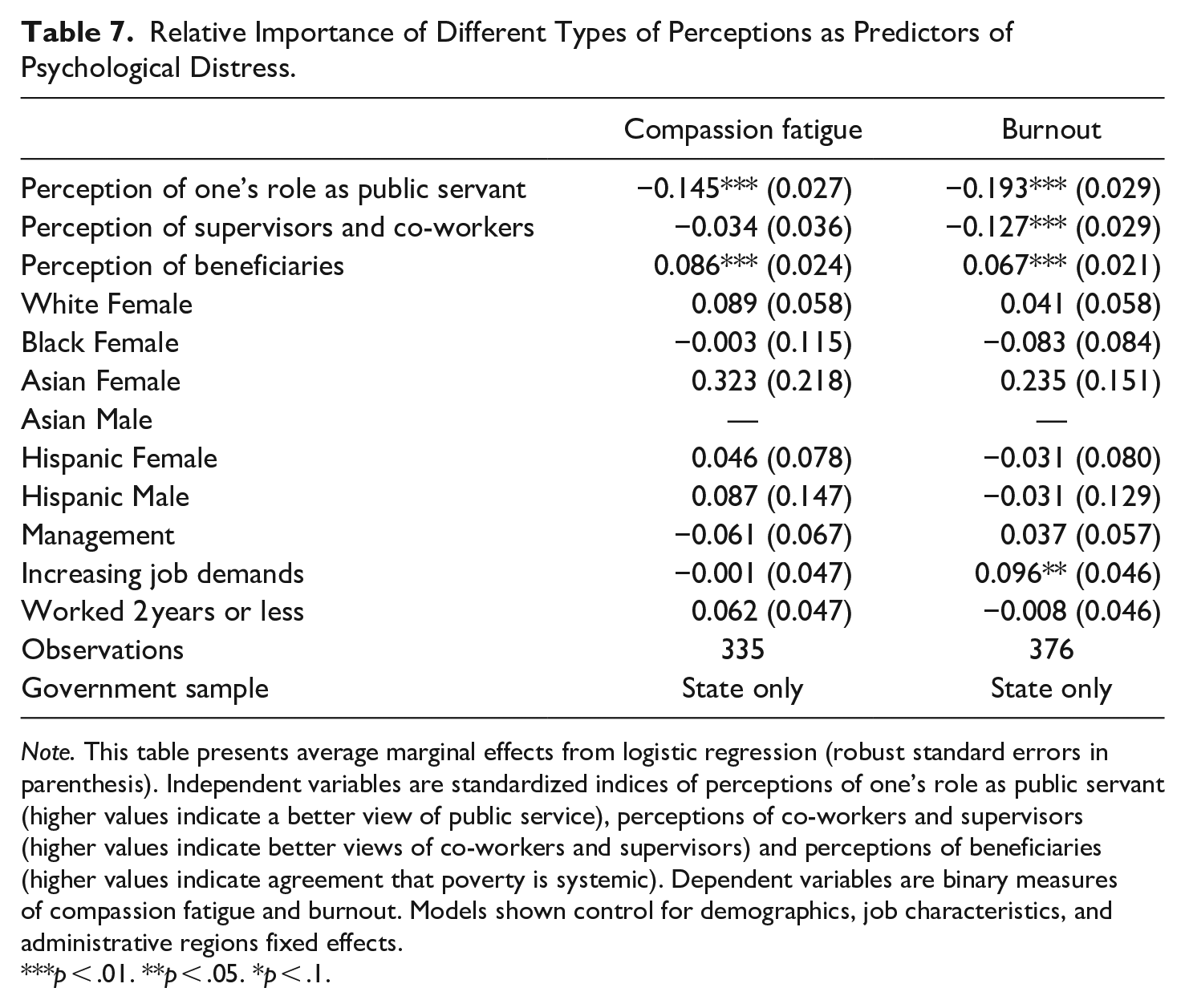
Note. This table presents average marginal effects from logistic regression (robust standard errors in parenthesis). Independent variables are standardized indices of perceptions of one’s role as public servant (higher values indicate a better view of public service), perceptions of co-workers and supervisors (higher values indicate better views of co-workers and supervisors) and perceptions of beneficiaries (higher values indicate agreement that poverty is systemic). Dependent variables are binary measures of compassion fatigue and burnout. Models shown control for demographics, job characteristics, and administrative regions fixed effects.
p < .01. **p < .05. *p < .1.
Perceptions of one’s own role as a public servant have the strongest negative association with psychological distress, especially with regards to burnout. Perceptions of competence in supervisors and co-workers shows no association with compassion fatigue, but shows a strong negative association with burnout. Conversely, perceptions of beneficiaries are more strongly associated with compassion fatigue than overall job burnout, but overall magnitudes are smaller than perceptions of self.
Discussion
The COVID-19 pandemic provides an opportunity to study a phenomenon that is more far-reaching than the pandemic itself: public servants’ mental health in times of crises. Using a sample of over 3,341 public servants at the beginning of the COVID-19 pandemic, we extend the Job Demands-Resources (JD-R) model to document how three separate channels may affect psychological distress among public servants: how public servants view their own role; how they view their co-workers and supervisors; and how they view the beneficiaries they serve.
We find public servants’ perception of their own role in government is highly predictive of psychological distress. Those public servants who view government as the place where one can make the biggest difference report lower levels of all measures of psychological distress. Perceiving co-workers and supervisors as competent is protective against compassion fatigue and burnout. Public servants’ perceptions of the beneficiaries they serve can also be predictive of their psychological distress. Attributing poverty to systemic factors (relative to individual factors) is positively associated with higher levels of compassion fatigue and burnout. In a horse-race that measures relative predictive power of each of these dimensions, perceptions of self have the largest effect on compassion fatigue and job satisfaction, compared to perceptions of others.
This study also has some important limitations. First, this is a correlational study where each participant is only surveyed once. While we see important associations, we cannot make causal claims about the direction of these relationships. For instance, it is possible that reframing public servants’ perceptions could mitigate the risk of psychological distress. It is equally possible that employees who already have better coping strategies to manage their own mental health are also the kinds of employees who view their own ability to make a difference through government differently. Second, the data were collected through a voluntary survey and we were limited in how many questions we could ask in each case. This creates some risk of mono-method bias in some of our constructs. Moreover, while we capture a wide distribution of government workers overall, response bias may limit the generalizability of our results.
Ultimately, however, our findings have both theoretical and policy significance, opening the door for future research in this area. First, we bring together relevant literature from public management, organizational psychology, and behavioral science to extend the J-DR model. We hope that future research will explore how perceptions of self and others can influence other important outcomes beyond mental health, including bureaucratic discretion and turnover. For instance, if perceptions about whether the government is the place to make a difference matter for mental health outcomes, they likely also influence retention patterns. Importantly, by bringing in perceptions of self and others into frameworks on mental health, we hope to encourage future research that aims to understand how changes to perceptions of others causally influence mental health outcomes.
Second, we show that public servants with a more holistic view of the systemic causes of poverty are also the ones who find it more emotionally challenging to cope with their beneficiaries’ distress. This has significant policy implications in who we choose to recruit and how we support public servants with this profile in staying. If a better understanding of systemic causes of poverty makes for “better” service delivery, then our research points to a potential red flag: neglecting the mental health consequences of hiring and training public servants to see poverty as systemic may lead to higher levels of turnover in the future. Conversely, public servants who believe beneficiaries are experiencing hardship through their own doing (e.g., lack of willpower or laziness) may not be the kind of public servants that many agencies are trying to attract, but they may be more likely to stay. We leave it to future research to explore whether there is causality in this relationship, and whether higher levels of compassion fatigue and burnout are also indicative of lower-quality interactions with beneficiaries.
Third, the descriptive findings suggest that policymakers will need to invest significant resources into their workforce’s mental health after this pandemic. Although much has been written about the toll of the pandemic on health workers and other essential workers, our findings suggest that the alarming rates of psychological distress are widespread. This suggests a potentially looming crisis not only in terms of public sector retention but also in terms of equitable service delivery. A re-commitment to investments in the government workforce as part of a broader post-pandemic strategy will be critical in ensuring that public service does not harm the public servant. As a female front-line worker from our sample shared: “I am in my favorite job. Is the unknown scary? Sure it is, but I feel connected to a division that will be part of the answer to help our communities sustain.”
Supplemental Material
sj-docx-1-rop-10.1177_0734371X221081508 – Supplemental material for When Perceptions of Public Service Harms the Public Servant: Predictors of Burnout and Compassion Fatigue in Government
Supplemental material, sj-docx-1-rop-10.1177_0734371X221081508 for When Perceptions of Public Service Harms the Public Servant: Predictors of Burnout and Compassion Fatigue in Government by Brenda Sciepura and Elizabeth Linos in Review of Public Personnel Administration
Footnotes
Declaration of Conflicting Interests
The author(s) declared no potential conflicts of interest with respect to the research, authorship, and/or publication of this article.
Funding
The author(s) received no financial support for the research, authorship, and/or publication of this article.

Supplemental Material
Supplemental material for this article is available online.
Author Biographies
References
Supplementary Material
Please find the following supplemental material available below.
For Open Access articles published under a Creative Commons License, all supplemental material carries the same license as the article it is associated with.
For non-Open Access articles published, all supplemental material carries a non-exclusive license, and permission requests for re-use of supplemental material or any part of supplemental material shall be sent directly to the copyright owner as specified in the copyright notice associated with the article.
