



Abstract
Attracting highly skilled IT talent has become a priority and an immense burden for government organizations—especially when they have other—higher paying—employment opportunities. We set out to explore why IT professionals choose a government job to make an impact on society. We aim at disentangling the effects of different types of motives, such as extrinsic, intrinsic, and other-oriented motivational forces on the decision to accept a challenging government IT job. We use self-determination theory (SDT) to analyze publicly available statements of former private sector IT professionals reporting their reason for joining 18F. Our study is one of the first attempts to use SDT as a comprehensive framework for conducting qualitative research into work motivation in the public sector. We shed light on the conceptual and empirical distinctiveness of motives, behaviors, and perceptions of prosocial impact, which are often lumped together in the public service motivation (PSM) literature. We contribute novel empirical evidence to a nascent stream of research that uses SDT to disentangle the intrinsic, prosocial, and purely extrinsic motives that drive individuals’ decisions to join public-sector organizations.
Keywords
Introduction
At a time where governments as well as private sector organizations are moving toward digitally transforming their service delivery (Mergel, Edelmann, & Haug, 2019), the demand for skilled IT professionals seems to be won by those who can pay the highest salaries or provide the most flexible work environment (Dewan & Myatt, 2010; Light, 2000). Especially, Silicon Valley start-ups are able to pay premium salaries, ensure a more experimental environment to support creative work, or provide other types of individualized compensation schemes. These are conditions that can rarely be met by public-sector employers given that they are bound to fixed payment schemes and limited possibilities to customize their job offers (Lewis, Pathak, & Galloway, 2018). In addition, the public sector is facing a significant skill gap as a result of looming retirement waves, demographic changes, and previous reform efforts: following the new public management paradigm, highly specialized IT competences were outsourced to external IT service providers, leaving public administrations with mostly IT contracting tasks and basic IT competences (Dunleavy, Margetts, Bastow, & Tinkler, 2005).
Nonetheless, governments have to face digital transformation demands and as a response, the Obama administration set up two high-level digital service teams which are staffed with the help of the Talent Act and innovative forms of hiring mechanisms, like the Presidential Innovation Fellowship program (U.S. Congress, 2017). While the hiring challenges persists across the U.S. federal government (Government Accountability Office [GAO], 2019; Office of Management and Budget, 2016), it is surprising that these digital service teams have gained the attention of highly skilled IT professionals and are able to attract them into the government workforce (Mitchell, 2016).
To understand what motivates IT workers to join the U.S. federal government, despite more attractive options with higher pay and flexibility outside the public sector, we analyzed their motives stated during the onboarding process. Our study aims at contributing novel empirical evidence that can help shed light on the complex relationship among the extrinsic, intrinsic, and other-oriented motives that shape individuals’ choice to join the public sector and accept a challenging IT job when other opportunities might seemingly offer more motivating options. Our effort builds on recent theoretical (e.g., Andrews, 2016; Grant & Berry, 2011; Perry & Vandenabeele, 2008; Ritz, Brewer, & Neumann, 2016; Vandenabeele, 2007) and empirical studies (Grant & Berry, 2011) that have attempted to disentangle these three motivational forces. In line with recent research on the motives that drive prosocial behavior (e.g., Bellé, 2015; Grant, 2008; Grant & Berry, 2011), we ground our study in self-determination theory (SDT) (e.g., Deci & Ryan, 1985), which features at its core the distinction between extrinsic and intrinsic motivation. Grant (2008) recently integrated the construct of prosocial motivation into the self-determination framework by conceptualizing prosocial motivation in terms of varying degrees of autonomous regulation. While not native to the SDT, the construct of public service motivation (PSM) overlaps with the concept of prosocial motivation, to the point that Wright, Christensen, and Pandey (2013) conclude these two constructs are “indistinguishable from each other” (p. 211). The rationale for using SDT as our theoretical framework is that it is more comprehensive than the PSM construct, which does not encompass the external and intrinsic forms of regulations that may be driving the decision to accept a challenging government IT job.
To answer our research question—what motives do highly skilled IT professionals have to join the U.S. federal government—we content analyzed the statements of 171 software engineers who joined a specific unit in the U.S. federal government on a so-called “tour of duty” (i.e., a short-term employment of up to 2 years) to help transform government digital service delivery. The engineers joined 18F—a digital service team founded by then-president Obama and initially located at the General Service Administration with the task to bring innovative, agile methods for designing digital service delivery into the federal government (Mergel, 2016). The engineers hail from Silicon Valley companies such as Google, Twitter, or Facebook, and also from government-related non-profits, such as the Sunlight Foundation, or other government organizations.
As part of the onboarding process, they were asked, “Why did you join [the digital service team] 18F?” Using a structured coding approach (Saldaña, 2015), we distinguish among extrinsic, intrinsic, and prosocial motivations. The coding revealed that prosocial motives, such as the desire to improve government operations in the public interest and the willingness to use one’s (IT) skills to make an impact on the country as a whole, are the most frequently reported incentives for joining government. Intrinsic motives, such as working on exciting and challenging tasks, the start-up atmosphere of the team, and the impression that the subject brings the right competencies to government, come second. Purely extrinsic motives, such as the reputational and competency gains associated with being part of a high-flying unit, are the least frequently reported reason for joining government. The insights gleaned from our data analysis can inform future HR recruitment policies to recruit and retain highly skilled IT workers into government.
Next, we present the results of a synthesis of scholarship on PSM and prosociality at work and discuss the theoretical integration of the PSM construct into SDT. We then describe the methodology that informed our analysis and then report our empirical findings. We conclude by discussing how our work may contribute to the existing literature on both PSM and prosociality at work. Furthermore, we examine implications for designing human resource management and policies that have the potential for attracting technologically skilled human capital to the public sector.
PSM and Prosociality at Work
Current research on other-oriented motives that drive human behavior (e.g., Grant, 2008; Grant & Berry, 2011) has emphasized SDT as a way of understanding the complex package of motives that operate in the workplace (e.g., Deci & Ryan, 1985). At its core, SDT features the distinction between intrinsic and extrinsic motivation. Intrinsic motivation has been defined as the desire to expend efforts based on the interest in and enjoyment of an activity in and of itself (e.g., Amabile, Hill, Hennessey, & Tighe, 1994; Deci & Ryan, 2010; Gagné & Deci, 2005; Grant, 2008). To the contrary, extrinsic motivation is triggered by forces that are external to the activity and separable from it (e.g., Amabile, 1993; Brief & Aldag, 1977). Ryan and Deci (2000a) define four different subtypes of extrinsic motivation, which involve progressively less external control: external regulation, introjected regulation, identified regulation, and integrated regulation. External regulation is a form of behavioral self-regulation triggered by external pressure; it refers to the desire to expend efforts to obtain an outside reward or to avoid an outside punishment. Introjected regulation is a form of behavioral self-regulation that is triggered by internal pressure; it refers to the desire to expend efforts based on internal feelings, including pride, guilt, and/or a need for self-approval or approval from others. Identified regulation is a form of behavioral self-regulation that is caused by neither external nor internal pressure but emanates from the need to act consistently with a personal value system. Finally, integrated regulation refers to identification with a given activity’s value to the extent that it becomes internalized as part of a person’s habitual functioning and self-identity (Grant & Shin, 2011).
The motivation typology proposed by Deci and Ryan (2000) entails five different regions that lie on a continuum, which involves increasingly less self-determination and spans from intrinsic motivation, at one end of the spectrum, to external regulation, at the opposite end. Intrinsically motivated behavior is more likely to occur when social contexts and individual differences fulfill individuals’ basic needs for autonomy, that is, “the organismic desire to self-organize experience and behavior and to have activity be concordant with one’s integrated sense of self” (p. 231), competence, that is, the “propensity to have an effect on the environment as well as to attain valued outcomes within it” (p. 231), and relatedness, that is, “the desire to feel connected to others—to love and care, and to be loved and cared for” (p. 231). Taking an organismic-dialectical perspective, Deci and Ryan (2000) argue satisfaction of all three needs is essential for ongoing psychological growth, integrity, and well-being. Individuals can experience intrinsic motivation at its fullest only when all three needs are supported at the same time; satisfaction of one or two is not enough. As social contexts and individual differences fall short of supporting full satisfaction of our innate needs for autonomy, competence, and relatedness, goal pursuits must be driven by regulatory processes that are progressively more extrinsic: that is, integrated, identified, introjected, or external regulation—in this order.
The SDT concept of needs has recently proven well-suited for investigating the prosocial motives that drive other-oriented behavior. Although the construct of prosocial motivation is not native to SDT, Grant (2008) recently adopted a SDT framework to conceptualize prosocial motivation as a state of internalized extrinsic motivation. Intrinsic and prosocial motivations have mostly been studied in separate literatures, using conceptual frameworks and typologies that are discrepant. For instance, economists tend to conflate these two constructs and use intrinsic motivation as a synonymous with prosocial motivation (e.g., Ariely, Bracha, & Meier, 2007; Bénabou & Tirole, 2006). Social psychologists have attempted to reconcile these discrepancies and disentangle the concepts of intrinsic and prosocial motivation within a SDT framework. For instance, Grant (2008) and Grant and Berry (2011) use SDT to distinguish between prosocial and intrinsic motivations along three dimensions: autonomy in self-regulation, goal directedness, and temporal focus. Whereas intrinsic motivation is triggered by autonomous self-regulation and has a focus on a process in the present, prosocial motivation stems from either introjected or identified regulation and has a focus on an outcome in the future. To illustrate, consider the case of a software engineer. When intrinsically motivated, the engineer’s effort is driven by enjoyment of the task of coding, which provides pleasure in the process. When prosocially motivated, the engineer’s effort is driven by a desire to help final users, which provides meaning and fulfillment in the outcome.
Scholars have recently situated prosocial motivation within the SDT typology that portrays motivation as continuum with five regions that involve increasingly less self-determination and progressively more external control (i.e., intrinsic, integrated, identified, introjected, and external regulation). In particular, Grant (2008) characterizes prosocial motivation as either introjected or identified regulation, contingent on levels of intrinsic motivation. When intrinsic motivation is low, the desire to expend efforts is primarily driven by introjected goals of avoiding guilt, feeling pride, and maintaining self-approval or approval from others. Under higher intrinsic motivation, prosocial motivation is characterized by identified regulation because it emanates from the need to act consistently with a personal value system (Grant, 2008).
The concept of prosocial motivation is conceptually analogous to the construct of PSM, which has generated enthusiasm and drawn extensive public management scholarship (Perry, Hondeghem, & Wise, 2010; Ritz et al., 2016; Vandenabeele, 2007). The willingness to act to generate benefits for others is common to both concepts. Indeed, Wright et al. (2013) conclude that these two constructs are “indistinguishable from each other” (Wright et al., 2013, p. 211). As a result, PSM and prosocial motivation scholarships can mutually benefit from each other through cross-fertilization. In this vein, we are convinced that research into the motivational bases of public service may be strengthened by adopting a recent contribution by Bolino and Grant (2016, p. 1), who highlight the importance of disentangling prosocial motives (i.e., “the desire to benefit others”), behaviors (i.e., “acts that promote/protect the welfare of individuals, groups, or organizations”), and impact (i.e., “the experience of making a positive difference in the lives of others through one’s work”). Our study goes in this direction by providing one of the first empirical tests of this tripartition in the context of public administration research and theory.
More generally, our study aims at contributing novel empirical evidence to this nascent stream of research that uses SDT to disentangle the intrinsic, prosocial, and purely extrinsic motives driving individuals’ decisions to join public-sector organizations. To the best of our knowledge, our study is the first attempt to use SDT to comprehensively investigate the motivational forces that drive IT professionals joining government work when they have other—potentially more profitable—options in the private sector.
In addition to the conceptual insights, we also identified an important methodological aspect that is missing in the current research on PSM: in their 2015 article, Perry and Vandenabeele have specifically highlighted the lack of qualitative methods to develop a grounded theory of PSM. We have, therefore, chosen a qualitative—interpretative—approach and analyzed interview statements made by IT professionals who are about to join the public service. The following section describes the data collection and analysis steps.
Data Collection and Analysis
Since Perry and Wise (1990) formulated their proposition that “[T]he greater an individual’s PSM, the more likely the individual will seek membership in a public organization” (p. 380), generations of scholars have investigated the motivational forces driving people to join government. Subjects included in these studies are either public servants already in office and well-versed in responding to surveys or Master of Public Administration students about to join public service (see, for example, Perry, 1996). More recently, Stritch, Pedersen, and Gabel (2017) have used Amazon Mechanical Turk respondents as proxies for public servants. Subjects were chosen based on certain demographic factors as well as a pre-selection of their opinions; however, they do not necessarily work in the public sector. A sample that has not been studied before are future civil servants, such as IT professionals with experiences in other sectors, who have already made the decision to join the public service, but have not made first experiences in their new organization. This is important because we are able to capture their pure job or task motivation before it is shaped by their experience on the job.
Our sample is drawn from a specific case that is relevant to study motivations to join public service: IT engineers mostly from the private and non-profit sectors who are recruited to join the U.S. federal government to help solve national priority projects with the help of their IT skills (Scott, 2016; The White House, 2015a). They either join for short-term “tour of duty” assignments to work on urgent IT projects (The White House, 2015b) or for full-time public service positions to introduce agile software and product development approaches (Christy, 2016; Mergel, 2016). The team they join is called 18F (located at 18th and F street in Washington, DC), a newly formed government IT consultancy team that is labeled by the press “an IT SWAT team” with the task to work on national priority projects like the failed Healthcare.gov website (GAO, 2014a, 2014b). These hires are either actively recruited using connections among peer networks or followed the call for action from then-President Barack Obama (The White House, 2012, 2015a). The U.S. Congress has created a special HR instrument to fast track high-profile individuals from the private sector into government (U.S. Congress, 2017; The White House, 2015a).
Although there are similar digital service teams emerging around the world, like UK’s Government Digital Service, Italy’s Team Digitale, or the Canadian Digital Service, the case we have chosen is not commonplace (Mergel, 2016). It can therefore be considered “exceptional” in its nature to fit our theoretical selection criteria (Miles & Huberman, 1994). The case in itself represents a unique empirical setting: members of the team are moving away from opportunities for high-paying, flexible work environments in the private sector from employers such as Google, Twitter, or Facebook or non-profits such as the Sunlight Foundation to the public sector. Most PSM and prosocial motivation studies have taken viewpoints of public servants into account for whom public service was the main and possibly only job choice. To the best of our knowledge, only one study so far looked at sector switching: using longitudinal data from the British Household Panel Survey (BHPS), Georgellis, Iossa, and Tabvuma (2011) found British workers are more likely to move from the private to the public sector if they predict greater satisfaction with the nature of the public job itself, whereas extrinsic rewards such as wages, job security, and working hours are either insignificant in influencing the transition probability into the public sector and may even reduce the propensity of intrinsically motivated individuals to accept public-sector employment. Particularly, highly skilled IT professionals are a rare human resource at times when all industries are aiming to digitally transform their operations. They have options on the labor market that allow them to pick and choose between many forms of individualized employment (Kunda, Barley, & Evans, 2002; Mastracci, 2009) and even work independent of time and space as digital nomads (see, for example, Reichenberger, 2017).
To answer our research question and to extend the existing theory on prosocial motivation and self-determination, we analyzed publicly available statements of a group of 171 software engineers who joined 18F in 2015 and 2016 (18F Blog, 2016). Initially, 18F started in 2014 with 15 team members located in Washington, DC, and 76 employees across 11 other U.S. cities. During the time period we examined (2015-2016), an additional 209 members were hired. At the same time, 25 innovation fellows rotated back into their previous assignments or jobs outside government. We are therefore confident that the high number of responses reflects the majority of employees starting to work for 18F during the first few years of its existence. As part of the onboarding process, they were asked, “Why did you join 18F?” Each statement is represented by a text element between 1 and 3 sentences long.
Qualitative Data Analysis
The responses to the questions “Why did you join 18F?” were extracted as statements from the website and all three authors coded the dataset individually and then discussed only those statements in interpretative modus where the coders did not have a consensus. The process was initially repeated two times and for each round of coding to ensure inter-coder reliability and to let the coding scheme evolve organically from the data and the discussions among the coders (Lombard, Snyder-Duch, & Bracken, 2002). To develop theory, we used this interpretative approach to discover themes in the statements of the software engineers (Strauss & Corbin, 1998). Following Glaser and Strauss (1967), the original statements were coded to reduce the text into main and then subcategories.
In the first round of coding, an open coding approach was used to uncover the predetermined framework of PSM derived from the literature. These dimensions included the following: attraction to public policy making, commitment to the public interest, civic duty, social justice, self-sacrifice, and compassion (Perry, 1996). This deductive approach is useful when researchers are already aware of probable participant responses. The limitation of this approach is that it might be inflexible and might introduce a systematic bias to the analysis process by imposing a coding framework on the data, which limited the emergence of new codes and the potential development of theory. However, it does add to the development of an initial coding scheme of constructed codes derived from the literature and in vivo codes derived from the statements of the subjects (Saldaña, 2015). The author team found that the four dimensions of the PSM construct proposed by Perry (1996)—that is, attraction to public policy making, commitment to the public interest/civic duty, compassion, and self-sacrifice—did not easily map onto the motives that the 18F staff reported as the reason to join the organization. In particular, the first attempt to code interviews using Perry’s (1996) typology produced very limited variation, with the quasi-totality of observations coded as “commitment to the public interest/civic duty.”
In the second round of coding, the team therefore used an inductive grounded theory–like approach with the aim to let additional categories emerge from the data, instead of only using a predefined coding scheme (Glaser & Strauss, 1967). The axial coding took some of the high-level categories derived from the open coding approach into account and additional categories emerged as axial codes (Strauss & Corbin, 1998). In discussions among the coders, the categories of codes were then related to each other and back to the phenomenon under investigation.
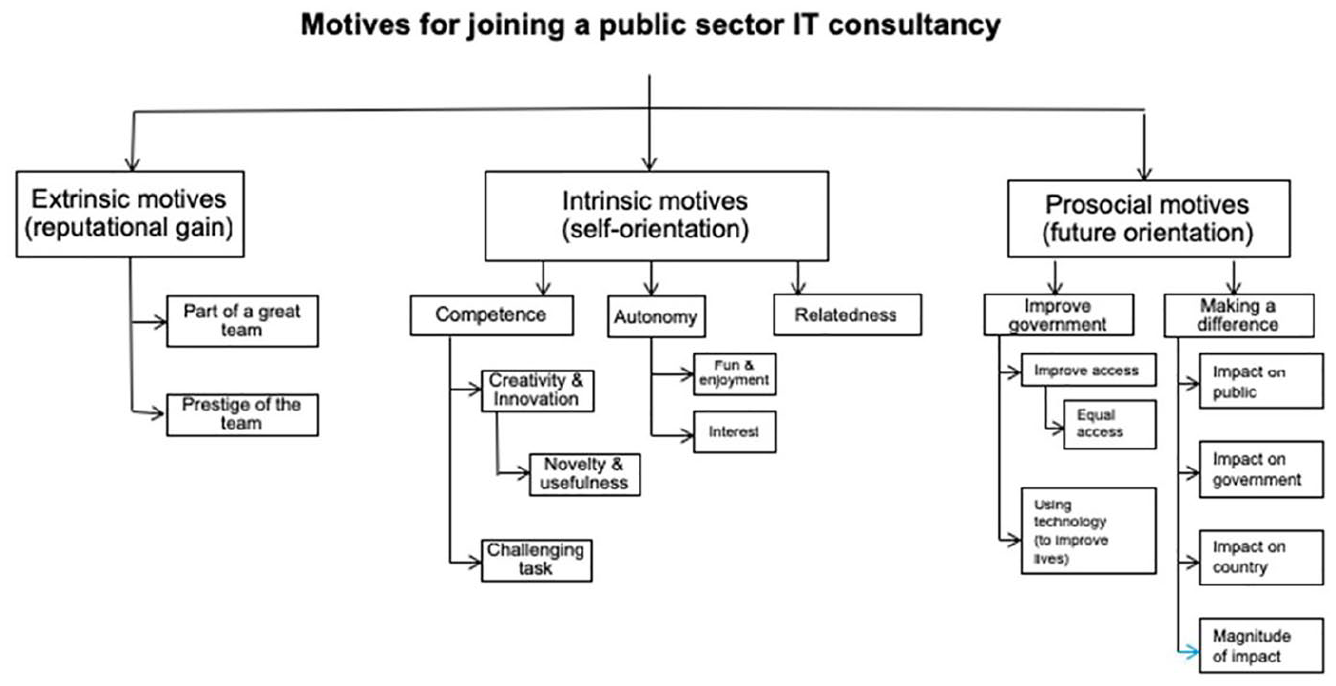
What emerged were three types of distinguishable high-level motives that were named by 18F employees to join government: extrinsic motives that mainly focused on status, job security, or reputation of the team; intrinsic motives that include the sense of competence that stems from the ability to solve the challenging task to some of the most pressing IT problems, interest, fun and amusement, sense of autonomy, and the sense of relatedness that originates from meaningful relationships with talented peers; and in addition, prosocial motives that included statements that showed the subjects were interested in using their skills for future outcomes that helped someone other than themselves, including the public, their country, or even the world.
These three categories of motives were then tied back to the theoretical framework developed by Deci and Ryan’s (1985) work on intrinsic and self-deterministic motives to perform certain tasks. Some of the statements fell only into more than one category of motives, and the second round of coding was therefore amended by another round of coding in which the coders agreed on a dominant motive.
During the third round of coding, the coders expanded the dominant motive codes to specify meaning the subjects attributed to the three dominant motives. Prosocial motives, which are generally externally oriented, were divided into two main drivers: (a) improve government and (b) making a difference. The first category “improve government” was then further divided into improve government to improve access and specifically equal access for citizens to government services. Especifically, this group of IT engineers indicated that they joined government to improve government by using technology to improve lives. “Making a difference” motives focus on differences the subjects can make on the public in general or humanity as a whole, on their country (serving their country as a replacement for service in the Army for example), and on government. In addition, the subjects repeatedly mentioned that the sheer magnitude of the impact they can make is a main driver for joining government.
Intrinsic motives, which are self-oriented and focus mostly on self-improvement—as opposed to external orientation—were divided into autonomy, competence, and relatedness using Deci and Ryan’s (1985) framework of intrinsic motives. The autonomy dimension includes quotes in which the subjects talked about (a) fun and enjoyment and also mentioned their (b) interest in the job or the mission of the organization. The competence motive focuses mostly on the characteristics of the task itself. The subjects mentioned that they were (a) intrigued by the challenging tasks and (b) the creativity and innovation potential of the task they identified. The third motive in the category of intrinsic motives focuses on relatedness as a reason for joining. This code includes statements like day-to-day interactions with great people.
The following figure shows the final outcome of the coding processes as well as the iterative discussions and changes in the categories. The resulting coding taxonomy (Saldaña, 2015) shows the types of dominant motives (extrinsic, intrinsic, and prosocial) and their specifications that emerged from the data.
Findings
We first report the summative findings of the coding taxonomy (Figure 1) and then discuss each code individually to provide evidence for the different types of motives and reflect on their implications for theory and practice.
Coding taxonomy.
Table 1 reports the findings based on the final round of coding. More than 57% of the subjects report a dominant motive, which equals 99 individuals in our sample. An example of a statement with a dominant motive is as follows: It was a fantastic opportunity to continue work started through the Presidential Innovation Fellows program. Improving government products and services for the American people with a group of incredibly talented individuals and strong government partners provided a great opportunity for meaningful work.
Dominant Motive for Joining the Federal Government’s 18F Team.
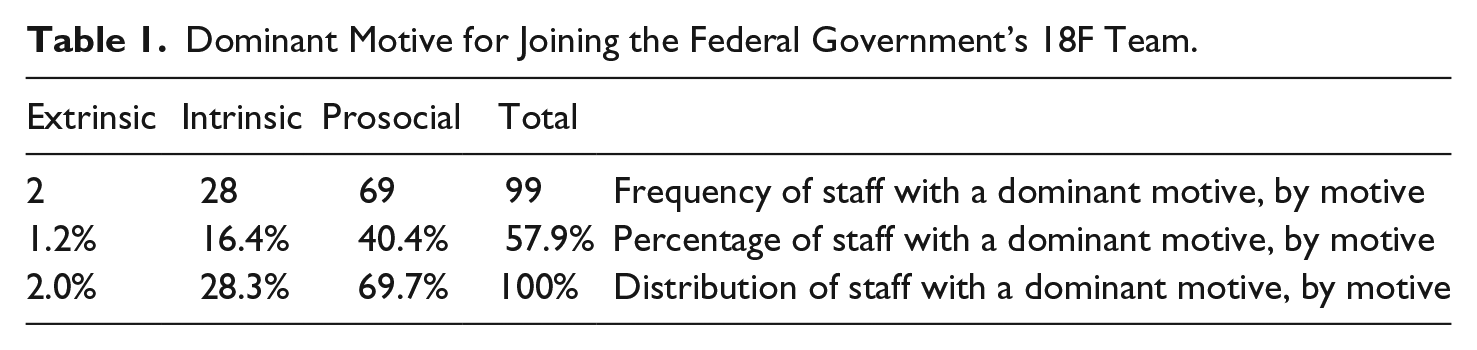
For the other subjects, a dominant motive was not identifiable either because their statements were inconclusive or several statements did not provide a clear direction toward a preference that focuses on work in the public sector. The following example is a statement without a motive: “She helps create interfaces, experiences, and code bases that are accessible on multiple fronts.” About 70% of the 99 subjects included in our final round of coding show dominant prosocial motives; the remaining show intrinsic ones. Only two subjects (1.2% of the staff) reported an extrinsic motive, such as image/reputation gain, as their dominant motive for joining the public sector.
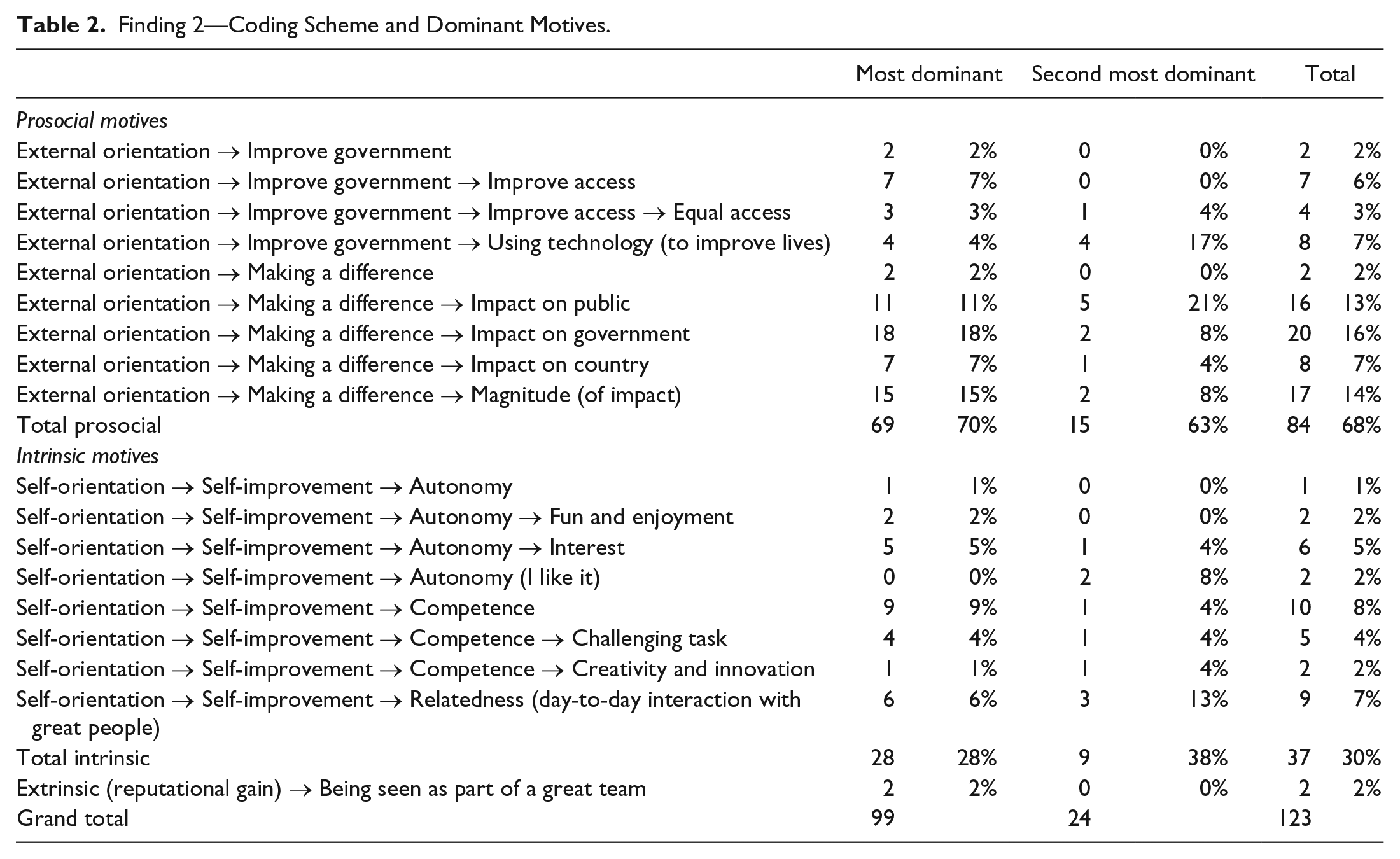
Table 2a provides the results of the coding for those people in our dataset that show a dominant motive. As a result of the second round of coding, we identified that our subjects at times indicated a most dominant motive and a second dominant motive. Of the 99 subjects, 24 mentioned the second dominant motive. Among the 24 people—a subset of the initial 99 people—for whom the coders identified the second most dominant motive in their statements, 63% indicated that they had a prosocial motive and 38% indicated that they were also driven by intrinsic motives. To be consistent in our analysis, we focused our interpretation on their dominant motive. Among the initial 99 people with a most dominant motive, 70% indicated prosocial, 28% intrinsic, and 2% extrinsic motives as the main drivers for joining 18F. 1
Finding 2—Coding Scheme and Dominant Motives.
Prosocial Motives
Prosocial motives focused mostly on making a difference (53%) in terms of impact on government, followed by magnitude of impact, impact on the public in general, and finally impact on country. This is the case overall and both in terms of most dominant and second most dominant motives. Software engineers are, therefore, driven by the enthusiasm to generate benefits for others with a focus on external outcomes.
When the subjects mentioned that they joined 18F to make a difference, they were referring to the anticipated impact of their work on government itself, in terms of supporting public agencies to pursue a critical public mission. One software engineer, in replying to the motivational question, stated, Since I joined the government in 2010, I’ve thought we’ve needed a centralized technology team to support federal agencies who are constantly asked to do more with less. I couldn’t be more honored to be part of a team that’s here to help agencies with their critical public missions.
The respondent emphasizes here that in comparison with previous waves of IT development, a mission-critical approach to dealing with IT problems is in his opinion helping the larger federal government to improve.
Other members of 18F pointed out that their goal was to make an impact on government by using their skills to fix government operations, enhance its way of conducting business, or improving its processes and results: So many people complain about the government being broken. Why not try and fix it? Especially if given the opportunity to work with this many talented and passionate people.
The quote above shows that members of 18F joining the public service feel that it is upon them to make a difference: they are aware that with their skillset, they will be able to effectively bring change to government.
Furthermore, some other software engineers stated that an impact on government can only be achieved if it is carried out from inside government and so people join because of the more direct impact they can have: Some people say that private sector tech companies don’t care about changing the world. I’ve found that to be far from the truth. But what is true is that many changes can only come from within. As part of 18F, I am able to help as part of that within.
Especially important given the nature of the task, their own background, their previous experience, and the organizational environment these software engineers are joining is that many of them notice the key role played by the use of their technical skills and application of new technologies. As one software engineer stated, I joined 18F to help build great digital tools for government with a team of amazing people.
And another added, I joined 18F to do work that was more soul satisfying. I felt that open source and lean processes could be combined to make the public sector efficient.
These categories suggest that the focus of their prosocial motives in making a difference in terms of government affects the mission and government’s inner workings with the use of specific technological skills and approaches. Only with their specific skillset and the unique opportunity that presents itself can 18F employees introduce the changes that will affect how government delivers services.
Many of the subjects also highlighted the sheer magnitude of their anticipated impact. Located in a prominent position with full political and managerial support from the White House, their reasons to join 18F can be summarized as making a difference for the people in general because of the large degree of government transformation they can accomplish as the result of their use of their own technological skills. One software engineer said that she “saw the immense impact of public servants and wanted to be involved.” Another person states, I was drawn to 18F because I wanted to make a difference. 18F offers a unique opportunity to have a positive impact across government services and their users—there aren’t many places with more public impact per line of code.
This suggests the scale of impact that IT professionals see is possible by taking part in 18F. One software engineer states that, “I saw GSA as the place that had the ability and mandate to shift gears and really scale out the digital efforts in government.” These statements show that those software engineers joining 18F see a specific potential in their use of new technologies and the way that they can apply their skills to government’s problems. In addition, they state here that by bringing innovative approaches to government, they can also reach beyond the single unit (18F) they are deployed to and reach deeper into government operations.
Other prosocial motives focus on improving government by building software to give citizens access to government and especially equal access for those citizens who might not have had access before. Some motives show a broad idea of access as follows: “I joined 18F to help people connect to their government.” Here, the 18F employees highlight the importance of opening government services to populations who might not have had readily available access to government before. Along similar lines, one respondent focused specifically on the perceived inequality of access to government’s services and communication: [She] “saw that 18F was doing the important work of making sure that government services and information are accessible to all.” And to serve those parts of the population who might be vulnerable and need government services the most: “There are so many services that this country provides to its citizens (and non-citizens) but many can’t figure out how to get them,” she says. “If we have any impact making these services more available to the U.S.’s most vulnerable populations, I’m happy.”
These statements highlight that motives move beyond the change of government operations itself and also focus on providing a service to citizens who are most in need of government services. The task is therefore not simply seen as a manual or intellectual activity, instead the respondents understand themselves as serving all citizens and providing a democratizing service by making sure that public services are accessible and usable.
Intrinsic Motives
Intrinsic motives uncovered in this dataset focus mostly on competence motives instead of creativity or innovation motives (Deci & Ryan, 2000). This is not surprising, given that the subject might not expect large degrees of creativity in a bureaucratic environment like the U.S. federal government. However, among the second most dominant motives, relatedness was observed more frequently than competence (Ryan & Deci, 2000b).
The quotes that highlighted a form of self-improvement as a dominant driver to join 18F were coded mostly as competence-driven. They reflect the sense that the subjects are bringing capacity and skills from other contexts and sectors to the public sector. Three software engineers state the following: (a) “I wanted to apply what he had learned from his work experience to other US agencies,” (b) “I wanted to apply his talent and skills to government agencies,” and (c) “I came to 18F to help share his experience with enterprise software with the US government.” These statements highlight that their behavior is—as Ryan and Deci formulate it—authentic and self-driven, and not externally driven (Ryan & Deci, 2000b).
In line with the literature (Grant, 2008; Grant & Berry, 2011), we found drivers for joining 18F that further detail the main motive of competences in terms of challenging task and, residually, creativity. They perceive the task as challenging enough to leave their jobs behind and join the public sector: I joined 18F because I like solving complicated design questions, and the federal government offers some of the most complicated questions out there.
Discussion and Conclusion
Our study provides a series of valuable contributions for theory and practice, which should be interpreted in light of some inherent limitations of our data. In particular, the type of publicly available data did not allow the authors additional opportunities to expand the questioning of the respondents. The data were collected at one specific point in time: joining a highly prominent government unit with a specialized set of skills and full political support of the president. The questions were asked during the onboarding process, and we recognize that motives or goal directness might change as subjects work through the frustrating aspects of a bureaucracy. Moreover, the self-reported data may be prone to social desirability bias, thus leading to underestimate purely extrinsic motives. The author team did not have an opportunity to follow up with more specific questions about the changing nature of their perceived impact. However, given the large number of quotes to which we got access that represent the majority of 18F employees onboarded during the first 2 years of 18F’s operations, we are confident that we can make statements about this particular group of subjects. To the best of our knowledge, this dataset is the only publicly available resource to a whole group of IT professionals joining the federal government. It is useful to gain insights into the intrinsic motives of a group of otherwise understudied professionals, who are bringing skills into government that did not exist before and for which there is a competitive market outside of government.
The first contribution of this article lies in using SDT to bring together the dominant PSM scholarship in the public administration field (e.g., Perry, 1996; Perry & Vandenabeele, 2015; Perry & Wise, 1990) with an emergent stream of studies on prosocial motivation (Bolino & Grant, 2016). Our findings suggest that this integration has the potential to advance our understanding of the motivational bases of public service. In particular, Bolino and Grant’s (2016) distinction among motives, behaviors, and impact—which is novel to the public administration literature—may help refine the conceptual structure of the PSM construct. Scholars in our field should more explicitly acknowledge and further elaborate on this conceptual tripartition, which has relevant implications for both theoretical and empirical research. From a theoretical standpoint, there has been little effort so far to harmonize within the PSM framework three interrelated streams of organizational research that focus on the motives, the behaviors, and the impact of prosociality at work. Integrating those lines of work seems imperative to solve current confusion about the definitions and distinctiveness of those constructs within the PSM scholarship. Embracing Bolino and Grant’s (2016) typology is also vitally important for keeping PSM research up with current developments in the social psychology and management fields and ensure a continued theoretical dialogue with those disciplines. To the best of our knowledge, our study is the first that makes an empirical use of the discriminant validity of Bolino and Grant’s (2016) tripartition in the context of public administration research and theory. Our results suggest the usefulness of this typology, along with potential limitations that point toward directions for future research. For instance, using Bolino and Grant’s (2016) framework in the context of our empirical research revealed a certain degree of conceptual ambiguity as we were not able to distinguish between motives and anticipated perceptions of prosocial impact.
The second contribution of our study is to a nascent stream of work that uses SDT to study the motivational forces that attract individuals to public-sector jobs. As we previously discussed, the SDT framework is more comprehensive than and encompasses the construct of PSM. Whereas the PSM theory only focuses on other-oriented motives, SDT allows disentangling the external, the prosocial, and the intrinsic forms of regulations that may all be playing a role in engineers’ decision to join 18F. In this respect, adopting an SDT framework provides a more granular and comprehensive understanding of what drives highly skilled IT professionals’ decision to take challenging public-sector jobs. Unfortunately, the very nature of our data, which consist of reasons for joining 18F as reported by the organization’s software engineers during the onboarding process, does not allow studying interactions between intrinsic and prosocial types of motives. This limitation calls for future research that is aimed at investigating the interplay among extrinsic, intrinsic, and prosocial reasons for taking challenging government jobs and for entering the public sector from a competitive private sector market.
Our article also contributes to some of the pre-existing literature on the recruitment of highly skilled professionals to support the digital transformation of government operations, which has so far neglected the intrinsic motivation of IT specialists to conduct their tasks. Here we can derive practical insights on how to recruit a highly skilled workforce back into the public sector (see, for example, Dunleavy et al., 2005). Especially during the New Public Management era, many IT jobs were outsourced to external IT service providers—making them quasi-government actors given the long-term nature of their service contracts with the public sector. However, now that the lack of competences inside government becomes apparent when large-scale IT projects fail, recruiting strategies should better leverage upon intrinsic motives to attract IT professionals that are called to provide skills that simply do not exist in government or were abandoned years ago. The recruits will be the only ones providing tools, approaches, and skills that will help large portions of the citizenry and contribute to the improvement of the relationship between government and its citizens. The communication of ongoing threads, such as cybersecurity or attacks on democratic institutions, such as elections, might help to catering toward motives of those who want to help improve government.
Our findings are adding to the understanding of why especially skilled IT engineers are willing to join this unit by providing their unique talent to solve highly complex legacy IT problems. Some—not all in our sample—give up high-paying jobs in much more agile and fast-moving industries to give back to their country and help improve the digital infrastructure of government. HR departments within government organizations can draw on our findings for designing recruiting and retaining strategies that speak to the motivational forces with the potential for attracting technologically skilled human capital to the public sector. In particular, HR policies should simultaneously target prosocial and intrinsic motives, which both appear to play a crucial role in engineers’ decisions to join 18F. As to the former, relational job design theory (Grant, 2008) points to the importance of HR policies that convey the magnitude (i.e., the degree and duration of the potential effects on beneficiaries) and the scope (i.e., the number or breadth of people potentially affected) of the impact that prospect IT professionals can have through their government jobs, which give the opportunity to improve public service quality and delivery, thus ultimately benefiting society as whole and especially underserved citizens. Alongside societal impact, public HR policies should capitalize on and communicate the opportunity to fulfill intrinsic motivation by working with talented coworkers on technologically challenging tasks that require higher order thinking skills, self-directedness, and creativity.
From a methodological standpoint, it is worth noting that—to the best of our knowledge—this is the first qualitative analysis that aims at investigating the motives that drive private sector employees to join the public sector. Our contribution may be particularly relevant to help fill a gap in the public administration scholarship on work motivation, which lacks substantive qualitative work. Indeed, the most comprehensive review of the PSM literature that is available to date shows that only 4.3% of the studies adopt a qualitative methodology (Ritz et al., 2016). We are convinced that rigorous qualitative research is highly needed to gain a fine-grained understanding of the multifaceted motives that drive behavior in the context of public organizations.
As a final remark, our study exemplifies how scholars in the field of PSM may benefit from branching out to emergent theories and concepts developed in neighboring fields, such as psychology or management, to expand the currently limited explanatory power of the PSM construct.
Footnotes
Declaration of Conflicting Interests
The author(s) declared no potential conflicts of interest with respect to the research, authorship, and/or publication of this article.
Funding
The author(s) received no financial support for the research, authorship, and/or publication of this article: This work was partially supported by the European Commission Award-Nr. 770356 under the title: Co-VAL: Understanding value co-creation in public services for transforming European public administrations.
