




Abstract
The study aimed to test the psychometric properties of a Portuguese adaptation of the Adolescent Students’ Basic Psychological Needs at School Scale (ASBPNSS). For this, we used data from a sample of eighth graders (N = 1648; Mage = 14.1 years; 46.9% girls) from Portugal. Cronbach alpha and omega coefficients showed the ASBPNSS subscales—autonomy, relatedness, and competence—were reliable. Confirmatory factor analysis (CFA) showed the hypothesized three-factor model fit the data well. Multi-group CFAs showed the ASBPNSS had scalar invariance across gender and students from different socioeconomic backgrounds. Finally, need satisfaction in school was positively correlated with positive affect and life satisfaction and negatively correlated with negative affect. These findings support the theoretical assumptions of Basic Psychological Needs Theory (BPNT), and particularly the assumption that basic needs are universally applicable. We conclude the ASBPNSS is a reliable and valid measure of basic need satisfaction at school in Portuguese adolescents.
Keywords
Given the current global interest in promoting quality education and individual wellbeing (UNESCO, 2014; United Nations General Assembly, 2015), there is now an increasing demand for cross-cultural research in the area of Psychology. To understand cultural effects on psychological phenomena, researchers often aim to test specific hypotheses by directly comparing how (and if) two or more samples from contrasting cultures differ in the way they respond to a measure of a psychological construct. Researchers also sometimes aim to replicate studies in different cultures to test whether results or theoretical assumptions can be generalized to different populations (Milfont & Klein, 2018). To address these types of research questions, a necessary preliminary step is to develop psychometrically adequate and semantically equivalent versions of study measures that can be used by different populations. This depends on the process of translating an original instrument presented in the literature into a second target language and then testing its psychometric properties in a sample that speaks the target language (Hernández et al., 2020; Mallinckrodt & Wang, 2004). In the present study, we take this approach to evaluate a domain-specific measure of a purportedly universal psychological construct; that of basic psychological need satisfaction in school.
Basic Psychological Need Satisfaction at School
Scholarly interest in the analysis of human motivation and personal development has grown and matured significantly over the past three decades. Within this body of work, much has been informed and directed by a theoretical framework known as Self-Determination Theory (SDT; Deci & Ryan, 2008; Ryan & Deci, 2017). According to this framework, and the Basic Psychological Need Micro-Theory (BPNT) that emerged from it, people derive their motivational energy for volitional action toward growth and healthy development from the satisfaction of three essential and universal basic psychological needs (Ryan & Deci, 2017; Vansteenkiste et al., 2020). The first of these needs, autonomy, captures the need to act, feel, and think authentically. When an individual has their need for autonomy satisfied, they experience a sense of volition. In contrast, when this need is frustrated, people can experience a sense of pressure and conflict. Competence refers to the need to feel that one is capable of attaining skills, being proficient when doing something or interacting with the environment and being able to produce a desired outcome. When the need for competence is frustrated, individuals can feel helpless and ineffective. Finally, relatedness captures the need to feel emotionally connected to others, and that one is a valuable and a significant part of a larger whole, such as a social group, a community, or a social organization. When frustrated, individuals can feel lonely, alienated, and excluded.
Just as humans require water, food, and sleep for physical growth and health, BPNT purports that all humans—regardless of age, gender, or cultural background—need to satisfy their needs for autonomy, relatedness, and competence for healthy psychological development. This is now widely supported by a large body of empirical evidence linking need satisfaction to elevated subjective wellbeing (Orkibi & Ronen, 2017; Šakan et al., 2020; Schutte & Malouff, 2021), mental health (González et al., 2016), interpersonal competence (Costa et al., 2015), and identity resolution (Skhirtladze et al., 2019). A large cross-cultural study of 123 countries (Tay & Diener, 2011) and a meta-analysis of studies from the US and East Asia (Yu et al., 2018) have both supported the proposition that the fulfillment of autonomy, relatedness, and competence consistently promotes wellbeing regardless of culture. That said, scholars have also shown that the specific pathways to need satisfaction can vary across cultures (Yu et al., 2018), meaning that cross-cultural research on basic need satisfaction, and particularly its antecedents in various contexts, remains a topic of interest.
BPNT is highly applicable to the context of education because it provides an integrative framework for understanding the process of how contextual factors that are under the control of schools and teachers can promote healthy psychological development and academic achievement in students (Appleton et al., 2008; Connell & Wellborn, 1991; Niemiec & Ryan, 2009; Vansteenkiste et al., 2020). For example, research has demonstrated that basic need satisfaction facilitates better academic performance via its influence on promoting resilience, optimism, and efficiency (Carmona-Halty et al., 2019). Moreover, studies have directly shown how an autonomous teaching style promotes student engagement with school and academic achievement via the satisfaction of basic needs (Jang et al., 2009; 2016). Thus, research on basic needs in the specific context of adolescent education is highly relevant because it has the potential to uncover the features of schools and teachers that satisfy students’ basic needs, with strong implications for shaping educational practices and policy. However, existing research on the influence of basic needs in school remains limited (particularly in younger adolescents; Conesa et al., 2022) and has been criticized for often employing measures of basic need satisfaction in general, which are insensitive to differences in need satisfaction across contexts (Tian, Han, & Huebner, 2014).
The Adolescent Students’ Basic Psychological Needs at School Scale (ASBPNSS)
Because school is a major developmental context for adolescents (Bronfenbrenner, 2005), research on the influence of basic need satisfaction in the context of school is highly relevant to promoting adolescents' growth, personal development, and academic achievement. As such, a growing number of studies have used a scale that was developed to capture students’ need satisfaction in the specific context of school, rather than in general (e.g., Tian et al, 2014a, 2016a, 2016b). In this scale, autonomy items capture the student’s desire to be free to choose, decide, and express themselves at school (example item; “I can decide for myself how to do things at school”). Relatedness items focus on the social environment, namely the student’s desire to establish fulfilling relationships with teachers and classmates (example item; “Teachers can classmates are pretty friendly towards me at school”). Finally, competence items capture the student’s acquisition of knowledge, mastery of school-related skills, and a sense of effectiveness and accomplishment (example item; “I have been able to learn interesting new skills at school recently”).
A preliminary psychometric assessment of the ASBPNSS in multiple samples of Chinese adolescents provided evidence of structural validity, measurement invariance, and scale reliability (internal consistency reliability and test-retest reliability; Tian, Han, & Huebner, 2014). Further analyses robustly demonstrated that the ASBPNSS is valid, and invariant across gender and time (Tian et al., 2014a, 2014b, 2016b). However, despite its promising psychometric properties, the ASBPNSS has not widely been used for research outside of the Chinese context and there have yet to be many thorough psychometric assessments of translated versions (although see Özen & Demir, 2018; Sheykholeslami & Khakdal Gojebagloo, 2018 for Turkish and Persian versions, respectively).
Given this gap in the literature, it is crucial to develop and confirm the psychometric adequacy of adaptations of the ASBPNSS that can be used to investigate the antecedents and consequences of students’ basic need satisfaction at school in societies other than China, including Portugal (the context of the present study). Indeed, despite an emerging interest in studying the psychological mechanisms that underpin adolescents’ positive development at school in the Portuguese context (such as Moreira et al., 2015; Moreira et al., 2018; Moreira, Faria, et al., 2020; Moreira, Pedras, et al., 2021; Moreira & Lee, 2020; Moreira et al., 2021), there is a dearth of research that directly tests the influence of basic need satisfaction. In fact, within the small number of studies that have considered basic needs, most used domain-general measures of basic need satisfaction (e.g., the Balanced Measure of Psychological Needs Scale; Cordeiro et al., 2016, 2018), meaning they were unable to disentangle the influences of specific contexts. In other cases, studies have used measures of basic need satisfaction that are specific to sub-aspects of school life (e.g., need satisfaction in commuting to school; Marques et al., 2021), and thus are also likely to be insensitive to need satisfaction in the broader context of school. Interestingly, we note that one psychometric study of a measure of basic needs in Portuguese adolescents failed to support the existence of three factors, as hypothesized by BPNT (Simões & Alarcão, 2013). Thus, in addition to the need to consider Portuguese adolescents’ need satisfaction at school using appropriate domain-specific measures, there is a broader theoretical justification for confirming that the three universal basic needs emerge in Portuguese adolescents.
Study Aims
Given the rationale described above, the overarching goal of the present study was to develop and validate a version of the ASBPNSS (Tian, Han, & Huebner, 2014) that is appropriate for Portuguese adolescents. This serves the practical purpose of providing a validated instrument for use in the Portuguese context, and in cross-cultural research more widely; but also, as a test of the theoretical assumptions of the BPNT (such as the assumptions that needs are universal across all types of adolescents and that need satisfaction promotes wellbeing). To this end, we aimed to evaluate the psychometric adequacy of this scale by confirming the three-factor structure identified by Tian, Han, and Huebner (2014) using confirmatory factor analysis (CFA), and testing subscale reliability by calculating Cronbach alpha and omega coefficients. In addition, we aimed to test measurement invariance and concurrent validity, as we shall describe.
Measurement invariance implies that there are no group differences that preclude responding to an instrument similarly, and is a prerequisite for meaningful group comparisons (Sass, 2011; Vandenberg & Lance, 2000). To achieve international goals of promoting equitable participation in quality education (United Nations General Assembly, 2015), there is a need to understand how variables influence student basic need satisfaction in groups of students who are vulnerable to educational inequity relative to others, such as students from low-SES families (who, e.g., have less access at home to learning materials and experiences; Bradley et al., 2001). For this, researchers must have access to instruments that are invariant across these groups of students. Extant research has shown the ASBPNSS has scalar invariance across gender (male vs. female) and age groups (junior high vs. senior high) (Tian, Han, & Huebner, 2014). However, there is a need to expand this evidence to include (a) replications in cultural adaptations of the measure, and (b) demonstrations of invariance across other groups, such as students from different socioeconomic backgrounds. Thus, we aimed to test the hypothesis that the Portuguese adaptation of the ASBPNSS would be invariant across gender and students from families of different SES. Because BPNT posits that basic needs are universally applicable regardless of personal and demographic characteristics (Ryan & Deci, 2017) we anticipated that the ASBPNSS would demonstrate measurement invariance across these two sets of groups. As far as we are aware, no study has specifically examined the assumption of basic need universality by testing whether basic needs satisfaction in school are equivalent across groups of students from different socio-economic backgrounds.
Evidence of validity can be obtained by testing whether scale scores correlate with theoretically-related constructs in an expected way (i.e., a criterion-oriented procedure to establish concurrent validity; Cronbach & Meehl, 1955). Because basic needs are defined by the fact that their satisfaction is essential for wellbeing (Vansteenkiste et al., 2020), and because this is strongly supported by empirical evidence (e.g., Stanley et al., 2021; Yu et al., 2018), we sought to test scale validity by assessing the associations between ASBPNSS subscales and subjective wellbeing: the degree to which one thinks about and experiences their life in a positive versus negative way (Diener et al., 2018). Theoretically, subjective wellbeing is purported to comprise the presence of positive affect, the absence of negative affect, and cognitive representations that one’s life is satisfactory (Diener, 1984; Diener et al., 1999; 2018). This description is now widely supported by empirical evidence (e.g., Arthaud-day et al., 2005; Felsman et al., 2017; Nima et al., 2020). Particularly informative for this study was the small body of prior research on the influence of basic need satisfaction and subjective wellbeing in adolescents (see Conesa et al., 2022 for a review). This includes studies in Chinese samples using the ASBPNSS (Tian et al., 2014a, 2016a), although it should be noted that these studies used domain-specific measures of subjective wellbeing such as the Brief Adolescents’ Subjective Well-being in School Scale (Tian et al., 2015). There remains little evidence about the influence of basicneed satisfaction in school on global wellbeing. Guided by this gap in the literature, and informed by previous work, we tested the hypothesis that the satisfaction of all three basic needs would be positively correlated with general positive affect and life satisfaction; and negatively correlated with general negative affect.
Methods
Participants
The present study involved young adolescents participating in the second wave of a longitudinal study into the influence of school characteristics on adolescents engagement with sustainable development. This broader longitudinal study followed the same cohort of adolescents from seventh to tenth grade, with the second wave occurring when students were in the eighth grade. Thus, all participants were eighth graders at the time of data collection.
Using a listwise deletion method for handling missing data, we excluded 126 individuals from the initial sample (n = 1786). A further 12 individuals were excluded for obtaining an Intra-Individual Response Variability (IRV) index across the three study measures >0.5, which is suggestive of “careless responding” (Dunn et al., 2018). After these exclusions, the final sample comprised 1648 participants.
The mean age of the final sample was 14.1 years (SD = 0.6), with most participants aged between 13.8 years (first quartile) and 14.3 years (third quartile). The sample comprised 773 girls (46.9%) and 730 boys (44.3%), with missing data for 145 individuals. Of the 1365 participants who reported their nationality, 98% reported being Portuguese. We deemed it reasonable to assume that the majority of the participants who did not report their nationality were also Portuguese.
Materials
The second wave of the broader longitudinal study required participants to complete an online survey. The present study considers three measures incorporated within this survey:
The Adolescent Student Basic Psychological Need Satisfaction Scale (ASBPNSS)
The primary study measure was the 15-item ASBPNSS (Tian et al., 2014a, 2014b). This scale comprises three 5-item subscales that each measure one of the three basic psychological needs defined in BPNT: autonomy, relatedness, and competence.
Cultural Adaptation and Translation
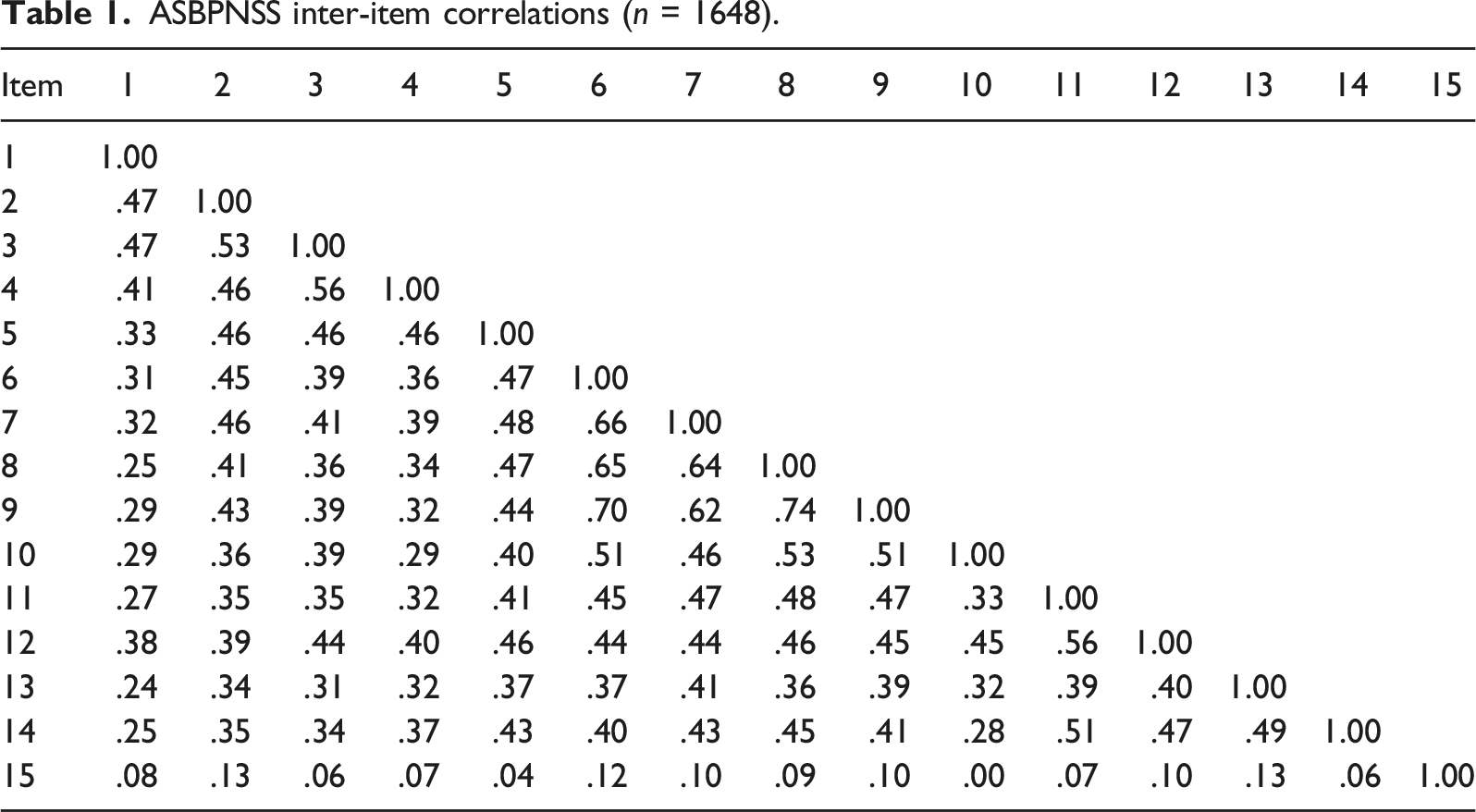
ASBPNSS inter-item correlations (n = 1648).
The Brief Multidimensional Student’s Life Satisfaction Scale (BMSLSS)
To test concurrent validity, participants completed the BMSLSS (Huebner et al., 2006), which has been validated for use in Portugal (Costa et al., 2022). The items in this scale measure students’ satisfaction with six distinct domains of life: family, friends, school experience, self, environment, and life in general. In this way, the BMSLSS captures the cognitive component of subjective wellbeing. Responses are given on a 7-point Likert scale from 0 (Terrible) to 6 (Fantastic). In the present sample, internal consistency of the BMSLSS was good (α = .81, ω = .87).
The Positive and Negative Affect Schedule (PANAS)
Also to test concurrent validity, participants completed the 20-item PANAS (Watson et al., 1988), which is also validated for use in Portugal (Galinha & Pais-Ribeiro, 2005). The PANAS comprises 10 positive and 10 negative adjectives for describing feelings and emotions, to which participants indicate the extent to which they feel on a 5-point Likert-type scale from 1 (Very slightly or not at all) to 5 (Extremely). Internal consistency was good for both the positive affect (α = .84, ω = .87) and negative affect (α = .87, ω = .89) scales.
Objective Socioeconomic Status (SES)
To establish whether the ASBPNSS was invariant as a function of SES, participants reported on parental education (highest academic qualification of mother and/or father) and monthly household income. These indicators were collected in the first wave of the longitudinal study. For parental education, scores from 1 to 7 could be assigned, with a score of 1 reflecting the lowest education level (maximum attainment of fourth grade) and 7 reflecting the highest education level (doctoral degree). For household monthly income, a score from 1 to 8 could be assigned, with 8 being the highest income category (>5000 euros). These three indicators of SES were summed to form a composite score that could range from 3 to 22. For participants only completing a subset of SES indicators, we replaced missing data with the median score from the remaining indicators before calculating the composite. When data were missing for all SES indicators (n = 275) no values were imputed and a composite SES score was not calculated. Based on the composite scores, participants were classified as lower (1–33 percentile), middle (34–66 percentile), or higher (67–99 percentile) SES.
Procedures
Data Collection
Data collection occurred during a period of lockdown in 2020 during the COVID-19 pandemic. Consequently, all students were experiencing online schooling. For each participating school, a member of the school staff acted as a liaison between the school and the research team. The study authors sent a Google Forms online survey link including the study measures to these school representatives who in turn distributed the link to students. These teachers then shared the survey link with participants in the context of an online class.
Statistical Analysis
The psychometric adequacy of the ASBPNSS was assessed through several analytical procedures. A preliminary descriptive analysis of ASBPNSS items was followed by the calculation of Cronbach’s alpha and McDonald’s omega coefficients to estimate the internal consistency reliability of the three subscales. Next, we assessed the factor structure of the ASBPNSS using confirmatory factor analysis (CFA). Specifically, we tested whether the three-factor model proposed by Tian et al. (2014a, 2014b) replicated in our sample. Because the ASBPNSS uses Likert-type items with five response options, we used the robust maximum likelihood (MLR) estimator for this analysis. We evaluated model goodness-of-fit using standard indices and thresholds for acceptable fit: CFI ≥.95, RMSEA <.06, SRMR <.08 (Hu & Bentler, 1999).
Next, we tested whether the confirmed factor structure was invariant across gender (male vs female) and SES groups (lower, middle, or high SES) using a multi-group CFA approach (Bollen, 1989). Specifically, we compared the fit of nested models differing in the number of parameter restrictions applied to test configural, metric, and scalar invariance. Configural invariance tests the extent to which the model fits across the global sample. Metric invariance (with factor loadings constrained to be equal across groups) tests the extent to which items load on the factors similarly across groups. Finally, scalar invariance (with factor loadings and intercepts constrained across groups) tests whether group means can be compared meaningfully. The degree of invariance was determined by assessing how the addition of model constraints influenced model fit indices. Specifically, changes in CFI ≥ −.010 and RMSEA of ≥.015 paired with changes in SRMR of ≥.030 for the metric model or ≥.015 for the scalar model were considered indications of non-invariance (Chen, 2007). We also examined two information-based fit indices, the Bayesian Information Criterion (BIC) and sample-size-adjusted BIC (SABIC). For these two indices, lower values were indicative of the favorable model. We also used the MLR estimator for these multi-group analyses.
Finally, we considered the concurrent validity (Cronbach & Meehl, 1955) of the ASBPNSS using a Structural Equation Modelling (SEM) approach. Specifically, we estimated the relationships between the ASBPNSS three-factor structure and the three components of subjective wellbeing: positive affect, negative affect, and life satisfaction. In each model tested (see Figure 1), the external wellbeing variable was modeled as a latent factor by using a single composite indicator and fixing its error variance to the value calculated using the equation: SEM model used to test factor correlations between the ASBPNSS three-factor model and external variables (indicators of subjective wellbeing). Numbered squares reflect items of the ASBPNSS. Ovals are latent factors.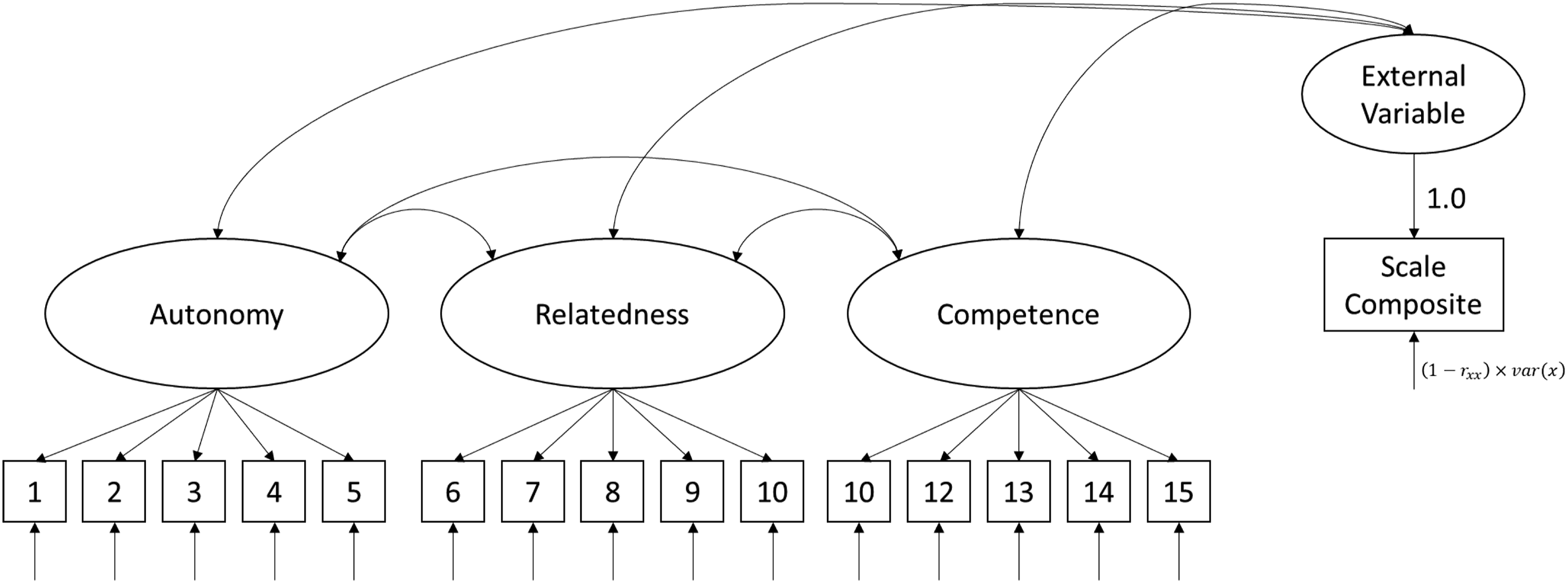
Ethical Declarations, Transparency, and Openness
The ethics committee at Universidade Lusíada, Porto (Ref: COMETICALUSIADA/PSI/2020/003) approved the study, ensuring that the study adhered to the ethical standards set by the Helsinki declaration. We obtained informed consent from all participants and their legal guardians before the study. All analyses were conducted using R version 4.1.2 (R Core Team, 2021). Data are freely accessible at https://osf.io/khvs9/. The study was not preregistered.
Results
Correlations among Items and Descriptive Statistics
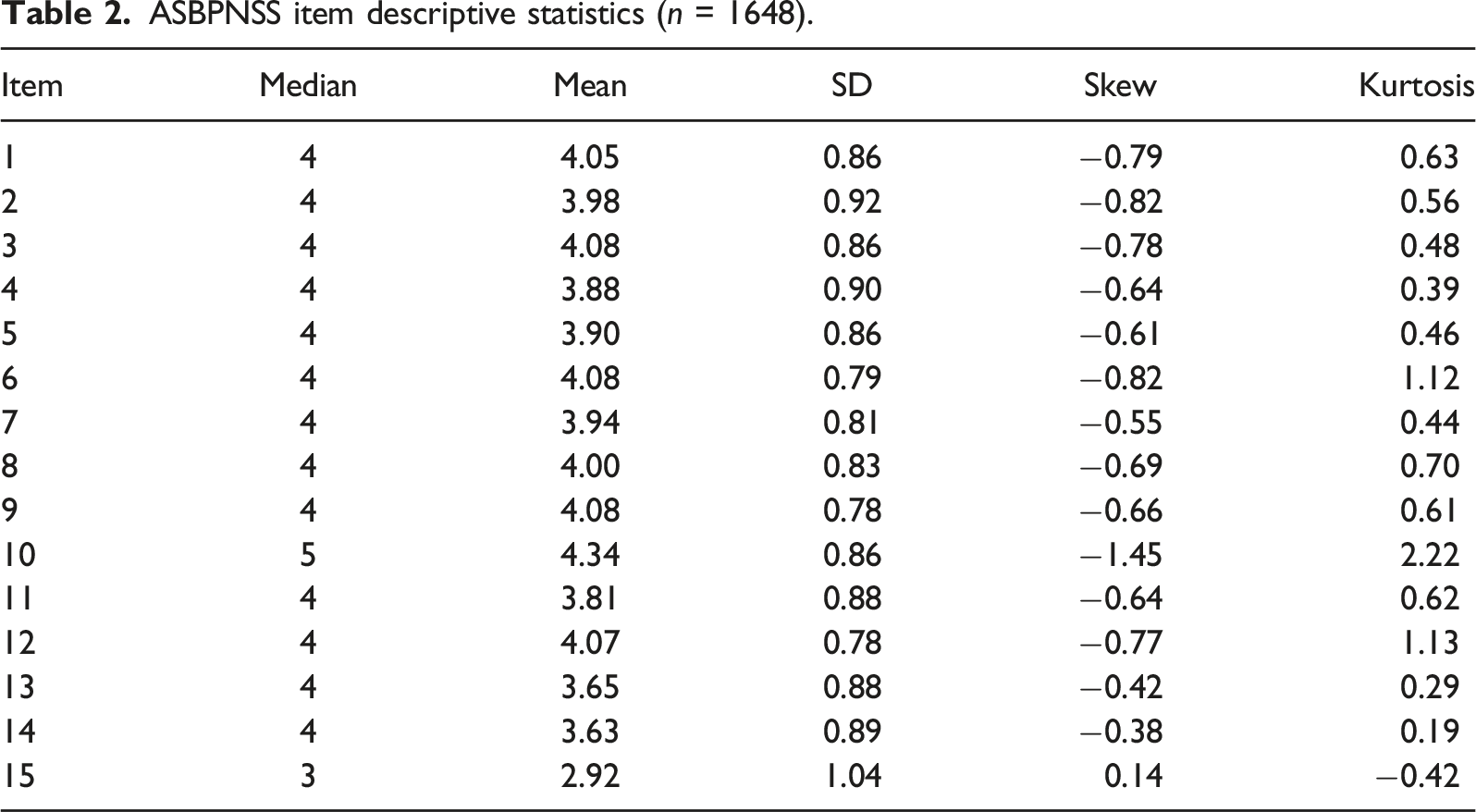
ASBPNSS item descriptive statistics (n = 1648).
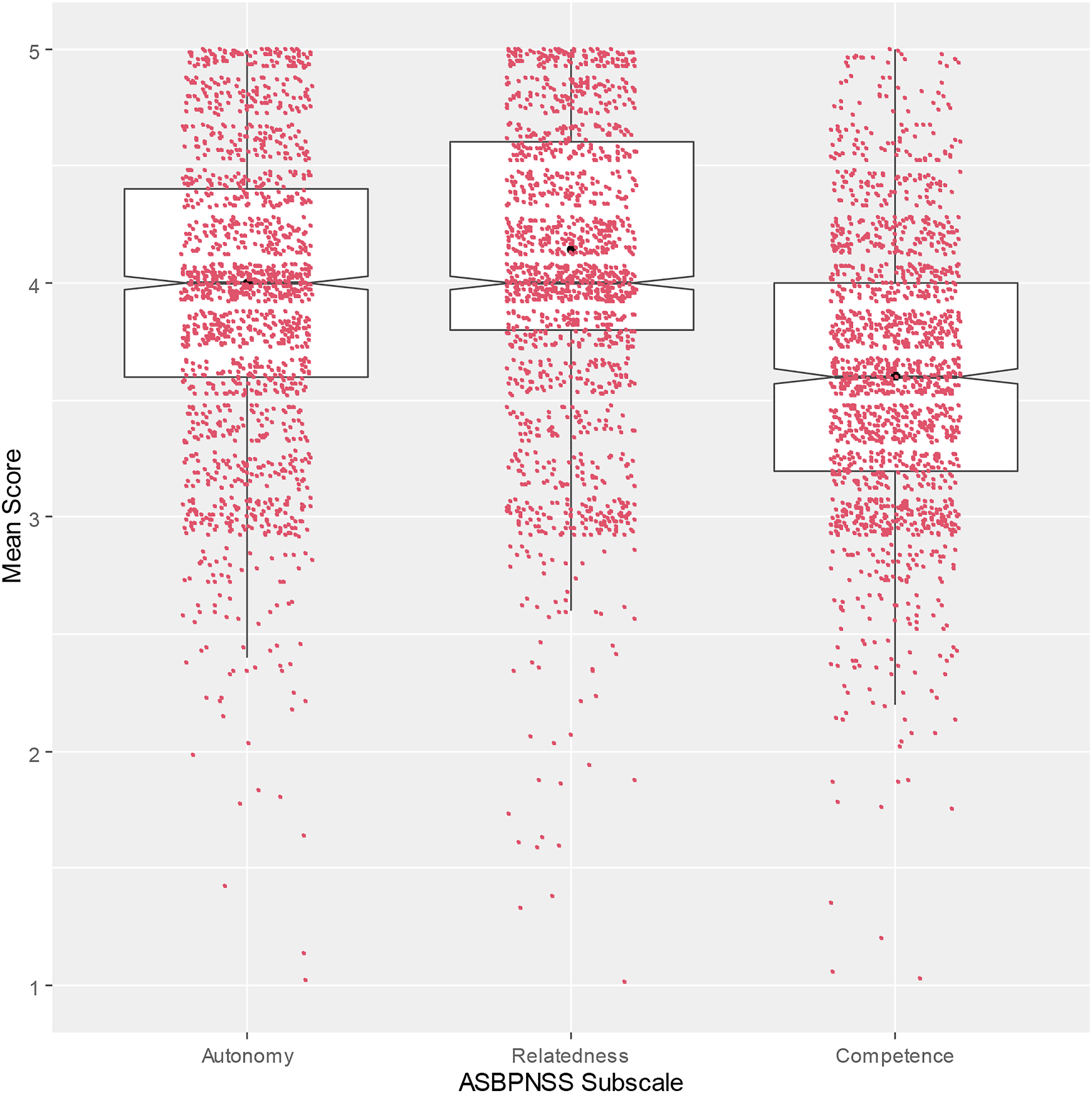
Box plot of participants’ mean scores for the three ASBPNSS subscales.
Internal Consistency
Reliability of the Portuguese ASBPNSS subscales.

Factor Structure of the ASBPNSS
We used CFA to test the hypothesized three-factor structure of Tian et al. (2014a, 2014b). A review of fit indices indicated that this model had a good fit to our data according to the thresholds prescribed by Hu and Bentler (1999): CFI = .951, RMSEA = .047, 90% CI [.043, .050], SRMR = .040. Figure 3 presents the estimates of factor loadings and latent factor correlations from this model. Most factor loadings were high, and all were statistically significant (p < .001), suggesting that the factors were generally well represented by the items. However, the single reverse coded item (Item 15: “I do not feel very competent at school sometimes”) had a weak factor loading of .13. Factor structure and fully standardized loadings for the ASBPNSS three-factor model. Numbered squares reflect items of the ASBPNSS. Ovals are latent factors. CFA performed using a robust maximum likelihood (MLR) estimator.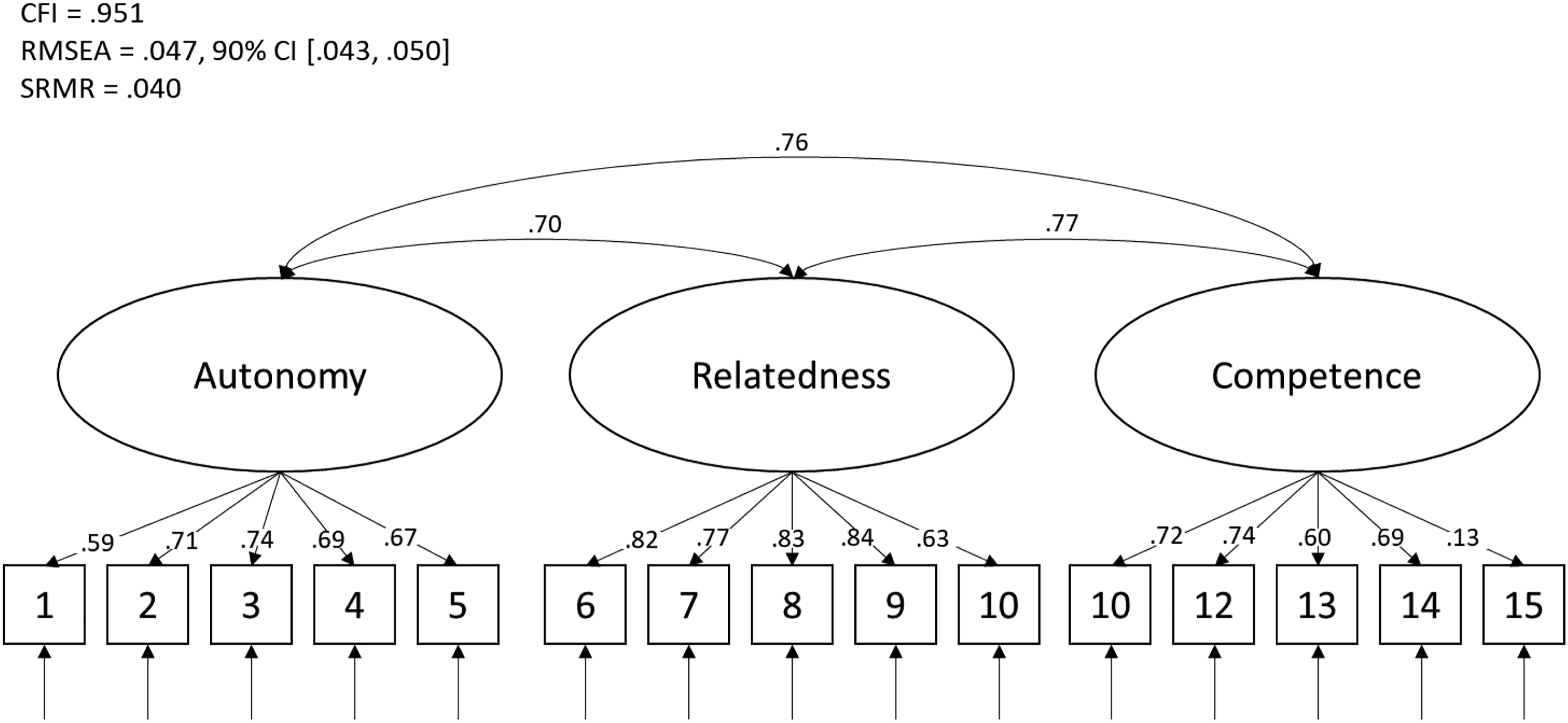
Measurement Invariance
Measurement Invariance across Gender
Fit indices for configural, metric, and scalar models testing measurement invariance of the three-factor ASBPNSS model.
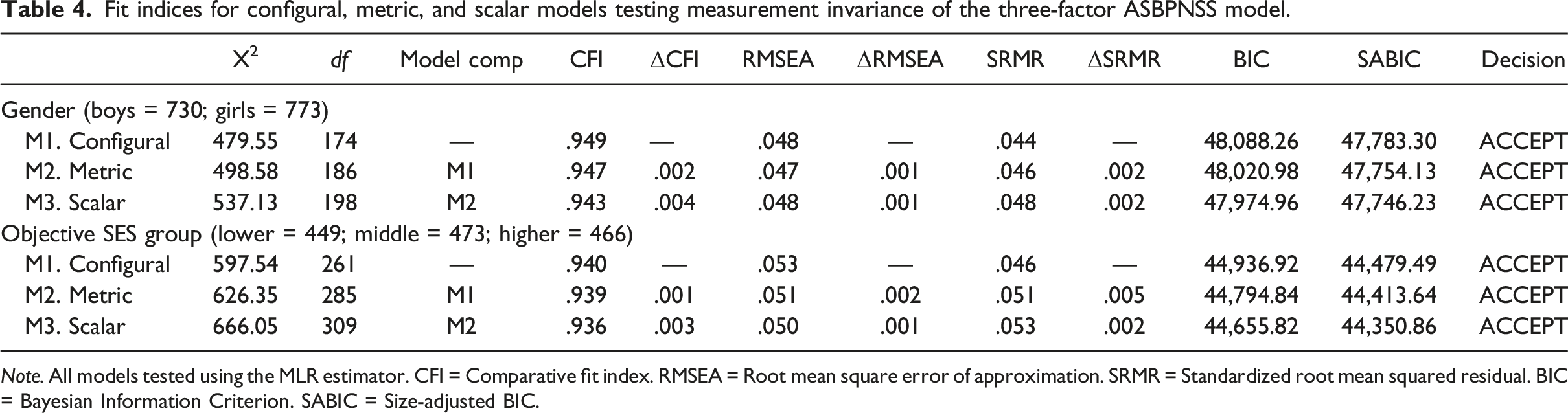
Note. All models tested using the MLR estimator. CFI = Comparative fit index. RMSEA = Root mean square error of approximation. SRMR = Standardized root mean squared residual. BIC = Bayesian Information Criterion. SABIC = Size-adjusted BIC.
Measurement Invariance across SES
Preliminary individual CFAs confirmed that the three-factor model had mostly acceptable fit for adolescents from low SES families, CFI = .938, RMSEA = .056 90% CI [.048, .064], SRMR = .050; medium SES families, CFI = .948, RMSEA = .047 90% CI [.039, .055], SRMR = .050; and high SES families, CFI = .934, RMSEA = .056 90% CI [.047, .064], SRMR = .048. In all groups, CFI fell below the threshold of .95 indicative of acceptable fit. For the following multi-group CFA, changes to CFI, RMSEA and SRMR from the configural to metric to scalar models supported scalar invariance (see Table 4).
Concurrent Validity
Factor correlations between ASBPNSS factors and subjective well-being dimensions.
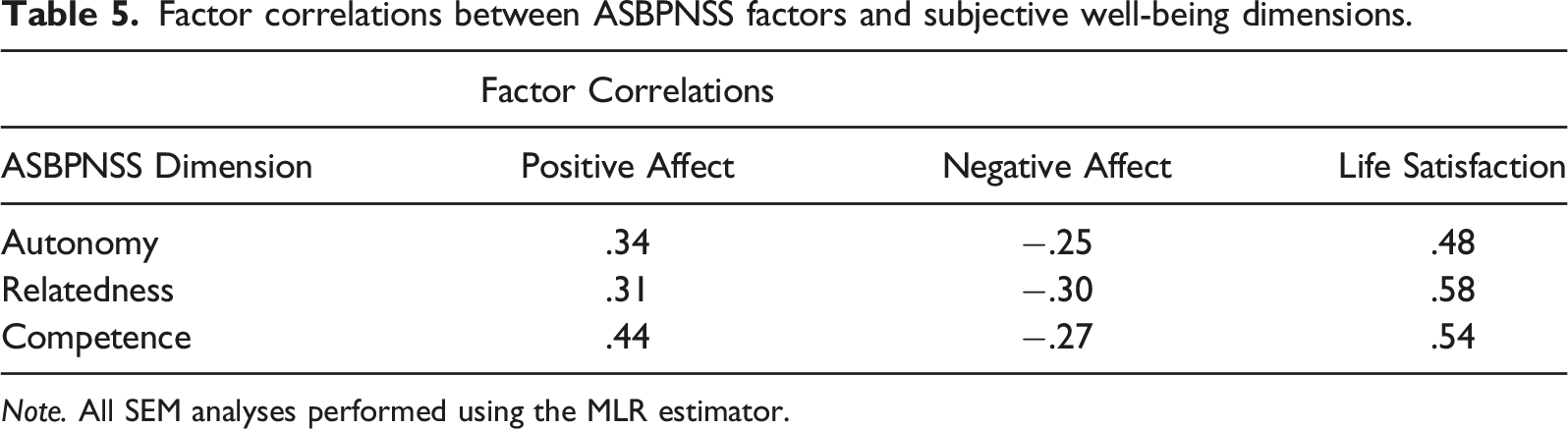
Note. All SEM analyses performed using the MLR estimator.
The pattern of factor correlations was consistent with those seen in prior works. First, basic need satisfaction had positive correlations with positive affect and life satisfaction, and negative correlations with negative affect. Second, the magnitude of associations was larger between basic need satisfaction and life satisfaction than positive and negative affect. As evidence that the three basic needs are distinct constructs, positive affect was most strongly related to the satisfaction of competence (r = .44, p < .001) while life satisfaction was most strongly related to the satisfaction of relatedness (r = .58, p < .001).
Discussion
In this study, we tested the psychometric properties of a Portuguese adaptation of the ASBPNSS (Tian, Han, & Huebner, 2014). Despite research on the psychological mechanisms that underlie positive youth development at school, including recently in Portuguese samples (Moreira et al., 2018; 2021; Moreira & Lee, 2020), there has not previously been a validated Portuguese-language instrument for measuring students’ satisfaction of basic needs in school rather than in general. Overall, the results provided supportive evidence that the Portuguese ASBPNSS was reliable and valid according to psychometric standards. Specifically, the present findings supported a three-factor structure in line with the propositions of BPNT (Vansteenkiste et al., 2020); found acceptable reliability values for the three subscales; showed evidence of scalar invariance across gender and SES background; and supported concurrent validity. Consequently, this instrument can be of use to researchers and practitioners who wish to evaluate the satisfaction of adolescents’ basic psychological needs in Portuguese schools. Moreover, as considered in the Introduction, translated versions of questionnaires are essential for testing theoretical assumptions and research questions on how cultural variables influence psychological phenomena. In this way, the validated Portuguese adaptation of the ASBPNSS can also be of use to cross-cultural researchers interested in developing knowledge of how cultural factors might shape adolescent students’ basic needs satisfaction in school, and how this process influences domain-specific outcomes such as academic achievement and positive functioning more widely. More directly, by confirming the three-factor structure, this study provides further supportive evidence for the theoretical assumption of BPNT that basic needs apply to all people, regardless of their cultural background.
In addition to confirming the factor structure, one specific aim was to determine whether the ASBPNSS had measurement equivalence across groups of students from different SES backgrounds. Prior to this study, no study had tested whether it is possible to make valid comparisons of need satisfaction across students from different SES backgrounds using the ASBPNSS; that is, whether this instrument measures the same constructs in all groups. The demonstration of scalar invariance across SES groups in this study is highly relevant because a) it confirmed the assumption of BPNT that needs are universal across all types of students; and b) because it will enable researchers to address research questions that are of high societal relevance. For example, aligning with international goals to promote equitable and inclusive education for all students (UNESCO, 2015; United Nations Department of Economic and Social Affairs, 2018), the ASBPNSS can serve as a valid tool to investigate how external factors, such as school policies and practices, differentially impact on the satisfaction of basic needs at school in students from diverse backgrounds. From such research, it may then be possible to identify and promote the best educational practices for satisfying students’ basic needs in school, and by extension facilitate associated desirable outcomes such as engagement in school and better academic achievement (Jang et al., 2012; Skinner et al., 2008).
An important finding of this study was that participants' satisfaction of competence, relatedness, and autonomy in school correlated with levels of positive affect, negative affect, and life satisfaction in a manner that was consistent with the predictions of BPNT (Ryan & Deci, 2017), and empirical research findings (Tian et al, 2014a). Specifically, we found significant positive correlations between the satisfaction of the three needs in school and positive affect and life satisfaction; and significant negative correlations between the satisfaction of the three needs in school and negative affect. As such, our findings are consistent with the proposition that basic needs are hardwired into humans, and therefore that we inherently experience need satisfaction as rewarding (Deci & Ryan, 2000; Maslow, 1954). From these results, it was particularly noteworthy that of the three needs, the satisfaction of competence in school was the most strongly correlated with positive affect. This finding was interesting given emerging evidence that positive affect has a unique and particularly important association with healthy and adaptive human functioning (as indicated by being more cooperative, helpful, intuitive, meditative, and creative: Moreira et al., 2022). As well as being a central indicator of human flourishing (Cloninger & Zohar, 2011; Seligman, 2011), positive affect is also demonstrated to help produce future wellbeing by broadening people’s thought-action repertoires and building adaptive personal resources (as theorized by the broaden-and-build theory; Fredrickson, 2001). Supporting this claim, there is now robust evidence that the experience of positive emotions has beneficial effects on attention (Fredrickson & Branigan, 2005), logical reasoning (Jung et al., 2014), and creativity (Davis, 2009). Thus, our findings support the claim that satisfaction of competence in school is particularly essential for adolescents (Molinari & Mameli, 2018; Tian et al., 2018; Tian et al, 2014a, 2016a), with the implication that schools and educators may wish to prioritize the fulfillment of this need in their students to maximize positive emotionality and, ideally, trigger upward spirals toward adaptive personal functioning and wellbeing (Fredrickson & Joiner, 2002).
Despite finding evidence of general psychometric adequacy, it is important to acknowledge that some specific findings show this scale could benefit from further revision. For example, in the output of the CFA, we noted that Item 15 (“I do not feel very capable at school sometimes”) had a weak loading on its respective factor, implying that it did a poor job of capturing students’ satisfaction of competence. Indeed, this item also showed a pattern of negligible correlations with all other items meaning it was a poor indicator of need satisfaction overall. Curiously, this item was omitted from the Turkish adaptation of the ASBPNSS for also displaying low factor loadings (Özen & Demir, 2018). One possibility in the case of our data (see Table 2) was that the specification of not feeling capable “sometimes” may have biased participants’ responses toward the middle of the scale. It may also have been the case that the reversed nature of this item, with high scores capturing the opposite of the intended construct, may have induced bias in responding. To address this shortcoming, we propose that future versions of the Portuguese ASBPNSS seek to revise the wording of Item 15, such as by removing the specification of “sometimes.” It may also be the case that reverting to the original 6-point scale without a midpoint may resolve this issue (although we note that the standardized factor loading for this item in the original psychometric study was also relatively weak; Tian, Han, & Huebner, 2014).
As discussed, cross-cultural research is dependent on the availability of valid and reliable measures that are semantically equivalent in different societies. We have argued that the present study contributes to this aim, although it should be taken into consideration that the literature currently only has a few validated versions of the ASBPNSS. Although the cultures of the People’s Republic of China and Portugal differ in many ways (the former broadly considered an “Eastern” culture and the latter a “Western” culture), they also share some similarities. Both, for example, can be described as collectivist cultures (Triandis, 1995). Consequently, research on the ASBPNSS should be extended to the development and validation of other versions of the ASBPNSS for use in other cultural groups, such as those that have strong individualist values (e.g., the United Kingdom/the United States of America).
Study Limitations
Like most studies, our study had some limitations that could constrain the generality of our findings. A major limitation was that the study sample comprised uniquely of eighth graders. Because this restricted our sample to individuals of a very narrow age, our findings might not apply to adolescents as a wider population. However, prior work by Tian et al. (2014a, 2014b) provided evidence that the ASBPNSS was invariant when comparing younger (12–14 years) versus older (15–18 years) high school students, suggesting that the factor structure of this measure is unlikely to differ as a function of age. It is also important to acknowledge that the study occurred in the context of the COVID-19 pandemic, at a point when students were experiencing online homeschooling. Although the items of the ASBPNSS were modified to refer to need satisfaction “in school/class,” thus being more applicable to the online schooling context, we reserve caution in generalizing our findings to the more classic school environment.
The study had several methodological features that should be noted. First, this study had a cross-sectional design. Cross-sectional research has well-known limitations regarding its inability to demonstrate causal relationships. Thus, it is worth emphasizing that one should not conclude from our findings that basic need satisfaction causes change in subjective wellbeing (although this has been demonstrated with longitudinal designs elsewhere; Tian et al., 2014a, 2014b). However, the cross-sectional approach is adequate for testing the psychometric properties of a questionnaire with factor analysis and for testing patterns of relations among theoretically related variables. Second, while the items were translated into Portuguese using a widely accepted procedure (Mallinckrodt & Wang, 2004), we did not verify the clarity or suitability of items further, such as by using a focus group method with the target sample. Finally, we tested measurement invariance across students from different backgrounds based solely on objective indicators (i.e., parent education and income). Recent research suggests that SES is more complex than this and that subjective perceptions of one’s own SES are also important. In fact, meta-analytic results indicate that subjective SES is more strongly related to wellbeing than objective SES (Tan et al., 2020). It remains unclear whether the ASBPNSS would remain invariant across SES groups if both components of SES were considered.
Footnotes
Declaration of Conflicting Interests
The author(s) declared no potential conflicts of interest with respect to the research, authorship, and/or publication of this article.
Funding
The author(s) disclosed receipt of the following financial support for the research, authorship, and/or publication of this article: This work was supported by the Fundação para a Ciência e a Tecnologia (PTDC/CED-EDG/31615/2017).

Appendix 1.
English and Portuguese Items of the ASBPNSS. Notes. † In the Portuguese version of the ASBPNSS, Item 10 was worded in the reverse to the original, thus capturing satisfaction of relatedness rather than frustration.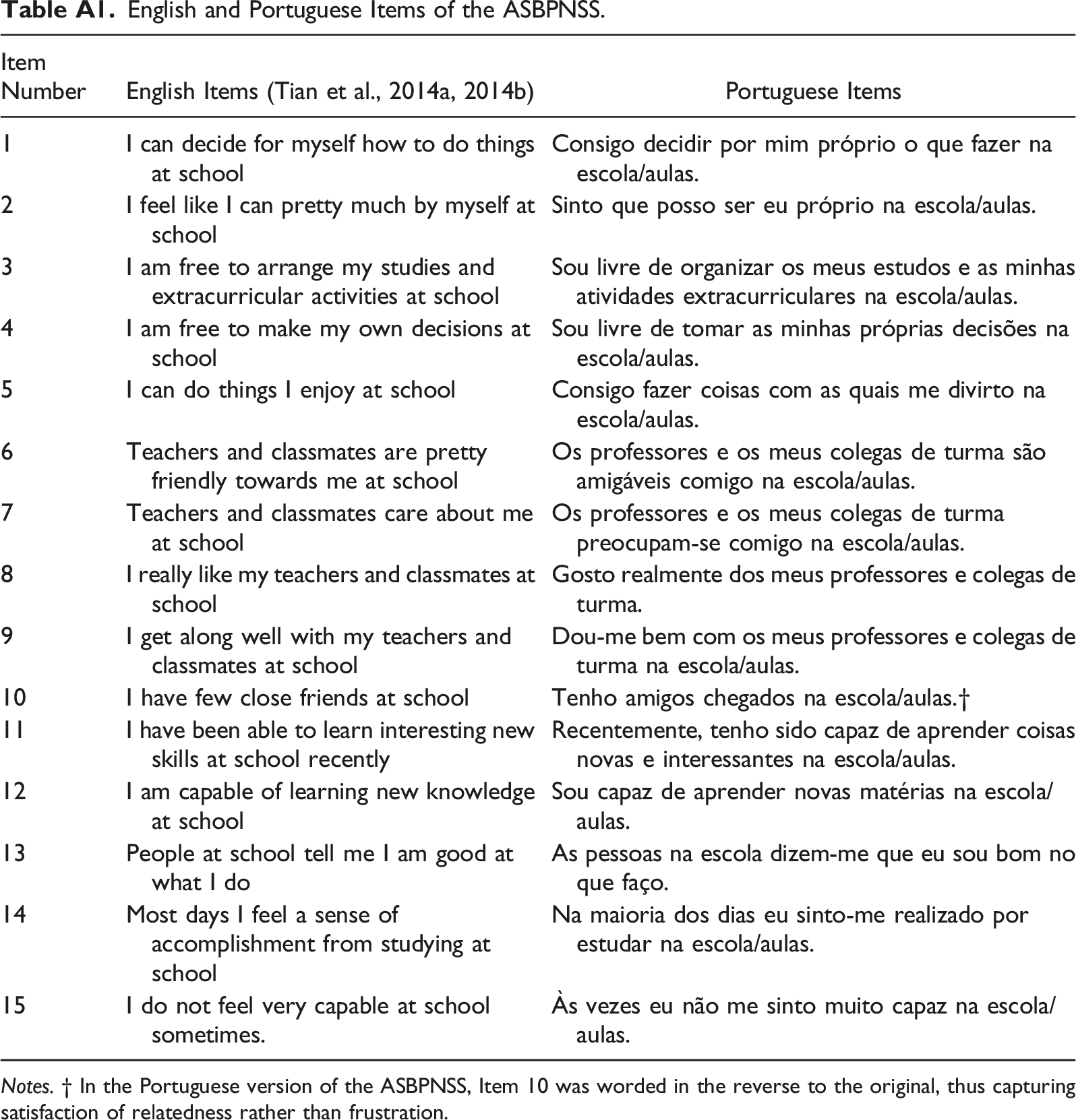
Item Number
English Items (Tian et al., 2014a, 2014b)
Portuguese Items
1
I can decide for myself how to do things at school
Consigo decidir por mim próprio o que fazer na escola/aulas.
2
I feel like I can pretty much by myself at school
Sinto que posso ser eu próprio na escola/aulas.
3
I am free to arrange my studies and extracurricular activities at school
Sou livre de organizar os meus estudos e as minhas atividades extracurriculares na escola/aulas.
4
I am free to make my own decisions at school
Sou livre de tomar as minhas próprias decisões na escola/aulas.
5
I can do things I enjoy at school
Consigo fazer coisas com as quais me divirto na escola/aulas.
6
Teachers and classmates are pretty friendly towards me at school
Os professores e os meus colegas de turma são amigáveis comigo na escola/aulas.
7
Teachers and classmates care about me at school
Os professores e os meus colegas de turma preocupam-se comigo na escola/aulas.
8
I really like my teachers and classmates at school
Gosto realmente dos meus professores e colegas de turma.
9
I get along well with my teachers and classmates at school
Dou-me bem com os meus professores e colegas de turma na escola/aulas.
10
I have few close friends at school
Tenho amigos chegados na escola/aulas.†
11
I have been able to learn interesting new skills at school recently
Recentemente, tenho sido capaz de aprender coisas novas e interessantes na escola/aulas.
12
I am capable of learning new knowledge at school
Sou capaz de aprender novas matérias na escola/aulas.
13
People at school tell me I am good at what I do
As pessoas na escola dizem-me que eu sou bom no que faço.
14
Most days I feel a sense of accomplishment from studying at school
Na maioria dos dias eu sinto-me realizado por estudar na escola/aulas.
15
I do not feel very capable at school sometimes.
Às vezes eu não me sinto muito capaz na escola/aulas.