




Abstract
Career Adapt-Abilities Scale (CAAS) was recently reduced to a briefer 12-items version, the Career Adapt-Abilities Scale-Short Form (CAAS-SF). Considering its advantages in long protocols, we validated CAAS-SF for the Portuguese context. Participants were 314 university students (17–47 years old, Mage = 21.50, SDage = 4.32, 82.8% females), and 899 working adults (17–66 years old, Mage = 40.14, SDage = 11.95, 76.8% females). Sociodemographic, career adaptability, vocational identity, and life satisfaction measures were applied. Confirmatory factor analyses supported CAAS-SF four-factor hierarchical structure, Cronbach alpha estimates supported CAAS-SF good reliability, and Pearson correlations indicated positive associations with CAAS, vocational identity, and life satisfaction. Multigroup analyses indicated CAAS-SF adequate configural invariance, full metric and scalar invariance across genders, and partial scalar invariance across students and workers’ groups. These findings support CAAS-SF usage as a valid and reliable measure to assess career adaptability with Portuguese university students and workers both in research and practice.
Keywords
Career Adapt-Abilities Scale–Short Form: Validation among Portuguese University Students and Workers
Career intervention focus evolved with societal and labor market changes. While in the 20th-century career professionals focused on helping individuals choose a lifelong job or occupation (e.g., Dawis, 1996; Holland, 1959), in the 21st-century the focus is on helping individuals build a strong sense of career identity (e.g., Lent & Brown, 2013; Savickas, 2021). The focus on identity aims to facilitate individuals’ meaningful decisional processes in current more fluid and dynamic career contexts, characterized by more frequent (un)expected transitions and demands of continuous learning (e.g., Hauschildt et al., 2021; Pabollet et al., 2019; World Economic Forum, 2018). Concurrently, the career theoretical focus also shifted from the career maturity perspective to the career adaptability perspective (Ambiel, 2014; Johnston, 2018), meaning that, career development is conceived as a process driven by environmental adaptation rather than by inner structures’ maturation (Savickas, 2021).
Career adaptability is a key concept in one of the most well-established contemporary theories, the Career Construction Theory (CCT, Savickas, 2005, 2021). CCT is conceived under the light of a multicultural society with a global economy and seeks to explain how individuals organize their characteristics, make career choices, and ascribe meaning to their career paths. Specifically, CCT considers that adaptation results, indicated by career success, satisfaction, and development are achieved through individuals’ willingness to change (i.e., adaptivity), self-regulatory resources (i.e., adaptability) acquired through experience, and one’s strategies to address changing conditions (i.e., adapting) (Savickas, 2021; Savickas & Porfeli, 2012). This sequential relationship ranging across adaptivity, adaptability, adapting, and adaptation is strongly supported in the literature (for a revision, see Rudolph et al., 2017 meta-analysis). Within this framework, career adaptability is defined as a psychosocial construct that mirrors individuals’ self-regulatory resources “to solve the unfamiliar, complex, and ill-defined problems presented by developmental vocational tasks, occupational transitions, and work traumas” (Savickas & Porfeli, 2012, p. 662). This means that adaptability helps to find a harmony between inner needs and outer challenges, namely social expectations about age-graded normative transitions, job transitions, and painful events such as contract violations, plant closings, and job accidents (Savickas, 2005; 2021).
As a multidimensional construct, career adaptability comprises four dimensions: concern, control, curiosity, and confidence about future career paths (Savickas, 2005; 2021). Career concern consists of thinking and planning the future career, being its absence linked with career indifference which is reflected in apathy, pessimism, and absence of career planning. Career control consists of individuals’ persistence and effort in adapting to environmental challenges. Its absence can lead to a lack of career goals establishment, which causes difficulties in the decision-making process. Career curiosity consists of individuals’ self- and environmental attention and inquiring, considering multiple career scenarios. Its absence can lead to low career exploration and unrealistic career decisions. Lastly, career confidence consists of individuals’ perceived efficacy in successfully implementing a career plan. Therefore, its absence can inhibit career actions.
Adaptability resources begin to develop during childhood through identification and imitation of role models (e.g., Garcia et al., 2019; Ramos & Lopez, 2018). Throughout life, adaptability resources are shaped by each person’s experiences and learnings (e.g., Hirschi & Valero, 2015; Savickas, 2021). Those with more career adaptability resources will experience greater ease in managing their career, as they perceive greater efficacy, are prone to explore career opportunities, and to design and implement a career plan (e.g., Hirschi et al., 2015; Hirschi & Valero, 2015; Neureiter & Traut-Mattausch, 2017; Taber & Blankemeyer, 2015). Studies with university students indicate significant and positive relations between career adaptability resources and life satisfaction (Ghosh et al., 2019; Hirschi et al., 2015), life meaning (Zhuang et al., 2018), sense of calling (Buyukgoze-Kavas et al., 2015), academic satisfaction (Urbanaviciute et al., 2016; Wilkins-Yel et al., 2018), academic persistence (Wilkins-Yel et al., 2018), perceived employability (Soares et al., 2021), academic engagement, and vocational identity (Merino-Tejedor et al., 2016). Meanwhile, significant negative relations were found between career adaptability and academic burnout (Merino-Tejedor et al., 2016). Likewise, studies with working adults indicate positive and significant relations between career adaptability and life satisfaction (Ramos & Lopez, 2018; Takao & Ishiyama, 2021), life meaning (Ramos & Lopez, 2018), career/job satisfaction (Chan et al., 2016; Spurk et al., 2020), and work engagement (Rossier et al., 2012). Significant negative relations were found between career adaptability and work stress (Johnston et al., 2013). Based on this evidence, we may assume the relevance of career adaptability to individuals’ lives.
Career Adapt-Abilities Scale
The operationalization and assessment of career adaptability, benefited from the work of an international team from 13 countries that developed the Career Adapt-Abilities Scale (CAAS, Savickas & Porfeli, 2012). CAAS – International Form comprises 24 items loaded on four first-order factors (i.e., concern, control, curiosity, confidence – six items per factor), loading in one second-order factor (i.e., career adaptability). The four-factor hierarchical structure was validated both in Western (e.g., Portugal - Monteiro & Almeida, 2015; Italy - Di Maggio et al., 2015; German-speaking Switzerland - Johnston et al., 2013) and in non-Western countries (e.g., Philippines - Tolentino et al., 2013; Lithuania - Urbanaviciute et al., 2014; Nigeria - Olugbade, 2016), presenting good psychometric properties. For example, in a sample of 406 Portuguese university students Mage = 25.60, SDage = 6.62) Monteiro and Almeida (2015) found a total reliability index of .92, and the following fit indices: χ2/df = 2.41, GFI = .89, CFI = .92, RMSEA = .06, SRMR = .05. Moreover, in the Portuguese context, there is another version of CAAS. Before the study of Monteiro and Almeida (2015), with the same 24 items of the international form, Duarte et al. (2012) from Savickas’ international team (2012) team, presented a 28-items version. For each factor, Duarte et al. (2012) kept the same items of CAAS – International Form, plus one additional item that proved to have a high factor loading on the sample collected (i.e., N = 916 participants, divided into 255 ninth grade and high school students, 395 workers and 266 unemployed). In their study, a total reliability index of .90 was found, together with the following fit indices: CFI = .97, RMSEA = .06, SRMR = .05. When comparing the psychometric properties of both CAAS Portuguese versions, the values found are close to those of the international study (i.e., a total reliability index of .92, CFI = .92, RMSEA = .05, and SRMR = .04) (Savickas & Porfeli, 2012).
Recently, considering the limited time most practitioners and researchers daily have, Maggiori et al. (2017) developed a shorter version of the scale. Using the 24-item of CAAS – International Form, Maggiori et al. (2017) selected the three highest factor loading items by subscale: items one, three, and four from concern subscale, items two, three, and five from control subscale, items two, three, and four from curiosity subscale, and items two, three, and four from confidence subscale. Confirmatory factor analysis with these 12 selected items supported the same hierarchical, four-factor structure of the 24-items version ( χ2/df = 6.66, NFI = .968, CFI = .964, TLI = .953, RMSEA = .064), with good reliability indices (French version = .77 < α < .90, German version = .76 < α < .90). This pattern was also found in Turkey (cf. Işık et al., 2018), China (cf. Yu et al., 2020), and India (cf. Pal & Jena, 2021). However, further studies are needed to evaluate the applicability and validity of this shorter version in other cultural contexts since environmental differences might affect career adaptability construction (e.g., Savickas & Porfeli, 2012).
In today’s global world, the relevance of comparing people to advance theories, as CCT, is a growing reality (e.g., Sheu et al., 2014; Soares et al., 2021). However, this requires valid and invariant measures. In other words, it is critical to choose an instrument that measures the intended construct, and gives confidence about the results found, indicating real group differences, rather than a product of cross-groups differential item response tendency (e.g., American Educational Research Association, 2014; Dimitrov, 2017). These assumptions are especially meaningful when working with psychosocial constructs such as career adaptability. As sociocultural contexts present a diverse constellation of variables and processes, different countries can be expected to present different opportunities to develop and express these adaptability resources (Savickas & Porfeli, 2012). Therefore, considering the time advantages of having a shorter measure to assess adaptability in Portugal, our study seeks to evaluate whether Maggiori et al.’s (2017) selected items of CAAS-International Form also present good psychometric properties in this sociocultural context.
The Portuguese Context
From 2019 to 2020, Portugal experienced an increase in the youth unemployment rate, standing 15.7% above the EU27 average. Meanwhile, the number of young people with temporary contracts and part-time work decreased, although remaining high (56% and 19.6%, respectively) and above the EU27 average (11% and 8% above, respectively, Tavares et al., 2021). Simultaneously, the structure and nature of employment have changed, both globally (Pabollet et al., 2019; World Economic Forum, 2018) and in Portugal, imposing frequent and continuous up- and reskilling (Duarte et al., 2019). This employment outlook, coupled with the difficulties of Portuguese people to find a paid job, may be contributing to the increase of enrolments in higher education. For example, in the 2021-year, national statistics registered the largest number of applicants to higher education (www.pordata.pt).
In this context, there is an increase of international students, and of students with impairments, women, and senior students (Martins et al., 2018). For example, in 2021, women represent more than half of the Portuguese university student population (www.pordata.pt). Meanwhile, the expression of senior students is less apparent. According to Hauschildt et al. (2021) report, Portugal still has a young population of university students, with more than half under the age of 21. This means that Portuguese university students are essentially dealing with career development tasks of the exploratory stage (Savickas, 2005). In other words, these individuals may still wonder about who they are or what role they should play in society. Their main needs include activities of exploration and experimentation, achieving a greater sense of autonomy, and establishing a commitment to a chosen career path (Hartung, 2021; Newman & Newman, 2015). Moreover, this period tends to be characterized by high levels of anxiety as one’s self-concept is still under construction (Newman & Newman, 2015). In contrast, the majority of working people are in a different developmental stage and present several educational paths.
According to 2021 national statistics (www.pordata.pt), more than 90% of Portuguese working individuals are between the age of 25 and 64. Specifically, 46.7% were aged 45 to 64 facing career development tasks of maintenance stage, and 44.1% were aged 25 to 44 facing career development tasks of establishment stage (Savickas, 2005). These career stages are characterized by a greater salience of worker role, as well as, a concern for maintaining, changing, or evolving in one’s job (Savickas, 2005; Hartung, 2021). Moreover, the need for balancing additional life roles, spread one’s social network, and engage in self-development activities increases (Newman & Newman, 2015). Regarding these people’s educational level, progress has been made over time. In 2021 only 0.4% of Portuguese workers have no school diploma. The remaining are heterogeneously distributed and less than half have a higher education diploma (www.pordata.pt). As a result, we may expect these differences in students’ and workers’ lives may influence their understanding of what is needed to build a desired career path. In line with previous evidence, both contextual (e.g., education, culture) and individual (e.g., age, gender) variables may impact one’s adaptability resources (e.g., Hirschi & Valero, 2015; Rudolph et al., 2017).
According to Kremer (2016) and Schultheiss (2021), gender constructions of what are typically the men’s and women’s roles in society have a clear manifestation in one’s career construction. In this regard, Portugal still presents a patriarchal culture where these gender norms are mirrored in domains such as education and work, despite notorious improvements across time. For example, in 2021 women were still mostly concentrated in health, social protection, and education courses, while men were mostly concentrated in engineering, manufacturing, and construction (www.pordata.pt). Meanwhile, in the employment context, there are still wage differences, with women earning less than men for the same qualification level (www.pordata.pt). Also, in line with European trends, Portuguese women continue to spend more time than men in household, making their life role management harder (EIGE, 2021).
Within this context, the task of searching for and holding the desired career path may be a challenge, affecting both men’s and women’s health, who study or work (e.g., Duffy et al., 2021; Shin, 2019). Therefore, developing adaptability resources will be advantageous. People will better anticipate barriers and opportunities to their goals, shape the environment in response, explore different career options, and build a meaningful plan that gives them the confidence to face the imposed circumstances. Nevertheless, a previous step consists of having a valid measure to assess the adaptability construct.
Current study aims
In line with CAAS-SF previous validation studies (e.g., Maggiori et al., 2017), we aim to evaluate CAAS-SF (1) psychometric properties in a Portuguese sample of university students and working adults, (2) convergent validity with CAAS 24-items, (3) concurrent validity with vocational identity among university students, and life satisfaction among working adults, and (4) measurement equivalence (i.e., configural, metric, structural) across social groups (i.e., university students and working adults) and gender (i.e., women and men). Considering adaptability’s psychosocial nature and its roots in CCT, these social and gender groups were chosen based on their different occupations and life challenges. One CCT proposition specifically states that “each occupation requires a different pattern of vocational characteristics” (Savickas, 2005, p.46). Therefore, one might wonder what impact these differences have on individuals’ career understanding.
Method
Participants and Procedure
Total sample included 1213 youngers and adults between 17 and 66 years old (M = 35.32, SD = 13.31), the majority being women (n = 950, 78.3%). Specifically, two independent social groups are represented – university students and working adults. Inclusion criteria for both groups included being of Portuguese nationality.
University students group consisted of 314 participants aged 17 to 47 (M = 21.50, SD = 4.32), 260 (82.8%) females and 53 (16.9%) males. At the moment of data collection, 229 (72.9%) students were attending a Bachelor’s, 47 (15%) a Master’s, 30 (9.6%) an Integrated Master’s, and eight (2.5%) a PhD. Working adults group consisted of 899 participants aged 17 to 66 (M = 40.14, SD = 11.95), 690 (76.8%) females and 208 (23.1%) males. Concerning participants’ educational level, 286 (31.8%) held a Bachelor’s degree, 255 (28.4%) a Master’s degree, 179 (19.9%) a PhD degree, 76 (8.5%) a high school diploma, 40 (4.4%) a vocational high school diploma, 20 (2.2%) a third cycle elementary school diploma, 17 (1.9%) a superior technician diploma, 16 (1.8%) technological specialization diploma, seven (0.8%) a second cycle elementary school diploma, and three (0.3%) a first cycle elementary school diploma. Participants were from diverse occupational backgrounds (e.g., teacher, researcher, psychologist, engineer, salesman). Both samples included working students. Forty-four (14%) in the university students’ group and 101 (11.2%) in the working adults’ group, reflecting the outlook of Portuguese higher education institutions (DGEEC, 2021).
This study is part of another larger study, and to better reach the groups under study, two independent protocols were designed. Sample collection was approved by the Portuguese Ethical Committee for Research in Social and Human Sciences (university students’ sample - CEICSH 093/2021, working adults’ sample - CEICSH 061/2019). Both protocols were elaborated on SPSS Data Collection. University students’ protocol included measures of sociodemographic data, career adaptability, and vocational identity. The participants who willingly accepted to fill out this protocol were required to be currently enrolled in a higher education course. Working adults’ protocol included measures of sociodemographic data, career adaptability, and life satisfaction. The participants who willingly accepted to fill out this protocol were required to be currently employed. For each case, we started by presenting the study’s aim and ensuring data confidentially and anonymity. The student group is a non-probabilistic convenience sample recruited between November 2020 and February 2021. Here we started by emailing several Portuguese students’ associations, from north to south of Portugal, asking to share and fill in the protocol online. Secondly, we emailed the same Portuguese students’ associations offering a free webinar on self-career management, which began with an invitation to fill in the protocol, also online. Protocol completion took approximately 10 minutes. As for the workers’ group, a non-probabilistic snowball sample was recruited between May and October 2020. Firstly, we emailed several Portuguese working adults, asking them to fill in the protocol online, and share it with other workers. Secondly, we emailed education and training institutions, employment services, and private companies, asking them to share the protocol with their employees. Protocol completion took approximately 10 minutes.
Instruments
Career Adapt-Ability Scale (CAAS)
The CAAS – Portuguese version (Monteiro & Almeida, 2015) contains 24 items as the CAAS-International Form 2.0 (Savickas & Porfeli, 2012), evenly divided by four factors that combined assesses individuals’ career adaptability. Scale factors include concern (e.g., “Preparing for the future”), control (e.g., “Keeping upbeat”), curiosity (e.g., “Exploring my surroundings”), and confidence (e.g., “Solving problems”). Response is given in a 5-point Likert scale ranging from 1 (not strong) to 5 (very strong). Higher scores represent higher career adaptability. The Portuguese version showed good reliability indices (.78 < α < .92, Monteiro & Almeida, 2015), as well as, we found for the present sample of university students (.81 < α < .93) and working adults (.80 < α < .92). Considering this 24-items CAAS and Maggiori et al. (2017) study, we will evaluate CAAS Short-Form in our sample (Appendix A (Table A1)).
Vocational Identity Scale (VIS)
The VIS – Portuguese version (Santos, 2010) contains 18 items (e.g., “I feel uncertain about what professions I could do well”) as the original version of Holland et al. (1980), and was applied to assess university students’ vocational identity. Participants evaluate if they have a clear and stable picture of their talents, interests, and goals, answering in a true or false scale. Higher scores represent higher vocational identity. The Portuguese version showed good reliability indices (α = .79, Santos, 2010), as well as, we found for the present sample of university students (α = .85).
Satisfaction With Life Scale (SWLS)
The SWLS – Portuguese version (Lent et al., 2009), contains five items (e.g., ‘‘I am satisfied with my life”) as the original version of Diener et al. (1985), and was applied to assess working adults global life satisfaction. Response is given in a 7-point Likert scale ranging from 1 (strongly disagree) to 7 (strongly agree). Higher scores represent higher life satisfaction. The Portuguese version showed good reliability indices (α = .91, Lent et al., 2009), as well as, we found for the present sample of working adults (α = .90).
Analyses
We used the Statistical Package for the Social Sciences (IBM SPSS), version 27.0 for Macintosh, to perform preliminary descriptive analysis, Cronbach’s alpha reliability estimates, and Pearson’s correlations between the applied measures. Pearson’s correlations were used to evaluate CAAS-SF criterion-related validity.
Confirmatory factor analysis (CFA) was performed with the Analysis of Moment Structures (AMOS), version 27.0 for Windows. Multivariate normality of sampling distribution was well-above the recommended value (i.e., Mardia’s coefficient ≤ 3 for normality, Tabachnick & Fidell, 2013). Therefore, we applied the Maximum Likelihood estimation method with bootstrapping (Gilson et al., 2013). Outliers by group were identified using the Mahalanobis’ Distance. Specifically, we identified 15 outliers among university students, 31 among working adults, nine among men, and 38 among women. Analyses were run with and without outliers to control for possible bias (Pinto et al., 2013). As there were differences in these findings, results without outliers were preferred. Having verified the statistical assumptions, two measurement models were specified. Model 1 (M1), theoretically defined (Maggiori et al., 2017), specifies that 12 observable variables loaded on four first-order latent variables (i.e., concern, control, curiosity, confidence), which in turn load on one second-order latent variable (i.e., career adaptability). Therefore, it was adopted a four-factor hierarchical structure. Model 2 (M2), an alternative first-order model (Yu et al., 2020), specifies that 12 observable variables are loaded on one first-order latent variable (i.e., career adaptability).
Model fit was evaluated taking into account the same indexes as Maggiori et al. (2017). Specifically, χ2/df, the Tucker–Lewis’s index (TLI), the Comparative Fit Index (CFI), the Normed Fit Index (NFI), and the Root Mean Square Error of Approximation (RMSEA) with 90% confidence interval (CI). Values of χ2/df equal or below five, TLI, CFI, and NFI above .90, and RMSEA between .05 and .08 indicate an acceptable model fit. Meanwhile, values of χ2/df below three, TLI, CFI, and NFI above .95, and RMSEA below .05 indicate a good model fit (Bollen, 1989; Browne & Cudeck, 1992; Byrne, 2010). The Akaike Information Criterion (AIC) was also considered to sustain the comparative appreciation of M1 and M2 measurement models, being the lower AIC value indicative of better fit (Oliveira et al., 2018).
Multigroup CFA was performed to evaluate measurement invariance across social groups and gender. This analysis is paramount in informing measure’s utility for comparative studies (Jiang et al., 2017; Vandenberg & Lance, 2000). Specifically, we started by testing a baseline model (MI1: Configural model) with no equality constraints across groups. After, we tested a second model (MI2: Metric model) in which factor loadings were constrained to be equal across groups, which were compared to MI1. Finally, we tested a third model (MI3: Scalar model) in which item intercepts were constrained to be equal across groups, being compared with MI2. Invariance was evaluated according to Δ CFI and Δ RMSEA indexes, for which values lower than .01 and .015, respectively, indicate models’ invariance (Chen, 2007). Nevertheless, when faced with inconsistencies between Δ CFI and Δ RMSEA indexes, the former was preferred due to its robustness (Cheung & Rensvold, 2002).
Results
Descriptive statistics and reliability estimates
Means, Standard Deviations, Correlations, And Cronbach Alpha Reliability Estimates (By Social Groups).
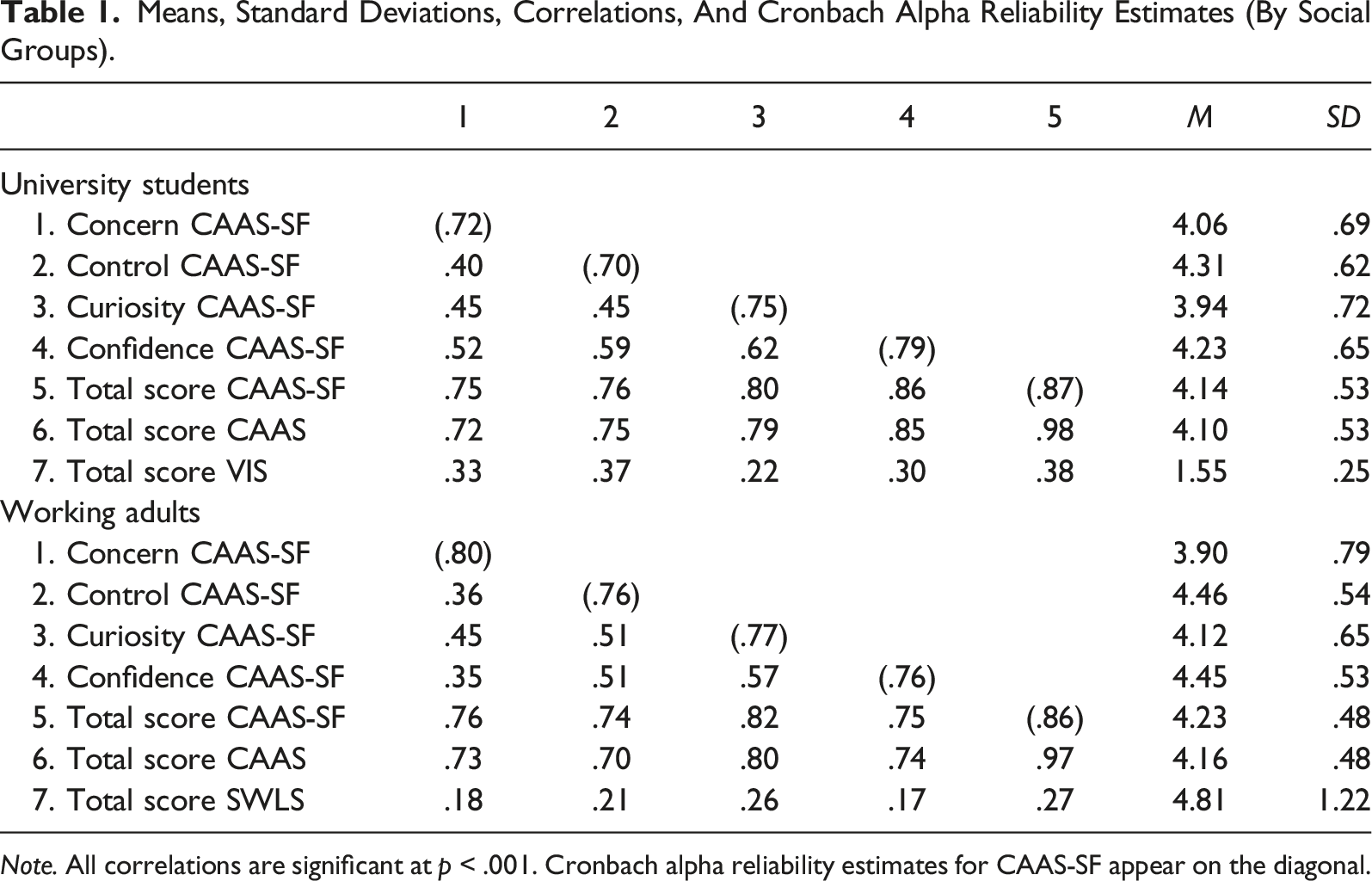
Note. All correlations are significant at p < .001. Cronbach alpha reliability estimates for CAAS-SF appear on the diagonal.
CAAS-SF inter-correlations and criterion-related validity
Pearson’s correlations coefficients were all significant as indicated in Table 1. Correlations magnitude between CAAS-SF dimensions and total score were strong (r > .50, Cohen, 1988) across groups, while the inter-correlations magnitudes among CAAS-SF dimensions ranged from moderate to strong (r > .30, Cohen, 1988). Regarding criterion-related validity, we started by analyzing convergent validity between CAAS-SF and CAAS 24-items. Overall, correlations magnitudes between CAAS-SF dimensions and total score, with CAAS 24-items total score were strong (r > .50, Cohen, 1988). As for the concurrent validity, we analyzed Pearson’s correlations between CAAS-SF and VIS among university students, which ranged from weak to moderate (r < .50, Cohen, 1988), and between CAAS-SF and SWLS among working adults, which were weak (r < .30, Cohen, 1988).
Confirmatory factor analysis among social groups
The results of M1, hierarchical model theoretically defined (Maggiori et al., 2017)indicated an overall adequate model fit, both for university students [χ2/df = 2.848, TLI = .919, CFI = .939, NFI = .909, RMSEA = .079 (90% CI, .064–.094)] and working adults [χ2/df = 4.721, TLI = .941, CFI = .955, NFI = .944, RMSEA = .066 (90% CI, .057–.074)] groups. Meanwhile, the alternative M2 first-order model (Yu et al., 2020) was notoriously worse, both for university students [χ2/df = 6.689, TLI = .750, CFI = .796, NFI = .770, RMSEA = .138 (90% CI, .125−.152)] and working adults [χ2/df = 22.742, TLI = .653, CFI = .716, NFI = .708, RMSEA = .158 (90% CI, .151–.166)] groups. This adjustment difference was also indicated by AIC value, which is lower for the M1, both for university students (M1: 198.417 vs. M2: 409.190) and working adults (M1: 292.054 vs. M2: 1276.083). Therefore, M1 is desirable and was used to evaluate CAAS-SF invariance (i.e., configural, metric, and scalar). M1 standardized factor loadings from items to four first-order factors, and from these factors to the second-order career adaptability construct ranged from .53 to .95, which suggests that all items and factors are strong indicators of their respective constructs (Figure 1). Hierarchical confirmatory factor model by social group. Note. Hierarchical confirmatory factor model and standardized factor loadings across university students and working adults, respectively. All factor loadings are significant at p < .001.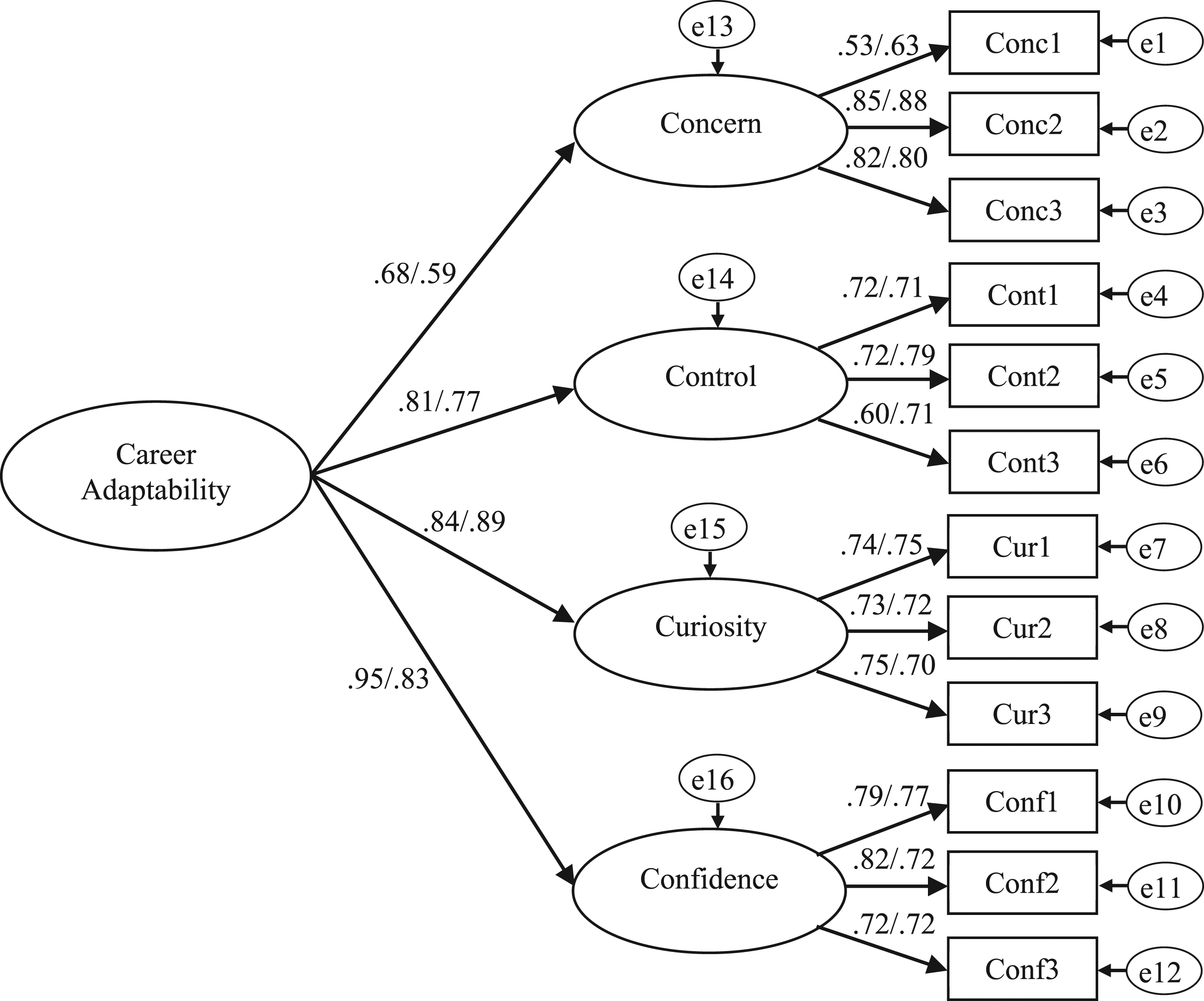
Measurement invariance across social groups and gender
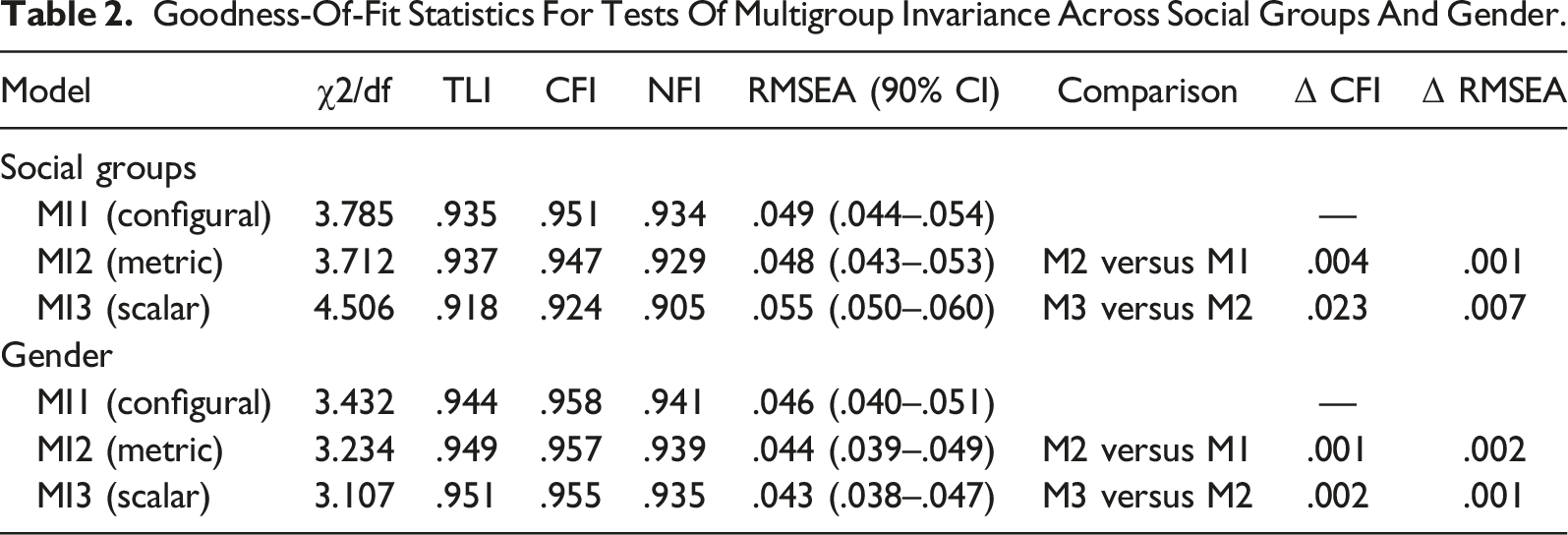
Goodness-Of-Fit Statistics For Tests Of Multigroup Invariance Across Social Groups And Gender.
Discussion
Our study sought to validate CAAS-SF across two Portuguese social groups (i.e., university students, working adults), therefore, contributing to the growth of career development literature. Overall, our findings are consistent with previous studies on the measure (e.g., Işık et al., 2018; Maggiori et al., 2017; Yu et al., 2020).
Specifically, CFA’s results supported the four-factor hierarchical structure of the CAAS-SF across university students and working adults, which is in line with adaptability’s multidimensional definition (Savickas, 2021; Savickas & Porfeli, 2012) and CAAS 24-items version structure (Monteiro & Almeida, 2015; Savickas & Porfeli, 2012). The same CAAS-SF internal structure was found among Turkish high students, undergraduates, and working adults (Işık et al., 2018); Chinese undergraduates and working adults (Yu et al., 2020), Swiss adults (Maggiori et al., 2017), and Indian graduates (Pal & Jena, 2021). Furthermore, in the Portuguese context, the reduction of measure’s number of items does not weaken the goodness of fit, compared to the 28 and 24 versions (Duarte et al., 2012; Monteiro & Almeida, 2015). Together, these findings provide additional support for the career adaptability literature and CAAS-SF factorial structure.
In line with career adaptability literature are also the Pearson correlations computed between CAAS-SF dimensions and CAAS-SF dimensions-total score. Our results support the idea that each measure’s factor, although correlated, assesses a distinct adaptability resource (Savickas & Porfeli, 2012). Additional correlation analyses support the high convergence between CAAS-SF and CAAS 24-items and indicate that CAAS-SF is a measure of decision-making resources rather than a measure of vocational identity or overall life satisfaction. Also, these additional correlations indicate significant and positive relations between adaptability resources and career results of increased goal clarity and life satisfaction, as found in previous studies with university students and working adults (e.g., Merino-Tejedor et al., 2016; Ramos & Lopez, 2018; Takao & Ishiyama, 2021). Nevertheless, the correlation between adaptability and life satisfaction in our sample is weak. To our best knowledge, there is no previous evidence, regarding this correlation, with Portuguese working adults. However, the previous studies, one with Japanese (Takao & Ishiyama, 2021) and another with American (Ramos & Lopez, 2018) workers, also indicate no strong correlation between these variables. Only a moderate correlation was found. This may indicate that engaging in environmental exploration, thinking about the future, making committed choices, and improving abilities have a minor impact on individuals’ perceived life satisfaction. Indeed, according to CCT, adaptability is likely to have stronger correlations with career responses (e.g., career planning and exploratory behaviors) rather than with career adaptation results (e.g., life satisfaction) (Savickas, 2021).
Regarding Cronbach alpha reliability estimates, our findings indicate values above the recommended cutoff point of .70 (Nunnally, 1970), indicating that CAAS-SF has good internal consistency. When compared to the Portuguese versions of 24 and 28 items, our reliability estimates are slightly below. Possibly due to the items’ reduction (Nunnally, 1970). Nevertheless, considering the recommended cut-off point, both career counselors and researchers may be confident about the measure’s property to evaluate participants’ adaptability level.
Lastly, we explore if CAAS-SF four-factor hierarchical structure was invariant across social groups and gender, a key subject in studies looking at comparative groups. This is an advance over previous CAAS studies in Portugal, which were mainly focused on measure’s reliability and factorial structure. In line with previous studies testing CAAS-SF invariance, our findings also supported configural, metric, and scalar invariance across genders (e.g., Işık et al., 2018; Yu et al., 2020). For the Portuguese context, where gender norms are still present, these results indicate that regardless of the background, adaptability construct understanding is similar for men and women. However, for social groups, only configural and metric invariance were supported. Scalar invariance raised doubts once the Δ CFI index did not accomplish the recommended cutoff point, contrary to Δ RMSEA (Chen, 2007). As a result, we release item one of the concern factor. Maggiori et al. (2017) also applied this strategy to meet scalar invariance across gender and linguistic groups, considering a more restrictive Δ CFI cutoff point. For our sample, this parameter release specifically indicates that university students score higher than working adults on “thinking about what my future will be like” (item 1). In other words, this result may echo previous evidence on the prevalence of anxiety feelings about future career paths among university students (e.g., Shin, 2019). Being less familiar with the labor market when compared to working adults, Portuguese university students may feel a greater need to reflect on and plan the desired career path. In other words, the concern factor’s total score in university students seems to be better explained by future career anticipation and perceived need for planning when compared with working adults. Moreover, anxiety about the future career path may also be explained by these students’ developmental and career stages. In line with national data (Hauschildt et al., 2021) our students’ group is, on average, between 17 and 25 years old, and the workers’ group is between 29 and 51 years old. This means that Portuguese students are still developing their self-concept (Newman & Newman, 2015). As a result, career choices may be under consideration, requiring more reflection and anticipation. Meanwhile, the vocational identity of workers may have already crystallized and their role as workers may be more stable (Hartung, 2021; Savickas, 2005). These hypotheses may justify the concern-factor partial scalar invariance across social groups.
Practical Implications
Our findings support CAAS-SF reliability and validity in the Portuguese context of university students and working adults, representing an economical alternative to the CAAS 24-items for evaluating individuals’ career adaptability resources. This finding is an advantage both for research and practice, specifically when facing time constraints or participants’ fatigue. Therefore, we encourage CAAS-SF use among Portuguese youngers and adults, as a means to stimulate the development of career adaptability resources, to evaluate career interventions’ effectiveness, or even to assess career adaptability differences between or across the same person. In other words, consistent with CAAS purpose (Maggiori et al., 2017; Savickas & Porfeli, 2012), this shorter version may be used in career counseling, organizational, and research contexts.
Moreover, the measurement invariance found across genders allows us to apply CAAS-SF indistinctly among men and women. In other words, our results encourage CAAS-SF use in comparative gender studies, once any difference found between groups will be justified by construct fluctuations rather than attributes of the measure. The same is true for social groups although concern factor partial invariance. Firstly, because amongst the three items of concern factor, only item one varied (Vandenberg & Lance, 2000). Secondly, because the intercept of this factor remained equal across the social groups. As a result, CAAS-SF also remains reliable for comparative studies (Jiang et al., 2017) aiming to analyze university students’ and working adults’ levels of career concern, control, curiosity, and confidence.
Limitations and future directions
To encourage future studies, it is relevant to caution about present study limitations. Specifically, we recall that our study presents a cross-sectional design. Therefore, we were focused on CAAS-SF criterion-related validity through Pearson correlations and CAAS-SF internal structure through Cronbach alpha reliability, factorial, and invariance analyses. Future studies could extend this knowledge by exploring CAAS-SF predictive power using a longitudinal design. Furthermore, we encourage our study replication to verify if concern factor partial invariance for social groups remains stable or is a characteristic of the present sample. Considering the non-probability sampling method, the numerical disproportion among groups may influence the results. The same is true for gender. Future studies should consider this aspect, analyzing the invariance between men and women within the same category (i.e., students vs. workers) to control variables as participants’ career development stage (e.g., Hartung, 2021; Savickas, 2005). Another sample characteristic to highlight is the presence of working students. Although the working students from our sample mostly share the same characteristics of the social group to which they belong (e.g., career development stage), future studies should be cautious about this variable. We agree that having two occupations simultaneously, studying and working, may require another sense of adaptability, in line with CCT’s propositions (Savickas, 2005).
In light of career adaptability’s psychosocial nature (Savickas & Porfeli, 2012), we recommend further studies of CAAS-SF across different countries. For example, we suggest studying measure’s invariance across countries sharing the same language but not the same culture (e.g., Brazil, Portugal, Angola). Moreover, considering that adaptability construct is integrated into the Career Construction Model (Savickas, 2005; 2021), future developments in model testing may be performed. Now, using the shortened version of CAAS as an assessment of career adaptability once our results support its validity, therefore preventing participants’ fatigue and dropout of the study.
Another suggestion for future research is the selection of more than two criterion measures. Despite our need to maintain a reduced protocol for online data collection, we recognize the importance of further investigation regarding construct’s correlations. Considering the weak correlation found between adaptability and perceived life satisfaction among Portuguese workers, future studies could explore adaptability’s relation with other constructs. Namely, the correlation with career adapting (e.g., career planning and exploratory behaviors) which, according to CCT where the adaptability construct is framed, is an antecedent variable to career results (e.g., life satisfaction).
Conclusion
In sum, our finds support CAAS-SF use among Portuguese university students and working adults of both genders. On the one hand, we hope this validation study encourages further theoretical advances, as on CCT (Savickas, 2021), where adaptability plays a key role. This might be accomplished through new national and cross-cultural studies. On the other hand, we hope this shorter version will facilitate adaptability monitorization among these groups.
A shorter itemized measure usage prevents participants’ fatigue and reduces response time, decreasing dropout probability. This methodological option is, therefore, advantageous in a fast-paced context, where there is a need to assess different variables, whether in career counselling, employee performance evaluation, or research.
Footnotes
Declaration of Conflicting Interests
The author(s) declared no potential conflicts of interest with respect to the research, authorship, and/or publication of this article.
Funding
The author(s) disclosed receipt of the following financial support for the research, authorship, and/or publication of this article: This work was supported by the Foundation for Science and Technology (FCT) through the Portuguese State Budget (UIDB/01662/2020) and Foundation for Science and Technology (FCT) and the Portuguese Ministry of Science, Technology and Higher Education, under the doctoral scholarship program (scholarship reference: 2020.06006.BD).

Appendix
Career Adapt-Abilities Scale–Short Form (Portuguese version). Note. Table adapted from Maggiori et al. (2017).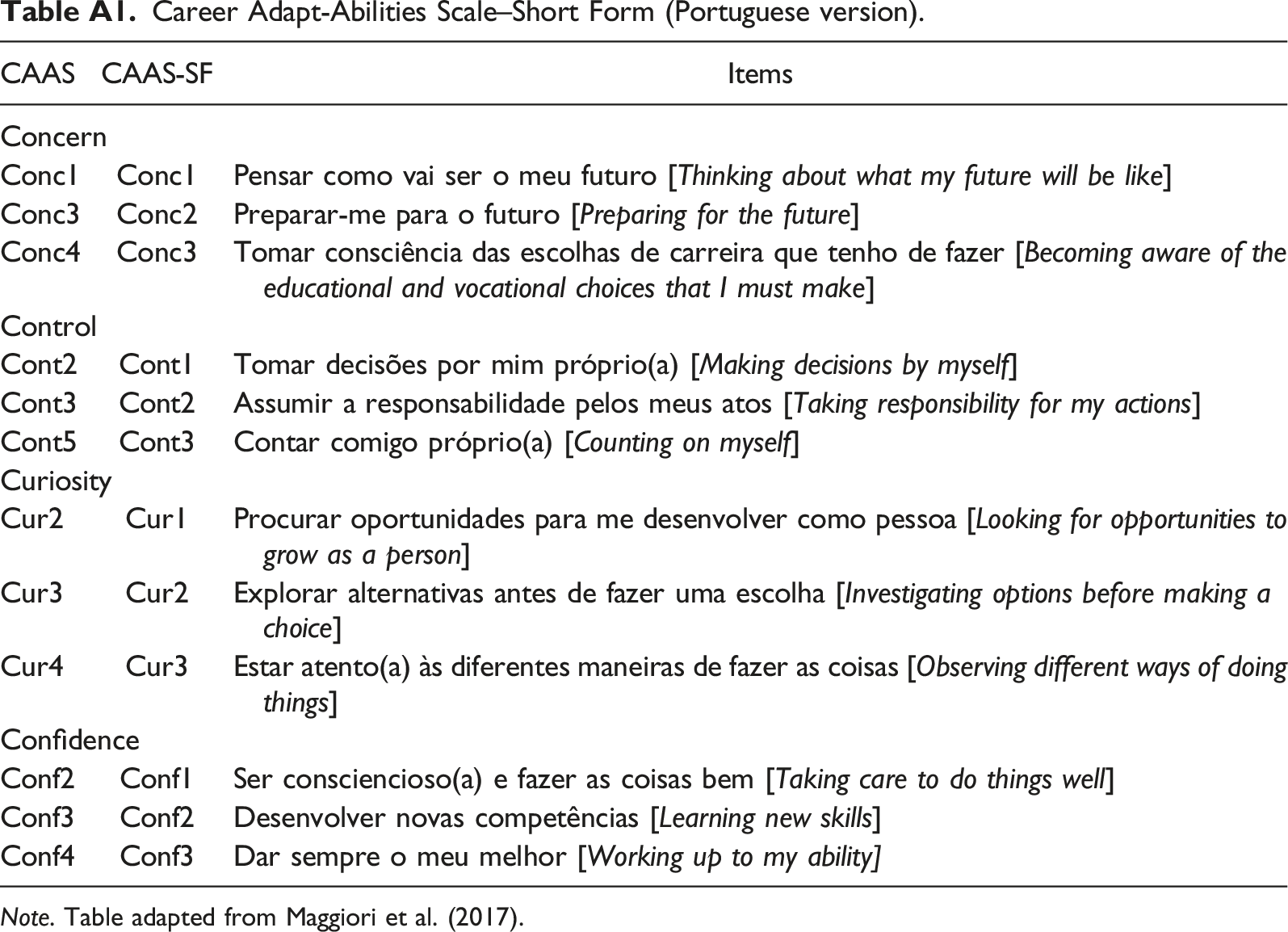
CAAS
CAAS-SF
Items
Concern
Conc1
Conc1
Pensar como vai ser o meu futuro [Thinking about what my future will be like]
Conc3
Conc2
Preparar-me para o futuro [Preparing for the future]
Conc4
Conc3
Tomar consciência das escolhas de carreira que tenho de fazer [Becoming aware of the educational and vocational choices that I must make]
Control
Cont2
Cont1
Tomar decisões por mim próprio(a) [Making decisions by myself]
Cont3
Cont2
Assumir a responsabilidade pelos meus atos [Taking responsibility for my actions]
Cont5
Cont3
Contar comigo próprio(a) [Counting on myself]
Curiosity
Cur2
Cur1
Procurar oportunidades para me desenvolver como pessoa [Looking for opportunities to grow as a person]
Cur3
Cur2
Explorar alternativas antes de fazer uma escolha [Investigating options before making a choice]
Cur4
Cur3
Estar atento(a) às diferentes maneiras de fazer as coisas [Observing different ways of doing things]
Confidence
Conf2
Conf1
Ser consciencioso(a) e fazer as coisas bem [Taking care to do things well]
Conf3
Conf2
Desenvolver novas competências [Learning new skills]
Conf4
Conf3
Dar sempre o meu melhor [Working up to my ability]