




Abstract
Childhood wellbeing is essential for positive outcomes in adulthood, as is academic attainment. Schools play a pivotal role in laying the foundations for children to live well. However, research investigating the relationship between wellbeing and attainment has relied on conceptualisations of wellbeing that are too broad (i.e. overall and domain-general wellbeing) or samples spanning large age ranges (thereby overlooking developmental differences). Additionally, the role of mindset, a potentially co-occurring psychological state of both wellbeing and attainment, has been neglected. This study therefore investigated the wellbeing-attainment relationship in 942 children aged 9–11 (447 male, Mage = 10.5; 495 female, Mage = 10.6) across 17 schools in England (UK). Structural equation models distinguished between overall wellbeing, life satisfaction, and eudaimonia, examining associations of each with children's attainment on standardised tests, accounting for mindsets, achievement goals, and sociodemographic factors. Results indicated lower life satisfaction was significantly associated with higher attainment on average, and in English and Mathematics, while eudaimonia was not significantly related to attainment. Overall wellbeing was negatively associated with Mathematics attainment only. A growth mindset was positively associated, while a fixed mindset was negatively associated, with wellbeing. In turn, a growth mindset was significantly positively associated, while a fixed mindset was negatively associated, with attainment. Implications for policy and practice are discussed.
Childhood wellbeing is foundational for positive outcomes in adulthood (Rees et al., 2015), including employment (Maccagnan et al., 2019), life satisfaction (Layard et al., 2014), mental health (Kryza-Lacombe et al., 2019; Ruini & Cesetti, 2019; Telzer et al., 2014) and physical health (What Works Centre for Wellbeing, 2017). Schools are pivotal in laying the foundations for children to live well, both in terms of their academic attainment and wider self-development (Langford et al., 2017). Indeed, neurobiologists and policymakers describe wellbeing as a critical force for children's learning (Immordino-Yang & Damasio, 2007; Public Health England, 2014). However, the wellbeing-attainment relationship is complicated (Suldo et al., 2006), depending on the developmental stage (Gutman & Vorhaus, 2012) and wellbeing conceptualisations (Clarke, 2020). Furthermore, research suggests children's mindsets (beliefs about the changeability of their self) cooccur alongside both wellbeing (Schleider et al., 2015; Tuominen-Soini et al., 2008) and attainment (Howell, 2016; Yeager & Dweck, 2020). The wellbeing-attainment relationship therefore requires further disentanglement considering these issues.
Theoretical overview
Wellbeing: A brief introduction
Three decades of positive psychology (Diener et al., 1999) have birthed multiple conceptual frameworks defining wellbeing. The most utilised frameworks, including Seligman's PERMA 1 model (2011), and the Life Course Theory of Human Development (Ryff & Singer, 2008), define wellbeing as a multidimensional construct. Common wellbeing dimensions across frameworks include positive emotions, interpersonal relatedness and accomplishment. However, a preferable conceptualisation defines ‘overall wellbeing’ as the combination of two core experiences: positive feelings (hedonia) and functioning (eudaimonia) (Lomas et al., 2021). Hedonia is theorised to consist of one's life satisfaction, maximal positive and minimal negative affect (Diener & Lucas, 1999). Eudaimonia, on the other hand, is defined as experiencing competence, confidence, meaning, and optimism (Ruggeri et al., 2020).
Much empirical support exists for the dual conception of wellbeing as consisting of both hedonia and eudaimonia (Huta & Ryan, 2010), including research with children (Vujčić et al., 2019). Yet critical differences exist between hedonia and eudaimonia, including how each are experienced and their temporality. Eudaimonia focuses on how individuals are functioning rather than their momentary feelings (Huppert & So, 2011), and while hedonia may be derived from any source, eudaimonia is experienced through self-realising sources only (Waterman, 2008). Furthermore, hedonia concerns temporary affectual experiences and self-appraisal of current life satisfaction, while eudaimonia concerns sustained engagement in activities and relationships (Bauer et al., 2015).
Theoretically, how individuals function in relationships (their ‘interpersonal relatedness’) is often subsumed within eudaimonia. Empirically, however, studies suggest interpersonal relatedness is significantly associated with both children's hedonia and eudaimonia (Bradshaw et al., 2007; Proctor et al., 2009; Yu et al., 2022; Yuen & Datu, 2021). Such findings align with needs-based wellbeing theories offered by humanistic psychology (Maslow, 1943; Rogers, 1979), positing individuals’ overall wellbeing is dependent on the extent to which their environments meet their ‘needs.’ Such needs include interpersonal relatedness, competence, and autonomy (see Self-Determination Theory (SDT), Deci & Ryan, 2000). This study thus conceptualises interpersonal relatedness as part of overall wellbeing.
Delineating between overall wellbeing, life satisfaction and eudaimonia
The complexity of the wellbeing construct necessitates research that distinguishes between overall wellbeing, hedonia, and eudaimonia, both conceptually (in theory) and operationally (in analyses) (Duarte, 2014). The utility of such distinctions is demonstrated by studies uncovering hedonic/eudaimonic differences pertaining to their: (a) associated life outcomes (Friedman & Ryff, 2012; Ruini & Cesetti, 2019); (b) developmental motives among children and adolescents (Gentzler et al., 2021); and (c) associations with academic attainment (Kaya & Erdem, 2021). Accordingly, this paper henceforth uses the following terminology: ‘life satisfaction’ referring to hedonia, a common proxy (Charlemagne-Badal et al., 2015); ‘eudaimonia’; and ‘overall wellbeing’ or ‘wellbeing’ referring to the combination of eudaimonia, life satisfaction and interpersonal relatedness. ‘Attainment’ herein refers to children's performance in summative academic assessments.
Children's wellbeing at school
Children's wellbeing, like adults’, is multidimensional (Ben-Arieh & Frønes, 2007), with schools recognised as influential contexts contributing to children's life satisfaction and eudaimonia (Seligman et al., 2009; Steinmayr et al., 2018). The incorporation of wellbeing into school practice is rooted in whole-child approaches to education (Noddings, 2003) that nurture children's emotional and cognitive capacities (Demetriou, 2018). More recently, the positive education movement (Kern & Wehmeyer, 2021) champions the role of schools in facilitating children's holistic personal development.
Yet, in England, as in other Western societies with neoliberal educational agendas (Booher-Jennings, 2005), school accountability and performativity cultures (Ball, 2003) reward pupils’ performance in high-stakes examinations. Such cultures often undermine children's wellbeing (Ryan & Weinstein, 2009) and whole-child approaches to education. Indeed, research suggests performativity cultures can breed a fixation with academic attainment and competition among children (Clarke & Platt, 2023; Hargreaves et al., 2022). As a result, there is a tension between English schools’ responsibilities to (1) care for children's wellbeing, now part of statutory curricula (Department for Education, 2019b), and (2) ensure pupils achieve increasingly high academic standards (Department for Education, 2022).
Altogether, an improved understanding is needed of how children's attainment is associated with their overall wellbeing, life satisfaction and eudaimonia at school, respectively, to ensure educational priorities are attuned to children's psychosocial needs at particular developmental stages (Erikson, 1950). International comparative studies and national longitudinal research highlight this imperative, documenting consistently low levels of children's happiness with school and schoolwork in England (Rees & Dinisman, 2015; The Children's Society, 2022).
Wellbeing and attainment
Almost two decades of research supports the claim that children and adolescents’ life satisfaction positively predicts more adaptive learning outcomes, including academic attainment, school engagement and attitudes towards teachers (Gilman & Huebner, 2006; Huebner et al., 2014; Zhou et al., 2021). As previously noted, however, the wellbeing-attainment relationship may depend on how wellbeing is conceptualised, given its distinct dimensions. For instance, research suggests children's current life satisfaction positively predicts their later attainment, whereas eudaimonia appears less relevant for children's future attainment (although it is significantly associated with adolescents’ future attainment; Gutman & Vorhaus, 2012; Riglin et al., 2013). Such differences may be developmental. Adolescence is characterised by eudaimonic motives of identity formation and crystalising one's unique strengths, while during late-childhood children are preoccupied with proving their competence to same-age peers (Erikson, 1950). Studies reinforce this, with children who report higher interpersonal relatedness experiencing greater school wellbeing (Gutman & Feinstein, 2008). Whereas studies suggest children's overall school wellbeing is significantly positively correlated with their learning (Tobia et al., 2019), understanding the relationship between children's academic attainment and their wellbeing is critical, given that attainment is the ‘currency’ of aforementioned performativity cultures (Brown & Eklöf, 2018). The association between children's wellbeing and academic attainment is complex and appears to differ depending on its conceptualisation, as exemplified by the following literature.
Life satisfaction and attainment
Research examining children's life satisfaction largely suggests a positive association with attainment. However, contributing studies appear limited in three major ways: (a) exploring the wellbeing-attainment association across large age ranges, (b) cross-culturally, and (c) eliciting domain-general rather than school-specific life satisfaction. Children's domain-general life satisfaction appears positively associated with objective (Kirkcaldy et al., 2004; OECD, 2019; van Batenburg-Eddes & Jolles, 2013), self-reported (Gilman & Huebner, 2006; Proctor et al., 2010), and teacher-reported (Eoh et al., 2022) attainment. Notably, however, sub-group analyses in one US study observed no difference between levels of domain-general life satisfaction in comparing average-achieving to high-achieving pupils (Mage 14.5) (Gilman & Huebner, 2006). Meta-analytic studies also document small positive correlations between domain-general life satisfaction and attainment (Bücker et al., 2018; Kaya & Erdem, 2021). Yet given schools are the main contexts children inhabit and are malleable environments influencing their wellbeing (Banerjee et al., 2014), measuring children's school-specific wellbeing surely has greater utility.
Nevertheless, UK studies suggest children with higher domain-general life satisfaction have significantly higher literacy abilities (Clark & Teravainen-Goff, 2018; ImpactEd, 2022). Yet these studies and aforementioned meta-analyses span wide age-ranges (e.g. 6–18 years), despite children's and adolescents’ different psychosocial needs (Erikson, 1950). Examining age-related differences in wellbeing and attainment is therefore critical (Clarke, 2020). For example, one English study (López-Pérez & Zuffianò, 2021) found that ‘getting good grades’ was not significantly associated with children's life satisfaction at school but was associated with adolescents’. These developmental differences were also replicated in an earlier Spanish study (López-Pérez & Fernández-Castilla, 2018).
Elsewhere, longitudinal research conducted with 9–10-year-olds in China documented significant bidirectionality between children's school-specific life satisfaction and attainment (Yu et al., 2022). While insightful, wellbeing is culturally-bound, requiring etic approaches (Rappleye et al., 2019). Indeed, prominent wellbeing scholars suggest that cultural differences may explain mixed findings documented globally in research examining relations between children's life satisfaction and academic attainment (Huebner et al., 2014, p. 806). This challenge is overcome in a UK-specific study analysing 10–11-year-olds’ life satisfaction and attainment in high-stakes examinations (Jerrim, 2021) that found no significant association between the two. Notably, though, analysis of different wellbeing dimensions indicated positive, though small, associations between children's eudaimonia 2 and attainment.
Eudaimonia and attainment
Developmental research suggests adolescents pursue eudaimonic motives significantly more than children (Gentzler et al., 2021). However, scarce research to date explicitly conceptualises children's eudaimonia at school. Studies instead focus on self-efficacy, satisfaction with schoolwork, school engagement, enjoyment or liking (Gutman & Vorhaus, 2012; Riglin et al., 2013), each independent constructs with long research traditions (e.g. self-efficacy, see Travis et al., 2020). Nonetheless, each of these constructs undoubtedly capture discrete aspects of what it means for children to function positively at school.
Conceptualised in these ways, ‘eudaimonia’ appears to be significantly associated with adolescents’ academic attainment but not children's (Gutman & Vorhaus, 2012; Kryza-Lacombe et al., 2019; López-Pérez et al., 2016; Riglin et al., 2013; Tobia et al., 2019). Correlational research documents similar age-related nuances, with school enjoyment significantly positively associated with attainment for older children only (Miller et al., 2008). Altogether, studies distinguishing conceptually and operationally between children's school-specific life satisfaction and eudaimonia are lacking, which is the main contribution of the present study.
Influences of motivational beliefs and goals on wellbeing and attainment
Recent research suggests that children's mindsets at school are significantly linked to their wellbeing and attainment (Boncquet et al., 2020; Valdez, 2023). Theoretical support for these associations stems from the Theory of Self (Dweck & Leggett, 1988), which posits that mindsets (deeply held beliefs about the changeability of one's personal characteristics, such as intelligence) have significant implications for learning (Dweck, 1999). Self-intelligence mindsets are distinguished as fixed or growth (De Castella & Byrne, 2015). Howell (2016) suggests that mindsets govern both thoughts about oneself (e.g. one's intelligence) and feelings about oneself and one's life (i.e. wellbeing). Indeed, research demonstrates that fixed mindsets significantly correlate with negative emotional experiences, while growth mindsets are associated with positive emotional experiences (Burnette et al., 2013; De France & Hollenstein, 2021; King, 2015, 2017; Tian et al., 2017). Pertaining to mindset and attainment however, international evidence is mixed (Foliano et al., 2019; Shively & Ryan, 2013; Yeager et al., 2019), though UK research with children found fixed mindset was significantly associated with lower Mathematics and English attainment (Warren et al., 2019).
Mindsets orient individuals to adopt different ‘achievement goals’—defined as the aims learners commit to in performance settings that guide behaviour (Elliot & Fryer, 2008). Children with growth mindsets endorse greater mastery-approach goals (intrinsically motivated to increase one's understanding) (Elliot & Church, 1997) and have greater attainment than peers endorsing fixed mindsets (Blackwell et al., 2007). Mindsets and achievement goals are intrinsically interrelated (Wormington & Linnenbrink-Garcia, 2017). Accounting for achievement goals is therefore essential when conducting exploratory analyses examining how mindset might facilitate the wellbeing-attainment relationship.
The current study
Aims and hypotheses
This study was part of a larger mixed multi-method research project investigating children's and adolescents’ wellbeing and academic attainment at schools in England (see Clarke, 2023; Clarke & Hoskin, 2022; Clarke, McLellan & Harold, 2023; Clarke & Platt, 2023, also detailed in Supplementary Materials). The present article documents the quantitative findings from the Primary school (ages 9–11) phase, a cross-sectional study which seeks to extend research on the wellbeing-attainment association in three main ways. First, it addresses the lack of delineation between two core wellbeing experiences, life satisfaction and eudaimonia, which research suggests have different cascading outcomes (Friedman & Ryff, 2012; Ruini & Cesetti, 2019). This study's second contribution is an examination of how life satisfaction and eudaimonia relate to children's attainment specifically, given that prior research suggests developmental differences in the importance of different facets of wellbeing for children and adolescents, respectively (Gentzler et al., 2021; Gutman & Vorhaus, 2012). Third, it accounts for children's mindsets, providing preliminary analyses of the involvement of mindset in the wellbeing-attainment relationship, given the significant associations between wellbeing and attainment with mindset reported in previous research (Boncquet et al., 2020; Valdez, 2023).
The present study has practical importance for school leaders, teachers and Education Mental Health Practitioners (EMHPs) – henceforth 'education practitioners' – responsible for attending to children's wellbeing needs while being held accountable for their attainment. A better understanding of the wellbeing-attainment association during this specific developmental window can support education practitioners’ understanding of how these two educational goals are related. Wellbeing is becoming increasingly prevalent in UK school agendas (e.g. whole-school approaches/ethos and statutory wellbeing curricula), yet it is complex. Researchers thus have a responsibility to critically examine how different wellbeing dimensions relate to other important school priorities (i.e. attainment) and concepts of pedagogical ubiquity in the UK (i.e. mindset) (Foliano et al., 2019) to inform practitioner training, policy and practice.
The current study therefore tested the following hypotheses (see Figure 1):
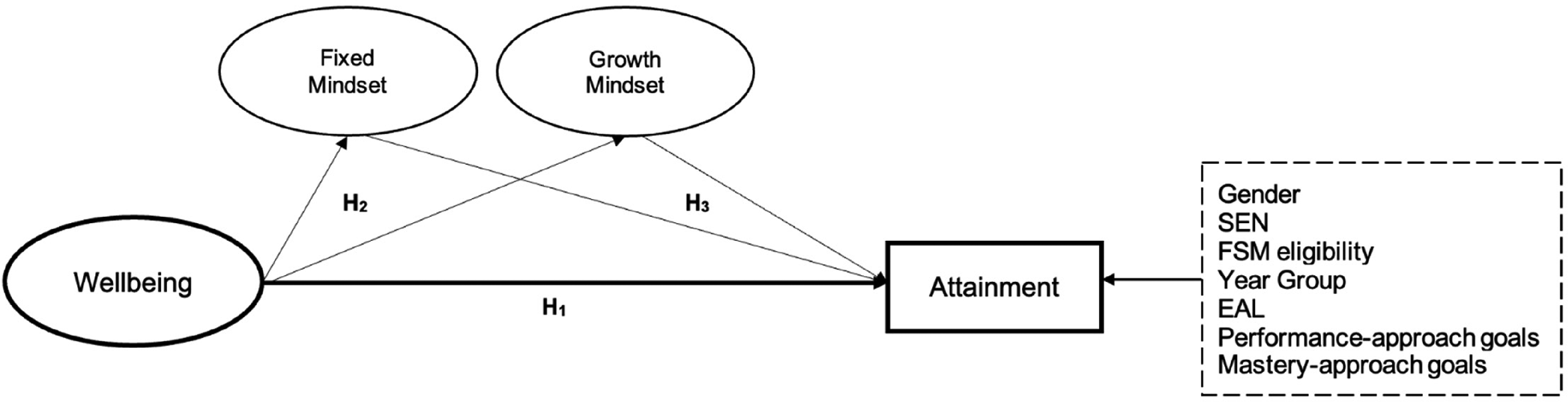
Conceptual model depicting hypothesised relations between study variables.
H1: Higher overall wellbeing is significantly associated with higher attainment.
H1a: Higher life satisfaction is significantly associated with higher attainment.
H1b: Higher eudaimonia is significantly associated with higher attainment.
H2: Higher overall wellbeing is significantly associated with a higher growth mindset.
H2a: Higher life satisfaction is significantly associated with a higher growth mindset.
H2b: Higher eudaimonia is significantly associated with a higher growth mindset.
H3: Higher growth mindset is significantly associated with higher attainment.
All relationships were tested after controlling for covariates of attainment documented in the literature (see ‘Covariates’ for an overview). First, separate models were performed testing overall wellbeing (H1), life satisfaction (H1a) and eudaimonia (H1b) theoretically predicting attainment. Within each of these models, direct paths were examined to test relationships between overall wellbeing (H2), life satisfaction (H2a), and eudaimonia (H2b), with fixed and growth mindsets, respectively. Finally, H3 was tested by examining paths from fixed and growth mindsets to attainment within the same models. Figure 1 provides a conceptual overview of the hypotheses tested.
Method
Participants
The higher education institution (university) where the authors were based granted ethical approval for data collection between October and December 2020. Participants were 942 children in the last two years of Primary education (aged 9–11; M = 10.6, SD = .74) from 17 schools in East England (UK). Schools were recruited via an email to headteachers. Parental written consent and child assent were required for children to be included in the study. Seventy-eight percent of parents who were contacted provided consent. The lead researcher created a 3-minute video for pupils communicating the research aims and what participation would involve in child-friendly language, shown to children prior to sharing an information sheet and obtaining their assent.
Participating schools were from three neighbouring counties. The recruitment process sought to include a range of schools broadly representative of primary schools in England. All schools were state-funded other than one, which was an independent (fee-paying) school. Table 1 provides sample demographic information obtained from schools’ administrative data. 3 Comparative to national averages (Department for Education, 2020), the sample contained a lower-than-average proportion of pupils eligible for free school meals (FSM), a similar proportion of children with English as an additional language (EAL), and an equal proportion of children with special educational needs (SEN). The sample comprised children from a range of ethnic backgrounds seen at the national level in 2020, yet proportionally some groups are underrepresented in this study. Overall, the proportion of pupils from Black and Minority Ethnic backgrounds (29.4%) was lower than the average of 35.2% for state-funded Primary schools. A breakdown of the ethnic diversity of the sample comparative to national statistics is provided in Supplemental Materials.
Sample demographic characteristics.
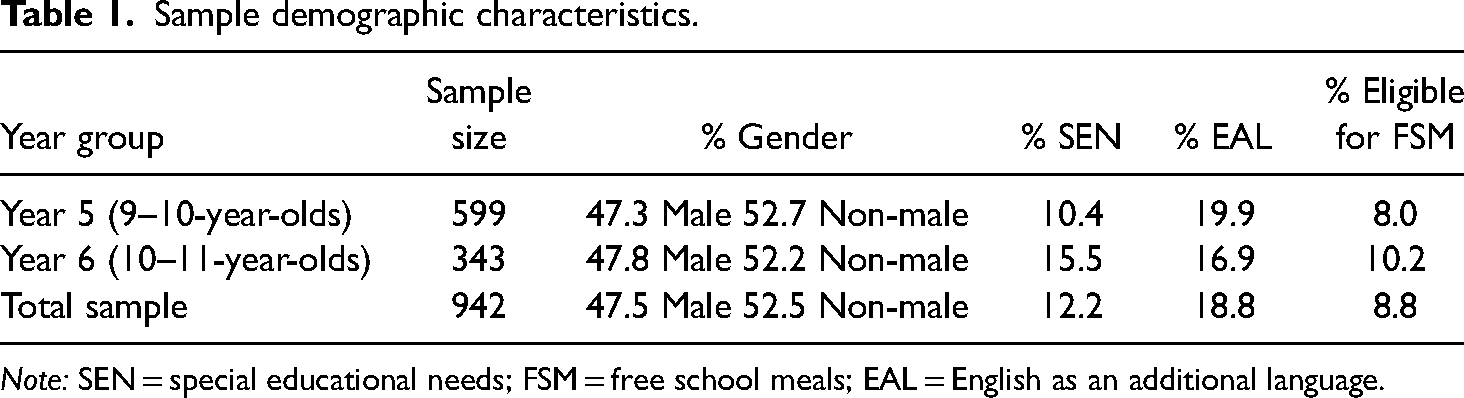
Note: SEN = special educational needs; FSM = free school meals; EAL = English as an additional language.
Procedure
All measures were administered by teachers in-person during lesson time in classrooms. Questionnaires were completed via Qualtrics, a secure online survey platform, while the standardised tests of achievement were completed as pen-and-paper assessments in classroom-based examination conditions. Teachers were briefed by the lead researcher to oversee children's completion of questionnaires following step-by-step written instructions. 4 Teachers read-aloud a script, including the information sheet to obtain their consent, and guided all pupils in the class through the questionnaire. Support staff assisted pupils with SEN. Standardised assessments were administered by teachers with the support of teaching assistants according to the set-up and administration rules provided by Granada Learning Assessment (https://www.gl-assessment.co.uk/assessments/progress-test-series/).
Children's questionnaire responses were matched to attainment data using unique identifiers assigned by the researcher and personal identifiers (initials and date of birth) included in questionnaire responses. Unique identifiers were used solely for the purpose of matching and were destroyed thereafter. The final dataset used for analysis was deidentified and anonymous.
Measures
Conducted with a separate sample of same-age pupils, a pilot six months prior to the main study established the mindset and achievement goal scales, which had minor rewording for age-appropriacy (see Supplemental Materials), had adequate reliability (α ≥ .70; the lowest being .74 and the highest being .91). Exogenous variables were modelled as latent constructs predicting their respective manifest variables (single-item indicators), except for overall wellbeing which was modelled as a latent construct predicting three parcels, each representing separate wellbeing subconstructs. Parcels were composite sum scores (linear combinations of the respective items for each subconstruct) (Bollen & Lennox, 1991). Parcelling is advantageous in structural equation modelling (SEM) when the goal is to assess structural relations between constructs, especially when parcels are justified by confirmatory factor analysis (CFA) and prior research (Rhemtulla, 2016). Measurement properties for all variables are detailed in the following sections.
Children's wellbeing
Self-report measures eliciting children's wellbeing are ubiquitous in research, with strong reliability and validity with children as young as seven (Norwood, 2007). For a full discussion, see Thompson and Aked (2009). As outlined previously, overall wellbeing is multidimensional, consisting of various dimensions. For the purpose of this study, overall wellbeing was operationalised as a combination of life satisfaction, eudaimonia and interpersonal relatedness. Separate models then specifically examined the two main wellbeing dimensions: feeling (life satisfaction) and functioning (eudaimonia) (Huppert & So, 2011). A validated self-report scale – ‘How I feel about myself and school’ (McLellan & Steward, 2015) – was used, which demonstrates good overall reliability (α ≥ .75) (McLellan & Galton, 2015). The scale measures distinct wellbeing dimensions (life satisfaction; five items, ω = 0.81, ‘I feel I enjoy things’, eudaimonia; five items, ω = 0.83, ‘I feel good about myself’, interpersonal relatedness; eight items, ω = 0.87, ‘I feel cared for’). The negative affect dimension was not included in the final models owing to insufficient reliability (α < .65), also found in validation studies (McLellan & Galton, 2015, p. 16). CFAs were performed for the three remaining dimensions, demonstrating adequate to good fit – (life satisfaction; RMSEA = 0.066, CFI = 0.99, TLI = 0.97, SRMR = .024, eudaimonia; RMSEA = 0.042, CFI = 1.00, TLI = 0.99, SRMR = .014, interpersonal relatedness; RMSEA = 0.079, CFI = 0.96, TLI = 0.94, SRMR = .037). Furthermore, a three-factor CFA indicated good fit: RMSEA = 0.070, CFI = 0.93, TLI = 0.91, SRMR = .044 with R2 ranging from 0.19 to 0.70, suggesting a modest to substantive proportion of item variance was accounted for.
Operational separation of wellbeing into subconstructs facilitates the investigation of the wellbeing-attainment relationship comprehensively. Different models therefore examined the association between wellbeing and attainment (H1). Models 1–3 examined the relation between overall wellbeing, a three-factor latent wellbeing construct formed of all three composites (life satisfaction, eudaimonia and interpersonal relatedness) and attainment. However, the core essences of wellbeing are hedonia and eudaimonia (Huppert & So, 2013) which, despite their interrelation, are distinct subconstructs (Deci & Ryan, 2008; Garcia & Siddiqui, 2009). Models 4–9 therefore examined their unique association with attainment. In this study, life satisfaction included children feeling that they enjoy, and are excited by things, that they have lots of energy, that there is lots to look forward to, and they do not feel bored. Eudaimonia is operationalised in large-scale research, such as the European Social Survey (ESS), as individual flourishing; experiences of competence, meaning, optimism and self-esteem (Ruggeri et al., 2020). Accordingly, children's eudaimonia herein included feeling confident, healthy, good about themselves, that they are doing well, and can deal with problems.
Academic attainment
Children completed standardised tests of attainment – Granada Learning Assessment's Progress Test in Mathematics (PTM) and Progress Test in English (PTE) – administered by teachers under exam conditions during lesson time. The tests were designed to sample the skills in England's National Statutory Curriculum and were standardised on a national sample of 85,000 children with demonstrable reliabilities (α ≥ .90) (GL Assessment, 2015a, 2015b). An independent systematic evaluation judged the tests to have adequate construct validity and reliability (Breadmore & Carroll, 2021). Raw scores are converted into Standard Age Scores (SASs) adjusted for age and scaled to a mean of 100, meaning pupils’ performance is comparable to same-age children nationwide. Focusing on domain-specific attainment measures can provide enhanced measurement precision (Fries et al., 2007). Therefore, multiple models were tested with attainment first operationalised as children's SAS in English and Mathematics, respectively, and then as children's ‘average’ attainment (SAS) across the two subjects. English and Mathematics are high-stakes subjects in England, with pupils’ scores in end-of-Primary school examinations (aged 11) being significant events used to hold schools accountable (Moss et al., 2021) and research suggesting children are susceptible to pressures to perform (McLellan et al., 2012; Stobart, 2009).
Mindset
Pupils’ mindsets were measured using a revised version of Dweck's Implicit Theories of Intelligence scale (Dweck, 1999): the Implicit Theories of Intelligence Self-Theory scale (De Castella & Byrne, 2015) which focuses on pupils’ theories of self-intelligence. The scale comprises two subscales: fixed; three items, ω = 0.74, ‘I have a certain amount of intelligence, and I really can’t do much to change it’, and growth mindset; three items, ω = 0.81, ‘With a lot of time and effort, I think I can change my intelligence a lot’. Pupils indicated how much they agreed with each item using a 6-point scale (6 = strongly agree, 1 = strongly disagree). Domain-general mindset beliefs significantly predict domain-specific attainment (Blackwell et al., 2007). Dweck's original scale was intended for use with pupils aged 10 but yields satisfactory reliability with children aged eight (Hellmich & Hoya, 2017; Ziegler et al., 2005) and even younger children have been found to hold theories of intelligence (Park et al., 2016) or ‘theories of badness’ (Dweck, 1998). Minor modifications made to item wordings for age-appropriacy in consultation with teachers were checked in piloting (see Supplemental Materials).
A two-factor CFA was modelled, replicating that of De Castella and Byrne (2015, p. 255). The CFA indicated good fit: RMSEA = 0.069, CFI = 0.98, TLI = 0.96, SRMR = .038. R2 ranged from 0.43 to 0.76, indicating substantive proportions of the variance in items was accounted for. Finally, to account for the relationship between mindset and achievement goals (Dweck, 1999; Lazarides & Watt, 2015; Miyagawa et al., 2018; Robins & Pals, 2002), with fixed mindset associated with performance-approach goals (Cho et al., 2019), mindset predicted both achievement goals in all models.
Achievement goals
The Patterns of Adaptive Learning Styles (PALS) (Midgley et al., 2000) measured pupils’ achievement goals. PALS demonstrates acceptable reliability with children aged eight (Bong, 2009; Kitsantas et al., 2009; Mägi et al., 2010; Wodzinski et al., 2018) and sound discriminant validity (Huang, 2012); thus, it was judged suitable for the proposed study following minor rewording (see Supplemental Materials). The scale comprises 14 items with three subscales evaluating pupils’ endorsement of (a) mastery-approach goals (five items, ω = 0.89 [Mathematics], ω = 0.93 [English], ‘I do my work in Mathematics/English because I like to learn new things’); (b) performance-approach goals (five items, ω = 0.85 [Mathematics], ω = 0.90 [English], ‘I want to look smarter than other children in my Mathematics/English class’); and (c) performance-avoidance goals (four items, ω = 0.75 [Mathematics], ω = 0.82 [English], ‘I want to stop other people thinking I am not smart at Mathematics/English’). According to Midgley et al.'s (2000) suggestion, the scale measured pupils’ domain-specific goals (in English and Mathematics). Pupils indicated the extent to which they agreed with items using a 5-point scale (1 = not at all true, 3 = somewhat true, 5 = very true).
Following two modifications allowing residual terms for two parallel-worded items to covary (see Supplemental Materials), final CFA demonstrated good fit: (English: RMSEA = 0.070, CFI = 0.96, TLI = 0.95, SRMR = .051; Mathematics: RMSEA = 0.071, CFI = 0.95, TLI = 0.93, SRMR = .059), with R2 ranging from 0.47 to 0.80 (English) and from 0.42 to .79 (Mathematics). However, performance-approach and performance-avoidance goals were highly correlated (.80 for English; .75 for Mathematics), as frequently found in the literature (Huang, 2011; Murayama et al., 2011). This has led researchers to focus on the two original goal orientations (mastery- and performance-approach) (Anderman et al., 1999; Gutman, 2006; Linnenbrink-Garcia et al., 2012). The same approach was therefore adopted in this study.
Covariates
Research suggests children's socio-economic status (SES) significantly predicts their attainment (Strand & Demie, 2005; Warren et al., 2019). In this study, pupils’ FSM eligibility (0 = not eligible, 1 = eligible), widely used as a proxy for SES to predict children's attainment in England (Hobbs & Vignoles, 2009; Ilie et al., 2017), was therefore used. Additional covariates of attainment included whether pupils had SEN (0 = no, 1 = yes), their gender (0 = male, 1 = non-male 5 ) and whether they had EAL (0 = no, 1 = yes), all documented as predictors of attainment (Department for Children, Schools and Families, 2009; Department for Education, 2018, 2019a; Hutchinson et al., 2020; Strand, 2014; Sylva et al., 2013). Finally, though children in this study were administered age-appropriate tests of attainment with age-adjusted SAS used as outcomes in all models, year group was included as a covariate of attainment (0 = year 5, 1 = year 6) to account for any additional year group-related factors.
Analytic plan
To estimate relationships between the multiple latent exogenous variables and the manifest endogenous variable (attainment), SEM was used. Nine SEMs were modelled, facilitating a detailed examination of associations between overall wellbeing, eudaimonia, and life satisfaction with attainment (in English and Mathematics, and ‘average’, respectively). The only differences between models were how wellbeing and attainment were operationalised. First, overall wellbeing (combination of life satisfaction, eudaimonia, and interpersonal relatedness) was modelled as correlating with attainment (Models 1–3; Figure 2), followed by life satisfaction (Models 4–6) and eudaimonia (Models 7–9) (see Figure 3). In all models, mindset and achievement goals were modelled alongside wellbeing associated with attainment, in addition to observed sociodemographic variables (see ‘Covariates’). To account for school clustering on children's attainment (Crawford et al., 2017), cluster robust standard errors (CR-SEs) are reported throughout, providing fixed-effects estimations (McNeish & Kelley, 2019). CR-SEs are most suitable for cross-sectional data with a small number of clusters (McNeish, 2014). Given the medium magnitude of correlations between predictors, variance inflation factors (VIFs) were inspected: all were < .3.
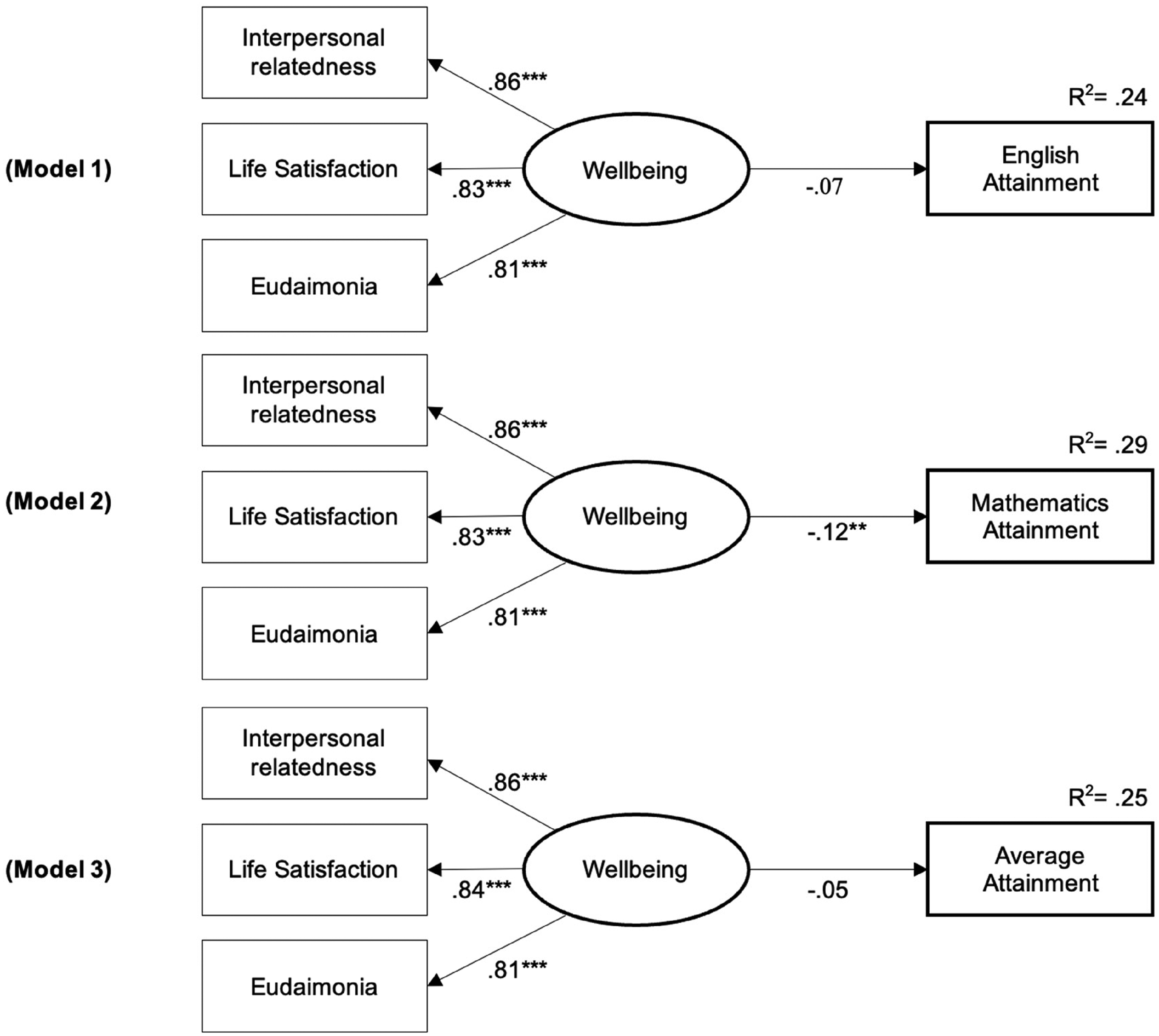
Main effects of overall wellbeing on attainment.
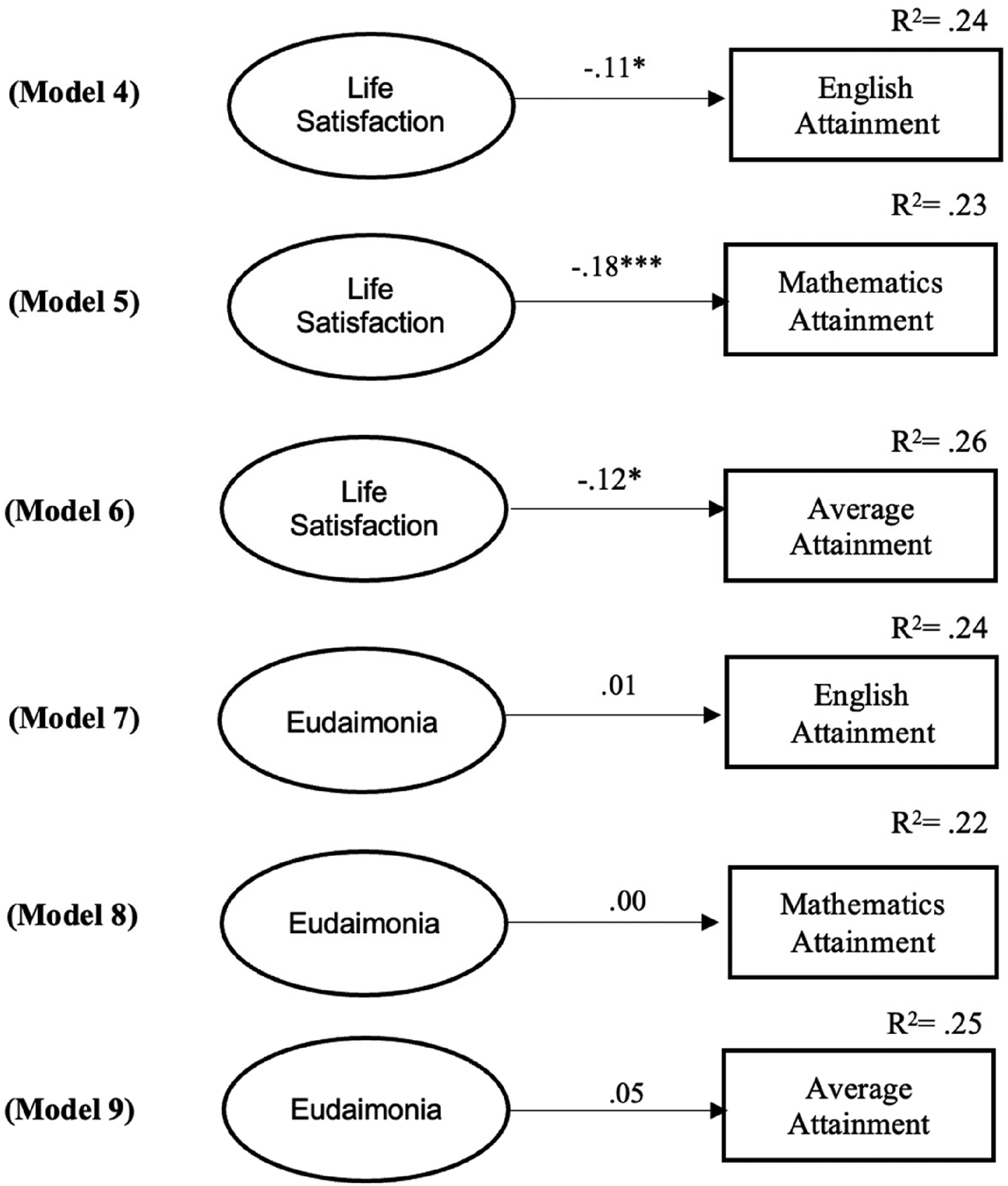
Main effects of satisfaction (Models 4–6) and eudaimonia (Models 7–9) on attainment.
Data were collected from 1,106 children. The proportion of systematic missing data ranged from 0% to 11.1%. Cohen and Cohen (1983) suggest when missing data cases are >10%, missingness warrants diagnostic tests, which were thus undertaken for two variables; English (10.55%) and Mathematics attainment (11.18%). Findings from t-tests comparing subgroups with/without attainment were all significant (p < .05), indicating the missing data process was not missing at random (MAR). Further, Little's missing completely at random (MCAR) test (Li, 2013) indicated no significant differences; therefore, the missing data process was established to be MCAR. The maximum likelihood (ML) method was used, requiring listwise deletion. Satorra–Bentler scaled chi-square (χ2) tests (Satorra & Bentler, 1994) were used to account for non-normality and obtain goodness-of-fit (GOF) indices for the full structural models (Curran et al., 1996; Hu et al., 1992).
As p-values for chi-square tests are expected to be significant in large samples (Bentler & Bonett, 1980) GOF indices were evaluated holistically. Cut-off criteria used to assess model fit acceptability included absolute fit indices: RMSEA close to or below 0.050, SRMR close to or below 0.080 and incremental fit indices: CFI and TLI ≥ 0.090 (Browne & Cudeck, 1992; Hu & Bentler, 1999). All models met or exceeded these cut-offs.
Results
Preliminary analyses
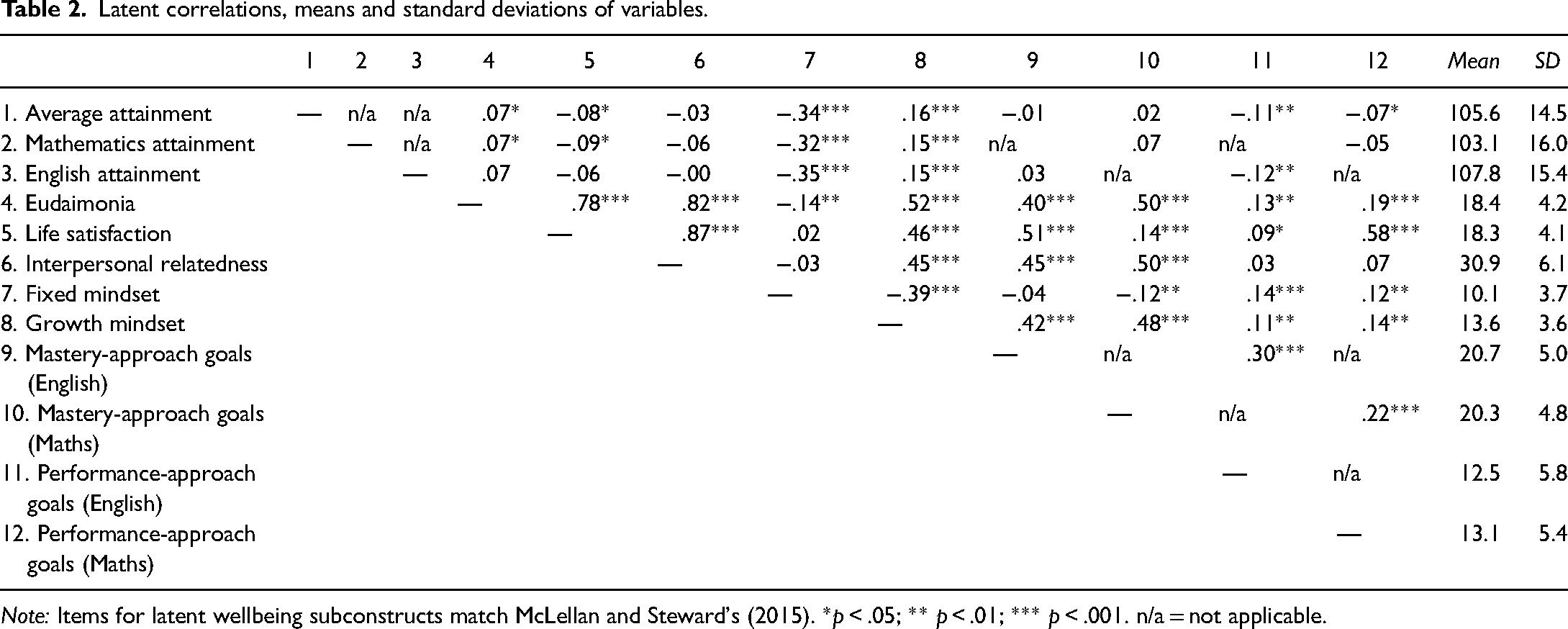
First, means, standard deviations and correlations were inspected (Table 2). Regarding the wellbeing subconstructs, eudaimonia was significantly positively correlated, while life satisfaction was significantly negatively correlated, with Mathematics and average attainment. Interpersonal relatedness was not significantly associated with attainment. There were no significant correlations between English attainment and any wellbeing subconstruct. As expected, the three wellbeing subconstructs were highly correlated, the highest being interpersonal relatedness and life satisfaction; all were modelled as manifest predictors of the overarching overall wellbeing latent construct (Models 1–3) and in different models whereby life satisfaction (Models 4–6) and eudaimonia (Models 7–9) were separate predictors.
Latent correlations, means and standard deviations of variables.
Note: Items for latent wellbeing subconstructs match McLellan and Steward's (2015). *p < .05; ** p < .01; *** p < .001. n/a = not applicable.
Regarding mindset, both eudaimonia and interpersonal relatedness significantly positively correlated with a growth mindset, while all wellbeing subconstructs significantly negatively correlated with a fixed mindset. Furthermore, growth mindset was significantly positively correlated, while fixed mindset was negatively correlated, with average Mathematics and English attainment. Pertaining to achievement goals, only performance-approach goals were significantly negatively correlated with attainment, specifically with English and average attainment.
Finally, correlations between sociodemographic covariates and attainment were examined. Having EAL was significantly positively correlated with average (r = .11, p = <.001), English (r = .09, p = <.01), and Mathematics attainment (r = .12, p = <.01), while being eligible for FSM was negatively correlated with attainment on average (r = −.20, p = <.001), in English (r = −.16, p = <.001) and in Mathematics (r = −.17, p = <.001). Moreover, having SEN was significantly negatively correlated with attainment on average (r = −.39, p = <.001), in English (r = −.38, p = <.001), and in Mathematics (r = −.35, p = <.001). Regarding gender, identifying as non-male was positively correlated with English attainment (r = .11, p = <.01) but negatively correlated with Mathematics attainment (r = −.10, p = <.01). Finally, being in Year 5 (as opposite to Year 6) was negatively correlated with Mathematics attainment only (r = −.07, p = <.05). There were no significant correlations between average attainment and gender, or year group. Altogether, correlations were small in size but warranted further exploration in the SEM context.
Structural equation models
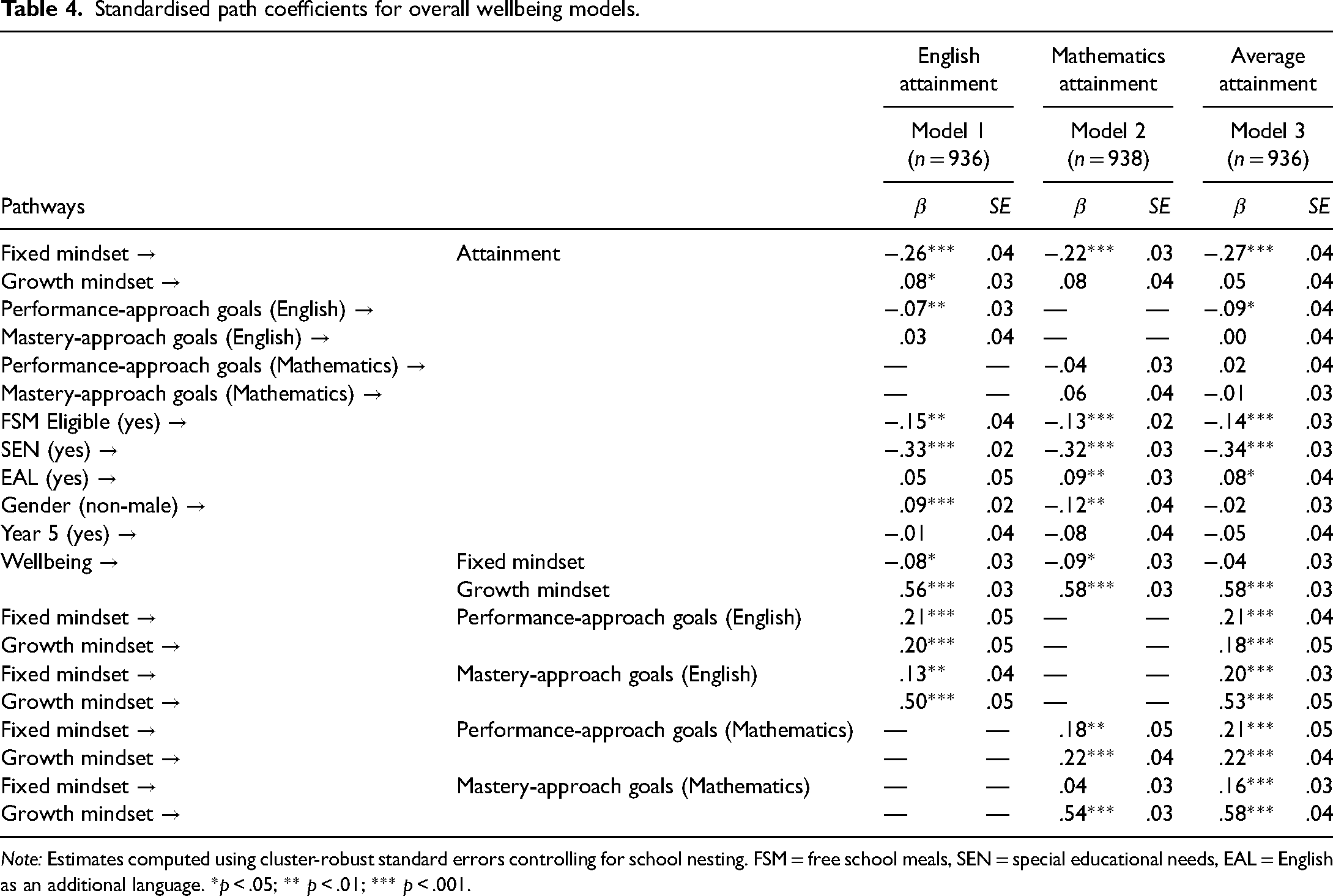
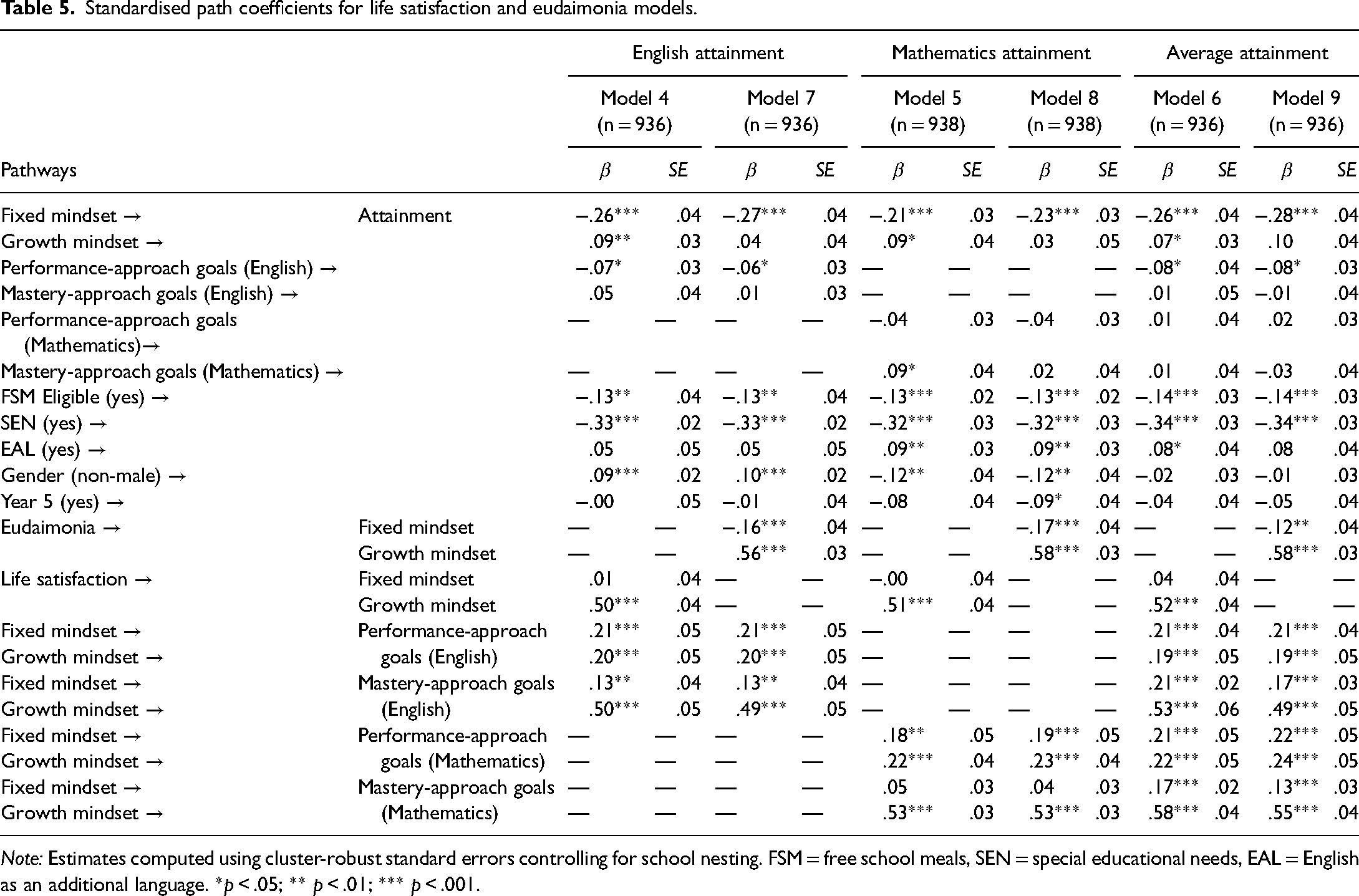
GOF indices for all models showed an acceptable fit to the data (Table 3). Models explained up to a third of the variance in attainment (R2 ranging from .22 to .29). Main effects of wellbeing on attainment for all models are presented in Figures 2 and 3, with all other model coefficients and factor loadings provided in Tables 4 and 5.
Goodness-of-fit statistics for SEMs.
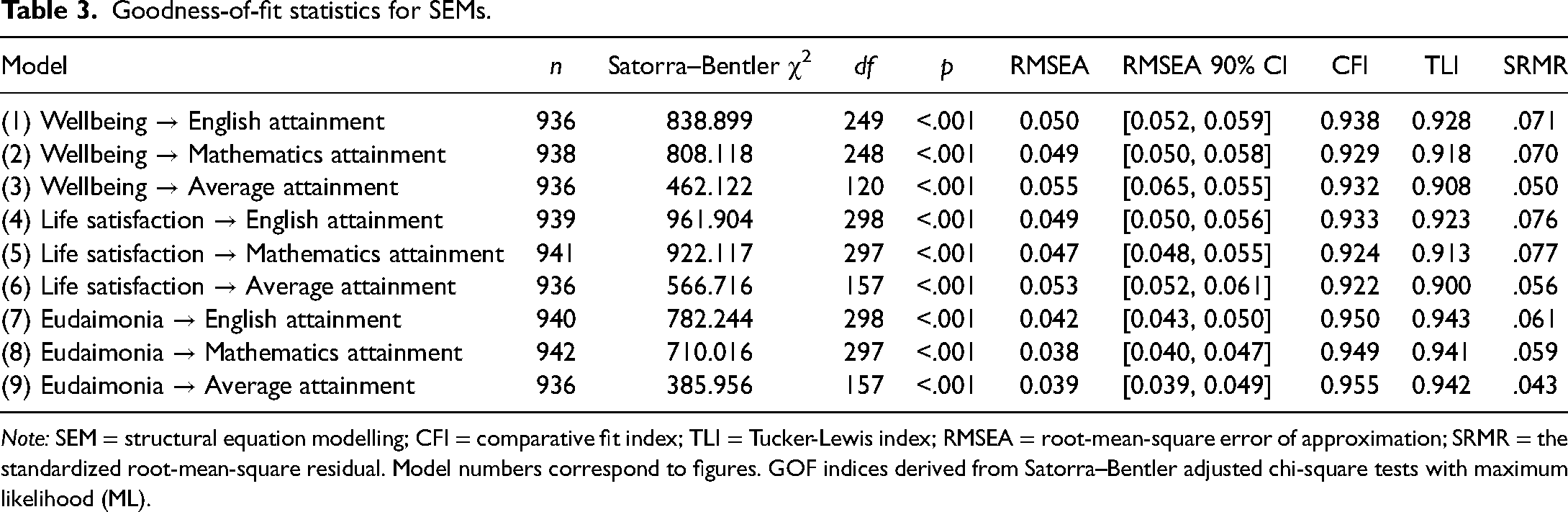
Note: SEM = structural equation modelling; CFI = comparative fit index; TLI = Tucker-Lewis index; RMSEA = root-mean-square error of approximation; SRMR = the standardized root-mean-square residual. Model numbers correspond to figures. GOF indices derived from Satorra–Bentler adjusted chi-square tests with maximum likelihood (ML).
The wellbeing-attainment relationship
H1, that higher overall wellbeing, life satisfaction (H1a) and eudaimonia (H1b), respectively, would be significantly associated with higher attainment was tested via different models. First, ‘overall wellbeing’ was operationalised as a combination of life satisfaction, eudaimonia and interpersonal relatedness (Figure 2). Wellbeing was then separated into its two core dimensions of life satisfaction and eudaimonia (Figure 3). Tables 4 and 5 present all other coefficients for models, with model numbers corresponding to those in the figures.
There was no significant association between overall wellbeing with neither English attainment or average attainment (Figure 2), therefore the null hypothesis was accepted for Models 1 and 3. However, overall wellbeing was significantly negatively associated with Mathematics attainment (Model 2; Figure 2), providing evidence to the contrary of H1.
Second, life satisfaction was significantly negatively associated with English, Mathematics, and average attainment (Figure 3), also providing evidence to the contrary of H1a. Eudaimonia was not significantly related to English, Mathematics or average attainment, therefore the null hypothesis was accepted for H1b. Altogether, therefore, there was no support for H1, H1a or H1b. Rather, higher life satisfaction was significantly associated with lower attainment in all models, while higher overall wellbeing was significantly associated with lower Mathematics attainment specifically.
Mindset, wellbeing, and attainment
Our hypotheses that higher overall wellbeing (H2), life satisfaction (H2a) and eudaimonia (H2b) would be significantly associated with a higher growth mindset were supported by SEM results (Tables 4 and 5). Higher overall wellbeing (Models 1 and 2) and eudaimonia (Models 7 and 8), respectively, was significantly associated with higher growth and a lower fixed mindset. An exception was the non-significant association between overall wellbeing and fixed mindset in Model 3. Higher life satisfaction was significantly associated with a higher growth mindset only and was not significantly related to a fixed mindset (Table 5). Altogether, findings supported the rejection of the null hypothesis for H2, H2a and H2b.
Finally, results partially supported H3, that a higher growth mindset would be significantly associated with higher attainment. A higher growth mindset was significantly related to higher English and Mathematics attainment in some models. Specifically, a higher growth mindset was significantly associated with higher English attainment in Model 1 (Table 4) and English, Mathematics and average attainment in life satisfaction models (Models 4–6; Table 5). Higher endorsement of a fixed mindset, however, was significantly associated with lower attainment in all nine models. Given the significant associations between wellbeing, mindset, and attainment, exploratory mediation analyses were performed to examine potential indirect effects. However, these analyses should be interpreted tentatively, given this study's lack of temporal precedence.
Standardised path coefficients for overall wellbeing models.
Note: Estimates computed using cluster-robust standard errors controlling for school nesting. FSM = free school meals, SEN = special educational needs, EAL = English as an additional language. *p < .05; ** p < .01; *** p < .001.
Standardised path coefficients for life satisfaction and eudaimonia models.
Note: Estimates computed using cluster-robust standard errors controlling for school nesting. FSM = free school meals, SEN = special educational needs, EAL = English as an additional language. *p < .05; ** p < .01; *** p < .001.
First, indirect effects of overall wellbeing on English attainment (Model 1) through both growth (b = .043, CI .005, .008, p < .05) and fixed mindset (b = .022, CI .003, .040, p < .05) were significant, indicating the effect of overall wellbeing was mediated by mindset. The indirect effect of overall wellbeing through fixed mindset on Mathematics attainment (Model 2) was also significant (b = .019, CI .004, .035, p < .05). Large proportions of the effects of overall wellbeing on attainment were explained by fixed mindset (50% for English and 60% for Mathematics). The indirect effects of overall wellbeing on average attainment (Model 3) through both growth and fixed mindsets were non-significant.
Second, indirect effects of life satisfaction through growth mindset were significant for English (Model 4; b = .046, CI .013, .078, p < .01), Mathematics (Model 5; b = .047, CI .006, .087, p < .05) and average attainment (Model 6; b = .036, CI .004, .067, p < .05). Growth mindset explained approximately 68%, 34% and 45% of the direct effects of life satisfaction on English, Mathematics and average attainment, respectively, representing competitive mediation. Lastly, indirect effects of eudaimonia through fixed mindset were significant for English (Model 7; b = .044, CI .020, .068, p < .001), Mathematics (Model 8; b = .038, CI .018, .059, p < .001), and average attainment (Model 9; b = .035, CI .013, .057, p < .01), indicating potential full mediation. Results remain exploratory only.
Covariate analyses
All models included a suite of covariates not presented in figures for the purpose of parsimony. In all models, fixed and growth mindsets were significantly positively associated with both performance-approach goals and mastery-approach goals (Tables 4 and 5). In turn, English performance-approach goals were significantly negatively associated with English and average attainment. Fixed and growth mindsets were also significantly positively related to mastery-approach goals, with the exception of a fixed mindset in Mathematics attainment models (Models 2, 5 and 8). However, mastery-approach goals were only significantly positively related to Mathematics attainment (Model 5).
Finally, the pattern of results linked to sociodemographic variables aligns with prior research and was as follows. Being eligible for FSM and having an SEN was significantly negatively associated with attainment, while having EAL was significantly positively associated with Mathematics and average attainment. Identifying as female or ‘other’ was not significantly associated with attainment on average, but was significantly positively associated with English attainment and significantly negatively associated with Mathematics attainment. Being in year 5 did was not significantly related to attainment, other than in Mathematics (Model 8 only), presumably because children's attainment was operationalised as SASs in age-appropriate tests.
Discussion
Children's wellbeing and attainment both predict important life outcomes (Farmer & Hanratty, 2012; Hu & Wolniak, 2013). Accordingly, attainment is used to hold English schools accountable and assess teacher effectiveness (Moss et al., 2021; Stobart, 2009), and wellbeing is part of statutory curricula and school inspection criteria (Ofsted, 2022). Yet longitudinal research documents declines in children's school-specific happiness (The Children's Society, 2022). International research also focuses educators’ attention on the relationship between wellbeing and attainment (OECD, 2019). This study advances research on wellbeing and attainment in two key ways, summarised in the following sections.
Measures matter when examining wellbeing and attainment
First, our findings exemplify the impact of research distinguishing between measures of overall wellbeing, life satisfaction, and eudaimonia conceptually and operationally when examining associations with attainment. Positive psychology conceptualises overall wellbeing as the combination of life satisfaction and eudaimonia (Lomas et al., 2021), which are related but distinct sub-constructs. By separating these two sub-constructs, our study found 9–11-year-olds’ reporting lower school life satisfaction attained significantly higher in standardised English and Mathematics assessments and on average across both subjects.
Our findings contradict some studies documenting positive associations between life satisfaction and attainment. We suggest a number of explanations for this. In particular, positive associations have been found in studies whose samples differ from ours, including studies with large age ranges (Clark & Teravainen-Goff, 2018; ImpactEd, 2022), meta-analytic studies aggregating effects across developmental stages (e.g. Bücker et al., 2018; Kaya & Erdem, 2021), and studies with older students (e.g. Datu & King, 2018). Different study contexts (Miller et al., 2013; Yu et al., 2022) provide another explanation, given England's distinct educational culture of performativity (Sanderse et al., 2015). One English study found no association between children's life satisfaction and attainment in national examinations (Jerrim, 2021). However, the data were collected over a decade prior, with performativity cultures arguably heightened since then (Moss et al., 2021). Notably, Jerrim (2021) also found different wellbeing-attainment relations dependent on the wellbeing sub-construct examined. Regardless, ours is not the first English study to suggest children attaining the highest academically report lower school-life satisfaction (Marks et al., 2004).
Eudaimonia was not significantly related to children's attainment, corroborating evidence that eudaimonia may be significantly associated with adolescents’ but not children's attainment (Kryza-Lacombe et al., 2019; López-Pérez & Fernández-Castilla, 2018; López-Pérez & Zuffianò, 2021; Tobia et al., 2019). This is also consistent with research documenting a higher prevalence of hedonic motives among children compared to adolescents (Gentzler et al., 2021). Indeed, the study conducted in parallel to the present as part of the larger mixed methods project (Clarke et al., 2023) found adolescents’ school-specific eudaimonia was significantly associated with their attainment, controlling for socio-demographic factors and prior attainment, whereas the relationship of life satisfaction with attainment was non-significant. However, our study is the first to our knowledge explicitly conceptualising children's school-specific eudaimonia; therefore, our results require replication.
Altogether, the present negative association found between children's school wellbeing and attainment highlights a potential ‘stage-environment’ misfit during late-childhood (Eccles, 2004). Our findings therefore suggest that the straightforward promotion of wellbeing in schools without consideration of how other priorities interact with this may be misled. There is a need for educational policymakers to better understand how the priorities of wellbeing and attainment intersect and for guidance as to how practitioners should manage them. For example, school climates promoting academic competition are associated with higher attainment but lower child life satisfaction (Rudolf & Lee, 2023). Furthermore, English research suggests that children's school wellbeing significantly predicts their later pre-adolescent engagement in schoolwork (Gutman & Vorhaus, 2012), suggesting a long-term view of any academic benefits of wellbeing may be valuable.
Mindset is a potential mediator of wellbeing and attainment
The second contribution of this study is its inclusion of mindset in analysing the wellbeing-attainment relationship and responding to calls from motivational psychologists (Datu & King, 2018). First, our finding that the negative effect of endorsing a fixed mindset on children's attainment was much stronger than the positive effect of a growth mindset supports findings from UK research elsewhere with same-age children (Warren et al., 2019). Additionally, wellbeing correlated positively with a growth mindset and negatively with a fixed mindset in our study, providing further evidence for the co-occurrence of wellbeing with mindsets (Howell, 2016) in children. Furthermore, follow-up analyses of indirect pathways suggested that roughly half of the negative association between life satisfaction and attainment was counteracted by a growth mindset, suggesting a potential tempering effect of mindset. Though these analyses were used for preliminary theory testing only (Putwain et al., 2020) and remain non-causal, our results provide a rationale for follow-up confirmatory research. Moreover, our results corroborate research finding significant relationships between mindset, wellbeing and learning outcomes in an English context (Boncquet et al., 2020; Valdez, 2023).
Policy and practice implications
Given that wellbeing and mindset are both alterable (Banerjee et al., 2014; Yeager & Dweck, 2020), our findings have important practical implications. Wellbeing is critical for healthy child development (Rutter, 1989), acting as a protective buffer against stress and psychopathology (Proctor, 2014). Accordingly, psychologists promote wellbeing as an outcome worthy of attention in its own right (Diener & Seligman, 2004). Because school environments are where children spend much of their formative years, promoting children's wellbeing should be a standalone educational aim. This remains true, even in light of the negative association observed in our study between children's wellbeing and attainment. Our findings do, however, suggest the promotion of wellbeing in schools requires a balanced approach.
School leaders should embrace holistic, whole-school wellbeing approaches that foster children's social, emotional and cognitive development (Allen et al., 2022). The WHO's Health Promoting Schools (HPS) framework offers a practical blueprint for school leaders to implement whole-school approaches that prioritise wellbeing and academic learning together (Langford et al., 2017). The rights-respecting schools award (RRSA) represents another practical framework for senior school leadership to implement, which focuses on fostering children's wellbeing through integrating children's rights into all aspects of school life. For example, promoting interpersonal connectedness and mutual respect between pupils and school staff as well as incorporating pupil voice into school decision-making may lead to improved self-esteem and learning outcomes (Robinson & Sebba, 2010). The positive relationship between children's mindset and wellbeing in our study also reinforces the relevance of mindset in positive education curricula (Kern & Wehmeyer, 2021). Teachers could incorporate mindset into wellbeing curricula, introducing children to fixed and incremental beliefs, including how mindsets extend to thinking about their emotions and relationships (Howell, 2016).
Second, our results suggest that encouraging incremental beliefs among children alone is not sufficient and that parents and educators need to also work toward discouraging children from internalizing a fixed mindset. This is particularly important for young children, who are especially susceptible to adopting fixed beliefs about ability (Warren et al., 2019). Teachers can be attuned to the ways they provide feedback on children's schoolwork, which can shape children's implicit beliefs about their abilities.
Teachers should ensure their feedback is informational and non-controlling (Ryan & Weinstein, 2009), emphasize effort over ability, and use assessment for learning (AfL) principles. Formative assessment, or AfL (Stobart, 2008) trains teachers to ensure any summative score/grade children receive is communicated with feedback indicating (a) the target they were aiming for, and (b) an indication of how their work can be improved to reach that target (Taras, 2005). AfL is a fundamentally incrementalist approach focused on encouraging individual improvement through targeted effort relative to one's current ability level.
Research suggests teachers are able to negotiate a balance between formative assessment practices and children's socio-emotional needs (Pyle & DeLuca, 2013), such as blended assessments that use play-based approaches (Pyle et al., 2022). Performance-oriented pedagogic practices ought to also be avoided by teachers, given that performance-oriented classroom environments encourage a fixed mindset (Covington et al., 2009). Moreover, teachers should avoid evaluating pupils’ performance based on normative rather than mastery standards, as the former encourages social comparison and favours ‘high ability’ pupils (Ames, 1992; Butler, 2000).
Limitations
This study is limited in at least three ways. First, the generalisability of our findings is unknown beyond our Western UK sample. Wellbeing is a culturally-situated experience, with children's school wellbeing also dependent on different societies’ educational approaches (Upadyaya & Salmela-Aro, 2013). Even pertaining to England, the generalisability of our findings across children nationwide requires further testing. In particular, children eligible for FSM, and from some Black, Asian, and other minoritized racial and ethnic groups (see Supplemental Materials), are underrepresented in our sample. It is thus imperative that future research includes these minoritized groups. Furthermore, our coding of gender as male or non-male – a decision taken to retain the small number of children in the sample whose self-reported gender identity was non-binary in final analyses – meant the wellbeing-attainment association for this specific sub-group of children was not examined. Studies with larger samples that enable sub-group analyses should ensure that the school experiences of children who identify outside the traditional gender binary are explored.
Second, all findings are non-causal owing to the study's cross-sectional design. Our findings provide evidence of correlational associations between wellbeing, mindset and attainment only. Research enabling temporal precedence and repeated measures is needed to properly test whether mindset might mediate the wellbeing-attainment relationship. Longitudinal research is particularly necessary, given the potential bidirectionality of wellbeing-attainment associations (Yu et al., 2022).
Third, our study did not include measures of negative affect as part of overall wellbeing due to the low reliability derived from the items included in McLellan and Steward's scale (2015). Had negative affect been incorporated into the overall wellbeing measure, we may have obtained different results. Lastly, children had been back at school for just two months at the time of data collection when English schools had re-opened following closures due to the coronavirus disease 2019 (COVID-19) pandemic. Children's wellbeing and attainment were affected by this historic context (Department for Education, 2023), underscoring the need for additional research.
Conclusion
This study investigated how children's wellbeing at school relates to their academic attainment using multidimensional validated wellbeing measures and reliable, nationally standardised assessments aligned to National Curricula with practical applicability (Brown & Eklöf, 2018). Through distinguishing conceptually and operationally between overall wellbeing, life satisfaction and eudaimonia, it found negative associations between children's life satisfaction and attainment that are developmentally and contextually specific (children aged 9–11 in England). Our findings suggest that policymakers should be attuned to the developmental wellbeing needs of children compared to adolescents (Erikson, 1963; Gentzler et al., 2021), balancing these with the frequency, focus, and timing of academic assessments (Ryan & Weinstein, 2009). For example, in England, reform to high-stakes assessments of children aged 4–11 has been proposed (Moss et al., 2021).
This study also reinforced the importance of considering children's mindsets as psychological states deserving of investment alongside wellbeing, finding that children endorsing fixed mindsets are more likely to have lower school wellbeing and attainment. Qualitative research suggests teachers can temper the effects of fixed mindsets on wellbeing by ensuring they provide formative feedback to accompany summative scores and reward effort over ability (Clarke & Platt, 2023). Educators should also consider the relevance of incorporating mindset into wellbeing curricula, given the two constructs were positively correlated in the present study.
According to the United Nations Convention on the Rights of the Child (UNCRC; United Nations, 1989), Article 24, every child has the right to the best possible health. Wellbeing is a fundamental part of health (World Health Organisation, 2020). Simultaneously, the UNCRC Article 29 stipulates children's abilities must be nurtured through education. Considering the present findings, flexibility is needed in terms of how these two rights are upheld by schools to support children's holistic development.
Supplemental Material
sj-docx-1-spi-10.1177_01430343231215836 - Supplemental material for Associations between children's school wellbeing, mindset and academic attainment in standardised tests of achievement
Supplemental material, sj-docx-1-spi-10.1177_01430343231215836 for Associations between children's school wellbeing, mindset and academic attainment in standardised tests of achievement by Tania Clarke and Ros McLellan in School Psychology International
Footnotes
Acknowledgements
We would like to thank all the children who took part in this project and their teachers.
Declaration of conflicting interests
The author(s) declared no potential conflicts of interest with respect to the research, authorship, and/or publication of this article.
Funding
The authors disclosed receipt of the following financial support for the research, authorship, and/or publication of this article: This work was supported by the Cambridge Trust, St. Edmund’s College, University of Cambridge (Awarded to Tania Clarke).

Supplemental material
Supplemental material for this article is available online.
Notes
Author biographies
References
Supplementary Material
Please find the following supplemental material available below.
For Open Access articles published under a Creative Commons License, all supplemental material carries the same license as the article it is associated with.
For non-Open Access articles published, all supplemental material carries a non-exclusive license, and permission requests for re-use of supplemental material or any part of supplemental material shall be sent directly to the copyright owner as specified in the copyright notice associated with the article.
