




Abstract
Academic self-efficacy (ASE) refers to a student’s global belief in his/her ability to master the various academic challenges at university and is an essential antecedent of wellbeing and performance. The five-item General Academic Self-Efficacy Scale (GASE) showed promise as a short and concise measure for overall ASE. However, of its validity and reliability outside of Scandinavia is limited. Therefore, this paper aimed to investigate the psychometric properties, longitudinal invariance, and criterion validity of the GASE within a sample of university students (Time 1: n = 1056 & Time 2: n = 592) in the USA and Western Europe. The results showed that a unidimensional factorial model of overall ASE fitted the data well was reliable and invariant across time. Further, criterion validity was established by finding a positive relationship with task performance at different time stamps. Therefore, the GASE can be used as a valid and reliable measure for general ASE.
Keywords
Introduction
General academic self-efficacy (ASE) refers to students’ global belief in their ability to master the various academic challenges at university and is an essential antecedent of wellbeing and academic performance (Nielsen et al., 2018). Within university contexts, higher levels of ASE has been associated with lower levels of depression/stress/anxiety (Tahmassian & Jalali-Moghadam, 2011), better decision-making, motivation, and engagement, as well as higher levels of academic- and task-performance (Doo & Bonk, 2020; Tossavainen et al., 2021; Van Zyl et al., 2021). As a social-cognitive process, ASE is concerned with developing the belief in one’s ability to obtain and optimize the cognitive, behavioral, emotional, and social resources required to perform better at academic-related tasks (Nielsen et al., 2018). A meta-analysis showed that ASE is the strongest predictor of overall performance at university i.t.o grade point average (over and above personality, motivation and learning styles) (Richardson et al., 2012). Various studies have also found that ASE is a strong predictor of students overall task performance (i.e., the proficiency to perform well in academic tasks through making the right choices and to take the initiative to perform the most important or core tasks central to their academic studies on time, and to specification) (Campbell & Hackett, 1986; Lim & Bang, 2018; Tossavainen et al., 2021). When students feel competent in their own academic abilities, they are better able to utilize their capabilities to prioritize the completion of competing academic tasks more effectively, are less likely to be discouraged by setbacks, less likely to procrastinate, and invest more effort into their studies (Richardson et al., 2012; Tossavainen et al., 2021). Given ASE’s importance for performing well at academic tasks, it is not surprising that its development has become a central strategy for universities to enhance academic throughput (Meintjes, 2020).
As such, various psychometric instruments to measure ASE have been developed (cf. Dever & Kim, 2016; Lindstrøm & Sharma, 2011; Owen & Froman, 1988; Zimmerman et al., 1992). However, these instruments are exceptionally lengthy (ranging from 16 to 33) and have shown different factorial structures and varying ranges of internal consistency in different settings (Meintjes, 2020). This could lead to biased results and limits the potential for cross-cultural comparisons. Developed and validated in Scandinavia, the English adapted five-item General Academic Self-Efficacy Scale (GASE) showed promise as a short, clear, and concise measure for overall academic self-efficacy (Nielsen et al., 2018). The scale measures the global belief in one’s ability to perform and plan tasks associated with an academic degree (Nielsen et al., 2018). The GASE has shown to be a valid and reliable measure in various studies and proved to be invariant between genders (Bass, 2020; Hitches et al., 2021; Nielsen, 2020). However, its validity and reliability outside of Scandinavia are yet to be investigated.
Therefore, the purpose of this paper was to investigate the psychometric properties, longitudinal invariance, and criterion validity (i.r.o. task performance) of the GASE within the tertiary educational environment in Western Europe and the US. The study aims to provide researchers and practitioners with evidence that the GASE can be used as a valid and reliable tool to measure general academic self-efficacy in university contexts.
Methodology
Research Design
A longitudinal, electronic survey-based research design was employed to explore the psychometric properties, longitudinal invariance and criterion validity of the GASE. Data for this paper form part of a larger cross-cultural student wellbeing project obtained at two time-points over 3 months.
Participants
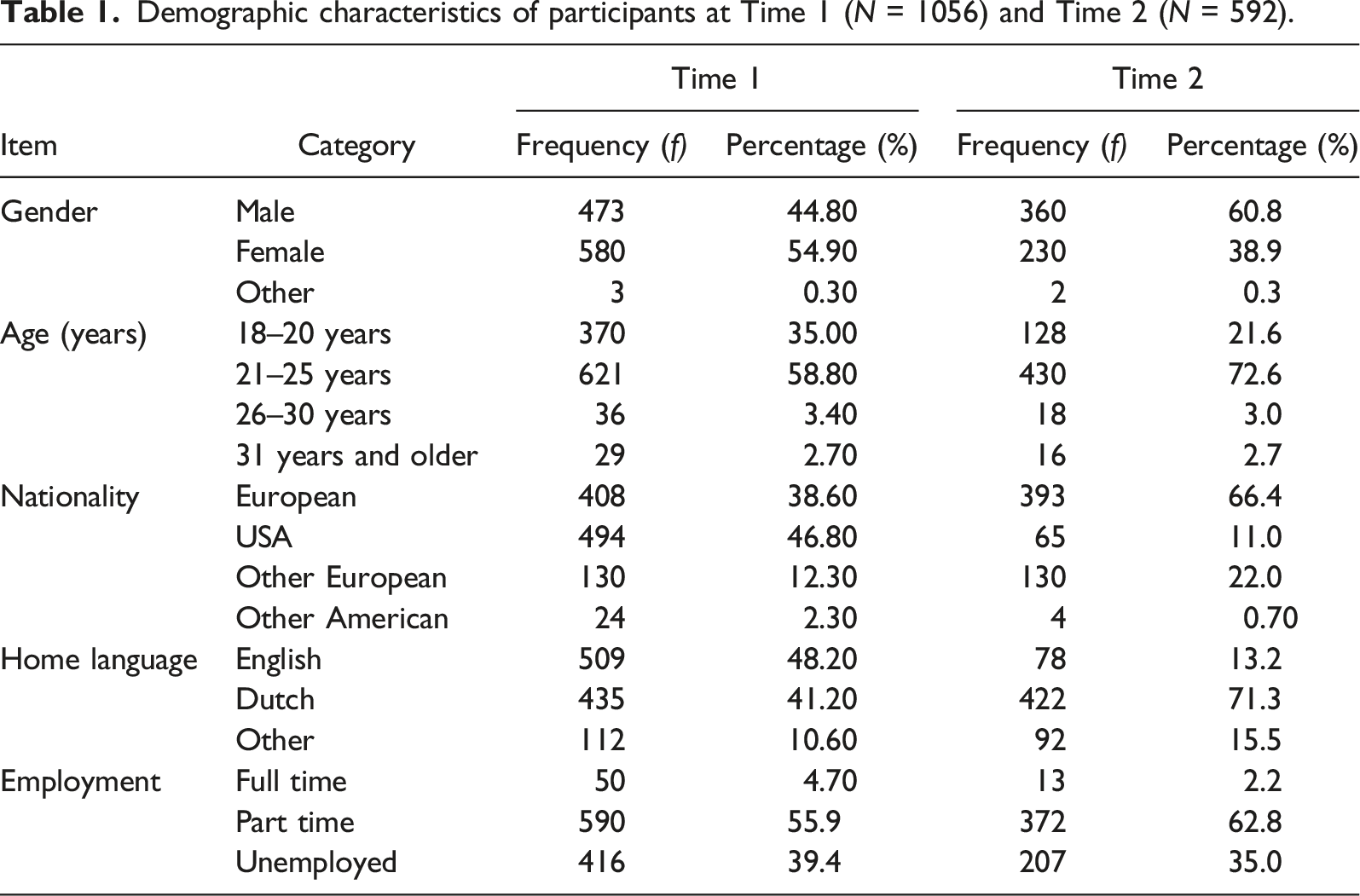
Demographic characteristics of participants at Time 1 (N = 1056) and Time 2 (N = 592).
Measuring Instruments
The General Academic Self-Efficacy scale (GASE: Nielsen et al., 2018) was used to measure academic self-efficacy. This five-item self-report scale measures academic self-efficacy on a five-point Likert scale ranging from 1 (strongly disagree) to 5 (strongly agree). An example item is: “I know I can pass the exam if I put in enough work during the semester.” Akanni and Oduaran (2018) reported acceptable levels of internal consistency with a Cronbach’s alpha of 0.81.
The Task Performance sub-scale of Koopmans et al.’s (2012) Individual Work Performance Scale was used to measure overall task performance. Task performance was measured by seven items on a six-point Likert-scale ranging from 1 (“Never”) to 6 (“Always”). An example of item is: “I knew how to set the right priorities.” In Europe, the scale also produced acceptable levels of internal consistency as represented by a McDonald’s Omega of 0.84 (Van Zyl et al., in press).
Statistical Analysis
Data were processed with JASP v. 0.15 (JASP, 2021) and Mplus v 8.6 (Muthén & Muthén, 2021) through Structural Equation Modelling (SEM) with the maximum likelihood estimator. The full maximum likelihood estimation method (FIML) was used to manage missing data.
Model Fit Statistics.
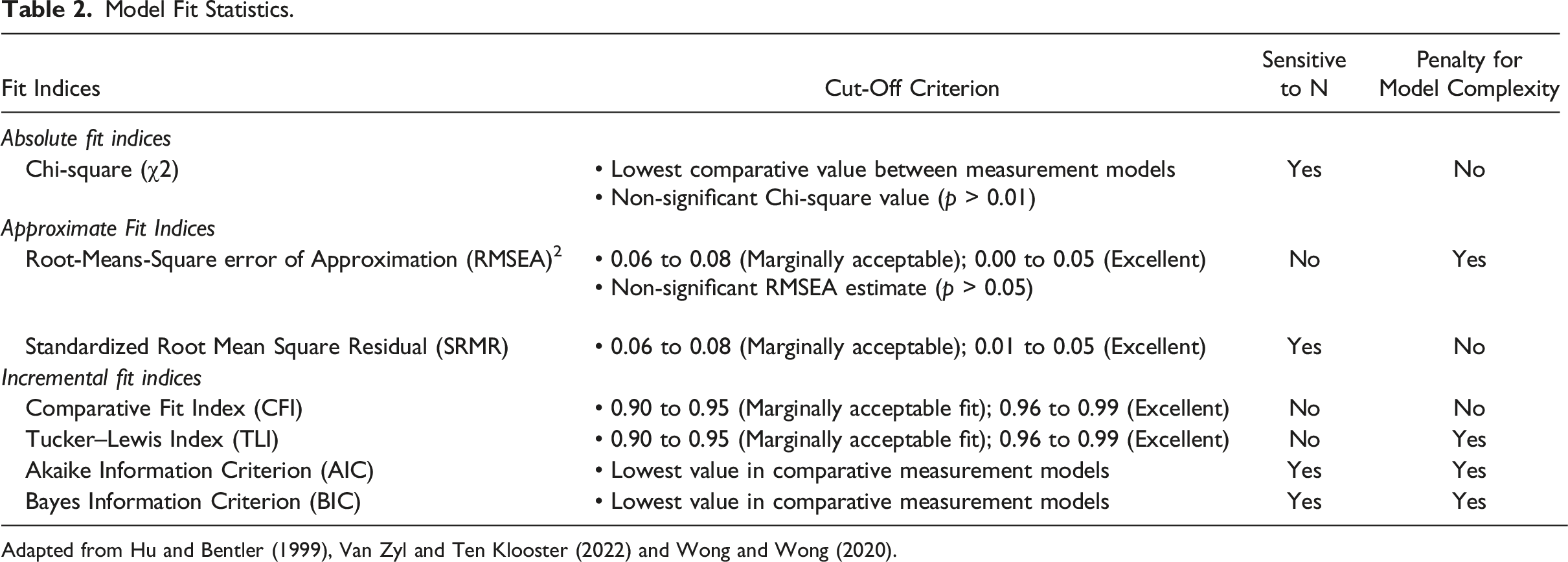
Adapted from Hu and Bentler (1999), Van Zyl and Ten Klooster (2022) and Wong and Wong (2020).
Second, a longitudinal CFA (LCFA) approach was employed to determine the temporal stability of the scale’s factor structure. Here, academic self-efficacy at Time 1 was regressed on academic self-efficacy at Time 2. The model had to show (a) good data-model fit (c.f Table 2), (b) excellent measurement quality (λ > 0.40; p < 0.01) (c) a positive regression path between the factors (p < 0.01), and (d) the scale at Time 1 needed to explain at least 40% of the variance in Time 2 (Wong & Wong, 2020). Further, the average variance explained and reliability estimates (Cronbach Alpha >0.70; McDonald’s omega > 0.70) were computed (Wong & Wong, 2020).
Third, longitudinal measurement invariance (LMI) was used to determine the configural (similar factor structure), metric (similar factor loadings), and scalar invariance (similar intercepts) of the scale over time. Invariance was established by comparing these models based on the following criteria: changes in RMSEA (Δ < 0.015), SRMR (Δ < 0.02 for configural vs. metric/scalar; Δ < 0.01 metric vs. scalar), CFI (Δ < 0.01), and TLI (Δ < 0.01) (Wong & Wong, 2020). Differences in χ2 were not considered (but reported for transparency) due to its sensitivity to both sample size and model complexity (Morin et al., 2020; Van Zyl & Ten Klooster, 2022).
Finally, criterion validity was established by estimating concurrent and predictive validity via a structural model. Concurrent validity was estimated by relating Academic Self-Efficacy at Time 1 to Task Performance at Time 1 and Academic Self-Efficacy at Time 2 to Task Performance at Time 2. To establish predictive validity, Academic Self-Efficacy at Time 1 was regressed on Task Performance at Time 2. To enhance fit, Item 1 and Item 2 of the Task Performance scale were permitted to correlate. For each regression, a significance level of p < 0.01 was set.
Results
Confirmatory Factor Analysis: Cross-Sectional and Longitudinal
Cross-sectional and Longitudinal Confirmatory Factor Analyses.
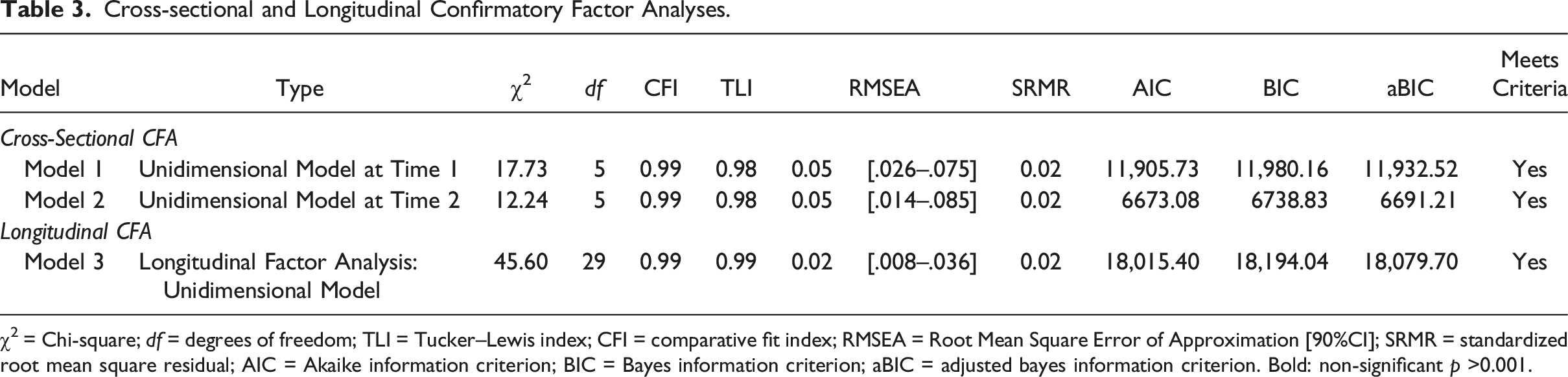
χ2 = Chi-square; df = degrees of freedom; TLI = Tucker–Lewis index; CFI = comparative fit index; RMSEA = Root Mean Square Error of Approximation [90%CI]; SRMR = standardized root mean square residual; AIC = Akaike information criterion; BIC = Bayes information criterion; aBIC = adjusted bayes information criterion. Bold: non-significant p >0.001.
Thereafter, a LCFA model was estimated. Here ASE at Time 1 was regressed on ASE at Time 2. Error variances between time-points were permitted to covary. Table 3 indicates that this model also fitted the data well (χ2(1056) = 45.60 p > 0.001; df = 29; CFI = 0.99; TLI = 0.99; RMSEA = 0.02 [.008, .036]; SRMR = 0.02; AIC = 18,015.40; BIC = 18,194.04). GASE at Time 1 was also significantly related to GASE at Time 2 (β = 0.69; S.E = 0.03; t-value= 22.05; p < 0.01) and explained 47% of the overall variance.
Item Level Parameter Estimates and Internal Consistency
Item Level Parameter Estimates And Internal Consistency of the GASE.
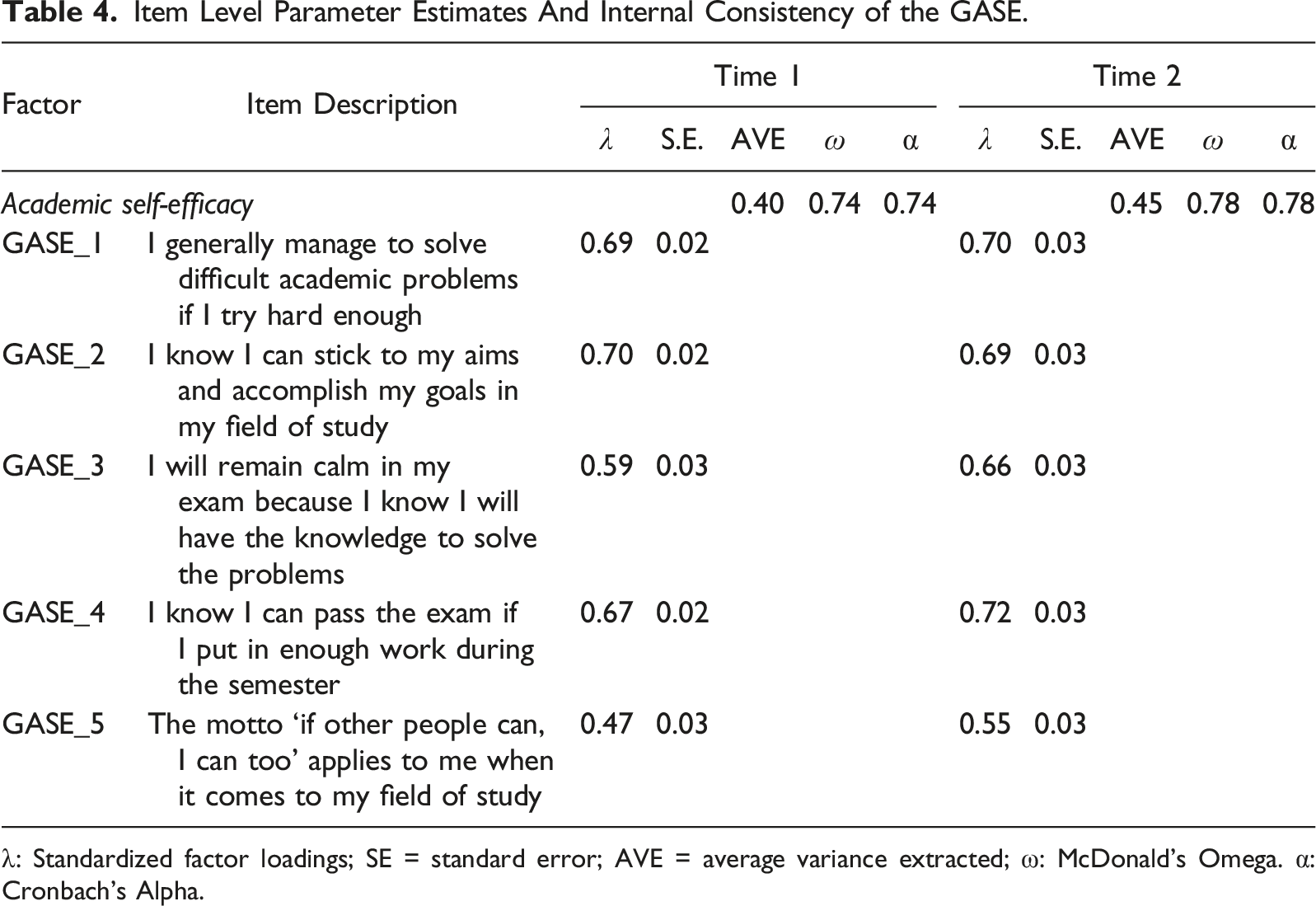
λ: Standardized factor loadings; SE = standard error; AVE = average variance extracted; ω: McDonald’s Omega. α: Cronbach’s Alpha.
Longitudinal Measurement Invariance and Mean Comparisons
Longitudinal Invariance of the Unidimensional General Academic Self-Efficacy Scale.
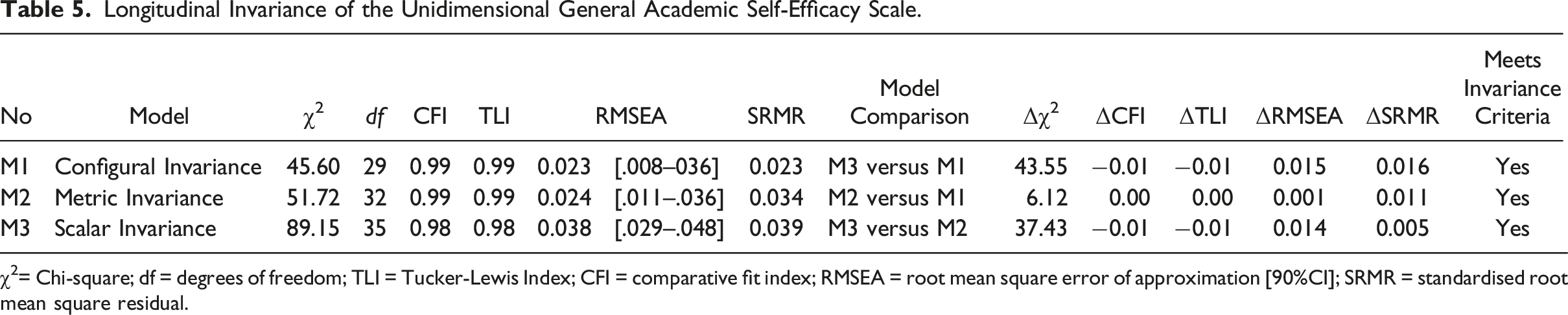
χ2= Chi-square; df = degrees of freedom; TLI = Tucker-Lewis Index; CFI = comparative fit index; RMSEA = root mean square error of approximation [90%CI]; SRMR = standardised root mean square residual.
Concurrent and Predictive Validity
Concurrent and Predictive Validity: General Academic Self-Efficacy and Task Performance.

→ = regression; β = standardized beta; SE = standard error; p = statistical significance; R2 = variance.
Predictive validity was also established through finding a positive relationship between GASE at Time 1 with Task Performance at Time 2 (χ2(1056) = 174.633; df = 52; CFI = 0.96; TLI = 0.95; RMSEA = 0.05 [.040, .055]; SRMR = 0.04; AIC = 23,741.36; BIC = 23,929.93; β = 0.39; S.E = 0.08; R2 = 0.15).
Discussion
The purpose of this paper was to investigate the psychometric properties, longitudinal invariance, and criterion validity (i.t.o. task performance) of the GASE within a US and Western European tertiary educational environment. The results showed that a single, first-order factorial model of overall academic self-efficacy fitted the data well, was reliable and invariant across time. In line with Nielsen et al. (2018), our findings show that the GASE measures general academic self-efficacy validly and reliably. Therefore, the mean scores of the GASE could be used by educational practitioners to measure ASE and track the effectiveness of educational programs or interventions aimed at enhancing ASE over time.
Further, criterion validity was established by finding a positive relationship with task performance at different time stamps. The results imply that when individuals hold active and positive beliefs about their abilities to plan/perform certain educational tasks or manage the challenges associated with their study programs, they are more likely to perform better in their academic-related tasks. This is because the feeling that one has mastery over the skills required to perform a given educational task enhances the engagement and motivation required to perform (Tossavainen et al., 2021). Further, according to Richardson et al. (2012) this could also be because holding a high level of ASE affects how obstacles or challenges are viewed (opportunities to learn vs. setbacks) which in turn leads to sustained task-related performance over time (Richardson et al., 2012; Tossavainen et al., 2021).
In conclusion, our results support the GASE as a valid and reliable measure for general academic self-efficacy within the current context. However, the study has its limitations. First, the sample is limited to a single US and two Western European universities. The results may therefore not be generalizable. Second, only (self-reported) task performance was used to establish criterion validity. Future research should include objective performance measures (e.g., grades) and other metrics associated with ASE, such as engagement, motivation, and resilience. Second, although various mechanisms were implemented to manage potential sample size attrition over time (e.g., students obtained course credit for participation; the follow-up assessment was kept as brief as possible; multiple reminders being sent: Mason, 1999) there was a 44% dropout between Time 1 and Time 2. This could have led to attrition bias which may affect the internal validity of the LFA and LMI assessments. However, the sample size at Time 2 is large enough to capture a full range of variation in responses, and therefore the configural, metric, and scalar invariance assessments are valid for the current study. Future research should attempt to manage the dropout rate through implementing more implicit and explicit incentives for participation at Time 2. Finally, with increased global competition between academic institutions, potential students and future employers may be interested in how effective academic programs are in developing more self-efficacious students. Given that the invariance between the two nations was not investigated due to sample size limitations, these types of comparisons cannot be made. Future research should aim to test the measurement equivalence of the scale across cultures.
Footnotes
Declaration of Conflicting Interests
The author(s) declared no potential conflicts of interest with respect to the research, authorship, and/or publication of this article.
Funding
The author(s) received no financial support for the research, authorship, and/or publication of this article.
