




Abstract
We examined students’ perceptions of mattering during the pandemic in relation to in-person versus online learning in a sample of 6578 Canadian students in Grades 4–12. We found that elementary school students who attended school in-person reported mattering the most, followed by secondary school students who learned part-time in-person and the rest of the time online (blended learning group). The students who felt that they mattered the least were those who learned online full-time during the pandemic (elementary and secondary students). These results were not driven by a selection effect for school choice during the pandemic—our experimental design showed that students’ perceptions of mattering did not differ by current learning modality when they were asked to reflect on their experiences before the pandemic even though some were also learning online full-time at the time they responded to our questions. No gender differences were found. As a validity check, we examined if mattering was correlated with school climate, as it has in past research. Results were similar in that a modest association between mattering and positive school climate was found in both experimental conditions. The results of this brief study show that in-person learning seems to help convey to students that they matter. This is important to know because students who feel like they matter are more protected, resilient, and engaged. Accordingly, mattering is a key educational indicator that ought to be considered when contemplating the merits of remote learning.
Since COVID-19 was declared a pandemic, there have been extraordinary educational and social disruptions in the lives of students around the world. To help stop the spread of SARS-CoV-2, schools quickly adopted mitigation strategies. Some of these strategies were extreme such as the closure of schools, which impacted over 90% of children worldwide (UNESCO, 2021; Vaillancourt et al., 2021). Other approaches were cumbersome but less dramatic such as the implementation of social distancing, mandatory mask wearing, and the cohorting of students into smaller units. In Ontario, Canada, an unprecedented education choice was offered by the Ministry of Education (2020) to help assuage the fears of parents and caregivers. Specifically, parents/caregivers of elementary students (Kindergarten to Grade 8) were given the choice to have their child learn in-person (students attend school full-time) or virtually (students learn online full-time from home). For students in Grades 9–12, an adaptive model was offered whereby students attended school in-person on alternate days for at least half of the instructional day and then attended remotely with their teachers and classmates for the rest of the time (blended learning). The option for full-time e-learning was also extended to students in Grades 9–12. Given this exceptional delivery model of education, effects of online versus in-person learning should be examined closely. In this study, we were interested in understanding whether learning fully online or in-person impacted students’ perceptions of mattering.
Mattering
Mattering, defined as the tendency to view oneself as significant to others (Rosenberg & McCullough, 1981), has received increasing research attention because of its central role in overall mental well-being (Flett, 2018a; Flett et al., 2012; Krygsman et al., 2022; Milner et al., 2016; Raque-Bogdan et al., 2011). Specifically, individuals who feel as if they matter to others tend to experience better mental health and psychological well-being than those who feel that they do not matter or matter less to others. Mattering is important across the lifespan but is particularly important to older children and adolescents (Rosenberg & McCullough, 1981). Mattering is most important during this developmental period because mattering stems from social processes such as social affiliation (Schieman & Taylor, 2001) and attachment (Raque-Bogdan et al., 2011). Adolescence is a time when there is a heightened motivation to affiliate with peers (Brown & Larson, 2009; Harris, 1995), thus mattering matters a lot to teens. Given these developmental norms, it is not surprising that the link between mattering and psychosocial well-being is robust in children and adolescents (Elliott, 2009; Elliott et al., 2005; Marshall, 2001, 2004; Schenck et al., 2009; Suh et al., 2016), extending to academic indicators such as school completion (Lemon & Watson, 2011) and school connectedness (Watson, 2017), a key aspect of healthy school climate (Flett, 2018b; Hamby et al., 2019; Tucker et al., 2010).
Considering that mattering arises from social processes, what are the implications of teaching children and adolescents online during the pandemic? In this brief report, we sought to answer this question in a large sample of 6578 Canadian students enrolled in Grades 4–12 during the pandemic. We predicted that students who were taught online during the first term of 2020 would feel that they mattered less than students who were taught in-person. Mattering is often relayed to students in subtle but important interpersonal ways such as a pat on the back, a smile from a teacher or a friend, an informal discussion in the hallway, or the shared enjoyment of a funny moment in class. Online, there are fewer opportunities to demonstrate to others that they matter because online classes tend to elicit fewer occasions for spontaneous chats, informal turn-taking, an evaluation of subtle non-verbal behaviour, and the like. In examining whether learning modality (in-person vs. online) impacted students’ perceptions of mattering we explored the moderating role of gender considering evidence that boys perceive that they matter less to others than girls (Flett et al., 2016; Rayle, 2005). We also examined the moderating effect of school grade level (elementary—Grade 4 to Grade 8 vs. secondary—Grade 9 to Grade 12). We expected that elementary students who attended school in-person full-time would report mattering more than students who learned online full-time (elementary and secondary), and more than secondary school students because their in-person learning was only part-time (a blend of in-person and online learning). Finally, there was likely a selection effect of who chose to learn online versus in-person during the pandemic (Collins-Nelsen et al., 2021); students who felt that they did not matter before the pandemic may have been more likely to opt out of attending school in-person. We examined this possible confound using an experimental design (comparing mattering rates before and during the pandemic), and as a validity check, we examined the association between mattering and school climate, a known correlate (Flett, 2018b; Hamby et al., 2019; Watson, 2017). We expected positive associations between students’ perceptions of mattering and school climate.
Methods
Participants
As part of a Safe Schools audit, we randomized students at the level of the school into two conditions. In the “pandemic condition”, students were asked to reflect on their current experiences from the start of September 2020 until November 2020 (Vaillancourt et al., 2021). In the “pre-pandemic condition”, students were asked to consider their retrospective experiences from September 2019 to March 2020 (before COVID-19 was declared a global pandemic). In the present study, we were primarily interested in the pandemic condition but compare mattering levels to the pre-pandemic condition when examining whether mattering was influenced by a learning modality selection effect.
A total of 2683 students (44.8% girls, 50.0% boys, 2.6% gender diverse 1 ) in Grades 4 to 12 participated in the pandemic condition in which they responded to their current situation during the pandemic. Most (46.7%) students identified as White and 32.1% identified as belonging to an underrepresented racial group. Students in this condition were clustered into three learning modalities: (1) learning in-person full-time (Grades 4–8; n = 1306), (2) virtual e-learning (students went to school from home; Grades 4–12; n = 50 in Grades 4–8 and n = 137 in Grades 9–12), and (3) secondary blended learning (students went to school for some classes and took other classes virtually; Grades 9–12; n = 1190). In the comparison group (pre-pandemic condition in which students responded to their situation before the pandemic), 3895 (49.3% girls, 44.8% boys, 2.1% gender diverse; 42.2% White, 29.1% underrepresented racial group) students completed the survey. Students in this condition were also clustered into three learning streams: (1) learning in-person full-time (Grades 4–8; n = 2340), (2) virtual e-learning (Grades 4–12; n = 30 in Grades 4–8 and n = 240 in Grades 9–12), and (3) secondary blended learning (Grades 9–12; n = 1285). There were more students in this pre-pandemic condition because randomization occurred at the school level and not all schools were the same size. For more details about the study design see Vaillancourt, Brittain, et al. (2021).
Procedures
To participate in the study, parent consent and student assent were required. Most parents (94.0%) of eligible students consented to have their child participate (with only 6.0% opting out) and most students provided assent to participate (97.3%). The University of Ottawa’s Research Ethics Board (REB) and the Hamilton-Wentworth District School Board’s REB provided ethical approval for this study.
For students enrolled in the in-person learning or rotational program, classroom teachers provided school-owned devices to students and had students access the survey. Students were informed of their rights as participants which included an assurance of anonymity and the right to skip any question in the survey. For students enrolled in virtual learning programs, parents of younger students (Grades 4–8) and secondary school students (Grades 9–12) were provided with an instruction on how to complete the survey. Live technical support was available to teachers, students, and parents.
Measures
Mattering. The General Mattering Scale (GMS) is a self-report measure that assesses the degree to which individuals feel they matter (Marcus & Rosenberg, 1987). The scales consist of five items that assess mattering (e.g., “How important do you feel you are to other people?”) that are rated on a 4-point frequency scale and response options include 1 = Not at all, 2 = A little, 3 = Somewhat, and 4 = A lot. To maximize available data and ensure scoring was consistent with previous studies, we computed a mean of all five items, allowing for two of five missing items, and multiplied by five. The internal consistency in the present study was good: Cronbach’s α = .86 for elementary students and .87 for secondary students in the pandemic condition and α = .85 for elementary students and .86 for secondary students in the pre-pandemic condition.
School climate. School climate was measured using the Sense of School as a Community Scale (Developmental Studies Centre, 1997). Students were asked to respond to 14 items using a 4-point scale (1 = Not at all, 2 = A little, 3 = Sometimes, and 4 = A lot). The Sense of School as a Community Scale is part of a larger scale about student perceptions of, and feelings about the classroom and school. These items ask students to report on how supported, welcomed, and safe they feel about their school as a whole (e.g., “People care about each other at my school.”; “Teachers and students treat each other with respect at my school.”). The internal consistency in the present study was good: Cronbach’s α =.88 for elementary students and .90 for secondary students in the pandemic condition and α = .88 for elementary students and .90 for secondary students in the pre-pandemic condition. A mean was computed allowing for up to five missing items.
Analytic Plan
We investigated the effect of modality of learning (in-person vs. online vs. blended) on perceptions of mattering using factorial ANOVAs. Since grade level was confounded with modality of learning (i.e., only elementary students could attend full-time in-person and only secondary students were eligible for blended learning) we created four groups (herein referred to as modality of learning): elementary in-person, elementary online, secondary blended, secondary online. The main effect and interaction with gender 2 were included to examine potential moderating effects. An interaction with reporting time frame (i.e., reporting during the pandemic or before the pandemic) was also examined to rule out selection effects of enrolling in in-person or online learning. The analysis included a three-way (4 × 2 × 2) factorial ANOVA with modality of learning (elementary in-person, elementary online, secondary blended, secondary online) by gender (boys vs. girls) by condition (pandemic vs. pre-pandemic). The main effects as well as all higher order interactions were included as predictors in the model with perceptions of mattering as the dependent variable. Significant effects were further explored using univariate and/or post-hoc tests to examine differences in the estimated marginal means. Finally, as a validity check, we used correlations to investigate the association between mattering and school climate. Differences between conditions were examined using Fisher’s r to z test. We used SPSS v28 for all analyses.
Results
Initial psychometric analyses supported the use of the GMS. Confirmatory factor analyses were conducted for elementary students and secondary students within each of the conditions using principal axis factoring. Results within each group indicated that one factor accounted for a large proportion of variance (61.98%–66.72%). Factor loadings for all items were high (min = .64, max = .81).
Estimated Marginal Means of Perceptions of Mattering.
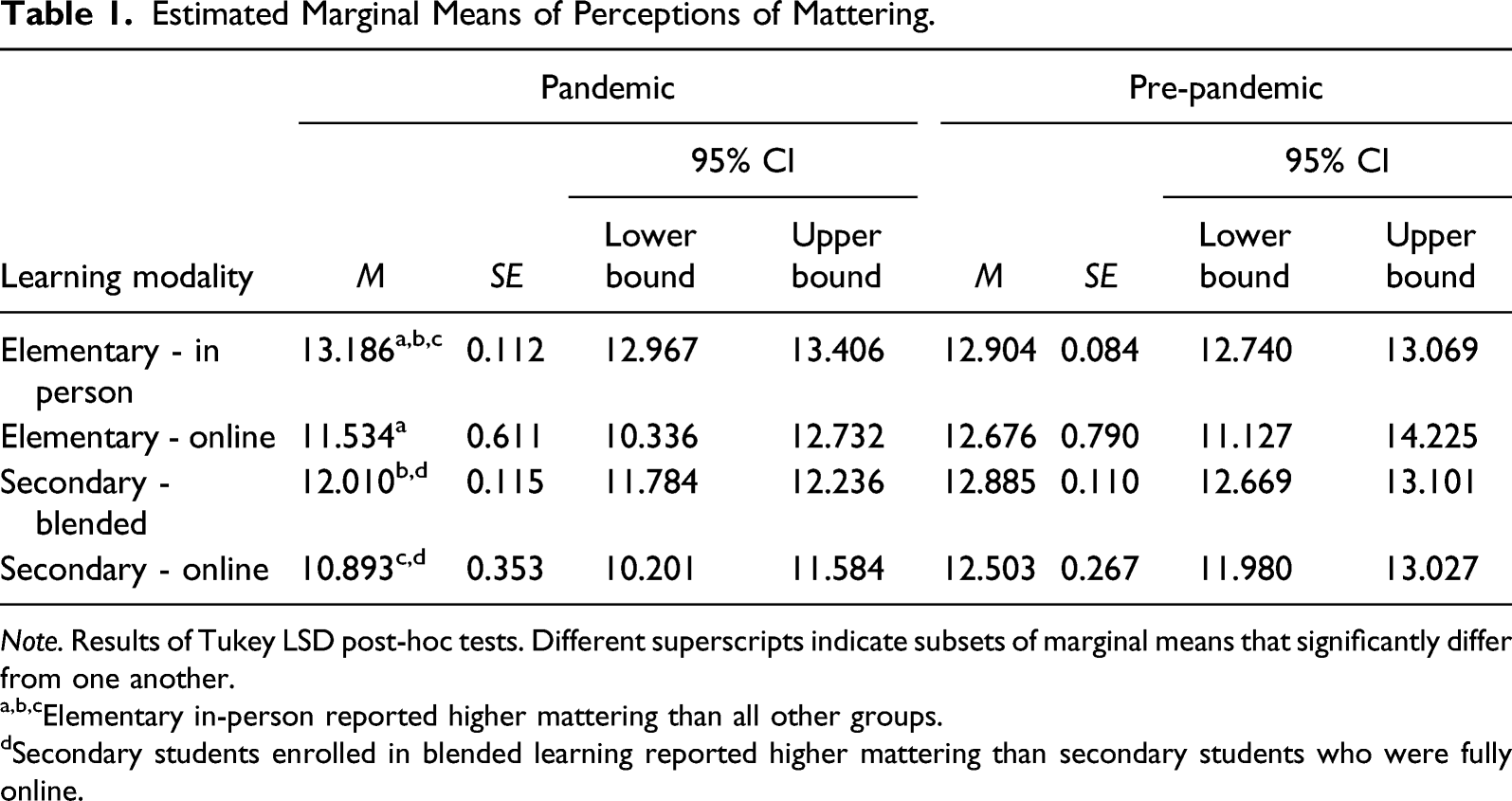
Note. Results of Tukey LSD post-hoc tests. Different superscripts indicate subsets of marginal means that significantly differ from one another.
a,b,cElementary in-person reported higher mattering than all other groups.
dSecondary students enrolled in blended learning reported higher mattering than secondary students who were fully online.
Validity check. The correlation between perceived mattering and school climate in the pandemic condition was r = .479, p < .001, and r = .455, p < .001 in the pre-pandemic condition, as predicted. The strength of the association did not vary by condition, z = 1.182, p = .119.
Discussion
To decrease the spread of COVID-19, extraordinary infection prevention and control measures were undertaken in Canadian schools (Comeau & Vaillancourt, 2021). The most effective measures in the hierarchy of controls (Centers for Disease Control and Prevention, 2015) are ones that contribute to the elimination of the infectious agent. Teaching students fully online falls into this category (Comeau & Vaillancourt, 2021). Although there has been increasing attention paid to examining the efficacy of this strategy on the reduction of virus transmission (e.g., Staguhn et al., 2021), learning loss (Engzell et al., 2021), and mental health (Vaillancourt, Szatmari, et al., 2021), little consideration has been made to the social-emotional implications of this approach for elementary and secondary students. In this study, we were interested in how teaching children and adolescents online during the pandemic affected their perceptions of mattering. Mattering should be of interest to educators given its link to school climate (Flett, 2018b; Hamby et al., 2019; Watson, 2017) and because students who feel like they matter are “more protected and resilient and highly engaged, both inside and outside the classroom” (Flett et al., 2019, p. 668).
Mattering arises from social processes (Raque-Bogdan et al., 2011; Rosenberg & McCullough, 1981; Schieman & Taylor, 2001), and as such, we predicted that students’ perceptions of mattering would be impacted by not being taught face-to-face during the pandemic. Results supported our initial hypothesis—students who learned in-person reported that they mattered more than students who learned either part of the time in-person or fully remote. These results are consistent with a recent study of adult learners that compared an online condition versus face-to-face learning. Specifically, Besser et al. (2020) found that Israeli college students “had pervasive negative reactions” (p. 1) to online learning that was necessitated because of the pandemic. They also found that a more positive reaction to online learning was noted among students who had a greater sense of belonging and mattering.
No gender differences were found in our study but there was an age effect. Elementary school students who learned in-person full-time reported mattering more than secondary students who learned in-person part-time (blended learning). Most studies show a linear association with mattering increasing with age (see review by Flett, 2018a). This typical age trend was likely attenuated by the number of contact hours students had with their peers and school staff. Unfortunately for high school students, no full-time in-person option was available to them, and thus, they received fewer direct contact hours with peers and school staff than elementary students.
It is possible that students who opted to learn fully online felt that they mattered less before the pandemic. To address this potential bias, we examined mattering rates in the pre-pandemic randomized condition. Students who reflected on their perceptions of mattering before the pandemic, when they all learned full-time in-person, did not differ on their level of mattering by learning modality during the pandemic.
Although our results suggest that face-to-face interactions favour students’ sense of mattering, it is important to acknowledge that in-person learning has not been the panacea for all learners (Black, 2020). Collins-Nelsen et al. (2021) interviewed students who experienced remote learning during the 2020-2021 academic year from the same school board that the current study was conducted. Students in this study reported that “lack of bullying, peer pressure and social anxiety were a welcomed change that allowed them to better focus on learning”. Students also cited that they appreciated the comforts of being at home, not being stressed during the morning, the extra sleep, and the increased time they had with their family. These comments underscore that schools are not always welcoming for all students, a point worthy of acknowledgement given the strong body of evidence demonstrating that a poor school climate is associated with lower academic achievement (Bryan et al., 2012; Catalano et al., 2004; Daily et al., 2019; Konold et al., 2018; Niehaus et al., 2012; Osher & Kendziora, 2010; Wang et al., 2014), poorer mental health (Aldridge & McChesney, 2018; Shochet et al., 2006; Somersalo et al., 2002; Suldo et al., 2012), and poorer peer relationships (Konishi et al., 2017; Low & Van Ryzin, 2014). Mattering is an important component of school climate, which is why it correlates positively with school climate (Flett, 2018b; Watson, 2017), including in the present study.
Because this is the first population-based study using the GMS, comments about its psychometric properties are warranted. Results from the CFAs support that GMS represents one factor across conditions and school divisions (elementary and secondary) that accounts for a large proportion of variance. The internal consistency of this measure was good across school divisions (elementary and secondary) in the two conditions suggesting that the GMS is reliable. In terms of validity, as mentioned, the GMS correlated with school climate in both conditions. In sum, our psychometric analyses supported the use of the GMS.
A final discussion point relates to our low mattering means for students who learned online during the pandemic. Our means are the lowest published ones to date for children and adolescents using the GMS (e.g., Karaman et al., 2019; Lemon & Watson, 2011; Watson et al., 2022; see review by Flett, 2018a). The low level of mattering is foreboding given its established link to poor psychological and psychosocial functioning (Flett, 2018a; Flett et al., 2012; Krygsman et al., 2022; Milner et al., 2016; Raque-Bogdan et al., 2011), as well as academic indicators like school completion (Lemon & Watson, 2011) and climate (Flett, 2018b; Hamby et al., 2019; Tucker et al., 2010). A note of caution however, is that in previous studies, the sample sizes were significantly smaller than ours, and thus our rates may in fact represent a truer population norm. Nevertheless, the means were lower for students who learned remotely during the pandemic, suggesting that students’ need to matter was likely thwarted.
Limitations
There are some limitations of the present study that warrant discussion. One, not all students had the same access to high-speed Internet or to digital tools and digital learning experiences in their homes and at school during the pandemic (Westheimer & Schira Hagerman, 2021). Accordingly, not all students who attended school online during the pandemic had the same opportunities to engage with others as those who attended school in-person. Two, we do not know what specific features of in-person learning during the pandemic were associated with a higher sense of mattering. Three, the natural groups that formed because of online, in-person, and blended approaches to school instruction were different across age groups and this limited our ability to separate the effects of age and learning modality. Four, we randomized students at the school level which resulted in unequal samples which could have an influence on power. Five, the timeframe was not equivalent in the pre-pandemic and pandemic conditions, which could have attenuated differences across learning modalities in the pre-pandemic condition because of memory erosion. Of note, Vaillancourt et al. (2021) examined this issue in earnest in relation to bullying rates using the same data set and found that “timeframe differences do not seem to have had a notable impact” on their results (p. 565). Six, students’ contact with classmates online outside of class time was not measured (e.g., texting and Snapchat). These experiences could indirectly affect perceptions of mattering. We recognize the need to replicate our study given these limitations and appreciate that this brief report only provides preliminary evidence on the potential negative impact of online learning for students during the pandemic.
Conclusion
Knowing how online, digital schooling affects elementary and secondary students is important because online learning is likely to be retained in some capacity after the pandemic (Li & Lalani, 2020). Moving forward, it is important to consider the impact of COVID-19 mitigation strategies on not only the academic experiences of students, but also on their social-emotional experiences. Accordingly, Vaillancourt et al. (2021) have argued in their recent policy report on children and schools during the pandemic that COVID-19 education recovery must focus on healthy relationships and the investment in social-emotional learning programs for students. Their rationale is that “learning happens in relationships, and healthy relationships promote optimal development” (p. 81). In other words, the need to be significant, that is to matter, is central to a post-pandemic recovery.
Footnotes
Declaration of conflicting interests
The author(s) declared no potential conflicts of interest with respect to the research, authorship, and/or publication of this article.
Funding
The author(s) disclosed receipt of the following financial support for the research, authorship, and/or publication of this article: This work was funded by grants awarded to Tracy Vaillancourt by the Social Sciences and Humanities Research Council of Canada [grant numbers 833-2004-1019, 435-2016-1251] and Canadian Institutes of Health Research [grant numbers 201009MOP-232632-CHI-CECA-136591, 201603PJT-365626-PJT-CECA-136591]. Heather Brittain is supported by a SSHRC Vanier scholarship, Zacharie Saint-Georges is supported by a CIHR Vanier scholarship, and Ann H. Farrell was supported by a SSHRC Banting Fellowship to initially conduct this research at the University of Ottawa.
