



Abstract
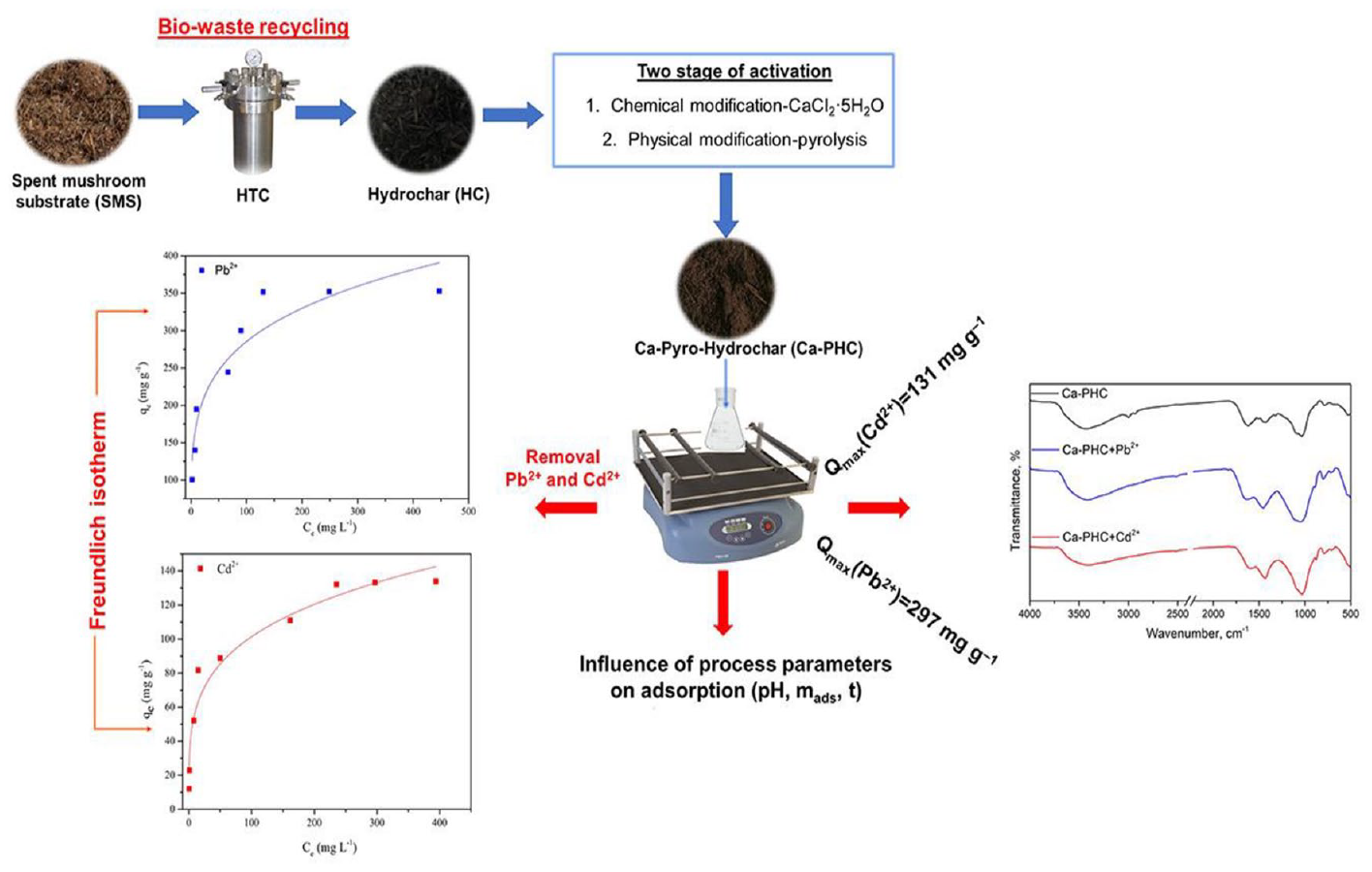
A calcium-pyro-hydrochar (Ca-PHC) can be distinguished as a novel sorbent of Pb2+ and Cd2+ from an aqueous solution. It was obtained using hydrothermal treatment of the spent mushroom substrate (SMS), followed by a CaCl2·5H2O activation and pyrolysis. The characterisation of chars before and after modifications was done by scanning electron microscope (SEM), Brunauer–Emmett–Teller (BET) and Fourier transform infrared (FTIR). Batch experiments were performed to examine Ca-PHC’s sorption properties and binding mechanisms to selected metal ions. The maximum sorption capacities of Ca-PHC for Pb2+ and Cd2+ were 297 mg g−1, and 131 mg g−1, respectively. The obtained results demonstrated that the sorption of Pb2+ and Cd2+ by Ca-PHC follows a pseudo-second kinetic model and Freundlich isotherm. The binding of the selected metals onto Ca-PHC was enabled by the ion-exchange mechanism, surface complexation, mineral precipitation and cation–π interaction. Thermodynamic parameters indicate that metal ions binding by Ca-PHC are spontaneous and endothermic. Due to the high adsorption capacities, the obtained Ca-PHC has good potential for application in industrial wastewater treatment. In addition, the demonstrated use of SMS highlights another possibility of applying this specific biomass relevant to sustainable and economical waste management in the growing mushroom industry.
Keywords
Get full access to this article
View all access options for this article.
References
Supplementary Material
Please find the following supplemental material available below.
For Open Access articles published under a Creative Commons License, all supplemental material carries the same license as the article it is associated with.
For non-Open Access articles published, all supplemental material carries a non-exclusive license, and permission requests for re-use of supplemental material or any part of supplemental material shall be sent directly to the copyright owner as specified in the copyright notice associated with the article.
