




Abstract
The jury serves as an important reference point for criminal case processing, despite the fact that the majority of cases are disposed of by pleas or dismissals. This research examines the downstream impact of BWC footage on the adjudication process with a particular emphasis on the management of uncertainty. Research involved interviews with prosecutors and defense attorneys in urban counties in California, New York, and Texas. The results indicate that both defense and prosecution anticipate BWC changing approaches to cases and how cases may be negotiated to an outcome. They also report that jurors expect BWC footage, and that it functions as a means to establish case facts and the credibility of police, the defendant and witnesses. Policy implications regarding the introduction of BWC and future directions for research are discussed.
Introduction
The adoption of body-worn-cameras (BWC) has principally been viewed as a tool for improving policing in the U.S., resting primarily on anticipated enhancements in police-community relations and increasing legitimacy (Makin, 2017; President's Taskforce, 2015), as well as expected reductions in the use of force and complaints (White, 2014). An extensive and rapidly growing literature describing the adoption, benefits, and difficulties facing police organizations adopting BWC has been developed (White & Malm, 2020). The impact of BWC on prosecution and defense, however, has recently become more salient as BWC footage becomes more prevalent as a form of evidence (e.g., Gaub et al., 2020; Morrow, Katz & Choate, 2016).
Westera and Powell (2017) for example found BWC to be useful as a tool for evidence collection and securing a record of witness, victim, and suspect statements in domestic violence cases. Lum et al. (2019) note, however, that this research avenue is specific to intimate partner violence cases and may not apply to the larger body of cases pursued by local prosecutors. Further Merola et al. (2016) survey of state prosecutors indicate about six in ten believe BWC would be more helpful to prosecutors, however, slight majorities believe it will increase preparation time and make for difficulty in generating discovery.
These conflicting expectations regarding the consequences of this technological change must be placed firmly against the reality that few cases make it to trial, but instead are resolved by plea bargains or dismissals. As such, the current research uses a qualitative approach to focus on how prosecutors and public defenders (PDs) in three U.S. counties are adapting to BWC in their everyday practice and construct the utility of BWC video as evidence in cases, much as officers construct its use in practice (Makin, 2016).
To accomplish this we consider prosecutorial and public defender (PD) understandings of how BWC influences the management of uncertainty, specifically in the form of jury expectations during plea negotiations. Through their perceptions, we are able to glean important policy implications both for future research and practical considerations for prosecutors and PDs in jurisdictions now adopting the technology.
Below we first review the literature on the management of uncertainty among prosecutors and PDs. Specifically we consider how BWC is perceived as affecting negotiations in the shadow of juror decision-making and for establishing the elements of the story of a crime (e.g., Bennett & Feldman, 2014). We discuss the data collected from three U.S. counties via qualitative results drawn from in-depth interviews. The results are translated into policy considerations for researchers, policymakers, and practitioners.
Literature Review
Prosecutorial decision-making is often framed in reference to uncertainty. Albonetti (1986), drawing on March and Simon's (1958) concept of satisficing, argues this is an apt characterization of strategy for dealing with uncertainty in the negotiated outcomes with defense attorneys. Trials take time (inefficiencies can thus result) and can yield losses (uncertainty). Evidence and seriousness are two key pieces of information for helping to weigh, manage, and make decisions under uncertainty. As a reference point, the jury is also explicitly mentioned as a source of uncertainty (Albonetti, 1986; Johnson, 1998) against which negotiations are weighed. Recent research by Bushway et al. (2014) finds support for the argument that prosecutors and defense attorneys “bargain in the shadow of the trial” to mitigate uncertainty. During the plea bargain process, both prosecutors and defense attorneys have working expectations of the sentence that will be imposed if a case goes to trial, and this serves to influence their behavior. Managing uncertainty, then, becomes tied to prosecutorial and defense expectancies regarding juries even though both sides know that jury trials are rare. Thus, in establishing the bounded rationality on which to achieve goals of justice and order, novel evidentiary elements such as BWC are expected to engender renegotiations about going rates, what constitutes a strong case, and perhaps how new forms of evidence (such as DNA, blood, and other forms) may be used to influence plea bargaining dynamics (see, e.g., Goodall, 2007).
In the U.S. criminal justice system the jury has multiple functions as it represents a community reference point for the application of law and procedure (Murley & Sutton, 2014; Feeney, 1983, p. 238) is sometimes at odds with the expectations of judges (Kalven et al., 1971), and functions as a check on prosecutors (Mather, 1979) and defense attorneys (Flemming, Nardulli & Eisenstein, 1992, Chapter 6). The jury can also be considered part of the local culture's impact on adjudication decision-making (Heumann, 1979; Worden, 2015). Given this backdrop, the question of the effect of police use of BWC on juror decision-making and expectations is an important one for prosecutors and defense attorneys as an anticipated reference point for their negotiations and management of uncertainty. The vast majority of cases are settled prior to trial and convictions are overwhelmingly obtained by pleas as compared to guilty verdicts at trial. Among Federal cases, more than 97% of convictions are adjudicated via guilty pleas, while in state systems roughly 95% are settled in a similar manner (Motivans, 2017; Turner, 2017).
A variety of research indicates that prosecutors and defense attorneys weigh dismissal, bargaining, and trial strategies against juries and expectations about their decision-making. McDonald et al. (1979) explored defense and prosecution decision-making through case simulation and found information related to case strength (evidence and case facts) to be nearly universally important to both. The research further indicated that defense attorneys and prosecutors across a variety of jurisdictions generally agreed on which cases were likely to result in convictions in front of a jury. This suggests a common understanding of case outcomes given similar evidence, and case facts on which prosecutors can negotiate or choose to dismiss cases deemed weaker or low probability of conviction at trial. Stanko (1981) for example interviewed prosecutors in New York City and considered the question “can a case be persuasive to a jury?” independent of evidence and suspect guilt. Her research focused on the credibility of the victim/witness in influencing prosecutors’ decisions.
Frohmann's (1991) research indicates that, in sexual assault cases, prosecutorial case rejection hinged on a “downstream” concern regarding anticipated moves by defense, and judge and juror responses to testimony, especially with regard to victim credibility. Spohn & Holleran (2001) further explored decision-making in sexual assault cases and found victim character and behavior to be particularly salient in non-stranger assaults. Frederick & Stamen (2012) extended these observations to a more general set of cases in interviews with prosecutors to evidence weighed by an expectation of how the jury may evaluate information or the absence of information such as lack of indications of drunkenness from a dashboard camera at a DUI stop.
It is also argued that jurors will rely more heavily on body-worn camera evidence in comparison to testimony from witnesses and victims, especially when video footage should be available, and lastly, juries may acquit or even refuse to indict a defendant on the grounds that there is not body-worn camera footage to corroborate the statement and claims of witnesses and victims, which might speak directly to their credibility (Hannaford-Agor, 2015). Frederick & Stamen's (2012) interviews with prosecutors yielded the concern: “videos are now used in all arrests for DUI and people are expecting to see a person very drunk in the videos; however, as one ADA pointed out, not everyone looks really drunk in the videos” (p. 85) [italics in original]. Similarly, Todak et al., (2018) interviewed a variety of stakeholders in Tempe, AZ and Spokane, WA and a judge commenting on BWC noted: “People have a CSI expectation that they’re going to get this awesome video of everything unfolding…” (p. 456). These point to a concern regarding jury expectancy that BWC will provide dispositive information.
BWC and the Impact on Prosecutors and Defense Attorneys
Westera & Powell (2017) encourage the collection of video evidence in intimate partner violence (IPV) cases and research findings from Phoenix, AZ (Morrow et al., 2016) regarding the increased likelihood of charge filing, case furtherance, guilty pleas and convictions in IPV cases with BWC, suggest, at least with regard to these case types, that such a renegotiation or change in process is taking place. While the existing literature disproportionately investigates the work of prosecutors, we argue that defense attorneys would necessarily be attentive to juror decision-making in the interest of their clients. Additionally, they are aware that prosecutors reference juries in their decision-making, and would thus have to adopt defense strategy with that in mind. In that context, it is equally important to query prosecutors and defense attorneys to ascertain their perceptions of how the introduction of body-worn camera influences jury decision-making.
There are currently two studies that focus on the downstream effects of BWC on adjudication that examine how prosecutors and defense attorneys are adapting to BWC. Gaub et al., (2019, 2020) conducted focus groups that examined defense counsel views of BWC evidence among 31 attorneys in 5 public defense offices in Virginia. Defense attorneys reported three positive aspects of BWC including that it allows for understanding tone and demeanor, provides a comparison for police reports, and overall was considered a ‘neutral observer’ for establishing truth. The respondents did mention the impact of video on the jury: “…Memory isn’t precise and generally it's an effective tool when we have an issue to present to a jury, so the jury doesn’t have to rely on exclusive testimony. They can see the video for themselves [Urban city]” (Gaub et al., 2020, p. 6). This research did not speak directly to managing uncertainty in negotiations, but does suggest that defense attorneys glean important evidence, areas on which to challenge police reports, and sometimes can view that their client is clearly guilty, which are all likely to shape their decision-making around bargaining on behalf of their clients.
Groff et al., (2018) studied the Los Angeles City Attorney's office and conducted focus groups with deputy city attorneys (DCA) regarding BWC usage and views as well as studying whether BWC was accessed prior to case decision-making in a sample of 4,833 cases. Focus groups conducted with DCAs indicated they did not typically consult video prior to case filing decisions. The reasons for this included the inability to access the video in a timeframe useful for case processing at that decision point, and to the amount of time video consumes if reviews are conducted. DCAs did, however, report perceived benefits such as the substantiation of officer testimony and the ability to “see what happened” including suspect demeanor and actions. Nevertheless, data on cases processed by DCAs were analyzed to explore patterns of BWC access prior to decision-making and indicated that BWC was viewed in only 2.5% of cases where an individual was in custody and 1.1% of cases where a person was not in custody. DCAs reported feeling confident in rejecting or filing cases without seeing video more than 80% of the time. In the 77 instances where BWC was watched prior to deciding to file, 91% of the time DCAs affirmed that video assisted in the filing decision.
A key framework for prosecution and defense attorney negotiation is a background of beliefs about how case information will be interpreted by the jury. Bennett & Feldman's (2014) research, for example, contextualizes the framework by noting that “storytelling” is a reference point for understanding how evidence yields jury decisions regarding convictions or acquittals. In that context, we surmise that the proliferation of BWC footage would be a particularly salient tool that contributes to these aspects of story-telling, fact-checking, and neutral sources. As such, BWC may be perceived as serving several purposes for the negotiated outcomes of adjudication. BWC presents a unique crucible in the sense that it reorients the consideration of the jury and storytelling in several interrelated ways: First, the jury may come to expect BWC as evidentiary material available as incriminating or exculpatory elements of case construction; second the video is likely to become part of juror decision-making in that it provides the contextual and informational backdrop to scenes, speaks directly to elements of a crime, or presents information that undermines or supports the credibility of defendants, witnesses, or the overall prosecutorial case-theory.
Given the sense that managing uncertainty over outcomes and capacity for storytelling form the backdrop against which negotiations occur, we offer the following general research questions on which to contrast and compare prosecutor and defense attorney views: How do prosecutors and defense attorneys perceive that the introduction of BWC has affected juror expectations?
How do prosecutors and defense attorneys anticipate these impacts in their processing and negotiation of cases as well as in their preparations for and presentations of cases in court?
Below we explore these propositions in three jurisdictions using a qualitative approach.
Data and Methods
This research involved data collection in three counties located in New York, California, and Texas. Details of the counties and primary law enforcement agencies of interest are highlighted in Table 1. The Monroe County, New York District Attorney's Office, which is overseen by District Attorney Sandra Doorley, is staffed by 70 to 80 attorneys working in 12 bureaus. When the research was conducted, the Monroe County PD's Office was overseen by lead PD, Tim Donaher, and was staffed by approximately 70 attorneys. Monroe County is located within the western area of New York State with an estimated population of approximately 747,000 residents. The city of Rochester deploys the largest police force in the county with 700 sworn personnel and fully adopted BWC in early 2017.
Select Characteristics of Three County District Attorney's Offices.
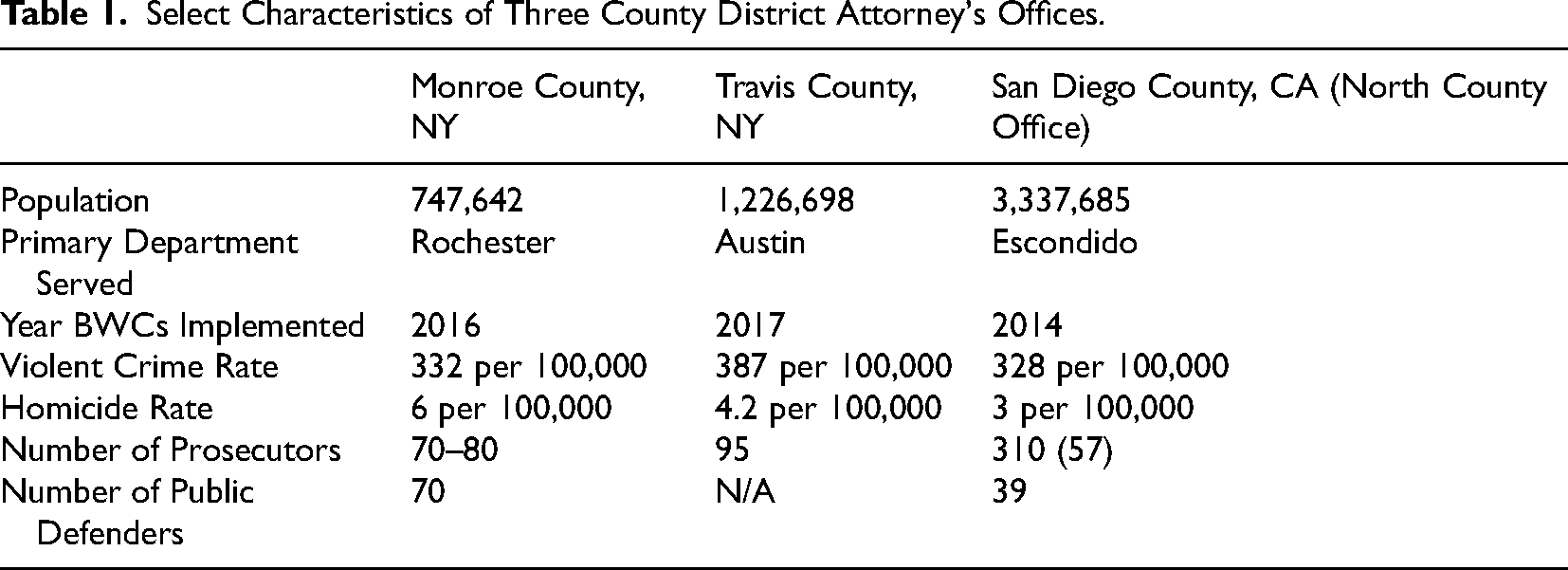
The San Diego County District Attorney's Office, which is the second largest office in California, is led by District Attorney Summer Stephan. The office has approximately 320 attorneys and 18 criminal divisions. The North County Prosecutors office, with about 57 attorneys, was the geographic focal point for data collection on this project. The San Diego County PD's Office is led by Randy Mize. The office is inclusive of several indigent defense services, including Primary PD, Alternate PD, Office of Assigned Counsel, Juvenile Delinquency and the Multiple Conflict Office. The North County division of the office has approximately 40 attorneys. San Diego County is in southwestern California and encompasses 18 cities with approximately 3,337,000 residents. The North County division serves a variety of cities, including Escondido, where police completed a department-wide rollout of BWC in 2014 among its approximately 150 officers (Littlefield, 2016).
The Travis County District Attorney's Office is overseen by District Attorney Margaret Moore. The department has approximately 95 attorneys and 7 divisions. Unlike the other sites the county does not have a dedicated PD's office except for a small juvenile and mentally ill public defense division (Satija, 2018). As a result, the county recruits and pays approximately 400 attorneys in the private sector to represent indigent defendants (Satija, 2018). Unlike the other sites, prosecution in Travis County is divided into two offices, the aforementioned District Attorney's Office which deals with felony cases, and the County Attorney's office which is overseen by David A. Escamilla which includes 9 divisions and approximately 175 attorneys. In this study, we collect survey data from the District Attorney's office, and interview data from both offices. Travis County is in south-central Texas and has an estimated population of approximately 1,226,000 residents. The City of Austin, the largest within Travis County, has an estimated population of 947,890 persons and is served by the Austin Police Department (APD) which is staffed by approximately 1900 officers. The APD started implementing body-worn cameras in 2016 (Shokar, 2016).
Data for this study are from 52 interviews of prosecutors (n = 36) and defense attorneys (n = 16) at the three research sites. We interviewed 10 prosecutors at the Monroe County District Attorney office, and 9 attorneys at the Monroe County PD office. In San Diego County we interviewed 14 prosecutors from the North County Office and 7 PDs. In Travis County we interviewed 12 prosecutors, 7 from the District Attorney's and 5 from the County Attorney's office.
The interviews were conducted in-person and lasted approximately 30 to 80 min, with an average time of 44 min. Each respondent was queried regarding their views of body worn cameras and their perceptions of the impact of BWCs on the adjudication process, particularly its impact on plea negotiations. Among the 20 questions asked, for this article we focus on two specific questions: 1) Are there growing expectations among potential jurors about the availability of BWC footage?; and 2) What is your perception of the impact of BWC on juries’ decision-making? Qualitative analysis of responses to these questions allow us to ascertain prosecutors’ and defense attorneys’ perceptions of how a hypothetical jury will vote given the uncertainty that is generated by the introduction of BWC to the plea bargaining process. When necessary, additional clarifying questions were asked of respondents. All interviewees were told their identities would be kept confidential; pseudonyms are adopted when attributing quotes below.
Qualitative Analysis
The collection and analysis of the interview data was guided by a grounded theory approach as outlined by Straus & Corbin (1998) and coding methods offered by Saldana (2016). The coded portions of the interviews were extracted and reread to arrive at more general categories and themes. For each jurisdiction we closely examined prosecutor and PD perceptions and generated themes. We compared the themes generated for each jurisdiction and found where they diverged and converged in addition to noting any continuities and discontinuities in the data. In generating themes, we were particularly attentive to differences in perceptions between prosecutors and defense attorneys (Cresswell, 1998, 2003).
Analysis of the data generated the following themes. Prosecutors offer that juror perceptions of BWC availability impacts case processing and plea negotiations; juror perceptions are consistent with the “CSI-Effect” regarding how lay individuals perceive the adjudication process and criminal justice more generally (Alldredge, 2015; Heinrick, 2006; Johnson, 2016); and BWC has much evidentiary value and is important for juror decision-making consistent with establishing a credible story. Public defenders are similar to prosecutors by offering that jurors expect BWC footage to be available for cases and that the “CSI-Effect” influences juror perceptions. Additionally defense attorneys perceive that jurors expect BWC at trial as it influences how they discern the facts of a case and the credibility of witnesses. These themes indicate that BWC availability impacts the management of uncertainty among both prosecutors and PDs.
Qualitative Interview Results
Prosecutor Experiences and Perceptions of Juror Expectations Related to BWC Availability
The first major theme arising from interview analysis of prosecutors is their perceptions of juror's expectations related to BWC availability and use.
Emily, an ADA in San Diego, offered the following: I think that because of the media portrayal of BWC, jurors expect everything now to be on camera. So, it's really frustrating or hard to explain why not everything is on camera, and when things happen…(camera gets knocked off)…it always seems to be that it's assumed that it's ill-intentioned or was…purposeful, which is really frustrating. I just did a resisting arrest…they [local police department] didn’t have BWC yet. My jurors did not like that at all and because the officers had to get physical with the defendant, they just assumed it was basically the officers beating up the defendant, but that wasn’t the case, but it wasn’t on camera… [Emily, ADA, San Diego County]
Sally, an ADA in Monroe County, offers a similar account of juror expectations of BWC at trial and the frustrations her and other district attorneys experience in getting jurors to trust officer testimony:
…obviously it's [BWC] in the news and it's not just…in Monroe County, it's all over. A lot of police departments do have body cams now and I think that jurors expect that…I think that just because a lot of police departments are using them now, it sometimes is frustrating cause I think people think, well, if it's not on body cam, it didn’t happen, which is not true at all. [Sally, ADA, Monroe County]
Melissa, an ADA in the Travis County, offers a similar account of juror expectations regarding BWC availability, tracking the idea of the “CSI Effect” in her response. She offers that: …the moment a jury hears that the police have or had access or have the potential to have access to BWC, they’re going to expect to see it. I know I would, because isn't that the whole purpose of a BWC? And so, I think absolutely the jurors will expect… when [during] voir dire, we always talk to them about…CSI all these…scientific DNA shows, because you have people just have those unrealistic expectations that every case is going to have that (Melissa, ADA, Travis County).
In summary, we note that prosecutors interviewed in all three jurisdictions overwhelmingly report (32 out of 36) growing expectations among potential and actual jurors regarding the availability of BWC, and many emphasize that jurors expect footage at trial attributable to the “CSI-effect” accompanying new technology. Specifically, the absence of video is potentially generating greater uncertainty for prosecution in assessing their case strength in the shadow of the jury.
Prosecutor Experiences and Perceptions of BWC Impact on Juror Decision-Making
In all three research sites prosecutors report believing that BWC has much evidentiary value and plays an important role in juror decision-making. Specifically, they offer that jurors use BWC when determining credibility of witnesses, and outweighs testimony during trial in jury calculations.
In response to the question of the impact of BWC on juror decision-making, Rebekah, an ADA in Monroe County, offers that “…it helps them [jurors] a lot in their decision-making to see for themselves the defendant at the time of arrest or at the time of the crime. I think it helps them just have another piece of evidence to decide the facts rather than the testimony.” This perception of the positive evidentiary value of BWC for trials is widely shared by the prosecutors in this study. Chris, an ADA in San Diego explains in more detail why this is the case. According to Chris: … And so when that witness testifies about how they felt emotional and that they were scared and couldn't believe what they were seeing, well then when you can push play and let the jurors see exactly the emotional state of that witness or that victim and then it helps the jury make a determination as to whether or not to actually believe them because you can see that emotion and hopefully the truthfulness of that. [Chris, ADA, San Diego County]
Bill, an ADA in Travis County, similarly perceives that BWC offers jurors “much better information to make their decisions.” He offers the following in response to the question of the impact of BWC on juror decision-making: It used to be that [jurors] would listen to a police officer witness or a civilian witness or whoever is testifying about what happened, and those jurors would go back and decide who they believed. Now they will view these body cams and substitute their judgment for everybody who was there, and that's a different thing, it really is…I think there are a lot of times where…that dynamic of they are going to make their own decision and sort of disregard everybody at the scene and I’m just going to decide for myself what I am seeing. [Bill, ADA, Travis County]
Public Defender Experiences and Perceptions of Juror Expectations Related to BWC Availability
Similar to the prosecutors we interviewed in San Diego, CA and Monroe County, NY, the PDs that we interviewed perceive that jurors expect that body-worn camera footage should be available. Defense attorneys believe that this expectation is a product of the CSI-effect in that jurors expect what they view in contemporary media regarding the widespread use of BWCs. Unlike the prosecutors but consistent with their responsibility to defend the indigent, a few PDs offer that they hope that jurors expect BWC footage, and if it is not available, or used according to the standing orders of the police department, then they would use that fact as part of their larger strategy to defend their clients.
Overwhelmingly the public defenders that we interviewed (14 out of 18) also believe that jurors expect BWC footage at trial. In their experience, congruent with prosecutors above, public defenders also discern that jurors prefer BWC at trial as opposed to witness testimony. Sean, a PD in San Diego County offers that: …the general public knows that body worn [camera footage] is more common and people know that it exists, I think that they expect to see it. And I think that whether for the good or for the bad people would prefer to see a video than listen to people testify about what happened. So, I think that if it is possible that it exists that they expect it is shown. [Sean, PD, San Diego County]
Vince of the Monroe County PD office, offers a similar assessment of juror expectations regarding BWC. He asserts that “juries in this day and age come to expect that we shouldn’t have to rely upon he said/he said, or he said/she said…it shouldn’t resolve into a swearing contest.”
Colin, a PD offers the following in response to the question of whether jurors expect BWC footage at trial: I hope so…most of our cases deal with RPD, so I certainly try to get out with every time I speak to a cop during an RPD case in front of a jury that they’re supposed to be recording the lion share of what they do and if for no other reason than to show that when they or other officers don’t. That's a breach of their protocol. I think the juries need to know that, whether it's again them simply not doing it because they turn it off instead of on, or whether juries can take the inference that no, you know what, there was this critical stage and suddenly nobody had their camera on? Well, that seems fishy. [Colin, PD, Monroe County]
Consistent with their work to defend their clients, a few PDs declare that they hope jurors expect to see BWC footage if a particular jurisdiction has access to them. As such, they engender an expectation of BWC footage among jurors, and if police officers do not follow their standing orders, this is then used to sow doubt among jurors, and anticipate it will be beneficial to their clients.
Public Defender Experiences and Perceptions of BWC Impact on Juror Decision-Making
Sean, a PD in San Diego County, relays the following account of his interactions with jurors and his perception of the impact of BWC on their decision-making: The feedback that I’ve gotten from jurors’ post-trial that have seen body worn [camera footage], the most common comments are “well we saw it on the video” or “it was there” so, it often just serves as a very clear answer to any disputed fact. I’ve also heard jurors say that “without that video we probably would’ve been thinking differently” or “the video gave us everything we needed”. I’ve heard jurors in cases where there was no video ask after the trial “why wasn’t there video?” or “was there video and why didn’t we see it?” So, I think that in general jurors want to see it and I think that it is very impactful on their decision-making process and I think it comes down to the fact that a picture is worth a thousand words kind of idea. Like if I can see it for myself in relatively real time they would rather make their decision based on that rather than listening to attorneys or witnesses telling them what they should think or how they should feel about it. [Sean, PD, San Diego County]
Additionally as conveyed by other PDs, BWC footage will “either give somebody credibility, a witness credibility, or it won’t [Tony, PD, Monroe County],” and “if they know that it is there, or they know that the possibility that the officer had access to that technology that they expect to see it and they are disappointed, or they start to struggle when that footage goes missing. [Whitney, PD, San Diego County].”
Overall the interview data reveal that the introduction of BWC in these three jurisdictions has, and will continue to impact the adjudication process consistent with the overarching concerns with managing uncertainty (e.g., the value of a case with missing BWC footage) and with helping to establish credibility of the story told in the courtroom. Specifically, prosecutors and defense attorneys perceive that jurors expect BWC footage to be available as evidence, thus its absence may weigh on calculations of case value and that BWC is influencing juror decision-making. Below we first consider the findings in the context of the current BWC technology adoption in the United States. Next, we discuss the limitations of the current research design. Finally, we offer policy implications and future directions for research.
Discussion
The impact of the widespread introduction of BWC technology in American policing on local prosecution has received relatively scant attention (Lum, Stoltz, Koper & Scherer, 2019). The current research aimed to address this gap by exploring three local county prosecutors’ and two PD offices via a qualitative research design. Respondents agree in their beliefs that juries favored video evidence over testimony however ADAs were more concerned than PDs regarding jurors questioning key testimony when video footage is not available perhaps because that absence weakens the story of the prosecution and increases their uncertainty about case outcomes.
Information and data from interviews of prosecutors and PDs allow for a more nuanced sense of how the absence of video is perceived to influence jurors and subsequently negotiations between defense and prosecution. The anticipation of this “video CSI-effect”, given the jury's role in establishing bargaining expectations and the uncertainty that may be introduced, has developed into concrete responses both in dismissals, negotiations, and presentations to the jury. Recalling the importance of the jury as a referential backdrop for case negotiations illustrates the importance of BWC on the anticipated change for local adjudication. Several ADAs and PDs commented that jurors speculated, inquired about, or asked if video existed in post-deliberation debriefings. Absence of video may change the way bargains can be reached, or whether cases are filed, and their resolution. In fact, in one research site a judge recently threw out a weapon possession case against a defendant due to the absence of video (Flasch, 2020). Second, BWC speaks directly, if available, to many of the concerns with character and demeanor that have been raised in prior research (e.g., Spohn & Holleran 2001; Frederick & Stamen, 2012). This is a vital addition to the “reality” that makes up the story-telling of a case and a check on the content of police reports that previously laid the usually unchallenged foundations for charging and the pursuit of justice (Bennett & Feldman, 2014).
Limitations
The research design here, involving in-depth interviews with prosecutors and defense attorneys across those jurisdictions has limitations that should be explicitly noted.
One concern is that the three sites are not randomly chosen and are unlikely to represent DAs offices throughout the U.S. They reflect, however, typically sized offices that are faced with BWC adoption in local police agencies and with regional variation (northeastern, southern, and western locations in the United States). Wright & Levine (2017) have argued that prosecution research, in general, has overrepresented the 20 largest offices in the U.S. and the generalizability of the results from those leviathans to more typically sized county offices is questionable. In this study, we have offices serving counties with a wide range of populations, and the North County Office of San Diego specifically serves smaller cities (Carlsbad and Escondido, for example) in the northern part of the county. To the extent the themes emerge from the three sites we would argue they likely characterize a common experience in grappling with new technology.
Another limitation is that we did not explicitly examine the organizational and administrative variation which can impact practice within DA offices (Levine & Wright, 2012). Our strategy, however, sampled ADAs to address horizontal and vertical prosecution patterns, bureaus, and special units in each, thus reflecting on a wide variation of experiences within offices. As noted, the experiences of these three offices may not generalize to every jurisdiction, but we argue that similarly situated counties, in terms of size, BWC adoption and use, and crime problems, are likely to face similar issues.
Final Considerations: Future Research and Policy Implications
We began this article with the notion that technology is associated with changes in the criminal justice system. We end with the same notion – that body-worn camera footage is changing the way in which prosecutors and PDs address plea bargains, witness and police officer credibility, and case processing.
Future Research
This research is exploratory and not definitive, but it nonetheless raises important implications for future research and policy on the impact of BWC on particular case types, the challenges facing prosecutors and PDs in managing digital evidence from BWC footage, and the need for direct evidence from jurors regarding the CSI-effect.
For evaluation purposes, we need more studies that address the impact of BWC on case attrition and outcomes by case type (e.g., DUI, domestic violence, disorderly conduct). Focusing on specific cases like domestic violence where victims, witnesses, and suspects are likely to be interviewed and on video would help further illuminate the impact of BWC on pleas and dismissals.
We also found that the CSI-effect may be present, but these are perceptions of prosecutors and PDs rather than directly from members of juries. Studies that survey jurors and/or conduct exit interviews of jurors would assist in determining whether the CSI-effect truly exists when it comes to BWC footage.
In terms of the actual role of technology, future research should examine the key challenges facing prosecutors and PDs as they manage digital evidence obtained from BWC footage. Important questions include, do prosecutors and PDs have the resources (people, software, and hardware) to obtain, store, review, edit, and redact footage? How does the practice of managing BWC footage vary across the country? In Travis County, we noted that the process of evidence collection and discovery is electronic via a software program that integrates various forms of evidence (e.g., police reports, BWC footage, witness statements), and prosecutors are able to access all materials pertinent to their cases including BWC. Through discovery defense attorneys also have access to these materials. Adopting this technology allows for more efficient use of BWC footage. New York State for example recently passed legislation mandating that prosecutors disclose relevant evidence to defense counsel within 15 days of a defendant's first court appearance. A thorough examination and evaluation of this type of software would assist other criminal justice organizations as they try to find more efficient ways to share BWC footage and develop best practices regarding storage, review and other matters.
Policy Implications
The findings from this study have important policy implications for prosecutors and defense attorneys. We focus on five specific policy implications for these offices.
First and foremost, with the increasing number of policing agencies adopting BWCs, it is incumbent upon both prosecutors’ and public defender offices to have processes and procedures in place for the acceptance and use of video footage. This means examining current practices and procedures about evidence and how BWC footage fits within that context. Both offices recognize the importance of footage to their cases, but neither the prosecutor nor the public defender have written procedures and policies about how to manage, use, or present footage to juries or judges. Training about BWC footage and their use should go hand-in-hand with policies and procedures.
Second, since both prosecutors and defense attorneys perceive that juries favor video evidence over testimony, it behooves both prosecutors and defense attorneys to have video footage and carefully review that footage to ensure that the content is of value to their respective cases. For example, Katz (2021), reporting on the flow of BWC footage in Maricopa County in 2020, indicates approximately 16,000 cases where footage was submitted to prosecutors from the Phoenix Police Department. Parallel to that research, examination of the Phoenix Police Department's BWC activation indicates that approximately 1 in 4 violent and property calls featured no footage (Katz & Huff, forthcoming). For prosecutors, the absence of BWC video footage at trial raises questions about police officer and witness credibility, and suggests that new validation tactics may be necessary to establish facts in such cases (Bennett & Feldman 2014). To mitigate this problem, prosecutors must insure that their witnesses are believable and that they are prepared to defend them accordingly. For defense attorneys, the objective is to raise even more questions about credibility and plant the seeds of doubt in the minds of jurors. During plea bargaining negotiations, both sides should be prepared to discuss the contents of the footage and be able to articulate the advantages they have to succeed in achieving their goals. These changes will develop in the shadow of juror expectations for the existence of BWC footage. Further, jurors expect that police reports and BWC are consistent and expect that prosecutor and defense arguments are validated by BWC footage, thus the footage could be considered an objective check on the system.
Third, prosecutors and public defenders should improve their technology systems to monitor and keep track of BWC footage that comes with arrest information. Within their case management data systems, the availability of BWC footage should be acknowledged (or not). Knowing that footage is available may speed up the adjudication process as plea negotiations can begin almost immediately.
Fourth, in addition to case management systems, both offices should invest in the technological resources needed for reviewing, editing, redacting, and using BWC footage prior to filing charges and during case processing. As more and more law enforcement agencies adopt body-worn cameras, the number of videos will proliferate and the need for review will grow accordingly. This trend is virtually guaranteed and by ignoring it, prosecutors and public defenders will harm their victims and clients. The adoption of new software and hardware in prosecutor and public defender offices to deal with evidence has the potential for increased efficiency and effectiveness. New software developments may make it possible to systematically notate and categorize video footage. This is helpful if a case needs to be transferred to a different district attorney or public defender, and given the abundance of BWC footage in jurisdictions where it has been adopted, it may make analysis of evidence more efficient.
Fifth, attorneys on both sides should assess the importance of video footage in specific cases and determine how to use that footage for their cases. Prosecuting attorneys in our study indicate that BWC footage is particularly helpful in some types of cases such as domestic violence. Often police are not present during domestic disputes however, respondents in our study reveal that when an officer arrives on the scene with a body worn camera, they are able to capture the raw emotion of the victim/s, perpetrators, or witnesses, which is helpful in adjudicating these types of cases.
Footnotes
Declaration of Conflicting Interests
The author(s) declared no potential conflicts of interest with respect to the research, authorship, and/or publication of this article.
Funding
The author(s) disclosed receipt of the following financial support for the research, authorship, and/or publication of this article: This work was supported by the Bureau of Justice Assistance, (grant number 2015-DE-BX-K002 )
