




Abstract
This study reviews the literature on error patterns in mathematics among students with mathematics difficulty. We analyzed and synthesized the findings from 17 studies, focusing on the characteristics of error analysis studies, the mathematics topics examined, and the specific error patterns identified. The results revealed the following: (a) the criteria used to identify mathematics difficulties and the coding processes varied; (b) the mathematics topics investigated encompassed fractions (including fraction computation and representation), problem-solving, and general computation; and (c) a variety of common error types were identified across these mathematical domains. Implications for practitioners and researchers were discussed.
Specific learning disability (SLD) is a broad category encompassing students who face significant challenges in areas such as reading, writing, spelling, or mathematics (Moll et al., 2014). Specifically, those with mathematics and reading disability (RD) have common cognitive characteristics, such as difficulties with working memory, processing speed, and phonological processing (Willcutt et al., 2013). This variability within the SLD category makes isolating the specific effects of a mathematics disability more challenging. Furthermore, students can exhibit below-grade-level performance in mathematics without a disability diagnosis. For these reasons, researchers frequently refer to students with diagnosed mathematics disabilities or consistently low mathematics performance as experiencing mathematics difficulty (MD; Nelson & Powell, 2018b).
During early childhood, children with MD struggle with identifying symbolic (e.g., “3”) and non-symbolic (e.g., “◆◆◆”) representations of quantity (Geary et al., 2012) and comparing and estimating quantities (Geary, 2011). These challenges also manifest in mathematical abilities within educational settings, including tasks, such as counting (Geary, 2011), arithmetic calculations (Raghubar et al., 2009), the mastery of basic number facts (Geary, 2011), and word problem-solving (Kingsdorf & Krawec, 2014). Research has shown that students with MD tend to make more errors than their typically achieving peers, with some errors differing in nature, highlighting the need for error analysis (e.g., Hwang & Riccomini, 2021).
Error analysis is an alternative assessment tool used to identify students’ misconceptions by systematically examining their work (Hwang & Riccomini, 2021). It helps teachers (a) determine whether an error is a one-time miscalculation or a recurring issue indicative of a deeper misunderstanding of a mathematical concept or procedure, (b) identify the specific types of errors a student makes, and (c) explore the reasons causing the errors (Hwang & Riccomini, 2021; Lewis et al., 2020). This approach is particularly beneficial for students with MD and low-performing students, who often struggle with mathematics and require targeted remedial instruction (e.g., Hwang & Riccomini, 2021; Nelson & Powell, 2018a). Some researchers have further integrated error analysis into interventions, finding that this combination improves students’ mathematical performance (Barbieri & Booth, 2016; Sharpe et al., 2014; Siskawati et al., 2022). Notably, the National Center on Intensive Intervention (2016) identifies error analysis as a cornerstone in designing effective, intensive mathematics interventions.
Studies investigating the error patterns of students with MD have focused on computations, fractions, and word problems. For fractions, error patterns varied with like and unlike denominators, particularly in addition and division problems, where diverse solution methods were observed for some addition, subtraction, and division tasks (Newton et al., 2014). Another study highlighted severe misconceptions among students with MD, such as improperly decomposing fractions into independent whole numbers, which reflects a fundamental misunderstanding of fraction concepts (Hwang & Riccomini, 2021). For word problems, students with MD often committed omission errors, indicating a lack of understanding of the mathematical concepts involved (Bouck et al., 2016). These findings underscore the unique challenges faced by students with MD, emphasizing the need to identify the types of errors they make and explore the underlying causes of these error patterns (Hwang & Riccomini, 2021; Lewis & Fisher, 2018).
Mathematics Error Types Among Students With MD
Mathematical errors can be classified as conceptual, procedural, factual, and careless. Raghubar et al. (2009) examined the four basic operations and discovered that students with MD frequently made factual errors more frequently than other types of errors. These students struggled to recall the correct answers to basic arithmetic facts from long-term memory. Additionally, they frequently exhibit visual-spatial errors, particularly in tasks involving number representation, such as aligning column digits. Procedural errors were identified in several studies (Geary, 2011; Raghubar et al., 2009; Rong & Mononen, 2022). In the context of multi-digit subtraction, students with MD tended to omit the regrouping step or subtract larger numbers from smaller ones (Nelson & Powell, 2018a; Raghubar et al., 2009b).
Researchers have also examined the errors made by students with MD by conducting interviews to gain detailed insights. Lewis and colleagues observed that students with MD often displayed unconventional understandings of mathematical concepts. For example, in simple subtraction problems such as 8 − 5, students with MD struggled with calculation orientation, resulting in answers such as −3 (i.e., calculating from right to left). Other misconceptions include treating positive and negative numbers as processes rather than objects. For example, the student with MD referred to negative numbers as decreases but could not quantify the decrease without reference to another number (e.g., −4 is a negative of something or a decrease of something). Lewis and others have also expanded error analysis to other mathematical topics, such as fractions and integers (Lewis, 2016; Lewis et al., 2020). Based on their error analysis, they posited that students with MD should be seen as different rather than deficient (Lewis, 2016).
Error Analysis Studies
Research on error analysis among students with MD can be traced to the work by Blankenship (1978), who conducted pioneering investigations into the acquisition, generalization, and maintenance of arithmetic regrouping skills among 9- to 11-year-old students with MD. Although Blankenship did not focus exclusively on error analysis, his investigation revealed that these students made systematic inversion errors in subtraction. Building on this foundation, Russell and Ginsburg (1984) examined the errors exhibited by students with MD when tackling multi-step problems, such as 45 × 12 or 126 + 537. The research revealed common errors, notably the misalignment of numbers during the regrouping process, which was observed in both addition and subtraction problems. Miller and Milam (1987) conducted further analysis, scrutinizing the types of mistakes made by students with MD in multiplication and division tasks. Their study demonstrated a striking diversity of responses, with students providing 96 distinct answers to the multiplication item and 93 to the division item, with 42% of the errors observed in the division problems originating from misconceptions associated with subtraction and multiplication within the division process. This finding implies that if left unaddressed, errors may propagate across various mathematical domains. Longitudinal research has demonstrated the enduring nature of these error patterns. Mazzocco et al. (2013) indicated that students with MD did not merely experience delays compared to peers without MD; instead, they exhibited a distinct and persistent pattern of errors over multiple years.
Researchers have conducted comparative analyses of errors among students with and without MD to discriminate the error patterns of students with MD. Räsänen and Ahonen (1995) scrutinized computation errors among participants, specifically focusing on whole-number addition, subtraction, and multiplication tasks (excluding division and fraction items). Their research revealed that students with MD, who were in grades three through six, committed significantly more computation errors across various categories than their typically achieving peers. These errors included incorrect operations, algorithm errors, rule violations in addition and subtraction, and random errors. Raghubar et al.’s (2009) research found errors in written multi-digit computation among students facing MD. A subsequent analysis compared students with severe MD, low average mathematics achievement, RD, and no MD. The results indicated a correlation between errors in mathematics facts and the severity of mathematics difficulties, independent of reading status.
Apparently, investigations into error patterns among students with MD have primarily centered on computational skills. The research has either analyzed error profiles exclusively among students with MD or compared error frequencies between students with and without MD. Over the past decade, research on error analysis has expanded to encompass additional mathematical topics, such as fractions and integer operations (Hwang & Riccomini, 2021; Hughes et al., 2020; Lewis et al., 2020).
Current Study
Despite the growing body of research on mathematical error patterns, a comprehensive systematic review of this literature has yet to be conducted. Existing studies on error analysis either broadly address students with SLD or focus exclusively on students with mathematics learning disabilities. Fully understanding the challenges faced by these students requires a research synthesis encompassing both groups. Additionally, the mathematical skills examined across studies vary widely, hindering the consolidation of identified error types. We addressed this gap by conducting a systematic review to answer key questions and assist educators in preemptively recognizing the error patterns of students with MD. Therefore, this study aims to (a) identify the characteristics of error analysis studies for students with MD, (b) summarize these students’ error patterns, and (c) provide instructional implications to aid educators and researchers in developing effective interventions. This review is guided by the following research questions: (a) What are the characteristics of error analysis studies related to MD? (b) Which mathematical topics have been the focus of these investigations? (c) What are the common mathematical error patterns observed among students with MD for each identified topic?
Method
Search Procedures
In June 2024, we conducted an electronic search in collaboration with a university librarian. The search used three major databases: Education Resources Information Center (ERIC), PsycINFO, and ProQuest Education. Search terms included Error Analysis or Error Patterns; Kindergartens, Early Childhood Education, Preschool Education, Primary Education, Elementary Education, Middle School, Education, Secondary Education, High School Education, Kindergarten Students, Preschool Students, Elementary School Students, Middle School Students, Junior High School Students, High School Students, Elementary Schools, Middle Schools, Junior High Schools, or High Schools; Mathematics, Mathematics Education, Mathematics Skills, Mathematics Curriculum, Mathematics Instruction, Mathematics Achievement, Mathematics Activities, Mathematical Concepts, Elementary School Mathematics, Middle School Mathematics, Secondary School Mathematics, Basic Skills, Fractions, Arithmetic, Algebra, Computation, Numeracy, Numbers, Geometry, Geometric Concepts, Equations, Transformations, Symbols, or Word Problems.
The ERIC database generated 253 studies; the PsycINFO database yielded 38 studies; and the ProQuest database generated 22 studies to screen further. Moreover, we conducted a manual electronic search on Google Scholar and an ancestral search, scrutinizing the reference lists of the included studies to identify other studies suitable for inclusion in this research. We conducted a further search on Google Scholar to identify recent papers that cited the studies we initially included in the review.
Inclusion and Exclusion Criteria
A total of 17 studies met the following criteria: (a) they included an analysis of error patterns in mathematics, and (b) participants were students experiencing MD. This category encompassed students with specific learning disabilities (e.g., reading disabilities) with IEP goals in mathematics, students identified as having mathematics learning disabilities or dyscalculia, and those with MD but no formal diagnosis. MD was defined as students performing below a specified percentile, scoring below a cut-off on a screener, or performing below-grade-level benchmarks. Therefore, the exclusion criteria encompassed (a) irrelevant topics, (b) participants who were not MD, (c) research questions that were unrelated to error patterns, and (d) studies that were not written in English.
We adhered to the Preferred Reporting Items for Systematic Review and Meta-Analyses (PRISMA) search guidelines. First, we deleted seven repeated studies retrieved from these three databases. Second, we omitted 215 studies because they had irrelevant topics or abstracts. However, 91 studies were eligible for further review as full texts. Third, we excluded 71 studies because their participants did not experience MD. Then, we downloaded and reviewed 20 studies as full texts, removing 6 studies for having irrelevant research questions and deleting 4 studies for not being in English. Finally, we included 10 qualified studies in the review.
Additionally, five studies met our criteria after conducting an electronic hand search (Google Scholar). We added two studies after examining the references in the included articles. Therefore, the review included 17 studies.
Coding Procedures
The author team developed a code sheet to extract relevant information from the articles. We extracted information across the following variables: authors, participants’ disability, gender, ethnicity, grade level, mathematical topics, and coding (see Table 1). For each mathematics topic, we coded mathematics skills and error types. The terms we used for mathematics topics were based on the terms most frequently used by researchers, including fraction representation, fraction computation, problem-solving, and computation. In this review, fraction representation refers to questions that required participants to draw or questions presented in images, such as fraction tiles or fraction lines. Fraction computation involved fraction addition, subtraction, multiplication, and division.
Studies of Error Pattern Analyses in Students With MD.
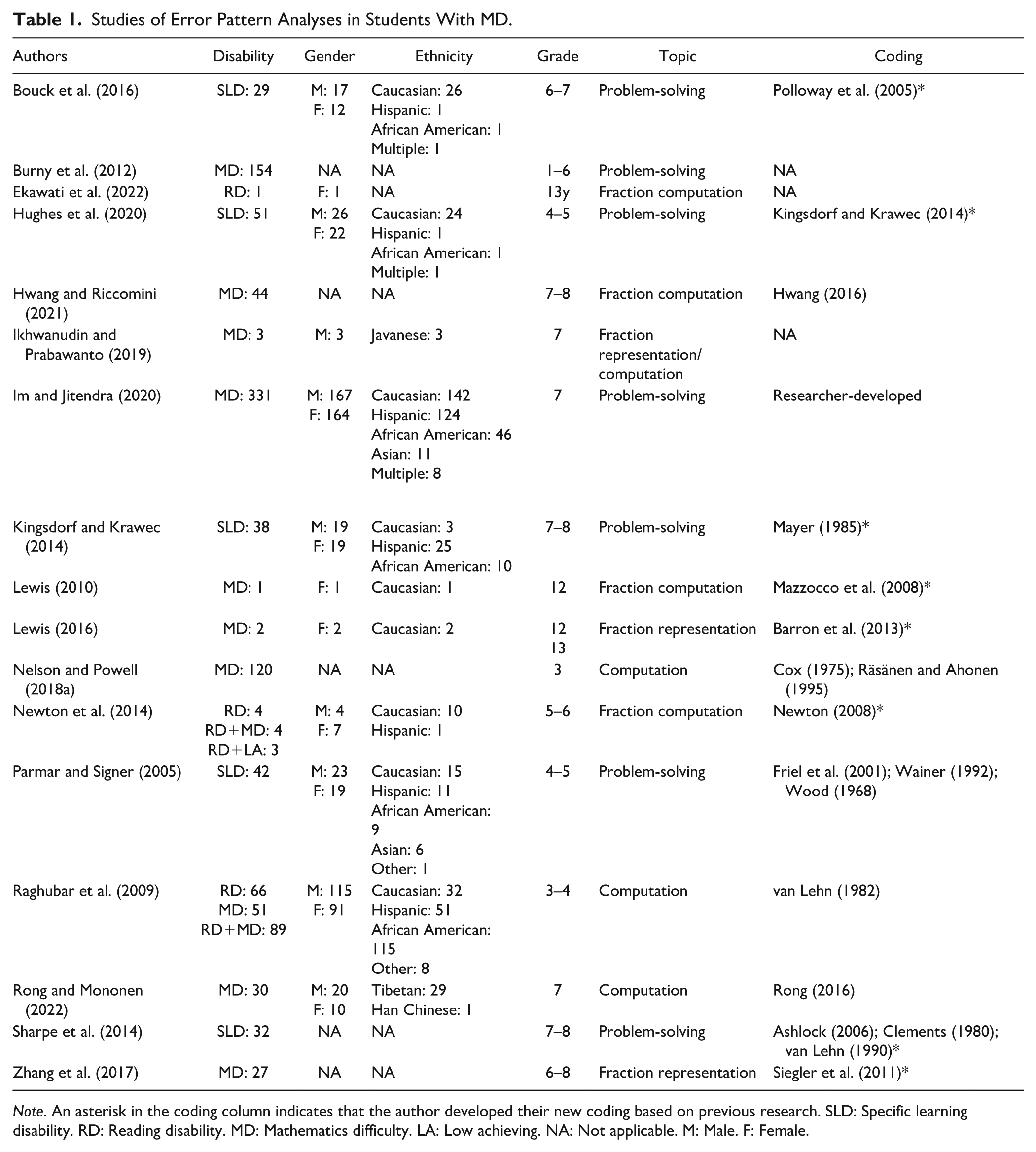
Note. An asterisk in the coding column indicates that the author developed their new coding based on previous research. SLD: Specific learning disability. RD: Reading disability. MD: Mathematics difficulty. LA: Low achieving. NA: Not applicable. M: Male. F: Female.
Regarding problem-solving, it entailed text that required students to solve the problems. Concerning computation, it denoted any question format that involved addition, subtraction, multiplication, division, etc. The coding areas (e.g., see Tables 2–5) for each mathematics topic were determined based on the terms and descriptions used by the authors in the studies reviewed. For example, in examining fraction computation error patterns (e.g., see Table 2), we compiled all relevant mathematics skill terms from the five studies that met our inclusion criteria, such as addition, subtraction, multiplication, division, computation, fraction ordering, equivalent fractions, and word problems. Additionally, the logic for coding error types was based on the most frequently identified error patterns in the literature on MD. For instance, Hwang and Riccomini (2021) described error patterns across various student groups, including typical achievers, low achievers, and students with MD. Our focus, however, was specifically on the error patterns made by students with MD. In cases where the error patterns in the original studies were disaggregated (e.g., combining students with and without MD), we grouped the errors for consistency (e.g., Nelson & Powell, 2018a; Table 5).
Fraction Computations of Error Patterns in the Studies Under Consideration.
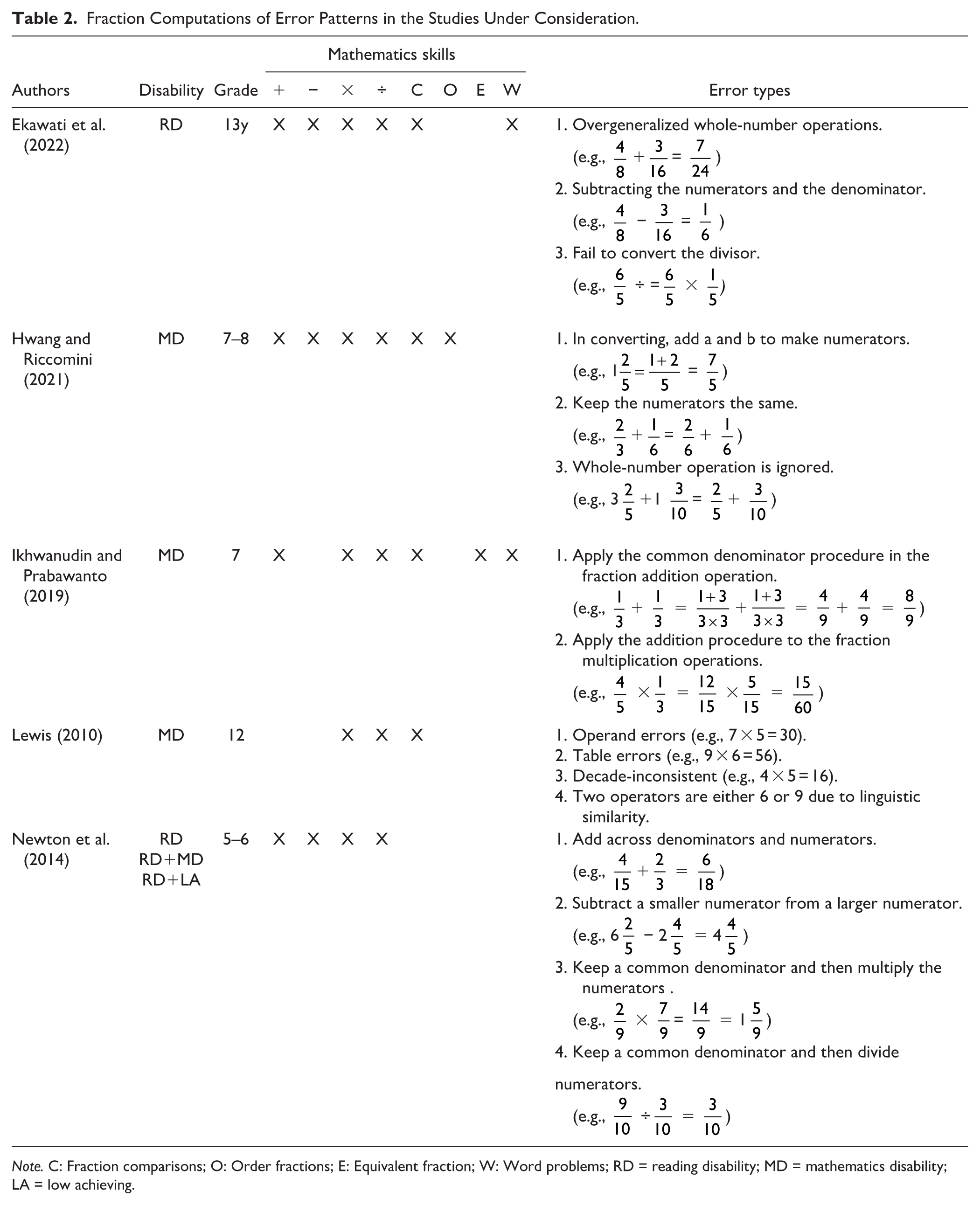
Note. C: Fraction comparisons; O: Order fractions; E: Equivalent fraction; W: Word problems; RD = reading disability; MD = mathematics disability; LA = low achieving.
Fraction Representations of Error Patterns in Studies Under Consideration.
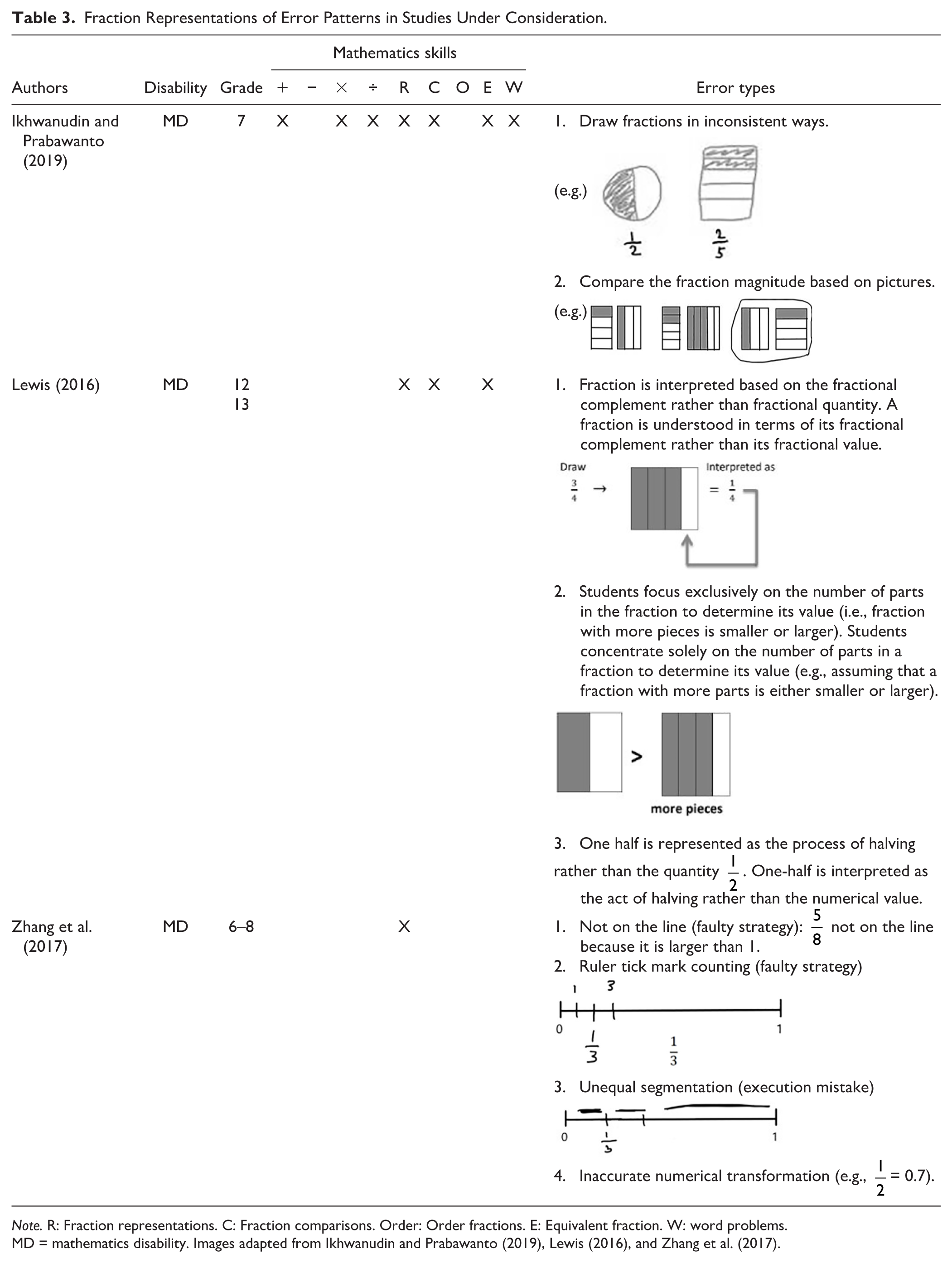
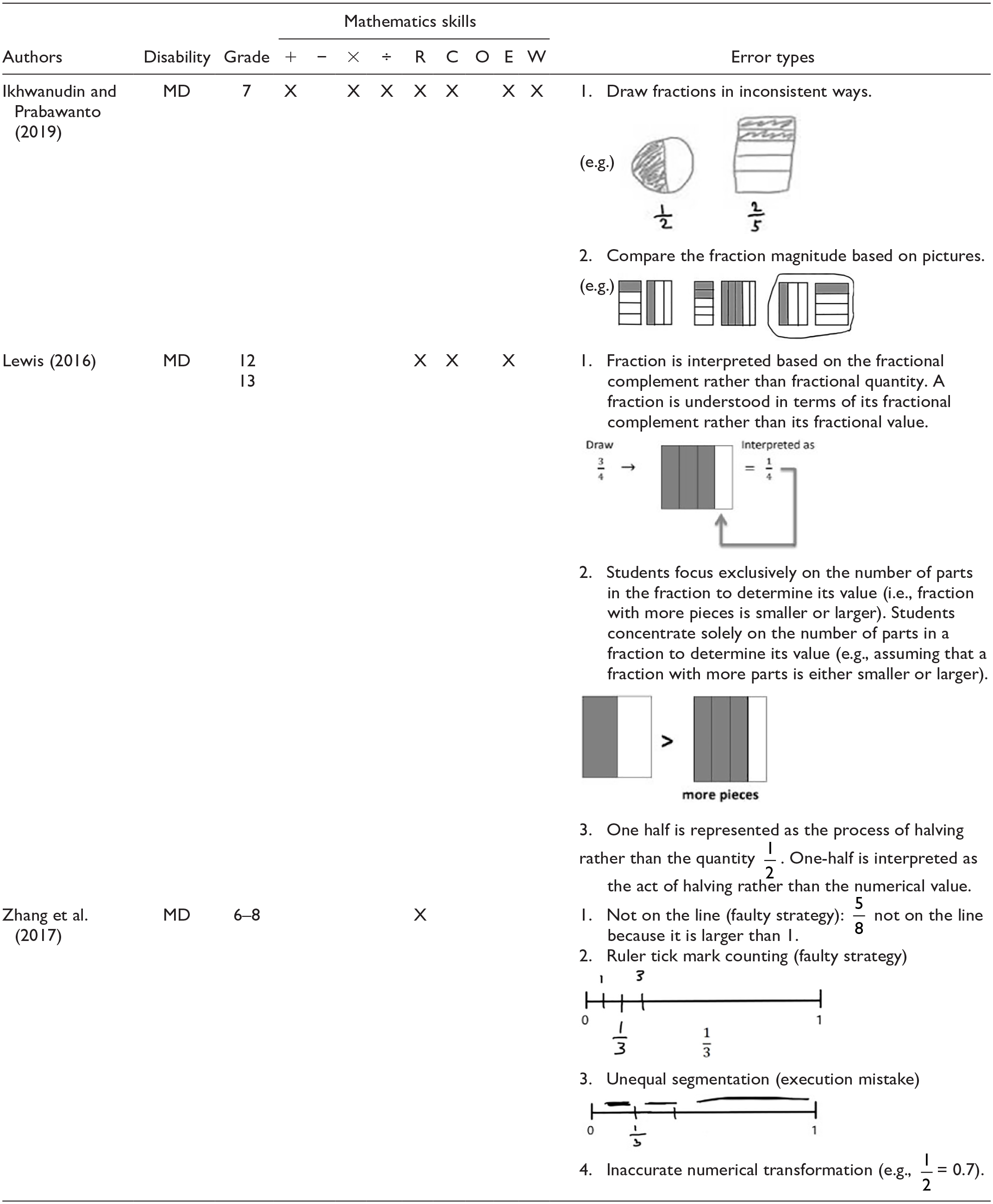
Note. R: Fraction representations. C: Fraction comparisons. Order: Order fractions. E: Equivalent fraction. W: word problems. MD = mathematics disability. Images adapted from Ikhwanudin and Prabawanto (2019), Lewis (2016), and Zhang et al. (2017).
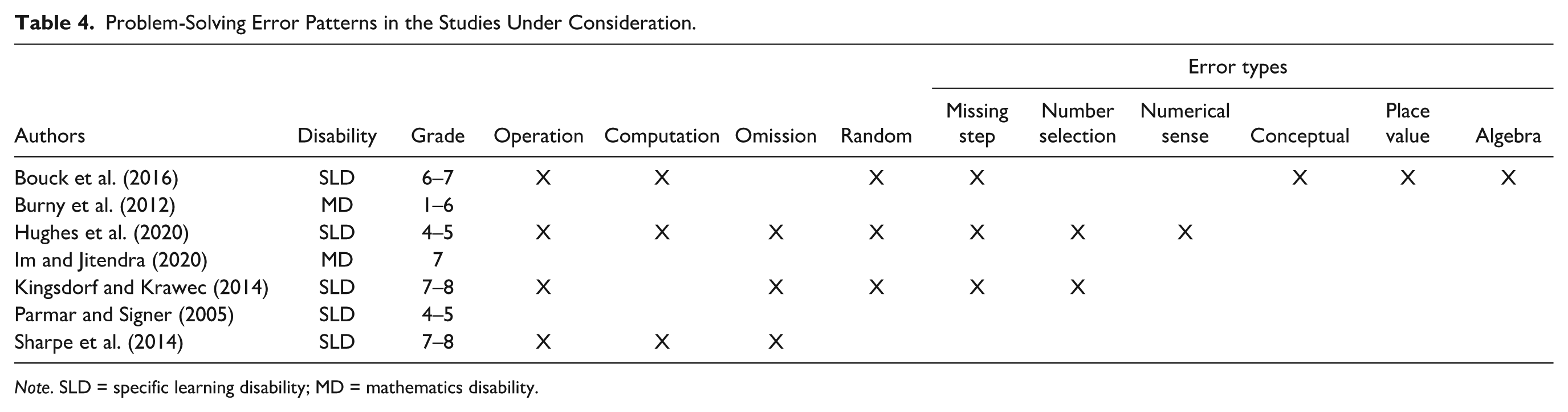
Problem-Solving Error Patterns in the Studies Under Consideration.
Note. SLD = specific learning disability; MD = mathematics disability.
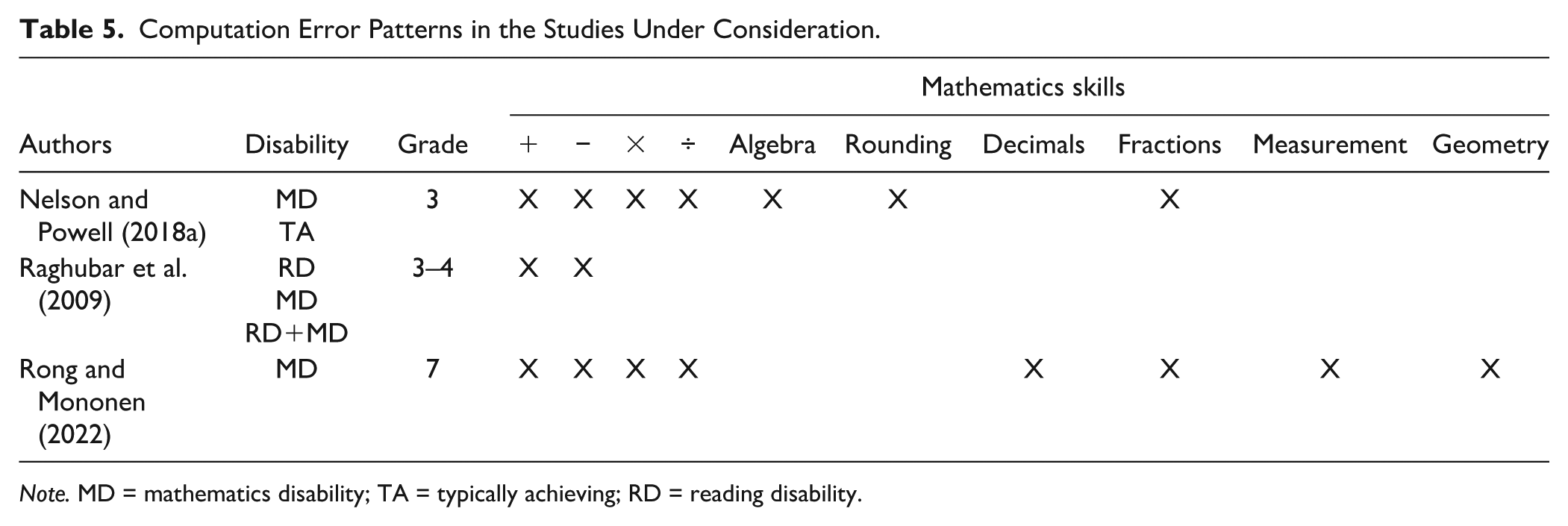
Computation Error Patterns in the Studies Under Consideration.
Note. MD = mathematics disability; TA = typically achieving; RD = reading disability.
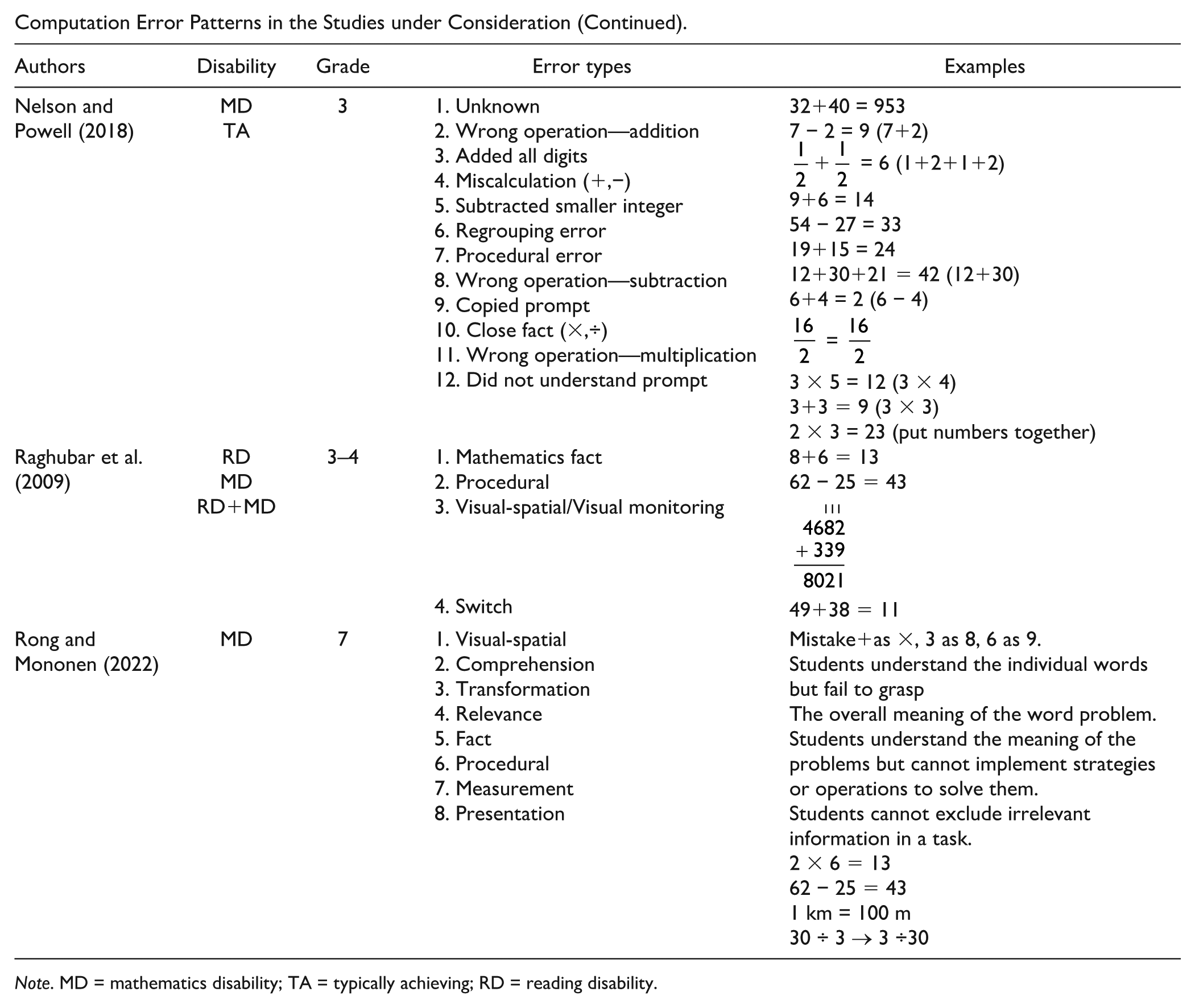
Computation Error Patterns in the Studies under Consideration (Continued).
Note. MD = mathematics disability; TA = typically achieving; RD = reading disability.
Interrater Reliability
Interrater reliability was calculated as total agreements divided by the sum of agreements and disagreements, multiplied by 100. To ensure the reliability of article search and selection, the first author, in collaboration with a librarian, conducted the initial search and selected articles that met the study’s inclusion criteria. Subsequently, the second author double-checked the selections, resulting in an interrater reliability of 98.1%. In addition, the first author coded all 17 studies, while the third author double-coded 50% of them. The initial interscorer reliability was 83.76% for the first research question (see Table 1), 88.24% for the second, and for the third: 90.14 for fraction computation (see Table 2), 82.22% for fraction representation (see Table 3), 94.62% for problem-solving (see Table 4), and 100% for computation error patterns (see Table 5). Following our discussion, the disagreements were resolved, and the final interrater reliability increased to 100%.
Results
Error Analysis Studies
The 17 studies included 1,122 participants, comprising students with SLD (n = 192), MD (n = 763), RD (n = 71), both RD and MD (n = 93), and both RD and low achievement (n = 3). Regarding gender, 394 and 348 participants were male and female, respectively. Most studies incorporated ethnicity data, with participants identified as Caucasian (n = 255), Hispanic (n = 214), African American (n = 182), Asian (n = 17), and multiracial Americans (n = 10). Eight studies focused on elementary grade levels (e.g., Nelson & Powell, 2018a; Raghubar et al., 2009). Seven studies investigated students at the middle school level (e.g., Bouck et al., 2016; Hwang & Riccomini, 2021); one study examined high school level students (Lewis, 2010), while another study focused on college students (Lewis, 2016). The cut-off for MD varied, ranging from the 25th percentile to the 40th percentile. Four studies adopted the 25th percentile cut-off (Burny et al., 2012; Ikhwanudin & Prabawanto, 2019; Im & Jitendra, 2020; Nelson & Powell, 2018a). One study applied a cut-off of less than the 30th percentile on standardized arithmetic subtests based on the Wide Range Achievement Test 3 (Raghubar et al., 2009). Another study applied a cut-off at the 40th percentile rank on a state-mandated mathematics test (Zhang et al., 2017). Additionally, one study defined MD as scoring two or more standard deviations below the mean on mathematics assessments (Rong & Mononen, 2022). Lewis (2010, 2016) employed more stringent criteria for identification, including (a) ranking below the 25th percentile on a state-mandated achievement test, (b) absence of social or environmental factors that explain low achievement, and (c) lack of response to instruction, as evidenced by a negative change in performance from pre-test (59% accuracy) to post-test (44% accuracy).
As shown in Table 1, researchers employed various coding methods to analyze errors. Four studies adopted coding practices directly from established frameworks, one study developed its own coding scheme, and eight studies combined prior research with newly identified error types specific to their investigations. Of the four studies using existing coding frameworks, three drew from their own prior research (Hwang & Riccomini, 2021; Newton et al., 2014; Rong & Mononen, 2022). Among the eight studies that integrated previous coding frameworks with newly created categories, most focused on word problem-solving (e.g., Bouck et al., 2016; Hughes et al., 2020). For instance, Bouck et al. adapted Polloway’s (2005) error task analysis, which originally included five categories: random responding, basic fact errors, wrong operations, defective algorithms, and place value errors. Bouck and the team expanded this framework by adding three new error types: defective algorithm in multi-step problems, lack of conceptual understanding, and errors specific to algebra. Similarly, Hughes et al. (2020) modified Kingsdorf and Krawec’s (2014) error categories by adding “numerical sense error” to better address issues with decimals and fractions.
Mathematics Topics
Approximately half of the studies focused on fractions (n = 7) and problem-solving (n = 7), followed by computation (n = 3). Within the context of fraction studies, five examined fraction computations, whereas two explored fraction representations (Lewis, 2016; Zhang et al., 2017). Among fraction computation studies, the most frequently studied skills were fraction multiplication (n = 5) and division (n = 5), with addition (n = 4) and magnitudes (n = 4) following closely. Other fraction computation skills included subtraction (n = 3), word problems (n = 2), ordering (n = 1), and equivalence (n = 1). In fraction representation studies, researchers focused on fraction representations (n = 3), followed by fraction comparisons (n = 2) and equivalent fractions (n = 2). Various studies have shown variations in problem-solving skills, encompassing a range of mathematical areas. These include number operations, algebra (Bouck et al., 2016), fractions and decimals (Hughes et al., 2020), multi-step word problems involving all four operations (Kingsdorf & Krawec, 2014; Sharpe et al., 2014), clock reading (Burny et al., 2012), interpretation of graphs (Parmar & Signer, 2005), and ratio (Im & Jitendra, 2020). Regarding computation studies, topics typically encompassed all four operations (Nelson & Powell, 2018a; Raghubar et al., 2009; Rong & Mononen, 2022) or were combined with other skills related to rounding, decimals, geometry, and measurement (Rong & Mononen, 2022).
Error Patterns
Based on the various mathematical topics and skills examined by researchers, error patterns varied significantly, particularly in problem-solving studies (e.g., graph analysis, clock reading, and ratio problems).
Fractions
Error patterns associated with fractions were classified into two categories: fraction computations and fraction representations. Regarding fraction computations (see Table 2):
Fraction addition: Students with MD tended to add across numerators and denominators (e.g.,
Fraction subtraction: They frequently subtracted a smaller numerator/denominator from a larger numerator or denominator (e.g., 6
Fraction multiplication/division: They maintained a common denominator and multiplied the numerators (e.g.,
Other errors: Lewis (2010) interviewed students with MD and identified unique errors in fraction computation. Among these, 75% of the students’ errors were operand errors (e.g., 7 × 5 = 30), while the remaining 25% were table errors (e.g., 9 × 6 = 56). A notable error involved confusion due to the linguistic similarity of two operators (e.g., confused by the numbers 6 and 9 because 6 × 9 = 54 and 9 × 6 = 54).
For fraction representations, common error patterns were identified across three studies (see Table 3):
Inappropriate use of visual information: Students with MD frequently relied on visual cues rather than conceptual understanding. They misunderstood fractions with larger visual representations as having greater value (Ikhwanudin & Prabawanto, 2019; Lewis, 2016). For instance, they may think that a larger picture indicates a larger fraction. Zhang et al. (2017) provided another example where students, when asked to point to a fraction on a number line, incorrectly stated that
Inconsistent fraction drawings: Students often drew fractions inconsistently, revealing a lack of understanding of the fraction concepts. For example, when asked to draw a fraction representation, they may switch between drawing a circle or a rectangle, resulting in errors in comparing fraction magnitudes (Ikhwanudin & Prabawanto, 2019; Zhang et al., 2017).
Unconventional understanding: In Lewis’ qualitative study, students interpreted fraction representations based on the fraction complement as opposed to the given fraction. When presented with an area model of
Problem-Solving
Among seven studies that involved problem-solving, four adopted similar error coding. Within the scope of these four studies, common error patterns encompassed operation errors (n = 4), computation (n = 3), random (n = 3), and missing step (n = 3; see Table 4; Bouck et al., 2016; Hughes et al., 2020; Kingsdorf & Krawec, 2014; Sharpe et al., 2014). Descriptive error coding was used for the other three studies, covering ratios, clock reading, and graph interpretation.
Ratio and proportional reasoning: Students with MD commonly made errors in ratio comparison problems related to numerical reasoning. They frequently evaluated ratios based on the numerical equivalence of each part or the total sum of the parts. For example, a common error was the assertion that “It is not equivalent because box ii has more soccer balls and skateboards (9:6) than box i (6:3)” (Im & Jitendra, 2020).
Clock reading: In Burny et al.’s (2012) study, children with MD made more errors compared with those without MD, particularly in procedural and retrieval strategy errors. They misinterpreted the numbers on the clock, resulting in miscounting and combined errors. For instance, they reported 9:04 instead of 9:20. This indicates ignorance that the number 4 on an analog clock represents 20 min when pointed to by the minute hand (memory retrieval deficit).
Graph interpretation: A common source of error was misinterpreting the term “taller than” to mean “tallest” (Parmar & Signer, 2005). Researchers discovered that the students lacked conceptual understanding. Consequently, they relied solely on the graph’s visual, or iconic, appearance and ignored referents and specifiers.
Computation
In the three computation studies, common error patterns involved factual, procedural, and visual-spatial errors (see Table 5; Nelson & Powell, 2018a; Raghubar et al., 2009; Rong & Mononen, 2022). Note that despite the researchers using different terms for coding, the identified errors were consistent across studies:
Mathematics fact error: This was the most frequent error and was also known as miscalculations. For example, students made basic factual errors, such as 8+4 = 11 or 3 × 5 = 12 (Nelson & Powell, 2018a; Raghubar et al., 2009; Rong & Mononen, 2022).
Procedural error: This type of error refers to mistakes in the process of carrying out algorithmic procedures, which included incorrect operations, incorrect algorithms, placement errors, incorrect steps, and missing steps. For example, students may incorrectly add 19+15 as 24 (Nelson & Powell, 2018a) or subtract smaller numbers from larger numbers (e.g., 62 − 25 = 43).
Visual-spatial error: This error refers to the errors made because of poor visual-spatial skills, such as difficulties in recognizing numbers, mathematical expressions, quantities, or shapes (Rong & Mononen, 2022). Raghubar et al. (2009) categorized visual-spatial/visual monitoring as number misalignment, miswriting numbers, and mess/overcrowding in standard algorithms.
Specifically, Rong and Mononen (2022) identified eight distinct error types: visual-spatial, comprehension, transformation, relevance, fact, procedural, measurement, and presentation. Their findings revealed that the associations among these error types were mostly weak to moderate, suggesting that the errors were relatively independent of one another.
Discussion
We conducted this systematic review of mathematical error patterns associated with MD to explore the characteristics of error analysis studies, synthesize the mathematical topics examined, and identify common error patterns linked to these skills. Our analysis revealed several key issues, including variations in research methodologies (e.g., cut-off criteria for identifying MD, coding), the dominance of certain mathematical topics, potential causes of error patterns, and their implications for educators and future research.
Although not all researchers reported participants’ gender, this review found a nearly equivalent ratio of males to females (394: 348), which aligns with previous studies on MD that reported no significant gender differences (Lewis & Fisher, 2016). For ethnicity, most participants were Hispanic and African American students, which resonates with the current national report indicating that culturally and linguistically diverse students represent a substantial portion (i.e., 34%) of those with SLD and are frequently overrepresented (Freeman-Green et al., 2021). A comprehensive review spanning 40 years of research on MD revealed that 90% of studies (n = 148) identified students with MD using a cut-off score, and the most commonly employed cut-off was at the 25th percentile, followed by the 10th and 15th percentiles (Lewis & Fisher, 2016). However, in our review, six studies used a cut-off at the 25th percentile, one at the 30th percentile, and another one at the 40th percentile, deviating from the prevailing trend in the field that favors stricter criteria for MD identification (Lewis & Fisher, 2016; Nelson & Powell, 2018b).
Similar to Lewis and Fisher’s observation, research on students with MD has predominantly focused on elementary-age students engaged in basic arithmetic calculations (Lewis & Fisher, 2016). Notably, while seven studies examined middle-grade students and two investigated high school or college students with MD, the mathematical content in these studies remained elementary, such as fraction computation (Lewis, 2010, 2016). This focus on fractions is not surprising, given the significant challenges students face in mastering this topic (Hwang & Riccomini, 2021). Problem-solving is another popular topic, which is understandable given the importance of word problems for students with MD (e.g., Bouck et al., 2016). Notably, three studies extended beyond word problems involving basic operations to examine topics, such as ratio and proportional reasoning, clock reading, and graph interpretation. We express optimism that these studies investigated topics beyond the more common areas because this broader focus helps deepen our understanding of the challenges students with MD may face across different mathematical domains. However, among these topics, only proportional reasoning aligns closely with middle school mathematics skills (Im & Jitendra, 2020). Given the growing number of students identified with MD at the secondary level, it is crucial to extend error analysis to more advanced mathematical content, such as algebra and geometry.
The most common error patterns in fraction computation involved treating the denominator and numerator as whole numbers. This finding aligns with previous studies highlighting students’ challenges in transitioning from whole numbers to fractions during fraction learning (e.g., Newton et al., 2014). In addition, the types of computation errors observed in this study suggest that difficulties with whole numbers may lead to systematic misconceptions when learning fractions (e.g., Nelson & Powell, 2018a). Educators may consider emphasizing the continuity between whole number and fraction knowledge. For example, students can be encouraged to extend their understanding of operations on whole numbers to operations on fractions and to connect fractions with the division of whole numbers (i.e.,
For fraction representation, a type of error committed by students with MD involves challenges with visual representation, highlighting the interplay between instruction and errors. Particularly, students with MD often draw fractions inconsistently, failing to accurately represent fractional values. This inconsistency may result from the variability in teachers’ visual representations during instruction. In school, teachers frequently use various shapes, such as circles or rectangles, to illustrate fractional concepts. However, the ability to use various representations (e.g., number lines or circular area models) to illustrate fractions requires distinct skills (Morano et al., 2019). Therefore, teachers may carefully select instructional materials and maintain consistency in the representations used to teach fractions.
Seven studies on problem-solving identified “carrying out the wrong operation” as a common error type among students with MD. One possible explanation is that students with MD often struggle to identify mathematical symbols from an early age (Geary, 2011). Based on this finding and the evidence from this review, teachers must understand that these challenges can persist across grade levels and prioritize instruction on mathematical symbol recognition. Alternative strategies, such as transcribing mathematical symbols (÷) into words (e.g., divided by), can also support these students. Furthermore, computation errors have consistently emerged in studies dating back to the early stages of error research (e.g., misalignment of numbers, Raghubar et al., 2009; Russell & Ginsburg, 1984) and across various mathematical topics (e.g., word problem-solving; Bouck et al., 2016). These findings raise concerns about the effectiveness of the instructional and intervention methods used for students with MD in the classroom. These interventions may fail to specifically address this challenge and may not be aligned with the unique profiles of students with MD, which may contribute to the persistent repetition of these error patterns (e.g., Lewis et al., 2020).
Lewis adopted Vygotsky’s sociocultural perspective on disability, suggesting that sociocultural tools developed over human history may sometimes be incompatible with an individual’s biological development (e.g., Lewis et al., 2020). For students with MD, conventional mathematical mediational tools, such as numerals, drawings, and manipulatives—which support the learning of typically developing students—may not align with the unique ways these students process numerical information. For example, students with MD interpreted one-half as the process of halving rather than as the quantity 1/2 (Lewis, 2016). This misunderstanding led them to incorrectly believe that 1/2 is larger than 3/4. Based on this, Lewis (2016) argued that the predominant use of quantitative methods limits the nature of the questions that can be asked and answered. More effectively addressing the emergence and persistence of error patterns in students with MD necessitates adopting alternative methodological (e.g., qualitative methods) and theoretical frameworks that extend beyond the conventional approaches typically used in MD research (Lewis, 2016; Lewis & Fisher, 2018).
In addition, the coding systems used by researchers to classify errors varied, even when addressing the same concepts. Nelson and Powell (2018a) categorized errors like 9+6 = 14 as “miscalculations,” while Raghubar et al. (2009) described the same errors as “mathematics fact errors.” Moreover, definitions of these error types differed. Raghubar et al. defined fact errors narrowly as computational mistakes where students used the correct operation but failed to retrieve the correct arithmetic fact from memory (e.g., 9+6 = 14). In contrast, Rong and Mononen (2022) adopted a broader definition, encompassing number facts and fundamental mathematical concepts, such as number properties, magnitude, geometric properties, and notations. These inconsistencies in coding systems and definitions highlight the lack of a standardized framework for classifying mathematical errors. This variability not only complicates comparisons across studies but also underscores the need for a unified approach to ensure more consistent and meaningful analyses of error patterns.
Implications for Practice
We identified four key implications for teachers grounded in error analysis: instructional strategies, instructional representations, the integration of error analysis into instruction, and a shift in perspectives on errors. First, teachers may employ different instructional strategies based on the specific types of errors students make. For example, one of the most common error types in computation is the mathematics fact errors. To address this, teachers may consider using strategies that specifically enhance students’ retention, such as retrieval practice. In addition, teachers may incorporate error patterns as teaching materials (e.g., Barbieri & Booth, 2016; Siskawati et al., 2022). Research has shown that students who often struggle with mathematics benefit significantly from reflecting on highlighted errors presented in examples of incorrect answers in their work. For students with MD, this approach may help them recognize and learn from errors in advance, thereby reducing the likelihood of repeating the same mistakes. Second, students with MD often rely on visual representations to learn mathematics, but this can also contribute to errors. This review revealed that students who used visual representations to learn fractions often lacked a conceptual understanding (Ikhwanudin & Prabawanto, 2019; Parmar & Signer, 2005). Therefore, educators must recognize that while visual representations can serve as helpful cues for learning, they may also confuse students who lack a solid understanding of the underlying concepts. Third, to gain a deeper understanding of students’ error patterns, teachers may interview students with MD to explore the cognitive processes behind error patterns. As demonstrated by the interview studies in this review (Lewis, 2010, 2016), students with MD exhibit unique mathematical thinking that leads to distinct error patterns. A brief interview during or after class may help teachers understand students’ thinking and tailor instruction to align more closely with students’ reasoning (Lewis & Fisher, 2018). Lastly, this review shows that students’ errors offer valuable insights that can help teachers customize interventions to meet students’ needs. In particular, the error patterns identified by Lewis (2010, 2016) highlight students’ diverse ways of thinking, emphasizing that mathematical difficulties reflect differences rather than deficits (Lewis et al., 2020). Therefore, we hope that teachers will shift their perspective, viewing errors not as setbacks but as opportunities for learning.
Limitations and Implications for Research
This systematic review had two notable limitations. The search terms and inclusion criteria may have excluded relevant studies, thereby failing to capture the existing literature. Second, this review excluded studies focusing on the comorbidity of MD with other disabilities. In other words, studies that analyzed error patterns among students with both MD and additional disabilities (e.g., intellectual and developmental disabilities; Bottge et al., 2014) were not included. Consequently, certain error types that students with MD might exhibit in mathematics may have been overlooked.
Based on our findings, this study offers three implications for future research. First, broadening the inclusion of disability categories may yield a more comprehensive analysis of mathematical errors among students with disabilities. Students with MD and those with other disabilities, such as autism or attention-deficit/hyperactivity disorder, may exhibit varied types of mathematical errors. Second, combining error analysis with instruction may benefit teachers and researchers. Previous studies have demonstrated that using students’ errors as intervention materials helps students learn from their mistakes, thus improving mathematics outcomes (e.g., Siskawati et al., 2022). Including error analysis in interventions is a novel area worthy of research for students with MD. Lastly, future research may focus on higher-level mathematics topics. As the results of this study demonstrate, almost all studies investigated elementary mathematics, leaving a gap in understanding how students with MD struggle with higher-level mathematics.
Footnotes
Declaration of Conflicting Interests
The author(s) declare no potential conflicts of interest regarding the research, authorship, and/or publication of this article.
Funding
The author(s) received no financial support for the research, authorship, and/or publication of this article.
