




Abstract
This paper examines the effects of a morphological awareness intervention on the word reading and spelling skills of Grades 4 to 6 children with dyslexia. Sixteen children in eastern Ontario, Canada, received 20 hours of morphologically oriented instruction spread over 6 weeks and eight served as controls, and all received a battery of reading and spelling tests before and after the intervention. Students were taught the nature of morphology and the types of morphemes, how words could be assembled from morphemes or deconstructed into morphemes to make meaning from print and access the correct pronunciation, and how to use morphology in reading and spelling words. Repeated measures analyses of variance and analyses of covariance indicated that the experimental group showed significantly larger gains than the control group on measures of morphological awareness, morphological decoding, morphological analysis, and morphological spelling. There were no significant effects on word reading (fluency and accuracy) or on standardized spelling measures.
Reading is a fundamental pillar of education, a determinant of opportunity and success in adulthood, and a key cultural tool that permeates life and enables the democratization of knowledge and communication. Some students fail to learn to read proficiently despite average intelligence, hearing, vision, and appropriate instruction. Many of these students are diagnosed with dyslexia, affecting 5% to 20% of students (Fletcher et al., 2019). Dyslexia is characterized by persistent difficulty in accurate and fluent word reading due to deficits in phonological awareness that are unexpected in relation to general intellectual ability and learning environment (World Health Organization, 2011). Reading comprehension and learning from text depend upon efficient word recognition (Perfetti & Stafura, 2014). Because phonological awareness and phonological decoding are widely seen as the core difficulty in dyslexia, many interventions have been designed to target these processes in remediation, but these interventions are not successful for all students (Fletcher et al., 2019; McArthur & Castles, 2013). There has been a growing interest in recent years in alternative and complementary remedial approaches that place less direct emphasis on the very skills that students with dyslexia find so challenging and focus more on their relative strengths.
One approach that has attracted attention is based on morphological awareness (Deacon et al., 2008; Elbro & Arnbak, 1996; Kirby & Bowers, 2018). Morphemes are the smallest units of meaning in words (for instance, cats has two morphemes, cat + s, and construction has three, con + struct + ion); morphological awareness is the sensitivity to the morphological structure of words and the ability to manipulate morphemes (Carlisle, 1995, 2000). There is considerable evidence that morphological awareness predicts achievement in word reading (Carlisle, 2000, 2010; Deacon & Kirby, 2004; Kirby et al., 2012; Roman et al., 2009), reading comprehension (Carlisle & Fleming, 2003; Deacon et al., 2017), and spelling (Deacon & Bryant, 2006; Deacon et al., 2009), even after controlling other factors such as vocabulary, nonverbal ability, phonological awareness, and naming speed. There is also a great deal of evidence that instruction in morphological awareness improves reading and spelling achievement (for meta-analyses, see Bowers et al., 2010; Goodwin & Ahn, 2010, 2013). Bowers et al. (2010) and Goodwin and Ahn (2010) found that morphological instruction benefited struggling readers. Bar-Kochva and Hasselhorn (2017) and Bar-Kochva et al. (2020) found that exposure to a lexical decision task that emphasized morphological structure improved morphological aspects of reading and spelling for struggling readers and those with dyslexia. Deacon et al. (2008), Law et al. (2015), and Quémart and Casalis (2018) have argued that morphology may represent a relative advantage for struggling readers, including those with dyslexia, suggesting that increased morphological skill may allow them to compensate, to some degree, for phonological weaknesses. Although Georgiou et al. (2023) found in a meta-analysis that children with dyslexia show deficits in morphological awareness, they argued that morphological awareness may still be improved by instruction. In this paper, we develop an intervention based on morphological awareness and investigate its effects on morphological, word reading, and spelling skills.
How Morphological Awareness Affects Word Reading and Spelling
Understanding how morphological awareness contributes to reading and spelling should inform the design of morphological instruction. There is a well-known description of word knowledge called the Triangle Model (Adams, 1990; Seidenberg & McClelland, 1989; Stafura & Perfetti, 2017) in which phonology, orthography, and semantics form the vertices of a triangle. As reading and spelling skills develop, the connections on each side of the triangle get stronger, forming a network of spreading activation; word knowledge is the result of the efficient functioning of this network. Kirby and Bowers (2017, 2018) proposed that morphology acts as a “binding agent,” tying the parts of this triangle together and thus contributing to its efficiency. Morphology’s connection with semantics is obvious because it concerns the meanings of parts of words. But morphology is also critically related to orthography because despite different pronunciations, written morphemes in English have very consistent spellings: for instance, signal and signing share the base sign and have related meanings, but the base is pronounced differently in each morphology and is also related to phonology. Consider the -ed that marks the past tense: this is a morpheme with a constant spelling, but several different pronunciations (d, t) and almost never -ed. Furthermore, some letter combinations are pronounced differently when they are within a single morpheme (the ea in read) as opposed to being in separate morphemes (the ea in react). Knowing the morphology of the word helps specify the correct pronunciation. See Kirby and Bowers (2017, 2018) for more examples of how morphology binds the components of the Triangle Model.
There is growing evidence that morphological awareness has distinct parts (Goodwin et al., 2022). For example, Deacon et al. (2017) and Levesque et al. (2017, 2019) argued that in addition to general morphological awareness, two specific components exist: morphological decoding and morphological analysis. They showed that morphological decoding, the sounding out of words morpheme by morpheme (rather than grapheme by grapheme), contributes to word reading, whereas morphological analysis (being able to infer the meaning of multimorphemic words by examining their morphemes) contributes to comprehension. Each of these should be facilitated by different aspects of morphological instruction.
Overall, instruction that encourages children to focus on larger units in reading or spelling, such as morphemes, should lighten the load on their working memory. Instead of decoding grapheme by grapheme, with alternative pronunciations for some graphemes, working with morphemes instead should reduce the number of discrete units that have to be held mentally before a word is recognized. Recognizing morphemes should also reduce the number of different pronunciations that need to be considered (the sign unit in signature and signing). Understanding the grammatical roles of morphemes (such as -s and -ed) should help with sentence comprehension, and morphemes should also help children see possible meanings in unfamiliar words. Spelling should be more successful once morphemes are recognized. See Apel and Werfel (2014), Goodwin et al. (2017, 2022), Kirby et al. (2012), Kuo and Anderson (2006), and Nagy et al. (2006) for more on how morphology is related to reading and spelling.
It is important to note that the introduction of morphology to literacy instruction is not intended to replace instruction in phonology. Especially for beginning readers, or those experiencing great difficulty, they will need help getting started with the first few graphemes of unknown words. Phonology is still part of the reading network and will continue to merit attention from teachers and their students.
This Study: Purpose, Research Questions, and Hypotheses
This study assessed the effects of a 20-hour intervention program based on morphological awareness for struggling readers in a pre-test–post-test quasi-experimental design, contrasting the performance of the intervention group with that of children who received regular remedial instruction. Our first research question was whether the intervention would have significant effects on morphological awareness, morphological decoding, and morphological analysis. Based on the research reviewed earlier, we hypothesized that it would. Our second research question was whether the instructional effects would transfer to measures of reading and spelling. Again, based on previous research, we hypothesized that they would. We examined these effects on standardized measures of reading and spelling and on specially constructed measures of word reading (morphological decoding) and morphological spelling. The measures of morphological decoding, analysis, and spelling included words that had been addressed during the intervention and those that had not. We considered the latter to assess near transfer, whereas the standardized measures assess far transfer.
Method
Participants
The participants were 24 students from three Junior Learning Disability Program classrooms in schools in eastern Ontario. Two classrooms were in a suburban school and one was in a small town nearby. There were eight students in each classroom. All parents or guardians provided informed consent for their children’s participation and all students assented to all assessments; no child was withdrawn over the course of the study. Four classrooms had been planned to participate, but one withdrew due to teacher illness at the last moment, and no further classrooms could be recruited later because of the COVID-19 pandemic. Classrooms were randomly assigned to control and experimental conditions, with the constraint that two would be in the experimental condition. The control group’s ages ranged from 121 to 137 months and five of the eight students were boys. The experimental group’s ages ranged from 123 to 141 months and 11 of the 16 students were boys.
All participants had been assessed and diagnosed with a learning disability by licensed psychologists and had been reviewed by a school board Identification, Placement, and Review Committee. All students had modifications to their Individualized Education Programs for reading and writing. These students met the school board’s criteria for a communications learning disability (outlined in the Board’s Special Education Plan document). These criteria describe academic under-achievement (in areas including reading and writing) that is inconsistent with the student’s intellectual abilities, is not due to factors such as sensory deficits, socio-economic factors, etc., and is associated with cognitive processing difficulties, for instance in phonological processing, working memory, and attention. These students came from regular Grades 4, 5, and 6 classrooms in a variety of schools and spent half-days in the specialized support classrooms, where class sizes were small (n = 8) allowing for evidence-based Tier 3 (specialized) instruction. As described in the Results section and shown in Table 1, participants’ performance on reading and spelling tests was consistent with their diagnosis.
Means and Standard Deviations for All Pre- and Post-Test Variables in Control and Experimental Groups.
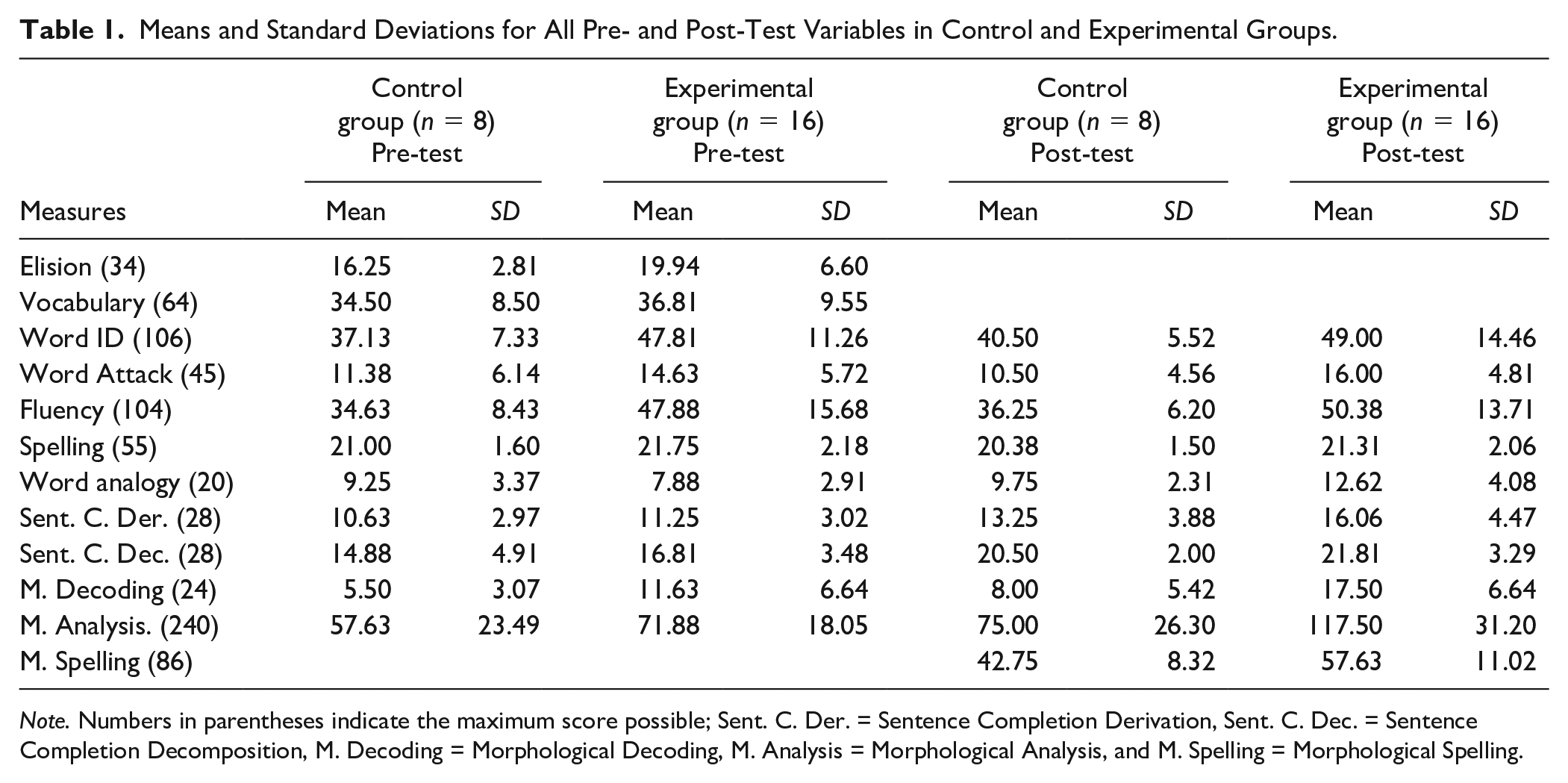
Note. Numbers in parentheses indicate the maximum score possible; Sent. C. Der. = Sentence Completion Derivation, Sent. C. Dec. = Sentence Completion Decomposition, M. Decoding = Morphological Decoding, M. Analysis = Morphological Analysis, and M. Spelling = Morphological Spelling.
Ethics approval was granted by (blinded for review) University and permission to carry out the study was granted by the District School Board.
Design
This quasi-experimental study, with randomization at the classroom level, employed a wait-list control approach. The intervention was delivered to the experimental group by the researchers, and at the end of the study, the lesson plans and resources were provided to the classroom teachers so that they could use them with the control group (and future students). All participants were given 11 measures at pre-test, during the 3 weeks before the intervention began. At post-test, nine of these measures were repeated, plus one further test. The measures that were not repeated were intended to help characterize the groups’ initial skill levels. Pre-test scores shown in Table 1 are consistent with the students’ diagnoses.
Measures
All measures were administered individually by the first author in one or two sessions, depending on student willingness, at pre-test and post-test. Pre-testing took 60 to 75 minutes, and post-testing 45 to 60 minutes. Reliabilities given below are split-half estimates from the current sample at pre-intervention.
Phonological Awareness
This skill was tested pre-intervention using the Elision subtest of the Comprehensive Test of Phonological Processing (CTOPP-2) (Wagner et al., 2013). In each item, a word (e.g., cat) was presented orally to the student, who was asked to repeat it, and then say it without a particular sound (e.g., /k/; correct response “at”). The items increase in difficulty, with the target sounds ranging from free bases in compound words to syllables to single phonemes, and the position of the target sound(s) changing from beginning to end to middle of the words. Feedback was provided only for the practice items and the first three test items. If the student requested it, the examiner was allowed to repeat the word and the instruction once. There are 34 items, and the test is discontinued after three consecutive incorrect answers. Scores are the total number of correct answers. The split-half reliability in the present sample was .95.
Vocabulary
Vocabulary was assessed pre-intervention using the Wechsler Abbreviated Scale of Intelligence (Wechsler, 1999) vocabulary subtest. Up to 34 items were administered, and the test was discontinued after four consecutive errors. Items 1 to 4 were scored 0 or 1, and items 5 to 34 were scored 0, 1, or 2 depending on accuracy, for a maximum possible score of 64. The split-half reliability coefficient for this sample was .91.
Word Reading Fluency
The Sight Word Efficiency subtest of the Test of Word Reading Efficiency, 2nd ed. (Form A; Torgesen et al., 2012) was administered pre- and post-intervention to measure word reading fluency. Students were asked to read out loud as many words as they could in 45 seconds from a list of 109 words. The student’s score was the number of words read correctly within the time limit. The split-half reliability coefficient at pre-test was .98.
Word Identification
The Word Identification subtest from the Woodcock Reading Mastery Test-Revised (Form G; Woodcock, 1998) was used to measure word reading accuracy pre- and post-intervention. The student is asked to read up to 106 words, organized in sets of increasing difficulty, and testing is discontinued after six consecutive errors. The student’s score is the number of words read correctly, and the split-half reliability coefficient was .95.
Word Attack
The Word Attack subtest from the Woodcock Reading Mastery Test-Revised (Form G; Woodcock, 1998) was used to measure decoding pre- and post-intervention. Students are asked to read up to 45 pseudowords, and testing ends after six consecutive errors. The student’s score is the number of items read correctly. The pre-test split-half reliability coefficient was .89.
Spelling
The Spelling subtest of the Wide Range Achievement Test-3 (blue form; Wilkinson, 1993) was given pre- and post-intervention. Students were asked to write up to 40 words of increasing difficulty. Words were dictated and repeated if requested. Each word was said, then a sentence with the target word was read, and again, the word was said in isolation. The test was terminated after 10 consecutive errors. Split-half reliability was .93.
Morphological Awareness, Decoding, Analysis, and Spelling
Five morphologically-related tests were administered pre- and post-intervention, and one further measure (Morphological Spelling) only post-intervention.
Sentence Completion (Derivation and Decomposition)
In these two tasks (Carlisle, 2000), given pre- and post-intervention, participants are asked to change a provided word to complete a sentence. There were 28 items in the derivation measure (e.g., “dryer: Put the wash out to ___.” [dry]) and 28 in the decomposition measure (e.g., “permit: Father refused to give ___.” [permission]). Half of each set was transparent, with no phonological, orthographic, or semantic shifts from the base words, and the other half was opaque, involving at least one of those shifts. The tester read each item aloud to the student, who was provided with a written copy to follow. Students responded orally, and their scores were the number of items answered correctly. The split-half reliability for the derivation items at pre-test was .77, and that for decomposition items at pre-test was .76. Scores are reported separately for the derivation and decomposition items.
Word Analogy
In this pre- and post-intervention test (Kirby et al., 2012), students were presented orally with sets of words as analogies (e.g., run: ran; walk: ___ [walked]) and asked to supply the missing word for each item. There are 20 items, half of which require the student to produce an inflected word and half a derived word, with an equal number of transparent (e.g., mess, messy, fun, [funny]) and opaque (e.g., dog, dogs, person, [people]) transformations in each group. The score was the number of correct answers and the split-half reliability at pre-test was .78.
Morphological Decoding
Participants were asked to read 24 morphologically complex words (e.g., powerful, musician) presented in order of difficulty, based on the items of Levesque et al. (2017). Levesque et al. selected them using the Zeno Word Frequency Guide (Zeno et al., 1995); words had high or low-frequency base morphemes and one of the 20 most common suffixes (Blevins, 2001). Word lists were provided by K. Levesque (personal communication, October 9, 2019). Students were instructed to focus on accuracy and not speed when reading the words. The 24 words were divided into two groups that were equal in transparency, surface (whole word) and base frequency, family size, and number of letters. The words in one of these groups were used during the intervention, and those in the other group were not, representing near transfer. Ten items included phonological and/or orthographic shifts, that is, changes to the sound and/or spelling of the bases when affixes were added. The total score was the number of words read accurately. The pre-test split-half reliability coefficient for this test was .92.
Morphological Analysis
This test was based on a multiple-choice measure used by Levesque et al. (2017) and provided by K. Levesque (personal communication, October 9, 2019). To reduce guessing, open-ended questions were used instead. Two lists of 20 words were created; one was used during the intervention, and the other was not. Word lists were matched based on surface, base, and suffix frequency, the number of letters, family size, and difficulty (based on the data of Levesque et al., 2017). Open-ended questions were asked regarding the meaning and morphological composition of the word, and prompts were created to enable partial knowledge to surface. Students were asked to verbally explain the meaning of each word, which had been read to them aloud, and presented written on an index card (e.g., knowledgeable, ceaseless). They were given two practice words, and if their response included the target word, they were asked to explain the word in a different way without using part of the word. For example, the student was asked to explain what the word teacher means without using the word teach. After the student responded, the assessor would provide an example of a correct answer: teach means the action of showing or explaining to someone how to do something, and er means the person who does it. After the two practice items, all items were administered, and students were given the option to say pass if they did not want to attempt a response. However, if the students’ responses were incomplete or vague (e.g., by giving an example rather than a synonym or clear definition), the tester would prompt them to complete or clarify their answers. The maximum score for each word was 6: up to 2 points for the definition depending on whether it was incorrect, incomplete, or correct with no prompts; 1 point for each morpheme identified (maximum of 2), and 1 point for each morpheme whose meaning was identified (maximum of 2). The maximum score for the test was 240 (40 words × 6 points). The split-half reliability coefficient at pre-test was .84.
Morphological Spelling
Given only post-intervention, this measure was created by selecting 16 words from Levesque et al. (2017, provided by K. Levesque, October 9, 2019) that increased in difficulty in terms of phonological, orthographic, and semantic shifts in affixation. Half of the words consisted of bases and roots taught in the intervention, while the other half did not. The two groups of words were equivalent in the number of morphemes and transparency. Words were read aloud, used in a sentence, and then said again; students were asked to write each word (e.g., helper, luckiest). For each word, a point was given for each morpheme identified (maximum 37), a point for each morpheme spelled correctly (maximum 37), and an extra point was given when the word included an orthographic or phonological shift. The maximum total score was 86 points. Guidelines for scoring were established; two researchers scored one-third of the tests, and the inter-rater consistency was above 95%. The split-half reliability coefficient for this test was .93. Items and their scoring are shown in the Supplemental Materials.
Intervention Program
The intervention program was delivered by the first author, an experienced remedial instructor, in the students’ regular learning disability classrooms; there were four 50-minute sessions per week for 6 weeks, for a total of 20 hours (Goodwin & Ahn, 2013 found that interventions longer than 20 hours did not yield additional benefit in focused interventions). The regular learning disability program teachers agreed to be present in class during all intervention sessions (in one session, a supply teacher was present instead). The teacher of the classroom assigned to the control group was also the teacher for one of the experimental groups and agreed to refrain as much as possible from teaching, reviewing, or discussing material addressed in the intervention group. The control group received regular literacy instruction in their home schools and a program with a phonemic and phonological focus in the learning disability support classroom.
The intervention consisted of direct instruction on morphological awareness and its application to reading, spelling, and vocabulary; the intervention was monitored through weekly diagnostic activities for the experimental participants. Students were introduced to the basic concepts of morphology: what a morpheme is, the kinds of morphemes, and the types of words that result from combining them. Students were taught how words could be assembled from morphemes or deconstructed into morphemes to make meaning from print and access the correct pronunciation. Bases (free and bound) and affixes (prefixes and suffixes) were explained; free bases can be words by themselves, whereas bound bases are ones that only become words when affixes are added, such as -struct- in construction. All explanations were integrated with class discussion and practice. Every lesson incorporated a review of the content taught in the previous lesson while focusing on the target content instructed throughout the week. The instructional plan and a sample lesson can be seen in the Supplemental Materials.
The first half of the intervention (10 hours) was composed of instruction on morphological structure awareness, decoding, and analysis, working with a selected set of base words, and affixes to be manipulated in reading and writing. Once the basic concepts underlying morphology were introduced, students were asked to manipulate bases and affixes. Word sums and word matrices (see Kirby & Bowers, 2017, 2018, for examples) were explained and used for teaching purposes and practice at the end of each week. An example of a matrix and the word sums related to it are shown in Figure 1.
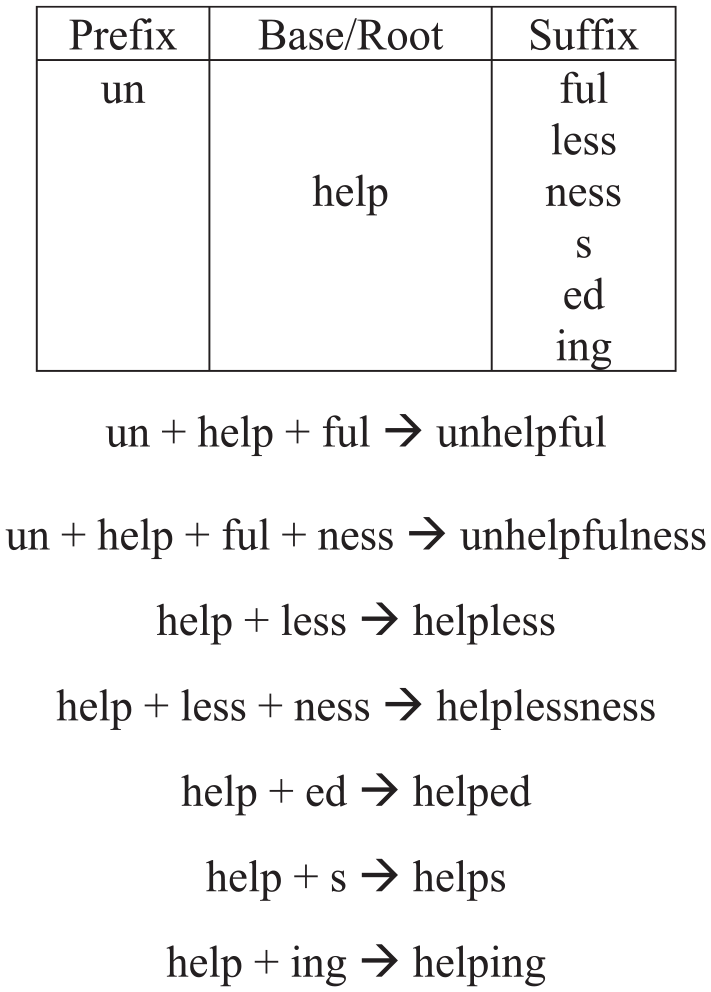
Word Matrix.
Word sums reveal the written morphological structure. For instance, walked is shown as walk + ed. Word matrices show the variety of prefixes and suffixes that can be combined with a single base to form multiple words. Both tools were used first on paper and then in conjunction with an online site (etymonline.com) to investigate the structure test (find other words with the same morphemes) and the meaning test (show that the base and the multimorphemic word share a common meaning) (see Kirby & Bowers, 2018, p. 237 for more on these tests). Inflectional affixes were the focus of the first week of intervention, followed by derivational affixes in the second. The researcher explained to students that inflections maintain the base word’s class and grammatical category (e.g., when the suffix ed is affixed to jump, the verb tense changes, but it continues to be a verb), while derivations often do not (adding -al to sign changes the word from a noun to a verb).
Transparent multimorphemic words were presented first, followed by those with phonological and/or orthographic shifts. Free bases such as help and fast were used to introduce word matrices and sums in the first 2 weeks of the intervention, followed by bound bases such as struct and ject in later weeks. Following the instruction on each new affix, practice was provided through game-based oral and written exercises; students were asked to transfer recently acquired knowledge to other base words using word sums and matrices. Students were taught how to use the online tool (etymonline.com) to encourage word inquiry to deepen their understanding of the morphophonemic structure of the English language. Word sums and matrices were used to develop students’ morphological awareness and morphological analysis abilities when they were asked to construct new words or take words apart. Students were given texts to read with target morphemes for them to identify, and they were asked to deconstruct multimorphemic words into word sums. Students were encouraged to engage in problem-solving and structured word inquiry, morpheme identification, and morpheme analysis to infer the meaning of multimorphemic words.
The second half of the intervention program, also 10 hours, focused on consolidation, targeting bases, spelling conventions, and phonological shifts related to affixing. Knowledge of affixes was reinforced to stabilize and foster a more in-depth understanding of the importance of morphology for reading and spelling. Spelling conventions comprised dropping the final nonsyllabic silent e, doubling the single last consonant in one syllable words with one vowel, and changing the final y of words to an i; exceptions to these rules were discussed. These spelling rules were practiced as a classroom activity with base words taught at the beginning of the lesson, and with affixes previously taught. Students were encouraged to apply the rules independently by identifying applicable situations, first using taught bases, and afterwards using untaught bases to encourage knowledge transfer. Phonological shift instruction addressed changes in the sounds of letters c, g, and y. Morphological analysis and decoding were interweaved in reading and writing activities, with texts created or adjusted to the reading and vocabulary levels of the participants. Students were asked to deconstruct multimorphemic words in the texts and look for words with similar structures. Students were encouraged to propose challenging words and investigate them using the etymonline tool, word sums, and matrices.
Greek and Latin bases were also taught in the second half of the intervention, with a focus on their meaning and importance as tools to deconstruct meaning in English words (e.g., struct, spect, port, dict, bi, tri). Students were provided with the opportunity to work with matrices, word sums, and etymonline to discover new words for each root taught. The final three sessions were dedicated to reviewing and integrating knowledge acquired throughout the intervention, focusing on the content that had been found to be more difficult.
Throughout the intervention, a brief overview of the material taught in previous lessons was done at the beginning of each session. Independent practice was encouraged to promote word analysis with multiple-choice fill-in-the-blanks production tasks (because many participants struggled with writing). When needed, instruction about sound-to-symbol correspondence was provided to support the students during the intervention.
Further details about the intervention program and a sample lesson plan are given in Mendes (2021).
Data Analyses
The planned analyses were 2 (Group) × 2 (Time of testing) repeated measures analyses of variance (ANOVAs) for most of the variables. For the morphological decoding and morphological analysis measures, in which half the items were encountered in the intervention and half were not, the planned analyses were 2 (Group) × a (Time of testing) × 2 (Taught or not) repeated measures ANOVAs. For morphological spelling, half the items were encountered in the intervention and half were not, but this measure was only given at post-test; the planned analysis was a 2 (Group) × 2 (Taught or not) analysis of covariance (ANCOVA), with pre-test scores on a standardized spelling test as the covariate.
Results
Means and standard deviations at pre-test and post-test for both the control and experimental groups are shown in Table 1. We first examined the pre-test scores to check that the participants met the criteria for reading disability. In terms of the various test norms, the elision, word identification, and word attack scores were in the Grade 2 range for these Grade 4 to 6 students. The fluency and WRAT spelling scores were about 1.5 SD below their age norms, but the vocabulary scores were less than .5 SD below age norms. Thus, the sample demonstrates the characteristics of children with reading disabilities; see Mendes (2021) for further details.
The groups were compared on pre-test scores with t-tests to assess group differences before the study began. There were no significant differences in 8 of the 11 measures (p-values > .05); however, there were significant differences in word identification, fluency, and morphological decoding. In each case, the control group performed worse than the experimental group. Any initial group differences are controlled in the following repeated measures ANOVAs.
Comparing Groups Between Pre-Test and Post-Test
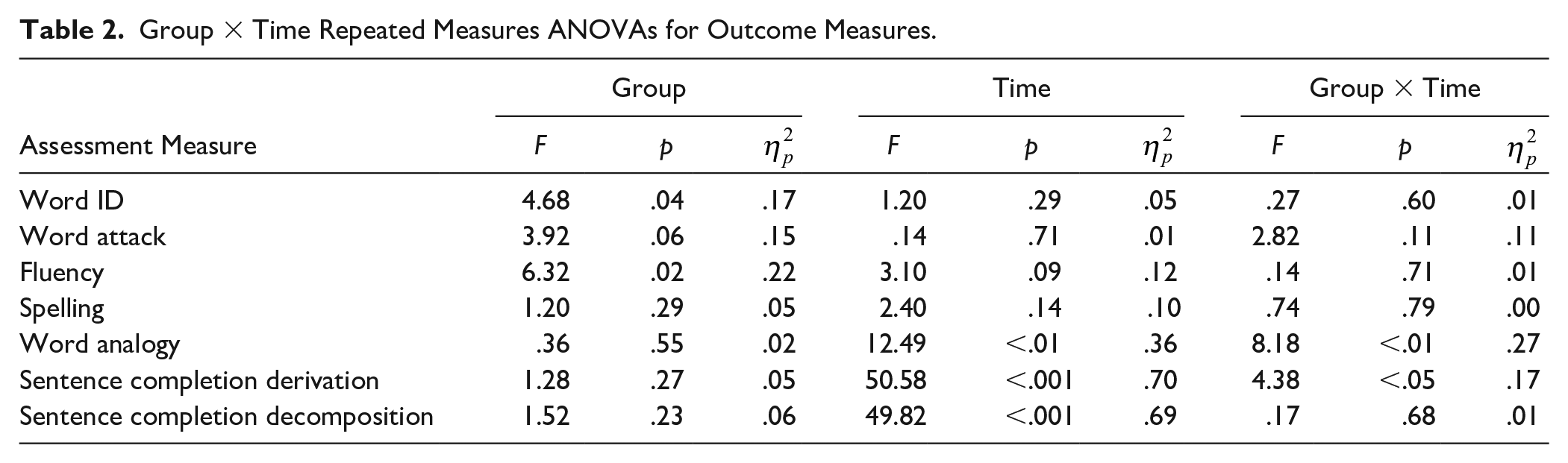
To assess the effects of the intervention, a series of Group × Time repeated measures ANOVAs were carried out on seven of the dependent measures (see Table 1 for the descriptive statistics, and Table 2 for the results); the other dependent measures are analyzed in later sections. There were significant Group effects on two reading measures (Word Identification and Fluency), perhaps partially reflecting the initial group differences in these measures, and a marginal difference (p = .06) on Word Attack. There were three Time effects, showing that participants had improved on word analogy, sentence completion (derivation), and sentence completion (decomposition). The important effects in the Group × Time analyses are the interactions, which indicate whether the two groups improved to different degrees throughout the study. Two interactions were significant for word analogy and sentence completion (derivation); these interactions are illustrated in Figure 2. Both interactions indicate that the experimental group showed more progress between the pre-test and post-test than the control group.
Group × Time Repeated Measures ANOVAs for Outcome Measures.
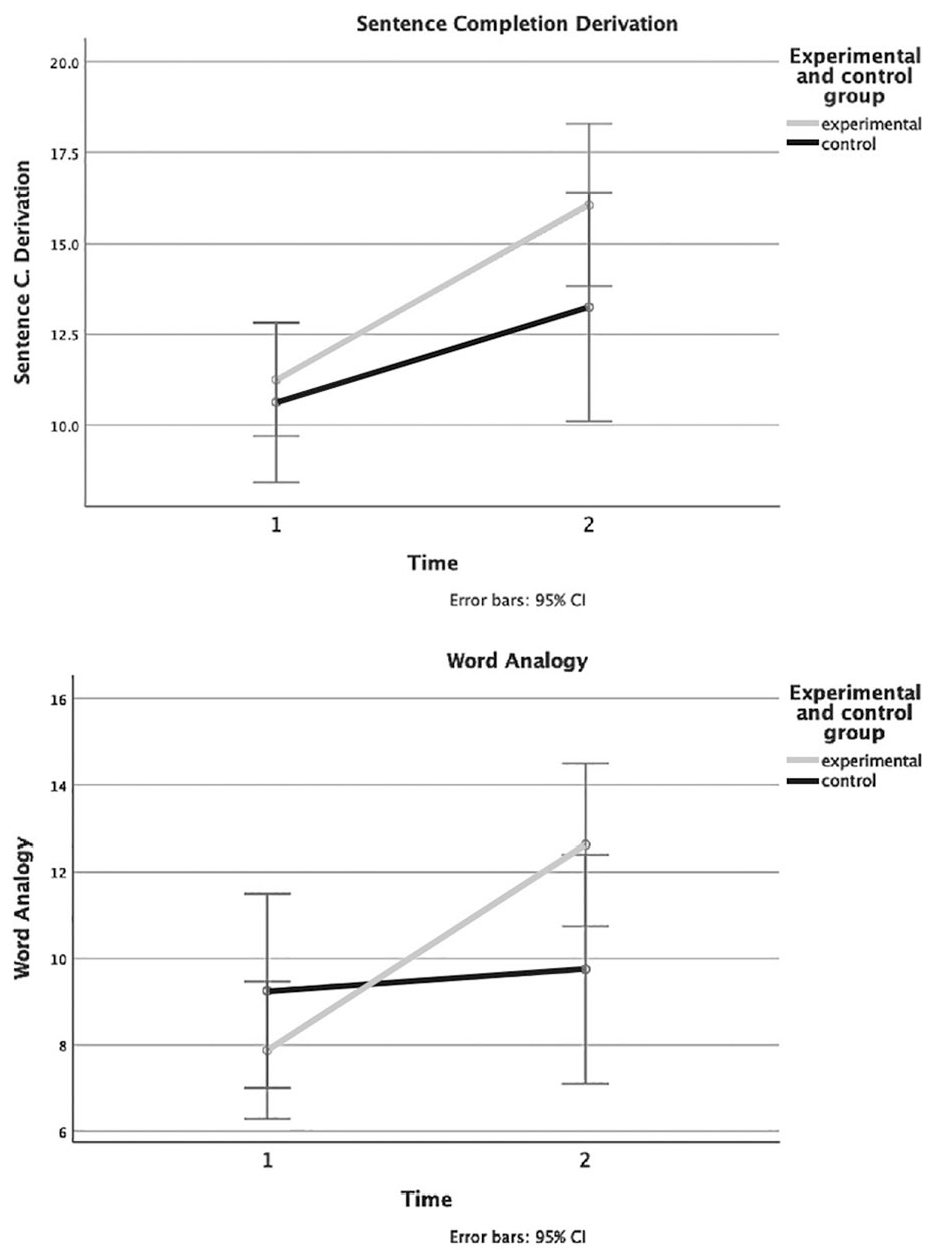
Group × Time Interaction Effects for Word Analogy and Sentence Completion (Derivation).
Comparing Groups Between Pre-Test and Post-Test on Words That Were Taught or Not
For three of the tests, items were divided into those that had been taught during the intervention and those that had not been taught. For morphological decoding and morphological analysis, these sets of items appeared on both the pre-test and post-test; for morphological spelling, the two sets of items appeared only on the post-test.
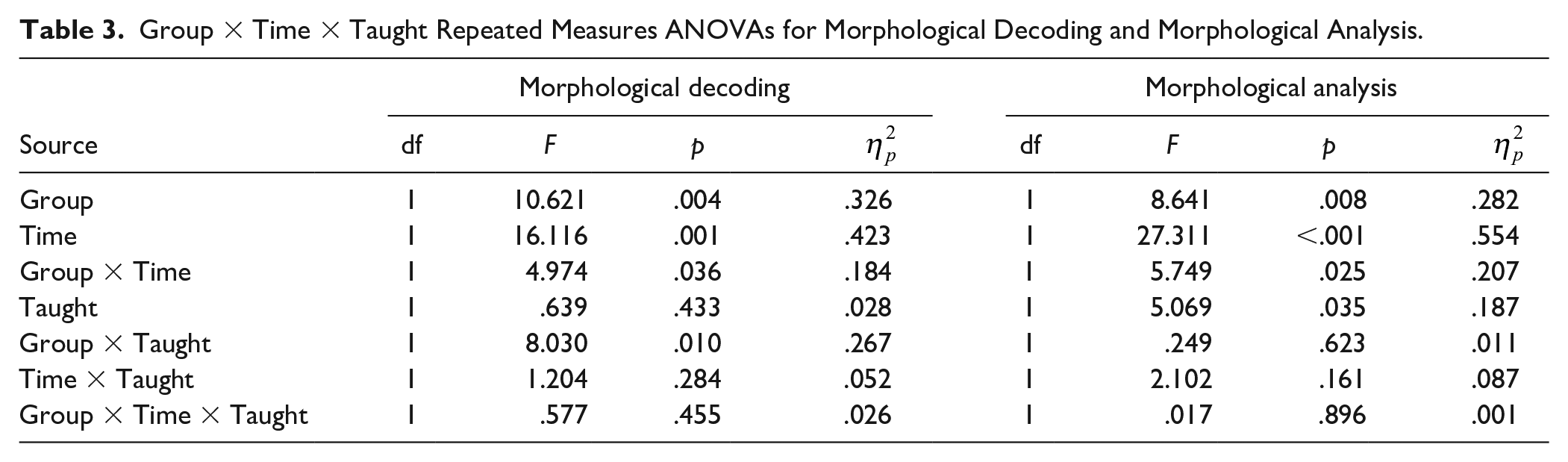
Group × Time × Taught repeated measures ANOVAs were conducted for morphological decoding and analysis. Descriptive statistics are shown in Table 1, and analysis results are given in Table 3. Group and Time effects were shown for each measure and a Taught effect for morphological analysis. The Group effects indicate that the experimental group outperformed the control group (i.e., combining pre- and post-tests), and the Time effects show that overall the participants improved over the course of the study. The Taught effect indicates that the Taught items were slightly easier than the not Taught items. Again, it is the interactions that are most informative. Each variable had a significant Group × Time effect; these are graphed in Figure 3 and show that the experimental group improved more than the control group did between the pre- and post-tests. There was also a significant Group × Taught effect for morphological decoding; as shown by the means in Table 1, the experimental group did better on both taught and untaught items than the control group, but the gap was greater for the untaught words. It is notable that the Group × Time × Taught effects were not significant, supporting the conclusion that the instructional effects were not confined to the words that had been studied in the experimental group.
Group × Time × Taught Repeated Measures ANOVAs for Morphological Decoding and Morphological Analysis.
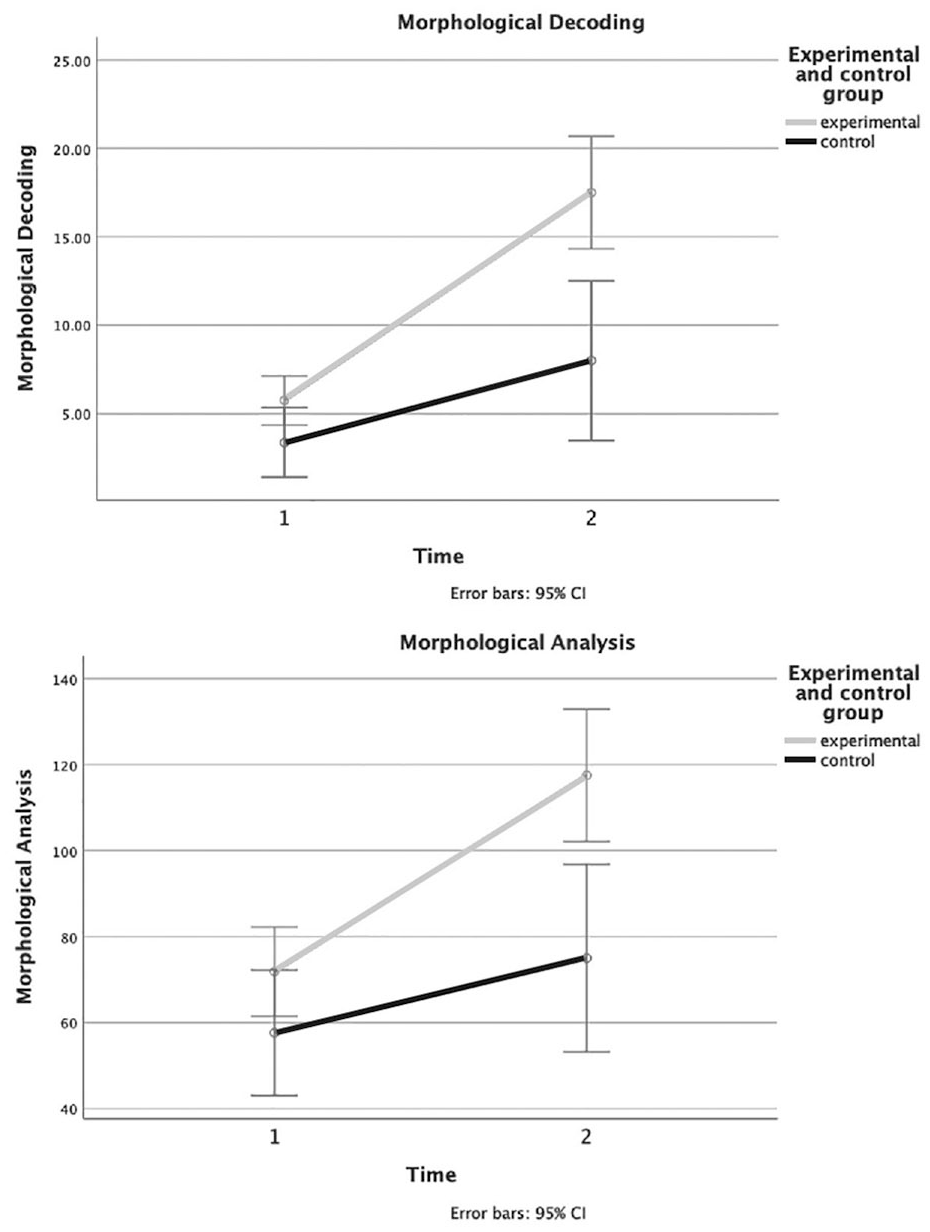
Group × Time Effects for Morphological Decoding and Morphological Analysis.
The morphological spelling items were also divided into those that had been seen in the experimental intervention and those that had not. Because this test had not been given as a pre-test, to control for any initial group differences, a Group × Taught ANCOVA was conducted, with pre-test WRAT Spelling as the covariate. Descriptive statistics are presented in Table 1. The results, shown in Table 4, indicate that the covariate was significant, as was the Group effect, with the experimental group obtaining higher scores than the control group. The absence of a significant Group × Taught effect again indicates that the instructional effects were not confined to words that had been seen in the intervention.
Group × Time Repeated Measures ANCOVA With Pre-Test WRAT Spelling as the Covariate.
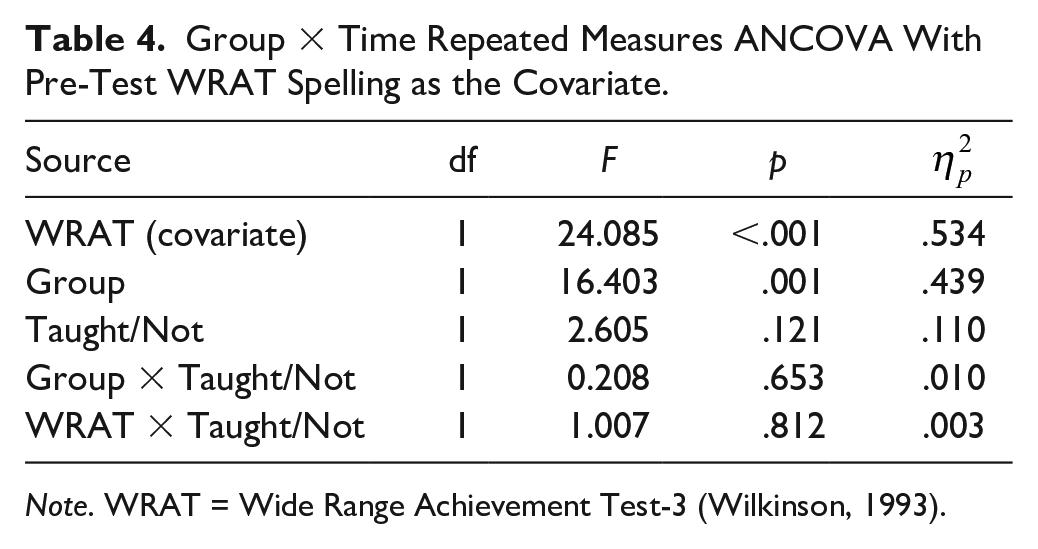
Note. WRAT = Wide Range Achievement Test-3 (Wilkinson, 1993).
Discussion
This quasi-experimental study investigated whether a 20-hour morphological awareness-based intervention program improved morphological awareness, morphological decoding, and morphological analysis in struggling readers and whether it also improved word reading, fluency, and spelling. It was hypothesized that the program would have a significant effect on morphological awareness in accordance with previous studies (Arnbak & Elbro, 2000; Bar-Kochva et al., 2020; Bowers et al., 2010; Carlisle, 2010; Goodwin & Ahn, 2010, 2013; Kirby & Bowers, 2017, 2018), and on morphological analysis and morphological decoding (Deacon et al., 2014, 2017; Levesque et al., 2017, 2019). It was also hypothesized that the experimental group would make greater gains in word reading, fluency, and multimorphemic word spelling than the control group, and that there would be a generalization to words that had not been taught in the intervention.
With respect to pre-test measures, participants generally performed well below their grade or age levels on literacy and literacy-related assessments. Students performed within a half SD of the norm on vocabulary, suggesting less weakness in general verbal ability. These results confirm that the sample met the criteria for a learning disability. Some differences were found between the experimental and control groups at pre-test in word identification, fluency, and morphological decoding; these group differences were controlled in the repeated measures ANOVA or ANCOVAs.
The results indicated that the experimental group showed greater gains than the control group on word analogy, sentence completion derivation, morphological decoding, and morphological analysis (all aspects of morphological processing). These all represent some degree of near transfer because the intervention did not address word analogy and sentence completion tasks or examine half of the morphological decoding and analysis items. The experimental group also made significantly larger gains on the experimental morphological spelling measure, on both words that had been taught and those that had not, showing further evidence of transfer. However, no significant differences were found in gains between the experimental and control groups for word reading, fluency, or the standardized spelling measure.
Assessing the Effectiveness of the Intervention
Previous research provides strong evidence that measures of morphological awareness, decoding, and analysis predict achievement in word reading, spelling, and reading comprehension, and that instruction in morphology produces gains in both morphological skills and literacy achievement (Bowers & Kirby, 2010; Carlisle, 2010; Goodwin & Ahn, 2013; Kirby & Bowers, 2017, 2018). Although there has been relatively little research on morphological instruction for children with reading disabilities, there is some evidence that weaker readers benefit from it (Bowers et al., 2010; Goodwin & Ahn, 2013). It has also been argued that morphology may be a more productive instructional target than phonological skills: even if children with reading disabilities are weak in morphological skills, those skills may be more responsive to instruction than are phonological skills, at least for some children (Deacon et al., 2008; Elbro & Arnbak, 1996; Georgiou et al., 2023; Law et al., 2015; Quémart & Casalis, 2018).
The results of this study are consistent with those of previous studies in showing substantial effects of morphological instruction on morphological awareness and go beyond most previous studies in showing these effects on morphological decoding and analysis, two key contributors to reading in Levesque et al.’s (2021) Morphological Pathways Framework. It is important that there was clear evidence of the transfer of these skills to words that were not considered during the intervention. However, the present results showed no evidence of further transfer effects on standardized reading and spelling measures. There was a significant effect on morphological spelling, again with transfer to words that had not been seen during the instruction. It should be noted that Bar-Kochva et al. (2020) also found effects on morphological awareness and spelling, but not on word or pseudoword reading with reading-disabled children.
There are several possible interpretations of these results. One is that these students either need further intensive instruction in phonological processing before they can benefit from morphological instruction, or perhaps intensive instruction that integrates phonology and morphology. A second interpretation is that the intervention was not long enough; we chose 20 hours based on Goodwin and Ahn’s (2013) findings, but the present participants may have had more serious reading difficulties than those in the studies reviewed by Goodwin and Ahn. An expanded intervention could have provided more extensive guided practice in applying morphological decoding and analysis skills and extended the program’s focus to reading comprehension. A third interpretation is that the standardized tests we used had only limited opportunities for applying morphological knowledge; the one achievement measure designed to depend heavily on morphology, the experimental spelling measure, did show significant intervention effects. Finally, it should be remembered that the participants in the control condition were receiving high-quality, small-group instruction for half-day programs; the morphological intervention may not have been able to surpass that in the short term.
Limitations and Future Directions
The sample size imposed an important limitation. We had planned to have an additional eight students in the control group, but a teacher illness eliminated this possibility, and the Covid pandemic prevented us from returning to collect more data subsequently. A much larger sample would have allowed investigation of individual differences in response to this intervention, asking, for example, whether specific student profiles led to greater benefit. These limitations should be addressed in future larger studies.
A second set of limitations revolves around assessment. The standardized reading and spelling assessments we used may not have provided adequate opportunities for applying the morphological skills the students had acquired. These standardized assessments may be more useful in judging long-term changes rather than the effects of a 20-hour intervention. Assessments of reading, spelling, and reading comprehension that were more tailored to the need for morphological knowledge may have been informative.
The third limitation was the short length and specific focus of the intervention. Children with more severe reading disabilities, such as those studied here, may require more intensive and extensive intervention, one that was integrated with more phonological instruction. The participants were already receiving considerable instruction in phonological processing in their half-day programs, but it may have helped to integrate that with the additional morphological instruction. The integration of morphological, phonological, and orthographic skills in instruction, as would be consistent with the Triangle Model (Kirby & Bowers, 2017), is an important focus for future studies.
Implications for Practice
This study demonstrates that relatively brief small-group instruction can improve morphological awareness, morphological decoding, and morphological analysis. This is important because of the extensive evidence that morphological skills are strongly related to literacy achievements. The participants in this study faced more challenges than many in previous studies, which may be responsible for the lack of transfer to standardized reading and spelling test scores. It may take much longer for them to establish more automatic morphological processing that can benefit their reading and spelling. Echoing the comments of many previous researchers (e.g., Carlisle & Kearns, 2017; Castles et al., 2018; Kirby & Bowers, 2017, 2018; Nagy et al., 2006), we suggest that morphology be introduced and integrated with language arts instruction, both for typically developing children and those experiencing reading disabilities. The latter group, however, will require more extensive morphological instruction integrated with phonological instruction.
Supplemental Material
sj-docx-1-ldq-10.1177_07319487241259775 – Supplemental material for The Effects of a Morphological Awareness Intervention on Reading and Spelling Ability of Children With Dyslexia
Supplemental material, sj-docx-1-ldq-10.1177_07319487241259775 for The Effects of a Morphological Awareness Intervention on Reading and Spelling Ability of Children With Dyslexia by Barbara Bivar Mendes and John Robert Kirby in Learning Disability Quarterly
Footnotes
Declaration of Conflicting Interests
The author(s) declared no potential conflicts of interest with respect to the research, authorship, and/or publication of this article.
Funding
The author(s) received no financial support for the research, authorship, and/or publication of this article.

References
Supplementary Material
Please find the following supplemental material available below.
For Open Access articles published under a Creative Commons License, all supplemental material carries the same license as the article it is associated with.
For non-Open Access articles published, all supplemental material carries a non-exclusive license, and permission requests for re-use of supplemental material or any part of supplemental material shall be sent directly to the copyright owner as specified in the copyright notice associated with the article.
