




Abstract
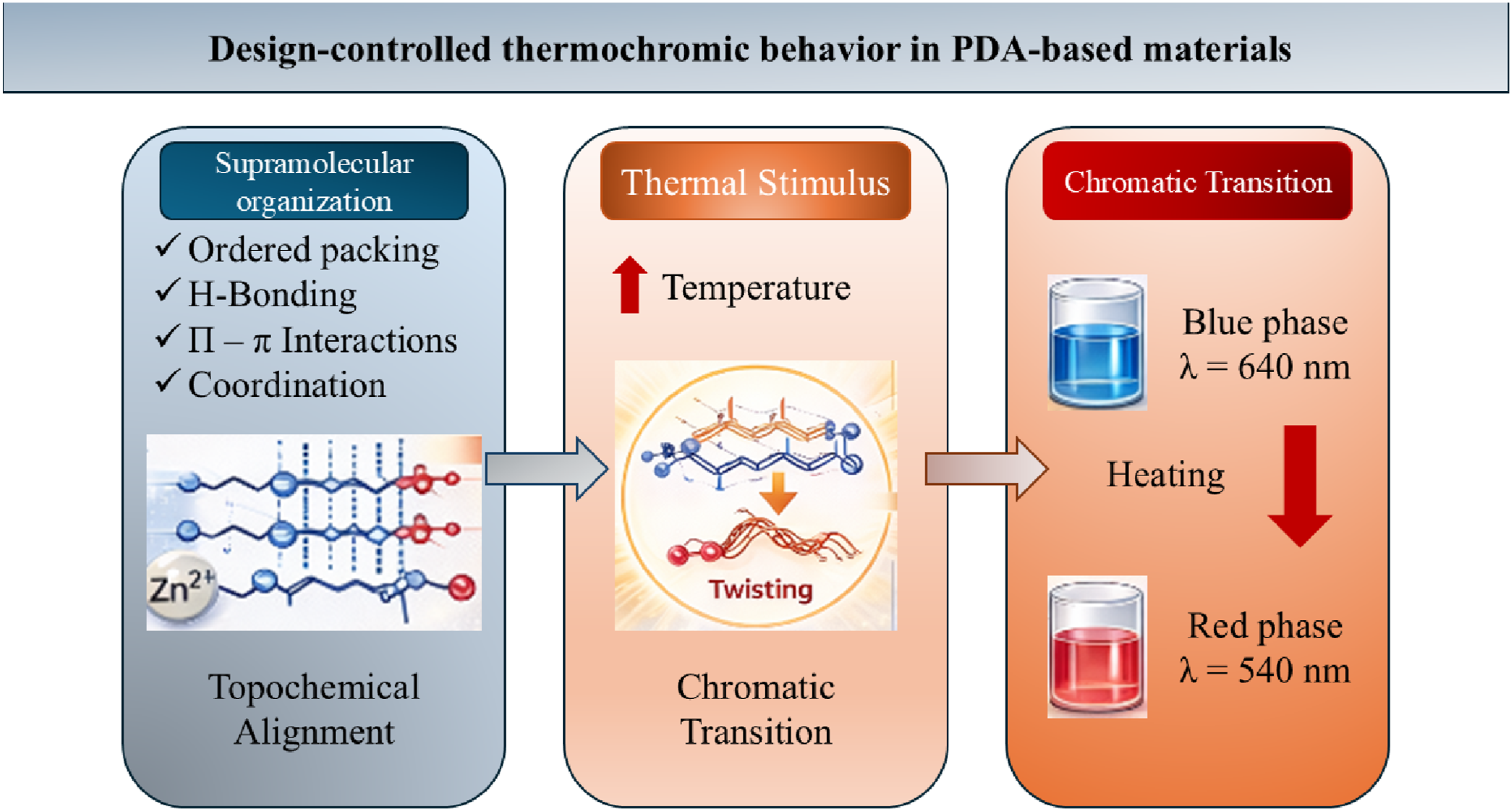
Polydiacetylene (PDA) is a conjugated polymer widely recognized for its distinct thermochromic behavior, characterized by reversible or irreversible transitions between blue and red phases upon external stimuli. These chromatic transitions arise from conformational distortions of the ene–yne conjugated backbone, which alter the effective conjugation length and shift the absorption maximum. The thermochromic response of PDA is strongly influenced by supramolecular packing, headgroup interactions, solvent environment, photopolymerization conditions, and the incorporation of metal ions or inorganic components. This review systematically discusses the molecular and structural factors governing PDA thermochromism, including solvent effects, precursor selection, photopolymerization time, pH, and metal coordination (e.g., Zn2+ systems). Emphasis is placed on the relationship between topochemical packing constraints, backbone planarity, and phase stability. Strategies to enhance thermal reversibility—such as headgroup modification and metal-ion coordination—are critically compared in terms of structural control and practical implications. Finally, recent advances in thermochromic sensing applications are highlighted, focusing specifically on systems where temperature-dependent chromatic transitions are central to functionality. By consolidating structure–property relationships with materials design strategies, this review aims to guide the development of next-generation PDA-based thermochromic materials.
Get full access to this article
View all access options for this article.