



Abstract
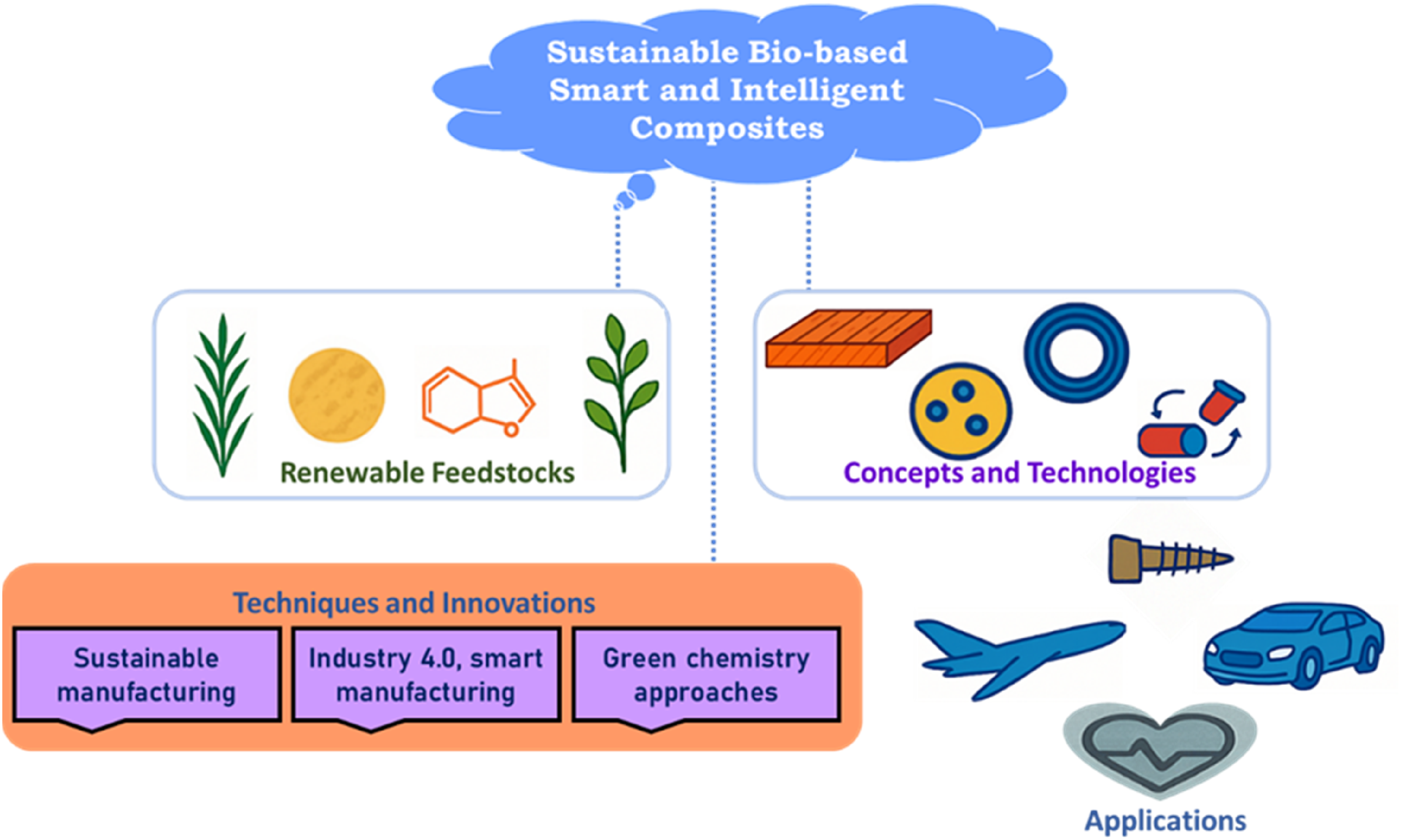
Bio-based smart composites have rapidly evolved as sustainable alternatives to petroleum-based materials, integrating renewable feedstocks with advanced functionalities. This review analyses recent advancements in bio-based matrices and bio-epoxy reinforced with natural fibres and cellulose nanocrystals, examining their mechanical performance, thermal stability, and environmental benefits. It critically examines the integration of innovative technologies, including embedded sensors, conductive nanofillers, shape-memory polymers, and self-healing systems, with a focus on design principles, actuation capabilities, and practical challenges in composite manufacturing. Manufacturing methods are evaluated for sustainability, process efficiency, and biocompatibility of materials. Life cycle assessment methodologies reveal that bio-based composites can achieve reduction in carbon footprint compared to glass fibre-reinforced plastics when integrated with end-of-life recycling or composting schemes. Nevertheless, persistent challenges remain in moisture resistance, thermal stability, cost-effectiveness, and the standardisation of testing protocols. Future research directions include the 4D printing of stimuli-responsive biocomposites, vitrimer chemistry, integration of AI in design and quality control, and development of policy frameworks for commercial adoption. Applications span robotics, wearable electronics, and smart packaging across multiple industries. Comprehensive synthesis of material innovations, processing technologies, environmental assessments, and regulatory landscapes provides a roadmap for developing sustainable, smart composites in the aerospace, automotive, construction, healthcare, and energy sectors.
Keywords
Get full access to this article
View all access options for this article.