




Abstract
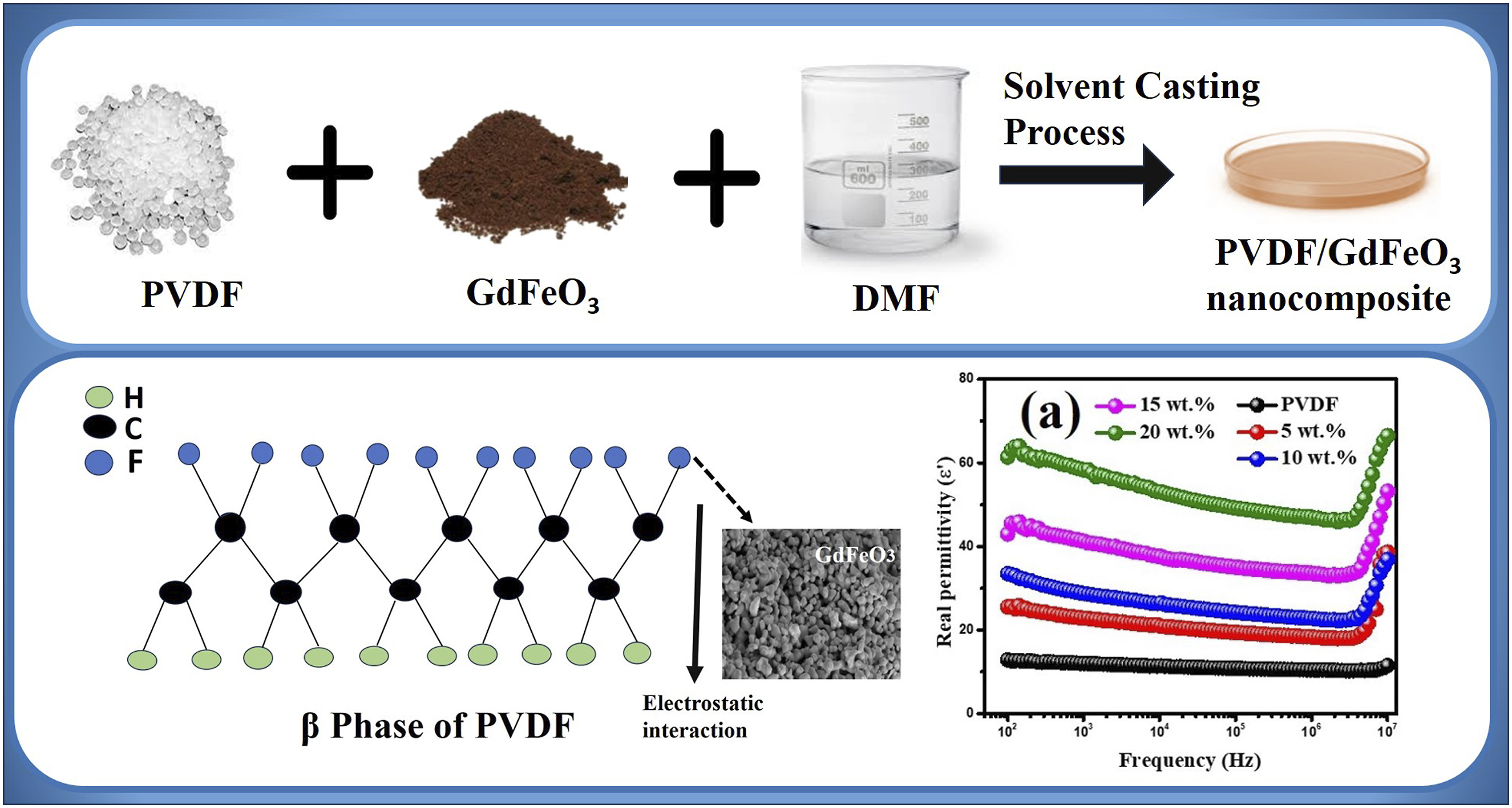
The current study used a solid-state approach to synthesize Gadolinium Orthoferrite nanoparticles (GdFeO3 NPs), followed by solution casting to prepare PVDF (Polyvinylidene fluoride)/GdFeO3 composites. The X-ray diffraction techniques have produced an average grain size of 1.01 μm and a crystallite size of 5 nm for GdFeO3 NPs. The semi-crystalline structure with mixed α, β, and γ-phases of PVDF was confirmed by vibrational spectroscopy. The highest β-phase percentage of 74.39% was achieved for a 15 wt% composite film. The morphological study of the PVDF matrix reveals very little agglomeration, indicating that the NPs are uniformly distributed. The inclusion of ceramic particles may cause PVDF to undergo a phase transition (from the α-phase to the β-phase), which could affect the crystallinity as determined by thermal analysis. The composite film containing 20 wt% NPs had the highest permittivity (ε′) of 61 (at 100 Hz), which is 6 times greater than the neat PVDF. The significant increases in permittivity were explained by a combination of a high ε′ of ceramic filler and strong interfacial polarization brought on by a short inter-particle distance between filler particles.
Get full access to this article
View all access options for this article.