




Abstract
Polyvinylidene fluoride (PVDF) films possess superior piezoelectric properties due to the β-phase obtained by methods, such as addition of nanofillers, application of high electric field, use of polar solvents and mechanical stretching. Simultaneous stretching and heating of the films can reduce porosity, increase transformation from α-phase to β-phase, and hence, improve their piezoelectric properties. This article presents the effects of stretching PVDF films on the β-phase formation and the resulting mechanical properties. A custom-designed stretching unit with roller mechanism and heating provision was employed for the purpose. The 200% stretched films at 100°C showed 86.79% β-phase, which is in correlation with X-ray diffraction peaks at 2θ = 20.3–20.6°. Transmission electron microscopy and scanning electron microscopy of the stretched films revealed spherulitic to lamellar transformation and decrease in porosity. Stretching increased crystallinity from 32.99% to 44.84%. Nanoindentation results showed increase in hardness and Young’s modulus from 23.33 MPa to 93.3 MPa and 0.483 GPa to 1.816 GPa, respectively. Tensile strength increased from 4.72 MPa to 21.02 MPa. The experiments were conducted using L9 orthogonal array and the results were analyzed using analysis of variance and gray relational analysis.
Introduction
Polyvinylidene fluoride (PVDF) is a semicrystalline polymer, which is highly nonreactive and has good mechanical, electrical, and chemical properties. 1 -5 PVDF exhibits characteristic stability of fluorocarbon-based polymers when exposed to thermal, chemical, and UV environment. 6 It is widely used because of its two main properties, that is, polymorphism and piezoelectric properties. 7 Its piezoelectric coefficient is almost 10 times greater than that of any other polymer. 8 These properties depend on the crystalline structures and α, β, γ, and δ phases. The ideal piezoelectric properties mainly due to β-fraction make it useful for tactile sensor arrays, strain gauges, and transducers. 9,10 Thus, increasing the proportion of the β-phase in PVDF has great scope for research. 11 Such an increase can be achieved by stretching the films, which straightens the polymer chain causing random dipoles arranged in a perpendicular direction along the stretching direction. 1,9 It can also be accomplished by applying an electric field at right angle to the polymer chains, which aligns the dipoles in mutual direction creating piezoelectric β-phase. The film is simultaneously heated during stretching to a temperature below its melting point, which causes the polymer chains to stretch and restructure. Phase transformation from α-phase to β-phase takes place when stretched and heated between 70°C and 100°C with stretching ratio of 3:5. 12,13 Commercially available polymer film stretching units are limited by width and thickness of films, gripping and stretching of seamless films, and nonuniform heating. 14 -21
Siviour et al. 15 developed a custom-made stretching unit with two clamps mounted on both sides. PVDF sheets are sandwiched in the clamps which move away from each other to stretch the films. Movement of the clamps is controlled by a rotational shaft. PVDF films were folded at the ends before clamping to avoid slipping of films from the clamps during stretching. Folding ensured uniform stretching force throughout the stretching. The setup is placed in an oven for heating of films. The authors reported stretching of films with different stretching ratios at 80°C. The design is limited by the size of the stretched films. Similar stretching unit is employed by Mahadeva et al. 16 in which the films are held in position by grips which are moved away from each other to effect stretching. The unit cannot accomplish heating of the entire film and cannot secure the films in the grips as the film softens. It is difficult to stretch and pole relatively large sheets since the oven is size limited.
Mhalgi et al. 17 developed a stretching machine with roller mechanism and rubber rollers to avoid slipping of the films during stretching. The setup consists of two godets, an unwinder, and a heating plate. Films from the unwinder are passed through the roller sets which rotate at different speeds. The relative speed between the rollers affects the stretching. A heating plate is placed between the rollers to soften the films. The setup is limited to a maximum stretching of 4.2 times the initial length of the film.
The stretching unit developed by Vijayakumar et al. 18 works similar to universal testing machine with a draw ratio of 4. The film specimen is mounted between two grips, whose movement is controlled by a stepper motor. Heating of films up to 150°C is achieved by placing the setup in an oil bath. The limitations of the machine include nonuniform stretching for lower stretch ratios, inflexibility to film dimensions, difficulty in maintaining constant temperature, and hence not suitable for continuous stretching.
Sun et al. 19 suggested that mechanical stretching of films is an efficient approach to produce β-phase, in which the polymer chains are straightened causing the random dipoles to orient in the stretching direction. Orientation of dipoles in the films during stretching depends on the strain rate, stretching ratio, and temperature of the films drawn. 20 Efficiency of phase transformation decreases at higher stretching temperatures due to the mobility of macromolecular chains. Sajkiewicz et al. 22 reported α-phase to β-phase transformation during stretching of PVDF films at temperatures of 50–145°C. Mohammadi et al. 23 observed that the transformation of polymer crystals increased with an increase in stretching ratio and stretching rate. Ueberschlag 24 presented piezoelectric characteristics of PVDF films, measurement of piezoelectric and pyroelectric coefficients, and sensing mechanisms of the films for different applications.
Review of open literature1-24 indicates that the effect of stretching on phase transition, crystallinity, and piezoelectric property has been the major focus of research. Stretching effect on mechanical properties of the films and their β-phase is scarcely reported. The main objective of this research was to study the improvement in β-phase due to stretching and the resulting mechanical properties of PVDF films by employing a custom-designed unit with provisions for heating during stretching, stretching seamless films, and adjusting the clearance between the rollers to accommodate films of different thickness. Fourier transform infrared (FTIR), X-ray diffraction (XRD), transmission electron microscopy (TEM), and scanning electron microscopy (SEM) were employed for evaluating the β-phase content, crystallinity, phase transition, and morphology, respectively. Nanoindentation and micro tensile tests were performed to determine the mechanical properties of the films before and after stretching.
Experimental details
Materials and processing
PVDF pellets 740 grade (Arkema Chemicals, Mumbai, India) and N, N-dimethylformamide (DMF) solvent (Vasa Scientific Co. Bengaluru, India) were used for preparing the films. PVDF (31.8 wt%)/DMF solution was prepared by dissolving 7 g of PVDF pellets in 22 ml DMF. The solution was continuously stirred using a magnetic stirrer and heated up to 60°C to dissolve PVDF in DMF. The films were cast on a glass substrate and dried at room temperature for 24 h to avoid shrinkage and subsequently kept in an oven at 70°C for 3–4 h to completely evaporate the solvent.
Film stretching unit
The custom-designed stretching unit (Figure 1) has two roller sets with individual and identical heating elements. Thus, the temperature of the roller sets can be controlled individually. The heating elements run through full length of the roller and hence, uniform temperature can be maintained in each roller set. A Proportional Integral Derivative (PID) controller maintains the set temperature. Identical motors (high torque DC motor, 24 V, 100 W) are used for roller set 1 and set 2. Roller set 2 can be used for supporting and pulling the film. Speeds of the two roller sets are adjustable by operating knob-1 and knob-2 in the range 5–60 r min−1. PVDF films were stretched by setting both the rollers to 5 r min−1. The speeds are closely controlled by employing a universal transformer with a 4700 µF capacitive filter, which absorbs the voltage fluctuations. Pressure on the film is due to the spring force. Screws are used to compress the spring. Stretch ratio corresponding to maximum β-phase for the thin film under study was obtained from studies elsewhere 12,13 and the effect of strain rate on the proportion of β-phase was studied.

Stretching unit with PID controller.
Testing and characterization
Mecmesin’s micro UTM (MultiTest 10i, IISC, Bengaluru, Karnataka, India) was used for testing of the films (gauge length 30 mm, width 10 mm, and crosshead speed 1 mm min−1) for ultimate tensile strength as per ASTM-D 638. Sample size was five in each case. Nanoindenter (Agilent Nanoindenter G200, CMTI, Bengaluru, Karnataka, India) was employed for hardness and Young’s modulus using Berkovich indenter at constant indenter displacement velocity of 10 nm s−1.
IR spectra of PVDF films were characterized using FTIR spectrometer (Agilent Technologies, Cary 600-series, CMTI). The content of β-phase was determined using the Beer–Lambert law. 25,26 Crystalline phases in the films were studied using XRD spectra (PAN analytical X’Pert diffractometer, NAL, Bangalore, Karnataka, India) for 2θ angle at room temperature. X-Ray diffractometer with Cu Kα (λ = 1.54 Å´ and energy of 40 keV) at 2° min−1 with a scan range of 10–50° was adopted to characterize the crystalline structures of the films. Crystallinity was calculated considering the area under β and α peaks. 27 The area under the curve with respect to α and β peaks was found using the trapezoidal numerical method of integration in MATLAB. Structural transformation was studied using a high-resolution transmission electron microscope (HRTEM-JEOL JEM 2100) at an acceleration voltage of 120 kV and 80 µA filament current. The as-cast and stretched films were gold sputtered to provide conductance and studied using TESCAN VEGA 3 scanning electron microscope at 10–15 kV accelerating voltage.
Results and discussion
FTIR analysis
The IR peaks were obtained in wavelengths ranging from 600 cm−1 to 1600 cm−1 for computing the β-phase. Figure 2 shows IR spectra of the as-cast films annealed at 70°C and the stretched films at different experimental conditions. Peaks at 766 and 1400 cm−1 were assigned to α-phase and peaks at 840, 876, 1070, 1170, 1278, and 1430 cm−1 to β-phase. In the as-cast films, the intensity of absorbance for α-phase at 766 cm−1 and β-phase at 840 cm−1 were 0.01 and 0.21, respectively. The films stretched at 90°C and 100°C with 20 passes showed strong intensity of absorbance of 0.55 and 0.52 for β-phase. The results indicate a favorable phase transition at higher temperature and extent of stretching. This is because of increased polymer chain mobility at higher temperature. The as-cast films annealed at 70°C were predominantly mixtures of α-phase and β-phase as expected and the content of β-phase was 79.65% and the same is reported to decrease in the films annealed above 100°C. 22,28 At stretching above 100°C, mobility of the atoms becomes high enough for phase transition. 29 Table 1 presents the achieved phase transition as per Beer–Lambert law. β-Phase increased with strain rate up to 90°C. At 100°C, the β-phase decreased with increase in strain rate as the transformation takes place from β-phase to α-phase at 100°C, which is consistent with studies elsewhere. 22,28,2 9
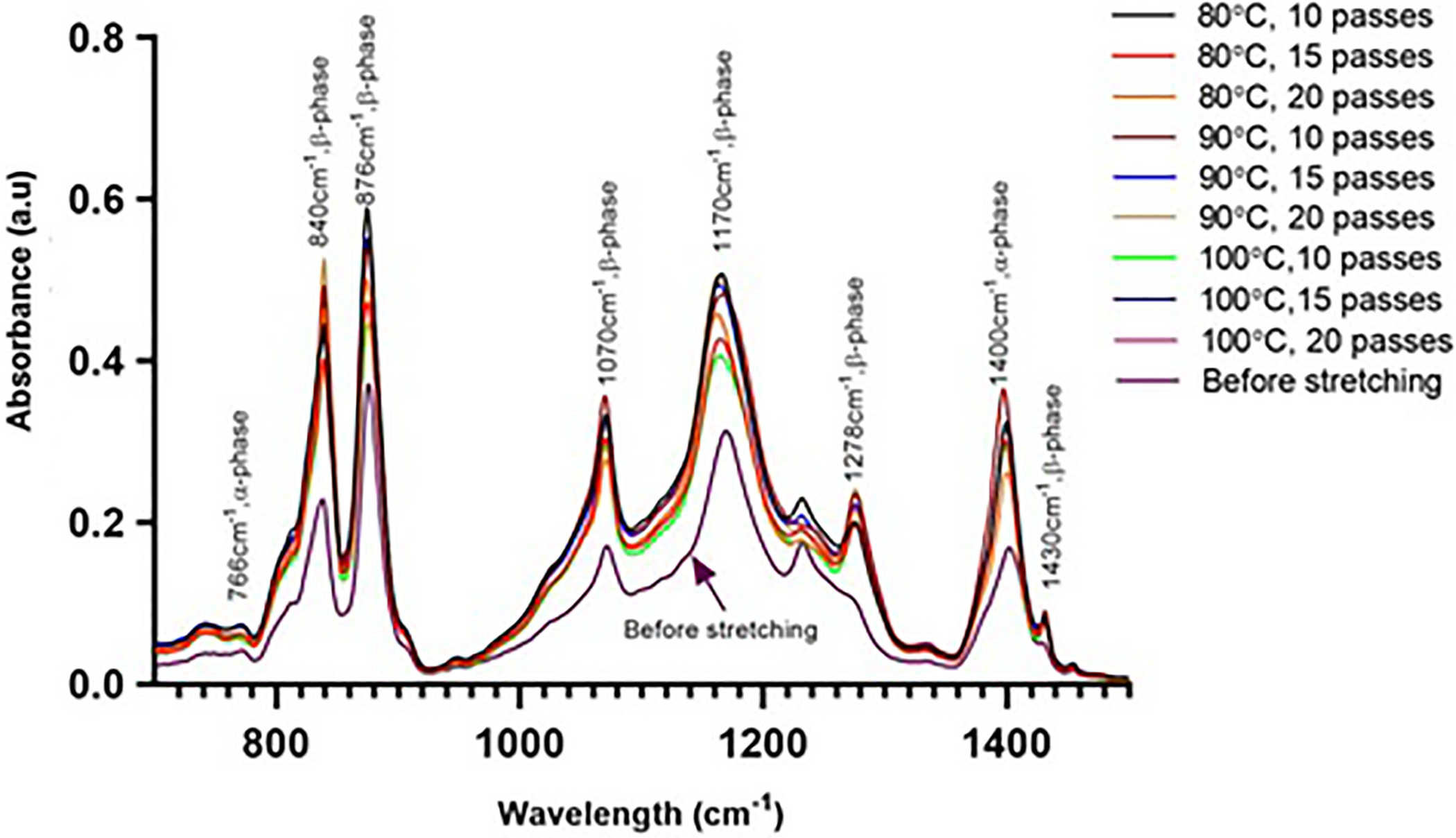
FTIR spectra with absorbance peaks for different phases in as-cast and stretched films.
Fraction of β-phase in as-cast and stretched PVDF films.
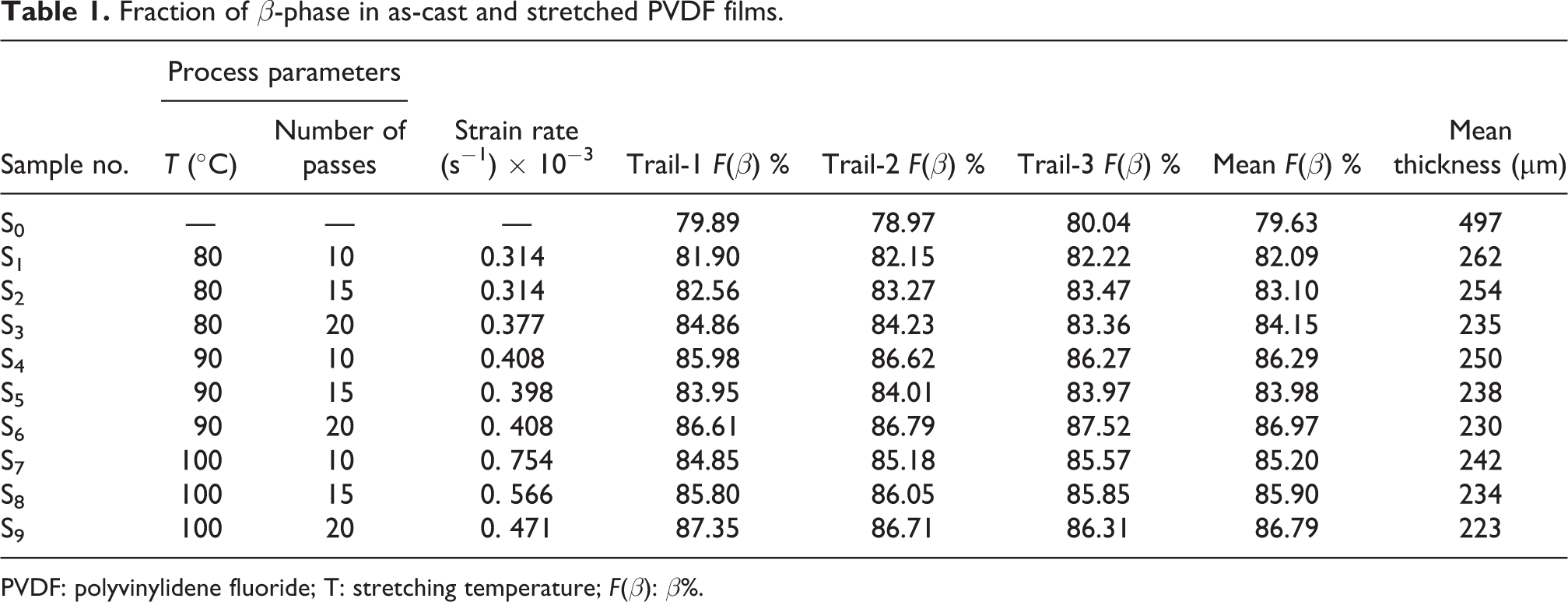
PVDF: polyvinylidene fluoride; T: stretching temperature; F(β): β%.
XRD
XRD patterns (Figure 3) were used to study the presence of crystalline phases in the as-cast and the stretched films. 30,31 The as-cast films showed the presence of characteristic peaks at 2θ = 17.11° and 18.6°, which are assigned to (100) and (020) reflections of α-phase and 2θ = 20.3° assigned to (110) and (200) reflections of β-phase, in agreement with studies elsewhere. 30 -32 Stretching of the films increased the intensity of β peaks at 2θ = 20.3°, whereas the α peaks at 17.11° and 18.6° tend to disappear at higher temperature and stretching ratios, thus resulting in the transformation from α-phase to β-phase. Stretching also improved crystallinity from 32.99% to 44.84%. 33

XRD characterization of as-cast and stretched PVDF films.
SEM
Figure 4(a) and (b) shows the microstructure of PVDF films before and after stretching. The as-cast films showed a spherulitic crystal structure with a grain size of 1–3 µm. Stretching induced the phase transformation from spherulitic to microfibrillar crystal structure, which is evidenced by the TEM image of Figure 4(c). This favors transformation from α-phase to β-phase and also decreases the porosity. 12 At lower temperatures, microcracks were observed on the surface of the films (Figure 4(b)). However, with the increase in temperature, the surface of the films was found to be uniform.

SEM images of PVDF films (a) as-cast and (b) stretched at 80°C, and (c) TEM image after stretching.
TEM
Figure 4(c) shows the TEM images of the PVDF films after stretching. The film sections with slice thickness of 130 nm were prepared using LEICA EM FC7 in a 200 mesh plain Cu grid. The spherulitic structure in the as-cast films was completely transformed into the microfibrillar crystals aligned in the stretching direction.
Mechanical characterization of PVDF films
Nanoindentation
Hardness and Young’s modulus of PVDF films (Table 2) increased up to four times due to stretching. This is because stretching eliminates surface defects such as cracks and voids. Stretching at higher temperatures increases the bond strength, which results in increasing the mechanical properties. 34 The films were subjected to indentation test in which the load was gradually increased till the maximum load and dwelling at this load for some duration before unloading. Load versus displacement curves for the as-cast and the stretched films are shown in Figure 5. The maximum load was 49 mN for the stretched films and the same was 12 mN for the as-cast films.

Load versus displacement behavior of PVDF films: (a) before stretching and (b) after stretching.
Young’s modulus and hardness of PVDF films before and after stretching.

PVDF: polyvinylidene fluoride.
Micro tensile test
Tensile characterization of the films was determined by micro tensile test carried out as per ASTMD638 using Mecmesin’s micro UTM (MultiTest 10i). Figure 6 shows the stress versus strain plots for the films before and after stretching. Tensile strength of the stretched films (21.02 MPa) improved significantly when compared with that of the as-cast films (4.69 MPa). Increase in tensile strength in the stretched films is due to the increase in bonding and decreased porosity. 2

Stress versus strain of films: (a) before stretching and (b) after stretching.
Analysis of variance of experimental results
Analysis of variance (ANOVA) of the stretching experiments of the films was performed for examining the effect of influencing parameters and their statistical significance. The highest signal-to-noise ratio for β% of Figure 7 indicates the optimum conditions for achieving a higher proportion of β-phase, that is, temperature 90°C and number of passes 20. ANOVA of Table 3 shows that the temperature is more significant for β-phase. As the estimated values of Fischer ratio (F) at 95% confidence level are greater than that of F-tabulated of 6.94, it confirms that the contribution of temperature is greater than that of the stretching ratio.
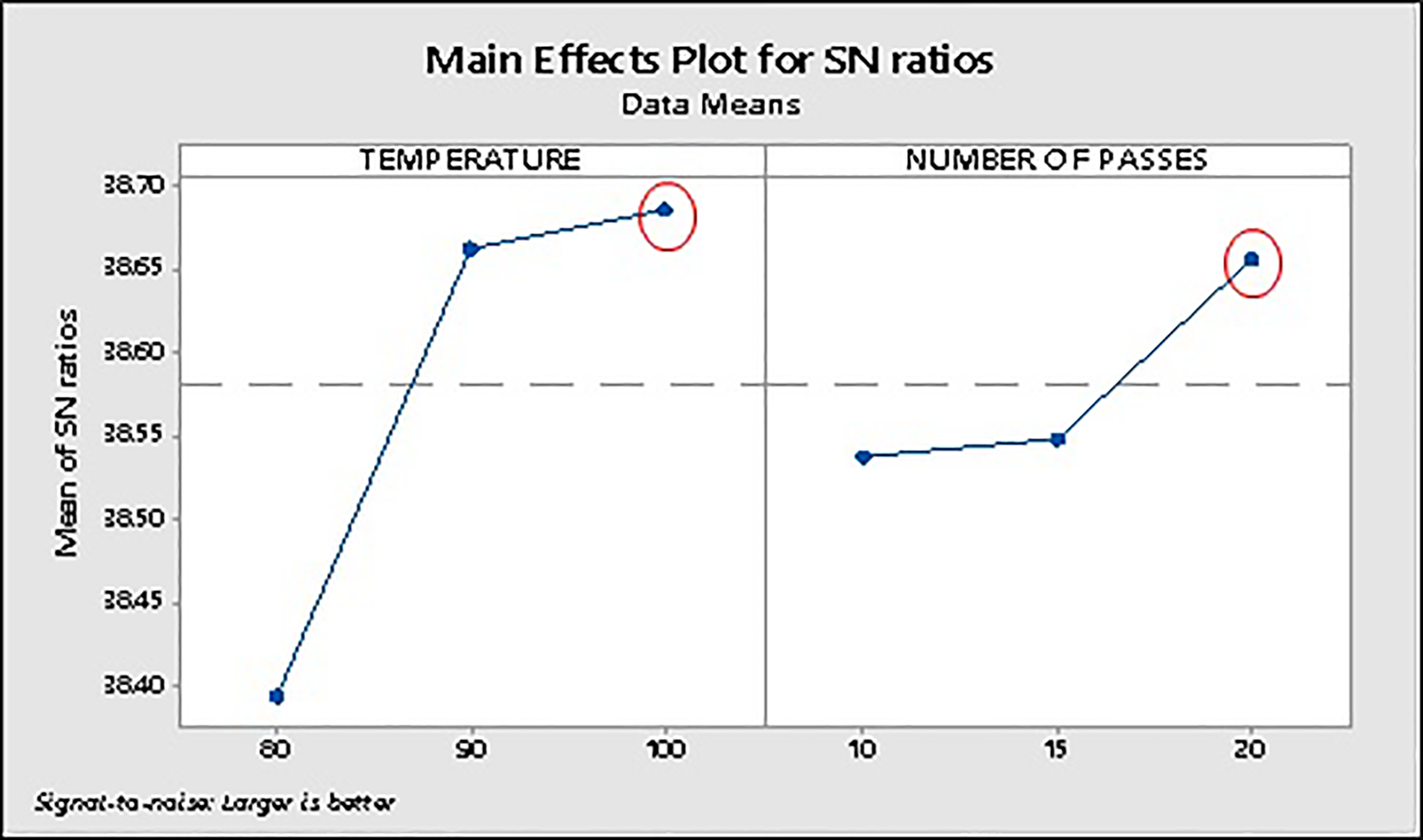
Mean of signal-to-noise for β%.
ANOVA of parameters contributing to β-phase.

ANOVA: analysis of variance; DOF: degree of freedom; F: Fischer ratio.
Gray relational analysis
Gray relational analysis of the experimental results is presented in Table 4. Higher relational grade implies that the corresponding parameter combination is closer to the optimal. Gray relational grade of S9 configuration (100°C with 20 passes) is close to unity and corresponds to optimal process characteristics when compared to other configurations.
Grey relational grade for stretched PVDF films.

PVDF: polyvinylidene fluoride.
Conclusion
Effect of stretching and stretching temperature on β-phase and the properties of PVDF films was studied using a custom-designed stretching unit with controls for speed, temperature, and clearance between the rollers to accommodate seamless films of different thickness. The unit is designed to overcome limitations such as nonuniform heating, difficulty in gripping of films, and inflexibility with respect to film dimensions. The films were stretched up to 200% in length. FTIR results showed α-phase to β-phase change with sharp peaks at 840 cm−1, which represents β-phase. XRD results showed higher intensity peaks at 2θ = 20.3–20.6 confirming α-phase to β-phase transformation due to stretching. The corresponding β-phase increased from 79.69% to 86.97%. ANOVA indicated higher significance of stretching temperature for β-phase. Highest gray relational grades corresponded to the films stretched at 100°C with 20 passes. SEM and TEM revealed the transformation of spherulitic structure in the as-cast film to fibrillar. Stretching reduced voids and surface cracks and improved crystallinity from 32.99% to 44.84%, leading to higher β-phase. Nanoindentation of the stretched films indicated improvement in hardness, Young’s modulus, and tensile strength. Tensile strength of the stretched films (21.02 MPa) improved significantly when compared with that of the as-cast films (4.69 MPa).
Footnotes
Declaration of conflicting interests
The author(s) declared no potential conflicts of interest with respect to the research, authorship, and/or publication of this article.
Funding
The author(s) received no financial support for the research, authorship, and/or publication of this article.
