




Abstract
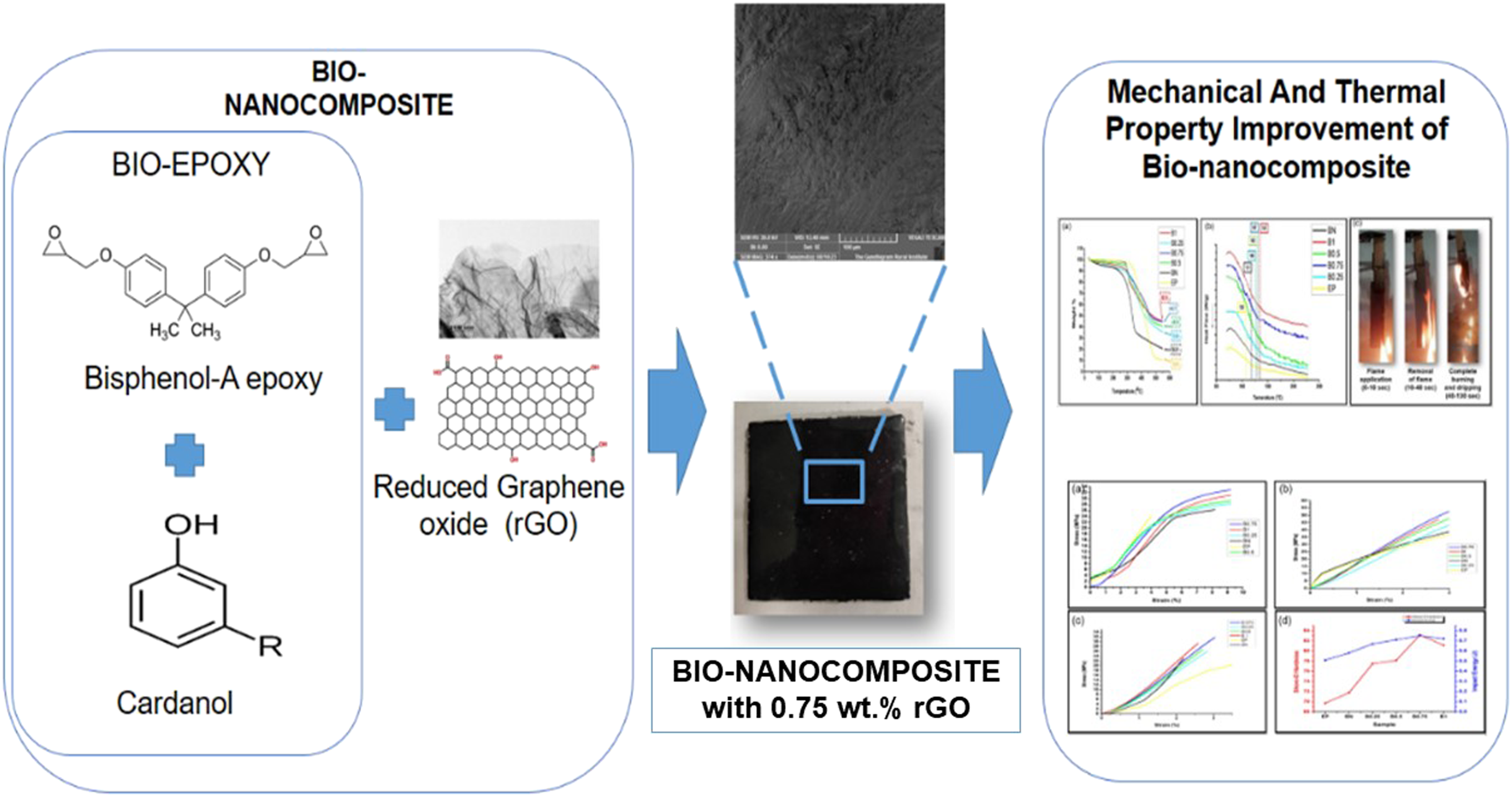
Firms choose to maximize the use of natural resources when producing new generations of polymer composites. The incorporation of carbon-based nanoparticles into the polymer matrix resulted in substantial enhancements in strength qualities. In this work, a set of bio-nanocomposites was fabricated using reduced graphene oxide (rGO) at several weight %s (0, 0.25, 0.5, 0.75, and 1 wt.%) in a bio-blended epoxy thermoset matrix generated from adding cashew nut shell liquid (CNSL) as an additive in a commercial grade bisphenol-A-based unmodified liquid epoxy resin. Thermal and mechanical properties, morphology analysis, XRD analysis, flammability, and limiting oxygen index (LOI) were used for characterization. The mechanical properties of the bio-nanocomposite containing 0.75 wt.% of rGO were investigated, resulting in the observation of enhanced flexural strength by 43.97%, compression strength by 58.08%, tensile strength by 39.84%, impact energy by 47.05%, and shore-D hardness by 21.26% compared to neat epoxy. The thermal stability of a bio-nanocomposite containing 0.75 wt.% of rGO is not compromised while demonstrating a 44.71 % residual mass at 550°C compared to neat epoxy. The cured bio-blended epoxy has a 23.38% lower combustion rate than epoxy resin and shows slow burning rate.
Keywords
Get full access to this article
View all access options for this article.
References
Supplementary Material
Please find the following supplemental material available below.
For Open Access articles published under a Creative Commons License, all supplemental material carries the same license as the article it is associated with.
For non-Open Access articles published, all supplemental material carries a non-exclusive license, and permission requests for re-use of supplemental material or any part of supplemental material shall be sent directly to the copyright owner as specified in the copyright notice associated with the article.
