



Abstract
Time is a central dimension to the study of long-term visions and political generations in social movements. Yet, missing from both concepts is theorizing of activist groups’ own agency in using time as a resource. I address this problem through two main contributions. First, drawing on the findings of a Grounded Theory study among two generations of feminist activism in Ecuador and Peru, I show how these constructed long-term visions through four stages: interrupting the course of gender hierarchies, getting policy change put into practice, making feminist practices accessible, and repoliticizing feminist activism. Second, I employ David Maines and colleagues’ retrieval of G.H. Mead’s theory of time to analyze how the two generations used time as a source of power differently in each stage, producing a shift regarding which generation was the driving force of the construction of long-term visions across the stages.
Keywords
Introduction
Feminist movements not only contest existing gender inequalities but also construct long-term visions. Because feminist movements themselves are evolving, they should create long-term visions that are varied and at times conflicting. One likely explanation for this diversification is the formation of different subgroups of activists according to age cohorts, protest waves, and political generations. Increased attention to these subgroups can be found in research on feminist movements in Latin America. Early in the millennium, studies relied on the social category of “youth” to locate new pathways of mobilization into feminism among teenagers and young adults (Epelde 2009; Gómez-Ramírez and Reyes Cruz 2008; Taft 2010; Vega 2012). More recent studies employ the “wave” metaphor to understand new forms of mass feminist protest (Álvarez Enríquez 2020; Ponce Lara 2018). Yet, others work with the concept of political generations to examine the internal dynamics of feminist movements (Borland 2014; Chen 2014; Friedman and Rodríguez Gustá 2023; Laronda and Ponce Lara 2019; Sutton 2020). In this article, I build upon this research by examining how two political generations of feminist activism in Peru and Ecuador constructed long-term visions.
Political generations and long-term visions are two key concepts in the study of social movements, yet are seldom treated together. An important dimension of both concepts is time, suggesting a fruitful path for integrating them. While long-term visions have a forward-looking orientation, activist groups create them through present actions (Scurr and Bowden 2021; Soler-i-Marti, Fernández-Planells, and Pérez-Altable 2024; Yates 2015) and by drawing upon the past (Gutman 2017; Habersang 2024; Wagner-Pacifici and Ruggero 2020). Indeed, activists’ own understandings of time shape their construction of long-term visions (Nairn et al. 2021). Feminist movements have been found to comprise distinct generations of activists that form in response to shifting historical conditions, and consequently, develop varied collective identities and strategies (Reger 2012, 2015; Whittier 1995). The degree to which political generations cooperate with one another is dynamic, changing with time (Borland 2014; Friedman and Rodríguez Gustá 2023; Sutton 2020).
Missing from both concepts is a social theory of time that captures activist groups’ own agency in engaging with temporality. To solve this problem and bridge these two concepts, I turn to G.H. Mead’s theory of time, grounded in a definition of human action as a process with duration rather than as a single point in time. To deal with emergent events, that is, situations in the present, people rely on previous presents, that is, the past, reconstructing them and connecting them to the emergent events, which in turn conditions future action (Maines 2012:37–43). Following Mead, David Maines and colleagues propose that control of time constitutes a resource in the power relations among community organizations: “Successful community groups contextualize their power in acts of systematically linking the past and future together in order to influence the construction of relations in the present” (Maines, Sugrue, and Katovich 1983:167).
This article draws upon the findings from a larger study that aimed to clarify how and why two generations of feminist activism in Ecuador and Peru understood and practiced feminist mobilizing as they did. Constructivist Grounded theory method was used to collect and analyze qualitative interviews with 45 key activists from two cohorts of feminist activism in Ecuador and Peru in 2012. I purposively selected cohorts according to the historical period in which participants were first mobilized into feminist activism. One cohort consisted of participants who had been mobilized into feminist activism between the late 1970s and early 1990s. I refer to this cohort as the initiator generation as it was the first to adopt the label of “feminist” to identify itself. The second cohort comprised participants who had been mobilized into feminist activism between the late 1990s and early 2000s. I refer to this cohort as the innovator generation because it created new forms of feminist activism, even though it had been mobilized by the initiator generation and addressed the same issues, namely, gender-based violence, sexual and reproductive rights, and political empowerment. In previous publications, I explained how the two generations created distinct forms of feminist activism according to their experiences with prevailing gender-based hierarchies and political action during the historical period when they were mobilized (Coe 2015, 2023) and their encounters with one another (Coe 2021). This article shows how the two generations constructed long-term visions.
Examining this question among feminist activism in Ecuador and Peru is relevant for several reasons. To begin with, it addresses an empirical problem faced by these movements. I found a generational cleavage in feminist activism in these two countries while conducting fieldwork for two other studies in the late 2000s. Moreover, examining political generations and their consequences for the construction of long-term visions within feminist activism in Peru and Ecuador fills a knowledge gap. Most of the studies on age cohorts, waves, and political generations in Latin American feminist movements are conducted in the larger or more powerful countries, for example, Argentina, Brazil, and Mexico. Turning to theory development, important insights can be garnered from the way in which feminist activism handles the sociohistorical conditions in Ecuador and Peru that set it apart from other Latin American countries and beyond. In addition to being smaller movements located in less powerful countries, feminist activism in Peru and Ecuador has developed hand-in-hand with their countries’ democratic projects. Contemporary feminist movements emerged during military regimes in the early 1970s that, in contrast to other dictatorships in the region, enacted progressive structural changes to remove longstanding oligarchic rule and stimulate mass social participation. These changes led ultimately to widespread mobilizations and the first elections in 1979 in which the majority of the population enjoyed political enfranchisement in both countries. Thus, these are contexts of young democracies. Key social movement concepts, including political generations and long-term visions, are typically developed based on empirical studies in the Global North that miss these contextual conditions.
This paper begins with an overview of temporality in research on long-term visions and political generations in social movements, respectively. Next, I present Mead’s social theory of time and its application to community organizations’ use of time as a resource according to David Maines et al. (1983). This is followed by a description of my research methods. In the results section, I present my findings and analyze them with Mead’s theory of time as developed by Maines et al. (1983). The paper ends with a discussion of the contributions of my findings and analysis to the scholarship on long-term visions and political generations.
Time in the Long-term Visions of Social Movements
Research on alternative futures and prefiguration demonstrates that temporality is a key dimension shaping the long-term visions of social movements. Although alternative futures signify a future temporality (Jung 2024), activist groups create these through present actions (Habersang 2024) and employ these to mobilize participants in the present (Soler-i-Marti et al. 2024). For anti-capitalist environmental justice activists in Australia, alternative futures were not merely utopian visions but also clearly anchored in current strategies (Scurr and Bowden 2021). In the 2014 Umbrella Movement in Hong Kong, present actions and their consequences contributed to participants reimagining alternative futures (Ting 2017). Activist groups also draw upon the past to construct alternative futures, illustrated by the memory activism of the Zochrot peace organization in Israel in the 2000s to make visible the peaceful coexistence between Jews and Arabs prior to the Israeli-Palestinian conflict in 1948 (Gutman 2017). Yifat Gutman (2017) proposes that different temporalities interact whereby the past shapes future visions and future visions shape the past. Karen Nairn et al. (2021) show in New Zealand how activist groups’ understandings of time influenced their future visions. Young Indigenous rights activists understood time as on a continuum, which allowed them to create future visions that encompassed both ancestors and offspring. In contrast, young environmental movement activists understood time as linear, which restricted their future visions to include younger cohorts but exclude older cohorts.
Early studies on prefiguration clearly distinguished between strategies in the present and long-term social change as two separate, parallel processes. Yet, Marianne Maeckelbergh’s (2011) study of the alterglobalization movement challenged this notion by demonstrating that prefiguration was a single strategy through which activist groups put into practice in the present what they wanted to achieve in the future, namely, decentralized decision-making structures, networked organizational forms, and horizontal practices to replace representative democracy with direct democracy. Subsequently, Luke Yates (2015) delineated five stages through which social centers in Barcelona used direct action in the present to create alternatives for the future: experimentation, perspectives, conduct, consolidation, and diffusion. Dan Swain (2019) categorized three types of relationships between present and future in prefigurative social movements: end-guided prefiguration aligns the means and ends of political action, ends-effacing prefiguration collapses future into the present, and revolutionary rehearsals form future practices in the present in organizations and movements. Prefiguration also entails drawing upon the past by way of collective memories, previous social movements, ancestral principles, and precolonial practices (Habersang 2024; Wagner-Pacifici and Ruggero 2020).
Time in the Political Generations of Feminist Movements
Temporality is also a key dimension shaping the formation of political generations within social movements. According to Mannheim ([1927/1928] 1952:303), a generation of actuality, or political generation, exists when members of a cohort experience similar disruptive conditions at the same moment in history and develop a tangible tie to one another. Each cohort has a subjective experience (internal time) of objective conditions in society (external time) that defines its outlook going forward. A generation can only participate in a temporally limited portion of the present set of conditions, resulting in generational cleavages especially between those farthest apart (Mannheim [1927/1928] 1952:283, 296–99). The newest generation tends to be most open to experimenting with new perspectives, while the oldest generation typically has greater experience but more conventional perspectives (Mannheim [1927/1928] 1952:293–96). Whereas for Mannheim, the formation of political generations occurs when members of a cohort come of age, in social movement research, it occurs when new recruits are mobilized into activism regardless of their age.
Political generations have been shown to engender both conflict and cooperation within feminist movements. In Nancy Whittier’s (1995) classic study of the radical feminist movement in Ohio in the 1970s and 1980s, the formation of political generations clarified internal conflict. Each new cohort of activists responded to shifting political contexts by creating a distinct collective identity that remained stable over time and aligned with specific forms of activism. Jo Reger’s (2012) study of feminism in three U.S. communities around the new millennium found that collaboration between generations of activists varied along a continuum. Generations were most likely to collaborate with one another when the political context was hostile to feminism, and less likely when it was favorable. Even when a generation distances itself from other ones, it may receive support from them. The slut-positive movement in Canada and the United States in the early 2010s drew upon the sexual violence discourse created by feminist activism in the 1980s (Reger 2014, 2015).
Conflict and cooperation between political generations in feminist movements are not static but rather change over time. In the late 1990s, the older cohorts of Argentina’s abortion rights movement dismissed the activism that was emerging among a younger cohort (Borland 2014). This rift grew in the early 2000s, when the younger cohort had clearly coalesced, but the older cohorts dominated the movement. By the early 2010s, when the younger cohort had gained a stronger position in the movement, narratives among all cohorts turned to respect, cooperation, and mutual recognition. These same narratives persisted in the late 2010s and embraced the importance of distinct forms of activism (Sutton 2020). Elisabeth Jay Friedman and Ana Laura Rodríguez Gustá (2023) similarly found that the Ni Una Menos protests in Argentina begun in 2015 against the murdering of young women (i.e., femicide), functioned as a watershed moment for forging intergenerational feminist mobilization because it gave young activists the spotlight while recognizing the role of older generations as mothers and grandmothers. Given that social movements depend on the recruitment of new members, it is not surprising that activist groups purposively work to foster intergenerational collaboration through organizing, dialogue, and storytelling practices (Binnie and Klesse 2018; Taft 2015; Weatherall 2020).
Time as a Source of Power in Activism
For both concepts, time is a central dimension, but they are missing a social theory that accounts for activist groups’ own agency in using time as a resource. Studies of long-term visions empirically examine activist groups’ engagement with temporality but have not integrated tools to theorize this agency. Political generations, in contrast, are clearly grounded in a social theory of time, but one that divides objective/external time from subjective/internal time (Mannheim [1927/1928] 1952). One solution to this problem is David Maines and colleagues’ retrieval of G.H. Mead’s theory of time (Maines et al. 1983).
Mead’s approach to time is both relational and reflexive because time must be socially transacted between actors and their environment (Maines 1987:307, 2017:37). His approach is grounded in a processual definition of society in which people create action to manage emergent events, that is, situations in the present, by referring to previous emergent events, that is, the past, and thereby setting conditions for future action (Maines 2017:37–43; Mead 1932). In these processes, David Maines (2017:27) indicates, “. . . . people must mark off the boundaries of pasts, presents and futures.” Mead’s theory comprises four interconnected dimensions of the past. The first dimension, symbolically reconstructed past, consists of redefining the connotation of past events in such a way that they have relevance and value for the present, facilitating the management of emerging circumstances. Accordingly, every present must reconstruct the past, which implies that there are always multiple pasts (Maines et al. 1983:163). The second dimension of time, implied objective past, consists of the existence of earlier events in the present through memory. This implies that there is agreement in the present about these events having occurred previously. As Maines et al. (1983:164) state, “Behavior realities of the present allow us to assume that there have been obdurate realities in the past.” Socially structured past, the third dimension, consists of the past structuring and conditioning experiences that occur in the present. The past influences the present and makes possible what may happen by sequencing activities, involving both the sequence itself and the activities being ordered consecutively, yet the past does not determine the present (Maines et al. 1983:163). The fourth and last dimension is the mythical past or symbolic creations that are used to manipulate social relationships and lack an empirical basis (Maines et al. 1983:164). Maines et al. (1983) employ Mead’s dimensions to understand power relations among community organizations, for which, they argue “control of time and the appearance associated with that control” (p. 167) are essential sources of power. Their work offers a suitable theoretical lens to deepen the analysis of my own findings of the construction of long-term visions among the two generations of feminist activism in Peru and Ecuador.
Methods
The overall aim of my study was to clarify how and why two generations of feminist activism in Ecuador and Peru understood and practiced feminist mobilizing as they did. I chose constructivist Grounded Theory method to capture the meanings and actions that participants assigned to feminist activism in Ecuador and Peru, and build concepts based on the empirical materials (Charmaz 2014). Following this method, I view the data collection process as an interaction between participants and myself, the empirical materials as a creation between participants and myself, and my resulting analysis as one interpretation of the empirical materials (Charmaz 2014).
This study built upon two previous studies with different aims. The first study examined the policy influence among reproductive rights coalitions in two regions of Peru. I found that almost all participants were over age 40 and had been mobilized into feminism in the late 1970s up until the early 1990s. They were concerned that younger cohorts were absent from reproductive rights activism. Yet, I knew this was not the case because during my own previous employment in this field in the late 1990s and early 2000, feminist and community development organizations had led the first efforts to train young people on gender equality and sexual and reproductive rights in Peru and neighboring countries. Hence, in a second study, I examined youth-led sexual health activism in Peru and Ecuador. I found that participants indeed had been mobilized in the late 1990s and early 2000s by organizations run by the earlier cohort. However, youth activists created their own form of political action instead of adopting the earlier cohort’s form. The two cohorts clearly understood and practiced their activism differently from one another, raising the questions of how and why.
For the study presented here, I purposively selected a new sample comprising two cohorts of feminist activists in Peru and Ecuador. Participants in the first cohort had been mobilized into feminism between the late 1970s and early 1990s whereas participants in the second cohort had been mobilized into feminism in the late 1990s and early 2000s. I refer to these as the initiator and innovator generation, respectively. To recruit participants, I firstly drew upon my contacts with feminist organizations in both countries that had been formed during one of the two time periods. For the initiator cohort in Peru, I had contacts with feminist organizations from previously working there on gender equality and reproductive rights. For the initiator cohort in Ecuador, I received help from a colleague who had worked previously with feminist organizations there on gender equality and reproductive rights. The innovator cohort in Ecuador and Peru was recruited with help from participants in my earlier study on youth sexual health activism. Moreover, during data collection, I asked all participants to recommend other feminist organizations and key activists to include in my study, allowing me to cross-check my own sample and expand it to include more perspectives. Feminist organizations consisted of a wide range of forms: small collectives, local associations, and large nonprofit organizations. A few participants from the initiator generation were not members of a feminist organization but rather worked for either a government agency or an international donor at the time of data collection.
The total sample consisted of 24 activists from the initiator generation and 21 activists from the innovator generation from three cities in Ecuador, namely, Quito, Guayaquil, and Coca, and two cities in Peru, namely, Lima and Arequipa. Even though the concept of political generations in social movements is not based on chronological age, all participants in my sample were mobilized into feminist activism during their young adulthood. At the time of data collection, participants in the initiator generation ranged between mid-40s to early 80s, and participants in the innovator generation ranged from early 20s to mid-30s. For more detailed descriptions of my sample, see Anna-Britt Coe (2015, 2023). During data collection and analysis, I remained open to differences between feminist activism according to the country contexts; yet, the main difference consistently captured in my data was along generational lines.
Data were collected during two separate visits, one to Ecuador in January 2012, and a second to Peru in August 2012. I gathered data through in-depth interviews with activists individually, in small groups (dyads, groups of three) and in two large groups. The interview guide covered four main themes. The first theme focused on gender inequalities, including what participants considered important and in need of political action. The second theme focused on gender equality policies and asked how successful governmental gender equality policies were in addressing gender inequalities and what other changes were needed. The third theme focused on feminist political action and asked how participants organized and carried out feminist political action and perceived the feminist movement. The fourth theme focused on future visions and asked which term(s) participants preferred for conveying gender justice and how they defined this term. Follow-up questions on emerging patterns were incorporated into subsequent interviews. All interviews were conducted in Spanish and audio recorded. The audio recordings were transcribed verbatim, and the transcripts imported into a qualitative data analysis program, organized in two data sets: one for initiator generation and one for the innovative generation.
I performed the coding techniques of the Grounded Theory method separately for each data set (Charmaz 2014). Initial coding entailed going through each interview entirely, comparing different portions of text, and creating and assigning codes to the text. Next, I compared codes with one another, sorting them and grouping them into clusters. I then refined the clusters into categories by organizing subcategories within them or merging categories together. Finally, I theorized the relationship between the categories. These steps were carried out first with the data set on the innovator generation followed by the initiator generation. The wider findings clarified why the two generations understood and practiced feminist activism as they did. The initiator generation pursued a strategy of policy advocacy in response to two social conditions—blatant gender hierarchies and Leftist modes of political action (Coe 2023), while the innovator generation pursued a strategy of social advocacy in response to two other social conditions—blurred gender inequalities and established feminist modes of political action (Coe 2015). Moreover, they captured the consequences of these diverse ways of understanding and practicing feminist activism, including the construction of long-term visions.
Results
The two generations of feminist activism in Peru and Ecuador constructed long-term visions through four stages. See Figure 1. During the first two stages, the initiator generation led the construction of long-term visions that proposed alternative gender relations, by, to begin with, interrupting the course of gender hierarchies and, subsequently, getting policy change put into practice. This cohort comprised the first feminist activist groups to accumulate expertise and develop a strong track record on what alternative gender relations might look like. These first two stages took place almost entirely prior to the formation of the innovator generation.
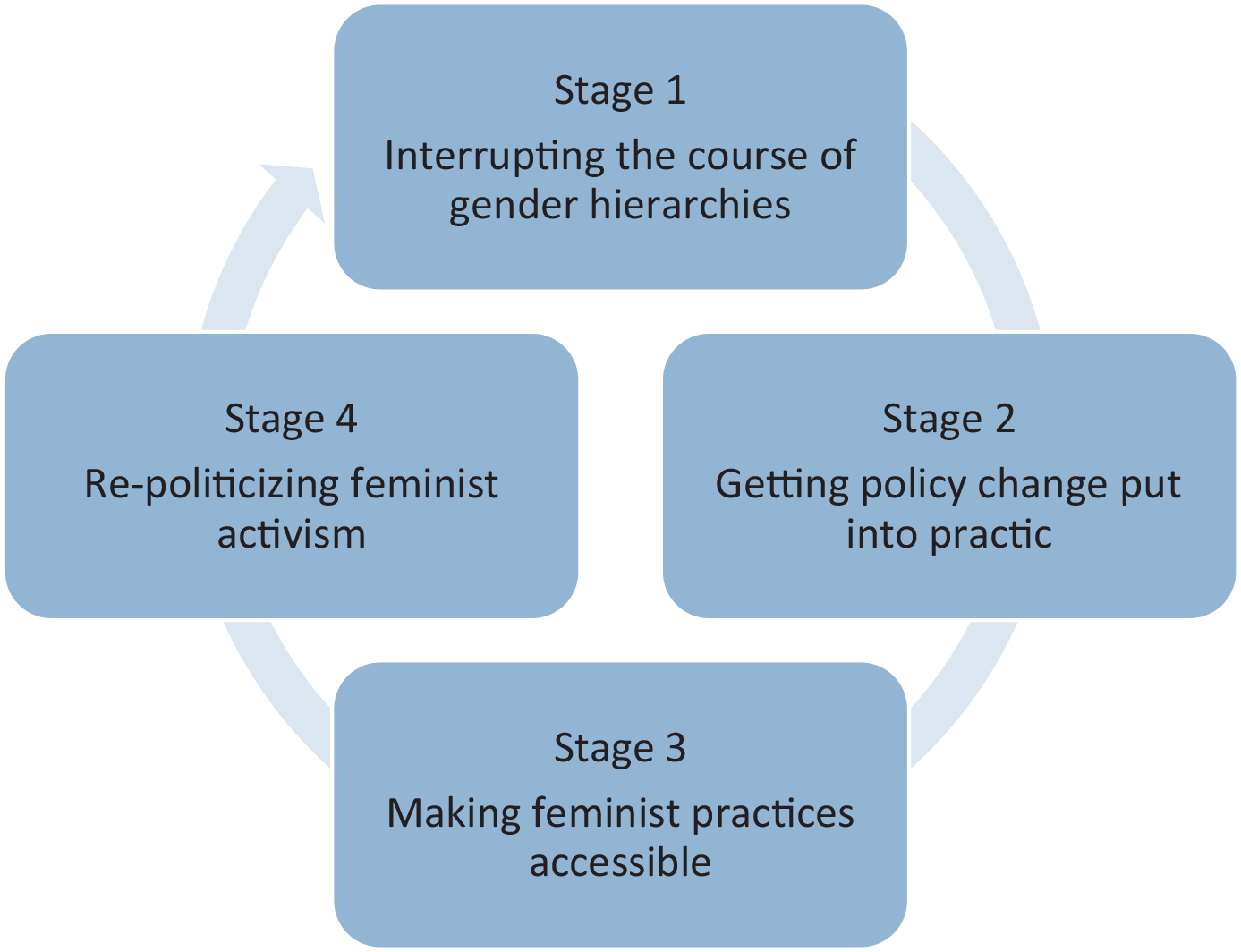
Four stages of constructing long-term visions in feminist activism in Ecuador and Peru.
During the latter two stages, the innovator generation led the construction of long-term visions that proposed alternative feminist mobilizing, by, in a third stage, making feminist practices accessible, and in a fourth stage, repoliticizing feminist activism. This cohort comprised activists who had been mobilized by the initiator generation, yet developed their own distinct forms of feminist mobilizing. These latter two stages took place with the initiator and innovator generation coexisting and collaborating. The long-term visions proposed in all four stages were conveyed with concepts imbued with notions of time. See Table 1.
The Four Stages of Constructing Long-term Visions, the Generation Driving the Stage, and the Core Concepts Developed during the Stage.
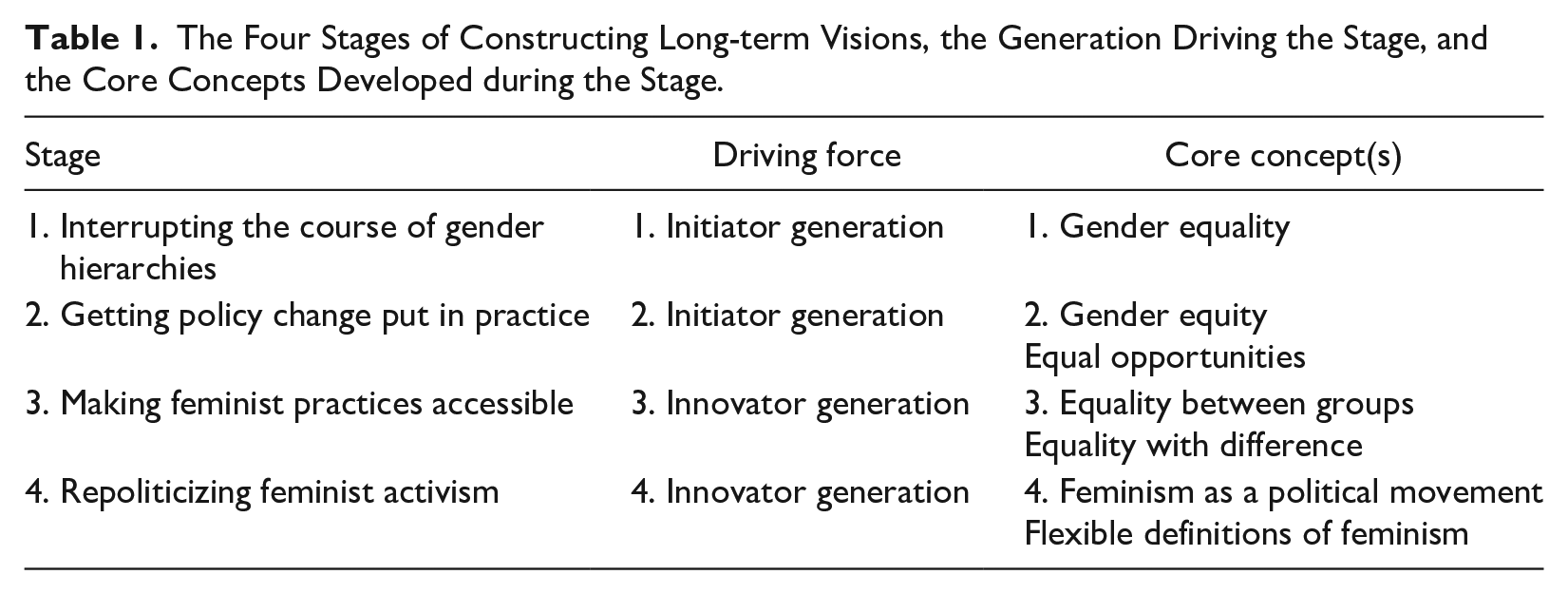
To clarify this shift in terms of which cohort led each stage and what content long-term visions had, I draw upon the four dimensions of Mead’s theory of time, as applied by Maines et al. (1983) to community organizations. Specifically, their framework helps clarify how the two generations of feminist activism accrued control of time and deployed dimensions of the past to lead the respective stages and construct distinct long-term visions.
Interrupting the Course of Gender Hierarchies
The first stage consisted of constructing long-term visions to interrupt the course of gender hierarchies. Long-term visions employed and developed the concept of gender equality as a future goal, a united past, and a present claim.
For the initiator generation, gender equality represented the main objective for which it had begun working over three decades earlier and continued to work toward at the time of data collection in 2012. Soledad in Quito stated, “Gender equality is the highest goal” and Rossina in Lima declared, “My ideal and my goal is gender equality.” Even the innovator generation embraced gender equality in this way, as Sonia in Arequipa conveyed: It is the clearest and most precise concept for everything I want to communicate concerning work, family, and personal aspects. Gender equality works for all of it. Even though, of course, attaining it is going to be a challenging task, it is not impossible.
The future temporality of gender equality offered hope and inspiration to the two generations by indicating that the present course of gender hierarchies was not inevitable. Gender equality further offered a forthcoming goalpost toward which the two generations could orient their activism in the present, as my dialogue with Maria Inés in Coca from the initiator generation illustrates:
And when you think of gender equality, is it something that can be achieved or is it more of a . . .
Utopia?
Yes
Yes, it is possible to achieve. When women clearly are no longer sexual objects, when they are not super women inside the home, but rather domestic work is shared, when women have the capacity to make decisions and manage their own resources, converse with their spouses, and make them participate. Even though it is tough, this is what we are working towards, yes, it is possible.
Despite the unknown character of the future, study participants depicted quite clearly what they thought gender equality would look like. Even so, they understood that gender equality would be difficult to achieve, thereby fostering a long-term commitment to this goal.
Gender equality was also constructed as a united past. For the initiator generation, participants experienced gender hierarchies during their childhood and young adulthood as blatant and indisputable. Gender equality became a rallying cry to expose these blatant gender hierarchies around which they could unite when they were mobilized into activism in the late 1970s into the early 1990s (see Coe 2023). Sonia in Guayaquil conveyed this: Gender equality corresponds to a specific historical and political point in time for defending women. Early feminist activists fought for equality because women did not have access to any social spheres—academic, political, you name it. Equality was the most appropriate concept.
Gender equality functioned to illuminate the discrimination of women as a group and the exclusion of women as a group from male-dominated spheres. It thereby created a set of claims around which the initiator generation could mobilize participants and make demands from policy elites within the state. In contrast, the innovator generation did not share this experience of gender hierarchies as blatant, or the united past offered by the concept of gender equality. Its participants had not grown up with obvious sex segregation in, or women’s exclusion from, education, work, leisure, and politics. Simply put, it experienced having benefited from advances in gender equality, which was understood as resulting from the initiator generation’s claims making. The innovator generation experienced lack of progress not in so-called “public” realms but rather in the family, household, and intimate relations, as Ana in Quito stated, “but women continue to be the only ones responsible for domestic work, caring for the children, they are the only ones.”
Lastly, gender equality was constructed as a present claim. Because gender equality was grounded in the law, it was a right that could be continuously claimed in the present. Carla in Lima from the innovator generation declared, For me, gender equality is fundamental. To speak of equality is to speak of a right, the meaning of equality is a right. It is not a situation, equity can be a situation, but equality is a right that we as persons have.
The legal, rights-based meaning of gender equality guided the initiator generation’s long-term strategy of policy advocacy to get laws changed that discriminated against or disadvantaged women. This strategy was seen as a foundational step because laws obliged both State and non-State actors to comply. It further aligned with international efforts, including feminist advocacy pursued by the Latin American and Caribbean Committee for the Defense of Women’s Rights (CLADEM) and legally binding treaties ratified by Peruvian and Ecuadorian states, such as the Convention on the Elimination of all forms of Discrimination Against Women (CEDAW).
Policy advocacy began to show results during the mid- to late 1990s when both countries adopted a series of laws upholding women’s rights. These advances were achieved about the time when the innovator generation was mobilized into activism. Although the innovator generation did not emphasize policy advocacy, it did incorporate gender equality as a present claim in its own activism, as David from Lima expressed: “There has to be gender equality, because without gender equality, then there is no true democracy, there is no rule of law.” Moreover, for the innovator generation, gender equality was something they were trying to realize within their own organizations, as Ana in Quito explained, “Here what we try to do it, to apply gender equality, following our basic agreements within the organization.”
Through this first stage, gender equality was constructed as a long-term vision to interrupt in the present gender hierarchies begun in the past, thereby proposing alternative gender relations for the future. The initiator generation used time as a source of power in this stage according to Mead’s dimensions (Maines et al. 1983). It symbolically reconstructed the past through its depiction of the blatant gender relations experienced by its participants when it was mobilized into feminist activism in the late 1970s through the early 1990s. It further symbolically reconstructed the past by depicting itself as the only actor making demands for gender equality and attaining legal and policy change. By the mid-1990s, this symbolically reconstructed past was accepted by other actors, particularly policy elites in both countries with legitimate authority, and eventually even the innovator generation when it emerged toward the end of that decade. Because agreement existed that these past events had occurred, the symbolically reconstructed past was also an implied objective past (Maines et al. 1983). By making claims of past achievements and having its claims legitimized by other actors, the initiator generation succeeded in creating a socially structured past (Maines et al. 1983). It thus exerted control of the past, giving it an advantage to shape the future, which it did in the second stage.
Getting Policy Change Put in Practice
The second stage consisted of constructing long-term visions to get policy change put into practice. Long-term visions developed and employed two concepts—gender equity and equal opportunities—that continued to propose alternative gender relations.
Once laws were changed, pursuing gender equality through legal and policy advocacy appeared to go only so far in impacting substantial change to women’s lives, as Virginia from Quito from the initiator generation conveyed: We activists defending women have put so much effort into what goes on paper, and I find it abhorrent that with so many changes to the Constitution and so many laws, that women continue to have so few opportunities. It makes me so mad.
Therefore, the initiator generation turned its efforts to pressure policy elites on all levels of government responsible for putting laws into effect. Gender equity was described by the initiator generation as useful for guiding policy formulation and implementation in various areas, for example, work, health, violence, and politics. Soledad in Quito from the initiator generation explained, I like using equity because it recognizes that gaps still exist, that obstacles remain in place, that holes need to be filled among men as well as women and that being able to identify these gaps is needed to pave the path to equal opportunities.
Soledad’s quote captures the present temporality of gender equity by addressing the current situation of gender hierarchies and orienting toward immediate action. As the next two quotes display, gender equity further shed light on cultural and social legacies of gender hierarchies accumulated from the past. Sonia in Guayaquil from the initiator generation discussed getting at the root of gender hierarchies to be able to reach future gender equality: Equity deconstructs why gender relations have been in this way, why men have repressed women, why they have disqualified, minimized, devalued women including using supposedly scientific arguments. . . . Equity means knowing these differences and their consequences for both men and women, and helping to reconstruct new “femininities.”
Zaida in Quito from the initiator generation raised how it exposed invisible aspects of gender hierarchies: “Gender equity makes visible some elements that are still hidden, for example, that women have been seen as the person of the private space, the family.”
The innovator generation, in contrast, described gender equity as useful for analyzing current needs for social change. Isabel in Lima stated, “Gender equity is helpful for describing social goals. It is about giving each person what they need because of differences caused by social gaps.” This interpretation aligned with the innovator generation’s strategy of social advocacy, rather than policy advocacy. Otherwise, the innovator generation critiqued gender equity as limited for making political claims because the concept had become a diluted technical tool for policy implementation and was sustained in moral judgment, not the law.
Equal opportunities were also seen as useful to guide policy implementation while still maintaining a legal, rights-based meaning. “Of course, as good students of CLADEM, we made the transition from equal before the law to equal treatment to equal opportunities” Maria Ysabel in Lima from the initiator generation explained. Equal opportunities acknowledged the privileges and disadvantages of diverse groups accumulated from the past, the detrimental effects of disadvantage on women’s capabilities in the present, and the creation of future opportunities. Virginia in Quito from the initiator generation stated, I like equal opportunities because men and women should have the same opportunities to be equal. We women have fewer opportunities because in many instances we are less capable, not because we are inferior or stupid, but because life experiences have made us less capable than men.
Equal opportunities further functioned to hold policy elites accountable in the present to comply with the law. This function motivated the innovator generation to identify with the concept, which the following quote from Carla in Lima depicted, “One of the most important aspects of Peruvian feminism is that it has always made demands upon the State to comply with its obligations and been a force for democracy.” Both generations agreed that the feminist movement must do more than change laws; it must press for accountability from policy elites.
Through this second stage, gender equity and equal opportunities were constructed as long-term visions to get policy change put in practice in the present to rectify past disadvantages and propose alternative gender relations for the future. The initiator generation continued to use time as a source of power in this stage (Maines et al. 1983). It symbolically reconstructed the more recent past in the late 1990s through its depiction of legal and policy change as necessary but insufficient to improve women’s lives in practice: Concrete tools were needed to advance its decades-long strategy of legal and policy advocacy. It further symbolically reconstructed the past by depicting itself as the only actor offering expertise in gender equity and equal opportunities to ensure that laws and policies were implemented. This symbolically reconstructed past was accepted by other actors, especially policy elites who relied on the initiator generation for technical support to implement laws and policies. Thus, again, the initiator generation was able to create a socially structured past because it made claims of past achievements and had its claims legitimized by other actors. By deploying the past as a resource and being the driving force of the first two stages, the initiator generation was able to define the parameters of feminist activism, that is, what counted as feminist activism, including for the innovator generation. It may have been on its way to create a mythical past. However, the innovator generation proved less willing to fully legitimize the past claims of the initiator generation during the second stage, by critiquing the emphasis on policy advocacy, which set in motion the last two stages in which the former became the driving force of the construction of long-term visions.
Making Feminist Practices Accessible
The third stage consisted of constructing long-term visions to make feminist practices accessible to the wider population, thereby shifting the focus from alternative gender relations to alternative feminist mobilizing. Long-term visions developed and employed two concepts: equality between groups and equally with difference.
Aligning with its experience of blurred gender inequalities, the innovator generation pursued social advocacy to convince other collective actors and the wider population to adopt feminist practices. Equality between groups communicated feminist ideas in a way that was easy for nonexperts and nonprofessionals to grasp. Linda in Lima from the innovator generation clarified, A problem with feminism is that it has a series of concepts and theories that are difficult to make concrete. I am not suggesting that we abandon them, but this is a problem to reach other persons because they do not know what we are saying.
Even the initiator generation recognized this problem as Cecilia in Lima portrayed: “For me, I am interested in being able to make our discourses understandable to the largest quantity of different women.” Instead of “gender,” participants used “equality between women and men” to specify which groups gender equality referred to as Linda in Lima continued, “In the end, I like to talk about equality between men and women because it makes the problem explicit, it is about men as well as women.” Within more circumscribed feminist circles, gender equality meant far more than this, including the transformation of the gender system beyond binary categories, reflecting the influence from queer feminism and LGBTQ movements. Nonetheless, as Gioconda in Lima from the initiator generation explained, even when biological sex is understood as socially constructed and fluid, the category “woman” continues to be associated with a devalued femininity: “So we continue to speak of feminism as proposing a more just and more equal society where no one is discriminated against for being a woman or being associated with femininity.”
Equality with difference conveyed feminist practices in a way that included diverse groups. According to participants’ accounts, equality with differences reinforced the legal, rights-based notion of equality while embracing diversity based on gender, ethnic, and cultural identifications. This concept was intended to overcome two problems experienced with the concept of gender equality. First, the concept had become associated with working to overcome women’s disadvantage in most social spheres. Yet, as the initiator generation garnered expertise in addressing gender hierarchies, it came to understand that most social spheres were dominated either by men or by a masculine norm, raising the question of whether removing women’s disadvantage in these spheres was enough. This also led to a revaluation of difference that put women’s experiences in the center, as Sonia in Guayaquil from the initiator generation depicted: “Feminists began to theorize difference, and said, no, ‘men and women are different, and I don’t want to be equal with a man, I want to be different, and I want my differences to be recognized.’” Attention to difference further emerged among those feminist activists from the initiator generation working closely with Indigenous, Andean, and Amazonian communities in their efforts to resist homogenizing racial projects. Thus, the seeds were sown by the initiator generation for what feminists of color in the Global North were developing as intersectionality.
The innovator generation built upon these early efforts by clearly making the link between difference and equality, thereby addressing a second problem with the concept of gender equality that was closer to their own experience: power relations between diverse groups of women and of men. The innovator generation had been mobilized into feminism when activism around sexual, gender, and ethnic identities was expanding in both countries, and this influenced its understandings of feminism. Ximena in Lima from the innovator generation explained, Equality with difference shows that there is not just one type of women but rather many diverse types. Especially ethnicity is an unresolve issue on the feminist agenda, at least at the national level. We are a diverse country ethnically, yet the vision offered by the feminist movement only includes urban women, seldom rural or Andean women.
And Ana in Quito portrayed, “One of our principles is equality, we say that we are equal because we are different, that is, we focus on that we are equal in our rights but at the same time we are distinct.” And George in Lima from the initiator generation explains, “I mostly used equality of rights because it says that we are all distinct, we recognize our differences.”
Through the third stage, equality between groups and equally with difference were constructed as long-term visions to make feminist practices accessible. Although this stage clearly built upon the initiator generation’s activist experience, the innovator generation became the driving force because it sought to create an alternative feminist mobilizing that matched its participants’ own lived experiences of blurred gender hierarchies and the need for social change. The innovator generation was now able to use time as a source of power in this stage (Maines et al. 1983). It symbolically reconstructed the past through its depiction of feminist practices when it was mobilized around the new millennium as confined to an exclusive group of activists, not very well known outside these circles, and vilified when they were known to the wider population. It further symbolically reconstructed the past by depicting itself as the only actor demanding equality between groups and equality with difference to make feminist practices accessible to the wider population. This symbolically reconstructed past was accepted especially by the collective actors with which the innovator generation was building alliances. Even the initiator generation to a certain extent accepted this past because of its own experience in grassroots advocacy over several decades from which it had learned about diverse groups of men and women in both countries. The innovator generation was able to create a socially structured past because it could both make claims of past achievements and have its claims legitimized by other actors’ past based on the sequencing of events above. Although this provided the innovator generation with a source of power, it did not have the same official legitimacy as that which the initiator generation obtained from policy elites (Maines et al. 1983). Yet, this did not deter the innovator generation.
Repoliticizing Feminist Activism
The fourth stage consisted of constructing long-term visions to repoliticize feminist activism. Long-term visions employed and developed two concepts: feminism as a political movement, and flexible definitions of feminist activism.
The innovator generation directed its activism not only externally toward other collective actors and the wider population but also internally toward feminist movements. Feminism as a political movement moved activism away from the technical focus on policy goals. Paula in Guayaquil from the innovator generation stated, “Feminism is a political ideology that allows us to aim for women and men having equal opportunities, equal rights, it is towards this we are aiming, without losing or forgetting the history of women’s subordination” and Maria in Lima, also from the innovator generation conveyed, “Honestly, I think it is sad to talk about concepts such as gender equity. I like talking about the women’s movement, constructing a broader politics, highlighting all the conditions in which women live according to class, age, economic situation.” Constructing feminism as a political movement made it clearly available for diverse gender identities to adopt, including men. This was highly relevant to the innovator generation because they had been mobilized into feminism in mixed-gendered groups which led men to identify as feminists, as the following dialogue between Juan and Pedro in Guayaquil illustrates:
Engaging with women’s issues and struggling for the recognition of their rights, it makes you a feminist, it unites you to the struggle, I am a feminist.
One time I heard an activist say he was a feminist man, and this question remained with me, because I thought that feminists were women, but now I understand. Working for women, for policies that favor women, eradicate violence against women, as we are doing here has made me question things. As Juan said, we consider ourselves feminists.
The initiator generation too acknowledged the limitations of using gender as a technical term and of excluding men. Gaby in Lima stated, “Feminism is a political movement, and therefore the concept of gender is a political proposal . . . We need to recover the political meaning of gender” and Cecilia in Lima, “I am convinced that feminism is a political proposal and therefore it cannot be assigned to a single sex.” Thus, although some members of the initiator generation exhibited resistance to, and even ignorance of, the internal critique developed by innovator generations, the initiator generation was generally on board with it and even welcomed it.
Flexible definitions of feminist activism moved away from narrow interpretations of activism tied to the initiator generation’s policy advocacy. Because the initiator generation was the first to self-identity as feminists, its definition of feminist activism had prevailed for several decades. The innovator generation did not merely propose an alternative definition of feminist activism; it proposed expanding this to comprise multiple definitions. The following quote by Ximena in Lima illustrates this: My goals are to work for a feminist articulation that overcomes definitions of what constitutes the movement. It is a mistake to define what is a social movement and what is not. It is like putting a feminist thermometer that says, “if you fulfill this and that requirement, then you are a movement.”
Flexible definitions of feminist activism were also a response to feminist activism being associated exclusively with the activities of well-established organizations started by the initiator generation. The professionalized, bureaucratic characteristics of these organizations created a distance with the innovator generation, which had formed horizontal organizations based on lay capacity. This distance between the two generations existed even within the well-established organizations of the initiator generation as Ana-Maria in Lima from the initiator generation described: “It is happening to the long-lived organizations: young women come in and they leave because they come up against a ceiling of older women, they find a very low ceiling in the organization.” This was potentially a problem for the survival of these long-lived organizations because members were gaining in age without being able to attract younger members. Ana-Maria’s quote also illustrates how participants from the initiator generation had taken in the critique from the innovator generation.
Flexible definitions of feminist activism tied into visions of a more inclusive and welcoming movement, willing to engage in internal and external debate about feminist issues, regardless of whether a person identifies as feminist. As Linda in Lima from the innovator generation stated, “Many of us are clear, we need go out to other organizations and debate feminism, it cannot stay amongst ourselves.” This broader understanding of the feminist movement was not lost on the initiator generation, which recognized the need for expanding outwards. Meche in Arequipa from the initiator generation described feminism not as a marginal movement but as a central actor for addressing the wider concerns and problems in the two countries: Without putting aside all that we have achieved, we need to recognize that we are part of a broader movement called human rights, of another problem called climate change, we are part of all these processes. All these are problems that women are living, women’s lives are affected by every change in society.
Yet, expansion to wider sectors of population differs from incorporating new activists in movement, as the following quote by Rossina in Lima from the initiator generation clarified: Not everyone is going to be an activist or in the movement. Anyone can self-identify as feminist. . . . But I also do not believe being a feminist is the same as belonging to the feminist movement. The more feminists the better, I am convinced of that. But it is necessary to distinguish the social movement from people in the population identifying as feminists.
This quote was important because all the participants in this study have dedicated their lives to feminist activism.
Through this fourth stage, feminism as a political movement and flexible definitions of feminist activism were constructed as long-term visions to repoliticize feminist activism. The innovator generation was the driving force because it sought to create concrete tools to continue its strategy of social advocacy internally within their feminist movements. The innovator generation continued to use time as a source of power in this stage (Maines et al. 1983). It symbolically reconstructed the past through its depiction of feminist policy advocacy as highly technical, professionalized, and depoliticized and of itself as the only actor developing feminism as a political movement and proposing looser definitions of activism to fortify feminism with political spirit again. This symbolically reconstructed past was accepted by other actors, now even by the initiator generation which itself had gained significant legitimacy. Thus, the innovator generation was able to construct a socially structured past because it both made claims of past achievements and had its claims legitimized by the initiator generation, providing the innovator generation with a source of power. Even though the initiator generation had focused on policy change, it had always held a wider intention to change the lives of the broader population and this stage was prompting it back to these origins.
Discussion
My study found that the two political generations of feminist activism in Peru and Ecuador constructed different long-term visions through four stages. Differences in which generation led each stage and hence the content of long-term visions can be understood in terms of their use of time as a source of power. This analysis builds upon and enhances existing research on long-term visions and political generations in social movements. The two generations of feminist activism constructed long-term visions not as impossible or unrealistic utopias but through present actions. As Ivy Scurr and Vanessa Bowden (2021) found in their study, the two generations developed in each stage a comprehensive critique of existing problems regarding gender relations and feminist mobilizing in the present, and assessed the effectiveness of their current actions, whether this was policy or social change. Nonetheless, their long-term visions emphasized different temporalities. The initiator generation had been active for over three decades. It relied heavily on this past to construct long-term visions by comparing to a previous time of blatant gender hierarchies upheld by government policies. Moreover, the initiator generation continued to prioritize policy change because it had formed during the peak of Leftist political action in both countries that sought change through the State. For this generation, there was an interaction between the past and the future, as Gutman (2017) found in the memory activism on the Israel-Palestine conflict. In contrast, the innovator generation did not have a long past to draw upon and therefore focused especially on the present to construct long-term visions. Seeking to distinguish itself from the initiator generation, this generation found inspiration in the alterglobalization movement that was committed to prefigurative politics (Friedman and Rodríguez Gustá 2023; Maeckelbergh 2011; Scurr and Bowden 2021; Yates 2015). Prefigurative politics was reflected in the innovator generation’s attempt to practice everyday activities that anticipated its desired future change, especially gender equality in their organizations and alternative feminist mobilizing. Thus, both generations carried out actions in the present as revolutionary rehearsals for the future, following Dan Swain’s (2019) categories, even though each generation had its own idea of revolutionary. This distinction can be linked to different articulations and experiences of time, as Nairn et al. (2021) found. Even though my study did not explicitly ask participants about their articulations of time, different experiences of time arose by examining the formation of political generations and construction of long-term visions.
The formation of two political generations led to the development of distinct long-term visions, which in turn produced tensions between them, as both Nancy Whittier (1995) and Jo Reger (2012) found. Nonetheless, the two generations indicated a strong degree of cooperation. Although each generation pursued its own goals and strategy, they tended to converge more than diverge in the construction of long-term visions across all four stages regardless of which generation was the driving force behind it. The innovator generation diverged from the initiator generation on only two points: the past unity offered by gender equality and the emphasis on the policy tool emphasis of gender equity. Moreover, following Jo Reger’s (2015) study of the Slut Walks, the innovator generation drew upon the legacy of the initiator generation to construct long-term visions. It did so regarding gender equality in the first stage, even if its own participants did not experience the blatant hierarchies, and it did so regarding the equality as difference in the third stage that built upon the grassroots work of the initiator generation. Given that my study was conducted in 2012, I do not have evidence after this point in time, but it is entirely possible that the two generations followed a similar trajectory to that demonstrated by Elizabeth Borland (2014), Barbara Sutton (2020) and Friedman and Rodríguez Gustá (2023) in Argentina, whereby collaboration improved as the innovator generation gained a stronger position in the overall movement. The fourth stage in my findings suggests that the innovator generation was gaining such as position. It is also possible that with the growth of conservative grassroots movements in the region, and thereby a more hostile political environment for feminism, the two generations have found it necessary to collaborate, as Reger (2012) found.
Conclusions
In this article, I bridge two key concepts of social movements that typically have been examined separately: long-term visions and political generations. Bringing the concept of political generations into the study of long-term visions helps clarify why social movements construct diverse visions both concurrently and over time. Meanwhile, the concept of long-term visions demonstrates an additional consequence of political generations in social movements, alongside collective identities and forms of activism found previously. As my findings show, even when distinct generations of feminist activism engage in different forms of activism, they do not necessarily diverge but also converge in the construction of long-term visions. Integrating these two concepts enhances not only the wider literature on social movements but also the specifical literature on feminist movements in Ecuador and Peru by providing a generational analysis of long-term visions that is currently missing from the latter. Whereas the initiator generation contributed with visions of alternative gender relations, the innovator generation contributed visions of alternative feminist mobilizing to expand who could participate and how. Future research can explore how different generations strategize to integrate different long-term visions in movements and overcome divergence.
I have further shown how the two generations of feminist activism had agency in using time as a source of power for their construction of long-term visions. There is growing attention to time in social movement research that is generating new theoretical perspectives and conceptual tools (Daphi and Zamponi 2019; Gillan and Edwards 2020; Soler-i-Marti et al. 2024; Wagner-Pacifici and Ruggero 2020). I add to this by applying Mead’s theory of time, following Maines et al. (1983), to capture how the two generations of feminist activism used the past as a resource to construct long-term visions in the present for the future. Specifically, my four stages illuminate the shift in control of time as a source of power from the initiator to the innovator generation. Future research can employ and modify these stages, and their specific concepts, to further the study of the long-term visions developing among new political generations of feminist activism, in the same countries and new contexts.
Footnotes
Declaration of Conflicting Interests
The author(s) declared no potential conflicts of interest with respect to the research, authorship, and/or publication of this article.
Funding
The author(s) disclosed receipt of the following financial support for the research, authorship, and/or publication of this article: Funding for this research was provided by Bank of Sweden Tercentenary Foundation under Grant SAB21-0016 and Magnus Bergvalls Foundation under Grant 2019-03112.
