




Abstract
Creative occupations are well-known for inequalities and exclusions. This article focuses on one such excluded group—creative workers who are the parents of young children—to examine the impact of the pandemic on their creative careers. We use the Household Quarterly Labour Force Survey, a large and nationally representative database of UK workers covering the period of 2015–2021. We run regression analyses to estimate the multidimensional impact of working in the creative field, gender, parenting and the pandemic period. The analysis demonstrates a clear parenthood penalty in creative occupations. For women with young children working in the ‘core’ creative occupations this penalty equates to working around nine fewer hours per week. This penalty is in addition to the general penalty for being a woman parent (25 fewer hours per week). The pandemic saw a further hit to ‘core’ creative parents’ working hours, and mothers suffered the heaviest reduction in working hours. Reduced working hours will exacerbate existing gendered inequalities in creative occupations. Based on the figures presented in the article, more must be done by policy interventions and employer activity to prevent even greater exclusions from creative work for mothers.
Creative occupations are often thought to be some of the most desirable jobs in the economy. Irrespective of the country in which they are based, they offer the chance to make the symbolic goods that are at the heart of individuals’, communities’ and nations’ cultures. Who works in creative occupations- who makes symbolic goods that shape cultures- is an important question for scholars of both work and occupations, and of cultural and social studies. Creative occupations are characterised by significant inequalities in their workforce. Those inequalities were highlighted by the impact of the Covid-19 pandemic (Comunian & England, 2020, Gillmore et al., 2024).
The global Covid-19 pandemic saw extreme levels of social disruption across the world. Virtually no part of the global economy and society was unaffected. Creative occupations faced specific and particular issues, with short- and longer-term impacts on their workers. However, the impact of the pandemic on creative occupations, as with the impact of the pandemic on many other parts of economic and social life, was unevenly distributed.
In Britain, the government offered general support for those prevented from doing their jobs as a result of public health measures. The government also offered direct support to specific parts of the creative sector, such as performing arts and museums. It also assisted film and television production to safely reopen. However, many workers in creative occupations struggled to access support, highlighting and exacerbating the sorts of inequalities found in these occupations before the pandemic (Comunian & England, 2020).
One such group is workers in creative occupations who are parents of young children. The existing literature suggests these were most likely to be subject to exclusions from the creative workforce in the pre-pandemic era (Brook et al., 2020). The limited research that has been conducted around the impact of the pandemic on the creative workforce has assessed this impact through a qualitative or theoretical approach (e.g., Comunian & England, 2020). This article presents a quantitative study of parenting in the UK's creative occupations, focusing on the number of hours worked.
To do so, the analysis uses the Household Quarterly Labour Force Survey - a large and nationally representative database of workers in creative and non-creative occupations covering the period of 2015–2022. The data contains information about working hours and family composition, which allows us to estimate the general parenting penalty for ‘core’ creative workers, along with the way this penalty was exacerbated for some workers during the Covid-19 pandemic.
Cultural and creative occupations involve the production, dissemination, and preservation of creative and artistic works (UNESCO, 2009). In the UK, these are considered part of the creative economy and are categorized into several occupational groups (DCMS, 2016). Within these groups, a distinction is often made between ‘core’ and ‘other’ creative fields. Core creative fields are more traditional, rich in cultural value, and their outputs possess a high degree of expressive value and are typically protected by copyright. These include fields such as film, TV, video, radio, and photography; publishing; museums, galleries, and libraries; and music, performing arts, and visual arts. Other creative fields are generally more modern and associated with higher levels of commercial content. Their outputs often involve mass reproduction of expressive works and include areas such as advertising and marketing, architecture, crafts, and design (Throsby, 2008; Work Foundation, 2007). This classification aligns with similar taxonomies, such as the one used by the US National Endowment for the Arts’ Office of Research & Analysis, which distinguishes between “core” artistic domains and “applied arts and design services domains” (National Endowment for the Arts, 2013). Additionally, IT occupations are recognized as part of the creative economy in the UK, reflecting their integral role in fostering innovation and creating digital content.
The analysis finds that workers in ‘core’ creative occupations have different patterns of family formation as compared to workers in the rest of the economy. These ‘core’ creative workers suffer some of the largest penalties to their working hours when they have children. There are clear differences in these penalties by gender. The article then shows how the pandemic aggravated the existing parenting, and in particular, the motherhood penalty.
The study finds that the impact of parenting is not uniform but varies with the age of the workers, and by gender. This analysis, combined with extensive reading of the existing literature on the motherhood penalty in other high-skill and high-status professions, allows the article to theorise that the pandemic's impact on mothers’ working hours may have long-term, negative impact on women's career prospects in creative occupations as the sector rebuilds in future years.
This finding adds to our understanding of how the general impact of the pandemic's disruption economies and societies, using a sub-sectoral case study. More specifically, the findings are significant for studies of creative occupations. They reinforce the literature that demonstrates gender inequalities in this area of economy and society, providing a quantitative perspective and quantitative evidence.
Moreover, as theorists of creative occupations (e.g., Gill & Pratt, 2008; McRobbie, 2016), and more general theorists of work (e.g., Pettinger, 2019) have argued, inequalities in creative occupations may serve as a blueprint for inequalities in other professions. Precarity, the rise of self-employment and freelance modes of work, low levels of unionisation and the associated struggles for collective action and occupational closure (Skaggs & Aparicio, 2023), as well as a lack of social protections (McRobbie, 2016) and lower returns for social capital (Dowd & Park, 2024) are all ongoing structural characteristics of creative occupations.
By understanding the gendered dynamics of labour market shocks, such as the pandemic, the paper provides a starting point to challenge creative occupations’ gendered inequalities. In turn, that starting point can be used by analysis looking at more general trends for those areas of work and occupations facing similar conditions to creative occupations. For example, research on workplaces in the ‘new economy’ of tech firms has shown a range of gendered inequalities and the impacts on women's careers (Hart, 2024; Mickey, 2022). This paper's analysis of a specific motherhood penalty for creative workers can be used in this new economy research as it deepens its explanations for gender, and other intersecting, inequalities.
Literature Review
What are the Effects of Parenting on Careers?
There is a huge and extensive literature on the effects of parenting on working hours and careers. As a result, it is impossible to fully cover the breadth and depth of research within a single review of the literature that aims to frame this analysis (see Grimshaw & Rubery, 2015 for an overview).
There are, however, a range of settled, and historically stable, positions in the literature, most of which hold irrespective of national contexts, datasets, or methodological approaches for the research.
The impact of parenting is deeply gendered, with mothers suffering clear penalties in terms of career development when they have children (Grimshaw & Rubery, 2015). Much of the literature is usefully summarised by the title of a recent popular study, arguing that women become ‘pregnant then screwed’ (Brearley, 2021) in terms of the impact of parenting on work and careers.
Explanations and underlying factors for this are several. Many societies are highly unequal in terms of gender, meaning the starting point for the impact of parenting is already likely to be more negative for women. At the point of entry into an organisation, mothers may experience discrimination due to employer perceptions of lower competence or productivity (Correll et al., 2007). Parenting responsibilities are not shared evenly in two partner-, heterosexual households (Collins, 2019), and this impacts more heavily on women's working hours, careers and patterns of labour force participation (Damaske, 2013). Work-effort theory, initially put forth by Becker (1985) implies that younger children compared with older children will have a larger impact on mother's careers due to a higher need for monitoring and physical caring activities that limit the amount of energy available to the mother while she is at work (Anderson et al., 2003). Consequently, the reduction in working hours related to parenting puts additional constraints on women's careers that are already subject to a pre-existing ‘glass ceiling’ effect (Cotter et al., 2001).
Examples of the impact of motherhood on careers include Kleven et al.'s (2019) long term analysis of women and men's earning trajectories in six western countries, finding that the drop in earnings after the birth of the first child is persistent and women do not recover even after a decade. Budig and England (2001) demonstrate, using American data, the existence of a wage penalty for motherhood, and there is also evidence, again in US data, of a fatherhood premium to wages, albeit one differentiated by race (Glauber, 2008). England et al. (2016) found the motherhood penalty on wages in the USA was most severe for women working in highly skilled and highly paid occupations. This point is important in the context of creative occupations as they are highly skilled and, in the case of film and television occupations, potentially highly paid, as compared to other managerial and professional, and all other, occupations (O’Brien et al., 2016). England et al. (2016) find these wage penalties are a result of losses of workplace experience, again important in the context of creative occupations where workplace experience, reputation, and project-based working history, are all significant factors in the likelihood of career advancement and higher pay.
Although the precise mechanisms through which these gendered inequalities are produced remain varied and complicated, the literature suggests that hours worked play an important role (for a review see Gough & Noonan, 2013). A German study found that when women remain with the same employer upon becoming mothers, they tend to adjust their working hours (Felfe, 2012). Despite the general convergence in employment rates between men and women across many countries, there remains a consistent hours’ gap between mothers and women without children and men (including fathers) (Boeckmann et al., 2013). In the UK, women take time out of the labour market after childbirth and tend to work fewer hours afterwards. Although lower work intensity and part-time working can offer important flexibility, we also know that it can limit opportunities for progression (Cahusac & Kanji, 2014; Nightingale, 2020). Working fewer hours can result in a lower rate of human capital accumulation, skills depreciation and less favourable job matches which serve to reduce wages (Anderson et al., 2002). Recent work by Stojmenovska and England (2021), using Dutch data, shows parenthood reduces women's hours worked and, as a result, their presence in supervisory or ‘authority’ work roles. There is no evidence of similar effects of parenthood for men. Conversely, longitudinal research has found that when flexitime and remote working are accessible, mothers become less likely to reduce their working hours after childbirth, with large implications for working mothers’ careers (Chung & Horst, 2018). This suggests that the impact of motherhood on careers is moderated through the number of hours worked. While these findings are significant in and of themselves, they are especially important in the context of creative occupations, based on the existing, mostly qualitative, studies of parenting and creative work.
Gender inequalities in the workforce and the associated parenting penalty for mothers must be understood in the context of specific nations’ welfare states. In the case of this analysis, using British data, support for mothers, particularly in the first months of the child's life, is more comprehensive than in the US system (Budig et al., 2016; Calarco, 2024). However, even in the context of a British welfare state with a moderate-length period of paid maternity leave and provision of public childcare (Budig et al., 2016; Gumy et al., 2022), creative workers are often not afforded the same levels of protection as those fully employed in careers in bureaucratic work organizations. The freelance nature of many creative occupations means mothers in creative occupations have access to only the most basic version of support from the state, and often face further barriers associated with accessing child care and support when they attempt to re-enter the creative labour force (Berridge, 2022; Dent, 2020). The pandemic highlighted these inequalities even in context of the seemingly more progressive UK welfare state (Wreyford et al., 2024).
Parenting and Creative Occupations
In the British context the welfare state struggles to support those in non-typical forms of employment. This is a longstanding issue for creative occupations. High levels of freelance and self-employment (Feder et al., 2024; Umney & Kretsos, 2015) are a core characteristic of these occupations across national context (Hénaut et al., 2023; Skaggs & Aparicio, 2023). These non-standard employment patterns have important consequences for inequalities within creative occupations, particularly for individuals with caregiving responsibilities, such as parents. In the UK, where pre-school childcare receives limited support from the welfare system (PIPA, 2021, Raising Films, 2021), these challenges are exacerbated. For example, a lower provision of funded childcare for children aged under three is linked to a larger per-child wage penalty, amplifying the structural barriers faced by parents in creative roles (Budig et al., 2016).
There are numerous books, papers, and research projects detailing the significant issues encountered by women in these supposedly open and meritocratic occupations (Conor et al., 2015). Research from film and television studies, for example, demonstrates how women are given lower status than men, and the positions of director, producer, writer, and other senior roles are seen to be men's work, even if this is only rarely made explicit (Dent, 2020; Eikhof et al., 2019; Galt, 2020; Wallenberg & Jansson, 2021; Wreyford, 2018). Women are stereotyped in various ways that afford them less prominent roles, doing the emotional labour in organisations and denied creative expression (Hesmondhalgh & Baker, 2015; Johnson & Peirse, 2021). Women are left out of, or uncredited, in the creative process, even where they have been leading projects (Berke, 2022; Henderson, 2011). They are treated as ‘risky’, both in terms of the possibility of needing time away if they chose to start a family, and in terms of industry assumptions about women (Brook et al., 2020; Coles & Eikhof, 2021).
These individual biases point towards the structural problems facing women. They exist beyond film and TV, in most other creative occupations (e.g., Alacovska, 2017; Allen, 2013; Bain, 2019; Bull, 2019; Cannizzo & Strong, 2020; Dowd & Park, 2024; Gill, 2002, 2014; Patel, 2020). Long and unpredictable hours, the need for constant socialising and network building, and informal hiring practices, are all core elements of creative work. These confront all workers, irrespective of gender. The result, however, is that these labour market conditions connect with sexist assumptions to mean women face heavier barriers to success than men (McRobbie, 2016).
Biases and structures are difficult to separate and tend to reinforce each other. Motherhood is a crucial example of this. An individual hiring bias that sees a woman as a ‘risky investment’ because she may need flexible working hours, goes hand in hand with the way freelance work does not offer support for maternity in the same way as more secure contracts of employment (PIPA, 2021, Raising Films, 2021). This point has been central to much of the research on motherhood and creative occupations (Dent, 2020). While motherhood is a key factor, this should not be allowed to obscure the individual biases and structural sexism that mean that, even where women do not have children, they are still not getting the highest profile roles (Gill, 2014).
Recent research on gender and creative labour has stressed the need to focus on structural issues. Much of this uses interview data on women's experience of motherhood. For example, O’Brien and Liddy (2021) demonstrate systematic bias against mothers in the screen occupations, in addition to the bias they suffer as women. Their research concurs with Brook et al. (2020), who found that women are very well aware of the penalties they face in creative occupations. However, at present they often see these as barriers to overcome, or see exit from higher profile creative roles as a decision for which they themselves are responsible. Women internalising the responsibility for structural unfairness is not unique to creative occupations and reflects post-feminist ideas about equality in the workplace (Brook et al., 2020: Dent, 2020; O’Brien & Liddy, 2021; Wreyford, 2018).
This is most striking in comparisons between fathers and mothers. For men, balancing fatherhood and the demands of creative labour markets is challenging, of course. The challenge is of a different magnitude for women. Fathers do not have the same fear of the impact or penalty on creative careers. For women, not only is there a set of harsh questions about their career and life choices, but they can be stripped of their identity as creative workers and positioned solely as mothers. In turn, they are presented a set of narrow expectations that they will abandon creative work in favour of caregiving. There is a double bind of potential struggle or failure as a mother and as a creative (Brook et al., 2020).
This double bind was particularly clear during the pandemic of 2020. Within the emerging body of literature analysing both what happened in 2020, and theorising what is emerging in the post-pandemic context, there is evidence of specific impacts for the creative sectors (Banks, 2020; Banks & O’Connor, 2021; Comunian & England, 2020; de Peuter et al., 2022; Eikhof, 2020; Gillmore et al., 2024; Joffe, 2021; Kay & Wood, 2020). There are also important differences depending on the specific creative occupation. Film and TV were able to reopen sets and studios relatively quickly, while theatres and music performance venues stayed closed. Occupations able to take advantage of digital modes of delivery, for example Film and TV, or working from home, for example Publishing, saw stability and even growth in the size of their workforce. Occupations facing venue closures and with high levels of freelance workers saw huge contractions in workforce numbers, including almost one-third of all performing, visual and music arts workers leaving the workforce in spring and summer of 2020 (Feder et al., 2024).
Overall contractions in workforce numbers masked differential impacts on demographic groups. Women, younger workers, ethnic minority workers, disabled workers, and workers without higher education qualifications all more likely to leave creative occupations than their white, able-bodied, older, better qualified male colleagues (Feder et al., 2024).
The Impact of the Pandemic
The impact of the pandemic on creative occupations is an example of how well known, pre-existing inequalities (Brook et al., 2020) were accelerated during 2020. There are clear parallels with the research on the impact of parenting and the motherhood penalty during the pandemic.
In this literature, Landivar et al. (2020) found evidence of mothers in the USA exiting the labour force and reducing hours at much greater scales than compared to fathers in similar positions. These findings on reduced hours and employment have been echoed by Bariola and Collins (2021), Collins et al. (2021) and Petts et al. (2021), while Calarco et al. (2021) have interview data to illustrate the justifications within households for mothers’ reductions of hours or exits from labour markets. Ultimately, the gendered division of caring labour, lack of social and state support, and longstanding ideologies associated with care and parenting as women's work were all clear before the pandemic, and underpin the issues of losses of hours and jobs during, and now after, the lockdowns of 2020.
The pandemic was difficult for parents irrespective of their occupation, and aggravated workforce related inequalities (Brown & Ciciurkaite, 2023; Chavez et al., 2022). However, the impact of the pandemic on parents was especially felt within the ‘gig-worker’ sector. These are self-employed workers whose labour is characterized by flexible work that is organized around demand rather than a standard schedule. During the pandemic, schools and daycare closed down, requiring parents, especially mothers, to spend more hours than regular to provide childcare. This meant that self-employed workers with children, who often rely on flexible work arrangements to manage family responsibilities, faced significant work-hour reductions (Auguste et al., 2022). The loss of working hours, coupled with the need to spend more resources at home on food, internet access, etc. exacerbated the financial constraints of these workers. Auguste et al. (2022) found that American gig workers with three or more children had a 15% greater likelihood of experiencing food insecurity during the Covid-19 pandemic compared to other gig workers without dependent children. Protasiuk (2024) described in a qualitative study of U.S. restaurant workers during the pandemic, how childcare responsibilities required mothers to negotiate limiting their working hours with their employers.
In the UK, and in the context of creative occupations, Wreyford et al. (2021a), along with campaigning groups including Raising Films (2021) and PIPA (2021), all echo the findings of unequal impacts of the pandemic on parents, particularly mothers. This work highlights how even with the UK's interventions, including a furlough scheme to directly support workers during the pandemic, parents in creative occupations were likely to suffer more severe impacts than their colleagues. Some of this stems from the specific dynamics of creative occupations, for example worker's inability to access the furlough scheme due to freelance status and difficulties of demonstrating previous income levels for self-employed support schemes (Feder et al., 2024). At the same time, the impact of policies such as school closures, exacerbated the already precarious position of parents in creative occupations vis-à-vis the specific UK welfare and childcare support system.
This overview of three key literatures- the general impact of parenting on careers, parenting and creative occupations, and the impact of the pandemic- provides the context for this paper's specific contribution. As we have noted, qualitative approaches are the main way that the impact of parenting on creative careers has been assessed. This paper adopts a quantitative approach, adding new analysis to the research question of ‘what is the impact of parenting on creative careers’? Second, the paper examines the question ‘what was the impact of the pandemic on those creative worker parents’? As yet, this question has not been answered quantitatively.
In doing so, the paper contributes to the broader literature that has sought to demonstrate (and reinforce) gendered inequalities in the impact of parenting on careers (e.g., Budig et al., 2016). It also extends the literature that has looked at the general impact of the pandemic, showing both the unique circumstances and dynamics of creative occupations, whilst at the same time concurring with the field that has highlighted gender inequalities of many nation's pandemic response.
Data
The data used for the analyses presented in this paper are taken from the ONS Household Quarterly Labour Force Survey (HHQLFS). The HHQLFS is a survey of approximately 37,000 UK households, conducted quarterly to collect workforce related data and additional related information at the household level. This analysis uses data from 2015 (the earliest publicly available full year of the HHQLFS) to the end of 2022. This provides a robust baseline for working hour patterns in the wider economy and within the creative sector prior to the Covid-19 pandemic, during the pandemic, and during the first stage of the labour market recovery in the second half of 2021 and 2022.
The sample is limited to include only individuals aged 19 and above who reported to be the head of the household or a partner of the head of the household (that excludes children and grandparents).
The analysis focuses on creative occupations. It uses the UK's Department for Culture, Media and Sport (DCMS) definition as its starting point. This definition has changed over time, shifting from a focus on occupations associated with the production of intellectual property, to a definition based on the ‘creative intensity’ of an occupation. Even as the underlying logic of the definition has changed, the set of occupations has remained broadly similar over time (Easton, 2023).
Our list of creative occupations draws on this current DCMS definition, and uses the Standard Occupational Classification (SOC) scheme, to classify workers according to the 4-digit SOC codes.
In the main, this allows to distinguish between workers in creative occupations and those in non-creative occupations. However, as there is a lot of variation in the kinds of jobs people perform in the creative sector (Skaggs & Aparicio, 2023), this analysis disaggregates creative occupations, and differs from the DCMS approach, by introducing a distinction between those in ‘core’ creative occupations, which includes Publishing; Film, TV, Video, Radio and Photography; Museums, Galleries, and Libraries; and Music, Performing and Visual Arts; and then those in ‘other’ creative occupations, which includes those in advertising and marketing, architecture, crafts, and design.
As a result of a very long running debate over definitions of creative occupations (see Campbell, 2019) this analysis distinguishes a separate category of IT workers. For DCMS, these occupations are included in the definition of creative occupations. However, working patterns and individual outcomes for IT workers look structurally different from the rest of creative occupations (Campbell et al., 2019), and are particularly different from ‘core’ creatives. Thus they are not part of our analysis.
Finally, we draw the distinction between occupations and industries. Much of the literature underpinning our focus on gender inequalities for creative workers looks at creative industries. The DCMS definition is also usually associated with creative industries too. Our analysis looks at creative occupations. This means we capture occupations including artists, authors, directors, musicians and curators. These occupations may be working in a variety of businesses and industries. The occupational approach also means we exclude those occupations, for example lawyers and accountants, who may be working for creative businesses, such as record labels. In doing so we keep the paper's focus specifically on workers in creative occupations, although we recognise an industries based approach may be fruitful for future research.
From 2015 to 2022, the dataset counts a total of 1.9 million unweighted observations. Of these, there are approximately 451,000 parents with children aged up to 16, including over 6,600 parents working in core creative occupations. This analysis uses the total number of hours worked in the last week as a continuous indicator of the level of employment. The dataset includes the number of children living in the household by age group, and the analysis uses the presence of children under five years old, under ten years old and under sixteen years old in the household as indicators for parenting.
We estimate OLS regression models with the weekly working hours variable as the dependent variable to explore the impact of parenting among different occupational groups, ages, and time periods. Weekly working hours is a commonly used variable in workforce and labor studies, usually as a control variable (e.g., Jacobs & Gerson, 2001; Kalleberg & Van Buren, 1996; Lindemann et al., 2016; Yaish & Stier, 2009) Weekly working hours data is routinely collected and reported by global agencies such as the OECD and Eurostat (Eurostat, 2024; OECD, 2024). In the UK Labour Force Survey we use, these data are self-reported. Reporting working hours can be challenging for workers in creative occupations, who often perform project-based labor and rarely record their work hours. However, respondents were asked to report the number of hours worked during the previous week, making it likely that they could estimate it adequately.
Since the analysis finds that workers in the creative occupations differ significantly from non-creative workers in the age of entry into parenting (see below), parenting and age are interacted in order to identify the effect of parenting at different ages. The models are estimated both with a linear age effect and a quadratic effect (using age and age squared). Both models yielded parallel results; due to the size and complexity of the models containing quadratic age effect and their interactions, only the simpler, linear effect model is presented. This analysis interacts the parenting*age effect with occupational group, to test the difference in the parenting penalty between occupations.
Additionally, we added a binary control for the pandemic, in which pre-pandemic quarters are coded as 0, and the second, third and fourth quarters (Q2, Q3, Q4) of 2020 and the first quarter (Q1) of 2021 are coded as 1. Further, with the easing of restrictions in the UK from summer 2021 and the subsequent return of many business and work activities, the remaining quarters of 2022 are coded as 0. This serves to isolate the first and second wave of the pandemic, including two national lockdowns, from the period of recovery and increasing resilience of the economy to lockdowns that followed. The Covid-19 period indicator is interacted with parenting, age, and occupation in order to assess the existence of an additional pandemic effect on the general impact of parenting on working hours. The inclusion of multi-layered interaction terms in the regression models is essential for accurately estimating the pandemic's impact on the work of parents across various occupational groups. Although some interaction term combinations may not significantly enhance the model, their inclusion is necessary since it is directly derived from our research questions that addresses the disparities in parenting penalties between genders, occupations, and time periods
The analysis also estimates separate models for women and men due to the well-documented differences in parenting time allocation. It was not possible to include the gender variable as another interaction term due to the complex 4-way interaction term already included. In these models we have also included controls for ethnicity (not BAME/BAME), marital status (married, single, separated, divorced, widowed, civil partnership), level of educational attainment (no degree/degree), and NS-SEC class level (1 or 2 vs. all other). The NS-SEC describes the national statistics socio-economic classification for jobs, ranging these from roles that are generally higher paid and have a lot of autonomy, such as directors or senior managers, to roles which do not require oversight over others, and which contain predominantly manual or routine tasks. Overall, BAME workers are underrepresented in the core and other creative workforce. Core and other creative workers are more likely to be single compared to workers in non-creative occupations, nearly twice as likely to hold an academic degree, and are predominantly classified in the top NS-SEC levels (see Tables A1 and A2 in the online appendix for descriptive statistics and correlations table).
As a robustness check, we ran the same regression models without the interaction terms. The results of these simpler models are congruent with the results of the full model containing the interaction terms. We also conducted variance inflation factor (VIF) tests on the basic model and found no evidence of multicollinearity (see Table A3 and A4 in the online appendix).
Results
The initial analysis looked at parenting for creative workers. Figure 1 shows that, compared to non-creative workers, creative workers tend to become parents later in life. Comparing the purple line representing the percentage of non-creative workers having a child under 5 years old with the other lines representing creative workers, reveals that creative workers reach at age 30 the same parenting proportions (of young children) that non-creative workers reach at age 20. Between 30 and 40, creative workers “catch-up” with non-creative workers. The tall and narrow graphs, especially for core creative workers, suggest that they are having children with narrower gaps than non-creative workers. After age 40, the parenting gap between creative and non-creative workers diminishes considerably. Consequently, the following analyses estimate a parenting penalty that is dependent on age using an interaction term, rather than a single parenting effect.
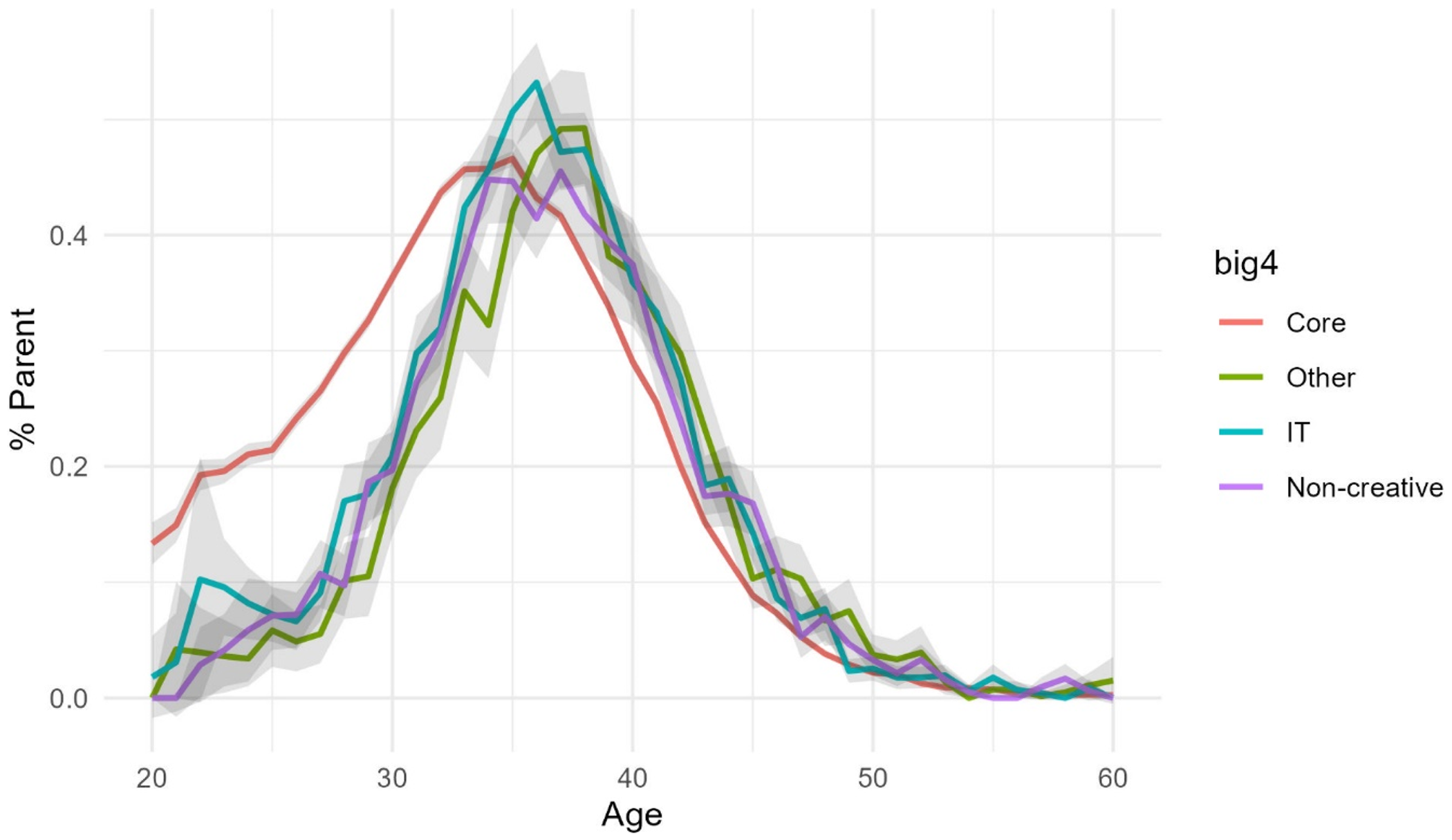
Percentage of workers having at least one child under 5 years old by occupational group.
The Impact of Parenting on Working Hours
Table 1 shows the results of the regression models for women and men and for parents of children of different ages. On average across the working population, workers with childcare responsibilities for young dependent children tend to work fewer hours than those who do not have children, or those who have older children. Confirming what many others have found before us, this analysis finds that women continue to take on the majority of childcaring responsibilities, which is reflected in the reduced number of hours worked for women compared with men. As a general trend, the gap in the working hours penalty narrows as parents get older.
OLS Regression of Working Hours per Week on Occupation, Age, Parenting, Covid-19 Period, and Additional Individual Characteristics
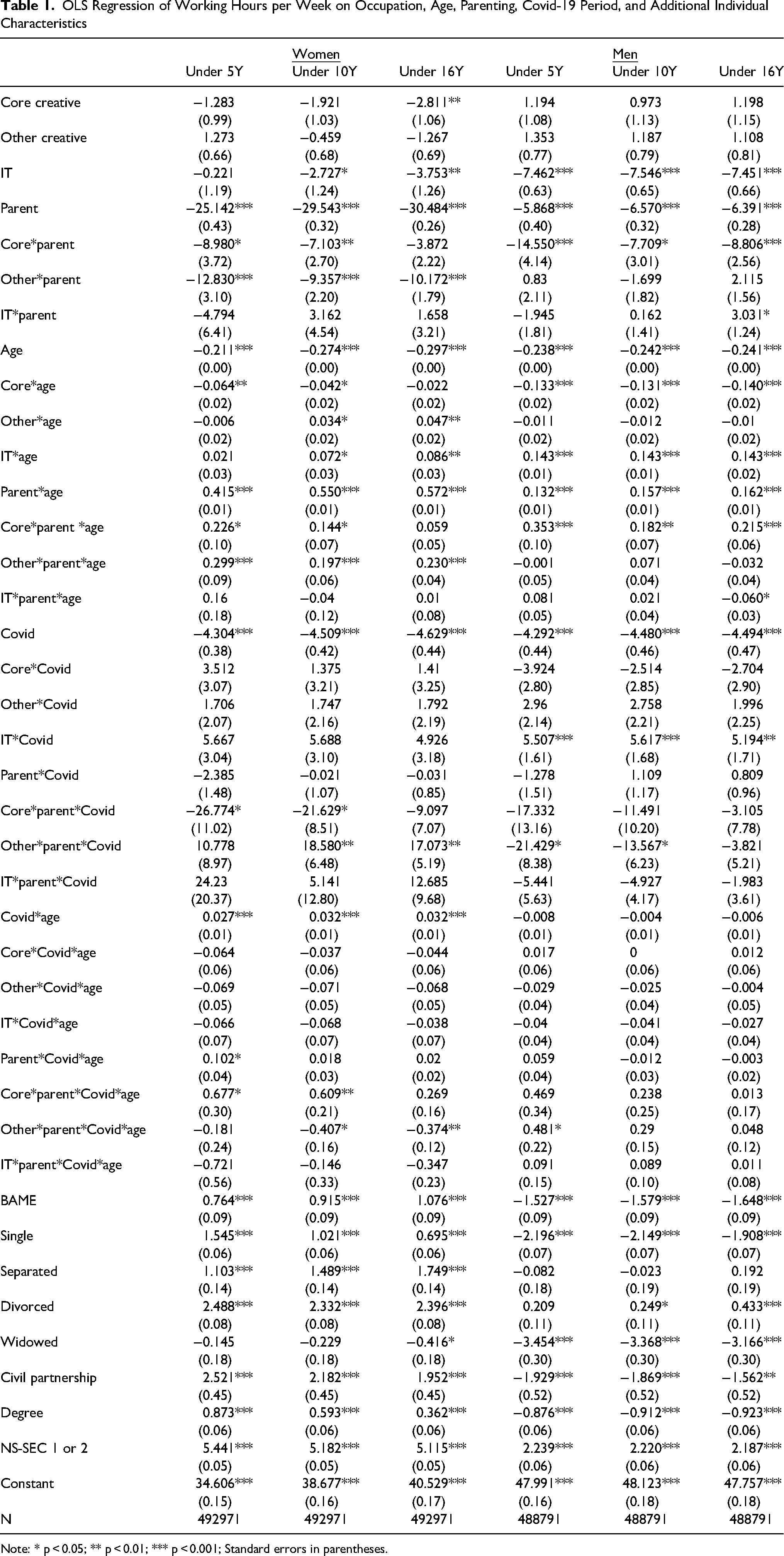
Note: * p < 0.05; ** p < 0.01; *** p < 0.001; Standard errors in parentheses.
For non-creative workers, this analysis finds an overall working hours penalty of parenting, and a positive interaction effect of parenting and age, showing that the working hours penalty decreases as parents get older. This is likely associated with older workers being more established in their roles and careers, as well as being more likely to have accrued the resources to afford childcare which would leave more time available to work.
Figure 2 illustrates the general parenting working hours penalty among non-creative parents. It depicts the effect of parenting with its interaction with age. At age 40, the mean age of those with children under 16 in the sample, the working hours penalty for women is around eight hours, whereas it averages at zero hours for men.
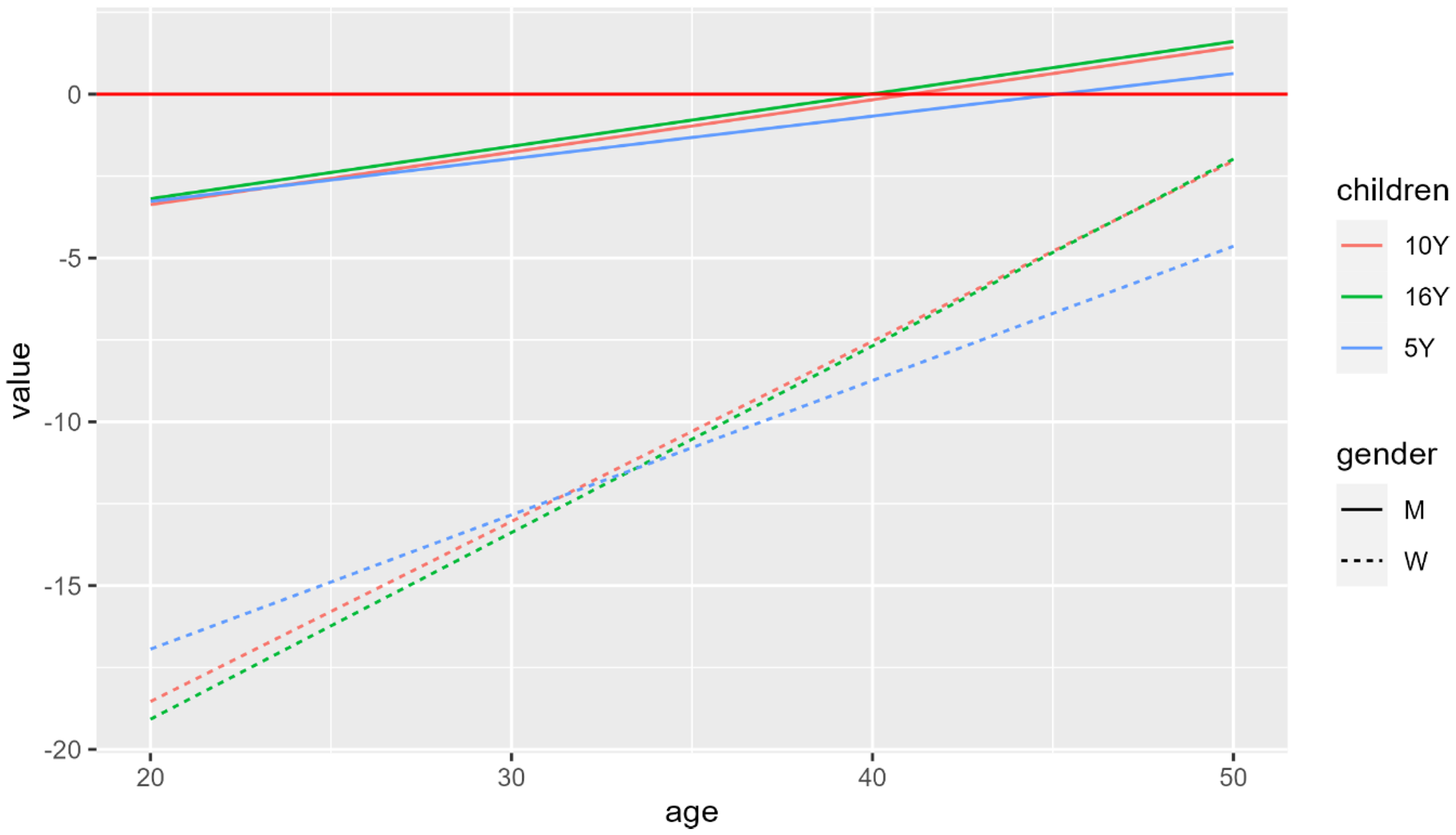
Parenting working hours penalty for non-creative workers, by gender and different ages of parents and children.
We find that women who live without spouses—single, separated or divorced- work more hours compared to married women, likely due to the necessity of compensating for the lack of second breadwinner in the household. Women in civil partnership also work more hours compared to married women, a result that might be related to the frequency of same-sex partnerships within this category. Interestingly, Ethnic minority workers (BAME), both men and women, with children in the household consistently work fewer hours per week. Additionally, having a degree increases the working hours of women with children while decreasing those of men with children. The findings concerning BAME status, degree, and marital status are also replicated in the simpler models without the interactions, demonstrating that these results are not artifacts of the complex model but are reliable (see Table A3 in the online appendix). However, these variables are not interacted with occupation and are thus computed across all occupations, predominantly non-creative ones. Therefore, they hold limited interest for our study.
The Impact of Parenting on Core Creative Workers
This analysis groups workers into the category of core creative workers, as described above. For this group, we find a more significant reduction of working hours related to parenting. For ease of reporting, this will be referred to as the additional core creative working hours penalty.
As Table 1 shows, this additional working hours penalty for core creative women is most pronounced for mothers of children aged under five (a nine-hour reduction). This effect decreases for mothers of older children (a seven-hour reduction for mothers of children aged under 10 and a non-significant effect for mothers of children up to 16 years of age). We find here again an attenuating effect of age which reduces the additional parenting penalty for mothers in the core creative occupations over time. Therefore, to fully capture the additional penalty for women core creative workers, the interaction effects of parenting and holding a core creative job are added together with the interaction effect with the mothers's age as shown in Figure 3.
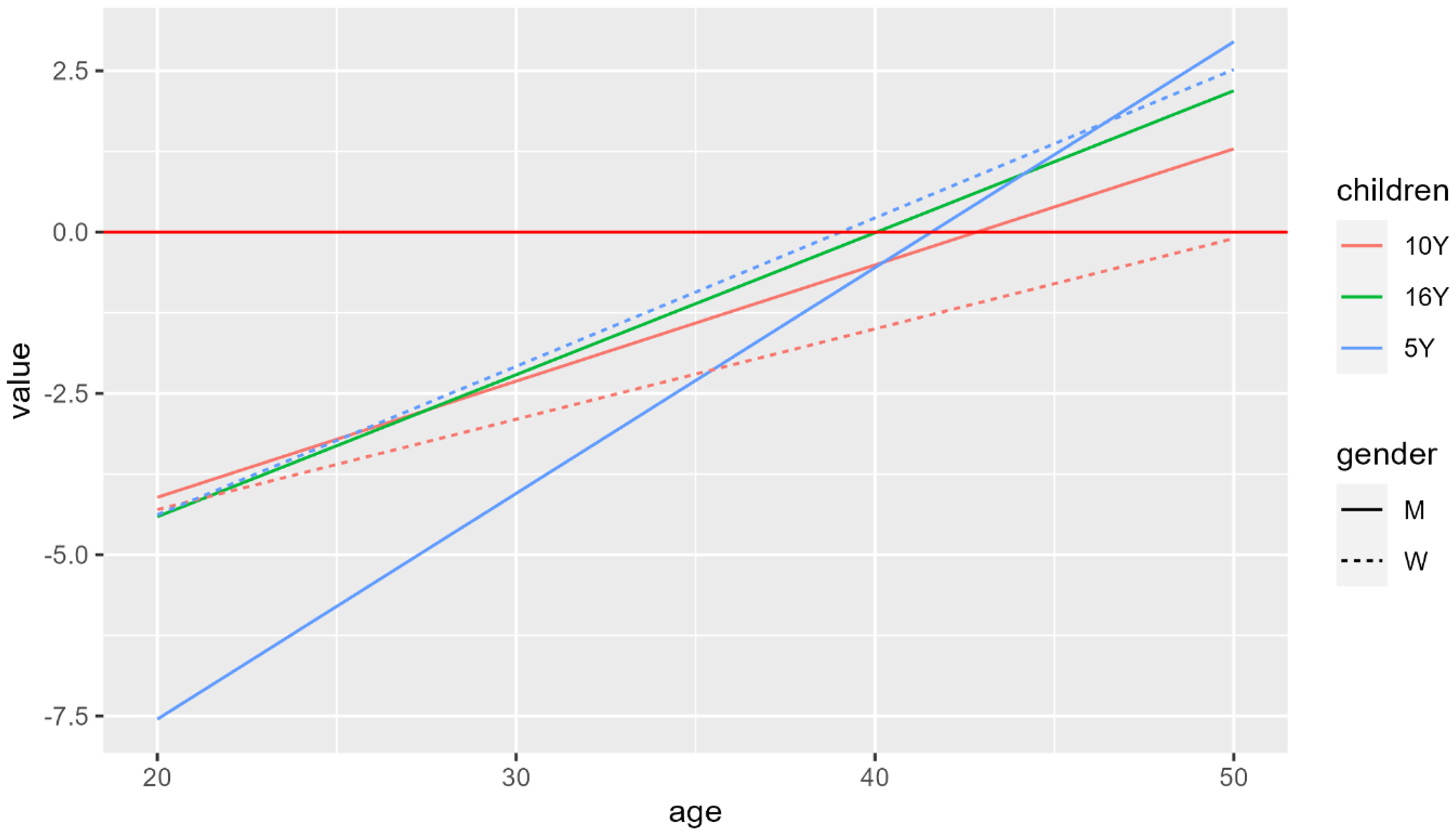
Additional parenting working hours penalty for core creative workers, by gender and different ages of parents and children.
For men in core creative jobs, there is similarly an additional core creative working hours penalty that decreases with age. Therefore, the additional penalty for men is composed of the interaction effect of parenting and being in a core creative job, as well as the interaction effect of parenting combined with working a core creative job and the men's age. Figure 3 depicts the level of the additional core creative working hours penalty dependent on the parent's age. The mean age is 42 for fathers of children aged up to 16 years old, and for these workers, the parenting penalty is close to zero. Interestingly, the negative effect of being a parent to children aged under five on the working hours of core creative fathers is greater than that of mothers. Moreover, the additional core creative parenting penalty is significant for fathers, regardless of the ages of the children.
Impact of the Pandemic on the UK Workforce and Creative Workers
During the Covid-19 pandemic, the UK Government introduced restrictions on social contact, resulting in the reduction of many business and employment activities. Hundreds of thousands of people were not working at all, but received income support from the Coronavirus Job Retention Scheme (for employees) or the Self-Employed Income Support Scheme for those who were self-employed 1 . Alongside the working restrictions, schools closed, and contact between households was also limited, including family members who were not living in the same household. Although the Labour Force Survey data used in this article does not hold specific variables relating to the use of these income support schemes, the effect of the pandemic on workers can be determined through looking at their reported weekly working hours in comparison to the period before the pandemic.
Looking at HHQLFS's second, third, and fourth quarters (Q2, Q3, Q4) of 2020 and the first quarter (Q1) of 2021 allows this analysis to explore the impact of Covid-19 related restrictions on workers.
During the first 12 months of the pandemic, the analysis finds a general reduction of around four working hours on average across the entire workforce (see Table 1). Broader evidence shows that this impact was highly varied across sectors and jobs. Jobs that required in-person activity, rather than remote forms of working such as working from home, and those that were not classified as essential work, were more strongly impacted (Fan & Moen, 2022).
The regression analyses show a reduction in working hours for mothers working in core creative occupations as a result of the pandemic. This reduction comes on top of the general parenting penalty, the additional penalty for core creative parents, and the general pandemic-induced impact on working hours. This is an additional contraction in working hours uniquely associated with the intersection of being a parent working in a core creative occupation during the pandemic. This finding highlights the specific difficulties of sustaining creative work for core creative mothers during this period.
In keeping with the broad trend, the effect is stronger for parents of younger children and diminishes as parents get older. For core creative mothers, the extra pandemic parenting penalty is strongest for young workers and starts to disappear around age 40 for parents of young children, and age 35 for parents of older children. We did find a similar significant effect for core creative fathers during the pandemic.
For a more complete picture of how these effects combine, we computed the marginal effects of parenting on working hours among the four occupational groups before and during the Covid-19 pandemic. Figure 4 presents the predicted working hours of women parents of children under five years old at age 33 (the mean age for having children under five). The graph shows that the parenting penalty outside of the pandemic period (nonparents – red column, parents – green column) is proportionally largest for core creative workers. During the pandemic, core creative workers were the only occupational group that saw their parenting penalty increase (non parents – blue column, parents – purple column) both in percentage and absolute value. Moreover, the gap between the working hours of parents before (green column) and during (purple column) the pandemic is greater for core creative workers compared to the other groups.
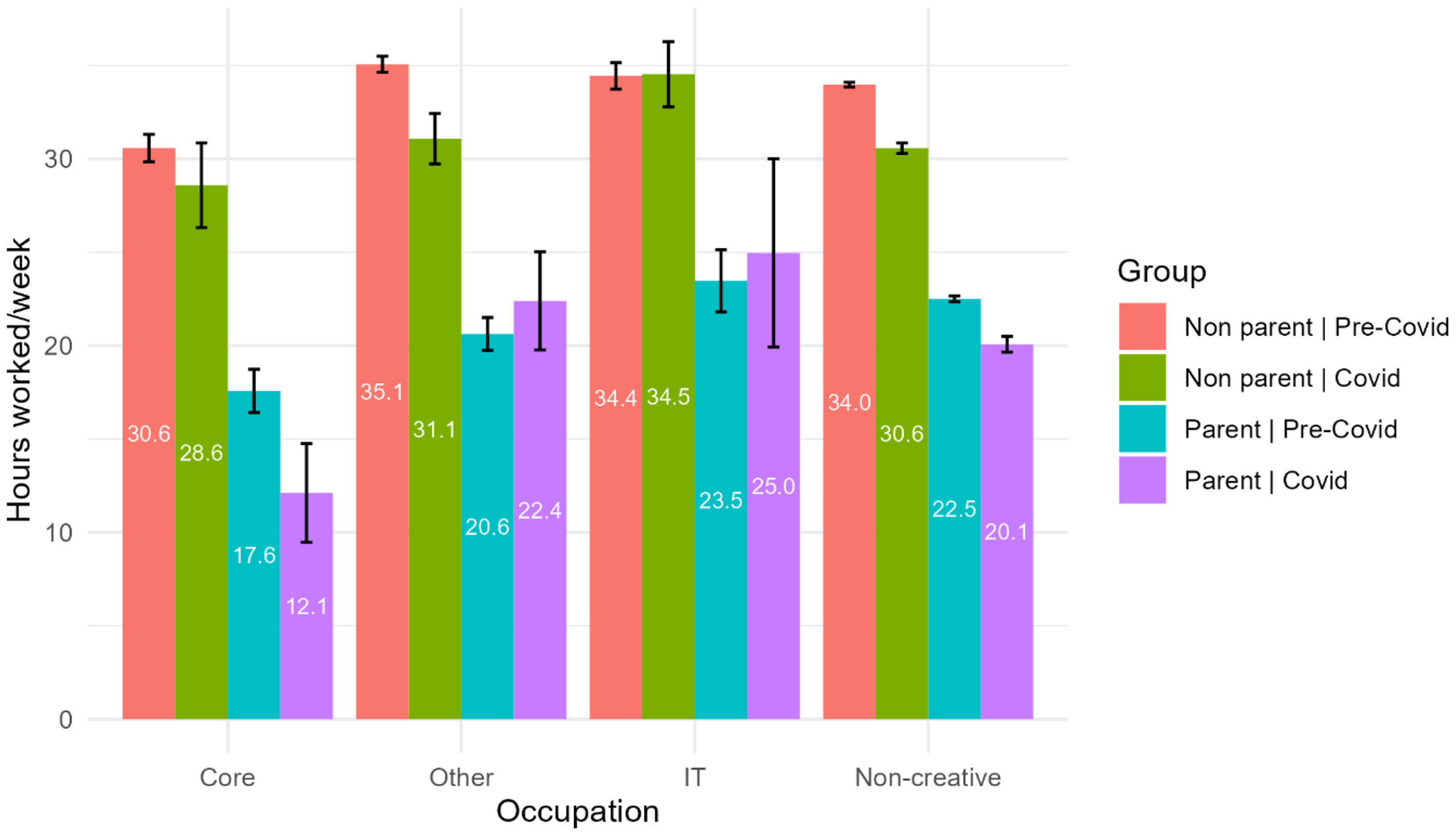
Predicted probabilities of hours worked for parents and non-parents prior to, and during, COVID-19 across different occupational groups. (Covariates are set at age 33, married, white British, with an academic degree and an NS-SEC 1 or 2 class background).
There are some limitations to the use of LFS data for studying these issues. Creative occupations see a high prevalence of the self-employed, with as many as 80% of workers in the music subsector working as freelancers or being otherwise self-employed without employees. Many self-employed were driven out of core creative occupations during the pandemic, as they were unable to sustain business activities during this time. This means that the remaining sample of self-employed core creative workers is composed of more established self-employed workers and those in the kinds of jobs that were less impacted by restrictions. Therefore, while one witnesses an average negative impact of the pandemic on the working hours of employees, the impact on a specific subset of creative workers may be much worse. The changing composition of the cohort of self-employed workers results, very likely, in an underestimation of the parenting effect, since younger creative workers were more likely to leave the creative occupations and therefore the sample is biased towards more resilient workers - likely older, white men (Brook et al., 2020).
This study also explored the extent to which some workers may have experienced a more enduring impact of the pandemic on their working hours than others. This was analysed by changing the pandemic control to account for two waves. The initial phase contains the three quarters of 2020 and the first quarter of 2021, and the second phase containing the second, third and fourth quarter (Q2, Q3 and Q4) of 2021. This however did not lead to significant results. It appears that hours lost due to parenting constraints recovered for workers in the core creative occupations as they did for the wider economy, although they continue to fall short of pre-pandemic hours. However, considering the job losses that have taken place in the creative sector and the enduring impact that pauses or delays in work experience can have on individual's career opportunities and wage-earning potential over the working life, further longitudinal research will be necessary to assess how the pandemic has differentially impacted mothers and fathers working in creative occupations.
Discussion
The review of the literature on the impact of the pandemic on the creative sector suggested a severe shock for specific creative occupations, particularly those with high levels of freelancers and those unable to return quickly to ‘in person’ forms of production. At the same time, the literature on inequalities in creative occupations suggested those with caring responsibilities, particularly parenting responsibilities, faced the highest barriers to career success. Consequently, we studied two research questions in this paper. First, what is the impact of parenting on creative careers? Second, what was the impact of the pandemic on creative worker parents?
For the first research question, the analysis gives several insights into the impact of parenting on creative careers. Aligned with previous research, which found that 43% of women in Britain across all occupations and sectors who returned to work after having their first child took up part-time work (Gumy et al., 2022), we found that having a child reduced working hours. However, working in one of the ‘core’ creative occupations - Publishing; Film, TV, Video, Radio and Photography; Museums, Galleries, and Libraries; and Music, Performing and Visual Arts- sees a greater working hours penalty than that suffered by all other parents, irrespective of occupation and the specific penalty suffered by women who are parents. For women in the ‘core’ creative occupations with young children (under five years old) this penalty equates to working around nine fewer hours per week in addition to the general penalty for being a woman parent (25 fewer hours per week). While this penalty does decline as children get older, there is still an additional loss of hours.
This quantifies, using a nationally representative dataset, the impact of parenting on women's creative careers. It reinforces the points made by previous research that creative occupations are not set up to support women who parent, and indeed exclude those women when they have these caring responsibilities. These exclusions are another layer of gender discrimination that supplements the exclusions of women from senior creative roles and the horizontal and vertical gender segregation common to many creative occupations.
Concurrently, the analysis shows the impact on fathers in core creative occupations. Fatherhood has seen comparatively less interest in the literature, and these findings provide an important contribution to potential research on this subject. Just as women suffer impacts on their hours worked, men face an additional parenting penalty. The models predict that a ‘core’ creative father aged 30 years old and who has a child aged under five, will work eight fewer hours a week than a comparable father working in the non-creative sector. Both impacts, for men and for women, are reduced as children get older, most likely connected to changes in caring patterns related to children's school attendance.
For the second research question, the analysis shows that pre-Covid, mothers of young children in core creative occupations worked, on average, almost half the hours of ‘core’ creative non-parents (18 compared to 31 h per week). The Covid-19 pandemic saw a severe hit to ‘core’ creative parents’ working hours, reducing them by nearly a third (from 18 h down to 12) and further increasing the gap with ‘core’ creative non-parents (who were working 29 h per week on average, a decline of only two hours per week). These figures, of course, pertain to those who remained in the workforce during that period. It is widely acknowledged that there were important gender, age, class, disability, race, and education differences in the rate of those leaving creative jobs in 2020.
The pandemic aggravated workforce related inequalities and negatively impacted parents, regardless of their occupation. Yet it seems to have had an especially serious impact for ‘core’ creative parents. In terms of the gender split, the pandemic's negative impact on working was felt most strongly by core creative mothers (compared with core creative fathers, or mothers in other sectors). This negative effect is particularly strong for mothers to young children, and is particularly for younger parents. For example, a 25-year-old mother in the core creative occupations with a child aged five would have experienced an additional pandemic parenting penalty of 10 hours, compared with a predicted three hours for a mother aged 35 years old.
Studies on the parenting penalty in the creative workforce are sparse. One notable exception is Lindemann et al.'s (2016) study of art alumni in the US, which examined income and found no evidence of a “parenting penalty” among women workers and a positive “parenting premium” among men. The discrepancies between their results and our findings of a parenting penalty for both men and women may stem from differences in the sample composition. While Lindemann et al.'s sample consists entirely of arts degree holders, our sample includes only 69% and 61% degree holders among core and other creative workers, respectively. Furthermore, their study does not include non-artistic workers as a reference category, as ours does. Another important difference is that they examined pay across the entire sample without distinguishing between types of art occupations. In contrast, we analyzed the parenting penalty across different creative occupation categories, focusing on working hours, which are indeed correlated with pay but vary significantly between different creative occupations. Therefore, the differences between our findings and Lindemann's underscore the need for further exploration in this subject and are not necessarily contradictory.
Conclusion
Following the financial crisis of 2008, research on the screen sector suggested significant gender differences in rates of individuals leaving film and TV roles (Skillset, 2010). Essentially, women's careers suffered more than men's because of the external shock to the overall economy, and creative occupations within it.
So then, as now. The external shock of the pandemic is again having profoundly gendered impacts. These impacts sit alongside the exclusions along lines of race, class, religion, age, education and disability, all of which are likely to have been aggravated by the pandemic (Banks, 2020; Banks & O’Connor, 2021; Comunian & England, 2020; de Peuter et al., 2022; Eikhof, 2020; Gillmore et al., 2024; Joffe, 2021; Kay & Wood, 2020), even in creative occupations that were able to re-open production quickly, such as Screen, or shifted working practices away from in person offices, such as Publishing, as schools and childcare remained closed.
For creative parents this was a disastrous moment. For mothers in core creative occupations, as we have shown, there were huge negative impacts. Our analysis demonstrates quantitatively, that ‘core’ creative mothers suffered the heaviest reduction in their working hours as a result of the pandemic. In the longer term, this is likely to lead to fewer work opportunities for these mothers, based on the importance of networks and the short timescales for hiring in these ‘core’ creative sectors (Caves, 2000).
The literature on parenting suggests lower hours impacts negatively on career development for mothers in all occupations. This is because of several factors, including loss of networking opportunities and the loss of workplace experience, alongside employers’ perceptions and discriminatory actions. Networking and experience are crucial for ‘core’ creative career advancement, given the role of reputation and networks in creative labour markets (Umney & Kretsos, 2015). Another important factor is the effect of self-employment which is the most common employment arrangement among core creative workers. Additional analyses (available on request), indicate that the general negative parenting effect on working hours is stronger for the more vulnerable and precarious self-employed workers. This was even stronger during the pandemic period, and particularly for self-employed mothers in the ‘core’ creative occupations. The additional hit to ‘core’ creative mother's working hours suggests that even where those mothers were able to stay on in their ‘core’ creative occupations, there are likely to be longer term impacts on their likelihood of career advancement as a result of the additional, pandemic, parenting penalty.
This analysis is, though, only a starting point. More research needs to be done to bring the quantitative perspectives into dialogue with qualitatively-driven research so vital in setting the agenda in this area. Much can also be learned from research in areas adjacent to creative occupations, for example ‘new economy’ tech firms that exhibit similar sorts of gender inequalities (Hart, 2024; Mickey, 2022). This literature may also build on our findings of a specific motherhood penalty in creative work.
In the British context, groups such as Parents In Performing Arts and Raising Films have pressed the case for understanding the demands of caring responsibilities in the context of a creative career. The pandemic has made their work more urgent, and the research presented in this paper reinforces the need for change in a creative sector that has been, is presently, and will likely continue to penalise those who have children. This is not only profoundly unfair on those individuals. It also diminishes contemporary culture, removing mothers’ perspectives if nothing is done by creative employers and policymakers to rectify the career penalties made worse by Covid-19.
The other, key, future research question is how best to mitigate these impacts. As exclusions from creative occupations diminish individuals’, communities’, and nations’ cultures, strategies for how best to address inequalities are essential. For sure, general transformations of gender relations and welfare state systems are necessary. Yet the precise interventions, answers to the ‘what works’ questions (Wreyford et al., 2021b), change over time. By showing the nature of the problem this analysis is hopefully the start of future research synthesising responses that mean the next crisis- whether financial, public health, or otherwise- is met by a set of creative occupations made more resilient by research.
Many of the original (e.g., Gill & Pratt, 2008; McRobbie, 2016) and more recent (Gu, 2023) scholars working on creative occupations have theorised that the labour conditions, and labour inequalities, characteristic of creative workers may be emerging in other highly skilled professions. As a result, understanding inequalities in creative occupations, and the impact of the pandemic on those inequalities, has important implications beyond creative occupations scholarship. Understanding inequalities also gives an indication of the general gender inequalities to be found in the UK. The impact of the pandemic falling most heavily on one specific group illustrates the precarious nature of work in the creative sector (Skaggs & Aparicio, 2023) and the limitations of the British welfare state's response to the crisis (Gillmore et al., 2024).
Supplemental Material
sj-docx-1-wox-10.1177_07308884241312897 - Supplemental material for The Parenthood Penalty in Creative Occupations: How the Covid-19 Pandemic Made Existing Inequalities Worse
Supplemental material, sj-docx-1-wox-10.1177_07308884241312897 for The Parenthood Penalty in Creative Occupations: How the Covid-19 Pandemic Made Existing Inequalities Worse in Manufacturing by Tal Feder, Rebecca Florisson, Dave O’Brien, Mark Taylor and Siobhan McAndrew in Work and Occupations
Footnotes
Declaration of Conflicting Interests
The authors declared no potential conflicts of interest with respect to the research, authorship, and/or publication of this article.
Funding
The authors disclosed receipt of the following financial support for the research, authorship, and/or publication of this article: This work was supported by the Arts and Humanities Research Council, AH/V00994X/1 COVID-19: Impacts on the cultural industries and implications for policy.

Supplemental Material
Supplemental material for this article is available online.
Notes
Author Biographies
References
Supplementary Material
Please find the following supplemental material available below.
For Open Access articles published under a Creative Commons License, all supplemental material carries the same license as the article it is associated with.
For non-Open Access articles published, all supplemental material carries a non-exclusive license, and permission requests for re-use of supplemental material or any part of supplemental material shall be sent directly to the copyright owner as specified in the copyright notice associated with the article.
