




Abstract
Understanding how occupations change their judgments about organizations has important consequences for occupations themselves, organizations, and ultimately for institutional change. Collectively held judgments about the value of specific organizational forms are difficult to change because occupations share normative understandings about what is good practice and discriminate across organizations based on this knowledge. Given the difficulty of changing collectively held judgments in occupational communities, the question asked in this article is: How does normative judgment change about organizations develop within an occupational community? We investigate how judgement change occurs in an occupational community in the context of the television broadcasting sector in South Korea. We study how producers in public broadcasters changed their respective judgments about public broadcasters and new commercial broadcasters. Producers found expressing judgment change difficult initially, yet judgment change among more experienced producers enabled it to spread among rank-and-file producers, ultimately leading to an “exodus” of producers from public broadcasters. Findings suggest that occupational members at different stages of their careers play distinct roles in bringing about collective judgment change in occupations. Our study highlights the importance of normative judgments by expert occupations as an impactful means by which occupations can withdraw cooperation or sever their relationship with organizations. The article also contributes to the study of occupational communities in creative industries.
Keywords
Today, most occupations work in or in affiliation with organizations (Bechky, 2003; Bechky & Chung, 2018; Huising, 2014, 2015). The support of occupations is essential for an organization's ability to coordinate and manage expert work (Raelin, 2011; Bechky & Chung, 2018), solve complex problems, and uphold its reputation and performance (Almandoz & Tilcsik, 2016). Neglecting the values of key occupations can be costly for organizations as occupational members can withdraw support (Sandholtz, 2012; Turco, 2012), and in extreme cases leave the organization for another (Schabram & Maitlis, 2017). Hence, occupational embeddedness in organizations entails that organizations induce cooperation from occupational members (Bechky & Chung, 2018). We examine the role of occupational judgment change in an occupation's propensity to lend its cooperation to organizations, a hitherto overlooked aspect of the relationship between occupations and organizations.
Research on occupational judgment has primarily focused on knowledge and cognition, in the form of expert judgment that enables professionals to assert authority and control their work (Evans & Silbey, 2022; Huising, 2014). We focus on an occupation's normative judgment of organizations, which we argue is an equally important source of discretion and influence even as it has been relatively overlooked in the literature. We define an occupation's normative judgment as a social evaluation of the appropriateness of organizations held by an occupational community. Positive judgments of organizations by occupations are important as they provide the rationale for the normative adhesion of occupational members to an organization's mission. Changes in occupations’ judgment of organizations can be impactful, affecting organizations’ ability to control occupations and benefit from their skills and expertise. A real-life example of occupational judgment change can be found in the current crisis experienced by the National Health Service (NHS) in the United Kingdom, where nurses, doctors, and other healthcare workers are leaving en masse citing an inability to do their jobs properly despite previously having expressed deep commitment to the NHS (Weyman et al., 2023). 1
As employees, occupational members are primary stakeholders in evaluating the standing of their organization with respect to other organizations. However, collectively held judgments by occupations about the value of specific organizational forms are difficult to change because occupations share normative understandings about what is good practice and discriminate across organizations based on this knowledge (Anteby et al., 2016; Evans, 2021; Reid & Ramarajan, 2022). Judgments by occupational groups about organizations are likely to be formed through a process of socialization in occupational values that requires time and effort (Anteby et al., 2016: 191, Bucher & Strauss, 1961; Van Maanen & Barley, 1984). Allegiances to the organization held by occupational members as employees can also act as a barrier to occupational judgment change (Sluss & Ashforth, 2007). Given the difficulty of changing collectively held judgments in occupational communities, our research question is: How does normative judgment change about organizations develop within an occupational community?
Despite the wealth of accumulated research on occupations in organizations, there is a dearth of work examining how members of an occupation change their judgment, and their allegiances, between organizations. Understanding how occupations change their judgments about organizations has important consequences for occupations themselves (Barley & Tolbert, 1991), organizations (Almandoz, 2012), and ultimately for institutional change (Bechky, 2011; Lounsbury & Kaghan, 2001), as the evaluation of expert occupations can impact the relative standing of organizations in an industry.
We investigate how judgment change occurs in an occupational community in the context of the television broadcasting sector in South Korea. The creative industries rely on tacit knowledge held by occupations to produce content that is esthetic rather than utilitarian (Lampel et al., 2000). Producers play an important role in bringing together the creative and business aspects, managing projects with unique combinations of inputs in a highly uncertain environment characterized by fluctuating audience preferences (Foster, 2013). We study how producers in public broadcasters changed their respective judgments about public broadcasters (PBs) and new commercial broadcasters (NCBs). This occupational community had for decades associated PBs as the best organizational form in which their values, such as creativity, experimentalism, and pursuit of public good, could be realized. Prior to 2008, there was little to no movement out of PBs. We examine how producers’ allegiance to PBs changed in response to organizational change that they did not favor and how NCBs, that were initially vilified, came to be preferred. Eventually, a significant number of producers moved from PBs to NCBs: out of a total of approximately 300 entertainment and drama producers in PBs, 111 left during the years of our observation. Producers found expressing judgment change difficult initially, yet judgment change among more experienced producers enabled it to spread among rank-and-file producers. An extreme case of occupational judgment change that developed amidst strong occupational disapproval in the early years, our case provides a rare opportunity to examine how collective social evaluation is revised in an occupation.
Occupations Evaluating Organizations
Occupations are “social worlds” where processes of evaluation and legitimation occur (Strauss, 1978; Bechky, 2020). Occupational members assert the worth of tasks and also evaluate the authenticity and appropriateness of other members of the occupation (Pratt et al., 2019), other occupations (Bechky, 2020), and organizational forms (Briscoe, 2006; Elsbach & Breitsohl, 2016; Reid & Ramarajan, 2022). The evaluation processes within occupational communities produce a social ordering in which occupational values play a central role (Strauss, 1978). For example, recent studies of sex workers (Toubiana & Ruebottom, 2022) and firefighters (Pratt et al., 2019) showed that occupations stratify their members according to shared moral standards within the occupation.
The social judgment literature has maintained that individuals draw on their perceptions of organizational characteristics to form judgments about whether the organization is appropriate as well as of benefit to them and their social group, and adjust their behavior toward the organization accordingly (Bitektine, 2011). When a social judgment about an organization is broadly accepted and disseminated, it acquires a rule-like quality (Bitektine, 2011, p. 166). Drawing on this, we define occupational normative judgment as the accepted social evaluation of organizations within an occupation. Primary considerations in assessing organizations’ propriety for occupations include the organization's congruence with occupational values (Reid & Ramarajan, 2022) and the extent to which the organization is seen to enable the occupation's control over its work (Bechky & Chung, 2018).
While theorization on occupations has hitherto privileged the role of occupations’ expert judgment on work in the maintenance of professional authority and occupational jurisdiction (Evans & Silbey, 2022), we submit that occupations’ normative judgments about the appropriateness of organizations are an important and hitherto relatively neglected aspect of occupations’ influence on organizations. Empirical examples of the impact of occupational judgment are abundant in the literature on occupations and organizations, demonstrating how occupational members withdraw cooperation from organizations in order to enact occupational values or protect valued identities. These include maternity support workers undermining the commercialization of services provided to new mothers (Turco, 2012), nurses transgressing hospital policy in order to enact preferred occupational identities (DiBenigno, 2022), and journalists shunning organizations whose practices fall short of occupational standards (Reid & Ramarajan, 2022).
For occupations embedded in organizations, judgment is likely to represent a compromise between occupational values and organizational priorities, reflecting the fact that organizations play a significant role in socializing occupational members (Barley & Tolbert, 1991; Muzio et al., 2019). Moreover, occupational members can feel obligated to place organizational priorities first (Augustine, 2021), suspend their judgment in favor of hierarchical consensus (Jackall, 1988), and/or engage privately in moral pursuits while remaining silent in public (Anteby, 2013). Indeed, studies have shown that organizational demands can result in initial occupational mandates being compromised (Augustine, 2021) and in the editing of occupational identities (DiBenigno, 2022) and work practices (Huising, 2014; Pine & Mazmanian, 2017; Waring & Currie, 2009).
Because social evaluations about organizations acquire rule-like quality over time (Bitektine, 2011), we expect occupational normative judgment to endure once formed. However, institutional change—such as deregulation, or the emergence of new organizational forms—can disrupt existing consensus within occupational communities over the social evaluation of organizational forms (Tost, 2011). The new institutional conditions must be interpreted by occupational members whose identities and livelihoods are directly impacted by ensuing changes to their organization (Bacon et al., 2010). When institutional change induces organizational change that is negatively received by stakeholders or the public, occupational members in the organization can feel their ability to control their work is threatened (Jiang, 2021; Reay & Hinings, 2005, 2009). Subsequently, established evaluations of organizations are likely to be re-assessed (Bitektine & Haack, 2015; Tost, 2011).
The occupations literature has suggested that large-scale institutional and organizational changes are likely to force occupational members to revisit existing occupational values in new situations and to construct new shared understandings (Evans, 2021; Kellogg, 2009; Leonardi & Barley, 2010: 15). Yet we do not adequately understand how such processes affect the social ordering of organizations within occupational communities. Moreover, recent scholarship has suggested that the re-assessment is likely to engage with values that are derived occupationally, those that are derived organizationally, and those that are derived personally (Kellogg, 2009; Manning & Anteby, 2016; Sonenshein, 2007). For example, chemists drew on values inculcated in their occupational roles in reacting to green chemistry (Howard-Grenville, 2017); surgeons who supported a reduction of working hours drew on personal values that conflicted with occupationally held values (Kellogg, 2009); and journalists who came to view working for large media corporations as immoral did so based on experiences of discrimination (Reid & Ramarajan, 2022).
Recent scholarship on occupational activism (Augustine & King, 2022; Cornfield, 2015; Cornfield et al., 2019) has suggested that social movements can provide impetus for the formation of occupational judgment or for changes in existing judgments. This literature has demonstrated how occupational members influenced by the civil rights and environmental movements become carriers of movement ideals in their employing organizations, holding their organizations accountable to these ideals (Augustine & King, 2022; Cornfield et al., 2019). While research has found activism to be salient during the formative years of occupations established to implement organizational mandates stimulated by social movements, such as sustainability officers, studies have suggested that activism based on the influence of social movements can give way to organizational priorities as the occupational role becomes institutionalized (Augustine, 2021; Augustine & King, 2022).
Most studies on value-based dissent by occupations have demonstrated the impact on organizations of actions undertaken by individual occupational members. Our study goes further to examine how occupational dissent develops within a collectivity. Recent scholarship on occupations has suggested that collective judgment change in an occupational community is likely to be complicated by internal heterogeneity. Sources of pluralism in what occupational members value include internal stratification within occupations due to demographic attributes (Ashcraft, 2013; Turco, 2010) or differences in levels of stigmatization (Toubiana & Ruebottom, 2022), and generational differences resulting in exposure to different institutional contexts (Reid & Ramarajan, 2022). Taken together, recent advancements in the occupational literature suggest that changes in the social evaluation of organizations are likely to be informed by the different lived experiences of occupational members.
Occupational Communities in the Creative Industries
Creative industries are characterized by dynamism as organizations seek to respond to changing esthetic trends, and by ambiguity, rising from the difficulty of predicting audience preferences (Lampel et al., 2000). The sector is highly unequal and stratified into a core-periphery structure due to a “winner take all” rule (Dowd & Park, 2023; Foster, 2013). Companies in the creative industries must balance providing structural support to creative activity without stifling creativity. Hence, scholars have pointed to ongoing tension between bureaucracy and commercialism on the one hand, and creativity on the other (Lampel et al., 2000, p. 265).
Creative occupations often display a publicly known status hierarchy (Foster, 2013), yet they have developed strong norms around cooperation and collegiality rather than competition and conflict (de Laat, 2015). This reflects the importance of network referrals in a flexible labor market organized around project work (de Laat, 2015; Schwartz, 2018). Scholars have shown that occupational communities in creative industries often replace organizations in providing training, developing careers, nurturing creativity, and building collective voice for workers (Cornfield, 2015; de Laat, 2015). A burgeoning literature on occupational activism in the creative industries has found that occupational communities are platforms for efforts to build social cohesion and self-determination for occupations in an environment increasingly marked by precarity (Cornfield, 2015). Cornfield (2015) has shown that as large music companies vertically disintegrated and entrepreneurialism emerged as an organizing logic in the music industry, activism in this industry has increasingly taken the form of peer organizing within the occupational community. Finally, occupational communities in this sector also play an important role in constructing meaning for members, often helping workers accept and make sense of precarity (Umney & Kretsos, 2015). Skaggs (2019), for example, found that the community of songwriters socialized novice members into normalizing rejection and failure as part of the process of building a career in songwriting. Studies have also shown that mentoring and peer support in creative occupational communities construct work-based identities and norms around collaboration (Schwartz, 2018). Hence, occupational communities can mold members’ values, motivations, and attitudes in contexts such as the creative industries where the average worker has limited connection with organizational structures.
Although it features many of the characteristics described above, the television industry relies on a relatively stable funding model and a less fragmented labor market compared to adjacent industries, such as film (Percival & Hesmondhalgh, 2014, p. 195). For the first half of its history, television was dominated by a small number of large, vertically integrated broadcasters engaged in production, distribution, and exhibition of content for their terrestrial broadcasting channels (Foster, 2013). In key Western economies, governments introduced legislation to break up vertical integration in broadcasting in the 1990s (Morris et al., 2023), prompting large television broadcasters to outsource production work. Despite this, production of key programs remains in-house and broadcasters often retain control over key facets of content development and production, especially over prime-time drama (Morris et al., 2023, p. 348).
The occupation of television producers
Studies of television producers have described the occupation as an “intermediary” overseeing the creative production process, synthesizing disparate ideas and actions into a coherent whole (Lingo & O'Mahony, 2010). Producers not only ensure the quality of the creative content but also manage resources and talent to complete the project on budget and on time (Cantor, 2017). They work with many different occupations, including actors, writers, technicians, and network executives across multiple organizational settings (Cantor, 2017). If feature films are the director's medium, scholars have viewed television as the producer's medium (Newcomb & Alley, 1983). Within television, entertainment is seen as the “cash cow” that must earn the revenue that pays for more informative programs such as news, yet scholars have found that entertainment producers combine a market orientation with concerns for creativity and public good (von Rimscha & Siegert, 2011). The latter orientations often place producers in conflict with network executives’ concerns for profit (Cantor, 1971).
Research Context
Institutional change affecting the South Korean television industry
The South Korean media sector has historically been led by two PBs (labeled here as A and B) that held rights to general programming, allowing them to produce programs across different genres. These broadcasters dominated the market despite competition from a private terrestrial broadcaster as well as cable television. Unlike public broadcasters in other advanced economies, South Korean PBs exerted influence not only over news and current affairs but also in entertainment and drama. Media independence has increased over the years as South Korea has democratized since the late 1980s. Historically, general programming broadcasters were vertically integrated and engaged in in-house production, distribution and exhibition. Similar to other countries, outsourcing was legally mandated since the 1990s and vertical disintegration of major broadcasters accelerated since the 2000s when broadcasters were restricted from solely contracting with subsidiaries (Han, 2015). Nevertheless, the major broadcasters continued to produce prime-time content and entertainment programs in-house (Han, 2015).
In 2008, a conservative government sought to exert more influence over public media as well as to deregulate the sector. The ruling party passed a series of amendments to media-related laws, resulting in the founding of four NCBs in 2011. Media professionals and the public viewed the move as politically motivated because of the government's antagonistic stance toward public media and its close relationship with the NCBs’ parent companies, influential daily newspapers noted for their conservative ideology (Hankyoreh, 2008). Indeed, CEOs and many board members in both PBs were replaced during the following years with pro-government personnel.
Unions in PBs, to which the vast majority of workers belonged, mounted a series of strikes to protest the regulatory changes leading up to and especially during 2012, an election year. However, the strikes ultimately failed to reverse the tide as the incumbent conservative party was re-elected in a landslide victory. Management in public broadcasters proceeded to retaliate against strike participants returning to work and tighten control over the work process (Journalist Association Newsletter, 2014).
NCBs began broadcasting in 2011 with programs that largely focused on news, reflecting a symbiosis with their parent companies in the newspaper business as well as the difficulty of building capacity in entertainment and drama in a short timeframe. While entertainment and drama programs became more established around 2014, NCBs’ production system in this area relied primarily on outsourcing (Choi & Han, 2015). As a result, the number of independent studios in South Korea increased from 291 in 2008 to 516 in 2012 (Han, 2015).
The South Korean case represents an extreme case of institutional change where four new entrants disrupted a relatively small media market, as well as an extreme case of judgment change based on the high standing of PBs in contrast to the illegitimate status of NCBs at the start of our study. However, in other ways, the case reflects a common challenge faced by public media globally, where public broadcasters are increasingly under threat from a diversified media landscape and the proliferation of “fake news.”
Producers in South Korean broadcasting
We examine producer-directors, an in-house occupation in broadcasting companies whose work spans the gamut of roles performed by commissioners in the United Kingdom and producers and directors in the United States (Hesmondhalgh & Baker, 2008). The centrality of producers to broadcasting justifies examining institutional change in South Korean media through judgment change in this occupation. Following international convention, we hereby refer to producer-directors as producers. Korean producers’ occupational self-conception is deeply rooted in the organizations that employ them; hence, one survey cited organizational culture as a primary determinant of producers’ job satisfaction (Kim, 2016). As of 2014, there were 2,337 producers in the three terrestrial broadcasters, including 1,376 in the two PBs (Korea Communications Commission, 2015). As stated earlier, approximately 300 of the latter were assigned to entertainment and drama. 96% of in-house producers in broadcasting companies held permanent contracts (Korea Communications Commission, 2015), indicating that the occupation is highly privileged relative to others in the industry.
As orientations among producers differ according to the nature of the programs they oversee (Cantor, 1971; von Rimscha & Siegert, 2011), we focus on entertainment and drama producers, the main occupational community to demonstrate judgment change and eventually move to NCBs. The cooperation of this occupation is consequential for broadcasters, as entertainment and drama content generates the highest proportion of broadcasters’ income, responsible for 42% of total income in 2013 (compared to 6.6% for news and documentaries) (Han, 2015). In-house producers exercised power and influence over other occupations involved in content production as well as over freelance producers and producers hired by independent studios, playing a key role in the selection of independent studios, writers, and actors (Han, 2015, p. 70). However, their expert authority in the organization was negotiated, and, as shown in our Findings, could be drastically curtailed.
Producers’ roles were differentiated by Assistant Director, Producer-Director, and Chief (or Executive) Producer (Kim, 2016). Assistant Directors were Producer-Directors in training. Producer-Directors were responsible for developing and producing in-house programs, and for assessing and selecting proposals developed by independent studios. After acquiring several years of experience, Producer-Directors were promoted to the Chief Producer role whose responsibilities included securing resources, coordinating production plans and broadcast schedules, and overseeing the contractual relationship with outside production companies (Kim, 2016). The role of Chief Producer typically was awarded to producers with at least 19 years of experience.
Data Collection
Our primary data sources comprised of archival material and interviews. We collected approximately 145 newspaper articles that covered changes in media organizations, fliers, pamphlets, newsletters, and social media pages authored by unions, occupational associations, and management groups of A and B, and all newsletter issues published by the national professional association representing producers, the Producers Journal, between 2010 and 2017 (see Table 1). The archival material we collected included many interviews with producers, which we combined with our own. In total, we analyzed just under 2,000 pages of documents. Additionally, we obtained a list of producers who moved from PBs to NCBs between 2008 and 2017 from the HR departments of A and B. Archival sources referenced in this paper are listed in the Appendix.
Overview of Data Collection.
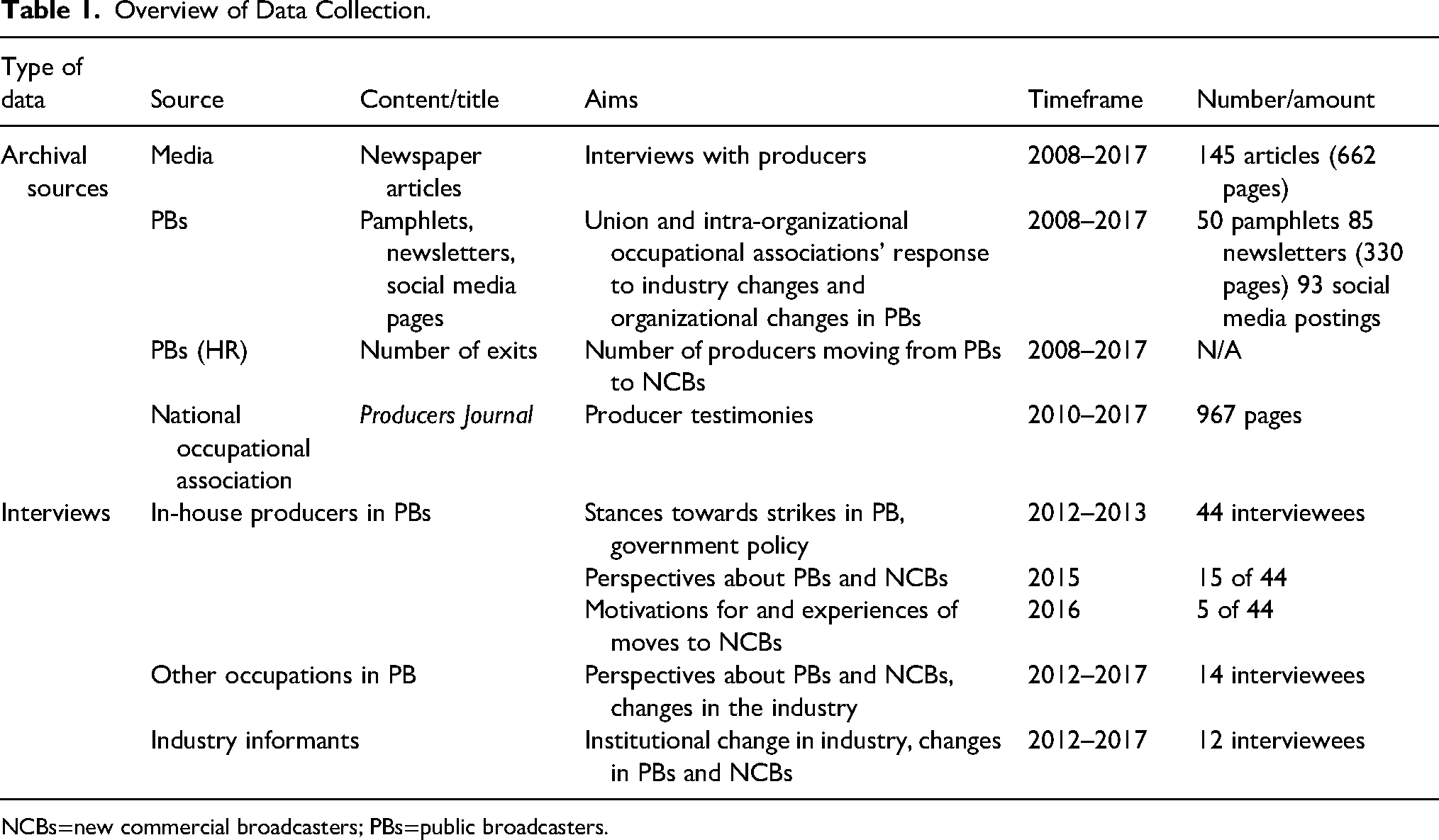
NCBs=new commercial broadcasters; PBs=public broadcasters.
In addition to archival data sources, the second author conducted direct interviews during fieldwork from January 2012 to December 2016. As part of a larger project on changes in the media industry, this author conducted 72 interviews with 44 in-house producers at the two PBs. Interviews were unstructured, lasted an average of 87 min and were held at the respondents’ workplaces and social settings. A first round of interviews between 2012 and 2013 asked participants about the 2012 strikes and their views about the launch of new broadcasters (52 interviews; 8 producers interviewed twice). Fifteen out of the 44 initial interviewees responded to a second round of interviews conducted in 2015 about producers’ views on developments in the two organizational forms. Five interviewees who participated in the previous two rounds and had moved to NCBs were interviewed in 2016 about their job moves. Finally, 26 interviews were conducted with employees outside of the producer occupation and informants in the media industry, including the sector-wide union, academics, and workers from other media organizations. We refer to the interviewees by denoting P for producers, J for journalists, and M for management, followed by a randomly assigned number. An overview of data collected for this article is presented in Table 1.
Data Analysis
Our overall analytical strategy focused on understanding how the two groups of broadcasters changed during the observation period as well as how judgment change unfolded within the community of producers in PBs.
Constructing a narrative story line
As an initial step, we constructed a narrative story line by dividing our data into chronological phases (Langley, 1999). Our starting point was 2010, when NCBs started recruiting workers in anticipation of program launch in 2011. We first generated a chronology of significant events during 2010–2017, including legislative changes, events that signaled significant organizational change in broadcasters, and job moves by producers (see Figure 1). We used these events to demarcate analytically distinct yet interdependent phases, deal with temporal data in “chunks,” and identify continuities and discontinuities that assisted us in understanding how changes in the organizations influenced actions among occupational members, and how actions taken in earlier phases affected those taken in subsequent periods (Langley, 1999). Based on this analysis, we developed a narrative description for each phase, which helped us identify different stages in the unfolding of judgment change in the producer community. The resulting three phases can be summarized as cracks in the legitimacy of PBs (2010–2012), spread of doubt in PBs and initial successes in NCBs (2013–2014), and exodus from PBs (2015–2017). Figure 1 provides a summary of the key events in the narrative story line.
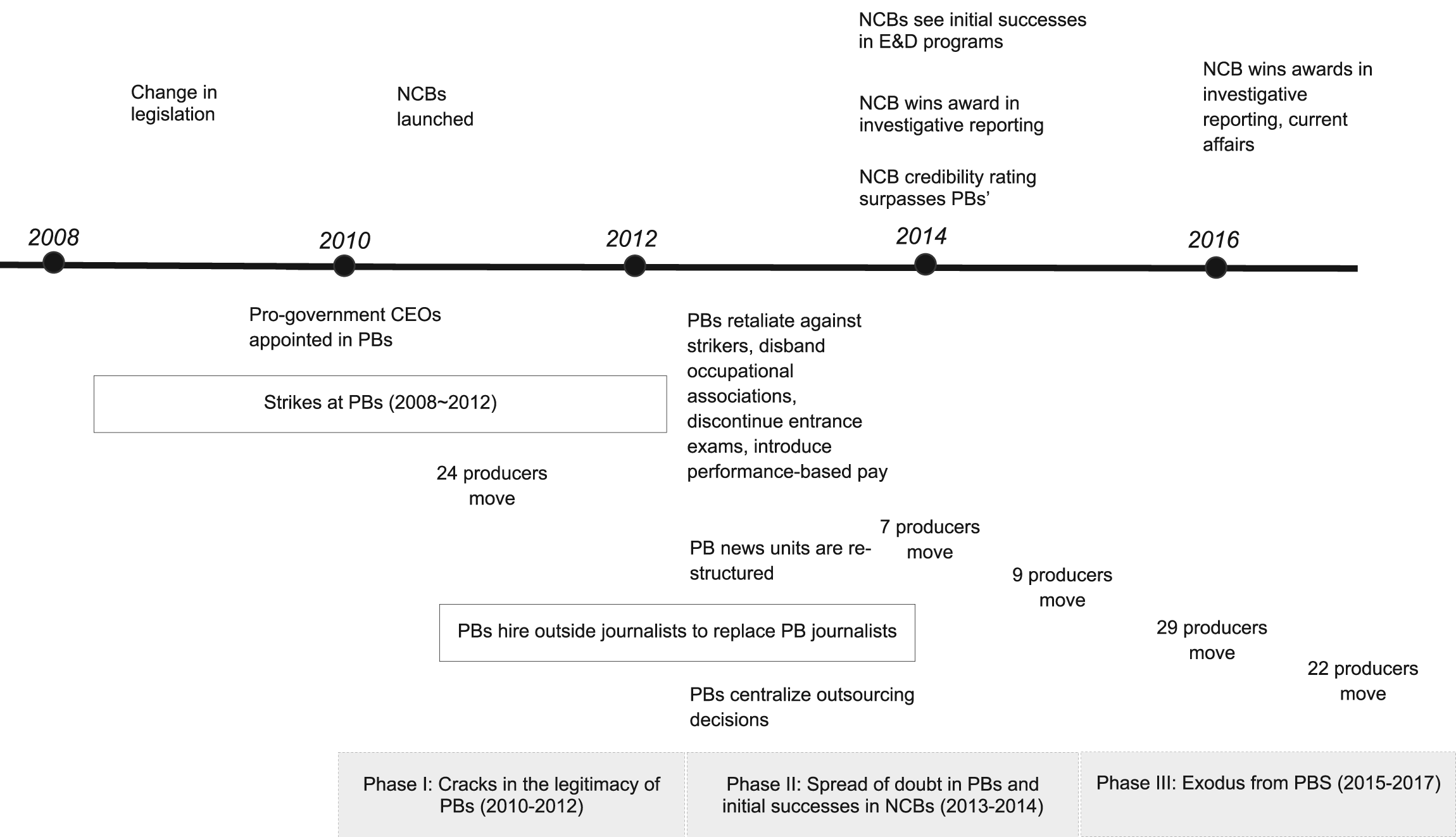
Timeline and event chronology.
Subsequently, we engaged in a fine-grained content analysis of interview transcripts and archival data within each phase as described below. Data were analyzed iteratively by both authors, who jointly developed a coding scheme building on initial pattern recognition in the data, which was subsequently subjected to theoretical reflection. Following Gioia et al. (2013), we identified patterns in our data to form first-order codes, combined them into second-order themes upon consulting with relevant literatures, and built on related second-order themes to construct aggregate dimensions. Table 2 presents the resulting coding structure and Table 3 presents additional quotes for each first-order code.
Coding Structure.
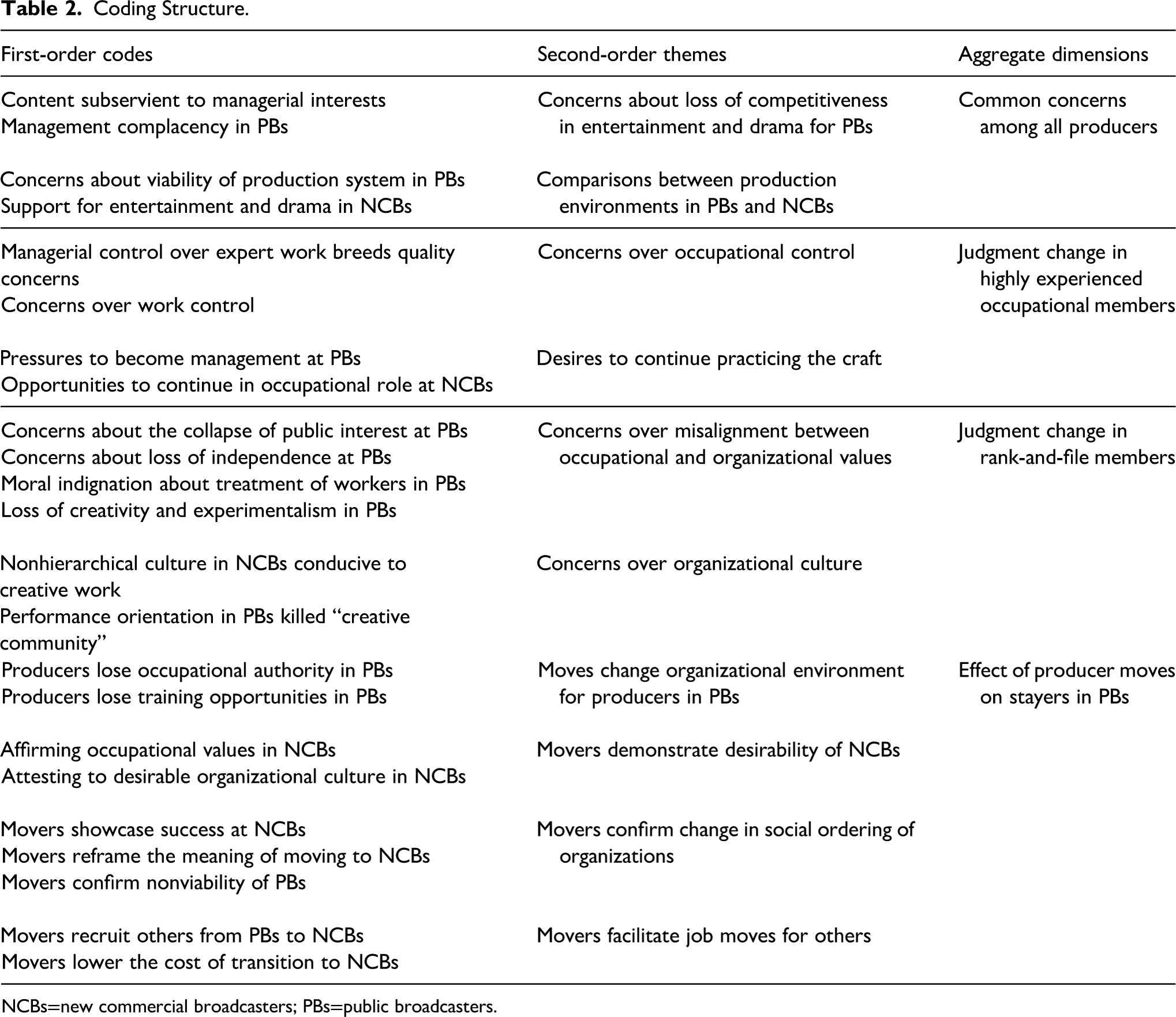
NCBs=new commercial broadcasters; PBs=public broadcasters.
Additional Quotes for First-Order Codes.
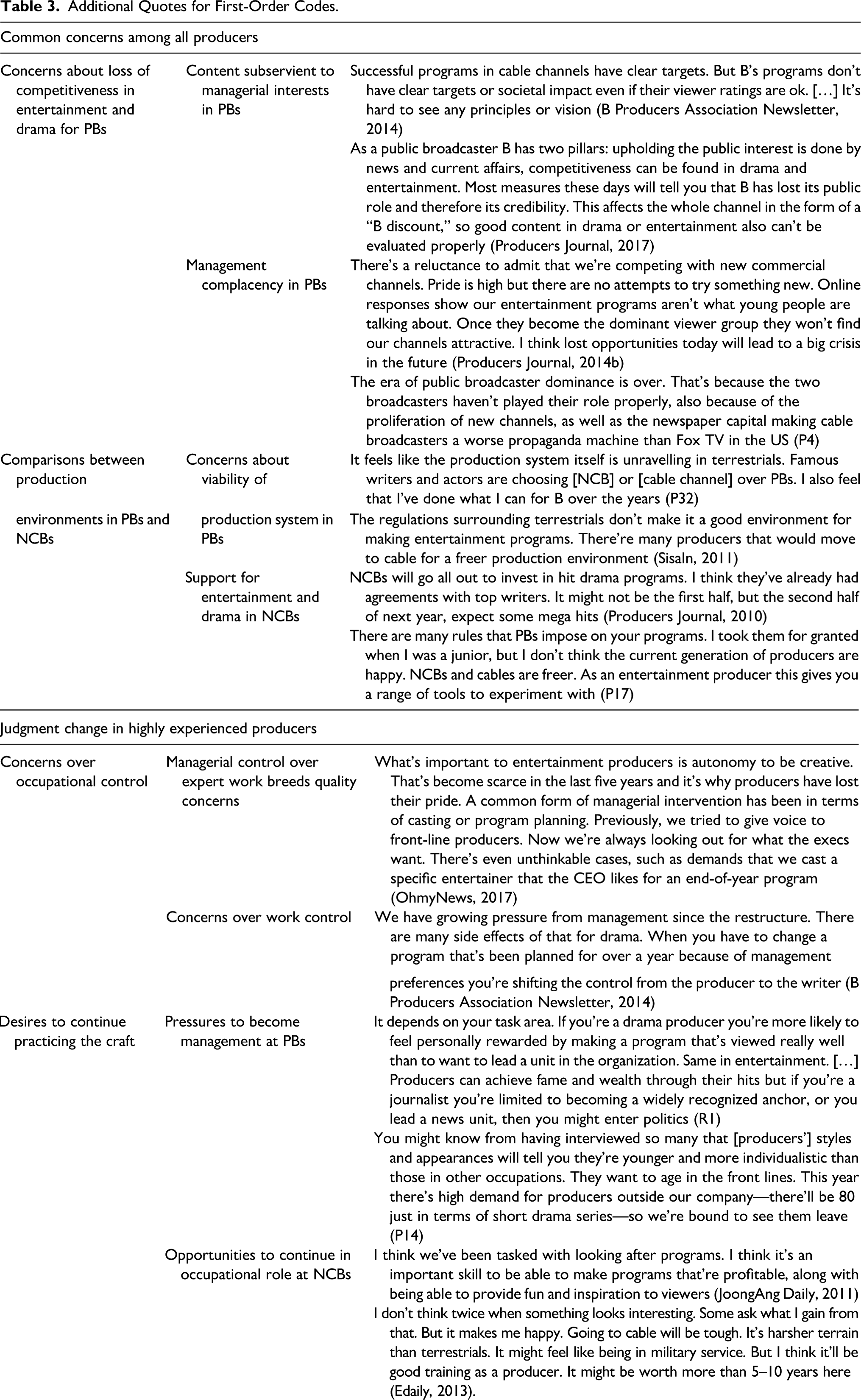
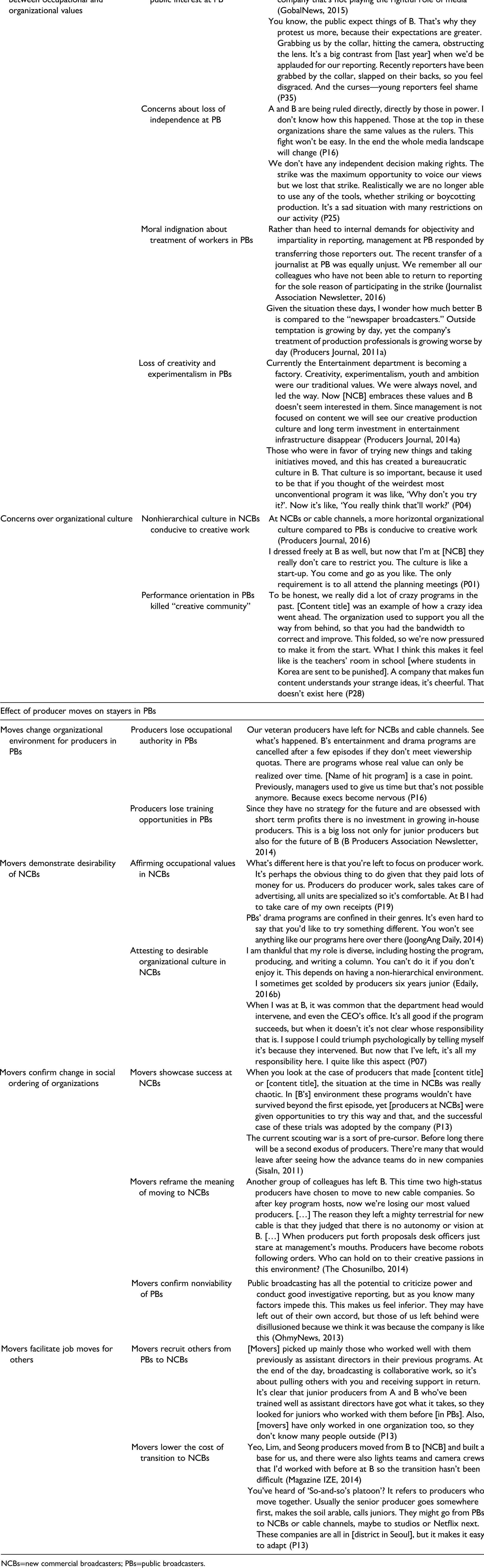
NCBs=new commercial broadcasters; PBs=public broadcasters.
Reasons for judgment change
Initially, we read the data repeatedly to identify key reasons for judgment change among producers. This indicated that occupational values such as creativity, experimentalism, and service to public interest were important in how occupational members assessed how broadcasters were changing, along with concerns around autonomy (Adler & Borys, 1996) and control (Bechky, 2003). Noting that early movers to NCBs disproportionately held the role of Chief Producers and that rank-and-file producers moved in later years (see Table 4), we compared the way producers with different levels of experience assessed the two organizational forms. We report these differences as between “highly experienced” and “rank-and-file” producers. We sought to understand what different groups of producers considered important in their evaluations of PBs and NCBs by utilizing insights gained from in-depth fieldwork on the responsibilities of producers at each experience level as well as knowledge of the organizational context.
Number of Entertainment and Drama Producers Moving From PBs to NCBs by Experience Levels.
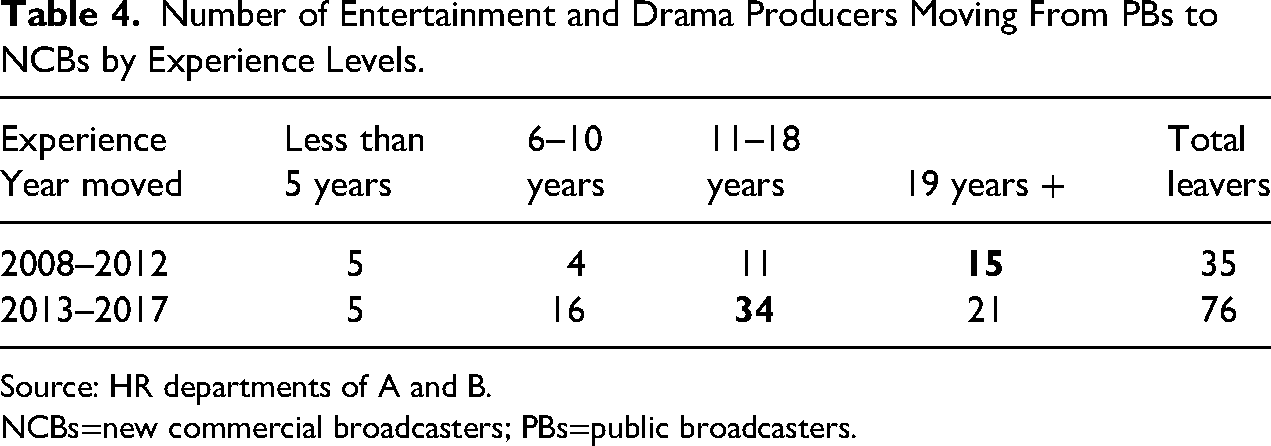
Source: HR departments of A and B.
NCBs=new commercial broadcasters; PBs=public broadcasters.
Effect of job moves
From the previous analytical step, we noticed that producers who remained in PBs referenced statements, actions, and achievements of those who moved to NCBs in constructing their comparative assessment of the two organizational forms. We hence formally coded for how producer job moves were interpreted by those who left and stayed, and how shared meanings emerged from these interpretations. Additionally, drawing on insights from recent studies on the influence of job moves on resourcing and organizational survival (Bermiss & Murmann, 2015; Nigam & Dokko, 2019), we searched for indications of change in levels of resources, authority, and producers’ control over work that could be attributed to job moves. See Table 2 for our data structure comprising first- and second-order codes for this analytical step.
Findings
Organizational Change in the Broadcasting Industry
Public broadcasters
Prior to the period of study, PBs represented the most prestigious places to work in Korean media. Producers and journalists were recruited through examinations considered as exclusive as those for entry into Korea's civil service. With few exceptions, these employees spent their entire careers in the same organization. Pay scales increased with seniority and contained no significant differences across occupations. An organizational culture characterized by most interviewees as “familial,” where managerial ranks were homegrown and creative occupations had significant input into managerial decisions was often cited by interviewees as a reason for harboring strong attachments to the organization (P42).
Beginning in 2010, newly appointed pro-government CEOs and executives began to censor news and current affairs programs (Kim, 2014). Management also exerted pressures on entertainment and drama divisions to promote the government through their programs and tightened control through ratings and viewership measures (Kim, 2015). To curb employee “activism,” management sought to dissolve organizational practices and structures that used to foster social cohesion, including the “cohort” system formed through recruitment by public examination and occupational associations, and introduced performance-based pay for producers. While historically PB producers maintained a hierarchical relationship with outside production companies and large discretion over production decisions, new contract management units were created during the period of our study to centrally manage outsourcing (Han, 2015). Control was thus taken away from in-house producers, who were forwarded already-negotiated contracts with service providers that reflected central decisions on program design (Choi & Han, 2015).
New commercial broadcasters
To generate revenue, NCBs sought to grow entertainment and drama programs through new recruitment (Choi & Han, 2015). Early programs were criticized for their sensationalism, political favoritism toward the government, and overall low quality (Choi & Han, 2015). This changed from 2014 as relatively small-scale yet targeted programs achieved successes, increasing viewership from a dismal 1% in 2011 to 12% market share (Choi & Han, 2015; Han, 2015). Early program successes induced sizeable investments in content production by NCB parent companies (Han, 2015). Initially considered ideologically biased, NCBs also surprised audiences with truthful reporting of a ferry sinking incident in 2014, which contrasted with PBs’ concealment of corruption implicating the government. This resulted in new broadcasters sweeping the awards in news and current affairs and receiving credibility ratings surpassing those of PBs’ (Media & Future Institute, multiple years).
As new companies, NCBs adopted performance-based pay since the beginning. An irony of producers’ judgment change was that while studies have found that broadcasting producers in Korea preferred in-house production over outsourcing overall (Kim, 2016), in-house producers came to regard new broadcasters as better organizations despite their higher reliance on outsourcing (NCBs outsourced over 90% of their production during the period of our study compared to approximately 50% in PBs; Choi & Han, 2015). Nevertheless, in contrast to PBs’ centralized management of outsourced production, in-house producers in new broadcasters enjoyed discretion in selecting and managing the relationship with outside production companies (Choi & Han, 2015). Due to the relatively high dependence on independent studios, these organizations were reported to have a collaborative relationship with contractors, working closely with them to make operative decisions (Han, 2015).
Judgment Change Among Producers
PB producers’ judgment regarding new broadcasters was overwhelmingly negative in the early years as they demonstrated pride and loyalty toward their organization. Producers believed that the small increases in viewership experienced by NCBs in the early years were entirely due to cash infusion by parent companies and could not compete with what they viewed as the systemic superiority of PBs. As one producer shared, “Organizational history matters. It accumulates to make a system. Our star producers benefited from a superior system. If you move to a new broadcaster you’ll need to make it happen on your own without that kind of support. What's the probability it’ll lead to success?” (P17) Moreover, producers wished for NCB underperformance, as they were normatively opposed to their existence, viewing them as tools of a neoliberal agenda to undermine public broadcasting. Producers emphasized that their occupational values included protection of public interest and social justice, and that public broadcasting enabled them to be true to these values. In the words of one respondent: As entertainment producers we shouldn’t neglect the public interest. Some people think that we are only interested in producing laughter, but if that's the case you can be a producer in cable TV. As members of terrestrial wave TV which uses a public good we have a responsibility. That's the meaning of our work. (P09)
Common concerns across both highly experienced and rank-and-file producers that served to destabilize the established judgment included PBs’ loss of competitiveness in entertainment and drama and a realization that the production environment was deteriorating, especially in comparison to new broadcasters’. For example, producers attested that PBs “used drama to prolong the careers of executives or to shore up the falling ratings of news rather than have a principle or vision for drama in itself” (B Producers Association Newsletter, 2014). They perceived management as oblivious or in denial about the ascendance of new broadcasters as competitors: “The dominant position that PBs enjoyed was based on the fact that they were the only thing citizens had to look at in the past. [It's] organizational inertia that doesn’t allow them to catch the latest changes in platforms” (P11). Producers also worried that increased rigidity in PBs undermined flexibility in the production environment.
Despite commonalities, the substantive reasons for judgment change and the timing of moves differed between highly experienced and rank-and-file producers. While highly experienced producers prioritized occupational control and comprised the largest contingent in an earlier group of movers, we find that rank-and-file producers were impacted by misalignment of values. Rank-and-file producers were disproportionately represented in the second wave of producer moves (see Table 4).
Judgment change among highly experienced producers
Concerns about the loss of control Responsible for overall program decisions including resourcing, highly experienced producers’ roles directly exposed them to executive interventions that undermined their autonomy and raised their concerns over producers’ abilities to control their work. Centralization also meant that discretion over the selection of outside production companies and writers was removed from chief producers’ roles. The prevalence of last-minute requests from executives—which involved changes in scripts, designated writers, or even specific actors—meant that control was transferred from producers to writers to effectuate quick changes (B Producers Association Newsletter, 2014). Furthermore, managerial control over their expertise made senior producers apprehensive about the impact on content quality. Having their authority curtailed by managers who prioritized commercial interests over quality of ideas bred resentment. A chief producer explained his judgment change thus: Just before I left B I had a division head who was annoying. He never made a hit but loved to tell you how to make your program. He asked for a new idea so I made a sketch, and he asked to reduce the budget on it. When I told him it was the smallest I could make it, he told me I should be creative in my thinking. My decision was made then. I have to go. Why should I go on working and stressing under someone like that. (P39) Entertainment programs are essential in raising the image of new broadcasters. […] ‘Love calls’ are placed to entertainment producers with previous hits because in this area you really need experience and expertise in casting good talent. (Producers Journal, 2011b)
During initial years of our observation, expressions of judgment change met with strong disapproval in the producer community which had vigorously opposed the launch of new broadcasters. One entertainment producer exemplified how occupational members criticized early movers: In the early days people disapproved. It didn’t look good to leave when those you struck with in news and current affairs were being constantly disciplined, no matter how much they were paying you. I felt like saying, ‘You could leave when you do, but don’t you think you should resist a little more, fight with us to restore the organization to what it was before you go?’ (P37)
Judgment change among rank-and-file producers
Previously, rank-and-file producers expressed strong pride in PBs, believing that the superiority of their culture and production system over those of commercial media companies outweighed any financial incentives for moving. Many attested that in public media, the motivation to do well came from “the fact that all citizens will be viewing my program, my company, my content” (P15) rather than from monetary reward. Accordingly, and in contrast to highly experienced producers, judgment change among rank-and-file producers progressed slowly. During initial years of our study (2008–2012), producers explained their reluctance to move to NCBs in terms of the “PB premium,” which they explained originated from organizational reputation. Questioned about moving to NCBs, several justified the desire to stay by stating that they would rather work in an organization “that doesn’t shake my principles” (P26).
Nevertheless, attachment to PBs began to waver as front line producers became aware of misalignments between occupational and organizational values, and of changes in the organizational culture they once cherished.
Concerns about misalignments between occupational and organizational values Moral discrepancies and the loss of creativity and experimentalism indicated to rank-and-file producers that PBs’ organizational values were diverging from their occupational values. The most salient grievance among front line producers related to the morality of organizational conduct, including the collapse of public interest, the loss of independence, and the treatment of workers. Entertainment and drama producers emphasized that even though they held roles in an arguably more commercialized division, as “media professionals” they valued pursuing the public interest. Front line producers considered shameful PB management's replacement of journalists with pro-government contractors and the resulting bias in reporting. Sentiments such as “Entertainment programs don’t pursue public interest but if my organization is engaged in bad reporting I will find this company difficult to bare” (Hankyoreh, 2012), and, “if a broadcasting company that doesn’t make proper news is only producing laughter then that laughter will only serve as opium” (GobalNews, 2015) abounded.
Front line producers similarly objected to the loss of independence in PBs, manifest from the highest levels of the organization to the level of production decisions. Producers attested that “Those at the top in these organizations share the same values as the rulers” (P16), “Currently we are absolutely controlled by external factors” (P25), and “I increasingly felt that A has been privatized, that it is occupied by particular entities. It's becoming harder to pose any opposition or disagreement.” (Mediaus, 2016).
Lastly, front line producers expressed moral indignation at how workers were treated in PBs, especially in the newsroom which received the brunt of management retaliation for the strikes and was subject to the strictest censoring. As an entertainment producer retorted in a union newsletter: It's no public broadcasting that gets rid of its current affairs and culture department and fires its journalists and announcers. They’re doing comedy with their news, better than any entertainment program, and they label colleagues who leave as ‘sell outs’. Yet we have to continue to produce laughter. It's getting really hard to make people laugh in this environment. (B Union Newsletter, 2017) For producers, there isn’t the distinction anymore between PBs and commercials. They are all workplaces that make programs. Now we have the same criteria for choosing as any other worker. Who pays more, who provides a better production environment. (P40)
Concerns about organizational culture Prior to change, relatively junior producers felt fully supported by an organization that provided a safety net for creative experimentation. A former producer and current member of management expressed a common theme: The basis for a fraternity-like culture here is performance management that's a plus-sum concept. If you start touching the details of what one does and cutting out, people lose the ability to strongly assert their ideas. Because if you fail, it's worse than not having started. That supports our organizational culture. It's why producers say it's the best workplace in the universe. (M28)
During the latter half of our study producers frequently mentioned that the culture of PBs had changed, contrasting the cooperative environment they enjoyed in the past with a rigid culture of performance management. An entertainment producer writing in the Producers Journal articulated this perspective well: Before, we were a community where we all helped each other be more creative. That was the tradition. It helped us in terms of performance, too. Since the 2012 strike the organization is running on a political logic and has been so commercialized. This killed the system we had. Performance is being forced on us without there being a new system to replace the old. For us producers, it's about whether you can do what you love and be creative. The current culture of publicly shaming producers based on their ratings doesn’t make it easy to work here with pride. (Producers Journal, 2014b)
Effect of Job Moves on Remaining Producers
We find that job moves from PBs to NCBs, disproportionately undertaken by highly experienced producers in earlier years followed by an “exodus” of rank-and-file producers (see Table 4), were consequential in precipitating and then normalizing judgment change within the producer community as well as in inducing even more job moves. Below we elaborate on the dynamics that job moves activated in the producer community.
Movers change the organizational environment for producers in PBs
When highly experienced producers left PBs, their absence left a vacuum. As one producer put it, “An organization is like a person. The spine needs to support the organization during turbulent times. Execs are desperate to meet their KPIs, and we need veterans who can patiently advise them.” (P12). The dearth of producers with clout diminished the collective authority of producers vis-à-vis management and weakened in-house training of junior producers (Moon, 2006). An entertainment producer explained it thus: The execs couldn’t touch the seniors who’d shown their production capacity with hit programs. There was a lot of to-and-fro as they pushed back against executives’ demands. Now that they’re gone, there's no one to push back on the orders from the top. So juniors like me are really suffering. (P15)
Movers demonstrate the desirability of new broadcasters
Informally through professional networks and formally through interviews with media, movers to NCBs affirmed that these organizations cultivated nonhierarchical organizational cultures where producers’ occupational values could be realized. These statements ranged from testimonies about creative autonomy in new broadcasters (“I wanted to work at a channel that values laughter the most. […] It's at least unthinkable that material will be censored before it sees light.” [Magazine IZE, 2014]) to confirmation that experimentalism, such as spanning content genres, was supported in these organizations (“I too started as an entertainment producer and moved to drama. […] We promise directors that they’ll be allowed to do what's important for them. It's important to constantly try to break the mould with flexible thinking that allows you to lead an ever-changing contents market.” [Edaily, 2016a]).
Movers influence meaning-making in the occupational community
Third, movers framed the meaning of their actions by countering the belief, spread by management in PBs and cynics, that they chose new broadcasters “for money.” As a highly experienced producer affirmed in an interview, “If [producers] think their vision can be realized here they will come. Moving is a question of a sense of accomplishment rather than of money. It's presumptuous to think that [NCB] is buying talent.” (Producers Journal, 2011a). This influenced how others perceived the job moves; for example, the producers association in B issued a statement depicting producers’ job moves as principled decisions: “Management is chalking this up to [the leavers] following the money, but it's not true. The reason they left a mighty PB for a new commercial is that they judged that there is no autonomy or vision at B.” (The Chosunilbo, 2014).
When movers produced hits, it prompted other producers to question the viability of public media. Hence, stayers in PBs were compelled to state, “I feel that I’ve lived my career as a PB producer in vain. There are producers in PBs that have moved to new commercials and cable companies. These folk are leading the change in broadcasting by producing innovative programs in diversified platforms.” (Producers Journal, 2014b). Another producer discussed the impact of a senior producer leaving his team thus: “It sort of confirmed I was in a sinking ship. I thought, ‘PBs are dead. If the era of content arrives [new broadcasters] will be more effective and we’ll just be exploited.’” (P18).
Movers facilitate job moves for others
Lastly, movers induced further job moves by directly recruiting other producers or providing references, and lowering the cost of the transition for subsequent movers by engaging contractors with pre-existing working relationships. Previous research has noted the networked nature of hiring and contracting decisions in the television industry and in creative industries in general (Morris et al., 2023; Starkey et al., 2000). Typically, movers recruited producers who had worked under them as assistant directors (P07). In some cases, producers moved as a team. One respondent described how a close producer at A suggested that they move together: “When I was suffering in the [name of unit] a senior who started two years before me was talking to an executive at [NCB]. He said that executive encouraged him to bring others. He asked me, so I said, 'Let's do it.'” (P19).
Moves to NCBs from PBs, then, occurred within the occupational community through a process of mutual influence and social comparison. As a producer shared with us, “I think many of us were asking, ‘Why didn’t I get the phone call?’ We used to joke around, ‘Hey, I got calls from three places’. Even those who didn’t dream of leaving talked about getting calls, like it showed their ability.” (P30). Another producer noticed a change in her own perception of career possibilities as she observed others move jobs: “Before, I looked at colleagues who left and asked, ‘Why?’ But now I think, ‘It's possible. I too will ponder over it.’” (P06).
Discussion
The foregoing study highlights how changes to judgments about organizational values, cultures, and morality were made through the lens of occupational values and the desires for occupational control over work. Judgment change was infused with meanings attributed by and shared within the occupational community, which initially discouraged deviances from the received occupational judgment. Findings from this study underscore the importance of studying the occupational judgment of organizations as a means of collective voice at work and as a potential avenue for socially transformative action. To the extent that occupations assess organizations for their morality, and cease to cooperate, sabotage, or leave organizations that violate moral principles, occupational judgment represents a constant yet relatively silent way in which organizations can be held accountable by employees compared to organized collective action. In our case, occupational judgment change was far more impactful on the television industry in South Korea and on the competitive dynamics of NCBs and PBs compared to organized action undertaken by trade unions.
While extant literatures have demonstrated how individual occupational members enact value-based dissent (or keep silent), our findings shed light on the process by which an occupational community can alter its collective judgment of organizations. Changes in collective occupational judgment relied on phased action undertaken by groups characterized by different lived experiences and status levels in the occupational community and the activation of both pragmatic and moral assessments of organizations. Highly experienced occupational members were freer in expressing judgment change, enabling and empowering rank-and-file members to follow suit. Primary motivations for judgment change also differed for highly experienced occupational members, who were concerned with occupational control over work, and for others, who were more likely to engage in moral reasoning. Our findings indicate that collective judgment change relies on a leading group within the occupational community breaking the initial taboo around judgment change followed by rank-and-file members who magnify judgment change through processes of interpretation (of early movers’ actions), adjudication (of organizational contexts), and successive action.
Conclusion
This study has important implications for future research in occupations and organizations and on the study of occupational communities in the creative industries. Overall, we contribute to understanding the dynamic and often contentious relationship between occupations and organizations by highlighting how occupational judgment can variously adhere occupations to organizations. Occupations are increasingly embedded in organizations due to the growing complexity in coordinating expert work (Bechky & Chung, 2018; Noordegraaf, 2011), regulatory requirements for quality control and accountability (Evans & Silbey, 2022; Huising, 2014; Waring & Currie, 2009), and the changing work preferences of occupational members (Briscoe, 2006; Kellogg, 2009). While Bechky and Chung (2018) demonstrated that occupations can be embedded in organizations to different degrees as a result of varying degrees of independence from management, our work suggests that groups within the same occupation can be embedded differently in organizations based on the extent to which they draw on the organization for support and meaningful interaction. Thus, differences in how embedded occupational members were in PBs influenced how easily they were able to unmoor their allegiance to the organization employing them.
In the foregoing case, rank-and-file occupational members were embedded in their organizations to a greater extent compared to highly experienced members due to the support they received from organizational systems and culture. Our work demonstrates that over time, as autonomy and authority increase on the job, occupational members in organizations are less likely to rely on relationships within the organization for personal validation and more likely to focus on safeguarding jurisdictional control.
A boundary condition for these implications is that they are likely to be applicable to occupations socialized within organizations. For occupations undergoing significant training and socialization outside the organization, occupational values may be more salient at the beginning of one's career and subsequently be tempered with organizational demands (DiBenigno, 2022; Pratt et al., 2006; Wright et al., 2017).
Our study also sheds light on the multidimensionality of factors that influence normative judgment among occupational members, encompassing assessments of organizational conduct and morality, as well as interest-based considerations. Previous studies on expert judgment in professionals have also indicated that multiple considerations shape this judgment in practice, including the maintenance of occupational authority and adherence to occupational norms (Evans & Silbey, 2022). This suggests that while normative and expert judgments are theoretically distinct, they may both be influenced by occupational values. Further research is needed to shed light on how normative and expert judgments are deployed by occupations together or separately to shape an occupation's standing in organizations and in relation to other workers.
Research on the creative industries has highlighted ongoing tension between bureaucratic goals of control and efficiency in corporations and the creative occupations in possession of expertise and skills (Lampel et al., 2000). This literature has documented how occupational communities have risen to provide continuity and meaning to work where organizations have failed, and to bargain for fairer distributions of the gains from creative work (Cornfield, 2015; de Laat, 2015; Skaggs, 2019). Recent resistance demonstrated by writers and actors against the Hollywood production system is but one demonstration of how occupational communities shape the values and motivations of workers in the creative industries (Christian & Peterson-Salahuddin, 2023).
Our study enriches the understanding of how occupational communities shape meaning-making for workers in creative industries. First, while extant literature has suggested that occupational communities may play a role in the evaluation of workplaces (Cornfield, 2015, 2019), we provide direct empirical evidence for the salience of occupational values in workers’ assessments of organizational policy and practice. Second, we contribute to an understanding of the role of networks in creative industries by extending previous studies that have emphasized networked hiring in creative industries (Morris et al., 2023; Starkey et al., 2000) to demonstrate the impact of networked job moves as collective action. Our findings suggest that networked job moves in a geographically contained occupational community can have significant impact on industries and local labor markets.
Current findings have implications for understanding occupational judgment as a complementary avenue of collective voice to occupational activism. While existing research on occupational activism in the creative industries has focused on how occupational communities build structures for mutual assistance in an uncertain labor market (Cornfield, 2015), examining changes in occupational judgments about organizations can shed light on the direct impact that occupations can have on organizations through withdrawal of cooperation and/or exit. Job moves have been previously studied as a mechanism enabling occupational members to enact their values (Reid & Ramarajan, 2022), as well as more broadly, institutional, and organizational change (Bechky, 2011; Lounsbury & Kaghan, 2001; Nigam & Dokko, 2019). We extend this understanding by demonstrating the impactful nature of job moves motivated by collective occupational judgment change. Our study suggests that competing organizational forms can benefit from occupational exit even when these organizations are not perceived as significantly more virtuous, as occupations favor value neutrality over value breach. The mechanisms of social influence and support within an occupational community identified here are key to understanding how even in roles that are institutionalized and embedded in organizations (Augustine, 2021), values can continue to fuel occupational action. More broadly, our study has shed light on the important role that occupational communities can play as incubating grounds for workers’ voice and solidarity (Doellgast et al., 2018).
Footnotes
Declaration of Conflicting Interests
The authors declared no potential conflicts of interest with respect to the research, authorship, and/or publication of this article.
Funding
The authors received no financial support for the research, authorship, and/or publication of this article.
