



Abstract
The labor of teaching assistants (TAs), as full-time students and part-time teachers, faces a “time bind.” Although research and teaching together compose graduate school for TAs, through this ethnography of TAing I argue these domains tend toward arrhythmia. Research and teaching engage distinct work rhythms that persistently interrupt one another, rendering individualized, improvisational coordination an organizing principle of TAing. Coordination is complicated by the commitment to research and teaching as meaningful projects. The autonomy to develop a projection of good teaching “responsibilizes” TAs, channeling surplus effort to teaching. I highlight preparatory work like lesson planning as a crucial site through which to understand the competing coordinative and projective pressures of TAing. I close by outlining some implications of arrhythmia for contemporary US higher education and for the sociology of labor.
As I was preparing for Monday's class, I realized I needed to step on the accelerator in order to catch up to [the professor] before the project due Friday and the quiz on Monday, so I made the choice to lean more on slides. Because the remaining material was pretty numbers heavy, I felt better about this. We just need to review it and give students a space to ask questions. I could boil it down and leave out the details that [the professor] presented.
…
I was relieved I could finish this quickly, and certainly spurred forward in doing so, because I owe Peter 1 [my advisor] a draft of a section of the paper we’re writing together. I had told him when we spoke on Zoom last Tuesday that I wanted “a couple more days” to work on it, but now it was a week later and I had barely touched it… So today was going to be another sprint day. I got to campus around 9, feeling a bit groggy. I walked to [a café], ordered an iced tea and got to work on the writing. Around 11:30 I decided that I had better get the lesson planning out of the way, so that I could really concentrate on writing the rest of the day. I made a lot of progress, but I didn’t finish the draft, extending the stress it's going to cause and probably require another sprint day to finish… We’ll see how that overlaps with TA work and more next week (Field Note Entry).
Teaching assistants (TAs) receive mixed messages about their teaching work. There is a sunny story that TAing is one of the most personally fulfilling experiences of the PhD. Some faculty will point to teaching as a source of consistency and purpose one can draw on during the uncertain perambulations of research. That our campus is home to outstanding undergraduates sweetens the deal, they say. There is also a gloomy story that centers the frustrations and time demands of teaching. Here, some faculty caution their advisees and TAs about teaching crowding out other, more professionally valued work. Academics have long reflected on the challenge of coordinating teaching, research, and other professional responsibilities, but this work almost exclusively speaks to the experience of faculty, who face a different set of opportunities and constraints than TAs (Shalley, 1996; Wright et al., 2004). Given this internally conflictual “public transcript” (Eby, this issue), how does the relationship between research and teaching appear from the vantage of the TA labor process?
In this ethnography of my work as a TA, I find that the everyday relation between research and degree progression, 2 on the one hand, and teaching, on the other hand, is deeply fragmented. Their coordination is an organizing principle of TA work. I adapt Hochschild's (1997) analysis of the work-family “time bind” and a rhythmic perspective on work (Lefebvre, 2004; Snyder, 2016) to argue that the TA time bind tends toward arrhythmia. Research and teaching consist of distinct bundles of rhythms that regularly interrupt one another, and it falls to the individual TA to improvisationally coordinate these two definitional components of their position. However, through the socialization and labor of graduate school, research and teaching alike tend to become projects, meaningful objectives one anticipates and works toward (Mische, 2001, 2009), which further complicates rhythmic coordination because TAs care to handle these projects to certain standards. This dual dilemma of coordination and commitment is what makes for arrhythmia, as purely efficient coordination undercuts projective commitment, while absorption in one's projects complicates coordination.
To understand the arrhythmia of TAing, I first generalize the work-family time bind as a tension between projects and use this as a template for the TA time bind. Next, I summarize the institutional role TAs play and my data collection. The empirics unfold in three sections. First, I explain how graduate education encourages the development of research and teaching projects. Second, I depict the arrhythmia of TAing, underscoring the importance of preparatory labor to both rhythmic coordination and project commitment. Third, I examine commitment to teaching more closely, arguing that autonomy responsibilizes TAs and emotionally charges the teaching project, sustaining participation in the arrhythmic to and fro. I conclude by discussing how this analysis of arrhythmia speaks to US higher education and the sociology of labor.
The Projects and Rhythms of Time Binds
Studies of work–family conflict offer an instructive entry into the temporal dilemmas of competing commitments. Hochschild's (1997) The Time Bind explores working parents’ ostensibly incompatible desires to work long hours and maintain close family lives. Her investigation of a company with undersubscribed flexible schedule policies reveals, more than the material or pecuniary, the emotional and cultural dimensions of time use. The time contest at play in the encroachment of work life on home life reflects a contest between two meaningful domains. In a culture where professional achievement indexes personal worth and in workplaces engineered to cultivate dedication, it is unsurprising that Hochschild finds working parents gravitating ever more toward work. But work and family duties are not “juggling balls” external to the individual. Rather, they reflect competing, deeply internalized “schemas of devotion” (Blair-Loy, 2003). The time bind thus transcends time management, reaching into individuals’ management of the self (Thompson & Bunderson, 2001). We internalize our commitments as components of our sense of self, making their contradictions profoundly personal matters. To transpose these insights to the case of time conflicts endogenous to work, I generically conceptualize time binds as tensions between projects.
Projects are meaningful objectives people seek to work toward, within structural and situational constraints, through both the backward lean of experience and habituation and the forward lean of inventive, strategic action (Mische, 2009; Tavory & Eliasoph, 2013). Mische (2001, p. 139) defines them as “more or less open-ended horizon[s] of possibility, culturally structured through existing narratives and yet implying orientation, mission, even vocation, in a self-conscious engagement of a changeable future.” Individuals may pursue projects within their work, such as achieving informal aesthetic or quality standards (Fine, 1992). To illustrate, within organizational constraints, TAs reflect on their own educational experiences and envision a desirable, aspirational way of doing the job. Although we strive to enact these ideals in the present, they result from future-facing acts of projectivity, in which possible paths and destinations are tentatively plotted (Emirbayer & Mische, 1998). Reframing the work–family time bind as a tension between the projects of parenthood and profession, we see how coordinating projections are problematic. Working parents endeavor toward their notions of a rich family life and a successful career. A father projects forward to his son's birth and being a “real dad,” leading him to refuse weekend work, but this triggers uneasy interactions between him and his supervisors. 3 This dilemma of commitments occurs because the rhythms of each project interfere with each other.
Social Rhythms
Projections of the future and efforts to enact projects in the present depend on the rhythms of daily life. Recurring late afternoon meetings mean having to keep the babysitter around longer. A toddler's morning dawdling risks making their mother late to work. Following Lefebvre (2004), rhythms are spatiotemporal cycles of action in which each iteration nevertheless varies to some degree from its antecedents. Habitual or routinized interactions each constitute a rhythm, as do patterns of a larger scale. For TAs, teaching and research each constitute a bundle of rhythms. Important beats in the teaching rhythm are the biweekly classes—with an interactional rhythm patterning each class session, too—the submission of weekly assignments, and a longer semesterly arc from receiving the syllabus through midterms to finals. The research rhythm may be less explicitly structured but is composed of daily field note writing, weekly or monthly research meetings, degree milestones, conference deadlines, and such.
Each rhythm is like a dance. The choreography assigns each dancer their steps, which they execute at the right time relative to the other dancers’ moves. The professor introduces new material in the lecture; the TA takes this and plans a discussion section; the students (are supposed to) do the reading and complete any assignments, and so on. Because social rhythms are interactive, they foster social ties that can acquire responsibility or significance. In this rhythmic perspective on the labor process, “to work does not mean to ‘allocate hours’ to work tasks, though that is one useful way of looking at it, but to engage in the rhythmic coordination of energy with other people in a workplace” (Snyder, 2016, p. 13). The experience of previous iterations equips actors to anticipate upcoming “beats” and perform their role within somewhat flexible parameters. Dancing to the rhythms of graduate school, TAs “think between situations” (Tavory, 2018). A moment like an afternoon of lesson planning overflows into the past and future, as anticipations of the upcoming class informed by prior experiences and desired, projected outcomes ground how I prepare. TAs must do two dances at once, though, the coordination of which may be more or less successful.
Every social setting is “polyrhythmic,” composed of many intersecting rhythms that may smoothly cohere, constituting “eurhythmia,” or, in the case of “arrhythmia,” clash jarringly. “In arrhythmia, rhythms break apart, alter and bypass synchronization” (Lefebvre, 2004, p. 67), such that each line of activity proceeds independently without adapting to or accommodating others. Like two walkers on the street, neither of whom gives way to the other, the rhythms stay their own course and collide with others. These more-or-less harmonious collections of rhythms shape the subjective experience of time in a situation or institution (Snyder, 2016). Any setting may become arrhythmic; the predictable daily flow of humans and vehicles through a city, always interruptible by a mistimed crossing or inclement weather, is a familiar example (Edensor, 2016). During periods of arrhythmia, workplaces still complete tasks and meet goals, but the process is marked by interruption, delay, and improvisation. “Somehow, through creativity, quick thinking, or gut instinct, we muddle through [it]” (Snyder, 2016, p. 15). Rhythms thus set an emotional tone. Further, they form the context in which one develops and enacts projects. For TAs, arrhythmia emerges because we pursue distinct projects of teaching and research, which follow their own rhythms.
Every job can experience arrhythmia, but in what follows I argue that the organization of TAing predisposes it to arrhythmia. In this arrhythmic role, the articulation of projects poses a twofold challenge. Since pursuing one project requires focusing attention on its rhythms, at least temporarily to the exclusion of other rhythms, 4 there is a dilemma of rhythmic coordination: how do I organize myself to hit the beats of both rhythms? However, because these rhythms advance different projects, there is also a commitment dilemma: how do I imagine myself as a researcher and teacher, and how do I satisfactorily realize and balance those projections? The experience of arrhythmia, simply, is of uncertainty over what to do and how to do it at any given moment, because of these twinned dilemmas. The labor process becomes a continuous compromise between rhythmic coordination and project commitment.
Studying the Arrhythmia of TA Work
TAs are graduate students charged with leading smaller “discussion” sections that complement large-enrollment lectures delivered by a faculty person. At my university, TAs have been unionized since 2000, affording various protections including a semesterly maximum of 340 working hours (for more on TA duties and context, see Burawoy et al., this issue; Torres Carpio, this issue). But these valuable safeguards do not prevent arrhythmia because the fundamental issue is not the sheer number of hours spent TAing, but the organizational and emotional strains of the disjointed rhythms of the teaching and research projects. TAships are usually assigned on a semesterly basis and are organizationally separate from research and coursework. Courses with TAs are typically large introductory classes, not advanced offerings that may relate more closely to one's research, and given the low number of classes large enough to hire TAs, it is uncommon for a TA to teach under their advisor. Rather, for both the TA and the university the relationship between teaching and research is inescapably financial. 5
TAs teach in exchange for financial support from the university. The standard funding mechanism for graduate students in my department when I was admitted illustrates teaching's instrumentalized role. Of a six-year funding package, years two through four are “teaching years,” meaning tuition, fees, health insurance, and a living stipend depend upon one's service as a TA. In later years, there are fellowships available that are contingent on having previously taught. To research, one must teach. Prestigious fellowships are intensely pursued not only for their symbolic value but also because they substitute for departmental funding, exempting the student from their teaching requirement. This bargain of teaching in exchange for tuition is crucial for the university, too. With declining public support for higher education, universities increasingly rely on contingent faculty and TAs, a less expensive labor force than tenure-track faculty (Newfield, 2008). Teaching, in short, is treated as a separate and secondary component of graduate education that is linked more to financial exigencies than the objectives of the training.
Alongside this context of TAing as a means to fund one's education, there is a process of academic socialization that develops graduate students’ sense of priorities and career trajectories. The training provided at “R1” institutions, those with “very high research activity,” intends to prepare students for employment at other comparable institutions. This training emphasizes the paramount significance of developing one's research, to the professional and symbolic devaluation of teaching (Cardozo, 2017). Indeed, the possibility of a publication exerted a substantial influence on my decision to participate in the ethnographic seminar that gave rise to this special issue. If my motives were so unilateral, though, there would be no arrhythmia. Even as I considered in which graduate program to enroll, I looked at teaching requirements as an opportunity, not a burden. My first TAships took place through remote instruction during the COVID-19 pandemic and the challenges of teaching were immediately palpable. Keeping a mosaic of webcams—some on, many off—engaged was never easy. I was lastingly impressed by how time-consuming lesson planning could be. Still, I remained dedicated to the work and as I wrote field notes on my TAing, I felt this dedication further solidify. The relationship between my research and teaching became recursive. Given the systematic attention I placed on my teaching, I came to experience unsuccessful classes as delegitimizing of this endeavor. I noticed myself becoming increasingly fearful of end-of-semester evaluations for the same reason. In my findings, I discuss how the organization of TAing generates arrhythmia, but it is also true that each TAs’ dispositions and experiences modulate their experience of arrhythmia.
Carrying these experiences and institutional position with me, over three semesters, one of which occurred remotely due to the COVID-19 pandemic, I recorded field notes on the various components of TA work (office hours, meetings with the instructor, teaching itself), including the isolated acts of preparation I did at my desk, such as lesson planning and reviewing student questions posted to the class site. 6 In documenting labor outside of the classroom, incursions from my research and coursework inevitably appeared prominently. In every semester, I taught lower division courses in sociology, but with different instructors. As a secondary data source, I kept a time diary for the two latter semesters of my fieldwork, tracking start and end times for each task I performed. How research and teaching emerge as meaningful projects, how the work rhythms of TAing clash with each other, and the persistent coordinative and commitment dilemmas this raises are the empirical substance of this paper.
Becoming a Dancer: The Competing Projects of Research and Teaching
Since teaching and research work are organized separately, what motivates commitment to either domain? Why, using my earlier heuristic, does the rhythm of each dance get us up and moving? In the course of graduate education, the professional and relational pressures TAs experience encourage the development of researching and teaching as projects, an aspirational imagination of oneself fulfilling the role in a certain way. The meaningful commitments implicated in these projects make it so that neither work domain can be easily deemphasized or ignored. Both clamor for attention. To understand this commitment dilemma, I begin by sketching the “magnets” (Hochschild, 1997, p. 44) of research and teaching for TAs.
An indispensable input into the research project is the expected professional value of this work. Because of its familiarity to academics, I only briefly address this. Graduate training regularly produces situations in which students learn to recognize the value of specific research accomplishments, including their home department's hiring practices, observations of more advanced peers, and advisory conversations with faculty mentors. These experiences instruct where to place our efforts, scaffolding the present day's pitch into the future (Tavory, 2018). Research also becomes professionally meaningful as a vehicle of anticipatory socialization, of showing oneself as a qualified member of the profession while we are still undergoing training (Merton, 1968). To illustrate, I once reflected on a research assistantship with my advisor as a way of gaining experience, yes, but also of demonstrating my capability as a sociologist. Although early-stage graduate students’ research programs are often inchoate, our forays into independent and collaborative research contribute to a growing sense of scholarly identity. This is before considering how the personal reasons that lead many researchers to their chosen areas of focus forge passionate commitments to scholarship. In this way, graduate students develop a research project, a vision of themselves as a researcher that they can gradually realize by engaging the rhythms of research work. Yet, many TAs spend substantial time on their teaching work.
Responding to the question of why, “despite so little institutionalized reinforcement, there are substantial numbers of unusually effective teachers” at universities, Merton speculated that “they obtain such direct rewards from student response that they are sustained in putting great effort into teaching” (Persell and Merton, 1984, p. 371). Unquestionably, seeing something click for a student or receiving a compliment about a class is rewarding. In field notes, I often recorded when I noticed a student “speaking somewhat more quickly, with fewer hesitant pauses between phrases and words,” indicating their solidifying grasp of the material. However, we should interpret this “student response” not through generic notions of the joys of teaching, but as situated in the autonomy and interactivity of TAing.
Because TAs have a significant say over how to run our classes, we are empowered to think creatively about how to do the work. In one case, I deviated from the content and pace of the professor when they introduced scientific paradigms to the class. Rather than review their examples, which I anticipated students may find confusing, I made an extra credit assignment that prompted students to relate paradigms to earlier course readings. And to allow enough time to complete this, I delayed our discussion of this material from the professor's by a week and a half, effectively offsetting our pace by three lectures.
This scope of choice fosters a teaching project, a desirable, imagined version of oneself as a TA. Each beat in the teaching rhythm presents an opportunity to enact this projection. The devolution of some labor process control to laborers, granting “responsible autonomy,” encourages “workers [to] behave as though they were participating in a process which reflected their own needs, abilities and wills” (Friedman, 1977, p. 53). Thus, as Germain (this issue) elegantly illustrates, following both perceived successes and failures in the classroom, his response was to recommit himself, either to continue his streak or to get back on track. The rhythm of teaching carries on, presenting new opportunities that the committed TA is eager to seize. At this stage in my formation as a teacher, my project was not a sharply defined pedagogy, but more simply a sense of addressing students’ needs effectively and engagingly. As a representative expression of this goal, during a terminologically dense stretch of the semester, I reflected that “throughout the lesson planning I was imagining how the class would play out and whether the material I was preparing would help students feel more confident and comfortable with all the concepts being thrown their way.” But a teaching project need not be so fixated on course goals. I have observed projects that conceptualize the TA in quite diverse ways, such as emphasizing care work or political awakening. These all serve the same purpose of defining the kind of TA one wishes to be. The consistent, direct contact TAs have with students sustains these nascent teaching projects.
The interactional spaces of a course provide opportunities for students to express their investment in their learning and for TAs to reciprocate. Office hours are one such space, and my many meetings there with a student called Louis demonstrate how student engagement engenders commitment to teaching as a project with meaning beyond the semesterly contract. Louis frequently attended office hours and our conversations about course material gradually spilled over into our own interests, academic or otherwise. He periodically updated me on a research assistantship he had, and I shared news about my work. Near the end of the term, he asked if he could return to my office hours next semester. Although he would no longer officially be my student, I happily agreed. Through this request and our dialogue throughout the semester, Louis validated my efforts as a teacher. TAs’ frontline position, the variegation of their duties, their autonomy, and the rhythmic repetition of interactions stimulate commitment to the role (Germain, this issue; Torres Carpio, this issue).
Interactions with students also inform what behaviors or emphases I incorporate into my teaching project. With the end of a semester nearing and office hours filling ahead of finals, I met with a student, Pearl. As we finished our appointment, Pearl thanked me for my work that semester and the support I offered when she experienced some personal hardships. She recalled enjoying the application of material in class exercises and expressed appreciation for my attentiveness to student questions. Recognizing specific behaviors like demonstrating sensitivity to students’ personal lives, which as Torres Carpio (this issue) shows intensifies TA work, and carefully developing lesson plans, Pearl's comments show how students help define the teaching project, filling the projection with tangible actions representing sound TAing.
In addition, how a department organizes TAing informs the projects TAs develop. In the department where I worked as a TA, discussion sections typically meet twice a week, whereas some departments have once-weekly sections. The biweekly rhythm construes the TA as a more active pedagogue, rather than a review session leader with limited class time. The relatively hands-off management style common in the department and sociology classes’ predisposition to discussion, as opposed to something like reviewing problem sets, further normalize a conception of TAs as seminar leaders. So, TAs’ projects are not individualistic constructions. TAs develop and rationalize time commitments in reference to the local organization of teaching, which not only helps them to construct a satisfying project but also one that conforms to organizational expectations of a good worker (Kuhn, 2006). Projections of oneself as a researcher and teacher thus begin to take hold in graduate school, both of which attract our attention and care, but the temporal proximity and certainty of these projections differ in ways important to their magnetism.
First, the research and teaching rhythms occur at different time scales. A long-term, but uncertain, career as an academic is a distinctly different horizon than a short term, but certain, job as a TA. Not only do graduate programs convey research's value vis-à-vis its worth on the academic job market, but the life cycle of a study is also quite long. While I work on my research now, its benefits are supposed to accrue later. Particularly at earlier stages of graduate school, when much of one's TA service is concentrated, this is a relatively long-term anticipation. Teaching, in contrast, is a much shorter-term anticipation and this immediacy bolsters the strength of its demands. Not only am I accountable to my students; I am accountable to them in the present. The rhythms of research and teaching impose different levels of “reach,” of extension into the future, to our projections (Mische, 2009), giving teaching temporal urgency. As I discuss below, research work acquires this immediacy when it is collaborative, such that I have obligations to colleagues. Otherwise, the more distant horizon slackens research work's motivational force. I could work on that paper today or tomorrow…
Conversely, the uncertainty of the long-term career reinforces the magnetism of research. Just as the uncertainty of the next performance evaluation (Sharone, 2004) or grant (Vallas & Kleinman, 2008) drives effort, the unknowns of the job market encourage assiduous attempts to strengthen one's CV. The certainty of teaching, however, diminishes its attraction. My future ability to obtain a TA post is effectively unrelated to my performance this semester. 7 Although the obligation to my students is certain, the productive anxiety of an uncertain future is absent. The dilemma of reconciling these commitments to research and teaching comes forward because the rhythms of the projects continuously clash.
Hitting the Dancefloor: Coordinating the Research and Teaching Rhythms
In this section, I construct an abbreviated narrative of three days of work to illustrate the arrhythmia of TAing, that is, how the rhythms of research and teaching interrupt each other and how I frenetically skip between domains in an effort to hit the “beats.” These are separate dances following separate rhythms and it falls onto the individual to achieve some coordination. This entails anticipating upcoming beats and imagining, in reference to earlier experiences, possible ways to hit them satisfactorily.
I intentionally contrast two days of lesson planning, one methodical and the other hurried, to demonstrate the twofold importance of preparatory labor to rhythmic coordination. First, the amount and type of preparation fluctuates in response to pressures from other rhythms (“what else do I have to do?”) and from within a rhythm (“what could I do to fulfill this role well?”). In other words, preparation varies in response to the dual dilemmas of coordination and commitment. Figure 1 traces these fluctuations, showing the elasticity of preparation in response to these two considerations. The variation in time allocated to different tasks suggests the uncertain and improvisational character of arrhythmic work. This inconsistency drives the coordination dilemma, as well as the stress of darting between commitments. Second, it follows that the cognitive labor of coordination is most visible during preparatory work like lesson planning.
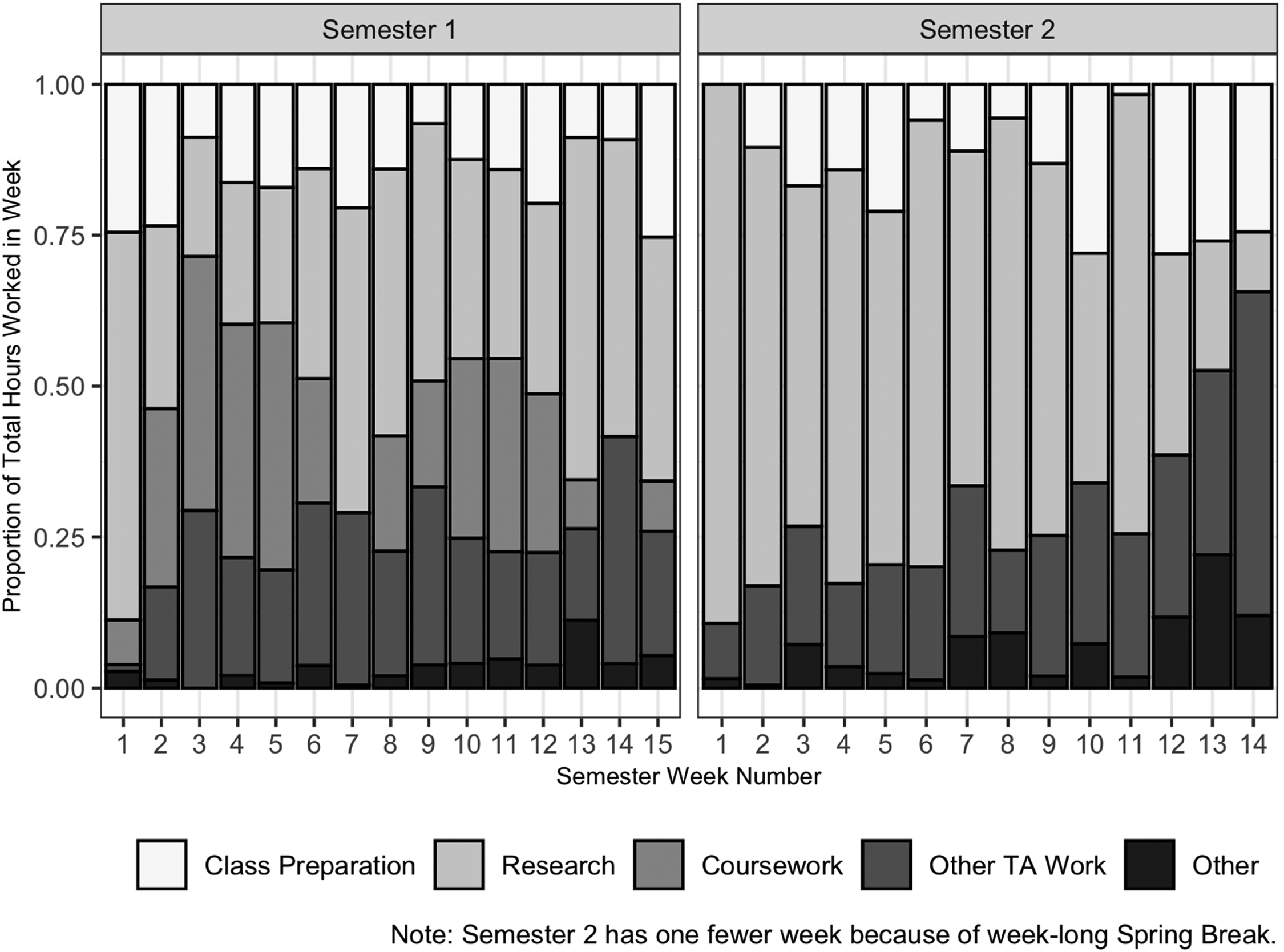
Proportion of Hours Worked by Task per Week.
For a Monday discussion section, I usually prepare my lesson Sunday. Lesson planning is an anticipatory act. Working within parameters the professor sets, TAs decide what material is most important to review, predict where students may have questions, and imagine how to organize the class session pedagogically effectively. What will stimulate student thinking or spark discussion? Slides? Group discussion (around what questions to orient the discussion)? Small group activity (what sort of activity)? In other words, lesson planning is a form of cognitive labor—“the work of (1) anticipating needs; (2) identifying options for meeting those needs; (3) deciding among the options; and (4) monitoring the results” (Daminger, 2019, p. 610)—informed by rhythmic experience. TAs’ flexibility is constrained not only by the professor's choices about content and pace but also by the need to use time efficiently. Indeed, the time demands of lesson planning balloon quickly. In both semesters during which I kept a time diary, developing and reviewing lesson plans was the single most time-consuming component of my teaching work, accounting for 35.0% and 32.2% of the hours I spent on TA duties. The anticipation of lesson planning is a “puzzle where the objective is twofold: save time and plan something useful and engaging for the students. It's an optimization of two goals that don’t always go together.”
On one Sunday, I start my workday spending 40 minutes finalizing some figures to share with my advisor for an article we are coauthoring. I am also due to send him a draft of the literature review but, feeling the pressure of the class I teach Monday morning, I pivot to lesson planning. Many students had submitted questions on the course site about levels of measurement, an important concept for the next project and quiz. Exemplifying the simultaneous backward and forward lean of anticipation, I recall in a previous semester asking students to identify the levels of measurement of the variables in one graph from an assigned reading. This had gotten the class thinking aloud, so I thought to make a seemingly simple activity in which they would do the same for graphs from academic papers related to the project topics they had developed earlier in the term. Having a week earlier divided each of my classes into groups of students with thematically similar topics, itself an extra time investment in the interest of improving the class, within 45 minutes I have found suitable articles for four of the seven groups. Finding the remaining examples takes three more hours, though, as I struggle to find articles that were both pertinent to student topics and appropriate to their level, considering and rejecting many possibilities. Having spent far more time than expected preparing Monday's lesson, my plans to work on the article are delayed: I’m behind on a piece of writing I owe to Peter. I still haven’t finished a draft for him to read and the longer it drags on the more it stresses me and the more I want to work on it to just get it done. I wanted to get the class prep done so I could focus on writing, but in the end I didn’t start writing until 6:30 PM.
Because of the short-term certainty of tomorrow's class, the teaching rhythm brusquely interrupted the research rhythm, which dictated that I return a draft to my advisor. Moreover, there is a constellation of tasks often less cooperative in nature—reading a recent book on a topic of interest, cleaning a dataset I hope to use for a new paper, or finally polishing my undergraduate thesis for peer review—that I do not even put on a daily to-do list, but which linger as loose ends. Why, then, make the 4-hour effort to search for relevant examples, rather than settling for a quicker, if less desirable, solution like assigning the same few papers to everyone? As I discuss further in the next section, commitment to one's teaching project can motivate surplus effort that aims, more than to stay on beat, to realize the kind of teaching that one imagines as worthwhile. Reflecting on a small earlier success, I envisioned a class session where students collaboratively worked through the course material in a context related to their interests. Both the teaching and research rhythms promise later interactions and deadlines that I anticipate as I prepare, but because the rhythms involve different projects inhabited by different people, attending to one does not progress the other. This is the arrhythmia of the TA time bind.
Monday morning before class I give my lesson plan a final once-over. I am interrupted by a couple of emails from students. One would be absent, having received a positive COVID-19 test, so I reply to wish her well and discuss how she can make up the in-class activity. I squeeze in one hour of reading for a seminar before departing for campus. I am enrolled in a seminar and on Friday, another student—Carlos—and I are scheduled to lead the discussion. Between larger blocks of scheduled time such as classes and meetings, I prepare for the next beat in one rhythm or another by making headway on these easily divisible tasks. I leave for campus with just enough time to walk to my classroom. Once class begins and we have started the group exercise, I attempt to underscore the connections between the activity and students’ topics. I take the chance when one group asks a question to explain the kinds of examples that I had sought for them, hoping that the students recognize the relevance of the examples to their projects. After dismissing the class, I also quickly apologize to a group seated near me for finding only a weakly related example, but I am relieved to hear how they found the article thought-provoking anyway. In both exchanges, we see how each preparatory process is based on anticipated outcomes which I attempted to reinforce during class.
Having just taught the previous day, Tuesday brings only an illusory pause. I need to lesson plan again for tomorrow's class. But now, the research and degree progression dance partners cut in. I need to progress further through my seminar readings, since Carlos and I will meet Wednesday afternoon to prepare. In the morning, I read one more of the six assigned articles, but after graciously leaving me to work on the draft at my own pace for a few weeks, Peter has also just emailed me to check on its status. I reply apologetically, promising to have a draft for him this week. Yet I must also return to TA work, which will take time because the next assigned reading is a new article I have never read.
With my obligations to Peter and Carlos, any lesson planning shortcuts become appealing. “Quality production is a luxury; production is a necessity” (Fine, 1992, p. 1281) and staying on the beat of both rhythms can require sacrificing some quality. From prior experience, I have a sense of how to fill a 50-minute class. Five or so review slides, a 25-minute exercise in small groups, and some time to discuss it as a class will suffice. I spend the remainder of the morning writing and, around noon, listen to the professor's lecture on Zoom. While listening I skim the class reading. So far in the semester, I have noticed the professor's implicit emphasis on reading for illustrations of concepts, not for empirical detail, as well as the dearth of reading questions from students. So, I gamble by closely reading only the introduction and methods, anticipating I will not need to know the rest in depth. While on Sunday I used prior experience to envision a good class, I now try to predict what I can get away with. As I read, I actively search for passages where the day's concept—deduction—appears, reverse engineering an in-class activity in which I ask students to locate where and explain how the authors employ this reasoning. In addition to the hour-and-a-half lecture I spent multitasking, I spend only 1-hour lesson planning today, freeing the rest of the afternoon to turn back to writing. I finish the workday writing field notes on my hectic day, reflecting on how “I want to do more and/or do better, but I can’t always do it.”
Dancing with Style: The Responsibility of Project Commitment
As the foregoing section previewed, TAs not only scramble to hit their teaching beats but they also endeavor to do so with “style,” in a fashion they believe is worthwhile and justified by their conception of TAing. Absorbed by the teaching dance, I sometimes rejoined my research dance partners a beat or two late. I now delve more deeply into the teaching half of this commitment dilemma, exploring why the rhythms of teaching capture TAs’ time and attention.
The same autonomy that fosters a teaching project, and that permitted me to take 4 hours designing one class activity, confers responsibility. Like Sharone's (2004) finding that self-management induces pressure to prove one's ability at every step, each beat of the teaching rhythm becomes pressurized, as I endeavor to consistently enact my teaching project. Indeed, I witnessed many TAs prioritizing utility and quality at the expense of their own time. In one semester, the professor distributed each week a handful of review slides as an optional resource TAs could use. However, within a few weeks, those TAs had largely abandoned that resource and were instead taking time to create their own materials that better fit their views of what would be useful in the classroom. Commitment to a conception of worthwhile teaching motivates many TAs to devote surplus effort, even refusing simpler solutions presented to them. As a fellow TA put it to me, “If I’m going to spend the time doing something, I might as well make sure the students get the most benefit.” This project commitment complicates coordination, but these TAs nevertheless undertake this work because of the responsible autonomy of the teaching project (Friedman, 1977). Autonomy “responsibilizes” TAs, instilling self-maintained concern with the quality and organization of the course (Shamir, 2008). This pressure is constant, whether class is going well or, especially, when it is not.
After staggering my pace from the professor, I urgently needed to catch up to cover concepts I knew would feature on an upcoming quiz. After teaching the latter half of my Monday and Wednesday class schedule, I was already nervously anticipating preparing review materials during the weekend for Monday, the last class session before the quiz. I sensed that the most efficient approach would be to lecture with a review slideshow. After a summary scan of old slide decks on Saturday, on Sunday I set about preparing a review session covering three lectures. “The end product was 18 slides, too long but I didn’t think about it. I had other stuff to do.” The class went poorly. Normally engaged students dozed while I lectured and when I opened the floor for questions, there were only a few, simple queries. I regretted leaving too much to cover in one day and resorting to a dense review lecture, so “at the end of [class], I half-joked ‘to make up for talking so much today, I won’t talk at all on Wednesday’.” Feeling I had fallen short of my responsibility, I promised to plan a more engaging lesson next time.
This attitude exemplifies a time strategy, a way of organizing time suffused with self-directed emotional messaging (Hochschild, 2013). Time strategies are at once decisions about how to use time and techniques for managing emotions. Disappointed in myself, I employed a time strategy geared toward compensating for my mistake by redoubling my effort. This strategy effectively says, “I’ll go again and if I’m more careful, I’ll do better next time.” Akin to Gill's (2016, p. 52) observation that in academia “the solution, then, for ‘us’ good neoliberal subjects, [is] simply to work even harder,” this messaging is a means of coping with the pressure of the responsibly autonomous project. 8 These strategies help TAs to persist through the hectic back and forth of arrhythmia. A protracted episode at the start of one semester illustrates how responsibilization funnels time and attention to the teaching project.
A few weeks into a new semester, the pressures of the teaching project surfaced as feelings of uncertainty and anxiety. Students were communicating their confusion and apprehension about the class. For example, Eva visited office hours because she was worried about her performance so far, particularly regarding study strategies and absorbing the material. Adelina and I exchanged messages via the course site—“I feel as though [my notes are] insufficient considering the detail of the class,” she wrote—and she restarted the dialogue in-person before the next class session. From my perspective, these students’ difficulties signaled that I was not meeting the aims of my teaching project. To manage the “self-doubt and anxiety as I adapt to this new class and try to discern what students are thinking and how I can help them through the class,” I employed the same time strategy of intensification.
During a 5-hour lesson planning session, I zig-zagged between recent lecture topics, “[wondering] what questions [students] might ask,” and imagining what sort of lesson I could prepare that would reassure them with the key concepts. Going beyond the syllabus, I pulled books off my shelf searching for examples to provide or to solidify my own understanding of the material. By throwing myself into my TA work, I hoped to equip myself to remedy students’ concerns. Ironically, in this frenzy to cover it all, I undercut myself by cramming too much into one class. I reflected later that “I’m doing too much in order to try to get the students to feel more comfortable with the class.” Although the anticipatory processes of lesson planning here are essentially the same as those during smoother sailing, in this period they were laced with doubt and self-questioning. If “it is through emotions that we know the world” (Hochschild, 2013, p. 13), these feelings signal both the pressure of responsibility that comes with TAs’ autonomy and the arrhythmic strain of managing two, disarticulated projects.
This is neither a complaint nor an argument that TAs should not feel responsible to their students. The point is rather that by empowering TAs to teach with some autonomy, the concomitant sense of responsibility bolsters the temporal and emotional sway of TAing. TAs’ responsibilization underlies the difficulty of compartmentalizing one's commitment to teaching in order to attend to other rhythms. As a means of mobilizing both one's time and emotional state, time strategies like those based on intensification are a response to this commitment dilemma, but one which exacerbates the coordination dilemma. TAs are in a bind, then. The pragmatic calculus of coordination must be reconciled with the emotional freight of commitment to teaching and research. So long as the dances of research and teaching remain separate, these dilemmas spiral.
Time and Autonomy in Committed Work
TAs’ research and teaching involve disconnected rhythms that each individual continuously coordinates. However, TAs’ arrhythmia stems not from the disarticulated rhythms of research and teaching alone, but from their projections of worthwhile research and teaching, to which TAs become committed and which engage different rhythms. The dual dilemmas together create arrhythmia because commitment to each project means neither is easily deprioritized for the sake of coordination. Always recalculating what they should be doing when, TAs make trade-offs about how to prioritize meaningful responsibilities. There is no time management or multitasking solution to arrhythmia because it is not about overwork per se, but rather an institutional assemblage of rhythms that structure the experience of time. The passage of time is marked by divided attention and frequent improvisation. Together with the sense of responsibility to others and to one's projects, this desynchronization produces a family of feelings related to doubt and inadequacy (Gill, 2016). This paper suggests that arrhythmia and academic laborers’ accompanying time strategies may help explain the everyday production of the socioemotional terrain of academia (Alhadeff-Jones, 2021).
I find that both the sunny and gloomy stories TAs hear from peers and faculty are true. TAing is a space where one can find purpose and creative satisfaction (Germain, this issue); it is also thirsty for attention and prone to elicit anxiety and insecurity (Eby, this issue; Torres Carpio, this issue). These experiences are two sides of one coin. The labor and socialization of graduate school cultivate responsible autonomy among TAs, taking the form of individual projects. This is a generic paradox of labor process autonomy (Boltanski & Chiapello, 2005; Friedman, 1977). As such, solutions like routinizing TAing, which may save time, would make drudgery of the work. Moreover, the ideology of apprenticeship under which TAs labor asserts that teaching is a fundamental piece of academic training (Pasquinelli, this issue). In practice, however, the disarticulation of graduate students’ teaching and research work underpins their draining, arrhythmic relationship.
If these two roles are meant to assemble the academic, then US graduate education should consider how to ensure that effort devoted to either domain contributes to the student's progress through and standing in their program. If departments relied less on TAs as a source of labor and if graduate students depended less on TAships to cover tuition and living expenses, TAing could be introduced into academic training more sparingly and intentionally. Allowing students more flexibility in when to TA, and supporting and rewarding their pedagogical efforts as part of their professional development, may help the projects of research and teaching to coalesce as one professional project. This requires that states adequately fund the educational mission of the public university, but as I finalize this article, the University of California is considering compensating for higher labor costs following graduate students’ 2022 strike by lowering graduate enrollment (Watanabe, 2023). If, instead of reprioritized budgets or increased state funding, the university spreads instructional labor across fewer individuals, it promises to degrade both how it educates undergraduates and trains graduate students.
I also identify preparatory labor as a valuable site in which to observe the opportunities, stressors, and aspirations felt during work. During preparation, we see the countless acts of anticipation through which one keeps up with the rhythms of work and sustains work projects. For example, in an analysis of emotional labor, we may conceptualize the management of emotions before or between interactions as preparation. Moments like when a subordinate imagines the facial expression and tone they wish to adopt before entering a room with a superior (Pierce, 1999) exemplify how attention to preparation can clarify the array of forces shaping the labor process. Furthermore, in an era of “entrepreneurial” and “flexible” work in which self-identification with work is encouraged (Weeks, 2011), the strained entanglements of rhythm and project that TAs experience likely occur elsewhere. Sociologists studying creative and knowledge work have described the reconciliatory dilemmas of multiple job holding (Chong, 2021) and “multi-layered” work that collapses a division of labor onto one individual (Dumont, 2016). For this broad set of functionally flexible occupations, the analytic tools of rhythm and project offer a means of dissecting the delight and dismay of committed work. As flexibilization channels responsibility for absorbing the shocks of instability and unpredictability onto the individual, understanding how and why we dance becomes increasingly important. After all, as TAs scramble across the dancefloor, keeping up with two choreographies, they keep the university's show going.
Footnotes
Acknowledgments
Writing this paper in dialogue with and in the company of Margaret Eby, Justin Germain, Natalie Pasquinelli, Elizabeth Torres Carpio, and Michael Burawoy has been a privilege. The author thanks all of them for their personal and intellectual support. Jeff Sallaz, Steve Lopez, and Kim Voss read the paper at different stages and all made invaluable comments. Finally, the author thanks Arlie Russell Hochschild for embracing their adaptation of her work and for her tremendously generative responses to an earlier draft.
Declaration of Conflicting Interests
The author(s) declared no potential conflicts of interest with respect to the research, authorship, and/or publication of this article.
Funding
The author(s) disclosed receipt of the following financial support for the research, authorship, and/or publication of this article: This material is based upon work supported by the National Science Foundation Graduate Research Fellowship Program under Grant Nos. DGE 1752814 and DGE 2146752. Any opinions, findings, conclusions, or recommendations expressed in this material are those of the author and do not necessarily reflect the views of the National Science Foundation.
