




Abstract
The twin pressures of dwindling state funding and widening student access has created a crisis of higher education that reverberates into the hidden abode of teaching and learning. In this special issue we reconnect pedagogy to its context of determination (and nondetermination) by bringing theories of the labor process to bear on the dilemmas and challenges faced by teaching assistants (TAs). Our project of auto-ethnography was suspended between two crises—COVID-19 and an unprecedented university-wide strike by graduate students. Elizabeth Torres Carpio advances the idea of the university's “selective recognition” that expands the work of street-level educators -TAs facing increasing numbers of students from economically poor and culturally diverse backgrounds. Natalie Pasquinelli considers the way faculty manage TAs as apprentices through hegemonic “status control.” Justin Germain focuses on the autonomy that allows TAs to turn teaching into “innovation games,” offering the players a sense of accomplishment. Thomas Gepts examines the “arrhythmic” time bind in which graduate students are caught between commitments to future-oriented research and present-oriented teaching. Margaret Eby shows how the “power of silence” allows TAs to conceal their anxiety and defend their autonomy. The university extracts the labor of TAs by giving them “constrained autonomy” to absorb, divert, and conceal the pressures descending from a top-heavy administrative structure. We extend the idea of “constrained autonomy” to other occupations.
…a schoolmaster is a productive labourer, when in addition to belabouring the heads of his scholars, he works like a horse to enrich the school proprietor. That the latter has laid out his capital in a teaching factory, instead of a sausage factory, does not alter the relation. Karl Marx, Capital, Vol.I (1967[1867])
Alvin Gouldner (1968, p. 103) famously wrote, “Sociology begins by disenchanting the world, and it proceeds by disenchanting itself. Having insisted on the non-rationality of those it studies, sociology comes, at length, to confess its own captivity.” But the road to sociological self-examination is a difficult one, strewn with obstacles, potholes, diversions, and dead ends so that we often fail to arrive at our destination. The resistance to “socio-analysis” of the self is deep. No one likes to be sociologized, objectified, least of all the sociologist, the specialist of objectification. We hide the “non-rationality” of the academic world behind lofty ideals. Thus, in their famous debate, Gouldner (1968) shows how Howard Becker, in claiming to be on the side of the underdog, obscures how he is also on his own side, and follows his own interests.
In short, sociologists are resistant to applying sociology to their own practices. Sociology aims at others, not at ourselves. On a mundane level, sociological self-analysis is openly discouraged, even stigmatized as “mesearch.” To be sure self-analysis can be self-indulgent; it is never easy to question the familiar, the lived experience that we take for granted. But the result is that we can be astonishingly blind—sociologically blind—when it comes to our professional world. This is especially true of our most social engagement and our best kept secret—teaching. In the articles that follow we attempt to break the silence by treating our own teaching as a labor process—a laboring activity that aims to cultivate the minds of our students.
A Project Suspended Between Two Crises
The project began in the Fall of 2020, the first full semester of lockdown due to COVID-19. Berkeley's campus had been evacuated and teaching had moved online 6 months earlier, March 10th to be exact. The project came to an end in the Fall of 2022 with our participation in a university-wide strike of 48,000 academic student employees (mainly teaching assistants [TAs]), graduate student researchers, academic researchers, and postdoctoral scholars, billed as the biggest strike in the history of US higher education. Between these two crises teaching was in perpetual disarray as the campus had to learn new ways of coping with the disruption of the pandemic, the postpandemic withdrawal, and then the six-week strike.
During the summer of 2020, in preparation for the Fall, a panicked administration organized multiple seminars and workshops on the “best practices” of remote instruction. As instructors we were overwhelmed by Zoom's bells and whistles that we were expected to deploy. Suddenly, the taken-for-granted armies of university teachers—normally eclipsed—were in the spotlight. After all the university is reliant on student tuition and fees, so all hands were on deck to make sure that education continued. Instructors, whether with tenure or without, became heroes, honored with a new award: “Extraordinary Teaching in Extraordinary Times.” But what was happening in the trenches and on the frontlines?
Margaret Eby (distinguished graduate student instructor 1 ) and Michael Burawoy (faculty person) had been assigned to teach the Berkeley sociology department's pro-seminar for first-time TAs in the Fall of 2020. In our department TAs are officially employed for 20 h a week, amounting to 340 h a semester. Utilized in the department's required courses, they meet two sets of 20 students twice a week for 50 min, complementing lectures given by instructors. Eby and Burawoy had been busy preparing for the remote pro-seminar in different ways during the summer—Eby contributing to a course for TAs at the campus Teaching Resource Center and Burawoy co-organizing a department Pedagogy Colloquium on remote instruction.
Fourteen first-time TAs enrolled in our seminar in the Fall. They were entering their second or third year of graduate school in sociology—a sentence that is supposed to last 6 years but in practice can stretch over a decade or more. Burawoy and Eby were in an absurd situation: teaching remotely how to teach remotely, even though they had limited experience in remote instruction. We did what was normally done in these pro-seminars. We met for 2 h each week—Burawoy absenting himself in the last half-hour so that Eby could discuss matters without the compromising presence of a faculty person. We introduced TAs to various services on campus (then operating remotely) for undergraduates—the Disabled Students’ Program (DSP), the Student Learning Center, the Center for Support and Intervention. We organized presentations from seasoned TAs and instructors as well as discussions of short articles on the art and mechanics of teaching.
But these were not normal times. So we decided to devote much of each seminar to specific issues TAs had faced the previous week. Provoked by the exceptional circumstances of remote instruction under pandemic conditions, this practicum in pedagogy compelled interrogating our practice as teachers. The abnormal problematized the normal. At the end of the semester, rather than asking first-time TAs to produce some premature statement of “teaching philosophy,” Burawoy and Eby asked them to write a short reflection on their experiences teaching that semester. Eby and Burawoy were intrigued, even excited, by these memos as they revealed so many unexpected insights inspired by remote teaching under COVID, insights that might never rise to consciousness among seasoned teachers.
With Eby's support, the following semester, Burawoy decided to offer an ethnography seminar for those who wanted to further investigate their own teaching. He imagined this to be a move from the pedagogy of sociology to the sociology of pedagogy. More than that he was not sure what would be possible. Eby plus five of the 14 first-time TAs enrolled—one would eventually leave us—and we met every Friday for 2 h of socio-analysis. Our journey had begun.
So during the Spring of 2021, Burawoy led an ethnography seminar as he had done many times before but now with a common project—everyone was studying teaching, their own teaching. Each week we shared and discussed extracts from our fieldnotes. Eby wasn’t TAing that semester so instead she studied the group itself. Burawoy joined in the discussion and wrote comments on everyone's fieldnotes each week. This coercively induced gaze on our own teaching, slowly but surely, taught us to examine our pedagogical performances through a sociological lens. The seminar began each week with discussion of a short reading to stimulate and broaden our reflections. After a few preliminary excursions into the practice of ethnography, we began reading the classics of critical pedagogy, Paulo Freire's Pedagogy of the Oppressed (2018[1970]) and Bell Hooks’ Teaching to Transgress (1994). Inspiring though they were, they seemed remote from TAing in the public university. They failed to spell out the conditions of possibility of emancipatory education. So we turned to the way the university structures inequality in Arlie Hochschild's (1975) portrait of the “male clockwork career” that systematically disadvantaged female faculty, bearing the burden of the double shift, and Pierre Bourdieu and Jean-Claude Passeron's (1977[1970]) theory of how education valorizes middle-class or upper-class cultural capital. In Chris Newfield's (2018) The Great Mistake and Robert Samuels (2013) Why Public Higher Education Should Be Free we saw how defunding California's higher education was reshaping the university. We were restoring the context of education that set limits on what was possible in the classroom, but we also wanted to explore what was actually happening in the classroom.
We turned to ethnographies of undergraduate life, such as Elizabeth Armstrong and Laura Hamilton's Paying for the Party (2013) and Rebekah Nathan's, My Freshman Year (2006) only to discover they focused on social life rather than the experience of learning. Even such studies as Richard Arum and Josipa Roksa's Academically Adrift (2011) that questioned whether university students learn anything, addressed every possible factor except the interactive labor of learning and teaching. Finding little in the way of research that investigated the realities of teaching in the public university, let alone that of the TA, we struck out on our own. We began to explore teaching as a labor process, looking to see how the voluminous literature on the labor process shed light on the experiences of the TA. 2 We met every Friday throughout the summer of 2021, then through the academic year 2021 to 2022 and into a second summer. Even as we were TAing we were reading draft after draft of each other's papers, developing a common vocabulary for a labor theory of pedagogy.
By the end of the summer of 2022 as we were getting ready to submit our papers for a special issue of Work and Occupations another crisis was brewing—the United Auto Workers (UAW), the union that represents academic employees, was on a collision course with the administration of the University of California. After extended bargaining for new contracts and a living wage, laced with unfair labor practices, the union called for an indefinite strike to begin on November 14th (2022). Of the 36,000 workers (out of a total of 48,000) who participated in the authorization vote, 98% declared in favor of joint strike for increased wages, improved childcare subsidies, expanded healthcare and other benefits. It took off with a burst of enthusiasm with daily rallies and pickets all over the Berkeley campus (as well as other campuses of the University of California), the likes of which had never been seen before. Participation was uneven across the campus, but in sociology the strike was strong and had the support of the majority of the faculty, many of whom canceled classes and refused to undertake the work of Readers and TAs. As the negotiations dragged on and the university showed few signs of significant concessions the UAW bargaining team lowered its demands. As finals week approached, it was thought that withholding grades would bring a more conciliatory stance from the administration. The final agreement, ratified on December 23, belied that hope and the expectations of many. The proposed package barely kept up with inflation. Strikers returned to work the following semester (Spring 2023) leaving the university in disarray with ungraded exams and complex negotiations over the implementation of the contract.
To varying degrees the authors of these essays were all involved in the strike, although only one of us was a TA that semester. The UAW believed that a massive turn out would bring the university to its knees. But widespread picketing was insufficient, given the scope of workers’ demands. Too marginal in the UAW's strategy were the specific conditions of academic labor—including in the classroom and the laboratory. As the strike stretched on and the University of California's administration postured as if there were no strike, evinced by its unwillingness to bargain earnestly, debates about strategy and leverage took hold at the prompting of rank and file organizers. To what extent would withholding grades through the registrar's deadline strengthen their position? How can student researchers who have ceased lab work crucial to their degrees continue to strike sustainably? How can TAs bring reluctant faculty on board without harming professional relationships? Without directly addressing these strategic issues, in this special issue we point to the implications of the laboring experience of frontline teachers, the TAs, who do most of the face-to-face instruction on our campuses. In the end, we raise the question: what sort of union is most appropriate for academic labor?
The Academic Labor Process
The theory of the labor process, as we know it today, originates with Marx's Capital, resurrected a half-century ago by Harry Braverman (1974) in his celebrated Labor and Monopoly Capital. Like Marx, Braverman focuses on manufacturing as the prototype of production and as the site of “labor control,” manifested in the separation of “conception” and “execution,” often referred to as “deskilling”. The expropriation of mental labor from the direct producer has a double effect: it cheapens labor (lowers wages) and, at the same time, increases managerial control to extract effort from workers. Both contribute to increasing profit. Braverman shows how the same principle turns white collar work into mindless bureaucratic tasks; the labor process model was extended from manufacturing to other sectors.
With the decline of manufacturing and the rise of the service economy, labor process studies took off in new directions, represented by such classic works as Arlie Hochschild's (1983) study of emotional labor expended by airline attendants and Robin Leidner's (1993) routinization in fast food and insurance sales. Studies of the service labor process acquired a second dimension, producers were not only accountable to their manager but to their clients—whether inert subjects or insurgent actors. We now have a plethora of studies of nursing, check-out clerks, care givers, police, security guards, hotel workers, sex workers, croupiers, ambulance drivers, and more, but still within the broad framework of “labor control”—albeit organized through the three-way relationship among management, workers and clients.
In focusing on the much neglected topic of teachers, specifically teaching assistants, we have had to rethink the labor control framework. Rather than the separation of conception and execution, we observe their unification; rather than routinization we emphasize flexible improvisation. 3 We worked with the concept of “constrained autonomy” in which workers become so focused on autonomy that the constraints are taken for granted—they become internalized or naturalized, even when they are exposed. 4 The real possibility of pleasure, the negotiated accountability between teacher and students, and a genuine autonomy to organize competing obligations drives a devotion to work that dissolves the boundaries between life and labor. These are features that broadly define the “new spirit of capitalism” (Boltanski & Chiapello, 2005), “immaterial labor” (Lazzarato, 1996), “the creative class” (Florida, 2002), the “commitment to work” (Weeks, 2011) as well as the “hidden injuries of the neoliberal university” (Gill, 2016).
The articles that follow examine how the university secures the particular type of effort, extracted from the direct producers of education, and how that extraction extends as access to Berkeley broadens to include populations who previously had slim prospects of entering university. TAs occupy a pivotal position between instructor and student, between university and its clients; they are themselves caught between teaching and research, between present and future; they answer to many constituencies. TAs are at the heart of what we call the extractive university; they offer a privileged insight into the changing structures of higher education.
The Extractive University
The extractive university 5 succeeded the public university of the 1950s and 1960s. At that time California's Master Plan for Higher Education intended the university to be a public good that benefited “everyone,” which meant free tuition and fees for students and lavish state funding for the university. In practice, it catered to a disproportionately white population. Registering pressure from the Civil Rights Movement and minority claims to spaces traditionally occupied by white students, the university began to admit a more diverse student population, but, at the same time, the state steadily withdrew funding. In the 36 years from 1985 to 2021 the contribution of the California state to the Berkeley budget has fallen from 50% to 13%. 6 The university has become a private good that benefited individuals—students who managed to secure education, faculty and administrators who secured jobs. “Public” came to mean broadly accessible at a price, rather than a good that benefits all.
Left to its own devices, the university takes revenues from wherever it can find them—alumni, corporate donors and sponsors, patents, online credentialing courses, concurrent enrollment—but its most lucrative source comes from regular students whose tuition and fees have risen from virtually zero in the 1960s to some $15,000 a year today, that is for California residents. University data from 2003–2004 to 2020–2021 show that revenue from student tuition and fees exceeded revenue from the state in 2010 to 2011 (Figure 1). When the California legislature capped fee increases, the university turned to recruiting more out of state and foreign students who pay twice as much as California residents. When the legislature, in turn, limited the proportion of foreign students, the university simply expanded enrollment, bringing it into conflict with local residents, exacerbating the housing crisis, pushing students further and further from the campus or leading them to take out more loans or live in squalid quarters.
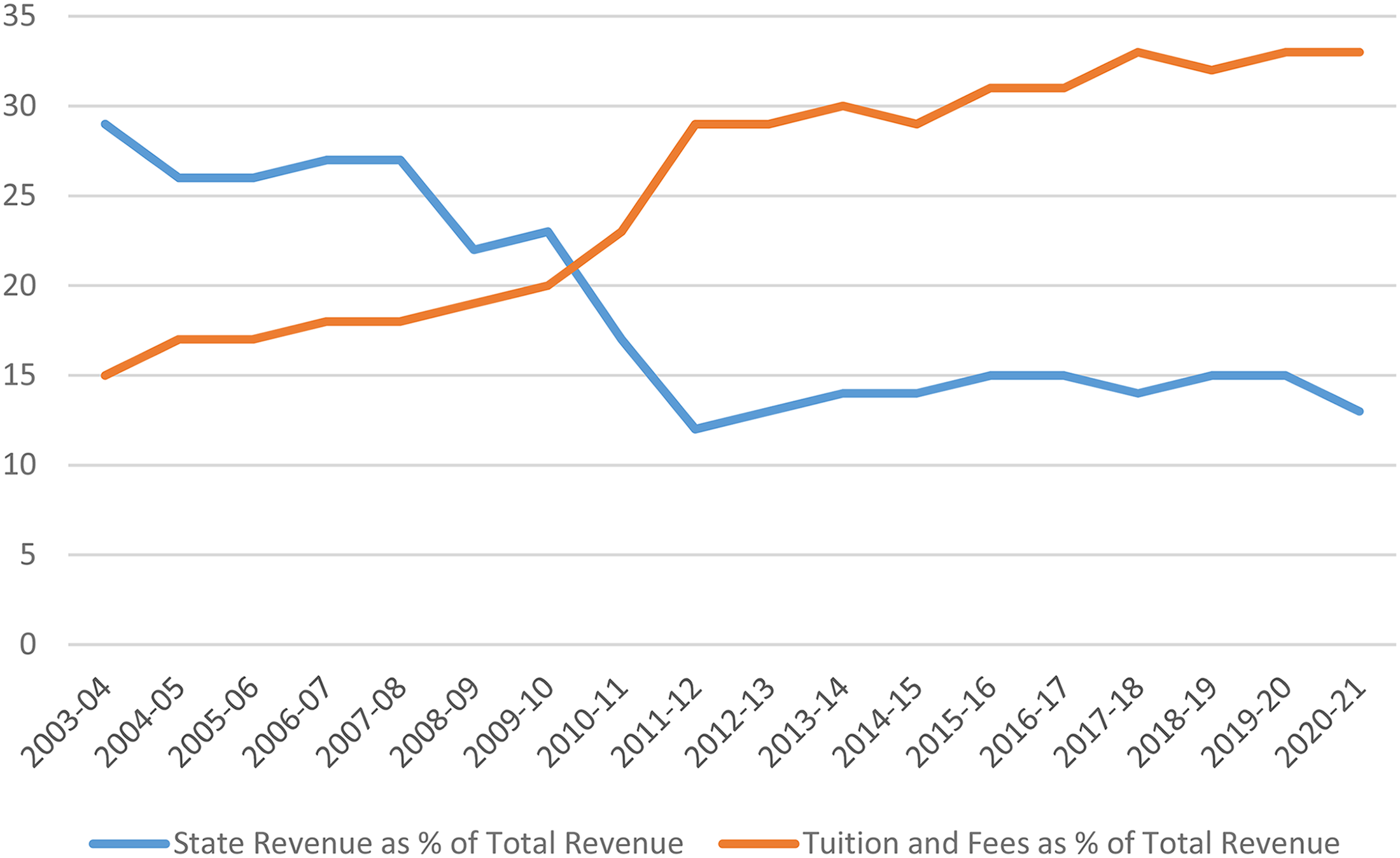
State funding and student tuition, 2004–2021 University of California, Berkeley. Source: https://www.universityofcalifornia.edu/about-us/informationcenter/revenue-and-expense-data.
As the pressure for revenues intensifies, the university recruits armies of highly paid administrators—at Berkeley the number of senior managers has increased five-fold over the past 30 years—tasked with renting campus property to private businesses, developing new credentialing programs, intensifying efforts to reach out to private donors, or any other stratagem that can bring in funding. Chancellors have been known to develop hare-brained schemes to attract revenue, such as the reconstruction of the football stadium to the tune of $445 million, which now contributes $18 million to the annual debt, rising to $37 million a year in 2044 (Burawoy, 2016). Indeed, issuing bonds guaranteed by real estate and future tuition has become a major source of immediate revenue but long-term debt (Eaton, 2022). At the same time, academic departments are encouraged to develop their own strategies, such as “concurrent enrollment” programs for short-term, fee-paying, visiting students, often from foreign countries. Since such students can only be enrolled after all Berkeley students have found a place, this has meant increasing the size of classes.
Whether the revenue seekers in the development office can even fund their own existence is unclear but the university has another arrow in its quiver: cost cutting. Apart from limiting the expansion of resources on campus, extending the use of lectures halls into evenings, deferring maintenance and so forth, they substitute cheap labor for expensive labor. In the 30 years between 1992 and 2022 the number of tenure-track faculty—ladder faculty as they are appropriately called—has been constant while the number of undergraduate students has increased by nearly 50%. To teach those students the number of “lecturers”—nontenure-track instructors—has increased to the point where they are now responsible for some 40% of student credit hours. These lecturers are often outstanding PhDs who take up nontenure-track positions, in the face of declining numbers of tenure-track positions. Diminishing opportunities for tenure-track positions varies from discipline to discipline, depending on student enrollments. Overall competition for faculty positions has become more intense, encouraging the professionalization of graduate programs.
Under competition from well-funded private universities who can pay their graduate students relatively handsome packages and recognizing the diminishing job prospects for their own graduate students, departments of public research universities curtail their graduate admissions, leading to fewer TAs. Increasingly, graduate student TAs are replaced by undergraduates—an even cheaper labor force—to make up the shortfall. So undergraduates are now teaching undergraduates. The result is simple: the degradation of public university education. Whether it is the overcrowding of courses, the undersupply of student housing, the reduction in the number of student advisors, undergraduates are receiving substantially less while paying substantially more, a process of unequal exchange—the first dimension of the extractive university.
Alongside the decline in state funding, there has been a widening of access to the university (see Table 1). In order to fulfill its mission of public education, the proportion of under-represented minorities, the number of first-generation students, and the number of transfer students has increased steadily over the past 50 years. This has only intensified the squeeze on undergraduate education. While the university celebrates its figures for broader representation among students and faculty—although the number of African Americans remains miserably low—the conditions in the classroom are becoming ever more challenging.
Changing Demographics of Undergraduates Enrolled at Berkeley.
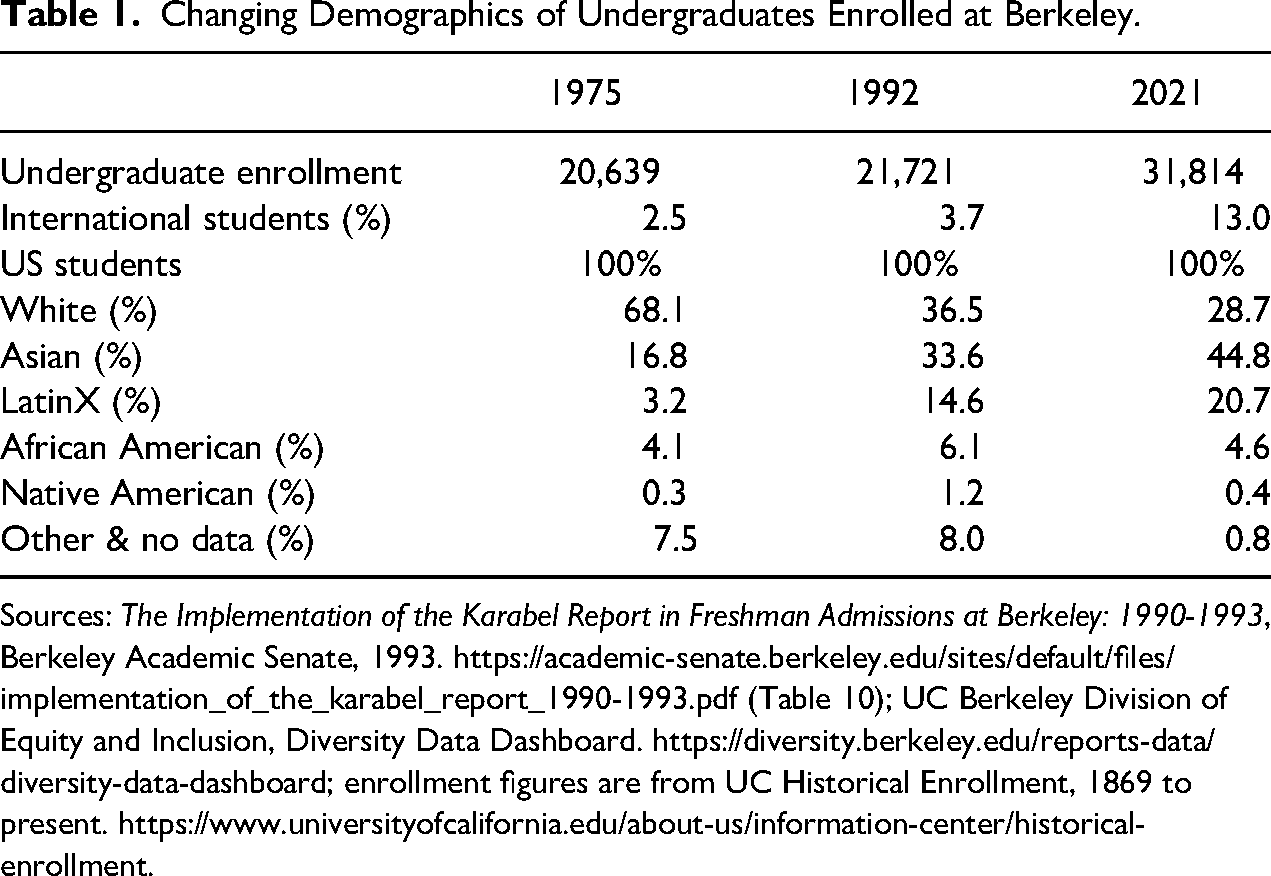
Sources: The Implementation of the Karabel Report in Freshman Admissions at Berkeley: 1990-1993, Berkeley Academic Senate, 1993. https://academic-senate.berkeley.edu/sites/default/files/implementation_of_the_karabel_report_1990-1993.pdf (Table 10); UC Berkeley Division of Equity and Inclusion, Diversity Data Dashboard. https://diversity.berkeley.edu/reports-data/diversity-data-dashboard; enrollment figures are from UC Historical Enrollment, 1869 to present. https://www.universityofcalifornia.edu/about-us/information-center/historical-enrollment.
Following Keeanga-Yamahtta Taylor (2019) we can call this a form of “predatory inclusion.” As the university widens its intake, students are less prepared, coming as they do from culturally unrecognized and economically poorer backgrounds. Even when resources are made available, students struggle to navigate the system to take advantage of them. Students from disadvantaged backgrounds are often not equipped to benefit from the sort of education Berkeley is still able to offer. Such students require more effective teaching rather than less. They especially suffer from the degradation of higher education—although they are often the most motivated and determined to do well.
The university has made some adaptations to the influx of a more diverse student body through the addition of various student services, but the additional burden of teaching still descends to the street-level educators who are largely left to cope on their own. Here lies the second dimension of the extractive university—the dimension of extraction, calling on TAs to extend themselves to expanding numbers of students with increasing needs.
Undergraduates from less privileged backgrounds gravitate toward certain disciplines, so the challenge of inclusion also varies by discipline. The STEM fields have a sparse minority representation whereas the social sciences, sociology in particular, attract the majority of its students from less privileged backgrounds. During the academic year 2021 to 2022, under-represented minorities constituted 52% of the students in the sociology major (over twice the campus average of 23%); 50.7% were transfer students (as compared to 21% for the campus as a whole); and 57.4% were first-generation students (as compared to 28.9% for the campus as a whole). 7 Indeed, among first-generation students, sociology was more popular than any other major. 8 Reflecting their poorer economic background, Berkeley sociology majors work longer hours as wage laborers. According to the UC Undergraduate Experience Survey (UCUES), in 2022 Berkeley sociology majors worked an average of 14.4 h per week in paid employment on and off campus nearly twice as many hours as the campus average (7.5 h). 9 As a reflection of the declining overall health and rising anxieties, the number of students registering with the DSP has increased almost three-fold since 2014. At the end of Spring 2022 DSP was serving 30% of sociology majors with different accommodations, more than twice the campus average (14.5%). 10 Whatever the reasons undergraduates from less privileged backgrounds converge on sociology, creating additional challenges for the teaching assistant, working on the frontlines of the extractive university.
So what is the extractive university? It is a university that is hollowing itself out, a university that in pursuing strategies to keep itself financially afloat, undermines the conditions of its own existence. It is a university that asks undergraduates to pay more even as they receive less. It is a university that shuffles the increasing burden of its teaching mission down to the street-level educators, among them TAs. The university depends on their silent cooperation in the face of mounting demands. When speaking of the neoliberal university (Giroux, 2020; Brown, 2015) or academic capitalism (Slaughter & Rhoades, 2004), commentators focus on the distorting effects of budget constraints, privatization, or corporatization. While acknowledging these market forces, we are focused on the internal conditions of teaching and learning, the extraction of pedagogic labor on the front line. Just as Marx followed workers from the noisy sphere of exchange into the sphere of production, uncovering capitalism's hidden secret, so we follow TAs into the sphere of pedagogic labor, there to reveal the mechanics of the extractive university.
Joining TAs in Their Hidden Abode
The broad conditions of the teaching assistant are fixed by the union contract. As first-time TAs, during the academic year 2021 to 2022, we were paid $22,000 before taxes plus a $4,000 department top-up. This is still $3,000 below the $29,000 the university estimates to be the 9-month cost of living for one person. We are, effectively, bonded as cheap labor because tuition, fees, and medical benefits to the tune of $21,000 are considered as part of TAs’ compensation, permitting the university to offer us such low take-home pay. This is the taken-for-granted cost of the degree, the passport to a future lucrative position. 11
One cannot understand the TA labor process, therefore, without understanding the position of the graduate student, indentured to the university, and accountable to various claimants: first, to the students they teach who come with very different resources and needs; second, to the instructor who sets the terms of teaching; third to themselves as self-respecting teachers both in the present and in their mind-eye's view of their future; fourth to the research supervisor who guides the graduate student to the completion of a PhD dissertation. Finally, the TA is able to negotiate these competing demands only because of the “constrained autonomy” that defines their labor process. The papers that follow focus successively on these five overlapping slices of TA work.
Our first slice is Elizabeth Torres Carpio's portrait of the street-level educator. On the one hand, there are three elements of the work itself: classroom teaching and its preparation; administration that involves grading, record keeping, weekly meetings with the instructor; and care work that occurs in weekly office hours, mentoring, answering emails and giving emotional support. Torres Carpio shows how students require different kinds of labor according to a latent classification embedded in the operation of the university. In its formal organization and distribution of resources, the university assumes an archetypal student who comes from a middle-class family, well trained in high school to read and write. In other words, they possess the resources to devote themselves to their education. Today, however, there are few archetypal students among sociology majors. The majority lie in two other categories. Torres Carpio describes students with disability accommodations and student athletes as partially recognized by the university—a recognition that requires them to undertake so much auxiliary work that they get behind on their reading and assignments, requiring the TA to do extra administrative and care work and sometimes to reorient discussion sections. Second, there are the unrecognized students—those who have excessive financial burdens, family commitments and personal travails, often on the verge of dropping out or being pushed out. Here care work is more extreme and can consume considerable TA time.
The TA is left having to negotiate these constraints, attending to the different concerns of different students as well as preparing presentations twice a week, grading assignments, conducting office hours and attending meetings with instructors. All this takes place under constraints defined by the instructor who constructs the syllabus, defines the readings, creates the examinations, and delivers lectures that TAs must attend. The instructor does more than frame the course, but to varying degrees gives direct instructions to the TAs. Natalie Pasquinelli describes the control that instructors have over TAs as a form of status control—that is to say TAs are seen first as apprentices and potential colleagues rather than wage laborers. Even though they have union representation, TAs are still treated as aspirant faculty, controlled through their status, but the control is not coercive (Hatton, 2020); rather it is based on consent, the willing engagement in teaching. Faculty are not able to control what TAs do in their sections, something that TAs can easily conceal both from instructors but also from fellow TAs. Pasquinelli elaborates one of three types of hegemonic control—a participatory pattern in which rules are forged collaboratively and secured through “confession” with implications for the development of alliances that endorse or contest the power of the instructor. Borrowing from Alvin Gouldner (1954), she outlines two other patterns: bureaucratic and mock.
If the instructor rarely observes the TA's practices as a teacher. So what goes on in the hidden abode of teaching? Justin Germain shows us how TA work can be constructed as the alternation between two games. Very different from Torres Carpio, who sees the university as constituting the student, in Germain's labor games it is the TA who constitutes the student. He does so in two ways. In Germain's first game, he appeals to students’ own experiences as part of drawing them into engaging issues raised in readings. The TA is victorious when students begin to reimagine their own lives through a sociological lens, reminiscent of Paulo Freire's “problem posing” or what Germain calls “experiential” pedagogy. Germain's second game is more like Freire's banking model or what Germain calls the “didactic” game, which involves a more direct transmission of ideas, concepts, and interpretations. The pressures and rhythm of the semester make it impossible to only play the more time-consuming (both for students and teachers) experiential game, and it is necessary to switch back and forth between games. Unlike Freire for whom banking is entirely negative, this labor process approach to learning shows the didactic approach to be a necessary accompaniment of the experiential game and vice versa. While this game of games is a contribution to the theory of labor games, it also underlines how TAs—and in this regard they are like gig workers—can use their autonomy to endow teaching and learning with meaning, thereby obscuring the wider structures of the extractive university in which they are embedded.
There is, however, one structure that looms heavily over the life of the TA and that is preparation for a future career, namely passage through the PhD degree program. This involves course work, research and finally the writing of a PhD dissertation. Thomas Gepts focuses on the way these two projects—research and teaching—are entangled. They follow different tracks, operating in parallel but with different rhythms that continually disrupt each other as they compete for the attention and commitment of the graduate student. The invisible preparatory work for teaching, leading to immediate rewards, competes with the programmed preparation of the PhD with its uncertain future. Gepts characterizes this as a time bind, not the time bind described by Arlie Hochschild between commitments to home and work, but a time bind that exists within work, between different parts of work. Many occupations have their different components, even with their different rhythms, but TA work is peculiar in the extreme bisection of a singular occupation, each side demanding a deep emotional investment. Following Henri Lefebvre, Gepts describes the relationship between the two tracks as two dances suspended in a state of arrhythmia.
Marx described the labor process as a hidden abode—hidden from the noisy sphere of exchange. In the fetishism of commodities, the process of market exchange obscures the labor that goes into the objects being exchanged. Within production, however, Marx assumed that there is transparency, workers are aware of their relation to management as well as their relation to one another. Indeed, that is how it is possible for classes to congeal into collective actors. Margaret Eby, however, draws our attention to the way TAs hide what they are up to—not just from the invasive instructor but also from one another. In the beginning, we feel anxious to be thrust into the role of teacher, anxious about the knowledge we possess, wondering whether we are equipped to be teachers. Behind the silence there is the fear of being found out. Subsequently, accustomed to concealment, we keep silent about our practices in order to maintain our autonomy vis-à-vis multiple claimants. To be sure TAs do share their teaching guides and help each other out in many ways, but there is never the organized collaboration that might make teaching less anxiety producing, more rewarding and more efficient.
As Rosalind Gill (2016) has argued this silencing is a feature of the modern university that stretches and strains everyone, not just TAs, making it difficult to contest the excessive dumping of workloads onto the most vulnerable. Studying our seminar, Eby plots the slow breakdown of silences as we learned to trust each other, to fear less and reveal more about the intimate challenges we faced as teachers. We began to develop a language to communicate the agony and ecstasy of teaching. We searched for ways to expand the fragile pleasures of laboring on the minds of our students, and whether those pleasures had to be so infrequent. We wanted to learn about the labor process: the arduous task of getting students to labor within their own labor process, knowing full well that students also serve multiple and hidden masters.
Some Methodological Issues
A collective ethnography like ours, especially in these times, inevitably faced considerable challenges. First, and most obviously, how does one conduct ethnography, which usually involves face-to-face interaction, during a pandemic? We documented our individual practices, shared our field notes and, thereby, collectively interrogated and advanced the meaning each of us gave to our teaching. Our ethnography of pedagogy was possible precisely because the university administration demanded that teaching continue, pandemic or no pandemic. One might think that our own Zoom seminars would also be problematic, but we got so used to being together every Friday. Zoom facilitated rather than obstructed our intimate communication. Indeed, without Zoom our seminar would never have happened. Burawoy was on the East Coast for a year, Eby was in Minneapolis, Torres Carpio had a baby, and others were traveling; only Zoom could bring us together every week. Even when we were quarantined with COVID, Zoom made our participation possible.
Other advantages of Zoom made themselves apparent when we were ready to expose our papers to outside critics. After 2 years orbiting in outer space, we returned to earth. As our welcoming party we chose reviewers whose work we appreciated and was closely connected to our own: first Jeff Sallaz and then Steve Lopez read all the papers, wrote comments, and then joined us to discuss those comments. It was so exciting to be back, discussing our projects with esteemed others. We scurried away to make revisions, before each paper was sent out to individual reviewers—Josh Seim, Erin Hatton, Ofer Sharone, Arlie Hochschild, and Rachel Sherman. Again we all met with several of the reviewers to discuss their comments on individual papers.
If COVID and remote instruction did not create barriers to our collective project, they nevertheless posed some methodological conundrums. Most obviously, we had to consider how our findings were affected by COVID and remote instruction. They obviously were, but often in a revealing way. When students are on campus their conditions of learning are hidden from us whereas under COVID students were often living at home and in their communities. As teachers we could often see what was happening in remote families and communities, right in front of our noses. The challenges faced by those partially recognized and unrecognized became far more transparent. So we treated COVID as an experimental situation, a moment of crisis that revealed sides of the university and the lives of its members that otherwise would lie hidden. Moreover, we had the advantage that the project continued over 2 years of teaching so we could test our claims as circumstances changed and COVID restrictions tapered off.
Still, questions of generalizability will inevitably be raised. The conditions of TAs vary from university to university. We know, for example, from our conversations with Steve Lopez, Jeff Sallaz, and Rachel Sherman that at Ohio State University, Arizona University and the New School, TAs are spread far thinner and not necessarily responsible for face-to-face teaching. Berkeley, therefore, is a particularly apt locus for such research as the shift to the extractive university is an ongoing process that is far from complete. Financial pressures drive it to forms of extraction and unequal exchange that are at odds with its claims to be a center of excellence. Where other public universities have shifted over to online education, at Berkeley it has, so far, met with effective resistance, although remote instruction under COVID may yet open the floodgates. Several decades of union organizing have also helped to slow the degradation of TA work, so conditions may be as good as they get for a public university. Still, the vantage point of the TA gives unique insight into the transition to the extractive university.
Even as we have tried to locate TAs in the specific context of the university, we have also tried to develop generalizable concepts that can travel to other workplaces—selective recognition, status control, innovation games, arrhythmia, and the power of silence. These are different aspects of the constrained autonomy that define TAing, and teaching more generally. But constrained autonomy applies to other professions accountable to multiple constituencies, such as nursing, policing, and social work, but also to jobs, such as gig work that embed such accountability in algorithms, operating at a distance through digital means. Constrained autonomy entices the worker to ignore or naturalize constraints, which, in the extreme, become invisible. The result is that the boundaries between work and nonwork become permeable, so that work imperceptibly colonizes everyday life. As Shoshanna Zuboff (2019) has shown in her analysis of our digitalized world, we are always at work producing data, even if we don’t know it.
In studying ourselves as we go about our daily tasks, we are not conducting auto-ethnographies that are limited to the emotional life of the self. Far from it, our strategy has been to locate our lives as teachers in the context of a changing university. However, studying one's own workplace rather than someone else's workplace can be a risky enterprise. In breaking the silence around the realities of TAing, in exposing the way the university shuts its eyes to what is going on in the classroom, in criticizing our own university, we are putting ourselves and others in a vulnerable position. 12 We are authors of a study that involved fellow graduate students, faculty and undergraduates, all participants in a finely balanced field of power. What we write can affect their lives and careers, which, in turn, can boomerang against ourselves. We had to be painfully attentive to the protection of our participants, often by diluting our rich ethnographic data.
The Union and the Labor Process
In trying to unify 48,000 workers, the union appealed to members’ shared interest in improved income and benefits, a very real concern given the rising rents in California. But this strategy had consequences for the organization of the strike itself. It is difficult to build solidarity among temporary workers locked into disconnected fiefdoms, employed today, gone tomorrow, all thrown together in competitive strife for recognition and success. It is one thing to withhold labor if you are an autonomous teaching assistant in sociology, as we learned, it is quite another matter if you are a dependent research assistant in a chemistry laboratory, directed by an anxious faculty person. Yet the strike lumped us altogether.
It is not only that labor process posed challenges of organization and preparation. Equally important was the significance of the labor process for the outcome of the strike. With the extractive university riveted to the financial bottom line, any success of the strike can backfire against the strikers themselves: improvements in the contract can be paid through cuts in the number of graduate students or cuts in departmentally negotiated “top-ups,” that is if they don’t come out of undergraduate fees and tuition. As we write the union finds itself in the rather unusual situation of negotiating the terms of the contract, even after an agreement had been reached and the strike ended.
The strike made it clear, if it was not clear before, that the quality of teaching is not a priority of the university administration. Unlike laborers in manufacturing or in the delivery of essential services where the withdrawal of labor exerts a powerful leverage, frontline educators have an uphill task convincing publics as well as managers of their importance. So long as undergraduates are prepared to substitute a credential for learning and so long as they pay their fees and tuition, so the university administration can absorb the cost of strikes by further degrading the educational labor process. The decoupling of the educational labor process—its constrained autonomy—from the functioning of the extractive university means the administration can engage in double-speak - speak in terms of the mission of education while focused on revenue generation and cost cutting. Given the isolation and invisibility of the educational labor process, the success of a strike crucially depends on the “articulation” of the interests of TAs with the interests of the undergraduates they teach and the faculty they serve. Understanding the possibility and consequences of strikes calls for an investigation of the TA labor process and the development of a theory of academic labor that pits the eduators and the educated against the machinery of extraction. In the final analysis, however, the struggle will have to go beyond the university and pursued at the level of the state, that is “bargaining for the common good,” if public higher education is to recover its mission.
Footnotes
Acknowledgments
We are very grateful to the following reviewers for their willingness to provide detailed critical and enthusiastic comments both written and in person: Jeff Sallaz, Steve Lopez, Rachel Sherman, Josh Seim, Erin Hatton, Ofer Sharone, and Arlie Hochschild. Once we started circulating drafts of our papers we received comments back from a wide range of participants and nonparticipants in the project, including Irene Bloemraad, Cybelle Fox, David Harding, Mara Loveman, Tianna Paschel and Kim Voss. Thanks to Eric Hayes for help with collecting data and to Dan Cornfield for all his encouragement and patience.
Declaration of Conflicting Interests
The authors declared no potential conflicts of interest with respect to the research, authorship, and/or publication of this article.
Funding
The authors received no financial support for the research, authorship, and/or publication of this article.
